FEATURE: Beyond the Piano Keys… Kate Bush and an Incredibly Broad Sound Palette

FEATURE:


Beyond the Piano Keys…
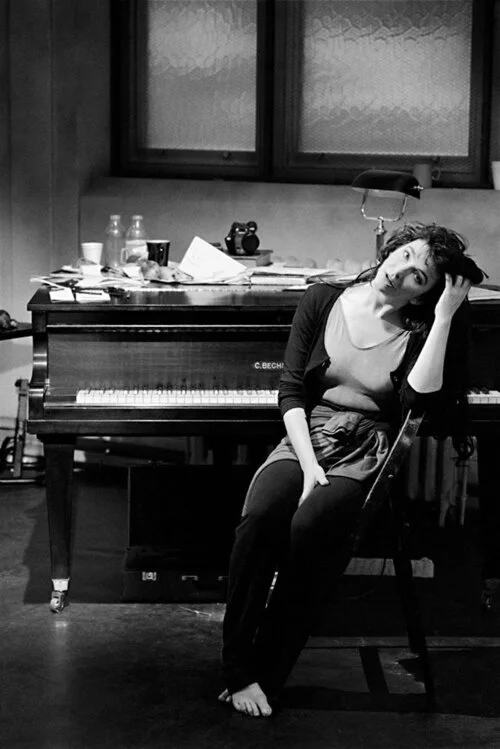
loo.jpg

IN THIS PHOTO: Kate Bush during filming for The Line, The Cross and the Curve in 1993/PHOTO CREDIT: Guido Harari

Kate Bush and an Incredibly Broad Sound Palette

___________

I have talked a lot…

IN THIS PHOTO: Kate Bush in a Lionheart album outtake in September/October 1978 at Great Windmill Street in Soho, London/PHOTO CREDIT: Gered Mankowitz

about Kate Bush’s debut album, The Kick Inside, lately as, not only is it my favourite album, but it has a quite different sound to albums that followed. I really like the fact that The Kick Inside has this simpler, more romantic sound that largely uses piano, voice, bass and guitar. Apart from the odd celeste, mandolin, beer bottle and Fender Rhodes here and there, The Kick Inside utilises the beauty of the piano, combined with the physicality of the guitar and percussion. In fact, before I move things along, it might be worth (briefly) mentioning the album and how the assimilation of a few well-selected sounds enhances the music. I am not suggesting other artists lack the compositional expansiveness as Kate Bush but, more and more, I am hearing new artists come through who are either not that adventurous when it comes to physical instruments – rather than samples and electronic sounds -, or they do not resonate or connect in the same manner (as Bush). The celeste, piano and acoustic guitar together gives Wuthering Heights a richness and depth that other artists might not have concocted. I listen to the song and notice these little touches that takes it to rarefied heights. The mandolin on Them Heavy People is a genius touch, whilst the boobam on Room for the Life has stayed with me ever since I first heard it.

It is hard to say why particular instruments makes the songs more interesting and memorable, but I do love the fact that Bush was thinking outside of the box from the very start! In 1978, there were innovative and broad-minded artists like Talking Heads, David Bowie and Wire, but a lot of the most popular artists of that year – from Elvis Costello, The Rolling Stones to Bruce Springsteen and The Jam – could have led Bush in a more conventional and formulaic direction. Maybe it was her established love of artists like Roy Harper, Pink Floyd, Steely Dan and David Bowie that opened her eyes to the possibility of imaginative instrumentation, or it may have been the familial inspiration of her brother, Paddy Bush – who would often show her weird and wonderful musicians, instruments and sounds. I think it was a combination of family, influence and her own desire to give her incredible songs a physicality and voice that you would not get from piano, bass and guitar alone. Those who dismiss The Kick Inside as a ‘piano album’ or overly-simple should listen to songs like The Saxophone Song (with tenor saxophone), Kite (with clavinet) and Oh to Be in Love (with synthesiser), and realise that this assumption would be faulty and negligent. Andrew Powell produced Kate Bush’s first two albums and, as a classically trained musician with perfect pitch, I guess he was also bringing in different sounds that could bring these magnificent songs to new places.

From Lionheart (her second album), one could hear a noticeable change in musical direction. Though the album was rushed and was not allowed to form and percolate as freely as it should have been – owing to the pressure from EMI and the want to capitalise on Bush’s rising stock and stardom -, I do love the way these lesser-heard instruments made an introduction. Consider one of the album’s best tracks, Kashka from Baghdad, and the fact there is a Joanna Strumentum (an unidentified instrument), a strumento de porco (psaltery), and a pan flute. Few other artists would even think of adding much into the mix beyond more routine instruments, but Bush had this interesting and original song that she wanted to bring to life. I have always loved Oh England My Lionheart and the recorder and harpsichord, rather than making it twee and offbeat, gives the track an elegance that is essential. Over a dozen musicians played on Lionheart, and there is a variety and musical broadness that few other solo artists of the time would have considered. One can easily say unique songs strung together would naturally call for the compositions to be just as varied, but few artists have the bravery and foresight to combine such disparate and unusual sounds. When Bush took more control of the production from 1980’s Never for Ever onward, her compositions widened, and she pushed further away from the sounds one hears on The Kick Inside.

Bush’s songwriting was always astonishingly fresh and away-from-the-mainstream, but heavier songs on Never for Ever called for new arsenal. I have not even mentioned backing vocals. On The Kick Inside, Bush herself was layering her own voice (there was the odd backing vocal), but she utilised other voices more on Never for Ever. Roy Harper’s voice gives Breathing huge gravity, and the fretless bass, electric guitars and percussion combined with that vocal (and Bush’s) is a potent blend. I recently examined how Bush’s love of the Fairlight CMI enhanced her work and gave her so many new possibilities. I think Kate Bush is on the same level as David Bowie when it comes to stylistic changes and producing albums that are vastly eclectic yet focused. The balalaika on Babooshka and the koto on All We Ever Look For is inspiring. Again, I am not sure whether her brother’s endless fascination with the unusual guided her firmly…but look at the musical credits for Never for Ever, and there are so many unusual instruments listed! One can just overlook this but, when you hear them in the context of the song, you notice harder and get a new experience – such as the Minimoog on Egypt or the musical saw on The Wedding List! Kate Bush’s albums never really conformed to what was happening around her – in terms of her peers or what was popular -, but her restlessness and desire to always evolve and not repeat herself meant that, on The Dreaming and Hounds of Love, she once more brought new instruments into the studio and showed that she took nothing for granted. The reason Bush used so many different instruments was not to overload her songs needlessly: she was trying to find that distinct sound that her songs demanded.

The Dreaming is a classic case of a lot of cooks in the kitchen resulting in a magnificent feast. Bush almost went mad making the album, as she solo produced for the first time and, as such, was listening only to her own voice. Percy Edwards contributed an array of animal noises on the title track and, without mentioning him too deeply, Rolf Harris’ digeridoo gave the song and authentic edge (The Dreaming concerns the destruction of aboriginal homelands). Get Out of My House has some brilliant praying, whilst the backing vocals from Paddy Bush, Ian Bairnson, Stewart Arnold and Gary Hurst on the album’s opener, Sat In Your Lap is sublime. In terms of non-vocal instruments, The Dreaming does not repeat albums that came before. Aside from the Fairlight CMI – which I shall not tread over again -, I do love how, again, some pretty cool instruments give certain numbers a real kick. The Dreaming features a bullroarer, and the uilleann pipes on Night of the Swallow gives the song an Irish kiss that we would hear more explicitly on Hounds of Love’s Jig of Life. Combine the instruments and voices I have mentioned with the array of sounds and effects Bush accessed on the Fairlight CMI and you get this clash of the natural and artificial.

Not to skip through the rest of Bush’s discography, but Hounds of Love is a very different-sounding record to The Dreaming, Warmer sounds are elicited from the Fairlight CMI, and the drum sounds are less anxious and frenetic. Maybe to match Bush’s happier mind and settled mood, the colour palette on Hounds of Love is brighter and warmer - more in common with the countryside and open air rather than the indoors or the claustrophobic. There are almost twenty-five different musicians on Hounds of Love, but they all brought something special to the plate. The fiddles and bodhrán on The Ninth Wave’s Jig of Life provides insatiable kick and Irish blood; the fujara on The Morning Fog takes us to Slovakia, oddly. Bush not only suggests new colours and emotions with these instruments, but she takes the music to different countries and provides a more itinerant and explorative experience than you get from most musicians. Whilst Bush did retain a lot of the same musicians between albums, even the drumming, bass and guitar playing changed in tone and personality. Strip away every other instrument from The Sensual World, and the band are different to how they were on Hounds of Love in  terms of their sound and vibe. The Sensual World arrived in 1989 but, rather than copy what was happening in the charts, Bush brought a flavour of the Middle East to Deeper Understanding with the tupan, and the Bulgarian vocal ensemble, Trio Bulgarka, add something spine-tingling to various numbers.

Kate Bush’s writing and lyrics infuse the senses and stimulate the mind, but it is the subtle touches and wonderful chemistry of the instruments that gives the music its beating heart. 1993’s The Red Shoes was less-well-received than previous albums, but Bush was definitely not limiting her ambitions when it came to the compositions. Listen to the kabosy on Eat the Music, or the valiha on Lily . These African sounds were not often heard on Pop records of the 1980s – if at all (maybe Talking Heads are the exception)! -, and I think these instruments say so much. By 2005’s Aerial, Bush moved away from using unusual instruments to the more heard-of in order to create arrest and power. Aerial’s orchestration and strings is no less imaginative and awe-inspiring than all the sounds of Hounds of Love or The Dreaming. If anything, one feels more moved and impressed by Aerial’s strings than the chaos on The Dreaming. On 50 Words for Snow – Bush’s latest studio album from 2011 -, there was almost a return to the more stripped sound of The Kick Inside. Although the lyrics and songs are different in terms of their maturity and intention, Bush takes things down to (largely) piano, bass, drums, and vocals – through we do hear flute, whistle, and harmonica. There are far fewer musicians on the album, and I think Bush’s desire to stay fresh meant that the wintry and almost Jazz-like sounds of 50 Words for Snow reminds many of The Kick Inside.

These albums were released thirty-three years apart, but the piano is very much the focal point. I think 50 Words for Snow’s percussion is more standout – the legendary Steve Gadd can be held responsible for that! I love all of her albums, in no small part because of how Bush unites accessible sounds with something that we have not heard before. I do hope she puts out more music but, until then, listen back to her catalogue and pay close attention to the songs. There are few artists out there where I unpick the compositions and listen out for particular instruments. With Kate Bush, songs stand in the memory because some rare instrument hits your ear and catches you by surprise. In terms of the albums that stand out most because of the instruments used…that would be a hard one. I would say Hounds of Love and The Red Shoes are particularly special, but one cannot discount the sheer beauty and emotion one gets from The Kick Inside and 50 Words for Snow and how, even though piano is at the centre, Bush uses it in a very personal and different manner. The last time I wrote about Kate Bush, I underlined how nobody has equaled her and, even though many are inspired by her, one cannot say there is a ‘new Kate Bush’ – as the fountainhead is very much untouchable and not going anywhere fast! One gets so much from a Kate Bush album; everyone will experience something different from each record. One thing is for sure: hearing a Kate Bush album take flight is…

fff.jpg

IN THIS PHOTO: Kate Bush goes through her Babooshka routine in 1980

SUCH an aural treat.

FEATURE: Rough and Rowdy, Yet Utterly Sublime: The Ageless Brilliance of Bob Dylan

FEATURE:


Rough and Rowdy, Yet Utterly Sublime

54454.jpg

IN THIS PHOTO: Bob Dylan in 2012/PHOTO CREDIT: Christopher Polk/Getty Images

The Ageless Brilliance of Bob Dylan

___________

I wanted to pen a few words…

to reflect on the new Bob Dylan album, Rough and Rowdy Ways. The album is out on Friday (19th June), but I have been reacting to a review that came out recently in The Guardian - there is also one from NME that I want to quote from. It seems that Dylan is enjoying a new peak right now. At the age of seventy-nine, one might forgive the songwriting genius if he slowed down a bit and produced an album that was sort of okay. As it seems, he has put out one of his best albums in years! I have heard the singles from the album, and Dylan has lost none of his sharpness, observational brilliance and humour. I am a big fan of albums like Highway 61 Revisited and Bringing It All Back Home and, on those albums, he put our shorter songs together with longer ones that were epic and hugely engrossing in terms of their detail and story. Rough and Rowdy Ways confirms that Dylan is one of the greatest songwriters who has ever lived, and I wonder whether the divisions of the current time have been influential. He clearly does not have a lot of time for President Donald Trump, and he spoke out against the death of George Floyd – how he was sickened and horrified by what we all saw. Some have written Dylan off when it comes to his very best work and whether he will ever be able to get anywhere near these days. His last album of mainly original compositions, 2013’s Tempest, is brilliant, but I did see some reviews that were dismissive or were comparing it unfavourably to his best work.

ssdsd.jpg

I think that Dylan has had some uneven patches, and albums that did not hit the mark – that is going to happen when you have put out so many records! I am seeing a lot of huge reviews for Rough and Rowdy Ways. Here is an extract from The Guardian’s review:

“This is obviously humour of a dark hue: if Tempest’s prevalent mood was one of murderous fury, then here it’s brooding menace and imminent doom. It’s there in the music – the weird tension in Crossing the Rubicon’s muted R&B shuffle and the way the backing on Black Rider keeps lapsing into ominous silence. You lose count of the lyrical references to judgment day and Armageddon, of the mysterious characters that keep cropping up with malevolence on their minds: “I can feel the bones beneath my skin and they’re trembling with rage, I’ll make your wife a widow, you’ll never see middle age,” he sings on Crossing the Rubicon. Of course, grouchily informing the world that everything is turning to shit has been one of Dylan’s prevalent songwriting modes for a quarter of a century – it’s the thread that binds Not Dark Yet, Things Have Changed, Ain’t Talkin’ and Early Roman Kings, among others – but this time the message seems to have shifted slightly: if you think everything has turned to shit now, Rough and Rowdy Ways keeps insisting, just you wait.

This isn’t perhaps the most comforting communique to issue in the middle of a global pandemic, but then the man behind it has seldom dealt in soothing reassurance. And besides, it doesn’t matter. For all its bleakness, Rough and Rowdy Ways might well be Bob Dylan’s most consistently brilliant set of songs in years: the die-hards can spend months unravelling the knottier lyrics, but you don’t need a PhD in Dylanology to appreciate its singular quality and power”.

Look at iconic and decades-enduring songwriters like Bob Dylan, Joni Mitchell and Paul McCartney, and I am always amazed how they are putting out work after so long – though Mitchell has not released an album for a while –, and how they are able to give the world such brilliance! I urge people to buy Dylan’s Rough and Rowdy Ways, as one is in for a real treat! His voice sounds incredible and moving, and I think his lyrics are as staggering as ever. This is a sort of love letter to a master of music, and one who many have sort of overlooked and assumed his best is far behind him – and those who just aren’t interested anymore. I think Dylan is one of those people who can take what is happening around him, craft this incredible song, and make sure that it speaks to everyone. In their five-star, this is what NME had to say:

“The roots of the erosion of US democracy plays out against a backdrop of counter-culture revolution. Between flickering scenes from Dealey Plaza and Parkland hospital, Dylan widens the shot to take in the birth of rock’n’roll, The Beatles, Woodstock and Altamont, before unleashed a bombardment of musical, cinematic and social references stretching the entire 20th Century, like ‘We Didn’t Start The Fire’ grew up and got a degree. Bluesmen, silent movie clowns, soul queens, jazz greats, rockers, hippies and pin-ups – Dylan revels in a hundred years of creative progress as if in accusation of America’s immutable ideological savagery. JFK, he’s saying, was just the highest profile, on-camera bloodstain to be splashed across the stars and stripes.

“The song is like a painting, you can’t see it all at once if you’re standing too close,” Dylan recently told The New York Times, “the individual pieces are just part of a whole.” As such, it’s a vision of which DeLillo, Picasso or Eliot would be proud, and serves as a fitting close on a record that aspires to be the musical equivalent of the Great American Novel. It would be foolish indeed to assume that ‘Rough And Rowdy Ways’ is Dylan’s last word, but it’s certainly a historic address”.

I do hope that we see Dylan release many more albums, as I feel he is going through one of the most productive and impressive stages of his illustrious career. He recently gave a rare interview to The New York Times, and he was asked about his new album and various tracks from it. He was asked about the strangeness and tense of 2020:

“There is a lot of apocalyptic sentiment in “Murder Most Foul.” Are you worried that in 2020 we’re past the point of no return? That technology and hyper-industrialization are going to work against human life on Earth?

Sure, there’s a lot of reasons to be apprehensive about that. There’s definitely a lot more anxiety and nervousness around now than there used to be. But that only applies to people of a certain age like me and you, Doug. We have a tendency to live in the past, but that’s only us. Youngsters don’t have that tendency. They have no past, so all they know is what they see and hear, and they’ll believe anything. In 20 or 30 years from now, they’ll be at the forefront. When you see somebody that is 10 years old, he’s going to be in control in 20 or 30 years, and he won’t have a clue about the world we knew. Young people who are in their teens now have no memory lane to remember. So it’s probably best to get into that mind-set as soon as we can, because that’s going to be the reality.

As far as technology goes, it makes everybody vulnerable. But young people don’t think like that. They could care less. Telecommunications and advanced technology is the world they were born into. Our world is already obsolete.

“I Contain Multitudes” is surprisingly autobiographical in parts. The last two verses exude a take-no-prisoners stoicism while the rest of the song is a humorous confessional. Did you have fun grappling with contradictory impulses of yourself and human nature in general?

I didn’t really have to grapple much. It’s the kind of thing where you pile up stream-of-consciousness verses and then leave it alone and come pull things out. In that particular song, the last few verses came first. So that’s where the song was going all along. Obviously, the catalyst for the song is the title line. It’s one of those where you write it on instinct. Kind of in a trance state. Most of my recent songs are like that. The lyrics are the real thing, tangible, they’re not metaphors. The songs seem to know themselves and they know that I can sing them, vocally and rhythmically. They kind of write themselves and count on me to sing them”.

Robert Zimmerman is a genius, and I do think that, if you can, go and check out his new album. It is frightening to think that, when he turns eighty next year, he will be in his seventh decade as a recording artist – although he would have been recording music before his eponymous album came out in 1962! To listen to a Bob Dylan album is an experience like no other. I remember when Murder Most Foul came out, and just being blown away by his peerless wordplay and gravitas-filled vocal. Bob Dylan is one of the greatest poets and voices who has ever lived and, when it comes to turning out these unbelievable albums, I…

IN THIS PHOTO: Bob Dylan in the 1960s

HOPE that does not stop anytime soon.

FEATURE: Vinyl Corner: Radiohead – A Moon Shaped Pool

FEATURE:


Vinyl Corner

Radiohead – A Moon Shaped Pool

___________

THE reason I am recommending…

sss.png

people go out and buy Radiohead’s A Moon Shaped Pool on vinyl is that it is a magnificent record, and it is the most-recent release from the band. There have been rumours that Radiohead will release another album, but there is no idea when that might be. I have very good memories of A Moon Shaped Pool. It was released a day before my birthday on 8th May, 2016, and I was very struck by the record. It is a classic case of a few songs hitting you and then, the more you listen, the more you love it. The album was recorded in southern France alongside their long-time producer, Nigel Godrich. Radiohead have always been able to combine their traditional and incredible sound with strings. Through the years, I think strings have become more key and played a bigger role. Performed by the London Contemporary Orchestra (arranged by guitarist Jonny Greenwood), they range from the sumptuous to the frightening. The first single, Burn the Witch, was released on 3rd May, 2016, and I was hooked from the start. Its strings are Hitchcock-esque in places; it is a wonderful score, and I think Thom Yorke’s voice is sublime. In terms of the lyrics, there are nods to groupthink and corruption; the video (directed by Chris Hopewell, it uses stop-motion animation in the style of the Trumptonshire trilogy) is so memorable and wonderful.

I think A Moon Shaped Pool sounds different to 2011’s The King of Limbs. You can hear a more digital and computer-based sound on that album. A Moon Shaped Pool, whilst not lo-fi, does use analog multitrack recorders. If the band made an error or needed to do another take, they’d have to erase the previous take – forcing them into a different way of working. Whilst there are some political and social-economic themes addressed, a lot of the lyrical inspiration revolves around loss and heartache – no doubt inspired by Yorke's recent separation from his partner of almost twenty-five years, Rachel Owen. I genuinely feel A Moon Shaped Pool is one of Radiohead’s best albums, and I love every song on it. Radiohead have moved away from the guitar-based sound of albums like The Bends and OK Computer, and I wasn’t overly-keen on The King of Limbs. I felt that there were relatively few standout moments, and there wasn’t a great deal to hook me in and listen to it again. Conversely, A Moon Shaped Pool has these incredibly beautiful and heartfelt songs that draw you in and stay in the mind. Even when the band are darker and more paranoid, the electronics and strings provide this nuance that nestles in the mind and leaves you wanting more. In terms of the reviews, Radiohead got positive feedback more or less right across the board. It is one of their highest-rated albums ever.

Before bringing in a couple of reviews, it is pretty cool that the album’s tracks are arranged alphabetically – starting out with Burn the Witch, and ending with the fan favourite, True Love Waits. In their review, this is what AllMusic had to say:

“Sly, dissonant strings grace some cuts, acoustic guitars provide a pastoral counterpoint to an electronic pulse, Thom Yorke's voice floats through the music, often functioning as nothing more than an element of a mix; what he's saying matters not as much as how he murmurs. Such subtle, shifting textures emphasize Radiohead's musicianship, a point underscored when this version of "True Love Waits" is compared to its 2001 incarnation. There, Yorke accompanied himself with a simple acoustic guitar and he seemed earnest and yearning, but here, supported by piano and strings, he sounds weary and weathered, a man who has lost his innocence. What he and Radiohead have gained, however, is some measure of maturity, and with this, their music has deepened. Certainly, sections of A Moon Shaped Pool contain an eerie, disconcerting glimmer, usually attained through power kept in reserve -- nothing stabs as hard as the sawing fanfare of "Burn the Witch," while the winding, intersecting guitars that conclude "Identikit" provide the noisiest element -- yet the album as a whole doesn't feel unsettling. Instead, there's a melancholic comfort to its ebb and flow, a gentle rocking motion that feels comforting; it's a tonic to the cloistered, scattered King of Limbs and even the sleek alienation of Kid A.

Radiohead are recognizably the same band that made that pioneering piece of electronica-rock but they're older and wiser on A Moon Shaped Pool, deciding not to push at the borders of their sound but rather settle into the territory they've marked as their own. This may not result in a radical shift in sound but rather a welcome change in tone: for the first time Radiohead feel comfortable in their own skin”.

I am still listening to A Moon Shaped Pool four years after its release, and I am finding that the songs still sound fresh and full of mystery. I am not surprised that it gained such applause in 2016, as it is an album anyone can appreciate and get something from – even if you are not a Radiohead fan. This is what Pitchfork wrote when they reviewed the album:

 “A song title like “Glass Eyes” hints at many of the band’s longstanding morbid preoccupations—the semblance of humanity in something cold and dead, or the violation of the biological body by foreign objects—but the song is a bloodflow of strings straight into the heart. “Hey it’s me, I just got off the train,” Yorke sings, and it’s a strikingly ordinary image: the Paranoid Android himself, picking up the phone and calling someone to tell them he’s just arrived. “I feel this love turn cold,” he confesses as the ballad draws to a close, the phrasing an echo, subconscious or not, of his Kid A sign-off “I’ll see you in the next life.” A throbbing cello appears like a lump in the throat; the song fades away.

Throughout the album, Yorke’s everyday enlightenment is backed by music of expanse and abandon. The guitars sound like pianos, the pianos sound like guitars, and the mixes breathe with pastoral calm. “The Numbers,” a song about the impending apocalypse brought on by climate change, meanders along, its groove as wide as an ocean. Even the malevolent synth wave that passes through “Ful Stop” sounds like a visitor, a momentary darkness rather than a caged spirit. As the song builds, the band works up a coursing groove that will feel familiar to longtime fans, with its interlocking guitars and an arterial bustle of rhythms serving to launch Yorke’s wordless moan. It’s a sound that Radiohead has spent the last decade honing, but the payoff here is deeper and more gratifying than it has been in a while”.

I would urge people to go and buy A Moon Shaped Pool on vinyl but, if you cannot, then it is available to stream. As we look forward to possible Radiohead material in the future, familiarise yourself with their ninth studio album. It is an album that becomes more powerful and arresting the…

MORE you listen to it.

FEATURE: The Lockdown Playlist: Brilliant Scottish Bands

FEATURE:


The Lockdown Playlist

PHOTO CREDIT: @omarlopez1/Unsplash

Brilliant Scottish Bands

___________

MOST shops are opening…

PHOTO CREDIT: @clarissemeyer/Unsplash

tomorrow, and it is another step towards regaining some feeling of normality. Of course, there are still going to be limitations and strict guidelines in place when shops do open their doors. I think it is good that things are improving but, still, we are in lockdown and are a bit of a way off from seeing things get back to how they were. Because of that, I am continuing with the playlists and I am combining some brilliant Scottish bands into the latest ones. I am a big fan of Scottish music, and I think it is an area of the musical landscape that gets overlooked a bit. I hope there is something in the rundown that gets the energy levels flowing and raised, as it is a weekend where many of us are feeling a bit tired. Here is a collection of terrific songs from some…

PHOTO CREDIT: @dariusbashar/Unsplash

TRULY excellent Scottish bands.

FEATURE: Every Night, Another Day: The Paul McCartney Playlist

FEATURE:


Every Night, Another Day

werf.jpg

PHOTO CREDIT: Mary McCartney

The Paul McCartney Playlist

___________

THE next in my series…

PHOTO CREDIT: Mary McCartney/MPL Communications 

of birthday playlists concerns the sensational Paul McCartney. The legendary songwriter celebrates his birthday on 18th June, so I wanted to put out a playlist with some of his best Wings and solo tracks. McCartney is my favourite songwriter, and I love his work. I wanted to avoid Beatles recordings, as I have done that in the past, and I wanted to spend some more time with his solo and Wings material instead - as it is often overlooked. I think Macca’s non-Beatles output gets criticised unfairly, and he penned so many classics outside of the band. It is amazing to think McCartney is still recording and performing just shy of his seventy-eighth birthday. To honour the great man, I have been trawling through his back catalogue and assembled some terrific tracks that proves just what a varied and amazing songwriter Paul McCartney is! I, like many out there, wish him…

PHOTO CREDIT: Linda McCartney

A very happy birthday.

FEATURE: Dressed to Impress: As Record Shops Reopen: The Beauty and Tactile Wonder of the Album

FEATURE:


Dressed to Impress

PHOTO CREDIT: @suryavu/Unsplash

As Record Shops Reopen: The Beauty and Tactile Wonder of the Album

___________

ON Monday (15th June)…

1dff.jpg

PHOTO CREDIT: @lensinkmitchel/Unsplash

non-essential shops will open and, happily, this means that some record shops will open their doors. You will have to check online to see if your local record shop is going to be open but, as the Government have announced that non-essential shops can trade, it will bring a lot of relief for record stores. I know that Rough Trade have announced they will be open from Monday. This NME article explains more:

“Rough Trade have announced that they will be re-opening all four of their UK record stores next week.

The record stores will re-open next Tuesday (June 16) at 11AM, ending the coronavirus-enforced closure of the business which began back in March when the UK lockdown was first ordered. Rough Trade have been operating solely online in the interim.

In a message to customers, Rough Trade said that they were “very pleased” to resume business across their four stores, and advised customers that safety measures will be implemented in line with the latest government guidance.

All four stores will also observe limited opening hours (Tuesday to Saturday, 11AM-5:30PM), while the stores will be closed on Mondays and Sundays”.

At the moment, record stores have been relying on online orders, and I think some are delivering to people’s doors; others are allowing customers to come to the store and collect their order from outside. It has been a strange time, and over this weekend, I am going to address how music has provided such inspiration and motivation for people – perhaps more than at any other time.

I have been missing the community and unique buzz that you only get from record shops. My favourite, Resident in Brighton, have been doing well with online orders, and they will look forward to welcoming customers in – although I am not sure whether they are opening next week. I guess we will all have to distance, and there will be queues outside of shops; contactless payment and less of the feel we are used to. Things will eventually get back to how they were, but at the moment we are going to adapt. The reason I wanted to write this feature is, even though we are going to see fewer people under one record store roof, I think there will be this new appreciation for vinyl. It has been great streaming albums but, more than ever, I am keen to hold an album and see a selection of great albums together. One reason why vinyl thrives and record shops carry on is because people want that physicality and tactility. Rather than write a piece about the album cover, I wanted to generally speak about the record shop as a whole. Of course, the beauty of picking up an album and being able to own this very special thing is hard to put into words. I have a list of albums I want to buy, and there is that sense of satisfaction one gets when holding vinyl.

ssasa.jpg

PHOTO CREDIT: @annietheby/Unsplash

Perhaps the buying experience will be a little better. Whilst fewer people will be allowed to browse together, it provides more room for those in the store, and one can still converse with the record shop staff – albeit, from a safe distance. People have asked why vinyl sustains and it is still popularity. Record shops provide something you cannot get from streaming. There is that community feel, and I think you come across great discoveries more in a shop than you would online. There is a special buzz and feel you get from being in a record shop, and I feel you are more invested in an album if you buy one, rather than stream it – more likely to come back weeks and months down the line. There is the sound quality that one gets from vinyl; one that is superior to the digital alternative, and the listening experience is different with a vinyl record. Rather than listen through earphones and sort of let the music pass you by, vinyl forces someone to sit back and listen in a very connective and immersive way. All of this makes the reopening of record shops all the more needed and welcome. To me, it is about the physical nature of vinyl, and the stimulating and mesmeric effect album art has. Those who love record shops want to be able to hold an album and get something from this thing that is like a work of art. One gets so much more from a physical album than they would the equivalent on streaming sites. I long to browse through the racks and grab those albums I have been desperate to own for months. I also think buying a record is more rewarding when you are in a store. It feels like you are giving something back, and that exchange is really satisfying. Conversing with fellow record-buyers and shop staff will still be allowed, and that is a big reason why record shops are so valuable. It has been a tough few months for the music industry, and record shops have had to switch to the online and try and keep their tills ringing. Next week will allow many record stores to open and, for me and so many music lovers, it comes as…

q22.jpg

PHOTO CREDIT: @rocinante_11/Unsplash

A blessed relief.

FEATURE: And So Is Love: Without Modern Equivalent: The Incomparable Kate Bush

FEATURE:


And So Is Love

awew.jpg

IN THIS PHOTO: Kate Bush shot in February 1979 by Gered Mankowitz

Without Modern Equivalent: The Incomparable Kate Bush

___________

IT is important to focus on some big issues…

IN THIS PHOTO: Kate Bush captured in March 1978 by Gered Mankowitz

that affect the music industry, such as venues struggling, black artists speaking out about their experiences of racism, and freelancers and creatives struggling for money – to address all of that and to have a conversation is key. Although it is important to reflect this, I do need chance to unwind and find some sense of uplift and escape! I write about Kate Bush twice a week, but I wanted to bring in a more general topic that has come back to mind recently. It is happening a little less now but, through the years, so many artists have been compared with Kate Bush. I will bring in an article I have quoted from before concerning Billie Eilish and whether she is the modern-day Bush. I have hailed Kate Bush in a similar piece before, but it is interesting to think that, forty-five years ago to the month Bush recorded The Man with the Child in His Eyes and The Saxophone Song at the age of sixteen – they would appear on The Kick Inside, her debut album, in 1978 -, there is nobody quite like her! This forty-fifth anniversary is important, and it is interesting to see how Bush was perceived back in the earliest days, and how she had to win a lot of people over. I am not going to talk about 1978 again – as I did so recently -, but I think Bush’s voice, beauty and songwriting gift was unlike anything out there; people didn’t know what to make of it.

I have been looking on the Kate Bush News website, and there has been a series of interviews between Guido Harari (who photographed Bush at various points in her career, and he shot behind the scenes while she was working on the film, The Line, The Cross and the Curve) and those who have worked with Bush. The message that has come from each interview is how unique Kate Bush is, and how there is nobody like her. Del Palmer – who has engineered several of her albums, played bass and various instruments since the earliest days and was in a long-time relationship with her -, spoke about her energy and brilliance; how it was thrilling to be on the Tour of Life in 1979, and why she endures. Stewart Avon Arnold is a dancer who has worked with Bush for a long time, and he discussed her energy and creativity – he also talked about the Tour of Life and her working with wireless mic (which she helped to invent), and how that helped her performance for songs like Kite and Don't Push Your Foot on the Heartbrake. Arnold considers Bush to be one of best dancers ever, and he singled out Rubberband Girl (from The Red Shoes) as a particularly great routine and moment. Mandy Watson – the singer for the Kate Bush tribute band, Cloudbusting - spoke of her love of Bush and, even though she is in a successful tribute band, how it is hard to equal her.

IN THIS PHOTO: Kate Bush photographed in January 1978 by Gered Mankowitz

I love the fact that people who worked with her years ago/for years – even if it was briefly -, still see Bush as this iconic and irreplaceable talent. I loved hearing Gered Mankowitz chatting about photographing Bush for The Kick Inside and Lionheart. Again, I have talked about Kate Bush’s ‘leotard shot’ that was going to be used for the Wuthering Heights single but was not used. Not to get back into the problems with The Kick Inside’s cover, but the shots Mankowitz took outline and emphasise another reason why Bush is incomparable: the aura and look she gave to camera; how she could inhabit various guises and looks and stun you every time. Mankowitz mentioned how the leotard shot stopped traffic, but the Americans wanted something less sexual/more conservative for the U.S. version of The Kick Inside. On that cover, Mankowitz shot Bush in jeans and boots, and it is homely-yet-captivating. He photographed Bush in a constructed wooden box/frame, and she sat in it. Mankowitz wanted his photos to pull people in. I wanted to mention these interviews, as these are people who have known Bush for years – apart from Mandy Watson – and still have not seen anyone like her. Seán Twomey has been running the Kate Bush News & Information website since 1998, and he runs a brilliant podcast. If you are new to Kate Bush, I would urge you to listen, as Twoney definitely knows his beans!

IN THIS PHOTO: Charli XCX is one of many artists who cites Kate Bush as an influence/PHOTO CREDIT: AP

I think we all need some distraction and positivity, so I would say that investigating Kate Bush’s music not only will bring some positivity and warmth, but it becomes apparent how there is no one like her. Look at Kate Bush’s Wikipedia page, and see the artists who count her as an influence:

“Musicians who have cited Bush as an influence include Beverley Craven,[134] Regina Spektor,[135] Ellie Goulding,[136] Charli XCX,[137] Tegan and Sara,[138] k.d. lang,[139] Paula Cole,[140] Kate Nash,[141] Bat for Lashes,[142] Erasure,[143] Alison Goldfrapp of Goldfrapp,[144] Rosalía,[145] Tim Bowness of No-Man,[146] Chris Braide,[147] Kyros,[148] Aisles,[149] Darren Hayes[150], Grimes,[151] and Solange Knowles.[152] Nerina Pallot was inspired to become a songwriter after seeing Bush play "This Woman's Work" on Wogan.[153] Coldplay took inspiration from "Running Up That Hill" to compose their single "Speed of Sound".[154] In 2015, Adele stated that the release of her third studio album was inspired by Bush's 2014 comeback to the stage.[155]

In addition to those artists who state that Bush has been a direct influence on their own careers, other artists have been quoted expressing admiration for her work including Tori Amos,[156] Annie Lennox,[157] Björk,[158] Florence Welch,[159] Little Boots,[160] Elizabeth Fraser of Cocteau Twins,[161] Dido,[162] Sky Ferreira,[163] St. Vincent,[164] Lily Allen,[165] Anohni of Antony and the Johnsons,[166] Big Boi of OutKast,[167] Stevie Nicks,[168] Steven Wilson,[169] Steve Rothery of Marillion,[170] and André Matos.[171] According to an unauthorized biography, Courtney Love of Hole listened to Bush among other artists as a teenager.[172] Tricky wrote an article about The Kick Inside, saying: "Her music has always sounded like dreamland to me.... I don't believe in God, but if I did, her music would be my bible".[173] 

IN THIS PHOTO: Courtney Love/PHOTO CREDIT: Nicholas Hunt/Getty Images

Suede front-man Brett Anderson stated about Hounds of Love: "I love the way it's a record of two halves, and the second half is a concept record about fear of drowning. It's an amazing record to listen to really late at night, unsettling and really jarring".[174] John Lydon, better known as Johnny Rotten of the Sex Pistols, declared her work to be "beauty beyond belief".[165] Rotten once wrote a song for her, titled "Bird in Hand" (about exploitation of parrots) that Bush rejected.[175] Bush was one of the singers whom Prince thanked in the liner notes of 1991's Diamonds and Pearls.[176] In December 1989, Robert Smith of The Cure chose "The Sensual World" as his favourite single of the year, The Sensual World as his favourite album of the year and included "all of Kate Bush" plus other artists in his list, "the best things about the eighties".[177]” 

I do think that the media is quick to compare new artists to legends like Kate Bush. Last year, there was an article in Variety that made suggestions that Billie Eilish is a 2019-version of Kate Bush. They made some interesting observations:

“Is Billie Eilish 2019’s answer to Kate Bush? The parallels are hard to ignore, starting with the fact that both collaborated with their respective brothers; that each made her cultural impact in visuals as much as the music itself; and, most importantly, that the two game-changing female artists broke the pop mold.

Eilish is an outlier who arrived at a time of need: Despite her couture-in-a-blender look, her songs represent a move away from verses full of conspicuous consumption. Rather than focusing on the well-worn territory of interpersonal transactions — “Me!” “You!” “We!” — the 17-year-old vital and visual artist twists our notion of gender.

IN THIS PHOTO: Billie Eilish/PHOTO CREDIT: Heather Hazzan

Both are pop prodigies: Bush started writing songs at 11 but she didn’t sign her contract with EMI Records until she was 16, coming in with major credentials — Pink Floyd’s David Gilmore produced her demo tape. Eilish broke out at 15 — and quickly became sick of talking about it. “That’s all I hear: What’s it like being 15,” she said at the time, adding: “Why does it define me?” What’s remarkable is that it didn’t. But they’ve both redefined the meaning of “teen idol” in their own way.

They’re stubborn non-conformists (A.K.A. proud weirdos): “Shape-shifting brilliance and an airy indifference to what’s expected of you are not the music industry’s favorite assets in any performer, but they are probably easier to accept in a man than in a woman,” wrote Margaret Talbot, reflecting on the genius of Kate Bush in The New Yorker. Similarly, The New York Times recently said of Eilish that she “is not your typical pop star” while Thrillist dubbed her “the strangest pop act in ages” — perhaps since Kate Bush?

They’re both album artists. Great songs make great single experiences, but they both know how to tie them into  conceptual arcs — Eilish, with her stunningly circular debut “When We All Fall Asleep, Where Do We Go” and Bush with such seminal long form story side albums such as “Hounds Of Love” and “Aerial.” Centering on themes of dream states, melding death imagery with pop melodies, both artists weave a fine web of melancholy and exuberance”.

I have also seen articles where Florence Welch (Florence + the Machine) and Charli XCX have been seen as the ‘new Kate Bush’ and, whilst there are similar elements – a love of dance and movement; a lack of commercial convention and a voice that can swoop and glide -, there is something unique and incredibly special that makes Kate Bush a once-in-a-lifetime. I think it goes back to the interviews I mentioned; hearing Gered Mankowitz reveal Bush’s magnetism and how she could stop traffic; Del Palmer has worked with very few artists because they cannot match Bush’s talent; Guido Harari was struck and in love with her as a photographer, and, well, it is hard to put into words just why Kate Bush can never be equalled or reincarnated and inhabited by a modern artist. I have nothing against the media and fans noticing similarities between Kate Bush and another artist, but I think these common strands are on the surface and, if you dig deep and look closer at Kate Bush, you will find that there is nobody who has her remarkable D.N.A. For me, it is how she was so determined and ambitious right from the start of her career. She challenged EMI when it came to selecting her debut single – they wanted James and the Cold Gun; her choice, Wuthering Heights, won and went to number-one! I also love how she stood firm against those who were snotty or wrote her off; how she grew and evolved between albums and, in every album, how she managed to create such variety.

3222.jpg

Her music still reveals layers so many years later, and you only need to listen to an interview with her to realise how humble she is and how easy it is to be drawn to her! I will wrap things up soon, but I want to bring in an article from The New Yorker, where Margaret Talbot discussed the incandescent power and originality of Kate Bush:

“And yet—in part because she emerged into the public eye at just eighteen, and with “Wuthering Heights,” surely the most literary and therefore one of the strangest hit singles in history—Bush struck some people as a wide-eyed sprite to whom music somehow happened, not an artist fully in command of her own ideas and craft. The evidence against this reading, even then, included the fact that Bush had defied EMI record executives to pick “Wuthering Heights” as the lead single from her 1978 début album, “The Kick Inside”; it went to No. 1, making Bush the first female performer with a self-written No. 1 hit in the U.K.”.

Many corners of the media have been kind to her music and her as a person, but many have been quick to label her as a recluse or strange; someone who is kooky and this middle-class girl delivering music that is quite insubstantial or unimportant. In actuality, Kate Bush is and always has been someone who is impossible to define and limit.

qww.jpg

IN THIS PHOTO: Kate Bush with Lindsay Kemp in The Line, the Cross and the Curve (1993)/PHOTO CREDIT: Guido Harari

I think people forget just how much she has achieved in her career and, as Talbot explains, how different Bush’s real story is to the fable and impression that others have created: 

“She was most productive between 1978 and 1994, when she made seven albums, but in the years since, she’s put out two critically acclaimed albums of original material plus a live album and a collection of some new versions of her old songs. She’s raised a son, Albert, who’s now in his late teens, with her partner, the musician Danny McIntosh. In 2014, she put on “Before the Dawn,” a twenty-two-night residency at the Hammersmith Apollo, in London, that combined theatre, puppetry, film, and music in a spectacle that critics found occasionally ridiculous and genuinely, almost unbearably moving. Tickets for all twenty-two performances sold out within fifteen minutes online.

Forty-five years since Bush recorded The Man with the Child in His Eyes and The Saxophone Song in London under the watch of David Gilmour, why is she someone we are still trying to figure out? Can others legitimately compare artists to Kate Bush and make a solid case for it? Is there ever going to be anyone like her again? The last section of the Talbot article I want to source from sort of hits the nail on the head regarding Bush’s boldness and how she was never one for walking the path of the predictable:  

“One secret of Bush’s artistry is that she has never feared the ludicrous—she tries things that other musicians would be too careful or cool to go near. That was apparent from the very first lines of “Wuthering Heights”—“Out on the wiley, windy moors / we’d roll and fall in green / You had a temper like my jealousy / too hot, too greedy.” When she wrote that song, she hadn’t yet read the Emily Brontë novel; she’d only caught the end of a TV adaptation. But of course she got the essence of the book, sucked it in, and transmogrified it in her teen-aged soul, and she knew how to keen those lyrics like a ghost ceaselessly yearning”.

I do love how Kate Bush has inspired other artists, but I do not think there will ever be a ‘new her’ – seeing as the original and best is still very much with us! Rather than try to compare any other artists with her – everyone is going to come off short! -, it is worth listening to the artists who cite her an influence and just how much Bush, without knowing it, has given to the music world. Here is a great article that outlines how many artists owe so much to Bush, and how she has not only changed the music world, but she has become an L.G.B.T.Q.I.A.+ icon, and given strength to so many people. Another reason why I wanted to do a general feature about Bush and her music is that, during a time when there is so much anger, anxiety and uncertainty around, I do think that her words and work can help bring some form of solace and uplift. It was forty-five years ago (more or less to the day) since she stepped into the studio to record the earliest tracks on her debut album but, in my opinions, her brilliance, music and incomparable genius…

IS even more powerful and relevant today.

FEATURE: The June Playlist: Vol. 2:  If I Fall, Forgive Me

FEATURE:

The June Playlist

IN THIS PHOTO: Tricky/PHOTO CREDIT: Erik Weiss

Vol. 2:  If I Fall, Forgive Me

__________

THIS week’s Playlist…

w222.jpg

IN THIS PHOTO: Jehnny Beth/PHOTO CREDIT: @tristane_m

is a particularly busy and interesting one! I think we all need a good dose of quality music to get us into  the weekend! In the mix this week are new tracks from Tricky, Chloe x Halle, Jehnny Beth, Fontaines D.C., Leon Bridges, JARV IS…, Neil Young and Orlando Weeks. There is so much brilliance out there this week, so I know that there will be something in there for everyone! It has been an extremely hard week for many of us, so I reckon that we need to unwind and get a bit of a boost! This Playlist is one of the strongest of the year and it contains so much…

IN THIS PHOTO: Fontaines D.C./PHOTO CREDIT: Daniel Topete

SENSATIONAL music.

ALL PHOTOS/IMAGES (unless credited otherwise): Artists

__________

Tricky (ft. Marta)  - Fall Please

Chloe x Halle – Forgive Me

32.jpg

Jehnny Beth – The Rooms

22323.jpg

IN THIS PHOTO: Leon Bridges/PHOTO CREDIT: Ryan Lowry for GQ

Leon Bridges (ft. Terrace Martin) – Sweeter

Margo Price - Letting Me Down

Liam Gallagher – Stand by Me (MTV Unplugged (Live at Hull City Hall)

ee0e0.jpg

Fontaines D.C. - I Don’t Belong

4ftf.jpg

PHOTO CREDIT: Rebecca Cabag/AP

Neil Young – Vacancy

Toots and the Maytals - Got to Be Tough

22222.jpg

Orlando Weeks - Blame or Love or Nothing

JARV IS... - Save the Whale

r444.jpg

PHOTO CREDIT: Melanie Hyams

Drug Store Romeos - Quotations for Locations

PHOTO CREDIT: Mark Allan Photography

Arlo Parks – Creep

Coach Party – Bleach

PHOTO CREDIT: @ssjnb

Stella Talpo – Mona

Liz Lawrence - Hope (Or Something Like It)

Drab City – Devil Doll

Buddy - Black 2

4fddf.jpg

PHOTO CREDIT: Jamie Nelson

Maren Morris – Just for Now

PHOTO CREDIT: John Chiasson

John Prine - I Remember Everything

IN THIS PHOTO: Kojey Radical

Kojey Radical (ft. Mereba) - Same Boat

Gia Margaret – body

Dirty Projectors - Inner World

Norah Jones – To Live

The Wytches – Cowboy

PHOTO CREDIT: Pedro Mkk

Jorja Smith - Rose Rouge

Gorillaz (ft. Octavian) - Friday 13th

Rufus Wainwright - You Ain’t Big

dff.jpg

Pillow Queens – Handsome Wife

ee3434.jpg

Torres - Too Big for the Glory Hole

Ellie Bleach - He Bought Me Nikes

PHOTO CREDIT: Luce Lapadula

Anna Pancaldi – How Do I Live with the Blues

Ella Henderson – Take Care of You

Buzzard Buzzard Buzzard - Double Denim Hop

w22.jpg

Anna Clendening – Get Me

FEATURE: A Buyer’s Guide: Part Six: Mary J. Blige

FEATURE:


A Buyer’s Guide

Part Six: Mary J. Blige

___________

FOR this edition…

of A Buyer’s Guide, I am focusing on the tremendous Mary J. Blige. Still producing music nearly three decades since her debut, there is nobody like her in music! Not only does Blige have one of the most distinct and powerful voices around; she is an artist who has inspired so many others, and she is seen as the ‘Queen of Hip-Hop Soul’. Not only has she made the marriage of Hip-Hop and Soul mainstream and accessible, but she has also broken down the male-dominated sphere of Hip-Hop with her viewpoint on black womanhood and femininity. I am saluting one of the greatest artists of our time, and recommending the albums you need to own – in addition to a very good and comprehensive book. Take a look at some of the finest work from…

dodod.jpg

THE inimitable Mary J. Blige.

_____________

The Four Essential Albums

What’s the 411?

Release Date: 28th July, 1992

Labels: Uptown/MCA

Producers: Sean "Puffy" Combs (exec/.)DeVante Swing/Tony Dofat/Dave "Jam" Hall/Mark Morales/Cory Rooney

Standout Tracks: Reminisce/You Remind Me/Sweet Thing

Buy: https://www.discogs.com/Mary-J-Blige-Whats-The-411/master/78837

Stream: https://open.spotify.com/album/5Q3xLiKnY4ShDuQda7qfg2

Review:

“With this cutting-edge debut, Mary J. Blige became the reigning queen of her own hybrid category: hip-hop soul. The eloquence and evocativeness that comes through in her voice, could be neither borrowed nor fabricated, making What's the 411? one of the decade's most explosive, coming-out displays of pure singing prowess. "Real Love" and the gospel-thrusted "Sweet Thing" (the primary reason for all her Chaka Kahn comparisons) are and will remain timeless slices of soul even after their trendiness has worn off, and "You Remind Me" and the duet with Jodeci's K-Ci ("I Don't Want to Do Anything") are nearly as affecting in their own right. It's nevertheless unclear how much of the hip-hop swagger in her soul was a genuine expression of Blige's own vision or that of her admittedly fine collaborators (Svengali Sean "Puffy" Combs, R&B producers Dave Hall and DeVante Swing, rap beatsmith Tony Dofat, rapper Grand Puba). Certainly the singer comes across as street-savvy and tough -- "real," in the lingo of the day -- and even tries her hand at rhyming on the title track, but never again would her records lean this heavily on the sonic tricks of the rap trade. In retrospect, it is easier to place the album into the context of her career and, as such, to pinpoint the occasions when it runs wide of the rails. For instance, the synthesizer-heavy backdrops ("Reminisce," "Love No Limit") are sometimes flatter or more plastic than either the songs or Blige's passionate performances deserve, while the answering-machine skits, much-copied in the wake of What's the 411?, haven't worn well as either stand-alone tracks or conceptual segues. In fact, those who prefer their soul more stirring, heart-on-sleeve, or close to the bone would likely find her fluid, powerfully vulnerable next recording (My Life) or one of the consistently strong subsequent efforts that followed it more to their liking. For broad appeal and historical importance, though, What's the 411? is an inarguably paramount and trailblazing achievement” – AllMusic

Choice Cut: Real Love

>

My Life

Release Date: 29th November, 1994

Label: Uptown

Producers: Sean "Puffy" Combs (exec.)/Chucky Thompson/Nashiem Myrick/Dalvin DeGrate/Herb Middleton/Prince Charles Alexander/Poke

Standout Tracks: You Bring Me Joy/I’m Goin’ Down/Mary’s Joint

Buy: https://www.discogs.com/Mary-J-Blige-My-Life/master/78734

Stream: https://open.spotify.com/album/4jovLVRCu6H0Ce6NHR4eTZ

Review:

“The enduring power of My Life lies in the fact that despite the heartache that pervades the expanse of the album, Blige frames many of its songs—fourteen of which she co-wrote—in universal, empathetic and inspiring terms, which resonated profoundly with listeners grappling with similar hardships and looking for reasons to maintain hope. “When I reached out and said I was hurting so bad, [My Life] was the only place I could say that,” Blige confided during a 2011 Daily Mail interview. “I didn't have a way to express myself, period, in life. I didn't have anyone to talk to. So I reached out and I gained a fan base that was hurting just like me….About four million [people] responded to that and it turned out we were all suffering at the same time and didn't want to be here.”

Blige’s more sanguine (and spiritual) disposition is best evidenced on the title track, which samples Roy Ayers’ classic “Everybody Loves the Sunshine” by no small coincidence and finds her offering a gospel-tinged clarion call to those confronted with adversity: “Don't you know I know we all are struggling / I know it is hard, but we will get by / And if you don't believe in me, just believe in He, yeah / 'Cause He'll give you peace of mind (Yes, He would) / And you'll see the sunshine (For real, yes, you would) / And you'll get to free your mind / And things will turn out fine / Oh, I know that things will turn out fine” – Albumism

Choice Cut: Mary Jane (All Night Long)

Mary

Release Date: 17th August, 1999

Label: MCA

Producers: Mary J. Blige/Babyface/Rich Harrison/Gerald Isaac/Jimmy Jam & Terry Lewis/Lauryn Hill/Malik Pendleton/Soulshock & Karlin/Chucky Thompson

Standout Tracks: All I Can Say/Deep Inside/Your Child

Buy: https://www.discogs.com/Mary-J-Blige-Mary/release/1188848

Stream: https://open.spotify.com/album/6L4mjZ7Wx0oSQU08alvHbq

Review:

“At first it seems a bit strange: There’s only one MC on Mary J. Blige’s new album, Mary. On her first and third studio albums — the genre-creating What’s the 411? and the merely stellar Share My World — she tapped a host of rhymers: Busta Rhymes, Grand Puba, Lil’ Kim, Nas. On her second album, the emotional autobiography My Life, there was a Keith Murray cameo and a slew of Puffy-produced interpolations. This latest record is her most superstar-packed — she welcomes aboard Lauryn Hill (producing and singing backup, not rhyming), Sir Elton John, Aretha Franklin, Babyface, Eric Clapton and ex-boyfriend K-Ci Hailey of K-Ci and JoJo — but with the late excision of the stunning “Sincerity,” featuring DMX and Nas, there’s a conspicuous void.

Blige seems to have moved away from the Terry McMillan once-again-he’s-breaking-my-heart mantra to, perhaps, an Oprah love-your-spirit ethos. She begins Mary with the lush Lauryn-produced “All That I Can Say,” singing, “Loving you is wonderful / Something like a miracle.” Two songs later, on “Beautiful Ones,” she sings, “With your love, maybe in my life / You know, we can stop the rain,” a direct answer to her classic theme song, “Everyday It Rains.” Of course, there are songs about sadness, like the brilliant strength-in-pain anthem “The Love I Never Had” — where she blares, “I gotta wake up!” while a Jimmy Jam-and-Terry Lewis-produced live band funks behind her — as well as the deep ballad “Your Child” and the spectacular “Memories.” But “Memories,” with its hot Timbaland-inspired track and junglish drum line, doesn’t match the sadness of which Mary speaks. The woman who concluded My Life singing, “All I really want is to be happy” seems to have found strength and happiness on the album’s closer, a remake of the classic disco invocation “Let No Man Put Asunder.” (You may remember the counterhook: “It’s not over between you and me.”)” – Rolling Stone

Choice Cut: As (International Track Listing)

The Breakthrough

Release Date: 20th December, 2005

Label: Geffen

Producers: 9th Wonder/Bobby Ross Avila/Issiah "Iz" Avila/Mary J. Blige (also exec.)/Vidal Davis/Cool & Dre/Bryan-Michael Cox/D'MileRon Fair/Andre Harris/Rich Harrison/Tal Herzberg/Infinity/J.U.S.T.I.C.E. League/Jake and the Phatman/Rodney Jerkins/Jimmy Jam & Terry Lewis/Davel "Bo" McKenzie/Raphael Saadiq/Chucky Thompson/will.i.am/Young Smoke

Standout Tracks: Enough Cryin’/Take Me as I Am/Can’t Get Enough

Buy: https://www.discogs.com/Mary-J-Blige-The-Breakthrough/master/78820

Stream: https://open.spotify.com/album/5cnNuunPepqlcT0VoFdLOh

Review:

“"I'm the soul hip-hop queen, and I ain't goin' nowhere," sings Mary J Blige on The Breakthrough, and she's not wrong. Free of the spoken interludes that spoilt 2003's Love & Life, this eighth album may be her best, the most vivid realisation of her gripping, confessional style. Unlike with most R&B divas, you get the impression that Blige's songs here are rooted in reality, not formula.

That's due in large part to her compelling delivery, the tone and timbre of which recalls Aretha Franklin on tracks such as "Can't Hide from Luv" and the symphonic slow-burner "I Found My Everything". She's the only singer of her era who can seamlessly combine classic gospel-soul's rawness with more clinical modern R&B - as illustrated by the ease with which her voice assimilates the bruised hope lent by the Nina Simone sample in "About You".

Other voices would be intimidated by the association, but Blige's operates on equal terms. Her lyrics draw on her assertive attitude, reclaiming mistakes from shame in "Take Me as I Am", dumping a lover in "Ain't Really Love", and tracing need for male affection to lack of a father in "Father in You", before a duet with Bono on a version of U2's "One" – The Independent

Choice Cut: Be Without You

The Underrated Gem

Love & Life

Release Date: 26th August, 2003

Label: Geffen

Producers: Mary J. Blige (exec.)/Sean "Diddy" Combs (also exec.)/Andy C./Malik Crosby/D-Dot/D-Nat/Dr. Dre/Sean Foote/Majid Hasan/Mechalie Jamison/Stevie J/Kay GeeK/ipper/Cecil Sanchez/Sting/Mario Winans 

Standout Tracks: Don’t Go/Ooh!/It’s a Wrap

Buy: https://www.discogs.com/Mary-J-Blige-Love-Life/master/46486

Stream: https://open.spotify.com/album/14E2CvlcAY07HT9Y9TryxA

Review:

“Mary J. Blige has made it clear in virtually all of her TV appearances and interviews surrounding her sixth studio album that she's happy with the way things have been going for her, both personally and professionally. That's more than apparent -- albeit detrimentally apparent -- throughout Love & Life, an album that sees her linking back up with production from P. Diddy and company. The down side is that you can tell that her heart isn't as into the songs that deal with the nastier aspects of relationships. It's that distance that holds the album back from being one of her best; neither she nor her partners should've felt obligated to cover so much emotional territory, especially when an album's worth of material here (at least 40 of the 70 minutes) beams with joy (and/or desire) and goes along with where she's at right now. Even on the somewhat clunky lead single, "Love @ 1st Sight," Blige's uplifted spirit is as contagious as it has ever been, and just the sound of her voice is enough to get by on. Though her re-pairing with P. Diddy doesn't return her to the glory of What's the 411?, at least half a dozen cuts will vie for slots on a future best-of. For 11 years running, Blige remains a durable and consistent artist, and no one is on the verge of dethroning her” – AllMusic

Choice Cut: Not Today

The Latest/Final Album


Strength of a Woman

aaaa.jpg

Release Date: 28th April, 2017

Label: Capitol

Producers: Mary J. Blige (exec.)/BadBadNotGood/Bigg D/DJ Camper/Hit-Boy/Brandon "B.A.M." Hodge/Kaytranada/Lamb/Neff-U/Teddy Riley/William Tyler

Standout Tracks: Love Yourself/Set Me Free/Find the Love

Buy: https://www.discogs.com/Mary-J-Blige-Strength-Of-A-Woman/master/1172926

Stream: https://open.spotify.com/album/4NbiqWISvtpKiWFwpmtzTF

Review:

“The album isn’t just made up of tracks to satisfy old fans, though; numbers like ‘It’s Me’ and ‘U+Me (Love Lesson)’ are refreshing in their use of trap-influenced sub-bass and heavier drum programming, rather than the orchestral swells of a typical Blige production. As evinced by her work with Disclosure and the many remixes of earlier tracks like ‘Real Love’ and ‘You Remind Me’, Blige is equally capable of making songs for the dance floor, as well as for the bedroom and post-breakup come-down. The Missy Elliot-featuring ‘Glow Up’ is a highlight of the record - despite DJ Khaled indiscriminately shouting over the track - as Blige embodies Frank Ocean and Dawn Richard in her rhythmic vocal.

Yet, running at 16 full-length tracks, ‘Strength of A Woman’ can seem overindulgent. Songs that are enjoyable in isolation, or as a smaller subset, become either repetitive or forgettable in the context of the whole. For instance, ballads like ‘Thank You’, ‘Set Me Free’ and ‘Indestructible’ become draining to listen to in one sitting, whilst atypical tracks like the funk-influenced ‘Find The Love’ and the electro-pop ‘Love In The Middle’ become incongruous and even jarring in the midst of so much other material.

Ultimately, Blige’s prolific songwriting is her downfall. The best tracks on ‘Strength Of A Woman’ seem destined to be poached for streaming service playlists and radio play, while the album as a whole potentially goes unnoticed, dragged down by its own weight and fated to settle comfortably only in the back catalogue” – CLASH

Choice Cut: Thick of It

The Mary J. Blige Book 

Real Love, No Drama (American Music Series): The Music of Mary J. Blige

Author: Danny Alexander

Publication Date: 29th March, 2016

Publisher: University of Texas Press

Synopsis:

“Mary J. Blige is an icon who represents the political consciousness of hip hop and the historical promise of soul. She is an everywoman, celebrated by Oprah Winfrey and beloved by pop music fans of all ages and races. Blige has sold over fifty million albums, won numerous Grammys, and even played at multiple White House events, as well as the 2013 Nobel Peace Prize ceremony. Displaying astonishing range and versatility, she has recorded everything from Broadway standards to Led Zeppelin anthems and worked with some of popular music's greatest artists-Aretha Franklin, Eric Clapton, Elton John, Whitney Houston, Sting, U2, and Beyonce, among them. Real Love, No Drama: The Music of Mary J. Blige tells the story of one of the most important artists in pop music history. Danny Alexander follows the whole arc of Blige's career, from her first album, which heralded the birth of "hip hop soul," to her critically praised 2014 album, The London Sessions. He highlights the fact that Blige was part of the historically unprecedented movement of black women onto pop radio and explores how she and other women took control of their careers and used their music to give voice to women's (and men's) everyday struggles and dreams. This book adds immensely to the story of both black women artists and artists rooted in hip hop and pays tribute to a musician who, by expanding her reach and asking tough questions about how music can and should evolve, has proven herself an artistic visionary” – Abe Books

Buy: https://www.abebooks.co.uk/9780292759435/Real-Love-Drama-American-Music-0292759436/plp

FEATURE: Second Spin: Menswear - Nuisance

FEATURE:

Second Spin

Menswear - Nuisance

___________

THIS will be a little bit shorter…

IN THIS PHOTO: Menswear in 1995/PHOTO CREDIT: Steve Double/Retna UK

than usual because, to be fair, there is not as much information online regarding Menswear’s Nuisance as there should be – considering it is a great album that has been making the news lately. There are a couple of reasons I want to put the album in Second Spin this week. The band just released a ‘lost’ single, Wait for the Sun, and a new 4CD boxset is out soon; a twenty-fifth anniversary edition of their debut album, Nuisance, is out soon, too – I will talk about that near the end. Also, though Nuisance got some good reviews when it was released in 1995, I feel it has been overlooked when we consider the best album of that time. It was definitely part of the Britpop cannon, but Menswear never got quite the same acclaim as their peers – maybe because the band would start to split and deteriorate after that first album. I have not listened to Nuisance for a little while, but I have been revisiting it and I love the tracks on it. There are a couple of filer tracks, but songs like Daydreamer and Sleeping In are classics of the '90s; terrific tracks that warrant greater airplay. For those that say Nuisance is not well know is because it has not sold well would do good to read this NME article from 2012:

“Defunct Britpop band Menswear‘s debut album ‘Nuisance’ has finally gone platinum.

The 1995 release from the Britpop stars reached Number 11 in the UK charts on its initial release, but has only just received this recognition from the British Phonographic Industry (BPI). Guitarist Chris Gentry took to Twitter to express his delight. He wrote: “‘Nuisance’ by Menswe@r goes WW Platinum. Thx to everyone who made it possible”.

I think the 1995-released album is one that should be reinvestigated almost twenty-five years after its release (Nuisance arrived on 24th October, 1995). I remember the band breaking out and I was hooked on songs like I’ll Manage Somehow. Maybe Menswear did not feature as prominently in my school conversations as bands like Blur, Pulp and Manic Street Preachers, but I think Menswear are more than just a Britpop band. Nuisance peaked at number-eleven in the U.K. charts, and Daydreamer and Stardust climbed into the top-twenty single chart. I will bring in some articles, reviews and timely links but, before then, I would encourage people to have a listen to Nuisance, as it is a great album that is not given as much love as it deserves. Go and check it out on streaming services, as it is a brilliant listen, and I guarantee there are songs on there that will stick in the head and stay with you! I have seen some negative and mixed reviews for Nuisance, but this review from AllMusic is a lot fairer:

“Perhaps Menswear was always destined to be a footnote in pop history, a product of the heady good times of London in 1994 and 1995. Reportedly signed after only three shows, the band was never given the chance to fully develop before they recorded their debut album, Nuisance. At the time of their first single, they appropriated the sound of Blur and the style of Pulp; by the time Nuisance was released, they also incorporated the sound of Elastica and Oasis, making the band a virtual Cliff Notes of Brit-pop. Naturally, Menswear doesn't quite have the skills or panache of any of their idols, but that doesn't mean they are lacking in charm.

Like Oasis and Blur, Menswear appropriates sections of pop history, claiming them as their own. However, they aren't half the songwriters that Noel Gallagher and Damon Albarn are, which means many of their ideas are never developed. Nevertheless, when they assimilate them fully -- like the intoxicating rush of "Around You Again" or the sweeping ballad "Being Brave," which lifts the intro to Pink Floyd's "Comfortably Numb" -- the band is an undeniable guilty pleasure. When pressed, the 'swear can come up with irresistably infectious pop gems, from the frazzled Monkees pop of "Sleeping In" to the flat-out great single "Daydreamer," which sounds more like Wire than Elastica, only funnier, even if it may be unintentional. Even funnier are Johnny Dean's lyrics, from the groupie saga of "125 West 3rd Street" to "Stardust," a silly attack on Primal Scream's Bobby Gillespie. In all, Nuisance is the perfect product from a band that is better known for being seen than being heard”.

I think Nuisance is one of those classic ‘lost’ albums that people are starting to come back to you. I have been spinning it a bit lately, and I am not sure why I did not give it more time back in 1995. I saw Menswear on Top of the Pops, and I would have seen Nuisance in the record shops. I think 1995 was such a busy and phenomenal year, so maybe it was just a case of it being hard to be heard above all the other great artists of that year.

I located a fantastic article from Pop Junkie that throws praise the way of Menswear’s Nuisance and how the band might have influenced The Libertines:

“Yep, back in the mid ’90s, when Pete Doherty was still a record company marketing man’s (crack)pipe dream, these youthful Britpop socialites had it all – good looks, massive hype and, unlike The Libertines, fantastic tunes. Menswear appeared on Top of The Pops performing I’ll Manage Somehow before they had even released a single and signed a record contract after only five gigs.

Their debut album, 1995’s Nuisance serves as a great reminder of the heady days when freaky Japanese girls would visit Camden pub The Good Mixer in the hope of getting a glimpse of floppy-haired Menswear frontman Johnny Dean and his razor-sharp cheekbones. From the guitar and Hammond mod stomp of 125 West Third Street to the pounding piano and blaring horns of Stardust – rumoured to be a dig at Primal Scream’s Bobby Gillespie (“He’s a superficial fucker,”) – Nuisance is a fantastically cocky Britpop classic that has more hooks than a second hand clothes stall on Camden market.

Check out The One. If Pete Doherty didn’t nick that sound and that tune for a track or two on the first Libertines album, then my name is not Carl Barat.

Daydreamer, the first song the band ever wrote, is awesome – a menacing, robotic New Wave stutter that sounds more like Wire than Elastica ever did. PopJunkie’s favourite however is the lovely summery ballad Being Brave, which ushers in warm evenings with its sweeping strings and epic, sing-a-long chorus. We’re also partial to the groovy Monkees sound-a-like Sleeping In, which is basically Last Train To Clarksville diverted via the Northern Line, and the Blur-like Little Miss Pinpoint Eyes – a cautionary tale of a posh bird from Hampstead who ends up strung-out on heroin and disco tunes. It really deserves to sell for more than the pitiful £2 or so you can get it for now.

After Nuisance, Menswear returned with a new single, the Beach Boys influenced We Love You, but nobody seemed to care – all except those freaky Japanese girls, that is. The band’s second album, the Japanese-only release, Hey Tiempo, was a massive success in the Far East. Shortly afterwards, the group disbanded. Where are they now? Well, guitarist Chris Gentry was last seen modelling Fred Perry menswear. Ah, the sweet irony….”.

With Wait the Sun out in the ether and some great releases on the horizon, there is going to be a new appetite for the band; younger listeners will discover this excellent band of the 1990s. ¡Hay Tiempo!, the band’s second album, was released in Japan only, so I view Menswear as a one-album band; one can chart their birth, life and death in the record, and sort of wonder what could have been. Frontman Johnny Dean spoke with NME recently and talked about Menswear and regrets regarding the departure of Matt Everett (the band’s drummer left the band after the debut album; he now works on BBC Radio 6 Music and BBC Radio 2 and is a successful journalist and writer):

“How do you feel about Britpop now?

“All Britpop was, was indie bands – and a lot of them had nothing in common with each other. Matt once accurately said ‘You’re not Britpop until you’ve denied being Britpop’. The term horrified us. Everyone looks at it as this laddish notion of having a beer on your head and watching the football, when one of the few common threads in the bands at the start was going to art school. That quickly mutated into this horrible laddism, where girls were only seen as cool if they behaved like boys – the ladette phenomenon. It was totally out of order, but people didn’t think twice about it then. It was a very white, male scene. Garage, trip-hop, dance music, they all sold far more singles than the guitar bands did. From the beginning, I sensed it was dodgy that the black music being made wasn’t being recognised. There were a lot of problems, but at the same time it was exciting for young kids outside of the major cities and I do get that.

When did it start to go wrong for Menswear?

“Not taking so many drugs would have helped. At 22, I was the oldest when Menswear started – Chris was just 17. I felt responsible for everybody, but I was off my tits most of the time and permanently confused. I was diagnosed with autism 12 years ago, and it didn’t help matters that nobody knew it then. That would have obviously made a massive difference to me then, but I don’t think it would have made any difference to Menswear.

Why not?

“One of my biggest regrets is that was Matt was forced out after ‘Nuisance’. The wheels fell off very quickly after he left. Matt was always the sensible one, and it was the first sign to the record company that we were beginning to lose it, which I agree with. Matt left due to differences in personality with other band members. ‘Being Brave’ had just gone Top 10 and, in the middle of that, you do whatever you can to keep it going. Looking back, it would have been funny if we’d split up then, as we’d have done what the Manics always said they’d do: make one record and piss off”.

There have been whispers whether the original line-up will reform and play any gigs – when we are able to see bands play – to commemorate their debut album turning twenty-five. It would be awesome seeing Menswear return to Camden and play a small gig in front of adoring fans. One other big reason for this feature was to sort of tie in with the upcoming anniversary release of Nuisance. If one visits the Rough Trade website, then they can find out some details regarding Nuisance’s twenty-fifth-anniversary release:

“On sale online from 18.00 hours August 29th.

This is a Record Store Day 2020 item. It will be available to purchase from our stores from 8am on either Aug 29th, Sept 26th or Oct 24th. Remaining stock will be available to purchase from this page at 18.00 on those respective dates..

Menswear were the 90s Britpop band who formed in Camden and signed a record deal after their fifth gig. The album reached no 11 in 1995 with three top 20 hits - the biggest single Being Brave at no 10 in 1996. Other singles include Daydreamer (UK14) Stardust (UK16), Sleeping In (UK24) and We Love You (UK22) and I’ll Manage Somehow which received good reviews in NME and Melody Maker. They had regular appearances on Top Of The Pops and were the first band to ever appear ahead of the first single being released. To celebrate the 25th anniversary of the original release, this special edition RSD release is presented on Orange coloured 180 Gram vinyl, original artwork and additional single We Love You”.

I have brought in some articles and information, as it not only gives you more detail regarding Nuisance, but one can look ahead as the album celebrates twenty-five years in the world. I do think we will hear the rumours of reformation rumble as we approach the autumn, and I would not bet against Menswear getting back onto the stage. I would recommend people seek out Nuisance, as it is an interesting and satisfying listen – Nuisance has plenty of nuance! Nuisance got a lot of attention in 1995, but I have read some stuffy reviews and those writing off Menswear as a lesser version of other Britpop bands. In years since, Nuisance has not faded away, but I also think it has been under-listened-to and exposed. I think Nuisance is getting the sort of focus it deserves…

ALMOST twenty-five years after its release.

FEATURE: The Lockdown Playlist: New Wave Bliss

FEATURE:


The Lockdown Playlist

zxcvn.jpg

PHOTO CREDIT: @dihrosa/Unsplash

New Wave Bliss

___________

IN this edition…

PHOTO CREDIT: @taylorannwright/Unsplash

of The Lockdown Playlist, I am moving onto New Wave tracks to help get you in the mood. I am keen to project some energy and uplift, so hopefully there will be something in the playlist for everyone. It is a strange and worrying time right now, and many of us are looking ahead and hoping things get better. I have loved sifting through some New Wave classics and riding their incredible sounds. I hope that you enjoy the playlist and are happier for listening to it. As we move through the weeks, I am going to be exploring more genres until we are…

sss.jpg

PHOTO CREDIT: @maltewingen/Unsplash

FULLY out of lockdown.

FEATURE: No Possibly Maybe About It… Björk’s Masterpiece, Post, at Twenty-Five

FEATURE:


No Possibly Maybe About It…

Björk’s Masterpiece, Post, at Twenty-Five

___________

SOME albums…

IN THIS PHOTO: Björk in 1995/PHOTO CREDIT: Anton Corbijn

hit you like a sledgehammer when they first come out and they seem to get more extraordinary and genius the more time ticks on! Björk’s Post was released on 13th June, 1995 and, as it is twenty-five on Saturday, I wanted to talk about a very special and important album. Her second album – after Debut came out in 1993 -, it is amazing to think there were some in 1995 who were not completely sold on Post! I love Björk’s music and think that everything she does is wonderful. Post is one of those albums that has picked up a lot more attention and praise years down the line - maybe Björk was ahead of her time or Post was a bit too different-sounding to anything that was around that year. Post saw Björk expanding her palette and taking on most of the production duties (through she did work with other producers) – Nellee Hooper was in charge on Debut. Debut is a phenomenal album with a range of sounds, but I think Post is even more eclectic, daring and consistent. A lot of artists who throw so much into the mix can come off a bit muddled and it all sounds a bit too busy and disconnected. Post is an album that sports everything from Trip-Hop and Dance to Jazz; Björk moved to London at the time and, in many ways, her second album was a sonic representation of London’s scenes, clubs and people. Though Post did receive a lot of acclaim in 1995 – and topped a lot of ‘best of’ lists -, I still think some overlooked the album or wrote it off as a bit of an oddity with no real substance or appeal. Björk always had an ear on the U.K. Dance scene, and you can hear that cropping up a lot in Debut.

On Post, that continues, but we get influence from bands like Massive Attack and Portishead; no doubt, she would have gravitated their way and been intrigued by what was coming out of cities like Bristol in 1993 and 1994. Although Björk is Icelandic, I think England was very special to her at a young age. In terms of the image and sound of Post, it owes more to England than it does to Iceland. I do think Debut is a remarkable album, but Post was the album where she broke through and transitioned from this unique singer for The Sugarcubes and become this global star. Nellee Hooper – the amazing British producer – was asked to produce Post, but he initially refused and felt it best Björk produce it. The two did produce together on Post, but there is much more of Björk’s input on Post compared with Debut. I do love the fact that, as it is rumoured, she went to some strange places to record some vocals. I think Cover Me’s first verse was recorded from a cave, whereas Possibly Maybe was recorded nude – so they say, anyway! I guess Björk did record vocals for There’s More to Life Than This at the Milk Bar Toilets on Debut, and she was always seeking that special and unique sound! If Debut was a little reserved (for Björk!), Post is the artist immersed in England and embracing all these wonderful and urgent sounds.

Post is such a colourful and brilliant record that is defined by Björk’s world-straddling voice! I can imagine Björk’s eyes being opened to all the sounds coming from the radio and clubs in England before she wrote Post. If Björk’s soundscape would become a little more minimal and icier on future releases, Post is the opposite: a bubbling and joyous blend that still sounds completely intoxicating twenty-five years on! I do want to bring in a few articles, just to give you a sense of how the media perceives the album and why Post resonates. In their review, AllMusic had this to say:

“After Debut's success, the pressure was on Björk to surpass that album's creative, tantalizing electronic pop. She more than delivered with 1995's Post; from the menacing, industrial-tinged opener, "Army of Me," it's clear that this album is not simply Debut redux. The songs' production and arrangements -- especially those of the epic, modern fairy tale "Isobel" -- all aim for, and accomplish, more. Post also features Debut producer Nellee Hooper, 808 State's Graham Massey, Howie B, and Tricky, who help Björk incorporate a spectrum of electronic and orchestral styles into songs like "Hyperballad," which sounds like a love song penned by Aphex Twin. Meanwhile, the bristling beats on the volatile, sensual "Enjoy" and the fragile, weightless ballad "Possibly Maybe" nod to trip-hop without being overwhelmed by it. As on Debut, Björk finds new ways of expressing timeworn emotions like love, lust, and yearning in abstractly precise lyrics like "Since you went away/I'm wearing lipstick again/I suck my tongue in remembrance of you," from "Possibly Maybe."

But Post's emotional peaks and valleys are more extreme than Debut's. "I Miss You"'s exuberance is so animated, it makes perfect sense that Ren & Stimpy's John Kricfalusi directed the song's video. Likewise, "It's Oh So Quiet" -- which eventually led to Björk's award-winning turn as Selma in Dancer in the Dark -- is so cartoonishly vibrant, it could have been arranged by Warner Bros. musical director Carl Stalling. Yet Björk sounds equally comfortable with an understated string section on "You've Been Flirting Again." "Headphones" ends the album on an experimental, hypnotic note, layering Björk's vocals over and over till they circle each other atop a bubbling, minimal beat. The work of a constantly changing artist, Post proves that as Björk moves toward more ambitious, complex music, she always surpasses herself”.

I have a few favourite tracks from the album. I love the cover of It’s Oh So Quiet, as Björk makes it her own, and it is such a burst of sunlight and energy! Army of Me (co-written by Graham Massey) is this intense and stunning opener, and its Michel Gondry-directed video (the two collaborated a lot) added new layers to the song – the fact that Björk’s videos were as evocative and mesmeric as the songs helped make albums like Post so enduring and singular. I also love The Modern Things, Isobel and Possibly Maybe but, to be fair, every track is a winner!

I think the retrospective acclaim Post has received has pushed it into the hands of new listeners. Pitchfork wrote a review back in March, and they gave it a perfect ten:

 “With Post, Björk set the bionic foundation for one of the most consequential careers in pop history. Here is where Björk became a perennial gateway drug, not to one sound but to the unknown, which is to say the future. She would soon leave London for the south of Spain and then New York, recording her two towering masterpieces—1997’s Homogenic, which Missy Elliott once gleefully likened to “Mozart at a rap show,” and the introverted microbeats of 2001’s Vespertine—crystallizing the totality of her vision. What other artist could successively collaborate with Wu-Tang Clan, interview Estonian minimalist legend Arvo Pärt, and appear on “MTV Unplugged” accompanied by a man playing a table of drinking glasses? In another era, maybe Bowie, which is just right—it was Bowie, after all, who inspired Björk’s immortal swan dress. By the end of the ’90s, the world would know the only answer: Björk”.

I do hope that Post gets a lot of celebration on its twenty-fifth anniversary, as it is one of the greatest albums ever, and one I felt that I had to celebrate and nod to. Post was an evolution for Björk, but one where she kept her personality and sound intact. On its twentieth anniversary, Stereogum wrote a fascinating article and underlined why Post was such a huge revelation:

“In a lot of ways, Post was the platonic ideal of a sophomore album. It had enough Debut-era dance-pop in it that it still sounded like the work of the same person, and those pop moments were strong enough to prove that Debut wasn’t a fluke. But the album also blew Björk’s previously-established sound out into something way, way bigger and more impressive. In its 11 tracks, it presented 11 completely different images of what Björk could do.

And it established Björk’s persona in ways that Debut simply couldn’t do. The videos were a big part of that. I can’t think of a single album that inspired a better set of music videos than Post. Björk was working with visionary-genius types like Michel Gondry and Spike Jonze when they were at their peak, and she was getting all their best ideas and still getting her own enormous personality across completely. The videos for “It’s Oh So Quiet” and “Hyper-Ballad” were the sort of things you’d be hoping to come across if you stayed up all night watching MTV, and when Jonze and Gondry released those Directors’ Label DVDs a few years later, they were some of the best reasons to buy the things. After Post, every single Björk album has focused hard one some particular idea, some shade of her sound. And that’s fine, since she proved with this one that she could do just about anything”.

I have been listening to Post a lot lately, and I have been blown away in new ways by the stunning songs and how much ground Björk covers through the eleven tracks! Post is so important, as there were not that many artists pushing chart and radio music to new place. There was so much safe and similar music in 1995; Post is hard to label and define, and Björk definitely changed the game and provided inspiration to artists at the time. Post continued to compel and influence past 1995, and it is clear the album has affected so many people and helped reshape music. As it turns twenty-five, I am still being dumbstruck and fascinated by…

SUCH a spellbinding album.

FEATURE: "Rosabel, believe!" Kate Bush’s Houdini: An Inescapable Work of Brilliance

FEATURE:


"Rosabel, believe!"

PHOTO CREDIT: John Carder Bush 

Kate Bush’s Houdini: An Inescapable Work of Brilliance

___________

NOW and then…

IN THIS PHOTO: Kate Bush captured by Janette Beckman in 1981

I spend an entire feature writing about a Kate Bush song but, more often than not, I’ll look at entire albums or periods of her career. The reason I am spotlighting Houdini from The Dreaming is because it is my favourite Kate Bush track. Although one of the song’s most beautiful elements, the swooning string arrangement, was put together by Dave Lawson & Andrew Powell (who produced her first two albums), I think the other strengths of the song are Bush’s incredible vocals, the vivid and astonishing story, and the way she commands your attention from the first to last note. As you could imagine, Houdini was inspired by Harry Houdini - the escapologist who was famed for being the ‘Handcuff King’ who could escape from almost impossible situations to the disbelief of his audiences. Houdini was also renowned for his debunking of spiritualists, and he is someone who fascinates me – clearly, Kate Bush felt the same! Look at the cover of her album, The Dreaming, and you see a key in her mouth, as she clasps the head of a man who is leaning in for a kiss – she is portraying Houdini’s wife, Bess, and Del Palmer is playing the role of Houdini. The idea was that the key is passed through a kiss, allowing Houdini to secretly receive the key and, when lowered in chains into the water, he can unlock the shackles and free himself.

After Houdini died in 1926, Bess attempted to contact him via seances. It was a little odd, as Houdini was a sceptic, so it would have been hugely ironic if he was actually able to contact Bess in the afterlife! During his time debunking spiritualist fraudsters, Houdini had devised a code, ‘Rosabel, believe’, so that she would know that it was him. Bess thought that she had successfully contacted Houdini in 1929, but it turned out to be a hoax. For an artist who wrote a masterpiece debut single after watching the last ten minutes of a BBC adaptation of Emily Brontë’s Wuthering Heights, how could she resist the supernatural epic that was Houdini’s life and death?! I love the fact that most artists would simply hear about Houdini’s story and just leave it at that. There is a small selection of artists whose minds are geared a different way; they think differently and do not just merely grab at the personal, obvious, and commercial when it comes to song inspiration. The vision of Bush scribbling Houdini and casting herself as the loyal wife - or looking at things in third-person - is something that opens my eyes and makes me smile. I will not discuss The Dreaming at length, but it is amazing to look at that record, and the sort of subjects Bush explores throughout. It is such a broad album in terms of its themes and sounds.

I am surprised that Houdini was not released as a single, as I think it would have charted better than The Dreaming (which only got to 48), There Goes a Tenner (a limp number-93), or maybe even the album’s first single, Sat in Your Lap (which got to 11 in the charts). Night of the Swallow was a single released in Ireland only, and Houdini appeared as a B-side – I think it is a shame that such a majestic song was sort of buried away as it was! I was looking at the Kate Bush Encyclopaedia, and I found an article where Bush discussed her motivation behind writing Houdini:

“The side most people know of Houdini is that of the escapologist, but he spent many years of his life exposing mediums and seances as frauds. His mother had died, and in trying to make contact through such spiritual people, he realized how much pain was being inflicted on people already in sorrow, people who would part with money just for the chance of a few words from a past loved one. I feel he must have believed in the possibility of contact after death, and perhaps in his own way, by weeding out the frauds, he hoped to find just one that could not be proven to be a fake. He and his wife made a decision that if one of them should die and try to make contact, the other would know it was truly them through a code that only the two of them knew.

po.jpg

IN THIS PHOTO: Kate Bush photographed by Anton Corbijn in 1981

His wife would often help him with his escapes. Before he was bound up and sealed away inside a tank or some dark box, she would give him a parting kiss, and as their lips met, she would pass him the key which he would later use to unlock the padlocks that chained him. After he died, Mrs. Houdini did visit many mediums, and tried to make contact for years, with no luck - until one day a medium called Mr. Ford informed her that Houdini had come through. She visited him and he told her that he had a message for her from Houdini, and he spoke the only words that meant for her the proof of her husband's presence. She was so convinced that she released an official statement to the fact that he had made contact with her through the medium, Ford.

It is such a beautiful and strange story that I thought I had very little to do, other than tell it like it was. But in fact it proved to be the most difficult lyric of all the songs and the most emotionally demanding. I was so aware of trying to do justice to the beauty of the subject, and trying to understand what it must have been like to have been in love with such an extraordinary man, and to have been loved by him. I worked for two or three nights just to find one line that was right. There were so many alternatives, but only a few were right for the song.

q11.jpg

Gradually it grew and began to piece together, and I found myself wrapped up in the feelings of the song - almost pining for Houdini. Singing the lead vocal was a matter of conjuring up that feeling again and as the clock whirrs and the song flashes back in time to when she watched him through the glass, he's on the other side under water, and she hangs on to his every breath. We both wait. (Kate Bush Club newsletter, October 1982)”.

I am a big fan of The Dreaming, and it is definitely in my top-five Kate Bush albums. The final two tracks on the album, Houdini and Get Out of My House, I think, are the two strongest albums enders she ever put out – topping Army Dreamers and Breathing from her previous albums, 1980’s Never for Ever. I do also really love the fact that Bush, against rationale and convention, wanted to give her voice a rawer and more mucus-y vocal for Houdini. Her more guttural and impassioned voice can be heard on songs like Get Out of My House, but there is something possessed about her voice at various points in Houdini – some people have, without irony, suggested the song might have been a precursor for Death Metal, as there is almost this death growl (albeit, one not quite as extreme as you might find in modern Metal!). The vocal is extraordinary, but eating bars of chocolate and drinking milk, whilst it gives her that mucus in the throat, could have taken a bigger toll; it is impressive how she managed to shift between the rawer voice and heavenly-sweet in the same track, without much pause for breath or any sort of recovery and rest!

The string arrangement adds a Classical, Baroque edge that she sort of flirted with in other songs; I think Houdini’s strings are spellbinding, and it is a shame that Bush did not use orchestration and strings as explicitly before Houdini (the odd song here and there, but none as impactful, in terms of the strings’ sound, as you get in Houdini). She would use stringed instruments a lot more after The Dreaming; Hounds of Love (1985) and Aerial (2005) are fantastic examples of how Bush can use strings in an incredibly original and powerful way! With Stuart Elliott on drums, Eberhard Weber deploying some stunning bass, and Kate Bush on piano and Fairlight, Houdini manages to use few musicians, but it says so much! Apart from Kate Bush’s voice, we hear Gordon Farrell say “Houdini” and Del Palmer sings “Rosabel, Believe!” – beautifully deployed, they act as these characters in this incredible drama. With Palmer’s theoretical Houdini having received the key through a kiss, Bush’s Bess looks on – “Through the glass/I'd watch you breathe/("Not even eternity")/Bound and drowned/And paler than you've ever been/("will hold Houdini!")”. It is impossible to listen to Houdini and not cast yourself in the story and imagine him going into the water. From the early scenes of Bush breaking a spiritual/séance circle (“The tambourine jingle-jangles/The medium roams and rambles”), to the intense and passionate moment a key is slipped to Houdini (“I'd pass the key/And feel your tongue/Teasing and receiving”), it is such an incredibly detailed and wonderful song.

The song switches between the mysterious – I always wonder whether “I'd catch the cues/Watching you/Hoping you'd do something wrong” is Bess hoping Houdini fails in his escape?! – to the humorous – “Not even eternity/Can hold Houdini!” -, and it is fascinating picturing the possible expressions on Bush’s (Bess) face as she watches Houdini lowered into the water. In terms of chronology, I always think the first verse or two concerns Bush/Bess trying to make contact with Houdini after he has died, and then she sort of talks about his escape tricks prior to his death and how, even when Houdini looked pale and near to death, there was hope and a deep love between them – “With your life/The only thing in my mind/We pull you from the water!”. One can unpick the lyrics and have their own take, but I think the best thing to do is to listen to the song. Sandwiched between the emotional and incredible All the Love and The Shining-inspired Get Out of My House on The Dreaming, Houdini is this mini-masterpiece that, oddly, takes on a different life when you listen to it on its own - as opposed experiencing it as the penultimate track when you listen to The Dreaming all the way through. In future Kate Bush features, I am going to explore broader subjects and topics, but the past couple have been reserved for an incredible album (last time out, I extolled the virtues of her 2011 album, 50 Words for Snow) and this magnificent song. The Dreaming’s Houdini has this incredible pull and magic and, after just one listen, you’ll find that…

wwwwwwwwwww.jpg

IN THIS PHOTO: Kate Bush shot by Janette Beckman in 1981

IT is impossible to break free from its spell.

FEATURE: Spotlight: Eve Owen

FEATURE:


Spotlight

e44.jpg

Eve Owen

___________

THE remarkable Eve Owen…

PHOTO CREDIT: Chris Almeida

is an artist you might not have heard of but, not only has she contributed to The National’s I Am Easy to Find, she also comes highly recommended and praised by the band’s Aaron Dessner! With a rising social media fanbase, Owen is an artist who you will definitely want to check out! I have known about her music for a little bit but, as she has been played on BBC Radio 6 Music a fair bit lately, I have got more into her brilliant sound. I will talk about her debut album, Don’t Let the Ink Dry, in a bit. It is a sensational record that has picked up some incredible reviews – as I shall prove by quoting from one. I am keen to bring in a few sources of information to flesh out this feature but, before I carry on, here is some biographical information about the wonderful Eve Owen:

“Eve Owen is a London based singer-songwriter. While growing up in London, Eve first explored songwriting as a form of catharsis, adopting the stream-of-consciousness style that still informs her music today. “I usually start out playing whatever I feel, even if it sounds horrible, like just bashing the piano keys,” says Owen. “I follow that feeling and write down everything that comes to me in the moment, and I don’t really edit much afterward.”

With her graceful musicality honed in part by taking up violin at a young age, Owen started composing on guitar and piano at age 13, and later recorded a number of songs with esteemed producer Guy Chambers in his London studio. Although Owen names her ukulele-playing grandfather among her main influences—“He doesn’t care what anyone thinks, and just plays because he loves doing it, which is exactly what I aspire to”—she also notes that finding artists like Bob Dylan and Joan Baez at age 14 indelibly altered her musical path. “Everything took a turn for me at that point, because I’d never heard so much truth in lyrics before.”

Her debut single “She Says” produced by The National’s Aaron Dessner, and released by 37d03d Records, is an intimate portrait of loneliness and longing, nearly devastating in effect but infinitely softened by the warmth of Owen’s vocals, the unbreakable hope in her delivery. In addition to her work with Dessner on “She Says” Eve is also contributed lead vocals on The National’s song "Where Is Her Head" from their album, I Am Easy To Find”.

She Says is a particularly potent example of Owen’s talent. There are little shades of Fiona Apple in her voice, I think, but it would be unfair to compare Owen with anyone else. I love her voice, and how much emotion and beauty she conveys!

There are a lot of great singer-songwriters around at the moment, but I feel Owen is one of the very best; she has an amazing future ahead, and she has already made such an impression. Eve Owen is only twenty, and I cannot wait to see how her career blossoms over the years. I was eager to source from a great interview from The Line of Best Fit, where she was speaking in lockdown about her new album:

 “You may already be familiar with Eve Owen’s delicate tones from her guest vocals on The National’s last record I Am Easy To Find, but you can get even more familiar with her through emotive debut Don’t Let The Ink Dry, released today.

The record has been a long time coming for the 20-year-old London-born Owen - some of the songs have been reverberating around her head since childhood: “This album for me is a collage of different material from over the years," she tells me. "Songs were never set in stone – themes branch out into different songs, and I just mix them together”.

Owen was only at the end of primary school when she first remembers using song-writing as catharsis. “Something had bothered me at school and it makes more sense in my brain to turn it into music. To be honest, I still can’t really do that when talking.” Even now, she describes song-writing as a very exciting and wholesome experience.

On this record, Owen has made a new imprint on folk music, taking its foundations and twisting it together with electronic elements. On album opener “Tudor”, which she says “encapsulates the whole album”, the song uses five notes with a very simple structure, which has then been produced into “a type of chant”. “You can sort of imagine dancing to it by a fire”, Owen says, “it’s got the instincts of a folk song, but the way it’s been translated is so new to me. I really am in love with that one.

Speaking from lockdown in North London, Owen displays a mix of childlike enthusiasm and wise-beyond-her-years insight when describing pretty much anything, and becoming friends with her favourite band is no exception. She describes Dessner has her mentor “before I even met him” due to her deep personal love of The National’s music: “I look up to their discography like the Bible”.

“They are my friends and they are my idols”, she says. There is a giddiness about her when she talks about them, evoking images of Owen as teenager lying in her bedroom in the middle of the night listening to their lyrics. It’s a beautiful story to hear, of a person relating to and being comforted by music she now gets to sing onstage: “I’m meeting them again in a whole different way”, she says”.

Make sure you listen to Don’t Let the Ink Dry, as it is one of this year’s best albums. In a way, the songs are like diary entries, or different sides of this extraordinary human and artist. I have listened to the album a few times, and songs like For Redemption and Blue Moon are truly stunning! Right through the album, one is moved by the incredible songwriting. I want to bring in a great review that was written about the album but, before then, there is a great feature from NME, where Owen explained more about the album:

“Your debut album ‘Don’t Let The Ink Dry’ – what’s that all about then?

“The songs are like a kept record of a lot of different phases I went through during my teenage years. As the album had no particular deadline, it meant that Aaron and I had the time and space to sieve through ideas and get to the core of what we wanted to create. The album is made up of the markings of my and Aaron’s friendship. I can hear my voice finding comfort and opening up more each time in the studio.

So perhaps over the span of three years, themes came and went because each time we recorded we were both in different places in our lives. The record deals with longing, loneliness, celebration, acceptance, freedom and chance.”

It must feel strange to be preparing to drop an album in to the middle of a global crisis?

“I had live shows planned, which have changed, but if I’m honest now seems like a really important time for art and its healing powers. I didn’t make this record not to say ‘I get it’ or ‘I know what you’re going through’, but to say ‘I will listen and try to understand’. Each and everyone’s pain and hurt occur and heal in different ways. I was in a quiet, dark place writing these songs and they helped me – so hopefully they will continue to do this for others during these quiet dark times.”

Would you say that the album has taken on new meaning or offers any newfound comfort during these trying times?

“Hopefully this album will help people feel whatever it is they need to feel. Going through intense waves of worry is scary. I hope this record brings some good company to all the isolated people”.

I will wrap things up soon. I implore people to follow her on social media and, when we can go out to see gigs again, catch her on the road. She is one of our brightest talents and, as I said, she is going to go a very long way! Don’t Let the Ink Dry is among this year’s best debut albums, and it is a record that seems to get stronger and more amazing the more you listen to.

CLASH were among many who were eager to praise Don’t Let the Ink Dry:

“It’s hard not to draw comparisons to Mazzy Star with ‘So Still For You.’ The guitar chords are similar to Star’s song with a similar name, ‘Fade Into You,’ but Owen’s voice is more fleeting, as she howls and shakes, reflecting on the lasting impact words can have on a relationship.

Owen showcases her range throughout the record, proving she’s truly a one to watch in the industry. The album might have roots in folk music, but that doesn't mean it lacks any colour or vibrancy. Soaring vocals take the lead in ‘Blue Moon,’ a grittier track with elements of classic rock as she introduces electric guitar, while songs like ‘Lover Not Today’ display twittering and bright vocals from the singer.

‘Don’t Let The Ink Dry’ is complex and rich in emotion, dazzling with every song. Owen’s talent was evident when she sang alongside The National, but her solo work is truly wonderful as she tells captivating stories through electro-folk music. Every song is a welcomed listen, with something for every mood. The singer-songwriter has mastered heartbreaking ballads like ‘For Redemption,’ but proved she can also create strong folk-pop tracks like ‘Mother.’

Eve Owen has only just started her journey, but there’s clearly a bright future ahead for the artist as her mature and accomplished album proves she’s indie music’s rising star”.

This year is a bit of an odd one for Eve Owen. Like quite a few artists, she has released an album whilst we are in lockdown and has not been able to tour it and promote in the manner she would have liked! I can imagine she will be busy gigging when that is a possibility, and I am going to try and go see her if she plays in London. Make sure you listen to the amazing Eve Owen and support…

HER every way you can.

_____________

Follow Eve Owen

12e.jpg

FEATURE: Vinyl Corner: SZA - Ctrl

FEATURE:


Vinyl Corner

333.jpg

SZA - Ctrl

___________

FOR this edition of Vinyl Corner…

addd.jpg

I wanted to look at an album that turns three on 9th June. SZA’s Ctrl is a phenomenal album, and one that was included in pretty much every ‘album of the year’ list in 2017. If you can get it on vinyl, then make sure you do. It is the debut album of he American artist and, after it made an enormous impact in 2017, many people are anticipating a second album and wondering if we might see that soon – there have been rumours of a second album, and SZA discussed the idea of putting out twenty unreleased songs ahead of a full studio project. Ctrl, apparently, was the result of tireless work and obsession from SZA who, having immersed herself in the songs so much, had to have her hard drive taken away by the record label; maybe fearful that they would not get an album. It is clear that anxiety was fuelling creativity but, at the same time, it was hard for SZA to disconnect. The album was originally slated for 2015, but I guess that extra time paid off: Ctrl is considered one of the best albums of the 2010s. Working with a range of producers, SZA delivered this incredibly broad album that mixes Neo-Soul and R&B with various genres. That blend of personal and relatable lyrics with these incredible performances and compositions meant that the album resonated with many. Singles like Drew Barrymore, The Weekend and Broken Clocks are staggering. Ctrl and tracks were nominated for four Grammys; the album has sold over one-million copies.

It is amazing to think that the original album sessions began in 2014. I know there were personal reasons for the delay, but it also clear SZA was putting her everything into the album! Taking inspiration from music across various decades, she was adding in these great sounds and disparate tones to great effect. The legendary producer Rick Rubin was a useful guide during the initial phases, and he suggested stripping stuff away and editing a bit more – SZA was used to adding layers and packing a lot in. What resulted is an album that has plenty to say and is full, yet SZA is at the front and she is not buried low in the mix. Rather than me discuss the ins and outs of the album, I wanted to bring in a couple of reviews that show what a huge impact the album made – and then urge people to listen to the album. In their review, this is what AllMusic had to say:

“Solana Rowe's proper debut album, due to its title, invites comparisons to Janet Jackson's 1986 personal and commercial breakout. It's an individual statement, however, one distinct from even the contemporary likes of Kehlani's SweetSexySavage. Placed beside only Z, its three-year-old prelude, Ctrl is the work of a considerably less-inhibited songwriter. Rowe likewise truly fronts these frank songs that wield power as they lament lonesomeness, insecurity, and inertia. She neither projects slight wisps nor obscures herself inside swirling synthesizers, yet she oversells not a single thought. On screen, a slight shrug from her would probably devastate an expectant admirer.

In the slow-motion hip-hop soul of "Doves in the Wind," featuring a hectoring verse from fellow TDE artist Kendrick Lamar, Rowe schools inapt and inept male behavior, offering intimate counsel and acerbic derision in a uniquely offhanded style. As assured as she is in this mode, she's not too proud to test a partner ("Call me on my bullshit, lie to me and say my booty gettin' bigger even if it ain't"), express personal dissatisfaction ("All alone still, not a thing in my name"), or plainly grieve ("Do you even know I'm alive?"). The production crew here is almost completely different from the one involved on Z, with TDE regular Tyran Donaldson (aka Antydote and Scum) the lone holdover, present on seven tracks. For every overdone trap trick, there's a couple of sly wrinkles, like the thick, chiming groove in "Go Gina," where Rowe brilliantly illustrates a specific kind of fatigue ("Picking up a penny with a press-on is easier than holding you down") and the woozy, decayed synthesizer line in the Travis Scott-assisted single "Love Galore," ideal for a song about rekindling a dead-end affair. This is a marked improvement, a distinctive statement, and an indication of more great work to come”.

I find myself coming back to Ctrl, as it keeps offering up new details and joys. It is such a nuanced album that hits you right away but, as I say often in these features, comes back and surprises you. The Irish Times discussed Ctrl being this deep and immersive listen:

 “Welcome to a gritty, soulful and widescreen new R&B landscape. SZA has previously flouted her credentials as a performer and songwriter, but this debut album is a much more striking affair than earlier releases as the New Jersey singer shows both tough and vulnerable sides with remarkable results.

Her first person confessionals and eye witness accounts about love, feminism, control and relationships in the age of social media, coupled with some sweet and rich musical textures, ensure that this an album with many layers to peel back and reward a deep listen.

She’s certainly got a great ear for how language can soothe and sting, a quality which makes her songwriting really connect on Normal Girl and Love Galore.

She’s also strong enough not to be dominated by such A-list guests as Kendrick Lamar (Doves In the Wind) or Travis Scott. It’s clear to see who’s in control on this record”.

That blend of the extraordinary musical backing and these very direct and important lyrics is why the album sounds so important and brilliant now – I don’t think its power will ever dim! As the world awaits new music from the brilliant SZA, have a listen to Ctrl and all that it offers. It is a brilliant album to buy on vinyl; sit down, let it sink in and blow you away. Go out and buy the album – or stream it if you can’t -, and experience a truly dazzling artist who is…

IN a league of her own.

FEATURE: The Lockdown Playlist: Seriously Good R&B

FEATURE:

The Lockdown Playlist

ee.jpg

PHOTO CREDIT: @lucaslenzi/Unsplash

Seriously Good R&B

___________

EVEN though…

PHOTO CREDIT: @jmuniz/Unsplash

we are sort of easing out of lockdown, most of us are still not able to travel far and are largely limited to home. Because of that, I am keeping the Lockdown Playlist series firm until things change. In this edition, I wanted to put out some great R&B tracks that should lift the energy levels, but also provide something quite sensual, smooth and sassy. It has been a tough week for us all, and I feel like music is needed more than ever. If you need some brilliant music that will help ease the stresses around and provide some great jams, then take a listen to the playlist below. In this selection are classics, brilliant cuts and…

PHOTO CREDIT: @mahiruysal/Unsplash

SOME real gems.

FEATURE: Flying the Flag: A Pride Month 2020 Playlist

FEATURE:


Flying the Flag

sa.jpg

PHOTO CREDIT: @brnkd/Unsplash

A Pride Month 2020 Playlist

___________

ALTHOUGH lockdown has…

42232.jpg

PHOTO CREDIT: @brnkd/Unsplash

prohibited coming together and community cheer, it is Pride Month, and it is important to provide a bit of information and awareness. I am going to finish this feature with a Pride playlist but, as June is a month to celebrate the L.G.B.T.Q.I.A.+ community, here is some more information about Pride Month:

“An Annual LGBT Pride Celebration

Every year, during the month of June, the LGBT community celebrates in a number of different ways. Across the globe, various events are held during this special month as a way of recognising the influence LGBT people have had around the world. Why was June chosen? Because it is when the Stonewall Riots took place, way back in 1969.

As well as being a month long celebration, Pride month is also an opportunity to peacefully protest and raise political awareness of current issues facing the community. Parades are a prominent feature of Pride month, and there are many street parties, community events, poetry readings, public speaking, street festivals and educational sessions all of which are covered by mainstream media and attracting millions of participants”.

Although the usual gatherings cannot take place, that is not to say that Pride Month this year is a washout. In fact, there are virtual events taking place. The Evening Standard discussed this unique and rather alternative Pride Month in a feature from earlier in the week:

“While parades, street parties, and creative festivities are typical of Pride Month, this year virtual alternatives will replace public gatherings due to the ongoing health risk and associated restrictions.

Amnesty International has partnered with UK Black Pride, Stonewall and ParaPride to create a fully-digitised calendar – spanning Zoom through TikTok ​– in what will be known as Pride Inside.

dddddddddd.jpg

IN THIS PHOTO: A pair kiss during World Pride NYC and Stonewall 50th LGBTQ Pride parade in New York in 2019/PHOTO CREDIT: Reuters/Lucas Jackson

Activists, comedians, artists, musicians and DJs will join forces to deliver online talks, performances and educational workshops in honour and support of the LGBTQ+ community.

“COVID-19 won’t stop us celebrating LGBT+ rights,” said Sen Raj, Amnesty International’s Rainbow Network committee member. “This year, Pride will be inside – in our homes and in our hearts.”

The virus has added incentive to the occasion.

“Around the world,” added Mr Raj, “the pandemic is having a disproportionate effect on LGBTI+ people who have been historically discriminated against in their access to healthcare, housing and employment”.

I felt that it was important not to overlook Pride Month because, whilst racism and some important issues have been filling the news this month, the L.G.B.T.Q.I.A.+ community are being affected by prejudice. Because of that, I thought it would be best to finish with an uplifting and eclectic Pride playlist that, I hope, manages to raise some energy. It is a shame that parades and outdoor celebrations will not happen this month but, I am sure, many people will be out in force in 2021 to…

PHOTO CREDIT: @janasabeth/Unsplash

MAKE up for it.

FEATURE: Fields of Gold: The Full Capacity Plan: Faster Contact Tracing v. Social Distancing

FEATURE:


Fields of Gold

PHOTO CREDIT: @v_well/Unsplash

The Full Capacity Plan: Faster Contact Tracing v. Social Distancing

___________

MANY of us are…

PHOTO CREDIT: @globelet/Unsplash

straining on the leash and are keen to flock to festivals! This year’s calendar has been suspended, and we are all looking ahead to 2021. Although one cannot imagine too many issues with next year’s gigs and festivals, you never know what might happen between now and then regarding the spread of Covid-19 and how it will impact the industry. At the moment, there are suggestions socially-distanced gigs could be the norm: allowing venues to open but with reduced capacity; people standing apart and not coming into contact with one another. Whilst venues everywhere are struggling and are desperate to open their doors, I do wonder whether many gig-goers will go for the more intimate and less atmospheric social-distancing approach. A vaccine is a long way off but, as talk of trace and testing/track and trace is being bandied around (though the timescale of when it will happen seems to shift every day), maybe that is a solution? This NME article concerns Reading & Leeds boss, Melvin Benn, and how trace and testing might help festivals get back on their feet:

“Reading & Leeds Festival boss Melvin Benn has suggested a proposal that is advocating an increase in coronavirus testing in order to enable the full re-opening of music venues, pubs and sporting events and serve as an alternative to social distancing following the pandemic.

Benn, who is the Managing Director of Festival Republic, has called for the increase in testing as the UK’s leisure industries “cannot operate with the measures that are currently in place”.

PHOTO CREDIT: @aranxa_esteve/Unsplash

‘The Full Capacity Plan’ is instead proposing an incentive-based scheme that will advocate the widespread public use of the NHS COVID-19 App, which aims to automate the process of contact tracing and spark an increase in population testing.

The Plan is seeking to “connect access to the entertainment and hospitality sector to a mandatory COVID-19 test” which will “create a personal incentive for the population to get frequently tested and use the NHS trace app”.

“This known customer principle provides a safe alternative to social distancing for the entertainment and hospitality sector for ‘known customers’ who have tested free from COVID-19,” the plan states.

Festival Republic hope to work in partnership with the government in order to get people using the app and getting regularly tested for coronavirus in order to access music venues, pubs, theatres and sporting events. If successful, the plan could be in place by November to commence an “industry restart with [an] embedded new process and rapid scaling”.

Speaking to NME last month about the possibility of enforcing social distancing at future music festivals, Isle Of Wight Festival boss and music agent John Giddings said the idea was “ludicrous”.

“Once you give someone a couple of drinks, they’ll start having the best time with all these people. With social distancing you can only fit 15 people on a double decker bus, how is that economically viable? It’s the same for festivals,” Giddings said”.

PHOTO CREDIT: @seththr/Unsplash

Right now, trace and testing might not be viable and rolled out until September but, if successful, that could give festivals and venues some peace of mind. I am not sure how it would work but, in theory, if people with Smartphones had an app that showed they were not infected, venues would be able to ensure people inside were safe. Many festivals have been put off until 2021; but will many have the confidence to return if there is no system in place to guarantee that the venue/festival is clear of Covid-19?! Maybe it would be easier for venues to operate with a track and trace system in place – and they will want to open this year -, but festivals like Reading & Leeds and Glastonbury won’t want there to be any restrictions when they come back next year. I think being socially-distanced will be hard in any venue or festival. There is that natural inclination to be close to other people, and to experience music in a physical and community sense. In the short-term, distancing might be the only way venues can remain viable, but I think it won’t be realistic next year when festivals start to come back. Let’s hope that some form of tracking and tracing can be finalised by the autumn, as it will give the music industry – and everyone for that matter – a real sense of confidence. It will take a long time to return to how things were last year but, right now, there is this hunger and desire for live music. Let’s hope the Government can get a track and trace system in place soon as it will give music fans…

PHOTO CREDIT: @robertbye/Unsplash

SOME much-needed good news! 

FEATURE: An Appetite for Genius: The Paddy McAloon Playlist

FEATURE:


An Appetite for Genius

3222.jpg

IN THIS PHOTO: Paddy McAloon, circa 2019/PHOTO CREDIT: Tom Sheehan

The Paddy McAloon Playlist

___________

I am doing a few more…

IN THIS PHOTO: Paddy McAloon in 1985/PHOTO CREDIT: Michael Putland

birthday playlists over the coming weeks – Paul McCartney’s birthday is this month so, invariably, there will be a Macca playlist! I am keen to celebrate a musician who, whilst not particularly active at the moment, has been responsible for some of the finest music ever! As the lead of the band Prefab Sprout, Paddy McAloon’s incredible songwriting genius is known to us all. The County Durham group were a big part of my early years, and I just adore their albums! Whilst the entire band are responsible for the terrific music, it is McAloon’s words and vocals that, to me, bring the songs to life (though, when he combines vocals with his bandmate Wendy Smith, you get something that is utterly transcendent). His birthday is today (7th June) so, to honour the great man, I wanted to compile a playlist with some of the absolute best Prefab Sprout tracks – highlighting just how consistently wonderful and diverse the man is! I am not sure whether there are going to be any more Prefab Sprout albums – the last, 2013’s Crimson/Red was, essentially, a Paddy McAloon solo album –, but that does not matter that much: the music we have out already will live forever! On McAloon’s birthday, I want to tip my cap to a songwriting great and wish the legend…

IN THIS PHOTO: Prefab Sprout

A really wonderful day.

FEATURE: The Spirit of Lake Tahoe: Kate Bush’s Beautiful and Spellbinding 50 Words for Snow

FEATURE:


The Spirit of Lake Tahoe

IN THIS PHOTO: Kate Bush in a promotional image for 50 Words for Snow/PHOTO CREDIT: John Carder Bush

Kate Bush’s Beautiful and Spellbinding 50 Words for Snow

___________

I last wrote about…

w0w0.jpg

Kate Bush’s 50 Words for Snow late last year, and I will try not to repeat myself too much. There are a couple of reasons for me returning to 2011’s 50 Words for Snow. I have been listening to it a lot recently, as I had been neglecting it a bit and I think the tones, stories and beautiful notes of 50 Words for Snow is providing something pure and wonderful. Also, as I mentioned in my previous feature, 50 Words for Snow is the latest album from Bush. Although it has almost been nine years since the album came out (50 Words for Snow was released on 21st November, 2011), I am discovering new things. I want to explore the beauty and spellbinding qualities of the record, but I was interested in the idea that Bush set up her own label, Fish People, and released on it – 2011’s Director’s Cut was also released on the label.. 50 Words for Snow being released on Fish People was Bush’s first album away from EMI, and I wonder whether she will be doing anything further with the label. When Ken Bruce (BBC Radio 2) interviewed Bush in 2011 – to promote Director’s Cut -, she was asked about it but was not too sure. Any future albums, of course, will be released via Fish People, and when she remastered and re-released her back catalogue in 2018, she put them out on her label – as she helped remaster the albums, that is fair enough.

I love the fact that, gradually, Bush is sort of taking back ownership of her music from EMI. Not that she was unhappy with EMI; I do think the establishment of Fish People was a deliberate move away from a major label and a chance for her to write, record and promote an album as she saw fit. In 2011, maybe connected to that, Bush provided a lot of interviews and was very open regarding her time. Those accusing her of being reclusive needs to listen to the scores of radio interviews and magazine features that she appeared in; someone who was able to command a lot of attention and get her album out there without leaving her home – Bush wound down T.V. interviews in the 1990s, and appearing on chat shows is not really her style! Although she released Aerial in 2005, and she ‘returned’ after twelve years away – The Red Shoes was released in 1993 -, I think 50 Words for Snow marked a new passage and phase of Bush’s career. With her son, Bertie, entering his teen years (he was born in 1998, and he contributed to the album) and Bush taking her music in new directions, 50 Words for Snow is one of Bush’s most engrossing and compelling albums. Aerial is an album synonymous with daylight, the natural world and dawn – at least on the double album’s second side, A Sky of Honey -, and the first half has this very nourishing feel to it. Whilst 50 Words for Snow is not a chilly and dark album, there is a sense of the night-time and the almost Christmas-like association with snow.

The album’s title came from the myth that Eskimos have fifty words for snow; the entire album has this gorgeously minimal feel. I adore the title track and the fact it is, effectively, Bush adding a couple of lines alongside Stephen Fry giving us fifty words for snow – they range from gibberish to funny. Since The Red Shoes, Bush moved more and more away from tight songs and Pop structures. Aerial has these beautiful orchestral passages, and I associate the album with piano, birdsong and strings. With 50 Words for Snow, I think vocals and drums stand out more. Perhaps less musically expansive and adventurous than its predecessor, 50 Words for Snow’s palette is still extraordinary. The legendary Steve Gadd played drums on all tracks but one – the final song, Among Angels, features no percussion -, and he brings so many textures, grooves and sounds to the plate. I think 50 Words for Snow’s percussion is incredible, but Bush’s voice is equally stirring. She was in her early-fifties when she began recording the album, and her voice is so full of emotion and wisdom. The percussion is largely minimal, and Bush’s vocals are at their most subtle and soft. Whilst one would assume 50 Words for Snow is as light and simple as snow itself, there are so many layers and surprises through the record.

Bertie appears on Snowflake, and his is the first voice we hear – a choir-boy register that gives 50 Words for Snow this angelic and ethereal start. I mentioned how 50 Words for Snow is sort of Christmassy; the songs are sort of hymnal and carol-like in their quality and resonance. I want to explore the album a bit more but, before I do, I want to source from a couple of reviews that show how people reacted to the album and how, thirty-three years after her debut album was released, Bush continued to subvert expectations and produce this unique and completely uncommercial music – she was never one for traditional structures and following her mainstream peers! Andy Gill reviewed 50 Words for Snow for The Independent:

“At 14 minutes, "Misty" is the longest track, with Steve Gadd's jazzy drumming swirling around the fairy-tale love-tryst between a woman and a snowman, whose inevitable dissolution is evoked in watery slide-guitar akin to a valiha. The empathy between human and non-human extends further in "Wild Man", where the search for a yeti is sketched with the geographical accuracy of an actual Himalayan expedition, Bush's softly voiced verses punctuated by more urgent refrains urging the beast's escape – its capture would mean death for the abominable snowman of myth and legend, now reduced to mere flesh and bone.

Elton John duets on "Snowed in at Wheeler Street", in which a pair of immortal, time-travelling lovers snatch a momentary erotic interlude under the cover of a blizzard, already regretting their inevitable separation as they each track their way through history: "Come with me, I've got some rope, I'll tie us together," sings Bush, as if they were emotional mountaineers. "I don't want to lose you, I don't want to walk into the crowd again."

But it's "50 Words for Snow" itself which offers the most engaging, genial development of the album's wintry theme, its scudding groove assailed by chilly wind as Stephen Fry enunciates the terms – mostly made-up by Bush herself – with quiet relish: "Eiderfalls... Wenceslasair... Vanillaswarm... Icyskidski...", while she stands on the sideline, occasionally jumping in to cajole him, like a coach boosting her player's morale. It's a fitting climax to a seasonal offering that manages to evoke the essential spirit of winter while avoiding all the dog-eared clichés of Christmas albums – or indeed, any overt mention of that particular fairy story. Which is some achievement”.

50 Words for Snow gained Bush some of her best reviews since 1985’s Hounds of Love, and I think a lot of people picked up on the child-like quality of the album and sense of wonder that ran through every track. To me, 50 Words for Snow is a series of short tales in a classic Victorian novel; almost like a lost classic, where we have these gorgeous wintery tales narrated beautifully. Beside the innate tenderness and dreaminess of the album, Bush’s compositions are brilliantly evocative and expansive. I mentioned how she moved away from shorter, radio-friendly tones; 50 Words for Snow’s seven tracks run in at sixty-five minutes, but no song ever sounds too over-long and pretentious. Pitchfork, in their review highlighted the child-like nature of the album:

“While much of 50 Words for Snow conjures a whited-out, dream-like state of disbelief, it's important to note that Bush does everything in her power to make all the shadowy phantoms here feel real. Her best music, this album included, has the effect of putting one in the kind of treasured, child-like space-- not so much innocent as open to imagination-- that never gets old. "I have a theory that there are parts of our mental worlds that are still based around the age between five and eight, and we just kind of pretend to be grown-up," she recently told The Independent.

"Our essence is there in a much more powerful way when we're children, and if you're lucky enough to... hang onto who you are, you do have that at your core for the rest of your life." Snow isn't a blissful retreat to simpler times, though. It's fraught with endings, loss, quiet-- adult things. This is more than pure fantasy. When faced with her unlikely guest on "Misty", Bush pinches herself: "Should be a dream, but I'm not sleepy".

This feature is not me looking back at Kate Bush’s latest album and wondering when another might arrive. I do wonder whether we will get some music in the coming years, and whether her Fish People label will take on other artists and become a bigger prospect. Perhaps it is the tumultuous, turbulent and troubled times we are living through that has caused me to spend a lot of time with an album that is so inviting and protective. Bush could have repeated previous albums or played it safe but, her being her, what we got with 50 Words for Snow is this hugely important and memorable album. I love all of her work, but I was taken aback in 2011 when 50 Words for Snow arrived. One has this in-built patience when it comes to Bush and album output, because she can take a while to release stuff, but the worth is always worth it – that is why this pretty long pause is not too bad; you just know, right now, there is some music brewing! Listening back to such a beautiful and calming album is helping me (and many others) find light and relief…

THROUGH these darker times.