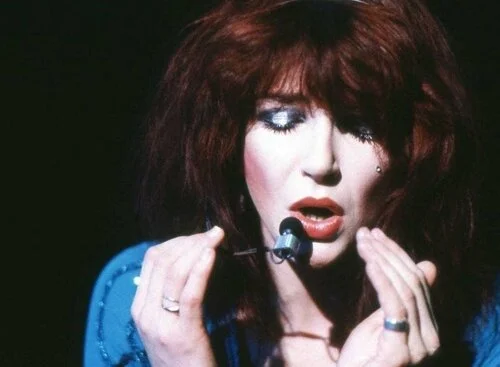
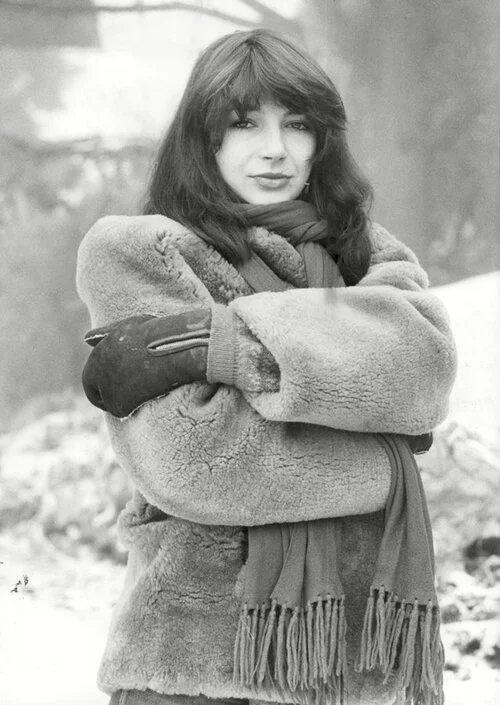
And then there was the extraordinary “Hounds of Love.” Bush’s voice is deeper and more resonant than on earlier records, the use of the synthesizer is more assured, and the experiments are never awkward, as Bush’s sometimes can be. When “Hounds of Love” came out, in 1985, I was in graduate school, at Harvard, and my mother had just had a stroke that robbed her of most of her speech. I’d soon be leaving school for a year to help take care of her. But, in the meantime, I’d walk home from Widener Library every day in a pen-and-ink drawing of a Cambridge November, the metallic smell of incipient snow permanently in the air, and when I got to my apartment with the sloping floors in Central Square—sometimes before I’d removed my winter coat or said more than hello to my boyfriend—I’d put “Hounds of Love” on the turntable, turn it up very, very loud, and wait for the galloping drum loops and the salty-sweet emotional rush of Bush’s vocals to comfort and exalt me. When it got to the end of the first side, I’d lift the needle up and put it right back at the first track, “Running Up That Hill,” the song with the pounding beat and irresistible synthesizer hook about “making a deal with God” so that men and women might “swap our places” and feel what it was like to be one another”.
In 2016, The Observer wrote a fascinating article that compartmentalised various aspects of Bush’s music and artistry and, when investigating the huge breadth and variety of artist who imbue something of Kate Bush in their own work, we can make an argument to say that she remains overlooked and under-exposed. I will move on soon, but I want to quote a section from that article, as they talked of Bush’s influence on artists who include sexual and gender identity issues in their music:
“These three artists—who grapple with issues of sexual and gender identity—all bear the hallmarks of Bush’s influence.
Mike Hadreas, the brainchild behind Perfume Genius, uses his glammed-up image and music as tools of both attraction and repulsion. The vocal/piano compositions that first brought Perfume Genius notice show that art-school flair works across the chromosomal divide.
Despite his love of opera and theatricality, Wainwright possesses less of an obvious connection to Bush. However, the Montreal-born singer/songwriter has both piano chops and humor to spare—both very much in keeping with Bush’s template.
Anohni, singer and focal point of Antony and the Johnsons has one of those rare voices, like Bush’s, which evokes an emotional response through its timbre alone. Words become secondary to Anohni’s delivery, which softly commands attention”.
Kate Bush’s fearlessness and openness in her music not only resonated with female songwriters at the time and those who have followed; as seen above, her music has made a big impact on the L.G.B.T.Q.I.A.+ community.