FEATURE: The Lockdown Playlist: Amazing Progressive Rock

FEATURE:


The Lockdown Playlist

zxxx.jpg

PHOTO CREDIT: @davidtoddmccarty/Unsplash

Amazing Progressive Rock

___________

THROUGH the various…  

PHOTO CREDIT: @mehdizadeh/Unsplash

Lockdown Playlists, I have included a lot of different genres into the mix. I have not mentioned Progressive Rock yet and, whilst it might not be to everyone’s taste, there are some all-time classics that one cannot refute! I wonder whether I should call these playlists ‘post-lockdown’, as we are sort of easing out but, whilst there are restrictions still, I will keep things as they are. If you need that extra bit of kick to get you through the weekend, then I hope that this playlist helps out. There are enough golden tracks in the pack to lift the mood, to get the body moving and inspire plenty of motivation. Settle back and enjoy some fine Progressive Rock songs…

yyy.jpg

PHOTO CREDIT: @dihrosa/Unsplash

FROM some truly incredible artists.

FEATURE: Modern Heroines: Part Twenty-One: Phoebe Bridgers

FEATURE:


Modern Heroines

PHOTO CREDIT: Jenn Five for The Forty-Five

Part Twenty-One: Phoebe Bridgers

___________

I have not done this feature…

for a while now, and the last person I covered for Modern Heroines was Grimes back in February. The reason I am kicking it back up (albeit briefly) is that the headline acts for next year’s Reading and Leeds festival were announced earlier in the week, and there were no women among the six acts! This compelled a wave of condemnation; many people asking why, again, one of the biggest festivals in the world is struggling to include women! Some might ask that, because they have an all-male headline line-up, that means there are no women who can fit the bill and would be popular enough. In terms of names that could headline and provide a stunning set, there are plenty of options. From Billie Eilish and Lizzo, through to Anna Calvi, Little Simz, and Fiona Apple, there would be no shortage! I also think that Phoebe Bridgers is someone who is not only among the most talented and popular artists of today, but she has a gravitas and command of the stage that would lead to an amazing headline set! In this feature, I am going to bring in some interviews and reviews that show just what an immense talent Bridgers is. If you want to follow her on Instagram and Twitter, then you can keep abreast of everything she is doing. I really like what she is putting out into the world and, before I bring in a selection of interviews from the past few months/year, I want to talk about her two solo tudio albums. Phoebe Bridgers is one of those artists who has already achieved so much in her life. Only just twenty-six, the Los Angeles-born musician is also known for her musical collaborations: boygenius (with Julien Baker and Lucy Dacus), and Better Oblivion Community Center (with Conor Oberst).

I have said before how we do not really have icons like we did back in the day such as Madonna and David Bowie - those artists with a unique style and changing innovation that seduced people and inspired countless artists and fans. Maybe that is unfair but, as there are so many artists out there and the media has changed a lot through the years, it is harder to find these artists that can rank alongside the greats. Like Jack White, Bridgers is someone who can succeed a solo artist, but she can also step into other groups and add so much. She is part of a duo and a trio, and I wonder whether we might see her also join a quartet – there is a supergroup involving Bridgers I have been thinking about that I would love to see! I am joking, but it is amazing to see how ambitious and passionate Bridgers is. Her debut single, Killer, was released on 28th April, 2015 (she did release a song called Waiting Room in 2014 for the Lost Ark Studio Compilation – Vol. 08), and her incredible debut album, Stranger in the Alps, was released on 22nd September, 2017. Almost three years after its release, I am still listening to it, and I just love the songs! In terms of influence, I know Bridgers is a huge fan of her Better Oblivion Community Center mate, Conor Oberst, but I think Bridgers’ sound and voice is very much her own.

Oberst features on Stranger in the Alps on the track, Would You Rather, and one can hear something very personal across the album. Bridgers co-wrote all but one song on the record - You Missed My Heart is a cover -, and the maturity and wisdom one hears on the album is truly moving – considering Bridgers was only twenty-three when the album was released. I have often wondered whether Stranger in the Alps got as much credit as it deserves. It gathered huge critical acclaim, but I think it should have won a load of awards and further recognition. The albums deals with sorrow and challenges, but there is that sense of hope and beauty that connects with the listener and brings them into the album. The immersive nature of Stranger in the Alps is one big reason why it received such positive feedback. This is what NME said in their review:

Like Sharon Van Etten and Angel Olsen? Then get ready to fall head over heels in love with Los Angeles’ Phoebe Bridgers. ‘Strangers In the Alps’ is a less a collection of songs and more a collection of feelings, a luscious but deeply sad debut that sees the 23-year-old singer putting her heart on the line and calling for you to do the same.

It’s not surprise to find she’s heavily influenced by fellow Angelino Elliott Smith, with songs like ‘Funeral’ – about the overdose of a friend – and the haunting ‘Demi Moore’ sharing atmospheric, finger-picked emotion with the late singer-songwriter.

A kind of urban folksiness runs deep through the record, and the strummed softness of ‘Would You Rather’ even features Bright Eyes’ Conor Oberst. The downbeat vibe is cut through by unmitigated banger ‘Motion Sickness’ but ‘Strangers In The Alps’ is definitely album for the sad times. Get ready to embrace the tears”.

There were some who gave the album a slightly mixed review, and I think many would upgrade their review listening back now. Stranger in the Alps is a truly stunning debut, and I would urge people to go and buy a copy. Between her debut and second albums, Bridgers was involved with two other big releases. The boygenius E.P. was released on 26th October, 2018, and Julien Baker, Phoebe Bridgers, and Lucy Dacus – alongside a select group of musicians – created something wonderful. I hope that boygenius release another E.P. or album soon, as there is something harmonious about them, yet Bridgers, Dacus, and Baker have their own vibe and characteristics that makes the E.P. sound so rich and diverse! I just want to bring in a snippet from the review Paste provided, that shows why the trio worked so well together:

The Bridgers-backed “Me & My Dog” is the buffed standout at the front of this EP’s trophy case. Loose acoustic guitars build to an inferno, or, rather, a glacier: “I had a fever / “Until I met you / Now you make me cool,” Bridgers sings, swiftly administering the cleverest compliment in rock this year.

Baker takes the wheel on a pair of fortified ballads “Souvenir” and “Stay Down,” The former would fit in snugly on Baker’s 2017 LP, Turn Out the Lights. Baker is very instrumentally savvy, and thumping timpani, focused keys and bear-all songwriting rule on “Stay Down.” It sounds like a song about giving up: “Push me down into the water like a sinner / Hold me under and I’ll never come up again.” But boygenius’ unified voices signal there’s still some hope, even as Baker echoes, singing from her gut, “So I stay down.”

The album ends on an especially magical note. On “Ketchum, ID,” Bridgers, Dacus and Baker assume soprano, alto and tenor and churn up a harmony so handsomely melancholic you’ll find yourself snatching tissues without even knowing why. It’s a fitting epilogue, too, that chronicles the band’s shared experience as touring musicians, and the emotional heaviness following those long nights in unfamiliar places. “I am never anywhere / Anywhere I go,” they sing in unison. “When I’m home I’m never there / Long enough to know.” Those are devastating words, but, at the same time, you get the feeling Bridgers, Baker and Dacus have found some sense of home in one another. Their mutual experiences are what unite them, and that bond bleeds through this music in every buzzing, beautiful bar”.

I think Phoebe Bridgers’ second album is a big step and sounds different to Stranger in the Alps; maybe it is because of the collaborations in-between and the fact that she picked something up from the different artists she worked with. The Better Oblivion Community Center album – I hope her next non-solo album project is not eponymously-named – was released on 24th January, 2019, and Oberst and Bridgers harmonise beautifully throughout. Although boygenius’ E.P. got slightly better reviews than Better Oblivion Community Center, the album is still another sign that Bridgers is among the most accomplished singer-songwriters of this age!

This is what The Line of Best Fit wrote when they reviewed the album:

Putting the elusive nature of the campaign, which will undoubtedly continue to grab headlines, to one side, the pairing makes perfect sense. Both Oberst and Bridgers are often classed as folk singer-songwriters, but neither resorts to conforming totally to that label. Oberst is just as well known for his influence on emo, as well as his rockier exploits with his band Desaparecidos, whereas Bridgers last year released the highly-acclaimed indie EP, boygenius, alongside Julien Baker and Lucy Dacus. They have in fact worked together in the past, most notably on "Would You Rather" off of Bridgers' debut album Stranger In The Alps, the results of which bode well for the new record.

It should come as no surprise then that Better Oblivion Community Center refuses to stick to typical folk-rock, dabbling at times in sounds ranging from alt-rock to synth-pop. “Exception To The Rule” opens with a pulsating, New Romantic-esque refrain before divulging in a beautiful spattering of synths and Bridgers’ and Oberst’s intertwined vocals. Elsewhere, the duo employ a combination of folk and cascading noise on one of the record’s highlights, “My City”. As both musicians temporarily abandon the jovial acoustic refrain underpinning the verses, they gradually build up to a release of distortion and drums for the final chorus, Bridgers' vocals in particular breaking with desperation. Both artists draw on their own well of influences, and the result is a wonderful myriad of styles.

Despite the wide range of aesthetics on the record, however, there are no two ways about it; this thing is bloody gorgeous. Two of the most adept singer-songwriters in haunting, poignant melancholy, the beauty to Better Oblivion Community Center lies exactly where you’d expect. Whether it be the tragic “Service Road” or the vocal duet on “Dylan Thomas”, there are endless moments on this record that prove just why both Oberst and Bridgers are so highly thought of. It’s the fact they’re able to do it together, and with such obvious chemistry, that makes it so much more impressive”.

Go and buy the boygenius E.P., and the Better Oblivion Community Center album, as they demonstrate the breadth and depth of Bridgers’ abilities. I still think there are reservoirs untapped in terms of where her songwriting and voice can go, not only in terms of themes but genres too. I am going to end with some interviews from this/last year, as I think it is important that Bridgers herself reveals some story and insight. Before then, I want to talk about Punisher. In terms of shifts, it is very different to Stranger in the Alps. More varied in terms of sound, it is a little edgier, and Bridgers’ voice is broader and more emotionally-rich.

zxxx.jpg

PHOTO CREDIT: Frank Ockenfels for Vanity Fair

I adore Stranger in the Alps, and I think repeating that album would have been a mistake. One can definitely feel a lot of the debut album in Punisher, but her follow-up is a different beast. This is how Rough Trade sum up Bridgers’ second solo album:

Phoebe Bridgers doesn’t write love songs as much as songs about the impact love can have on our lives, personalities, and priorities. Punisher, her fourth release and second solo album, is concerned with that subject. To say she writes about heartbreak is to undersell her blue wisdom, to say she writes about pain erases all the strange joy her music emanates. The arrival of Punisher cements Phoebe Bridgers as one of the most clever, tender and prolific songwriters of our era.

Bridgers is the rare artist with enough humor to deconstruct her own meteoric rise. Repeatedly praised by publications like The New Yorker, The New York Times, GQ, Pitchfork, The Fader, The Los Angeles Times and countless others, Bridgers herself is more interested in discussing topics on Twitter, deadpanning meditations on the humiliating process of being a person, she presents a sweetly funny flipside to the strikingly sad songs she writes. Fittingly, Punisher is fascinated with, and driven by, that kind of impossible tension. Whether it’s writing tweets or songs, Bridgers’s singular talent lies in bringing fierce curiosity to slimy and painful things, interrogating them until they yield up answers that are beautiful and absurd, or faithfully reporting the reality that, sometimes, they are neither.

Bridgers pulls together a formidable crew of guests, including the Julien Baker, Lucy Dacus, Christian Lee Hutson and Conor Oberst as well as Nathaniel Walcott (of Bright Eyes), Nick Zinner (of the Yeah Yeah Yeahs), Jenny Lee Lindberg (of Warpaint), Blake Mills and Jim Keltner as well as her longtime bandmates Marshall Vore (drums), Harrison Whitford (guitar), Emily Retsas (bass) and Nick White (keys). The album was mixed by Mike Mogis, who also mixed Stranger In The Alps.

On the album’s epic, freewheeling closer, I Know The End, Bridgers orchestrates wails and horns, drums and electric guitar into a sumptuous doomsday swirl, culminating in her own final whispered roar. This is Punisher in a nutshell: devastating elegance punctuated by a moment of deeply campy self-awareness”.

Again, Bridgers co-writes on the album – on every song in fact -, and Conor Oberst can be heard on a few numbers, too. Moving from the more Folk and Indie sound of her debut, there is something harder and slightly darker on Punisher. Thematically, Punisher tackles the tension between the inner and outer-self; Bridgers has said how the album addresses numbness and personal loss – Bridgers lost her black pug, Max, in 2019 (she had had him for sixteen years). Though Bridgers tackled loneliness and loss when writing the album, there is plenty of light and redemption throughout the album. Punisher has earned Bridgers the best reviews of her career, and the album ranks alongside the very best of the year.

I think 2020 has been dominated by women, and Bridgers second album proves why she is a modern icon who is more than ready to take on headline slots! The songwriting throughout Punisher is fabulous and so engrossing! This is what SLANT wrote in their review of Punisher:

Punisher’s best songs are those most adept at bringing all of these themes and sounds together. “Chinese Satellite” starts out wispy and ethereal before building to an apex of lush, cinematic strings, booming drums, and keen electric guitars. Here, Bridgers is in peak form as a lyricist, her moments of devastation shot through with a sardonic smile: “I want to believe,” she declares as a myriad of sounds fades away and we’re left with only those serious, dramatic strings. “Instead I look at the sky and I feel nothing,” is the punchline, and the moment is jarring compared to what initially feels like a real epiphany.

Punisher’s closing track, “I Know the End,” is a travelogue at the end of the world, explicitly illustrating the cloud of uneasiness that hangs over the album. Bridgers sprinkles the song with nods toward an amorphous kind of closure: A tornado comes for her hometown, a siren sounds in the distance, government drones and alien spaceships float off in the sky, and a billboard warns that “the end is near” amid a crescendo of horns and explosive noise. The album ends with blood-curdling screams, until all the sound fades out and Bridgers’s voice is hoarse. The end of the world is a central detail on Punisher, an influence over the uncertainty that falls over these dark but gorgeous songs”.

Since the release of Punisher (go and buy the album when you get time!), Bridgers has done interviews and some live performances (from her home), and I think she is as keen as every other artist to get back to gigs and get out there! Having released an album in lockdown, there is that desire to perform these new songs, and I am sure Bridgers has other songs in her mind that she would love to air. You can visit her homepage for news and updates, but it is clear that Bridgers has a very long and bright future. She is one of the finest artists around, and I think we really learn a lot from interviews. One can glean so much from the music, but I love to hear and read about Bridgers, as she is a fascinating human! I am going to bring in a few interviews that captured my attention to show what I mean. When Bridgers spoke with NME last year, she discussed the progress of her second album and how it differed from Stranger in the Alps:

Were you working a lot on the record before you took time out for the boygenius and Better Oblivion Community Center album?

“Truly. My plans got derailed by those two projects, in the best way. I was planning to go into the studio in the summer of 2018, and then I started two bands! And it was awesome and I’m so glad I did it like that, but we really started [on the new album] after I got off those tours.”

Did being in those bands change how you write songs?

“Yeah, totally. Not even just in recording, but I feel so much more comfortable live. I think the main thing which boygenius and I talk about ad nauseum, is that I feel like I just apologise for myself less. I’m not afraid to have a really weird idea or, you know, take a really bad guitar solo. I’m unafraid of getting made fun of anymore. I feel like both of those projects have made me feel like the boss of my own music in the best way.”

Does that make you feel like a very different person and songwriter to that which wrote ‘Stranger In The Alps’?

“I could talk a big game about how I’m not that person or I’m getting far away from those topics, and then I end up with 10 songs that are about depression. I have no idea. I’ve never really been afraid of how people were going to define me, as long as I didn’t write some cheaper song because people like that I’m depressed.”

How far along is the album? Is it finished?

“I don’t know! Honestly… The last record, I wrote the last two songs literally in the final hour. I don’t like to put time limits on myself as much as possible. I think that’s the worst thing that I could do right now.”

PHOTO CREDIT: Jessica Lehrman for Rolling Stone

And what makes the new album different from your debut?

“The production is totally different to my first record. People still kind of think of me as like a folk artist, but on the first record, I truly was deferring to other people to produce me. I basically had these country folk songs. [On the new record] I do a little bit of screaming on what we’ve recorded so far”.

The penultimate interview I want to grab from is from The Ringer back in June, as there is a lot to pour over. I was not overly-familiar with Bridgers’ early life and upbringing, and it was great to learn that side of her:

Bridgers grew up in Pasadena, California, and was always adjacent to the entertainment industry. Her dad was a carpenter who built sets for film and television, and her mother, Jamie, had a variety of white-collar jobs, from receptionist to house manager for a fine arts complex. (Jamie is currently a stand-up comedian. “She has made jokes about me being a musician, and STDs and stuff. She’s pretty raunchy. It’s great.”)

“This whole COVID situation is reminding me a lot of high school, actually. I’m in bed all day. I eat whatever I want. A lot of the time I don’t have energy to reheat something, so I either go back to sleep or make a toaster waffle,” she says. “I feel like it’s weirdly like exposure therapy to my depressed teen years.”

Her parents divorced when she was 19, and in interviews she has alluded to her father’s substance misuse issues (or as she said in GQ, his “drug thing”) and says they have a strained relationship. But she also credits him for filling their house with music, including plenty of Jackson Browne and Joni Mitchell, when she was a child. Later she would also gravitate to the brooding of future collaborators and friends like Oberst and the National. She’s always known she wanted to be a songwriter. “Before I knew how to do it. Before I was making anything good, I wanted it”.

There is a lot of great stuff in that interview, but the subjects of the #MeToo movement caught me. Also, Bridgers used to be in a relationship with Ryan Adams and, when the songwriter was accused of sexual assault by a number of women, naturally, many people came to Bridgers for an interview. Bridgers discussed both #MeToo and Ryan Adams in the interview:

Alps was released right as the #MeToo movement began kicking into high gear after the exposé of Hollywood mogul Harvey Weinstein’s numerous incidents of sexual assault and harassment. While doing interviews for Boygenius, Bridgers would comment that sometimes after she would shoot down condescending “women in music”–style questions from male journalists, she could tell a bunch of other questions were being deleted. “I don’t know if it’s better. I mean I think that more places are afraid to send an old white man to go interview a young woman,” she says. “Hopefully, people are just hiring more women, and even if it’s just because they have to or for a look, they’re editing out the questions that they have seen other people get ripped apart for asking. So it seems like everybody’s on their toes a little bit, and the people who should be on their toes are on their toes.”

While gigging around L.A., Bridgers caught the attention of Ryan Adams, who released her single “Killer” through his label PAX AM in 2015. As revealed last year in an article in The New York Times by Joe Coscarelli and Melena Ryzik, they began a romantic relationship when she was 20 and he was more than twice her age. The article recounted how, she says, Adams became emotionally abusive, and after she ended the relationship “Adams became evasive about releasing the music they had recorded together and rescinded the offer to open his upcoming concerts.” (Through a lawyer, Adams contested the accounts of Bridgers and many other women.).

A year later, she reflects on how her life has changed since the article’s publication. “I guess I just get to talk about that shit a little bit more than I did before, and I met tons of great people through it. It was definitely worse right before it came out. I was afraid it wasn’t gonna come out, afraid we’re gonna get sued. You still gaslight yourself and it’s like, ‘Did any of this shit happen?’” she says. “And then the day it came out, no matter how many people told me to go fuck off and die on the internet, I met so many amazing people and got so many fucking emails that made me really emotional, being like, ‘I was the barista down the street from the studio,’ or whatever. It just made me feel good”.

I will wrap things up in a second, but I will end by sourcing from an excellent interview from The Forty-Five from earlier in the year. I wanted to select a passage that details how Bridgers’ music has helped fans struggling emotionally – and how her music connects to her fans like nothing else out there:

Elsewhere on the spectrum, there are the fans who connect to the explicit existential angst of Bridgers’ music, and find themselves talking to her about the emotional issues she’s helped them through. “Sometimes I’m talking to somebody for five hours about suicide,” she says. “It’s a lot of pressure.” Bridgers’ writing style is unflinching, and will often cut to the heart of an ugly emotion by writing vignettes around it. It’s not surprising that her listeners find themselves inside the blue and grey landscapes of her music; she deliberately carves space for them in her writing.

“I can’t write too close to an experience, because I feel like I’ll write a way too sincere, ‘Fuck you for not loving me’ song,” she explains of her oblique, evocative approach to writing lyrics. “But if I’m far enough away from it, I can be like, ‘Oh, it’s way sadder to just describe what’s happening, and not say how you feel about it.’ Almost like JD Salinger or something.”

It is a worrying time for all artists, but Bridgers has not been thinking too much about the future in fearful terms. There is always a sense of hope and light in her music and conversations:

While she’s been reflecting on these fears about what comes next for the music industry, Bridgers admits in an on-brand fashion: “I haven’t been thinking about the future that much.” Just like her music, Bridgers is currently living firmly inside the moment, eating her PB & J sandwiches and making short-term plans for a virtual world tour. In the longer term, she says vaguely, “I would like to write, and record. Those are my hopes. And I hope there’s a vaccine.” While Bridgers makes music for endings, her songs also occasionally glimmer with implicit, trepidatious optimism. On “Garden Song”, she sings, “When I grow up, I’m gonna look up from my phone and see my life.” Even when the future feels impossible, she seems to say, it’s coming. The existence of ‘Punisher’ proves that last time she felt she’d run out of songs forever, she was wrong. Hopefully, she’ll be wrong again”.

Phoebe Bridgers is such a prodigious talent, and a restless artist who loves to work with different people. She has released one of this year’s most remarkable albums in Punisher, and who knows where 2021 will take her. I hope she can do as much touring as possible, and you just feel another album will come around, whether that is a solo record or with boygenius; perhaps she will release a record as part of Better Oblivion Community Center. Who knows. What I do know – and many other share this opinion – is that Phoebe Bridgers is…

AN icon of our times.

FEATURE: Too Good to Be Forgotten: Tracks That Are Much More Than a Guilty Pleasure: Billy Joel – We Didn’t Start the Fire

FEATURE:


Too Good to Be Forgotten: Tracks That Are Much More Than a Guilty Pleasure

zzzz.jpg

IN THIS PHOTO: Billy Joel boxing in NY in 1989/PHOTO CREDIT: Timothy White

Billy Joel – We Didn’t Start the Fire

___________

THIS is a feature…

cccc.jpg

IN THIS PHOTO: Billy Joel shot by Eugene Adebari in 1989

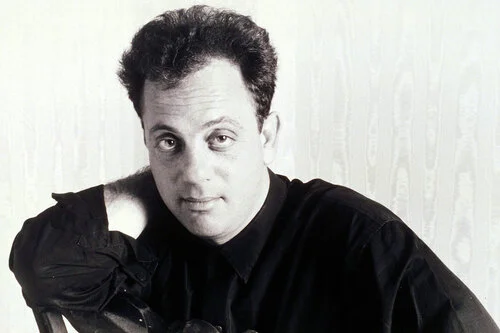
where I look at songs that have been overlooked or, for the most part, are seen as a bit of a guilty pleasure! Not only are there no such things in music, but I think a lot of songs were either panned when they were released, or people feel embarrassed about loving them now. There is no denying the genius of Billy Joel, but I have seen him listed as a ‘guilty pleasures artists’, and someone who has a few decent songs in the catalogue and others that are not quite so strong. I like We Didn’t Start the Fire, because Billy Joel manages to cover so much history, and he name-drops so many historical figures. Last year, the Los Angeles Times wrote a feature that asked where all the people mentioned in We Didn’t Start the Fire are. It is clear that the song has made an impact since its release:

Whatever you think of the concept – and millennial audiences may certainly raise their eyebrows at the Baby Boomer rundown of the Luckiest Generation’s trials and tribulations – there’s no denying that ‘We Didn’t Start The Fire’ had the cultural impact of a meteor strike.

The rapid-fire vocals are second nature even to people who couldn’t pick their author out of a line up, and it’s hard to pick a stronger contender for the definitive Billy Joel song, despite a career packed with highlights.

Even while covering forty years of world history in a little over four minutes, by offering no commentary (save for whatever you choose to believe the ‘fire’ is – something we don’t find out until the last few frames) Joel manages to keep the song itself remarkably apolitical.

By contrast, the video is a fast-paced run down of the generational evolution of the American family, taking in the burning of flags, bras and draft papers as martial bliss gives way to medicated stress and anger, with Joel himself a be-shaded, background presence throughout”.

I love Billy Joel, but 1989 was not his most successful year. Storm Front was not reviewed that highly, and he followed that in 1993 with River of Dreams – another album that gained some mixed response. Some say that Joel’s last truly great album was 1983’s An Innocent Man, and his albums after that were in decline. His final studio album in 2001, Fantasies & Delusions, was a fitting farewell, but it is a shame that Joel is no longer recording music. I love a lot of Billy Joel’s later albums, and I think songs like We Didn’t Start the Fire are classics. Maybe the production is very 1980s, in the sense that it might not have dated that well, but I think the lyrics are really educational and informative, and Joel’s vocal is very committed!

Rarely talked about in the same breath as classics like Piano Man, and She’s Always a Woman, I think we need to reframe and reinvestigate We Didn’t Start the Fire. I think the fact that the song has been parodied a lot means that some distance themselves from it. This 2014 article from Entertainment Weekly discusses the division the song has created:

At the time of its release, some found “We Didn’t Start the Fire” to be a poignant statement on the decay of the collective American morale. John McAlley at Rolling Stone, for example, wrote that Joel chronicled “the steady erosion of our national spirit since 1949—incidentally, the year of his birth.”

Of course, not everyone was thrilled with “We Didn’t Start the Fire.” A 1997 story in College Teaching points out that when Joel’s album was released, Columbia Records, in collaboration with Scholastic, Inc., distributed the song to 40,000 junior and senior high school classrooms, along with a taped talk from Joel—a self-professed history buff—titled “History Is a Living Thing.”

Teachers’ reactions were mixed.

Nevertheless, “We Didn’t Start the Fire” would go on to become both a Billboard No. 1 and an honorable mention on at least one list of the Worst Songs Ever, as well as an ever-springing fountain of inspiration for parodists and an occasional classroom resource for history teachers.

In 1994, after a performance at Oxford University, a woman—presumably an Oxford student—asked Joel whether he accidentally or intentionally chronicled the Cold War in “We Didn’t Start the Fire.” Thankfully, someone captured the exchange on video; Joel’s sprawling response is a little less than illuminating on that particular subject, but he offers a few marvelously entertaining extra tidbits about the origins and the legacy of the hit song he “didn’t think was really that good to begin with”.

It is a shame that Billy Joel is not overly-fond of We Didn’t Start the Fire, because I think there is a lot of genuine affection for it, and the fact that he was tackling history and putting out this ambitious song in 1989 – a year where we saw so much change and progress – is to be commended. It was a very different track to what the public were used to hearing but, apart from the production, I think We Didn’t Start the Fire resonates still and it is much more than a guilty pleasure! I would rank We Didn’t Start the Fire among Billy Joel’s best, and I especially love the song’s video! One does not hear the song so much on the radio, and that is a real pity. We Didn’t Start the Fire is a lot better and more important than people give it credit for, and I would urge everyone to…

GIVE it a good spin.

FEATURE: Second Spin: The Clash – Combat Rock

FEATURE:


Second Spin

The Clash – Combat Rock

___________

I think The Clash…

cv.jpg

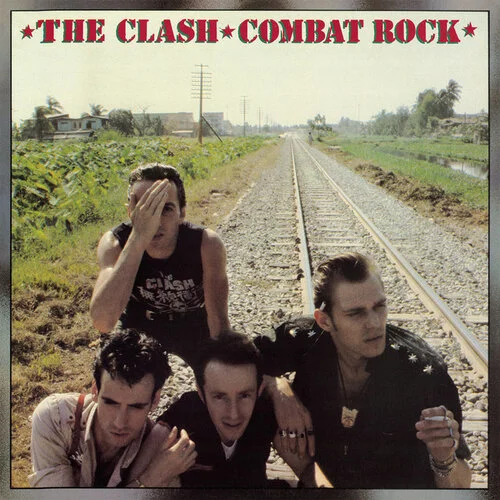
IN THIS PHOTO: The Clash in Philadelphia in 1982/PHOTO CREDIT: Bob Gruen

are one of those bands who released some real classics, and a couple of albums that were very short of their best. I guess that is the same with every artist, but there is a real divide between, say, The Clash (1977), London Calling (1979) and Cut the Crap (1985). In fact, actually, I think Cut the Crap was the only bad album they ever released. The band did release a couple of albums that I think divide people. I have seen people argue as to whether Sandinista! (1980) is a great album, and they also debate Give 'Em Enough Rope (1978). The latter followed the band’s exceptional debut and, whilst not as iconic, it is definitely a worthy follow-up. Sandinista! arrived after London Calling and, with such a high standard being set there, the band entered the 1980s with a really good album. It is interesting how there were these critical rises and slight dips. It seemed that straight after a stone-cold classic album, there followed one that was excellent but not imbued with the potency and memorability of its predecessor. This brings us to Combat Rock of 1982. It followed Sandinista!, and I think this is an album that many people feel is in the bottom-two Clash albums. I actually think Combat Rock is one of the strongest albums from The Clash, and it arrived at a time when Punk had lost a lot of its momentum and relevance.

The Clash were never purely a Punk band – they always mixed sounds together -, but the London band were definitely entering a different stage. Their fifth studio album was released on 14th May, 1982, and it charted at number-two, spending twenty-three weeks in the U.K. charts – and it peaked at number-seven in the United States, spending sixty-one weeks on the chart. Combat Rock is the group's best-selling album, being certified double-platinum in the United States. That all sounds like a recipe for success; surely Combat Rock, on that basis, is a classic that cannot be faulted?! This is another case on Second Spin of an album being successful in terms of sales, but a little less sure-footed when it comes to the reviews. Maybe it is a case of critics comparing Combat Rock with bigger Clash albums, or perhaps not feeling that there was a lot of gold beyond the huge singles, Should I Stay or Should I Go, and Rock the Casbah. There is a trippiness that runs through Combat Rock. The impact of the Vietnam War was very important on the band, and one can hear this on songs like Straight to Hell. Even though it had been five years since their debut album, The Clash were still discussing politics and warfare in a way that took you aback and made you think. Tackling U.S. foreign policy and America in decline, there is a lot of depth to Combat Rock.

Know Your Rights, Straight to Hell, and Overpowered by Funk are Clash classics that can rank alongside their best. One of the issues with Combat Rock, I think, it how it is very top-heavy: Know Your Rights, Should I Stay or Should I Go, Rock the Casbah, and Straight to Hell are in the first half, and there are relatively few heavy-hitting songs in the second side. That said, there are plenty of gems to be found, and I think Death Is a Star is a great album closer. For me, I think Should I Stay or Should I Go is that song that defines the album. Whilst not as political and loved as many other Clash songs, it is the one I grew up on and remember very fondly. Rather than Joe Strummer singing lead, this one was tackled by Mick Jones – the two often shared vocal duties, either soloing or together -, and I reckon it is a remarkable number. There is debate as to whether the song is about Jones’ imminent departure from The Clash, or whether it is about a relationship breakdown – in years since, Jones has denied any specific inspiration, explaining that it is just a good Rock song. It is a bit sad that Mick Jones and drummer Topper Headon were dismissed from the band by the time Cut the Crap came along, as they were pivotal members, and the band suffered because of their loss.

One cannot really detect any strife or inter-band tension through the album. Strummer and Jones’ Know Your Rights is excellent, whilst Headon, Strummer and Jones co-wrote Rock the Casbah. The reviews vary when it comes to Combat Rock. I shall bring in some positive assessment soon - but I want to quote from AllMusic, who were a little mixed:

On the surface of things, Combat Rock appears to be a retreat from the sprawling stylistic explorations of London Calling and Sandinista! The pounding arena rock of "Should I Stay or Should I Go" makes the Clash sound like an arena rock band, and much of the album boasts a muscular, heavy sound courtesy of producer Glyn Johns. But things aren't quite that simple. Combat Rock contains heavy flirtations with rap, funk, and reggae, and it even has a cameo by poet Allen Ginsberg -- if this album is, as it has often been claimed, the Clash's sellout effort, it's a very strange way to sell out. Even with the infectious, dance-inflected new wave pop of "Rock the Casbah" leading the way, there aren't many overt attempts at crossover success, mainly because the group is tearing in two separate directions. Mick Jones wants the Clash to inherit the Who's righteous arena rock stance, and Joe Strummer wants to forge ahead into black music. The result is an album that is nearly as inconsistent as Sandinista!, even though its finest moments -- "Should I Stay or Should I Go," "Rock the Casbah," "Straight to Hell" -- illustrate why the Clash were able to reach a larger audience than ever before with the record”.

I think there is plenty to love about Combat Rock. If you do not except it to sound like London Calling, or The Clash, then that is the best approach – I think a lot of people will always judge The Clash’s back catalogue like that. Maybe there are not as many diamonds on Combat Rock as those albums, but there are at least four or five songs that can sit proudly with their best work! When they approached the album in 2005, this is what Sputnik Music wrote:

It’s clear that this is one of the bands albums that really stands out from the rest in their history, and really captures a new sound that would catch on to the newer Clash generation. This is one of the band’s best works, and defines that no matter what slice of meat they choose out, and how the cook it, it will always somehow to come out being very damn delicious. As the band has a short run after this album, with their live album and Cut The Crap, one of the more poor album on this side of The Clash. Combat Rock whole-fully comes out of it’s womb with something new to offer, and leaving you wanting more. It’s one that no fan should be without, and with an attitude that gets you up and out of your seat, and at the same time pondering how they ever did it. This is an album that the band didn’t disappoint with. Not that they ever did”.

Unlike a lot of albums from the 1980s, I don’t think Combat Rock sounds dated at all. Maybe that has something to do with the fact that the album was co-produced by The Clash and Glyn Johns – whose has worked with The Beatles, The Rolling Stones, and The Who, among numerous others! I am going to wrap things up but, before I do, I wanted to quote from an Albumism feature from 2017, as they marked thirty-five years of The Clash’s Combat Rock:

Combat Rock is so much more than just “Should I Stay or Should I Go” and “Rock the Casbah.” The band were big fans of the movie Apocalypse Now and they had a great fascination with the Vietnam War. As a result, several of the album’s songs are meditations on the war and its impact on society. “Straight to Hell” tells the story of Vietnamese women and their children whose fathers were American soldiers who eventually abandoned them. “Sean Flynn” is another Vietnam-themed tale about the son of actor Errol Flynn who was a photojournalist who disappeared in 1970 while in Vietnam.

“Overpowered By Funk” is a song that illustrates the heavy influence that hip-hop (then referred to as rap) had on the band. Joe Strummer recalled in 2002, “When we came to the U.S., Mick stumbled upon a music shop in Brooklyn that carried the music of Grand Master Flash and the Furious Five, the Sugar Hill Gang…these groups were radically changing music and they changed everything for us.” The song features a rap vocal by legendary graffiti artist Futura 2000. It captured the mood and feel of New York City in 1982 and it gave us a glimpse into Jones’ musical future with his band Big Audio Dynamite. The dark side of New York is on display in “Ghetto Defendant,” a reggae dub track featuring Beat poet Allen Ginsberg. It’s an ominous tale about heroin addiction and despair. Ironically, it was heroin addiction that forced the band to fire drummer Topper Headon after the album’s release.

The various styles of music on Combat Rock were emblematic of the drifting apart of Strummer and Jones. “Know Your Rights” is Joe Strummer personified and one hell of a way to kick off an album. The song exemplified the direction he wanted the band to go. Strummer thought they needed to get back closer to their punk roots. The stylistic tug of war on Combat Rock works with the heavy subject matter. Unbeknownst to us at the time, it was the last great statement from The Clash as we knew them. When the Combat Rock tour ended, Strummer and the band’s manager Bernie Rhodes forced Jones out of the band. Strummer confided in 2002, “I committed one of the greatest mistakes of my life with the sacking of Mick.”

Combat Rock’s legacy lives on years after its initial release, with the most notable example being “Straight to Hell”, which was sampled in M.I.A’s 2007 song “Paper Planes.” Combat Rock may be one of the most misunderstood albums of all time. The band’s hardcore fans wanted more of what London Calling was and The Clash wanted to grow and explore. In the long run, I think we were the better for it”.

If you have never heard Combat Rock before, I would encourage you to do so. And for those who have sort of pushed it aside or only listen to the big singles, then dust it off and give it another spin. It is a great album that has not received the positive press that it warrants – though there has been some fond retrospection. I think it is a brilliant record, and one that should be seen as one of The Clash’s best efforts. Give it a play and…

SEE what I mean.

FEATURE: Dress You Up: Might a Madonna Biopic Finally Hit the Screens?

FEATURE:


Dress You Up

IN THIS PHOTO: Madonna shot by Helmut Werb in the 1980s

Might a Madonna Biopic Finally Hit the Screens?

___________

DESPITE some T.V. shows and films…  

xxx.jpg

IN THIS PHOTO: Madonna captured in 1984/PHOTO CREDIT: Francesco Scavullo

resuming filming, there are still guidelines in place regarding what can be filmed. I am going to limit my Madonna features, as I tend to latch onto anything vaguely interesting to do with her but, as she is a Pop icon who continues to turn heads and whip up discussion, there is always going to be interest around her. There is no predicting what Madonna will say and do next, and I like the fact that she still sort of does what she wants and is not scared of what the record label will think! This all stems back to her earliest days, and the fact Madonna has always been bold and individual. Because of that, I have asked whether we will ever see a biopic on the screens. I mention it frequently because, over the past few years, a lot of great artists have had their stories brought to life. I can understand why there is an appetite to see an artist’s life translated for the screen, as it can introduce them to new fans and it is a chance for people to see that artist away from the music – to learn more about their life and story. There have been rumours that a Madonna biopic is taking shape, and, as The Independent report, a star might have been found:

A rumoured Madonna biopic may have found its star, after the Queen of Pop began following Ozark actor Julia Garner on Instagram.

Fans spotted that Madonna and her long-time manager Guy Oseary both followed Garner last week (28 August). The actor’s striking resemblance to a young Madonna sparked speculation that they have their eyes on her for a rumoured biopic.

IN THIS PHOTO: Julia Garner

While a Madonna biopic has yet to be officially confirmed, the pop star has posted a series of videos to her Instagram this month in which she appears to be co-writing the story of her life with Oscar winner Diablo Cody.

Cody wrote the screenplays for films including Juno, Jennifer’s Body and Young Adult, as well as the book for the Alanis Morissette musical Jagged Little Pill. The show, which premiered in 2019, uses the musician’s songs as the backdrop to a story of a family struggling through personal woes in Nineties suburbia.

“When you’re stuck in a house with multiple injuries what do you do?” Madonna wrote on her Instagram on 8 August. “Write a screenplay with Diablo Cody about..............?”

In her Instagram Stories, Madonna has also posted various photographs of old diaries dated to the early 1980s, suggesting the possible biopic may only chronicle her early rise to fame.

In 2017, Madonna condemned plans for an unauthorised film biopic about her life. Titled Blonde Ambition, and put into development by Universal Pictures, the script was written by Elyse Hollander and explored the star’s early days and the making of her first album.

“Nobody knows what I know and what I have seen,” Madonna wrote on Instagram at the time. “Only I can tell my story. Anyone else who tries is a charlatan and a fool looking for instant gratification without doing the work. This is a disease in our society”.

It would be great if the rumours were true, as there have been attempts to make a biopic and they have come to nothing. I get why Madonna would want to be protective and not allow something onto the screen she is not happy with. As it seems like Madonna herself is closely involved with the project and script, I wonder whether it will be something factual, or there will be some fantasy in there. In terms of biopics, a Madonna film is a pretty big one! Although her career has spanned five decades, I do think that her early years is the most exciting and interesting.

View this post on Instagram

#screenplay #diablo #davidbanda

A post shared by Madonna (@madonna) on

From her first movements in 1982 to, say, 1990’s Blond Ambition World Tour, that period was a whirlwind and a real time of transformation. From the somewhat innocent Pop artist of her eponymous 1983 debut album to the more mature and boundary-pushing woman who released Like a Prayer in 1989, that was a really interesting and memorable time in music! There are many artists today who would like to learn Madonna’s story and how she managed to arrive in New York with next to nothing and succeed. I don’t think a lot of people know about Madonna’s years before her debut single, Everybody, was released in 1982. Maybe a film will focus on 1978-1982 – or spend the opening half hour or so around that time. This article from i-D explains more about Madonna’s earliest years around New York:

According to pop legend, Madonna Louise Ciccone arrived in New York City in 1978 with $35 in her pocket, and told a taxi driver: "Take me to the centre of everything." He dropped her off in Times Square, where she worked for a while at Dunkin' Donuts before being fired, so the story goes, for squirting jelly in a customer's face. Right from the start, this college dropout from the Detroit 'burbs was a true rebel heart.

Madonna would eventually cut her creative teeth in edgier neighbourhoods like Manhattan's then-rundown Lower East Side and Corona in Queens, home to a large Hispanic and Latino population. Recalling her first impressions of the Big Apple nearly four decades later, she said: "I felt like I plugged my finger into an electric socket."

Madonna wouldn't score her first really big hit, Holiday, until 1983, but her pre-fame years running around NYC’s scuzzy underground are key to understanding who she is as a person and as a pop star. She didn't study at stage school like Lady Gaga, or hone her craft on a TV show like Britney Spears and Justin Timberlake. She learned on the street, figuring out who Madonna was and what sort of artist she wanted to be. She had room to grow and space to make mistakes because she didn’t become super-famous until she was 26 or 27.

She worked as a waitress at the Russian Tea Room and posed for nude photos to make extra cash. After she became famous, these pictures reappeared with depressing inevitability in Penthouse and Playboy magazines, but Madonna refused to be slut-shamed. "I was expected to feel ashamed when these photos came out, and I was not. And this puzzled people," she recalled during her 2016 Billboard Woman of the Year acceptance speech.

She also earned money as a dancer, and played drums in a band called The Breakfast Club before leaving to form her own group Emmy and the Emmys. She hung out at Studio 54, where her best friend Martin Burgoyne was a bartender, and played her first solo show at another iconic nightclub, Danceteria.

"It wasn’t until I really decided to switch into being a musician and a songwriter, and I moved to the Lower East Side, that I started meeting artists like Keith Haring and Jean-Michel Basquiat and Andy Warhol," she explained in a 2015 Noisey interview. "While I felt we all fed off each other’s energy and we were all inspired by each other and jealous of each other, collaborating with each other, I had no idea then what their place in the world would be now. But not my own, either. So we were just artists having fun, happy that anyone was interested in our work."

IN THIS PHOTO: Madonna in 1978/PHOTO CREDIT: Jeff Hochberg/Getty Images

It was an intensely inspiring period for Madonna, but at the same time, we shouldn't romanticise it too much. "It wasn’t safe to be gay; it wasn’t cool to be associated with the gay community," she recalled in her Billboard speech. "It was 1979 and New York was a very scary place. In the first year I was held at gunpoint, raped on a rooftop with a knife digging into my throat. And I had my apartment broken into and robbed so many times I just stopped locking the door. In the years that followed, I lost almost every friend I had to AIDS or drugs or gunshots”.

Although it was not a perfect time, Madonna did learn a lot in her first years in New York. From her 1983 debut album to today, she has battled against sexism, and she has faced more than her share of critics and doubters! From the epic tours, big films, flop films, and those albums that reinvented her, there is a lot to focus on. Many would want to see Madonna’s 1992, where she released Erotica and her Sex book more or less at the same time and, from then, she faced backlash and criticism – even though the album is terrific and the book is tame by today’s standards. For all the glamour and eventfulness that encapsulated so much of Madonna’s career, I think bringing it back to the earliest days would be best; maybe a look from 1978 through to 1983 (her debut), or 1984 – when Like a Virgin was released and her popularity was heightened and sealed. Whatever is planned and whatever might come about, I am glad that there seems to be some substance in the biopic rumours – something fans have been waiting for for years now! When (or if) the biopic does arrive, it will definitely…

GIVE inspiration to so many artists coming through.

FEATURE: Love Spreads: The HELP Album at Twenty-Five

FEATURE:

Love Spreads

The HELP Album at Twenty-Five

___________

WITH most album anniversaries…

IMAGE CREDIT: War Child

we celebrate the artist involved and how the songs have resonated through the years. I do love to mark the anniversary of classic albums, as it is a good opportunity to revisit a wonderful moment of time. In the case of the HELP album, its twenty-fifth anniversary on Wednesday (9th September) is important for a couple of reasons. HELP is a 1995 charity album to raise funds for the War Child charity, which provided aid to war-stricken areas, such as Bosnia and Herzegovina. All the songs were recorded in a single day. The album features British and Irish artists including Paul McCartney, Paul Weller, Radiohead, Oasis, Blur, and the Manic Street Preachers. Like Live Aid, artists came together over a common cause that they felt very passionate about. Whereas the original Live Aid concert of 1985 was established to raise awareness and funds to combat the ongoing Ethiopian famine, HELP was different. Maybe the Live Aid concert was the inspiration for HELP, as that concert was unique in the way that it united huge artists from around the world. HELP was followed by 1 Love (2002), Hope (2003), Help!: A Day in the Life (2005), and War Child Presents Heroes (2009). If you are new to HELP and need to know a bit more information, then War Child – the album was recorded to raise funds for the charity – explain more here:

The support from the artists was incredible. Taking time out from their busy schedules, they recorded the entire record in just 24 hours. In a pre-digital time when the only conflict the UK music industry cared about was Blur versus Oasis, even they were willing to come together to support some of the world's most vulnerable children.

rt.jpg

IN THIS PHOTO: Sinéad O'Connor appeared on the HELP album in 1995

What is HELP?

HELP is a charity album launched in response to the Bosnian War. In 1995 the inter-ethnic conflict had taken the lives of 250,000 people and displaced a further two million. Those fleeing the bloodshed - ordinary men, women and children - were left with nothing, and little hope their lives would ever return to normal.

Tony Crean, International Marketing Manager at Go! Discs, along with music industry experts Anton Brookes, Terri Hall and Rob Partridge wante to do something to support families - and fast. They put their heads and contacts together to create the groundbreaking HELP album, in aid of War Child.

"We'll put aside our differences for the cause - and it's the only time you'll see the two of us agreeing on anything" - Noel Gallagher said in an interview.

To celebrate the album's 25th anniversary, we're so excited to announce that HELP will be re-issued on limited edition vinyl, and made available on digital and streaming platforms for the first time ever! Pre-order a record today.

The iconic album, originally launched in 1995, features tracks from Oasis and Friends, The Boo Radleys, The Stone Roses, Radiohead, Orbital, Portishead, Massive Attack, Suede, The Charlatans vs. The Chemical Brothers, Stereo MCs, Sinéad O'Connor, the Levellers, Manic Street Preachers, Terrovision, The One World Orchestra, Planet 4 Folk Quartet, Terry Hall and Salad, Neneh Cherry and Trout, Blur and The Smokin' Mojo Filters (Paul McCartney, Paul Weller and Noel Gallagher).

The names that were united for this album boggles the mind! I realise the cause and intention is more important than the calibre of the artists involved, but it shows that, when it came to a huge issue that could not be ignored, there was no ego at all! I will talk more about my experiences of music in 1995, but at a time when Britpop was at a high and people could have overlooked HELP, the album was a massive success:

With such a legendary line-up, how could it not be? In a time before The Cloud, iPhones and email, HELP raised over £1.25 million to transform the lives of children caught up in the Bosnian War.

A quarter of a century after its original release, we're relaunching the HELP album to raise vital funds for War Child's lifesaving work responding to the Coronavirus pandemic.

Want to know more about how the album came about? Hear about its history in the podcast Help - the Story of the War Child Album, narrated by Matt Everitt, told through recollection from the artists involved and the people that made the record. Listen here from 9th September.

To mark twenty-five years of such a landmark and vital album, one can download it. I would suggest you buy the vinyl edition, as the sound quality is richer, and one can keep the album for years to come as, in decades to come, it will still be hugely important:

Where can I buy HELP?

The HELP album will officially launch on 9th September - exactly 25 years after its original release.

For the first time ever, you'll be able to download or stream HELP on digital platforms.

Or you can buy one of our limited edition, 180g double vinyl LPs, by pre-ordering now. With only 2,020 copies available, you won’t want to miss out!

This reissue includes never-before-seen photos by world renowned photographer Lawrence Watson of the recording session with Paul McCartney, Paul Weller and Noel Gallagher at Abbey Road in September 1995”.

IN THIS PHOTO: Matt Everitt narrates the podcast, Help - the Story of the War Child Album, that looks back at the 1995 album and brings in artists involved (available to stream from 9th September)

At a time when refugees are risking their lives to come to this country, the importance of HELP seems even more defined and timely! I wonder, given the current COVID-19 crisis, the refugee struggles, and other issues around the world (including racism and political tension), a new album should be made to raise funds and awareness. I do think that we live in a time when we can look back to 1995 and how so many popular artists lent their voices because they were passionate about a cause that meant a lot to so many people. The tracklisting of the original album is immense:

1.    Oasis and Friends – Fade Away

2.    The Boo Radleys – Oh Brother

3.    The Stone Roses – Love Spreads

4.    Radiohead – Lucky

5.    Orbital – Adnan

6.    Portishead – Mourning Air

7.    Massive Attack – Fake the Aroma (alternate version of Karmacoma)

8.    Suede – Shipbuilding

9.    The Charlatans vs. The Chemical Brothers – Time For Livin'

10. Stereo MC’s – Sweetest Truth (Show No Fear)

11. Sinéad O'Connor – Ode to Billie Joe

12. The Levellers – Searchlights

13. Manic Street Preachers – Raindrops Keep Fallin' on My Head

14. Terrorvision – Tom Petty Loves Veruca Salt

15. The One World Orchestra featuring The Massed Pipes and Drums of the Children's Free Revolutionary Volunteer Guards (aka The KLF) – The Magnificent

16. Planet 4 Folk Quartet – Message to Crommie

17. Terry Hall and Salad – Dream a Little Dream of Me

18. Neneh Cherry and Trout – 1, 2, 3, 4, 5

19. Blur – Eine kleine Lift Musik

20. The Smokin' Mojo Filters – Come Together

At he date of publication (5th September), there are still vinyl copies of HELP available, so make sure you are quick and get your copy! If you miss out, one can stream it from 9th September, and make sure you tune into the podcast presented by Matt Everitt, as it will be illuminating and something you will not want to miss! 1995 was a marvellous year for music and life in general. I was only eleven when the year started, but I was obsessed with music and what was coming out. As I said, Britpop was at its peak and it was not long before Oasis and Blur would go toe-to-toe in the chart battle that saw Blur’s Country House defeat Oasis’ Roll with It. There was so much to love, and, from a cultural viewpoint, there were so many classic T.V. shows and films about. In this rather sweet bubble of bliss, I was not really expecting something as monumental and important as HELP. I was only two when Live Aid was on the T.V., and there hadn’t really been anything since then that sort of brought artists together because of something utterly horrifying happening in the world – correct me if I am wrong on that point! To see war-stricken areas on the news and see children displaced must have affected the artists on the HELP album in a profound way. I remember when the album came out and the news attention that it got. From a musical standpoint, seeing this compilation featuring so many of my favourite artists was great; the fact that there were some rare and unusual songs in the mix was another point of fascination! The album's sleeve notes included a contribution from the former Nirvana bassist Krist Novoselic, as well as brilliant artwork by John Squire and Massive Attack's 3-D. HELP (or The Help Album) reached number-one in the U.K. albums compilation charts, but it was not eligible for the standard charts as it was a compilation. The album raised more than £1.25 million for War Child, and it remains one of the most important albums ever released. Go and buy a copy, stream it (on 9th September) if they are sold-out, and make sure you listen to the podcast, as it will be a rare opportunity to hear artists involved in the album recall such a…

IN THIS PHOTO: Radiohead, whose song, Lucky, appeared on the HELP album - two years before it was featured on their iconic album, OK Computer

SIGNIFICANT moment of modern history.

FEATURE: “He Swooned in Warm Maroon” Never for Ever at Forty: Kate Bush’s The Wedding List

FEATURE:

He Swooned in Warm Maroon

Never for Ever at Forty: Kate Bush’s The Wedding List

___________

THERE is debate…

as to when Kate Bush’s Never for Ever turns forty. I have seen some sources say that it is 7th September (some say 5th September), but it seems to be the case that, in fact, 8th September (which would have been a Monday - albums usually were released on Mondays back then in the U.K.) is the anniversary – and that is the one that I am going with (even if some of my earlier features have said it was on the 7th…my bad). It is frustrating that it can be difficult trying to find a release date for an album but, on 8th September, 1980, Kate Bush released her third album, Never for Ever. This was Bush’s first number-one album (but not her last). It was also the first ever album by a British female solo artist to top the U.K. album chart, as well as being the first album by any female solo artist to enter the chart at number-one - quite the record-breaking gem! I still maintain that this album is underrated and, forty years later, there are people who place it way above many of her other albums. I can see how it does not quite reach the same heights as Hounds of Love – which turns thirty-five on 16th September -, but it is an album that contains massively impressive singles in Babooshka, Army Dreamers, and Breathing - and the remaining eight tracks are awesome! The album came just after a year from Bush’s The Tour of Life, and this was the first album where Bush co-produced (alongside Jon Kelly, who was the engineer on her first two albums). With the personal discovery of the Fairlight CMI (via her friend, Peter Gabriel), Bush had this new access to sounds that fed into her work, and I think Never for Ever is a broader album in terms of themes and compositions when one compares it to The Kick Inside, and Lionheart (both from 1978). I hope that Never for Ever gets a lot of acclaim and new attention when it turns forty, and that it is not overshadowed by Hounds of Love’s impending anniversary.

IN THIS PHOTO: Kate Bush at Virgin Records in Eldon Square, Newcastle in September 1980/PHOTO CREDIT: Mirrorpix

Maybe there are a couple of tracks that divide people, and I would say that Egypt, and Violin are those two. The former ends the first side of the album, whereas Violin is the second track from the second side. Sitting between those tracks – and the song that people hear when they flip the vinyl and lay down the needle – is The Wedding List. I have paid special attention to a few tracks from Never for Ever, but the last one that I want to expose is The Wedding List. If some feel that Violin is one of Bush’s weaker rockers, and Egypt does not quite ignite, then one cannot deny that The Wedding List is a more interesting and emotionally-rich song that tells a fascinating story. I can appreciate that Bush did not want to release too many singles from Never for Ever. Although not all of its singles were released in the U.K., on The Dreaming (1982), Hounds of Love (1985), and The Red Shoes (1993), Bush did put out more than she did on Never for Ever. I respect how she did not want to put out too many singles when the albums were there; she was always about looking forward and doing something new, but there was an opportunity, I feel, to release a fourth single from Never for Ever. In terms of competition, one could cite All We Ever Look For, and The Infant Kiss as songs that would make popular singles, but I feel The Wedding List would have bested them both!

The reason I say this is because Bush performed the song as part of her Christmas Special in 1979 – it would be over eight months until people heard The Wedding List on Never for Ever. It was clear that Bush had a lot of love for this song, and the video/clip of that song being performed is incredible (and one can see where Quentin Tarantino’s Kill Bill character, The Bride, might have stemmed from!). The song was inspired by a François Truffaut's film called The Bride Wore Black ('La Mariée était en noir'). It tells of a groom who is accidentally murdered on the day of his wedding by a group of five people who shoot at him from a window. The bride succeeds in tracking down each one of the five and kills them in a row, including the last one who happens to be in jail. It is another case of Bush picking from the more obscure end of the inspiration section of the ideas supermarket! I love the fact that she was moved by areas, films and subjects that other songwriters would never consider. There is drama and beauty; some fantastic lyrics and story development, and I think it would make a great companion with Babooshka – which chronicles a wife's desire to test her husband's loyalty. To do so, she takes on the pseudonym of Babooshka and sends notes to her husband in the guise of a younger woman - something which she fears is the opposite of how her husband currently sees her.

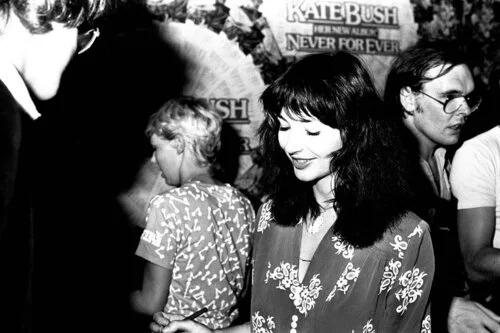
IN THIS PHOTO: Kate Bush at a Never For Ever album signing in 1980

In her bitterness and paranoia, Babooshka arranges to meet her husband, who is attracted to the character who reminds him of his wife in earlier times. The relationship is ruined only because of her own paranoia. Maybe Bush was wary of the songs being compared, but they are very different and I think having The Wedding List as a final single from Never for Ever would have been great! The Kate Bush Encyclopaedia gives examples where Bush discussed The Wedding List and its inspiration:

The Wedding List' is about the powerful force of revenge. An unhealthy energy which in this song proves to be a "killer". (Kate Bush Club newsletter, September 1980)

Revenge is so powerful and futile in the situation in the song. Instead of just one person being killed, it's three: her husband, the guy who did it - who was right on top of the wedding list with the silver plates - and her, because when she's done it, there's nothing left. All her ambition and purpose has all gone into that one guy. She's dead, there's nothing there. (Kris Needs, 'Fire in the Bush'. Zigzag, 1980)

Revenge is a terrible power, and the idea is to show that it's so strong that even at such a tragic time it's all she can think about. I find the whole aggression of human beings fascinating - how we are suddenly whipped up to such an extent that we can't see anything except that. Did you see the film Deathwish, and the way the audience reacted every time a mugger got shot? Terrible - though I cheered, myself. (Mike Nicholls, 'Among The Bushes'. Record Mirror, 1980)”.

eeeeee.jpeg

IN THIS PHOTO: Kate Bush at EMI, Manchester Square, London in 1980/PHOTO CREDIT: Brian Rasic/Getty Image

I love The Wedding List, and it is one of those songs – among many others – that one never hears on the radio! It has a terrific chorus, and Bush’s range and voice throughout is amazing! She puts so much passion into the recording, I could imagine an official video of the song would be very similar to that Christmas performance. Maybe that is a reason why it was not released as a single: having it on T.V. and seen by many sort of does the same job. As we celebrate Never for Ever turning forty, songs such as Babooshka, Breathing, Army Dreamers, and even Delius (Song of Summer) will be discussed, and I think there are some underrated cuts that might not get mentioned as much – The Wedding List is certainly one of them! I wanted to salute the track, as it is one of my favourite Kate Bush compositions, and it is a gem from an album that is absolutely stuffed full of them! I do hope that people get a new sense of appreciation and context when they listen back to Never for Ever, and they look beyond the singles to realise there are many gifts and gems to be discovered. The Wedding List is a magnificent track that always blows me away, and it is further proof (if it were ever needed) that Kate Bush was a songwriter who…

WAS always exploring and improving.

FEATURE: Annie Nightingale: Saluting a Broadcasting Pioneer: Hey Hi Hello: Five Decades of Pop Culture from Britain's First Female DJ

FEATURE:


Annie Nightingale: Saluting a Broadcasting Pioneer

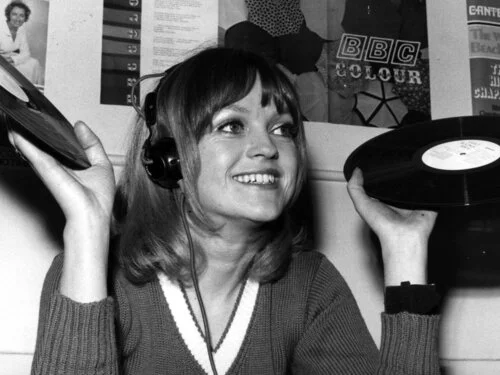
IN THIS PHOTO: Anne Nightingale in Brighton promoting the show, That’s for Me (her first T.V. job), in 1964/PHOTO CREDIT: John Pratt/Getty Images

Hey Hi Hello: Five Decades of Pop Culture from Britain's First Female DJ

___________

A few questions come to mind…

PHOTO CREDIT: BBC/David Venni

when I think about the remarkable Annie Nightingale. At eighty years old, she is one of the most influential, long-running broadcasters in the world, so I wonder why she has not been made a Dame. Maybe she would not want such an honour, but I feel there are few more deserving of such a lofty honour than her! I also wonder why Nightingale has not been given a show on BBC Radio 6 Music, as she has the sort of music tastes and eclectic nature that would be perfect for the station! This year, Annie Nightingale celebrates five decades of broadcasting and presenting for the BBC. Annie Nightingale was the first female D.J. on the BBC in 1970, and she holds the Guinness World Record for the longest-running radio show on the station. As a D.J. and broadcaster on radio, T.V. and the live music scene, Nightingale has been a hugely important and inspiring force. I will talk about her memoir/new book in a minute, but the fact she is still at BBC Radio 1 after fifty years - where she presents the fabulous Annie Nightingale Presents - is truly inspiring! It is a massive year for a broadcaster who has broken barriers down and inspired a legion of broadcasters/D.J.s around the world. What I love about Annie Nightingale (among other things!) is the fact that she is so relentless cool and curious. There is no slowing her passion for great new music, and she remains one of the most influential and important champions of new music in the world! I heard Nightingale speaking with Gemma Cairney on BBC Radio 6 Music yesterday (3rd September), and she revealed how she admires great young artists like Little Simz and Billie Eilish.

Nightingale is such a fascinating broadcaster and, alongside her BBC Radio 1 colleague, Annie Mac, her guidance and championing is vital. I will move on, but I want to bring in an interview from The Guardian where we learn more about Nightingale’s earliest days, and what it was like joining BBC Radio 1 when there was an all-male line-up:

Being an only child is fundamental to Nightingale’s personality. She had to reach out to make friends, and she enjoyed being a part of different gangs (which she still does, she says, only now these are pockets of people in different international cities who she’s met through her musical travels).

Her outward-looking nature also went against the experiences of the many suburban women she lived alongside. “They were so competitive with each other, and so isolated – all they had to look forward to was a new washing machine. Very early on, I remember thinking, hang on, this isn’t fantastic.” A small Bakelite wireless bought for Nightingale by her father gave her a glimpse of distant worlds through Radio Luxembourg. By her late teens, she was also partying with jazz-loving beatniks at Eel Pie Island, less than a mile down the road.

She trained as a journalist, and by the mid-1960s had moved to Brighton to work at the local newspaper, the Argus, as a reporter. She covered court reporting, council meetings, and once interviewed a young Sean Connery at a local Wimpy. Here, she also met Ready Steady Go! producer Vicki Wickham, who is still a close friend, backstage at a Dusty Springfield gig.

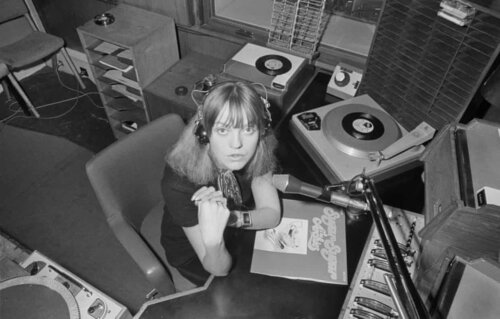
IN THIS PHOTO: Annie Nightingale in 1970, the year she joined BBC Radio 1 as its first female presenter/PHOTO CREDIT: BBC

Wickham recruited her as a presenter for her first stint on TV, in a short-running TV show, That’s For Me. Later, Nightingale had a pop column at the Argus, Spin With Me, through which she got to know bands well, including the Beatles. (She’s still in touch with Paul McCartney, and wrote the essay for his album reissue of Tug of War and Pipes of Peace in 2015. He also called Annie live on air when she was presenting Old Grey Whistle Test the night after John Lennon died, to get her to pass on thanks to their fans on behalf of him, Yoko, George and Ringo.)

When Radio 1 launched in 1967 with its all-male DJ roster, Nightingale was desperate to join the station, but they didn’t actively look for a female presenter for three years. DJs were viewed as husband substitutes for bored housewives; it was only the Beatles’ press officer Derek Taylor vouching for her, she says, that got her the job, despite her “trying to kick the door down myself”.

There is (quite rightly) a lot of focus on Annie Nightingale right now. I think the fact that there are so many great women in radio can be traced to Nightingale. Of course, it is their talent that got them there, but Nightingale’s appointment on BBC Radio 1 was a huge move, and I am sure she faced a lot of sexism in the early days.

PHOTO CREDIT: Andrew Crowley

There are still big radio stations where there is a majority of male broadcasters, and I do hope that this is redressed at a time when sexism and imbalance continues strong – the recent announcement of the all-male (six of them) headliners for next year’s Reading and Leeds festivals raised more than a few eyebrows! Another very cool thing about Annie Nightingale is the fact that she was a friend of The Beatles, and she was pretty close with John Lennon and Yoko Ono. I have included an episode of I Am the Eggpod (a podcast run by Chris Shaw that celebrates Beatles and solo Beatles albums) - where Nightingale talks about Lennon and Ono (and the 1980 album, Double Fantasy) but, in this recent interview, more love is aimed in the direction of a broadcasting legend:

It’s now 50 years since Nightingale became Radio 1’s first female broadcaster (it took the station another 12 years to hire a second woman). At 80, she is Radio 1’s longest-serving presenter, and also its most cherished (cementing her national treasure status, she was recently a guest on Desert Island Discs). And though she never sought fame, it arrived anyway. With her backcombed hair and oversized shades, Nightingale is a rock star of radio who has tutored the nation in her exquisitely forward-looking music tastes. Unlike many of her early peers, she never catered to her age group or background. It’s testament to her ability to move with the times that most of her listeners are now roughly 60 years her junior.

Nightingale – who this year was awarded a CBE for services to broadcasting – has never lost her love of unearthing new sounds. Despite starting out as a music reviewer, she was always more enthusiast than critic and long ago disregarded the old Lester Bangs edict that writers shouldn’t be friends with musicians. She was famously close to The Beatles, who were wary of the media and yet welcomed her into their inner sanctum at Apple Studios. She knew about John Lennon’s relationship with Yoko Ono long before they went public, but kept shtum”.

This all brings me, semi-neatly, to a book that everybody should own! Hey Hi Hello: Five Decades of Pop Culture from Britain's First Female DJ is an indispensable volume written by a real icon. I have been quoting a lot from other sources, but I feel it is important to learn about Nightingale and hear from her. If you want a true and deep representation of Nightingale, then I suggest you buy the book. This is how Waterstones have described it:

Hey Hi Hello is a greeting we have all become familiar with, as Annie Nightingale cues up another show on Radio One. Always in tune with the nation's taste, yet effortlessly one step ahead for more than five decades, in this book Annie digs deep into her crate of memories, experiences and encounters to deliver an account of a life lived on the frontiers of pop cultural innovation.

IMAGE CREDIT: White Rabbit

As a dj and broadcaster on radio, tv and the live music scene, Annie has been an invigorating and necessarily disruptive force, working within the establishment but never playing by the rules. She walked in the door at Radio One as a rebel, its first female broadcaster, in 1970. Fifty years later she became the station's first CBE in the New Year's Honours List; still a vital force in British music, a dj and tastemaker who commands the respect of artists, listeners and peers across the world.

Hey Hi Hello tells the story of those early, intimidating days at Radio One, the Ground Zero moment of punk and the epiphanies that arrived in the late 80s with the arrival of acid house and the Second Summer of Love. It includes faithfully reproduced and never before seen encounters with Bob Marley, Marc Bolan, The Beatles and bang-up-to-date interviews with Little Simz and Billie Eilish.

Funny, warm and candid to a fault, Annie Nightingale's memoir is driven by the righteous energy of discovery and passion for music. It is a portrait of an artist without whom the past fifty years of British culture would have looked very different indeed”.

Lots of love to the boundless Annie Nightingale, whose energy and love of music continues untarnished and slowed. I hope that we get to hear her on the airwaves for many years to come, as she remains one of the most important voices around! I can only imagine how hard it was in the late-1960s and early-1970s entering radio and being surrounded by men. Perhaps not all of her colleagues were sexist, but there would have been challenges and, as she has said herself, the earliest shows were not always smooth – the wrong song being played or there being these gaps of silence! It is testament to her talent, popularity, hunger and passion that she helped change radio and, in 2020, I think her example and story should be turned into a film – maybe that is a step too far, but who wouldn’t want to see an Annie Nightingale biopic?! I think it would be really arresting and inspiring. I will leave things there, but I want to send congratulations to Nightingale on hitting that milestone. Nightingale’s fiftieth anniversary at BBC Radio 1 will be marked by two documentaries on BBC T.V., and a series of events on BBC Radio 1. It is a very fitting and deserved tribute to…

IN THIS PHOTO: Annie Nightingale on BBC Radio 1 in 1970/PHOTO CREDIT: Evening Standard/Getty Images

A real colossus of radio and broadcasting!

FEATURE: The September Playlist: Vol. 1: All Together for Black Joy. Black Peace. Black Justice

FEATURE:


The September Playlist

IN THIS PHOTO: Poppy Ajudha/PHOTO CREDIT: Harry McCulloch

Vol. 1: All Together for Black Joy. Black Peace. Black Justice

__________

THIS edition of…

IN THIS PHOTO: SZA/PHOTO CREDIT: Nathaniel Goldberg/GQ

the weekly Playlist features some really good new tracks. There are fresh cuts from Poppy Ajudha, SZA (ft. Ty Dolla $ign), Arab Strap, Father John Misty, Tricky (ft. Marta), ANOHNI, Julia Stone, Hot Chip, Declan McKenna, and The Pale White. It is a typically eclectic and busy week for music, with so many gems in the pack. Alongside the aforementioned artists we have Emmy the Great, Daniel Avery, Saint Saviour, Adrianne Lenker, Temples, and many others. Settle back and investigate this week’s best tracks that are guaranteed to give you the kick and extra motivation…

IN THIS PHOTO: Tricky

TO see you on your way.

ALL PHOTOS/IMAGES (unless credited otherwise): Artists

__________

Poppy Ajudha - Black Joy. Black Peace. Black Justice

PHOTO CREDIT: Campbell Addy

SZA (ft. Ty Dolla $ign)- Hit Different

Arab Strap - The Turning of Our Bones

ANOHNI - R.N.C. 2020

PHOTO CREDIT: Mustafah Abdulaziz

Tricky (ft. Marta) Like a Stone

AURORA - The Secret Garden

PHOTO CREDIT: Tom Jamieson

Father John Misty - Main Man

Anna Straker & Gabrielle Aplin - Good Days Bad Days

The Rolling Stones All the Rage

PHOTO CREDIT: Brooke Ashley Barone

Julia Stone - Unreal

zzzz.jpg

Daniel Avery - Lone Swordsman

Saint Saviour Taurus

Hot Chip - Candy Says (Late Night Tales: Hot Chip)

zzz.jpg

PHOTO CREDIT: Ro Murphy

Foxes - Friends in the Corner

PHOTO CREDIT: Nicholas O'Donnell Photography

TV People - Nothing More

sss.jpg

PHOTO CREDIT: Phil Sharp

Girlhood Queendom

aaaa.jpg

Declan McKennaRapture

ddd.jpg

Emmy The Great - A Window/O’Keeffe

PHOTO CREDIT: Fiona Garden

The Pale White - Take Your Time

Fickle Friends What a Time

PHOTO CREDIT: Alex Franco

Actress, Sampha - Walking Flames

Carly Pearce Next Girl

Dagny - It's Only a Heartbreak

Mabes Danny

Paloma Faith Better Than This

The Jaded Hearts Club - Love's Gone Bad

PHOTO CREDIT: Genesis Báez

Adrianne Lenker anything

Temples Paraphernalia

aaaa.jpg

Gia Woods CHAOS

Daniela Andrade Puddles

qwww.jpg

FLETCHER The One

Matilda Mann - Happy Anniversary, Stranger

Laurence Guy The Spirit

Bow Anderson Island

Monica, Lil Baby Trenches

Blithe If I Ain’t the One

Sølv Gentle Riot

FEATURE: Fell for the Physical: Will the Recent Surge of Physical Sales Continue?

FEATURE:

Fell for the Physical

PHOTO CREDIT: @joanna_nix/Unsplash

Will the Recent Surge of Physical Sales Continue?

___________

ALTHOUGH there have been some bad points…

PHOTO CREDIT: @burst/Unsplash

and it has been a tough year, there have been some positives that have come from everything. It was scary, when lockdown started earlier in the year, whether record shops would be able to survive and whether people would still be able to buy physical music easily! Not only are record shops open but, as the first drop day of Record Store Day happened on 29th August, that has really shown that people want to get out there and buy music! Whilst we cannot move as freely as before and some people are staying away from record shops, it appears many have missed that community and experience you get from buying from a shop. As NME report, Discogs have reported how online sales have boomed:

Online music marketplace Discogs says global sales on the platform in the first half of 2020 have increased dramatically during lockdown, with vinyl, CD and cassette sales seeing a surge.

According to their mid-year report released last Friday (August 28), physical sales on the Discogs Marketplace rose 29.69 per cent – 4,228,270 orders – between January and June this year, compared to the same period last year. A dramatic spike in sales can be seen from April, shortly after the coronavirus pandemic forced many record stores to shut their physical shopfronts.

The report attributes the rise in sales partially to a larger number of users as lockdown saw more shoppers turning online, along with “a desire to support small business”. The report also cites independent music retailers making their catalogues available online as a significant contributing factor, prompted by lockdown measures around the world forcing stores to close their physical stores, at least temporarily.

PHOTO CREDIT: @imani_bht/Unsplash

The most substantial year-over-year improvement came via vinyl record sales, which increased 33.72 per cent with over 5.8 million units sold. CD and cassette sales weren’t far behind, demonstrating a 31.03 per cent (1.6 million units sold) and 30.52 per cent (over 137,000 units) increase respectively. Vinyl sales accounted for over 75 per cent of transactions on the platform in the first half of the year.

Overall, more than 7.6million pieces of physical music were sold by independent sellers around the world throughout the first six months of the year – an overall 33.83 per cent increase over the same period last year”.

Vinyl sales have been rising for a while now, and it is good to see people buying physical music online and going out to shops. There is always talk of how digital is taking over, and some feel that vinyl is only bought by a small sector of people. I think that the surge that has been seen will continue into 2021. Of course, if the pandemic situation worsens, record shops might be forced to close, and online sales might also be affected. My feeling is that the surge will continue, but it will level off in the coming weeks. I think a lot of people have been making up for lost time and, at a particularly rough time, there has been a slight shift away from the digital to the physical.

PHOTO CREDIT: @brett_jordan/Unsplash

What has amazed me most is that the sales of C.D.s and cassettes have been pretty healthy. There is talk as to whether the C.D. is dying and, whilst they are not selling as much as they did in their heyday, people are still snapping them up, and I hope we will see a revival and a change at record shops – where there is more room for C.D.s and they are given more focus. It is strange that cassettes are doing well, and their revival has also been documented. As we move forward, I think people are going to keep physical sales healthy, as we have not really been able to go to gigs and support artists like that way, so buying their albums is a good alternative. I think people love that tangible feel of a physical album, and especially so at a time when we cannot get that close to one another. Let’s hope things regarding the pandemic will improve in the coming months, but it is heartening to see record shops do a great trade, and online sales have been really impressive. There is no telling what the future holds in terms of lockdown and virus numbers, but I think the rise of physical sales will continue to climb – maybe less steeply than the past couple of months. It is always nice to highlight some good news in the music industry, and let’s hope that the rude health and success of physical sales…

PHOTO CREDIT: @iampatrickpilz/Unsplash

CARRIES on unabated.

FEATURE: A Buyer’s Guide: Part Eighteen: Elton John

FEATURE:

A Buyer’s Guide

x.png

IN THIS PHOTO: Elton John in 1973/PHOTO CREDIT: Michael Putland

Part Eighteen: Elton John

___________

THERE are some artists…

who burn brightly for a little while, but then they seem to fade away. There are others who continue to record material for decades, and there seems to be no signs of their career ending. Elton John’s debut album, Empty Sky, arrived in 1969 and his most current album, Wonderful Crazy Night, was released in 2016. He is in the middle of his final tour – which will be delayed until next year -, and the influence of Elton John cannot be underestimated. Together with songwriting partner Bernie Taupin, there is nobody quite like him! John feels that the modern Pop charts do not contain real songs so, for that reason, I wanted to highlight his work and show what a master he is. If you need a guide regarding the best work of Elton John, then I think I have…

PHOTO CREDIT: Rex Features

GOT it covered.

____________

The Four Essential Albums

Elton John

Release Date: 10th April, 1970

Label: DJM

Producer: Gus Dudgeon

Standout Tracks: Take Me to the Pilot/Border Song/The Greatest Discovery

Buy: https://www.discogs.com/Elton-John-Elton-John/master/84203

Stream: https://open.spotify.com/album/0C2grVR8DnJnL8rg7OP6Zm?si=Z0SvhmepT6mkIwCx6CJ6iA

Review:

Empty Sky was followed by Elton John, a more focused and realized record that deservedly became his first hit. John and Bernie Taupin's songwriting had become more immediate and successful; in particular, John's music had become sharper and more diverse, rescuing Taupin's frequently nebulous lyrics. "Take Me to the Pilot" might not make much sense lyrically, but John had the good sense to ground its willfully cryptic words with a catchy blues-based melody. Next to the increased sense of songcraft, the most noticeable change on Elton John is the addition of Paul Buckmaster's grandiose string arrangements. Buckmaster's orchestrations are never subtle, but they never overwhelm the vocalist, nor do they make the songs schmaltzy. Instead, they fit the ambitions of John and Taupin, as the instant standard "Your Song" illustrates. Even with the strings and choirs that dominate the sound of the album, John manages to rock out on a fair share of the record. Though there are a couple of underdeveloped songs, Elton John remains one of his best records” – AllMusic

Choice Cut: Your Song

Honky Château

Release Date: 19th May, 1972

Labels: Uni (U.S.)/DJM (U.K.)

Producer: Gus Dudgeon

Standout Tracks: Honky Cat/I Think I’m Going to Kill Myself/Mona Lisas and Mad Hatters

Buy: https://www.discogs.com/Elton-John-Honky-Ch%C3%A2teau/master/85555

Stream: https://open.spotify.com/album/2ei2X6ghPnw7YRwQtAH075?si=1ouhB6PqTYmkolHhbgkXxQ

Review:

On the other hand, no Elton John album has ever sounded looser; the bogus over-production that marred both of the earlier releases at crucial moments is never in evidence, and the album sounds more intimate and personal than either of its predecessors. John and associates are obvious creatures of the studio and so shy away from nothing in terms of technique — there is plenty of vocal double tracking, but their use of it is more natural than ever before.

“Mona Lisas and Mad Hatters” shows how much John can really do in the space of a single cut. Using minimal instrumentation and singing one of Taupin’s most direct lyrics, John effortlessly reveals the myth beneath the myth of “… a rose in Spanish Harlem.” He expresses his involvement with the city, his need for its people, and his final desire to be alone through one of his best tunes, simplest arrangements, and most natural vocal performances.

Honky Château is ultimately a solid work with enough happening to keep someone listening for weeks trying to absorb everything on it. And, as each additional layer is revealed to the listener, he is constantly reminded that this is one of the rare albums released this year worth pursuing at length, for it rewards each additional playing with increased enlightenment and enjoyment” – Rolling Stone

Choice Cut: Rocket Man

Goodbye Yellow Brick Road

Release Date: 5th October, 1973

Labels: Uni (U.S.)/DJM (U.K.)

Producer: Gus Dudgeon

Standout Tracks: Candle in the Wind/Bernie and the Jets/Saturday Night's Alright for Fighting

Buy: https://www.discogs.com/Elton-John-Goodbye-Yellow-Brick-Road/master/30577

Stream: https://open.spotify.com/album/5WupqgR68HfuHt3BMJtgun?si=j4VNGhbDS-CingcoGE37uw

Review:

Born Reginald Kenneth Dwight, Elton John became one of the biggest stars of the glitz n’ glamour fueled ‘70s, racking up seven consecutive number one albums and scoring at least one Top 40 hit every year until 1996. Following his 1972 U.S. breakthrough Honky Chateau, which spawned the hits “Rocketman” and “Honky Cat,” John released two back-to-back albums, Don’t Shoot Me I’m Only The Piano Player and the now-classic Goodbye Yellow Brick Road, which displayed the singer’s talent for crafting infectious pop/rock ditties that evoked a diverse span of genres ranging from mellow piano music to full-out rock n’ roll. The double-album begins with the dirge-like, 11-minute “Funeral For A Friend,” which opens with a foreboding organ that later gives way to swirling prog-rock guitars, piano, and psychedelic keyboards. The complex song is instantly juxtaposed by the album’s second track, the simple “Candle In The Wind,” John and perennial songwriting partner Bernie Taupin’s famously sentimental homage to Marilyn Monroe. (The song would later become the fastest selling single in history after John revised it as an ode to the late Princess Diana in 1997.) Accentuating Goodbye’s impressive diversity is the smooth, lounge-y “Bennie And The Jets,” with John’s high reaching falsetto giving the track a cabaret feel. The album doesn’t shy away from John’s signature subversion either: “All the Girls Love Alice” is a masked sweet ballad that’s really about a teenage lesbian who does “favors” for older women, while the hit “Sweet Painted Lady” is a jaunty song about prostitution: “Getting paid for being laid/Guess that’s the name of the game.” From the catchy title track and the orchestral “I’ve Seen That Movie Too” to songs like “Grey Seal,” with its high-adrenaline rush of pounding piano keys and won’t-leave-the-head-for-days hook, it’s the balance between melancholic ballads (where John’s vocals and strong narratives take center stage) and the pure rock n’ roll tunes that makes the album work as a whole. Goodbye Yellow Brick Road is such an epic, varied display of emotional depth and soul it should be classified as some sort of operetta” – SLANT

Choice Cut: Goodbye Yellow Brick Road

Songs from the West Coast

Release Date: 1st October, 2001

Labels: Rocket/Mercury

Producer: Patrick Leonard

Standout Tracks: The Emperor's New Clothes/Dark Diamond/I Want Love

Buy: https://www.discogs.com/Elton-John-Songs-From-The-West-Coast/master/126938

Stream: https://open.spotify.com/album/2TkOhyL6D0hgVsyz31vKWa?si=suV6sxC-Rc6N7fBz9wyYAg

Review:

In the 1970s, when Elton John had six consecutive American number ones, he and lyricist Bernie Taupin were regarded as major talents. Decades seemingly dedicated to messing about have turned John into a national treasure, but along the way his music has fluttered into the background. Now comes Songs from the West Coast and, almost inconceivably, John is reborn as a serious artist. The album harkens to his golden years, but its quality renders it as timeless as Goodbye Yellow Brick Road. It's a simple but dramatic affair, performed with a sympathetic band, capable of turning Original Sin and I Want Love into grandstanding but uncluttered epics. Meanwhile, John sings his heart out, and creates soaring keyboard melodies to Taupin's ice-pick-sharp lyrics. Birds and Mansfield are the pick of a splendid bunch. Maybe the coasting days are over” – The Guardian

Choice Cut: Original Sin

The Underrated Gem


Tumbleweed Connection

aa.jpg

Release Date: 30th October, 1970

Labels: Uni (U.S.)/DJM (U.K.)

Producer: Gus Dudgeon

Standout Tracks: Come Down in Time/My Father’s Gun/Talking Old Soldiers

Buy: https://www.discogs.com/Elton-John-Tumbleweed-Connection/master/84216

Stream: https://open.spotify.com/album/03zfU3IwWmymKoaWnwFNaY?si=NLan04icQGGlqihCGGLDrg

Review:

It’s the sound of a songwriting team hanging on to their perceived rock credibility, not yet stumbling on the pop chops that sent the Elton brand supernova. Produced by Gus Dudgeon with orchestral arrangements by Paul Buckmaster, this is almost as laden with Americana as Bernie Taupin’s lyrics. Elton sings in a distinctly Yankee twang and the influence of The Band’s Music from Big Pink is evident throughout. Ballad of a Well-Known Gun sets out the album’s stall, a mid-tempo country-rocker gilded by period guitar fills from Caleb Quaye and a backing choir including one Dusty Springfield. Themes flicker here which reoccur between tracks: gunslingers young and ageing, a sepia sense of saloons and one-horse towns. My Father’s Gun and Talking Old Soldiers overtly try to enter the heads of ailing John Waynes.

The best songs are those which transcend Taupin’s Western fantasies. Come Down in Time is an exquisite ballad which remains one of John’s most under-acclaimed tracks. Where to Now St. Peter? allows itself more time to float than the formulaic structures which later became his trademark, and he exhibits a keening falsetto. Amoreena (used over the opening sequences of Sidney Lumet’s Dog Day Afternoon) bristles with drama, although Lesley Duncan’s Love Song (a rare case of Elton covering a friend’s song) can’t glide past its cheesy lyrics. The climactic Burn Down the Mission – a live showstopper at the time – enjoys a grandstand finish, all bombast and infectious enthusiasm. Relatively (it’s sold a million) overlooked in the canon, Tumbleweed… is a crafted, often impassioned work” – BBC

Choice Cut: Ballad of a Well-Known Gun

The Latest/Final Album


Wonderful Crazy Night

Release Date: 5th February, 2016

Labels: Mercury/Virgin EMI/Island

Producers: T Bone Burnett/Elton John

Standout Tracks: Blue Wonderful/A Good Heart/Looking Up

Buy: https://www.discogs.com/Elton-John-Wonderful-Crazy-Night/master/953440

Stream: https://open.spotify.com/album/2n7B7svtcYIrYJFtYREauV?si=PP5_X9l-Sy6CYIgliEInpQ

Review:

Such vivid keyboard detail is a recurring feature, as on the brooding introduction to the driving “In the Name of You” and the vaguely psychedelic “Claw Hammer”. The latter also showcases nicely textured electric and acoustic guitars before the inspired introduction of jazz horns, as Taupin’s evocative lyric describes someone “holed up in your house of wax, just waiting for the fire”.

To have such a consummate piano player showcasing the instrument, as he did on his marvellous introductory run of records, adds considerable heft to the album. At times, as on “I’ve Got 2 Wings”, the sense of Americana in sound and imagery recalls the atmosphere of, say, Madman Across the Water, whereas the bare “Blue Wonderful” evokes the Eighties era of Too Low for Zero.

By the time of “Looking Up”, which introduced the album as a pre-Christmas single, we’re back into killer piano motifs and unswerving optimism. Wonderful Crazy Night is not an album of hit singles, but John knows his game is to sit on the sub’s bench these days. But still to be delivering such carefully and enthusiastically forged handiwork says much about his respect for his legacy and his audience” – The Independent

Choice Cut: Wonderful Crazy Night

The Elton John Book


Me

Author: Elton John

Publication Date: 15th October, 2019

Publisher: Macmillan

Review:

In his first and only official autobiography, music icon Elton John reveals the truth about his extraordinary life, which is also the subject of the upcoming film Rocketman. The result is Me - the joyously funny, honest and moving story of the most enduringly successful singer/songwriter of all time.

Christened Reginald Dwight, he was a shy boy with Buddy Holly glasses who grew up in the London suburb of Pinner and dreamed of becoming a pop star.  By the age of twenty-three, he was on his first tour of America, facing an astonished audience in his tight silver hotpants, bare legs and a T-shirt with ROCK AND ROLL emblazoned across it in sequins. Elton John had arrived and the music world would never be the same again.

His life has been full of drama, from the early rejection of his work with song-writing partner Bernie Taupin to spinning out of control as a chart-topping superstar; from half-heartedly trying to drown himself in his LA swimming pool to disco-dancing with the Queen; from friendships with John Lennon, Freddie Mercury and George Michael to setting up his AIDS Foundation. All the while, Elton was hiding a drug addiction that would grip him for over a decade.

In Me, Elton also writes powerfully about getting clean and changing his life, about finding love with David Furnish and becoming a father. In a voice that is warm, humble and open, this is Elton on his music and his relationships, his passions and his mistakes. This is a story that will stay with you, by a living legend” – A BBC Radio 4 Book of the Week

Order: https://www.waterstones.com/book/me/sir-elton-john/9781509853311

FEATURE: Irreplaceable: The Lockdown Playlist: Beyoncé’s Very Best Tracks

FEATURE:


Irreplaceable

q.jpg

PHOTO CREDIT: Andrew White/Parkwood Entertainment and Disney+, via Associated Press

The Lockdown Playlist: Beyoncé’s Very Best Tracks

___________

AS it is the birthday…

PHOTO CREDIT: Parkwood Entertainment

of Beyoncé today (4th September), I thought I would do a special playlist collecting her best songs. I realise I have done a few playlists lately, but I think it is good to mark important occasions and take a break from something a bit more serious. I am still calling these Lockdown Playlists, as things are not back to normal, and there are still restrictions around. For that reason, here is a selection of the best Beyoncé songs from her career. I have also included some of her songs with Destiny’s Child, and some with The Carters as well. Even if you are not a fan of Beyoncé, one cannot deny that her music has so much energy and variation. I hope there are songs in the playlist that make you move and, give you some…

PHOTO CREDIT: Buda Mendes/Getty Images

REAL energy.

FEATURE: Glamour Profession: Bringing Steely Dan to the New Generation

FEATURE:


Glamour Profession

IN THIS PHOTO: Steely Dan (Walter Becker (left) and Donald Fagen) in 1995/PHOTO CREDIT: Lynn Goldsmith

Bringing Steely Dan to the New Generation

___________

I will keep this relatively brief…

IN THIS PHOTO: Steely Dan (L-R: Jeff ‘Skunk’ Baxter, Denny Dias, Donald Fagen, Jim Hodder, and Walter Becker) pose in Coldwater Canyon on 22nd September, 1972 in Los Angeles, California/PHOTO CREDIT: Ed Caraeff

but I am of the opinion that Steely Dan remain one of the most underrated acts ever. Consisting Walter Becker (guitars, bass and backing vocals) and Donald Fagen (keyboards and lead vocals), the duo were the core of the group, and they worked with a cast of different musicians through their career. The blend of eclectic genres and the incredible musicianship, combined with stunning production and memorable songs, are reasons why Steely Dan should be considered one of the greatest groups/duos ever. Blending in humorous and cryptic (and sometimes caustic) lyrics, they were definitely a lot different to other groups of the Seventies. Founded in 1972, they broke up in 1981, but then returned in 1993. They continued to tour extensively, and 2000’s Two Against Nature arrived twenty years after Gaucho. Steely Dan released Everything Must Go in 2003, and they were inducted into the Rock & Roll Hall of Fame in 2001. With over forty-million album sales to their names, it is amazing to think how many people have not heard of Steely Dan! I guess their lack of glamour and yearning for the spotlight is a reason why some missed the band. Steely Dan stopped touring in 1974 to become a studio-only band, and I don’t think any of their songs were ever turned into a music video! I cannot think of any act like that today. Steely Dan, for so many reasons, are the epitome of cool, in the fact that they never followed their contemporaries in terms of promotion and their sound.

The real reason why I wanted to do this feature is because today (3rd September) marks three years since the world lost Walter Becker from esophageal cancer. Becker would have been seventy this year, and it such a shame that he and Donald Fagen will never tour again (there are some good videos of their previous tours). Fagen has continued to tour under the Steely Dan name, and I hope he does for many years – though the very big hole that Becker has left is noticeable and can never be replaced. Obviously, there will never be another Steely Dan album, so the chance to bring new fans in through fresh material is not an option. In November, it will be forty years since Gaucho’s release, and there have been numerous best ofs/greatest hits packages through the years – the best, The Very Best of Steely Dan: Reelin' In the Years, was released in 1985 and 1987 (there were two compilations with the same name and the exact same cover for some reason!). One does hear Steely Dan on the radio but, for the most part, I think their best-known songs are played. One hears a lot of Dirty Work, Do It Again, and Reelin’ in the Years from their remarkable debut, Can’t Buy a Thrill of 1972; occasionally we might hear My Old School from Countdown to Ecstasy (1973); Rikki Don’t Lose That Number from Pretzel Logic (1974);  Peg, and Josie from Aja (1977), and maybe Hey Nineteen from Gaucho (1980).

Although Steely Dan have not exactly left a huge archive or live performances and B-sides, so much of their material has not been played and is hardly known. I have talked before how there are very few documentaries dedicated to Steely Dan – this excellent Classic Albums documentary about Aja is must-see. Apart from a couple of their studio albums, it is hard to get hold of a decent copy of the remainder of their albums, and one has to ferret on auction sites and Amazon to get copies of their studio albums second-hand – often they can cost you a small fortune! There is an excellent Steely Dan book by Brian Sweet, but that is about it! I know Steely Dan are not as big as some artists from the Seventies, and their music didn’t necessarily have the commercial edge of many of their peers. Instead, we got this group who were committed to feel and providing the best sonic experiment. Rather than throwing out easy choruses and soundalike songs, each Steely Dan album is unique and bursting with life, layers, and nuance! I grew up round Steely Dan’s music, and I was intrigued from the very start. I have sort of gone over this in other Steely Dan features, but I want to reiterate a couple of points regarding their legacy and why there has been a real lack of retrospective examinations and documentaries.

Like me, I know so many young listeners would fall for Steely Dan, and I have argued why we need a new documentary out into the world. I discovered Steely Dan through vinyl copies of their albums and compilation C.D.s, and I know anyone can get all of their albums on streaming services. Being such studio perfectionists, I think the best way to indoctrinate a generation of new listeners is to make their albums readily available on vinyl. I have mused before why there have not been reissues of the records. Three years after the untimely passing of Walter Becker, I thought someone by now would have either re-released the albums on vinyl, or there would have been an effort to at least remaster Can’t Buy a Thrill. Aja is the only album one can easily access, and it is a real bear trying to get an affordable, good-quality copy of the other albums. It is a shame, as I do not think Steely Dan’s music is a remnant of a past time or was cool once and sounds dated now. If anything, their music sounds sharper and more amazing in 2020 than when I was listening to them back in the 1990s. They are one of the few bands/artists in history who put out filler-free albums time and time again.

One cannot really call Steely Dan a singles band, as they are a classic albums band, in the sense that every track is essential, and they were not consciously writing particular songs to get a lot of airplay and fame – maybe there was a bit of that on Can’t Buy a Thrill but, when David Palmer’s (who was their lead singer on that album) blue-eyed Soul voice took the group in the wrong direction, he was surplus to requirements by the second album! Some of their songs have a radio-friendly tone, but I think Steely Dan were much more about the quality of their albums and put out singles as a formality. As so many artists of the Sixties, Seventies and Eighties are seeing their albums remastered and are subject to retrospection, that seems to have passed Steely Dan by. It would be a shame if their music were overlooked by young listeners, as I don’t think the group have a particular demographic. Yes, there is some smart and sophisticated songwriting, but Walter Becker and Donald Fagen were never writing for the hipsters or an elite demographic. Similarly, one cannot call them Jazz-Rock or label them easily as, on every album, they were bringing in elements of other styles. I hope there are some tributes to Walter Becker today, as I can scarcely believe it has been three years since he died, but the importance and power of Steely Dan’s music remains. One can get carried away and say there should be a Steely Dan musical (which would be great), or a T.V. show that uses their songs in the story (another good idea). I think a radio documentary is long-overdue, and one would welcome the remastering of all their studio albums, alongside the essential greatest hits package – and live albums for that matter! With news that the long-lost song from Gaucho, The Second Arrangement, has been discovered, I wonder whether that will see the light of day and, in the process, set off a chain of restoration and retrospection – I sure hope so! It is a shame if the years rolled on and Steely Dan’s music was left as it is now and not opened out and reexplored. Even if they are not completely your bag, one cannot deny that they have…

s.jpg

IN THIS PHOTO: Walter Becker and Donald Fagen with their two Grammys for Two Against Nature in 2001/PHOTO CREDIT: Sam Mircovich/Reuters

SUCH an important legacy.

FEATURE: Until the Morning Fog Comes: Kate Bush’s The Ninth Wave

FEATURE:


Until the Morning Fog Comes

IN THIS PHOTO: Kate Bush in a promotional photo for The Ninth Wave/PHOTO CREDIT: John Carder Bush (from the book, Kate: Inside the Rainbow)

Kate Bush’s The Ninth Wave

___________

THIS month…


two of Kate Bush’s best albums celebrate big anniversaries. To be fair, not that many people will be spreading love about Never for Ever’s fortieth on 8th September (some sources say the album was released on 7th September; others say it is the 8th). It is a fantastic album, but I don’t think it gets the same sort of love and appreciation as Hounds of Love. On its thirty-fifth anniversary on 16th September, people around the world will be sharing their stories about Hounds of Love and which tracks are their favourite. As I have said in previous features, there is a split between the two sides of Hounds of Love. On the first, there are the tracks that are almost like a collection of singles – in fact, every one of the five tracks bar Mother Stands for Comfort were put out as a single. Even though the tracks are unconnected in terms of themes, one can get a sense of nature and the open land on Running Up That Hill (A Deal with God), The Big Sky, and Cloudbusting. Maybe that is a reach, but one senses an openness and evocative nature that takes one’s imagination into the countryside. On the other side, The Ninth Wave takes us into the ocean. There is a mix of the first-person/personal and character-based on the first side – Running Up That Hill (A Deal with God), and The Big Sky seems much more like Kate Bush talking and sharing her feelings, whilst Hounds of Love, Mother Stands for Comfort, and Cloudbusting is more Bush taking on different guises.

IN THIS PHOTO: Kate Bush in 1985/PHOTO CREDIT: Guido Harari

There is debate as to whether Bush is the heroine on The Ninth Wave, or whether she has completely taken herself out of the role and is writing from a fictional perspective. In interviews, Bush has talked about The Ninth Wave and how she spoke with friends and they agreed that being lost in water and at the mercy of the ocean is the scariest thing one can imagine! Maybe I have covered that before, but I was keen to delve into The Ninth Wave again as I think it is the crowning achievement of Hounds of Love. As much as I love the first side, the sheer sense of accomplishment and ambition of The Ninth Wave blows me away! I have written how Bush’s two suites, The Ninth Wave, and A Sky of Honey (from 2005’s Aerial) are quite rare to see in music. It is a big thing committing to a song suite, and I think it can be harder writing a series of songs that link together, rather than a series of tracks that do not have a conjoined thread and narrative. This article from the Kate Bush Encyclopedia brings in an interview from Kate Bush where she explained the origins of The Ninth Wave:

The Ninth Wave was a film, that's how I thought of it. It's the idea of this person being in the water, how they've got there, we don't know. But the idea is that they've been on a ship and they've been washed over the side so they're alone in this water. And I find that horrific imagery, the thought of being completely alone in all this water. And they've got a life jacket with a little light so that if anyone should be traveling at night they'll see the light and know they're there.

And they're absolutely terrified, and they're completely alone at the mercy of their imagination, which again I personally find such a terrifying thing, the power of ones own imagination being let loose on something like that. And the idea that they've got it in their head that they mustn't fall asleep, because if you fall asleep when you're in the water, I've heard that you roll over and so you drown, so they're trying to keep themselves awake. (Richard Skinner, 'Classic Albums interview: Hounds Of Love'. BBC Radio 1, 26 January 1992)”.

Most classic albums are remarkable because of the songs and how they hang together, but Hounds of Love is special because of its two contrasting sides! Even though Hounds of Love is not a double album, it almost seems like one considering the weight and substance of the tracks! From the run of brilliant tracks on the first side – which, if one were digging deep, could be a suite/narrative of its own – to the immensely atmospheric The Ninth Wave, it is a staggering album! Hounds of Love reached number-one in the U.K. album charts and it is regarded as one of the best albums ever – I think one big reason is because of The Ninth Wave. There is a literary adaptation of The Ninth Wave, and many people have argued whether the song cycle is her finest work.

I admire The Ninth Wave, as the concept is one that is simple and we can all understand, yet it could have come off poorly. Not to underestimate Kate Bush as a writer, but other artists could have created something a little unrealistic or boring; others would have written a few songs that sound the same, or the overall effect would have been quite unsatisfying or flat. From the heartbreaking And Dream of Sheep, through to the rescue of The Morning Fog, The Ninth Wave is an epic odyssey where the heroine strives for survival, even when all seems lost. The Ninth Wave was brought to the stage for 2014’s Before the Dawn and, whilst those there attested to its incredible impact, The Ninth Wave is even more powerful in the minds of the listener – playing the songs through headphones and just imagining everything unfold! I want to bring in a couple of articles that focus on particular songs; four songs of that second side that are especially evocative and moving. I love And Dream of Sheep, but Under Ice is the moment when the heroine’s mind slips into nightmarish territory. Bush discussed Under Ice in an interview from 1992:

Well at this point, although they didn't want to go to sleep, of course they do. [Laughs] And this is the dream, and it's really meant to be quite nightmarish. And this was all kinda coming together by itself, I didn't have much to do with this, I just sat down and wrote this little tune on the Fairlight with the cello sound. And it sounded very operatic and I thought "well, great" because it, you know, it conjured up the image of ice and was really simple to record. I mean we did the whole thing in a day, I guess. (...) Again it's very lonely, it's terribly lonely, they're all alone on like this frozen lake. And at the end of it, it's the idea of seeing themselves under the ice in the river, so I mean we're talking real nightmare stuff here. And at this point, when they say, you know, "my god, it's me," you know, "it's me under the ice. Ahhhh" [laughs] (Richard Skinner, 'Classic Albums interview: Hounds Of Love. Radio 1 (UK), aired 26 January 1992)”.

IN THIS PHOTO: Kate Bush in 1985/PHOTO CREDIT: Guido Harari

It is not just the incredible writing and the way Bush immerses herself in every track that captivates me. The musicianship and range of sounds on each track is stunning! Watching You Without Me provides another emotional hit where the heroine’s family are watching the clock and waiting for her to come home. Neither party can see or communicate with one another. Before this song, Waking the Witch arrives. I think this is the best-written track on the album because there are so many different voices and characters that mingle together. I love all the different people that are in the song and try to keep the heroine awake and alive as things look bleak. Again, I want to bring in the aforementioned Bush interview, as she explained each song – and she discussed the origins of Waking the Witch:

These sort of visitors come to wake them up, to bring them out of this dream so that they don't drown. My mother's in there, my father, my brothers Paddy and John, Brian Tench - the guy that mixed the album with us - is in there, Del is in there, Robbie Coltrane does one of the voices. It was just trying to get lots of different characters and all the ways that people wake you up, like you know, you sorta fall asleep at your desk at school and the teacher says "Wake up child, pay attention!". (...) I couldn't get a helicopter anywhere and in the end I asked permission to use the helicopter from The Wall from The Floyd, it was the best helicopter I'd heard for years for years [laughs].

I think it's very interesting the whole concept of witch-hunting and the fear of women's power. In a way it's very sexist behavior, and I feel that female intuition and instincts are very strong, and are still put down, really. And in this song, this women is being persecuted by the witch-hunter and the whole jury, although she's committed no crime, and they're trying to push her under the water to see if she'll sink or float. (Richard Skinner, 'Classic Albums interview: Hounds Of Love. Radio 1 (UK), aired 26 January 1992)”.

Every song on The Ninth Wave is essential, because they are stages of the story. One cannot help but be immersed in the action and sympathise with the heroine, hoping that she gets through things. There is this tangible feeling of the elements and time conspiring against the heroine whilst she fades in and out of hope. The fact that Bush allows the imagination to wander but explicitly documents the horrors and changing moods of the heroine stranded at sea makes The Ninth Wave so utterly intoxicating. Jig of Life is the next track from The Ninth Wave that really hits me. I think it is the tonal shift that makes it so remarkable. There is a defeatism and sense of lost hope in Watching You Without Me, whereas Jig of Life brings in fiddles, whistles, bouzokis, uilean pipes and bodrans to provide this Celtic flair!

Bush is half-Irish (her mother was Irish), and I love the fact that one of the most musically-remarkable songs on Hounds of Love takes us via Ireland. The lyrics, again, are superb, and there are so many terrific lines and phrases that stand out – “Can't you see where memories are kept bright?/Tripping on the water like a laughing girl/Time in her eyes is spawning past life/One with the ocean and the woman unfurled/Holding all the love that waits for you here”. Jig of Life is a turning point: the first sense of sunlight and hope coming through the stormy night. Again, I will let Bush herself discuss the song:

At this point in the story, it's the future self of this person coming to visit them to give them a bit of help here. I mean, it's about time they have a bit of help. So it's their future self saying, "look, don't give up, you've got to stay alive, 'cause if you don't stay alive, that means I don't." You know, "and I'm alive, I've had kids [laughs]. I've been through years and years of life, so you have to survive, you mustn't give up."

This was written in Ireland. At one point I did quite a lot of writing, you know, I mean lyrically, particularly. And again it was a tremendous sort of elemental dose I was getting, you know, all this beautiful countryside. Spending a lot of time outside and walking, so it had this tremendous sort of stimulus from the outside. And this was one of the tracks that the Irish musicians that we worked with was featured on.

There was a tune that my brother Paddy found which... he said "you've got to hear this, you'll love it." And he was right [laughs], he played it to me and I just thought, you know, "this would be fantastic somehow to incorporate here."

Was just sort of, pull this person up out of despair. (Richard Skinner, 'Classic Albums interview: Hounds Of Love. Radio 1 (UK), aired 26 January 1992)”.

Hello Earth was, according to Bush, almost too big a track to write. It is about the heroine watching from the water and looking up at the stars, as they sort of look down on her as this speck in the water. After the hope of Jig of Life, maybe there is this solace and acceptance from the heroine. Whether she is resigned to an uncertain fate or knows that rescue will come, she is a lot calmer than when we visited her during Under Ice, and Waking the Witch. The grand finale gives us the answer that we were all hoping for: that the heroine survives and is rescued after such a tortuous and unsure time at sea. Hounds of Love is such a positive album, and Bush could not well of left her heroine to die or spend days floating without knowing what lays ahead – we end on a sense of relief. There is a new-found sense of respect for the daybreak and planet from the heroine – “The light/Begin to bleed/Begin to breathe/Begin to speak/D'you know what?/I love you better now”.

IN THIS PHOTO: Kate Bush in Studio 2 of Abbey Road in 1985/PHOTO CREDIT: Guido Harari

In some ways, I wonder whether The Ninth Wave is a dream or continuation of one of the songs from the first half of Hounds of Love; maybe Bush during the album’s title track…that is just me speculating! Rather than The Ninth Wave being a suite that is distinct from the album’s first five songs it could almost be a single track about someone who is not taking things for granted after being tested and enduring such a trial. That is another reason why The Ninth Wave is such a masterful work: thirty-five years after it was released, there is a mystery and ambiguity at play. The Morning Fog takes us to the next day and, as Bush explained, it is like the curtain closing on the play:

Well, that's really meant to be the rescue of the whole situation, where now suddenly out of all this darkness and weight comes light. You know, the weightiness is gone and here's the morning, and it's meant to feel very positive and bright and uplifting from the rest of dense, darkness of the previous track. And although it doesn't say so, in my mind this was the song where they were rescued, where they get pulled out of the water.

And it's very much a song of seeing perspective, of really, you know, of being so grateful for everything that you have, that you're never grateful of in ordinary life because you just abuse it totally. And it was also meant to be one of those kind of "thank you and goodnight" songs. You know, the little finale where everyone does a little dance and then the bow and then they leave the stage. [laughs] (Richard Skinner, 'Classic Albums interview: Hounds Of Love. Radio 1 (UK), aired 26 January 1992)”.

Combined, The Ninth Wave is 26:21 of wonder that takes us through the night and into the morning. We are watching this heroine from different angles and perspectives. From under the ice and above the Earth to under the sea and inside her mind, we also visit her parents’ house and hear these voices plead for the woman to survive. It is such a wonderful work where each song is so different and deep – that is why I wanted to focus on a few of the songs and why they are so interesting. So many people talk about Hounds of Love’s first side, because that is where the singles are and, with Mother Stands for Comfort, you have a non-single that could well have been released – even if it is darker and perhaps not as commercial as other songs on that side. I think The Ninth Wave is a suite that was begging for some sort of theatrical or filmic realisation and, though Bush presented it during her Before the Dawn residency six years ago, might there be room for a short film of the songs at some point? I have speculated before, but it is a question that keeps coming back to mind! On 16th September, we will bow and salute Hounds of Love and talk about how influential it is. The sublime The Ninth Wave is a song suite so many emotions, stories, and colours, and it is a series of songs that one keeps coming back to over and over…

IN THIS PHOTO: The album cover for Hounds of Love/PHOTO CREDIT: John Carder Bush (from the book, Kate: Inside the Rainbow)

EVEN though we know what the outcome is!

FEATURE: Some Things Never Change: Will Reading and Leeds’ Headline Slots Always Be Reserved for Men?!

FEATURE:


Some Things Never Change

eeeee.jpg

IMAGE CREDIT: @OfficialRandL

Will Reading and Leeds’ Headline Slots Always Be Reserved for Men?!

___________

ON Thursday (3rd September)…  

IN THIS PHOTO: Liam Gallagher is one of the confirmed headliners for Reading & Leeds 2021/PHOTO CREDIT: Jenn Five/NME

the tickets for next year’s Reading and Leeds festivals go live. There are many people excited to get back to these festivals, as this year has seemed very bare! Whilst Glastonbury’s 2020 line-up saw women outnumber men on the bill and include one female headliners (2020) - Taylor Swift -, the story for next year’s Reading and Leeds festivals is predictably dire: there are no female headliners on the bill once again! This article from The Independent explains more:

The Reading and Leeds festival lineup for 2021 shows that organisers have failed to book a female headliner for the seventh consecutive year.

The event, which has long been criticised for billings that are skewed towards male artists and male-fronted bands, has added three headline slots – totalling six – and a second “main stage”.

These are being filled by Stormzy, Liam Gallagher, Disclosure, Queens of the Stone Age, Catfish and the Bottlemen, and Post Malone.

Next year will mark the third time that US rapper Post Malone has performed on the main stage, after his spot ahead of headliners Fall Out Boy and Travis Scott in 2018, and a headline slot in 2019.

The last time a female headliner appeared at Reading and Leeds was Paramore in 2014, on a co-headline slot with Queens of the Stone Age.

With the exception of Arcade Fire (who are co-fronted by singers Win Butler and Régine Chassagne), Paramore are the only female-fronted act to have headlined Reading and Leeds in more than two decades.

zzzz.jpg

IN THIS PHOTO: Doja Cat is one of only a few female artists announced so far for Reading and Leeds 2021

The 2020 lineup featured headliners Stormzy, Rage Against the Machine, and Liam Gallagher. Rage Against the Machine will not perform at next year’s event.

The Independent has contacted representatives for Reading and Leeds for comment.

Other artists announced to perform at Reading and Leeds in 2021 include AJ Tracey, Lewis Capaldi, Ashnikko, Two Door Cinema Club, Beadadoobee, DaBaby, Doja Cat, Mabel, Madison Beer and Sofi Tukker”.

There has been a lot of reaction online since the announcement was made regarding no female headliners and, when the tickets go online, more people will react. It seems to be the same old tale with Reading and Leeds. As they diversify in terms of genre, gender is still a big issue! There are so few women on the bill to begin with but, as 2020 has been dominated by women, why have none of them been rewarded with a headline slot!? Not only have Fiona Apple, Dua Lipa, Charli XCX, HAIM, Rina Sawayama, Laura Marling, and Phoebe Bridgers created masterful albums over the past year or two…there are countless other bands and solo artists with incredible women leading. There is no doubt that the talent is out there, and one always hears arguments (from men mostly) that say the reason men dominate the headline slots at Reading and Leeds is because male acts are more commercial and profitable. That is not the case, and I think it is another year of the organisers hiding behind excuses! Also, there is this laziness regarding the same acts being booked.

IN THIS PHOTO: HAIM released one of this year’s best albums with Women in Music Pt. III, and they would make perfect headliners/PHOTO CREDIT: Paul Thomas Anderson

Not that the headliners for next year are bad: they are lazy, and one does not exactly salivate over their inclusion! There are so many fresh female artists who have warranted a place as a headliner, and it is not just the fault of Reading and Leeds’ boss, Melvin Benn. He is not especially progressive or reactive, but one cannot entirely put the buck at his feet. There are labels and record bosses that are either not putting their artists out to festivals, and there is this fear, I think, that is Reading and Leeds did include female headliners, there would be complaints from the punters - and there doesn’t seem to be any appetite to change. I think some would moan, but many want to see equal representation, or at the very least ONE female headliner! One could list dozens of women who could headline, and each passing month reveals another stunning album by a female artist. As other festivals are slowly moving towards a fifty-fifty bill, and others are starting to include women as headliners, Reading and Leeds just highlights a glaring issue that afflicts most festivals. If there does need to be a collective kick up the backsides of festivals, I think Reading and Leeds is especially flawed and predictable. There are options available to force action. Women booked for the festivals could refuse to play, and people could boycott the festivals altogether. Maybe the balance will never shift but, as six male headliners have been booked for Reading and Leeds next year, it is a disgrace that women have been ignored once more. Melvin Benn and his team need to open their eyes to the wave of female talent out there and start representing them. Reading and Leeds with each passing year, is in danger of becoming…

IN THIS PHOTO: Lizzo is another name that would make for a popular headliner/PHOTO CREDIT: Linda Nylind/The Guardian

A stain on the festival scene.

FEATURE: Spotlight: Courtney Marie Andrews

FEATURE:


Spotlight

Courtney Marie Andrews

___________

WHILST this year has seen some…  

zzzz.jpg

PHOTO CREDIT: Kendall Lawren Rock

incredible albums arrive from some of music’s best-known names, I think it is the albums made by those who are slightly less-well-known that really resonate – to me, at least. I am a fan of Courtney Marie Andrews and her latest album, Old Flowers, was released back in July. It was the seventh studio album from the twenty-nine-year-old Andrews – who must be one of the most prolific and productive young artists in music. Straddling Americana and Folk, the album has been met with universal acclaim, and one does not need to be steeped in those genres to bond with the album. The songwriting is so strong, and the vocal performances are stunning! It really is an album that will get into the heart and inspire the mind. I will talk about that album towards the end, but I want to bring in a few interviews that give more detail and depth regarding Andrews and her beginning. In this interview from The Times from this year, we learn more about her early years:

As a solo female artist travelling around the US from her teens onward, Andrews also had to learn how to be tough. Born on the fringes of Phoenix to a roofer father and a mother who worked in the local branch of the budget retail store Target, she started singing aged two. From the age of five she was begging her mother to take her to a Phoenix store that sold CDs for karaoke sessions.

“There’s no rhyme or reason to it,” she says of her calling. “My parents weren’t musical. I think it started because I loved musicals and I liked writing stories, and when I realised you could do both music and stories in the form of a song I was hooked. Mum was very much a ‘be your own person’ type of parent, so that helped too, and my actual career came from a strong desire to get out of Phoenix. Growing up in the desert feels like being on an island. It is so far from everything”.

It is quite amazing that Andrews did get into music, and it doesn’t seem like there was any great support and encouragement from her family. Not that this was deliberate at all: they had different passions, and Andrews’ parents’ upbringings must have been very different. In any case, it is wonderful that Andrews got into music. Although she has been putting out albums for a decade, her breakthrough was 2016’s Honest Life. Since then, Andrews has been putting out music quite regularly, and she has grown and developed between each album. It has been a strange year for her and all artists but, as The Times’ interview also revealed, she has experienced some personal upheaval and disruption:

There is a kind of dark irony to it. For the first time since leaving her family home in Phoenix, Arizona, aged 16 for the wandering life of a hard-touring musician, in 2019 the country rock singer Courtney Marie Andrews found a home of her own in Nashville, Tennessee. Then in early March this year, tornados ripped the city apart. Then coronavirus hit. Then the city’s mayor, John Cooper, declared a state of emergency, as protests against the death of George Floyd led to riots that culminated in the torching of Nashville’s courthouse.

“It’s been a crazy few months,” says Andrews, 29, speaking from her (still standing) home in East Nashville. “The tornado left parts of the city looking like war zones. My friend’s house was actually lifted off the ground. The musicians were locked down first because we saw the seriousness of [coronavirus] out on tour, but the common working man in Nashville still doesn’t believe it’s true. I feel like if you just focus on the bad during a state of crisis it can become overwhelming very quickly, however, so you have to find silver linings. I’ve certainly been hearing the birds singing in Nashville a lot more”.

I would urge people to go onto Spotify and listen to as many Courtney Marie Andrews records as possible, and buy the ones that you really like. I think her latest album is her finest, and many other people agree. I often listen to albums and wonder what happened in that artist’s life before they started writing the songs; what were the catalysts for the tracks, and how much of their personal experiences and trials are considered. For Old Flowers, I think a lot of the songs’ D.N.A. can be traced back to 2019 and a relationship break-up Andrews faced. When Andrews spoke with The Independent this year, she talked about that 2019 break-up and the impact it had:

When Courtney Marie Andrews’ nine-year relationship ended, a few hours into 2019, the American musician got busy being heartbroken. She drove to the Smoky Mountains just to drive back. She danced with a Portuguese boxer and cried on his shoulder in a Fado cafe. She read Mary Oliver poetry. She didn’t listen to music – “it hurt too much” – but she did write it. And she was repulsed by every song she came out with

“I was just so disgusted with the way I felt that I couldn’t listen back to them,” says the 29-year-old, speaking over the phone from Nashville, Tennessee. “I was embarrassed to play them for people. I was embarrassed by my vulnerability. Maybe I didn’t like who I was in those songs. But the thing is that they were really me in that moment.”

Every one of those songs made it on to Andrews’ new album, Old Flowers, a rich country-folk record full of catharsis and contradiction. Written alone late at night – in Arizona, Lisbon, Nashville and London – it feels designed to be listened to that way, too”.

The title of the album, Old Flowers, does suggest a love that has soured and died. Although the songs on the album are not hugely heavy and downcast, there is a lot of emotion and honesty that comes through; a very personal record where Andrews commits to every moment in every song. It must have been a tough process to write and record the songs. Andrews chatted with Americana UK about the process and what it was like reflecting on a tough period on Old Flowers:

Given these songs and this album document a hugely emotional time in your life how hard were these songs to write? Did they come easy, or was it hard to find the right words and music to reflect the situation.  I mean, did they take on their own life as the emotive input came out?

These songs came very quickly to me– some under fifteen minutes.  I was acting as my own therapist in some of these narratives, so writing this record came as a relief.  It felt like I could finally reckon with these truths, enabling me to finally let go.

It feels such a personal record, do you think you were writing it solely for yourself or is there always an eye, as a songwriter, to somehow be aware as to connect universal themes?  Or is our input as a listener in this case just that, we listen?

Personal records generally end up being the most universal in a lot of ways because if you have felt something deeply, with matters of the heart, most likely the listener has as well. I think heartbreak is one of the most universal themes of all. It’s age-old, that thing… love”.

If you have not bought Old Flowers, then make sure you do, as it is one of this year’s best releases, and I wonder – with a bit of distance behind her past relationship break-up and some catharsis on the record – where Andrews goes from here. Will the next album be one where she reacts to new love and an exciting new stage in life? She would have turned thirty by that time, so maybe that will provide her with something to ponder. Whatever she releases, you just know that it is going to be stunning! I just want to bring in a review of Old Flowers from the Evening Standard, just to give you a sense of what the critics thought, and how this extraordinary record has connected with people:

The latest album from Phoenix singer-songwriter Courtney Marie Andrews is the nicest kind: it’s quiet and still and unbearably sad, but somehow leaves the listener feeling better. No flowerpots hurled or suits scissored in half: it’s a soft closing of the door on her nine-year relationship and a firm stride towards whatever’s next. “Hope your days are even better than the ones that we shared,” she concludes over the muted organ of the closing song, Ships in the Night. Oh that we could all be so magnanimous.

It was recorded with just two other musicians — multi-instrumentalist Matthew Davidson and Big Thief drummer James Krivchenia — so there’s less going on behind her songbird vocals than on previous albums, such as her 2016 breakthrough Honest Life. It makes the times she edges away from classic Laurel Canyon-style balladry stand out more: the gradual distorting of the drums at the close of Carnival Dream, or the twinkling percussion that floats by during How You Get Hurt. The slow-building If I Told is among her finest compositions.

While it may have been written with an audience of one in mind — her ex — the power and grace of its sentiment is universal”.

It is the universality of Old Flowers that means anyone can appreciate the songs, but there is that deeply personal aspect that means every song carries such weight and importance. I hope Courtney Marie Andrews gets to come to the U.K. next year to tour, as it would be great to see her play and, hopefully, many people will have an appetite to see Old Flowers’ songs on the stage. I think the past few months would have given Andrews inspiration regarding songs. In any case, make sure you check her out and follow her music – as she is primed for the big leagues very soon and, judging Old Flowers, it sounds like she is ready. I was eager to show some respect and tip my cap to…

SUCH a fine talent.

_____________

Follow Courtney Marie Andrews

FEATURE: Vinyl Corner: Arcade Fire – The Suburbs

FEATURE:

Vinyl Corner

Arcade Fire – The Suburbs

___________

I realise that I am a little late…

when marking the tenth anniversary of Arcade Fire’s The Suburbs, as that happened on 2nd August! Regardless, I wanted to include it here and urge people to go and buy the album on vinyl. Arcade Fire’s first two albums – Funeral (2004), and Neon Bible (2007) – are classics, and there must have been a certain amount of pressure to exceed themselves on their third outing! If anything, they released their best album ever, and it is testament to the Canadian band and their incredible consistency. The Suburbs is a remarkably good album that has so many classic moments – from the title track, to Ready to Start, through to City with No Children. I like the fact there are lead vocals by Will Butler and Régine Chassagne, and they combine on a couple of tracks. The Suburbs won Album of the Year at the 2011 Grammy Awards, Best International Album at the 2011 BRIT Awards, Album of the Year at the 2011 Juno Awards, and the 2011 Polaris Music Prize for best Canadian album. It is considered to be one of the best albums of the 2010s, and I think The Suburbs still reveals glory and beauty a decade after its release! It is an album that one can play and get lost in; the songwriting is uniformly stunning, and the band are so tight and nuanced. The Suburbs’ lyrical content is inspired by band members Win and Will Butler's upbringing in The Woodlands, Texas (a suburb of Houston).

The band neither represent that area in a hateful or loving way: The Suburbs is an honest and open documentation with low and highpoints. I want to bring in a couple of interviews regarding The Suburbs, but if you are new to Arcade Fire, I would advise you to start at the beginning and work your way forward. To me, The Suburbs is their crowning achievement, so it is good to work your way to the third album and then keep going. I have been relistening to The Suburbs the last few weeks, and I can see why it is so cherished! The album is so complete and rewarding. One dives into the record and pictures themselves in the landscape and scenes. It is such an engrossing album, and I think we will be talking about it for decades to come. In their review of The Suburbs, this is what AllMusic had to say:

Montreal's Arcade Fire successfully avoided the sophomore slump with 2007's apocalyptic Neon Bible. Heavier and more uncertain than their nearly perfect, darkly optimistic 2004 debut, the album aimed for the nosebleed section and left a red mess. Having already fled the cold comforts of suburbia on Funeral and suffered beneath the weight of the world on Neon Bible, it seems fitting that a band once so consumed with spiritual and social middle-class fury should find peace "under the overpass in the parking lot."

If nostalgia is just pain recalled, repaired, and resold, then The Suburbs is its sales manual. Inspired by brothers Win and William Butler's suburban Houston, Texas upbringing, the 16-track record plays out like a long lost summer weekend, with the jaunty but melancholy Kinks/Bowie-esque title cut serving as its bookends. Meticulously paced and conservatively grand, fans looking for the instant gratification of past anthems like "Wake Up" and "Intervention" will find themselves reluctantly defending The Suburbs upon first listen, but anyone who remembers excitedly jumping into a friend's car on a sleepy Friday night armed with heartache, hope, and no agenda knows that patience is key. Multiple spins reveal a work that's as triumphant and soul-slamming as it is sentimental and mature. At its most spirited, like on "Empty Room," "Rococo," "City with No Children," "Half Light II (No Celebration)," "We Used to Wait," and the glorious Régine Chassagne-led "Sprawl II (Mountains Beyond Mountains)," the latter of which threatens to break into Blondie's "Heart of Glass" at any moment, Arcade Fire make the suburbs feel positively electric. Quieter moments reveal a changing of the guard, as Win trades in the Springsteen-isms of Neon Bible for Neil Young on "Wasted Hours," and the ornate rage of Funeral for the simplicity of a line like "Let's go for a drive and see the town tonight/There's nothing to do, but I don't mind when I'm with you," from album highlight "Suburban War." The Suburbs feels like Richard Linklater's Dazed & Confused for the Y generation. It's serious without being preachy, cynical without dissolving into apathy, and whimsical enough to keep both sentiments in line, and of all of their records, it may be the one that ages the best”.

I wanted to bring in that review above, as I think a lot of great observations are made, and it sort of says everything – though I am going to bring in another review before I end things here. It is the detail of the compositions and the personal relevance of the lyrics that makes The Suburbs (among other things) such an incredibly connective and fascinating album. In their review, SPIN were moved by what they heard:

This is a bigger, more byzantine Arcade Fire. Words that serve as master keys in one lyric become hushed whispers in another. Looped sounds of lonely traffic and needles stuck in endless grooves act as segues. “Jumping Jack Flash” echoes in the clarion-call guitars of “City With No Children” while the rapturous “Half Light II (No Celebration)” resounds with “Baba O’Riley” piano chords. Safety-pin punk and campfire folk share space on the punch-caress combo of “Month of May” and “Wasted Hours.” Butler’s consumptive croon in “Sprawl I (Flatland)” is rejuvenated by Régine Chassagne’s seraphic wail on “Sprawl II (Mountains Beyond Mountains).” There are no wrong turns.

Radiant with apocalyptic tension and grasping to sustain real bonds, The Suburbs extends hungrily outward, recalling the dystopic miasma of William Gibson’s sci-fi novels and Sonic Youth’s guitar odysseys. Desperate to elude its own corrosive dread, it keeps moving, asking, looking, and making the promise that hope isn’t just another spiritual cul-de-sac. After all, you never know who might be coming in the next car”.

There is so much to love about The Suburbs, and I am glad Arcade Fire are still recording and putting out material – their most recent album, Everything Now, was released in 2017. I will leave things here, but do get The Suburbs if you can, or stream the album if not. It is such a tremendous album and one…

THAT started the 2010s in such style!

FEATURE: Blowin’ Your Mind! Van Morrison at Seventy-Five: His Finest Cuts

FEATURE:


Blowin’ Your Mind!

Van Morrison at Seventy-Five: His Finest Cuts

___________

AS it is the seventy-fifth birthday…  

IN THIS PHOTO: Van Morrison in 1969/PHOTO CREDIT: PoPsie Randolph/Michael Ochs Archives/Getty Images

of Van Morrison today (31st August), I thought it was only right to put together a playlist of his best tracks. Unlike Shania Twain – whose fifty-fifth birthday I marked earlier in the week -, I am not doing this as a Lockdown Playlist: instead, I am doing it as a standalone playlist. Morrison has slammed socially distanced gigs, and he has caused a bit of controversy. The Belfast-born legend is no danger to causing a bit of trouble but, with forty-one studio albums under his belt and a legacy that stretches far and wide, one can forgive him! Through his career, Van Morrison has received many an honour. He has received two Grammy Awards, the 1994 Brit Award for Outstanding Contribution to Music, the 2017 Americana Music Lifetime Achievement Award for Songwriting and has been inducted into both the Rock & Roll Hall of Fame and the Songwriters Hall of Fame. In 2016, he was knighted for services to the music industry and to tourism in Northern Ireland. There are great articles written about Morrison, and I would encourage people to do a bit of reading and digging. Albums like Astral Weeks (1968), Moondance (1970), and Tupelo Honey (1971) are classics, but Morrison has remained pretty consistent and inventive right through his career. As a celebration of his remarkable work, I have put together a playlist that collects together some fine cuts…

PHOTO CREDIT: Caroline International

FROM a true master.

FEATURE: Gentle on My Mind: The Importance of Providing Mental-Health Assistance to Musicians

FEATURE:


Gentle on My Mind

IN THIS PHOTO: Fontaines D.C. in 2019/PHOTO CREDIT: Daniel Topete

The Importance of Providing Mental-Health Assistance to Musicians

___________

NOW it more than ever…  

zzzz.jpg

PHOTO CREDIT: @ericjamesward/Unsplash

the mental-health of musicians and those in the industry is paramount! Ordinarily, artists would be on the road and playing gigs and, whilst that sounds like an ideal set-up, the toil and toll of playing so many gigs and traveling so far can really do some damage! I know many are aching to get back into the swing of touring because, for the past few months, there has been that lack of connection between audience and artists. This can be applied to crew and those are venues, too, who are used to the rush and hustle of gigs where there is this bustle of activity and the anticipation of a show. Now, even though artists can live-stream gigs, there is this vacuum and lack of earning. Going from a situation where you are used to be being active and being among people to the relative isolation of lockdown, it will be a long time before artists can return to the road and resume their normal routine. I have been looking at social media, and so many artists are expressing their anxieties and struggle right now. Not only are they missing the embrace of live performance; the fact their income stream has been diminished is also a huge contributory factor when it comes to their well-being. There is uncertainty when they can return to gigs, and how many venues will be open when things get better. This is all combining to create a tundra and storm of uncertainty and unhappiness.


I think it is vital that there is more relief provided to those in the industry that are finding things especially tough. I saw a tweet from musician BC Camplight (Brian Christinzio), who has been expressing how difficult things are for him right now. It is a struggle for everyone at the moment, but musicians are in a particularly precarious position. Venues are going to be among the last places to open when things do start to get better, so there is this long and stressful wait until they can get back out there. I was reading an article from Music Week, where Fontaine D.C.’s Grian Chatten suggested there should be more help in place to help those in the industry who are struggling – especially younger acts:

 “Chatten said the music industry should help young acts with their mental health, especially when success happens quickly.

“Absolutely,” said Chatten. “It’s dangerous, you know, even without the drugs. The big killer for us was a lack of sleep. We’d have a flight in between gigs as our allocated sleep time. So that was rough and made us very bitter about the whole thing, and we started to see each other and everyone we worked with as the devil.

“Then we started to realise that we were bringing it all upon ourselves, and we started asking ourselves again, ‘What exactly do we want out of it?’”

Chatten and the band realised they didn’t have to say yes to every gig and promo opportunity. They’re set to resume touring in Australia in December, followed by European dates in 2021. They play their biggest UK headline show to date at Alexandra Palace on May 27.

“A huge thing for us was just being clever about routing on tours and ensuring that you can get some time off, or that you’re not doing too many drives after gigs,” he added. “These things add up and they can destroy [a band]”.

I don’t think assistance should just be reserved to younger acts. Right now, all artists are going to be feeling the strain but, in terms of the rigours and punishment that comes from extensive touring, I do feel that younger acts especially need some protection. We will have to see how things pan out next year, but I am concerned about the next few months and how artists are going to cope and adapt. Many are losing their income, and others are struggling to maintain their audience and output. The Musicians’ Union is a great resource for those in need, but I think there should be a wider campaign that not only encourages the Government to invest more in the mental-health sector, but to raise awareness about the effect COVID-19 is having on those in the industry.

IMAGE CREDIT: Music Minds Matter

I do think it can be hard for artists speak up, and many might not feel comfortable being that open on social media. Of course, there are other resources like Music Minds Matter that are also there to help those in need:

Whatever you’re going through right now, you can contact Music Minds Matter on 0808 802 8008 or email us at MMM@helpmusicians.org.uk.

If you work in music and are struggling to cope, or know someone who is, talk to us. It doesn’t have to be a crisis, or about music. We have trained advisors that are here to listen, support and help at any time.

With 97 years supporting musicians, Help Musicians UK understands the complexity of working in music and created Music Minds Matter as a dedicated service for anyone in the industry”.

It is encouraging to see so many organisations and bodies fighting against the rise in mental-health and addiction issues, and I think right now is a time of crisis. I know labels are doing the best they can to support their artists at this difficult time, but I think we should all be more mindful. One does not find as much social media toxicity aimed at musicians compared with other people, but I am still seeing a lot, and many do not realise what that does to their mindset and health. From young acts finding quick success and having that pressure on them, to those who are unable to perform and feel stifled, so many in the music industry need care and support – and that extends to crews and everybody in the music sector. A big salute to those organisations out there to help, but I think funding to keep them going is as essential now as it has ever been! Many assume that by subsidising venues, that will help ease the malaise and anxieties swirling around, but what are artists to do until venues reopen?! It is troubling to hear of so many in music having a hard time off but, with increased funding, awareness, and discussion, let’s hope that this accumulation helps to…

PHOTO CREDIT: @all_who_wander/Unsplash

TAKE a weight off.

FEATURE: (Just Like) Starting Over: Gimme Some Truth: Genuine, Deep Representation of an Icon, or an Inessential Compilation?

FEATURE:


(Just Like) Starting Over

IMAGE CREDIT: Apple/EMI

Gimme Some Truth: Genuine, Deep Representation of an Icon, or an Inessential Compilation?

___________

ONE cannot deny the…

PHOTO CREDIT: Iain McMillan/BPI

legacy of John Lennon and what he gave to the world of music in his forty short years. In December, it will be forty years since the world lost the songwriting genius – on 9th October, it will be his eightieth birthday. His last studio album, Double Fantasy, was released on 24th October, 1980 in the U.K., and I do wonder what could have been if Lennon had lived. There is no doubt that he was recovering some form in 1980 after a slight dip, and I think his voice would have been essential at such a tough time for us all. To mark what would have been his eightieth birthday, there is a new compilation coming out called Gimme Some Truth. Here are some further details:

Capitol/UMe will mark what would have been John Lennon’s 80th birthday, and celebrate his life and work, with a suite of collections titled GIMME SOME TRUTH. The Ultimate Mixes, out on October 9.

The retrospective is named after Lennon’s biting rebuke of deceptive politicians, hypocrisy and war that was part of 1971’s Imagine album. The new compilations gather together some of the best-loved songs from his solo years, remixed from scratch. They have been executive produced by Yoko Ono Lennon and produced by Sean Ono Lennon.

Ultimate listening experience

The 36 songs are thus radically upgraded in sonic quality and are presented as an ultimate listening experience, mixed and engineered by multiple Grammy Award-winning engineer Paul Hicks. He also helmed the mixes for 2018’s universally-acclaimed Imagine – The Ultimate Collection series. Assistance is again provided by engineer Sam Gannon, who also worked on that release.

The new mixes use brand new transfers of the original multi-tracks, cleaned up to the highest possible sonic quality. Following weeks of painstaking preparation, the final mixes and effects were completed using only vintage analog equipment and effects at Henson Recording Studios in Los Angeles. They were then mastered in analog at Abbey Road Studios in London by Alex Wharton.

GIMME SOME TRUTH. will be available in a number of formats. A Deluxe Edition Box Set will offer several different ways to listen, with the new mixes across two CDs alongside a Blu-ray audio disc. This contains the mixes in studio quality 24 bit/96 kHz HD stereo, immersive 5.1 Surround Sound and Dolby Atmos.
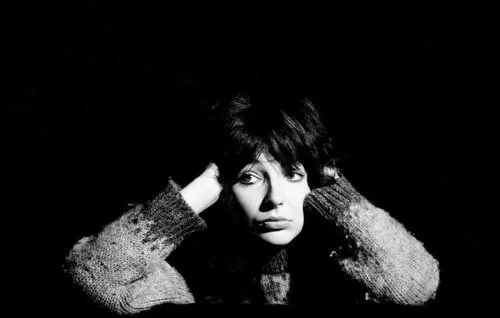
“The truth is what we create”

In the 124-page book that’s part of the Deluxe Edition, Yoko writes: “John was a brilliant man with a great sense of humor and understanding. He believed in being truthful and that the power of the people will change the world. And it will. All of us have the responsibility to visualize a better world for ourselves and our children. The truth is what we create. It’s in our hands.”

The book has been designed and edited by Simon Hilton, who was the compilation producer and production manager of the Ultimate Collection series. The story of each of the 36 songs is described in John and Yoko’s own words and of those who worked with them. Archival and new interview material is used as well as hundreds of previously unseen photographs, Polaroids, movie still frames, letters, lyric sheets, tape boxes, artworks and memorabilia from the Lennon-Ono archives.

GIMME SOME TRUTH. will also be released in 19-track CD and 2LP editions; in 36-track 2CD and 4 LP formats; and in several digital versions for download and streaming, including in 24 bit/96 kHz audio and hi-res Dolby Atmos. The vinyl was cut by mastering engineer Alex Wharton at Abbey Road Studios.

A letter to the Queen

The Deluxe Edition and 4LP formats will include a GIMME SOME TRUTH. bumper sticker, a two-sided poster of Lennon printed in black and white with silver and gold metallics, and two postcards. One of these is a replica of Lennon’s famous letter to the Queen of England in 1969, when he returned his MBE in “protest against Britain’s involvement in the Nigerian-Biafra thing, against our support of America in Vietnam and ‘Cold Turkey’ slipping down the charts.” The 2LP and 2CD will also include the poster; all formats will include a booklet with photos and the letter.

On the album cover is a rarely-seen monochrome portrait of Lennon, taken on that day in 1969 that he returned his MBE. The album cover, CD and LP booklets and typographic artworks were designed by Jonathan Barnbrook. He previously created the covers for David Bowie’s Heathen, Reality and The Next Day albums and won a Grammy for the packaging of Bowie’s Black Star album.

The collection contains songs from each of John’s solo albums including John Lennon/Plastic Ono Band (1970), Imagine (1971), Some Time In New York City (1972), Mind Games (1973), Walls and Bridges (1974), Rock‘n’Roll (1975), Double Fantasy (1980) and the posthumous 1984 release Milk and Honey.

The full GIMME SOME TRUTH. The Ultimate Mixes. tracklist is:

2 CD + 1 Blu-ray audio disc (24 bit/96 kHz Stereo, 5.1 Surround Sound, Dolby Atmos) and 124-page book:
CD1
1. Instant Karma! (We All Shine On)
2. Cold Turkey
3. Working Class Hero
4. Isolation
5. Love

6. God
7. Power To The People
8. Imagine
9. Jealous Guy
10. Gimme Some Truth
11. Oh My Love
12. How Do You Sleep?
13. Oh Yoko!
14. Angela
15. Come Together (live)
16. Mind Games
17. Out The Blue
18. I Know (I Know)

CD2
1. Whatever Gets You Thru The Night
2. Bless You
3. #9 Dream
4. Steel and Glass
5. Stand By Me
6. Angel Baby
7. (Just Like) Starting Over
8. I’m Losing You
9. Beautiful Boy (Darling Boy)
10. Watching The Wheels
11. Woman
12. Dear Yoko
13. Every Man Has A Woman Who Loves Him
14. Nobody Told Me
15. I’m Stepping Out
16. Grow Old With Me
17. Happy Xmas (War Is Over)
18. Give Peace A Chance

BLU-RAY AUDIO DISC
All of the above thirty-six tracks, available in High Definition audio as:
1. HD Stereo Audio Mixes (24 bit/96 kHz)
2. HD 5.1 Surround Sound Mixes (24 bit/96 kHz)
3. HD Dolby Atmos Mixes

4 LP:
LP 1 SIDE A
1. Instant Karma! (We All Shine On)
2. Cold Turkey
3. Working Class Hero
4. Isolation
5. Love
LP 1 SIDE B
6. God
7. Power To The People
8. Imagine
9. Jealous Guy

LP 2 SIDE A
10. Gimme Some Truth
11. Oh My Love
12. How Do You Sleep?
13. Oh Yoko!
14. Angela

LP 2 SIDE B
15. Come Together (live)
16. Mind Games
17. Out The Blue
18. I Know (I Know)

LP 3 SIDE A
19. Whatever Gets You Thru The Night
20. Bless You
21. #9 Dream
22. Steel And Glass
23. Stand By Me

LP 3 SIDE B
24. Angel Baby
25. (Just Like) Starting Over
26. I’m Losing You
27. Beautiful Boy (Darling Boy)
28. Watching the Wheels

LP 4 SIDE A
29. Woman
30. Dear Yoko
31. Every Man Has A Woman Who Loves Him
32. Nobody Told Me

LP 4 SIDE B
33. I’m Stepping Out
34. Grow Old with Me
35. Give Peace a Chance
36. Happy Xmas (War Is Over)

2CD / DIGITAL (DOWNLOAD & STREAMING)
CD1
1. Instant Karma! (We All Shine On)
2. Cold Turkey
3. Working Class Hero
4. Isolation
5. Love
6. God
7. Power To The People
8. Imagine
9. Jealous Guy
10. Gimme Some Truth
11. Oh My Love
12. How Do You Sleep?
13. Oh Yoko!
14. Angela
15. Come Together (live)
16. Mind Games
17. Out The Blue
18. I Know (I Know)
CD2
1. Whatever Gets You Thru The Night
2. Bless You
3. #9 Dream
4. Steel And Glass
5. Stand By Me
6. Angel Baby
7. (Just Like) Starting Over
8. I’m Losing You
9. Beautiful Boy (Darling Boy)
10. Watching the Wheels
11. Woman
12. Dear Yoko
13. Every Man Has A Woman Who Loves Him
14. Nobody Told Me
15. I’m Stepping Out
16. Grow Old with Me
17. Give Peace a Chance
18. Happy Xmas (War Is Over)

2 LP

LP 1 SIDE A
1. Instant Karma! (We All Shine On)
2. Cold Turkey
3. Isolation
4. Power To The People

LP 1 SIDE B
5. Imagine
6. Jealous Guy
7. Gimme Some Truth
8. Come Together (live)
9. #9 Dream

LP 2 SIDE A
10. Mind Games
11. Whatever Gets You Thru The Night
12. Stand By Me
13. (Just Like) Starting Over
14. Beautiful Boy (Darling Boy)

LP 2 SIDE B
15. Watching The Wheels
16. Woman
17. Grow Old With Me
18. Happy Xmas (War Is Over)
19. Give Peace A Chance

aaaa.jpg

IMAGE CREDIT: Apple/EMI

1CD / DIGITAL (DOWNLOAD ONLY)
1. Instant Karma! (We All Shine On)
2. Cold Turkey
3. Isolation
4. Power To The People
5. Imagine
6. Jealous Guy
7. Gimme Some Truth
8. Come Together (live)
9. #9 Dream
10. Mind Games
11. Whatever Gets You Thru The Night
12. Stand By Me
13. (Just Like) Starting Over
14. Beautiful Boy (Darling Boy)
15. Watching the Wheels
16. Woman
17. Grow Old with Me
18. Happy Xmas (War Is Over)
19. Give Peace a Chance

Most of us are familiar with Lennon’s solo catalogue, and so many of his classics are included: Instant Karma! (We All Shine On), Power to the People, Imagine, and (Just Like) Starting Over are all in there! It is a veritable banquet of brilliant Lennon cuts, and there are some great bonuses. There is a four-L.P. edition for those who want a little bit extra.

IN THIS PHOTO: Yoko Ono and John Lennon photographed in 1968/PHOTO CREDIT: Susan Wood/Getty Images

I think it is great that we get to mark such a huge birthday in October, and I do hope that there is a combination of Lennon solo songs and his best work with The Beatles played across the world. Not every album Lennon put out and contributed to with The Beatles was golden, and there were some missteps through his career – one would expect that from someone so prolific! I can definitely see the advantages of launching a new ‘best of’ set. New fans will be introduced to his music, and it is an opportunity for us all to discuss his music and reveal in his brilliance. There will be those that argue the twenty-song album, Lennon Legend: The Very Best of John Lennon, released in 1997 is pretty much the same album (as the two-L.P. release). I think that it is a bit reductive having a best of that concentrates mainly on the bigger hits. Although they are not singles, there are some terrific album tracks that are not included in the new edition – the second side of John Lennon/Plastic Ono Band is awash with great tracks, for example. Mind Games is very underrepresented, and there are tracks from Imagine that could have been included. Some of the best from Double Fantasy are missing – no I’m Losing You?! -, and there are a few gems from the lesser-loved albums that would be good to have in the mix. I know a best of needs to include the best-known tracks and the more popular selections, but that is the question: Do the biggest singles truly represent the ‘best of’ an artist?!

The reaction to Gimme Some Truth has been largely positive. Fans and Beatles devotees are definitely excited, but I wonder whether an opportunity was missed to either expand on the best of the best type of tracks and dive a bit deeper; maybe a few of the classic Beatles tracks? I think, if you want a fuller picture of John Lennon as an artist and innovator, one needs to dig into the archives more and present a broader picture. Without collating dozens of tracks, there could have been a nice thirty-track album that spliced the solo big hits with essential album tracks, with maybe the odd epic Beatles song. As a starting point, Gimme Some Truth is a good collection that will boost some great mixes and there is quite a broad representation of Lennon’s best solo albums. I think any excuse to celebrate Lennon is great, but I do wonder whether replication older compilations is the best choice? Look at 1982’s The John Lennon Collection and the same tracks pop up; same with the aforementioned Legend album. A 2002 compilation did go a bit broader, but I do feel that, again, there are some omissions and missed opportunities. The latest revision, Icon, is another repeat of earlier compilations. I don’t think Lennon can be defined and explained by the same twenty-or-so numbers, so it would have been nice, in such a landmark year in terms of Lennon’s life and death, to broaden things and maybe throw it out to the fans; decide which songs resonate with them.

After all, there are best of compilations out there that one can buy, so why not put to vinyl some of the greatest hits, but then combine them with deeper cuts that show different sides to Lennon?! I guess the more expansive edition of Gimme Some Truth does stretch things and goes deeper than the two-L.P. edition, but I do wonder whether that has even gone far enough – in the sense that most/many of the tracks included have already been released. It is a hard balance to strike. I would suggest, if you have the money, to invest in the wider C.D. and L.P. editions, as they give a more representative look at Lennon’s music and there are some great live tracks included. One can debate whether Gimme Some Truth is an essential anniversary release. I love the depth of the four-L.P. edition, and there are some tracks on there that have not been covered before but, I dunno…it feels like there is something still lacking. However one feels, I think the world should come together and mark John Lennon’s eightieth birthday. He remains one of the greatest songwriters the world has ever seen and, if you think a new greatest hits package feels like we are just starting over or it is a bold release, new fans will discover Lennon, and I am sure many of his diehards will buy Gimme Some Truth. Of course, Lennon’s solo albums are available to buy or stream so, in your own way, make sure you do your best investigate the brilliant work of…

A true legend.