FEATURE: The Lockdown Playlist: Christmas Come Early!

FEATURE:


The Lockdown Playlist

r.jpg

PHOTO CREDIT: @rpnickson

Christmas Come Early!

___________

I am going to put out a Christmas playlist…

c.jpg

 PHOTO CREDIT: @erwanhesry/Unsplash

nearer the big day of alternative Christmas songs but, as it has been a bad year and many people are readying themselves for Christmas now, I thought I would also start a bit early when it comes to the tunes! In this Lockdown Playlist, there are some known classics and some lesser-known and newer ones that I felt were worth covering. What I will do in the next playlist for Christmas is include songs that are sort of the anthesis of the romance and familial vibe of Christmas – these songs are just about celebrating the spirit of the time or yearning for someone or better times (for the most part). These songs, I hope, will bring some joy; there is a combination of the classic numbers and some that many people have not even heard - there are a few more emotive and melancholic moments thrown in for balance. Even though there is over a month to go until Christmas, I think we can agree that we all need a bit of Christmas cheer…

 PHOTO CREDIT: @frostroomhead/Unsplash

A little early.

FEATURE: Ran Tan Waltz: The Illustrated Kate Bush

FEATURE:


Ran Tan Waltz

ART CREDIT: Noelle McClanahan Broughton

The Illustrated Kate Bush

___________

THE title of this feature…

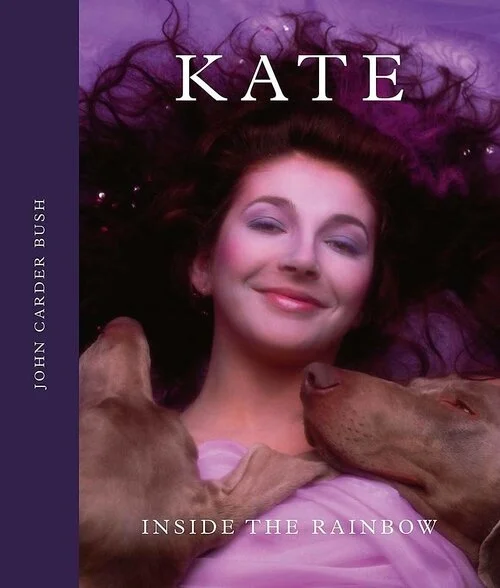
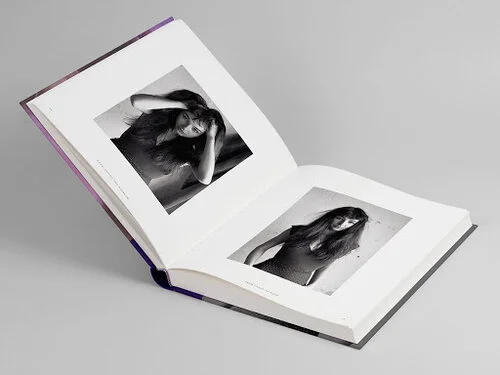
doesn’t really mean too much really, but I am running out of song-based titles - and Ran Tan Waltz will play a part in something I want to discuss later. I have covered a few different areas regarding Kate Bush projects and stuff that needs to be on the market that is not there already. I have already written about a possible podcast before and I am also keen to explore a documentary somewhere down the line. There are definite gaps in the market that could be usefully filled, but one area that is a little under-represented is books. There are some great Kate Bush books around already; from Under the Ivy: The Life & Music of Kate Bush by Graeme Thomson, to John Carder Bush’s KATE: Inside the Rainbow – her brother’s unique and loving visual documentation of her young life and career. There has not been much in the way of new books for quite a while. I know there is at least one scheduled for early next year. Here are some more details regarding Kate Bush On Track: Every Album, Every Song:

“Kate Bush started her career at the top, the spellbinding 'Wuthering Heights' giving her a number one hit single with her first release. Yet from there, artistically at least, the only way has been up. For while the sales of both singles and albums over the five decades since have had their peaks and troughs, every new release has seen Bush refuse to be boxed in by past success but instead continue to take the musical chances that have characterised her career from day one.

IN THIS PHOTO: Kate Bush in a promotional photo taken during her visit to Holland in spring 1978

 Across ten studio albums, including director's cut reassessments of two of them, and a live record of the 2014 Hammersmith Apollo residency, Kate Bush has constantly sought new ground, reinventing her sound time and again. She has often strayed from the commercial path of least resistance to examine the less travelled musical byways that have provided the inspiration for an extraordinary body of work, quite unlike anyone else's. With a string of platinum albums and hit singles to her credit, Kate's is a fascinating journey. This book examines her entire recorded catalogue from The Kick Inside through to Before The Dawn, hoovering up all the B-sides and the rarities along the way. It's a comprehensive guide to the extraordinary music of Kate Bush”.

Aside from that book coming out, I don’t think there is anything else planned at the moment. Max Browne was looking to release a book of photographs that he took of Bush during 1979’s The Tour of Life, and that would be fascinating to see if it ever comes to life. There were also plans for Gered Mankowitz to release a photobook, Symphony of You, around this time, but those plans were shelved – I am not sure whether it will ever see the light of day. A book of lyrics, How To Be Invisible, was published in 2018, and I think this is the most-recent book regarding Bush and her work.

 IN THIS PHOTO: Kate Bush during the Hounds of Love era in 1985

Nobody really knows what is going to happen next year regarding projects around Kate Bush and whether she will release music herself, but I am interested in both Bush’s visual side in addition to her magnificent work. I feel a lot of people do not know about the sheer depth and scope of her music and career. One can see a lot of great photos in books like KATE: Inside the Rainbow, and it provides snapshots and illustration of who she was and how her music and personality entwined and evolved. I really love that book, and I also really like Graeme Thomson’s biography, as it is authoritative and deep. One gets to learn a lot about Bush as a child and at every turn of her career, and there is enough on the market, in book form, that gives you really good detail and depth. One book that I really like is Visualizing the Beatles: A Complete Graphic History of the World's Favorite Band, which is wonderful in the way it mixes great visuals and brings The Beatles’ music to life. For example, we get to learn the types of guitars the band played, how their style changed through the years; there are quotes and lyrics sprinkled in. I think The Illustrated Kate Bush would be a useful compendium. Similar to the book about The Beatles, there could be illustrations that looks at every single and its chart position; the fabulous and rare tracks (like Ran Tan Waltz), and Bush’s appearances on T.V. through the years. There could be graphs and illustrations regarding her dates for The Tour of Life, the various famous faces who attended 2014’s Before the Dawn, and the visual breakdown of that show in 1979.

Also, similar to the book that is coming out each year, there could be this section regarding each album and a song-by-song guide that has illustrations that bring various lyrics and facts to life. I like the idea of putting in various lyrics and unseen photos. Record Collector is bringing out a special edition dedicated to Kate Bush next month that looks at her collectables and memorabilia, a look at every album and some unseen photos, so a lot might be covered then. I think there is plenty of scope for addition and expansion. Hounds of Love’s The Ninth Wave is such a cinematic piece, and I like the idea of a chapter charting those songs and illustrating each moment of that suite – in a similar way, one could also do that with Aerial’s A Sky of Honey, as it is similar epic and immersive. From memorabilia and chart records through to innovations and various musicians and singers she has worked with, bringing that to life through charts and illustrations would be easier to absorb and digest, I think, than a longer biography. There are album cover designs and photos with great stories behind them, so they could be illustrated and annotated. There are so many great Kate Bush interviews that could be charted and exposed.

 IN THIS PHOTO: Kate Bush during filming for The Line, the Cross and the Curve in 1993/PHOTO CREDIT: Guido Harari

I do think that the book coming out next year that explores every Bush album and track will be quite detailed but I wonder if, like Caroline Sullivan’s Madonna: Album by Album, there could be an integration of that idea in a Kate Bush book; in the sense that each album has a lot of story, detail and background – maybe the Kate Bush On Track: Every Album, Every Song will be great but not as comprehensive as possible. There is so much to explore when it comes to Bush’s long career, little-known details, biography, lyrics and so much more. Putting all that together in a hardback book that is beautiful and detailed, I think, would appeal to the fanbase and bring in new people – many discovering Bush and her music for the first time. This is another idea I am punting out there but, like a new podcast and a documentary, I do think that there is room and demand in the marketplace to have these out there! I look forward to the new book coming next year regarding her songs and albums – and how it explores them -, in addition to the much-anticipated Record Collector magazine that is arriving in December. I like what some magazines have done this year regarding Kate Bush’s music. MOJO ranked Bush’s best songs, and they also talked about her 1979 tour and residency in 2014. Another great aspect was the stories behind albums like Hounds of Love (1985) - and the terrific details laid out. Maybe The Illustrated Kate Bush could bring timelines to life and introduce great diagrams that includes all the pertinent date, but does it in a very captivating and easy-to-absorb manner. There are some great Kate Bush-related books that were published years ago worth seeking out such as Kate Bush: Complete Recordings Illustrated: Volume 1 (which is current out of print), but an up-to-date book that draws in everything fans want to know could, I feel, provide…

 QUITE a popular addition.

FEATURE: The Lockdown Playlist: Stunning Duets

FEATURE:


The Lockdown Playlist

IN THIS PHOTO: George Michael and Elton John 

Stunning Duets

___________

AS the Elton John album…

x.jpg

 IN THIS PHOTO: Brandy and Monica/PHOTO CREDIT: Getty Images

Duets was released on 23rd November, 1993, I am marking that upcoming anniversary by putting together a Lockdown Playlist with some of the best duets ever – or ones that I just really like. This is dedicated to the great duets that are either fairly new to people or are legendary and need to be treasured. Many will have their own ideas as to the best duets around, but I think there is great a nice spread in this playlist. I hope that the assorted songs below help guide you to some songs you might not have been aware of and will also help to…

x.jpg

 IN THIS PHOTO: David Bowie and Freddie Mercury (Queen)

LIFT the mood.

FEATURE: Digital Vinyl: Sleevenote and the Physical Music Device

FEATURE:


Digital Vinyl

IN THIS PHOTO: Tom Vek has launched a Crowdfunder for a new playing device, Sleevenote/PHOTO CREDIT: Gabriel Green

Sleevenote and the Physical Music Device

___________

I am going to tie together…

 PHOTO CREDIT: @fixelgraphy/Unsplash

two different ideas and theories because, with music consumption becoming more digital and less tangible, I do yearn for those days of the physical music device. With Spotify and other streaming services not offering artists a great fee and slice of the pie, I do worry about the market and whether artists will forego streaming sites because of the payment discrepancies – larger artists who stream millions are alright, but most artists receive hardly anything. I have always preferred physical music because, not only do you feel more money goes to artists – though one feels the labels get a big cut -, but the listener experience feels purer and engaging. In a similar vein, I love physical devices and playing music through a turntable. One reason why I connected with music at such a young age is because the social connection and exposure came through sharing cassettes and listening to music in a physical form. I remember owning a cassette player/boombox and playing albums with friends. I know a lot of people listen to music through their phones, but I think there is a big difference between experiencing music that way and the old-style devices. Whilst it is not a return to the past and the days of listening to music through hardware, I am interested in any technology that can help bridge the reliance and need for digital music, together with cool new pieces of kit.

PHOTO CREDIT: Sleevenote/Tom Vek

I was reading NME a little while back. They covered the news regarding a new innovation from musician Tom Vek. Sleevenote sounds like a real interesting idea:

“After six years away, Tom Vek has been very busy indeed. Today, he unveils the fruits of his labour by dropping his surprise new album ‘New Symbols’ and unveiling a new music playing device that he’s designed, by launching the Crowdfunder for Sleevenote.

Described as a “visual hi-fi” device and “the music player for album lovers”, Sleevenote is a stand-alone music player that “brings hi-definition, full fidelity album artwork to digital music” and allows the listener to fully appreciate and engage with an album’s sleeve and visuals. He’s launched a crowdfunder today to find the first 1,000 people to buy a Sleevenote and get them into production.

Hello Tom. How do your new album and Sleevenote relate to each other?

Tom Vek: “Over the last few years I’ve been working as a designer and met a software developer. That’s what led to the Sleevenote project. The excitement of that coming together is what spurred me into getting the record finished. I was excited about it being so unusual for a musician, as my interests have grown into design and product design, because I need that extra excitement. When I was a teenager, releasing an album was the most exciting thing. Now I’m quite excited that the album is part of a bigger picture. I figured that I’m going to have to go crazy on Sleevenote marketing-wise – and I can’t say that I’m a recording artist if I haven’t released an album in six years!”

PHOTO CREDIT: @blockerphoto/Unsplash 

So, what does it do?

“It’s all about keeping each album’s identity going. When albums are presented inside a clean interface, it puts it behind a sheet of glass and inside a box to make for a more ‘tasteful’ user experience. Whereas with us, the character of the record is right up there and up front. It has interactive tracklist art where you tap the name of the song into the art to play it. That will be different for every album, so they’ll be in different places. We can also bring back the hidden track. Whoever made it so you could just see ‘hidden track’ on Spotify and iTunes, that’s such a joyless decision.”

And it’s just about the music?

“I like the idea of going back to listening to music on something that isn’t a multi-use device. You can just enjoy it without checking another feed or getting a notification or an email or whatever. It’s just an ideal setting for enjoying an album and getting lost in the art. You can look at this standalone thing and know that’s where your music is”.

In this feature with It’s Nice That, we get more details when it comes to the Sleevenote concept and what the physical product will actually consist:

“Album artwork has always been the handle, the grip to pin down the sort-of shapeshifting nature of music,” Vek tells It’s Nice That. “It’s like ‘that’s what it looks like, that album that has that song on it that I love’. The signifier is all-powerful, you see an album cover you like and it releases all these memories and feelings you have associated with the record, you can almost hear it.”

The device is square, almost the size of a 7” record, with a high-resolution display, designed to show covers in all their glory. It has a touch screen but also physical buttons on top, to keep the user interface away from the artwork. But the most important bit is the world of artwork it unlocks. The Sleevenote database already holds over 1,000 album covers and booklet artwork images, but Vek and his developer Chris Hipgrave have also built a platform for designers, labels and fans to upload album art. Once approved, it will automatically show up in the device and apps for everyone to enjoy. The player can also be used a “music vault” for your owned music, and supports streaming platforms Apple Music and Spotify, with more to be added on demand. It also uses Sleevenote API to source new artwork when requested.

“The crux of the product harks back to music and artwork being intrinsically linked. On the Indiegogo page, Vek says that digital music is “great for discovery but not so great for an immersive album experience” and that people usually listen to music on a multi-use device, where it competes for attention with other apps. In the transition to digital, album art has been “miniaturised and compromised” he says, and Sleevenote aims to lead “the digital album artwork revolution”.

On the £533 price tag he adds that prospective customers are “people with a certain amount of cash to invest in a cool bit of digital music tech, who have nice hi-fi gear, and also a nice bluetooth speaker, a Sonos setup, people who like minimal setups, who are digital-only, or still want a great place for stuff they can’t get on vinyl. If you like the idea of having friends over and saying “put some music on” and it being from your collection, not ‘hey find something, anything on Spotify’, or having those moments where you are like ‘what music I have liked?’, and actually liked, not what an algorithm thinks you will like. It’s great seeing the rise of Bandcamp, and I think it’s the perfect device for saying ‘I want to buy that album and get stuck into it, I’m going to put it somewhere valuable’”.

I do like the idea of Sleevenote and what Vek is trying to accomplish and, looking forward, I wonder whether there will be any other physical devices. I don’t necessarily like how there is so much reliance on the digital and, apart from vinyl, how often do we experience music physically? I think a lot of people who listen to C.D.s do so in their cars, and I wonder how many are listening to them through hi-fis.

 PHOTO CREDIT: @thanospal/Unsplash

I think we will see a decline in non-vinyl physical music in years to come as more and more people are either listening to music through streaming services and their phones or, when they do listen physically, it is through a record player – which are, obviously, fixed and you cannot take them with you. Sleevenote seems like a great way of experiencing an album and artwork in a similar way to those who listen to and digest vinyl. Not that I want a return to the past when music listening was entirely through devices, but I do miss that experience of hearing physical music on the go and having that sort of connection! Cassette sales are rising, and I think it more than mere nostalgia. Maybe people do feel unethical streaming or paying so little for music, but I reckon many just want a more human bond with music. The long-gone days of the mixtape seems strange when we consider the number of playlists that are around. I wonder whether anyone will make a device that maybe embraces a digital mixtape. I actually like the new boom of cassettes, and it would be great to see a modern version of the Walkman produced – I think it is quite hard to procedure Walkmans now! Similarly, iPods and Discmans have gone out of fashion and, when digital music started to take hold, there was a waning demand for physical devices.

 IN THIS PHOTO: The Sony Walkman TPS-L2 was first introduced in 1979

I feel the rise in people buying cassettes, vinyl and even C.D.s does signal that people want to listen to physical music. I think we would see a new generation experience music how I did – in a more physical and sociable way – if there was a resurgence in playing devices. Sleevenote, I think, is just the start of people coming up with new ways of staying current and modern but reconnecting people to the visual and physical aspect of music. Maybe it would not be a magic cure when it comes to funding artists and ensuring they are compensated, but I am fascinated by technology that looks forward but also takes us back. Maybe someone will invent a device that can combine vinyl and something more portable; perhaps a twenty-first century Walkman that also has a digital element, or a revitalisation of the iPod that would give people access to a digital library, but there would be new features (like Sleevenote) that expose and promulgate the importance of the album as an artform. I also like the concept of having a device that lets someone buy a song or album, but they can remix the song and isolate various tracks – a forensic approach to music where you can dissect songs and albums and maybe rearrange the track order. I am also still hooked on the romantic notion of a mixtape and whether a piece of kit could come about where one could buy tracks online from a device that would then instantly put them onto a cassette. I like the new-style SONY Walkman that, although not as evocative and special as the original, does at least keep the name alive. There are devices like Mighty that hooks the physical to the digital, and there are some good MP3 players around. There are not that many devices which encourage the use of C.D.s, cassettes and vinyl but bond it with digital technology – most of what is on the market is people streaming and downloading music and playing that through a device. I am interested to see what 2021 brings and, with great new releases like Sleevenote, I think more and more people will experience, explore and appreciate the album…

 IN THIS PHOTO: The MYMAHDI M350 MP3 Player

AS a physical format.

FEATURE: Take Your Best Shot: The Importance and Value of Music Photography

FEATURE:


Take Your Best Shot

PHOTO CREDIT: @andre_furtado/Unsplash 

The Importance and Value of Music Photography

___________

IT is clear that…

 PHOTO CREDIT: @aflynnn/Unsplash

without music photographers, there would really be no music journalism! The two go hand in hand. I have always respected photographers and, apart from an expensive bit of trouble earlier this year regarding use of an image on my site, my relationship with music photographers has been care-free and convivial – it is quite expensive clearing photos and those times when I have to pay for images have hit me hard (but that is the way it goes). My site does not make any money and there is no advertising so, for me, it can be quite tricky trying to stay afloat and include the content I want to. This year has been a rough one for everyone in the music industry, but I especially feel sorry for artists. They have really not been able to play live, and it is particularly tough for new artists coming through who might have been planning a busy 2020. Venues are closed so, when they do open next year, I think many are going to be booked up and it will mean acts who were hoping to get into the mix this year might have to wait until 2022! It is really tough, but the same can be said for music photographers. Unlike musicians, there is not really the option to do virtual gigs and find a way around the pandemic. I know they can still work and do what they do, but the whole industry has been hit hard and there is far less new photography out there.

I will talk about gigs and the importance of photography there but, on a basic level, artists require photographs so that they can get their faces seen and music spread. Even though I am not selling what I do and have any commercial ambition, I have had photographs taken professionally because it projects an image and people like to put a face to a name. Technology allows us all to take photos all of the time and add any filter we want, but I get sort of bothered when artists rely on these lo-fi and often scrappy images to promote themselves! I can appreciate how having photos taken is expensive and one cannot do it too often but the impact these images can make is amazing. Many artists will be featured in the press and on blogs; a great photo can hook people in and almost make or break an artist. I have turned down so many artists for interviews and reviews – back when I used to accept requests – based on slapdash and insignificant images; a few pretty bad photos and not a lot else. I have no patience for those artists who say that the ‘music does all the talking’, so, in their minds, they do not need photos taken. Those who feel that image quality is not important are wrong and, so often, I skate past an artist on social media because their photo portfolio is understocked and woeful. This is where photographers come in. Not only are they capturing an artist in a unique moment and helping them find an audience, but I think a relationship can be struck. Many artists use the same photographers because they feel at ease and like they are being represented in the best possible way.

A great shot can last as long as the music in terms of staying in the mind, and I love a great concept where the artist is brought to life and visualised in a way you would not imagine from their music. Prices do vary between photographers, but most are really reasonable - and artists need to think of it as an investment. Many bands cannot get close to one another at the moment, so fewer creative shots are being taken in this area. In a lot of cases it might not be until next year when new and established bands can get some images taken when they are close and have feel normal! There are great articles like this that underline the fact that, frequently, images arrive before the music does:

“Often times before your music is even heard, you’re seen. Whether this be in a record store, on social media, a flier, whatever. That’s just what it is.

High quality, professional imagery shows that you’re not willing to skimp on every detail. And that you’re taking the whole experience of your listeners into consideration.

Getting the attention of your listeners is important. Your music will for sure get their attention, but you want your first visual impression to be a good one.

Your music or whatever else you create is your art, letting other artists into your art with you can be a lot of fun and can expand what you’ve made into other mediums”.

 PHOTO CREDIT: @andre_furtado/Unsplash

We all know legendary photographers like RANKIN and Danny Clinch, and, through the years, there have been iconic images posted and shared of much-loved artists. It is impossible to properly explore music photography through the decades but, if you want a guide to good photographers of the moment, then articles like this and this give you some guidance. Historically, I think music photography has been vital when it comes to seeing artists in a new light. Often, interviews can be misleading, or artists do not really give much of themselves away. Photography, I think, allows them to be more open and natural. That is true today. One can get an impression of who an artist or band is through their music; you can listen or read interviews and that will go some way but, really, I think great photography can put artists at ease and paint more than a thousand words. One of my favourite photographers of the moment, Pooneh Ghana, is masterful when it comes to getting the best out of artists – and capturing those brilliant live shots! In an interview from 2017, Ghana was asked about her start and working in different mediums:

“When did you know you wanted to be a photographer? How did you get your start?

It was a very gradual thing that happened. In high school, I stumbled upon Lomography’s website and instantly fell in love with their cameras/films. I also loved the community of photographers on their website all sharing each other’s work and posting photography tips. It created a really inspiring atmosphere for me at that time. From there, I started shooting on a bunch of cheap film cameras I’d buy off the internet and take them to shows with me for fun.

IN THIS PHOTO: The Big Moon/PHOTO CREDIT: Pooneh Ghana

That was also around the same time I bought a Polaroid camera and started snapping polaroids of the bands I’d go see and meet at the shows. I did it all totally as a hobby at that time, without a photo pass or anything. I lived in San Antonio and would travel up to Austin almost every week to go to see a band. Or if it wasn’t Austin, I would plan a trip that involved either going to a bunch of shows or going to a festival. I started uploading my shots to Flickr, and really came to enjoy music photography more as I did it. I wanted to learn more and more about photography in general, things like developing film, which light modifiers to use, which lenses to buy, how to get into the photo pits at show, how to build a portfolio, etc. I think at some point I just figured that I love photography, live music, supporting the bands I love, traveling, and working on my own schedule, so let’s try to make this music photographer thing work!

What was the first camera you picked up? Do you still use it?

A Holga was the first camera I ever bought, but my dad’s Pentax K1000 was the first camera I ever picked up. I remember loving to play on it when I was kid, even though I had no idea what I was doing with it. I have a different Pentax now that I love shooting on, and the K1000 is still with my dad.

e.jpg

PHOTO CREDIT: @joshrocklage/Unsplash 

What’s the best part of shooting live music? What’s the best part of shooting portraits? Do you prefer one over the other?

I like both just as equally. With live music, you don’t really have control of your environment or what’s gonna happen while you’re shooting. All you can do is be alert during the performance and have your camera ready to capture those perfect moments and the energy of the room. On the opposite spectrum with portraits, you have complete control of what’s going on in the photo and of the subject. The lighting, setting, positioning of everyone in the shot, etc., can all typically be controlled and modified to bring an exact idea to life. I love the intimacy of shooting portraits as well. So I’d say live music and portraits both inspire a lot of creativity in shooting, but in completely different ways. Which is why I wouldn’t want to choose one over the other”.

If you are interested in becoming a music photographer then there are guides out there, and I think there is a greater demand now than ever. With so many new artists out there, I think good music photographers are a precious resource. It can be hard to make a good living from it at the start and, in a hard year like 2020, there are fewer opportunities for photographers. Whilst the cost of starting out even on a budget level can be quite expensive, I don’t think photographers should be put off.

 PHOTO CREDIT: @aljandro/Unsplash

There is less money available shooting live, but there are ways to make money. For many photographers, the main source of their income will be shooting portraits and albums/single covers. The value that photographers bring to artists is immense, and I think they are unsung heroes when it comes to pushing an artist’s music to new people and getting them recognised. A great visual spread online can make such a big difference in terms of marketing, and a perfect shot that catches your eye can draw you to the music and, from there, you are connected to that artist. One of the biggest loses of this year is live music and, with it, the lack of great live photography. Obviously, nearly everyone these days takes shots at gigs, and that has made it hard for a lot of photographers to compete. The expertise and undeniable quality that a professional brings to the table (as opposed fans) is huge! As this article explains, live photography is hugely important for artists:

“However, concert photography is way more than just taking you back into the concert you saw the other night, or a concert you saw ten years ago.  It is almost critical for any musician to have pictures taken of them at their shows. It is a form of promotion. Those pictures are what makes people WANT to attend a show because it “looked” fun, or epic.  Concert photography is also an art form. A form self expression. But also something that triggers the feelings of others. It affects the lives of others”.

I don’t think we should undervalue music photography and how important it is. Artists can photo themselves, but it is less likely to make an impression than the sort of invention and quality one gets from a professional. Let’s hope that things start to get back to normal next year and we can enjoy some brilliantly engaging live shots and portraits of new and existing artists. There have been some great images shot this year but, in a weird and limited year, not quite as many as usual. Music is important to us all and we all put so much stock in artists, but I really think that music photographers (and the role they play) should be…

 PHOTO CREDIT: Memory for life ↗/Unsplash

PUT in the spotlight.

FEATURE: From East Wickham Farm to Bracing the Snow: John Carder Bush’s KATE: Inside the Rainbow at Five

FEATURE:


From East Wickham Farm to Bracing the Snow

ALL PHOTOS: John Carder Bush (from his book, KATE: Inside the Rainbow)

John Carder Bush’s KATE: Inside the Rainbow at Five

___________

I am a little late marking…

x.png

the fifth anniversary of John Carder Bush’s KATE: Inside the Rainbow as that happened on 22nd October – so I am about a month out! Regardless, whilst others have not marked the anniversary, I think it is as important as any album anniversary and it is a significant work. Here are some details regarding the book:

“KATE: Inside the Rainbow is a collection of beautiful images from throughout Kate Bush’s career, taken by her brother, the photographer and writer John Carder Bush. It includes outtakes from classic album shoots and never-before-seen photographs from sessions including The Dreaming and Hounds of Love, as well as rare candid studio shots and behind-the-scenes stills from video sets, including ‘Army Dreamers’ and ‘Running Up that Hill’.

These stunning images will be accompanied by two new essays by John Carder Bush: From Cathy to Kate, describing in vibrant detail their shared childhood and the early, whirlwind days of Kate’s career, and Chasing the Shot, which vividly evokes John’s experience of photographing his sister”.

I would recommend that everyone buys the book, as it is great value for money and here are shots of Bush that nobody else had taken; a very real and revealing look at an artist through the years. I also wanted to mark KATE: Inside the Rainbow at five because, since 2015, there has not been another photo collection.  

There have been some magazine spreads which feature rare photos but, in terms of a good hardback that allows you to view a range of magnificent photos, then I think John Carder Bush’s book is best. It is a bit strange that there have not been other photo collections, and this is something I have raised before. Maybe it is the case that a lot of great images are press images and it would be hard to put them into a book, but there is Guido Harari’s The Kate Inside that is available – it is quite expensive, so not everyone can afford it. I would love to see another coffee table book with unseen photos, as there has been an absence considering how many terrific shots of Kate Bush there are. In any case, do go and investigate KATE: Inside the Rainbow, as one can see the affection and natural bond between brother and sister through the book. Rather than narrate every section of the book, I wanted to share a few personal highlights and pick up on some of the commentary and narration from John Carder Bush. In the opening, he inscribes “This book is for my sister, Kate, as a memoir shared inside the rainbow, and as ongoing thanks for the precious gift of a bow many years ago that led me to a path along which I am still travelling”.

The introduction explains how ordinary life transformed as Kate Bush became known: “During those years, it was though I was surrounded by a pulsating system of remarkable creativity – it actually felt as though I was living life from inside such a phenomenon”. I love the idea that there was this rainbow and sense of light that Kate brought to John and, in return, he tried to capture her at her truest. The book, Cathy, was published privately in 1986 – the reprint was announced in 2014, and Carder Bush explained how he could remember the details and photos like they were very recent. KATE: Inside the Rainbow is an updated and expanded chronicle of Kate Bush through her career. I like how John Carder Bush describes holidays in Ireland (their mother was Irish) and how the Irish side was quite vibrant, whereas the English side was pretty grey. The introduction shows us Kate Bush transforming from Cathy to the Kate; how there was always music, and, because of the English and Irish roots, there was a great mixture. Even though Kate took to the piano and would play often, none of the family felt it was the start of a prosperous career. I have written about this before but, in the book, John Carder Bush tells how Kate was part of the first generation where her parents were not trying to make them follow in their footsteps.

Despite that, there was fear (from her mother especially) that she was squandering her chance of further education by pursuing music and, with it, a safety and security that would have been very much on everyone in the family’s mind. There is great honesty and emotion in the introduction. He writes how, though friends noted how grown-up Kate was becoming, for him, “she was still little Cathy”. It is touching how Carder Bush notes that there was an exact moment – August 1974 – where he noticed his sister’s adult beauty blossoming. I wonder whether that spurred him to photograph her more and do so through her career, rather than just journal her childhood years. By then, Kate was sixteen, and it would only be a year until she stepped into a studio to record songs that would appear on her debut album, The Kick Inside. As Kate took up dance and mime, he could see her blossom and blaze this trail. The family relationship and dynamic changed when Wuthering Heights became a success, and there was this continuing bloom and transformation. I shall leave the introduction there, but one finds so much detail regarding the family and how martial arts was both important in regards a connection between Kate and her brother, and how it (kyudo especially) connects with photography.

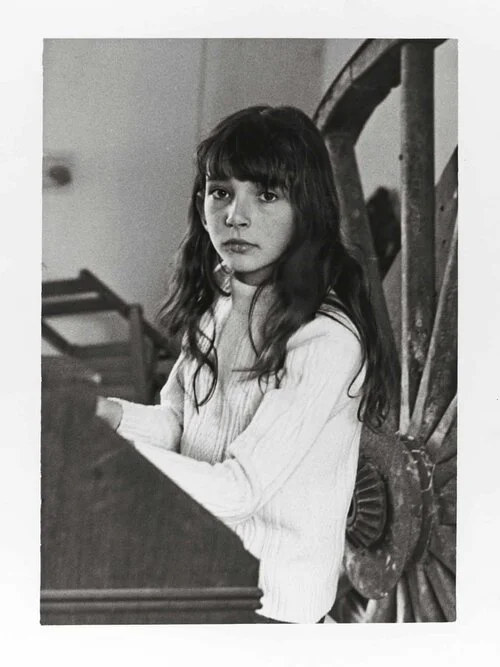
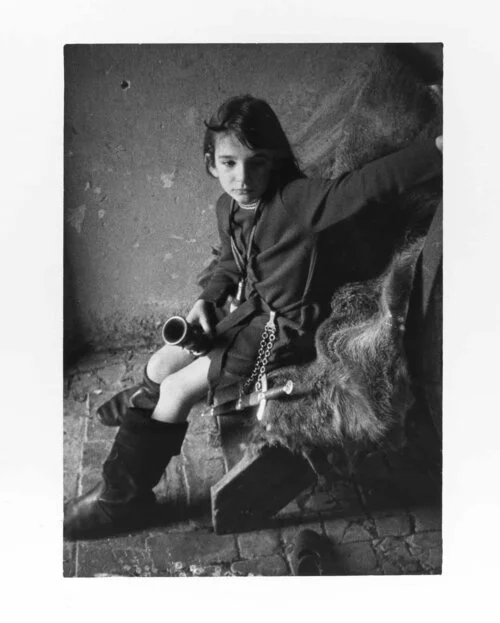
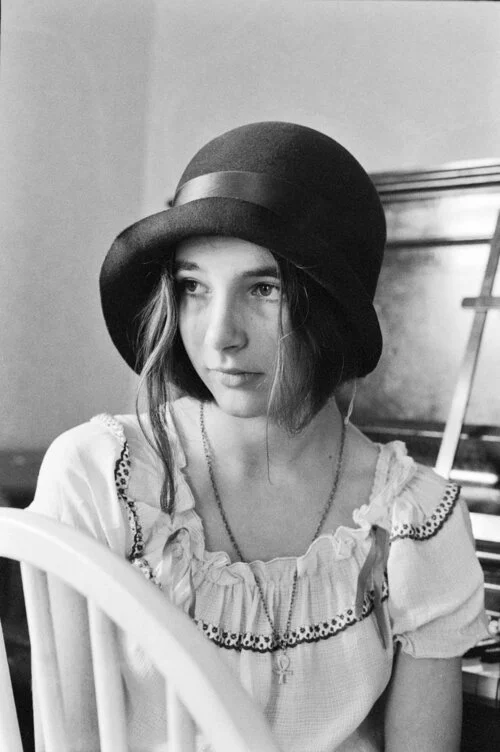
There are some beautiful shots before we get to the first album where John Carder Bush was shooting promotional images. To see Kate Bush as a child through to her teens is revelatory and fascinating, and there is this affinity she has with the camera. She is never too relaxed or playing up to the camera. Instead, Bush is at ease but there is this magic that she projects that is hard to put into words. It is also worth remarking, before moving on, how there was a period between Kate Bush as a girl and when her career started when she hated having the camera pointed at her. Her early and middle teenage years was that period, and I guess there was this sense that it might seem intrusive to photograph her – which is why there are relatively few images of her from that time. John Carder Bush started photographing his sister professionally from October 1977 (just before her second album, Lionheart, came out), and he had never worked with colour photography up until that time. I wonder how John Carder Bush felt when seeing others photograph his sister and whether he was every uncomfortable. It must have been strange for him but, as he remarks in the book, people could always tell when a photo of Kate was his – “It may also have something to do with where the photos were taken: it was always where we were living”.

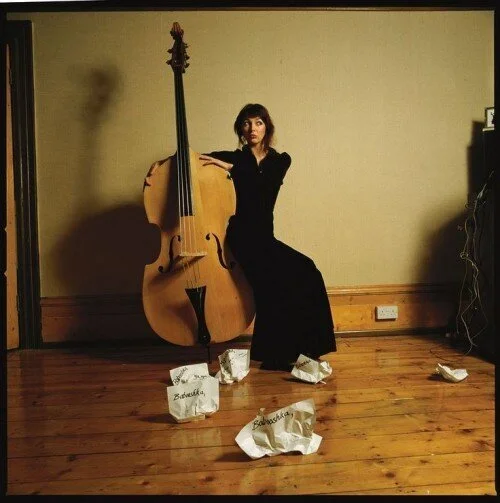
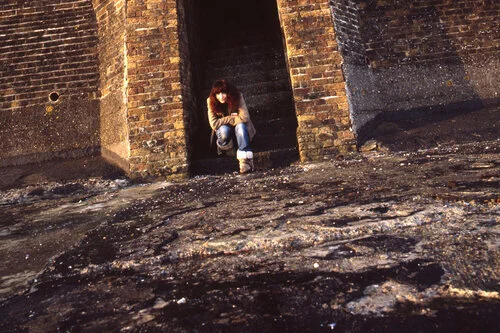
I will give a brief impression of each album but, starting with Never for Ever in 1980 – the first album of Bush’s where her brother became heavily involved -, and I like the description for the Babooshka single shoot. Carder Bush sanded and varnished the floor himself and, using a wide lens, he wanted to capture Kate and the body of the double bass (which we see her using in the video). We learn about the rehearsal time that went into videos like Army Dreamers, and one marvels at the variety and quality of the photos from 1980! My favourite are ones taken during breaks of the Army Dreamers video where Bush is seen with a young boy (an extra from the video) and an almost mother-son bond is present; others see her reading notes and having her make-up touched up. These candid and rare shots go way beyond the press photos and very structured photoshoots – just seeing this young songwriter in a way nobody else would have. The access John Carder Bush had meant we get so many great shots and, towards the end of the Never for Ever chapter, there are photos of Bush playing a violin; great ones of her and her (and John’s) brother Paddy, and one particularly striking one where she is outside and seen crouching underneath a brick archway. I am not sure where that was taken, but it is one of my favourite shots from that period.

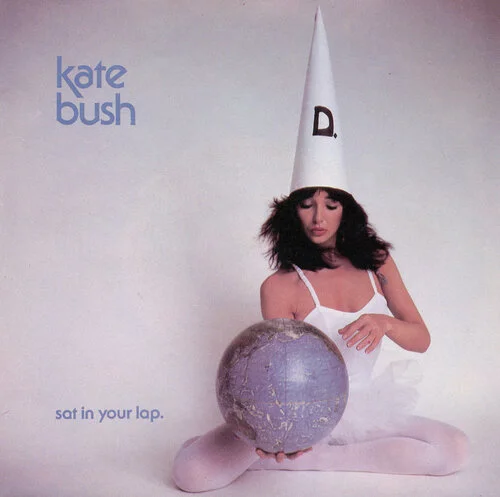
The Dreaming was, as John Carder Bush noted, not what people who were expecting The Kick Inside got…but it ranks as “one of her most artistically daring” (albums). Carder Bush (I shall refer to John as such as to avoid confusion and, as I am not keen on addressing people by their first names, I will call Kate ‘Bush’) says – in the chapter for The Dreaming -, how he wished he’s learned to play instruments so he could be more involved with his sister’s music, perhaps, but his photo for the album cover is remarkable! I think the photos for this album are his finest to that point. In outtakes for the cover for the Sat in Your Lap single, Bush is in a dunce’s hat and looks solemnly to the floor; in another, she holds a globe in her hand. Again, one of my photo highlights from this chapter – like the candid one from Army Dreamers -, is Bush and a dancer/extra during the shoot of There Goes a Tenner where Bush is standing on his shoulders. It is a fantastic shot, and it can almost be seen as a metaphor for Bush’s growing career and how, though stepping into dangerous territory at times, she was climbing high and had this assuredness. Perhaps the most important chapter is when Hounds of Love came out in 1985. So far from when Carder Bush was photographing his sister as a child and this musical talent was emerging, she was now a star and creating music that few could have dreamed she had in her even a decade previous!

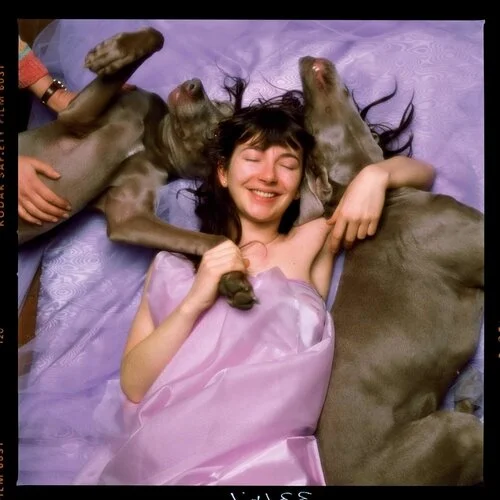
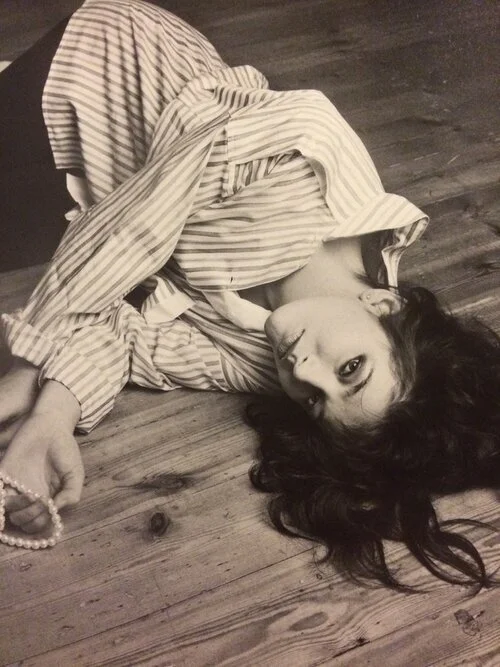
If the album cover seems natural and like it was easy to shoot, getting the two hounds (two big Weimaraners) still and comfortable was a chore! There are great outtakes where Bush is smiling because the dogs were moving around, but the album cover is the shot we get on KATE: Inside the Rainbow’s cover: one of these timeless images that underline’s Bush’s beauty and this almost effortless allure. The Pop music on Hounds of Love is, as Carder Bush notes, accessible yet “so incredibly heavy and insightful in its content” that one can listen over and not get bored. We get some detail regarding where the shots were taken and the process and, whilst Carder Bush gives credit the make-up team and others who were involved in the shots, he was the one who captured those final live moments and turned them into a still, immortal image. We see some wonderful stills from the Cloudbusting video shoot (as there was a lot of natural light over the hills of Oxford), and one can sense genuine pride when he talks about the single cover being this perfect moment. The shots for Running Up That Hill (A Deal with God) are terrific, and not only are there stills from the video shoot, but images with Bush’s back to the camera as she has the song’s title written on her back. Carder Bush was mixing colour photos with black-and-white, and the images he took when the Hounds of Love (single) video was being filmed are brilliant – and, as Bush directed it, the brother was photographing his sister behind the camera and her composing her own images! The Hounds of Love section is one of the most full and vivid chapters of the book, and one of my all-time favourite images of Bush is her in black-and-white, on the floor with pearls in her hand. It is such a beautiful composition, and I really love the look she gives to the camera!

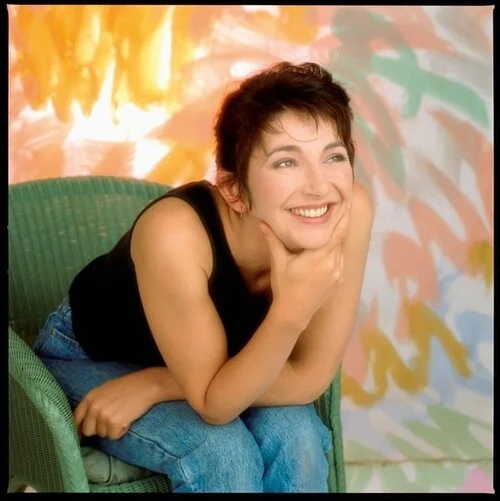
1986 is a year where Bush released her first greatest hits collection, The Whole Story, and it is unusual, I think, as original images were shot – normally, artists use archive photos or do not use photos at all. The black-and-white cover shot is Carder Bush’s favourite and, when that was being shot, his wife, Vivienne, was going into labour with his first son – it is so touching that his son was about to be born when he was capturing his sister and there was this combination of new and urgent life and stillness. In some ways, there are comparisons between the covers for The Dreaming, and The Sensual World where Bush’s mouth is the prime spot. In The Dreaming’s cover, we see a gold key on her tongue (it relates to the song, Houdini, where she/the heroine would slip the key to Houdini before a trick so he could then use it to unlock the bolt/chains), and there is a rose covering Bush’s mouth for The Sensual World. Both are gorgeous shots, but the fact the latter is in black-and-white not only differs from Carder Bush’s previous covers, but the eyes really stand out! Both the cover for the album and its eponymous single had colour alternatives, but we see the black-and-white used instead. The same is true for This Woman’s Work - and I wonder whether Carder Bush, subconsciously, was reverting back to the Cathy days and trying to capture his sister in a new (but familiar) way. My picture pick from the chapter is where there is a painted background (scribbles of green, orange, blue and pink) where Bush is sat on a chair and rests her chin on her right hand. It is such a beautiful shot and one where she provides this big smile.

I shall put The Red Shoes and Carder Bush’s shots after that album in the same passage but, four years after The Sensual World, we could hear and see Bush changing as an artist. It may be strange to say, but she does appear womanlier and different to how she looked during The Sensual World – maybe that is as a result of slight ageing, but she looks incredible! Even though The Red Shoes is the first album cover not to feature Bush, the famous pair of feet/red shoes took a while to get down! One might think ballet shoe shots look the same but, as Carder Bush remarked: “We were amazed that a pair of feet in ballet shoes could show such variety in what they had projected”. In spite of there being tragedy in the lives of Bush and her brother – their mother died in 1992 -, there was a lot of change and new beginnings. I think the photos from that time are gorgeous, and I especially love a picture of Bush at the piano with her eyes closed. Although there is a promotional shot of Bush for 50 Words for Snow in the book (I wonder why none were taken by Carder Bush for Aerial?!) – of her in fake fur and a hat looking into the distance -, the majority of the final shots are from the album, Director’s Cut – where Carder Bush thanks his son, Gavin, for “taking me by the hand into the digital age”.  

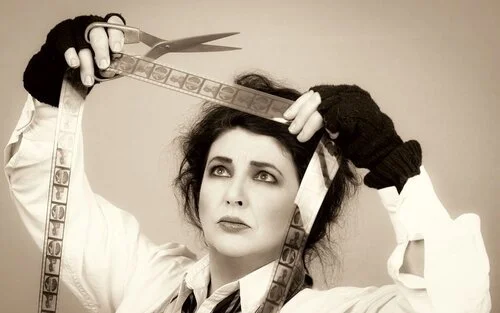
There are a couple of great colour photos – including one where Bush is wearing a green costume with a big white ruff – that are especially beautiful. One photo sees Bush pointing her finger out with a stern look on her face! I wonder what the motivation for the shot was and what they were trying to articulate. My favourite are two stunning black-and-white images. One is Bush hugging a cat (who looks straight at camera as she nuzzles him/her with her eyes closed), and it is a great composition – again, I wonder whether there was a particular angle (pardon the pun!). My favourite shot, I think, should have been the album cover. It is Bush holding up some camera film with scissors in her right hand as she - dressed in a white shirt, black tie and black gloves (like a Johnny Depp character) – examines the shots and prepares to make the cut (with some eyeliner and lipstick, she has this classic, smoky look that is stunning!). On the back cover, John Carder Bush remarks how every image “forms part of a golden thread”; storytelling has always been a part of Bush’s work and “it has been a privilege to capture these photographic illustrations that accompany these magical tales”. Aside from the press images that were taken in 2014 for Bush’s Before the Dawn residency, we have not seen any publicity or album photos since. I hope, if there is another studio album, we get this return of the brother-sister partnership, as the photos throughout KATE: inside the Rainbow are amazing!

rr.jpg

From the girl at the family home looking relaxed and safe through to Bush dressed as a solider (Army Dreamers), a sword-wielding temptress (Babooshka), to her playing Peter Reich in the Cloudbusting video (as Donald Sutherland played her ‘father’, Wilhelm), we have seen this amazing transformation through the lens of her brother, John (or Jay, as Bush might have called him). Make sure you get the photobook as, five years after its release, I think it carries a lot of weight and is an essential piece of Kate Bush fan kit! The words are thoughtful and beautiful, and one gets these remarkable photos captured through the decades. I shall leave things there, but I was eager to return to a book that is very precious in my collection. Perhaps not as detailed and biographical as a biography, I feel the photos and Carder Bush’s notes give us a more intimate look at Kate Bush and (he explains) why she is so remarkable to shoot. I love the behind-the-scenes snaps, and they carry as much potency as Bush gazing into the camera for a single/album cover shoot. Even though these photos carry more emotional and personal significance to John Carder Bush, he allows the reader to witness these amazing shots and truly bring us…

INSIDE the rainbow.

FEATURE: Second Spin: Wild Beasts – Limbo, Panto

FEATURE:


Second Spin

 Wild Beasts – Limbo, Panto

___________

IN terms of the…

w.jpg

two types of albums that I feature on Second Spin – those that were underrated when they were released and those that are not talked about much now -, Wild Beasts’ debut album, Limbo, Panto, is one that was received well when it came out but, in terms of their cannon, I think other albums of theirs have gathered more love and play. Hayden Thorpe (vocals, guitar, piano), Ben Little (guitar), Tom Fleming (vocals, bass guitar) and Chris Talbot (drums, backing vocals) parted ways in 2017 but the Cumbrian band, formed in 2002, made a huge mark on music! The band released their first single, Brave Bulging Buoyant Clairvoyants, on Bad Sneakers Records in November 2006, and it was an awesome introduction! I think a few people were a little unsure about the band based on that song, as Thorpe’s vocals are quite unusual and wild and, in terms of its lyrics and themes, it as very different to everything out there! Even though there would go on to release albums that were a bit more subtle and emotionally rich, I love the slightly untamed and eccentric nature of Limbo, Panto. Released on 16th June, 2008, many had already heard Brave Bulging Buoyant Clairvoyants, but many others were coming fresh to the band. Look down the ten tracks and the titles definitely catch your eye! Albums such as Smother (2011), and Present Tense (2014) are miles away from Wild Beasts’ debut - and the song titles are a bit more traditional and less arresting.

Starting with Vigil for a Fuddy Duddy, before going onto The Club of Fathomless Love, one definitely projects a lot of different visions before hearing a note! The opening track features some exotic and intriguing lyrics – “Room a catacomb, this ghoul a balloon, with the breath/From beneath your breast, yes that is best” -, and Thorpe’s voice swoops and flies! One of the greatest aspects of Wild Beasts is how Hayden Thorpe’s high and more acrobatic register combines with Tom Fleming’s deeper and more grounded vocal. It is a key ingredient through the album and, whilst Fleming gets more spotlight on songs such as The Devil’s Crayon, and His Grinning Skull, most of the vocals are handled by Hayden Thorpe. Wild Beasts’ lyrics have always been more poetic and inventive than most, but I think they drew more from the heart and soul on later albums - whereas there is fiction, feverish imagination and more theatre on their debut. Maybe some critics were seeking something more relatable and restrained from the boys but, as I say, most critics were positive towards the album. I can appreciate how songs aren’t played a lot on the radio as they are very distinct and still sound unabashed and unique all these years later. Limbo, Panto is only ten tracks long, so it never goes on too much and, as such, I don’t think there are any weak moments. My favourite tracks employ Thorpe’s dexterous and beguiling lead and the band’s ability to talk about something ordinary in an extraordinary manner.

Consider a drama from the football terraces, Woebegone Wanderers, and some of the lyrics employed (“Darrell, my son the bastards won/We've been lumbered with losing life for far too long/The ground groans like the belly of a sleeping whale/Don't flinch an inch he'll be released on bail”). Thorpe groans, screams and dances through this song that, on paper, is quite well-trodden and cliché but, in the band’s hands, we get tension, criminality and something akin to an opera! The same can be said on the single, Brave Bulging Buoyant Clairvoyants, which gallops along gleefully; She Purred, While I Grrred is Thorpe in full flight and, whilst the lyrics deal with matters of the heart, it is the wording and deployment that makes Wild Beasts’ music both florid and striking – “I die every day/to live every night/Under the industry of her want for me in our fusty foundry/Please no ceremony/I want she, I want she, no matrimony”. The Old Dog blends Thorpe and Fleming together and it is one of the less explosive and wild songs. Cheerio Chaps, Cheerio Goodbye closes the album in suitably gleeful and delirious style and, after ten tracks, one has witnessed so much and needs to take a breath before going back in! One minor criticism is that Tom Fleming does not get enough vocal employment and, whilst this would change later on, his vocals balance out Thorpe’s tones – which, at times, do need to be reigned in and controlled.

I remember buying Limbo, Panto when it came out in 2008 and listening to it a lot. Even though I prefer the more energetic and strange songs, I think there is a nice blend of the more subtle and calm as there is these big, dramatic numbers. The band are incredible throughout and definitely announced themselves as a proposition to watch! Some critics were taken aback by the album and how it is very unusual and full-on at times. I have a lot of love for Limbo, Panto, and it is interesting to see where the band would head on future albums (and mature). Whilst some prefer them when they are more musically experimental and less vocally bold, I think Limbo, Panto is their finest release, as it is an album that gets right in the brain from the first time you hear it and then keeps coming back! I will finish off soon, but I want to bring in a couple of reviews for the album. This is what AllMusic remarked in their review:

“When it comes to creativity, the Wild Beasts have an embarrassment of riches. The band's full-length debut, Limbo, Panto, is exotic, exciting, fascinating, and forced in equal measures. "Vigil for a Fuddy Duddy" opens the album by spotlighting the most divisive, and definitive, part of the band's music: singer/guitarist Hayden Thorpe's vocals. He careens from a warbling falsetto to a suave croon to a feral growl, sounding like a hybrid of Antony Hegarty, Tiny Tim, and Mika (with shades of Tiger Lillies howler Martyn Jacques and possibly Dame Edna to boot), not just during the course of one song, but sometimes within a single syllable.

It's an attention-getting sound, but it often crosses the line between distinctive and difficult, especially since Thorpe's fondness for wordy lyrics such as "don't render me the sorriest parody" and the Seuss-like internal rhymes and alliteration on "Brave Bulging Buoyant Clairvoyants" and "Cheerio Chaps, Cheerio Goodbye" are already extremely stylized. However, Limbo, Panto is more than Thorpe's love-it-or-hate-it lightning rod of a voice. The rest of the Wild Beasts' music is relatively restrained but still far from conventional, fitting around Thorpe's vocals in more subtly unique ways. Relying mostly on a traditional guitar-bass-drums lineup (along with the occasional keyboard), the Wild Beasts evoke cabaret, vaudeville, jazz, disco, and Afro-pop, depending on their whims. "The Old Dog" could be a lost and very warped '70s pop single, while "Please Sir" fuses doo wop rhythms with chamber pop delicacy and "Woebegone Wanderers" flips from a disco strut to a carnivalesque oompah beat. Over the course of the album, the band's experiments teeter between genuinely intriguing music and just trying way too hard. "The Devil's Crayon" is excellent, with percolating guitars and lunging drums that come together in strangely graceful, romantic ways. This song and "His Grinning Skull" -- another standout that makes the lyric "I'll eat this young whelp's heart, I will" seem perfectly conversational -- feature bassist Tom Flemming's throaty vocals. "She Purred While I Grrred" is a highlight that is all Thorpe's, however; he sounds like he's in heat as he purrs and grrrs his way through the song's jungle-like carnality. These moments balance tracks like "The Club of Fathomless Love," where everything that is interesting about the band's music just sounds grating. In its own way, the Wild Beasts' volatile flamboyance is more difficult to embrace than an overtly dissonant experimental band's music, but that's just another way that this group sets itself apart from the rest of the pack -- and there's something very liberating about that, even if it's baffling at times”.

When they assessed the album, The Guardian remarked that Wild Beasts seem like a normal male Rock band on the surface but, when you listen to the music, their individuality and U.S.P. shows:

“Wild Beasts are that dread creature, the all-male guitar band, average age 21. Yet they are as like to the standard all-male guitar band as a peacock to a warthog. Limbo, Panto is an outrageously ostentatious album: think the lascivious court of Charles II, Victorian opium dens, 1930s cabaret, the Tiger Lillies' musical Shockheaded Peter and the New York club Studio 54 at its disco peak, and you'll get the flavour of their keeling theatricality. Though they sing of such laddish preoccupations as sex (Vigil for a Fuddy Duddy), booze (Brave Bulging Buoyant Clairvoyants) and footie (Woebegone Wanderers), it's in a language - musical and verbal - as fiery and kaleidoscopic as a catherine wheel. Dominating proceedings is Hayden Thorpe's sordid falsetto. He's been compared with Antony Hegarty, but he's not that graceful, and whenever the album strives for melancholy stateliness it falls flat. But for every failure there is a song of such coruscating originality, it sends you reeling”.

If you have not heard Limbo, Panto, then I would recommend people investigate it as it is a fantastic album and one that is full of life and these wonderfully strange stories. In 2008, Wild Beasts lived up to their name with this remarkable record, but they displayed a lot of heart and soulfulness too. They would, as I said, go on to develop their sound and, in a way, smooth off some of the rougher edges. Their debut remains this remarkable album from a hugely talented band. The world had not witnessed anything like it back in 2008 and, twelve years later, I still think Limbo, Panto is…

SO different and heady.

FEATURE: A Buyer’s Guide: Part Thirty: Cocteau Twins

FEATURE:


A Buyer’s Guide

Part Thirty: Cocteau Twins

___________

FOR the thirtieth…

outing of A Buyer’s Guide, I am looking at the Cocteau Twins. The Dream-Pop band were formed in Grangemouth by Robin Guthrie (guitars, drum machine) and Will Heggie (bass), adding Elizabeth Fraser (vocals) in 1981 and replacing Heggie with multi-instrumentalist Simon Raymonde in 1983. The band disbanded in 1997 in part due to issues stemming from the disintegration of Fraser and Guthrie's romantic relationship. There was talk of Cocteau Twins reuniting to play Coachella in 2005, but Fraser did not want to perform on the same stage as Guthrtie. It is a shame that we will not see the band play together again but, from their fantastic debut of 1982, Garlands, to their final studio album of 1996, Milk & Kisses, they definitely left their mark! To celebrate a wonderful band, I have recommended the four Cocteau Twins albums to own; the one that is a little underrated in my view; their final studio album and, as always, a book that makes for useful reading. If you need some guidance regarding the wonderful back catalogue of Cocteau Twins, then have a look at…

THE guide below.

______________

The Four Essential Albums


Head Over Heels

Release Date: 31st October, 1983

Label: 4AD

Producers: Cocteau Twins/John Fryer

Standout Tracks: Five Ten Fiftyfold/Glass Candle Grenades/My Love Paramour

Buy: https://www.discogs.com/Cocteau-Twins-Head-Over-Heels/release/62108

Stream: https://open.spotify.com/album/67aJJEfYLuRmxvKgvTilOq?si=_yJemma1RpuFObDeboyzyg

Review:

“Losing original member Heggie might at first have seemed a troubling blow, but in fact it allowed the duo of Fraser and Guthrie to transcend the darkened one-note gloom of Garlands with Head Over Heels. The album introduces a variety of different shadings and approaches to the incipient Cocteaus sound, pointing the band towards the exultant, elegant beauty of later releases. Opening number "When Mama Was Moth" demonstrates the new musical range nicely; Fraser's singing is much more upfront, while Guthrie creates a bewitching mix of dark guitar notes and sparkling keyboard tones, with percussion echoing in the background. Other songs, like the sax-accompanied "Five Ten Fiftyfold" and "The Tinderbox (Of a Heart)" reflect the more elaborate musical melancholy of the group, while still other cuts are downright sprightly. "Multifoiled" in particular is a charm, a jazzily-arranged number that lets Fraser do a bit of scatting (a perfect avenue for her lyrical approach!), while "In the Gold Dust Rush" mixes acoustic guitar drama into Fraser's swooping singing. Perhaps the two strongest numbers of all are: "Sugar Hiccup," mixing the mock choir effect the band would use elsewhere with both a lovely guitar line and singing; and "Musette and Drums," a massive, powerful collision of Guthrie's guitar at its loudest and most powerful and Fraser's singing at its most intense” – AllMusic

Choice Cut: In Our Angelhood

Treasure

Release Date: 1st November, 1984

Label: 4AD

Producer: Cocteau Twins

Standout Tracks: Lorelei/Pandora (for Cindy)/Aloysius

Buy: https://www.discogs.com/Cocteau-Twins-Treasure/master/5232

Stream: https://open.spotify.com/album/5N2tixSCaFkwdtJIG0jQmi?si=CxLwi0cnRa6STpX9bSzWWQ

Review:

“The fact remains that despite a whole host of post-punk wannabes adopting the flange 'n' drum machine tactics of the Twins, no-one has ever come remotely close to emulating their sound. They are, possibly, the perfect example of a band who inhabit their own hermetically-sealed universe. Fraser's voice to resort to cliche, can only be described as unearthly. The swoops, ululations and delicate, whimsical, nursery rhyme-aliteration were coaxed out of her famously painful shyness by bathing them in the new wave Phil Spectorism's of the trio's production style of reverb, drenched in delay...in a cathedral. Like Spector, the Cocteaus never knew the meaning of restraint when it came to processing a sound. But on Treasure, the style, which could prove a little too muddy, repetitive and overlayed on previous albums, here benefits from better digital equipment and Raymonde's production skills. Witness the way that the opener (and ode to 4AD label boss, Ivo Watts-Russell), Ivo, builds from folky lullaby to something that probably set Kevin Shields on his merry way” – BBC

Choice Cut: Persephone

Victorialand

Release Date: 14th April, 1986

Label: 4AD

Producer: Cocteau Twins

Standout Tracks: Lazy Calm/Throughout the Dark Months of April and May/How to Bring a Blush to the Snow

Buy: https://www.discogs.com/Cocteau-Twins-Victorialand/master/5199

Stream: https://open.spotify.com/album/6Zv1yOKTpAHX0S0qOv2HRu?si=u1QLTm1XSOODBJF7VOHrLQ

Review:

“With Raymonde taking a break to work on the second This Mortal Coil album, Fraser and Guthrie made up the Cocteaus for the first full-length follow-up to Treasure. Rather than trying for a full-band approach, Fraser and Guthrie instead created a much more simply beautiful effort, with a relaxed air to it. Rhythms are subtler, with bass and drum machine often totally eschewed in favor of Guthrie's delicate guitar filigrees and lush, produced textures. Fraser is, as always, in wonderfully fine voice; her words are quite indecipherable, but the feelings are no less strong for it. "Lazy Calm" starts things perfectly, as deep, heavily-treated guitar strums combine with a heavy flange and guest saxophone from Dif Juz member Richard Thomas. Other songs sparkle with a lovely vivaciousness. Far from being stereotypical arty music to sit around and be gloomy to, two pieces especially shine with a gentle energy: "Fluffy Tufts," with its many-layered ringing strings and Fraser's overdubbed vocals; and the joyful "Little Spacey," with a soft rhythm underlying more sheer electric loveliness. Guthrie adds heavy reverb and overdubbed lines to create the Cocteaus' wash on such songs as "Throughout the Dark Months of April and May" and "Feet Like Fins," the latter again featuring Thomas, this time on tablas. For all the sweet beauty of Victorialand, things end on a quietly dramatic note, but a dramatic one nonetheless. "The Thinner the Air" starts with treated piano and rather spooky guitar leads -- the mysterious soloing is especially wonderful -- while Fraser then sings with a slightly haunted feeling, concluding with slightly nervous wails. It's an unexpected but effective touch for this fine record” – AllMusic

Choice Cut: Feet-like Fins

Heaven or Las Vegas

Release Date: 17th September, 1990

Label: 4AD

Producer: Cocteau Twins

Standout Tracks: Cherry-coloured Funk/Iceblink Luck/I Wear Your Ring

Buy: https://www.discogs.com/Cocteau-Twins-Heaven-Or-Las-Vegas/master/5104

Stream: https://open.spotify.com/album/37hHXJ7xas2Nb7Jbi8ip4E?si=B6B-XpZCSiiQYr5Cgetokg

Review:

“Instead, they turned all that turmoil and uncertainty into the best album of their career. Heaven or Las Vegas explodes in Technicolor from the first melty guitar chords on “Cherry-Coloured Funk”. Every note sounds like a new and richer shade of indigo and scarlet and violet than the previous one, and it doesn’t fade until closer “Frou-Frou Foxes in Midsummer Fires” descends into silence. If Blue Bell Knoll is spare and ambient, Heaven is supersaturated: lush without being vulgar, luxuriant without being indulgent. Tellingly, some lyrics bubble up to the surface, often loaded with personal meaning: “cherry,” “perfection,” “burn this madhouse down.” On a song called “Pitch the Baby”, ostensibly written for—or at least sung to—the couple’s infant daughter, Fraser repeats, “I’m so happy to care for you, I only want to love you,” as a sweet lullaby. We may not always be able to understand her lyrics, but that doesn’t mean they’re not important. In fact, her lyrics would never be more vital or confessional than they are on Heaven or Las Vegas, which lends the music added emotional and conceptual heft” – Pitchfork

Choice Cut: Heaven or Las Vegas

The Underrated Gem


Blue Bell Knoll

Release Date: 19th September, 1988

Label: 4AD

Producer: Cocteau Twins

Standout Tracks: Blue Bell Knoll/Carolyn's Fingers/Suckling the Mender

Buy: https://www.discogs.com/Cocteau-Twins-Blue-Bell-Knoll/master/5040

Stream: https://open.spotify.com/album/7mP4JgeDNV56zXuBuvb2kI?si=fD2wAh8lRdGw61OPI8p3Uw

Review:

“On the other hand, its general dismissal by critics and fans as a lesser Cocteau Twins album may have less to do with the album itself and more to do with the fact that it is bookended by better and more ecstatically creative works. There are moments of disarming beauty on Blue Bell Knoll—the melting keyboards on “Cico Buff”, the lush vocal layering of “Athol-Brose”, the shooting-stars opening of “A Kissed Out Red Floatboat”, Raymonde’s syncopated bass trudge of “The Itchy Glowblo Blow”, the whatever that is at the end of “Spooning Good Singing Gum” (I think it might be a herd of lovelorn goats playing saxophones). But the standout is “Carolyn’s Fingers”, which would become the Cocteau Twins’ first American single. The band never utilized its rhythm section to better effect: Against Guthrie’s crisp guitar line, that churning momentum pushes Fraser’s vocals to greater and greater heights, her unexpected swoops and eloquently rolled consonants creating a bewildering indie-pop aria” – Pitchfork

Choice Cut: The Itchy Glowbo Blow

The Final Album


Milk & Kisses

Release Date: March 1996

Label: Fontana

Producers: Cocteau Twins

Standout Tracks: Tishbite/Calfskin Smack/Seekers Who are Lovers

Buy: https://www.discogs.com/Cocteau-Twins-Milk-Kisses/master/5318

Stream: https://open.spotify.com/album/2xWjRAaO5qYhsJSxmJp1IK?si=I1ryzGtNR2yl18FB3PC-mA

Review:

“Throughout the '80s, Cocteau Twins created some of the most beautiful and innovative music of the decade. Liz Fraser's uncanny, gossamer voice and Robin Guthrie's shimmery guitar work both garnered acclaim and inspired bands. Milk & Kisses finds the band in a comfortable rut; they've created, and now perfected, a style of music so distinctive that there seems to be little recent creative growth. The result is a beautiful, lush, but somewhat dated and unengaging sounding album that tends to wash over the listener without making any real impact. It is, however, everything that a Cocteau Twins album promises; hypnotic, dreamy, awash in ethereal voices, and delicate, liquid guitars. "Tishbite" in particular delivers an accessible dream pop sound that sounds nice while it's playing but fails to have anything really memorable about it, a problem that plagues most of Milk & Kisses. "Half-Gifts," "Rilkean Heart," and "Treasure Hiding" have an airy, otherwordly prettiness to them -- but that's about it. Necessary for Cocteau Twins diehards and potentially interesting to those that have never heard the band before, Milk & Kisses says nothing, but says it beautifully” – AllMusic

Choice Cut: Violaine

The Cocteau Twins Book


The First Time I Heard Cocteau Twins

t.jpg

Authors: Scott Heim, Dean Garcia, Emily Franklin, Ian Masters, Harold Budd, Lincoln Fong, Guy Fixsen, Anka Wolbert, Mark Van Hoen and David Narcizo

Publication Date: 24th June, 2012

Publisher: Rosecliff Press

Synopsis:

“The First Time I Heard Cocteau Twins is Part II in an ongoing series where musicians and writers tell their stories of first hearing the music of an iconic artist or band. In this second volume (following the opening installment, which covered Joy Division / New Order), forty different musicians and writers remember their initial experiences hearing the seminal dreampop / post-punk band Cocteau Twins, a standout group from the legendary 4AD Records and favorite of radio personality John Peel. The Cocteau Twins hailed from Grangemouth, Scotland, and featured musicians Elizabeth Fraser, Robin Guthrie, and Simon Raymonde.

Contributors to the Cocteau Twins edition include musicians such as David Narcizo (Throwing Muses); Ian Masters (Pale Saints); pianist and Cocteau Twins collaborator Harold Budd; band collaborator and live guitarist Lincoln Fong; Pete Fijalkowski (Adorable); Anka Wolbert (Clan of Xymox); Sean "Grasshopper" Mackowiak (Mercury Rev); Meredith Meyer; Mark Van Hoen (Locust, Seefeel); Paul Anderson (Tram); Paul Elam (Fieldhead); Rebecca Coseboom (Halou, Stripmall Architecture); Michael Cottone (The Green Kingdom); Sarah Jaffe; Antony Ryan (Isan); Dean Garcia (Curve); Kurt Feldman (The Pains of Being Pure at Heart); Erik Blood; Annie Barker; John Loring (Fleeting Joys); Guy Fixsen (Laika and co-engineer for My Bloody Valentine); Emily Elhaj (Implodes); Carlo Van Putten (The Convent, White Rose Transmission); Eric Quach (thisquietarmy); Ryan Policky (A Shoreline Dream); Matthew Kelly (The Autumns); Steve Elkins (The Autumns); Ryan Lum (Lovespirals); Michael Savage (The Fauns); Amman Abbasi (The Abbasi Brothers); Eric Loveland Heath; Ben Mullins (Midwest Product); Keith Canisius; Michael McCabe and David Read (Coldharbourstores); and writers like Emily Franklin, Craig Laurance Gidney, Alistair McCartney; Tony Leuzzi; and Sommer Browning.

The "First Time I Heard" book series is edited by Scott Heim, a novelist (Mysterious Skin, We Disappear) who is also a longtime music fan. Other installments in the series (or those forthcoming soon) include books on Joy Division / New Order, David Bowie, The Smiths, Kate Bush, R.E.M., Kraftwerk, My Bloody Valentine, Abba, Roxy Music, The Pixies, and others” – Amazon.co.uk

Order: https://www.amazon.co.uk/First-Time-Heard-Cocteau-Twins-ebook/dp/B008EFC3ZI

FEATURE: Warm in the Heart, Cold to the Touch: Misty from Kate Bush’s 50 Words for Snow

FEATURE:


Warm in the Heart, Cold to the Touch

Misty from Kate Bush’s 50 Words for Snow

___________

BECAUSE Kate Bush’s 50 Words for Snow…

 IN THIS PHOTO: Kate Bush in a promotional image for 50 Words for Snow (2011)/PHOTO CREDIT: John Carder Bush (from his book, KATE: Inside the Rainbow)

is nine today (21st November), I wanted to do my last song-specific feature regarding the album – through the months, I might pop back into the album for some inspiration. It does not seem that long ago that she released the album but, in 2011, we got a sublime tenth studio album from Bush. One would understand if Bush’s work lost some of its appeal and brilliance through the years but, on 50 Words for Snow, she was as beguiling and sensational as ever! I think her albums post-The Red Shoes (1993) are as accomplished and stunning as any she ever produced. The albums offer more space and atmosphere; Bush less dependant on shorter tracks and easy singles. Instead, there is more attention on allowing songs to expand and extend to elicit something beautiful as they unfurl. After Aerial’s sense of the natural world revealing itself through the course of a day – on the double album’s second disc, A Sky of Honey -, and Director’s Cut’s transformation of older tracks, Bush brought out an album that very much had the cold and beauty of winter at its heart. I have talked about various songs from 50 Words for Snow and how she brought in guest vocalists like Elton John, Stephen Fry, and Andy Fairweather-Low. I like how there are relatively few musicians on 50 Words for Snow, and how that creates necessary sparsity and space for these songs to emote.

At the core, I think, is Bush and her piano; almost like her revisiting albums like The Kick Inside, and Lionheart (both 1978) in that sense. With seven tracks on the album, none of them shorter than six minutes, I feel one can immerse themselves in these wonderful tales. Of course, snow is a central theme, and one of 50 Words for Snow’s finest tracks comes in the form of Misty. At 13:32, Misty is the longest song on the album, and, in fact, the longest song Bush has ever released on a studio album. She would not have really been able to do this earlier in her career I feel, as there was more desire for her to record shorter songs. Albums such as The Dreaming (1982), and Hounds of Love (1985) contained plenty of experimentation and drama, but 50 Words for Snow is an album where Bush created these magnificent mini-symphonies. Misty never feels too long or plods. With Bush on piano and vocal, Danny McIntosh on guitar, Danny Thompson on double bass, and Steve Gadd on percussion, there is this tight and small crew that bring this incredible song to life! On paper, Misty might sound like a mix of Raymond Briggs’ The Snowman and Madonna’s Erotica – the single from the album of the same name. Misty is a love song concerning a woman and a snowman, and rather than it being about Bush, it is about a general protagonist.

In this article from the Kate Bush Encyclopaedia, we get a couple of interview snippets where Bush talks about Misty:

“Well, I think in that particular song obviously there is a sexual encounter going on… (John Doran, 'A Demon In The Drift: Kate Bush Interviewed'. The Quietus, 2011)

It's a silly idea. But I hope that what has happened is that there's almost a sense of tenderness. I think it's quite a dark song. And so I hope that I've made it work. But in a lot of ways it shouldn't because... It's ridiculous, isn't it, the idea of the snowman visiting this woman and climbing into bed with her.

But I took him as a purely symbolic snowman, it was about...

No John, he's REAL (laughs). (BBC4 Radio, Front Row, 2011)”.

There is definite sensuality and steaminess to be found in the song but, rather than it being this intensely passionate song about an unusual and unconventional muse, I think it is more Bush having this child-like fascination with a  snowman; maybe reacting to how her son, Bertie, would built snowmen as she watched from the window. 50 Words for Snow has this very tangible sense of snow and the way it can transform a scene and people. I consider Misty to be an unofficial (if unusual) Christmas single, whereby we get images that are very much traditional and relatable.

 IN THIS PHOTO: Kate Bush in 2011/PHOTO CREDIT: John Carder Bush (from his book, KATE: Inside the Rainbow)

The opening verse is very much about the snow falling and the construction beginning: “Roll his body/Give him eyes/Make him smile for me/Give him life”. Rather than it being like The Snowman in terms of the narrative, there are twists and turns early on. The way the protagonist is injured (“My hand is bleeding, I run back inside”) and her window flies open would suggest something darker and gothic. In fact, after the snowman is built and the heroine retreats to her bedroom, the outside comes inside: “My bedroom fills with falling snow,/Should be a dream but I'm not sleepy/I see his snowy white face but I'm not afraid/He lies down beside me”. I really love how delicate and tender Bush’s piano is and, soon, we get Steve Gadd providing this gentle drumming that elicits the pitter-patter of snow, the beauty of the night and all the magic we associate with winter and Christmas – even though it is not a Christmas-set song, one can feel something Christmas-like in the air! This being Kate Bush, one is arrested by the lyrics and her storytelling. Not to bring it back to The Snowman, but there is a similar sense of loss and transient joy. Whether the protagonist was dreaming and imagining the snowman coming through her window, or whether it is a supernatural case of a snowman actually materialising, I am not too sure.

 PHOTO CREDIT: @mirakemppainen/Unsplash

The snowman lies beside her and feels so cold and, soon, this fully-formed and glistening being starts to dissolve and disappear: “His crooked mouth is full of dead leaves/Full of dead leaves, bits of twisted branches and frozen garden/crushed and stolen grasses from slumbering lawn/He is dissolving, dissolving before me and dawn will come soon”. I adore the composition and mood Bush and her musician summon through Misty. There is a brilliant combination of moodiness and deeper notes, together with Bush’s elongated and held vocals which provoke warmer, lighter images. There is a mixture of the child-like and adult in the song. At its heart is this woman who is awe-struck by the fascination of snow and creating this snowman, but there is also a sensualness and something more explicit: “Melting, melting, in my hand/Sunday morning/I can't find him/The sheets are soaking”. There is that desperation and plea as the snowman has gone – “Oh please can you help me?/He must be somewhere/Open window closing/Oh but wait, it's still snowing” -, but hope that he might be alive somewhere! Not many songwriters explore snow and its possibilities, but 50 Words for Snow is an album where this beautiful and sometimes oppressive weather is examined spectacularly through the album (apart from the closing track, Among Angels). Many critics highlighted Misty when reviewing 50 Words for Snow, and I think many were intrigued.

AllMusic were hooked and impressed: "Misty," the set's longest -- and strangest -- cut, is about a woman's very physical amorous tryst with, bizarrely, a snowman. Despite its unlikely premise, the grain of longing expressed in Bush's voice -- with bassist Danny Thompson underscoring it -- is convincing. Her jazz piano touches on Vince Guaraldi in its vamp. The subject is so possessed by the object of her desire, the morning's soaked but empty sheets propel her to a window ledge to seek her melted lover in the winter landscape”. The Guardian had this to say: “(“It devotes nearly 14 impossibly beautiful minutes to Misty, a song on which Bush imagines first building a snowman and then, well, humping him, with predictably unhappy consequences: "He is dissolving before me," she sings sadly, not the first lady in history to complain about an evening of passion coming to a premature conclusion”). Tthat blend of beauty and strangeness definitely makes the song a standout. Although Misty was not officially released as a single, there is a video for it and one does get this visual and physical sense of an odd rendezvous that actually packs an emotional punch! Even though 50 Words for Snow is less personal and autobiographical than Aerial, I think a lot of Bush’s memories go into the album. She was asked by The Quietus about where the centrepiece of snow originated from: “Did the snow theme come from an epiphany or a particular grain or idea? Was there one particular day when you happened to be in the snow…

KB: No. I don’t think there was much snow going on through the writing of this… it was more to do with my memories of snow I suppose and the exploration of the images that come with it”. She was also asked about the enticing Misty:

“Yeah, ‘Misty’, which has the reference to the girl's affair with a snowman, the wet sheets, the idea of him melting in her hands and on her bed. KB: Yeah. [massive pause] I’m sorry John, did you ask me a question? What was the question? I asked if there was a sexual undercurrent to this record, which is ostensibly quite childlike and innocent? KB: To that song, yeah. Yeah, because of the story that’s being told. But with the other tracks… I don’t know…”.

The cover for 50 Words for Snow sees a woman kissing a snowman and, whilst it might not be the best kiss you could imagine – quite cold and all sort of bits of twigs and ground in there! -, I think there is this wonderful romance and bond; a woman connecting with the beauty of snow and what it brings. As we get near to Christmas, I not only wanted to mark the anniversary of 50 Words for Snow, but to highlight one of its best songs. Bush herself has said how 50 Words for Snow is not a Christmas record, but I think Misty does elicit visions of that time. As I have compared the song to The Snowman, I always consider Misty to be a sort of Christmas single that never was – Bush did record Home for Christmas, which originally appeared in The Comic Strip Presents film, Wild Turkey,, on 24th December, 1992. I shall leave it there, but I wanted to highlight a wonderful and evocative song from 50 Words for Snow that I would urge people to listen to. It is a stirring, tender, peculiar and beautiful track that…

xxx.jpg

 PHOTO CREDIT: @aaronburden/Unsplash

WILL touch the heart.

FEATURE: The Lockdown Playlist: Steely Dan’s Gaucho at Forty: Brilliant Songs from Albums Released in 1980

FEATURE:


The Lockdown Playlist

Steely Dan’s Gaucho at Forty: Brilliant Songs from Albums Released in 1980

___________

WHILST the album did divide critics…

in 1980, I think Steely Dan’s follow-up from 1977’s Aja is a very strong album. Gaucho was released on 21st November, 1980, and it contains some of the band’s/duo’s (essentially Donald Fagen, the late Walter Becker and a rotating cast of musicians) best songs – including Hey Nineteen, Babylon Sisters, and Time Out of Mind. Steely Dan would soon split and they didn’t return with their eighth studio album, Two Against Nature, until 2000. To mark forty years of an underrated and important album, I wanted to put together a Lockdown Playlist with songs from other great albums that have turned/will turn forty this year. I know I have done a 1980 playlist before, but I wanted to go deeper into albums rather than putting out the obvious songs. To mark forty years of Steely Dan’s Gaucho, here are a couple of great tracks from that album and some awesome songs from…

ALBUMS released in 1980.

FEATURE: Too Good to Be Forgotten: Songs That Are Much More Than a Guilty Pleasure: The Corrs – So Young

FEATURE:


Too Good to Be Forgotten: Songs That Are Much More Than a Guilty Pleasure

f.jpg

The Corrs – So Young

___________

MAYBE I have been hogging the 1990s…

 IN THIS PHOTO: Sharon, Jim, Andrea and Caroline Corr/PHOTO CREDIT: Jeff Kravitz/FilmMagic, Inc

when it comes to this feature but, as I have often said, many people associate the decade with this sort of flawless sound, when in actual fact there are songs that divide people – though the decade is the strongest we have ever seen for music! I may trip back to the 1960s for the next edition of this feature, but I wanted to include a band that many of us would have encountered back in the ‘90s. The Corrs consist of Andrea, Sharon, Caroline, and Jim. They hail from County Louth, Ireland. The band are still going and their most recent studio album, Jupiter Calling, was released back in 2017. Jim Corr has been in the news for, maybe, the wrong reasons – regarding his views about vaccines -, and I am not sure what his sisters think - though one can’t judge the band on one member alone! Regardless of Jim’s divisive views, I have a lot of love for a group that I encountered when their debut came out. In 1995, Forgiven, Not Forgotten was released, and it was an album that took me by surprise. I loved the sound of Pop-Rock mixed with Irish tones that was pretty exciting for a music lover who had not heard a lot of music like that previously. As I always say with this feature: there are really no guilty pleasures and I think the aim here is to dispel the notion that certain music and artists should be considered as such.

That said, there was a split in my school’s playground regarding The Corrs’ music and whether it was considered cool or not. Some felt that it was a guilty pleasure but, from their debut on, they established themselves as one of the most interesting groups around. I especially love the vocal blends of the sisters, and there is a real affection and connection in the group. That debut contained the huge hit, Runaway, and, whilst many felt a bit guilty liking it, it remains a beautiful track that one cannot help fall for. Skip ahead to their breakthrough album of 1997, Talk on Corners, and it was a year when I faced tragedy. Not only was the nation rocked by the death of Princess Diana, but I lost a school friend and, at the age of fourteen, I had not experienced anything like this. It was a hard time for many people at school, and I think music was a tonic and distraction. So many tracks and artists from that year made me feel better at a tragic time, and The Corrs can be included in the list. I think I bought Talk on Corners when it came out, as it was being heavily promoted - and tracks such as Only When I Sleep, and What Can I Do were in heavy rotation. Perhaps the best-known song from that album is a cover of Fleetwood Mac’s Dreams and, at a time when that song has been in the news because of a TikTok video that was then followed by responses from Mick Fleetwood and Stevie Nicks (of the band), I think some people were unsure whether The Corrs’ version was equal to the original back in 1997.

I adore Stevie Nicks’ (she wrote the song) original, and it is one of my favourite songs ever. The Corrs did a worthy version and they definitely made the song their own – the fact it reached the top-ten in the U.K. and was added to a re-released edition of Talk on Corners proves people loved it! I was a fan of The Corrs from the start, and I never subscribed to this notion that bands like that in the 1990s were a guilty pleasure or should divide people. The decade was so vibrant and diverse, and the fact the band are still going today shows their fanbase is loyal; they have crossed the generations and resonated with a whole host of new people. I think, back in 1997, Andrea Corr was a big musical crush and I was generally smitten with The Corrs (less so with Jim; nothing personal). What really got to me in a hard year was the beauty and sense of comfort Talk on Corners provided. At a time when we do not really have vocal groups and bands who harmonise sublimely, Talk on Corners seems like a bit of a blast from the past! One song I wanted to highlight was So Young. Even if, I think, What Can I Do is my choice cut from the album, I think So Young divided more people when I was at school – I feel it is a song that, sadly, many adults today might feel a bit guilty about enjoying.

I really love the story behind So Young. It was written by Sharon Corr and is a song about her parents, Jean and Gerry Corr, who she believed were ‘forever young’. The band initially had to fight with their label to include the song on the album; a decision vindicated by its popularity. The lyrics, to me in 1997 (though the single was released in 1998), definitely made an impression and helped lift my mood. I love the infectiousness of the track and how anyone could approach it and feel better and infused! It is one of those songs that is very much of the ‘90s, but I don’t think it sounds dated at all. Talk on Corners is an album that requires re-examination and new listens as it is packed with great tracks. Maybe the comparative lack of fiddles and instruments like the bodhrán brought more people in, though the traditional Irish sounds are a huge reason why I love The Corrs. So Young is sparser in terms of its composition and it relies on the vocal blends and that real sense of authenticity and delivery. The Corrs give their heart to So Young, and it was a song that was played on the radio a lot when it came out. Even though the original version of the song is brilliant, a remixed version proved even more popular.

The K-Klass remix contains an extra section for the first verse, which was deleted from the album version for unexplained reasons (on the demo version, both the first and second verses were constructed as a single long verse, with the extra verse serving as the second shorter verse). Since May 1998, the band have performed the song with the extra verse included. There was a lot of that going on in the ‘90s whereby popular songs were given a remix and then they found a new lease of life – I am thinking especially of Norman Cook (Fatboy Slim) transforming Cornershop’s Brimful of Asha. I am glad that The Corrs are back. In 2015, they returned with White Light and they spoke about what it was like coming back after a decade apart. When they split after 2005’s Home, many did not expect them to return at all. Andrea put out two solo albums, Ten Feet High (2007), and Lifelines (2011), and Sharon put out Dream of You (2010), and The Same Sun (2013). I hope the band carry on, as there is nobody out there who sounds like them. I wanted to revisit So Young, as it is one of many peals from the brilliant Talk on Corners. Far from it being a guilty pleasure, The Corrs’ smash is a terrific song that will give many people energy and positivity today. Even though So Young was released as a single back in 1998, all these years later, it is a song that is…

STILL very much in my head.

FEATURE: Mind Your Ps and Qs! The Case of Fairytale of New York: Censorship in Music

FEATURE:


Mind Your Ps and Qs!

IN THIS PHOTO: Kirsty MacColl and Shane MacGowan 

The Case of Fairytale of New York: Censorship in Music

___________

I can appreciate…

 PHOTO CREDIT: @dariusbashar/Unsplash

how, especially in a more modern and (hopefully) enlightened time, certain songs that are played on the radio might not seem appropriate or contain language that is either rude, offensive or discriminatory. There has been a bit of a debate rumbling because one of the best-loved Christmas songs, Fairytale of New York, by The Pogues and Kirsty MacColl has been the subject of censorship. We all know the word ‘faggot’ is offensive and not one that we can really accept in 2020. It is not only offensive to the L.G.B.T.Q.I.A.+ community but, if an artist used that word today in a song, it would be censored for the radio edit. As this BBC article reports, BBC Radio 1 are not going to air the version with the F-word included:

“BBC Radio 1 will not play the original version of Fairytale of New York by The Pogues and Kirsty MacColl this Christmas, because its audience may be offended by some of the lyrics.

The station said young listeners were particularly sensitive to derogatory terms for gender and sexuality.

It will instead play an edited version with different lyrics sung by MacColl.

But the 1987 original will still be played on Radio 2, while 6 Music DJs can choose between the two versions.

A BBC spokesman said: "We know the song is considered a Christmas classic and we will continue to play it this year, with our radio stations choosing the version of the song most relevant for their audience."

The duet is one of the most enduring Christmas pop songs, having returned to the UK top 20 every year since 2005. Along with a string of other festive favourites, it is now rising the chart again, at 59 in the current midweek chart”.

But Radio 1 has decided younger listeners who are unfamiliar with the track would find some of the words stark and not in line with what they would expect to hear on air.

The new edited version changes two lines - one swapped for an alternative version in which MacColl sings "You're cheap and you're haggard" in place of a homophobic slur”.

Some say the song should be binned completely, but Fairytale of New York is a fabulous song that is not only one of the most enduring and unusual Christmas songs – like Die Hard being a Christmas film! -, but I think we should play the song as it features the late Kirsty MacColl – who died twenty years ago this year. Even though it is just one word being edited, there are those who feel that, as we can hear the original on streaming services with the F-word included, does it matter if a radio station censors?! This article in The Guardian polled listeners from BBC Radio 1, 2 and BBC Radio 6 Music to get their views:

“The Radio 1 listener: Alex Hood

A culture war around the Pogues’ song Fairytale of New York feels like a new Christmas tradition, like a Lindt chocolate Santa, but homophobic. In this year’s iteration, Radio 1 has removed two offensive words from the recording it plays, but Radio 2 will continue to play the original; Radio 6 Music DJs can choose between the recordings.

This perennial debate has become more tiresome by the year, but simply put: popularising slurs against the LGBTQ+ community, particularly on a mainstream platform such as a BBC radio station, is unacceptable. The song has not, and should not, be outright banned, but we shouldn’t have to accept slurs of any form – especially in this instance, when there is a perfectly acceptable alternative lyric in the rerecorded version from 1992.

The 6 Music listener: Luke Turner

While the argument over Fairytale of New York is not a new one, this year it has felt especially fraught, like a bad dose of port’n’turkey flavoured acid reflux at 4am on Boxing Day. I admit that, on a personal level, the contemporary enthusiasm for deeming this or that song or artist #problematic and beyond redemption is exhausting and troubling. The best art challenges preconceptions, makes us feel uncomfortable, forces us to confront the safety blanket of orthodox views. Does Fairytale of New York fall into that category?

Shane MacGowan’s explanation for the lyrics – that they’re the words of a character and that “sometimes characters in songs and stories have to be evil or nasty in order to tell the story effectively” – is perfectly reasonable. Across the pop spectrum from, say, the devilish characters Nick Cave created in Murder Ballads to the horrific storytelling on Immortal Technique’s Dance With the Devil, offensive lyrics are key to the artistic process of writing a convincing, dramatic work. The same applies to art, television, literature. But is “faggot” really adding anything to the song that Kirsty MacColl’s replacement “haggard” doesn’t serve? I don’t think so”.

Banning the song altogether would be too far but, I guess, there is not going to be a lot of difference is the offending word is removed. It does call into question the debate regarding censorship and, now that we are more aware and open-minded as a society, should we go back and evaluate other songs that might not seem appropriate?! There are rules and guidelines regarding language and what words can be included in songs for radio - and I listen to stations when the word sh*t is included in songs. Anything spicier than that would be taken out and, when it comes to profanity, radio stations have to be aware that younger listeners may be listening and it is not appropriate. That said, if you listen to The Beatles Hey Jude, one can hear John Lennon swearing in the background at one point – after he fell off a chair during recording, the F-word is shouted. It is audible and, to this day, it is played on radio stations all around the world! I am not going to say which F-word is most offensive and inappropriate, but given the recent argument regarding a Christmas classic, I think censorship and editing needs to be applied more widely. Rather than sweep every song that is going to be broadcast to ensure the language is not offensive and outdated, there are examples that, I guess, need re-examination.

Obviously, as 2020 has been a particularly important year regarding racial issues and promoting Black Lives Matter, do we need to take a closer look at songs where there is outdated and offensive racial language – those that are derogatory or offensive to the Black community? There is a famous song, Walk on the Wild Side (by Lou Reed), where there is an un-P.C. term for a Black person (or Black girls in the case of the song), and that gets played widely - and it is controversial because of its mentin of drugs. How far do we go regarding censorship or anything considered blasphemous? I do think that, as we need to support the L.G.B.T.Q.I.A.+ community, certain terms in songs that are played on radio need to be reassessed. I would be interested to see, in the coming days, whether the BBC stations align and Fairytale in New York is edited or not played as often. I think the problem arises when you consider the fact that streaming services will not edit songs like radio stations will and, to this date (20th November), Fairytale of New York is not marked as ‘explicit’ on Spotify – and the F-word is left in. I am going to bring in an article that examines censorship through the decades and how, from sexual references to mentions of guns and drugs, there have been some infamous cases:

“Music censorship relaxed a little bit in the 60s and 70s, as long as you didn’t say things too blatantly. A hit single about delaying sex till marriage to avoid pregnancy? Sure, if you could say it as artfully as The Supremes did in “Love Child.” An honest-to-God Top 20 hit about the sex and drug predilections of the Andy Warhol crowd? Thank you, Lou Reed, for “Walk On The Wild Side.”

Songs with erotic noises are an art in themselves. Jane Birkin and Serge Gainsbourg’s ‘Je T’Aime… Moi Non Plus’ proved too hot for America in 1969, but The Chakachas ‘Jungle Fever’ broke the taboo just a year later, as did “Pillow Talk” by Sylvia Robinson, the same woman who’d make history as the founder and owner of Sugar Hill Records.

By the 80s it seemed that the powers behind music censorship had lost the war. Songs with strong language were all over FM radio (The Who again, with ”Who Are You”); longtime boundary-breaker Frank Zappa had his first (and last) Top 40 single with the family-friendly “Valley Girl”; and the twin revolutions of hip-hop and metal were knocking down whatever lyrical restrictions were left.

Then along came the Parents Music Resource Center (PMRC), whose crusade for music censorship was in some ways the best thing to happen to musical freedom in the 80s. You might call the former First Lady Tipper Gore and her crew the definitive mix of noble intentions and utterly ham-fisted execution. Let’s give them the benefit of the doubt and assume that they really wanted to protect teenagers’ ears from potentially harmful messages. But their aggressive methods (including bankrupting Dead Kennedys’ leader Jello Biafra over a museum-quality piece of HR Giger art), and their clueless choice of targets (yes, Twisted Sister’s “Under The Blade” really was about surgery) doomed them to failure, as did a nation of teens who figured they could protect themselves just fine, thank you.

Music censorship got uglier as the 90s wore on. The hip-hop group 2 Live Crew may have been every parent’s nightmare, but they did have a “Tipper sticker” on their notorious album As Nasty As They Wanna Be, and the PMRC always insisted that the parental-advisory warning was all they asked for in response to their crusade for music censorship. But that didn’t stop authorities in Florida from arresting the owner of a store that sold the album, and, eventually, the group itself. Both convictions were overturned, and As Nasty As They Wanna Be sold two million copies, but for a time the censorship wars weren’t so funny anymore. What was funny was your local indie-rock band’s attempts to cover the single “Me So Horny” in solidarity – as many did at the time.

By the 90s, the Wal-Mart chain store had replaced the PMRC as America’s moral arbiter, refusing to stock albums if the content didn’t meet their criteria. Nirvana changed the name of the In Utero track “Rape Me” to the nonsensical “Waif Me,” leaving the song title partially intact. More notably, Wal-Mart banned Sheryl Crow’s self-titled second album because of her song “Love Is A Good Thing,” which mentioned Wal-Mart and, specifically, how easy it was to buy guns there. This perhaps was an ominous hint that anti-corporate sentiment was about to replace sex and drugs as the real taboo”.

 PHOTO CREDIT: @melwasser/Unsplash

Does one go through these songs and, as you can see from the article, adjust some older tracks to suite a more modern mindset and moral compass?! I think, in the wake of Fairytale of New York cropping up in the news, maybe radio stations do need to draw up new rules when it comes to mentions of sex, violence and language – and, especially, offensive terminology and outdated terms. Censorship has recently come into play regarding Drill videos and the assumption, by the police, that they incite violence. There are a lot of articles regarding censorship in music and where one draws the line. Is it a case of simply hooking out swear words and offensive terms but, when it comes to suggestiveness regarding sex and violence, is that okay!? There are particular genres, like R&B, Rap and Drill, that are more prone to linguistic cosmetic surgery and censorship compared to others. One song that has raised debate because of its content is Cardi B’s WAP. An article from The New York Times examines that song’s content:

“What kind of music do you listen to? Do you ever listen to songs with lyrics that are explicit, suggestive or violent? Do you prefer the clean versions of these songs or the unedited ones? Why?

In “Cardi B’s ‘WAP’ Proves Music’s Dirty Secret: Censorship Is Good Business,” Ben Sisario writes about the hit single and its explicit themes:

Doc Wynter still remembers the first time he heard “WAP.”

A top radio programmer for decades, Wynter has come across countless explicit rap tracks and “blue” R&B songs that required nips and tucks before they could be played on-air. But even Wynter, the head of hip-hop and R&B programming for the broadcasting giant iHeartMedia, was taken aback by “WAP,” Cardi B and Megan Thee Stallion’s brazenly graphic anthem of lubrication, when he was given a preview before the song’s release in August.

“It hits you at the very beginning — like, whoa! — and then it just keeps on going and going and going,” Wynter said, still marveling at the song’s barrage of suggestive imagery. “Thank God we have systems in place,” he recalled thinking, “that prevented that record from hitting the airwaves.”

Of course, “WAP” did hit the airwaves, and the streaming services, in a big way. One of the year’s most inescapable hits, it held No. 1 on Billboard’s Hot 100 chart for four weeks and drew 1.1 billion clicks on streaming platforms. An instant social media phenomenon, the song spawned remixes and memes galore, including a subgenre of outraged-slash-titillated parental reaction videos.

To an extent not seen in years, “WAP” also became something of a political lightning rod, decried by pearl-clutching commentators like Ben Shapiro, who saw the song as a “really, really, really, really, really vulgar” embodiment of liberal hypocrisy. (Cardi B has been a vocal supporter of Joe Biden and Bernie Sanders.)”.

I am quite liberal when it comes to language in songs and, so long as anything offensive and obviously controversial is omitted when it comes to airplay, then the rest is okay. I think it is impossible to go through the entire history of music and adjust for 2020 but, when it comes to artists putting out songs for airplay today, self-censorship and consideration is required regarding language that might be deemed offensive. I do find it odd that there are songs widely played today that contain very obvious racist and even homophobic language. Some might say that if Fairytale of New York is censored or up for discussion, then what about other songs that tread a similar course?! I think the Christmas classic will get played a lot this year but, as mentioned, it will be intriguing to see whether there is widespread censorship or whether stations are more relaxed. Either way, I don’t think the song will put off a lot of people; it will continue to be shared and loved by people this year. I do think censorship needs to be more of a priority going into next year, as 2020 has been a year of awareness. Some might say that censorship removes artists’ freedom of speech and it will damage expression and music in general, but we are only talking about radio play and, as highlighted, streaming services will not necessarily edit a song or mark it as explicit if they do not feel it is. There is a lot more to discuss and, going forward, I do think the nature of censorship needs to be examined and explored…

cccccccccccc.jpg

 PHOTO CREDIT: @krivitskiy/Unsplash

IN greater depth.

FEATURE: Venthouse Suite: Deyah’s Care City and the Welsh Music Prize

FEATURE:


Venthouse Suite

Deyah’s Care City and the Welsh Music Prize

___________

I think there is a bit of…

ccc.jpg

 IMAGE CREDIT: Welsh Music Prize

bias when it comes to covering music prizes. The Mercury Prize gets a lot of attention, but I think that the Welsh Music Prize is as interesting and incredible. The field for this year’s shortlisted works was incredibly strong, and I know about/have covered a few of the acts. This article from Stereoboard gives some details about the shortlisted and introduces us to the winner of this year’s Welsh Music Prize, Deyah:

“Deyah has won the Welsh Music Prize for 'Care City', a record she released through her own label High Mileage, Low Life that mixes spoken word, rap and soul.

The rapper and singer — who previously operated under the NoNameDisciple moniker — saw off competition from Ani Glass, Colorama, Cotton Wolf, Don Leisure, Georgia Ruth, Gruff Rhys, Islet, Keys, Kidsmoke, Los Blancos, Luke RV, Right Hand Left Hand, Silent Forum, and Yr Ods to succeed last year’s winners, Adwaith, who took home the gong for 'Melyn'.

Returning for its 10th year with an increased shortlist of 15 albums, the award recognises the best in creativity from the growing Welsh music scene. In place of its usual Cardiff-based celebrations, the winner was announced via a livestream ceremony due to COVID-19 restrictions.

The 2020 judging panel featured Polly James (Radio X), Gemma Cairney (BBC Radio/author), Mark Sutherland (Music Week), Daniel Minty (Minty’s Gig Guide), Ffion Wyn (Ladies of Rage), Angharad Jenkins (musician/composer), Emma Zilmann (Bluedot/Kendal Calling), and Sian Eleri Evans (BBC Radio Cymru/Folded Wing)

The Triskel Award, which was introduced last year and is presented to acts that have "a bright future for music in Wales", was given to Eädyth, Mace The Great, and Malan”.

I hope there Deyah will get a lot of attention because her E.P., Care City, is fantastic. It is one of the best releases of this year! I adore her voice, and one can easily get lost in the songs - they have a combination of beauty and potency that draws you in. I really like the percussion through the E.P./mini-album, which has a sort of Trip-Hop vibe and it beautifully blends with the vocals. The lyrics are personal and hugely thought-provoking, and the combination of sparser – yet very evocative – compositions and a powerful lead makes it an E.P. that everyone will want to get a hold of! Make sure you follow Deyah on Twitter. At eight tracks, I guess Care City is a long E.P. or short album, but I think that sort of focus and relative brevity makes it an incredibly powerful and memorable listen. I want to bring in an interview from Deyah and a review of Care City but I hope, after winning the Welsh Music Prize, there is a vinyl run of Care City and that it gets played a lot more across a range of music stations! If you need a little bit of background regarding this unique and hugely promising artist, this article from the PRS Foundation is useful:

“Deyah is a gifted MC, who’s music combines Lo-fi Hip Hop with a hint of old school and new school vibes, neo-soul, and R&B.

Her influences include Lauryn Hill, Queen Latifah and Fela Kuti to name a few. Still in her early 20’s , Deyah has gained the attention of Lily Allen, who has publicly stated that she is going to be the next big artist in 2019 as well as Wiley, Kojey Radical, Little Simz, JME, Shakka, Jessie J and Bugzy Malone who have all shown their appreciation.

 Her first EP project “Therapy Sessions 77” back in 2017, gained attention and support from Linda Serck @ BBC Introducing Berkshire , DJ Semtex (Capital Xtra) and DJ Target (BBC 1Xtra). Her performances include Reading + Leeds Festival in 2018. She’s featured on Etta Bond’s “Surface” remix with proceeds going to Nordoff Robbins charity. Manga Saint Hilare featured her on his “Outsiders Live Forever” project. In 2019, Deyah was added to BBC Introducing’s Hot List for International Women’s Day.

Deyah remains humble as she focuses on her calling, the task at hand, being a messenger, a storyteller, shelling bars to make her audience think, and feel empowered, uplifted and entertained, all at the same time”.

The Care City E.P./mini-album has received a lot of praise; people noting this phenomenal talent whose music, once heard, does not shake from the mind! One of the most interesting and impassioned reviews came from The Line of Best Fit back in April:

“Realising she can’t depend on others, she finds some kind of comfort in solitude. Sleepy synth pads score declaration of independence "Planet X", where she sing-raps about inner- peace and taking time for herself, and laughs off an ex who wants to reconnect. On "SYS", she swears off the Tinder generation altogether. Bookended by dialogue with an older woman who doesn’t see the appeal of online dating, the song is a scathing repudiation of men who can’t commit to a relationship.

 In the past, religion was her port in this storm. Her Lover Loner EP was flush with paeans to faith in the face of habitual heartache. Promoting that project, Deyah told I Am Hip-Hop magazine last year: “My underlying message is about seeking a relationship with God”. Now, her conviction is shaken. Closing track "Liquor Lament" is a scream into the void wherein she proclaims she’s “never felt so far from the God” she used to know, while ‘Mars’ is a sobering look back to the moment she lost her faith. The only track on the EP without a drumbeat, Deyah’s words echo around a bare arrangement of piano chords and guitar tones.

“Rehab got me on my way to a long road/I need to be clean if I’m gonna chase the dream,” she resolves. Deyah has been to hell and back, but still she looks ahead to better days. “After dark, light does prevail,” she stresses on "Terminal 7". Her voice quivers with a touch of uncertainty”.

I am going to finish up in a minute but, just before wrapping up, I want to bring in a really good interview from I Am Hip Hop Magazine - who spoke with Deyah about the release of Care City and its influence; they asked where she was going to head after this:

“Care City is an incredibly raw album that tackles really personal struggles like substance abuse, heartbreak, rehab and depression. During the creative process was there ever a fear of being too personal or too open with your art? For instance, was there ever a moment where you thought, ‘I don’t want to put that in there, it’s too sensitive,’ or did you find it cathartic?

I never for a second had any fear of being too personal. I wanted to be as authentic and as transparent as possible. I feel like when you go through certain experiences, the fear of mankind no longer exists within you. This is why creating Care City was so different compared to my other projects, I never thought once to rephrase a sentence or to try dumb it down a little. I went with my soul on this one. The only thing of course I didn’t mention, is the names of people, I would never do that, I’m not that type of person.

What is/were the healing process like when dealing with those issues? Did focusing on writing music help you heal during this time?

I didn’t initially give time to the healing process, so it was a slow starter for me but once I allowed it, it was the most challenging but rewarding process I’ve ever gone through. I wouldn’t say focusing on music helped me heal but it did allow me to creatively deal with my issues at the time. Funnily enough, I’m finding the healing more so now… when I find myself at a low point, I listen to Care City and helps me a great deal to reflect but also to feel.

Was there any particular sounds or musical influences that influenced you during the making of this EP?

Not particularly but maybe subconsciously. At the time, I was only listening to garage and house music and there’s definitely no influence of that in the project. I will say though, Jaden Smith and Diggy Simmons creative versatility has always inspired me regarding sound. In general though, the openness of J Cole, Wretch 32 and Saba’s music has for sure pushed me more so to be even more transparent than before and Little Simz lack of fear in production and delivery also encouraged me to be more versatile and go with the soul.

Now that you’ve released three projects, what vision do you have for your music in the future?

I just intend on continuing to create material that i like. I don’t really think much of those other two projects, as I feel they were trial and error/experiments. Care City is the first project i’d actually call an adequate body of work. I’m currently working on my next project which is unlike anything I’ve ever created before. I want to continue moving in this fearless space that I’m in and create whatever it is on the inside that I feel I need to”.

Go and check out Care City - and you can follow Deyah on Instagram and Spotify. I know she will be a big name of the future and, when venues open up next year, she will be keen to capitalise on the Welsh Music Prize win and the plaudits Care City has received. Go show some love for Deyah because, in Care City, here is one of 2020’s…

MOST extraordinary works!

FEATURE: The November Playlist: Vol. 3: Does It Feel Right Being a Prisoner?

FEATURE:


The November Playlist

IN THIS PHOTO: Biig Piig 

Vol. 3: Does It Feel Right Being a Prisoner?

__________

THIS is a packed edition…

 IN THIS PHOTO: Dua Lipa

of the weekly Playlist, as there are new cuts from Biig Piig, Shameika (ft. Fiona Apple), Miley Cyrus (ft. Dua Lipa), MARINA, slowthai, Lana Del Rey, girl in red, King Gizzard & The Wizard Lizard, Phoebe Bridgers, Megan Thee Stallion, and great Christmas tracks from Poppy, Twinnie, and Paul Heaton and Jacqui Abbott - and a video from Paul McCartney. In addition, there is some awesome music from The Cribs, Lou Hayter, Ariana Grande, shame, Tierra Whack, Nick Cave & The Bad Seeds, Sia, and Kara Marni! It is a busy week with a great array of music from some sensational artists. If you need some energy and quality tunes to get you into the weekend, then have a listen to the artists below and they will give you…

THE kick you need!

ALL PHOTOS/IMAGES (unless credited otherwise): Artists

__________

vvv.jpg

IN THIS PHOTO: Shameika Stepney/PHOTO CREDIT: Ray Perks

Shameika (ft. Fiona Apple) - Shameika Said

Paul McCartney - Coming Up

z.jpg

PHOTO CREDIT: Mat Hayward/Getty Images

Lana Del Rey - Summertime The Gershwin Version

slowthai - nhs

Biig Piig – Feels Right

Miley Cyrus (ft. Dua Lipa) - Prisoner

MARINA – Man’s World

d.jpg

PHOTO CREDIT: Sarah Louise Bennett for DORK

girl in red – two queens in a king sized bed

Poppy - I Won’t Be Home for Christmas

Megan Thee Stallion – Body

Phoebe Bridgers – Kyoto (Copycat Killer Version)

tt.jpg

Ariana Grande - 34+35

King Gizzard & The Lizard Wizard – Intrasport

The Cribs – Deep Infatuation

GIRLI – Letter to My Ex

Bleachers (ft. Bruce Springsteen) - chinatown

Lou Hayter – Private Sunshine

PHOTO CREDIT: Flo Ngala/WWD

Tierra Whack – Peppers and Onions

Kara Marni – Close

PHOTO CREDIT: Sam Alexander-Gregg

shame – Water in the Well

IN THIS PHOTO: Bill Callahan

Bill Callahan & Bonnie Prince Billy (feat. Bill MacKay) - Deacon Blues

FLOHIO - Sweet Flaws

vvvv.jpeg

PHOTO CREDIT: David Barajas

Nick Cave & The Bad Seeds – Sad Waters (Live at Alexandra Palace, 2020)

Matilda Mann – Paper Mache World

Hannah Georgas, Matt Berninger – Pray It Away

Sia - Hey Boy

Ava Max – My Head & My Heart

Mysie – Patterns

Alex Jayne – Pictures

Twinnie – Driving Home for Christmas

Paul Heaton, Jacqui Abbott – Christmas (And  Dad Wants Her Back)

nnn.jpg

PHOTO CREDIT: Daniel Alexander Harris

MarthaGunn – Nowhere to Run

Lucy Spraggan – Roots

Kelly Rowland, NFL - Hitman

PHOTO CREDIT: Madison Phipps Photography

Sam Smith – The Lighthouse Keeper

Blithe – Beast

Lauren Faith – Feels

Cloud Nothings - The Spirit Of

Kings Elliot - I'm Getting Tired of Me

Mealtime – Moneybag

RAYE - Natalie Don’t

FEATURE: Blackbird Braille, Deamondi-Pavlova, Shovelcrusted and Vanishing World… Dispelling a Myth: Kate Bush’s 50 Words for Snow

FEATURE:


Blackbird Braille, Deamondi-Pavlova, Shovelcrusted and Vanishing World…

c.jpg

IN THIS PHOTO: Kate Bush in 2011

Dispelling a Myth: Kate Bush’s 50 Words for Snow

___________

TODAY (21st November)…

Kate Bush’s 50 Words for Snow turns nine. It is her latest studio album and, so long after its release, it keeps on revealing new things to me. I may put out one more feature before its anniversary later, as it is an album that boasts some phenomenal songs with great stories. One such diamond is its amazing title track. The album’s title/song refers to the myth that Eskimos have fifty words for snow – I am not sure why they ever would or why people ever believed that! This is an album where Bush explores snow in a very romantic way, but she throws in some gothic and ghostly touches on Lake Tahoe; some yeti-spotting on Wild Man and, on the title track, a nod to the Eskimos and that list myth. I always love Bush’s title tracks as I think, like other artists, the title track sort of defines an album and will get extra focus. On 50 Words for Snow, she had the unenviable task of coming up with fifty different words for snow! This article from the Kate Bush Encyclopaedia gives some background regarding the track:

“Years ago I think I must have heard this idea that there were 50 words for snow in this, ah, Eskimo Land! And I just thought it was such a great idea to have so many words about one thing. It is a myth - although, as you say it may hold true in a different language - but it was just a play on the idea, that if they had that many words for snow, did we? If you start actually thinking about snow in all of its forms you can imagine that there are an awful lot of words about it.

Just in our immediate language we have words like hail, slush, sleet, settling… So this was a way to try and take it into a more imaginative world. And I really wanted Stephen to read this because I wanted to have someone who had an incredibly beautiful voice but also someone with a real sense of authority when he said things. So the idea was that the words would get progressively more silly really but even when they were silly there was this idea that they would have been important, to still carry weight. And I really, really wanted him to do it and it was fantastic that he could do it. (...) I just briefly explained to him the idea of the song, more or less what I said to you really. I just said it’s our idea of 50 Words For Snow. Stephen is a lovely man but he is also an extraordinary person and an incredible actor amongst his many other talents. So really it was just trying to get the right tone which was the only thing we had to work on. He just came into the studio and we just worked through the words. And he works very quickly because he’s such an able performer. (...) I think faloop'njoompoola is one of my favourites. [laughs] (John Doran, 'A Demon In The Drift: Kate Bush Interviewed'. The Quietus, 2011)”.

x.jpg

 IN THIS PHOTO: Stephen Fry

I have already written a feature about another guest star who appears on the album, Sir Elton John, on Snowed in at Wheeler Street, and it was rare to that point for Bush to bring in such big names on her music – she had worked with Peter Gabriel on a couple of his albums and Prince was in the mix on The Red Shoes, but nobody had true equal billing with Bush on vocals to that point. I love the fact that Bush could just call up Elton John and invite him over for tea and a recording session and, similarly, give Stephen Fry a buzz and wonder whether he would read these words! Whereas Elton John’s contribution is more traditional and sung, Fry’s is narrated and spoken word. He is, literally, doing what Paul Simon didn’t do on 50 Ways to Leave Your Lover and actually committing to the task – Fry gives us ever-increasing weirdness and inventiveness regarding snow-related words. I can imagine Bush coming at that side of the song day after day: chipping away and removing some words; she’d then add new ones like a Christmas shopping list that keeps changing through the weeks. I would struggle to name ten words for snow, so I can believe her when she said she had some crap attempts and was still writing when Fry was on his way to record! At 8:31, perhaps releasing 50 Words for Snow as a single would have been futile, but I think it is one of the best tracks on the album - and it is a pity that, like Snowed in at Wheeler Street, Bush did not release a video of her and Fry doing this song. I can imagine a great concept that would have got a lot of love!

I will end soon enough, but I want to bring in an interview where Bush discussed working on the song. It is a shame that this track and Snowed in at Wheeler Street did not get more attention and praise from critics. Many felt Snowed in at Wheeler Street features a few clumsy lyrics and Elton John’s vocal was not as stirring as it could have been – a good track but not one of the best. Some saw 50 Words for Snow as an interesting concept for a song but, as it is a long track, perhaps it lost momentum and it was a weaker effort. I love the title track, as it is a change of direction from beautiful songs like Wild Man, Among Angels, Misty, and Lake Tahoe and, whereas those tracks allow Bush more focus, it is nice that we hear a different voice and shift on the album. I love the drumming by Steve Gadd and the fact the song has a tribal touch with some wild swagger and groove; the guitar from Danny McIntosh is excellent, and the bass from John Giblin is liquid but has a rawness and fervency. When promoting the album, Bush was asked by the HUFFPOST about coming up with the core of 50 Words for Snow’s title track:

“MR: How much fun was putting that list together?

KB: Well, it wasn’t as much fun as getting Stephen Fry to say them. We had such a load of fun doing that — he’s a lovely man. It was really fun working with him. I have to say that the whole album was a lot of fun to make. It came together really quickly, it had a flow to it. It was like there was a kind of simplicity that ran through this album, although there was some complex structures and ideas going on.

c.jpg

IN THIS PHOTO: Kate Bush in a promotional image for 50 Words for Snow/PHOTO CREDIT: John Carder Bush (from his book, KATE: Inside the Rainbow) 

What I hoped that song allowed to happen was to have a bit of fun, you know? It’s not meant to be taken seriously at all — it’s meant to have a bit of a sense of humor. Stephen Fry is very popular here; he’s a lovely man and very talented actor, and very intelligent. He’s the kind of person that whenever he says something, it’s with such a sensible authority that people automatically assume that it’s important. So, I thought that it would be great to get him to read the words because he still maintained that sense of authority. He also just has an extremely beautiful voice”.

I really love the amazing title track, and the combination of Fry’s serious and dedicated listing of these absurd words and Bush’s raw interjection to (Fry’s character) Prof. Joseph Yupik (“Come on Joe, you've got 32 to go/come on Joe, you've got 32 to go/Come on now, you've got 32 to go/come on now, you've got 32 to go/Don't you know it's not just the Eskimo/Let me hear your 50 words for snow”), is fantastic! 50 Words for Snow’s long songs mean that we do not hear them on radio, so I think the best thing to do is grab a copy of the album and enjoy. It is a wonderfully absorbing and fascinating album where we are guided by Bush through these snow-covered scenes and are presented with these incredible characters! Even if many choose songs like Wild Man, and Among Angels as highlights from Kate Bush’s tenth studio album, I think 50 Words for Snow is among…

THE finest tracks on the album.

FEATURE: The Lockdown Playlist: Björk at Fifty-Five: Her Essential Tracks

FEATURE:


The Lockdown Playlist

PHOTO CREDIT: Björk

Björk at Fifty-Five: Her Essential Tracks

___________

AS the legendary Björk…

 PHOTO CREDIT: Ryan Pfluger for The New York Times

is fifty-five today (21st November), I wanted to mark her birthday by putting together a list of her great tracks. This will be more expansive than other Björk playlists I have compiled, and I have wanted to give people the scope of her talents - and, thereby, show what a consistent and innovative songwriter she has been through her career. Her most recent studio album, Utopia, was released in 2017, and I hope that she does put out more albums, as she is one of the most amazing artists the world has seen. Maybe I have missed a couple of obvious songs but, through this Lockdown Playlist, I have tried to include the very best cuts from the amazing Björk. If you are new to her stunning and hugely original work, then the playlist below will..

 PHOTO CREDIT: Inez Van Lamsweerde for INTERVIEW Magazine

PROVIDE you with some revelation.

FEATURE: Bands on the Run: BBC Radio 6 Music’s #TShirtDay: A Family United

FEATURE:


Bands on the Run

xxxxx.jpg

IN THIS PHOTO: Róisín Murphy  getting properly stuck into BBC Radio 6 Music’s T-Shirt Day/PHOTO CREDIT: @roisinmurphy

BBC Radio 6 Music’s #TShirtDay: A Family United

___________

IT is simple in concept…

 IN THIS PHOTO: BBC Radio 6 Music’s Georgie Rogers sporting her T-shirt choice/PHOTO CREDIT: @GeorgieRogers

but, every year, BBC Radio 6 Music has their T-Shirt Day. It has a very simple business model: people wear T-shirts with bands and artists on them and, using the hashtag #TShirtDay, they post a snap online for a chance to get that artist’s music played. Today has been a frantic day on my social media, as the day was trending on Twitter for hours and hours! Check back on the station’s schedules from today (20th November) at 7 a.m., and you can relive all the magic. It does sound like a simple concept but, what we heard as the day unfolded, was the sheer scope of the community and family! From BBC Radio 2 to venues and organisations around the world, people were sharing their photos of T-shirts! Everyone was banded together in a day of some sensational music! As important as the playlists are on BBC Radio 6 Music, it was great having that set aside for a day as we got this varied and fascinating new playlist. There are several reasons as to why BBC Radio 6 Music’s T-Shirt Day is a success. The music played is so varied because, essentially, anyone can request anything. Most stations have limits to the type of music they play, and it was nice to have the broad and endlessly-curious BBC Radio 6 Music expand their playlist ever further and include artists that do not get played much on the station – including Taylor Swift, Bon Jovi, and PJ & Duncan. From ABBA and Pink Floyd through to Moloko and Car Seat Headrest, there was such an assortment of sounds!

I think a lot of people would have discovered so many new artists through the day’s celebrations. Launched by Steve Lamacq and colleagues (Lamacq took the helm at the station from 4 p.m. today and will see things through until 7) years ago, T-Shirt Day has taken off and has become almost like Christmas to music lovers of BBC Radio 6 Music (and wider afield)! I think that is another reason why the day is so special. We have all been so divided and isolated and, let’s be fair, most of what we see on social media has some negative aspect or it can be quite downbeat! Seeing so many smiling people proudly sport their various musical T-shirts was a rainbow and explosion of togetherness in a dark year. We know that the BBC Radio 6 Music family is wide-ranging and committed, but we got a real sense of just how many people listened to the station today and wanted to participate. I feel sorry for the social media team who have been tasked with sharing so many photos and organising the influx of messages and tweets that came through (and continue to do so) – and what has been happening on Facebook! I think the station would have accrued a lot of new listeners who, tempted by the news and hashtag of #TShirtDay, decided to tune in and bask in all the great music and messages! The final reason why the day is so special is because it is amazing how something as simple as a T-shirt can mean so much to so many people. I have a few music T-shirts myself – including ones for Steely Dan, Madonna, and IDLES -, and they mean so much more than them being clothing.

So many people who sent photos to BBC Radio 6 Music today have fond memories of getting the T-shirts. Whether it was at a merchandise stall at a gig or they bought it somewhere else, the fabric that they wear carries so much weight. This year, we have not been able to get to gigs much…so there is something bittersweet regarding gig T-shirts. We all yearn to be at gigs and, by digging out our special and loved T-shirts, we reconnect with past gigs but, also, there is a sadness that we could not acquire new band T-shirts in 2020 at these gigs. I guess there is online merchandise, and, after BBC Radio 6 Music’s day of community and love, I would urge people to support musicians by buying merchandise like T-shirts. I think we will see an influx anyway but, after such a day where so many people have been bonding over their T-shirts this will translate, I think, into people snapping up T-shirts from new artists and classic acts. I lost track of everything that was going on online up to a point – with the sheer number of posts! – but, as T-Shirt Day clocks off at 7 p.m., I just wanted to reflect on the positivity it gave to so many people. It is a shame the day cannot be more regular than once a year but, in a year with so little live music, people responded more passionately than ever! I think next year when gigs will start coming back and, if anything, we might see even more people sharing shots of themselves in various T-shirts. It has been a truly exciting and familial day at the station where music of all varieties and shapes was spun. From the threads of Steve Lamacq and company’s brilliant idea to a bumper 2020, the listeners of BBC Radio 6 Music proved that they are one of the radio world’s…

MOST dedicated and passionate families!

FEATURE: Virtual Vitality: From the Stage/Home to the Screen: Live-Streamed and Virtual Gigs in 2020

FEATURE:


Virtual Vitality

f.jpg

From the Stage/Home to the Screen: Live-Streamed and Virtual Gigs in 2020

___________

THIS year has almost come to an end…

 IN THIS PHOTO: Laura Marling performing live at the Union Chapel Union Chapel, London in June of this year/PHOTO CREDIT: Lorne Thomson/Redferns

and we are looking ahead to 2021 and hoping that, at some point soon, there will be gigs happening. It may not be until the summer but things look like they will improve and start to reopen. For music fans, the live experience has been very different this year. There have been a few socially-distanced gigs, and many have got to experience a semblance of the old way through this method. Mostly, though, we have seen artists perform through virtual gigs. They have altered in terms of scale and scope but, whether it is from a near-empty venue or from their own home, there have been some great gigs from a range of artists! I do wonder whether, as I have said before, there will be a replacement of the traditional tour calendar next year so that artists can combine normal gigs with virtual ones. It will be interesting to see. Whilst there have been many virtual and live-streamed gigs this year, I just wanted to mention a few and cover the subject generally. Artists and fans have adapted superbly to the changing world, and in a year when we did not think that live music would be possible, technology has allowed us to at least feel a small rush – it is hard to replicate the roar and atmosphere that one gets from going to a busy venue! There have been a few fundraisers this year and events where many artists are joined up for a gig.

As NME reported back in October, a gig for Planned Parenthood pulled in some big names:

“Also playing the event were Margo Price, Devendra Banhart, Brittany Howard, Ezra Furman, Perfume Genius, Weyes Blood, Tenacious D and lots more, who gave performances of their own songs as well as a number of covers.

During Angel Olsen’s set, she covered George Harrison‘s ‘Beware Of Darkness’ and Blondie‘s ‘Heart Of Glass’.

Phoebe Bridgers, meanwhile, shared a tribute to the late John Prine, who died back in April from coronavirus complications”.

Róisín Murphy has been busy and, looking online, she has delivered these videos of her performing and entertaining her fans. Recently, she performed a live-streamed event to celebrate the launch of her new album, Róisín Machine, and she managed to replicate a lot of the drama, colourfulness and spectacle of her live shows. It must be hard for artists who have put out albums this year and were looking to tour them. Murphy is one artist who has been taking advantage of technology and has found a way of connecting with people. If you want to see which live-streamed gigs are coming up, then Billboard has it covered. I guess one of the strangest things with virtual gigs is the lack of audience interaction. That said, many artists have found ways of making the virtual experience beneficial and unique. As the Seattle Spectator wrote when they reviewed a recent Glass Animals virtual gig, there were some positives:

“Playing a diverse set of songs during their online show, Glass Animals “Live In The Internet” concert featured songs from their newest album, along with hits from their previous two, “Zaba” and “How To Be A Human Being.”  Old fans and new fans alike were able to enjoy the show thanks to a proper blend of timeless hits such as “Gooey,” “Youth,” “The Other Side Of Paradise,” and new pop favorites “Tokyo Drifting” and “Tangerine.”

During the show, Glass Animals also hosted multiple special guests. Arlo Parks was able to share the stage, offering a verse on “Tangerine.” Denzel Curry also live streamed his rap verse on the song “Tokyo Drifting.” Without sharing any vocals, Kanah Flex instead offered a visual of live contortionism, which added to the mystique of “Hazey.”

Without the sensation of a sweaty room full of clamoring concert-goers, it was difficult to become fully immersed in the performance at times. Despite this, viewers received a few personal boons. Viewers were able to pause the stream and rewatch it anytime within the first three days after the show aired, enjoy the concert without having beers spilled on them and remain within the comfort of their own homes.

The show was best likened to a multi-set music video. Dancing around on a traditional stage, frontman Dave Bayley also explored an extended area to the left and right decorated with jungle undergrowth.

Glass Animals worked to create a concert atmosphere and provide entertainment, and lots of preparation went into the show. With mesmerizing visual effects and guest performances during the show, each song provided its own magical experience. Massive screens displaying moving backgrounds also accompanied each song”.

I like the fact that artists can perform these streamed gigs and bring a host of other artists onto the ‘stage’ – something that you do not really see during normal gigs. Other benefits of virtual gigs has been the variation and affordability. I think many people are seeing some artists play live that they might not have normally bothered with and, as seeing live-streamed gigs is free or costs very little, many people have seen more live performances this year than ever. There has been a range in terms of intimacy and scale. I will mention a couple of big stars who have provided different virtual gigs but for two huge bands, Foo Fighters and Metallica, having no crowd and putting out a gig on the Internet must be very strange in terms of how they perform. As Forbes wrote in their review, both offered fans something new during their recent gigs:

“Eight months later, with cases surging and no clue when live concerts will return in full, artists and the industry have definitely evolved the live stream exponentially since this began in March. Yesterday we got to see how much when two of the biggest rock bands in the world, Metallica and Foo Fighters (who share a publicist, Nasty Little Man, who cleverly called the day "Nasty Little Saturday" to media), did very different, but effective live streams.

The Foos stream was more of a traditional rock concert with the band taking the Roxy stage a little after 5 PM PST and delivering an hour of hits, from "Everlong" and "Best Of You" to the new "Shame Shame" and "Times Like These."

Besides the fact the band sounded in vintage form, even though Grohl commented at one point they didn't see each other for six months, what made the show so effective was Grohl not trying to pretend it was a normal gig. He had a lot of fun with the format, imploring fans at one point to sing along with their iPad to piss off neighbors or roommates they hate, and shared the crew singing along during "Best Of You."

Sure, getting to watch Metallica cover Deep Purple's "When A Blind Man Cries" and Bob Seger's "Turn The Page,' and bring some of their offspring out to play on "All Within My Hands" was a blast. But getting this level of intimacy with stadium headliners was way more special and unique than any song. And it showed why the live streams can work going forward, by bringing artists and fans together in new ways”.

Dua Lipa is an artist who put out an album this year. Future Nostalgia was released earlier in the year and is one of the best from 2020! Lipa is also putting together a great event later this month you can buy tickets for. Her Studio 2054 is, as NME explain, going to offer treats aplenty!

“Featuring tracks from her recent album ‘Future Nostalgia’, remix album ‘Club Future Nostalgia’ and her self-titled debut album, the event will see the singer “move through custom-built sets, surreal tv shows, roller discos, ecstatic raves, trashy rocker hangouts, voguing ballrooms and diva style dressing rooms” according to a press release.

Dubbed ‘Studio 2054’, the show will see the singer perform “a brand new multi-dimensional live experience” in a warehouse on November 27.

Accompanied by a cast of musicians, dancers, skaters, aerialists and acrobats, Dua will also be joined by a host of surprise superstar guests for the show”.

It has been interesting to see how artists have adapted since March in terms of using technology to connect with their fans. Many have had to wrestle with technical glitches and almost mind-boggling task of connecting themselves to thousands of fans! I would not attempt it myself but, from the somewhat modest Kitchen Discos that Sophie Ellis-Bextor started in March, to those where artists have been at venues, it has been a year of adaption and learning! Charli XCX is another artist who has been busy and performed at a recent virtual concert, and she has an album out to promote in the form of How I’m Feeling Now. She performed a recent gig from her house in the U.S. This review highlights the energy that artists like Charli XCX have brought during virtual gigs – and how technical glitches can get in the way at times:

“Charli’s energy is clearly high as she drops to the floor for the bright, bubbling ‘Detonate’ or hops from foot to foot as she segues seamlessly between the juddering ‘Anthems’ and the slow-building tenderness of ‘Visions’. But these moments make the constant lagging, freezing or skipping all the more frustrating, offering glimpses of the euphoria that could have been. It couldn’t be more fitting for 2020 if it tried.

After the sweet and gleaming ‘Forever’, she grabs her laptop and a seat, intending to answer some questions from fans in the chatroom. “I don’t see any questions so I don’t know what to do,” she says to someone off-screen. After filling for a minute, she instead jumps on Zoom to chat with some special guests – drag queens Miss Toto, The Juicy Love and the brilliantly named FKA Twink – before heading to her garden to DJ.

The final part of her Boiler Room appearance is still hit by tech gremlins, but is the kind of silly fun we’ve come to expect from Charli. Her “totally live” set sees her press play on her laptop and then flail around to her own songs and dance bangers like T2’s ‘Heartbroken’ and Darude’s ‘Sandstorm’. Her guests, still on Zoom, dance along in the bottom of the screen while Charli throws out a range of bizarre shout-outs, from “Jennifer Lopez’s pink diamond from Ben Affleck” to her quiet Hertfordshire hometown of Bishop’s Stortford”.

Laura Marling is one artist who has delivered a professional and high-quality gig from an empty venue. She performed at Union Chapel in June and, whilst it was clearer (in terms of the visuals) and had a different feel to many of the gigs we are seeing – where artists stream from their homes -, maybe that creates an odd sort of atmosphere? By all accounts, as The Guardian reported, there were definite advantages to Marling’s set – and it offers hope to struggling artists in the form of paid gigs:

“This gig’s hyper-focused stage management might not work for a different kind of artist – there’s little room for wild catharsis here – but it does, in spades, for Marling. There has long been something of a stiff upper lip to her – a very English reserve with which she has conveyed tales of passion from a kind of deep freeze.

This setting allows her to perform her songs with perfect control, creating an atmosphere broken only for a moment when a roadie hands Marling a guitar for What He Wrote. She only makes eye contact with the camera briefly, a few songs from the end, on Goodbye England; later, there is a brief half-smile.

I am going to end by bringing in an article that explores the financial implications of live-streamed gigs and how newcomers cannot offer the same sort of live experience and spectacle as bigger acts. That is something that has become apparent since the pandemic struck. It has been wonderful seeing these ambitious live shows but, for upcoming acts, their budget is less and they have had to provide a more stripped-back and homely show. It must be a bit of a nightmare trying to keep fans satisfied and earning what little money smaller acts can when they need to promote their music. Let’s hope that venues are give a substantial boost and financing next year as, for many, live-streamed gigs will not be viable in terms of earning a crust. That said, it has been fascinating watching all the different virtual performances and seeing how people have responded to them. I think there has been an amazing array and, whilst many yearn for venues to reopen, I would hate to see live-streamed and virtual gigs end.

One major artist who delivered a stunning gig recently is Billie Eilish. Her Hallowe’en virtual gig was seen by The Guardian:  

“You suspect, though, that this mischievous, boundary-pushing artist would really love to provoke a neurological as well as an emotional reaction in her fans. The hairy nightmare vision stalks the 18-year-old singer as she moves around the stage – constructed as a hi-tech 3D green screen – singing You Should See Me in a Crown. A many-jointed leg just misses impaling Eilish by a hair’s breadth every time. The massive spider – one of a number of VR-like scenarios created for this streamed performance – recalls its smaller brethren from the track’s 2019 video. Tonight, its shape also visually echoes the two sharp-angled silhouetted rigs that bookend the singer: Eilish’s brother and writing partner Finneas on keyboards to the left and the duo’s drummer, Andrew Marshall, to the right. The track comprehensively nails Eilish’s best creepy trap-pop, her commitment to fear – either subjectively felt or objectively provoked – and her love of insider references.

There are, perhaps, a couple too many intimate songs in the tracklist. Of these, When the Party’s Over remains one of Eilish’s finest. A technically audacious composition, its nearest neighbour is the Bon Iver of 22, a Million; it’s no accident James Blake covered it seamlessly. Both are forerunners of what Eilish has brought to a younger, poppier audience. The combination of baggy clothes, big trainers, goth nightmares, spider fixations and pop tunes also brings to mind the aesthetic choices of the Cure.

Of the livelier, skin-prickling bangers – of which there are not enough – the finale, Bad Guy, is still the Billie Eilish anthem to beat. An earworm theme strapped to bags of attitude, it stands out even more tonight surrounded by all the lower-key atmospherics. But the song’s masterful surliness – “duh!” sneers Eilish – jars with the presence of a virtual luxury car driving around her at speed. It narrowly misses Eilish in a bling version of the spider’s earlier threat”.

I have only just skimmed the surface regarding the variety of live-streamed and virtual gigs that have gone down since March. There are more to come and, as there is no set date for venues returning, this new lifestyle is something that most artists will need to live with. In an interesting article, the Financial Times explained how this might be a new way of providing live sets for a long time and how, inevitably, the budget gap between large and smaller artists with dictate what sort of experience they can deliver:

“While questions will linger over whether the concept will have legs post-pandemic, it’s not hard to build a case that streamed gigs are here to stay. Over the past two decades concerts have got outrageously expensive and are generally only held in a few select cities bar the odd festival. In short — like the practice of being an artist — they’ve become a locus for time-rich affluent urbanites. Ticketed streamed shows, therefore, can be a great leveller for those unable, for whatever reason, to take a five-hour round trip to the nearest arena -- that’s if your favourite artist is even playing in your country. It may seem like a moot point but, for many, a live concert is a rare experience. Driift’s concerts has pulled viewers from 151 countries including Kiribati, Cape Verde and the Faroe Islands. Not exactly the sort of names you associate with your typical headline world tour. Even when touring resumes, it’s fair to speculate that one-off streamed concerts will remain enticing to artists, both as a way to access hard-to-reach fans and as a promotional tool.

So what of the economics? Driift have focused so far on putting on high-production-value shows, so that paying audiences get an experience that is not just your standard filmed concert experience. That, of course, carries a serious cost. We talked to Ric Salmon and Brian Message on Monday, who revealed that the typical all-in cost for a show so far has been in the £40k to £50k range. For a concert like former One Direction member Niall Horan’s at the weekend, which sold over 100,000 tickets, that’s not a problem.

For emerging artists at the bottom of the food chain, however, that cost could be prohibitive, potentially exasperating the already-widening income gap between the megastars and everyone else. The team at Driift, it must be said, are aware of this issue, and as well as trying to bring the costs down, hinted in the future they are planning to spread one concert’s costs over multiple artists — perhaps in the form of a showcase or “festival”

I think there are many positives regarding live-streamed gigs. As I said, many more people have been seeing live music and they have been able to see a host of different artists from the comfort of their own homes. Many gigs have been free but, even when you need to buy a ticket, I think the price is worth it as you are getting this unique experience and it is heartening to know that artists can make money at a hard time.

Of course, one loses the thrill of the crowds and the sort of buzz you get when in venues but, as a bridge between last year’s highs and the promise of next year, virtual and streamed gigs are allowing artists all around the world not only the chance to connect with their fans when they need it most, but to use technology to craft these very special and new types of sets. In terms of accessibility, people who could not normally go to a gig – those suffering certain disabilities for example – get to see live music. From Disco queens providing these awesome sets to the Foo Fighters providing something special, artists have adapted well! Not to end on a bummer note but, whilst live-streamed gigs have been awesome, there remains that problem with income. Not only have venues been hit by the lack of money and people coming in, but so many artists have lost the main source of income. A BBC article explains problems that have beset artists this year:

“Music creators will lose two-thirds of their income as a result of Covid-19, according to a new report by UK Music.

The effective shutdown of concerts and festivals will also cause live music revenues to fall by 85% in 2020.

The pandemic has dealt a "catastrophic blow" to the music industry, said UK Music's Jamie Njoku-Goodwin, with tens of thousands of jobs at risk.

However, he said that music was "an international success story in normal times" and can boom again.

The report predicted that musicians and songwriters would lose 65% of their income this year, rising to 80% for those most dependent on live performance and studio work.

Before the pandemic, a typical musician earned £23,059, well below the national average of £29,832, according to the Office of National Statistics. A 65% pay cut would mean an income of just £8,070.

The report predicted that musicians and songwriters would lose 65% of their income this year, rising to 80% for those most dependent on live performance and studio work.

Before the pandemic, a typical musician earned £23,059, well below the national average of £29,832, according to the Office of National Statistics. A 65% pay cut would mean an income of just £8,070”.

Despite some hardships and drawbacks, I think there have been some positives in a very difficult year. So many interesting and memorable live-streamed gigs have been produced - and it will be interesting to see how this evolves as we go into 2021. I also wonder whether there will be Christmas gigs and if we get some specials then. From big sets from major stars to those where artists let us into their homes, I think the live-streamed and virtual gigs have given fans something to smile about at…

A very dark time.

FEATURE: The Lockdown Playlist: The Beatles’ Anthology 1 at Twenty-Five: Album Rarities, Lesser-Heard Tracks, B-Sides and Outtakes

FEATURE:


The Lockdown Playlist

The Beatles’ Anthology 1 at Twenty-Five: Album Rarities, Lesser-Heard Tracks, B-Sides and Outtakes

___________

THERE are a few anniversary…

 PHOTO CREDIT: @blocks/Unsplash

Lockdown Playlists coming over the next couple of weeks as special albums and people come into focus. As The Beatles’ Anthology 1 was released on 21st November, 1995, I am putting together a playlist with some rarer album tracks, outtakes and those lesser-known tracks. Anthology 1 was released as part of The Beatles Anthology series. It features rarities, outtakes, and live performances from the period 1958–1964, including songs with original bass player Stuart Sutcliffe and drummer Pete Best. It is the first in a trilogy of albums with Anthology 2 and Anthology 3, all of which tie in with the televised special, The Beatles Anthology. I think the first Anthology was a lot of people’s inroad to The Beatles as a band, so the release and its anniversary is pretty important. To honour that, this playlist includes some great tracks that do not get played much, are not overly-known and, for the most part, people would not necessarily seek out - but they are intriguing and worthy. I hope that this Anthology 1-inspiored playlist…

 PHOTO CREDIT: @annietheby/Unsplash

TICKLES your fancy.

FEATURE: The Lockdown Playlist: The Great Escape 2021: The First Fifty Names

FEATURE:


The Lockdown Playlist

IN THIS PHOTO: Denise Chaila/PHOTO CREDIT: Tara Thomas Photography 

The Great Escape 2021: The First Fifty Names

___________

I can see that there are festival announcements…

IN THIS PHOTO: Holly Humberstone 

coming along. I think people are responding to the possibility that a COVID-19 vaccine might mean that the cases of those infected is low enough by the summer so that festivals can go ahead. One of the best festivals and events that showcases new and rising artists is The Great Escape. As this article from CLASH explains, there are some great names already on the bill:

“The Great Escape have announced the First Fifty names for next year's event.

The colossal south coast new music event was paused in 2020, as the pandemic shuttered the live music industry.

Looking to return in 2021, The Great Escape have outlined the first fifty names for their new edition.

Arlo Parks will perform, alongside pop rsier Holly Humberstone, and the colossal East London force Bree Runway.

Pa Salieu will appear at The Great Escape, BERWYN, 220 Kid, Mae Muller, and more.

The press note from The Great Escape cites the new vaccine developments, while also referencing encouraging news surrounding mass test and trace systems.

Hoping for a "full capacity" event, tickets can be found HERE.

Alongside this, The Road To The Great Escape will seemingly be stopping off in Glasgow (May 8th - 9th) and Dublin (May 10th - 11th).

Line up for those events includes BERWYN, Baby Queen, Oscar Lang, Remi Wolf, Chubby And The Gang, and more.

The Great Escape runs between May 12th - 15th”.

In honour of The Great Escape naming the First Fifty artists who will play next year, this Lockdown Playlist features songs from most of the artists announced. If you need some guidance regarding some exciting artists worth keeping an ear out for then dig into…

 IN THIS PHOTO: Che Lingo

THE names included below.