FEATURE: Groovelines: Frankie Goes to Hollywood - Relax

FEATURE:


Groovelines

wwa.jpg

Frankie Goes to Hollywood - Relax

___________

THERE are a couple of articles…

aaa.jpg

that I want to bring in to illustrate and explain the recording and success of Frankie Goes to Hollywood’s monster hit, Relax. As it is Pride Month, I wanted to spend some time with this L.G.B.T.Q.I.A.+ classic. Before coming onto some interesting articles, Wikipedia provides some backdrop and biography about one of the greatest songs of the 1980s:

The hit version, produced by Trevor Horn and featuring the band along with other musicians, entered the UK Top 75 singles chart in November 1983 but did not crack the Top 40 until early January 1984. Three weeks later it reached number one, in the chart dated 28 January 1984, replacing Paul McCartney's "Pipes of Peace". One of the decade's most controversial and most commercially successful records, "Relax" eventually sold a reported two million copies in the UK alone, easily ranking among the ten biggest-selling singles ever. It remained in the UK Top 40 for 37 consecutive weeks, 35 of which overlapped with a radio airplay ban by the BBC (owing to lyrics perceived as overtly sexual). In June 1984, bolstered by the instant massive success of the band's follow-up single "Two Tribes", the single re-entered the Top Ten for a further nine weeks including two spent at number two (behind "Two Tribes"). At that time Frankie Goes to Hollywood were the only act apart from the Beatles and John Lennon to concurrently occupy the top two positions on the chart. Several 12-inch single versions fed the "Relax" phenomenon. The single re-entered the UK Top 75 in February 1985, and, more successfully, in October 1993, when it spent three weeks in the Top Ten”.

When thinking about these anthems and songs that defined a time, I feel Relax is especially influential and important. It is definitely one of the greatest U.K. number-one singles. When The Guardian ranked the finest U.K. number-ones, they placed Relax at thirteen. This is what they said:

 “In 1983, Margaret Thatcher swept to general election victory on a moralistic platform of “Victorian values”. The Victorians are well-remembered for their culture of sexual repression, and – as a direct result – their obsession with sex and erotica. So perhaps Thatcher should have seen it coming: mere months later, the country’s No 1 single was the most gloriously filthy in chart-topping history.

Frankie Goes to Hollywood’s Relax, the ultimate banger about banging, made little impact on its first release on ZTT Records in late 1983. But after a performance on Top of the Pops in January 1984, it shot to the top of the charts and stayed there for five weeks, beginning a year of total chart dominance for the Liverpool group. It remains the sixth bestselling single in British history, beaten only by Band Aid, Candle in the Wind, Bohemian Rhapsody and some novelty songs. Its immense success proves that, besides charity, nothing brings the UK together quite like extreme horniness”.

With not only its flagrant innuendo, but its wide-open synths, and swooning, psychedelic disco structure, the song was a complete wildcard – and the band performing it even more so. Frontmen Holly Johnson and Paul Rutherford were both openly gay, still a rarity in pop at the time, and courted controversy with the use of fetish wear in their performances and videos. Famously, it was censorship from the BBC that propelled the song to its peak: when it was at No 6 in the charts, BBC Radio 1’s breakfast DJ Mike Read yanked it off air after taking a cursory glance at the lewd lyrics and cover art. He declared he’d never play it again. The BBC backed him by banning it across all its shows – including TOTP. For five weeks, Frankie were announced as No 1 – and then the show played out on a different track.

The song’s runaway success was testament to the fact that censorship and repression don’t work. It was a powerful message at the dawn of the Thatcher era: this was towards the beginning of the HIV/Aids epidemic that would devastate the LGBT community and lead to a dangerous increase in homophobia, and just three years before Thatcher would introduce the regressive Section 28 amendment. It was an era of hate, in which homosexuality was pushed even further to the fringes of society than it had been before. And yet, Frankie Goes to Hollywood prevailed”.

aaa.jpg

Prior to wrapping up, there is a very deep and intriguing article from Sound on Sound that explored Frankie Goes to Hollywood’s hit. I am not bringing it all in (as it is very long) - though there are a couple of portions that I wanted to source:

It was in 1983, while producing at a small studio named the Producer's Workshop on London's Fulham Road, that Steve Lipson received a call asking him to spend a couple of days engineering for Trevor Horn. This would be at Sarm West, where an SSL E-Series console was supplemented by a couple of Studer A80 tape machines.

"I knew who he was," Lipson remarks, "but I just didn't want to do it. By then I wanted to be a record producer, and so engineering, for me, seemed like a black hole. At the same time, I also wanted to achieve success on my own terms, not through anybody else, and I was therefore anti the whole idea. Still, the job was for just two days, so I took it even though I had no interest in being there. I basically adopted a couldn't-care-less attitude, but what transpired was that Trevor is the kind of producer who loves the people around him to get on with their jobs. That meant I was inadvertently doing exactly what he wanted me to do — it was weird. And after two days, without either of us saying a thing, we just kept going."

Having already tried to record 'Relax' with Frankie and the Blockheads, as well as with Frankie alone, Horn was now attempting to give the song some fresh impetus, and to that end he'd recruited the engineering talents of Lipson, along with keyboard player Andy Richards and Fairlight programmer JJ Jeczalik. Initially, three weeks were spent on trying to re-fashion the track, while also working on 'Ferry 'Cross the Mersey' and editing The Art Of Noise. Yet it wasn't until he took a dinner break during a 'Ferry' session that Horn came to appreciate Lipson's musical abilities.

"That song didn't have a guitar part yet," Lipson recalls, "so I plugged in my guitar and began playing something for the middle eight. All of a sudden, Trevor ran into the control room and asked whose sound he was hearing. I said, 'Oh, it's me.' He said, 'You never told me you could play the guitar,' and I said, 'Sure, I did, but you didn't appear interested.' Now he was. And this brings us back to 'Relax', which at that time bore no comparison to the finished record, even though the song itself was similar. Trevor had obviously gleaned its essence from the band, but he'd also incorporated some ideas from the Blockheads, along with a few sounds that were in the Fairlight."

These included bass hooks recorded by the Blockheads' Norman Watt-Roy, and a bass pulse sampled on a Fairlight CMI at Battery Studios a couple of years earlier by session musician Mark Cunningham. But Trevor Horn still had an ace up his sleeve.

Upon its initial US release, 'Relax' only peaked at number 67 in the spring of 1984. Yet in the UK, where Frankiemania was in full cry, it remained on the charts for 42 consecutive weeks, including a revival in the summer of that year when it climbed back to number two while the band's follow-up single occupied the top spot for nine weeks, having entered the chart at number one. Not that the aforementioned follow-up had been very easy to find.

www.jpg

"Sarm was a busy and expensive studio, so rather than mess around there trying to come up with a new song, Trevor asked me if I knew a cheaper place where we could go with the band," Lipson recalls. "I told him about the Producer's Workshop in Fulham, and so we all decamped for there. Even though he'd already figured out what the next single should be, it was a real long shot. The song was 'Two Tribes', and I remember when we first heard it we all looked at him like he was mad, but he said, 'It's all about the bass line.' He completely got it. He was firing on all cylinders, whereas the rest of us were completely in the dark.

"For one thing, there wasn't much to the song, and for another, the demo wasn't any good. However, out of all the material it was the only track that he could envision being the follow-up single — it wasn't a positive choice, but one made out of necessity. The thing about the bass part on the finished record is that it drops an octave, whereas the original bass part didn't do that. It sounded like kids were playing the song, and they were. What Trevor loved about it was the beat, and so after we went down to the Producer's Workshop and the band members did their thing, they then left and again it was down to the four of us — Trevor, Andy, JJ and me — all feeling depressed as anything because it just sounded terrible. We therefore set up and played it ourselves, and interestingly the only part that ended up being retained from the Producer's Workshop was my guitar.

"I played a sort of harmony, and that, together with dropping the bass down on those notes and sequencing it, as well as Andy then coming in with the chord movement — a minor chord to a fourth and back to the minor — were the key elements. Once these were all in place, we then moved back to Sarm to work on the track, and while we were in Studio Two, figuring out how to make the bass sound good, Clive Langer and Alan Winstanley were mixing an album in Studio One, and they then went away to record another album, came back to mix it, and we were still working on the bass. We were looking for sounds, trying to get the articulation right”.

I was born the year before Relax was released. I have listened to the song a lot through the years. It has this timeless quality but, at the same time, it seems to be rooted at a particular time and place. For this Pride Month-inspired Groovelines, it was great reconnecting…

WITH the amazing Relax.

FEATURE: Second Spin: Cyndi Lauper - Sisters of Avalon

FEATURE:


Second Spin

zzz.jpg

Cyndi Lauper - Sisters of Avalon

___________

SOMETIMES, you get these albums from, major artists…

qqq.jpg

that are not given the credit and exposure they deserve when they are released. That is the case with Cyndi Lauper’s Sisters of Avalon. Released worldwide on 1st April, 1997, the album tackles issues of complacency and ignorance in popular culture, and the discrimination of minorities, gays, and women. There are big and serious themes covered on Sisters of Avalon. Say a Prayer, for instance, concerns the AIDS epidemic. Not as lauded and popular as earlier albums like 1986’s True Colors, Sisters of Avalon is a great album that deserves another spin. Maybe the album seemed a bit too heavy for some people. There are so many highlights on Sisters of Avalon. From the title track to You Don’t Know, Sisters of Avalon is an album that you need to hear. There are very few reviews available to read. Among the ones that are there, there are those that are mixed and not convinced by the album. I will bring in a couple of reviews that are more positive. Before that, there is an archived interview - where Lauper discussed the recording of Sisters of Avalon:

At the height of her career in the mid-'80s, Lauper sang upbeat pop tunes about love, relationships, and having fun. She still deals with the same themes today, but has evolved into a more mature artist by experimenting with hip-hop, electro-reggae, and jazz.

On "Sisters of Avalon," she weaves together six-strings and violin; drum loops and accordion; and synthesizers and mandolin. The album was written and recorded in Tennessee and Connecticut and finished in an old mansion in Tuxedo Park, N.Y., where she lived and worked at that time.

Lauper says she loves to write and record music at her home. "It's your own thing. It's calm. You get up at 4 a.m. and record this guitar part," she says.

To improve from her last album, "Hat Full of Stars," Lauper says she "needed it to be more cohesive." She accomplished this by writing with one person, not the usual crew of 10.

And Lauper says she worked well with her writing partner, Jan Pulsford, who is one of her band members.

"It has a wild energy to it that takes you on a journey," she says. Persuaded by her producer, Mark Saunders, Lauper recorded her music on the computer instead of tapes.

"It's kind of weird when you're working with a bunch of cyberfreaks. There wasn't a lot of get-together, sit-down, and talk," she says. In fact, there was so much equipment that there was no space for a living room in the house, she says”.

If you are someone who is a bit unsure of Cyndi Lauper’s cannon and where to start, I would say that an album such as Sisters of Avalon is as good a place as any. It is not a depressing or too heavy listen by any means. Showcasing Lauper’s remarkably strong and versatile voice, there is much to love about Sisters of Avalon. I think one of the issues was the lack of promotion for the album. It did not perform well in most markets. In the United States, the album debuted at 188 on the chart. In the U.K., Sisters of Avalon was released in February 1997. It got to fifty-nine and did not make much of an impression.

It is a shame that Sisters of Avalon was not given much of a chance. I feel it is a very fine album that should be played by more people. There are a couple of short reviews that I want to drop in regarding Sisters of Avalon. This is what Entertainment Weekly wrote in their assessment:

Judging from the soaring self-assurance of ”Sisters of Avalon” to the love-wounded quiver on ”Unhook the Stars” (the title track of the recent Nick Cassavetes film), Lauper remains an intoxicating pop siren. Her sixth album — and first release of all-new material in four years — is a wonderfully eclectic affair that has the gorgeous sound of sweet comeback in every cut”.

Even if you are not a massive Cyndi Lauper fan, I reckon you will discover gems and songs you’ll love on Sisters of Avalon. I will end by sourcing this interesting review. Despite some more muted review, there are those who have kind things to say:

Cyndi Lauper's newest album, "Sisters of Avalon," has to be the greatest album I've ever heard. From the dance hit "You Don't Know" to the groovy title cut, this album has it all. The songs range from tender ballads such as "Fall Into Your Dreams" and "Fearless" to harder pieces like "Love to Hate." "Sisters of Avalon" also contains a host of funky dance grooves such as "Ballad of Cleo and Joe," "You Don't Know" and the pulsating title cut.

Cyndi's dizzy voice is sounding better than ever these days, reaching lower notes and higher, tear-jerking pitches on "Say a Prayer." She is accompanied by Bush's Nigel Pulsford on lead guitar on "Love to Hate" and "You Don't Know." The lyrics are lush and the accompaniments are thick with electric guitars and synths along with acoustic strings

"Sisters of Avalon" is Cyndi's best work since "Girls Just Want To Have Fun." I haven't been able to stop listening to it. I highly recommend it to any music lover - I promise you'll love it”.

Go and spend some time with Cyndi Lauper’s fifth studio album. Nearly twenty-five years old, it is an underrated and tremendous album that has not dated or lost any of its impact. For those who have ignored or underestimated Sisters of Avalon, I would urge them to give it…

ANOTHER look.

FEATURE: The Lockdown Playlist: June Songs

FEATURE:


The Lockdown Playlist

zzz.jpg

PHOTO CREDIT: @artic_studios 

June Songs

___________

AS we are well into June now…

zzz.jpg

 PHOTO CREDIT: Kaizen Nguyễn/Unsplash

I wanted to put together some songs with the month in their title. We are half-way through the year and many of us are looking forward to the summer. The weather is pretty nice at the moment, so many people are taking advantage of it. As we look ahead to the rest of 2021, I wanted to stay in June and combine songs that are influenced by the month. If you require a playlist for June, I think that this one should set you up and motivated. There are a variety of interesting and eclectic track that have the month of June…

xx.jpg

 PHOTO CREDIT: @linkhoang/Unsplash

AT their heart.

FEATURE: Childhood Treasures: Albums That Impacted Me: Michael Jackson - Bad

FEATURE:


Childhood Treasures: Albums That Impacted Me

zzz.jpg

Michael Jackson - Bad

___________

THIS new series…

ss.jpg

might seem a little self-indulgent, but I think every music lover has those albums that came to them during childhood that impacted them and changed how they felt about music. In terms of the earliest albums, Michael Jackson’s Bad was a huge one for me. I know there is a bittersweet and slightly controversial nature discussing Jackson today. I am not going to talk about accusations of sexual abuse that have been levied at him. I am discussing an artist and album that delighted and enthralled me as a child. Bad is Jackson’s seventh studio album. It was released on 31st August, 1987, nearly five years after Jackson's previous album, Thriller (1982). It was the third and final collaboration between Jackson and producer Quincy Jones. In terms of Pop albums, I think Jackson was the master. He could pen these songs that got straight to the heart. There is this debate as to which Michael Jackson album is the best. Many would say Thriller, whereas others gravitate towards Off the Wall (or another one of his studio efforts). I feel Bad is an underrated album that might have been compared to Thriller too heavily. Maybe critics were expecting something similar to that album in 1987. Bad, to me, is a more consistent album. I do not think that it is perfect. Tracks like Just Good Friends are not among Jackson’s best.

I think there has been reappraisal of the album, seeing as a lot of time has passed by. Many artists have cited Bad as a key album to them, so critics have returned to the album and judged it on that basis. There are sites that ranks the tracks on Bad. It is an album with some obvious highlights. I think Man in the Mirror, Dirty Diana, Bad, Smooth Criminal, Leave Me Alone and I Just Can’t Stop Loving You are Jacko classics. The album is balanced so you get incredibly strong songs on both sides – not just a case of top-loading so that you get all the quality at the front and then it is diminishing returns. I latched onto the album from the age of six or seven. That would have been a year or two after Bad was released. With the ability to write instantly catchy choruses that, plus Jackson’s vocal tics and incredible vocal range, ensured  Bad resonated and got under the skin. I really love the album and listen to it a lot today. I want to finish by sourcing from a positive review of the album. As I said, it is underrated and did not get the wonderful reviews across the board. It is impossible to narrow down to the best three songs, for instance - though there are tracks that hit me harder than others. I especially love Another Part of Me and Leave Me Alone. Every time I listen to the album, different songs elicit new reactions and images.

Before closing with a review, it is worth knowing a bit more about the history of Bad and its creation. The Atlantic revisited Bad twenty-five years after its release. I am not going to use all of the article - though there are portions worth illuminating:

Beginning in 1985, the media became increasingly vicious toward the artist. "They desire our blood, not our pain," Jackson wrote in a note in 1987. Tabloids soon began disparaging him with the nickname "Wacko Jacko" (a term Jackson despised). It was a term first applied to the pop star by the British tabloid, The Sun, in 1985, but its etymology goes back further. "Jacko Macacco" was the name of a famous monkey used in monkey-baiting matches at the Westminster Pit in London in the early 1820s. Subsequently, the term "Jacco" or "Jacco Macacco" was Cockney slang to refer to monkeys in general. The term persisted into the 20th century as "Jacko Monkeys" became popular children's toys in Great Britain in the 1950s. They remained common in British households into the 1980s (and can still be found on Ebay today).

The term "Jacko," then, didn't arise out of a vacuum, and certainly wasn't meant as a term of endearment. In the ensuing years, it would be used by the tabloid and mainstream media alike with a contempt that left no doubt about its intent. Even for those with no knowledge of its racist roots and connotations, it was obviously used to "otherize," humiliate and demean its target. Like Ralph Ellison's "Battle Royal" scene in Invisible Man, it was a process by which to reduce Michael Jackson the human being and artist, to "Jacko" the minstrelized spectacle for avaricious amusement. (It is significant to note that, while the term was used widely by the white media, it was rarely, if ever used by black journalists.)

Jackson called his home studio at Hayvenhurst "the Laboratory." This is where the magic was created with a small group of musicians and engineers, including Matt Forger, John Barnes, Chris Currell, and Bill Bottrell (often referred to as the "B-Team"). It has now become the stuff of legend that Jackson wrote "100 million" on his bathroom mirror, the number of albums he expected Bad to sell. The figure was more than double the number of what Thriller had sold to that point. Such was the scope of Jackson's ambition.

However, it wasn't just commercial success he was after. Jackson wanted to innovate. He told collaborators he wanted to create sounds the ear had never heard. Exciting new synthesizers were coming on the scene at the time, including the Fairlight CMI and the Synclavier PSMT. "It really opened up another realm of creativity," recalls recording engineer Matt Forger. "The Fairlight had this light pen that could draw a waveform on the screen and allow you to modify the shape of it. The Synclavier was just an extension of that. Very often we would end up combining two synthesizer elements together to create a unique character. You could do that within the Synclavier, but you also had the ability in a very fine increment to adjust the attack of each sound character. And by doing that you could really tailor the sound. We were doing a lot of sampling and creating new sound characters and then creating a combination of sample sounds mixed with FM synthesis."

What makes the Bad album so timeless, however, is the way Jackson was able to compliment this technological innovation with more organic, soulful qualities. In "The Way You Make Me Feel," for example, the relentless steel-shuffling motion of the beat is juxtaposed with all kinds of natural, improvisational qualities that give the song its charm: the vocal ad libs, the finger snapping, the blues harmonies, the percussive grunts and gasps, the exclamations. Recording engineer Bruce Swedien speaks of how he left all of Jackson's vocal habits in as part of the "overall sonic picture." He didn't want to make the song "antiseptically clean" because it would lose its visceral effect.

In so many ways, Bad was Jackson's coming-of-age as an artist. Quincy Jones challenged him at the outset to write all the material and Jackson responded, writing nine of the 11 tracks that made the album and dozens more that were left off. "Study the greats," he wrote in one note to himself, "and become greater." He spoke of the "anatomy" of music, of dissecting its parts. He was also reading a great deal, including the work of Joseph Campbell. He wanted to understand what symbolism, myths, and motifs resonated over time and why.

Twenty-five years later, the results speak for themselves. Videos like "Bad" and "Smooth Criminal" are among the finest the medium has to offer. Songs like "Man in the Mirror," "The Way You Make Me Feel," "Dirty Diana," and "Another Part of Me" remain staples in Jackson's vast catalog. Hearing the remastered album, included in the three-CD Bad25 set out September 18, is a reminder of its singular personality and pleasure. Listen to the propulsive bass lines, the layers of rhythm, the vocal experimentation, the cinematic narratives, the signature exclamations and invented vocabulary, the sheer vitality and joy. This is pop at its most dynamic, and it stands, along with the best work of Prince, as one of the best albums of the 1980s.

Bad is a portrait of the artist in peak form—bold, creative and confident. Now as then, "the whole world has to answer”.

To end up, there is a glowing review that I want to spotlight. AllMusic assessed Bad in 2012. They are a lot fairer towards the album than a lot of critics – maybe because twenty-five years had passed and allowed for a fresh perspective:

The downside to a success like Thriller is that it's nearly impossible to follow, but Michael Jackson approached Bad much the same way he approached Thriller -- take the basic formula of the predecessor, expand it slightly, and move it outward. This meant that he moved deeper into hard rock, deeper into schmaltzy adult contemporary, deeper into hard dance -- essentially taking each portion of Thriller to an extreme, while increasing the quotient of immaculate studiocraft. He wound up with a sleeker, slicker Thriller, which isn't a bad thing, but it's not a rousing success, either. For one thing, the material just isn't as good. Look at the singles: only three can stand alongside album tracks from its predecessor ("Bad," "The Way You Make Me Feel," "I Just Can't Stop Loving You"), another is simply OK ("Smooth Criminal"), with the other two showcasing Jackson at his worst (the saccharine "Man in the Mirror," the misogynistic "Dirty Diana"). Then, there are the album tracks themselves, something that virtually didn't exist on Thriller but bog down Bad not just because they're bad, but because they reveal that Jackson's state of the art is not hip. And they constitute a near-fatal dead spot on the record -- songs three through six, from "Speed Demon" to "Another Part of Me," a sequence that's utterly faceless, lacking memorable hooks and melodies, even when Stevie Wonder steps in for "Just Good Friends," relying on nothing but studiocraft. Part of the joy of Off the Wall and Thriller was that craft was enhanced with tremendous songs, performances, and fresh, vivacious beats. For this dreadful stretch, everything is mechanical, and while the album rebounds with songs that prove mechanical can be tolerable if delivered with hooks and panache, it still makes Bad feel like an artifact of its time instead a piece of music that transcends it”.

I will cover albums in this feature as the weeks go by. Bad opened my eyes to Michael Jackson’s music and it has remained with me ever since that first experience. So many gems can be found on The King of Pop’s seventh studio album. It has inspired so many artists and fans since 1987. I feel Bad will continue to do so…

FOR generations to come. 


FEATURE: Station to Station: Part Fourteen: Emma Barnett (BBC Radio 4)

FEATURE:


Station to Station

aaa.png

Part Fourteen: Emma Barnett (BBC Radio 4)

___________

RATHER than feature…

qqqq.jpg

 PHOTO CREDIT: BBC Radio 1

a broadcaster on a music-playing radio station, I am focusing on someone who is more known for talk radio. Though, of course, BBC Radio 4 plays music, Emma Barnett is one of the hosts of Woman’s Hour. Though the show has been in the news regarding Zara Mohammed experience on the show, and the fact Sinéad O'Connor pulled out of an interview recently, Barnett’s presenting is excellent and hugely popular. She presents Woman’s Hour alongside Naga Munchetty. I will come to an article regarding both and what the reaction has been like to their introduction – they replaced Dame Jenni Murray and Jane Garvey this year. Before getting to an article and a couple of interviews, here is a little background about Emma Barnett:

Emma Barnett (born 5 February 1985) is a British broadcaster and journalist. She has been the main presenter of Woman's Hour on BBC Radio 4 since January 2021 and is one of the regular presenters on BBC Two's Newsnight.

Barnett worked for BBC Radio 5 Live for six years, beginning in 2014, after three years working for LBC. Between 2016 and 2020 Barnet presented 5 Live's mid-morning weekday programme. Before beginning her broadcasting career Barnett worked for The Daily Telegraph firstly as its Digital Media editor and latterly its Women editor, being credited with bringing a more serious edge to the coverage of women's issues in the paper. Between August 2016 and 2020, Barnett was a columnist for the The Sunday Times and, from June 2017, a co-presenter of BBC One's Sunday Morning Live. In autumn 2017, she co-presented the live discussion programme After the News on ITV”.

A multi-talented broadcaster, writer, author and writer, Barnett is someone you should follow on Instagram. I have been listening to Woman’s Hour for years. I loved when Murray and Garvey hosted. Although Barnett and Munchetty have different styles to their predecessors and one another, they are fantastic hosts. I am surprised there are not more interviews online with Emma Barnett. She is one of the most important broadcasters we have in the U.K. I am keen to pull from an interview and a review of her and Munchetty hosting Woman’s Hour. Just before that, I want to bring in a little more detail regarding Barnett’s radio achievements – in addition to her valuable charity work:

Emma was named Best Speech Broadcaster of the Year 2020, winning Gold, at the Radio Academy Awards. She was also named Radio Broadcaster of the Year by the Broadcasting Press Guild in 2018 for her agenda-setting interviews. The Emma Barnett Show (Monday-Thursday 10am-1pm) won Gold at the the Radio Academy Awards 2018, for Best News Coverage of real-life stories. She was also named Broadcaster of the Year 2017 by the Political Studies Association.

On radio Emma makes documentaries for BBC Radio 4 and the World Service - in which she has investigated a wide range of subjects including: the march of military women to the front line; the personal hypocrisy within religion; the rise of mindfulness and whether we have a right to be forgotten in the digital age. She started her broadcasting career on LBC radio - where she used to host the Sunday drive-time programme and for which she was named the best new radio presenter at the Arqiva commercial radio awards 2012.

She then landed her first BBC radio show on Sunday evenings for Radio 5 Live called The Hit List - which revealed the 40 most shared and talked about stories of the week - before transferring to her own named programme in the station’s daily schedule. Emma writes a monthly column for the i Paper. For 4 years, she wrote a weekly column for The Sunday Times Magazine. Entitled Tough Love, she advised readers who came to her with their deepest problems - from difficult children to even worse partners”.

Emma is a patron of Smartworks, a charity which helps economically disadvantaged women get back into the workplace through interview training and having the right outfit to make the best first impression. She has been a volunteer dresser for more than a decade - helping women discover the best outfit to land the job - and in 2017 was very proud to become one of the charity’s patrons.

She also supports Endometriosis UK, a charity dedicated to helping women suffering from Endo navigate each day and raising money for much-needed research into this incurable disease”.

It seemed like a natural progression to appoint Barnett as one of the hosts of Woman’s Hour. She has settled into the role really well. The news stories about guest complaints takes nothing away from her talent and suitability. In fact, I feel like she will be helming the long-running show for many years to come. It would be nice to know a little more about the woman behind the microphone. I was interested reading Mark Lawson’s reaction to the new hosts of Woman’s Hour. He was writing for The Guardian on 4th January, 2021:

Barnett started by reading out a letter the show had solicited from the Queen, congratulating Woman’s Hour on its 75th anniversary this year: a counterintuitive traditionalism from a 35-year-old presenter, although segueing to a specially recorded song by the former Spice Girl Mel C suggested a desire to cover the generational bases. Munchetty also started with music, reading her menu of the items coming up over a thumping drum’n’bass track, which seemed mainly designed to make the show sound different from Barnett’s reign, and from Munchetty’s other gig on BBC One Breakfast News.

The opening monologues spoke identically of “looking forward to getting to know” the listeners, part of the greater tendency of modern broadcasting towards emotionalism: the question used most often by each presenter to interviewees was: “How do/did you feel?”

Unusually, the recruitment of two women does not alter the gender balance of the airwaves; the 10am time-slot has had women simultaneously in charge on Radio 4 and Radio 5 since 2016, when Barnett took over mornings on Radio 5. And both have previously done holiday shifts on their new programmes, but having the front door keys, and being able to redecorate, is a very different proposition.

Barnett’s 5 live style was built around politics, showbiz and debates fuelled by social media; on Monday, it felt as if she was craving more texts to interact with. But, as her appearances on 5 live and Newsnight were aimed at the entire audience, the most intriguing question was to what extent she will acknowledge the implication in the title of Woman’s Hour (anachronistic to some, controversial to others) that it has a restrictive remit.

Barnett started very Westminster, with what was billed as the “first interview” with Sonia Khan, the Treasury aide dismissed by the former chief Downing Street aide Dominic Cummings. This was less of a scoop than it might have been. Surprisingly, as Barnett thrives on live radio, the chat was recorded, perhaps because of BBC legal fears about discussing the shortsighted Durham explorer without an editing safety net. Khan then repeatedly refused to “get into what happened back then” when Cummings sacked her, preferring to “focus on the learnings”. (Might the show have seen this coming, as the ex-aide recently reached an out-of-court settlement with the government?)

qq.jpg

PHOTO CREDIT: BBC Radio 4/PA 

Barnett used her considerable interviewing skill, but sounded increasingly frustrated, at one point somewhat tetchily telling Khan that she “must have” a view on Cummings. In retrospect, the second item should have been first. Daringly for Woman’s Hour, and possibly indicating Barnett’s intended flexibility with content, it was a conversation between two men – the admirable Richard Ratcliffe, whose wife, Nazanin Zaghari-Ratcliffe, remains under house imprisonment in Iran, and the former foreign secretary Jeremy Hunt.

But, on first-day form, the BBC has two sharp programmes with high-class presenters, although radio overlords may become concerned that these shows seem much closer in sound and content than when Murray and Barnett were going head to head. There seems a clear risk as well that Barnett will find herself in turf wars with the Today programme for subjects and guests, given that her core interests overlap so much with its.

The solution to those problems may be that within a few years, Barnett and Munchetty will be sitting around the Radio 4 studio breakfast table. For each of them, these new shows, which opened very enjoyably, feel like steps rather than destinations”.

I wonder whether Barnett will pursue other opportunities and ventures in the coming years – or whether her time on Woman’s Hour is going to take too much time up. It will be interesting seeing Barnett’s career bloom and evolve as the years go by.

qqq.jpg

I want to end by quoting a few questions from an interview that was conducted by The Guardian earlier this year. It was a quick-fire interview…though it did provide some interesting answers and insights:

What is the trait you most deplore in yourself?
Impatience.

What is the trait you most deplore in others?
I loathe people who are stingy with their time, their contacts or buying a round. I loathe people who don’t listen properly, and I loathe people who lie

What is your most treasured possession?
My glasses. I’m blind as a bat.

What makes you unhappy?
Having no plans in the diary.

What is top of your bucket list?
To catch a huge fish somewhere remote and beautiful, and gut, cook and eat it.

What does love feel like?
Very hard, meaningful kisses.

Which words or phrases do you most overuse?
Perhaps. If I may. Thank you for your time. I’m just trying to understand.

If you could edit your past, what would you change?
Not being able to have a baby for two and a half years. Lots of people say it made me a better person; I think it made me worse. You go to a very dark place with your friends because they are having kids, and you want to be happy for them but you’re not
”.

I shall leave things there. It has been great spending a little bit of time with a hugely important and talented broadcaster. Although there are many strings to her bow, I am focusing on the radio side of her career. As she is so young, I think that Emma Barnett will work for a number of different stations. Her work on BBC Radio 4’s Woman’s Hour is exceptional. Though she (and Naga Munchetty) have big boots to fill (taking over from Dame Jenni Murray and Jane Garvey), they are making the show their own. Barnett is helping to bring Woman’s Hour to…

A whole new audience.

FEATURE: All I Want: Joni Mitchell’s Blue at Fifty

FEATURE:


All I Want

eeee.jpg

Joni Mitchell’s Blue at Fifty

___________

I shall try not to repeat…

aaa.jpg

 PHOTO CREDIT: Redferns/Getty Images

what I did with a recent feature about Joni Mitchell’s Blue turning fifty. It is such a remarkable and important album, I wanted to bring in some other features regarding the album and its story. I know that, on 22nd June, people all around the world will celebrate the genius fourth studio album from Mitchell. It is a flawless piece of work that hits you in different ways the more you listen. To me, Blue is one of the most personal and raw albums there has been. This article from Hotpress goes into the confessional nature of it. The interview was originally published in 2000. There are some interesting paragraphs and sections I wanted to pull together:

Joni Mitchell may not have actually started the singer-songwriter phenomenon, but she sure as hell moved the genre centre stage. In terms of the "confessional" nature of the Lyrics, and the use of language that is so precise and so poetic there isn't room for a wasted syllable, her 1971 album Blue was a watershed.

"The emphasis on lyrics, I think, began with Dylan" she suggests. "That's where I picked up the gauntlet. I always wrote poetry, but I never liked poetry! I only wrote it when I was emotionally disturbed. Like, when a friend of mine in high school committed suicide. Or something like that. There were things that would make me go home and write. And then I'd put it in a drawer and, sometimes, when I had to turn them into English class, I would. And it was recognised, in High School, that I was a writer. But I never based my identity in that. Besides, I liked to dance! So, for a dancer, the Lyrics didn't really matter. 'Tutti Frutti' was fine by me" Joni admits that when Bob Dylan first arrived on the scene she was not impressed! Mostly because he seemed, to her, like little more than a copycat of Woody Guthrie.

"I have this need for originality," she explains. "It's actually in my stars. I was born on the Day of the Discoverer and that, I believe, had a profound influence on this need to be original. And also, because I've always been a painter, there is the painter's need to discover a new voice. Whereas musicians go into a tradition, with no need for discovery. But there came a point when I heard a Dylan song called Positively Fourth Street and I thought 'oh my God, you can write about anything in songs'. it was like a revelation to me."

Joni Mitchell suddenly becomes more contemplative. "But, seriously, I have felt the sting of religious hypocrisy. I was sick a lot, as a child. In Catholic hospitals. Yet, on the other hand, a Sister Mary Louise, once said to me 'you're exactly what I need'. She thought I was like a Thomas Merton, tried to get me to convert to Catholicism, thought I was divinely inspired until my work got quite carnal. But before that happened, I did play at Nuns' conventions for her and she really believed I had, as I say, some kind of divine spark."

Reflecting further on that "acid, booze and ass/needles guns and grass" line, does Joni understand why more and more people these days might turn to drugs for a "high", fearing that all true spirituality has gone from contemporary society?

"I understand," she says, softly. "I've never done junk but it is a kind of velvet blanket that has this internal comfort. Yet, better not to start. What if you liked it?"

Kilauren is the daughter Joni was singing about in 'Little Green' from Blue. "The time of her birth really was traumatic for me," Joni continues. "That's why I could identify with the women who were sent to Magdelene Laundries in Ireland, which I wrote about in that song for Turbulent Indigo." "But, to get back to why I wrote those songs on Blue, the point is that soon after I'd given up my daughter for adoption I had a house and a car and I had the means and I'd become a public figure. The combination of those situations did not sit well. So I kind of withdrew from music and began to go inside. And question who I was. And out of that, Blue evolved. I guess I was being a 'shrink' to myself! And if I, in the process of doing that, found something I thought was universal I was willing to open up at that level."

Joni Mitchell pauses. But only to take a drag from one of her seemingly ever present cigarettes. "There wasn't much illumination in psychology books at that time. I'm not sure there is now," she continues. "There was a lot of pigeon-holing and labelling, nothing very useful if you were really thinking. There didn't seem to be anything good to hang onto. Even the good books. And believe me, I searched through a lot of them. Dao-ism, what-ever. I became a seeker. I also was contemptuous of the kind of pseudo-spirituality afoot at that time which I found unsettling. So the point was that if I was to discover any illumination, it had to be backed up in the character of someone. I wasn't setting myself up as any sort of guru! But if I was to find a revelation, I felt it was more honest to present it, with a character, which I was drawing off myself. A character that was vulnerable and lost”.

There is no doubting how seminal and seismic Blue is. Since its release in 1971, it has influenced so many songwriters and resonated with so many people outside of music. As I have said before, the lyrics are personal to Joni Mitchell - though they also mean a lot to so many others. Not to mangle this article from Far Out Magazine, but they look at a 1990s interview (where she spoke about the acoustic guitar):

There are two prominent motifs that run through Joni Mitchell’s iconic 1971 record Blue, an album that came out on this day some 49 years ago. The two profound themes are a perfect summation of Mitchell as a songwriter, firstly her intent to share herself more than ever before on this album and secondly to do it while using the often forgotten instrument the dulcimer.

It’s hard to imagine Joni Mitchell without her acoustic guitar in front of her. The image of Mitchell using the classic instrument to share her soul is so ubiquitous with her iconography that it is difficult to envisage her playing anything else.

However, Blue rests on one unusual instrument, the dulcimer. Mitchell picked up her first dulcimer in 1969 at the Big Sur Festival and instantly began playing it, though she admits speaking with Jeffrey Pepper Rodgers that she never really knew how to play one.

“I had never seen one played,” remembered Mitchell. “Traditionally it’s picked with a quill, and it’s a very delicate thing that sits across your knee. The only instrument I had ever had across my knee was a bongo drum, so when I started to play the dulcimer I beat it. I just slapped it with my hands.

“Anyway I bought it, and I took off to Europe carrying a flute and this dulcimer because it was very light for backpacking around Europe. I wrote most of Blue on it. Some of the album’s best songs were composed on the instrument including ‘A Case of You,’ ‘All I Want’ and ‘California’ and Mitchell’s connection to the instrument runs deeper still.

It can be quite revealing being very honest in a record. Maybe Mitchell, looking back, felt quite exposed. She revealed more about how hard it was to be so open on an album such as Blue:

Mitchell continued to shed light on the deeply personal moment of the record: “It begins with a sense of isolation and of not knowing anything, which is accompanied by a tremendous panic. Then clairvoyant qualities begin to come in, and you and the world become transparent, so if you’re approached by a person, all their secrets are not closeted.”

The ‘Big Yellow Taxi’ singer continued: “It makes you see a lot of ugliness in people that you’d rather not know about, and you lie to yourself and say something nice about them to cover it up. It gets very confusing. In that state of mind, I was defenceless as a result, stripped down to a position of absolutely no capability of the normal pretension that people have to survive.”

It was a state of mind that even concerned some of her closest friends who were worried Mitchell was giving too much of herself to the audience. “I played it for Kris Kristofferson, who said, “God, Joan, save something of yourself.” He was embarrassed by it. I think generally at first that people were embarrassed by it, that in a certain way it was shocking, especially in the pop arena.” It’s not an arena for truth in Mitchell’s eyes, “It’s a phoney business, and people accept the phoniness of it. It’s fluff, it’s this week’s flavour and it gets thrown out, and it isn’t supposed to be anything really more than that”.

aaa.jpg

 IN THIS PHOTO: Joni Mitchell playing an Appalachian dulcimer in 1971/PHOTO CREDIT: GAB Archive/Redferns

Just before I round off, there is another article that I feel deserves some attention. Treblezine dove deep into Blue and how she progressed as a musician after its release:

Blue isn’t necessarily flawless, but even the less dynamic moments speak to something vulnerable and real. In fact, the title track, “Blue” is one of the weaker moments on this wonderfully raw record. It reminds me of her earlier music actually—slightly unsure of where to go. Perhaps this parallels her physical situation of not knowing where to travel to next, or her just-ending relationship with James Taylor. Her voice, which can be so quiet and susurrus at times, is warbly and, as my mother says kindly, occasionally screechy. Mitchell—having used many of her paints as album covers—no doubt brings in some color symbolism here and there. “Blue,” with its elegant piano playing, is by no means a bad or poorly written song; it gets Mitchell’s point of feeling isolated across (though “River” also does this with great results), but it doesn’t soar above the sorrow. Yet, as she puts it herself, “sometimes there will be sorrow.”

After the success of Blue, Joni Mitchell delved deeper into jazz. Court and Spark and Mingus show a move away from folk melodies. However, their themes of love and everyday things like coin rolls or summer lawns or cars on hills or a brood mare’s tail can be traced back to her earlier projects. Her concerns with relationship dynamics or being a prisoner of the “free freeway” appear in Blue. In “A Case of You” she considers the idea of being constant as a northern star and makes a quip about being constantly in darkness. Tasting “so bitter and so sweet,” Mitchell is “still on [her] feet” even after heartbreak, disillusionment. In Mitchell’s music everything is about being connected, about how things join together and fall away. Her melodies come and fade and come again. Her style of playing and her way of layering her tunes with harmonies sung by herself is classic; it’s uniquely her own. Though she changes and shifts her musical aspirations, Mitchell is constant as a northern star in the way she employs music and verse to relay genuine emotion.

At 50, Blue might not have the same dynamic punch, the newsworthy drama of a recent breakup, but it still contains all the emotions and ideas that accompany a relationship in its final throes. Listeners can still learn something about life, about healing and living with grief without it taking over—which can feel especially poignant following a year like the one we just experienced. Blue is atmospheric at times, melody-forward at others, and her guitar and piano playing is top drawer, refined and thoughtful. Nothing is left to chance, even in her jazzier moments. Mitchell is a true pioneer, pushing boundaries and returning to old structures—like the faux “Jingle Bells” bit at the beginning of “River”—and Blue is a monument in her career. It is by no means an end, but it marks a peak, a high point where her talent mixed with raw emotion to create something special, something indelible”.

I would put Blue in my top-twenty favourite albums. I have always loved Mitchell’s songwriting and voice - though I think it is at its best on Blue. Some would argue that other albums are finer and a better representation of her immense talent. There is no denying the place Blue holds in the history books and what a remarkable work it is. Fifty years after its release, one still uncovers gems, layers and elements that they might not have heard on previous listens. Listening to it now, and the sensational Blue has lost…

NONE of its power.

FEATURE: The Spirit of Love: Kate Bush: The Hair of the Hound at Thirty-Five

FEATURE:


The Spirit of Love

aaa.jpg

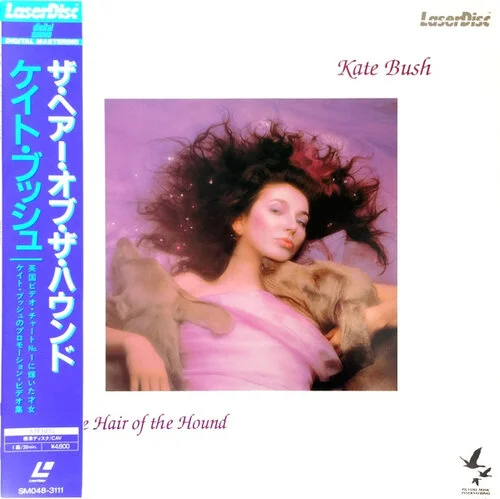
IN THIS PHOTO: Whilst The Hair of the Hound was released on VHS in the U.K., it was released on laserdisc in Japan

Kate Bush: The Hair of the Hound at Thirty-Five

___________

I try to capture ‘big anniversaries’…

zzzz.jpg

PHOTO CREDIT: John Carder Bush 

when it comes to Kate Bush. In June, we have one in the form of Sat in Your Lap. That song turns forty. It was the first single from Bush’s fourth studio album, The Dreaming. Sat in Your Lap marked a real sonic change for her. I have written a few features already about that song – and I will mark its anniversary on 21st June. Although it might not rank alongside the anniversary of a single or album, I wanted to mention a video collection that was released after Hounds of Love’s success. On 16th June, 1986, The Hair of the Hound was released. I like the title – whether it refers to the term ‘hair of the dog’ (meaning alcohol that is consumed with the aim of lessening the effects of a hangover) or meaning a taster of the album as a whole –, and I know there would have been a lot of demand for the VHS back in 1986. It wouldn’t be until 27th October of that year until people got a new Bush single in the form of Experiment IV. On 10th November, the greatest hits collection, The Whole Story, was released (Experiment IV was a new track on that greatest hits package). Not that The Hair of the Dog is inferior in any way. It was designed, I guess, to keep the momentum for Hounds of Love going. More than that, it allowed people to view four excellent videos!

I have said how Bush could have released more than the four singles from the album – Running Up That Hill (A Deal with God), Cloudbusting, Hounds of Love, and The Big Sky are the singles. As each video is very different and Bush directed the last two singles herself (and would continue to direct videos until the 1990s), it would have been a real treat. Whereas I feel a track from Hounds of Love’s second side, The Ninth Wave, could have been released as a single – And Dream of Sheep? Watching You Without Me? -, the four singles that were put into the world did well. Running Up That Hill (A Deal with God) reached number-three in the U.K.; Hounds of Love went to number-eight; The Big Sky went to number thirty-seven (which was unexpectedly low – perhaps owing to the fact many people had the album already and did not buy the single); Cloudbusting reached twenty. Because Hounds of Love did reach number-one in the U.K. and was such a successful album, I can see why the video collection was compiled. I am turning to the always-reliable Kate Bush Encyclopaedia for assistance. Let’s get an overview of The Hair of the Dog first:

Collection of music videos by Kate Bush. It contains all four of her music videos from the album Hounds Of Love. It was released on 16 June 1986.

The Hair Of The Hound' features the following music videos:

Running Up That Hill

Hounds Of Love

The Big Sky

Cloudbusting”.

I will conclude and give more thoughts at the end. It is worth knowing more about the videos and stories behind the four singles featured on The Hair of the Hound – ahead of the thirty-fifth anniversary of the collection. First up is the iconic Running Up That Hill (A Deal with God):

'Running Up That Hill' was intended as a fond farewell to dance, at least as far as Kate's video appearances were concerned. The music video, directed by David Garfath, featured Bush and dancer Michael Hervieu (who won an audition after Stewart Avon-Arnold was not available due to other commitments) in a performance choreographed by Diane Grey. The pair are wearing grey Japanese hakamas. The choreography draws upon contemporary dance with a repeated gesture suggestive of drawing a bow and arrow (the gesture was made literal on the image for the single in which Bush poses with a real bow and arrow), intercut with surreal sequences of Bush and Hervieu searching through crowds of masked strangers. At the climax of the song, Bush's partner withdraws from her and the two are then swept away from each other and down a long hall in opposite directions by an endless stream of anonymous figures wearing masks made from pictures of Bush and Hervieu's faces. MTV chose not to show this video (at the time of its original release) and instead used a live performance of the song recorded at a promotional appearance on the BBC TV show Wogan. According to Paddy Bush, 'MTV weren't particularly interested in broadcasting videos that didn't have synchronized lip movements in them. They liked the idea of people singing songs'.

'Running Up That Hill' was one of the first songs that I wrote for the album. It was very nice for me that it was the first single released, I'd always hoped that would be the way. It's very much about a relationship between a man and a woman who are deeply in love and they're so concerned that things could go wrong - they have great insecurity, great fear of the relationship itself. It's really saying if there's a possibility of being able to swap places with each other that they'd understand how the other one felt, that when they were saying things that weren't meant to hurt, that they weren't meant sincerely, that they were just misunderstood. In some ways, I suppose the basic difference between men and women, where if we could swap places in a relationship, we'd understand each other better, but this, of course, is all theoretical anyway. (Open Interview, 1985)”.

Rather than put the videos in chronologically (Hounds of Love was released after Cloudbusting, for instance), they were assorted so that Hounds of Love’s title single came second. It was the first music video directed by Kate Bush. I really like her directing style. As she had wanted to direct for a long time, there must have been a certain amount of pressure. What she does with the video is quite extraordinary:

The music video (directed by Bush herself) was very much inspired by Alfred Hitchcock's film 'The 39 Steps'. 'Hitchcock' also features in the video (a nod to the director's famous cameo appearances in his movies).

In the song 'Hounds Of Love', what do you mean by the line 'I'll be two steps on the water', other than a way of throwing off the scent of hounds, or whatever, by running through water. But why 'two' steps?

Because two steps is a progression. One step could possibly mean you go forward and then you come back again. I think "two steps" suggests that you intend to go forward.

But why not "three steps"?

It could have been three steps - it could have been ten, but "two steps" sounds better, I thought, when I wrote the song. Okay. (Doug Alan interview, 20 November 1985)”.

Although it was the poorest-performing single from Hounds of Love, The Big Sky is my favourite track. I also love the Bush-directed video. With some wild editing and jam-packed scenes, it is quite frenetic and busy video:

The music video was directed by Bush herself. It was filmed on 19 March 1986 at Elstree Film Studios in the presence of a studio audience of about hundred fans. The Homeground fanzine was asked to get this audience together, and they did within two weeks. Two coaches took everyone from Manchester Square to Elstree studios early in the morning, after which the Homeground staff, who were cast as some of the aviators, were filmed, and finally the whole audience was admitted for the 'crowd scenes'. The scenes were repeated until Kate had them as she wanted.

'The Big Sky' was a song that changed a lot between the first version of it on the demo and the end product on the master tapes. As I mentioned in the earlier magazine, the demos are the masters, in that we now work straight in the 24-track studio when I'm writing the songs; but the structure of this song changed quite a lot. I wanted to steam along, and with the help of musicians such as Alan Murphy on guitar and Youth on bass, we accomplished quite a rock-and-roll feel for the track. Although this song did undergo two different drafts and the aforementioned players changed their arrangements dramatically, this is unusual in the case of most of the songs. (Kate Bush Club newsletter, Issue 18, 1985)”.

sss.jpg

Ending up with the brilliant Cloudbusting. There are many reasons as to why the video is so brilliant. Not only does it feature Donald Sutherland…the video seems like a film in itself. It is a beautiful video indeed:

The music video was directed by Julian Doyle and was conceived by Terry Gilliam and Kate as a short film. In it, Canadian actor Donald Sutherland, portrays Wilhelm Reich, and Kate Bush, portraying his son Peter. Filming took place at The Vale of White Horse in Oxfordshire, England. Bush found out in which hotel Sutherland was staying from actress Julie Christie's hairdresser and went to his room to personally ask him to participate in the project.

The video shows the two on the top of a hill trying to make the cloudbuster work. Reich leaves Peter on the machine and returns to his lab. In flashback, he remembers several times he and Peter enjoyed together as Reich worked on various scientific projects, until he is interrupted by government officials who arrest him and ransack the lab. Peter senses his father's danger and tries to reach him, but is forced to watch helplessly as his father is driven away. Peter finally runs back to the cloudbuster and activates it successfully, to the delight of his father who sees it starting to rain.

In the UK, the music video was shown at some cinemas as an accompaniment to the main feature. Due to difficulties on obtaining a work visa for Sutherland at short notice, the actor offered to work on the video for free. Although the events depicted in the story took place in Maine, the newspaper clipping in the music video reads "The Oregon Times," likely a reference to Reich's home and laboratory Orgonon. The Cloudbusting machine in the video was designed and constructed by people who worked on the Alien creature and bears only a superficial resemblance to the real cloudbusters, which were smaller and with multiple narrow, straight tubes and pipes, and were operated while standing on the ground. In a reference to the source material of the song, Bush pulls a copy of Peter Reich's "A Book of Dreams" out of Sutherland's coat.

“It's a song with a very American inspiration, which draws its subject from 'A Book Of Dreams' by Peter Reich. The book was written as if by a child who was telling of his strange and unique relationship with his father. They lived in a place called Organon, where the father, a respected psycho-analyst, had some very advanced theories on Vital Energy; furthermore, he owned a rain-making machine, the Cloudbuster. His son and he loved to use it to make it rain. Unfortunately, the father was imprisoned because of his ideas. In fact, in America, in that period, it was safer not to stick out. Sadly, the father dies in prison. From that point on, his son becomes unable to put up with an orthodox lifestyle, to adapt himself. The song evokes the days of happiness when the little boy was making it rain with his father. (Yves Bigot, 'Englishwoman Is Crossing The Continents'. Guitares et Claviers (France), February 1986)”.

aaa.jpg

 PHOTO CREDIT: Guido Harari

I wanted to spend some time with a video collection, as I discovered Bush through the greatest hits VHS, The Whole Story. That is where I saw the video for Wuthering Heights (aged, maybe five or six). A love affair was born. In 1986, aside from music television, one did not have access to music videos. People might have already owned Hounds of Love - though they may not have seen the videos for the singles. The Hair of the Hound was a way of owning those incredible videos. Even though there is some duplication when it comes to The Whole Story – every single bar The Big Sky is included there -, owning The Hair of the Hound would have been an essential purchase for every Kate Bush fan. In terms of video compilations, there was The Hair of the Hound and The Whole Story in 1986. This Woman's Work: Anthology 1978–1990 (released in 1990) was not accompanied by a VHS. In 1994, Live at Hammersmith Odeon was released. Taken from a Hammersmith set during 1979’s The Tour of Life, the video and C.D. contain twelve songs from the tour, consisting mainly of songs from The Kick Inside and Lionheart. In terms of any DVD since the 1990s, it has been a bit sparse. I think fans would welcome a chance to see all of Bush’s music videos on a DVD. For that reason, I feel it is important to look back at compilations such as The Hair of the Hound, as it was a chance to have those videos on a physical format. With four wonderful videos from Kate Bush’s most-successful album, it is left to me to wish The Hair of the Hound

A happy thirty-fifth anniversary.

FEATURE: The Lockdown Playlist: Paul McCartney Solo Gems

FEATURE:


The Lockdown Playlist

fkfgjgui.jpg

PHOTO CREDIT: Mary McCartney

Paul McCartney Solo Gems

__________

I can’t recall…

fff.jpg

 PHOTO CREDIT: Collier Schorr for GQ

whether I did a similar playlist last year on Paul McCartney’s birthday. As he turns seventy-nine on 18th June, I wanted to put out a playlist containing his best solo tracks (I have excluded his work with The Beatles and Wings and collaborations with other artists. I am including music he recorded with Linda McCartney). Before getting to that playlist, in case you need it, here is some biography about the great man:

Sir James Paul McCartney CH MBE (born 18 June 1942) is an English singer, songwriter, musician, and record and film producer who gained worldwide fame as co-lead vocalist and bassist for the Beatles. His songwriting partnership with John Lennon remains the most successful in history. After the group disbanded in 1970, he pursued a solo career and formed the band Wings with his first wife, Linda, and Denny Laine.

A self-taught musician, McCartney is proficient on bass, guitar, keyboards, and drums. He is known for his melodic approach to bass-playing (mainly playing with a plectrum), his versatile and wide tenor vocal range (spanning over four octaves), and his eclecticism (exploring styles ranging from pre-rock and roll pop to classical and electronica). McCartney began his career as a member of the Quarrymen in 1957, which evolved into the Beatles in 1960. Starting with the 1967 album Sgt. Pepper's Lonely Hearts Club Band, he gradually became the Beatles' de facto leader, providing the creative impetus for most of their music and film projects. His Beatles songs "And I Love Her" (1964), "Yesterday" (1965), "Eleanor Rigby" (1966) and "Blackbird" (1968) rank among the most covered songs in history.

In 1970, McCartney debuted as a solo artist with the album McCartney. Throughout the 1970s, he led Wings, one of the most successful bands of the decade, with more than a dozen international top 10 singles and albums. McCartney resumed his solo career in 1980. Since 1989, he has toured consistently as a solo artist. In 1993, he formed the music duo the Fireman with Youth. Beyond music, he has taken part in projects to promote international charities related to such subjects as animal rights, seal hunting, land mines, vegetarianism, poverty, and music education.

McCartney is one of the most successful composers and performers of all time. He has written or co-written 32 songs that have topped the Billboard Hot 100, and as of 2009, had sales of 25.5 million RIAA-certified units in the United States. His honours include two inductions into the Rock and Roll Hall of Fame (as a member of the Beatles in 1988 and as a solo artist in 1999), 18 Grammy Awards, an appointment as a Member of the Order of the British Empire in 1965, and a knighthood in 1997 for services to music. As of 2020, he was one of the wealthiest musicians in the world, with an estimated fortune of £800 million”.

To mark the birthday of the greatest songwriter the world has ever seen, here is a selection of fantastic songs from Paul McCartney’s long and…

ILLUSTRIOUS solo career.

FEATURE: Spotlight: Loraine James

FEATURE:


Spotlight

xxx.jpg

Loraine James

___________

IT is interesting discovering…

aaa.jpg

 PHOTO CREDIT: Sophie Barloc for Loud and Quiet

artists that are really hitting their stride and you know will go far. That is the case with Loraine James. I will pull in a couple of reviews of her latest album, Reflection. Her 2019 sophomore album, For You and I, was lauded and marked her as an Electronic artist to watch closely. As a Black artists in that sphere/genre, perhaps opportunities have been fewer than they would have been for others – imbalance and racial exclusion still exists here. If you are new to James and not sure what she is about, then I can assist with a couple of choice interviews. The first comes from a very recent piece from The Guardian. They highlighted Loraine James on the release of her much-anticipated and terrific third album:

Raised in a tower block in Enfield, north London, James has been inspired by electronic music since her mid-teens, allured by IDM greats like Squarepusher and Telefon Tel Aviv: “I was always intrigued by melodic IDM, and wanted to replicate it,” she says, sitting among the craft-beer-sippers in a bar in Hackney Wick, east London. But James has gone far further than mere replication.

“I’m very much a living-room producer,” she says. “I had a keyboard my mum bought when I was younger. From my flat, I could see the London skyline, so I’d jam on the keyboard for hours, overlooking the sky.” James’s tracks have a paradoxical crafted deconstruction: they might initially feel disjointed until you realise that every hit and beat is intentional. She mimics the controlled chaos of free jazz, adopting the dissonance and odd time signatures through beats and glitching synths. “My music is a bit rough,” she says. “A lot of it sounds a bit scrappy, but I don’t re-record it, because I like how it sounds.”

Her 2019 album For You and I garnered widespread critical acclaim, topping end-of-year lists in the Quietus and DJ Mag. James assumed that her Hackney Wick gig, around, around the corner from where she’s sitting today, was destined to be the start of her breakout year. “People only caught on to me when the end-of-year lists came out, so I wasn’t known properly until last year” – and then the pandemic hit. “It’s like I came up and then suddenly disappeared. It’s kind of shit.”

With touring cancelled, James was forced to contemplate the state of her life, hence Reflection. “Sitting there with your thoughts for a year

James is in a predicament in which a lot of Black alternative musicians find themselves: facing routine exclusion from predominantly white electronic music spaces, while feeling as if she will never be Black enough for Black ones. This transitional position has been tough for her to navigate. “I’m still learning to fully appreciate my Blackness because I’ve always felt like I was different,” she says. “I’ve been called an Oreo” – white on the inside, black on the outside – “and other things.” Despite being noticed by prestigious publications, James wishes she could be recognised by the Black community: “Even the Mobo awards don’t have a rock or electronic genre at all”.

If you do get the opportunity to see James perform live, then it guarantees to be a rewarding experience. She is someone who is making music that is very much her own. It is revealing, powerful and hugely impactful! I feel she is someone who will continue to put out music and grow even stronger. As someone who seems to be near the top of her game, to realise she might grow even stronger is exciting indeed!

There are some good interviews out there that James participated in - so I would advise people to do some additional reading and research. In this interview with Loud and Quiet from late last year, we get a nice insight into the mind and music of a remarkable young artist:

Despite the wealth of stuff she’s put out – largely pay-what-you-want, no less – she’s still self-effacing: “I should probably concentrate on the proper releases.” We’re ostensibly here today to talk about one of those “proper releases”. Directly after the release of For You And I, James uploaded unfinished songs onto a private Soundcloud account with the idea of reaching out to potential collaborators via Twitter, who would later sift through the available tracks for anything that captured their interest. The resulting EP, Nothing, sounds like a greatest hits sampler, containing sonic elements and preoccupations of James’ past work condensed into a single disc. This isn’t to say she was convinced of each track’s potential at first. “I wasn’t feeling the instrumental to ‘Don’t You See It’ at all,” she says. “I wasn’t really into it at the time and wouldn’t have recommended it to anyone.” Luckily, Jonnine Standish of dynastic Australian group HTRK took the gauntlet anyway. “Jonnine sent me her vocals and we reworked the song a bit. Everything started falling into place.” Curiously, with its gut-punching piano, choral pads and sputtering beat, paired with Standish’s R&B-inflected vocal and lyrical melancholia (“Summer is a traitor / ’cos Summer’s moving on”), James hasn’t sounded this tenderly accessible since ‘Sensual’. “I’ve definitely heard a few people call [‘Don’t You See It’] kind-of-pop. I get where they’re coming from, it’s definitely one of the more straightforward songs I’ve done.”

James’ mother is also to be credited for her eclectic listening, if not her cross-genre approach to her own music, having played everything from Calypso to Metallica in the home. As such, you can’t click on any of James’ YouTube videos without seeing a top comment from an ‘S James’: “Loving this from my daughter,” they tend to read, followed by two flame emojis. “She doesn’t listen to electronic music or anything,” laughs L James, “but I’m grateful that she checks out my stuff. I’d sometimes get embarrassed if she’d come down to gigs but it’s fine, and obviously my last few gigs have been clubbier ones that run until one or two o’clock so she’d be in bed anyway”.

There is a 2019 interview from Pitchfork that interested me. The response to the first question really struck me. I hope that things have improved since 2019 - though one feels that there is still a way to go:

What did you make of the queer scene in London? There’s not a lot of spaces for women.

There isn’t. There’s, like, women’s nights—wow, a night!—but it’s shit. Heaven’s mainstream as hell, so there’s a lot of straight people in there anyway. My guy friends always find someone, and it’s like, “That’s great…” [laughs] When I was single, I would see these women standing in the corner looking very intimidating and be like, “What did I do?!” They literally have their arms folded, watching everything, not having a good time. Or there will be the straight girls.

You said your first album, Details, was more of a technical exercise. Was For You and I your first attempt at making really personal music?

Yeah. Though I didn’t know what direction it was going to go in, and it wasn’t intentional. At the start, the album was called Disjointed. I changed it literally when I sent the masters to Hyperdub because I listened to it whole, and the name didn’t make sense any more.

I didn’t initially have a personal feeling towards a track like “So Scared,” but then I added in vocals that I recorded a few years ago [“You’re over there/You’re fucking scared”]. That’s probably the most vulnerable track on there. It’s basically about public displays of affection—obviously being queer, dealing with verbal abuse or physical abuse, and always being afraid of that. A lot of the time, when I walk around with my partner, I wouldn’t even touch her. I’m a quiet, shy person as it is, I don’t like attention. So that just feels pretty shitty. Sometimes I look at straight couples, and I get a bit like—it’s not fair. Something so easy, I have to think twice about. Even to listen to that song now, I feel like I’m in that situation”.

It is no surprise that Reflection has resonated with critics. It is a remarkable album that one cannot help be moved and entranced by. If you have not got a copy, then it is definitely worth owning one. This is what Rough Trade say about Reflection:

Made during summer 2020, Loraine James’ second Hyperdub album, Reflection, is a turbulent expression of inner-space, laid out in unflinching honesty, offering gentle empathy and bitter-sweet hope. Reflection further develops a unique pop sensibility realised on last year’s Nothing EP, while tones of Drill and R&B seep through into this collection too. In contrast to the brash splashes of 2019’s For You And I LP and the grimey anger of Nothing, Reflection is pared-down and confident, taking the listener through how last year felt as a young black queer woman in a world that has suddenly stopped moving, the arc of the album peppered with Loraine's diaristic confessions. Starting positively with the gentle pop-trap of ‘Built To Last’ ft Xzavier Stone, into the bumpy instrumental of ‘Let's Go’, the album switches tone with ‘Simple Stuff’, followed by regular collaborator Le3 bLACK amplifying Loraine's vulnerability on the downcast drill of ‘Black Ting’, then ‘Insecure Behaviour And Fuckery’ is a techno glide which pairs Nova's confrontational plea for respect, delivered in monotone autotune, against deep Drexciyan chords. With Baths on vocals, the weightlessness of ‘On The Lake Outside’ soothes numb feelings, and Eden Samara explores the shadow world of anxious dreams on the airy R&B of ‘Running Like That’. Closing track ‘We're Building Something New’ with Manchester rapper Iceboy Violet brings the album together, confidently suggesting a new world is in reach. Reflection is a brave step forward for a unique and creative 21st century musician”.

zzz.jpg

I am going to wrap up in a second. Beforehand, CRACK were very positive when they sat down to review one of this year’s very best albums – from an artist who is catching the eyes and ears of a whole new wave of fans and admirers:

With its fractured beats and shy confessionalism, London producer Loraine James won hearts with her acclaimed Hyperdub debut For You and I in 2019. Since then, James has zeroed in on her craft, self-releasing a string of multi-track collections and even put out another EP, titled Nothing, for the revered London label. The arrival of her third album, Reflection, feels like a culmination of all these projects; it’s an open-hearted work by an artist that has undoubtedly levelled up.

Featuring her vocals far more prominently than ever before, James flits between doubtful introspection and open vulnerability. On Simple Stuff, she lays it bare and declares, “I like the simple stuff/ We like the simple things/ What does that bring?” over spliced beats. Building on the album’s tender energy, James enlists the layered harmonies of emo-pop electronic producer Baths for On the Lake Outside.

But Reflection’s emotional catharsis goes beyond the personal. Written during a period of lockdown-induced focus, the album carries within it the broader collective anxieties that came to define 2020. This is most noticeable on album closer We’re Building Something New, which sees Manchester rapper Iceboy Violet anatomise the grief felt throughout the Black community through stark imagery (“breaking bread and cable ties”). Dedicated to “all the victims of police violence”, the track’s ascetic rhythms make room for flourishes of warm piano, like resilience giving rise to something approaching hope. It’s a fitting end to an album that shores up James’ position as one of the UK’s most compelling producers”.

Actually, it is worth highlighting one more review. I feel that Reflection is such an interesting album, hearing a couple of different angles is important. This is what The Quietus remarked in their review:

The gorgeous ‘On The Lake Outside’ (a collaboration with Baths) shimmers into a calm lullaby-like ode to the outdoor world, while on ‘Change’, James asks herself: “What are you gonna do about it? Huh?” as she snaps to her feet by focussing on rebuilding a future better than the past. The question drives James and lifts her from self-doubt to assurance and the frenzied sparseness of earlier tracks is replaced by soaring affirmations.

It’s perhaps seen most strikingly on the album’s standout, ‘We’re Building Something New’, with Manchester rapper Iceboy Violet. “One million views of Black bodies bruised and you’re acting so confused? / The seeds they sowed bare strange fruit / They tryna bleed us for that juice,” Violet raps as they circle back to where James started on ‘Simple Stuff’ and ‘Black Tings’. But here, Violet and James offer a vision of hope for the future via airy R&B and soaring club synths: “The seeds we sow bare beautiful fruit / We’re building something new....sharing building supplies til we touch the sky.”

Reflection is a striking step forward for James, who has reaffirmed herself as one of the UK’s most talented young IDM artists. Lockdown led James to interrogate every aspect of her identity and the vulnerability she felt in doing so is a feeling many will be able to relate to here; so too is the bitter-sweet hope she finds at the end. This is both a call to change and a call to reflect; without the latter there can’t be the former, James says, on this brave, ambitious and challenging new album”.

I shall leave it there. Go and follow Loraine James and check out her new album. Let’s hope that she is able to gig as much as possible. As a breakthrough artist, last year should have been a really big and exciting one for her. I can understand how anxiety-making the stress of the pandemic would have been. When things open up, she will be able to make up for lost time and strike. That will be…

THRILLING to witness.

_______________

Follow Loraine James

wwsw.jpg

FEATURE: Vinyl Corner: The Stooges - Fun House

FEATURE:


Vinyl Corner 

The Stooges - Fun House

___________

FOR this Vinyl Corner…

eeeeeeeeeeeee.jpg

I am focusing on an album that I am a big fan of. The Stooges’ Fun House was released in July 1970. The second studio album from the Iggy Pop-fronted band, it remains hugely important. Musicians such as Mark E. Smith and Nick Cave have named it as their favourite album. Songs from the album have been covered by a range of artists. Featuring seven tracks, one might feel Fun House is too lean to make an impact. There is great focus and economy on the album, though a couple of the tracks (Dirt and Fun House) exceed seven minutes. There is an urgency and thrill to the album that wowed fans ands critics in 1970. Over fifty years later, Fun House remains so exhilarating and important. I would urge people to buy it on vinyl. At the moment, one can get the vinyl through Discogs. It is harder to find it at your standard record shop. Let’s hope the band/Elektra release Fun House or remaster it very soon. One does not need to be familiar with The Stooges to appreciate Fun House. It is an album that, once heard, stays long in the head. Rather than bring in a feature about the album and its creation, there are a few reviews that tackle the album is different ways. It is rewarding seeing how such a classic has resonated with so many people.

In this expansive and fascinating review, Elliot James provided his take, thoughts and opinions on Fun House back in 2017. He makes some great observations and points:

What makes Fun House so great? You can start by appreciating the howling craziness of one Ignatowski “Iggy” Pop Music “Pop.” Fun House is his most inspired performance of all the Stooges’ records. On opener “Down on the Street,” he is a cheetah on the prowl, crooning and swaying until BAM, he unleashes his fury and lets you know what you’ll be dealing with for the rest of this record. When he’s not singing like a greaser angel he is positively unhinged, a detail I noticed when I was sitting on the deck with my baby listening to Iggy scream like a maniac, leading me to fear judgment from my neighbors in their backyard who might think I’m purposely polluting my daughter’s mind with traumatic music. But those neighbors have motorcycles, so their opinion on literally anything in life is null and void.

Iggy’s yelps and squeals come between lyrics that boast of his strengths and inadequacies as a lover and as a human being. He might brag about being “Loose,” and he sees pretty things “Down on the Street.” He also spends seven minutes telling us he’s been “Dirt,” but he doesn’t care. It’s no accident that he sounds much more believable when he runs himself down as opposed to when he’s building himself up. There’s too much eagerness in his proclamations of grandeur, it’s like he’s over-compensating. The Stooges were dirtbags in an era when being a dirtbag didn’t sell records. The big rock bands in 1970 were larger than life, or at the very least appeared to have their shit together. Even the Stones were less ragged than this.

The rest of the band pounds out careening feedback and menacing rhythms that don’t go far to soften the blow of Iggy’s wildness. They mostly favor insistent rhythms like “T.V. Eye,” where Scott Asheton just never stops hitting the snare, or “Loose,” which rumbles forward with no mercy. Only on “Dirt” do they bring things down in a jam that is decidedly not punk, but does tap into a feeling of alienation most punk bands could only dream of imitating. Bassist Dave Alexander is absolutely essential to the success of this record, as his basslines provide the melodic foundation upon which everyone else just goes nuts. The title track is a jam and a half, but that bassline is key. By the time they get to album closer “L.A. Blues,” everything has fallen apart and no one wants to play together anymore. It’s five minutes of unorganized chaos, and even if it’s not the most listenable track in the world, it acts as a funny final statement: we can only be nice for so long until we explode”.

I am going to wrap it up soon. I wanted to convince those – if it was needed at all – who have not heard Fun House to give it closer investigation. I think that it ranks alongside the very best albums of the 1970s. Welcoming in a new decade with something so explosive must have stunned people. I think of Fun House as a Punk album, though it predated the movement. It is hard to genre-lise the album and define it. It was definitely a wake-up call to so many other musicians. In their review, this is what AllMusic had to offer:

The Stooges' first album was produced by a classically trained composer; their second was supervised by the former keyboard player with the Kingsmen, and if that didn't make all the difference, it at least indicates why Fun House was a step in the right direction. Producer Don Gallucci took the approach that the Stooges were a powerhouse live band, and their best bet was to recreate the band's live set with as little fuss as possible. As a result, the production on Fun House bears some resemblance to the Kingsmen's version of "Louie Louie" -- the sound is smeary and bleeds all over the place, but it packs the low-tech wallop of a concert pumped through a big PA, bursting with energy and immediacy. The Stooges were also a much stronger band this time out; Ron Asheton's blazing minimalist guitar gained little in the way of technique since The Stooges, but his confidence had grown by a quantum leap as he summoned forth the sounds that would make him the hero of proto-punk guitarists everywhere, and the brutal pound of drummer Scott Asheton and bassist Dave Alexander had grown to heavyweight champion status. And Fun House is where Iggy Pop's mad genius first reached its full flower; what was a sneer on the band's debut had grown into the roar of a caged animal desperate for release, and his rants were far more passionate and compelling than what he had served up before. The Stooges may have had more "hits," but Fun House has stronger songs, including the garage raver to end all garage ravers in "Loose," the primal scream of "1970," and the apocalyptic anarchy of "L.A. Blues." Fun House is the ideal document of the Stooges at their raw, sweaty, howling peak”.

To round things off, there is a review from Classic Rock Review that I felt I needed to include. Fun House is one of those albums beyond fault. No matter what your tastes, one has to bow to its majesty and genius:

The influence of some of the more intense numbers by The Doors can be felt in the opening “Down on the Street”, with a strong interlocked bass and guitar riff holding the backing track for Iggy Pop’s reverberated vocals and chants. Although this song feels raw at first listen, it is more refined than anything that follows and may be the most traditionally produced track on Fun House, even to the point of having Ron Asheton guitar overdubbed during the lead section. “Loose” follows with an interesting drum intro by Scott Asheton as he finds the upbeat groove which, overall, leans more toward the yet-to-be-developed punk genre with a starkly honest lyric.

“T.V. Eye” features a bluesy riff while the vocals are still energetic, wailing and (occasionally) screaming. This very repetitive song builds a tension which never really breaks but does reach a bit of a crescendo late in the song, just before an abrupt stop and restart. Iggy Pop has said he was channeling blues legend Howlin’ Wolf while recording “T.V. Eye”. “Dirt” has a long drum intro by Scott Asheton as Alexander’s bass and Ron Asheton’s guitar slowly join in to this overall soulful rocker. Here, Iggy Pop sounds similar to Eric Burdon of The Animals on this one while it is an overall showcase for Ron Asheton, especially during the multi-textured, wah-wah fused guitar lead.

It is quite obvious that the second side of an album derives from a singular jam which now includes saxophonist Steve Mackay, and Gallucci laid this out in side-long linear fashion. On “1970”, the rhythmic drums and bass provide backdrop for a pseudo-blues bark on a jam that does provide differing chord structures for the chorus and post-chorus. Late in the song Mackay makes his debut, adding a distinct and original element to the overall sound and vibe. On “Fun House” Mackay is more of an integral part of the sound while Scott Asheton’s drumming is a fine adhesive for the overall jam and Iggy Pop’s vocals are more strained and desperate than ever, as he technically makes his lyrical finale on the album. “L.A. Blues” wraps things up with, effectively, five minutes of noise, screams and off-beat chops as all five members desperately search for a common ending before settling on a sustained feedback loop by Ron Asheton.

Although Fun House has sold under 100,000 copies to date, it has influenced numerous other artists, with many specifically citing as this as their favorite album. The Stooges and their individual members, soon entered a tumultuous period and it would be nearly three years before they followed up Fun House (with the critically acclaimed Raw Power) but that album was sandwiched in between a pair of band breakups”.

Go and get Fun House on vinyl if you have not done so already. It is a little pricey, though I think it is worth the investment. As I said, I hope that there is another release soon enough. Although 2013’s Ready to Die was the fifth album from The Stooges, I think their best albums were the first three: The Stooges (1969), Fun House (1970) and Raw Power (1973). Make sure that you own…

A masterpiece from The Stooges.

FEATURE: Long Players: Writers on the Albums That Shaped Them: Tom Gatti’s Revealing and Insightful New Book

FEATURE:


Long Players: Writers on the Albums That Shaped Them

ccc.jpg

IMAGE CREDIT: Bloomsbury Publishing PLC 

Tom Gatti’s Revealing and Insightful New Book

___________

IT is not often that I focus on a book…

r.jpg

IN THIS PHOTO: Bernardine Evaristo/ PHOTO CREDIT: David Levenson/Getty Images

but a fascinating new release arrived on Thursday. There are a lot of books dedicated to great albums and why they are so important. We do not often read about albums that are important towriters. I think that every album affects people differently, though it is interesting learning why different people have different reactions. Tom Gatti has released Long Players: Writers on the Albums That Shaped Them. As the title suggests, it is a book where a series of writers discuss why particular albums are important to them. It is a book that every music lover should have on their shelf. Waterstones tell us a bit more:

From Bernardine Evaristo to Neil Gaiman, fifty of our finest writers divulge their favourite album and the story behind their adoration in this addictive love letter to the power of music.

Our favourite albums are our most faithful companions: we listen to them hundreds of times over decades, we know them far better than any novel or film. These records don't just soundtrack our lives but work their way deep inside us, shaping our outlook and identity, forging our friendships and charting our love affairs. They become part of our story.

In Long Players, fifty of our finest authors write about the albums that changed their lives, from Deborah Levy on Bowie to Daisy Johnson on Lizzo, Ben Okri on Miles Davis to David Mitchell on Joni Mitchell, Sarah Perry on Rachmaninov to Bernardine Evaristo on Sweet Honey in the Rock.

uu.jpg

Part meditation on the album form and part candid self-portrait, each of these miniature essays reveals music's power to transport the listener to a particular time and place. REM's Automatic for the People sends Olivia Laing back to first love and heartbreak, Bjork's Post resolves a crisis of faith and sexuality for a young Marlon James, while Fragile by Yes instils in George Saunders the confidence to take his own creative path.

This collection is an intoxicating mix of memoir and music writing, spanning the golden age of vinyl and the streaming era, and showing how a single LP can shape a writer's mind.

Featuring writing from Ali Smith, Marlon James, Deborah Levy, George Saunders, Bernardine Evaristo, Ian Rankin, Tracey Thorn, Ben Okri, Sarah Perry, Neil Tennant, Rachel Kushner, Clive James, Eimear McBride, Neil Gaiman, Daisy Johnson, David Mitchell, Esi Edugyan, Patricia Lockwood, among many others”.

There is a connection between the world of literature and music. I feel a lot of artists are inspired by literature and books. Writers, in return, take influence and motivation from music. Gatti’s book brings together authors and songwriters to get their take on particular albums. Not only does it provide us with fresh perspectives on well-known albums. There are going to be albums mentioned that many of us have not heard. That fresh discovery is so rewarding for the reader. As much as I love hearing authors speaking about albums and why they are loved, having a collection of testimonies Long Players: Writers on the Albums That Shaped Them provides a different angle.

qwq.jpg

It is no surprise that Gatti’s tome is already accruing some positive reviews. I have ordered the book and feel like it will compel other authors to embark on similar projects. In their review, The Guardian observed the following:

Perhaps unsurprisingly it turns out that writers tend to value literary effects and skills, and to draw literary comparisons. Deborah Levy, who chose Ziggy Stardust, calls Bowie a “great writer” who has influenced her “more than Tolstoy ever will do”. Sarah Hall compares Radiohead’s OK Computer to “a great short-story collection” and Musa Okwonga loves Outkast’s Aquemini as he loves “the collected short stories of Kurt Vonnegut – every time I return to both works, I find some new way of looking at the human condition”. In less celebratory mode Daljit Nagra links Morrissey – “grudgingly” via the Smiths’ Meat Is Murder and the 80s yobs who smashed his parents’ shop windows and painted the shutters with racist slurs - to Philip Larkin. “Like Larkin, I’d have Morrissey leave the limelight, so I can love the best work before he smashes the shopfront of his own great tenderness.”

The entries can be just a few hundred words long – some of them began life as a column in the New Statesman where Gatti is deputy editor – but throw up some vividly disparate autobiographical vignettes. In the mid 80s the teenage David Mitchell, who’d “never been in love, much less fallen out of it”, first heard Joni Mitchell’s “raw autobiography” of California heartbreak, Blue, on his Walkman while wandering around his hometown of Malvern. His encounter with the great and dark Christmas breakup song “River” came on a June day “halfway across the golf course”.

rrr.jpg

Around the same time Will Self was in a cavernous flat off the Cromwell Road in west London “with a needle stuck in my arm, the barrel of the syringe full of blood” as Van Morrison’s Astral Weeks “strummed his heart strings”. The poet Will Harris recalls how his father once made him “sit through the eight-minute album version of Donna Summer’s ‘I Feel Love’” which, very indirectly, led him to Warren G’s Regulate ... G Funk Era.

Taken as a whole, the collection’s many observations and angles amount to a richly textured snapshot survey of artists on art. And at their best the pieces reveal something useful about the writer, the music, the world at large and the world at that moment. For Linda Grant, Joni Mitchell’s Hejira clearly laid out “the great paradox of 70s feminism”, the desire for independence from men and also for a “love that sticks around”. It also crystallised the strange and powerful relationship between the listener and the artist: “I never saw her perform live. I don’t want to. I’ve no interest in sharing her with total strangers because none of this is about her, it’s about me”.

Long Players: Writers on the Albums That Shaped Them is a really immersive and compelling book that gives us some very personal takes on particular albums. It has made me think more carefully and personally about particular albums. Normally, I listen to albums and do not really consider why they mean a lot to me. If we all think about it, our favourite albums are so loved because they affect us in a specific way – or they are attached to special memories. Given the great reviews that many have afforded Long Players: Writers on the Albums That Shaped Them, there will be plenty of demand for…

aaa.jpg

A sequel.

FEATURE: Second Spin: The Human League – Crash

FEATURE:


Second Spin

tttt.jpg

The Human League – Crash

___________

IT is strange how…

qqq.jpg

some bands produce an incredible and faultless record and then, on their next couple of releases, sort of slump. Not to say that is what happened to Sheffield’s The Human League after the release of 1981’s Dare. That album is such a classic and it contains some of their best tracks – The Sound of the Crowd and Don’t You Want Me among the gems. 1984’s Hysteria was the next studio album. It wasn’t really up there with Dare. Despite some strong material, critics did not react as positively. Following Hysteria, the band delivered Crash. That title might be ironic: considering some of the reviews, many felt it was a bit of a disaster. I don’t think it is the best album from The Human League, though it is one that has some great moments. This year will see many people revisit Dare on its fortieth anniversary. It seemed that Crash was a difficult album to record. During a period where things were quite tense in the band, one can understand why there is a slight lack of focus and quality. Released on 8th September, 1986, Crash does contain some pearls. It is hard to find many reviews of the album. I will bring (a mixed) one in soon. I do think that people should seek out Crash and give it another chance. Bringing in some background, and one gets a sense of how The Human League developed and adapted after the release of Hysteria:

After spending two years recording their fourth album Hysteria, which met with only moderate commercial success, the band struggled to record further material. By 1985, musician/songwriter Jo Callis had left the group. Virgin Records, worried by the lack of progress in one of their leading acts, called the band principals to a meeting where a solution was sought. As the problem was perceived to be the lack of production, it was suggested that the band take up an offer to work with Minneapolis based production duo Jimmy Jam and Terry Lewis. Jam and Lewis had written for and produced the S.O.S. Band, Cherrelle and Alexander O'Neal, and had just finished working on Janet Jackson's breakthrough album Control. They had developed an interest in The Human League after the success of their US releases; they were also seeking an opportunity to cross over into mainstream pop and saw The Human League as the perfect opportunity.

In February 1986, The Human League were flown out to Minneapolis to work at Flyte Time Studios with Jam and Lewis. After initial enthusiasm on both sides, the working relationship began to break down. Jam and Lewis had total control over the final album and insisted that their own tracks take precedence over the band's material. Jam and Lewis were also intolerant of the band's laid back working methods and their lack of musical technical ability.

After four months in Minneapolis, a sidelined Philip Oakey pulled the band out of further recording and they returned to Sheffield leaving Jam and Lewis to complete the album using session musicians. Oakey said later:

We like to be in control in the studio. We don't like giving that up to a producer. That's why we had a big, final argument, and we just decided to go home and leave them to finish it off. It just got to the point of who had the power, and in that instance...They were the men behind the mixing console, so they had ultimate control.

Keyboard players Philip Adrian Wright and Ian Burden also had been sidelined by Jam and Lewis. Wright would not recover from the humiliation and immediately left the band upon their return to the UK. Burden eventually quit the band in 1987.

The album name was taken from a moment in the studio during the recording. Oakey described it thus:

It's from a crash cymbal, because it's a disco album again with lots of cymbals. One day somebody said “what sorts of cymbals do you want, a ride or a crash?”, and we thought, “what a great title!”

Although at the time the band had all but washed their hands of the album post production, when released it quickly became an unexpected success. One of the Jam and Lewis compositions, "Human", was released as the album's first single and became the Human League's second number-one on the US Billboard Hot 100 and their first UK top-ten hit in over three years (no.8). Follow-up singles "I Need Your Loving" and the 1988 UK-only release "Love Is All That Matters" were less successful, failing to reach the UK Top 40. The album itself peaked at number 7 in UK (where it was certified Gold for sales in excess of 100,000 copies) and number 24 on the US Billboard 200 album chart. Oakey, with hindsight, states that it was this album that saved the band's career and one of the main reasons they are still recording today.[citation needed] However, he also stated in 1995 his disconcert with the record, saying: "The Jam and Lewis album [Crash] was just like being a puppet for four months. It was interesting to pick yourself out of the industrial north of England and dump yourself in Minneapolis. Great experience, but it just wasn't our album".

I have a lot of time for Crash. It is an album that has some weak spots, though it is not as bad as some people say. I opened by remarking how bands can produce a classic and then not live up to that standard very soon after. If Dare is the masterpiece from The Human League, I think that Crash is an album that is worth listening to. I want to source one review for Crash. This is what AllMusic wrote in their assessment:

The Human League turned to American R&B producers Jimmy Jam and Terry Lewis in the wake of their success with Janet Jackson's Control, and the combination brought the group its second number one hit with the Jam-Lewis composition "Human," which harked back to the earlier "Don't You Want Me," albeit with a gentler tone. The album's second single, the Control-soundalike "I Need Your Loving," was also a Jam-Lewis song (as was the U.K.-only third single, "Love Is All That Matters"), but the bulk of the album was made up of group-written songs with appealing backing tracks that maintained their dance appeal while eschewing the overtly synthesized sound of previous albums. That made Crash an improvement over the lackluster Hysteria, but still not on a par with Dare”.

Human is the big hit and success from Crash. I also feel that there are four or five other tracks that are really good. Overall, I would say Crash is an album that has its moments and should not be seen as a disaster. It wasn’t until the band’s eighth album, Secrets, of 2001 where they recovered some of their form and got back on track. That being said, I do think that 1986’s Crash is…

WORTHY of some more time.

FEATURE: An Impossible Choice: The Best of the Best: Kate Bush’s The Whole Story

FEATURE:


An Impossible Choice

ssss.jpg

The Best of the Best: Kate Bush’s The Whole Story

___________

THE year 1986…

aaaa.jpg

 IN THIS PHOTO: Kate Bush in 1985

was a very interesting one in Kate Bush’s career. The previous year, she released her masterpiece fifth studio album, Hounds of Love. After promoting the album quite heavily (including interviews in America), she was one of the most popular artists in the world. Not to say that her previous four albums were overlooked. Hounds of Love was a huge declaration and incredible release that took her to new heights. It was her biggest album to date in America, and there would have been decisions as to what came next. I am going to do more features in the run-up to its thirty-fifth anniversary on 10th November. The Whole Story was what came in 1986. I feel like the greatest hits compilation was a definite end of a chapter. It would be three years after the album until Bush released another album. 1989’s The Sensual World was a new stage for Bush. I have spoken before about Kate Bush greatest hits collections. There have been others since 1986 – including 1990’s This Woman's Work: Anthology 1978–1990. Although The Single File 1978-1983 arrived in 1984, that was just an assortment of singles to that point rather than a greatest hits package. Hounds of Love’s success and brilliance inevitably led to calls for a greatest hits album. Bush might have been reluctant to put one out earlier in her career. Before continuing, here is some critical reaction regarding The Whole Story – in addition to some comments from Bush regarding the album:

Roger Holland in Sounds (UK): "Over the last nine years and five albums, Kate Bush (...) has matured into quite the most sensual, expressive, and creative artist this country can now boast". Colin Irwin, Melody Maker (UK): "This glorious retrospective collection... she's playing a high-risk game, and more often than not her irrepressible flair, her instinct for a hook, and her gift for unusual and gripping arrangements carry her through." John McReady, NME (UK): "More useful and more enjoyable than the constipated jangling of a hundred and one little lads with big mouths and even bigger clothes allowances. Such people are not worth a carrot. Meat or no meat, Kate Bush is streets ahead." Andy Strickland, Record Mirror (UK): "A monumental tribute to this craziest, coziest girl-next-door. (...) One of the most refreshing compilation LPs it would be possible to put together."

Kate about 'The Whole Story'

Yes, I was [against the release of a compilation album] at first. I was concerned that it would be like a "K-tel" record, a cheapo-compo with little thought behind it. It was the record company's decision, and I didn't mind as long as it was well put together. We put a lot of work into the packaging, trying to make it look tasteful, and carefully thought out the running order. And the response has been phenomenal - I'm amazed! (Kate Bush Club newsletter, Issue 22, December 1987)

It wasn't chronological because we wanted to have a running time that was equal on both sides, otherwise you get a bad pressing. In America, where I'm not very well known, they didn't realise it was a compilation! ('Love, Trust and Hitler'. Tracks (UK), November 1989)”.

I am excited about the anniversary later in the year, as it will provoke questions whether it is time for another greatest hits album. I think, after ten studio albums and a career that has exceeded forty years, there is definite scope for an expanded collection that takes us from 1978’s The Kick Inside through to 2011’s 50 Words for Snow. In my view, it must have been exceedingly hard narrowing down the tracks to include on The Whole Story. What we do have with the twelve tracks is a representation of Bush’s incredible talent and progress.

aaa.jpg

 IN THIS PHOTO: Kate Bush in a still from the 1986 Experiment IV video (which she directed)

I want to discuss the tracklisting and importance of The Whole Story. Before that, there is a review of the album from 2018. Marking forty years since Bush’s debut album  arrived, this article examined a hugely important album:

40 years ago, the world was blessed with one of the weirdest and most wonderful artists it has ever seen. The world was blessed with a frizzy haired 19 year old singing about Emily Bronte’s novel Wuthering Heights whilst dancing in a forest wearing fantastically bold red lipstick and green eyeshadow. The world was blessed with Kate Bush.

With five albums worth of material to work with, The Whole Story sees Kate take the best of her brilliant early catalogue and assemble it into one amazing compilation. 32 years on, this record has not aged a day, with every track still proving timeless, fuelling its listeners with all of Bush’s raw emotions.

The Whole Story takes the listener away on a musical ride through some of Bush’s most iconic moments from the beginning of her career. Hearing Bush’s early work in particular showcases the evolution of her wonderfully wavy vocals and wild imagination. From her softly sung piano ballad ‘The Man With The Child In His Eyes’, written at the age of just fourteen, to her spacey-orchestral experiment track ‘Wow’, taken from her second album Lionheart.

Bush uses The Whole Story to really showcase the formation of her now trademark quirkiness. With tracks like ‘Babushka’, (about a woman romantically fooling her husband) and the iconic pop anthem ‘Running Up That Hill (A Deal With God)’, being flawless demonstrations of her ability to continually surprise listeners and push boundaries. Every track on The Whole Story shows the pure creativity and song-writing talent possessed by Bush – a skill heard in every one of her song’s piano notes and every drum beat.

Opening this compilation is the genius ‘Wuthering Heights’, which Bush remixed and re-recorded herself for this project. This remixing was done purely with the intent on giving the song a more mature sound, replacing Bush’s original vocals for the track when it was released in 1978, when Bush was just 19. This minor alteration in sound really does highlight the subtle change in vocal depth and resonance Bush developed in the eight years between the original track release to the polished and perfected iteration heard on The Whole Story.

Kate Bush creates magical worlds through her music, vocals and lyrics that has the fantastic ability to transport you away to a wondrous place where anything could happen. A place where Catherine and Heathcliff are together; a place where God will let you be another person to escape from the excruciating feeling of loving someone too much. The Whole Story is a vessel that ultimately transports the listener to the depths of Kate Bush’s imagination.

Kate Bush is not a singer, she is an artist. In fact, she is one of the most important artists of our time, and one that will continue to shape the music industry forever. Listening to The Whole Story is all the proof you need”.

It must be strange for an artist to have a greatest hits album out. They might feel like it defines them or is a bit of a full stop. It was clear Bush had a lot of material left in her. Rather than it being a chance to cash in on the success of Hounds of Love, it allowed new fans to discover her previous work. It also provided people the opportunity to see how Bush, from album to album, produced very different sounds and songs. I will explore Bush in 1986 a bit before the anniversary of The Whole Story. Although there were singles released and activity, it was a less busy and eventful year than the one previous (there was another 1986 release, The Hair of the Hound, which featured all four of her music videos from the album Hounds of Love. It was released on 16th June. Bush also appeared during the Comic Relief live shows in April, performing Breathing and singing the duet, Do Bears..., with Rowan Atkinson). Whereas greatest hits collections are meant to bring in the most successful singles and, to a degree, most accessible songs, I think Bush has some fascinating deeper cuts. With only two songs from The Kick Inside – the singles, Wuthering Heights (with a new vocal) and The Man with the Child in His Eyes -, some might have felt that album was short-changed. Some might say that including The Dreaming’s title track (which only charted at forty-eight) might have denied other tracks. That album’s Suspended in Gaffa would have been a good selection. Hounds of Love’s The Big Sky is also missing. Narrowing it down to a dozen tracks means that some cuts miss the grade. Listen to the five albums prior to The Whole Story, one realises that there are so many non-singles that are also worthy.

As it traditional with greatest hits collections, there is a new track. It is a chance for an artist to give a new song a home or give the listener extra incentive to buy the album. I have already spotlighted The Whole Story’s new track, Experiment IV. I may revisit it ahead of 10th November. I love the track and wonder where it could have sat if it was available for inclusion on Hounds of Love. I think the song has an element of Peter Gabriel’s Shock the Monkey (the first single from his fourth eponymous album of 1982) – an artist that Bush worked with several times. I forgot to mention that, in addition to The Whole Story, 1986 saw Bush appear on the Peter Gabriel song, Don’t Give Up. The powerful diet appeared on his So album. The single was released on 27th October (the same week as Experiment IV). I love the fact that Bush had two singles out from two different albums that are very different themselves. Although I said 1986 was fairly quite or Bush, she actually had quite a bit on! I wonder how much say Bush had regarding choosing songs to appear on The Whole Story and whether she would have preferred some non-singles being in the mix. I feel EMI could have stretched The Whole Story to fifteen tracks. That might have meant it needed to be a double vinyl/C.D. release. I will leave it there. As it is five months until the thirty-fifth anniversary of The Whole Story, I am going to pepper a couple more features in beforehand. If you have not heard the album then do so now. It gives new context to the songs and the albums they are taken from. It must have also been hard deciding which tracks to put where, but I feel like there is a great balance - so that tracks from the same album are not bunched together and there is nothing jarring and disjointed in terms of the sonic flow. It is a fitting tribute to an artist who, on her first greatest hits compilation, had a dozen of her finest songs…
ALL in one place.

FEATURE: Too Good to Be Forgotten: Songs That Are Much More Than a Guilty Pleasure: Blue - All Rise

FEATURE:


Too Good to Be Forgotten: Songs That Are Much More Than a Guilty Pleasure

a.jpg

Blue - All Rise

___________

THERE are various musical anniversaries…

q.jpg

that make me feel really old. Blue’s hit, All Rise, was released twenty years ago! I recall when the song came out. At the time, where was a wave of boybands around that each offered their own thing. Whilst some were generic and lacked identity, we had something a bit different in Blue (Antony Costa, Duncan James, Lee Ryan and Simon Webbe). To be fair, they were not too different from the usual boyband crop. They had a bit of personality and cool that definitely made their songs stronger than a lot of the competition. I think that many of their songs get labelled as being ‘guilty pleasures’. Whilst not all of their tracks match the level of All Rise, there are some good cuts in their catalogue. I especially like All Rise. Not only does it have a catchy chorus and a clever lyrical angle. The guys supply great vocals, and there is a terrific, polished production sound. It is no surprise that the song was a success. I don’t think you really hear Pop/R&B tracks like All Rise anymore. We have boybands, though the music they perform has changed and evolved - K-Pop is more dominant and popular when it comes to girl groups and boybands. Because of that, maybe some feel Blue’s All Rise is a bit outdated or unfamiliar. I definitely feel it is a lot stronger than a guilty pleasure (not that I think any song can be called such). Before moving on, here is a little background to one of the big hits of 2001:

All Rise" is a song by British boy band Blue. It was released in 21 May 2001 as the lead single from their debut album of the same name. "All Rise" was co-written and produced by Norwegian production team Stargate, who went on to produce several of Blue's biggest hits from 2001 to 2003. The song contains elements from the theme from The Pinchcliffe Grand Prix (1975), composed by Bent Fabricius-Bjerre. Stargate previously used the sample in their production of "Not for the Dough" (1999) by Norwegian hip hop group Multicyde.

The song became a hit worldwide and helped the group break the charts in Europe and Oceania. It peaked at number four in the United Kingdom, number three in Australia, number one in New Zealand, and number 15 in Ireland. The song has received a Gold certification for sales of over 400,000 copies in the UK and also went Gold in New Zealand. In Australia, the song received a Platinum certification for sales exceeding 70,000 copies. The band performed the song during the first series of The Big Reunion in 2013”.

I feel 2001 was a particular strong year for tracks. There was a lot of Pop/R&B crossover, and a strong continuation of the quality and consistency we saw in the ‘90s. If you have overlooked Blue or feel that all boybands are not worth investigating, I would suggest people check out All Rise. Taken from the debut album of the same name, All Rise is a smash. Despite the fact the album received some mixed reviews, there are other tracks on the album that are worthy of study. In their review, this is what AllMusic said:

Blue were not the average boy band. Yes there were four of them, standing there in a line, looking good and singing, note singing, not playing any musical instruments. But the foursome of Duncan James, Antony Costa, Simon Webbe, and Lee Ryan actually did appear to have talent. This is not to say that other boy bands didn't have that in abundance, but there was something about Blue's songs that marked them as different. For a start there was the production, which was slick and creamy smooth. Soulful in a way that harked back to the Temptations or the Four Tops, and they weren't boy bands were they? Secondly regarding soul, the vocals were sung as if there was some real feeling, and that maybe is what separated Blue from their peers. Having arrived seemingly from nowhere in the summer of 2001 with the hit "All Rise" that pop radio couldn't stop playing, and hitting number one with both the follow-ups "Too Close," which was a cover of the little heard (in the U.K.) track by Next and "If You Come Back."

After three successful singles came the debut album All Rise, which hardly surprisingly entered the chart very high at number two. What was surprising was that after the fourth single, "Fly By" was released, the album went one place better and topped the chart six months after its initial release. The lads had street cred, too, and Webbe broke into the occasional rap on the tracks "Fly By" and "Back to You." "Bounce" does exactly what one would think it should, it bounces on the offbeat, and "Girl I'll Never Understand," "Back Someday," and "Best in Me," the three tracks that close the album, are slow R&B ballads, while it would have been nice to end on a high. However, for all the Westlife and Boyzone ballads and good looks since the late '90s, Blue may be not really that different from the American prototypes *NSync and Backstreet Boys after all: attitude yes, different yes, but something new, not really”.

I am not a huge fan of boybands, though I do like the big hits from the best of the bunch. All Rise is a hugely memorable and singalong song where Blue show plenty of attitude, quality and harmony! Although the song boasts a fair few songwriters (Mikkel S. Eriksen, Tor Erik Hermansen, Hallgeir Rustan, Simon Webbe and Daniel Stephens), the band very much make it their own. Blue released their fifth studio album, Colours, in 2015. I am not sure what the future holds. Whilst other boybands from the 1990s and 2000s have gone their own way, Blue are still together. Twenty years after its release, All Rise still stands up and has plenty of punch. Rather than it being a guilty pleasure, All Rise is…

AN awesome track.

FEATURE: Modern Heroines: Part Fifty-Four: Laura Mvula

FEATURE:


Modern Heroines

fff.jpg

Part Fifty-Four: Laura Mvula

___________

LIKE I am doing with…

xxxx.jpg

next week’s Modern Heroines subject, MARINA, it might have been prudent to wait until Laura Mvula’s new album, Pink Noise, is released before writing more. Not only do I want to build up momentum for the album and get people buying it; I also think that I have opportunity to look back and see how far Mvula has come. I think Pink Noise is shaping up to be her finest album yet. In terms of inspirations, there is a lot of the 1980s to be found – a lot of artists at the moment are experimenting and bringing the decade into their mix. I am going to drop in a couple of interviews that Mvula has conducted. Before that, here is a little information about Pink Noise:

Pink Noise explores a side of Laura previously uncharted. As triumphant as ever, the album is a battle cry and stark reminder of the sheer talent of the critically acclaimed artist. This is Laura in a new found light - still reflecting her distinctive signature sound but showing the progression of an artist who has come into her own. Contrasting confessional lyricism with compelling and infectious synth pop, Pink Noise feels completely and uniquely Laura. Her artistic prowess knows no limits - take the neo-soul meets art pop of ‘Remedy’ for example, or the darker, pulsating ‘Conditional’ that injects bombastic funk into indietronica. She feels rejuvenated too, especially on electro pop stunners ‘Magical’ and ‘Before The Dawn’. This is Laura Mvula at her most ambitious to date, leaving no stone left unturned in this cosmic new realm.

I have always loved Laura Mvula’s music - though I think she has hit on a sound right now that suits her perfectly. So fresh, uplifting and memorable, there is a mix of emotional weight and the lightness one feels. Pink Noise’s singles have indicated that we are going to receive a triumphant and awesome album on 2nd July! Go and follow Mvula on Instagram and have a look at her official website. I think that Pink Noise is going to be among the very best of 2021. I am going to work my way up to a new interview from Mvula. Pink Noise is her third studio album. I want to look back on her previous album, 2016’s The Dreaming Room. It is a gorgeous record that exceeds her debut, Sing to the Moon (2013). After five years, there is a huge appetite for a new Laura Mvula album. I think that she is not only an incredible songwriter and artist; Mvula is inspiring and incredibly interesting. I feel she will be a huge name of the future and someone who will continue to inspire others. Pink Noise is a sonic shift away from The Dreaming Room. That said, I really love her previous album. In their review, this is what AllMusic remarked:

The Dreaming Room is somehow more sumptuous and emotive than Sing to the Moon, Laura Mvula's impressive 2013 debut. Written and produced primarily with Troy Miller, who she met while working on the soundtrack for 12 Years a Slave, it's another categorically evasive set that updates and amalgamates traditional forms of blues, jazz, R&B, and orchestral pop. For all its unearthly charm, it nurtures the soul. Mvula's rich voice prances across songs of perseverance, salvation, survival, hope, and pride. Everything is transmitted with a contagious form of optimism, even in darker moments like "People," where Mvula mourns "They strip us down and rape our minds, our skin was a terrible thing to live in," then marvels "How glorious, this light in us," her words accentuated with a congruent verse from Wretch 32. The only other guest appearance comes from Nile Rodgers, whose golden and unmistakable rhythm guitar is threaded throughout "Overcome," one of the many highlights of this powerful album”.

I was captivated when The Dreaming Room came out. Phenomenal Woman and Overcome are two of the strongest cuts of Mvula’s career. I have mentioned Phenomenal Woman when I recently reviewed Laura Mvula. It is a sensational song. Before collating some interviews, I want to quote from The Guardian’s review of The Dreaming Room:

The Dreaming Room is a rich stew. It’s vivid, cramming a lot of information into barely half an hour of music. Even the most commercial tracks are pretty odd – as evidenced by the off-kilter funk and yelped, incomprehensible chorus of the single Phenomenal Woman, Mvula’s interpretation of her grandma’s instruction to “write a song I can lift me spirits, write a song I can jig me foot” – and even the quiet moments prickle with intensity: the ostensibly straightforward piano-and-vocal section in Show Me, recorded in such a way that Mvula appears to be singing directly into your ear, the tranquil piano chords disrupted by the noise of her feet on the pedals. Lyrically, it’s preoccupied with relationship woe and black empowerment. The artist who declined to attend the Brits in protest at its woeful lack of black nominees is present on People – “our skin was a terrible thing to live in” – while there’s also a lot of raw, often harrowing stuff about Mvula’s divorce, the tracks on which she appears to come to terms with the collapse of her marriage outnumbered by those where she seems inconsolable: “I miss the wonder of a future with somebody,” she sings on Show Me’s hymn-like opening, “Oh God, where are you?”

It should be much harder work than it is. But like Joanna Newsom, Mvula pulls the listener along with her through the most serpentine songs: however winding their routes, the melodies are almost always beautiful; however much the musical scenery shifts, it is always striking. You do wonder what its commercial fate will be. Despite the discrepancy between its advance publicity and its contents, Sing to the Moon went gold, but there are moments here strange enough to make Sing to the Moon sound like the work of the new Adele by comparison. Or perhaps audiences will be seduced by The Dreaming Room’s invention and originality, which would be entirely fitting”.

Both of Mvula’s albums have been nominated for Mercury Prizes. I am not sure whether Pink Noise will be released in time to receive a nod this year – perhaps it will be in the shortlist next year. It shows that she is a consistent and hugely impressive artist! I want to bring in a couple of interviews, as it is interesting learning more about Mvula. Things have changed quite a lot since The Dreaming Room was released. There is an interesting 2016 interview from The Guardian that caught my eye. Before quoting a section about The Dreaming Room, there was one regarding her upbringing and her parents that was very interesting:  

I grew up in a very Christian household,” she begins. “The family unit was… tight. Our socialisation, mine and my siblings, was centred on family, church life, school.” It was “a house of love. But if I was to be critical, I would say that there was a lot of growing-up I wasn’t exposed to.” When she went to sixth form college in Solihull, aged 16, “it was the first time I took a bus”. She says that she enrolled at the Conservatoire, aged 18, with the chief intent of finding a musician to marry.

“It was. I wanted a saxophonist.” Mvula shrugs: she was a child of the 90s, sax was cool. Her point, anyway, is that “I was sheltered. Massively sheltered.”

At the Conservatoire she met someone right away. “Themba. Just a stunning human being to look at. He had such presence.” She spotted him while they were singing in the same choir. “I literally said to myself, ‘Yes, thanks!’ Even without speaking to him.” They became friends, then a couple. “We had a lot in common. Fathers in the church. Two siblings. I felt a very instant connection. I wanted to spend all of my time with him – I did spend all of my time with him. Not a lot of studying in those years.”

They got married after graduation. Everyone approved the match. “Particularly in church, we were put on a pedestal. I could think to myself: ‘We are people who lots of people admire and now we get to build our own way of life.’” Themba encouraged Mvula’s musical ambitions, forming choir groups and jazz ensembles with her. It was Themba who suggested she write music of her own. The demos that resulted from this – Mvula working on a laptop, equipped with not much more than a mic, a keyboard and a piece of composition software – caught the ear of a producer, Steve Brown, and his manager, Kwame Kwaten. Both would become key figures in Mvula’s career to come.

qqq.jpg

PHOTO CREDIT: Julian Broad/The Observer 

Mvula believes that she’s written “a beast of an album in The Dreaming Room. I never thought I’d be able to. I couldn’t be left in a room on my own. So how could I write?” She only got around this obstacle, she says, because for weeks on end Dionne and Mariama “found ways to be in the room with me, but not in the room”. They’ll have to do something similar again, soon, when Mvula takes to the road for a run of gigs. She feels guilty about this (“These are people who have lives of their own”), but at the same time she doesn’t feel ready to give up her career. Music has been “a way to grieve about my marriage, and make sense of what it means that my life has changed”.

With her computer open on the table, it suddenly occurs to Mvula that she can show me some of the curious processes that went into composing The Dreaming Room. While writing, she explains, she often recorded herself using her laptop’s camera – in case she should hit on a “moment in time thing” and later want to recapture it. Many of the videos Mvula shot are hours and hours long. We scroll through them. They tend to show her hunched over a keyboard in casual clothes or pyjamas. One video has her sitting in a desk chair, singing phrases into a microphone, when suddenly she whips off her headphones and disappears from view”.

The third album from Mvula has come after a period of transition and struggle. Rather than there being personal trauma and romantic strife, the songwriter has changed label. I do not know what her experiences were like with her old label. It seems like she is in a better place now. Mvula discussed this with the Evening Standard this year:

There are a few lyrics on Laura Mvula’s forthcoming third album that will make the listener think she’s been through a nasty break-up. Take this, on Conditional: “I don’t cry no tears for you/I needed love unconditional.” Or this, from the comeback single, Safe Passage: “Never imagined I would ever be free from your story/Staring in the face of it, I finally see I’m everything I need.”

And they’d be right, but this isn’t necessarily romantic trauma. At the start of 2017, the Birmingham musician’s record label, Sony, told her they were dispensing with her services via a brief email. Both of her albums to date had received wide acclaim and prestigious Mercury Prize nominations, and the first, Sing to the Moon, had been a gold seller. Prince had messaged her to ask to be on a track on the second, The Dreaming Room, which he loved, but she had to turn him down because Nile Rodgers was already on it. Talk about a rock and a hard place. So this bad news came as no small surprise.

“I thought I was an important artist. I just remember feeling I’d been unfairly treated, not necessarily with the decision itself but with the manner in which it had been dealt with, which I thought was rude and careless,” she says. “I’d apologised so much for who I was right from the beginning. I’d tried to be the most palatable version of Laura that I could be, and played this game with real class and elegance, so to be let go in that way, I just felt, ‘Hold on a second!’ The least I could have had was a real conversation.”

She discovered the term because she wanted to be able to describe the sounds she was going for, which can be better summarised for the layperson by saying simply, “really really Eighties”. The processed boom of the drums opening Safe Passage reminded me of the beginning of Kate Bush’s Hounds of Love, though Mvula says she was going more for Phil Collins’ In the Air Tonight. Weighty analogue synthesizers dominate the songs. The rolling bassline and artificial horn blasts of the brilliant Got Me have strong echoes of When the Going Gets Tough, the Tough Get Going by Billy Ocean, no less. The ballad What Matters would fit nicely on the end credits of a John Hughes film and features an unrecognisably smooth contribution from rocker Simon Neil of Biffy Clyro”.

I will leave things in a bit. Just before then, there is a song from Pink Noise that will be highlighted by many reviewers. It is the single, Safe Passage. I reviewed the most-recent single, Got Me. Safe Passage was the first single to come from Pink Noise. This NME article provided us words from Mvula regarding the story behind the song:

Describing the new track, Mvula said: “‘Safe Passage’ is a poem about the vehicle that takes us all from the space where we feel like we’re drowning, and we’re trapped to the promised land, which actually exists.

“It’s not a dream, it’s not a fictional place. We can go there. We can go there like right now. We just have to tap into ourselves to our love relationships. ‘Safe Passage’ evokes that feeling in me. It reminds me of a time when feeling positive emotions was much simpler, much less complicated.”

Mvula added: “Writing the song was a struggle because I had to really dig for it. But as it revealed itself to me, it struck me down like lightning on the Damascus Road, and I was grateful for it. I was so scared of letting myself down.

“And I was so exhausted of caring only about pleasing people and things around me. And I wanted and needed release from that. That’s what ‘Safe Passage’ is”.

I will leave things there. I am a big fan of Laura Mvula, so I am really looking forward to seeing what Pink Noise offers up. From the singles so far, it sounds like another triumphant release! I feel Mvula  is one of the best and most inspiring songwriters in the world. Let’s hope that she has many more albums in her. In Laura Mvula, the world is lucky enough to have such…

AN incredible talent.

FEATURE: Spotlight: Shaybo

FEATURE:


Spotlight:

Shaybo

___________

IN today’s Spotlight…

I get to focus on one of the strongest and brightest Rap artists in the U.K. Even though she is so young and embarking on her first steps, Shaybo has so much confidence and quality. She has not reached her peak yet - although, the music she has released to date suggests an artist who has found her feet and is wasting no time in establishing herself! I am eager to bring some interviews together so that we can learn more about Shaybo and what she is about. She is an artist who has come into my life recently and has made a big impression! The Primary Talent website tells us more about a rising powerhouse:

Born and raised in south east London, Shaybo the hard-hitting truth-telling female rapper is not here to play games. With a passion for rapping running through her veins, Shaybo's fervent lyrics, and catchy melodies expose a highly versatile artist whose sound has the power to provoke a profound response across all genres.

Being no newcomer to the rap scene, Shaybo has always been a creator at heart, dabbling in rap since her early teens where she became a household name with the already bubbling UK rap scene, growing up in southeast London inevitably shaped her to become the honest, driven and highly spirited individual that she is today. A firm believer in the strength of community amongst women, the sounds of Shaybo lyrics are charged by the electricity that connects people. Her lyrical delivery and content is what people resonate with males and females.

Shaybo has the accolades and momentum in her favor with her most recent releases 'Bonjour cava' and 'Ya Dun Know' gaining huge attention from her 'Real One Fans' with the upcoming release of her EP 'Queen Of The South' featuring top tier artist there will be no limit on what she will be able to accomplish in the near future”.

Having featured on a string of singles this year (including a collaboration with Jorja Smith, Bussdown), one feels that an album or mixtape is imminent. Such fertile and consistently brilliant output is consistent with an artist who adored and fell for music very early. I think there were plans for an E.P. or something bigger last year. With the pandemic raging, things have been put back. We shall see what the rest of this year holds. In this interview with CRACK, we learn more about Shaybo’s career, early life and fanbase:

Born Shayon Brown, she was just 13 when she began releasing YouTube freestyles and building a following, before suddenly going quiet. Then, in 2013, she edged her way back into the spotlight with Guess Who’s Back – a single which announced her statement of intent over an ominous road rap beat. But then, again, silence.

That second silence lasted seven years, a lifetime in the music industry. Her first wave of buzz, built from frequent freestyles on the then-popular street rap YouTube channel Rap City, belongs to a time when road rap was still deep underground. But that was the past – and she’s not looking back. “I was locked in the studio for about five months just crafting,” she says, of her new EP Queen of the South. “My voice is an instrument and it’s part of the song, I’m not just rapping over a beat, so no matter what I put out there, what they’re getting from my music is all of me,” she says, softly.

Born in Nigeria, Shaybo grew up in south London, first Lewisham and later, Woolwich – areas that are home to two of the largest Nigerian communities in the UK. Due to waves of immigration from West Africa in the past couple of decades, she finds herself caught between two cultures, blurring the notion of Black Britishness with her cadence and what she describes as ‘cultural language’. The Yoruba wit and humour oozes from her on record, where she often rhymes in Pidgin before going back to road slang or vice versa. On her Link Up TV HB Freestyle, she raps: “Mummy I’m famous now/ How you tryna send me shop to go and get Lyca/ I don’t care which aunty’s in Naija/ Oya take back your fiver”. While she jokes about those moments, which are often a rite of passage for people with family ‘back home’, it also speaks to her duality as a Nigerian-British woman.

Shaybo doesn’t delve deep when asked about her past. She nods fleetingly towards the challenges she faced as a young person, coming of age in south London and affiliated with the streets – stories and themes she frequently tackles in her writing. But her new music reveals an emotional depth to Shaybo that longtime fans may not expect: “I want people to see the good and the bad. I want to show them anger, love, heartbreak and all the things girls where I’m from can relate to.”

PHOTO CREDIT: Michelle Helena Janssen for CRACK

Before the Covid-19 lockdown, she even wanted to invite her fans to eat jollof rice, stew and chicken with her at an EP launch party. “I just want to do things in a much more grounded way. Before I’m a rapper and I’m this and that, I’m a person who has to live life as well.”

Shaybo is confident in her belief that her fanbase will buy into Queen of the South and the story she’s telling, not just because of any notions of ‘realness’ or the fact she’s a woman in a male-crowded drill scene, but because she’s a storyteller. “People have given me the title of ‘queen of drill’ but I’m not really interested in that, I’m not just drill. I guess because it’s popular at the moment…” As an MC, her ability to move with ease from poignancy to humour is one of the qualities that makes Shaybo so infectious – she is so clearly having fun. On her recent Tiffany Calver Freestyle for BBC 1Xtra’s Rap Show, Shaybo was smiling the whole way as she reeled off bar after bar, punchline after punchline, in her piercing and boisterous flow (“Anger is my issue, aside from that I’m cool,” she beams). The road rap productions may have become drill beats in the intervening years, but her presence and skill is as sharp as it ever was – or better”.

I think that the next year or two will see Shaybo hook up with other artists and producers. I feel like she is at her most powerful and honest when performing solo. That is when one feels Shaybo at her very best. I am interested in how Shaybo’s career has taken off and the interest courted from labels. Her delivery and flow is different to other rappers. She is shaping up to be one of the U.K.’s greatest rappers. I think it is worth bringing in a feature/interview from DIY. They went into more detail regarding the themes I have just mentioned:

Shaybo’s MCing style, though, is unique, articulating her alpha female energy by peppering her English bars with insults and slang in Yoruba, the language of her native Nigeria. “There’s a huge Nigerian community in London, so I felt like I wanted to embrace my culture while rapping,” she says.

She almost left music behind in her teens. “When I used to do music, I used to be, in a way, a delinquent,” she says. “I used to get in trouble a lot, into fights a lot, but I just felt like I was misunderstood. I felt like I couldn’t articulate myself. I went into music because it’s a way of expressing how I feel.”

After her parents encouraged her to explore other avenues, she decided to study social work at university. “I wanted to be in my community and be able to help people. It’s very important to have somebody to help you, somebody who relates to what you’ve been through.”

She used that experience to help survivors of the Grenfell Tower fire, setting up programmes to help traumatised children. “When I was young, I experienced certain things. I have bad PTSD. I know how to relate to [the kids], but through training I could articulate myself in a formal way. I did one-to-one sessions and a fitness programme, partnering with a gym. It was a good feeling.”

Black Butter, the label that broke UK artists like J Hus and Octavian, also noticed Shaybo’s talent. She inked a deal with them last year. Ever since watching a Netflix show based on an Arturo Pérez-Reverte novel, Queen of the South, where she identified with the main character, she’s called herself that. Her EP of the same name is due to come out later this year; a record that points to varying sides to Shaybo’s artistry. She locked herself in the studio, recorded between 60 and 70 tracks, then picked out “the best ones that just show different things that women can relate to”.

Switching between no-nonsense barring and deeper explorations of real life issues, ‘Queen of the South’ represents a cross-pollination of different strands of UK music — drill, rap, Afrobeats. On it she’s worked with Ghanaian producer Guiltybeatz, who’s worked with Beyonce — “He’s an artist himself, so he understands both sides of the spectrum and we just create really well together” — Kenny Allstar producer’s Nostalgia, and the MOBO-winning Victizzle, who produced ‘Ya Dun Know’.

Where Shaybo’s baby face was known only in pockets of South London before, now she’s getting props from all over. Lily Allen, Katy B and So Solid Crew have all reached out. Cara Delevigne followed her on Instagram today (“I almost fainted!”), but she’s also backed by rap tastemakers DJ Semtex, Julie Adenuga, Joey Clipstar (whose Hardest Bars freestyle series she appeared on), and has supported the likes of MoStack and JAY1.

Shaybo describes her return to music like “watching a little sister grow up.” Rapping as a 13-year-old, and a self-described tomboy, she didn’t feel like women could identify with her. “I’m more than happy that females can relate to me now, and they look at me as somebody who’s just raw,” she says, “[someone] who just says what they’re thinking. So I’m very happy about that part.” Things are different now, and Shaybo’s having her moment”.

I am going to wrap up soon enough. There are a couple more interviews that I wanted to introduce. If you have not discovered Shaybo already, follow her on social media. I think that we are going to get more music from her in 2021. In spite of the pandemic, Shaybo has made big impression this year.

Shaybo talked about female representation in Rap when she spoke with Wonderland. last year. She looked at the situation in the U.S. and compared it to how things are in this country:

Still learning a decade into her career, it’s this experimental approach to her craft that has helped Shaybo develop as an artist. “I’ve failed so many times that I know what not to do,” she admits. “I want girls looking up to me to see that, when I was that age, I was doing music and just developing myself. Evolving. I want them to feel empowered, like strong independent women that don’t tolerate nonsense from anybody,” she adds, delivering a presidential-style mission statement. “I want them to feel like no matter what situations they go through — whether it be heartbreak, work pressure, relationship pressure, or just dealing with friendship groups — that they don’t have to tolerate things and feel confident in what they do and how they speak.”

While Shaybo believes female representation in UK rap music is definitely improving, she doesn’t think it’s on the same level as in the US. “In America there are so many female rappers and different styles that people can listen too, and I feel that the UK should have that as well. We’re getting there,” she considers optimistically. “It’s about encouraging the next generation to see that it’s possible.” It’s unsurprising, then, that Shaybo — whose 2021 aims include a vast tour (“hopefully I can sell out the O2 Arena”) — has her sights set on going global. “I want to show the next generation of women that I can cross over to the African market, or the American market, and that I can be a worldwide success,” she manifests. “I want future female rappers to see that even somebody from the UK can be as international, or as big, as their American counterparts.”

It’s this versatility that really shines on her long-awaited debut EP, “Queen of the South”, the release of which was delayed to give space to the Black Lives Matter movement. “I felt like it was a time for the whole of society to reflect, and see what’s wrong in the world,” she insists. As someone who’s always on the go, the effects of lockdown have given Shaybo space to reflect personally, too. “It was hard for me to stand still,” she recalls, “but sometimes you have to be able to live in the moment and observe what’s going on in the world. It just let me chill out”. Now though, she’s ready to show everyone what she’s been working on, promising that the best is yet to come. “Musically, I’ve evolved to another level,” she asserts. “But, because I’ve got so many songs in my archive, people have only heard the beginning stages. They’ve not heard what I’ve been making recently, so I’m happy for people to hear my story.” After all those years developing herself, evolving her sound and mastering her craft, Shaybo’s time is now”.

As you can see, there was anticipation regarding a debut E.P. At the time of writing this (6th June), there has been no announcement on her social media pages regarding a release date. I am sure that we will hear in good time. There is a great deal of excitement as to what Shaybo will deliver.

The final interview I want to source from us from THE FACE. They fired some questions at her. Whilst they are not in-depth questions, there were some interesting answers:

20%: At what point did you realise you’d be able to do what you love for a living?

I’ve been rapping on-and-off for about ten years – so since I was 13. I always wanted to do music, however I was encouraged by my family to go to uni and get an education first. So after I managed to get all of that done, I decided that music was the perfect calling for me and I just went for it.

40%: What kind of emotions and experiences influence your work?

It’s a lot to do with my life. When I went into uni it made me reflect on my life and why I am the way I am. I was very hood-affiliated so I used to be very angry. I used to get in trouble a lot, so I just pull from experiences and the things I’ve been through. Whether that be my anger or my love situations, I just articulate myself through music.

PHOTO CREDIT: Jack Bridgland for Wonderland. 

70% What can artists do to help save the world?

When you get to a position of influence and you have people looking up to you, I think it’s very important to give back to your community. I feel like there are so many ways the world can be saved but you have to start within your community first. You need to encourage people to do stuff for the community or bring awareness to certain situations that are happening in the world”.

I shall leave things there. Go and fololow Shaybo, as I think that she will rise and rule this year. Whilst we have great female rappers like Shaybo, Little Simz and Bree Runway, there is still not the equality that we need to see. I think that the likes of Shaybo will encourage other women. Hopefully, barriers and doors will be broken down, as Rap is so much richer with gender diversity and equal opportunity! With the incredible Shaybo in our midst, the U.K. and world of Rap has a talent…          

TO be proud of.

_____________

Follow Shaybo

FEATURE: A Buyer’s Guide: Part Fifty-Eight: Eurythmics

FEATURE:


A Buyer’s Guide

sss.jpg

Part Fifty-Eight: Eurythmics

___________

ONE of my favourite acts ever…

www.jpg

 PHOTO CREDIT: Ilpo Musto/REX/Shutterstock

are in A Buyer’s Guide now. I discovered Eurythmics as a child and was instantly hooked on their music. Before I come to deciding which of their albums is the best and the ones you’ll want to own, here is some biography:

Eurythmics were one of the most successful duos to emerge in the early '80s. Where most of their British synth pop contemporaries disappeared from the charts as soon as new wave faded away in 1984, Eurythmics continued to have hits until the end of the decade, making vocalist Annie Lennox a star in her own right, as well as establishing instrumentalist Dave Stewart as a successful, savvy producer and songwriter. Originally, the duo channelled the eerily detached sound of electronic synthesizer music into pop songs driven by robotic beats. By the mid-'80s, singles like "Sweet Dreams (Are Made of This)" and "Here Comes the Rain Again" had made the group into international stars, and the group had begun to experiment with their sound, delving into soul and R&B. As the decade wore on, the duo's popularity eroded somewhat; by the late '80s, they were having trouble cracking the Top 40 in America, although they stayed successful in the U.K. By the early '90s, Eurythmics had taken an extended hiatus -- both Lennox and Stewart pursued solo careers -- but they reunited occasionally for recording or tours.

The origins of Eurythmics lay in the Tourists, a British post-punk band of the late '70s formed by Lennox and Stewart. The pair met in London while she was studying at the Royal Academy of Music. Stewart had recently broken up his folk-rock group Longdancer and was writing songs with guitarist Pete Coombes. Immediately after meeting, Stewart and Lennox became lovers and musical partners, forming a group called Catch with Coombes, which quickly evolved into the Tourists in 1979. Though the band only was together for two years, the Tourists released three albums -- The Tourists, Reality Effect, and Luminous Basement -- which all were moderate hits in England; two of their singles, "I Only Want to Be With You" and "So Good to Be Back Home Again," became Top Ten hits.

During 1980, Lennox and Stewart's romantic relationship dissolved and, along with it, so did the Tourists. Though they were no longer lovers, Lennox and Stewart decided to continue performing together under the name Eurythmics and headed to Germany to record their debut album. Featuring support from various members of Can and Blondie drummer Clem Burke, among others, the duo's debut, In the Garden, was released in 1981 to positive reviews, but weak sales. Following the failure of In the Garden, Stewart set up a home studio and Eurythmics recorded a second album, Sweet Dreams (Are Made of This), which was released in 1983.

"Love Is a Stranger" was the first British single pulled from the album, and it became a minor hit in the fall of 1982, a few months before the LP appeared. The title track was released as a single in the spring, and it rocketed to number two on the U.K. charts; shortly afterward, it climbed to number one on the American charts. "Sweet Dreams (Are Made of This)" was helped enormously by its stylish, androgynous video, which received heavy airplay from MTV, who had only recently become a major influence within the music industry. After "Sweet Dreams," Eurythmics re-released "Love Is a Stranger" and it reached the U.K. Top Ten (number 23 U.S.), beginning a string of hit singles that ran for a year. Touch, the duo's third album, was released toward the end of 1983 and continued their success throughout 1984, spawning the hits "Who's That Girl?" (number three, U.K.; number 21, U.S.), "Right by Your Side" (number ten, U.K.; number 29, U.S.), and "Here Comes the Rain Again" (number eight, U.K.; number four U.S.). During the course of 1984, Annie Lennox's theatrical gender-bending was becoming increasingly notorious, which helped their record sales. At the end of the year, they released the soundtrack for the film adaptation of 1984, which received poor reviews and sales, despite the Top Ten U.K. placing of its single, "Sexcrime (Nineteen Eighty-Four)."

Released in the spring of 1985, Eurythmics' fourth album, Be Yourself Tonight, boasted a tougher, R&B-influenced sound and featured a duet with Aretha Franklin, "Sisters Are Doin' It for Themselves." The duet became one of three hit singles from the album, in addition to "Would I Lie to You?" (number 17, U.K.; number five, U.S.) and "There Must Be an Angel (Playing with My Heart)" (number one, U.K.; number 22, U.S.). Revenge, released the following year, followed the R&B and soul inclinations of Be Yourself Tonight to a harder-rocking conclusion. Though the album peaked at number 12 in the U.S. and spawned the number 14 hit "Missionary Man," its sales were noticeably weaker than its predecessor. In the U.K., the group was slightly more popular -- "Thorn in My Side" reached the Top Ten -- but it was evident that the group was past the point of its peak popularity.

As appropriate for a group passing their commercial pinnacle, Eurythmics began branching out into other areas. During 1985 and 1986, Dave Stewart produced a number of superstars, including Bob Dylan, Daryl Hall, Tom Petty, and Mick Jagger. Annie Lennox began a short-lived acting career, appearing in Revolution. Eurythmics reconvened in 1987 to release Savage, which was greeted with mixed reviews and weak sales. That same year, Stewart married Siobhan Fahey, a former member of Bananarama who had also appeared in the "Who's That Girl" video; she would later be a member of Shakespear's Sister, which was produced by Stewart. In 1988, Lennox had a hit duet with Al Green with "Put a Little Love in Your Heart," taken from the Scrooged soundtrack. The following year, Eurythmics released We Too Are One, which sold well in Britain, reaching number one, but poorly in America, despite "Don't Ask Me Why" becoming their first Top 40 hit since "Missionary Man." Furthermore, the reviews were decidedly mixed on the album.

Eurythmics quietly went on hiatus as of 1990, releasing Greatest Hits the following year. Lennox began a solo career in 1992, releasing Diva, an album that would eventually sell over two million copies. Stewart continued producing records and writing film soundtracks, as well as forming a band called Spiritual Cowboys. In 1995, he officially launched a solo career with the release of Greetings from the Gutter. Lennox and Stewart re-formed Eurythmics in 1999, releasing Peace, their first new studio album in a decade”.

To honour an iconic and legendary duo, this A Buyer’s Guide recommends the finest Eurythmics albums, the one that is underrated, their final studio album – I will also bring in a book that makes for useful reading. Here is a guide to the…

FANTASTIC Eurythmics.

_____________

The Four Essential Albums


Sweet Dreams (Are Made of This)

sa.jpg

Release Date: 4th January, 1983

Label: RCA Records

Producer: David A. Stewart

Standout Tracks: Love Is a Stranger/The Walk/This Is the House

Buy: https://www.roughtrade.com/gb/eurythmics/sweet-dreams-are-made-of-this

Stream: https://open.spotify.com/album/5jNDWA19BJbE24x1UUJGRY?si=W4j_0qKkQNWJcY9IgPdKzg

Review:

By the early 1980s, the electro-pop sounds of Kraftwerk, Yellow Magic Orchestra, and Gary Numan had seeped into the pop mainstream courtesy of a slew of Brit-poppers like Vince Clarke by way of Depeche Mode and Yaz, but synth-pop had been predominately male-driven up to that point. Not only did the Eurythmics’ breakthrough Sweet Dreams (Are Made of This) give the genre a distinctly feminine voice, it helped give it soul, marrying the intentionally artificial, repetitive elements and robotic rhythms of techno to more organic sounds (a cornucopia of live flute, scat-like vocals, and synthesized organ creates a jungle milieu on the brief “I Have an Angel”; trumpets sound a lover’s forced departure on “The Walk”), not to mention Annie Lennox’s smooth, soulful voice. This was no more evident than in the title track (the album’s final single and the duo’s first U.S. hit), an ode to masochistic desire in which Lennox’s supple vocal takes on the stern, dominant tone of a taskmaster—and, mirroring the androgynous, Grace Jones-inspired dual personas of many of the group’s music videos, she is also the subordinate.

“Sweet Dreams (Are Made of This)” is a triumph of computer programming, boasting what this magazine’s own Ed Gonzalez called “the single greatest use of a prolonged synth line in the history of dance music” in our list of 100 Greatest Dance Songs, but it’s the album’s opening track, “Love Is a Stranger,” that is, perhaps, an even bigger coup. The very first line paints love as dangerous, frightening, and enticing with eight simple words: “Love is a stranger in an open car.” Her taut harmonies stretched out atop Dave Stewart’s drum computer beats and percussive grunts, Lennox goes on to describe the series of chemical and emotional disturbances that comprise the experience of love and lust, essentially achieving what poets and philosophers have attempted for centuries: “It’s guilt-edged/Glamorous and sleek by design/You know it’s jealous by nature/False and unkind/It’s hard and restrained/And it’s totally cool/It touches and it teases/As you stumble in the debris.”

Though Touch, which was released later that same year and brought the duo even more success, maintained the Eurythmics’ synth-pop sound, it implemented more Caribbean and dub styles and veered increasingly toward the pop mainstream. Sweet Dreams is more faithful to snyth-pop’s avant-garde roots, incorporating the jittery computerized drum patterns and sliced-and-diced vocals-as-snyths that would become even more prominently used by the likes of Art of Noise. The minimalist tech-pop song “Jennifer” gives us, aptly, minimal narrative information, an ominous synth bassline that sounds like it could have been composed by John Carpenter percolating beneath a simple arpeggio while Lennox beckons to the titular character who, we glean from the sounds of waves breaking and a bridge that consists of the softly repeated line “underneath the water,” has drowned. Only the album’s b-sides “Home Is Where the Heart Is,” “Monkey Monkey,” and “Baby’s Gone Blue” (later included on the 2005 remastered version of the album) are purer descendents of the electro-pop sound that influenced Dave and Annie’s sweet dreams” – SLANT

Choice Cut: Sweet Dreams (Are Made of This)

Touch

qqw.jpg

Release Date: 14th November, 1983

Label: RCA Records

Producer: David A. Stewart

Standout Tracks: Right By Your Side/Cool Blue/Who’s That Girl?

Buy: https://www.roughtrade.com/gb/eurythmics/touch

Stream: https://open.spotify.com/album/4WHI6fYfLxXBKGev2xNanW?si=dkS1-TuPQsy_rnZ8aorj0Q

Review:

Eurythmics followed their 1982 breakthrough album Sweet Dreams with the superior Touch, which yielded three hit singles and kept the innovative duo at the forefront of the 1980s British new wave explosion and MTV phenomenon. Mixing cold, hard, synthesized riffs with warm, luscious vocals, the duo crafted some of the most unique and trendsetting music the 1980s had to offer. Subsequent albums found the duo leaning heavier toward straightforward rock -- this album found them at the height of their electronic incarnation. The lead single, "Here Comes the Rain Again," is a melodramatic opus, complete with pre-techno beats, sweeping strings, and Annie Lennox' rushing, cool vocals. The soulful "Who's That Girl" is an icy, steamy throwback to the torch songs of yesteryear, with Lennox oozing sensuality from every syllable emitted from her lips. The final hit, "Right by Your Side," finds the duo in a cheerful, Caribbean-inspired mode. Other standouts include the seven-and-a-half-minute disco trance of "Paint a Rumour," the driving "The First Cut," and the icy, spellbinding, and sparse "No Fear No Hate No Pain (No Broken Hearts)." The cool, sophisticated musical experimentalism all over Touch cemented Eurythmics' reputation as one of the most innovative duos of their time; the hit singles solidified their reputation as dependable 1980s hitmakers and MTV mainstays. Touch is a testament to what Eurythmics were at the height of their electronic-techno phase and, without doubt, is a milestone in 1980s pop music” – AllMusic

Choice Cut: Here Comes the Rain Again

Be Yourself Tonight

Release Date: 29th April, 1985

Label: RCA Records

Producer: David A. Stewart

Standout Tracks: Would I Lie to You?/Sisters Are Doin' It for Themselves (with Aretha Franklin)/It's Alright (Baby's Coming Back)

Buy: https://www.roughtrade.com/gb/eurythmics/be-yourself-tonight

Stream: https://open.spotify.com/album/2tbXCl8en5ZDVnHIk1OZGI?si=HuWlb1-EQ4OedXuc34BMhw

Review:

There is no denying that Eurythmics were at the forefront when it came to experimenting with their music via synth sounds and the usage of Lennox’s hauntingly, but incredibly soulful voice. For many, Be Yourself Tonight was a departure from this formula and was even perceived as “selling out” given its phenomenal commercial success. I disagree. Even with the introduction and implementation of a more traditional lineup and usage of instruments, their distinctive and somewhat unconventional take on the norm was still in full view.

Be Yourself Tonight is no doubt Eurythmics’ most commercially successful studio album to date. The album spawned four singles, with the aforementioned lead track storming the charts around the globe, ultimately securing the number one spot in Australia, whilst cracking the top ten and top twenty in the US and UK respectively. Two months later, the duo released the gospel inspired “There Must Be An Angel (Playing With My Heart).” Again proving that Eurythmics where onto something special, the song hit number one in three countries, including the U.K., the only number one the band has ever achieved there. A harmonica solo by the legendary Stevie Wonder adds an extra, soulful layer to an already ethereal song.

Towards the latter half of 1985, the band turned up the soul to full blast by releasing “Sisters Are Doin’ It For Themselves,” featuring the Queen of Soul, Aretha Franklin. The feminist anthem was filmed in the now historical Music Hall in Detroit, Michigan and also featured three of Tom Petty’s Heartbreakers. Mike Campbell provided the lead guitar, Benmont Tench on the organ the legendary Stan Lynchan on drums, all bringing an extra layer to a song that remains anthemic to many women around the world to this very day. Tina Turner was originally offered the track by Eurythmics, but was unavailable. Imagine if there is a long-lost demo floating around somewhere out there of the Queen of Rock going head-to-head with Annie Lennox. One can dream.

The fourth and final single from the album was “It’s Alright (Baby’s Coming Back).” Whilst it did break into the top 20 in the UK, it failed to make an impact elsewhere, like the album’s first three singles. The duo did go on to receive an Ivor Novello Award in 1986 for best song, recognizing the composition’s musical and lyrical importance.

There are some other treasures on this album too. “Conditioned Soul” opens with some beautiful instrumental work courtesy of the pan flute, which continues throughout the track, coupled with Dave Stewart showcasing some of his spectacular guitar work. Another equally interesting track on the album saw Elvis Costello join Lennox on vocals on the romantically fear laden “Adrian.” Yes, the commerciality is present in this album, but it was a move in the right direction both financially and yes, even creatively”- Albuism

Choice Cut: There Must Be an Angel (Playing with My Heart)

Revenge

xx.jpg

Release Date: 30th June, 1986

Label: RCA Records

Producer: David A. Stewart

Standout Tracks: Missionary Man/Thorn in My Side/When Tomorrow Comes

Buy: https://www.roughtrade.com/gb/eurythmics/revenge

Stream: https://open.spotify.com/album/5vl4lQTP3L0avOrXQizFso?si=N0pT1j1zRUGdLnz4I7aKOQ

Review:

This 1986 album is a turning point for the Eurythmics, towards rock stadiums and away from the electro synth-pop of their first four albums. I was very big on the Eurythmics at the time. Along with Queen, the Pet Shop Boys and Prince (and yes, I admit, a little bit of A-ha too) they were one of the few bands I followed in ‘real time’. The rest of my listening material was made up of discovering Hendrix, Led Zeppelin, Genesis and David Bowie.

Revenge was a big commercial success at the time, and its easy to hear why, there’s some great songs on here, and I thoroughly enjoyed listening to it again after a long hiatus, surprised to find that I still know ALL the words. Missionary Man is undoubtedly one of the sexiest, most subversive songs you’ll find about a preacher (Dusty Springfield notwithstanding) and clearly the raw mix of sex and religion appealed greatly to me at that age (still does tbh). Lennox has never sounded sexier and more dangerous, her vocal style and lyrics during the Eurythmics were always that of a strong powerful woman. She only ‘did vulnerable’ in her solo work, perhaps because it was safe then to do so, she’d already proved herself.

The first side contains all the hit singles – Thorn in My Side, When Tomorrow Comes and Miracle of Love, which was all over the radio in 1986 – but the second side isn’t filler. The Eurythmics never really did filler, some of their more interesting songs and inventive music is on the non-single fare. Even the throwaway Let’s Go – simply about jumping in a car with your lover and going for a drive – is sublime in Annie and Dave’s hands.

However, it’s always the soft slow ones that get me the most, and at the time I was particularly taken by the last track, I Remember You. It came to represent a confused not-quite-love-yet-too-close-friendship at the tender age of 13 with a boy at my athletics club. We used to walk home together afterwards, bike handlebars not quite touching.

Forgive me for a moment of nostalgia including most of the lyrics here: “And I remember you, you were the back-yard boy, hiding in the wreckage of broken dreams, standing by the railway line, standing. Oh – we were so young, we didn’t realise just what we’d done. Oh – we were too young. And all the sweetness has been taken out of this place, so many memories are knocked down or replaced. And I can’t stand to see the shifting time, taking me further – leaving you behind” – Random Record Review

Choice Cut: Miracle of Love

The Underrated Gem


In the Garden

www.jpg

Release Date: 19th October, 1981

Label: RCA Records

Producers: Eurythmics/Conny Plank

Standout Tracks: Belinda/Take Me to Your Heart/Your Time Will Come

Buy: https://www.roughtrade.com/gb/eurythmics/in-the-garden

Stream: https://open.spotify.com/album/1tpBcNFC8Wxy4Ci3woWwTx?si=cx9_3M6jQcyQpJr7Olo5NQ

Review:

Eurythmics' debut album, In the Garden, is the missing link between the work of the Tourists, who included both Dave Stewart and Annie Lennox, and 1983's commercial breakthrough, Sweet Dreams (Are Made of This). Co-produced by Kraftwerk producer Conny Plank at his studio in Cologne, Germany, it has some of the distant, mechanistic feel of the European electronic music movement, but less of the pop sensibility of later Eurythmics. The chief difference is in Lennox's singing; even when the musical bed is appealing, Lennox floats ethereally over it, and the listener doesn't focus on her. As a result, In the Garden wasn't much of a success, though when Eurythmics streamlined their sound and emphasized Lennox's dominating voice on subsequent releases, they found mass popularity” – AllMusic

Choice Cut: Never Gonna Cry Again

The Final Album


Peace

sss.jpg

Release Date: 19th October, 1999

Label: RCA Records

Producers: Eurythmics/Andy Wright

Standout Tracks: 17 Again/Peace Is Just a Word/My True Love

Buy: https://www.roughtrade.com/gb/eurythmics/peace

Stream: https://open.spotify.com/album/3u6LBuJSC7bIXSI63EzHYU?si=U-VWunWBSFKuWY1VuOo7Pg

Review:

By definition, pop reunions are all about togetherness. But on the first new Eurythmics recording in ten years, Annie Lennox and Dave Stewart practically turn their recommitment into a concept album. The opening cut and first single, "17 Again," traces the circle that runs from the meeting of these former lovers to where they are today, even quoting their immortal first hit, "Sweet Dreams (Are Made of This)." Like Lennox's vocal, it's atypically strained but still affecting: "You and all your jewelry and my bleeding heart/Who couldn't be together and who could not be apart."

Lyrical echoes of their failed romance and hugely successful partnership resonate throughout Peace. Yet for a duo that broke through on a hook-happy synth-pop wave, Peace is low on the catchy choruses and instant-gratification electronics that defined Eurythmics, instead favoring ornate orchestral arrangements. Despite the presence of Stewart's trad-rock guitars on the Stones-y "Power to the Meek" and the grungy dud "I Want It All," the album's multiple stately symphonic ballads remain closer to Lennox's somber solo work than to the spunky spirit of the pair's peak-era delights. Peace charms with repeated listenings, but its well-crafted down-tempo musings lack the old urgency. This is Eurythmics without the rhythm” – Rolling Stone

Choice Cut: I Saved the World Today


The Eurythmics Book


Eurythmics: Ultimate Collection (Pvg Artist Songbook)

zzzz.jpg

Authors: Eurythmics

Publication Date: 4th April, 2012

Publisher: Hal Leonard Publishing Corporation

Synopsis:

This songbook includes nearly 20 top tunes from the globally adored British pop duo, Eurythmics, all arranged for piano, voice and guitar. Includes 'Sweet Dreams (Are Made Of This)', 'There Must Be An Angel (Playing With My Heart)', 'Thorn In My Side' and more” – Amazon.co.uk

Buy: https://www.amazon.co.uk/Eurythmics-Ultimate-Collection-Artist-Songbook/dp/1458422011/ref=sr_1_1?crid=197294X3N8CV5&dchild=1&keywords=eurythmics&qid=1622708351&s=books&sprefix=eurythmics%2Caps%2C164&sr=1-1

FEATURE: Groovelines: The Doobie Brothers - What a Fool Believes

FEATURE:


Groovelines

aaa.jpg

The Doobie Brothers - What a Fool Believes

___________

IN this Groovelines…

ddd.jpg

 IN THIS PHOTO: The Doobie Brothers in Amsterdam in 1975 (L-R): Tiran Porter, Jeff 'Skunk' Baxter, Michael McDonald, Keith Knudsen, John Hartman, front - Pat Simmons/PHOTO CREDIT: Gijsbert Hanekroot/Redferns/Getty Images

is a song that is not adored by all. I really love it and remembering hearing it for the first time as a child. What a Fool Believes is one of those classics that has lost none of its memorability and popularity. There have been different versions of the song. I am interested in the one by The Doobie Brothers. It is the standout track from their 1978 album, Minute by Minute (What a Fool Believes was released in January 1979). The album got the award for Best Pop Vocal Performance by a Duo or Group and received a nomination for Album of the Year at the Grammy Awards in 1980.  What a Fool Believes won them three Grammys, including Song and Record of the Year. There is an interesting article that gives us some story regarding What a Fool Believes. Before that, I want to bring in some Wikipedia background:

"What a Fool Believes" is a song written by Michael McDonald and Kenny Loggins. The best-known version was recorded by The Doobie Brothers (with McDonald singing lead vocals) for their 1978 album Minute by Minute. Debuting at number 73 on January 20, 1979, the single reached number one on the Billboard Hot 100 on April 14, 1979 for one week. The song received Grammy Awards in 1980 for both Song of the Year and Record of the Year.

The song was one of the few non-disco No. 1 hits on the Billboard Hot 100 during the first eight months of 1979. The lyrics tell a story of a man who is reunited with an old love interest and attempts to rekindle a romantic relationship with her before discovering that one never really existed.

It was claimed that Michael Jackson contributed at least one backing track to the original Doobie Brothers recording, but was not credited for having done so. This was later denied by the band”.

Although Stereogum are not completely sold on the legacy and brilliance of What a Fool Believes, they gives us some backdrop and useful information:

There weren’t a whole lot of #1 singles in 1979 that didn’t at least nod toward disco. The Doobie Brothers’ “What A Fool Believes” stood out. It wasn’t disco. It wasn’t funky dixieland, either. Today, the song is considered a foundational yacht rock classic. But yacht rock wasn’t an actual genre; it was a retrospective category. Instead, “What A Fool Believes” was vaguely soulful soft rock, written by two of the key figures in the coming smoothed-out moment and recorded by a band in transition.

In the four years after they first hit #1 with “Black Water,” the Doobie Brothers didn’t land so much as a top-10 single. The band still sold albums, and they were still a live draw. They made their now-iconic guest appearance on a two-episode arc of What’s Happening!!, teaching Roger and Rerun about the evils of bootlegging, in 1978. But the Doobies had nothing to do with the disco wave that had taken over pop music, and they probably seemed like a relic of a distant post-’60s past.

And yet the Doobie Brothers were changing. Jeff “Skunk” Baxter, a former Steely Dan sideman, had played on “Black Water,” and he became a full-time Doobie soon after. Meanwhile, frontman Tom Johnston was suffering from bad health, including a bleeding ulcer that kept him off the road for long stretches. Since the Doobies needed a new lead singer to tour, Baxter suggested another Steely Dan contributor: Michael McDonald, a native of the St. Louis suburbs who had serious piano chops and a big, burly voice.

aaaa.jpg

Michael McDonald started writing “What A Fool Believes” on his own. He had the first verse, and he had the general storyline. He knew that this was a song about an old ex-couple, their breakup distant in the rearview mirror, meeting again to catch up. The man thinks they’re about to rekindle things. The woman is just being polite. The man has a hell of a time letting it go. McDonald couldn’t finish the song. Ted Templeman, the Doobies’ producer, heard McDonald’s fragment and told him that it was a hit, that he needed to finish it. Eventually, Doobies bassist Tiran Porter told McDonald that Kenny Loggins was hoping to write some songs with him.

Kenny Loggins came from the Seattle suburbs to Los Angeles in high school. As a young musician, he had stints playing guitar in a later Electric Prunes lineup and writing songs for the Nitty Gritty Dirt Band. In 1970, he met the former Buffalo Springfield and Poco member Jim Messina, and they formed Loggins And Messina, a smooth-rock duo who went on to sell a whole lot of records in the ’70s. (Loggins And Messina’s highest-charting song, 1972’s “Your Mama Don’t Dance,” peaked at #4. It’s a 5.) Loggins And Messina split up in 1976, and Loggins kicked off his solo career nicely, getting to #5 with the 1978 Stevie Nicks duet “Whenever I Call You ‘Friend’.” (It’s a 6.)

The story of those “What A Fool Believes” lyrics is a classic grown-up pop music tale. A man thinks he’s in love. A woman isn’t into it at all. And so it turns into a reverie for the man, who can’t let go of this bygone era or of the idea that the era is destined to start again: “The sentimental fool don’t see/ Trying hard to recreate what had yet to be created once in her life.” McDonald and Loggins know that the guy is deluded and that the couple won’t get back together, but they sympathize. Those lyrics, unfortunately, are a weird syntactic jumble that, at least for me, don’t really evoke the ache or the awkwardness of that situation: “As he rises to her apology/ Anybody else would surely know/ He’s watching her go.”

“What A Fool Believes” is clearly a well-made song. McDonald delivers it with verve and passion and personality. His big, heavy voice has enough versatility to hit upper-register notes — a natural baritone willing itself toward falsetto. The recording is thick and lush, with a whole lot going on. There’s a vaguely samba-ish rhythm and a sea of analog synths. The people who made the song knew what they were doing”.

I really love The Doobie Brothers and their great hits. Although there are various versions of What a Fool Believes, it is the one where Michael McDonald sings lead that leaves the biggest impression. It is a song that never fails to warm my spirits and get me singing along – this is the case with so many other people. Over forty years since it was released, What a Fool Believes continues to…

MOVE me hugely.

FEATURE: Kate Bush’s Aerial: Revisiting An Endless Sky of Honey

FEATURE:


Kate Bush’s Aerial

qqq.jpg

IN THIS PHOTO: Kate Bush in 2005/PHOTO CREDIT: Trevor Leighton/National Portrait Gallery, London  

Revisiting An Endless Sky of Honey

___________

I am revisiting Kate Bush’s Aerial

qass.jpg

because it is an album I did not cover fully during my series that ranks the songs from her studio releases. The reason for that is that its second side/disc compromises nine songs. It is a gorgeous, glorious forty-two-minute suite of songs that is a nice accompaniment to the first side, A Sea of Honey – a shorter half that is more conventional and has seven standalone tracks. Originally entitled A Sky of Honey, we hear and feel a complete day. From Prelude and the morning awakening through to Sunset and on to the darkness of Nocturn, it then ends with the wonderful title track. It is a hugely impressive series of songs that I always heard as a suite. On the album, the individual tracks are there so we can see the titles and feel them as their own songs. As of mid-May 2010, Aerial was released for the first time on iTunes. The second disc, A Sky of Honey, then ran as one continual track - its title was changed to An Endless Sky of Honey (the track titles merged altogether on the sleeve). In 2011, Bush re-released Aerial alongside others of her albums on her own label Fish People, where they appeared again in 2018 in Remastered versions. The reason why (for one) An Endless Sky of Honey was changed back to A Sky of Honey is because of the involvement in the album of Rolf Harris. Due to his convictions for sexual assault, In the 2018 remastered edition, A Sky of Honey was returned to its original nine tracks. The spoken parts parts that Harris originally voiced (An Architect's Dream, The Painter's Link) were removed and replaced by Albert ‘Bertie’ McIntosh (Bush's son).

I am going to talk about the second disc of Aerial and why I feel we need to see a return to An Endless Sky of Honey/a separate project that explores the songs. I think it is important to source from an interview that was conducted in 2005 by The Guardian. One needs to remember that there was no expectation for a Kate Bush album in the 2000s. After 1993’s The Red Shoes, there was little intimation and suggestion that she would release an eighth studio album. Whereas some rumoured that she had retired or was super-reclusive, the simple fact was she was taking a break, working on her first double album, in addition to being a mother to Bertie (who was born in 1998). I wouldn’t normally say that a new album after twelve years is worth the wait. In the case of Aerial, I definitely think that it was! Not that I want to source the entire interview - though it is interesting reading the interaction between Bush and Tom Doyle:

We have been waiting for Kate Bush. For 12 years, she has been missing, Garbo-like, from public life, leaving tabloid reporters to rattle up frothing reports, and patient fans to gratefully absorb every molecule of drip-fed information. Until very recently, EMI Music's directors were chewing their nails down to their elbows wondering if their most elusive signatory would ever finish making her eighth, long-gestated record, Aerial. The rest of us could rely on nothing but whispered rumour, adding to an already towering myth.

qqqq.jpg

IN THIS PHOTO: Kate Bush in 2005/PHOTO CREDIT: Trevor Leighton/National Portrait Gallery, London 

Yet here, in Kate Bush's home, there is a 47-year-old mother of one, the antithesis of the mysterious recluse, dressed in a workday uniform of brown shirt, jeans and trainers, hair clipped up in practical busy-busy fashion, all wary smiles and nervous laughter. We shake hands, tentatively. She seems tiny (five foot three-and-a-half inches) and more curvaceous than the waif-like dancer of popular memory.

Famously, Kate Bush hates interviews - the last was four years ago, the previous one seven years before that. So the prospect of this interrogation, the only one she has agreed to endure in support of Aerial, must fill her with dread. Around us there is evidence of a very regular, family-shaped existence - toys and kiddie books scattered everywhere, a Sony widescreen with a DVD of Shackleton sitting below it. Atop the fireplace hangs a painting called Fishermen by James Southall, a tableau of weather-beaten seadogs wrestling with a rowing boat; it is soon to be familiar as part of the inner artwork of Aerial. Balanced against a wall in the office next door is a replica of the Rosebud sledge burned at the dramatic conclusion of Citizen Kane, as commissioned for the video of Bush's comeback single, King of the Mountain, and brought home as a gift for her seven-year-old son Bertie.

Can she understand why people build these myths around her?

"No," she begins, apprehensively. "No, I can't. Pffff. I can't really."

You once said: "There is a figure that is adored, but I'd question very strongly that it's me."

There is silence. A stare. You did say it ...

"Well supposedly I said that. But in what context did I say it?"

Just talking about fans building up this image of you as some kind of goddess.

"Yes, but I'm not, am I?"

So, do the rumours bug you? That you're some fragile being who's hidden herself away?

"No," she replies. "A lot of the time it doesn't bother me. I suppose I do think I go out of my way to be a very normal person and I just find it frustrating that people think that I'm some kind of weirdo reclusive that never comes out into the world." Her voice notches up in volume. "Y'know, I'm a very strong person and I think that's why actually I find it really infuriating when I read, 'She had a nervous breakdown' or 'She's not very mentally stable, just a weak, frail little creature'."

This is how 12 years disappear if you're Kate Bush. You release The Red Shoes in 1993, your seventh album in a 15-year career characterised by increasingly ambitious records, ever-lengthening recording schedules and compulsive attention to detail. You are emotionally drained after the death of your mother Hannah but, against the advice of some of your friends, you throw yourself into The Line, the Cross & the Curve, a 45-minute video album released the following year that - despite its merits - you now consider to be "a load of bollocks". You take two years off to recharge your batteries, because you can. In 1996, you write a song called King of the Mountain. You have a bit of a think and take some more time off, similarly, because you can.

Two years later, while pregnant, you write a song about artistic endeavour called An Architect's Dream. You give birth to a boy, Albert, in 1998 and you and your guitarist partner Danny McIntosh find yourselves "completely shattered for a couple of years". You move house and spend months doing it up. You convert the garage into a studio, but being a full-time mother who chooses not to employ a nanny or housekeeper, it's hard to find time to actually work in there. Bit by bit, the ideas come and a notion forms in your mind to make a double album, though you have to adjust to a new working regime of stolen moments as opposed to the 14-hour days of old. Your son begins school and suddenly time opens up and though progress doesn't exactly accelerate ("That's a bit too strong a word"), two years of more concentrated effort later, the album is complete. You look up from the mixing desk and it is 2005.

If the outside world was wondering whether Kate Bush would ever finish her long-awaited album, then it was a feeling shared by its creator. "Oh yeah," she sighs. "I mean, there were so many times I thought, I'll have the album finished this year, definitely, we'll get it out this year. Then there were a couple of years where I thought, I'm never gonna do this. If I could make albums quicker, I'd be on a roll wouldn't I? Everything just seems to take so much time. I don't know why. Time ... evaporates".

Coming back to Aerial, and I am fascinated with A Sky of Honey vs. An Endless Sky of Honey. Bush performed the songs as part of Before the Dawn in 2014.I saw the same thing about Hounds of Love’s second side, The Ninth Wave (which was also performed in 2014)…but it would be great to see a short film based around the song suite on Aerial. Whilst one can enjoy A Sky of Honey on Aerial, I would be very interested having a separate vinyl that was An Endless Sky of Honey. All of the songs on their own are terrific – I especially love Prelude, Aerial Tal and Somewhere in Between -, but I think of that second disc as one piece. I immerse myself into the whole that is The Ninth Wave, rather than seeing them as individual songs. Maybe we will not see another remaster where there is a restoration to An Endless Sky of Honey. I have spoken about it before. I really love the idea of, similar to Bush’s concept for Before the Dawn – where the conceptual suites from Hounds of Love and Aerial were paired -, playing out these songs as a narrative whole. Although the albums were released twenty years apart, I think The Ninth Wave would make an intriguing first half of a short film; one where the heroine is adrift at sea and battling for her life against the uncertainty of the water as she clings to hope.

Fast forward, and Aerial’s An Endless Sky of Honey could be her in her home admiring the beauty. A stark and welcomed contrast where she is at peace and we get a dichotomy. It would make for an epic piece. I listen to Aerial a lot and, whilst I love A Sea of Honey, it is the second disc/side that always draws me in. It is the scope, power, diversity and blend of colours and emotions Bush mixes that intrigues me. Perhaps these song cycles could feature in a wider whole. Not a musical based on Kate Bush’s albums; perhaps a feature where there are central characters that either live within the songs or we hear Bush’s tracks soundtrack the action. To see these gorgeous songs visualised away from the stage would be fascinating. To the best of my knowledge, there has not been a great deal of Bush music used in films. I know she wrote a track for the 1994 film, Castaway (where she was originally approached to appear). Andy Samberg asked Bush for permission to use Cloudbusting in his film, Palm Springs (she accepted his request). These are cases of her music playing against someone else’s story and vision. To have a film where An Endless Sky of Honey could end the second act would be wonderful. I think 2011’s Director’s Cut and 50 Words for Snow would perfectly open the third act; perhaps a part of the film where the heroine/characters have aged. Of course, Bush’s career is not through - so one does not know how the film would end. Some might say that, unlike The Ninth Wave, An Endless Sky of Honey might be a little drama-less and anticlimactic – that is the point, really. Bush loved recording Aerial, so one could never rule out the possibility that the album could feature more heavily. She does not often grant permission to use her tracks – and she mist get requests every week! -, so it would have to be something special that she would love. I will leave it there. I have been struck and hooked back in by A Sky of Honey and its possibilities, either on a new vinyl or on the screen. Bush’s music is so powerful and fantastic that it is interesting to imagine…

JUST what could be!

FEATURE: Spotlight: ĠENN

FEATURE:


Spotlight

aaaa.jpg

PHOTO CREDIT: Bridie Florence 

ĠENN

___________

THIS time around…

 PHOTO CREDIT: Holly Whitaker

I am focusing on a band that I really like. I am aware of the music of Janelle Borg. I was following her when she was based out in Malta. As the guitarist for ĠENN (pronounced Jenn), I am intrigued by the new group and what they are putting out. The quartet is Leona Farrugia, Janelle Borg, Leanne Zammit and Sofia Rosa Cooper. Their amazing debut album, Titty Monster, was released in 2018. I will come to their new E.P., Liminal (sourcing a review and a track-by-track feature). The first thing I want to drop in is a little biography from the band’s Bandcamp page;

Leona (vox), Janelle (guitar) and Leanne (bass) are originally from Malta and moved to the UK to complete their lineup with drummer Sofia. ĠENN have toured extensively across the UK and Europe, including support for Acid Mothers Temple, Honeyblood and The Orielles”.

I am really intrigued by the wave of bands coming through right now. The past few years hasn’t been overly-packed with bands. That has changed recently. Though ĠENN are not sparkling new, they are starting to get more attention and column inches in 2021. I think they will go a long way and have a lot more music in them. They are so connected and powerful as a band. One can hear and feel the harmony and affection between them. This means their music gets into your head and you keep coming back to it.

The first feature I want to quote from is from Fred Perry. They shot the band some quickfire questions that provided some illuminating answers:

Name, where are you from?
We’re ĠENN and we’re based in Brighton. Leona (vocalist), Leanne (bassist) and Janelle (guitarist) are originally from Malta. Sofia’s (drummer) from the UK.

Describe your style in three words?
Unapologetically honest, relatable and badass.

What’s the best gig you’ve ever been to?
Leanne: Easy - getting to see Gojira at the Melkweg in Amsterdam last June. The energy of the people and the band was unreal, plus it was Mario's (drummer) birthday so he got a pie to the face and crowd-surfed at the end! It was an experience.

If you could be on the line up with any two bands in history?
Leona: It would probably be The Doors. Growing up, I listened to them closely and I must say they are one of my main influences.
The other band would be IDLES - they literally changed my life and the way I see things. They helped me get through some really rough times and I just love watching videos of them performing live. They are real people who worked super hard. I can’t wait to see them live and hopefully meet them one day.

Of all the venues you’ve been to, which is your favourite?
Leona: The Orpheum Theatre in Malta. It makes me feel nostalgic and reminds me of how unique Malta can be. First time I went there was when I saw a local band called Stalko. Their music lit this old theatre. It’s one rare beautiful jewel and I wish we could play there one day.

Your greatest unsung hero or heroine in music?
Sofia: Molly Burch. She’s definitely not unsung amongst fans but I still believe not enough people know about her. 'Please Be Mine' is one of my favourite albums!”.

A song lyric that has inspired you?

Leona: Leonard Cohen "Hey. That’s No Way To Say Goodbye"

A song you wished you had written?

Janelle: Nocturne No.2 in E flat by Chopin or Claire de Lune by Debussy...because they're two mesmerising pieces that I adore. Plus I've always wished I was a better classical musician”.

If you are looking for a talented new band that you want to add to your rotation, I can recommend that you get involved with ĠENN. They are sensational and producing music of the highest quality. Dead Good Music spoke with Janelle from the band recently about their incredible new E.P. One can sense her excitement and relief:  

You’ve recently released your new EP, Liminal. How does it feel to know that it’s out there?

Janelle: Huge relief is an understatement. We’ve been working on the EP for the past year or so, so the fact that it’s out there and it’s been so well-received is a relief!

On your interview with Reel Culture, you mention how you wanted Liminal to highlight how much change has happened to the band from debut album Titty Monster. Do you feel you were able to do this?

Janelle: Yeah, definitely! I think the fact that the EP was wholly written and finalised during the first lockdown managed to highlight that element of liminality that we wanted to portray when we initially set out to write the EP. We all agree that it managed to capture a specific moment in time.

aaaaa.jpg

Your sound is quite varied and uses elements from multiple genres, which ties in to the travelling world of ‘Mackerel’s Funky Mission’. Does having that scope and freedom help with the writing process?

Janelle: Well, in this case, we were basically stuck in different houses, trying to write an EP, so we weren’t super free and all But yeah, mentally we never set out to sound like anything in particular, and everyone’s free to experiment with their sound. I guess this sense of experimentation and genre-lessness is kinda becoming our signature thing. Personally, I love it!

While ‘Mackerel’s Funky Mission’ aimed to get away from everything, ‘Catalyst’ dives in the middle for revolution. How important is it as a band to write music around current events?

Janelle: As a band, we’re becoming more and more aware of social injustices. Living in Brighton helps as it’s a vibrant city that’s rife with protests and activism. Last year’s events, in particular, made us reflect on stuff and I guess music was our way of challenging all of these extrinsic and intrinsic turbulences into something that made sense for us.

What’s next for ĠENN? What are you looking forward to doing once normalcy can resume?

Janelle: Gigs and travelling! We’re honestly a pack of wanderers so we can’t wait to indulge in a cycle of travelling and gigging…and, of course, eating at service stations and random cafes around Europe”.

I am keen to get to that track-by-track of Liminal. The last interview that is worth highlighting is from Dreainisfree. Conducted last year, they spoke with Janelle during the first lockdown:

I read an article before this interview and it said you're the "girls next door, turned punk bad asses". Is that fair?

In a way we're very relatable as people, because for us it's very important that we're approachable. Some musicians curate their image and it's nothing like real life. We're very down to earth! We want people to feel like they can get up on stage and play too! Nowadays with social media, people try to portray this unobtainable image. What you see with Ġenn is us. There's no fake.

What was it like, working with David Vella?

Ah we were going to record with him in June - he's a really nice guy. He's more of a mentor to us, he's recommended things to us, confirmed our thoughts. He's helped us a lot. His studio is next to the beach as well, so we were really looking forward to it. I'm not sure when we will get out there to write again, but we will at some point.

So you've swapped Valetta for Brighton. Palm trees and Prickly Pears for The Pavillion. What made you choose Brighton?

So basically we knew if we wanted to make it in the music industry, we were going to have act sooner rather than later. We were back and forwards to Malta and the UK a lot and it was getting exhausting. We were obviously operating under another name then Cryptic Street, we knew if we wanted to take this to the next level we needed to leave Malta. There are so many talented musicians and bands in Malta, but due to its size opportunities are very limited. We had other ambitions.

The drummer at the time didn't want to leave Malta and so I was scrolling online musician forums, Brighton bands and I contacted Sofia and we asked her if she wanted to join us and she said yes.

We actually met her a few hours before our first performance together was due to start in London! We've been together ever since. We decided on Brighton as there are some aspects of it that are similar to Malta and we thought that would have a positive impact on us. It also has a pretty good music scene and its close to London. We decided to choose the name as we were entering a new chapter”.

ssss.jpg

I would urge people to listen to Liminal as it is a terrific work from ĠENN. I was curious about the tracks on the E.P. and the inspiration behind each. Luckily, Joyzine covered that:

1. Feel

Leona – Musically, the song was inspired by the song structure of The Doors and Lou Reed’s ‘Walk On The Wild Side’ – it’s drone-centred and infused with psychedelic elements, giving space for the vocals to shine through. It culminates in a shoegazey bridge that showcases our love for experimentation, 70’s music and jamming. The lyrics personify a relationship with drugs and the dependency that stems from that sense of escapism.

2. Mackerel’s Funky Mission

Leona – I think ‘Mackerel’s Funky Mission’ is an escapism mechanism….  you sort of pretend to be someone else – in this case a fish – to escape from a current situation. It’s fun to pretend you’re something else and write from that perspective. It was also inspired by the lockdown as I wanted to be a fish just to be able to travel, and also by my love for the sea. I tried to be as visual as possible with the lyrics and the story.

3. 23rd March

Leona – When I was writing this song’s lyrics, I was thinking about the current political situation… with Covid, Brexit, BLM… The chorus is written in the style of a Maltese expression…. In Malta, when someone is seen as ‘evil’, there’s a tendency to say that you’re gonna pray for someone’s soul since this particular person needs your prayers to be saved… Very biblical.

4. Catalyst

Janelle – This track’s origins can be traced back to around 2018 when Leanne and I were jamming on this riff that we really liked but was a bit too dark for what we were doing at the time. Fast forward to 2020, and the main riff proved to be perfect for this EP.

5. Just Another Sad Song

Janelle – Leona came up with the main guitar riff and we kinda evolved it one night in her living room. This song was written really quickly and we decided to keep the demo name as the official name since we thought it’s kinda cheeky and sarcastic.

6. Falling Out

Janelle – Another song that can be traced back to the past – this time 2016. In fact version 1 of “Falling Out” was debuted in Barcelona in 2016. We evolved it and changed it a billion times. The EP version is the latest iteration of this tune and we refer to it as our “New Song” (Warpaint), pop/disco-influenced moment”.

aaa.jpg

PHOTO CREDIT: Andras Paul Photography 

It is important to finish off with a review for Liminal. I have seen a few online and they are all positive. I do think ĠENN are going to be really big before long. They seem like a festival-ready band that can delight the masses. In their review of Liminal, this is what DIY offered:

Six tracks across a little over 20 minutes means ‘Liminal’ is a record that gallops rather than canters. Not so much bridging the gap between psych and post-punk, as occupying the murky waters beneath said bridge, each track on offer differs aesthetically somewhat from the next, something that maintains the record’s pace, even with some tracks getting caught in their own distinct hypnotic grooves.

Opening track ‘Feel’ is built around a chunky bass and sporadic lead guitar licks, building steadily towards a hypnotic conclusion. Following track ‘Mackerel’s Funky Mission’ tells the story of the titular Mackerel’s journey to Malta and with its Ian Dury-esque delivery, retains plenty of grit and gravel to make it a fitting inclusion.

Elsewhere, ‘Catalyst’ takes things in a darker, more sinister direction. As much a call to arms as it is the record’s centrepiece, a frenetic bass rumbles beneath claustrophobic guitars and steadfast percussion, all the while the gang-chant calls for revolution never seem far away.

It falls to the final track on offer to showcase the group’s poppier side. Feeling like a heavier, crunchier Haim offering, ‘Falling Out’ is the perfect conclusion to the record. Harbouring echoes of bands such as Fleetwood Mac, its verses are jaunty and angular, while the chorus glossy and perfectly produced.

With such a degree of differing aesthetics on offer, some might assume ‘Liminal’ to be a record that feels disjointed, instead what it does do is confirm Ġenn to be both versatile and multi-faceted, and still managing to have a whole lot of fun”.

Go and check out ĠENN on social media and listen to their new E.P. I am not sure what they have planned in terms of touring later this year. I am sure we will see them perform live very soon. I am a big fan of what they are doing and feel they are primed for major tours. Make sure that you check out…

THIS exciting young group.

____________

Follow ĠENN

sssss.jpg