FEATURE: A High Street Institution: HMV at 100

FEATURE:


A High Street Institution

PHOTO CREDIT: HMV

HMV at 100

___________

A very special anniversary…

sas.jpg

 IMAGE CREDIT: HMV

is about to be marked. On 20th July, 1921 the first HMV store was opened on London's Oxford Street. We are about to mark a century of, to me, a high street institution! Although the chain has suffered some mixed fortunes fairly recently, there is a feeling of resurgence and future planning. During a pandemic, mixed with the fact that streaming has a massive place in the music world, one would expect a chain like HMV to struggle or go out of business. Whilst some of its stores have closed, it does seem that things are looking bright. I am going to provide some explanations why, though it is worth getting some background. Here is some history about HMV:

hmv is a leading specialist retailer of music, film, games and technology products, with over 120 stores around the UK, offering a wide selection of new release and catalogue titles.

The hmv brand, made famous by the iconic image of the ‘dog and trumpet’ trademark featuring ‘Nipper, is practically synonymous with the very history and development of British popular music and culture.  Hmv’s rich heritage as a retail specialist stretches back over 90 years to 20th July 1921 when its first store in London’s Oxford Street was officially opened by the celebrated British composer and conductor, Sir Edward Elgar.

Since that time hmv has made music and entertainment available to its customers in every format imaginable: from sheet music and the earliest gramophone 78s to today’s digital downloads. On the way hmv has, of course, notably also taken in vinyl singles and albums, cassettes and CDs as well as film and TV content on VHS, DVD & Blu-ray and games titles across all platforms.  More recently still hmv has gone ‘back to the future’ by carrying the latest portable technology such as headphones and tablets. 

As one of the first high street brands to recognise the passion that so many of us have for music, film and games, hmv virtually invented the idea of instore events and product launches, and over the years many of the world’s greatest artistes have appeared in its stores to meet their fans, sometimes to perform live or occasionally just to shop.  From recording giants such as Elgar and Yehudi Menuhin in its very earliest days to icons including Cliff Richard, Kate Bush, Paul McCartney, Michael Jackson, Madonna, David Bowie, Beyonce, Amy Winehouse and Quentin Tarantino and more recently Lady Gaga, Justin Bieber and One Direction, hmv has hosted them all.

In its first few decades hmv traded principally from its main London flagship store and supplied own-label products to recognised dealers around the country on a franchise basis, but all that changed with the advent of first Elvis then the Beatles in the late Fifties and early Sixties and explosion of popular culture that followed.  More HMV stores began to open around London and then gradually the rest of the country as the chain began to take shape and expand during the Seventies. But it was really in the Eighties, through the combined catalyst of Liveaid in 1985 and the advent of the compact disc around the same time that hmv really took off as a leading retail brand with a national footprint.

hmv continued to expand through the 1990s, reaching 100 stores in 1997. The launch of the DVD format in the late 1990s propelled the hmv’s growth for the following decade with the company exceeding 200 UK stores in 2004”.

zzszs.jpg

 IN THIS PHOTO: Doug Putman

I know that some stores have closed and there have been occasions when HMV looked doomed. I think the fact that Doug Putman took over and has helped to rejuvenate HMV means that there is some stability. It seems that physical music is not going anywhere. People love it, and there is this demand for something tangible. The experience of shopping and buying music this way is going to increase and take on a new lease when COVID-19 restrictions ease. At present, the chain is excited to celebrate a hundred years on the high street. Most of us have some experience of HMV. In a recent interview with Music Week, Doug Putman spoke about the anniversary - and how HMV has fared some challenging times:

In the latest edition of Music Week, we mark the anniversary with an eight-page special on HMV, including interviews with owner Doug Putman, MD Phil Halliday and marketing boss Patrizia Leighton, plus long-term events supremo Simon Winter - and we hear from the industry about their HMV memories.

HMV has been through tough times in the past decade - including two periods of administration - and the lockdowns during the pandemic.

But the retailer is now open again and has seen its vinyl strategy under new owner Doug Putman pay off as the format continues to grow. It’s also becoming an even more vital outlet for physical music and entertainment, following the news that Sainsbury’s is to stop selling CDs and DVDs.

 HMV is releasing special anniversary vinyl editions alongside merchandise. The celebrations can also step up a gear once Covid restrictions lift later this month.

“Once restrictions lift [on July 19] we’ll be able to do much more in stores, and given the year we’ve had, we’re determined to have a full year of celebrations,” Doug Putman told Music Week.

Here, Doug Putman opens up about the anniversary and the future of HMV - the last UK music chain...

HMV has been around for 100 years – why’s it endured when every other music/entertainment chain has departed?

“There have been other music chains in the UK, but there’s something unique about HMV that means it has remained relevant. I think part of the reason is that it’s always felt like a hub for music fans, with a vast range of titles and staff who have a huge enthusiasm for music and entertainment, but not intimidatingly so for shoppers who might have a more casual interest. It’s part of the fabric of the British high street, and as an extension of that, of the UK as a whole.”

The last few years have been quite a rollercoaster – how’s it been for you in an exciting and challenging period for HMV?

“When I bought HMV it had been through a highly publicised period of turmoil, but at the core was this really exciting and iconic brand that people still loved, and staff who are such fans of music, film and TV that their passion really shone through. The team and I worked really hard to build a stable foundation for the business going forward. We couldn’t have foreseen the impact the global pandemic would have, which means that we’ve accelerated the growth of our online store. But I’m convinced that physical, in-store retail will never be replaced, and we’ve seen that from the footfall we’ve had since we reopened following the lifting of the last set of restrictions.”

PHOTO CREDIT: HMV 

What did HMV get right in recent years - and what’s changing?

“In some ways it’s good to be all things to everybody - I’m proud that regardless of whether you’re into music, film or TV, HMV feels like home to many shoppers. But what did change was that we started really testing whether something felt right for us. This year we agreed to sponsor the Coventry Empire – now the HMV Empire - because there’s a symbiotic relationship between live music and music retail: it delivers something extra and truly personal for the fans.”

Do you have a favourite memory since you acquired HMV?

“We opened Europe’s largest entertainment store in October 2019 with The Vault in Birmingham, which offers not only a huge range of music, film and merchandise, but also a stage for both big artists and grassroots local bands to perform. It felt like a moment that put HMV back on the map. Last year we also saw Stormzy visit our stores, drawing huge crowds, and it showed the power that big artists have to drive excitement around music, and that experiencing music is something that can’t just be done in front of a screen”.

It is nice to think that HMV could survive for many years to come! One always wonders how much of the high street will be left before long. I am not sure whether Putman will change stores in terms of what they stock. The DVD and C.D. component might not be as popular as it was years ago. Vinyl is becoming more sought-after and important. I go to HMV as much as I can and hope that, one day, it returns to Oxford Street. There were two stores on Oxford Street; neither is open anymore.

fff.jpg

 PHOTO CREDIT: HMV 

For me, HMV represents happy memories. When I was young and getting into music, I would take a bus ride into town with friends to buy an album or single – buying something as modest as a single was crucial to me! Alongside Our Price and Woolworths (which closed many years ago), HMV was a crucial portal for music discovery! The thrill of going in and seeing the album or single you wanted there on the display rack/shelve was a rush! It was not only music that I went there for. There is a lot of great merchandise and DVDs that I browsed. It is a nice place to be. Even though there are great record shops that provide the same experience, HMV offers something extra! It has that history and sense of legacy. It is testament to its place in the country that it can hold its head up after a century! It will be a very sad day if we ever have to walk around the high street and know that HMV does not exist anymore. To mark the big anniversary on 20th July, go and visit HMV or buy something from the website. The special anniversary vinyl editions look amazing. When restrictions lift next week, the store can welcome in more people and operate at near-normal. It will be a welcome stage for them after such a hard time. HMV is definitely such an important and loved part…

zzz.jpg

 PHOTO CREDIT: PA Wire/PA Images

OF so many people’s lives.

FEATURE: Spotlight: The Goon Sax

FEATURE:


Spotlight

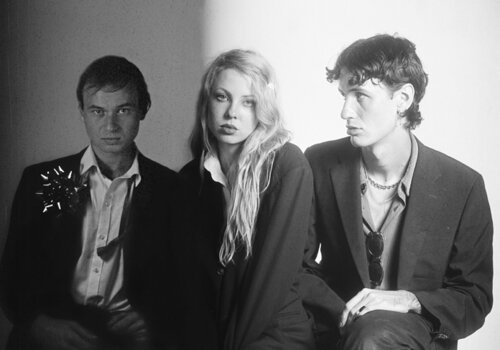
qww.jpg

PHOTO CREDIT: Lance Bangs 

The Goon Sax

___________

BEFORE I bring in…

wqq.jpg

a couple of reviews for the trio’s new album, Mirror II, It is worth sourcing interviews with Brisbane’s The Goon Sax. I discovered them fairly recently, but I have been listening back to their earlier work – I especially love 2016’s Up to Anything. I think that Mirror II is the most impressive album from The Goon Sax. Before coming to a more recent interview, Rolling Stone published a spotlight feature of the band. It is interesting how the trio found one another:

Louis Forster of the excellent Australian indie-pop band the Goon Sax started writing songs when he was seven years old, right after he got his grade-school-aged mind blown by Green Day’s American Idiot. He kept at it for years, but he never really felt comfortable sharing his work with anyone else — even his uniquely musical parents. His father, Robert Forster, was co-frontman of the Go-Betweens, one of the Eighties’ most acclaimed indie-pop bands; his mother, Karin Bäumler, was in the German group Baby You Know. “Songwriting is such a personal thing,” he says. “Only in the last year or so has it been that I could ever share that with anybody else. Doing that with any member of my family just seems so awkward.”

His hesitance fell away around the time he met another fledgling songwriter, James Harrison, in high school. “When I first showed James my songs, he didn’t really say anything,” Forster recalls. “He just started playing along. He wasn’t picking it apart, and that made me feel all right about it. We just played the song twice, and said nothing, and then we had a sandwich and went to the creek and got high or something.”

The two recruited drummer Riley Jones, an intimidatingly cool girl who also wrote songs and was already in a band despite having only mastered, by her count, two drum beats. The bandmates’ fragility and shyness — a sense that intimacy is something you earn, sometimes the hard way — remains an engine to the fantastic songs the trio have written since forming the Goon Sax. “You don’t have to hold my sweaty hands/I completely understand,” Forster sang on the band’s 2016 debut, Up For Anything, an album that often recalled the spare, naive guitar-pop of Jonathan Richman, Half Japanese or Television Personalities. On another Up to Anything standout, “Boyfriend,” Forster and Jones sweetly sang, “I need a boyfriend/Or just anything real/And we can break your heart/So you see how I feel.”

The Goon Sax just released their second album, We’re Not Talking, one of this year’s most charming indie releases. On its devastatingly great single “Make Time 4 Love,” a jumpy cowbell beat and taught guitar churn unfold into a gushing melody and summery strings as Forster sings, “Let’s get nervous in your room again,” with the florid charisma and old-world charm of a cardigan-clad Bryan Ferry. “All of our lyrics are a little bit self-indulgent,” says Harrison, “and maybe that’s great.”

The band were still teenagers when they started playing shows, so young they were often hustled out of clubs right after their sets because they were under drinking age”.

I would advise anyone who has not discovered The Goon Sax to check out the Australian trio. Earlier this month, Under the Radar spent some time with the group. It is interesting hearing about the origins of the album title, Mirror II:

The Australian trio (which also features Riley Jones, and James Harrison) released a new album, Mirror II, today via Matador, their first for the label. Mirror II is the band’s third album and the follow-up to 2018’s We’re Not Talking, which was released by Wichita. John Parish (Aldous Harding, PJ Harvey) produced the album, which was recorded in Bristol, England at Invada Studios (which is owned by Geoff Barrow of Portishead and Beak>). Since their last album, Forster moved to Berlin and worked in a cinema, while Jones and Harrison formed a post-punk side-project, Soot.

“The first two albums are inherently linked,” said Forster in a press release announcing the album. “They had three-word titles; they went together. This one definitely felt like going back to square one and starting again, and that was really freeing.”

“We lived in a shared house together, this tiny little Queenslander we called ‘Fantasy Planet,’ where we wrote the album,” Jones explained of the album’s genesis. “We were able to go to each other’s rooms and say anything that came to mind and go to the practice room three times a week. It was pretty intense.”

Of the album title, Jones added: “I was reading The Philosophy of Andy Warhol the other day. He said something so perfect… ‘I’m sure I’m going to look in the mirror and see nothing. People are always calling me a mirror, and if a mirror looks into a mirror, what is there to see?’ The name [Mirror II] was totally arbitrary to begin with, but it became about reflecting on reflection: we all get so influenced by each other. You find other people who show you yourself, who you are”.

I really love the bond between the members of The Goon Sax. They are a remarkable group who have such energy and chemistry. I feel we will be getting albums from them for a very long time. One cannot hear any sense of them tiring or lacking inspiration. Conversely, they seem to be hitting a new peak. Before coming to some reviews, Our Culture Mag ran a deep and extensive interview with the trio this month. There are some sections of the interview I was keen to include:

Brisbane trio The Goon Sax – Louis Forster, James Harrison, and Riley Jones – were in high school when their debut album, 2016’s Up to Anything, was released, and they were still in their teens when its follow-up came out two years later. All three members take turns writing, singing, and playing each instrument, and 2018’s We’re Not Talking saw them honing in their endearingly raw brand of guitar-pop as well as their conversational style of songwriting and delivery – in conversation with each other and the listener, certainly, but also with the greater lineage of alternative and pop music that they both are influenced by and belong to. Their new album and first for Matador, Mirror II – out today – is a marvel of craft, dynamism, and emotion: aided by producer John Parish (PJ Harvey, Aldous Harding, Dry Cleaning), they’ve managed to expand on the eclecticism of its predecessor while delivering their most infectiously catchy collection of songs yet, a record as mature as it is playful and as relatable as it is surreal and larger-than-life. Despite the group’s diverse sensibilities and idiosyncratic taste, they’ve come through sounding more confident and in sync than ever.

qqq.jpg

PHOTO CREDIT: Hugo Nobay 

It took you three years to write and record this album, and you spent quite a bit of time apart during that period. I’m wondering if that affected your creative process in any way compared to your previous releases.

Louis Forster: Yeah, I think it did. When we’re together, we kind of share what we’re listening to and what we’re experiencing constantly, and I think that was the first time that all three of us went off entirely in our own directions and spent some time alone, just discovering new things independently of each other. And I think it was important for us all to do that alone and it gave us more of a personal identity within the record, but also changed the way that we play together and slot in together, in that we maybe have more of an idea about ourselves – not just the band as a whole, but the parts that make it up, and how we can be the strongest and push each other the furthest.

How do you choose which perspective or moment to try and capture, then? Because there is a kind of selective process, and in some ways it seems like you have chosen the songs or the moments that do take an almost transcendental quality.

James: I think a lot of the songs are quite transcendental. Even in the live show we’ve tried to make it really epic and bigger than maybe ourselves, or larger than life. And that’s kind of how I felt in some of my lyrics, just observing when I feel out of my body because of the things around me or the thoughts in me.

 You obviously went into these songs with different perspectives, but was there something that after the fact you realized was kind of a common through-line in your writing?

Louis: It’s something we talked about a lot throughout the process of making the record, was the supernatural and love as this supernatural and powerful idea. We express it in very very different ways, but I think it’s definitely there for all of us. And I think our songs are very genuine and emotional, but there’s also a silliness and a playfulness to them. We all like pop music and rock and roll when it’s silly, in the way that T Rex is silly or in the way that Kylie Minogue is silly. And it’s so genuine at the same time, it’s completely heartfelt, but I think you can almost be more genuine and more emotional when you don’t constantly take yourself too seriously and you’re hung up on some really truthful, honest essence of yourself, but you allow yourself to go into the more far-flung corners of your personality that you maybe don’t feel all the time that are at times, you know, exuberant or whatever.

Riley: I think that a big part of it is filtered through the part where we come together at the end. It’s like you’re bringing your idea to the tribunal, in a way, and then some things stick because they feel good in the context of playing it together. We all have so many ideas for songs – Louis writes hundreds of songs; James writes hundreds of parts. And I – I don’t write songs very often, actually, but I play music a lot [laughter]. But when we come together, that’s when you know what works.

To bring things together, I wanted to relate this to the album title – I hope it was Riley this time who said this, but you’ve talked about how it started as something almost arbitrary and then became about “reflecting on reflection,” and how we find ourselves through other people. In what ways would you say that you’re influenced by each other, and beyond that, also see yourselves more through each other and working with each other?

Riley: It’s very… complex. We’ve known each other for so long now, we’ve spent so much time together. It’s kind of like beyond friendship. It’s more like family, but it’s also something else. Like, I wonder sometimes how I how I exist outside of this context, because it’s such a huge part of my life. And I think that I maybe lean on James and Louis just as I go about, you know, doing my thing in the world. I kind of always know that they’re there in some way. And I think that they’re a huge part of how I present myself too, not because I always say, “Yeah, I’m in this band” to everybody I meet. Which, actually, I kind of do. [laughter] But just in terms of their demeanors; it’s something that I definitely carry with me. Like, the people that you get to understand first kind of inform your understanding of everybody else in the world.

Louis: I totally second that. Sometimes the clothes I wear are informed by the fact that I’ll be standing next to Jim and Riley and what they’re wearing. It’s a conversation where we’re responding to each other in every element of ourselves. And recently, Riley’s been in the UK for a while and we haven’t been doing so much band stuff physically, and I noticed – I don’t know, it’s different when you’re not existing in the context of each other. But at the same time, I completely agree with what Riley says, it is always there”.

www.jpg

I want to move on to the reception that has been afforded to Mirror II. It is a remarkable album that has been met with acclaim and huge interest. In their review of the album, The Guardian discuss how the writing credits and balance has changed in the group:

With Mirror II, the label appears to have inherited a different band to the authors of We’re Not Talking. After a layoff in which their members variously moved to Berlin, took up free jazz drumming and dabbled in noise rock, the Goon Sax are now more expansive, ambitious and confident, their efforts aided by producer John Parish, best known as PJ Harvey’s primary musical foil. In the Stone and Psychic take a sound that started life as resolutely unvarnished and small scale – part of the appeal of the Goon Sax’s debut album was how listening to it felt like covertly reading someone’s teenage diary – and shift it on to a bigger stage without losing any of the idiosyncratic charm. There’s a muscular power-chord chug underpinning In the Stone, but it’s topped off with disjointed, needling lead guitar and weird spatters of ghostly electronics; Psychic’s sound is built out of an odd combination of drum machine, rumbling distorted guitar and bright, poppy synthesiser. Both songs are superbly written, their sweet melodies carrying lyrics that depict people arguing, frequently at cross purposes – “you said that we were psychic,” protests the latter, “like I’d find some comfort in that” – their drollness amplified by Forster’s doleful, conversational delivery.

Forster was initially the Goon Sax’s primary writer, and he’s still the provider of their most immediate songs – not just In the Stone and Psychic, but the spectacular chorus of The Chance, and Bathwater, which starts out rackety and nervous then suddenly picks up speed, breaking into an assured sprint. But a lot of Mirror II’s strength lies in the fact they now contain three distinct writing voices. Riley Jones deals in songs that bear the melodic influence of 60s girl groups alongside more left-field concerns. She’s apparently a fan of Throbbing Gristle and avant garde 70s Japanese psych-rock band Les Rallizes Dénudés, and you can tell: the chaotic mesh of guitar and synth on Tag keeps spiralling out of tune, at odds with her airy vocal, and the track concludes with a keyboard line that would sound poppy were it not in a completely different key to the other instruments.

James Harrison’s writing, meanwhile, is the toughest sell, equal parts Syd Barrett-ish strangeness and the shambolic 80s indie of Television Personalities or the Pastels: his voice is wayward, his chord sequences lurch at odd angles, the lyrics tend to quirky imagery and non-sequiturs (“let me educate you, you clearly don’t understand – and nor do I”). It’s a hard thing to pull off without sounding faintly annoying and contrived, a trap he falls into on Carpetry, but when it clicks – as it does on the sprawling melody of Temples, or the closing Caterpillars, which abruptly jumps from whimsy to a majestic synthesiser coda – the results are really striking.

The diversity of the writing means that Mirror II occasionally feels more like a hugely enjoyable compilation than a single artist album: whether one trio can successfully contain three writers with such diverse approaches indefinitely is an interesting question. Hopefully yes – in a world filled with artists who present themselves as a perfectly finished product, their notion of themselves already set in stone, there’s something intriguing about hearing a band so clearly in a state of flux, pulling what they do in different directions, developing before your ears. It makes growing up in public seem fascinating rather than arduous”.

zzz.jpg

PHOTO CREDIT: Elliott Lauren

I am interested seeing where The Goon Sax head. There is so much great music coming out of Australia at the moment. Brisbane has always been a real hub – if an underrated one – for innovative and original music. NME provided their take on Mirror II when they sat down to review it:

A lot can happen in five years. The group’s latest album, ‘Mirror II’, sometimes feels like the work of a different band altogether. Their first record with indie giant Matador Records (though released on Chapter Music in Australia and New Zealand), it marks a sharp pivot in direction. The Goon Sax has taken cues from new wave and electronica, most evidently on ‘Desire’, a dreamy, fuzzy track overlaid with a sparkly sheen that takes the listener on a five-minute sonic journey. ‘Desire’ floats from a wall of noise to quieter, more contemplative moments, stillness used in a way that the band hasn’t attempted before: creating space for the ideas to make maximum impact.

Jones takes the front seat on ‘Tag’, her gentle vocals swimming over a delicious bed of synthesisers as the band tackles modulations with ease. ‘The Chance’ brings in keys and distortion, with Forster and Jones’ voices combining in the chorus to create an epic, expansive atmosphere. A saxophone punctuates ‘Bathwater’, adding a woozy new element before exploding back into angular guitar pop. These are assured, mature songs bursting with creativity.

That’s not to say that the trademark Goon Sax attitude has vanished: that same propulsive simplicity underpins many of the songs, layered as they are with new ideas. Driven by Harrison’s slacker drawl, ‘Carpetry’ could be lifted from either of the band’s first two albums, and ‘Caterpillars’ begins in the same way before leaking into an extended outro, voices used wordlessly as instruments.

Perhaps the most touching thing about listening to ‘Mirror II’ is noticing little connections with The Goon Sax’s early teenage songs: on 2016’s ‘Telephone’ they sang, “I hate those telephones / they hurt me everyday,” and on 2021’s ‘In the Stone’ they sing, “Didn’t have to sound so disappointed when I called / if you had ever saved my number in your phone”. So much can change in five years, especially in the transition from adolescence to adulthood, but some things will always be the same”.

I shall wrap up. Go and explore the work of The Goon Sax. It is hard to compare them to anyone else. They very much have their own niche and groove. Mirror II is one of the best albums of the year, and it signals a trio with fresh intent and inspiration. It seems like a lot of people are discovering The Goon Sax fresh or have been with them a while but can see them evolved and strengthened. I hope that they can tour worldwide soon enough and bring their music to the U.K. I have not seen them live, though I can imagine their work sounds amazing on the stage. Seeing The Goon Sax take to the stage would be…

EXCITING to see.

______________

Follow The Goon Sax

xxx.jpg

FEATURE: Too Good to Be Forgotten: Songs That Are Much More Than a Guilty Pleasure: Atomic Kitten - Whole Again

FEATURE:


Too Good to Be Forgotten: Songs That Are Much More Than a Guilty Pleasure

 Atomic Kitten - Whole Again

___________

THIS is a rather strange…

aaa.jpg

instalment of this feature, as I am recommending a song that has sort of been remade by the band. Atomic Kitten were a big girl group of the 1990s. The current line-up, Liz McClarnon, Jenny Frost, Natasha Hamilton, have sort of remade Whole Again for the England football team. The Line of Best Fit explain the remix:

Atomic Kitten have re-recorded and released their updated version of "Whole Again" featuring lyrics about England football manager Gareth Southgate ahead of tomorrow's Euro semi-final game against Denmark.

Last weekend Atomic Kitten took to the stage at Boxpark Croydon following England's Euro 2020 win against Ukraine to perform the Gareth Southgate remix of "Whole Again", which was first adapted by fans during the 2018 World Cup.

Today (6 July), ahead of tomorrow's semi-final game against Denmark, Atomic Kitten have given the reworked version of the song an official release.

Atomic Kitten's new version is titled "Southgate You're the One (Football's Coming Home Again)", and features the iconic chorus paying tribute to the England manager, "Looking back on when we first met / I cannot escape and I cannot forget / Southgate you’re the one / You still turn me on / Football’s coming home again”.

Few people were expecting the group to come back together for a cause like England’s progress in Euro 2020. This is being written before the final so, when it goes online, we will know whether England won against Italy.

Whole Again is taken from the group’s debut, Right Now, of 2000 The album was re-released in 2001 following the departure of Kerry Katona. Whilst not one of the strongest girl groups, the Liverpool-formed trio were pretty strong. Many people have judged Whole Again to be a guilty pleasure. Before going on, here is some background regarding the track:

Whole Again" is the fifth single released from British pop girl group Atomic Kitten's debut album, Right Now (2000). It is the group's biggest selling single to date and was the final single to feature founding member Kerry Katona, who left the group midway through promoting the single. "Whole Again" was the first single released from the album in Europe and South Africa. It was a massive success, reaching number one in several countries and selling over a million copies in the UK alone.

"Whole Again" was co-written by Orchestral Manoeuvres in the Dark (OMD) members and Atomic Kitten founders Andy McCluskey and Stuart Kershaw, along with Jem Godfrey and Bill Padley. The four writers were nominated for the Ivor Novello Award for excellence in songwriting, and Billboard ranked the track number 96 on their list of the "100 Greatest Girl Group Songs of All Time". Multiple artists, including OMD, have covered the song.

Following the departure of Katona, she was replaced a few days later by Jenny Frost of fellow English girl group Precious, just after the single topped the UK Singles Chart. As a result, the music video was reshot and Frost's vocals appeared on the reissue of Right Now”.

A lot of songs from girl groups of the 1990s and early-2000s are dismissed or seen as inferior. Whilst the U.S. girl groups were stronger than ours, I have a lot of time for Atomic Kitten. Whole Again is catchy, soulful and romantic! The fact they have reworked it for England is pretty good! If you have never heard the song before, then give it a spin. The Right Now album is satisfying and has plenty of good songs on there. I don’t think that Whole Again is a guilty pleasure – not that I think this is a term that can be applied to any song. Whole Again is a lot stronger than many have given it credit for. Going back to Wikipedia. They discuss and explore the impact and success of the song:

The single debuted at number one in the United Kingdom with first-week sales of 69,286 copies, staying atop the chart for four weeks and increasing in sales during every week that it was at number one. It has since gone on to sell over 1,000,000 copies in the UK alone. It is the fourth best-selling single by a girl group of all time, after "Wannabe" and "2 Become 1" by the Spice Girls and "Never Ever" by All Saints. It also became the 13th overall best-selling single of the 2000s decade. As of November 2016, it remains the biggest-selling song of the 21st century in the UK by a girl band”.

If you have been against Atomic Kitten and avoided Whole Again, then spend some time with it now. It is a really solid song that should get a lot more love. I first heard it when it came out and I like to give it a play every now and then. To me, it is most definitely not

A guilty pleasure.

FEATURE: When You Wish Upon a Star: Kate Bush’s Lionheart: Would a Reorganised Tracklisting Make It a Stronger Album?  

FEATURE:


When You Wish Upon a Star

rr.jpg

IN THIS PHOTO: Kate Bush in an outtake from the Lionheart album cover shoot/PHOTO CREDIT: Gered Mankowitz 

Kate Bush’s Lionheart: Would a Reorganised Tracklisting Make It a Stronger Album?  

___________

THIS is not the first time…

qq.jpg

that I have dove deep into Lionheart. Kate Bush’s second studio album, it is one that often comes in for some stick. When I wrote about it last year, I defended it (as if it needed that at all!). Many people, when ranking her ten studio albums, often place Lionheart last - either that or 1993’s The Red Shoes. Whereas The Red Shoes has a few weak tracks and the production sound is a bit compressed and lacking in warmth, Lionheart is very similar to The Kick Inside. Her 1978 debut (Lionheart was released in the same year) was produced by Andrew Powell. He produced Lionheart with assistance from Bush. Some people have argued that Lionheart lacks songs as memorable and important as Wuthering Heights and The Man with the Child in His Eyes – unarguably the two best-known songs on her debut. Wow and Symphony in Blue are stunning. The former track is one of Bush’s older ones, whereas Symphony in Blue was written for Lionheart (she only wrote three new songs for her second album). It is amazing how, given the short amount of time she had to compile a second album, there are so many wonderful tracks! Even if Lionheart is slightly weaker than The Kick Inside, why then is it placed much lower than its predecessor!? Some can argue that, for a second album, it is not a huge leap from the debut. I would disagree to an extent.

Nine months after her debut came out, one could not expect something like The Dreaming or Hounds of Love. Lionheart is broader in terms of its themes. Songs of love and longing seem more varied and diverse. Listen to a track such as Coffee Homeground. It is very different to anything on The Kick Inside. Despite the odd weaker track, there are some stunning tracks on Lionheart. It is baffling that the album has received such unremarkable reviews. In a review that does offer some positives, this is what Drowned in Sound said:

One of the funny things about The Before Time when you had to buy music to listen to it is that ropey critical reputations could really put you off ever listing to certain records, even by artists you loved. It took me years to get around to Lionheart. And you know, sure, it’s the weakest Kate Bush record but that doesn’t make it bad. If anything the fact it’s routinely dismissed as a rushed follow up to The Kick Inside means it doesn’t have the pressure to compete with the stronger later records. The luminous ‘Wow’ is obviously the best and most memorable song, but seriously, check out those elaborately layered vocals on opener ‘Symphony in Blue’. The songwriting is a bit hazy compared to the laser-definition of later albums, but musically and texturally it’s a really beautiful record - the only Kate Bush album that is content to be pretty and not ask you to commit to it, and there’s something to be said for that, I think. (7)”.

Most reviews are quite dismissive. Many compare Lionheart negatively with The Kick Inside in terms of consistency and songwriting brilliance. Take apart Lionheart, and I feel one could find a lot to love. How many people – who have placed the album so low – have heard it in full lately!? To me, the quality of the songs, production and Bush’s vocals are not that inferior compared to her debut album. So, then, what is it that means the album is seen as the less spectacular of Bush’s cannon? One explanation might be the tracklisting and sequencing. Beforehand, I have argued how her albums are brilliantly arranged so that the tracks are where they need to be. That is true of albums like The Kick Inside, The Dreaming and Hounds of Love. Maybe one could slightly tweak Never for Ever and The Sensual World and make them even stronger. Revisiting Lionheart as I have been, a couple of things struck me. I have been impacted by songs that I overlooked before. In Search of Peter Pan is a gorgeous song where, at the very end, Bush sings lines from When You Wish Upon a Star (a very rare case of her using other people’s words in her song. Leigh Harline and Ned Washington wrote it for Disney's 1940 adaptation of Pinocchio). Oh England My Lionheart has taken on new life and meaning. There is so much to unpack and enjoy through Lionheart. Not that it will be done….though I feel a reordering of the songs would make for a better album.

The quality is there for sure! Perhaps this is a case of the right tracks being in the wrong order. Not that an iPod-like reshuffle would make the album more brilliant and popular than Hounds of Love or Aerial. I don’t think Lionheart would be bottom or in the bottom-two if there was a rearrangement – The Red Shoes and 2011’s Director’s Cut would probably occupy those bottom slots. As it is, Lionheart’s tracklisting is as follows:

Symphony in Blue

In Search of Peter Pan

Wow

Don't Push Your Foot on the Heartbrake

Oh England My Lionheart

Full House

In the Warm Room

Kashka from Baghdad

Coffee Homeground

Hammer Horror

It is a subjective preference in terms of what a ‘new tracklisting’ would look like. In terms of quality, you have two of the strongest tracks – Symphony in Blue and Wow – in the first half. Two other big ones – Kashka from Baghdad and Hammer Horror – are in the second half. If anything, Lionheart is a little top-heavy. I always find it strange that the album’s first single, Hammer Horror, ends the album. It possesses a sweeping sound that suggests producer Andrew Powell might have envisaged this climatic ending. Perhaps Bush herself was instrumental in the track order; or was Jon Kelly (recording engineer, mixing) influential? Whomever gave the final okay for the order of the songs, a reassembling could lead to an album that retains its balance (in terms of the compositions and vocal) but leads to an even more satisfying listening experience.

Many Kate Bush fans ignore Lionheart. For those (like me) who love the album, they would have thought about how, if they had the chance, they would organise the songs. One of my wishes is that, one day, we can have access to the masters and be able to pick apart and rearrange songs – so that vocals can be isolated and we can have different mixes. Lionheart is a fabulous album where the weaker tracks are not in the right place. Not that there are drastic changes, but here is my view of what the tracklisting for Lionheart should look like:

Symphony in Blue

Wow

Oh England My Lionheart

In Search of Peter Pan

Don't Push Your Foot on the Heartbrake

In the Warm Room

Full House

Coffee Homeground

Hammer Horror

Kashka from Baghdad

Actually…there is a fairly drastic reshuffle! The song that definitely has always been in the correct place is Symphony in Blue. Like Moving on The Kick Inside, it is the perfect opener. In fact, when it comes to her albums, the opening track has always felt right and like it could not be anywhere else – maybe 50 Words for Snow’s Snowflake is an exception. This is, as I said, my personal opinion. Others might be of the view that the tracks are fine where they are on Lionheart. I feel that the quality of the material is exceptional. Maybe some who have reviewed the album harshly have had moments where their attention dipped, or they felt there was a lack of surprise.

My ordering provides means two big tracks are at the top. In Search of Peter Pan is another solid song. The first half would end with one of the slightly weaker songs, Don’t Push Your Foot on the Heartbreak. Even so, we go out with a Rock number that ensures a big finish to that half. I don’t think the first five songs are too samey or there are drastic turns in terms of tone and sound. Perhaps Oh England My Lionheart and In Search of Peter Pan are two similar songs right next to each other. I feel they compliment one another and sound great side by side. After the impassioned end to side one, we open the same way on side two as we did on the first. In the Warm Room, again a track that some dismiss, is in the middle of the pack. It mirrors, in a way, the feel of Symphony in Blue. Whilst the first four songs provided strength and consistency, the final four do too. Full House and Coffee Homeground – two of the more experimental and darker songs – are beside one another and come fairly close to the end. We build to these. Rather than doing a full-180 after Coffee Homeground, Hammer Horror provides a not-too-severe segue. People might argue that I have not exactly moved Hammer Horror too far up the list! That is true…

I do think that it needs to be in the second half. Some may disagree. It seemed strange having it as the final track. I always feel that, when you listen to Hammer Horror last, you are waiting for a finale or something else. With one of the strongest tracks, Kashka from Baghdad – why was this not a single?! -, ending things, we get a beautiful song that takes us to rest. Again, there are similarities to Symphony in Blue. It is pointless trying to re-sequence an album that has been out for over forty years! I get tired of the bashing Lionheart receives. The feeling that the material is weaker and it is a very pale follow-up to The Kick Inside. That is not the case. Also, there is plenty of evolution and growth in an amazingly short space of time! I wonder whether there were a couple of extra tracks that Bush considered for Lionheart but did not include. At ten tracks, it is a tight and fairly short listen of about thirty-seven minutes. Not that two extra tracks would have made the album that much better. It is interesting to imagine and dream what could have been back in 1978. I do hope that more people give Lionheart a try and spend more time with it. I truly believe that it is a record that is overdue fresh love. Maybe, with the ten tracks organised as I have suggested above, people might see Lionheart

wqww.jpg

 IN THIS PHOTO: Kate Bush in the ‘redhead’ shoot (1978)/PHOTO CREDIT: Gered Mankowitz

IN a new light.

FEATURE: A Buyer’s Guide: Part Sixty-Three: The Roots

FEATURE:


A Buyer’s Guide

IN THIS PHOTO: The Roots backstage in Chicago in October 2000/PHOTO CREDIT: Paul Natkin/WireImage 

Part Sixty-Three: The Roots

___________

BEFORE coming to the albums…

zzz.jpg

from The Roots that you need to own, it is worth bringing in some biography. The legendary and hugely influential act are one of the greatest ever. I am not recommending a book this week. Instead, the four essential albums, the underrated one and their latest studio album. Prior to getting there, here is some more background regarding The Roots:

One of the most prolific rap groups, the Roots were also among the most progressive acts in contemporary music, from their 1993 debut through their conceptual 2010s releases. Despite the seemingly archaic practice of functioning as a rap band with several instrumentalists -- from 2007 onward, their lineup even featured a sousaphonist -- they were ceaselessly creative, whether with their own material or through their varied assortment of collaborations. They went platinum and gold with successive studio releases and won a handful of Grammy Awards. After they gained a nightly nationwide audience through a close partnership with television host Jimmy Fallon, they continued to challenge listeners with works free of genre restrictions.

The Roots' focus on live music began back in 1987, when rapper Black Thought (Tariq Trotter) and drummer ?uestlove (Ahmir Khalib Thompson) became friends at the Philadelphia High School for Creative Performing Arts. Playing around school, on the sidewalk, and later at talent shows (with ?uestlove's drum kit backing Black Thought's rhymes), the pair began to earn money and hooked up with bassist Hub (Leon Hubbard) and rapper Malik B. Moving from the street to local clubs, the Roots became a highly tipped underground act around Philadelphia and New York. When they were invited to represent stateside hip-hop at a concert in Germany, the Roots recorded an album to sell at shows; the result, Organix, was released in May 1993 on Remedy Records. With a music industry buzz surrounding their activities, the Roots entertained offers from several labels before signing with DGC that same year.

The Roots' first major-label album, Do You Want More?!!!??!, was released in January 1995. Forsaking usual hip-hop protocol, the record was produced without any samples or previously recorded material. It peaked just outside the Top 100 of the Billboard 200 and made more tracks in alternative circles, partly due to the Roots playing the second stage at Lollapalooza that summer. The band also journeyed to the Montreux Jazz Festival in Switzerland. Two of the guests on the album who had toured around with the band, human beatbox Rahzel the Godfather of Noyze -- previously a performer with Grandmaster Flash and LL Cool J -- and Scott Storch (later replaced by Kamal Gray), became permanent members of the group.

Early in 1996, the Roots released "Clones," the trailer single for their second album. It hit the rap Top Five, and created a good buzz. That September, Illadelph Halflife appeared and made number 21 on the Billboard 200. Much like its predecessor, though, the Roots' second LP was a difficult listen. It made several very small concessions to mainstream rap -- the bandmembers sampled material that they had recorded earlier at jam sessions -- but failed to make a hit of their unique sound. Their third album, February 1999's Things Fall Apart, was easily their biggest critical and commercial success. Released on MCA, it went platinum, and "You Got Me" -- a collaboration with Erykah Badu -- peaked within the Top 40 and subsequently won a Grammy in the category of Best Rap Performance by a Duo or Group.

The long-awaited Phrenology was released in November 2002 amid rumors of the Roots losing interest in their label arrangements with MCA. In 2004, the band remedied the situation by creating the Okayplayer company. Named after their website, Okayplayer included a record label and a production/promotion company. The same year, the band held a series of jam sessions to give their next album a looser feel. The results were edited down to ten tracks and released in July 2004 as The Tipping Point, supported by Geffen. A 2004 concert from Manhattan's Webster Hall with special guests like Mobb Deep, Young Gunz, and Jean Grae was issued in February 2005 as The Roots Present in both CD and DVD formats. Two volumes of the rarities-collecting Home Grown! The Beginner's Guide to Understanding the Roots appeared at the end of the year.

A subsequent deal with Def Jam fostered a series of riveting, often grim sets, beginning with Game Theory (August 2006) and Rising Down (April 2008). In 2009, the group expanded their reach as the exceptionally versatile house band on Late Night with Jimmy Fallon. The new gig didn't slow their recording schedule; in 2010 alone, they released the sharp How I Got Over (June), as well as Wake Up! (September), where they backed John Legend on covers of socially relevant soul classics like Harold Melvin & the Blue Notes' "Wake Up Everybody" and Donny Hathaway's "Little Ghetto Boy." It earned Grammy Awards for Best R&B Album and Best Traditional R&B Vocal Performance. As they remained with Fallon, the Roots worked with Miami soul legend Betty Wright on November 2011's Betty Wright: The Movie, and followed it the next month with their 13th studio long-player, Undun, an ambitious concept album whose main character dies in the first track and then follows his life backward.

Work on the group's next studio LP was postponed as an unexpected duet album with Elvis Costello took priority for the group in 2013. Originally planned as a reinterpretation of Costello's songbook, the record Wise Up Ghost turned into a full-fledged collaboration and was greeted by positive reviews upon its September 2013 release on Blue Note. Within six months, the band joined Jimmy Fallon in his new late-night slot, the high-profile Tonight Show program. Another concept album, the brief but deep ...And Then You Shoot Your Cousin, was released in May 2014. Rapper Malik B., a fixture on the Roots' early albums, died on July 29, 2020, at the age of 47”.

If you require a guide about The Roots and are not sure which are the albums you need in your collection, I hope that the suggestions below are of some help. As you will hear from their music, it has the power to move you…

IN so many ways.

____________

The Four Essential Albums


Do You Want More?!!!??!

aa.jpg

Release Date: 17th January, 1995

Labels: DGC/Geffen

Producers: The Grand Negaz/Questlove/Kelo/A.J. Shine/Black Thought/Rahzel

Standout Tracks: Proceed/Do You Want More?!!!??!/Silent Treatment (ft. Cassandra Wilson)

Buy: https://www.roughtrade.com/gb/the-roots/do-you-want-more-63de765c-f30f-4d7a-b2c3-92514477b1ae

Stream: https://open.spotify.com/album/3N0wHnD5Rd8jnTUvNqOXGz?si=kc0UtertSRi8u7sesDGDDg&dl_branch=1

Review:

Because the Roots were pioneering a new style during the early '90s, the band was forced to draw its own blueprints for its major-label debut album. It's not surprising then, that Do You Want More?!!!??! sounds more like a document of old-school hip-hop than contemporary rap. The album is based on loose grooves and laid-back improvisation, and where most hip-hoppers use samples to draw songs together and provide a chorus, the Roots just keep on jamming. The problem is that the Roots' jams begin to take the place of true songs, leaving most tracks with only that groove to speak for them. The notable exceptions -- "Mellow My Man" and "Datskat," among others -- use different strategies to command attention: the sounds of a human beatbox , the great keyboard work of Scott Storch, and contributions from several jazz players (trombonist Joshua Roseman, saxophonist Steve Coleman and vocalist Cassandra Wilson). By the close of the album, those tracks are what the listener remembers, not the lightweight grooves” – AllMusic

Choice Cut: Distortion to Static

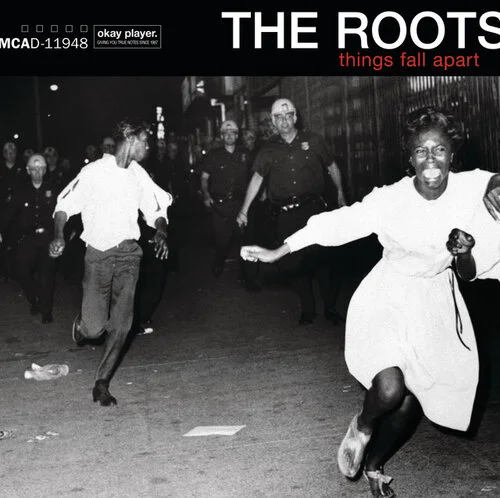
Things Fall Apart

zzz.jpg

Release Date: 23rd February, 1999

Label: MCA

Producers: The Grand Wizzards/Scott Storch/Jay Dee

Standout Tracks: Step into the Realm/Double Trouble (ft. Mos Def)/You Got Me (ft. Erykah Badu, Tariq Trotter and Eve)

Buy: https://www.roughtrade.com/gb/the-roots/things-fall-apart

Stream: https://open.spotify.com/album/0qbl8aNaCUOvX8HGsZYLfh?si=PWOisNNzT6asozdEpcfNiw&dl_branch=1

Review:

Despite being a breakthrough for their band and their scene, the Roots didn’t immediately build on Things Fall Apart’s success. Powered by D’Angelo’s sultry “Untitled (How Does It Feel)” video, Voodoo became a phenomenon, and ?uest spent most of 2000 on tour as the singer’s drummer. By the time the Roots re-grouped, ?uest’s closest peers were pushing their sounds to new places. D wanted to learn guitar; Common and Dilla wanted to experiment with electronic textures. The Roots responded by moving away from the movement they helped create; their follow-up record, Phrenology, was essentially the anti-Roots album, with a heavy emphasis on rock. And while it alienated the Roots’ core fanbase, Phrenology performed well, pushing the group further into crossover territory. The Roots became a more regular presence on TV and radio. Soon after, Rahzel and Malik B. left the group for good. In 2006, Dilla died at age 32 from complications of lupus, and the Roots’ album of that year, Game Theory, kicked off a series of releases with a darker tone, including 2008’s Rising Down, 2010’s How I Got Over, and 2011’s undun. Having secured a gig as Jimmy Fallon’s backing band—first on “Late Night,” then on “The Tonight Show”—the Roots finally and completely entered the mainstream. But they used the freedom to experiment and make the music they wanted.

Things go in cycles, and the approach the Roots pioneered came back around. In 2015, the “next movement” the Roots mentioned on Things Fall Apart seemed to arrive. Kendrick Lamar’s To Pimp a Butterfly—a densely lyrical and allegorical exploration of Blackness and struggle, set to a live-jazz soundtrack featuring dozens of collaborators—is hard to imagine without this album in its rearview. Artists like Robert Glasper, Thundercat, Terrace Martin, and Kamasi Washington channel the same creativity as the Roots, D’Angelo, and company, banding together to push rap, jazz, soul, and more into atmospheric new places. The spirit of Things Fall Apart is in the air.

Looking back on it now, this record feels like both a love letter and a fond farewell to the Roots’ early days, acknowledging that they needed to evolve to stay relevant. And some of the album’s continued relevance is painful. Its closing poem, “The Return to Innocence Lost,” details the fate of a young man seemingly doomed to fail since birth. He dies tragically, leaving nothing but thoughts of a life that could’ve been. Nowadays, black men are dying at the hands of police with alarming frequency, and we’re left to mourn the dead in hashtags and shared articles, wondering what’s next—or who’s next—in this seemingly endless war. Things Fall Apart imparts a similar tone, even if the band didn’t address those issues directly. The black and white cover art, taken in Bed-Stuy, Brooklyn in 1965, depicts a young black woman running from a waiting police officer, her face twisted in fear. The scene is sadly familiar 50 years later. As the Roots teetered between fame and purgatory, virtue and failure, Things Fall Apart captured the intensity of a group with everything to lose and the world to gain” – Pitchfork

Choice Cut: The Next Movement (ft. DJ Jazzy Jeff and Jazzyfatnastees)

Phrenology

aaa.jpg

Release Date: 26th November, 2002

Label: MCA

Producers: DJ Scratch/The Grand Wizzards/Kamal Gray/Tahir Jamal/Omar the Scholar/Questlove/Karreem Riggins/Scott Storch/Zoukhan Bey

Standout Tracks: Rock You/Break You Off (ft. Musiq Soulchild)/Quills

Buy: https://www.discogs.com/sell/release/14776901

Stream: https://open.spotify.com/album/01FOonRYntwISzaCSa7S7p?si=eBy-Fz9gSQyNLA_7wPgoow&dl_branch=1

Review:

The pseudoscience of phrenology claims that your essential personality can be “read” by feeling the bumps on your head, as if they were a kind of fingerprint of the brain. Everything is predetermined at birth, phrenologists say. But on Phrenology, their fifth and best CD, the Roots prove that wherever we start, we can still boldly change our course. This bohemian Philadelphia hip-hop crew, renowned for their great, tradition-soaked live funk performances, have received almost as much credit for what they’re not: gangstas, clichés or sample biters. Here, they clearly spell out their identity and mission — in songs that are both very personal (“Complexity,” about a couple on the edge of romantic commitment) and as specific as the morning news (“Pussy Galore” skewers people who use sex to sell products). From the thudding opening war chant, “Rock You,” the Roots make great use of new guitarist Ben Kenney. (They were turned on to rock, drummer Amir “?uestlove” Thompson recently quipped, “while we spent countless hours in front of MTV waiting for the one black video to come on.”) And they do a great job of casting, too, calling in cameos from take-no-mess R&B naturalist Jill Scott, underground Brooklyn rapper Talib Kweli, freakadelic black rocker Cody Chesnutt and even Amiri Baraka, the one living poet who actually scares people. The first single, “Break You Off,” featuring Philly neosoul singer Musiq, is a glowering tale of emotional push-and-pull that’s half hip-hop and half Marvin Gaye — and that’s before it flows into an arcing, orchestrated second section. The Roots are confident enough to follow soul music like that with the freaky soundscape “Water,” which plinks and plunks around in the urban darkness like Tom Waits let loose in the ghetto. The Roots used to be the great what-ifs of hip-hop — symbols of the thoughtful road not taken by the commercial rap masses. Suddenly, they can fulfill nearly all of their sweeping ambition to resuscitate soul’s past. Phrenology is a celebration of self-determination, a nonstop joyride through some very complicated brains” – Blender

Choice Cut: The Seed (2.0) (ft. Cody ChesnuTT)

Undun

Release Date: 2nd December, 2011

Label: Def Jam

Producer: Ray Angry/Rick Friedrich/D.D. Jackson/Khari Mateen/Richard Nichols (exec.)/James Poyser/Brent ‘Ritz’ Reynolds/Sean C & LV/Sufjan Stevens/Ahmir ‘Questlove’ Thompson

Standout Tracks: One Time (ft. Phonte & Dice Raw)/The OtherSide (ft. Bilal & Greg Porn)/I Remember

Buy: https://www.roughtrade.com/gb/the-roots/undun

Stream: https://open.spotify.com/album/0cwlEeMEkvdoiPNJxlzHtI?si=iLlYO0rqS6eXhdh7GCFnWg&dl_branch=1

Review:

The Roots' umpteenth album is titled after a Guess Who song mutilated by countless lounge bands since 1969. It incorporates a Sufjan Stevens recording, mixtape-style, for the purpose of starting a four-part instrumental suite that closes a program lasting only 40 minutes. Based on those details, it would not be irrational to think that the band’s well of inspiration might be dry or tainted. While the well might be slightly tainted, it is full. Undun is based on the life of Redford Stephens, a fictional product of inner-city New York who was born in the mid-‘70s and tragically passed in 1999, the point at which the album begins -- with a quiet EKG flatline. Appearances from MCs Big K.R.I.T., Dice Raw, Phonte, Greg Porn, and Truck North, as well as contributions by singers Aaron Earl Livingston and Bilal, flank principal voice Black Thought, yet this is no hip-hop opera or anything close to a typical concept album. The existential rhymes, seemingly created with a shared vision, avoid outlining specific events and focus on ruminations that are grave and penetrating, as if each vocalist saw elements of himself and those he has known in Redford. What’s more, Undun probably shatters the record for fewest proper nouns on a rap album, with the likes of Hammurabi, Santa Muerte, and Walter Cronkite mentioned rather than the names of those who are physically involved in Stephens’ life. (The album’s app, filled with video clips and interviews with Stephens’ aunt, teachers, and peers, provides much more typical biographical information.) Musically, Undun flows easier and slower than any other Roots album. The backdrops ramp up with slight gradations, from soft collisions of percussion and keys (“Sleep”), to balmy gospel-soul (“Make My”), to Sunday boom-bap (“One Time”). There's a slight drop into sinewy funk (“Kool On”) that leads into a sustained stretch of stern, hunched-shoulder productions, highlighted by the crisply roiling “Lighthouse,” that match the cold realism of the lyrics. The strings in the slightly wistful “I Remember” and completely grim “Tip the Scale” are a setup for the Redford suite, which is nothing like padding. It glides through the movements, involving mournful strings, a violent duel between drummer ?uestlove and guest pianist D.D. Jackson, and a lone death note that fades 37 seconds prior to silence” – AllMusic

Choice Cut: Make My (ft. Big K.R.I.T. & Dice Raw)

The Underrated Gem


The Tipping Point

sss.jpg

Release Date: 13th July, 2004

Label: Geffen

Producers: Questlove/Scott Storch

Standout Tracks: I Don't Care (ft. Dom)/Don't Say Nuthin'/Duck Down! (ft. Dom)

Buy: https://www.discogs.com/sell/list?master_id=39958&ev=mb

Stream: https://open.spotify.com/album/2fw2PxmN6epMmz6qZXXNLn?si=dKdZiFzMSAqjlL2aZWPo-Q&dl_branch=1

Review:

If 2002’s ”Phrenology” was the Philly crew’s left-field rock-rap opus, their sixth studio effort is an eclectic and often breezy reimagining of hip-hop’s energetic essence. ”Boom” is a lightning-paced evocation of late-’80s Rakim, while standout bonus track ”In Love With (the Mic),” boasting assists from incorrigible scene-stealers Dave Chappelle and ODB, recalls the loose, amped-up collaborations of the Native Tongues movement (e.g., the Jungle Brothers and Black Sheep). One of hip-hop’s premier album artists, the Roots could still stand to strengthen their singles prospects: Their most club-friendly track ever, the Scott Storch-produced ”Duck Down,” has everything going for it — except a chorus to sing along to” – Entertainment Weekly

Choice Cut: BOOM! (ft. Dice Raw)

The Latest Album


...and then you shoot your cousin

ddd.jpg

Release Date: 19th May, 2014

Label: Def Jam

Producers: Black Thought/D.D. Jackson/Damion Ward/Joseph Simmons/Karl Jenkins/Mike Jerz/ Richard Nichols/Ray Angry/Trapzillas/Questlove/The Wurxs

Standout Tracks: Never (featuring Patty Crash)/Black Rock (ft. Dice Raw)/The Unraveling (ft. Raheem DeVaughn)

Buy: https://www.discogs.com/sell/list?master_id=690403&ev=mb

Stream: https://open.spotify.com/album/6kYqws8vRcaUKTjFnJRb4X?si=jY9Ti734SJmKT6I7jGobjQ&dl_branch=1

Review:

So while the accusations that hip-hop’s social justice wing has totally collapsed are more than a bit overblown, particularly myopic in regard to how that sense of justice has changed and infused into different strains within the mainstream, …And Then You Shoot Your Cousin does offer something rare in today’s climate: It’s an album whose sole focus is reportage, with no individual aspirational narrative to disguise the ugliness. It’s a purposefully fragmented work, in which main vocalist Black Thought provides the clearest through line, popping in and out of songs dotted with a roster of repeating guest stars, mostly group affiliates like Dice Raw and Greg Porn.

They take on a variety of voices, offering quick snapshots from various sectors of ghetto experience: “Black Rock” imagines street vagrants munching on early morning cheeseburgers, their jittery desperation echoed by galumphing piano and a hard-edged drumbeat; “The Dark (Trinity)” features frustrated corner boys getting soaked in the rain, their arrogance wilting as the spare, steady music grows increasingly mournful. All this gets echoed by the group’s live-band aesthetic, which pieces together revised versions of traditional soul instrumentation with spooky atonal strings and jagged samples, jumping from Nina Simone to Mary Lou Williams to Michel Chion, the patchwork structure conveying the feeling of a culture broken into pieces, exploiting those rifts to explore the full extent of hip-hop’s literary capabilities.

There’s also the welcome fact that …And Then You Shoot Your Cousin is a trim 35 minutes in length, with 11 tracks and eight proper songs, zooming through its disjointed structure without much padding. This slimness functions as a counterweight to the often stifling subject matter, as the group employs its soul-influenced backdrops in a way that feels totally opposed to what most modern hip-hop is doing. The Roots have a different sense of the music, and a further commitment to developing its ideas, rather than just miming them. In keeping with the album’s inverted sense of order, there’s no nostalgia here, and instead that warm soul sound is repeatedly pushed into twisted horror-movie palettes, with repeated references to hell and waking nightmares, the music tilting into mechanistic repetition on tracks like “The Unraveling,” with its churning, gloomy atmospherics.

A depiction of disorder and chaos, …And Then You Shoot Your Cousin places almost no focus on the hard-working everymen of the traditional soul milieu, zoning in on the desolate and the down and out, nightmare scenarios in which dreams of riches molder inside condemned buildings. While this approach sacrifices some potential subtlety in exchange for a broader, stereotype-tweaking social crusading, one perhaps a bit too enamored of its crusader status, it’s hard to deny the effect, the album’s approach integrating neatly into an overall sense of claustrophobic dread” – SLANT

Choice Cut: When the People Cheer (ft. Modesty Lycan and Greg Porn)

FEATURE: The Influence, Impact and Legacy: Forty Years of MTV

FEATURE:


The Influence, Impact and Legacy

wwww.jpg

Forty Years of MTV

___________

NOT to cover…

xss.jpg

what I have already done in the past, but MTV turns forty on 1st August. I am not sure how many people are going to cover the anniversary. MTV is one of these stations and phenomenon that has divided people. Perhaps the U.K.’s Top of the Pops has more of a legacy in terms of the mix of live performances and videos. In terms of the impact of that long-running show, maybe it resonates more than MTV. There has been a lot of criticism of MTV through the ages. I will bring in a few articles regarding MTV and its legacy. There was a definite period where the station ruled and it was hugely important. I would say that the mid-1980s and early-1990s was a golden age for MTV. That might sound like a long time though, in that period, it made a huge impression. Many established directors of today started by making music videos to feature on MTV. Pop artists like Madonna and Michael Jackson created these incredible videos and saw their careers take off - in no small part because of the station. For me, I tuned in because you got to see these great videos. MTV was not just about entertainment. I discovered a lot of different artists through the channel. Top of the Pops was important, as was radio and my friends. MTV provided this sense of wonder and cool that I didn’t get anywhere else.

Some might say that the station was quite vacant and vacuous. It is sad that music videos are not as revered and celebrated now as they were in the 1980s and 1990s. Between 1995 and 2000, MTV played thirty-five percent less music videos on the station. I do miss the days when you got these iconic and memorable videos. Today, music videos do not have the same sense of scope, ambition and importance. For that reason, I think that the fortieth anniversary of MTV should be celebrated. It is interesting learning more about the history and growth of MTV. This fascinating article from 2017 documents the birth, rise and decline of MTV. I have selected a few points:

1. Roots in financial services

American Express wanted to sell financial services to people via their televisions so they bought cable television company Warner Cable Corporation for $175 million in 1979. The plan was to use an interactive program they’d developed to reach every home in the network and sell credit cards.

Once the companies merged, they split it between a division responsible for building the cable infrastructure and an area responsible for programming. They had two main channels in the beginning: The Movie Channel and Nickelodeon. An executive decided they needed a third channel with a focus on music.

2. MTV had to be ready in 7 months

The Warner Amex board said ‘no’ to the original pitch to launch a 24-hour music channel, positioned as “radio with pictures”. After a little executive wrangling, MTV was approved on the proviso that it would be cheap to run because the record companies would provide music videos for free. MTV was approved for launch in January 1981 and its founders only had 7 months to build it because Warner Amex wanted it on-air in summer, which is when most fads began. They wanted teenagers and college students returning from their summer break to be talking about MTV.

3. The first video played was The Buggles’ Video Killed the Radio Star

At midnight on 1 August 1981, MTV launched with Video Killed the Radio Star - a song that would go on to be prophetic for how the channel would change the music industry. Funnily enough, the second music video played was Pat Benatar’s You Better Run, programmed as a warning shot to the record companies who were still sceptical about MTV.

4. They began with only 250 videos

Music videos were in short supply at the beginning of the 80s, so MTV played whatever they could get their hands on. Many record companies in America didn’t believe in MTV and weren’t willing to provide music videos at their own cost. A bulk of the music videos MTV played came from Europe where record companies made short promotional films for their artists to be played on video jukeboxes - a popular new piece of technology at the time. With only 250 music videos being played over a 24-hour period, the early artists of MTV got a lot of exposure thanks to a combination of repetition and desperation.

5. The Second British Invasion

MTV helped British new wave bands become popular in America because they were the artists getting played in heavy rotation. In the early days of MTV it was only available in smaller American towns because the channel hadn’t been picked up in the big cities yet. Teenagers living in these towns would watch MTV and rush to their local record store to buy the albums of the bands they saw. Still, a few American record companies still didn’t get it. The Human League’s Don’t You Want Me Baby became a hit in the states thanks to MTV. Other acts to benefit include: Flock of Seagulls, Billy Idol, Spandau Ballet, Adam and the Ants, ABC, Bananarama, Soft Cell, Tears for Fears and Dupeche Mode. There would be one British band who would not only benefit from being on MTV, but would define the music video aesthetic for the rest of the decade, and that band was Duran Duran.

9. A nursery for Hollywood directors

Like Mulcahy, a lot of music video directors would develop reputations for being able to deliver clips that would catapult bands into superstardom using the power of MTV. A nursery of creative talent was created by the industry that sprung up around MTV as record labels began investing budgets in music video production. Many directors from the MTV days would make the leap to Hollywood. Mulcahy was hired to direct the cult hit Highlander. Other notable directors who made the transition include: David Fincher and Michael Bay.

13. Moonwalking into lounge rooms nation-wide

Before 1983, Michael Jackson struggled to get played on MTV. Legend has it that the president of CBS Records International, Walter Yetnikoff, threatened to pull all their artists from MTV if they continued to ignore Jackson, who had just put out Thriller and submitted the video for Billie Jean. CBS had Billy Joel, Cyndi Lauper and Bruce Springsteen on their books.

Tensions were high between CBS and MTV but then something big happened: Jackson performed during a television special to commemorate Mowtown’s 25th anniversary. Jackson took to the stage to perform Billie Jean in a fedora, black sequin jacket, and glove. Mid-performance, Jackson debuted his iconic moonwalk and people went wild. Following the performance, Thriller began to sell a million copies a week and certified Jackson as a solo artist. MTV began playing Billie Jean in high rotation and Jackson would become a staple of the channel setting a new standard for what a music video was with Thriller and Beat It.

14. Michael Jackson verses Prince

The arrival of Jackson on MTV (finally) paved the way for other black artists who were added to the playlist. The other act who was put in high rotation in the wake of Billie Jean was Prince. Little Red Corvette was put into overdrive on MTV and Prince blew the minds of teenagers across America — especially in smaller towns. Jackson and Prince had an intense rivalry. In the MTV era their extravagant videos were seen as a way for them to one-up each other. Jackson dominated the pop world with Thriller, so Prince replied with Purple Rain. It was perfect for MTV because the videos helped define the channel as it continued to revolutionise the music industry and become a dominant force in pop culture.

15. The holy trio of MTV

Jackson and Prince became the first big stars of MTV in the 80s but a third was about to arrive: Madonna. The popstar’s debut album failed to become a hit and Madonna only managed to make an impression in the dance club scene. One of the places to embrace Madonna from the outset was Australia, thanks to the work of Molly Meldrum on Countdown to promote her as the next big thing.

Madonna released her second album, Like A Virgin, along with a salacious music video that immediately went into high rotation on MTV. Albums sales rocketed and the title track dominated the charts. Madonna embodied everything that MTV was looking for as it moved away from its album-orientated rock format and into the pop megastar era.

16. 1984: MTV reaches its apex

The music channel was no longer considered a fad in 1984. It was in nearly every American home, record companies (and advertisers) were spending millions on music videos, and everything that was cool in the 80s could be sourced back to MTV as a pop cultural phenomenon. To celebrate their dominance, MTV hosted its first awards show: The Video Music Awards (VMAs). Dan Aykroyd and Bette Midler hosted the event at Radio City Music Hall, New York City. Madonna made everyone forget who actually won an award that year with her performance of Like A Virgin where she appeared on stage atop a giant wedding cake in a wedding dress. The performance was punctuated by Madonna’s odd dance moves that morphed into a lot of thriving and humping. Again, it led to more album sales for Madonna and MTV’s stature grew.

25. Get out the plaid

In 1991, MTV played the video for Nirvana’s Smells Like Teen Spirit and a gigantic shift happened in the music industry toward grunge. The rise of alternative rock was totally in opposition to what MTV stood for in the early 90s, so they underwent another identity crisis.

MTV flooded their playlist with videos from Stone Temple Pilots, Rage Against the Machine, Marilyn Manson, Pearl Jam, Tool, Beck, Radiohead, and The Smashing Pumpkins. These bands also paved the way for a second wave of auteur music video directors such as Spike Jonze, Michel Gondry, Samuel Bayer, Mark Romanek, Jonathan Glazer and F. Gary Gray. A bulk of these filmmakers would go on to have successful careers making films.

26. Rock the vote

MTV is credited as having an influence on the 1992 Presidential Election by getting more young people interested in voting for the first time. Candidate Bill Clinton appeared on a show titled ‘Choose or Lose: Facing the Future with Bill Clinton’. It’s where Clinton was asked the famous question about whether he ‘inhaled’ while smoking weed in his college days. A majority of the youth vote that contributed to Clinton’s election is attributed to MTV”.

Even though there are cynics and detractors of MTV, there is no denying that it has a huge impact on a generation. I know that MTV could not be revived and return to what it was from the 1980s. My love and admiration for music deepened when I started tuning into MTV from the 1990s. Even though MTV had a fairly rocky start, the sheer excitement of its launch on 1st August, 1981 cannot be understated. Newswise looked back on the launch of an iconic station that made music mode visual:

Newswise — MANHATTAN, Kan. -- "Ladies and gentlemen, rock and roll."

That declaration was given nearly 30 years ago with little fanfare and was only audible to a few thousand people in northern New Jersey. But the launch of Music Television, also known as MTV, on Aug. 1, 1981, had permanent implications for the music industry and popular culture, according to two Kansas State University music experts -- an impact foreshadowed by images of the moon landing that accompanied MTV's launch.

The network's first music video was "Video Killed the Radio Star" by the Buggles, an intentional selection according to one of those experts.

"That song came out a couple of years prior to the launch of MTV," said Nora Lewis, assistant professor of music. "When MTV launched, it featured videos 24 hours a day on every day of the week. MTV creators knew its cultural and musical impact would be huge, and the selection of 'Video Killed the Radio Star' served as the perfect harbinger for its impending significance."

MTV initially had a limited audience. Cable television was not widely available in the early 1980s. As the popularity and scope expanded, MTV began to effectively define popular culture and the music industry in an unprecedented manner, according to another K-State music expert.

"Popular music became more visual," said Steven Maxwell, assistant professor of music. "Dancing styles and clothing styles became increasingly more important. It also helped break the color barrier for popular music on television. Michael Jackson's 'Billie Jean' video was shown in 1983 and helped MTV and Jackson gain in popularity."

Many networks followed MTV's example and began playing music videos. The success of MTV also spawned several sister networks that became the primary areas for playing music videos. It was an ideal opening for reality television, a burgeoning portion of the network's programming. Reality television was introduced to MTV viewers in 1992 with "The Real World." The music programming on MTV and related networks would never be the same and it could be focused on one factor”.

I am going to round off soon enough. There are a lot of articles that discuss the highs and lows of MTVs. From its fairly brief run to the way it put Black artists’ videos on the screen, everyone will have their own take. Many grew up after MTV changed from a music T.V. station to one more concerned with reality shows. If you are not aware of what MTV used to be, go back and do some research and watch videos on YouTube.

I think the boldness and boundary-pushing element of MTV was what stood it out and ensured that it is in the music history books. Medium explored this more when they dissected the impact of the station of musical television and culture:  

The one thing that MTV never lost throughout its entire run is its ability to push the envelope with its programming. They put black artists into their rotation when it didn’t seem popular to do so. They gave comedians a shot at getting their material out there, no matter how racy. Their news and documentary broadcasts were cutting edge and showed real life problems that people in the channel’s demographic were dealing with. Even now, MTV’s unscripted programming is some of the most inclusive in terms of portraying people of all races, religions and sexual orientations.

MTV has been a pioneer in music television and cultural programming. Early on, the channel was a force in the music industry, popularizing the music video and launching the careers of many artists along the way. Though it has gotten away from the music programming it was once known for, its ability to break boundaries has continued to guide the channel’s current programming. MTV might not be the musical influencer that it once was and probably never will be again, but it will always be remembered for what it has done, no matter what comes next”.

Not only did MTV become this social lubricant and must-see channel. People watched the videos and discovered artists and albums they might not have been aware of before. Soundcheck ran an article in 2011 to mark thirty years of the station. They spoke with various figures in music and the media to highlight what MTV meant to them:

Walter Podrazik, Consulting Curator for the Museum of Broadcast Communications: “The year before MTV began, CNN had launched. That all news service demonstrated that cable could offer an option that, once experienced, could be readily embraced (and justified by adults): all-news, all-the-time, on television. Little more than a year later, MTV upped the ante. The difference with MTV was that it was entirely superfluous but absolutely necessary — at least for the younger members of the household. That younger demographic then lent a sense of urgency to adding cable access to the household. It’s no coincidence that 'I Want My MTV' became the new generation’s catch phrase. It embodied the voice of that younger generation; this is something they wanted, they needed, now! The younger household members would consider MTV as the reason for having cable, and would embrace the channel as part of their own up-to-the-minute-social-standing-lifestyle."

Sasha Frere-Jones, pop critic for the New Yorker: "I’ve been watching the first 24 hours of MTV, and they are were pretty remarkable, every video they played. The No. 5 video is Ph.D's “Little Susie’s On The Up” — nobody has ever heard that song. The first song they played is kind of cool: “Video Killed the Radio Star” by The Buggles. There’s something very knowing about video killing off another form, and that’s not entirely true, but it certainly presages the moment where the MP3 kills the entire form and perhaps an entire industry. They knew that a format change, a technical change, could create a social and behavioral change. And they were right! The minute you could download music, the entire game changed. Whether it was the age when videos mattered a lot from the mid ‘80s to the mid ‘90s, or Total Request Live, which was an early form of social media in its own way, or the birth of reality TV that came after, MTV’s legacy is kind of huge no matter what anyone thinks of them now”.

On 1st August, MTV turns forty. To some, it was before their time or means very little. To those who were young when it launched, it was a massive deal! I and so many others have affection for a station that opened our eyes to music and videos in a new way. In the days before YouTube, one could only see music videos on T.V. I bought so many singles and albums on the strength of the videos I saw on MTV. I also loved the interviews, features and chat on the station. It was a one-stop portal for all the latest news and releases. Because of that, on 1st August, I will…

SALUTE MTV.

FEATURE: Second Spin: Placebo - Sleeping with Ghosts

FEATURE:


Second Spin

ttt.jpg

Placebo - Sleeping with Ghosts

___________

SOME say…

ree.jpg

 IN THIS PHOTO: Placebo (Brian Molko centre) in 1997/PHOTO CREDIT: Pat Pope/Rex/Shutterstock

Placebo didn’t match the excellence of their eponymous debut (1996) and its follow-up, Without You I'm Nothing. That album especially (released in 1998) was one of my favourites from high school. With Placebo classics like Every You Every Me and Pure Morning, how could that album not receive huge acclaim?! Although their subsequent albums have gained enough praise, they have not scored the same big and consistent reviews as their earlier work. I feel their fourth studio album, Sleeping with Ghosts, is one that warrants new attention. Released in 2003, there were those who were kind. That being said, I have seen a lot of mixed reviews. Whilst not my favourite Placebo album, it is one that has some brilliant numbers on it. English Summer Rain and The Bitter End are among my favourite Placebo tracks. Perhaps a lack of Glam and the sort of stomp that greeted their first couple of albums meant that some critics were not willing to score Sleeping with Ghosts too highly. If you are not overly-familiar with Placebo’s back catalogue, I would urge people to give albums like Sleeping with Ghosts a spin (go back and check their first three albums). Before sourcing from a couple of reviews, here is some information about the themes explored on the album:

Frontman Brian Molko, who is known to be a fan of the band Sonic Youth, references lyrics from their album Sister on "Plasticine" ("Beauty lies inside the eye of another youthful dream" directly references "Beauty lies in the eyes of another's dream" from Sonic Youth's "Beauty Lies in the Eye").

The album has several songs based on a theme of relationships, such as relationships that end badly ("The Bitter End"), power struggles in relationships ("Special Needs") or the idea that some are meant to be eternal soulmates (the title track). Brian Molko told Kerrang! magazine: "I'm looking back to what's happened in my past emotional decade, trying to understand it. Trying to exorcise the ghosts and the demons of relationships past. It's the old cliché of it being therapeutic but it does work for me in that way."

Another interview has Molko explaining:

The album title's about carrying the ghosts of your relationships with you, to the point where sometimes a smell or a situation or an item of clothing they bought brings a person back. For me it's about the relationship that you have with your memories. They inhabit your dreams sometimes. There can be a lot in the future that's gonna remind you of the ghost of relationships past. So I see the album as a collection of short stories about a handful of relationships. Most of them mine. In a way writing the songs helps me to get a lot of the nasty feelings off my chest and put them in a box, and therefore have a bit more of an objective discourse with those emotions because you've done something positive with them, you've rid yourself of them”.

Apart from a couple of weaker tracks ending the album, I wonder why a lot of critics were fairly harsh towards a strong album with plenty of highlights. Listening to it now, I am picking up on things that I might have missed when I listened back in 2003.  I shall wrap things up in a bit. I think it is important to put together some reviews – to show what critics made of Sleeping with Ghosts.

When they sat down to listen to the album, AllMusic made the following observations. Whilst they found some positives, the overall tone was a little mixed:

Since the band's 1996 self-titled debut, Placebo has penchant for delivering spiky, stylishly slick pop songs, in particular "Nancy Boy" and "Pure Morning." Brian Molko's femme-like vocals and androgynous appearance is matched with Stefan Olsdal and Steve Hewitt's solid glam-inspired instrumentation, giving Placebo a spot of its own in the typically cheeky Brit-pop scene. Fourth album Sleeping with Ghosts works with the band's post-grunge/experimental desire to keep things campy and emotionally intact; however, Placebo's a bit reserved this time around. While Without You I'm Nothing boasted a glam rock edge and Black Market Music captured more of a punk-glam polish, Sleeping With Ghosts crawls with mopish, gnarled ballads. "Bulletproof Cupid" is a vibrant album opener with classic guitar snarling, but the album's intensity quickly drops when "English Summer Rain"'s flimsy electronic bits lose step with Molko's dismal interpretation of nature. The electric riffs of "The Bitter End" stick with Placebo's frenzied rock style, and "Plasticine" and "Second Sight" are equally cool dark pop, but stand in contrast to the bigger standouts of "Taste in Men" from Black Market Music and "Every You Every Me" from Without You I'm Nothing. Placebo has an undeniable swagger, and any attempt to tame its overconfident character simply doesn't work. The whiny, synth-driven "Protect Me from What I Want" is a perfect example; Molko's sharp wit is much too literal in criticizing social conformity, typically mocking and self-deprecating as in the song "Special Needs." Sleeping with Ghosts doesn't venture out lyrically or sonically, but that's not to say it's a bad album. The members of Placebo, now in their early thirties, move beyond the spit and scowl of their previous albums, and new fans will find Sleeping with Ghosts to be a good record. Old fans, though, might think the band wimped out while growing up”.

Before I finish off, I want to quote from The A.V. Club. I feel their approach and discussion of Sleeping with Ghosts had more positives and pluses about it:

Even though the European success of Placebo's first three albums hasn't translated into more than cult stardom in the U.S., the London glam-rock trio doesn't change much for its fourth full-length, Sleeping With Ghosts. The new disc continues to alternate frenzied guitar charges with spacey ballads and danceable pop, all derived from the angst and adventurousness of The Smashing Pumpkins, Rush, and David Bowie. The proggier elements of Placebo's sound have diminished over time, but the arena-filling ambition and the decadent posturing of high-voiced, warbling singer-guitarist Brian Molko remain. Molko and his bandmates are a gleaming ennui machine, converting romantic misery and punk aggression into polished, pretty expressions of melancholy. They also have the U.K. rocker gift for perfect singles, in this case "The Bitter End," a vague breakup prognosis set to the locomotive rumble of bass and drums and an increasingly ethereal set of propulsive guitar stings. Placebo matches that high point with a handful of others, including the upbeat loser anthem "This Picture," the pluck-and-fuzz guitar duet (and groupie kiss-off) "Special Needs," and the this-world-sucks-but-you're-beautiful dream-pop of the title track. Placebo may never reach an American audience past its established fans, but those fans ought to gravitate to Sleeping With Ghosts' uncluttered, moody niche.”.

Make sure that you check out Sleeping with Ghosts and give it some time. It is a solid album with only a few weak tracks. There is talk of a new Placebo album arriving this year. Having been going since 1994, Placebo show no signs of slowing! Whilst I am not smitten with all their albums, I do like Sleeping with Ghosts. It is one that, in my opinions, is worthy of…

BIGGER applause.

FEATURE: 50 Words for ‘No’: Kate Bush and the Struggle with the American Market

FEATURE:


50 Words for ‘No’

wwww.png

PHOTO CREDIT: Guido Harari 

Kate Bush and the Struggle with the American Market

                                                                                  ___________

NOT to duplicate what I have written previously…

qqq.jpg

PHOTO CREDIT: RexUSA

but I have been researching Kate Bush for a new project that I want to put out next summer. It is concerned with the fortieth-anniversary since she recorded her debut album, The Kick Inside. As per of that, I was seeing how that album was received in America. I don’t think Bush was known widely across the country that early in her career. I am going to drop in a recent podcast from the U.S. where British journalist Jude Rogers discussed Bush’s 2005 double album, Aerial. Whilst it has (clearly) not dented her influence and popularity, it seems strange that there is this gulf between British/European audiences and those in America. As I have said before, Bush did not really appear in America much through her career. Pre-Internet, there would have been few channels to discover her music. Unless a radio station or T.V. show was not playing her music, it might have been difficult to hear her stuff. One can labour and discus why she was so much more revered here than in the U.S. Look at the world today and there are plenty of American artists who take inspiration from Kate Bush. From St. Vincent to Rufus Wainwright, her music reached the U.S. and compelled a lot of artists. I have discussed chart positions a few times through the years. Recently, I revisited that subject and stated how there was unpredictable trend regarding her success. The singles from The Kick Inside and Lionheart did well – if you average them out – in the U.K. and Europe. The Dreaming did not fare so well regarding chart positions and, actually, one would have expected some of the singles from Hounds of Love to do better than they did!

Not that Bush herself would sweat too much about the singles’ positions - so long as people bought and liked the albums. The U.K. has been her biggest and most consistently successful market. There are reasons why Bush did not promote in America too much. When The Tour of Life started in 1979, it was intended for the U.K. and Europe. I feel extending it to America would have been exhaustive and problematic! At that point (1979), she did not have enough recognition there to sell a lot of tickets. It is odd that America did not pick up on her. She recorded an alternate video for Wuthering Heights for the U.S. – the U.K. version was deemed as too weird and intense. That single did nothing there. In fact, if one looks at the singles’ positions, she did not find success until Hounds of Love’s Running Up That Hill (A Deal with God) reached thirty. Alongside some low-charting singles (The Man with the Child went to eighty-five; Rubberband Girl to eighty-eight), here is a market that was probably up for grabs but never taken. Bush did promote Hounds of Love in America; the first album of hers to really make an impression. It was curious listening to the Late Era podcast. Aerial reached the top-fifty in the album charts in 2005. Looking through the discography, and the width between the U.K. and U.S. is immense!

Whereas all of her studio albums reached the top-ten here, only six charted at all in America! From The Dreaming hitting a lowly one-hundred-and-fifty-seven to The Red Shoes getting to twenty-eight, it has been a rather unpredictable and fallow canvas. It is clear that there was a period where Bush ignited interest in the U.S. after a while. Hounds of Love reached thirty and, a year later, she released the greatest hits album, The Whole Story. EMI saw that there was this interest from America. In 2021, well over four decades since Bush entered with Wuthering Heights, I scratch my head and wonder whether America just didn’t ‘get’ Bush…or whether she and EMI were not concerned about success there. Bush wouldn’t be such an icon and popular if American fans and musicians had overlooked her. Today, there is so much love for her. New generations are discovering her music and one can hear American artists come through who have clearly been influenced by her music! Even so, there is far less recognition of Bush in America compared to the rest of the world. I feel it was her post-Hounds of Love released turned the tide slightly. I like the fact her albums from Hounds of Love got into the top-fifty. 2011’s 50 Words for Snow did well here and Europe (it also got to twenty-two in Australia). It only reached eighty-three in the U.S. It is not a disaster though, considering Aerial made the top-fifty (just), what happened in 2011 to result in a low chart position!?

To me, it is more to do with the tone and sound of the album, rather than there being a decline in interest. Looking at other albums, there are one or two that charted. The Whole Story, luckily, charted – it would have been a bit mystifying if the U.S. market turned away only a year after showing affection towards Hounds of Love! Her live album, 2016’s Before the Dawn, was a very minor success. Of course, one cannot define an artist’s worth by chart positions and sales alone! I like the fact that one of the albums considered to be among her weakest, The Red Shoes, charted highest in America! One can say that a relatively invisibility in terms of promotion and live appearances was a factor. Bush hardly performed a lot in the U.K. and Europe, mind. Maybe American audiences are calibrated slightly differently regarding their preferences. Writing for The New Yorker, Margaret Talbot discussed her experiences with Bush’s music. There are a couple of passages that struck me. One refers to a perception of Bush’s music and her as a person; the other, how Talbot sort of lost connection with her music in the 1990s:

Thomson contends that, at a time when musical camps were more fiercely armored than they are now (remember when people had to choose, absurdly, between punk and disco?), Bush got a bad rap from some music journalists for being a dreamy middle-class girl rather than an angry working-class bloke. There was grumbling about her tweeness, her witchy, unapologetic femininity. “Most of her records,” the jazz critic Richard Cook, writing about Bush in Sounds magazine, complained, “smell of tarot cards, kitchen curtains and lavender pillows.” That said, John Lydon—a.k.a. Johnny Rotten—loved her music. In a BBC documentary about Bush, from 2014, he allows that “a lot of my friends at the time couldn’t bear” Bush’s high-pitched, passionate warbling on “Wuthering Heights” and other early songs. “They just thought it was too much”—and, indeed, Bush is the high priestess of too much.

I’d more or less fallen off the Kate Bush bandwagon in the nineties, so there were two albums in the boxed set that were almost entirely new to me: the two-disk “Aerial,” from 2005, and “50 Words for Snow,” from 2011. Neither is much like her earlier work; they are quieter, smoother, more jazz-inflected, less ahead of their time than outside of it. They can sound a little hermetic—and, listening to them, you do sometimes wish that Bush, who has said in interviews that she doesn’t consume much contemporary music, fired up the old Spotify now and then. She doesn’t throw her voice up and down and all around with the same wild-child exuberance. (The childlike notes come from her son, whose singing and speaking voices are on both records.) But both albums are powerful mood pieces, full of lovely moments. “How to Be Invisible,” from “Aerial,” has a bluesy, sexy, echoey guitar line and some of Bush’s finest lyrics, describing an introvert’s spell for going unseen (“Eye of Braille, hem of anorak, stem of wallflower, hair of doormat.”) “The Coral Room,” from the same album, is a heartbreaking hymn on the workings of memory, the passage of time, and her love for her late mother. The album “50 Words for Snow” is lush and sombre, with melodies that eddy and drift, and a thirteen-minute song about a woman’s affair with a snowman, which somehow manages not to make you laugh.

I shall finish up in a minute. Kate Bush will never lose popularity in America. Stations play her music and there will always be awareness of what she has performed and recorded. Not concerned too much with cracking America, the lack of big sales and chart positions there is not something that hurt her or caused too much concern with the label. What intrigues me is whether there was a single factor as to why U.S. buyers did not take to Bush earlier in her career. It can be quite difficult predicting which artists will succeed (in the U.S.) and which will struggle. Each country is different in terms of musical tastes. Perhaps Bush was seen as ‘too British’ or odd. Maybe her subject matter was not that accessible or she was, by not touring, seen as a bit distant and aloof. I don’t think any of those explanations fit. In 2011, an interesting NPR piece reacted to journalist Lee Zimmerman laying out reasons as to why America didn’t care for Kate Bush:

At least, that's the claim set forth by Lee Zimmerman of the Broward/Palm Beach New Times. In a blog post published on Bush's birthday, he laments the lack of traction that the British singer/songwriter has experienced in the United States.

So now that I've lovingly shut down all of Zimmerman's arguments, how to explain Bush's relative lack of success in this country? Well, she certainly didn't fit any of the molds of what women were doing in pop music in the 1980s; only Madonna (who, for whatever it's worth, is a mere 17 days younger than Bush) was as chameleonic, but she was both more overtly sexual and more cannily club-oriented in a particularly dance-crazy decade. And Peter Gabriel notwithstanding, art rock wasn't exactly a ticket to mass success.

nnsn.jpg

 But it might be that Bush never broke through in the U.S. because she just wasn't that interested in it. Columbia certainly was, wanting to prove with The Sensual World that their new investment wasn't just a one-hit wonder. But looking back at Bush's career, there's a nagging sense that if American success was truly something she'd wanted, she would have booked those tours, done that press and schmoozed radio and MTV. She didn't, and as a result or not, she remains the province of a small group of highly devoted American fans”.

There is a slightly snobbish and dismissive tone to the article. There is this split between the buying public in the U.S. and the critics compared to artists there and other fans. Those who understand her music and truly invest are deeply passionate and extoll her brilliance. Many Americans have been less patient and willing to give necessary focus to a truly groundbreaking artist. I don’t think it is patriotism that accounts for Bush’s success in the U.K. It annoys me that there has been this comparable lack of commercial success in America. I don’t think she will travel or promote there before her career is through. If some critics are crude and a little ignorant, one only need to look at social media to show that plenty of Americans hold Kate Bush very dear to their hearts. Even though her albums and singles have not charted hugely well through the years in the U.S., musicians, fans and admirers in the country will remember her and play her music…

FOR generations to come.

FEATURE: (There Is) No Greater Love: Remembering the Iconic Amy Winehouse

FEATURE:


(There Is) No Greater Love

ee.jpg

IN THIS PHOTO: Amy Winehouse at the Prince's Trust Urban Music Festival at Earl's Court, London in May 2004/PHOTO CREDIT: David Montgomery

Remembering the Iconic Amy Winehouse

___________

ON 23rd July…

cc.jpg

 IN THIS PHOTO: Amy Winehouse in promotional images for Lioness: Hidden Treasures/PHOTO CREDIT: Bryan Adams

it will be ten years since we lost the immense talent of Amy Winehouse. Taken from us at the tragically young age of twenty-seven, I wanted to post a final feature that marks a decade since we said goodbye to one of the most powerful and inspiring voices of her generation. I am not going to go into the controversial side of her life and how she died – that would not be fitting or appropriate. Instead, I wanted to spend a little time talking about her legacy. Born in Enfield, London, Camden’s adopted daughter released two studio albums in her lifetime: 2003’s Frank and 2006’s Back to Black. I am not sure how close Winehouse was to releasing a third studio album. Given the incredible reception to Back to Black, there would have been a degree of pressure on her shoulders to top that work and provide something that was a step on. 2011’s Lioness: Hidden Treasures is a posthumous compilation that combines some unreleased or rare originals alongside some covers. We get a glimpse of where Winehouse might have headed, in addition to how brilliant an interpreter of other people’s work she was. Whilst some are all too eager to demonise Winehouse, there are many more who lionise and salute a wonderful talent. Many new features will go online that mark ten years since Winehouse died (the documentary, Reclaiming Amy, is broadcast on 23rd July; it is well worth watching). I want to bring in a few older tributes that explore her fascinating love of music - and what she left behind. One can debate ‘what ifs’ and predict where Winehouse would have headed.

Would she have produced many more albums and turned her life around? Although addiction and her struggles are a big part of her story, one cannot define her by it. I feel Winehouse would have developed as an artist and we would, no doubt now, be readying ourselves for new work from her. I think that the press intrusion was as big a factor as anything as to why she was so troubled. I am not going to dwell on that. Instead, I want to source from a few articles that highlight Winehouse’s legacy. In this feature from The Sunday Post from a couple of weeks ago, Stuart Cosgrove looked back on an amazing and unique artist:

Camden was uniquely rich in youth and pop culture. It was her first real love affair. From her early teenage days, she feasted on the neighbourhood’s rich relationship with rock and soul. It was an area of old London pubs, pop-up street markets and dance venues, a simmering stew of music and fashion, of the stylishly old and the shockingly new.

Significantly, it was also the home of vintage fashion, decades of secondhand clothes recycled by stall-owners, young designers and local street kids. It was in Camden at the height of retro chic that she developed her trademark beehive hairdo and the spider-black eyeliner that made her such a visible presence on stage.

Like Paul Weller, Winehouse had a curatorial personality. She delved into pop and soul history, digging out old CDs and buying scratched vinyl in junk shops in North London, excavating her way through rockabilly, the blues, northern soul and showtunes seeking inspiration for her own songs or a hidden gem worthy of revival.

One of the songs she picked up along the way was Toots & The Maytals’ 1969 ska classic Monkey Man, which she performed live on television with Jools Holland, another was The Temptations song Ain’t Too Proud To Beg which she recorded in concert with the Rolling Stones.

My personal favourite is her achingly grandiose version of Gerry Goffin and Carole King’s Brill Building standard, Will You Still Love Me Tomorrow, originally a hit for the girl group The Shirelles.

The past fascinated Amy Winehouse and it permeated her music. It was her father, a London taxi driver who introduced her to the crooners and to show-tunes music, it was her grandmother Cynthia, a cabaret singer, who inspired her love of jazz. When her grandmother passed away in 2006, Amy visited a tattoo artist and had an effigy of her inked into her arm, styled as an old-school pin-up girl.

Although Back To Black is her requiem for lost love, it was the nagging disobedience of Rehab – a song about her father’s unsuccessful attempt to put Winehouse in a rehabilitation clinic – that came to dominate the charts and speak to disaffected youth around the world. She wrote the song in only a couple of hours, after a casual conversation with her writing partner Mark Ronson, and it became an anthem for a troubled generation, as resonant to its era as The Who’s My Generation or The Undertones’ Teenage Kicks had been in the decades before.

In 2011 Winehouse made her final recording and it proved to be epic in many ways. She joined forces with her favourite singer, the crooner Tony Bennett to perform a version of Body And Soul, another song about lost love and the emotional wreckage of breaking up.

On hearing of her death, Bennett issued a statement: “Amy Winehouse was an artist of immense proportions, and I am deeply saddened to learn of her tragic passing. She was an extraordinary musician with a rare intuition as a vocalist and I am truly devastated that her exceptional talent has come to such an early end”.

It is worth quoting from The Guardian’s article of 2012. They discussed the job of assessing Winehouse’s work following her death and working through the archives. They state that, despite the way some painted her, she left something very special behind:  

Last December, Island Records released Lioness: Hidden Treasures, a collection of unreleased songs and demos selected by Winehouse's family along with producers Mark Ronson and Salaam Remi. It immediately reached No 1 in the UK album charts, selling almost 200,000 copies in its first week. To some it seemed rushed out with undue haste, but for others it met not only a demand but a need – solace for the devastated fans who craved more of her very particular brand of salty, rough-edged soul.

It was also, crucially, the first step in the shift away from the Winehouse of common caricature, the Olive Oyl figure with the beehive, and the drug abuse, the saucy mouth and the baleful talk of "Blake Incarcerated"; the artist people had sadly come to expect – who had once offered to lamp a member of the audience at Glastonbury, and who had last graced a stage at a festival in Serbia, where she stood swaying and mumbling before a baying audience of 20,000.

How we process the death of an artist and how their legacy is then established is a peculiar and somewhat unsettling art. There is a gulf to be bridged between the rawness of a musician's departure and the new world of biopics and boxsets; a period of grace, in which their image and their music must lie in state.

But the velocity of our world now, and the encyclopaedic inclinations of modern technology, make this period of sitting musical shiva harder. In our desire to refresh and consume new entertainment, we are eager to forget that which went before; and should we wish to remember, all of the misdemeanours, the unflattering photographs, the phone camera footage of that shambolic performance in Belgrade are preserved online in perpetuity.

On the cover of its latest issue, Q magazine labels Winehouse "the voice of our time". It is a bold claim (and some might argue that the true voice of our time is the autotuned drone of American pop), but it is another stride towards the cultivation of her legacy, the fading of those images of the singer roaming the streets with bloodied feet and wild eyes.

After all, though she provided fodder for the gossip columns and the morally outraged, Winehouse also brought something remarkable to the music world, a tarry, beetle-black voice and lyrical humour. A songwriter who wrote of an intensely female experience, of the pain of love, as well as the hunger for sex, drugs and alcohol. And, of course, she helped create an appetite for the soulful British voice, paving the way for the likes of Adele, Duffy and Plan B. It is the voice that we hope will be remembered”.

Since that 2012, there are so many other artists who have been influenced by Winehouse. She was such a powerful force in the world. Her voice was so rich, expressive and stirring! Her lyrical voice, too, was personal yet universal. She could perfectly describe the sides of her personality whilst also speaking to so many other people. From the more intimate songs on her debut, Frank, to the sweeping and bigger numbers on Back to Black, it is no surprise that Winehouse is still being talked about so fondly a decade after her death.

There is no doubt that Winehouse is an icon. It is bittersweet remembering her now. After a decade, I feel there has been so much new investigation and love of her music. Besides artists influenced directly by her work, there are many others who have discovered her music and have been hugely moved by it. The final article that I want to draw from is from 2016. It wonders what music would have been were it not for Winehouse’s undeniable gifts and influence:

What would the music world look like in 2016 without Amy Winehouse, particularly for artists in the UK? Where better to start than with Adele, one of the best-selling artists in the world today. While fellow Londoner Adele is quite clearly an exceptional talent in her own right, many have questioned whether she could have sold more than 100 million records had Amy not passed her the baton, particularly in terms of trans-Atlantic success. Adele said so much herself in a 2011 tribute:

“Amy paved the way for artists like me, and made people excited about British music again. I don’t think she ever realised just how brilliant she was, and how important she is.”

One of the most original artists of recent decades, Lana Del Ray, has expressed her admiration for Amy’s strong sense of authenticity. She put it beautifully when she said: “I believe she was who she was, and in that way she got it right.”

dsdsd.jpg

IN THIS PHOTO: Florence Welch 

Florence Welch, of Florence And The Machine, has stated that seeing one of Amy’s early Glastonbury performances was a big moment of inspiration for her: “Seeing her up there made me think, wow, there is a place for female singer-songwriters in this world," she said, in 2011.

Pop singer, Ellie Goulding, like Adele, has gone on record to say she owes a debt to Amy Winehouse for being able to reach American audiences as quickly as she did; and Sam Smith and Paloma Faith - both also from London - are very similar musically (Faith also notably has hairstyles and outfits not dissimilar to those worn by Winehouse), and it is difficult to imagine their soul pop reaching such wide audiences had Amy not come before them.

Quirk-pop sensation, Lady Gaga, has also praised the iconic songstress, putting forward her belief that she made the music scene a much less banal place, and made it easier for eccentric artists to break through. And frequent collaborator and producer, Mark Ronson, described her death as “losing a musical soulmate.”

Amy Winehouse is immortalised in a statue in her beloved Camden Town, and also in wonderful street art tributes around the capital. With musicians like her, it is easy to focus too much on ‘what could have been’ thoughts, especially when considering how one of the most famous singers of modern times only released two albums. But it is a testament to how phenomenal those two albums are. After her death, record labels actively sought singers who were British, female, and had a fierce sense of independence. Amy Winehouse bemoaned the quality of the music industry in her early years, and she left it a vastly better place than when she found it. For that reason, songs such as Back to Black and Love Is a Losing Game will endure forever”.

On 23rd July, the world will mark a decade since Amy Winehouse died. We will share memories of her music and try to articulate what she meant to us. To me and so many others, her music is still in our heads. It is so immensely affecting and memorable! I do not think we will see anyone like her ever again. Some quibble whether she was the voice of her generation – I believe that she was! Although it has been a decade since we lost the amazing Amy Winehouse, this icon will…

NEVER be forgotten.

FEATURE: Modern Heroines: Part Fifty-Eight: FLETCHER

FEATURE:


Modern Heroines

qq.jpg

Part Fifty-Eight: FLETCHER

___________

IN most of these features…

qqq.jpg

I focus a female artist who has been around for a while and is shaping up to be a huge name of the future. Whilst FLETCHER has been in the business for a few years now, she has not put out a studio album yet – her most-recent E.P., THE S(EX) TAPES, was released last year. I am keen to introduce you to FLETCHER via interviews. Before then, Wikipedia provide some information about the New Jersey-born artist:

Cari Elise Fletcher (born March 19, 1994), known mononymously as Fletcher (stylized in all caps), is an American singer and songwriter. Fletcher's breakthrough single "Undrunk" was released in January 2019 and became her first single to chart on the Billboard Hot 100, and reached number one on Spotify's Viral Chart in the United States. "Undrunk" was released on her extended play You Ruined New York City for Me, and according to Mediabase, the song was the fastest-rising song at pop radio for a new artist since 2014. Spotify ranked the song as one of the "Best Pop Songs of 2019”.

There are a lot of interesting and different Pop artist around right now. Seven years since her debut single, War Paint, was released, FLETCHER has amassed a loyal following. I do feel she is going to go on to big things. In the modern age, it is hard to shape idols like we had decades ago. There are certainly artists working right now who you can see going on to be hugely important and inspiring.

I know there are upcoming artists who are compelling and influenced by FLETCHER. The interviews are focused on THE S(EX) TAPES. I want to start with an interview where FLETCHER mentioned the importance of New York and what songwriting means to her. When she spoke with DORK last year, we discover more about a fascinating talent:

It’ll follow 2019’s ‘you ruined new york city for me’, an EP detailing Cari’s time in the Big Apple – an experience that shaped her as both a person and an artist. Though she frequents it for work nowadays, the memories that made up her last EP are still strong.

“New York City, there’s just something about it. It has a way of just like, ripping you down to absolutely nothing and building you back up again, just to kick you in the ass again. There’s this cycle of life that can happen there, you know?

“I was just in New York yesterday, and I was driving through the East Village and passing my old dorms, and where I went to my first concert in New York, restaurants I used to eat at, and I was just having this flooding flashback of memories – like really good ones, but also really bad ones. There are these places that hold of a piece of you that I feel like I’ll never really get back, and not in a way that’s sad or anything but I feel like there are all these little pieces of Fletcher that have been put all over that city in a way that’s like really nostalgic and sometimes painful but also a reminder of how much growth can happen.”

New York’s influence on Fletcher goes further than her own time there. Most of the artists she cites as her biggest influences have their own experiences with the city; Patti Smith, Madonna, Lady Gaga, David Bowie (of course that’s not the reason she picked them, but it’s a fun connection).

She uses songwriting as a form of therapy, processing her emotions in the studio and putting them out into the world for others to relate to. “We all just want to feel connected and understood and heard,” she says, “and it’s really like the only reason why I make music.” From breakup songs and cheating partners to emotional dedications to the Me Too movement, there’s no bullshit in Fletcher’s discography. Sometimes its stripped back, and sometimes it comes with a SOPHIE remix in tow, but the common thread is always her sincerity.

“I think my humanity is so beyond intertwined with my artistry, and I do what I do because I feel like I needed as a little kid growing up, to see more humanity in artistry, and especially within female artistry and specifically within the female pop space. I grew up with a lot of role models, but I just felt like everything had to look and feel and be a certain way, and I questioned for a long time if I would ever be able to be a pop star, because like I don’t feel represented in what I’m seeing”.

Every interview with FLETCHER reveals something new and really interesting. To me, she is one of the most honest artists around. Not that her previous work was lacking authenticity and spark. I feel THE S(EX) TAPES marked a real high for her career. CLASH profiled FLETCHER last year. Among the topics covered, she discusses being a queer artist and how that has shaped her career. It is clear how much music means to her:

When asked why she got involved with music, she describes it as a “lifeline”. “Growing up, I was a nervous kid. I didn't have a lot of friends. I kept a lot of things bottled up and I was really scared, but writing songs felt like a way of releasing things,” she explains. The artist went from writing in her diary, standing in as a Disney princess and Hannah Montana impersonator throughout high school, to landing a spot on X Factor USA. “For me, following the likes of Bruce Springsteen, Bon Jovi and, and Whitney Houston and telling a story through the art of performance has been something that’s so important to carry through my music.”

Now with a rapidly growing fanbase, FLETCHER’s aspirations with her platform are simple — to keep it honest. “Now people are following me because they give a fuck about what I have to say and what I feel. I think people are craving sincerity and transparency more than ever,” she tells Clash. “I'm so over the bullshit. I'm so over the idea that everything's perfect. Life isn't that way, shit is messy and my life is a hot fucking mess. I have no idea what I'm doing the majority of the time, but things have to feel organic and that's why everything comes from my heart.”

FLETCHER’s latest release ‘If I Hated You’ is out now. Having seen the video, Clash asked her about the inspiration for the track. “'If I Hated You' is the best visual representation of what the whole EP looks and feels like. The EP is called The S(ex) Tapes. All the visuals were shot by my ex and I wanted this EP to just be a really fucking honest representation of what it is like to love somebody, have such a connection, but also have all these questions,” she explains. “From exploring my sexuality to never having been on my own before and having co-dependency issues, or not knowing how to deal with shit by myself; I wanted to sit in that and heal from the things I've been running away from.”

For FLETCHER, this EP ties back into portraying her authentic self. “I wanted to start with 'If I Hated You' because it feels voyeuristic. Everybody's always putting up some kind of front or some kind of filter,” she tells Clash with a sense of frustration at the industry. “Women in the music industry have an expectation to present things in a way that feels relatable. Be funny but don't be too funny, be crazy but not be too crazy because you don't want to think you're off your meds. There's nothing wrong with being on medication, so what's the fucking issue with that?”

“My sexuality has obviously shaped my experience and is a part of who I am. It's something that I will always talk about and I will always be open to talking about. Fighting for and standing with the LGBTQ+ community is something that I will always do, I will always fight for my community and I will always speak up about it,” she begins, “That said, my sexuality is not my headline. It is not the focus of the story. It doesn't matter if I wrote a fucking song about a girl, a boy, a trans or nonbinary person, or if I wrote about a fucking rock.”

Taking a minute to pause, she also throws out the a very relevant off-the-cuff question: "first of all, who the fuck created gender?".

Getting back on track, she picks up where she left off: "My favourite colour is turquoise, and this is also my sexuality; I'm queer. I will always talk about it and it's really important to me, but it's not my headline. My sexuality and the struggle with my sexuality is part of my humanity, but there's also a fuck ton of other things that make me who I am. We should always speak up, we should always tell our truth, but my sexuality is not at the forefront of my personal story”.

That is a really intriguing and memorable interview that I would urge people to read in full. As her new single, Healing, came out very recently, I wonder whether we will get another E.P. from FLETCHER before the end of 2021.

qqq.jpg

 PHOTO CREDIT: Shannon Beveridge

Apologies to play around with chronology and being a bit random in terms of the information sourced. I want to bring in an interview from The Forty-Five, as we find out about the story behind the name, FLETCHER, and why being hopelessly romantic is important to her:

FLETCHER – real name Cari – calls me from a beach on the Californian coast. She had to get out of her apartment, she explains, because everything around her carried the weight of too many memories about her ex-girlfriend. ‘THE S(EX) TAPES’ might feel like the final word on their relationship, a chapter closed – but of course, it’s complicated. The project was just as much a visual one, following a cinematic arc: seven music videos for seven tracks. And who was behind the camera? FLETCHER’s ex, the lines between artist and muse, as ever, blurred.

And while the story might be a little unfinished, it captures a moment in time while they were in quarantine together, where the world outside was just as confusing as their own, private one. It’s this no holds barred outpouring of feeling that makes FLETCHER a pioneer in a world in which we can be unapologetically ourselves, in all our chaos.

I’m so interested in this idea of FLETCHER being a persona. Who is she? How is FLETCHER different to Cari, and why is it important to have a separation between the two for you, as an artist?

That’s an idea I’ve been playing with for a really long time – not for anything other than my mental health. From a really young age, I decided that I needed to be the artist who I needed growing up, who I really needed as a little girl, and so like Cari really needed FLETCHER. It’s the thing that keeps me going and reminds me of the reason why I do this. At the end of the day, the only thing that matters is the connection my music makes with people. Somebody said something the other day: that my music made it easier for them to breathe again. I just broke down crying when I heard that. FLETCHER allows me to step into all my superpowers and my vulnerabilities. At the same time, they’re also the same person. Cari is really sensitive and soft and tender, and FLETCHER is too, but I think… FLETCHER is my highest self – future me – and I’m always trying to step into that. It’s definitely been an interesting journey.

You’re completely unfazed by being direct in your music. Is there any fiction – or artistic license, if you will – involved with the songs you write, or is it all taken entirely from your real experiences?

I think every single song that I’ve ever written has come from a real thought or a real feeling, even if it’s just the foundation of the song. One of the most personal songs on it is a song called ‘Sex with my Ex’, and the lyrics were just pulled from a text message exchange with my ex and the conversation we had when we met up. I remembered it really vividly, and I just wanted to put a melody to those words. At the core of every single song, it always stems from a real feeling and a real place.

In a world of ghosting and swiping left and right, why is it important to you to defend being a hopeless romantic?

The desire to have things so quickly is because we’re all just craving connection, and wanting to be loved and seen and held. At the root of that, we all just have this fucking massive fear of loss of connection and loss of belonging. We still need to be talking about what love looks like. I’ve never been on a dating app, so maybe I’m missing the whole point of it – or maybe that’s what makes me a hopeless romantic, because I’m like, ‘No! In person, real feelings!’ I don’t think it’s necessarily lost, but it’s just covered up by a lot of shit, a lot of masking, of people being afraid to admit they want to be loved. That’s what we all want at the end of the day, and I think that’s where so much pain in the world comes from, too.

I’m curious – did you ever fall back in love with New York? You live in LA now, how do those cities differ for you and what effect have the two places had on you and your music?

I’ve definitely fallen back in love with New York City. For a while, when a place or things are so connected with somebody, it’s really hard to feel anything different other than the feelings that the other person left you with in that space. It was hard for me to be in New York, and then after a while I’d gone back and spent time, made new memories, and you know, found new restaurants and new bars, and was in love there again. New York City has become un-ruined for me and made me start feeling all the things that made me think, ‘Yes, this is the reason why I loved this city in the first place’. My family lives in Jersey, and I’m home often – I’m like a real big homebody – and yeah, I think I’m such an east coast girl at heart, you know. I’ve learned to love it again, which is kind of metaphorical for my self-love journey, if you will, that I’m on at the moment. I’m just figuring out how to look at it in a new way and love it again.

Tell me about your choice to stay away from using gendered pronouns in your music.

I’ve never really wanted anybody to feel removed from the story. The important part of a song is the intention and the emotion behind it. When I’m listening to something, I’m immediately trying to relate it to my life in some capacity. The lyrics probably mean something so different to me compared to the person who originally wrote them. The important part about the song is the emotion and the intention behind it. I wanted to give people as much opportunity as possible to immerse themselves in the story. At the end of the day, gender doesn’t have anything to do with it at all. It doesn’t fucking matter. If you got heartbroken, or turned on by, or hooked up with a non-binary person or a trans person or a cis person – male, female, whoever – it doesn’t fucking matter. I put it in the song if it feels necessary for me as part of the story that I feel like sharing, but I am really conscious of it because at the end of the day, what is gender, anyway? It’s just a construct, so who cares?”.

I am going to move on and wrap things up in a moment. Do some digging and listen to FLETCHER’s songs and find as many interviews as you can. This is an artist who is producing some wonderful music and seems determined to endure and keep recording for many years more. I’ll finish up by bringing in LADYGUNN. They explain why THE S(EX) TAPES is so essential and powerful:

FLETCHER provides an important space in pop by showing that there is room for the LGBTQ+ community in mainstream music today. With “THE S(EX) TAPES,” providing a space of normalcy for those within the community to have relatable art that talks about love, sex, and the struggles of any relationship. She shows that the gender of who you are singing about does not change the emotions behind it. That being said, for those who rarely hear love described with the pronouns that mirror the way they love, it can mean so much to have music that feels like it was from a perspective they know. It can be easy to forget that not so long ago, there wasn’t anybody to look to if you loved in a way that was outside of how you were told you were supposed to.

The songs themselves on “THE S(EX) TAPES” really encapsulate the emotions of meeting someone perfect for you at the wrong time in life. For anyone going through a hard breakup, this album is sure to be a lifesaver to blast in your room late at night. The tracks don’t shy away from the more challenging emotions in a breakup with sorrow, love, bitterness, fantasy, and brutal truth being just a few of the ones running throughout the whole project. FLETCHER vocalizes the things you hear your friends whisper at 3 am when they are curled up next to you on a couch feeling their way through heartbreak.

 FLETCHER’S actual vocals are strong and clear while maintaining an emotional tone that only adds to her storytelling lyrics. The base tracks of the songs are synth-heavy with a focus on rhythmic beats that grip your hands as they pull you along for the ride side by side with FLETCHER .

I’ll shall leave it there. The amazing FLETCHER is going from strength to strength. It will be great to see what comes next and how her career progresses. Healing is the latest remarkable track from the American artist. If you have not discovered her yet, then make sure that you…

RIGHT that now.

FEATURE: The July Playlist: Vol. 3: So Much Thirstier on the Wild Side

FEATURE:


The July Playlist

IN THIS PHOTO: TORRES/PHOTO CREDIT: Shervin Lainez 

Vol. 3: So Much Thirstier on the Wild Side

__________

THIS week’s Playlist…

 IN THIS PHOTO: Normani

has some great new tracks in the mix. There is music from TORRES, Normani (ft. Cardi B), Caroline Polachek, Clairo, CHVRCHES, Anne-Marie, Pop Smoke (ft. Dua Lipa), and Manic Street Preachers (ft. Julia Cumming). Throw into the mix some Pixey, Anna Meredith, and Supergrass, and it is another broad and exceptional week for music. It is sunny and warm this weekend but, if you need further boost and energy, then I hope that this assortment helps. I am sure that there is something in the playlist below that tickles your fancy. It is another typically eclectic selection that should provide a great and varied soundtrack to…

errr.jpg

 IN THIS PHOTO: Caroline Polachek

HELP you on your way.   

ALL PHOTOS/IMAGES (unless credited otherwise): Artists

__________

ddd.jpg

 PHOTO CREDIT: Shawn Brackbill

TORRES Thirstier

ddjd.jpg

Normani (ft. Cardi B) Wild Side

ee.jpg

Clairo Amoeba

Caroline Polachek Bunny Is a Rider

dddd.jpg

CHVRCHES Good Girls

eee.jpg

Anne-MarieBeautiful

xx.jpg

PHOTO CREDIT: Getty Images

Pop Smoke (ft. Dua Lipa) - Demeanor

ddd.jpg

Manic Street Preachers (ft. Julia Cumming) - The Secret He Had Missed

wqwww.png

PHOTO CREDIT: BLACKKSOCKS

Pixey - Sunshine State

ddjdjk.jpg

Anna Meredith BPM 100

aaa.jpg

Supergrass - It's Not Me (Early Version)

aww.jpg

YONAKA (ft. FEVER 333) - Clique

www.jpg

WILLOW & Avril Lavigne (ft. Travis Barker) - GROW

www.jpg

The Chemical Brothers Work Energy Principle

aaa.jpg

Mabel Take It Home

sss.jpg

Eliza Shaddad Fine & Peachy

ssw.jpg

Pip Blom - It Should Have Been Fun

www.jpg

Alessia Cara - Sweet Dream

eewew.jpg

Liz Lawrence Babies

PHOTO CREDIT: Clark Franklyn

Baby Queen - You Shaped Hole

Ruby Fields Song About a Boy

dddd.jpg

Shakira Don’t Wait Up

sss.jpg

Baba Ali Thought Leader

aaa.jpg

Yves Tumor - Crushed Velvet

slsskl.jpg

ENNY Keisha’s & Brenda’s

swerer.jpg

PHOTO CREDIT: Neelam Khan Vela

The Ninth Wave - Maybe You Didn’t Know

qqq.jpg

Mahalia - Whenever You’re Ready

drt.jpg

Chet Faker - It’s Not You

eerer.jpg

PHOTO CREDIT: Michael Schmelling

Lala Lala DIVER

ddd.jpg

Charli Adams Bullseye

eeee.jpg

Sirusho - Let It Out

sweee.jpg

Genesis Owusu - The Fall

zzz.jpg

Chelsea Cutler Walking Away

ttsd.jpg

Spector - Funny Way of Showing It

ddkdkd.jpg

PHOTO CREDIT: Dmitry Rollins

Nina Kraviz Skyscrapers

k.jpg

PHOTO CREDIT: Lily Brown

Buzzard Buzzard Buzzard - Crescent Man vs Demolition Dan

aaa.jpg

PHOTO CREDIT: Kai MacKnight

Shannon Lay - Awaken and Allow / Geist

asxs.jpg

Emma Bradley - Malibu

zzz.jpg

Shenseea Run Run

wwwq.jpg

Lucy BlueTaxi Driver

ww.jpg

Tatiana HazelWork Hard

qqq.jpg

Soccer Mommy - rom com 2004

qqqq.jpg

Haim - Cherry Flavored Stomach Ache (From The Last Letter From Your Lover)

ssa.jpg

KHALLA - Rearview Mirror

FEATURE: Groovelines: Violent Femmes - Blister in the Sun

FEATURE:


Groovelines

aaw.jpg

Violent Femmes - Blister in the Sun

___________

THE first track…

aaa.jpg

from the Violent Femmes’ eponymous debut album of 1983, I wanted to spend a bit of time with Blister in the Sun. If the title doesn’t ring any bells, then the track will become known to you once you hear it. Although the song has been part of some animosity in the band – “In August 2007, Gordon Gano was the subject of a lawsuit brought by bassist Brian Ritchie. The lawsuit stems partly from Gano's authorization of the use of "Blister" in a Wendy's commercial” -, it has not dented its magic and legacy. With founding members Gano and Ritchie still in the band, they don’t seem to get that sick of playing their best-known song. I would encourage people to check of Violent Femmes’ catalogue and albums like their eponymous debut. That album especially is a majestic work. I really love Blister in the Sun. I am going to bring in a few articles regarding the song. In 2019, Rolling Stone ran an article regarding their series, The Breakdown. We get an insight into the story and meaning of Blister in the Sun:

Everyone remembers the scene in My So Called Life where Angela celebrates getting over Jordan Catalano by dancing to the Violent Femmes’ “Blister in the Sun” in her bedroom, or when the song was prominently featured in Gross Pointe Blank. (The band even made a new video for the film that starred a puppet version of Bill Clinton’s cat, Socks.)

Now, in the latest installment of Rolling Stone‘s “The Breakdown” series, Femmes frontman Gordan Gano and bassist Brian Ritchie discuss the making of their 1983 hit — and its long misinterpreted meaning. Gano describes a conversation that took place nearly 20 years after the song’s release, where someone claimed it was about masturbation. “I was really surprised,” says Gano. “When you say ‘I stained my sheets,'” replies Ritchie, “if it’s not about masturbation, then what was it about?”

Gano says he initially wrote the song with a female singer in mind. “I just thought of big hands because mine are small,” he says of the line “Big hands I know you’re the one.” Original drummer Victor DeLorenzo spontaneously created the song’s signature drum lick, making it the first song he played with the band.

Elsewhere in the clip, the duo discuss the song’s long-lasting popularity, despite the fact that it was never put out as a single (the record company decided against it because it didn’t have a bass drum). The song has taken on a life of its own, constantly playing in pubs, sports stadiums and in the media. “Through a long process of word of mouth, playing the gigs, other people doing covers of it, radio stations going rogue and playing it anyway even though the record company didn’t want them to,” says Ritchie, “it became a standard before it was a hit.”

36 years later, Gano says he hasn’t grown wary of playing “Blister in the Sun.” “We’re never tired of doing it for an audience or for people because there’s such joy,” he says. Adds Ritchie: “It’s wonderful to be able to incite such enthusiasm by simply doing what we do and having a song that has that impact”.

I am going to shift back and forwards regarding the chronology of the articles. There has been misconception regarding the lyrical inspiration of Blister in the Sun. This interview from The Village Voice of 2013 brought together Brian Ritchie and Gordon Gano. Again, we get some clarification regarding Blister in the Sun’s truth:

Do you have fond memories of playing New York early on?

(Brian) Ritchie: We came out of the punk era and the best of that music came from New York, so some of our favorite bands were people like Television, Richard Hell and the Voidoids, Ramones, Talking Heads, that whole scene. And that was still relatively recent. New York is the musical capital of the entire world.

The first gig we did was opening for Richard Hell at the Bottom Line and at CBGBs. It was his comeback, sort of. And The New York Times‘ Robert Palmer wrote a review where he basically gave a paragraph to Richard Hell and wrote the whole rest of the article about how great we were. So we felt like that really put us on the map. And after that when we came back, the word had spread and there were people lined up around the block. Even before we had our first album out, there was a buzz on us in New York City.

It really made us feel special, because coming from Milwaukee where everybody takes everything for granted and doesn’t really appreciate the local talent, to go someplace like New York, which is more significant than Milwaukee obviously and achieve acclaim like that, really helped our self-confidence. Gordon moved to New York in 1984, in between the release of the first album and when we recorded Hallowed Ground, and I moved to New York in 1995.

In recent years, Kenny Chesney and Keith Urban have been covering “Blister in the Sun” in concert. Do you think they understand the lyrics?

(Gardon) Gano: I don’t think there’s a whole lot to understand with the lyrics. In fact, it was maybe 10 or 15 years later, when somebody was asking me about that song and said something like, “Well, you know… You know what that song’s about.” I’m like, “No. What are you talking about?” “Well everybody knows. You wrote it.” I’m like, “What?” And they told me the song was about masturbation. I had never thought of that.

So it’s not about masturbation?

Gano: Not to me! [Laughs] But I can see where people could get that idea. I just hadn’t thought of that. [Laughs] I don’t think anybody likes that song because they think the lyrics are deep.

Do you ever get sick of playing “Blister in the Sun”?

Ritchie: When we played Coachella, we could see the panorama of the entire festival. There are a number of different stages, and as soon as we started out the set with “Blister in the Sun,” when that riff hit, it was like a swarm of insects coming towards our stage. They all started running from the other stages. [Laughs] When you can get that kind of reaction–I guess it would be like if the Rolling Stones started playing “Satisfaction”–it really never gets old”.

I am going to finish soon. There is an another article – this one from 2014 -, where Tash Reith-Banks wrote for The Guardian regarding her exposure of and experiences with the song:

It was Blister in the Sun by the Violent Femmes, and when I heard it it was already nearly a decade old. But it took me at least another year to find out what it was. We had no interwebs in those days, children, and the man in the local music shop looked at me like I was speaking Swahili standing on my head when I tried to explain the song without the title or band name. I left with a copy of New Kids’ Step by Step, though, which seemed like a victory of sorts. It sounded thin and fake in comparison. It was thin and fake in comparison.

We moved back to England at the end of 1992. I still didn’t know the name of my song. But in January, wandering around Camden market trying to acclimatise, I heard it. A guy with a CD stall was playing it and dealt pretty well with my slightly incoherent demand to know what it was (I was still working on my new London accent). I bought the CD. It cost all of my Christmas money. The CD guy said to come back if I liked it – he had more stuff I might be into.

I liked it. I loved it. I mainlined the whole album, and the Violent Femmes and their aggressive, whinging, humorous post-punk, outsider rock became my gateway drug for punk and indie. I went back to that stall time and time again and was introduced to Nirvana, Pearl Jam, Buzzcocks, the Undertones, Rufus Wainwright and more. With the help of the Violent Femmes I sidestepped Take That, the Spice Girls and all manner of R Kelly 90s chart-toppers and came out smiling on the other side”.

Almost forty years after its release, Violent Femmes’ debut album still resounds and impacts. One big reason is the brilliant opening track. I wanted to explore it a little more and get some details and recollections (from the minds behind the music) about a classic. Blister in the Sun is surely…

ONE of the best tracks of the 1980s.

FEATURE: The Lockdown Playlist: Martha Reeves at Eighty

FEATURE:


The Lockdown Playlist

ww.jpg

Martha Reeves at Eighty

___________

FOR this Lockdown Playlist…

wwwwdd.jpg

 IN THIS PHOTO: Martha and the Vandellas

I am celebrating the upcoming eightieth birthday (on 18th July) of Martha Reeves. She is an iconic singer and group leader who is among music’s most important and inspiring. I am going to finish with some of the best tracks from Martha and the Vandellas/Martha Reeves & The Vandellas (though Spotify lists all the songs as Martha Reeves & The Vandellas). Before coming to that, AllMusic provide some biography regarding the phenomenal Reeves:

Motown's brightest female star after Diana Ross, Martha Reeves was the earthy, gospel-infused counterpart to her rival Ross' uptown sophistication. With her backing group, the Vandellas, Reeves cut some of the brightest, most infectiously danceable R&B of her time. Unfortunately, she didn't fare as well after leaving Motown for a solo career in the '70s, and although she continued to perform for quite sometime, it was mostly on the oldies circuit, looking back over her past glories.

Reeves was born in Eufaula, AL, on July 18, 1941, and before she was even a year old, her family moved to Detroit. As a child, she sang in her grandfather's church and in school, and continued her vocal training through high school. After graduating in 1959, she joined a girl group called the Fascinations, and the following year co-founded the Del-Phis, whose membership included the future Vandellas. They cut a flop single for a Chess subsidiary in 1961; the same year, Reeves won a talent contest as a solo act and got a nightclub engagement performing as Martha LaVaille.

There she was noticed by Motown exec William "Mickey" Stevenson, who invited her to stop by the label's offices. Reeves wasn't able to land an audition right away, but did parlay her visit into a secretarial job in the A&R department. She caught a lucky break when backup singers were needed for a recording session as quickly as possible, and so the Del-Phis wound up supporting Marvin Gaye on his first hit, 1962's "Stubborn Kind of Fellow." Stevenson was impressed enough to record a Del-Phis (renamed the Vels) single, "You'll Never Cherish a Love So True ('Til You Lose It)," and released it on Motown's Mel-O-Dy subsidiary. One day, Mary Wells failed to show up for a recording session, and musicians' union rules demanded that a lead vocalist be present on the mic -- so secretary Reeves was hastily tapped to sing "I'll Have to Let Him Go." That song went on to become the first single credited to the newly renamed Martha & the Vandellas in 1963; their second single, the ballad "Come and Get These Memories," reached the R&B Top Five.

The rest, of course, was history. Martha & the Vandellas racked up an impressive slate of Motown classics that included the Top Five smashes "(Love Is Like A) Heat Wave" and "Dancing in the Street," plus "Nowhere to Run," "I'm Ready for Love," "Jimmy Mack," and "Honey Chile," all of which made the R&B Top Five. Despite the occasional personnel turnover, and the fact that rivals the Supremes had become Motown's female group of choice, Martha & the Vandellas' run of success continued through 1967. Unfortunately, feeling the pressure to keep up, Reeves developed an addiction to prescription drugs, and in 1968 a bad acid trip prefigured a nervous breakdown that slowed the Vandellas' momentum even further. Although they continued to perform and record for several more years, they never matched the success of old and disbanded in December 1972 after a farewell concert in Detroit.

Meanwhile, Motown decided to transfer its offices from Detroit to Los Angeles. Reeves adamantly refused to move along with them and sued for release from her contract; she eventually won her independence and signed with MCA as a solo artist. She entered the studio with producer Richard Perry and a top session cast, and cut a monstrously expensive album that mixed rock, pop, and R&B covers, both vintage and contemporary. Martha Reeves was released in 1974 and sold very disappointingly, especially given its cost. Reeves sank deeper into a host of personal problems until she finally cleaned up and became a born-again Baptist in 1977. That year, she signed with Arista for The Rest of My Life, which blended '60s soul with disco-era production; once again, it sold poorly, and Reeves moved to Fantasy for 1978's even more disco-oriented We Meet Again, which featured four of her own compositions. After 1980's Gotta Keep Moving, Reeves gave up the ghost on her solo career. She spent the early '80s working on various Motown package tours, and eventually put together a new version of the Vandellas. In 1989, she reunited with original Vandellas Annette Sterling and Rosalind Holmes and cut the single "Step Into My Shoes" for British producer Ian Levine's Motor City label. However, she mostly continued make her living on the nostalgia circuit. Reeves was inducted into the Rock and Roll Hall of Fame in 1995”.

To mark the upcoming eightieth birthday of a musical legend, this is a selection of classic songs from Martha Reeves and Vandellas. A mighty happy eightieth birthday to…

A wonderful artist.

FEATURE: The Lockdown Playlist: HMV at One-Hundred: Songs from Their 1921 Centenary Editions Vinyl Series

FEATURE:


The Lockdown Playlist

sss.jpg

PHOTOS: HMV

HMV at One-Hundred: Songs from Their 1921 Centenary Editions Vinyl Series

___________

WHILST I normally mark album anniversaries…

dmdjd.jpg

and musicians’ birthdays, it is appropriate to salute a haven and hugely important point of call for so many music fans. On 24th July, HMV turns one-hundred. To mark that, they have released details of their 1921 Centenary Editions. They are thirty-seven albums included. One can get a copy of these albums from 24th July. There is a limited run of each, so one needs to get to an HMV store (or they can order online). The famous chain are excited to be able to offer their customers something very special:

Happy Birthday to us! This year marks a full century since the first hmv store opened its doors at 363 Oxford Street in London, and on July 24 we'll be celebrating our 100th birthday in style with a brand new and exclusive range of limited edition vinyl just for you...

As part of our birthday celebrations we're pleased to announce the new 1921 Centenary Edition range, for which we have carefully curated a selection of the finest albums and soundtracks from the last 100 years and had them specially pressed onto some beautiful coloured vinyl - all of which will be available exclusively in hmv stores on Saturday July 24.

As ever, our exclusives will be available on a first come, first served basis, so we do recommend that you head to your local store nice and early so you don't miss out. While stocks last there will also be a very limited number of copies available in our online store from 4pm on July 24...but when they're gone, they're gone!

Each week we'll be revealing more of the new and exclusive 1921 Centenary Editions, but today we're excited to unveil details of the first batch of albums that will be arriving at your local hmv on Saturday July 24”.

To honour this, I am including a track from the thirty-seven albums that have been selected for a true honour (there is only one album I could not find on Spotify to include. It is the cover album by The Undertones). It will be exciting to mark one-hundred years of HMV on 24th July. To me and so many other people, they were an important part of our childhoods – and they remain so special and instrumental. Let’s hope that the legendary chain remains…

www.jpg

FOR many more years to come.

FEATURE: Masters, Mixes and Isolated Vocals: A New Appreciation of Kate Bush’s Work

FEATURE:


Masters, Mixes and Isolated Vocals

rrr.jpg

PHOTO CREDIT: John Carder Bush

A New Appreciation of Kate Bush’s Work

___________

ALTHOUGH it may seem like sacrilege…

gggg.jpg

to tamper with Kate Bush’s work, I feel there are revelations and recordings that provide one a new appreciation of her talents. I know there have been remixes of her tracks, though it is wonderful when we get isolated vocals and get to hear her songs stripped back. Looking at a recent article from Far Out Magazine - where they highlight a vocals-only version of Bush’s debut single, Wuthering Heights - has provoked wider speculation and curiosity:

Though it may have been just the start of Kate Bush’s impressive career as one of Britain’s most unique and highly-valued artists, ‘Wuthering Heights’ will remain one of the singer’s landmark moments. Not only was it the first song to top the charts both written and performed by a female artist, nor was it just an indictment of Bush’s supreme skill as a songwriter, it showcased that Kate Bush was unlike anything the world had ever seen or, indeed, heard before.

Bush’s vocal dexterity has often been heralded as one of her defining facets. With a remarkable range, she was able to perform tongue and chord gymnastics that would make the Olympics blush. There are countless moments throughout her impressive canon where Bush has shown off just how flexible her instrument is, but perhaps no performance made a greater impact than ‘Wuthering Heights’. Below, we examine her isolated vocal track for the song and marvel at her talent.

Inspired largely by the BBC adaptation of Wuthering Heights instead of the Emily Bronte novel, the track that launched Kate Bush was written in the leafy South London suburb in the summer of 1977. As London was swollen with the vicious angst of punk, Kate Bush was creating a masterful pop record: “There was a full moon, the curtains were open, and it came quite easily,” Bush told her fan club in 1979.

Despite the TV adaptation providing the nugget of inspiration, the singer did lift lines straight from Brontë’s work as she uses Earnshaw’s plea “let me in! I’m so cold” among other quotations from the novel. It’s clear that Bush truly connected with the song, and in fact, the novel too. She told Record Mirror in 1978: “Great subject matter for a song. I loved writing it. It was a real challenge to precis the whole mood of a book into such a short piece of prose.”

Bush continued, “Also when I was a child I was always called Cathy not Kate and I just found myself able to relate to her as a character. It’s so important to put yourself in the role of the person in a song. There’s no half measures. When I sing that song I am Cathy. (Her face collapses back into smiles.) Gosh, I sound so intense. ‘Wuthering Heights’ is so important to me. It had to be the single. To me, it was the only one”.

Whilst I have written features asking whether there will be reissues of her albums with demos and extras, I am really interested in the construction of Bush’s music and looking at individual layers and components. There are quite a view vocals-only tracks online. The Wuthering Heights one is especially spine-tingling. Maybe not in the form of albums, but it would be interesting to be able to isolated vocals on other tracks of hers.

zzz.jpg

 PHOTO CREDIT: Alamy

Maybe having instrumental versions of songs would showcase her compositions and the instruments that went into them. I would love to hear vocals-only songs from The Kick Inside and Lionheart (1978). I am really interested in the evolution on Never for Ever (1980). To be able to have some vocal and instruments-only versions of those tracks would be so intriguing. Perhaps it does slightly circle back to my thoughts regarding releasing early versions of tracks and putting some demos into the mix. Kate Bush is a complete songwriter, in the sense that she thinks about every aspect and makes sure they are as impactful and effecting as possible. Some may say that, therefore, it would be detrimental and a disservice to isolate tracks and mess with the magic. By contrast, I feel having a rare chance to remix and reimagine Bush’s work would showcase and underline what an original and always-brilliant songwriter she is. To be able to, say, have some of those songs from The Dreaming in a new state. I would be intrigued to go inside Sat in Your Lap (the album’s first single) and isolate the vocals and percussion. Similarly, it would be cool to discover what Get Out of My House (the album’s final track) sounded like if there was just the vocals or instruments. Having access to master recordings so that fans could go deep inside tracks would be such a treat! I don’t think we will see studio demos and outtakes – or at least anytime soon.

I am sure quite a few exist, though Bush would probably not be too pleased about them being out into the world! Rather than release new songs or ones that are not album-fit, it wouldn’t be anything like that. Having software where one could buy the original tracks and then arrange accordingly would allow us to hear Bush’s songs in a new light. I am especially captivated by the depth and beauty of Aerial’s second disc, A Sky of Honey. There are tracks in Bush’s catalogue where the vocals are especially strong or there are a couple of instruments that sound perfect on their own. It would prove to a dream for those who want to explore Bush’s music forensically. After hearing the isolated vocal of Wuthering Heights, it has opened my mind and made me wonder about the rest of her cannon. Thee are a select few artists whose work is so strong and arresting that would benefit from this sort of treatment. I think The Beatles and David Bowie might be on the same list. As much as I (and her fans) adore her music as it is, what worlds and possibilities could be ignited and opened up were we to have the potential to isolate vocals/instruments and reconstruct songs?! It is just a thought…although I know that other fans and followers of her music have held similar desires. The Wuthering Heights isolated vocal video shows that it only takes Kate Bush’s voice alone to…

CREATE shives and wonder!

FEATURE: Vinyl Corner: Caroline Polachek - Pang

FEATURE:


Vinyl Corner

sss.jpg

Caroline Polachek - Pang

___________

WHEN it comes to albums…

 PHOTO CREDIT: Aidan Zamiri

that you need to own on vinyl, I would definitely put Caroline Polachek’s Pang up there. The third studio album from the New York artist, Pang is a near-masterpiece. Definitely one of the best albums of 2019, I would urge people to go and grab it on vinyl. This is what Rough Trade say about Polachek and a magnificent album:

Caroline Polachek has already lived an extraordinary life in music: her previous band Chairlift formed in 2006 whilst Caroline was still in art school; and in 2008 the band was thrust into the spotlight when Bruises was synched in an iPod commercial as the Brooklyn indie scene peaked as an international export. Caroline's idiosyncratic vocal style and synth textures quickly became their sonic trademark, and continued to evolve through their three critically acclaimed albums into a new, more modular kind of pop experimentation.

Caroline expanded into production in 2013, landing her first credit writing and producing on Beyonce's grammy-nominated self-titled album. Restless while making Chairlift's third (and final) record Moth, Caroline quietly fostered two side projects: baroque girl-group Ramona Lisa, and minimal synth project CEP. Moving fluidly through radically different genres, Caroline collaborated with dozens of artists (Blood Orange, SBTRKT, Charli XCX) ; sometimes writing, sometimes singing, sometimes directing videos, and sometimes all three.

Chairlift disbanded in 2017 and Caroline feverishly began writing for her first solo project under her own name. For the first time, the DNA from these seemingly different projects fit together perfectly; the playfulness of Chairlift, the theatricality of Ramona Lisa, futuristic glimmerings of CEP, plus a new mastery of her voice and thick rolodex of keen collaborators.

Fast forward two years spent manically between the studio and navigating a series of personal crossroads, and Pang marks the beginning of a new chapter. It is the most ambitious, hardcore and beautiful album of her career to date. With her signature 'organic autotune' and liquid lyricism finally center stage, the record positions her firmly as one of the most singular and captivating singers of a generation”.

I heard the album first when it came out in 2019. I was aware of Polachek when she was in Chairlift. Her songwriting and production throughout Pang is exceptional. When it comes to anticipated albums of this year or next, I think a lot of people would love to see new material from the wonderful Polachek. Pang received hugely positive reviews. Many publications and sites listed it among their favourite albums of 2019. It is no surprise when you listen to the album and come across songs as brilliant as Pang, Ocean of Tears and Door. In their review, this is what The Line of Best Fit had to offer:

Pang is a remarkable debut for the singer. Intoxicatingly distinct, it features executive production work from both British producer Danny L Harle, as well as Polachek’s own carefully regimented style. Additionally though, Pang also features added production assistance from the likes of Jim E Stack, A. G. Cook & Daniel Nigro.

Polachek has clearly drawn from a well of talented production talent but the results of her meticulous selection cannot and should not go understated. Each track on Pang feels cautiously constructed yet mindful of its own sense of space, as if each has been sifted through with a fine-tooth comb, with any imperfections rejected.

These are broad, expansive examples of modern indie pop, entrancing in their potential to effectively convey mood and ideas. "Shut Up" for example is a cavernous piece, equal parts seductive and bewildering, whilst "So Hot You’re Hurting My Feelings" has all the trappings and swaggering femininity of the best '80s pop pieces. In turn, "Parachutes" displays Polachek’s ‘Organic Autotune’ to euphoric effect come the album’s close.

This is to say that the excellence and consistency is so uniform across the album that any one song could feasibly have been released as a single and it still wouldn’t have betrayed the excellence of the project.

There are moments that feel surplus to requirement at times or run slightly too long but this is to be pedantic in the face of the album's successes. Particular congratulations should go to the effortless perfection of the single "Door" as well as title track, "Pang" both of which are consummate modern pop songs and testament to Polachek’s talents as a singer, songwriter and producer.

Pang is a remarkable debut album assured of its legitimacy and brilliance, one that should be celebrated for its shimmering beauty and the success of its authorial intent”.

If you are new to Caroline Polachek, then I would advise people to check out her previous solo albums, 2014’s Arcadia and 2017’s Drawing the Target Around the Arrow. Pang is most definitely her most astonishing and important album. It is one that every record collector should have!

Before closing this down, there is another review that I want to source. I do lean on AllMusic for great reviews and insights. This is what they said in their review of the mighty Pang:

Throughout her tenure as the lead singer and keyboardist of the experimental indie rock outfit Chairlift, Caroline Polachek offered her atmospheric take on synthy, arty pop. It's a sound she expanded upon with her solo projects, including 2014's Baroque Arcadia (released as Ramona Lisa) and 2017's ambient-leaning Drawing the Target Around the Arrow (issued as CEP). With 2019's Pang, her first album released under her own name, Polachek further distills her approach with a collection of deeply emotive songs that showcase her delicate vocals and intricate pop sensibilities. Helping her achieve this deft balance of art and emotion is British producer Danny L. Harle. Together, they craft arrangements that straddle the line between moody electronica and adult contemporary pop. Cuts like the soulfully fractured "I Give Up," the yearning acoustic ballad "Look at Me Now," and the icy, hip-hop-tinged "Ocean of Tears" bring to mind the languid sophistication of icons like Kate Bush, Imogen Heap, and Annie Lennox, while remaining true to Polachek's own distinctive artistic voice. On Pang, one gets the sense that Polachek has come through a dark period of personal and creative transformation and is writing directly from that experience. She details the end of a relationship on "Look at Me Now," singing "Now my friends all tell me, 'Girl, you're getting skinny. Have you not been sleeping?'/How could I be?" She further encapsulates these feelings of change on "Hit Me Where It Hurts," singing "I'm feeling like a butterfly trapped in a plane/Maybe there's something going on/I'm not insane." There's also a vivid conceptuality to Polachek's work here. The opening "The Gate" is a shimmering flagship song that evokes a mythic sense of rebirth, as if Polachek is about to embark on a journey of discovery. It's that personal artistic voice cracking through the beautiful scrim of her conceptual artifice that makes Pang so compelling”.

Go and get a copy of the magnificent Pang. As I said, there will be curiosity and excitement as to where m Polachek heads next. She is one of our finest and most extraordinary songwriters. If you need an album that stands up to repeated listens and gets inside the head, then there is no doubt that Pang

IS up to the job.

FEATURE: Spotlight: Brave Girls

FEATURE:


Spotlight

j.jpg

Brave Girls

___________

ONCE was the time…

wwwq.jpg

when I was not aware of the music coming from South Korea. I think now, more than at any other time, there is this explosion of interesting Pop music from the nation. Different in sound and scope to that of the Pop music we hear in the U.K. and U.S., one needs to keep an eye out for what is happening in South Korea. One of the most interesting girl groups coming from there is Brave Girls. They are not a brand-new band – there have been line-up changes through the years. I feel a lot of people outside of South Korea might not know about them. As this year marked a decade since they released their debut single, I wanted to spend some time spotlighting Brave Girls’ music. There are a few pieces that I want to bring in. Before then, Wikipedia provide some background about the group:

Brave Girls (Korean: 브레이브걸스; RR: Beureibeu Geolseu; also known as BG) is a South Korean girl group formed by producer Brave Brothers in 2011 and managed by Brave Entertainment. After making their debut with the single album The Difference on 7 April 2011, the group has since released four mini-albums, including Back to da Future (2011), Re-Issue (2012), High Heels (2016), and Rollin' (2017). Initially a five-member group, Brave Girls has undergone multiple lineup changes and currently consists of Minyoung, Yujeong, Eunji, and Yuna, with no original members remaining. In 2021, the group gained a sudden surge in popularity after their song "Rollin'" unexpectedly went viral”.

If you do not know Brave Girls now, that will change in the months to come. One of their best-known songs is Rollin’. As this NME news feature explains, the group have been bowled over by their success:

When the group first released ‘Rollin’’ four years ago, they had promoted it with a concept based on vampires. However, the K-pop idols recently revealed that they thought there was a mismatch between the concept and the “very light clean, pastel tone feel” of the song.

“After hearing the concept change to ‘Vampires’, we were like, ‘Oh no, what do we do? We’re doomed’,” member Eunji told News1 Korea. “It was truly shocking. [This is my] first time saying this, but that was our reaction to the concept change.”

In spite of the concept, the group said that they felt that ‘Rollin’’ still had the makings of a hit. “We when first heard ‘Rollin’’, I felt like [the song] was an automatic number one. Definitely,” Yuna said. “When we went back to the practice room, even though we just heard the [demo] version, we dance and played with the song thinking this was a number one hit.”

“What kind of concert and dance would fit, these things would come in our thoughts – [although] they didn’t turn out that way in the end,” Eunji added. “But since the song was so good, we thought this had a chance of getting first place”.

Earlier this month, the group described their newfound success as “bewildering” while expressing their thankfulness towards listeners. “I feel both dumbfounded and overjoyed. It was our dream to chart on Melon, and I’m so emotional by this that I can only say that I’m grateful,” said member Yujeong”.

I’ll end with a review of their new E.P., Summer Queen. Before working me way to that, the South Korean group celebrated a music show win with the song, Rollin’. For a group that has come a long way and gone through various iterations, the win was a huge honour to them. This article explains more:

On March 14, Brave Girls took their first-ever music show win since their debut on SBS’s “Inkigayo” with their resurgent hit song “Rollin'”.

In an interview with Hankyung, Brave Girls shared their thoughts and feelings about the emotional first win, as well as the reaction of their CEO and producer, Brave Brothers.

Eunji said, “I thought about everything that had happened to us until now and I cried a lot. I was so shocked. It wasn’t until we got off the stage that I felt like it was real. In all my time as a singer, I never thought that I would get No. 1 and receive a trophy. I was so happy yesterday.”

Minyoung said, “We’d never been nominated for first place before, so we’d never even had the chance to stand next to the MCs. I had no idea where we were supposed to stand. The other nominees for first place were kind enough to guide us. To be honest, we thought that the end of the ‘We Ride’ promotions would be our last time standing on stage, so this felt even more unbelievable.”

Brave Brothers is the agency CEO for Brave Girls and produced and wrote the song “Rollin'” for them. Minyoung said, “He told us yesterday that he almost cried. He was watching TV with his mother, so he was embarrassed and held it in, but he told us, ‘I really felt like I was going to cry. I’m so happy for you girls.’ After hearing that, we cried again too. He suffered a lot for our sake as well.”

In their speech, Brave Girls thanked their fans, but also thanked the officers and soldiers of the armed forces, new military recruits, and members of the civil defence forces. Brave Girls has often performed for military audiences and is known to be a popular girl group among them.

The members said, “The reason that we could get No. 1 on music charts and on music shows was because of them. If they hadn’t been cheering us on, we would never have gotten first place. That’s why it was natural for us to thank them in our speech”.

Among the exciting and varied groups coming out of South Korea, I think that Brave Girls’ longevity and recent success shows that they are ones to watch closely. I really love their sound and how they have evolved through the years. They are such an exciting and fresh group. Their humbleness also stands them out.

I think groups like Brave Girls are what the world needs right now. Medium agreed. They ran a feature where they talked about the current line-up and how the group came back from the brink of disbandment:

The current lineup of Brave Girls (Minyoung, Yujeong, Eunji, and Yuna) debuted in 2016, and the past 5 years have not always been kind to them. Sales were lackluster, as were results when the group participated in survival show The Unit. Brave Girls also took an extensive hiatus before the release of their digital single “We Ride” in late 2020, after which it was quietly assumed they would disband.

But the universe had other plans. On February 23, the very day that Brave Girls privately decided to call it quits, Viditor’s video was posted. According to Yujeong, the group’s initial reaction when it went viral was not excitement but to tell each other, “Don’t get your hopes up, you’ll end up feeling hurt.”

Reality, however, has gone beyond even their wildest hopes. As I write this, Brave Girls have scored 4 more music show trophies since that first win on Inkigayo and recorded over 100 hourly Perfect All-Kills (or PAKs, a term referring to holding the #1 spot on every major Korean music chart simultaneously). I’m sure these numbers will be wildly outdated before the week is out — they seem to break another record every time I blink.

The past few weeks have been the busiest of their career, and the members constantly reiterate how grateful they are to be working. In one interview, Minyoung even said, “I’m so happy and excited that I can’t fall asleep.” There’s a simple delight in watching people who are so clearly thrilled to be doing what they’re doing. Brave Girls’ current success may have been catalyzed by a viral video, but it’s been sustained by the world’s overwhelming compulsion to root for them.

Whether you mean for the Kpop industry or the world as a whole, it’s safe to say that things are rough. In the midst of all the doomscrolling and discourse, the “Rollin’” renaissance has been a much-needed breath of fresh air on my Twitter timeline. Here are 4 talented women who spent years struggling and receiving limited recognition, whose salvation arrived with absurdly perfect timing and catapulted them to stardom. It’s enough to make you believe in miracles again.

Not only that, but the members of Brave Girls are also all in their late 20s or early 30s, making their tale especially poignant in an industry where idols often debut as teenagers and flare out by the time they’re 25. In Yujeong’s own words: “Our group is not young. I am the second oldest and I am 31 [in Korean age] … I have hit rock bottom after debut, but I eventually ended up where I wanted to be. You never know what life has in store for you”.

The Summer Queen E.P. is one that everyone should listen to. It is perfect for the hot days. Rather than it being merely shallow Pop with a veneer of promise, there is substance and depth to the music. You come back to the tracks because of their compelling energy and brightness. This is what NME wrote in their review:

We want to establish ourselves as the group people think about during the summer,” leader Minyoung said during their media showcase last week (June 17). ‘Summer Queen’ won’t harm that ambition – it’s a record that feels ready-made for listening to at the beach, by the pool and on sticky nights when the day’s heat is replaced with an electric energy. It’s also a record of variety, refusing to settle into any one summery groove.

The title track ‘Chi Mat Ba Ram’ takes the form of an exuberant tropical house song whose energy is impossible to not get swept along by. Its sound isn’t exactly “on trend” for 2021, but somehow that makes it work all the more – Brave Girls aren’t playing up to what’s cool to keep their momentum going, just pulling big, euphoric bangers out of the bag that could land in any era. It only falters on the English version, whose lyrics feel more stilted than the Korean original.

‘Pool Party’ – which features a great cameo from Brave Entertainment labelmate and DKB rapper E-Chan – dials things back to ’80s-inspired synth-pop and wouldn’t sound out of place on Carly Rae Jepsen’s ‘Emotion’ album, while ‘Summer By Myself’ brings together city pop and new jack swing, and ‘Fever’ delves into balmy disco. There are elements of second-generation K-pop throughout, but instead of feeling dated and old, Brave Girls make everything sound as fresh as hearing it for the first time.

Lyrically, though, there’s less range. All of the songs detail some version of a moment of love under the sun – on ‘Chi Mat Ba Ram’, Minyoung sings: “Love comes to me too / The hot sun shines / It’s a beautiful summer night.” Later, on ‘Summer By Myself’, Eunji tells us: “Under the dazzling sunlight, I will confess my love / This feeling of walking on the cloud.”

In many ways, ‘Fever’ is the record’s most adventurous track – in its lyrics, its sound and in Yujeong’s ultra cool rap verse. Here, Brave Girls conspire to beckon you away from a life of predictability, even if just for one night, and into a world of rule-breaking and running wild. “So dangerous, somebody call 911 / I thought I got burned,” Yujeong drawls as things heat up. “Make way for the ambulance / The atmosphere is lit, so fabulous.”

Although there is the occasional moment of misfire across its five tracks, ‘Summer Queen’ is more than strong enough to keep the hype around K-pop’s biggest resurgence. Brave Girls should start polishing their crowns – their ascendance to the queens of summer is almost complete”.

Go and follow Brave Girls. They are an incredible force and a group that I feel are going to be around for a lot longer yet. Although they have been together (in some form) a long time, many people are discovering them now. In a tough 2021, their music is a tonic and much-needed soundtrack of positivity. The group most certainly have…

A fantastic sound.

______________

Follow Brave Girls

qqq.jpg

FEATURE: Spotlight: Frances Forever

FEATURE:


Spotlight

qqq.jpg

Frances Forever

___________

IT is no surprise that there…

jjj.jpg

is a lot of excitement around Frances Forever. Real name Frances Garrett, they are best known for the song, Space Girl. With a new E.P., paranoia party, out, they are gaining a lot of attention and love. Make sure that you check out the E.P. I am a fan of Frances Forever and am interested to see where they head next. Before wrapping things up and letting you do some investigating, there are a couple of interviews I want to drop in. They were conducted, primarily, around the success of Space Girl – I am sure that more interviews will come online soon. NME caught up with the Boston-born nineteen-year-old Frances Forever:

Frances Forever always knew that ‘Space Girl’ was going to reach more people than anything they’d done before. After growing up in children’s choirs and surrounded by the music of Taylor Swift and The Beach Boys, their 2018 debut EP ‘Pockets’ was a lo-fi collection of bedroom pop gems that dealt with rage, lust and heartache as the then 19-year-old tried to find their own sound.

Inspired by an old episode of Star Trek (they scribbled down the title while watching the show) and full of astrology terminology, the woozy indie rock daydream of ‘Space Girl’ is a cosmic love song that sees Frances Forever step away from those lo-fi beginnings; the 21-year-old from Boston now sounds as confident as they come. “I had a feeling it was going to be bigger than the other stuff I had written just because I liked it so much,” they tell NME. Their partner also joked that the simple but joyful dance routine they’d created for the track would blow up on TikTok. Neither of them were really expecting just how viral a moment it would become though.

52 million streams on a song is totally wild. Why do you think ‘Space Girl’ has connected like it has?

“A mixture of luck and it being a catchy song. I wrote it with my band instead of writing it alone in my bedroom, so that’s why I think people jam to it so much. It’s really fun to play and I can’t wait to play it live. I want people to mosh to it. The dance really made it trend on TikTok thanks to the magic of the algorithm but it’s still connecting because of the lack of representation for gay music. There’s hardly any songs about same sex or sapphic relationships and I wanted to change that. There’s a real hunger for songs like that. I get so many DMs from people about what the song means to them and impacting people in their daily lives is incredibly special and something I never thought I’d be able to do.”

Has the reaction to ‘Space Girl’ changed your ambitions for Frances Forever?

“Absolutely. Over quarantine I was really struggling with writer’s block and finishing projects. The EP that’s coming out has been in the works for a couple of years but I’ve just been sitting on it, asking ‘do people really want this from me?’. Once that song took off and I got signed, it definitely helped my motivation. The only downside to my success is making sure I’m still authentic in my own music. With so many people listening, it’s important not to cater to everyone who just likes ‘Space Girl’ because I can do a lot more than that one song and I have other aspects of my personality than just being gay.”

aaa.jpg

Lyrically, what do you tackle on the EP?

“I write a lot about mental health or things I’m struggling with. Rather than Taylor Swift poetry and metaphors I’m just like, ‘here we go, this is what I feel’. ‘Eat The Rich’ was inspired by all the minimum wage jobs I’ve worked where the bosses weren’t very nice. It’s me ranting and being passive aggressive through song while ‘Condolences To Myself’ is about past relationships where I had low self-esteem and was just letting people walk all over me. It’s basically me cussing them out.

The title track is pretty much what the whole EP is about though, where you’re trying to find your place in the world and feeling like you don’t fit in. I hope other people realise that they’re not alone in feeling like that.”

Does it feel like the indie scene has got a lot more diverse in recent years?

“Definitely. It’s been really cool to see a lot more representation. Willow is doing great things in rock, Phoebe Bridgers has really blown up and Clairo’s been doing cool bits with Jack Antonoff. There’s been that shift because it got boring. There’s only so much of one type of perspective you can listen to, and I think everyone’s trying to find the things that are relatable to them and their experiences. Some parts of TikTok are just 2013 Tumblr, so whatever these alt kids are listening to can be easily shared around and given a huge platform. I remember King Princess and Girl In Red were some of the first people I really heard talking openly about gay love and it made me want to write my own”.

I love the music Frances Forever is putting out. I know that they are going to be a huge success. I have covered a few young Pop artists who are providing something unique and new. There is a lot of competition out there. With an excellent E.P. out in the world, there is no stopping the incredible American. Whilst Space Girl (the title is in all lowercase on the E.P. and partly uppercase for the YouTube video; I am keeping it as it appears on YouTube) is a standout of paranoia party, there are many other highlights – eat the rich is possibly my favourite song. That said, one cannot ignore the success of Space Girl and how it has connected with people. In their interview, NOTION asked Frances Forever about their success and what it is like being a D.I.Y. artist:

When creating “Space Girl”, did you know it would become your breakout song?

I think I definitely knew it was special, like from my other songs. The way that we wrote it, my friend Cash brought me the guitar chord progression, and then I brought it to my band and we all wrote it in a live aspect. I was like, ‘I’ve never done anything like this’. I think it was really organic, how it all came together. I kinda knew it was a really special song, but I didn’t know it was gonna be this big. I don’t think anyone could have really predicted that. But I definitely had some type of feeling while writing it.

How does it feel to have so many people enjoy something you’ve made?

It’s honestly incredible. Because the only thing that I really wanted when making music is to leave an impact on people. I’ve gotten so many like messages from people saying like, ‘This is me and my girlfriend’s song. I’m space girl, she’s Earth girl’ or something like that. And just people resonating with it. I didn’t realise like how much people would relate to it, I guess. Also seeing fan art for “Space Girl” and like covers of it. It’s amazing to see what people can do with something that I made. I think that’s probably the most special thing that I’ve gotten out of all this.

Everything you’ve done has been completely DIY up until now. Does it feel scary or exciting to be sharing control of your art?

It’s very different. I think working with deadlines – I’ve never done that before, but I definitely like it. When it’s just me on my own, I’m like, ‘Well, I don’t have to put this out anytime soon’. I would just put it off because I would want to work on it more. But now, having somebody say, ‘We have to finish the mix, finish the master, let’s get it go on’, I’m like, okay, like this is happening. I think working with Mom + Pop [the record label Frances is signed to], it’s very important to them that I have a lot of creative direction. So if I need more time, I can ask. I think that’s super important to keep my own identity and my own sanity in this whole thing [laughs].

Which artists were instrumental in shaping your sound? Has it changed over the years?

Taylor Swift was definitely my first inspiration to start writing songs. She’s amazing. More recently, Clairo, Rex Orange County, Sidney Gish, who’s from Boston like me. Phoebe Bridgers, Mitski, obviously. Those types of artists I really take a lot from lyrically and production-wise”.

I am going to round off in a second. Make sure you follow Frances Forever. They will be keen to hit the road and showcase the amazing material on paranoia party. In a year that has seen many terrific E.P.’s, I think that Frances Forever’s ranks alongside the very best. I do worry that, especially for teenage artists, there is a lot of pressure on them in such a competitive industry. That doesn’t seem to be phasing Frances Forever. They have such a strong attitude and a fanbase that is loving and supportive. With paranoia party out in the world, things are looking incredibly positive and bright for an arresting and inspiring young artist. Even though there are a lot of new artists one can choose from, if you overlook Frances Forever , then you are most definitely…  

MISSING out.

______________

Follow Frances Forever

qmqmqm.jpg

FEATURE: The Lockdown Playlist: Songs That Spent the Longest Time and Most Consecutive Weeks at Number-One in the U.K. Over Time

FEATURE:


The Lockdown Playlist

www.jpg

Songs That Spent the Longest Time and Most Consecutive Weeks at Number-One in the U.K. Over Time

___________

I can’t recall covering this…

p.jpg

for a Lockdown Playlist. On 13th July, 1991, Bryan Adams’ song, (Everything I Do) I Do It For You (from the film, Robin Hood: Prince of Thieves), went to number-one in the U.K. – and it stayed there for sixteen weeks! It seemed like nothing would dislodge the song from the top shot! Mercifully, U2’s The Fly overthrew it. I do admire a song that can hold onto the number-one for that long. Now, we don’t really pay as much attention to chart positions. There have been songs that have stayed at number-one for many weeks - though not as much fuss is made (not that this lessens the achievement!). Because of that, this is a selection of songs that stayed at the top of the U.K. singles chart for a very long time. If you need a reminder of tracks that refused to budge from the apex of the charts, this Lockdown Playlist puts them back in the spotlight. To honour the upcoming thirtieth anniversary of Bryan Adams’ (Everything I Do) I Do It For You beginning its reign at the top of the singles charts in the U.K., here are some other tracks that…

sss.jpg

 IN THIS PHOTO: Tones and I’s track, Dance Monkey, spent eleven weeks at the top of the U.K. chart

WERE pretty comfy sat at number-one!

FEATURE: Childhood Treasures: Albums That Impacted Me: Sheryl Crow – The Globe Sessions

FEATURE:


Childhood Treasures: Albums That Impacted Me

Sheryl Crow – The Globe Sessions

___________

WHILST the three albums I have …

qqqq.jpg

included in this feature so far were in my life when I was a young child or in middle school, Sheryl Crow’s The Globe Sessions arrived when I was in high school. In 1998, her third album was released. I knew about her prior to 1998, though The Globe Sessions was the album that really opened my eyes to her work. Two of her best songs, My Favorite Mistake and There Goes the Neighborhood, are on The Globe Sessions. I am going to bring in a couple of reviews for the album. For me, it arrived at a time when I was entering the final stages of high school. As a fifteen-year-old, I was becoming more open to different kinds of music. I have spoken about The Globe Sessions before. It is an album that scored some positive reviews when it was released – though some were not taken and gave it a bit of a mixed reaction. I really love it, and it holds some very good memories. I love a lot of what Sheryl Crow has produced - although The Globe Sessions’ songs are ones that bring back a time when my musical exploration was widening and deepening. I love Crow’s songwriting and, to me, she is one of the most underrated performers ever. Apart from the singles released from The Globe Sessions, tracks such as It Don't Hurt and Mississippi (a Bob Dylan cover) are phenomenal.

If you have not heard The Globe Sessions, then give it a spin. One of the tragedies is that, in 2019, it was announced that the 2008 fire that burned through Universal Studios Hollywood destroyed buildings belonging to Universal Music Group. It has emerged that The Globe Sessions was one of hundreds of albums to have had their studio masters completely destroyed. This means that any re-releases or reissues is not too likely. That is a real pity. In 2023, we mark twenty-five years of the album. I would have loved to have heard some outtakes or extras added to a reissue. I am going to finish off with some positive reviews for The Globe Sessions. In their assessment, AllMusic had the following to say:

Since her dense, varied, postmodernist eponymous second album illustrated that Sheryl Crow was no one-album wonder, she wasn't left with as much to prove the third time around. Having created an original variation on roots rock with Sheryl Crow, she was left with the dilemma of how to remain loyal to that sound without repeating herself on her third album, The Globe Sessions. To her credit, she never plays lazy, not when she's turning out Stonesy rockers ("There Goes the Neighborhood") or when she's covering Dylan (the remarkable "Mississippi," an outtake from Time Out of Mind).

However, she has decided to abandon the layered, yard-sale production and pop culture fixations that made Sheryl Crow a defining album of the mid-'90s. The Globe Sessions, instead, is the work of a craftswoman, one who knows how to balance introspective songs with pop/rockers, one who knows how to exploit her signature sound while becoming slightly more eclectic. In that sense, the album is a lot like a latter-day album from her idols, the Stones -- it finds pleasures within the craft and the signature sounds themselves. That means that there are no surprises (apart from the synthesized handclaps, of course). The Celtic homage "Riverwide" may be new, but it's not unexpected, much like how the whiplash transition in "Am I Getting Through" isn't entirely out of the blue. That's not necessarily a bad thing, though, since The Globe Sessions has a strong set of songs. Since it lacks the varied sonics, humor, and flat-out weirdness of Sheryl Crow, it's never quite as compelling a listen as its predecessor, yet it is a strong record, again confirming Crow's position as one of the best roots rockers of the '90s”.

Not only does The Globe Sessions provide a nostalgic rush. It is an album that I can play and get something new from. Various songs reveal fresh aspects. That is the mark of a truly great album! It remains very special to me…almost twenty-three years after I first heard it.

I am going to end with a second review for The Globe Sessions. This one is from Entertainment Weekly. They had the following to say about an album that, in my humble opinion, is among the absolute best of the 1990s:

Crow’s Globe Sessions can be heard as the flip side of Mitchell’s refreshed interest in mass outreach. Coming off of two solid hit albums, Crow now offers music that tries to make its singer-songwriterly confessionalism less specific. The CD is a sustained yearning for privacy, solace, and escape, lest she (as the closing song title has it) ”Crash and Burn.” Produced by Crow and mixed by Tchad Blake, the entire enterprise is filled with clatter and clutter — guitar distortion, radio static, the sound of a phone left pulsing off the hook — that convey a conflicted state of mind about love, fame, and the nagging feeling that she can’t trust anyone’s motives.

”I am scared that I’m weird,” she says on ”Am I Getting Through (Part I & II),” and answers the title question with a muttered, ”I don’t care, I don’t care.” Even when she admits to insecurity, it’s cast as an aside or a pun, as in her watery refrain in ”Riverwide,” ”Don’t bail on me.”

Which isn’t to say that The Globe Sessions is unfocused or not catchy. It leads off with the devilish single ”My Favorite Mistake,” whose bouncy melody almost disguises the fact that the title phrase refers to a wayward lover she can’t quite dump. It’s a measure of how good The Globe Sessions is that I couldn’t pick out the Time Out of Mind outtake Bob Dylan gave her to record until I looked at the credits, and even then, ”Mississippi” still seemed like just a nifty throwaway on an album of crafted keepers. And Crow, by the way, doesn’t get enough credit for a wily sense of humor: Aren’t the lines in ”There Goes the Neighborhood” — ”The photo chick made to look sickly/Is standing in her panties in the shower” — a good description of Fiona Apple’s ”Criminal” video? And how ’bout that ”hidden” final cut, a Dylanly diatribe about the persecution of Bill Clinton?

Inspired by Mitchell, I dug out my tattered college copy of Blake’s ”Songs of Innocence and Experience” and damned if I didn’t almost immediately come upon its message for Sheryl Crow: ”Love seeketh not Itself to please/Nor for itself hath any care/But for another gives its ease/And builds a Heaven in Hell’s despair.” Or, less eloquently: Your favorite mistake might be a blessing in disguise, Sheryl. The Globe Sessions: A-“.

In future editions, I am going to go further back and explore albums that entered my life at a very young age. I wanted to include this teenage gem, as it came to me at a time when I was looking ahead to leaving high school. The Globe Sessions provides me comfort now…

AS it did back then.