FEATURE: A Classic Introduction Riff, the Iconic Video and Its Ongoing Popularity… Nirvana’s Smells Like Teen Spirit at Thirty

FEATURE:


A Classic Introduction Riff, the Iconic Video and Its Ongoing Popularity…

qqq.jpg

Nirvana’s Smells Like Teen Spirit at Thirty

___________

ALTHOUGH Nirvana are being sued…

ccc.jpg

because of the album cover of Nevermind (Spencer Elden claims the nude image of him as an infant on the band’s iconic album cover constitutes child pornography), there is going to be a big celebration on 24th September when the Seattle band’s second studio album turns thirty. Ahead of that, its lead single, Smells Like Teen Spirit, hits its thirtieth birthday. On 10th September, there is going to be a lot of attention for the track. I have seen various features about the song going up over the past few weeks. It is clear that this song means a lot to many people. Not only is it one of the 1990s’ best moments and a classic Grunge track. Smells Like Teen Spirit is one of the greatest songs ever written. Penned by band members Kurt Cobain, Krist Novoselic, Dave Grohl, it is the only track from Nevermind where all three band members contributed (Cobain wrote the rest of the album himself, save for a co-write on Territorial Pissings). I am going to get to the story of Smells Like Teen Spirit, information about its iconic video and a little about how the track has continued to grow in popularity. Reaching new generations and listeners, this is an anthem that will never lose its potency. There are so many reasons to worship Smells Like Teen Spirit. Whereas most bands would put a song like that lower down the tracklisting, Smells Like Teen Spirit is the first thing we hear on Nevermind!

That scratchy Cobain riff opens the album. One feels the build before is a thunderous riff, incredible bass and Dave Grohl’s biblical drumming. It is such a force of nature, one could forgive the rest of the album if it was overshadowed! As it is, the rest of the songs on Nevermind are so strong - so Smells Like Teen Spirit does not stand out like a sore thumb. There are few songs that start as memorably as Smells Like Teen Spirit. Rather than blow the speakers off or go straight in with a fiery riff, the tease and strum that leads to that firepower is terrific! The introduction to Smells Like Teen Spirit is one of the best ever! This article gives us the story of Smells Like Teen Spirit. The single was a massive and instant success – something that Kurt Cobain came to resent:

“’Smells Like Teen Spirit’ was released on September 10 as the lead single from Nevermind, the band’s major label debut on DGC Records. The song did not initially chart, and it sold well only in regions of the United States with an established fanbase for the group. ‘Smells Like Teen Spirit’ was not expected to be a hit, for it was merely intended to be the base-building alternative rock cut from the album. It was anticipated that the follow-up single ‘Come as You Are’ would be the song that could cross over to mainstream formats.

Kurt Cobain said that “Smells Like Teen Spirit” – the opening track and lead single from the group’s second album Nevermind was an attempt to write a song in the style of the Pixies, a band he greatly admired.

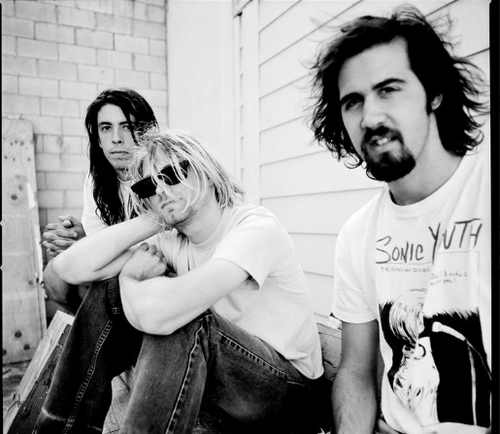
IN THIS PHOTO: Dave Grohl, Kurt Coabin, Krist Novoselic in a posed group shot/PHOTO CREDIT: Paul Bergen/Redferns

Cobain didn’t begin to write ‘Spirit’ until a few weeks before recording started on Nirvana’s second album, Nevermind, in 1991. When he first presented the song to his bandmates, (just the main riff and the chorus vocal melody), bassist Krist Novoselic dismissed it at the time as “ridiculous.” In response, Cobain made the band play the riff over and over again until collectively the band members slowed the riff down so they had fast and slow sections. As a result, it became the only song on Nevermind to credit all three band members as joint composers.

Cobain came up with the song’s title when his friend Kathleen Hanna, (at the time the lead singer of the Riot Grrrl punk band Bikini Kill), spray painted “Kurt Smells Like Teen Spirit” on his wall. Since they had been discussing anarchism, punk rock, and similar topics, Cobain interpreted the slogan as having a revolutionary meaning. What Hanna actually meant, however, was that Cobain smelled like the deodorant Teen Spirit, which his then-girlfriend Tobi Vail wore. Cobain later claimed that he was unaware that it was a brand of deodorant until months after the single was released. (Sales rocketed of the deodorant and the grunge army were no longer smelly!).

The unexpected success of ‘Smells Like Teen Spirit’ in late 1991 propelled Nevermind to the top of the charts at the start of 1992, an event often marked as the point where alternative rock entered the mainstream. “Smells Like Teen Spirit” was Nirvana’s first and biggest hit, reaching number six on the Billboard Hot 100 and charting all over the planet in 1991 and 1992.

The video, which was based on the concept of a school concert which ends in anarchy and riot, won the group two MTV Video Music Awards music, which was in heavy rotation on music television and in 2000 the Guinness World Records named “Teen Spirit” the Most Played Video on MTV Europe. The video was shot at GMT Studios in Culver City, California and features real Nirvana fans as the audience.

A notable alternate performance of “Smells Like Teen Spirit” occurred on BBC’s Top of the Pops in 1991, during which the band refused to mime to the prerecorded backing track and Cobain sang in a deliberately low voice with hilarious result. Kurt also changed lyrics in the song (for example, “Load up on guns, bring your friends” became “Load up on drugs, kill your friends”). Cobain later said he was trying to sound like one of heroes – former Smiths frontman Morrissey.

Nirvana grew uncomfortable with the success and attention “Spirit” received as a result. In the years since Cobain’s death, listeners and critics have continued to praise “Smells Like Teen Spirit” as one of the greatest rock songs of all time. In the years following Cobain’s death, ‘Smells Like Teen Spirit’ has continued to garner critical acclaim. In 2000, MTV and Rolling Stone ranked the song third on their joint list of the 100 best pop songs, trailing only The Beatles’ ‘Yesterday‘ and The Rolling Stones’ ‘(I Can’t Get No) Satisfaction’”.

One cannot talk about the popularity and iconic status of Smells Like Teen Spirit without referencing the video. I can only imagine what it was like for the extras that featured in the video. Thirty years later, they are probably still talking about it! Ultimate Classic Rock take us inside that sensational video:

“On Aug. 17, 1991, Nirvana assembled a group of fans to a sound stage in Culver City, Calif. What they shot that day would go in to become one of rock’s most iconic music videos.

By this point, the band had built a fanbase beyond Seattle. Nirvana’s debut LP, 1989’s Bleach, sold poorly but generated positive reviews and a strong word of mouth. As such, the group enjoyed an underground following across the country, largely made up of college students.

With their sophomore album, Nevermind, prepped for release, Nirvana played a show on Aug. 15, 1991, at the Roxy on West Hollywood’s famed Sunset Strip. “Smells Like Teen Spirit” was the third song on the set that night, and during the performance fans were handed flyers inviting them to be extras in the music video shoot.

“Nirvana needs YOU to appear in their upcoming music video, 'Smells Like Teen Spirit,'” the flyers proclaimed. “You should be 18 to 25 years old and adapt a high school persona, i.e. preppy, punk, nerd, jock…

As the casting call insinuated, the video was set in a high school. The idea was the brainchild of Kurt Cobain, taking inspiration from the films Over the Edge and the Ramones’ Rock ‘n’ Roll High School. Its basic concept was a “pep rally from hell,” with an apathetic student body eventually worked into a frenzy by Nirvana’s music.

 First time director Samuel Bayer would helm the project, and his personality bristled with the band. “He’s got a little Napoleon complex,” Cobain explained of Bayer in the book Come as You Are: The Story of Nirvana. “He was just so hyper, such a rocker guy. I couldn’t believe it. I couldn’t believe we actually submitted to that.”

Bayer was a disciplinarian on set, chiding extras, attempting to keep the band in check and generally coming across as overbearing. “It was just like we were in school,” Cobain recalled. “He was the mean teacher.”

Several aspects of the video would change due to Bayer’s input. For example, Cobain wanted “really ugly overweight cheerleaders” because he was “sickened by the stereotypical prom queen.” Instead, Bayer went with attractive women, recruited from local strip clubs.

“Kurt hated Sam Bayer,” Courtney Love recalled to New York Magazine in 2011. “For ‘Teen Spirit,’ Kurt wanted fat cheerleaders, he wanted black kids, he wanted to tell the world how fucked up high school was. But Sam put hot girls in the video. The crazy thing is, it still worked.”

“There were certain things we found to be really funny about videos—tits and ass and pyrotechnics, shit like that,” added drummer Dave Grohl, “and when we showed up at the shoot, we were like, ‘Wait a minute, those cheerleaders look like strippers’.”

For his part, Bayer “couldn’t understand why [Cobain] wanted to put unattractive women in the video.” “I think Kurt looked at me and saw himself selling out,” the director admitted. “But to me, these were nasty girls. They had rug burns on their knees. In my eyes, the whole video was dirty.”

The day of the shoot would be grueling for the band, crew and extras. Still, having the crowd made up of actual Nirvana fans -- rather than actors playing the part -- proved imperative.

“We did a couple of takes, and the audience just started destroying the stage,” Grohl recalled. “The director’s on a bullhorn screaming, ‘Stop! Cut!;’ And that’s when it started to make sense to me: This is like a Nirvana concert.”

Cobain convinced Bayer that the video needed to end with anarchy, the student body overtaking the school’s gym and running wild. It would be the final scene shot, and after a long day on the set -- including getting yelled at by the director -- the fans were anxious to let loose. Given the green light, the mob exploded into a massive mosh pit, breaking equipment and even taking some of the band’s instruments.

“Once the kids came out dancing they just said 'fuck you', because they were so tired of [Bayer’s] shit throughout the day," Cobain noted.

Ultimately, that explosion of energy helped make “Smells Like Teen Spirit” the legendary video it became. Cobain would edit Bayer’s original cut, removing footage that had focussed on some of the school teachers. He also added closeups of himself at the video’s end, giving viewers a clear image of the frontman’s intensity.

The “Smells Like Teen Spirit” music video would premiere on MTV's 120 Minutes on September 29, 1991. In October, it was added to the network’s “Buzz Bin,” a showcase for acts the network viewed as up-and-coming stars. Soon, Nirvana would find itself among the biggest bands in the world, and reluctant poster boys for the grunge revolution. Meanwhile, “Smells Like Teen Spirit” cemented its place as the defining music video of Generation X”.

A lot of the great songs gain respect and success when they are released. That does not mean the momentum continues and the tracks are taken to heart down the line. I am not sure why some songs translate and remain whereas others were at their peak when they were first released. Smells Like Teen Spirit is a song that has remained hugely popular ever since 1991. Such is its relevance and simplicity, legions of fans have kept the track ablaze! There is no telling how many bands were formed from that one song. Back in June, Nirvana’s Smells Like Teen Spirit joined an exclusive club: it surpassed a billion streams on Spotify. It had already gained more than one billion views on YouTube. NME report on the news that it ‘did the double’:

“Nirvana‘s ‘Smells Like Teen Spirit’ has surpassed a huge one billion streams on Spotify, only months before the band’s game-changing 1991 album ‘Nevermind’ celebrates its 30th anniversary.

The iconic track appeared on Nirvana’s second album and helped usher in a new wave of grunge and alternative rock dominance .

It now joins more than 150 tracks that make up Spotify’s Billions Club, which is largely comprised of landmark hits such as Queen‘s ‘Bohemian Rhapsody’, ‘Another One Bites The Dust’ and ‘Don’t Stop Me Now’.

They’re closely followed by the likes of Guns N’ Roses’ ‘Sweet Child O’ Mine’, with roughly 975 million plays) and AC/DC’s ‘Back In Black’, which boasts more than 800 million plays.

The track’s impressive Spotify ranking comes after the ‘Smells Like Teen Spirit’ YouTube video scored over a billion views on YouTube in 2019”.

Ahead of its thirtieth anniversary on 10th September, I wanted to revisit a song that defined a decade. Nirvana’s most popular song is one that will be picked apart and studied for generations to come. It is a track that is not just for Grunge fans. The lyrics are not often studied. I love the first verse: “Load up on guns, bring your friends/It's fun to lose and to pretend/She's over-bored and self-assured/Oh no, I know a dirty word”. It is both oblique and somehow crystal clear! Kurt Cobain was one of the great wordsmiths of his day. He can blend words that mean nothing and mean everything into the chorus and manage to captivate millions: “With the lights out, it's less dangerous/Here we are now, entertain us/I feel stupid and contagious/Here we are now, entertain us/A mulatto, an albino, a mosquito, my libido/Yeah, hey”. The song’s title is never song; it is not even suggested. My favourite line is “I'm worse at what I do best”. I love how Cobain uses language and the images he summons. Krist Novoselic and Dave Grohl are stunning. Providing so much weight, power and rhythm, they help turn Smells Like Teen Spirit into a timeless anthem! On 10th September, make sure you put the song on, turn it up loud…
rtrr.png

 IN THIS PHOTO: Nirvana in Los Angeles, 1991/PHOTO CREDIT: Chris Cuffaro

AND lose yourself.

FEATURE: Blown Away: Kate Bush’s Never for Ever at Forty-One

FEATURE:


Blown Away

q.png

IN THIS PHOTO: Kate Bush at a record signing for Never for Ever in Glasgow on 9th September, 1980

Kate Bush’s Never for Ever at Forty-One

___________

IT may seem odd to mark…

dd.jpg

a forty-first anniversary, but there are three Kate Bush albums that were released in September that I am revisiting. Never for Ever was released on 8th September, 1980. As we read on her official website, it was a groundbreaking release:

“Never For Ever is Kate's third studio album and was released in 1980.

Never For Ever was Kate's first no.1 album. It was also the first ever album by a British female solo artist to top the UK album chart, as well as being the first album by any female solo artist to enter the chart at no.1.

It has since been certified Gold by the British Phonographic Industry.

Kate co-produced the album with Jon Kelly”.

Rather than examine each song, I want to spotlight a couple and give an overall viewpoint of Never for Ever. I have already written how Kate Bush’s third studio album is underrated and did not get the reviews it deserved when it was released. It is still undervalued and not really discussed as one of her best. Co-producing with Jon Kelly – the first time Bush was in the production chair (though she did assist on Lionheart) -, this was her making music that was more truthful; where she had greater say and was breaking away from her first two albums (1978’s Never for Ever and Lionheart). As a huge fan, I can feel Bush sounds more in control and ambitious. The compositions on Never for Ever are much broader than those on her previous albums. Even though, in years following Never for Ever’s release, she was not entirely happy with her work until 1985’s Hounds of Love, she should be very proud. Never for Ever, forty-one years after its release, is finding new audiences.

Before exploring my two favourite songs from the album and dropping in a review, it is worth reading about Bush’s perspectives on the album. The Kate Bush Encyclopaedia is at hand to assist:

“Each song has a very different personality, and so much of the production was allowing the songs to speak with their own voices - not for them to be used purely as objects to decorate with "buttons and bows". Choosing sounds is so like trying to be psychic, seeing into the future, looking in the "crystal ball of arrangements", "scattering a little bit of stardust", to quote the immortal words of the Troggs. Every time a musical vision comes true, it's like having my feet tickled. When it works, it helps me to feel a bit braver. Of course, it doesn't always work, but experiments and ideas in a studio are never wasted; they will always find a place sometime.

I never really felt like a producer, I just felt closer to my loves - felt good, free, although a little raw, and sometimes paranoia would pop up. But when working with emotion, which is what music is, really, it can be so unpredictable - the human element, that fire. But all my friends, the Jons, and now you will make all the pieces of the Never For Ever jigsaw slot together, and It will be born and It will begin Breathing. (Kate Bush Club newsletter, September 1980)

It's difficult to talk about the album without you actually hearing it, I suppose it's more like the first album, The Kick Inside, though, than the second, Lionheart, in that the songs are telling stories. I like to see things with a positive direction, because it makes it so much easier to communicate with the audience of listener. When you see people actually listening to the songs and getting into them, it makes you realise how important it is that they should actually be saying something. (...)

There are a lot of different songs. There's no specific theme, but they're saying a lot about freedom, which is very important to me. (Deanne Pearson, The Me Inside. Smash Hits (UK), May 1980)

For me, this was the first LP I'd made that I could sit back and listen to and really appreciate. I'm especially close to Never For Ever. It was the first step I'd taken in really controlling the sounds and being pleased with what was coming back. I was far more involved with the overall production, and so I had a lot more freedom and control, which was very rewarding. Favourite tracks? I guess I'd have to say 'Breathing' and 'The Infant Kiss'. (Women of Rock, 1984)”.

I like that last interview and the tracks Bush selects as her favourite. If she was asked today, I am sure she would change her mind. The two that I think showcases Bush at her very best are The Wedding List and Babooshka. The latter is a hit single that most people know about. It is such a great song because one can hear a vocal that sounds different to anything she delivered before. With a bit of the newly-discovered Fairlight CMI and a classic video, it is a confident songwriter very visibly and audibly entering a new phase of her career. The Wedding List is underplayed and a track that I think should have been a single. It has a great story. I will start by highlighting Babooshka. Again, it is to the Kate Bush Encyclopaedia for some useful information:

“The music video depicts Bush beside a double bass (contrabass) which symbolises the husband, wearing a black bodysuit and a veil in her role as the embittered wife. This changes into an extravagant, mythlike and rather sparse "Russian" costume as her alter-ego, Babooshka. An illustration by Chris Achilleos was the basis for the costume.

It was really a theme that has fascinated me for some time. It's based on a theme that is often used in folk songs, which is where the wife of the husband begins to feel that perhaps he's not faithful. And there's no real strength in her feelings, it's just more or less paranoia suspicions, and so she starts thinking that she's going to test him, just to see if he's faithful. So what she does is she gets herself a pseudonym, which happens to be Babooshka, and she sends him a letter. And he responds very well to the letter, because as he reads it, he recognises the wife that he had a couple of years ago, who was happy, in the letter. And so he likes it, and she decides to take it even further and get a meeting together to see how he reacts to this Babooshka lady instead of her. When he meets her, again because she is so similar to his wife, the one that he loves, he's very attracted to her. Of course she is very annoyed and the break in the song is just throwing the restaurant at him...  (...) The whole idea of the song is really the futility and the stupidness of humans and how by our own thinking, spinning around in our own ideas we come up with completely paranoid facts. So in her situation she was in fact suspicious of a man who was doing nothing wrong, he loved her very much indeed. Through her own suspicions and evil thoughts she's really ruining the relationship. (Countdown Australia, 1980)”.

One demonstration of Bush’s strength as a unique and hugely inventive songwriting came with The Wedding List. I do love the story behind my favourite song on Never for Ever:

“Song written by Kate Bush. The song was inspired by a François Truffaut's film called The Bride Wore Black ('La Mariée était en noir'). It tells of a groom who is accidentally murdered on the day of his wedding by a group of five people who shoot at him from a window. The bride succeeds in tracking down each one of the five and kills them in a row, including the last one who happens to be in jail.

Revenge is so powerful and futile in the situation in the song. Instead of just one person being killed, it's three: her husband, the guy who did it - who was right on top of the wedding list with the silver plates - and her, because when she's done it, there's nothing left. All her ambition and purpose has all gone into that one guy. She's dead, there's nothing there. (Kris Needs, 'Fire in the Bush'. Zigzag, 1980)

Revenge is a terrible power, and the idea is to show that it's so strong that even at such a tragic time it's all she can think about. I find the whole aggression of human beings fascinating - how we are suddenly whipped up to such an extent that we can't see anything except that. Did you see the film Deathwish, and the way the audience reacted every time a mugger got shot? Terrible - though I cheered, myself. (Mike Nicholls, 'Among The Bushes'. Record Mirror, 1980)”.

As a producer, Bush definitely changed things and started to make music in her own way. Feeling more of a leader and architect than an artist in the machine with others moulding her music. Whilst 1985’s Hounds of Love was the most realised and spectacular example of Bush’s production and songwriting brilliance, Never for Ever was the first sign. With some of her best songs – Babooshka, Breathing, Army Dreamers, The Wedding List, Delius (Song of Summer) and All We Ever Look For -, Never for Ever is a magnificent album! I want to end with an article from PopMatters. They celebrated forty years of Never for Ever last year:

“Never for Ever was a commercial success, yielding three UK Top 20 hits (“Breathing”, “Army Dreamers”, and “Babooshka”) and topping the UK Albums chart. She produced the album, along with engineer Jon Kelly. For some artists, this achievement would be enough, and they’d be content to churn out variations on a theme year after year. But not so for Kate. On Never for Ever, we see her evolve lyrically, hear her expand sonically, and get a taste of what’s to come. Bush’s influences may be hard to map, but Never for Ever plots a course to the frenzied experimentation of The Dreaming, the triumph of Hounds of Love,, and indeed to the rest of her career. Hence, Never for Ever serves as a bridge between where she started and where she was going all along.

It is on these songs, in particular, that listeners catch a glimpse of what’s to come. Tracks like “Delius”, with its dreamy and capacious soundscapes, are intermixed with tracks like “The Wedding List”, a sort of companion piece to “Babooshka”. With its dastardly narrative building to a dramatic chorus, “The Wedding List” is a showy vaudevillian number. But it relies on the conventional instruments and string arrangements of Bush’s earlier LPs and would have been at home on either one.

ff.jpg

IN THIS PHOTO: Kate Bush performed Delius (Song of Summer) on The Russel Harty Show on 25th November, 1980/PHOTO CREDIT: John Carder Bush

“Blow Away” and “All We Ever Look For” are sweet, sentimental songs that could also fit in the pre-Fairlight era. I particularly enjoy Kate’s voice on the latter, but the Fairlight samples of a door opening, Hare Krishna chanting, and footsteps seem to have been an afterthought. The samples add a narrative layer to the song, but the sounds are not integral to the arrangement.

“The Infant Kiss” is one of the highlights of the album, though it, too, is more of a throwback to earlier compositions. The eerie song was inspired by the film The Innocents, which was in turn based on the Henry James novella The Turn of the Screw. Lyrically, the song is similar to the title track of The Kick Inside and “The Man With the Child in His Eyes” in its dealing with taboo sexuality. The song’s narrator is a governess torn between the love of an adult man and child who inhabit the same body. Or, as one critic called it, “the child with the man in his eyes.”

What sets this song apart is Bush’s production. Instead of overwrought orchestral arrangements of the earlier albums, Bush relies on restrained, baroque instrumentation to convey the song’s conflicted emotions. With Bush behind the boards, she begins to use the studio as an instrument unto itself. Her growing technical facility, combined with the expansive possibilities of the Fairlight and other synthesizers, allowed her to express her feelings through sound more fully.

“Breathing” is a full opera in five-and-a-half minutes, written, scored, arranged, and performed by an artist growing into herself and beginning to realize her full potential. It’s a fitting ending for Never for Ever, an album that sees Bush, only 23 years old at the time, leaving behind her ’70s juvenilia. At the turn of the 1980s, she was poised to scale new heights with her music, some of which would define the decade to come”.

Ahead of its forty-first anniversary, I wanted to return to Never for Ever. After the exhaustive The Tour of Life in 1979 (which was fulfilling and successful) and two years before she released her most experimental album to that point, The Dreaming, Never for Ever was a phase where Bush assumed more production control and delivered a more eclectic album. There are one or two tracks from the album that I do not always listen to…though that is only a minor slight. I love Never for Ever and think that we need to hear more from it. Such an interesting and strong album, go and listen to it in full. Forty-one years after its release, Never for Ever remains…

ddd.jpg

IN THIS PHOTO: Kate Bush performs Babooshka on French T.V. in 1980

A remarkable album.

FEATURE: Above Us Only Sky: John Lennon’s Imagine at Fifty

FEATURE:


Above Us Only Sky

rrr.jpg

John Lennon’s Imagine at Fifty

___________

THERE are albums turning fifty this year…

ddd.jpg

 IN THIS PHOTO: John Lennon, Imagine 1971 by The Vincent Vigil Collection

that are hugely important and have touched so many people. There are few albums from 1971, in my view, that are as vital as John Lennon’s Imagine. Of course, the title track is one of the finest releases ever. A song that is as beautiful and moving now as it has ever been. The Imagine album was released on 9th September, 1971. I am going to bring in a review for the album, in addition to a feature regarding its recording. First of all, here is some overview regarding Lennon’s Imagine:

“Imagine is the second studio album by English musician John Lennon, released on 9 September 1971 by Apple Records. Co-produced by Lennon, his wife Yoko Ono and Phil Spector, the album's lush sound contrasts the basic, small-group arrangements of his first album, John Lennon/Plastic Ono Band (1970), while the opening title track is widely considered to be his signature song.

Lennon recorded the album from early to mid-1971 at Ascot Sound Studios, Abbey Road Studios and the Record Plant in New York City, with supporting musicians that included his ex-Beatles bandmate George Harrison, keyboardist Nicky Hopkins, bassist Klaus Voormann and drummers Alan White and Jim Keltner. Its lyrics reflect peace, love, politics, Lennon's experience with primal scream therapy, and, following a period of high personal tensions, an attack on his former writing partner Paul McCartney in "How Do You Sleep?" Extensive footage from the sessions was recorded for a scrapped documentary; parts were released on the documentary film Imagine: John Lennon (1988). The documentary John & Yoko: Above Us Only Sky, based on that footage, was released in 2018”.

I guess it would be unfair to call Imagine a John Lennon solo album, as Yoko Ono was such a big contributor. In fact, there is an Ultimate Collection that Ono was instrumental in bringing together. It provides outtakes and rarities that offers a greater insight into the making of one of the best albums ever. I will come to the positives of the album. I think that the fact there was bitterness between John Lennon and Paul McCartney in 1971 leads to some rather acidic moments. Some say that Jealous Guy is about McCartney (although many feel it is about Yoko Ono). The notorious song, How Do You Sleep?, is about McCartney for sure! One wonders what Imagine would have sounded like were there not the acrimony between the former Beatles members. George Harrison also appears on Imagine. Whilst there are a lot of sweeter songs on the album, there are some more pointed ones. Despite Lennon harbouring anger – not just towards McCartney -, Imagine is an album with very few weaknesses. Imagine, Jealous Guy and Gimme Some Truth are three of his greatest songs. The musicianship throughout is exceptional. Lennon and Yoko produced Imagine with Phil Spector. Whilst the late, disgraced producer helped to ruin The Beatles Let It Be in 1970, his production on Imagine is tasteful and decent. I wonder what Lennon would make of Imagine turning fifty were he still alive? I also wonder whether his former Beatles bandmates Paul McCartney and Ringo Starr will mark the anniversary.

I want to bring in an article that highlights an album where Lennon’s wit and gift for hooks was at its peak. To me, Imagine is John Lennon’s finest solo album:

“Powerful, poignant, important and beautiful are all words that describe Imagine – both the title song and the LP that was John Lennon’s second solo album release, in the autumn of 1971. One song does not make a great album, even when it is as seminal and defining as Imagine… and make no mistake this is a great album, full of brilliant songs, with great hooks, but with John’s acerbic wit ever-present to avoid it from becoming the kind of music that John found irrelevant and meaningless.

“The concept of positive prayer … If you can imagine a world at peace, with no denominations of religion—not without religion but without this my God-is-bigger-than-your-God thing—then it can be true.” – John Lennon

John began work on the album that was to become Imagine a little over three months after finishing John Lennon/Plastic Ono Band. Recording his new album was done in three separate stages, the first between 11 and 16 February, followed by another from 24 to 28 May, before some final overdubs and mixing in New York over the 4th of July weekend. The earlier sessions were at Abbey Road and the May sessions were at the Lennon’s home studio at Tittenhurst Park, the New York sessions in July were at the Record Plant.

Imagine is a very different album from the one that went before it, as John told David Sheff in 1980, “The album Imagine was after Plastic Ono. I call it Plastic Ono with chocolate coating.” From the stark, but brilliant John Lennon/Plastic Ono Band this record is more instantly accessible, but let not that fool you into thinking John had gone soft. And like his previous album, Imagine has Yoko Ono’s influence all over it and no more so than in the brilliant title song.

Yoko’s poetry, included in her 1964 book Grapefruit, helped inspire John’s lyrics for ‘Imagine’, and also influenced the cover of the album. In Yoko’s poem, ‘Cloud Piece’ it includes “Imagine the clouds dripping, dig a hole in your garden to put them in.” John later said ‘Imagine’, “Should be credited to Lennon/Ono. A lot of it—the lyric and the concept—came from Yoko, but in those days I was a bit more selfish, a bit more macho, and I sort of omitted her contribution, but it was right out of Grapefruit.”

“The World Church called me once and asked, “Can we use the lyrics to ‘Imagine’ and just change it to ‘Imagine one religion’?” That showed [me] they didn’t understand it at all. It would defeat the whole purpose of the song, the whole idea.” – John Lennon

Just what is it that makes ‘Imagine’ such a perfect recording? From the opening bars of John playing the piano the song stakes its claim on our senses. The clever way the track is produced, to move the seemingly distant piano from the centre to the full stereo pan helps to accentuate John’s plaintive, and vulnerable, vocal. The subtly beautiful strings, scored by Torrie Zito, play their part in making this song the very creative peak of John and Yoko’s working together.

The earlier sessions, at Abbey Road, took place during the recording of the single, ‘Power To The People’ and because Ringo was unavailable, Jim Gordon from Derek and the Dominos was drafted in to play drums, along with Klaus Voormann on bass. ‘It’s So Hard’ and ‘I Don’t Want To Be A Soldier’, were begun at the February sessions, with King Curtis adding his saxophone to the former in New York in July, while the latter song was substantially reworked at the May sessions. At Abbey Road, they also recorded Yoko’s, ‘Open Your Box’ that became the b-side of ‘Power To The People’.

‘Jealous Guy’ has become one of John’s best-known songs, helped in no small part by it having been covered by Roxy Music in early 1981 and taken to No.1 on the UK charts. But it is a song that is ‘so John’, and its one that had its beginnings in India in 1968 before its full flowering when John rewrote its original lyrics that capture the feelings of a man in a love relationship or possibly it gives another view as to how John felt over the break up of the Beatles. Whatever, it is about, this is consummate songwriting as John tackles a subject that most of us would prefer to keep under wraps.

Acerbic and political, ‘Gimme Some Truth’ highlights John’s way with words and succinctly sums up so much of what made John tick. John, always ahead of his time tackles the question of political leadership – just as relevant today as in 1971 – and this song acts as the bridge to what would follow in John’s songwriting over the coming years”.

I am looking forward to seeing the reaction gets on Imagine’s fiftieth anniversary on 9th September. Before I wrap up, Classic Rock Review gave their take on the 1971 classic in 2011:

“Imagine, the second full post-Beatles album by John Lennon, kicks off with an idyllic song envisioning a utopian world where there is no conflict and everyone agrees. Sounds pretty good on the surface, but this is where the art of making a album comes into play. The title song taken on it’s own may lead the listener to believe that this is how Lennon wished the world would be some day. But listening to the album as a whole completes the picture of how Lennon really seemed to view his world.

In many ways, the album was a musical continuation of Lennon’s 1970 debut John Lennon/Plastic Ono Band, which also featured Phil Spector as producer and a heavy presence by Klaus Voormann on the bass guitar. Many songs from Imagine (especially those on the “second side”) feel like they could have been left over from that previous album. However, there is a clear and distinct departure on Imagine towards a more cerebral and measured approach to these deep, inner subjects as opposed to the raw “primal scream” method on Plastic Ono Band”.

IN THIS PHOTO: John Lennon and Yoko Ono, N.Y.C., 1971/PHOTO CREDIT: Bob Gruen 

“Gimme Some Truth” is the best song on this album. It is a rant expressing John’s frustration with the general bullshit of life and society. It features scathing lyrics delivered in a syncopated rhythm against a background heavy with bass and drums –

“I’m sick to death of seeing things from tight-lipped, condescending, mama’s little chauvinists All I want is the truth Just gimme some truth now I’ve had enough of watching scenes of schizophrenic, ego-centric, paranoiac, prima-donnas”

It is a precise statement about politicians lying and propagandizing – cut the crap and just tell the truth.

Although the album features Beatles band mate George Harrison as lead guitarist, he does not shine too brightly at any one moment. Pianist Nicky Hopkins, however, provides some great virtuoso and memorable playing, especially on “Crippled Inside”, “Jealous Guy”, and the upbeat pop song, “Oh Yoko!”. Alan White takes over for Ringo on drums and there are many guest musicians, including several members of the band Badfinger”

On Imagine, John Lennon slides from themes of love, life, political idealism, to raw emotion. Honesty is an ongoing theme in his lyrics, especially after he descends from the polyanic vision of the theme song. It settles on the more realistic theme of life is not perfect, but if one lives honestly, loves fully and rises above the conflicts, it’s pretty close”.

Although some critics in 1971 (and many since) dismissed Imagine because it is quite commercial and it lacks the experimental nature of previous albums from John Lennon and Yoko Ono, I like that there are more tender moments – from a songwriter who rarely showed it during his time with The Beatles. There are sour and more angry moments. I think the only track to ignore is How Do You Sleep? Musically, it is a good track, though the lyrics really do put you off. Apart from that, the album is phenomenal. In 1971, Paul McCartney (with Linda McCartney) put out Ram.  In some ways, there was this war between the two. Whilst they did build bridges before Lennon’s death in 1980, one cannot help but feel the scars of The Beatles’ break-up on Imagine. Take that away, and what you have is one of the greatest albums of the 1970s. Possessing so many beautiful songs and some of John Lennon’s best lyrics, a happy fiftieth anniversary to…

THE stunning Imagine.

FEATURE: A Buyer’s Guide: Part Seventy: Deacon Blue

FEATURE:


A Buyer’s Guide

ff.jpg

Part Seventy: Deacon Blue

___________

FOR this A Buyer’s Guide…

ccc.jpg

I am featuring one of my favourite bands. Deacon Blue are a group that formed in Glasgow in 1985. I have been a fan of their since I was a child. As their album, 1991’s Fellow Hoodlums, celebrated a big anniversary recently, I wanted to include them here. There are so many great Deacon Blue albums – so drilling down to the essentials will be hard! Before that, here is some biography from AllMusic:

“Taking their name from a Steely Dan song, Scotland's multi-platinum pop/rockers Deacon Blue emerged from the aftermath of the post-punk era to hit the mainstream during the mid-'80s, and after five years away during the '90s, they returned in the 21st century. Their clean, euphoric sound winds the lead vocals of husband-and-wife team Ricky Ross and Lorraine McIntosh across infectious hooks and sweeping melodies in a sophisticated meld of rock, pop, jazz, blues, Celtic soul, and folk music. Their debut album, 1987's Raintown, attained platinum status and spent a year-and-a-half on the charts. Their second, When the World Knows Your Name, topped the U.K. album charts and went multi-platinum inside of a month. Subsequent outings, including 1991's Fellow Hoodlums, and 1993's Whatever You Say, Say Nothing were also certified best-sellers and registered longstanding Top Five chart entries. The group split in 1994 but returned to touring in 1999. 2001's Homesick marked their part-time return to recording, and the band continued to exist for a few years on a part-time basis as Ross cut solo outings and wrote for other artists. In 2012 Deacon Blue issued The Hipsters. It rocketed to number two and signaled their full-time return to recording and touring. While 2014's A New House and 2016's Believers both went Top Five, 2020's City of Love topped the charts. In November of that year, Deacon Blue's 1987 single "Dignity" was voted "Scotland's Greatest Song" by a landslide.

Deacon Blue formed in 1985 after former educator, songwriter, and lead vocalist Ricky Ross relocated from Dundee to Glasgow. The band's original lineup consisted of Lorraine McIntosh (backing and lead vocals), James Prime (piano and keyboards), Dougie Vipond (drums), Ewen Vernal (bass), and Graeme Kelling (guitar). They performed their first concert opening for the Waterboys' premier show in England. With the expressive baritone vocals of singer/songwriter Ricky Ross and McIntosh's resonant alto, fronting pop-jazz and soul-inspired melodies, Deacon Blue's debut single, 1987's "Dignity," entered the U.K. Top Ten. Their Jon Kelly-produced full-length Raintown peaked at 14 on the charts and stayed inside the Top 100 for more than 18 months, going on to sell over a million copies. After a year of touring the U.K. and Europe, Deacon Blue re-entered the studio and emerged with When the World Knows Your Name. It went straight to number one in Scotland and the U.K., thanks to five Top 30 singles, including "Real Gone Kid," "Wages Day," and "Fergus Sings the Blues." The set was certified multi-platinum and remains their best-selling album to date.

The following year, Deacon Blue played to 250,000 fans at The Big Day, a free concert held to celebrate Glasgow being named that year's European City of Culture. The same year, "Real Gone Kid" was nominated for British Single of the Year. While on tour in 1989, the band issued the compilation Ooh Las Vegas which collected B-sides, demos, and soundtrack selections. It peaked at three on the U.K. albums chart. In 1990, McIntosh and Ross married.

In 1991, Deacon Blue released Fellow Hoodlums. Again enlisting Kelly as producer, the set peaked at number two on the U.K. albums chart and was certified platinum. They toured Europe and the States that year. While Deacon Blue became one of the biggest pop bands in the U.K., they made only a small industry impression in the U.S., but they couldn't have cared less.

With 1993's Whatever You Say, Say Nothing, the band changed producers and musical direction. They enlisted the team of Steve Osborne and Paul Oakenfold and deliberately moved toward a guitar-heavy alternative rock sound. Certified gold, the album peaked at number four on the U.K. album charts. After a pair of sold-out tours, the band returned to the studio to cut new songs for their greatest-hits compilation, Our Town. The chart-topping set contained three new tracks. First single "I Was Right and You Were Wrong" entered the Top 20 of the U.K. singles charts, as did a re-release of "Dignity." The other new songs were "Bound to Love" and "Still in the Mood," and the album was certified double-platinum. In 1994, drummer Dougie Vipond announced he was leaving the band to pursue a career in television. After some discussion, the band decided to split.

Ross, who had recorded a solo album before joining Deacon Blue, resumed his solo career. He issued What You Are in 1996. A radical departure from his former band's music, this set's session players included a who's-who of American studio aces including Jeff "Skunk" Baxter, Patrick Warren, and Joey Waronker. Ross shifted gears for 1997's New Album and pulled the plug on the edgy electric guitars of his previous outing. Produced by Love and Money keyboardist Paul McGeechan, the record wove acoustic guitars and pianos through 11 ambient soundscapes with vocals.

In 1999, Deacon Blue re-formed for a sold-out reunion gig with Vipond back in the fold. The gig went so well, they performed others and hit the studio to record Walking Back Home. It collected nine hits alongside eight new songs and a couple of covers. It sold quite respectably and landed inside the Top 40. Deacon Blue toured behind it and decided to re-form part-time. They returned to proper studio recording with 2001's Homesick on Chrysalis' short-lived Papillon label. It peaked at 13 on the U.K.'s Indie albums chart and at 59 on the U.K. albums list.

Ross signed a publishing deal with Warner Chappell in 2001, the same year that guitarist Graeme Kelling was diagnosed with the pancreatic cancer that would claim his life three years later. Ross issued the solo This Is the Life in 2002, and in 2005 followed with Pale Rider. As part of his publishing deal, Ross has penned a wealth of material for other artists including James Blunt, KT Tunstall, and Jamie Cullum.

In 2009, Ross and McIntosh released the co-billed Americana album The Great Lake on Cooking Vinyl. It was inspired, in part by the Roman Catholic couple making a faith retreat of the SpiritualExercises of St. Ignatius. That same year, Ross began a broadcast career with the BBC Scotland; his program, Another Country with Ricky Ross, continues to showcase modern and vintage country and Americana.

Deacon Blue continued to make intermittent festival appearances and release compilations. They played Manchester United's Old Trafford stadium as the pre-match entertainment for the Rugby league Super League Grand Final in October 2006, and did a full U.K. tour in November. They toured again in November 2007 and provided support for a Simple Minds tour in 2008. In 2009 they appeared at The Homecoming Live Final Fling Show at Glasgow's SECC, and headlined Glasgow's Hogmanay on New Year's Eve. After playing the Glastonbury Festival and Liverpool Echo, they re-entered the recording studio.

In 2012, they celebrated their 25th anniversary and released the Paul Savage-produced The Hipsters in September with Del Amtiri's Mick Slaven guesting on guitar. It peaked at 19 on the U.K. albums chart. They toured the U.K. and Europe. As part of the band's anniversary, their previous studio albums were remastered and reissued in deluxe editions by Edsel, along with the compilation The Rest.

In 2013, Ross released the solo outing Trouble Came Looking, and undertook an acoustic tour. Deacon Blue hit the studio almost immediately after he returned. Their seventh studio album, A New House, arrived in 2014. Produced by Savage, the album reached 19 on the U.K. albums chart and peaked at two on the indie albums list. It was the band's first album to feature guitarist Gregor Phillip.

The band re-teamed with Savage for the politically charged Believers. Issued in September 2016, it received universal critical acclaim and peaked at four on Scotland's album charts while hitting 13 on the U.K. albums survey. A European promotional tour culminated in a triumphant return to the Glasgow Barrowlands, the venue where they had played in 1994. The event was filmed and recorded for 2017's Live at the Glasgow Barrowlands. Ross followed with the solo Short Stories, Vol. 1 later that year. Among its new songs were covers of Deacon Blue's "Raintown" and "Wages Day."

The band issued City of Love in 2020. The anthemic collection was produced by Ross and mixed by Savage. Greeted with glowing reviews on both sides of the Atlantic, it topped Scotland's albums list and went to number four on the U.K. album charts. During a promotional tour that November, the band's 1987 debut single "Dignity" was voted "Scotland's Greatest Song."

With more touring planned for early 2021, the global COVID-19 pandemic put Deacon Blue's plans on hold. Undaunted, they took four leftover tracks from City of Love and cut four more Ross-penned songs while separated from one another in quarantine. The end result was the companion album Riding on the Tide of Love. It was released in February 2021”

If you are new to the wonders of Deacon Blue, the guide below lists their very best albums, one that is an underrated gem, plus a book about them that is useful to have. Of course, dig out as much of their great music as you can! Over thirty-five years since they formed, the Glasgow band are still…

PRODUCING such exceptional music!

____________

The Four Essential Albums


Raintown

a.jpg

Release Date: 1st May, 1987 (U.K.)/February, 1988 (U.S.)

Label: Columbia

Producer: Jon Kelly

Standout Tracks: Loaded/When Will You (Make My Telephone Ring)/Chocolate Girl

Buy: https://www.roughtrade.com/gb/deacon-blue/raintown

Stream: https://open.spotify.com/album/7dN67Cy3jynzfNWROXxB7H?si=v05EePTOQS2SxaMqpjX--w&dl_branch=1

Review:

“I missed the recent 30th anniversary of Raintown probably because I was surprised it was originally released as early as 1st May 1987.

A famous ‘sleeper’ record, it eventually crawled up to #14 in the UK album charts but remained in the top 100 for 18 months off the back of some re-released singles and constant touring.

Later on in Deacon Blue’s career, singer/lead songwriter Ricky Ross name-dropped Van Morrison and Springsteen, but on Raintown the big influence is surely Prefab Sprout.

They gave the game away a few years later, naming their collection of B-sides and outtakes Ooh Las Vegas. Nothing to do with Prefab’s ‘Hey Manhattan’, then… (To be fair, the influence may have worked the other way round too – Prefab employed Raintown producer Jon Kelly for some of From Langley Park To Memphis, and that album’s slick sheen bears an occasional resemblance to Raintown.)

Raintown is pop, not rock. The album positively sparkles. James Prime’s excellent keyboard playing is prominent (they didn’t really need a guitarist at this point) with his ‘mystery’ chord very recognisable (later also heard on ‘Real Gone Kid’ and ‘Love And Regret’).

Vocalist Lorraine McIntosh emerges as a kind of ‘bluesier’ version of Prefab’s Wendy Smith though she certainly divides opinion – she nearly ruins the title track and otherwise superb ‘Love’s Great Fears’ but is very effective when reining it in on ‘Loaded’ and ‘Dignity’.

There aren’t many more evocative ’80s album openers than the brief ‘Born In A Storm’, a gorgeous mood piece which sounds a bit like The Blue Nile with a few more chords.

‘Loaded’ is a classic song ‘about some of the people we’d met in the record business’, in Ross’s words. His gritty vocals really work on this – he sounds positively distraught by the last few choruses – and the modulation at 2:48 is one of the great moments of late-’80s pop.

‘When Will You Make My Phone Ring’ is also memorable, even if Ross struggles a little with the lead vocal and the whole thing is a little similar to the soul standard ‘If You Don’t Know Me By Now’.

The excellent ‘Chocolate Girl’ – influenced by Prefab’s ‘Cruel’ in its portrait of a modern relationship – features some gorgeous BJ Cole pedal steel and a few classic couplets including: ‘He calls her the chocolate girl/Cos he thinks she melts when he touches her’.

Finally, Raintown is a romantic album about work, home, love and nostalgia which probably gives a lot of people (including me) a warm glow when they hear it. I couldn’t get with the band’s later rockier direction but I’ll always have a soft spot for this one” – movingtheriver.com

Choice Cut: Dignity

When the World Knows Your Name

Release Date: 6th April, 1989

Label: Columbia

Producers: Warne Livesey/Deacon Blue/David Kahne

Standout Tracks: Queen of the New Year/Wages Day/Fergus Sings the Blues

Buy: https://www.discogs.com/sell/release/249581

Stream: https://open.spotify.com/album/2yBIZUvK09HBf6M7Tti3Wy?si=C__QMQDET9y46xk-NVLp_g&dl_branch=1

Review:

“Fergus Sings The Blues follows this, and this track was the album’s third UK single, and it reached #14. From the off, there’s a great little bass and piano line. There’s almost an echo of disco here, but thankfully they keep themselves on the 80’s rock-pop mould side of it. There’s some great brass going on here – thanks to trumpets and trombone. Again, Lorraine’s here with some perfectly placed backing vocals. Mr 80’s Obligatory Saxophone gets to do a little sultry outtro.

Next up it’s The World Is Lit By Lightning – a great title. This track is laden with synths and is less rocky than some of their songs. Again, there’s plenty of piano, and some brass moments. Ricky is briefly joined by Lorraine for some vocal parts, but the vocals are a little quiet in comparison to the music. The use of contemporary keyboard sounds seems to dominate, leaving their vocals a bit buried.

Silhouette is quite a simple little track, seeing the return of the double bass, ‘woo hoo’ vocals, and a light sprinkling beat and guitar section for the chorus. This song really helps to show off Ricky’s vocals, but thankfully lets Lorraine take a lead at about 2mins.

This is followed by One Hundred Things, which really is quite a nice up-beat track. Vocally, musically and even lyrically (that ‘case of old photographs‘ is back again) feels like a companion track for Real Gone Kid. The track has a great musical and vocal pace to it – leaving it feel catchy and as if it should have been a single.

Up next is penultimate track Your Constant Heart, which brings the pace down again. This is definitely well in the 80’s stadium pop-rock genre. Musically it feels a bit busy with a lot of background layers going on, which includes guitar and harmonica. Ricky’s vocals vary from sounding like he’s singing on stage to singing in a cupboard.

The album closes with the brooding drums and piano of Orphans. This is almost lullaby-esque. Ricky’s vocals feel raw here, aided perfectly by the softer backing vocals of Lorraine and a swelling synth. I could easily imagine this being sung by Sinéad O’Connor instead. This is a wonderfully gentle ending to an album” – POP RESCUE

Choice Cut: Real Gone Kid

Fellow Hoodlums

ww.jpg

Release Date: 3rd June, 1991 (U.S.)/10th June, 1991 (U.K.)

Label: Columbia

Producer: Jon Kelly

Standout Tracks: James Joyce Soles/Your Swaying Arms/Cover from the Sky

Buy: https://www.roughtrade.com/gb/deacon-blue/fellow-hoodlums

Stream: https://open.spotify.com/album/7ueq3u8C3OXdkeUGfj8EHF?si=OOooIW2PTcm1KmxbERtxbA&dl_branch=1

Review:

“Peaking at No.2 in the UK, Fellow Hoodlums is a more organic collection of songs than its predecessor, embodied by its second single (and Deacon Blue’s second Top 10 hit), Twist And Shout. Not to be confused with the song made famous by The Top Notes, The Isley Brothers and, of course, The Beatles, it fuses pop with Cajun zydeco. Ross and McIntosh are in sparkling form once again, particularly on One Day I’ll Go Walking, while McIntosh also gets a solo spot on the sublime Cover From The Sky.

Elsewhere, there’s much to admire in the weirdly wonderful title track, James Joyce Soles and The Day That Jackie Jumped The Jail.

Your Swaying Arms made No.6 in Ireland, the band’s seventh consecutive Top 10 single there” – CLASSIC POP

Choice Cut: Twist and Shout

The Hipsters

Release Date: 24th September, 2012

Labels: Demon/Edsel

Producer: Paul Savage

Standout Tracks: Stars/The Outsiders/Laura from Memory

Buy: https://www.discogs.com/sell/list?master_id=703449&ev=mb

Stream: https://open.spotify.com/album/5emVP9CzoLDdoKbVfrzTbu?si=ZpmK3kJOR1u0C_UnOetKlw&dl_branch=1

Review:

“Eleven years since their last original release, with between-album pursuits ranging from actor to TV presenter to university lecturer, staple highlight-of-a-decade Deacon Blue have never fully gone off the radar. Members have sporadically dipped back into the band via best ofs, reunion tours and one-off events.

And the parallel careers are on hold once again, this time for a full studio album. But with The Hipsters, there’s a real feeling of commitment to the cause.

The lead single and title track provides the promise of optimistic, sunlit, indie-flecked arrangements, which does follow through for the most part. The rhythmic thump of The Rest and That’s What We Can Do prove to be perfect examples.

Beyond that, The Hipsters does sway briefly into gentler terrain, the sinuous balladry of She’ll Understand complementing the more upbeat numbers effectually. The back-and-forth vocal play between Ricky Ross and Lorraine McIntosh is as congruent as ever – no huge surprise given they’re a married couple – acting as an unpremeditated reminder of the magic of their 1988 benchmark Real Gone Kid.

The Hipsters proves that Deacon Blue are showing their age, in the most positive way – their tightly-defined chemistry, accomplished storytelling and knack for melodies have been finely honed over the past 25 years. And while the title lends itself to all manner of trend-conscious pretension, there are no such gimmicks present.

Instruments win out against any threat of desk over-twiddling, not a million miles from the safer moments of Snow Patrol or latter-day Take That, and something which would translate agreeably to the live stage.

This isn’t a band attempting to recapture their halcyon days – Deacon Blue are doing what they’ve always been able to do with aplomb, atop some well-considered, refined and timely production. There’s no huge statement to be made, no desperate clawing for another shot – merely a legitimate love for what they do. And on The Hipsters, that’s made very evident indeed” – BBC

Choice Cut: The Hipsters

The Underrated Gem


Whatever You Say, Say Nothing

qa.jpg

Release Date: 1st March, 1993

Label: Columbia

Producers: Steve Osborne/Paul Oakenfold

Standout Tracks: Only Tender Love/Hang Your Head/Will We Be Lovers

Buy: https://www.discogs.com/sell/list?master_id=152364&ev=mb

Stream: https://open.spotify.com/album/5J1QNo0QUyU8nxuis1sksy?si=ugxlbVY0SaidvronKeWG4g&dl_branch=1

Review:

“Abandoning the folkish feel of earlier records, Ricky Ross took Deacon Blue in a more rocking direction on the band's fourth new studio album, Whatever You Say, Say Nothing. It was as if, having failed at becoming the next Van Morrison, Ross decided to become the next Bono. Songs like "Bethlehem's Gate" were paced by relentless, martial drumming and rhythmic instruments that played pulse patterns rather than complete chords. Meanwhile, Ross adopted a high, breathy singing voice with lots of echo. The lyrics Ross sang had less to do with his old Glasgow neighborhood than with "Peace & Jobs & Freedom" "All Over The World." Many of Deacon Blue's British fans were willing to follow, but America still wasn't listening” – AllMusic

Choice Cut: Your Town

The Latest Album


Riding on the Tide of Love

Release Date: 5th February, 2021

Label: Earmusic

Producers: Deacon Blue

Standout Tracks: Nothing's Changed/Not Gonna Be That Girl/It’s Still Early

Buy: https://www.roughtrade.com/gb/deacon-blue/riding-on-the-tide-of-love/lp-plus

Stream: https://open.spotify.com/album/6BUybrF9utRs1EMRwsEW4O?si=wRjR65zYTWugn-8BcB2t3Q&dl_branch=1

Review:

“The first single and title track draws musical inspiration from Leonard Cohen's "Democracy" with a marching beat and simple two-chord vamp. Vocalists Ricky Ross and Lorraine McIntosh offer an apocalyptic yet redemptive lyric in chant-like unison. It references growing up during the atomic age, the fears and travails of adolescence, and the ultimate redemption that comes with embracing the complexities of life and love; they even use an episode from St. John of Patmos' Revelation story as signifier and metaphor. Possibility pours from McIntosh's full-throated delivery in the refrain amid a stinging single-note lead guitar line, swelling keyboards, and soaring strings to become one of Deacon Blue's signature pop anthems. "She Loved the Snow" is more pastoral, with Ross and McIntosh singing in glorious harmonic unison; it could easily have found its way onto 2009's duo project The Great Lakes. The shimmering organ in "Look Up" slyly references Curtis Mayfield's "People Get Ready" in homage. It's a moving, gospel- and soul-tinged exhortation to transcend fear amid the fleeting nature of life. The notion is underscored with the magisterial rock of "Time," which is fueled by thrumming tom-tom loops that affectionately recall Kate Bush's "Running Up That Hill." The gorgeous "Send a Note Out" uses a Steve Cropper-esque guitar vamp, B-3 organ, rubbery bass, and clapping drumsticks to surround Ross and McIntosh in Celtic soul as they testify to the power of responding to adversity with creativity and resolve. "Not Gonna Be That Girl" is a story of unconditional, romantic, redemptive love. It commences as a ballad but ends a swaying anthem complete with processional brass. Riding on the Tide of Love almost whispers to a close with the jazzy, romantic pop ballad "It's Still Early." These eight songs are a stellar thematic follow-up to The City of Love. That said, they stand on their own as a single, musically sophisticated, emotionally direct, remarkably cohesive document that desires to provide safe haven in a dark age -- especially given the piecemeal origins of these sessions” – AllMusic

Choice Cut: Riding on the Tide of Love

The Deacon Blue Book


Deacon Blue: To Be Here Someday

vvv.jpg

Author: Paul English

Publication Date: 14th October, 2021

Synopsis:

“To Be Here Someday’ is Deacon Blue’s first official book and will feature extensive interviews with Deacon Blue as well as key members of their crew over the past 35 years along with fans’ memories of gigs, singles and albums.

The highly-collectable limited edition comes with a specially-curated hoard of previously-unreleased vinyl, with artwork, posters, replica tickets, a signed set list and a VIP laminate all selected by the band. It includes a new vinyl 7″ single, featuring never before released, demo recording of ‘Dignity’ that got the band signed, backed with one of the best live versions of ‘Dignity’, recorded in 2006 at the Hammersmith Apollo, released on vinyl for the first time.

Deacon Blue want fans to tell them your story of your connection to the band. We want this definitive book in the band’s history to include your recollection about what the band have meant to you. Tell us your memories of first gigs, singles and albums, the memorable moments and people tethered to songs, about the place the band have in your life, and the reason why.

Email your story to deaconbluebook@gmail.com

Authored and edited by journalist Paul English, ‘To Be Here Someday’ will be published in two editions: a standard hardback version, priced at £39.99; and a special edition box – limited to just 1,000 copies, each featuring an individually hand-numbered certificate – priced at £75.00.

The boxed set will also feature a poignant signed setlist from the band’s emotional swansong on 20 May 1994, with each member of the original lineup, including the late Graeme Kelling, dedicating a message to Ricky after what everyone thought would be the last-ever show.

It’ll also feature a special A3 poster, presented to the band on selling out their ‘To Be Here Someday’ 2018 UK tour, plus another from their ‘Extended Play’ tour of Spain in 1990” – Deacon Blue & Ricky Ross: The Official Site

Pre-Order: https://thisdayinmusicbooks.com/product/deacon-blue-to-be-here-someday/

FEATURE: Second Spin: The Beatles – Please Please Me

FEATURE:


Second Spin

ccc.jpg

The Beatles – Please Please Me

___________

EVEN though…

gg.jpg

I have played The Beatles’ 1963 debut album, Please Please Me, in Vinyl Corner, I think that it is an album that does not get played and discussed as much as it deserves. Maybe people think that the cover versions are not as strong as the original material, or that it is a promising debut but albums like Rubber Soul (1965), Revolver (1966) and Abbey Road (1969) are better. I do not hear many tracks from the album played on the radio. Not many Beatles fans list it among the finest from the group. I am a big fan of Please Please Me. I feel it is one of the most important albums ever. I Saw Her Standing There, Please Please Me, Love Me Do and P.S. I Love You are absolute classics! Although the reviews for the album are fantastic, how many people talk about Please Please Me as one of the best albums ever? It is amazing to consider the speed in which the album was recorded! The official site of The Beatles provides more insight:

“The Beatles' Please Please Me album was rush-released by Parlophone on 22nd March, 1963 to capitalise on the enormous success of the title track which had been the group's second single and their first no. 1 in the majority of UK charts.

Ten of the album's fourteen tracks were recorded in just one day - 11th February, 1963. These included a mixture of stage favourites and "Lennon-McCartney originals". The four remaining songs had been committed to tape in 1962 having formed the B-side of their debut release and both sides of their second single. A slightly later recording of 'Love Me Do' to that previously released, was selected for the album. This version would also appear on a subsequent EP and later still on an American # 1 single in 1964.

The iconic front cover shot was taken at the then headquarters of EMI Limited at 20 Manchester Square in London's West End in early 1963 by Angus McBean. EMI remained in the building until 1995 before moving to West London taking the famous balcony railing with them.

Given that the UK album chart in those days tended to be dominated by more 'adult' tastes such as film soundtracks and easy listening vocalists, it was a surprise when Please Please Me hit the top of the chart in May 1963 and remained there for thirty weeks before being replaced by With The Beatles.

Please Please Me didn't receive an official US release until 1987 but "Introducing The Beatles" issued early in 1964 on the Vee-Jay label and "The Early Beatles" released by Capitol Records the following year later did contain many of the songs from the British release”.

Amazing to think that the boys (John Lennon, Paul McCartney. George Harrison and Ringo Starr) put down these tracks so quickly! Of course, the band would evolve and strength with every album. By the time Revolver arrived, The Beatles had entered a more experimental and psychedelic realm. I love the raw simplicity and urgency of Please Please Me. I wonder whether, as there has been with albums like Sgt. Pepper’s Lonely Hearts Club Band, there will be a reissue of Please Please Me - where we get outtakes, demos and extras. Maybe there wasn’t a lot left in the vaults, as producer George Martin wanted to get the album down as quickly as possible. It would be interesting to see if there is anything the world has not heard.

There is this divide between how Please Please Me has been reviewed and the sort of acclaim it gets now. I would put it in the top-five albums from The Beatles. There are one or two cover versions that are not overly-great. One can forgive that, as the rest of the material is so good. The band are on top form! The album has a live feel, yet they are such tight and professional performances. This is what AllMusic wrote in their review:

“Once "Please Please Me" rocketed to number one, the Beatles rushed to deliver a debut album, bashing out Please Please Me in a day. Decades after its release, the album still sounds fresh, precisely because of its intense origins. As the songs rush past, it's easy to get wrapped up in the sound of the record itself without realizing how the album effectively summarizes the band's eclectic influences. Naturally, the influences shine through their covers, all of which are unconventional and illustrate the group's superior taste. There's a love of girl groups, vocal harmonies, sophisticated popcraft, schmaltz, R&B;, and hard-driving rock & roll, which is enough to make Please Please Me impressive, but what makes it astonishing is how these elements converge in the originals. "I Saw Here Standing There" is one of their best rockers, yet it has surprising harmonies and melodic progressions. "Misery" and "There's a Place" grow out of the girl group tradition without being tied to it. A few of their originals, such as "Do You Want to Know a Secret" and the pleasantly light "P.S. I Love You," have dated slightly, but endearingly so, since they're infused with cheerful innocence and enthusiasm. And there is an innocence to Please Please Me. The Beatles may have played notoriously rough dives in Hamburg, but the only way you could tell that on their first album was how the constant gigging turned the group into a tight, professional band that could run through their set list at the drop of a hat with boundless energy. It's no surprise that Lennon had shouted himself hoarse by the end of the session, barely getting through "Twist and Shout," the most famous single take in rock history. He simply got caught up in the music, just like generations of listeners did”.

Before wrapping up, I want to quote from Pitchfork’s assessment of Please Please Me. Anyone can listen to the record fresh and be blown away by the sheer joy and energy. It is such a varied and interesting album that deserves more focus today. This is what Pitchfork say:

“The Beatles' life as a rock'n'roll band-- their fabled first acts in Hamburg clubs and Liverpool's Cavern-- is mostly lost to us. The party line on Please Please Me is that it's a raw, high-energy run-through of their live set, but to me this seems just a little disingenuous. It's not even that the album, by necessity, can't reflect the group's two-hour shows and the frenzy-baiting lengths they'd push setpiece songs to. It's that the disc was recorded on the back of a #1 single, and there was a big new audience to consider when selecting material. There's rawness here-- rawness they never quite captured again-- but a lot of sweetness too, particularly in Lennon-McCartney originals "P.S. I Love You" and "Do You Want to Know a Secret".

Rather than an accurate document of an evening with the pre-fame Beatles, Please Please Me works more like a DJ mix album-- a truncated, idealized teaser for their early live shows. More than any other of their records, Please Please Me is a dance music album. Almost everything on the record, even ballads like "Anna", has a swing and a kick born from the hard experience of making a small club move. And it starts and ends with "I Saw Her Standing There" and "Twist and Shout", the most kinetic, danceable tracks they ever made.

The "evening with the band" feel makes Please Please Me a more coherent experience than other cover-heavy Beatles albums: Here other peoples' songs work not just as filler, but as markers for styles and effects the band admired and might return to as songwriters. McCartney, for instance, would go on to write songs whose drama and emotional nuance would embarrass "A Taste of Honey", but for now he puts his all into its cornball melodrama, and the song fits.

Please Please Me also works as a unit because the group's vocals are so great. At least some of this is due to the remastering, which makes the Beatles' singing thrillingly up-close and immediate. I'd never really paid much attention to "Chains" and the Ringo-led "Boys", but the clearer vocals on each-- "Chains"' sarcastic snarls and the harmonies helping Ringo out-- make them far more compelling.

And as you'd imagine, making the voices more vivid means Lennon's kamikaze take on "Twist and Shout" sounds even more ferocious. Done in one cut at the session's end, it could have been an unusable wreck. Instead, it's one of the group's most famous triumphs. This sums up the Beatles for me. Rather than a band whose path to the top was ordained by their genius, they were a group with the luck to meet opportunities, the wit to recognize them, the drive to seize them, and the talent to fulfil them. Please Please Me is the sound of them doing all four”.

One can say that there are very few Beatles albums that are underrated. I would say their debut, Please Please Me, is one. Such a brilliant introduction from a band who would take over and change the world very soon! If this is a Beatles album that you have not heard in a while, then set aside some time and…

GIVE it a spin.

FEATURE: Running Up That Hill (with No Problem?): The Long-Overdue Commercial Success for Kate Bush in America Following the Release of 1985's Hounds of Love

FEATURE:


Running Up That Hill (with No Problem?)

ss.jpg

The Long-Overdue Commercial Success for Kate Bush in America Following the Release of 1985’s Hounds of Love

___________

AS September…

xxxx.jpg

IN THIS PHOTO: Kate Bush at Tower Records, New York in 1985 (where she was promoting Hounds of Love)

marks the anniversaries of three Kate Bush studio albums – 1980’s Never for Ever (7th), 1982’s The Dreaming (13th) and Hounds of Love (16th) -, I am writing pieces on those releases. I want to revisit Hounds of Love first. I have discussed how, perhaps, Kate Bush never really got recognition in America. It is true that, even after the releasee of The Dreaming, she was more of a cult concern. That album won some good reviews, though it didn’t make much of an impact in the charts there. There has been retrospective examination of The Dreaming. Hounds of Love was a different story. Maybe it was the most accessible Bush album. In 1985, the mainstream sound had changed dramatically. Perhaps audiences in the U.S., bonding with homegrown artists like Madonna, felt greater connection with the sounds on Hounds of Love. Even though the album’s second side, The Ninth Wave, is quite challenging and has some darker sounds, audiences were a lot more receptive. The album got to thirty in the U.S., as did the first single, Running Up That Hill (A Deal with God). If audiences and fans in the U.S. were kinder and helped ensure that Kate Bush was not completely overlooked in the country, it is strange to think that there was mixed critical reception:

“In the US, reaction to the record was mixed. Awarding the record the title of "platter du jour" (i.e. album of the day), Spin observed that "with traces of classical, operatic, tribal and twisted pop styles, Kate creates music that observes no boundaries of musical structure or inner expression". The review noted "while her eclecticism is welcomed and rewarded in her homeland her genius is still ignored here – a situation that is truly a shame for an artist so adventurous and naturally theatrical", and hoped that "this album might gain her some well-deserved recognition from the American mainstream".

 However, Rolling Stone, in their first ever review of a Kate Bush record, was unimpressed: "The Mistress of Mysticism has woven another album that both dazzles and bores. Like the Beatles on their later albums, Bush is not concerned about having to perform the music live, and her orchestrations swell to the limits of technology. But unlike the Beatles, Bush often overdecorates her songs with exotica ... There's no arguing that Bush is extraordinarily talented, but as with Jonathan Richman, rock's other eternal kid, her vision will seem silly to those who believe children should be seen and not heard."The New York Times characterised the album's music as "slightly precious, calculated female art rock" and called Bush "a real master of instrumental textures", while The Independent called Hounds "a prog-pop masque of an album". Pitchfork gave the album a perfect score, noting that the album draws from synth-pop and progressive rock whilst remaining wholly distinct from either style.[20] Spin called it an "art-pop classic”.

I know that perception has changed since its release in 1985. It is a case of critics not being too sure but fans and buyers being a lot keener. It is clear that, as Bush did promotion in the U.S. (not the first of last time she did so there; she was back in 1993 promoting The Red Shoes), there was demand there.

Kate Bush appeared in the Tower Records in New York twice, to sign records for fans. On 17th November, 1985 she appeared in the shop (signing Hounds of Love) before recording appearances in the programmes Live at Five and Nightflight (which was an unfortunately disastrous interview thanks to the interviewer’s complete lack of research!). I have heard interviews with Bush pre-1985, and the majority are her chatting with people here in the U.K., Europe and Australia. Whilst there were U.S. print interviews, there was not really televisual exposure there. Bush was in front of the camera in America when Hounds of Love came out. She was not being talked down to; the album did not get dismissed. People were interested to learn what Hounds of Love was about. I love the fact that Kate Bush, to some extent, was being admired in America. One can debate that she only really has been taken to heart by critics in recent years – or after the release of The Red Shoes? America is a tough market to crack. Even though Hounds of Love is this masterpiece, critics in America were not completely on board! The success I am referring to is from the record-buying public. That is a different thing. Bush was not concerned with cracking America, though it is clear she was thrilled to promote Hounds of Love in the country. Events like her signing the album at Tower Records would have been a chance for her to connect with her fanbase there. In turn, they turned out in their droves! If some snobby critics wanted to marginalise her – even with an album as good as Hounds of Love under her belt! -, one noticed a more visible reaction and outpouring from fans compared to previous albums. Maybe greater exposure meant that more were aware of her work.

I am going to investigate more this month as it turns thirty-six. Changing tastes and the emergence of a more ‘commercial’ sound from Bush might have swayed the audience vote in America. Looking back at single releases, I guess the fact there were only two charting singles in the U.S. prior to Running Up That Hill (A Deal with God) – Wuthering Heights got to 108, whereas The Man with the Child in His Eyes reached 85 -. Kept Bush underground. Her albums certainly fared better than the singles post-Hounds of Love. The Red Shoes went to 28; Aerial (Bush returning after twelve years) went top-fifty. I want to wrap up with a 2016 review for Hounds of Love from Pitchfork. Barry Walters, a U.S. journalist, discusses the reaction Bush received in America in 1985:  

“As her sailor drifts in and out of consciousness, Bush floats between abstract composition and precise songcraft. Her character’s nebulous condition gives her melodies permission to unmoor from pop’s constrictions; her verses don’t necessarily return to catchy choruses, not until the relative normality of “The Morning Fog,” one of her sweetest songs. Instead, she’s free to exploit her Fairlight’s capacity for musique concrete. Spoken voices, Gregorian chant, Irish jigs, oceanic waves of digitized droning, and the culminating twittering of birds all collide in Bush’s synth-folk symphony. Like most of her lyrics, “The Ninth Wave” isn’t autobiographical, although its sink-or-swim scenario can be read as an extended metaphor for Hounds of Love’s protracted creation: Will she rise to deliver the masterstroke that guaranteed artistic autonomy for the rest of her long career and enabled her to live a happy home life with zero participation in the outside world for years on end, or will she drown under the weight of her colossal ambition?

By the time I became one of the few American journalists to have interviewed her in person in 1985, Bush had clinched her victory. She’d flown to New York to plug Hounds of Love, engaging in the kind of promotion she’d rarely do again. Because she thoroughly rejected the pop treadmill, the media had already begun to marginalize her as a space case, and have since painted her as a tragic, reclusive figure. Yet despite her mystical persona, she was disarmingly down-to-earth: That hammy public Kate was clearly this soft-spoken individual’s invention; an ever-changing role she played like Bowie in an era when even icons like Stevie Nicks and Donna Summer had a Lindsey Buckingham or a Giorgio Moroder calling many of the shots.

It was a response, perhaps, to the age-old quandary of commanding respect as  a woman in an overwhelmingly masculine field. Bush's navigation of this minefield was as natural as it was ingenious: She became the most musically serious and yet outwardly whimsical star of her time. She held onto her bucolic childhood and sustained her family’s support, feeding the wonder that’s never left her”.

Today, all around the world, people play and discuss Hounds of Love. It is the album of hers that gets the most focus and airplay. A new generation of American fans and critics have discovered the album and reappraised it. Even some who gave it a mixed review in 1985 have seen the error of their ways and looked at it with fresh ears. Fans in America ensured that the album got into the top thirty in 1985. Whilst not a massive influx of love, one can see photos of fans keen to meet Bush. The U.S. interviews from that time are really interesting and respectful. Although there was not a complete embrace from America in 1985, the success of Running Up That Hill (A Deal with God) and the Hounds of Love album meant that she was definitely on the radar. It is a sublime album that…

IS impossible to dislike.

FEATURE: Groovelines: Bronski Beat – Smalltown Boy

FEATURE:


Groovelines

Bronski Beat – Smalltown Boy

___________

WHEN we think of classics…

vv.jpg

 IN THIS PHOTO: Bronski Beat (Steve Bronski; Jimmy Somerville; Larry Steinbachek) in 1984/PHOTO CREDIT: Eric Watson

from the 1980s, surely Bronski Beat’s Smalltown Boy comes to mind?! It was released in 1984, the year after I was born. I like the fact that I was in the world when the song came out. I want to get to an interesting article from the Financial Times, who studied and explored the song in 2019 (to mark thirty-five years). The 1980s boasted some of the best Pop ever. Whilst some of it was not great, one cannot deny that Smalltown Boy is a classic. Not only for its hypnotic and instantly recognisable composition. The lyrics and Jimmy Somerville’s vocals are sensational! Here is a little overview about Smalltown Boy from Wikipedia:

“Smalltown Boy" is the debut single by British synth-pop band Bronski Beat, released in June 1984. It is from their debut album, The Age of Consent, released in December 1984.

The song was a big commercial success, reaching number 3 in the band's native UK. It was also a number one hit in the Netherlands and Belgium, and hit the top 10 in Australia, Canada, France, Ireland, Italy and Switzerland. The track reached number 48 in the US pop chart and was a number one US dance hit.

The song was released again in December 2013 after featuring in a Christmas advertising campaign for Boots UK. Smalltown Boy was also re-recorded by Jimmy Somerville and released as Smalltown Boy Reprise (2014) for the 30th anniversary of its initial release”.

Although a lot of Pop songs rely on the trope of heartache and loss, there is something significant and groundbreaking about Smalltown Boy. As I said, the Financial Times looked at the significance and impact of Bronski Beat’s best-known track:

“Rejection and heartbreak are recurring staples of pop music, but every now and then a song turns the stuff of sadness into an irresistible dancefloor filler. One such song, mining an upbeat theme of liberation from a downbeat tale of homophobia, is Bronski Beat’s 1984 hit “Smalltown Boy”.

It opens with an electro-pop pulse dipping into ominous, discordant notes — but then shifts gear, setting plaintive lyrics against the high-energy tempo of 1980s gay clubs. A few bars in, Jimmy Somerville’s soaring falsetto belts out an anguished lament, sustaining at length the word “cry”. Then to the nitty-gritty: the story of a young gay man being forced by bullying and ostracism to leave home:

You leave in the morning with everything you own in a little black case,

Alone on a platform, the wind and the rain on a sad and lonely face

Pushed around and kicked around, always a lonely boy,

You were the one that they’d talk about

Around town as they put you down

Somerville’s remarkable voice was “discovered” by musicians Steve Bronski and Larry Steinbachek after he sang the lyrics to a short film shown at a 1983 lesbian and gay arts festival. The trio formed Bronski Beat that year, and by summer 1984 “Smalltown Boy” had reached number three in the UK charts — quite a feat, given the attitudes of the time. Its success led to a contract for the band with London Records and their 1984 album The Age of Consent.

The video to “Smalltown Boy” is a near-literal visualisation of the song’s narrative in which Somerville plays the titular “smalltown boy”, culminating in an emotional farewell with his mother — while his father hands him some money but refuses to shake his hand.

This semi-autobiographical song flagged up the need for gay men to flee small-town intolerance and pursue reinvention in the big city. Leaving was a wrench, but a necessary liberation.

The song hit the charts in the summer that saw striking British miners locked in violent conflict with Margaret Thatcher’s Conservative government; and Thatcherism forms the political backdrop to a song that foreshadowed Thatcher’s Section 28 legislation (now repealed), aimed at banning any supposed “promotion” of homosexuality in schools and public libraries.

Age of Consent spoke to similar concerns in a community struggling for acceptance and about to be hit by Aids. The album’s title referred to the age at which gay men (the law made no mention of lesbians) could legally engage in consensual sex, then set at 21, rather than 16 for heterosexuals.

Somerville’s rendition remains definitive — yet cover versions of “Smalltown Boy” have proliferated, most of them little known in the Anglophone world. In 1992, Germany’s Plastic Noise Experience churned out something discordant and anarchic, while Canadian outfit The Nylons produced a more upbeat a cappella interpretation in 1996.

In 2007, Vanuatu group The Sunshiners brought a syncopated, reggae-like flavour to the song, while in the same year Argentine-Swedish singer José González delivered a brisker, airier rendition, accompanied only by his guitar. In 2010 Sharon Corr (of The Corrs) sang an Irish folk-inflected version with violin accompaniment.

None of these matched the original. In fact, it was a bearded, shaven-headed Somerville who most successfully reprised the song for a 30th anniversary release in 2014, his falsetto still intact, delivering a soulful interpretation with only a piano backing.

Somerville, who left Bronski Beat in 1985 to form The Communards with instrumentalist Richard Coles (now a clergyman and broadcaster), made a career out of distinctive covers. In 1986 his version with The Communards of the soul classic “Don’t Leave Me This Way” topped the UK charts for four weeks, while in 1989 he had a solo UK hit with “You Make Me Feel (Mighty Real)”, a cover of Sylvester’s 1970s disco classic.

Bronski Beat stood out for their heart-on-sleeve declaration of gay desire. This came at a time when singers such as George Michael, Elton John and Freddie Mercury were still plugging away with heterocentric lyrics — and would themselves take years to be more open about their homosexuality”.

I love the Scottish band. Although I cannot relate to the lyrics directly myself, it is a song that resonates and moves me. It is a shame that it did not get to number one. It definitely deserved to! There is another article that I want to bring in before rounding things off. A song with a big message that hits hard, there is that blend of emotional heft, yet there is this warmth that brings the listener in and gets you dancing. There are not many songs that can do that!

In 2013, the BBC’s Stuart Maconie presented The People’s Songs: the epic story of how modern Britain was fashioned and shaped, as told by the music, stories and memories of this nation's people. It was told across fifty episodes. We discover more as to why Smalltown Boy provoked debate:  

“While we’d come a long way from the Victorian attitudes which still lingered post-WWII, the establishment’s attitude to homosexuality was holding back any progress. In what was termed the social transition in British society from homosexuality as "illegal-but-discussed", to "legal-but-not-always approved" only in 1967 was it made legal for two adults over 21 to engage in homosexual acts. By 1984 little had changed. Many western countries had reduced the age of consent to 16, but not Britain. Indeed Bronski Beat’s album was called ‘The Age of Consent’ in direct reference to this. And part of this regressive culture was the problem of young men and women feeling stigmatised by the inability of their peers to accept them as they were.

Smalltown Boy’ was a distinctive step in the right direction, with its lyrics about a young man forced to abandon his home town for fear of this disapproval. Not only did it highlight the plight and shared experiences of hundreds of thousands of gay people, but it also provoked serious debate over these issues.

There was still a way to go. The notorious ‘Section 28’ amendment of the local authority bill was introduced in 1988, stating that any local authority "shall not intentionally promote homosexuality or publish material with the intention of promoting homosexuality" or "promote the teaching in any maintained school of the acceptability of homosexuality as a pretended family relationship". It wasn’t repealed in England until 2003.

rrr.jpg

 The single reached number three in the UK charts but, as if in recognition of the song’s liberal and heartfelt message, it actually reached the number one spot in a country where attitudes to sexuality were more relaxed: Holland. In fact, it was a massive worldwide hit, signalling that not only Britain, but the rest of the (western) world was finally waking up to the facts. After ‘Smalltown Boy’, and other acts like The Pet Shop Boys, Marc Almond (who recorded with Bronski Beat) or The Communards, gay pop was finally accepted currency in the charts. Today it all seems like ancient history”.

Whilst Brosnki Beat’s Smalltown Boy is not celebrating an anniversary, I wanted to include it in Groovelines as it is such an important and popular song. I wonder how many younger listeners hear the song and know what it is about? Are they simply entranced by the quality of the music? For so many, the song offers a comforting voice, a sense of belonging and identity. One of the best songs that never reached number one in the U.K., the significance of Smalltown Boy will continue to be felt for years to come. It is an ‘80s classic. Released in a decade that gave us some of the finest Pop music ever, Smalltown Boy is definitely…

UP there with the best.

FEATURE: Inspired By… Part Twenty-Eight: Britney Spears

FEATURE:


Inspired By…

cc.jpg

Part Twenty-Eight: Britney Spears

___________

ONE of the most important and iconic…

zzz.jpg

 PHOTO CREDIT: Getty Images

Pop artists of her generation, Britney Spears is someone I am always happy so spotlight. I have not included her in this feature. She has influenced so many other artists. Whether that is one of her song or her sound; maybe something else. There is no doubting that she is a huge icon to many. Given the ongoing legal issues around conservatorship and her finances, I do not think we will see new music for a little while. Let’s hope that we have not heard the last of Britney Spears. Before getting to a playlist of songs from artists who either have a bit of Spears to their music or have cited her as an influence, I will bring in biography from AllMusic:

“Britney Spears is the defining figure of the Y2K pop era, the artist who shaped the sound and look of pop music in the first decade of the 21st century. Like Madonna before her, Spears melded her music to her image so thoroughly, it became impossible to separate the two: the title of "...Baby One More Time," her 1999 breakthrough hit, evokes the industrial Max Martin-produced hook and Spears' schoolgirl dance routine in equal measure. "...Baby One More Time" arrived in early 1999, months after the launch of MTV's Total Request Live and just as the pop charts were shaking off post-alternative doldrums in preparation for millennial bacchanalia that was just around the corner. Spears provided the soundtrack for that era as she moved from fizzy bubblegum like "(You Drive Me) Crazy" to the slinkier, sexier funk of "I'm a Slave 4 U." Hits were certainly central to Spears' appeal but she didn't reach the Billboard Top Ten with the same regularity as her fellow Mickey Mouse Club veterans Justin Timberlake, who fronted the boy band *NSYNC, and Christina Aguilera. Spears' stardom transcended the confines of the charts and even film, television, and the tabloids. Her cultural omnipresence in the 2000s elevated her to iconic status, turning her into the embodiment of all of that decade's glorious excesses. Spears' presence as a pop idol endured even after her personal problems led to her being placed in a conservatorship in 2008. In the years that followed, she continued to work, appearing as a judge on The X Factor, releasing singles that brought her back to the top of the charts and settling into a series of Las Vegas residencies.

Britney Jean Spears was born December 2, 1981, in the small town of Kentwood, Louisiana, and began singing and dancing at a young age. With a nationally televised appearance on Star Search already under her belt, Spears auditioned for the Disney Channel's The New Mickey Mouse Club at age eight. The producers turned her down as she was too young, but one of them took an interest and introduced her to an agent in New York. Spears spent the next three years studying at the Professional Performing Arts School, and also appeared in several television commercials and off-Broadway plays. At 11, she returned to The New Mickey Mouse Club for a second audition, and this time made the cut. Although her fellow Mouseketeers included an impressive array of future stars -- *NSYNC's Justin Timberlake and JC Chasez, Christina Aguilera, and Felicity actress Keri Russell -- the show was canceled after Spears' second season. She returned to New York at age 15 and set about auditioning for pop bands and recording demo tapes, one of which eventually landed her a deal with Jive Records.

Spears entered the studio with top writer/producers like Eric Foster White (Boyzone, Whitney Houston, Backstreet Boys) and Max Martin (Ace of Base, Backstreet Boys, *NSYNC). In late 1998, Jive released her debut single, the Martin-penned "...Baby One More Time." Powered by its video, in which Spears and a troupe of dancers were dressed as Catholic school jailbait, the single shot to the top of the Billboard charts. When Spears' debut album of the same title was released in early 1999, it entered the charts at number one and stayed there for six weeks. Once the ubiquitous lead single died down, the album kept spinning off hits: the Top Ten "(You Drive Me) Crazy," the near-Top 20 ballad "Sometimes," and the Top 20 "From the Bottom of My Broken Heart." By the end of 1999, ...Baby One More Time had sold ten million copies and went on to sell a good three-plus-million more on top of that. Its success touched off a wave of young pop divas who included Christina Aguilera, P!nk, Jessica Simpson, and Mandy Moore. Spears was a superstar.

By the time ...Baby One More Time finally started to lose steam on the singles and album charts, Spears was ready to release her follow-up. Oops!...I Did It Again appeared in the spring of 2000, and the title track was an instant smash, racing into the Top Ten. The album itself entered the charts at number one and sold over a million copies in its first week of release, setting a new record for single-week sales by a female artist. Follow-up singles included "Lucky," the gold-selling "Stronger," and "Don't Let Me Be the Last to Know," which was co-written by country diva Shania Twain and her producer Mutt Lange. A year after its release, Oops!...I Did It Again had sold over nine million copies. Rumors that Spears was dating *NSYNC heartthrob (and fellow ex-Mouseketeer) Justin Timberlake were eventually confirmed, which only added to the media attention lavished upon her.

For her next album, Spears looked ahead to a not-so-distant future when both she and much of her audience would be growing up. Released in late 2001, Britney tried to present the singer as a more mature young woman, and was accompanied by mild hints that her personal life wasn't always completely puritanical. It became her third straight album to debut at number one, although this time around the singles weren't as successful; "I'm a Slave 4 U," "I'm Not a Girl, Not Yet a Woman," and "Overprotected" all missed the Top Ten. In early 2002, Spears' feature-film debut, Crossroads, hit theaters, but its commercial performance was somewhat disappointing; moreover, her romance with Timberlake fizzled out not long after. Spears next made a cameo appearance in Mike Myers' Austin Powers: Goldmember, and contributed a remix of "Boys" to the soundtrack. Meanwhile, sales of Britney stalled at four million copies, perhaps in part because a new breed of teenage female singer/songwriters, like Michelle Branch and Avril Lavigne, was emerging as an alternative to the highly packaged teen queens. Spears took a break from recording and performing for several months, and began work on a new album in early 2003. The results, In the Zone, reflected a wish to be taken seriously as a mature (though still highly sexualized) adult. Predictably, it topped the charts and launched several singles into orbit, including the musically adventurous "Toxic," "Everytime," and "Me Against the Music."

In the Zone hit number one on the Billboard 200, and "Toxic" snagged a Grammy for Best Dance Recording, but in 2004 Britney's personal life started to hit the tabloids on a regular basis. She had a brief two-day marriage to childhood friend Jason Alexander, followed by the controversial Onyx Hotel tour, which was eventually canceled despite positive financial numbers. Soon, Britney revealed her relationship with her former backup dancer Kevin Federline. Spears and Federline married in September and were tabloid regulars in the months after the ceremony; some of this relationship was documented in Chaotic, a UPN reality show consisting mostly of their own home videos.

The year 2005 was no less eventful for Spears. She released Greatest Hits: My Prerogative that January, but it was the announcement of her pregnancy that really garnered the headlines. Her son Sean was born in September, and a bidding war ensued for first rights to the baby photos. As the hubbub surrounding Sean's birth continued, Britney released a remix album just in time for the holiday season. In 2006, Spears discovered she was pregnant again; shortly after the birth of her second son, Jayden, she divorced Federline. Following another headline-grabbing incident in early 2007 (in which Spears spontaneously shaved her head at a salon in Tarzana, California, much to the delight of nearby photographers), Spears sought help at Malibu's Promises Treatment Center. After leaving the facility, she began working on her comeback album and performed a few small shows at House of Blues locations in Los Angeles, San Diego, Anaheim, and Las Vegas that May. Despite ongoing turmoil in her life that summer and fall, Blackout arrived in October 2007. It proved to be her least successful album to date, charting three Top 40 hits but failing to achieve platinum certification within its first year of release.

Spears was dealt more blows in early 2008 when she lost custody of her children, made several court appearances, and was placed on involuntary psychiatric hold twice in one month. Blackout nevertheless won several MTV-sponsored awards, including Album of the Year from the Europe Music Awards in November 2008. That same fall, "Womanizer," the lead-off single from Spears' next record, became her first number one single in nearly a decade. The full-length Circus arrived in December, featuring a mix of syrupy ballads and uptempo dance numbers that were designed to fuel Spears' comeback. In 2009, the single "3" followed "Womanizer" to the top, and appeared on her career-spanning compilation The Singles Collection. In 2011, Spears returned with the studio album Femme Fatale, featuring the single "Hold It Against Me," which became her fourth single to top the Billboard Hot 100. The second single, the Ke$ha co-written "'Til the World Ends," didn't top the charts but it was a bigger hit, going double platinum in the U.S.

Britney supported Femme Fatale with an international tour that ran until the end of 2011; at the end of the year, the home video Live: The Femme Fatale Tour was released. Spears made a splashy return to television in 2012 when she signed to be one of the celebrity judges on the second season of the U.S. version of Simon Cowell's The X Factor. The show returned in the fall of 2012. Spears did not return to the show for its third season. Also in 2012, Britney appeared on will.i.am's track "Scream and Shout." This was the beginning of a greater partnership, as will.i.am wound up as the executive producer for her eighth studio album, Britney Jean. Preceded by the single "Work Bitch" -- along with a Britney cameo on Miley Cyrus' 2013 album Bangerz and the announcement of a two-year residency in Las Vegas -- Britney Jean appeared during the first week of December 2013. Although Britney Jean debuted in the Top Five on the Billboard 200, it would be her lowest-performing album to date. In the following years, she continued her Vegas residency and contributed to a pair of new tracks: "Pretty Girls" with Iggy Azalea and a cover of Suzanne Vega's "Tom's Diner" for Giorgio Moroder.

Spears released "Make Me," a midtempo track featuring rapper G-Eazy, in July 2016, with the full-length Glory appearing a month later. Glory peaked at three in the U.S., two in the U.K., and wound up generating only one other charting single, "Slumber Party," which peaked at 86. Spears supported Glory by taking her Vegas show on the road in 2017. Her Britney: Piece of Me production wrapped in Las Vegas at the end of 2017 and there were plans for another residency called Britney: Domination for February 2019, but it was canceled after her father suffered serious health problems. Spears entered an "indefinite work hiatus" that lasted into 2021, a period punctuated by a deluxe version of Glory in 2021”.

To celebrate the influence and popularity of Britney Spears, the playlist at the bottom contains artists who are certainly fans of hers. I know that Spears’ impact will resonate and continue for many years to come. She is a…

TRULY phenomenal artist.

FEATURE: The September Playlist: Vol. 1: We Always Had Faith in You

FEATURE:


The September Playlist

ddaa.jpg

IN THIS PHOTO: ABBA 

Vol. 1: We Always Had Faith in You

__________

THIS Playlist…

sdfhf.jpg

IN THIS PHOTO: Charli XCX

is led by new music from ABBA! Few people thought that we’d get an album announcement yesterday from the Swedish legends. Voyage is coming out on 5th November. They shared two tracks, I Still Have Faith in You and Don’t Shut Me Down – I have included the former. Also in the mix this week are Charli XCX, Little Simz (ft. Obongjayar), Diana Ross, Kanye West, Johnny Marr, Damon Albarn, Biffy Clyro and Pixey. Add in some Camila Cabello, Sting, Rosie Lowe, Baby Queen, Iron Maiden and Little Mix, and it is an eclectic and fantastic blend. It is such an interesting and huge week for music. Not only have ABBA graced us with new music; there is a plethora of wonderful sounds from all over the musical map! If you need a boost to get you into the weekend, then the tracks below should do the trick. Investigate the best of this week’s songs. They are certainly going to provide you with…

www.jpg

 IN THIS PHOTO: Kanye West

ENERGY and spirit.   

ALL PHOTOS/IMAGES (unless credited otherwise): Artists

__________

fff.jpg

ABBA – I Still Have Faith in You

rrr.jpg

Charli XCX – Good Ones

qqq.jpg

Little Simz (ft. Obongjayar) - Point and Kill

sidfhyf.jpg

Diana Ross – If the World Just Danced

www.jpg

PHOTO CREDIT: Patrick Demarchelier

Kanye West – Hurricane

zzz.jpg

Johnny Marr - Spirit, Power and Soul 

zz.jpg

Damon Albarn – Particles

aaa.jpg

Biffy Clyro – Unknown Male 01

www.jpg

PHOTO CREDIT: Blackksocks

Pixey – Life in Stereo 

ww.jpg

Camila Cabello - Million to One (from Amazon Original "Cinderella")

qqq.jpg

Sting – If It’s Love

qq.jpg

Baby Queen – Narcissist

aaa.jpg

Rosie Lowe – Freedom    

aaa.jpg

Anderson .Paak (ft. 88rising, NIKI, DJ Snake) – Fire in the Sky

zzz.jpg

Little Mix – Love (Sweet Love)

qq.jpg

Iron Maiden – Days of Future Past

aaa.jpg

Kamasi Washington – My Friend of Misery (from The Metallica Blacklist)

qqq.jpg

Connie Constance – Kids Like Us

rrrr.jpg

Matilda Mann – Stranger (for now)

aaa.jpg

PHOTO CREDIT: Matsu

POND - Human Touch  

k.jpg

PHOTO CREDIT: Malthe Milthers

Marie Dahlstrom – He Is 

aa.jpg

Mabes – Fairground

dcdd.jpg

Tokischa x ROSALÍA – Linda

qqq.jpg

PHOTO CREDIT: Colin Medley

Andy Shauf - Spanish on the Beach

ass.jpg

Priya Ragu – Lockdown

aaa.jpg

SOFI TUKKER & John Summit - Sun Came Up

aaa.jpg

Ms Banks – Go Low

ddd.jpg

FINNEAS – The 90s

dd.jpg

Maya Delilah – Thank You

ss.jpg

Maya Jane Coles – Night Creature

ee.jpg

Etta Bond – How Could I Forget You

aaa.jpg

Zuzu – The Van Is Evil

aa.jpg

Maria Kelly - the sum of the in-between

sssd.jpg

Wet – Clementine

sss.jpg

Lauren Alaina - Good Ole Boy

aaa.jpg

Chloe Lilac – 10 Things

eee.jpg

María Isabel - Baby…

rr.jpg

Alex Jayne - Hollywood

FEATURE: Living on My Own: Freddie Mercury at Seventy-Five: Will We Get a Biopic/Documentary About the Legend?

FEATURE:


Living on My Own

ccc.jpg

Freddie Mercury at Seventy-Five: Will We Get a Biopic/Documentary About the Legend?

___________

ON 5th September…

xxx.jpg

it will be the seventy-fifth birthday of Freddie Mercury. We lost the iconic lead of Queen in 1991. I have done a few features about his legacy and best performances. I wonder whether Mercury would still be recording were he still alive. Certainly, he would have enjoyed many more years with Queen. Maybe he would have recorded some solo albums and done some collaborations. One can read about Mercury and get a sense of the man. Many know that, whilst he was an extrovert and showman on stage and record, he was shier and quieter away from the spotlight. Many artists have this dichotomy. Like they are unleashed and become someone else when they are performing. I am interested regarding Mercury being portrayed on the screen. This Wikipedia article lists the posthumous screen representations:

 “The 2018 biographical film Bohemian Rhapsody was, at its release, the highest-grossing musical biographical film of all time. Mercury was portrayed by Rami Malek, who received the Academy Award, BAFTA Award, Golden Globe Award and Screen Actors Guild Award for Best Actor, for his performance. While the film received mixed reviews and contained historical inaccuracies, it won the Golden Globe for Best Motion Picture – Drama.

Mercury appeared as a supporting character in the BBC television drama Best Possible Taste: The Kenny Everett Story, first broadcast in October 2012. He was portrayed by actor James Floyd. He was played by actor John Blunt in The Freddie Mercury Story: Who Wants to Live Forever, first broadcast in the UK on Channel 5 in November 2016. Although the programme was criticised for focusing on Mercury's love life and sexuality, Blunt's performance and likeness to the singer did receive praise.

In 2018, David Avery portrayed Mercury in the Urban Myths comedy series in an episode focusing on the antics backstage at Live Aid, and Kayvan Novak portrayed Mercury in an episode titled "The Sex Pistols vs. Bill Grundy". He was also portrayed by Eric McCormack (as the character Will Truman) on Will & Grace in the October 2018 episode titled "Tex and the City".

Freddie Mercury has often been represented on stage and screen in the context of Queen. Whilst the Bohemian Rhapsody film provided an insight into the more private Mercury (and the relationship with his parents), there were some creative licenses and a sense of his private life being watered down a lot. Not to say that there should be something warts-and-all, though it would be good to watch a documentary where we get to learn about Mercury’s musical inspirations and what it was like growing up. I am fascinated about the early days with Queen and this very special and powerful lead captivating crowds. Most people associate Mercury with being a phenomenal singer. I think a lot of people underrate his songwriting ability. He could be touching, romantic, silly, fantastical or pompous. Compare a song like Love of My Life (from A Night at the Opera) or the delightfully whimsical Bicycle Race (from Jazz). Mercury has exceptional range! He was quite a complex figure and, whilst he was not free from drama, I feel there is so much to unearth and love. I would like to know more about his friendship with Kenny Everitt and what it was like recording his solo album, 1985’s Mr. Bad Guy (where the hit, Living on My Own, is from). As we look ahead to what would have been the master’s seventy-fifth birthday, I am sure there will be projects and plans. Maybe new books are being written. I am not sure whether a follow-up to Bohemian Rhapsody will happen any day soon. There is still this huge appreciation and fascination for one of the greatest artists who has ever lived. To me, there are few voices as incredible as Mercury’s. He was the ultimate frontman. Whilst some are not keen on Queen, I really like them and have always felt Mercury’s tracks (the ones he wrote) were the most exceptional (one could write an entire piece on the genius of Bohemian Rhapsody!). Even though this year marks thirty years since we lost Mercury, with the wonderful music out in the world, it is…

VERY much like he is still with us.

FEATURE: Stepping Towards The Fog: Highlighting Another Underrated Gem from Kate Bush’s The Sensual World

FEATURE:


Stepping Towards The Fog

gggggggg.jpg

IN THIS PHOTO: Kate Bush in 1989/PHOTO CREDIT: John Carder Bush 

Highlighting Another Underrated Gem from Kate Bush’s The Sensual World

___________

I know I have expended a lot of focus…

bvvb.jpg

on Kate Bush’s 1989 album, The Sensual World. It is one that received some great reviews, though some were disappointed it was not the same as Hounds of Love or quite as strong. Away from the obvious big songs from The Sensual World – The Sensual World, Deeper Understanding and This Woman’s Work – there are these great tracks one never hears. I have already spent time with Reaching Out, Heads We’re Dancing and Love and Anger. There are a couple of reasons why I wanted to arrive at The Fog. The third song from The Sensual World, there are so m any beautiful elements to it. Whistle is played by Davy Spillane; Jonathan Williams adds cello; Nigel Kennedy is on violin, whilst Alan Stivell plays the Celtic harp. Some beautiful orchestral arrangements from Michael Kamen means we have this evocative, beautiful and quite heartbreaking song. Dr. Bush (Kate’s father) appears on the song. There is that familial link. A song of letting go and learning to swim. Being let go to swim by yourself, but having your father there to support you. Bush’s has a fascination with water, as a literal and metaphorical device. The Fog has so many musical elements that blend beautifully. Dr. Bush’s speaking part is so affecting and touching (as he died a long time ago). I reckon Bush must listen to The Fog to hear her father’s voice). Given the sense of being alone, growing up and that attachment to fog and the water, this song could have fit on Hounds of Love’s The Ninth Wave – possibly between Waking the Witch and Watching You Without Me.

It is worth learning about the story behind The Fog. The Kate Bush Encyclopaedia sources interviews where Bush discussed one of The Sensual World’s best tracks:

“It's about trying to grow up. Growing up for most people is just trying to stop escaping, looking at things inside yourself rather than outside. But I'm not sure if people ever grow up properly. It's a continual process, growing in a positive sense. (Len Brown, 'In The Realm Of The Senses'. NME (UK), 7 October 1989)

Again, it's quite a complex song, where it's very watery. It's meant to be the idea of a big expanse of water, and being in a relationship now and flashing back to being a child being taught how to swim, and using these two situations as the idea of learning to let go. When I was a child, my father used to take me out into the water, and he'd hold me by my hands and then let go and say "OK, now come on, you swim to me." As he'd say this, he'd be walking backwards so the gap would be getting bigger and bigger, and then I'd go [Splutters]. I thought that was such an interesting situation where you're scared because you think you're going to drown, but you know you won't because your father won't let you drown, and the same for him, he's kind of letting go, he's letting the child be alone in this situation. Everyone's learning and hopefully growing and the idea that the relationship is to be in this again, back there swimming and being taught to swim, but not by your father but by your partner, and the idea that it's OK because you are grown up now so you don't have to be frightened, because all you have to do is put your feet down and the bottom's there, the water isn't so deep that you'll drown. You put your feet down, you can stand up and it's only waist height. Look! What's the problem, what are you worried about? (Roger Scott, BBC Radio 1 (UK), 14 October 1989)

cccc.jpg

 That started at the Fairlight. We got these big chords of strings, and put this line over the top, and then I got this idea of these words - slipping into the fog. I thought wouldn't it be interesting to sort of really visualize that in a piece of music, with all these strings coming in that would actually be the fog. So I wrote a bit of music that went on the front of what I'd done, and extended it backwards with this bit on the front that was very simple and straightforward, but then went into the big orchestral bit, to get the sense of fog coming in.

Then we put a drummer on, and Nigel Kennedy, the violinist, came in and replaced the Fairlight violin, which changed the nature of it. He's great to work with - such a great musician. The times we work together we sort of write together. I'll say something like, "what about doing something a bit like Vaughan Williams?", and he'll know the whole repertoire, and he'll pick something, and maybe I'll change something. By doing that we came up with this different musical section that hadn't been on the Fairlight.

So when I got all this down it seemed to make sense story-wise. This new section became like a flashback area. And then I got the lyrics together about slipping into the fog, and relationships, trying to let go of people.

It sounded great with the Fairlight holding it together, but it just didn't have the sense of dimension I wanted. So we got hold of Michael Kamen, who orchestrated some of the last album, and we said we wanted this bit here with waves and flashbacks. He's really into this because he's always writing music for films, and he loves the idea of visual imagery. So we put his orchestra in on top of the Fairlight.

Again a very complicated process, and he was actually the last thing to go on. I don't know how anything comes out as one song, because sometimes it's such a bizarre process. It does seem to work together somehow. (Tony Horkins, 'What Katie Did Next'. International Musician, December 1989)”.

I love Dr. Bush’s dialogue on the song, though it is the lyrics that really stand out. I think one of my favourite passages from The Sensual World occurs on The Fog: “Just like a photograph/I pick you up/Just like a station on the radio/I pick you up/Just like a face in the crowd/I pick you up/Just like a feeling that you're sending out/I pick it up/But I can't let you go/If I let you go/You slip into the fog...”. It is a shame that The Fog was not released as a single, as it would have been great to see it realised and Dr. Bush appear alongside his daughter (one can see Bush’s mother in the video for Suspended in Gaffa). Also, seeing a song like The Fog realised in a live setting would have been extraordinary. I feel one of the great losses is the fact albums like The Sensual World have not really been explored by Bush live. So many of the album’s songs would look wonderful on the stage (The Fog, Heads We’re Dancing, This Woman’s Work and Deeper Understanding would have great visuals!). I shall end things there. I might come back to The Sensual World and another of the under-played songs. Whilst not quite as exceptional as Hounds of Love, there are some brilliant moments on The Sensual World. The Fog is an example of Kate Bush being one of the most fascinating songwriters who can pen tracks that are personal yet manage to resonate with the listener. The Fog struck me, as I can apply some of the lyrics to my feelings and personal feelings now. It is a shame the song is not played on the radio or known more widely. Let us not let The Fog…

DISSAPEAR in the mists of time.

FEATURE: The Lockdown Playlist: The Best of Billy Preston

FEATURE:


The Lockdown Playlist

vvv.jpg

The Best of Billy Preston

___________

I think…

ccc.jpg

 IN THIS PHOTO: Billy Preston with The Beatles and Yoko Ono

Billy Preston is one of the more underrated musicians that does not get talked about as much as he should. Not only did he have a successful solo career; he worked quite a bit with The Beatles. That is not bad for a career! We sadly lost him in 2006. On 2nd September, it would have been Preston’s seventy-fifth birthday. I am going to end with a playlist of some awesome songs by/featuring him. Before then, AllMusic provide some biography:

“It's advantageous to get an early start on your chosen career, but Billy Preston took the concept to extremes. By age ten he was playing keyboards with gospel diva Mahalia Jackson, and two years later, in 1958, he was featured in Hollywood's film bio of W.C. Handy, St. Louis Blues, as young Handy himself. Preston was a prodigy on organ and piano, recording during the early '60s for Vee-Jay and touring with Little Richard. He was a loose-limbed regular on the mid-'60s ABC TV series Shindig, proving his talent as both a vocalist and pianist, and he built an enviable reputation as a session musician, even backing the Beatles on their Let It Be album. That impressive Beatles connection led to Preston's big break as a solo artist with his own Apple album, but it was his early-'70s soul smashes "Outa-Space" and the high-flying vocal "Will It Go Round in Circles" for A&M that put Preston on the permanent musical map. Sporting a humongous Afro and an omnipresent gap-toothed grin, Preston showed that his enduring gospel roots were never far removed from his joyous approach. He continued to perform and record throughout the '80s, '90s, and 2000s, until he fell into a coma caused by pericarditis late in 2005; sadly, he never regained consciousness and passed away on June 6, 2006”.

To mark the upcoming seventy-fifth birthday of one awesome musician who made a huge impact, below is a collection of songs boasting the original and insane talent of Billy Preston. If you have not encountered the skills of Preston, then this playlist below should offer you…

INSIGHT into his genius.

FEATURE: Even In Its Youth: Is Nirvana’s Smells Like Teen Spirit the Most Important Song of the ‘90s?

FEATURE:


Even In Its Youth

PHOTO CREDIT: Everett 

Is Nirvana’s Smells Like Teen Spirit the Most Important Song of the ‘90s?

___________

TO be fair…

one can say that Nirvana’s track, Smells Like Teen Spirit, is one of the most important tracks ever. Released on 10th September, 1991, its thirtieth anniversary is very close. With B-sides like Drain You and Even in His Youth, it is an amazing single that not only took Nirvana closer to the mainstream. It also became a Generation X anthem that is among the most instant and powerful songs of a magnificent decade. I am going to end with information about the reaction to the song and its legacy. I think it is important to know more about its story. I listen to a lot of music from the 1990s, as it is the decade where I was a child and going into my teen years. Most of the music I listened to as a child was Pop or what was in the charts. I also liked Dance and Rock. I am not sure whether Grunge was a massive part of my life. Nirvana definitely helped me open the door to the genre. Their second studio album, Nevermind (where Smells Like Teen Spirit was taken from), is one of the best of the 1990s. If Kurt Cobain – the band’s lead songwriter and frontman – felt that Nevermind was too commercial or not the band’s true sound, I wonder whether he would feel differently were he alive today (he sadly took his own life at the age of twenty-seven in 1994). There are great albums and songs that helped define the 1990s. I reckon Oasis and Blur were pivotal. I also feel Pulp, with Common People, penned an anthem!

To me, Smells Like Teen Spirit is the most important track of the decade. Not only did it give a voice to so many people. It is a song that contains some iconic lines – “I feel stupid and contagious/Here we are now, entertain us!” among them. If Smells Like Teen Spirit was on an album that was average, then people might have called it a one-off. As it is, it was the lead single from Nirvana’s 1991 masterpiece. The album contains so many other wonderful tracks. Written by Cobain, Krist Novoselic, Dave Grohl – one of only a couple of songs on Nevermind not solely written by Cobain -, it is a statement of intent that few other artists have equalled! Ahead of its thirtieth anniversary, I wanted to dive deeper into one of the greatest songs ever. Before thinking about its enduring impact and popularity, I want to bring in an article from KERRANG! They wrote about the story behind Smells Like Teen Spirit:

“Kurt Cobain said that when he sat down to pen Smells Like Teen Spirit, the track that secured Nirvana their unexpected crossover into the mainstream, he was trying to write ​“the ultimate pop song”.

Kurt​’s main influence had been The Pixies, telling Rolling Stone, ​“I connected with that band so heavily… We used their sense of dynamics, being soft and quiet and then loud and hard.” Indeed, Krist Novoselic worried that the song was too Pixies-ish, telling Kurt, ​“People are really going to nail us for it.”

PHOTO CREDIT: Frans Schellekens/Redferns 

Lyrically, Teen Spirit painted an ambivalent portrait of the indie-rock revolutionaries he’d lived alongside in Olympia, its title drawing upon memories of a night of uncivil disobedience with his friend Kathleen Hanna, who fronted Bikini Kill, her insurrectionary and brilliant riot grrl band with Tobi Vail.

Kathleen later recalled that, in August of 1990, fuelled by a bottle of Canadian Club whisky, the ​“angry young feminists… decided we’d do a little public service” and graffitied the exterior of a ​‘Teen Pregnancy Centre’ which had just opened in town, and was, in fact, ​“a front for a right-wing operation telling teenage girls they’d go to hell if they had abortions”.

She wrote ​‘Fake abortion clinic, everyone’ on the walls, while Kurt added, in six-foot-high red letters, ​‘God is gay.’ Mission accomplished, they continued drinking, and ended up at Kurt’s apartment, where Kathleen scrawled lots of graffiti on his walls, including the words, ​‘Kurt smells like teen spirit [a deodorant brand].’

“Kurt called me up six months later,” she added, ​“and he said, ​‘Hey, do you remember that night? There’s a thing you wrote on my wall… it’s actually quite cool, and I want to use it.’”

Smells Like Teen Spirit was one of the last songs written before Nirvana travelled to California to record Nevermind, Kurt sending producer Butch Vig a cassette of its demo a week ahead of the sessions.

 “It was a boombox recording of a rehearsal,” Butch remembered to Kerrang!. ​“Kurt introduced it by saying, ​‘Hey Butch, we got some new songs for you, and we also got Dave Grohl – he’s the best drummer in the world!’ Then they clicked into Teen Spirit, with the scratchy guitar at the start. It was so fucking distorted, I could barely hear anything. But underneath the fuzz, I could hear ​‘Hello, Hello’, melodies and chord structures. And even though the recording was terrible, I was super excited.”

Just before the recording session, Nirvana played through their songs at a nearby rehearsal space. ​“It blew me away,” Butch remembers. ​“It was the first time I heard Dave Grohl play live, and it sounded so amazing. I was floored when I heard it. I remember pacing around thinking, ​‘Oh my God, this sounds crazy intense.’”

To give Teen Spirit proper emphasis, Butch wanted to use some studio trickery, though Kurt was typically reluctant. ​“I said, ​‘Kurt, I want you to double-track the guitars and vocals, to really make this jump out of the speakers.’ He thought it was ​‘cheating’, especially with his vocals. So I had him do multiple vocal takes, and he sang them so consistently I could run them at the same time as a double track, and it really made the song sound powerful”.

Why did Smells Like Teen Spirit captivate a generation and become so popular? There are many reasons why a song like that ignited the imagination and wider consciousness. In 2000, NPR discussed how the song became an anthem:

“Nevermind, the album that included "Smells Like Teen Spirit," reached the top of the charts. Most ironic is that the very demographic "Smells Like Teen Spirit" appeals to, the so-called slacker generation, is the subject of ridicule in the song. Singer Kurt Cobain observes his generation as "over-bored, self-assured." The refrain shouts, "Here we are now, entertain us."

Nirvana crafted a cynical video to accompany the track that showed the band playing background music for a truly spirited high-school cheerleading squad.

Almost instantly, the song was embraced as a crossover anthem. It appealed to the football players and cheerleaders just as much as it did to the angst-ridden teenage punks. You could interpret it as a generation's call to arms or a simple loud rock song. And despite massive commercial success, Nirvana managed to maintain its credibility by posing as anti-rock stars. The first time the band was featured on the cover of Rolling Stone magazine, Kurt Cobain wore a shirt that read, "Corporate rock mags still suck."

"There have been a lot of great and popular guitar-rock bands, but there was always a feeling or a suspicion that their careers were somehow manufactured," Poneman says. "Nirvana was the real deal.

"I mean, in a very short period of time, they went from playing for eight people at a small tavern in the Pioneer Square district of Seattle to playing the Coliseum, and they did it on their own terms."

And their own terms were simple: Nirvana was part of a movement that believed anyone could produce music. Neither money nor connections nor even talent were prerequisites. But for all the band's anti-corporate rock credentials, Nirvana's legacy would have a very corporate impact on alternative rock. With its success, record companies turned grunge into one of the most profitable and best-selling rock sub-genres. Years later, the acts that dominate the charts pose as anti-rock stars — and, at the same time, make a lot of money doing it”.

In 2019, American Songwriter wrote how Smells Like Teen Spirit is influencing young people who were not alive when the song was originally released:

“The YouTube music video for “Smells Like Teen Spirit” has definitely stood up over time. As of today, the video has 988 million views, just short of one billion. Set in a dark and smoky high school auditorium, the music video features Nirvana bandmates, a janitor, cheerleaders and other students. It’s possible that Nirvana wanted the video to be as mysterious as the song, since there are a lot of scenes that aren’t easily interpreted.

Young people are dancing, playing air guitar, and being unconfined as Cobain and his band play and sing on the gym floor. The janitor at one point also lets loose and begins to dance, which could symbolize individuality and non conformance. The last scene in the video shows a man in the background wearing a dunce cap and suspenders while the janitor continues to sweep the floor.

Ultimately, “Smells Like Teen Spirit” set the foundation for Nirvana’s overall success and provided unity for young people who needed an outlet. Nirvana started a movement with this one song, and provided a voice for an angst-filled generation. It still remains one of the most notable rock songs in history, due not only to its lyrics, music video, guitar riffs, and drums, but to the influence it brought. Perhaps their producer Butch Vig said it best when he told The Daily Beast in a 2017 interview, “It was a zeitgeist moment, you know? It turned people’s heads. Those records don’t come along very often”.

 IN THIS PHOTO: Nirvana in London in 1991/PHOTO CREDIT: Richard Bellia

For the reason that a new generation have adopting this song means Smells Like Teen Spirit is more potent and influential than nearly any other song from the 1990s. Although it was released in 1991, it was not a song merely capturing a moment; something temporary that sounds dated and lacks punch and relevance now. This Wikipedia article details how Smells Like Teen Spirit has been celebrated through the years:

“Dubbed an "anthem for apathetic kids" of Generation X, in the years following Cobain's 1994 suicide and Nirvana's breakup "Smells Like Teen Spirit" has continued to garner critical acclaim, and is often listed as one of the greatest songs of all time. It was inducted into the Rock and Roll Hall of Fame's list of "The Songs That Shaped Rock and Roll" in 1997. In 2000, VH1 rated the song at number forty-one on its "100 Greatest Rock Songs" list, while MTV and Rolling Stone ranked it third on their joint list of the "100 Greatest Pop Songs". The Recording Industry Association of America placed "Smells Like Teen Spirit" at number eighty on their 2001 "Songs of the Century" list. In 2002, NME awarded the song the number two spot on its list of "100 Greatest Singles of All Time", with Kerrang! ranking it at number one on its own list of the "100 Greatest Singles of All Time". VH1 placed "Smells Like Teen Spirit" at number one on its list of "100 Greatest Songs of the Past 25 Years" in 2003, while that same year, the song came third in a Q poll of the "1001 Best Songs Ever". In 2004, Rolling Stone ranked "Smells Like Teen Spirit" ninth on its list of "The 500 Greatest Songs of All Time", and described its impact as "a shock wave of big-amp purity", noting that "[it] wiped the lingering jive of the Eighties off the pop map overnight." The song was placed at number six in NME's "Global Best Song Ever Poll" in 2005.

In the 2006 VH1 UK poll The Nation's Favourite Lric, the line "I feel stupid and contagious / Here we are now, entertain us" was ranked the third-favorite lyric by over 13,000 voters. VH1 placed "Smells Like Teen Spirit" at number one on its list of the "100 Greatest Songs Of The '90s" in 2007, while Rolling Stone ranked it number ten on its list of "The 100 Greatest Guitar Songs of All Time". In 2009, the song was voted number one for the third time in a row on the Triple J Hottest 100 of All Time in Australia[(it was first place previously in 1991 and 1998). That year, VH1 ranked the song seventh on its list of the "100 Greatest Hard Rock Songs". Despite previously proposing in its 2006 entry for Nevermind on "The All-TIME 100 Albums" that "'Smells Like Teen Spirit' ... may be the album's worst song," Time magazine later included it on its list of "The All-TIME 100 Songs" in 2011. That same year, "Smells Like Teen Spirit" kept its number nine ranking on Rolling Stone's updated list of "The 500 Greatest Songs of All Time", while in 2019, the magazine ranked it at number one in its list of "50 Best Songs of the Nineties". NME placed the song at number two on its list of the "100 Best Tracks Of The '90s" in 2012, and at number one on its list of "The 500 Greatest Songs of All Time" in 2014. In 2015, the song was also named the most iconic song of all time according to a study by Goldsmith's College, which analysed various songs featured in numerous 'all-time best' lists, using analytical software to compare their key, BPM, chord variety, lyrical content, timbral variety, and sonic variance – the result of which designated the title to this song In 2017, it was inducted into the Grammy Hall of Fame”.

Ahead of its thirtieth anniversary, Smells Like Teen Spirit has lost none of its potent scent. It is a track that, once heard by anyone, can elicit so many emotions. The song will resonate for generations to come! Although Kurt Cobain is not around to see how such an important song has been taken to heart, he would have known in 1991 what an anthem Smells Like Teen Spirit was. From the indelible and instantly recognisable scratchy intro riff to the powerhouse band performance and the huge chorus, Smells Like Teen Spirit is the most important song from the 1990s. A song that defined the decade. It is clear that this track will cause ripples…

FOR the rest of time.

FEATURE: Love on Top? Beyoncé at Forty: Her Ten Greatest Solo Singles

FEATURE:


Love on Top?

ccc.jpg

IN THIS PHOTO: Beyoncé in 2018/PHOTO CREDIT: Tyler Mitchell for Vogue

Beyoncé at Forty: Her Ten Greatest Solo Singles

___________

ALTHOUGH I have compiled…

fff.jpg

PHOTO CREDIT: Robin Harper Invision for Parkwood Entertainment

a playlist of Beyoncé’s best tracks before, as she is forty on 4th September, I thought it would be best to collate her ten finest solo singles. I am not including her songs with Destiny’s Child or The Carters. Such is the quality and consistency of her solo material, there are quite a few awesome songs that are not going to make the list. Everyone will have their own opinions as to which Beyoncé tracks are the very best. Ahead of the fortieth birthday of an icon, here are ten slices of gold that show why she is so respected and loved. In terms of brilliant tracks, here is my view regarding…

ccc.jpg

THE best of Beyoncé.

______________

10. All Night

vvv.jpg

YouTube Views (as of 24th August, 2021): 108M

From the Album: Lemonade

Single Release Date: 2nd December, 2016

US Billboard Hot 100 Position: 38

Album Release Date: 23rd April, 2016

Single Producers: Diplo/Beyoncé/Henry Allen

Reception:

“Entertainment Weekly listed "All Night" at number 15 on their list of best songs of the year, with the editor Leah Greenblat commenting "It makes sense that a sweet, tender lullaby of a love song would garner less attention in the immediate wake of Mrs. Carter's firebomb Lemonade revelations, but it would be a shame to miss this low-key stunner, one of the all-time finest odes to a subject pop music hardly ever deigns sexy enough to address: long-term monogamy." Consequence of Sound included the song at number 38 on their year-end ranking and USA Today, at number 3. The song would later be voted in Village Voice's Pazz & Jop the 46th best single of 2016” – Wikipedia

9. Hold Up

YouTube Views (as of 24th August, 2021): 202M

From the Album: Lemonade

Single Release Date: 27th May, 2016

US Billboard Hot 100 Position: 13

Album Release Date: 23rd April, 2016

Single Producers: Diplo/Beyoncé/Ezra Koenig

Reception:

“Pitchfork Media's Ryan Dombal named "Hold Up" as "Best New Track", calling Beyoncé's vocals "emotive" and stating "The music has no weight, no place, no time—a calypso dream heard through walls and generations...When Beyoncé works in the pained refrain of Yeah Yeah Yeahs' "Maps," she makes it glorious while allowing our memories to hint at the anguish underneath."

Slant considered the song the 4th best one of 2016, while Pitchfork named it the 28th best. The song would later be voted in Village Voice's Pazz & Jop best in music in 2016, the 18th best single of the same period. Billboard ranked "Hold Up" at number 23 on their "100 Best Pop Songs of 2016" list: "Beyonce's Lemonade was designed for memes… and tweets… and gifs. But ask anyone the image that defines the album, and you're likely to see a shot from "Hold Up"."

"Hold Up" was named the greatest song of the decade (2010s) by Richard Walker for The National” – Wikipedia

8. Déjà Vu (ft. JAY-Z)

ccc.jpg

YouTube Views (as of 24th August, 2021): 97M

From the Album: B’Day

Single Release Date: 24th June, 2006

US Billboard Hot 100 Position: 4

Album Release Date: 1st September, 2006

Single Producers: Darkchild/808-Ray/Beyoncé Knowles

Reception:

“Déjà Vu" debuted to mixed and positive reviews among critics. Mike Joseph of the international webzine PopMatters' believed that it was "fantastic to hear Beyoncé singing her lungs out over a full-bodied groove featuring live instruments". Spence D. of IGN Music, a multimedia news and reviews website, complimented Jerkins' bass-laden groove, writing that it brought the track to perfection.] Describing "Déjà Vu" as a magnificent song, Caroline Sullivan of The Guardian complimented Beyoncé and Jay-Z collaboration calling it "feverish as pre-watershed pop gets". She added that even though when Jay-Z is not physically present, he manages to bring out something formidable in Beyoncé that evokes "the young, feral Tina Turner". Bernard Zuel The Sydney Morning Herald praised the assertiveness with which Beyoncé delivers her lines and considered buying "Déjà Vu" as worthwhile.

Several other music critics have compared "Déjà Vu" to Beyoncé's 2003 single, "Crazy in Love", the lead single of her debut album. According to Gail Mitchell of Billboard magazine, the song is viewed by many as a sequel to "Crazy in Love". Jason King of the Vibe magazine deemed the song as "cloned from the DNA of the raucous 'Crazy in Love'" while Thomas Inskeep of Stylus Magazine referred to it as "'Crazy in Love' lite". Some reviewers, however, were negative to the parallels drawn between the two songs. Andy Kellman of AllMusic, an online music database, wrote that "['Déjà Vu'] "had the audacity to not be as monstrous as 'Crazy in Love'", referring to the commercial success the latter experienced in 2003. The internet-based publication Pitchfork's writer Ryan Dombal claimed that "this time [Beyoncé] out-bolds the beat" – Wikipedia

7. Drunk in Love (ft. JAY-Z)

dddd.png

YouTube Views (as of 24th August, 2021): 620M

From the Album: Beyoncé

Single Release Date: 17th December, 2013

US Billboard Hot 100 Position: 2

Album Release Date: 13th December, 2013

Single Producers: Detail/Beyoncé Knowles/Timbaland/J-Roc/Boots/Dre Moon/Brian Soko/Rascool Diaz

Reception:

“Jody Rosen writing for Vulture described the song as an "appealing" record and one of the best collaborations between the duo throughout their careers. He concluded that "Jay's rap is goofy but not embarrassing." Nick Catucci of Entertainment Weekly termed Beyoncé's rap as "truculent" and noted that "Drunk in Love" is one of the few songs of the album that displays scale-busting. Kitty Empire of The Observer wrote that "Drunk in Love" finds Beyoncé "rapping lasciviously and making eyes at her husband. It's about 100 times better than that description allows for." Julia Leconte from Now praised the singer's "perfect" growling vocals. Chris Kelly of FACT magazine dubbed the song as the "requisite duet with Jay Z (whose Ike Turner-referencing verse caps off a year of cringeworthy efforts)". Pitchfork Media's Carrie Battan felt that the lines in which Beyoncé ad-libbed "surfboard" were "some of the most infectious snippets of pop music in 2013", elaborating "the single word serving as both shorthand for woman-on-top and a neat summation of an entire era of trends in rap cadence". Greg Kot of the Chicago Tribune described the track as a "frisky reverie". Likewise, Evan Rytlewski of The A.V. Club wrote:

The D'Angelo-indebted grind session 'Rocket' and frisky 'Drunk In Love' are similarly sexy, but they're not sexy like a glamour shot or a steamy video. They're sexy like an overeager, pre-shower quickie, or a hushed morning make-out session before the baby wakes up. These are the most unapologetically raunchy songs she's ever sung, and in many ways also the most romantic” – Wikipedia

6. Single Ladies (Put a Ring on It)

www.png

YouTube Views (as of 24th August, 2021): 832M

From the Album: I Am... Sasha Fierce

Single Release Date: 13th October, 2008

US Billboard Hot 100 Position: 1

Album Release Date: 12th November, 2008

Single Producers: Christopher ‘Tricky’ Stewart/Terius ‘The-Dream’ Nash/Nash/Beyoncé Knowles

Reception:

“The song received critical acclaim. Nick Levine of Digital Spy particularly praised its beats, which according to him, "just don't quit". Michelangelo Matos of The A.V. Club wrote that the song is "fabulous, with glowing production, a humongous hook, and beats for weeks". Ann Powers of the Los Angeles Times was also impressed with the overall production of the song, specifically the chorus, adding "More than most female singers, Beyoncé understands the funky art of singing rhythmically, and this is a prime example." Fraser McAlpine of BBC Online considered "Single Ladies" to be the best song Beyoncé has attempted since "Ring the Alarm" (2006) and complimented the former's refrain, describing it as "so amazingly catchy that it provides a surprisingly solid foundation for the entire song". Alexis Petridis of The Guardian commended the threatening atmosphere that "Single Ladies" creates by using minor chords. Daniel Brockman of The Phoenix complimented the song's use of the word "it", and wrote that the technique "sums up her divided musical persona far more effectively than the [album's] two-disc split-personality gimmick."

Darryl Sterdan of Jam! called the song single-worthy, and wrote that it is "a tune that actually sounds like a Beyoncé number". Sarah Liss of CBC News wrote that "Single Ladies" represents Beyoncé at her best, describing it as "an instantly addictive [and] a bouncy featherweight dance-pop track". She further commented that it was pleasant to hear a voice which "changes timbre naturally, a voice with actual cracks and fissures (however slight)" in contrast to the "Auto-Tune epidemic that seems to be plaguing so many of her mainstream pop peers". Douglas Wolf of Time magazine added that "Single Ladies" is a sing-along which allows Beyoncé to demonstrate her virtuosity and "a focused, commanding display of individuality that speaks for every raised hand without a ring on it". Sasha Frere-Jones of The New Yorker wrote that the song combines a jumble of feelings and sounds that "don't resolve but also never become tiring". He concluded that "Single Ladies" was generally jubilant and that Beyoncé's vocals were pure and glimmering. Andy Kellman of AllMusic and Jessica Suarez of Paste magazine noted the song as one of the standouts from I Am... Sasha Fierce, and saw similarities to "Get Me Bodied” – Wikipedia

5. Run the World (Girls)

YouTube Views (as of 24th August, 2021): 517M

From the Album: 4

Single Release Date: 21st April, 2011

US Billboard Hot 100 Position: 29

Album Release Date: 24th June, 2011

Single Producers: Beyoncé Knowles/Switch ‘The-Dream’/Shea Taylor

Reception:

“The video received general acclaim from critics. On the night of the video's premiere, Rap-Up complimented Beyoncé on starting a "dance revolution", her "heavily-choreographed visuals" and "menagerie of wild animals, outrageous fashion, and epic dance sequences". Eric Henderson of Slant Magazine wrote that Beyoncé comes off like "barely sentient" but added that she remains cohesive and rational as a human being in real life. He further wrote: "Her reserve of crazy is far from bottomless, and she seems to save it all for her music videos, and I love her for that [...] [The video is] awesome in distressingly fragmented ways." Gina Serpe of E! Online wrote that "for anyone still laboring under the illusion that Beyoncé does not mean business, well, just watch this video. Described by B[eyoncé] herself as 'futuristic', 'electronic' and 'African', the 29-year-old fused all that and more into a still remarkably cohesive music video." CBS News wrote the "smoking hot video [was] blowing up on the web". The Huffington Post wrote that Beyoncé largely brings back the elements that made "Single Ladies (Put a Ring on It)"'s video a hit, citing women's empowerment and a brand new dance. Jarett Wieselman of the New York Post complimented Beyoncé's wardrobe and dancing in the video, and wrote that the choreography ensures the lyrics, "my persuasion can build a nation" – Wikipedia

4. Ring the Alarm

ij.png

YouTube Views (as of 24th August, 2021): 56M

From the Album: B’Day

Single Release Date: 10th September, 2006

US Billboard Hot 100 Position: 11

Album Release Date: 1st September, 2006

Single Producers: Swizz Beatz/Beyoncé Knowles/Sean Garrett

Reception:

“Ring the Alarm" received polarized responses from contemporary music critics, who noted that it was a marked departure from Knowles' previous material. Eb Haynes of AllHipHop wrote that the song is "emotionally high-powered. The Boston Globe's Sarah Rodman noted that it finds Knowles in "full hell-hath-no-fury mode", singing with grit and urgency that feel genuine. A critic of Billboard magazine viewed "Ring the Alarm" as a memorable release even though he wrote that it is not as good as Knowles' 2003 single "Crazy in Love". He praised her distorted vocals and the "ranting assault of a lyric", which she uses to convince her love interest. Jody Rosen of Entertainment Weekly called "Ring the Alarm" torrid, and wrote that Knowles "sounds positively horrified by the prospect of relinquishing the luxury goodies her boyfriend has bought her". Brian Hiatt of Rolling Stone stated that she sings with "enough frantic, quavering intensity to make you believe she really is crazy in love". Marcos Chin of Vibe magazine described "Ring the Alarm" as "both a sexual invitation and a threat". Darryl Sterdan of Jam! described "Ring the Alarm" as a "shrill tantrum of green-eyed monsterdom", and Kelefa Sanneh of The New York Times described it as a "canny display of emotional vulnerability". Tom Breihan of The Village Voice commented that "Ring the Alarm" may become Knowles' "You Oughta Know" – Wikipedia

3. Love on Top

YouTube Views (as of 24th August, 2021): 474M

From the Album: 4

Single Release Date: 12 September, 2011

US Billboard Hot 100 Position: 20

Album Release Date: 24th June, 2011

Single Producers: Shea Taylor/Beyoncé Knowles

Reception:

“Love On Top" was highly acclaimed by critics. Rich Juzwiak of The Village Voice complimented its "easy listening/easier dancing boogie vibe". Genevieve Koski of The A.V. Club said "Love On Top" had an up-tempo nature, saying that it was possibly the only "first-listen earworm" on the album with its "breezy, retro-soul style." Matthew Horton of BBC joked about the climax of the song, stating that the album 4 "was named after the four key changes in the final, teetering chorus of 'Love on Top' to ram the point home." Greg Kot of the Chicago Tribune commended the song for putting a "bounce" in Beyoncé's step. Similarly, Matthew Perpetua of Rolling Stone named "Love On Top" "a blast" as Beyoncé creates a modern take on old-school Whitney Houston. Hamish MacBain of NME favored the song's up-tempo style, stating that it was much needed after the "ballad-heavy" first half of the album. Priya Elan of the same publication commented that it has "100 watt smile lyrics". Stating that "Love On Top" is reminiscent of 1980s R&B, Erika Ramirez of Billboard magazine complimented the song as a "Halcyon love song, perfect to be whisked away to". Spence D. of IGN commented that Beyoncé's "cheery disposition" and the "brash horns" will remind listeners of "damn good" mid-1980s R&B can be. While including the song as a "must hear" from the album, Andy Gill of The Independent named "Love On Top" as "a small footnote to Stevie Wonder's innovatory genius." Alexis Petridis of The Guardian praised Beyoncé's vocals and called "Love On Top" a "well-written" song” – Wikipedia

2. Crazy in Love (ft. Jay-Z)

YouTube Views (as of 24th August, 2021): 565M

From the Album: Dangerously in Love

Single Release Date: 14th May. 2003

US Billboard Hot 100 Position: 1

Album Release Date: 20th June, 2003

Single Producers: Rich Harrison/Beyoncé Knowles

Reception:

“Crazy in Love" was lauded by contemporary music critics, who complimented the horn lines and the guest appearance of Jay-Z. Many of them called it the Summer Anthem of 2003. Tim Sendra of AllMusic described the song as a "stunning pop masterpiece", while Stephen Thomas Erlewine of the same website called it "deliriously catchy". Darryl Sterdan of Jam! noted the "Crazy in Love" is "instantly addictive horn lines". Anthony DeCurtis of Rolling Stone wrote: "'Crazy in Love' ... roars out of the speakers on the strength of a propulsive horn sample and the charged presence of her pal, Jay-Z." Ben Ratliff of Blender magazine called the song an "itchy [and] eager-to-please" one. Marc Anthony Neal of PopMatters called the "uh-oh, uh-oh" phrase catchy. MTV News considered "Crazy in Love" to be the "proudest moment" of Dangerously in Love. Similarly, Allison Stewart of The Washington Post called it the best song on the album, praising its instrumentation, harmonies, and the rap verse of Jay Z. This was echoed by Kelefa Sanneh of The New York Times who wrote that "Crazy in Love" is the best one on the album thanks to its "simplicity, irresistible combination of triumphant horns and a wicked hip-hop beat". She added that "[Beyoncé's] vocals – as deft and accurate as ever – convey none of the giddy rush that the lyrics describe.” Likewise, Sal Cinquemani of Slant Magazine wrote the lyrical arrangement, the music structure and the guest vocals by Jay Z all contributed in making "Crazy in Love" a wonderful resume for Beyoncé” – Wikipedia

1. Formation

ggg.png

YouTube Views (as of 24th August, 2021): 255M

From the Album: Lemonade

Single Release Date: 6th February, 2016

US Billboard Hot 100 Position: 10

Album Release Date: 23rd April, 2016

Single Producers: Mike Will Made It/Beyoncé

Reception:

“Formation" received widespread critical acclaim upon release. Alexis Petridis, head rock and pop critic for The Guardian, characterized "Formation" as "a masterpiece", citing the "adventurous" music, Beyoncé's "perfect" vocal performance which switches "between playfulness and determination", and the lyrics that act as "a powerful statement of black resilience and a tribute to the fabulousness of Beyoncé". Pitchfork named the song "Best New Track", with Britt Julious describing it as one of Beyoncé's "most instrumentally-dense and trend-forward productions" which is made specifically for black women, "an audience that might not receive the sort of mainstream, visually and sonically-enticing wisdom that Bey has perfected". Julious added that "for Beyoncé (and for her listeners, too), the unapologetic embracing of one's blackness and the power one can harness when making a name, livelihood, and legacy can't ever be ignored or taken for granted." The New York Times' Jenna Wortham praised the expression of black identity in the song, writing that is "about the entirety of the black experience in America in 2016" encompassing topics such as beauty standards, police brutality, empowerment, and shared culture and history. Wortham also characterized the song as "an existential call to action", with Beyoncé telling black women to join her in formation, making "a power structure that doesn't rely on traditional institutions."

In The Lemonade Reader, Tamara Winfrey Harris described the song as "a radical act", with Beyoncé forgoing an image of blackness that appeases white Americans ("smiling, agreeable, passive, straight, and as close to white as possible") in favor of one that makes them uncomfortable ("Nappy Black, 'Bama Black, queer Black, sexual Black, militant Black"). Omise'eke Natasha Tinsley, a professor of African Studies at University of Texas at Austin, writes for Time that the song, which many called "political" because of its references, "differs radically from other post-Ferguson protests songs like Trip Lee's "Coulda Been Me" or Rihanna's "American Oxygen" video, which focuses on black men's deaths," calling African American women to stand side by side ("in formation"). Kevin Fallon of The Daily Beast called the song "a booming meditation on black identity, the validity and transience of a person's roots and history, and the crushing interplay between power and helplessness, agency, and victimization". A Rolling Stone journalist wrote that "in the era of #BlackLivesMatter, 'Formation' felt downright necessary" and further deemed it "a powerful statement of black Southern resilience". "Formation" was later placed at number one on the same magazine's "50 Best Songs of 2016" list by Rob Sheffield, with him commenting: ""Formation" was a song that kept hope alive in a bleak year – and it will be essential ammo for the struggles to come in the next” – Wikipedia

FEATURE: Never, Never Say Goodbye: Kate Bush’s Jig of Life

FEATURE:


Never, Never Say Goodbye

ccc.jpg

IN THIS PHOTO: Kate Bush in 1983/PHOTO CREDIT: Brian Griffin 

Kate Bush’s Jig of Life

___________

I know that I have given…

aaaa.jpg

Kate Bush’s fifth studio album, Hounds of Love, a pretty good going over. I have ranked its tracks and explored it from different angles. I have also written about the Irish roots of Bush and the Irish themes on some of her tracks. I do not think I have spotlighted Jig of Life and written about it in much detail. I have been re-reading Graeme Thomson’s excellent biography, Under the Ivy: The Life & Music of Kate Bush, and I was intrigued about his writing about Hounds of Love. He is especially impassioned about the second side, The Ninth Wave. Jig of Life is the fifth track on that seven-song suite. After Christmas 1983, sessions were moved to Ireland. Thomson notes that, after the success of The Dreaming’s Night of the Swallow – I assume he means Bush felt pleased with the song, as the track was unsuccessful when it was released as a single in Ireland only -, she was interesting in exploring Irish music more. By spring 1984, she travelled to Dublin for sessions at Windmill Lane, where pipes, fiddles and other Irish instrumentation was added to And Dream of Sheep and Hello Earth. The most obvious and intense nod to Ireland comes from Jig of Life. Donal Lunny has said how Bush was pretty exacting and intense when it came to the whistle note at the end of And Dream of Sheep – making him play it over and over for several hours until she got the sound she was searching for. She definitely had an idea of what she wanted her music to sound like and was not going to settle. That being said, she had a great bond and relationship with the musicians she worked alongside.

Bush finished writing Jig of Life at Bill Whelan’s house the day before heading into the studio – Whelan oversaw the Irish sessions and arrangements for The Dreaming and Hounds of Love. Recorded over a few days with some of Ireland’s best session musicians - fiddles, whistles: John Sheahan, bouzouki, bodhran: Donal Lunny, uillean pipes: Liam O'Flynn -, by all accounts, it sounds like the sessions were magical and productive! Del Palmer (bass) recalls how, when they were playing along with him and the rest of the musicians, it was so intense and wonderful! Having Irish family and roots, it was important to Bush to get this authentic sound from musicians who could provide something pure and strong. Jig of Life, to me, is one of the most important and impressive songs on Hounds of Love. It seems like the moment in The Ninth Wave where the heroine starts to sense hope and finds strength. The Ninth Wave is a woman who has been left at sea with only the light form her life jacket providing any guidance. It is a psychological odyssey where our protagonist wrestles with fear, doubt and delirium as she tries to stay awake and safe from whatever lurks beneath the dark ocean. Surviving through to the morning where she is eventually rescued, it is a masterful song suite that is akin to an opera or some huge production!

It is, doubtless, one of Kate Bush defining achievements. Jig of Life is such a spirited and intoxicatingly energetic track! In this piece from the Kate Bush Encyclopaedia, we discover where Jig of Life fits into The Ninth Wave’s story and chronology:

“At this point in the story, it's the future self of this person coming to visit them to give them a bit of help here. I mean, it's about time they have a bit of help. So it's their future self saying, "look, don't give up, you've got to stay alive, 'cause if you don't stay alive, that means I don't." You know, "and I'm alive, I've had kids [laughs]. I've been through years and years of life, so you have to survive, you mustn't give up."

This was written in Ireland. At one point I did quite a lot of writing, you know, I mean lyrically, particularly. And again it was a tremendous sort of elemental dose I was getting, you know, all this beautiful countryside. Spending a lot of time outside and walking, so it had this tremendous sort of stimulus from the outside. And this was one of the tracks that the Irish musicians that we worked with was featured on.

There was a tune that my brother Paddy found which... he said "you've got to hear this, you'll love it." And he was right [laughs], he played it to me and I just thought, you know, "this would be fantastic somehow to incorporate here."

Was just sort of, pull this person up out of despair. (Richard Skinner, 'Classic Albums interview: Hounds Of Love. Radio 1 (UK), aired 26 January 1992)”.

xx.jpg

 IN THIS PHOTO: Kate Bush in 1985/PHOTO CREDIT: Guido Harari

I love how Jig of Life is this sort of dream or vision that gives the protagonist strength to keep going. Maybe, after the struggles and stresses to this point, this is the moment when things change. By the next track, Hello Earth, there seems to be this calm as the heroine floats above the world and looks down. The juxtaposition between the frenetic and rousing Jig of Life compared to the more serene and touching Hello Earth is marked. In terms of lyrics, Hounds of Love is Bush at the prime of her craft. The way she builds in imagery and dialogue is incredible! The opening lines and verses of Jig of Life showcase that: “Hello, old lady/I know your face well/I know it well/She says. "Ooh-na-na-na-na-na-na-na-na! I'll be sitting in your mirror/Now is the place where the crossroads meet/Will you look into the future? "Never, never say goodbye/ To my part of your life/ No, no, no, no, no!/Oh, oh, oh/"Let me live!”/She said "C'mon and let me live, girl!”/She said, "C'mon and let me live, girl!" ("C'mon and let me live!")”. At 4:04, Jig of Life seems like the perfect length. It allows for plenty of that incredible musicianship from Sheahan, Lunny and O’Flynn. Her lyrics are so full of poetry and beauty against the wild wind and spiritual energy of the music. The final words are among the most gorgeous and memorable from all of Hounds of Love: “Come over here to where When lingers/Waiting in this empty world/Waiting for Then, when the lifespray cools/For Now does ride in on the curl of the wave/And you will dance with me in the sunlit pools/We are of the going water and the gone/We are of water in the holy land of water/And all that's to come runs in/With the thrust on the strand”. Coming between the more settled and calming songs, Watching You Without Me and Hello Earth (which builds in drama nearer the end) is this burst of life that has a very different sonic palette. It is a magnificent track from The Ninth Wave where one can feel and hear Bush’s heart and soul throughout. In terms of the story and chapters on The Ninth Wave, Jig of Life appears at…

SUCH an important moment.

FEATURE: Higher Than the Sun: Primal Scream’s Iconic and Mind-Blowing Screamadelica at Thirty

FEATURE:


Higher Than the Sun

xxxx.jpg

Primal Scream’s Iconic and Mind-Blowing Screamadelica at Thirty

___________

THERE are a couple of reasons…

fkjfkj.jpg

why I am coming back to the exceptional third studio album of the Scottish band, Primal Scream. Screamadelica was first released on 23rd September, 1991. It won the first-ever Mercury Prize (or Mercury Music Prize as it would have been known) in 1992. The album features the legendary Manchester singer, Denise Johnson. She sadly died last year. It is amazing to hear what she delivers on the powerful, Don't Fight It, Feel It. Of course, Screamadelica is coming up for its thirtieth anniversary! I do like marking big anniversary for albums that have stood the test of time and are hugely influential. Even if you were not around in 1991, you can listen to Primal Scream’s opus and be transported. One of the album’s producers, the iconic Andrew Weatherall, died last year too. Not to make things too depressing, but it would have been great to have him and Denise Johnson around so they could see the impact Screamadelica still has – and the celebration it will receive on its thirtieth anniversary next month. I am going to source an article and a couple of reviews for Screamadelica. On 17th September, there is a nice package that Primal Scream fans will want to get hold of. As we read on the HMV website, Screamadelica: The 12" Singles is going to be very special:

'Screamadelica' is the third studio album by the Scottish rock band, originally released in 1991. It was Primal Scream's first album to become a commercial success and it pushed the band firmly into the limelight, winning them the Mercury Music Prize in 1992. This 12-inch singles box features nine replicas of the singles from the original campaign, all pressed on 180-gram heavyweight vinyl, as well as a tenth disc, which consists of a previously unheard remix (and accompanying instrumental) of 'Shine Like Stars' by the album's late and beloved producer Andrew Weatherall. The box also features three art prints by the album's cover artist Paul Cannell and a download code”.

There is no doubt that Screamadelica is one of the masterpieces of the 1990s! There are a few huge albums celebrating their thirtieth anniversary next month – including Pearl Jam’s awesome debut, Ten. Actually, there are a couple of articles worth dropping in. If you want the original album, you can get it on vinyl here. In 2018, LOUDER spoke with Bobby Gillespie about the making and impact of Screamadelica. I have selected some sections from the feature:

“I honestly never thought it would be a commercial record,” Gillespie says. “I thought it was going to be just a really cool underground album, like Tago Mago by Can. But then it started getting amazing reviews and just kept selling and selling. I believe it’s sold a couple of million now.”

The success of Screamadelica – led off by two UK Top 30 hits in Loaded and Come Together – was as swift as it was unexpected. Emerging from Glasgow’s early-80s indie scene, Primal Scream had been formed by Gillespie and schoolmate Jim Beattie, fired by punk and the licentious rock’n’ruin of the Stooges and MC5. In fact Gillespie was the drummer for The Jesus And Mary Chain by the time of the Primals’ first official gig, in 1984.

There were a couple of unsteady PS singles, followed by the inclusion of Velocity Girl on the NME’s fabled C86 cassette, a compilation that celebrated the new jingle-jangle dawn of British indie bands. Primal Scream’s debut album, Sonic Flower Groove, in 1987, was an awkward conflation of Love, the Velvet Underground and the Byrds, recorded for McGee’s micro-label Elevation. It peaked at 62 on the UK chart.

Loaded was released as a single in March 1990, and reached made No.16 in the chart. It was Primal Scream’s first UK Top 40 hit, and one that had the curious effect of crowning this most rock’n’roll of bands as the new darlings of the rave scene. The success of Loaded led to Alan McGee putting the band on a weekly wage of £50.

“We were on the Enterprise Allowance Scheme just before that,” Gillespie recalls. “We were absolutely skint. He gave us an advance of a few thousand pounds, so we built a studio in Hackney, on Tudor Road. We rented an office and turned it into a writing studio. We wrote a lot of Screamadelica in there. We wrote a lot of the songs on keyboards, though I shouldn’t really be saying that in Classic Rock. I mean, we are a guitar band live, a high-energy rock’n’roll band.”

They were certainly living the life. Screamadelica was a filthy party animal of a record. It was a place where the tribal edicts of rock’n’roll were played out amid the glowstick rallies of rave. The album’s unbowed hedonism was typified by songs like Higher Than The Sun, Gillespie intoning to some imaginary Golden God: ‘I live just for today/Don’t care about tomorrow.’

“That’s exactly how I felt,” Gillespie says today. “I didn’t care if I died. I know that sounds dramatic, but it’s all there in the lyrics. We were out there taking ecstasy and speed. Speed was our main drug of choice, then people got more money and got into cocaine, then they got into heroin and it kind of fucked everything up. But I can’t really include heroin here, because while we were making the record it’d be speed and ecstasy. We’d never record on it though; you can’t play rock’n’roll on ecstasy.

“Acid house was similar to the LSD explosion of the sixties. The music was different, but I think it released a similar amount of energy and creativity in people who maybe hadn’t realised they had that inside them before. The energy in the clubs was intense. It reminded me of early rock’n’roll and punk. And that energy was extremely seductive. So we were up for days, living what it says in the songs. Being up for days meant we were exposed to a lot of great scenes and wild, strange, dangerous people. And fucking weird scenes with weird women. But we were a serious band when it came to recording and gigs. We may have partied at the weekends, but every week we were in the studio writing. At that point in your life you’re really out to prove to the world what you can do.

“We had a fucking great time, and that found its way into the music and the songs. I think it’s a very euphoric record. To me it’s ecstatic rock’n’roll. It’s what rock’n’roll should be: joyous and celebratory.”

So was Screamadelica ultimately a balancing act between guest producers and the Primals’ own artistic vision?

“With Andy Weatherall, I think we were both coming from the same place,” Gillespie offers. “I think we married a rock’n’roll attitude and sensibility and songwriting instinct to Andy’s knowledge of the dancefloor and contemporary rhythms. Also, Andy was a bit of a punk. He wasn’t a musician, but what he had was ideas in abundance. I think the best records are not just made by people with loads of technique, it’s about attitude and imagination. And between Andy and us – and The Orb and Jimmy Miller – we made a fantastic record. I’ve got to give those guys credit, but then they did what producers are supposed to do.

Producers are supposed to enhance your songs and suggest things. For example, I know the Stones struggled with the rhythm of Honky Tonk Women, then Jimmy Miller came up with the cowbell intro. Charlie Watts says that it was Jimmy’s riff. And that’s one of the most famous intros in the whole of rock’n’roll.”

True to their own wilful nature, Primal Scream refused to repeat Screamadelica. Give Out But Don’t Give Up, in ’94, was instead a return to the visceral charge of time-worn rock’n’roll. The music press largely bemoaned the fact that this was no Son Of Screamadelica, and duly waded in. True, the album may have been uneven, but there were more than a few choice moments.

“Even if we’d wanted to we couldn’t have made another Screamadelica,” reasons Gillespie. “We were in a different place, and so was Andy Weatherall. I know that he didn’t – and we didn’t – expect that success. And then we went away and toured the world. Some of the band got into heroin. My take on it is that the creativity seized up a little. It was a really strange period, then out of that came the …Don’t Give Up album. We could have made a better record than that, but maybe that record was as good as it could be. There are two songs from that that we play live every night: Rocks and Jailbird. At the time, the music press in Britain slagged it. But when we play Rocks at our gigs these days, younger and younger generations just love it and the place goes fucking nuts. To me it’s like School’s Out by Alice Cooper”.

I want to come to a couple of critical reviews for 1991’s Screamadelica. There is no doubt there will be new focus and attention ahead of its thirtieth anniversary – not just because of the timelessness of the album; the fact Andrew Weatherall and Denise Johnson are no longer here adds extra poignancy and importance. THE LIST published a feature back in 2011, breaking down the components of Screamadelica:

“25% An Acid House Defining Sound

As described in the recent Creation Records rockumentary Upside Down, Screamadelica’s story began in 1989 after Creation boss Alan McGee relocated from London to Manchester for a year to be at the epicentre of one of the biggest youth culture phenomena Britain had witnessed since punk – acid house, and the so-called second summer of love. He began preaching the gospel of E to Primal Scream singer and bezzie mate Bobby Gillespie, whose band were hitherto jangly indie also-rans that had failed to deliver Creation a single hit in six years. In a cauldron of pills, crossover experimentation and all-night raving, Screamadelica was cooked. Hailed as an instant classic upon its release in 1991, it won the inaugural Mercury Music Prize, framed the zeitgeist and enshrined rock’s enslavement to the beat.

5% Bobby Gillespie’s Swagger

The Primal Scream frontman has always been a divisive figure, with a personality veering from righteous groover to arrogant, lunkheaded prick over the years, depending on his mood and state of intoxication. But the cult of Screamadelica owed everything to his totemic presence, as did the fate of Creation. Screamadelica was Creation’s first in a clutch of epochal albums, and it turned the iconic label’s fortunes around in time for them to sign Oasis and sell tens of millions of records worldwide. ‘I couldn’t have done it without Gillespie,’ says Creation boss Alan McGee at the end of Upside Down of his old Glasgow schoolmate, a figure in whose footsteps Liam and Noel Gallagher promptly followed, swaggering.

35% Pills, Thrills and … more Pills

Nobody will be rubbing their hands together in greedy anticipation of Primal Scream’s Screamadelica performance more than Glasgow’s drug dealers. It’s the quintessential ecstasy album – the very sound of guys on pills making music to take pills to. Gillespie has described ecstasy as the drug that ‘opened everyone’s minds’ during recording sessions. Without it Screamadelica would probably have never existed. Or at least it would have sounded very different, as proven by its lackluster 1994 follow-up Give Out But Don’t Give Up, which was made after the band had developed such serious smack habits they actually thought they were The Rolling Stones.

10% Andrew Weatherall’s Production

The undersung hero of Screamadelica is producer Andrew Weatherall, the Windsor bricklayer turned DJ who was central to a London enclave of acid house centered around the Islington club night Shoom. He brought an inventive, eclectic cut’n’paste aesthetic to bear on the album. ‘Loaded’, for example, is simply a remix of Primal Scream’s ‘I’m Losing More Than I’ll Ever Have’ overlaid with a sampled bassline, bits of obscure movie dialogue and a Gillespie lyric borrowed from Robert Johnson’s ‘Terraplane Blues’. ‘I’m just glad I was part of something that resonates 20 years later,’ a modest Weatherall recently told The List.

20% Songs to Come Up To

As the oft-quoted sample from Peter Fonda B-movie The Wild Angels at the start of ‘Loaded’ (see below) concludes with the lines ‘We’re gonna have a good time, we’re gonna have a party,’ be sure that an SECC on MDMA will follow suit. From the Stonesy gospel of ‘Moving On Up’, through the soulful, psych-frazzled 10-minute epic ‘Come Together’ and the beatific dub of ‘Step Inside This House’, Screamadelica is an album that repeatedly lives up to the title of its standout track ‘Higher Than The Sun’.

5% Songs to Come Down To

While it’s best known as an album for enjoying on a high, Screamadelica is also a record sensitive to the lows too, both emotional and chemical, be it the broken-hearted bluesy wail of ‘Damaged’, or the dawn haze of the almost sea shanty-esque final come down ‘Shine Like Stars’, which sees the album wash out woozily to the sound of a wheezing harmonium and lapping waves”.

Before wrapping up, here are a couple of reviews for Screamadelica. I don’t think many who have approached the album have given it anything but glowing praise – maybe one or two were not sure how to perceive it in 1991 but have changed their opinions in the years since. This is what Entertainment Weekly offered in their 1991 review:

“…The musical palette is a bit broader on Screamadelica, the first full U.S. release from Primal Scream. My personal favorite is the band’s cover of Roky Erickson’s ”Slip Inside This House”; with their wound-up house-music version, they pull off a nice aural pun. Elsewhere you get everything from thoroughly modernized Stones (”Movin’ On Up”) to a thoroughly rocked-up take on the percolating black pop of Soul II Soul (”Don’t Fight It, Feel It”). Ultimately, though, the pastiches backfire a bit; the dizzying array of styles keeps the band from developing a consistent personality….Screamadelica: B+”.

I am really looking forward to seeing and hearing what is said of Screamadelica on its thirtieth anniversary. I discovered the album when it came out in September 1991. It took a few years before I completely appreciated and understood the album, as I was eight when it was released. Now, it is this broad masterpiece; a real musical odyssey. I often wonder whether a short film could be constructed around the album’s songs - such is their power and vivid nature. One cannot put Screamadelica on in the background: it is an album that needs to be played loud and focused on!

zjashjde.jpg

Pitchfork investigated Screamadelica in 2016. This is what they had to say about a mind-blowing album that is among the most-acclaimed and revered in all of music:

“If welding "dance" and "rock" was all it achieved, its 18-month gestation would have hurt Screamadelica. The album might have been a mere appendix to a briefly promising scene. Fortunately, Screamadelica's power isn’t in an abstract clash of two different genres, but in the marriage of two very similar sensibilities.

One is Bobby Gillespie’s. Primal Scream’s output has sometimes been dismissed as "record collection rock", their versatility no more than a procession of learned poses – the Byrds, rave, krautrock, post-punk. But Gillespie’s approach is less bandwagon-jumping and more a kind of aesthetic cosplay, where his fannish intensity of identification works to overcome the limitations of technique. The comedown blues of "Damaged" is Screamadelica’s weakest song, but Gillespie’s conviction makes it essential to the record.

The other is producer Andy Weatherall’s. Weatherall, along with Terry Farley who remixed the "Come Together" single, was part of the Boy’s Own DJ and fanzine collective in the earliest days of London Acid House. Boy’s Own loved big, uplifting records, played any genre they fancied, and everything they did, in print or on record, was touched with a cheeky swagger. The euphoric splash of Italo house piano at the climax of "Don’t Fight It, Feel It", Screamadelica’s most floor-ready track, is a great Weatherall moment.

The meeting of these approaches – unashamed, celebratory club music and rock star fandom – is what gives Screamadelica its particular mood, half strutting with confidence, half yearning for transcendence. One result is that the record is often better when Bobby Gillespie is a presiding spirit rather than an actual singer. Compare album centrepiece "Come Together" with its single version, where Gillespie enacts a loved-up Ecstasy high in winsome style. The LP drops his vocals, reshapes the track around the gospel backing singers, and it becomes something titanic. It’s a full-length manifesto not just for the brotherhood of clubbing but for the syncretic approach to rock Primal Scream were exploring. "All those are just labels", thunders a sampled Reverend Jesse Jackson, "We know that music is music." If you want to know how joyful – and how corny – pop’s discovery of rave could feel in 1991, this is where to start”.

I would suggest to anyone who has not heard Screamadelica to stream or buy the album. It is a revolutionary release. Whilst there are some associations between Screamadelica and drugs such as LSD and MDMA, it is the musical invention and the sheer power of the songs that is the most important aspect. It is hard to believe that it is almost thirty years old! A lot of albums from 1991 sound a bit tired or dated now. That is not true of Screamadelica. Primal Scream’s third studio album was not only a progression for them. It was a huge album full stop! One that, in many ways, few have been able to equal! Starting with the epic Movin' on Up, Screamadelica is an album without any……

WEAKNESSES or less-than-genius tracks.

FEATURE: Vinyl Corner: Broadcast - The Noise Made by People

FEATURE:


Vinyl Corner

eeee.jpg

Broadcast - The Noise Made by People

___________

THIS Vinyl Corner…

ssssw.jpg

is all about an album that a lot of people might now know about. Broadcast were an Electronic band formed in Birmingham in 1995 by Trish Keenan (vocals, keyboards, guitar) and James Cargill (bass). The last album from the band, 2013’s Berberian Sound Studio, was a soundtrack for the 2012 film of the same name. Tragically, their lead, Trish Keenan, died in 2011. In terms of debuts, Broadcast’s The Noise Made by People (2000) is one of the best of that decade. That being said, it is an album that passed a lot of people by. Maybe more of a cult concern than a mainstream success. Released on 20th March, it is such a beautiful album that anyone can play and feel moved by. One does not need to know anything about Broadcast to love The Noise Made by People. Given the strength of the band and the incredible vocals of Keenan, I have been listening to The Noise Made by People on and off since its release. I am going to bring in a positive review of the album soon. Before that, Stereogum celebrated twenty years of a stunning debut:

“To look at Broadcast 20 years after their full-length debut The Noise Made By People is to confront the idea of what “psychedelic” meant at the end of the 20th century, both before and after they made their mark. Case in point: The first place you likely heard their music was coming across “The Book Lovers” on the soundtrack to 1997’s go-go spy spoof Austin Powers: International Man Of Mystery, and the last was almost assuredly the foley-room-nightmare score to 2012’s psychotronic existential thriller Berberian Sound Studio. How pop culture got from one of those points to the other is a process far more involved than just one band can encompass. But the fact that Broadcast was around for it all, from campy comedy to uncanny eeriness, means that even their first full-length album felt like a crucial step towards a more sophisticated, less caricatured notion of what psychedelia even meant for a new millennium.

The Noise Made By People is in an odd position itself: It’s such an accomplished debut album that it obscures the years-long struggle it took to come out, but it’s also considered more of a component of a body of work than a particularly definitive standout effort. It came at the peak of the idea of Broadcast as a singles band — between 1999 and 2000 they released three of them, plus the two Extended Play EPs — but the instrumental album-track abstractions that would be considered filler on another band’s records turned out to be just as crucial to Broadcast’s reputation in the future.

It’s easy to hear why they touched so many twisted nerves: There was a particular DIY appeal to a band with a background of self-taught musicianship that, in Keenan’s words to CMJ, translated their interest in “intricate music by people who really know their shit” into “this weird area where… you’re limited to your technique, and it comes out in a weird or unusual way.” Not with the adolescent, noisy bluntness of punk or garage rock, but something more immersively mysterious. Still, even in their early work, it’s impossible to listen to Keenan’s voice and come away with a sense of amateurishness. As someone whose ear for pop was as instinctual as it was adventurous, she was able to transmute that into one of the most graceful voices to front an indie-pop band, ever: melodies that sound like someone reacting to wonder for the first time and providing it for someone else in the process. Sophisticated and hinting at old-soul experience beyond her years, yet to-the-point enough to emphasize the evocative simplicity in her lyrics’ language, Keenan’s singing voice was the most immediately arresting component of a group hardly content to settle for workaday rocking out.

What kept The Noise Made By People from capitalizing quickly on that fast-building circa-’97 buzz, unfortunately, was a succession of misguided producers who thought rocking out was what would make them stars. After three strikes’ worth of dealing with wannabe auteurs attempting to steer them towards something more radio-ready — and replacing Pram-bound Perkins for new drummer Keith York — Broadcast capped off a nearly three-year album recording process by finishing all the production and engineering themselves (with a bit of a motivational assist from Squarepusher). While this earned them a rep for difficulty in the studio, The Noise Made By People seemed to arrive fully lived-in as a result, an unfiltered culmination of worried-over sounds that felt like they’d plugged a hole in a musical negative space that was waiting decades for them.

It’s a remarkable album just on a pure listening basis. Figuring out the specifics of their equipment is best left to the gearheads, and while it’s fun to speculate what kind of resurrected old analog synths, ring modulators, ribbon mics, and effects pedals might have been scrounged up and daisy-chained into operation, hearing the end result as this ineffable swirl of extrasensory stimuli is a hell of a lot more immersive. Losing track of where reverb ends and new chords begin, sinking into the blurred interplay of bass and keyboards, finding all the richness in the nuances of Keenan’s clear-toned enunciations — it’s enough to promote the idea that psychedelia doesn’t even need hallucinogenics to turn your mind around when insinuations of the out-there can sneak through the notes and inspire visions you never knew you had”.

If you like the sound of Broadcast’s debut album, I would recommend people buy it on vinyl. If you need some more convincing, this is what AllMusic wrote in their review for The Noise Made by People:

“After being mired in the studio for nearly three years, Broadcast returned with their first proper full-length album, The Noise Made by People, a collection of more shimmering, weightless pop that is nostalgic for yesterday's visions of the future but remains on the cutting edge of contemporary music. Where their early singles (collected on 1997's Work and Non-Work) painted small, quaint portraits of their retro-futurism, The Noise Made by People delivers their sound in widescreen, filmic grandeur. Richly layered yet airy pieces like the album bookends, "Long Was the Year" and "Dead the Long Year," seamlessly blend symphonic, electronic, and pop elements into smoky, evocative epics, while synth-based interludes such as "Minus One" and "The Tower of Our Tuning" present Broadcast's more detached, scientific side. Likewise, Trish Keenan's air-conditioned vocals sometime suggest a robotized Sandie Shaw or Cilla Black, but her humanity peeks out on "Come on Let's Go" and "Papercuts." "Echo's Answer" and "Until Then" are two of the other highlights from the album, which despite all of its chilly unearthliness, is a noise made by (very talented) people”.

I am going to leave it there. I think Come On Let's Go – the album’s second single – is the highlight…though other people might have their own impressions. The Noise Made by People is a sensational album that is so fascinating and strong (Pitchfork observed, in their review: “Though it's slightly disconcerting to hear sounds like this without being floored by a sense of daring and originality, it's a testament to the explosion of genre-bending music that was the underground's biggest artistic accomplishment in the 1990's. Broadcast one-ups the avant leanings of most of these juxtaposition-experimenting acts by making these advances work in the context of memorable pop songs). If you are not aware of The Noise Made by People, then go and get a copy and…

ABSORB the magic and mystery.

FEATURE: Childhood Treasures: Albums That Impacted Me: Soundgarden – Superunknown

FEATURE:


Childhood Treasures: Albums That Impacted Me

eeee.jpg

Soundgarden – Superunknown

___________

IT is not directly related…

ccc.jpg

 PHOTO CREDIT: A&M Records

but Metallica have announced they are releasing an album of Soundgarden covers. They are doing it as a tribute to the band’s leader, Chris Cornell, who sadly died in 2017. It is clear that there was a lot of love for Cornell and respect for what he did as a musician, singer and songwriter. The reason that I am bringing up Soundgarden is that their 1994 album, Superunknown, was a very important one for me during childhood. The first experience I had of the band Seattle band was seeing the video for Black Hole Sun. The third single from the album, it was released on 14th May, 1994. I was instantly struck by the weird imagery and darkness of the video! I love the song, of course, and then found my way to Superunknown. In 1994, Grunge had been around for a while. Nirvana released the iconic Nevermind in 1994. Of course, in 1994, Kurt Cobain died (on 5th April) One can hear some darkness and depression from that fact on Superunknown. The Nirvana’s frontman’s death rocked the world of music and definitely had an impact. Not that the Soundgarden masterpiece is synonymous with depression. I found out more about Nirvana and Grunge by listening to Soundgarden – I was aware of Nirvana in the early-1990s but I had not truly immersed myself. At seventy minutes and fifteen tracks, one might feel Superunknown is too long and would be unfocused.

There is so much variation and interesting songwriting throughout. Most tracks are written by Chris Cornell, though the rest of the band - Kim Thayil – lead guitar, Ben Shepherd – bass, drums and percussion, backing vocals, lead vocals and guitar and Matt Cameron – drums, percussion, Mellotron, pots and pans - contribute. The band are so compelling and astonishing throughout the album. No wonder it affected me! I was listening to some heavier music in 1994, though I was definitely more aware of Britpop and what was coming from the U.K. An album like Superunknown was something very different. It opened my eyes to new genres and avenues. I was a fan of Soundgarden the moment I heard their fourth studio album. For the band, it was definitely their most solid, ambitious and memorable outing to that point – and I am not sure they topped an album that is among the finest of the ‘90s. I am going to finish off by sourcing two positive reviews for the mighty Superunknown. This is what AllMusic wrote in their review:

“Soundgarden's finest hour, Superunknown is a sprawling, 70-minute magnum opus that pushes beyond any previous boundaries. Soundgarden had always loved replicating Led Zeppelin and Black Sabbath riffs, but Superunknown's debt is more to mid-period Zep's layered arrangements and sweeping epics. Their earlier punk influences are rarely detectable, replaced by surprisingly effective appropriations of pop and psychedelia. Badmotorfinger boasted more than its fair share of indelible riffs, but here the main hooks reside mostly in Chris Cornell's vocals; accordingly, he's mixed right up front, floating over the band instead of cutting through it.

The rest of the production is just as crisp, with the band achieving a huge, robust sound that makes even the heaviest songs sound deceptively bright. But the most important reason Superunknown is such a rich listen is twofold: the band's embrace of psychedelia, and their rapidly progressing mastery of songcraft. Soundgarden had always been a little mind-bending, but the full-on experiments with psychedelia give them a much wider sonic palette, paving the way for less metallic sounds and instruments, more detailed arrangements, and a bridge into pop (which made the eerie ballad "Black Hole Sun" an inescapable hit). That blossoming melodic skill is apparent on most of the record, not just the poppier songs and Cornell-penned hits; though a couple of drummer Matt Cameron's contributions are pretty undistinguished, they're easy to overlook, given the overall consistency. The focused songwriting allows the band to stretch material out for grander effect, without sinking into the pointlessly drawn-out muck that cluttered their early records. The dissonance and odd time signatures are still in force, though not as jarring or immediately obvious, which means that the album reveals more subtleties with each listen. It's obvious that Superunknown was consciously styled as a masterwork, and it fulfills every ambition”.

The second review is from Pitchfork. I don’t think there is anyone that can say a bad word about an album that is so impressive and full of highlights. From the big-hitters like The Day I Tried to Live, Fell on Black Days, Spoonman and Black Hole Sun to songs like Limo Wreck, 4th of July and My Wave, it is an astonishing album that really affected me aged eleven in 1994:

“Upon its release on March 8, 1994, Superunknown wasn’t just a highly anticipated album from a critically acclaimed rock band—its multi-platinum success and Grammy wins practically felt predestined. This was Soundgarden’s long overdue turn to come out on top. Though they were the first late-’80s Seattle-scene spawn to sign to a major label, and dutifully embarked upon traditional career-building exercises like opening stadium tours for Guns N' Roses, they would be soundly leapfrogged on the charts by their Emerald City peers in Nirvana and Pearl Jam; by comparison, Soundgarden’s metallic sonatas were seemingly too knotty (and naughty) to inspire the same magnitude of crossover success. Sure, 1991’s Badmotorfinger landed a bare-chested Chris Cornell on the cover of SPIN, and an MTV ban of the allegedly blasphemous “Jesus Christ Pose” video brought the band more attention than if the station had actually aired it, but Soundgarden appeared destined to be the perennial bronze medalists in the Grunger Games.

By early 1994, however, the playing field had changed considerably: Though Pearl Jam were still the most popular rock band in America, they were actively trying to be the least visible one, declaring a moratorium on videos and interviews in an orchestrated (and ultimately successful) campaign to kill their own hype. Nirvana, likewise, were in the midst of a similar retreat, and though their story had yet to reach its tragic conclusion, ominous warning signs were in the air. But as a band that enjoyed a steadier ascent than their flannelled friends—and whose records got progressively better after jumping to a major—Soundgarden didn’t seem so conflicted about success. Their response to the Seattle-scene media storm wasn’t to try to avoid it, but transcend it, and embrace the opportunity to, for a moment, become the biggest band in the land.

Usually, it’s a bad sign when the wild-child frontman of your favorite group cuts his hair and starts wearing shirts. But the clean-cut Cornell that emerged with Superunknown was emblematic of the album’s mission to deliver maximal effect with minimal histrionics. With its despairing worldview, gold-plated production, and CD-stuffing 71-minute running time, Superunknown is a quintessential ’90s artifact. But thanks to its still-formidable high-wire balance of hooks and heft, the album nonetheless represents, some 20 years later, the platonic ideal of what a mainstream hard rock record should be. And even if that’s an ideal to which few contemporary bands aspire (aside from, say, Queens of the Stone Age), Superunknown remains a useful model for any left-of-center artist hoping to achieve accessibility without sacrificing identity.

For Soundgarden, the push toward pop was the result of incremental evolutions rather than a spectacular leap. Where Badmotorfinger introduced flashes of psychedelia and paisley-patterned melody amid Kim Thayil’s pulverizing riffage, on Superunknown, these elements become featured attractions. The once-oblique John Lennon references gave way to unabashed homage—centerpiece power ballad “Black Hole Sun” is pretty much “Lucy in the Sky With Diamonds” turned upside down and dropped in a heap of soot and coal. That song counts as Superunknown’s most wanton act of subversion—setting its apocalyptic imagery to a tune so pretty, even Paul Anka can dig it—but if that element of surprise has been diluted by two decades of perpetual rock-radio rotation, the album boasts a wealth of less celebrated deep cuts (the queasy psych-folk of “Head Down,” the dread-ridden doom of “4th of July”) that retain a palpable sense of unease.

Even the album’s eternal fist-pump anthems—“The Day I Tried to Live”, “Fell on Black Days”, “My Wave”—are infected with misanthropy and malaise, making Superunknown the rare arena-rock album that makes just as much sense in blacked-out bedroom. (And yet, despite the junkie intimations of its title, “Spoonman” is really just about a man who plays with spoons.) That said, if you don’t hate the world now quite as much as did when you were 18, you may find yourself skipping over the leaden likes of “Mailman” and “Limo Wreck,” while developing a newfound appreciation for how bassist Ben Shepherd’s India-inspired oddity, “Half”, injects a welcome dose of absurdity into the mix”.

Twenty-seven years later, Superunknown is still one of my favourite albums. It is an amazing work that struck me hard when I was a teen. From Soundgarden, I explored Heavy Metal. Grunge and Alternative music a lot more. It is tragic that Chris Cornell is no longer with us to see how Superunknown continues to influence people. His genius runs right through the album. A lot of albums arrived in my childhood that were instrumental and shaped me. There is no doubting the fact that Soundgarden’s Superunknown is…

ONE of the most important.

FEATURE: Kate Bush: The World’s Greatest Shop Assistant: A Charitable Thirtieth Birthday with the Terrence Higgins Trust

FEATURE:


Kate Bush: The World’s Greatest Shop Assistant

 IN THIS PHOTO: Kate Bush cuts her 30th birthday cake on 30th July, 1988 at Blazers Boutique, where she was raising money for AIDS victims on behalf of the Terrence Higgins Trust (celebrities appeared in shops at Covent Garden, London as shop assistants to sell T-shirts and raffles. The money generated from this, plus 5% of the shops' takings, were donated to the charity)/PHOTO CREDIT: Trinity Mirror/Mirrorpix/Alamy Stock Photo 

A Charitable Thirtieth Birthday with the Terrence Higgins Trust

___________

I sort of joked…

fff.jpg

recently that I would publish a trilogy of Kate Bush/charity-related articles - as she has been involved with a number of charities through her career. Although I have done a general feature on Kate Bush’s charity involvement before, I have been looking more closely at the years 1986-1988 and ways in which Bush was engaging with charity. I am not sure why this period was especially prolific in terms of her activity. Perhaps, between the release of Hounds of Love (1985) and The Sensual World (1989), she wanted to donate more of her time to worthy causes. The AIDS crisis of the 1980s was something that severely impacted the world. Not to make light but, on 30th July, 1988, Kate Bush became a shop assistant to help raise funds for the Terrence Higgins Trust. A brilliant charity still going today, I can only imagine how affected musicians were seeing the HIV/AIDS epidemic impact so many. Queen frontman Freddie Mercury was one high-profile musician who was affected – he died on 24th November, 1991 of bronchopneumonia (as a complication of AIDS). I shall keep this one brief. One of the most interesting and noble charity causes Kate Bush was involved in happened on her thirtieth birthday! The Kate Bush Encyclopaedia explains a bit more:

“Kate participated in a charity event July 30, 1988 called 'Shop Assistance' to benefit the Terrence Higgins trust to help people with HIV/AIDS. She helped out in a men's wear shop called Blazers in Covent Garden in London (UK), selling clothes and also signing autographs for fans. Other artists participating were Jeremy Irons, Boy George, Jayne Seymour, Jimi Sommerville, Lloyd Cole, Mandy Smith and Rick Astley”.

Although Bush has auctioned signed goods and done other charity things since 1988, it is fascinating that she gave so much time on an important day for her! Of course, she would have had time to mark her thirtieth birthday later that day. That said, she gave a lot of 30th July, 1988 to raise money for charity. That speaks volumes about her priorities! I do love that she was so selfless! She did get to cut some birthday cake whilst there, in addition to meeting a lot of her fans. Sometimes, you see artists called into charity things and they look quite awkward and out of place! Bush looked perfectly comfortable and happy being there. Whilst I love her because of the music, I have spent a few features zeroing in on a few very generous occasions when she put charity and others before herself. I can only imagine how exciting the Shop Assistance event must have been! Whilst it was launched to help people with HIV/AIDS – and raise money for the Terrence Higgins Trust -, the media were keen t get down to Covent Garden and report the news. Rather than it being an opportunity for musicians to raise their profile, it was them getting involved with a charity they wanted to help. As I said, the HIV/AIDS crisis of the 1980s was incredibly serious. Not many of us would spend a day as important as a thirtieth birthday helping others and not celebrating. It doesn’t surprise me that Kate Bush eschewed the festivities to meet fans and raise awareness for a very serious and worthy cause. Her incredible charitable nature is a facet that burns bright and remains strong…

ccc.jpg

 IN THIS PHOTO: Kate Bush in a still from the T.V. show, Rough Guide To London (The programme had a short report about the Shop Assistance charity event)

)TO this very day.

FEATURE: Inspired By… Part Twenty-Seven: Björk

FEATURE:


Inspired By…

ddd.jpg

PHOTO CREDIT: Hadi Karimi 

Part Twenty-Seven: Björk

___________

ALTHOUGH the amazing Björk…

 PHOTO CREDIT: Rex

is a singular artist who is very hard to compare with anyone else, I think there are a lot of artists who either cite her as important or have followed her. Definitely, when we think of those who have elements of Björk or embody some of her spirit, there is a long list! I will end with a playlist of some artists who are definitely influenced by her. Before then, as I do at this stage, I am dropping in some AllMusic biography.

“A visionary artist who effortlessly blends avant-garde and pop elements, Björk soon eclipsed the popularity of her former group the Sugarcubes when she launched her solo career after the group's demise in 1992. Instead of continuing the band's arty guitar rock pretensions, she immersed herself in dance and club culture, working with many of the biggest names in the genre, including Nellee Hooper, Underworld, and Tricky. Debut, her first solo effort (except for an Icelandic-only smash released when she was just 11 years old), not only established her new artistic direction, but it became an international hit, making her one of the most unlikely stars of the '90s. In the the decades that followed, she remained at the forefront of musical innovation with albums like 2004's vocal-based Medúlla and 2011's science-themed Biophilia.

Though the title of Debut implied that it was Björk's first-ever solo project, she had actually been a professional vocalist since she was a child. When she was in elementary school in Reykjavik, she studied classical piano and, eventually, her teachers submitted a tape of her singing Tina Charles' "I Love to Love" to Iceland's Radio One. After "I Love to Love" was aired, a record label called Falkkin offered Björk a record contract. At the age of 11, her eponymous first album was released; the record contained covers of several pop songs, including the Beatles' "Fool on the Hill," and boasted artwork from her mother and guitar work from her stepfather. Björk became a hit within Iceland and was not released in any other country.

Björk's musical tastes were changed by the punk revolution of the late '70s; in 1979, she formed a post-punk group called Exodus and, in the following year, she sang in Jam 80. In 1981, Björk and Exodus bassist Jakob Magnusson formed Tappi Tikarrass, which released an EP, Bitid Fast I Vitid, on Spor later that year; it was followed by the full-length Miranda in 1983. Following Tappi Tikarrass, she formed the goth-tinged post-punk group KUKL with Einar Orn Benediktsson. KUKL released two albums, The Eye (1984) and Holidays in Europe (1986), on Crass Records before the band metamorphosed into the Sugarcubes in the summer of 1986.

The Sugarcubes became one of the rare Icelandic bands to break out of their native country when their debut album, Life's Too Good, became a British and American hit in 1988. For the next four years, the group maintained a successful cult following in the U.K. and the U.S. while they were stars within Iceland. During 1990, Björk recorded a set of jazz standards and originals with an Icelandic bebop group called Trio Gudmundar Ingolfssonar. The album, Gling-Gló, was released only in Iceland. By 1992, tensions between Björk and Einar had grown substantially, which resulted in the band splitting apart.

Following the breakup of the group, Björk moved to London, where she began pursuing a dance-oriented solo career. The previous year, she had sung on 808 State's "Ooops," which sparked her interest in club and house music. Björk struck up a working relationship with Nellee Hooper, a producer who had formerly worked with Soul II Soul and Massive Attack. The first result of their partnership was "Human Behaviour," which was released in June of 1993. "Human Behaviour" became a Top 40 hit in the U.K., setting the stage for the surprising number three debut of the full-length album, Debut. Throughout 1993, Björk had hit U.K. singles -- including "Venus as a Boy," "Big Time Sensuality," and the non-LP "Play Dead," a collaboration with David Arnold taken from the film Young Americans -- as well as modern rock radio hits in the U.S., and in both countries she earned rave reviews. At the end of the year, NME magazine named Debut the album of the year, while she won International Female Solo Artist and Newcomer at the BRIT Awards; Debut went gold in the U.S. and platinum in the U.K.

During 1994, Björk was relatively quiet as she recorded her second album with Nellee Hooper, Tricky, 808 State's Graham Massey, and Howie B of Mo' Wax Records; she also released a remix EP, co-wrote Madonna's "Bedtime Stories," and performed on MTV Unplugged that same year. "Army of Me," the first single from Björk's forthcoming album, was released as a teaser single in the spring of 1995; it debuted at number ten in the U.K. and became a moderate alternative rock hit in the U.S. Post, her second album, was released in June of 1995 to positive reviews; it peaked at number two in the U.K. and number 32 in the U.S. Post matched its predecessor in terms of sales and praise, going gold in the U.S. and helping her earn her second BRIT Award for Best International Female Artist. Post yielded the British hit singles "Isobel" (number 23), "It's Oh So Quiet" (number four), and "Hyperballad" (number eight), yet her singles failed to make much headway on American radio or MTV. Late in 1996, Björk released Telegram, an album comprising radical remixes of the entire Post album, in the U.K.; Telegram was released in America in January 1997.

Homogenic, her most experimental studio effort to date, followed later that same year and spawned many remix releases in the next few years to follow. In the spring of 2000, she was named Best Actress by jurors at the Cannes Film Festival for her work in Lars Von Trier's Palme d'Or-winning Dancer in the Dark. Selmasongs, her score for the film, reunited Björk with her Homogenic collaborator Mark Bell and arrived in the fall of 2000, just in time for Dancer in the Dark's U.S. release. The full-length follow-up, Vespertine, was released one year later. She released a Greatest Hits collection and the Family Tree box set late in 2002. After performing a few dates in 2003, Björk geared up for a busy 2004, which included the release of her all-vocals and vocal samples-based album Medúlla and a performance of one of its songs, "Oceania," at the 2004 Summer Olympics in Athens, Greece.

The soundtrack to Drawing Restraint 9, a film by multimedia artist Matthew Barney, arrived in 2005 and also featured contributions from Will Oldham. Released in 2007, Volta returned to the more playful, percussive side of Björk's music and included collaborations with Timbaland, Toumani Diabaté, Antony Hegarty, and an all-female Icelandic choir. Her tour supporting the album was a lavish affair, as chronicled in the 2009 set Voltaic, which was released in sets ranging from a CD/DVD to limited multi-disc and vinyl editions.

While she was touring the world in support of Volta, Björk began work on her most ambitious project to date: Biophilia, an interactive exploration of humanity's relationships to sound and the universe that would also educate listeners/viewers about music theory and science. Initially envisioned as a musical house, then an IMAX film directed by Michel Gondry, Biophilia -- which took shape with the help of engineers, scientists, and video game designers -- was eventually released as a suite of apps for the iPad and iPhone. The album, which was also released on CD, arrived in October 2011. Bastards, a collection of Biophilia remixes, was released in Europe in late 2012 and in the U.S. in early 2013. Around that time, Björk launched a Kickstarter campaign to fund translating the Biophilia app for Android and Windows 8 platforms. Though the campaign was canceled after ten days, the app was translated to Android in July 2013. That month, she also appeared in When Björk Met Attenborough, a BBC Channel 4 documentary with Sir David Attenborough and scientist Oliver Sacks that related Biophilia to humanity's relationship with music.

In 2014, Björk contributed vocals to Death Grips' album Niggas on the Moon. She also continued the Biophilia project with a live concert film, Biophilia Live. Filmed at London's Alexandra Palace and featuring spectacular visuals, it was released theatrically and in DVD and Blu-ray sets that also included the live audio on CD. Late that year, it was announced that producers Arca and the Haxan Cloak collaborated on her upcoming album. Vulnicura, which traced the aftermath of Björk's relationship with Matthew Barney and harked back to the sounds of Vespertine and Homogenic, arrived in January 2015 after it was leaked ahead of its scheduled March release date. An acoustic version of the album, Vulnicura Strings, arrived at the end of 2015 and featured the viola organista, a keyboard-driven string instrument designed by Leonardo da Vinci. That year, Vulnicura Live, which featured Björk's favorite performances of the album's songs as well as some chosen from her other albums, was given a limited release; wider distribution followed in 2016. The following year, Björk once again teamed up with Arca for a follow-up to Vulnicura. The lighter but still complex Utopia, which featured Icelandic and Venezuelan birdsong, an all-female flute section, and lyrics inspired by science fiction and folklore, arrived in late 2017”.

To show how inspiring and important Björk is, below are a selection of songs from artists who I feel are either influenced by her or are seen as natural successors or similar artists – once again, AllMusic have been quite helpful in this sense. Here is a hearty salute to…

THE Icelandic icon.