FEATURE: Into My Arms: Nick Cave & The Bad Seeds’ The Boatman's Call at Twenty-Five

FEATURE:


Into My Arms

Nick Cave & The Bad Seeds’ The Boatman's Call at Twenty-Five

___________

I know it is an album…

that Nick Cave  has mixed feelings about. On 3rd March, 1997, Nick Cave & The Bad Seeds released their tenth studio album, The Boatman’s Call. I shall come to an article in a minute where Cave voiced his ‘disgust’ regarding the album. It was definitely a marked shift for the band. The Australian legends shifted from the Post-Punk sound that people were used to and embraced a more piano-driven one. The music on The Boatman’s Call was sombre, romantic and tender. Since 1997, the band have released albums like this. In fact, their two most-recent albums, Skeleton Tree (2016) and Ghosteen (2019) are as revealing, open and, at times, devastating as The Boatman’s Call. One can see how, in the years after their 1997 release, Cave distanced himself slightly. Last year, NME reported the fact that, at one stage, Nick Cave was not entirely proud of an album that many fans consider to be a highpoint for his band:

Nick Cave has opened up on why he felt “disgusted” by his classic album ‘The Boatman’s Call’ and how, in time, he has developed a greater appreciation for the record.

The 1997 record is widely considered to be one of Cave’s greatest efforts with The Bad Seeds, featuring seminal tracks such as the seminal ‘Into My Arms’ and ‘(Are You) The One That I’ve Been Waiting For?’

Writing in the latest edition of his Red Hand Files, Cave responded to a fan who asked why he opted to play tracks from the album during his recent livestream show at London’s Alexandra Palace.

“After ‘The Boatman’s Call’ came out I experienced a kind of embarrassment. I felt I had exposed too much. These hyper-personal songs suddenly seemed indulgent, self-serving amplifications of what was essentially an ordinary, commonplace ordeal. All the high drama, the tragedy and the hand wringing ‘disgusted’ me, and I said so in press interviews,” Cave explained.

“In time, however, I learned that the disgust was essentially the fear and shame experienced by someone who was swimming the uncertain waters between two boats — songs that were fictional and songs of an autobiographical or confessional nature. A radical change was occurring in my songwriting, despite myself, and such changes can leave one feeling extremely vulnerable, defensive and reactive.”

Cave added: “Of course, I no longer see ‘The Boatman’s Call’ in that way, and understand that the record was a necessary leap into a type of songwriting that would ultimately become exclusively autobiographical — ‘Skeleton Tree’ and ‘Ghosteen’, for example — but, conversely, less about myself and more about our collective ‘selves’. When I sang the ‘The Boatman’s Call’ songs for the Idiot Prayer film, they no longer felt like cries emanating from the small, yet cataclysmic, devastations of life”.

I will, as I do, get to reviews in a second. After 1996’s Murder Ballads – where the band performed new and old murder ballads; talking about crimes of passion -, I guess The Boatman’s Call was a chance to do something that was very different. Purer and more personal, I can understand why The Boatman’s Call is now considered a classic. Into My Arms, perhaps Nick Cave & the Bad Seeds’ best-known song, opens the album. A seemingly natural evolution for a masterful songwriter who adopted different personas and sonic avenues, The Boatman’s Call will get a lot of new focus on its anniversary come 3rd March. Spectrum Culture revisited the album in 2017.

By 1997, Nick Cave had already traversed numerous guises. He’d been a noisy gutter poet with the Birthday Party, a gothic troubadour in his early solo work, a post-punk genius and, by the mid-1990s, a Springsteen-like figure whose own highway mythos sounded suited to a lane leading to Hell. Yet even by the artist’s own unpredictable standards, few could have anticipated him making a record like The Boatman’s Call. Prior to this, even Cave’s sweetest, most tranquil songs were infused with cynicism, irony and misery, but here is an album of rich, sonorous ballads, unvarnished and vulnerable. It added yet another wrinkle to Cave’s warped self-portrait, so naked as to be confounding in its clashing honesty.

The album opens with “Into My Arms,” which sports one of the greatest first lines to ever usher in an album: “I don’t believe in an interventionist God/ But I know, darling, that you do.” Cave’s wit is still present in the mouthful of a first line, but it nonetheless conveys a bracing sentiment, balancing twin impulses of apostasy and romantic longing that run through the album. “Into My Arms” mines Biblical imagery to make an agnostic’s prayer, a fervent plea to powers that may or may not exist to watch over a lover. It remains Cave’s most beautiful, stripped-down ballad, with nothing but a piano to shape the singer’s muted vocals as he intones to the heavens. Cave’s voice, heretofore filled with sinister menace, is now just somber, admitting weakness in the face of love.

This newfound warmth pervades much of the album. “Lime Tree Arbour” is a tranquil dedication of affection and trust in a partner that nakedly admits to reliance on someone else with lines like “There is a hand that protects me/ And I do love her so.” “Black Hair” is an ode to his lover’s raven locks, with “black hair” factoring into every line, the repetition oscillating between dedication to fixation as an accordion lends a moonlit swell to Cave’s intonations. “Green Eyes” homes in on another body part, with Cave plaintively begging, “So hold me and hold me, don’t tell me your name.” There’s a mournful, sea-shanty quality to the artist’s lovesick ballads, not entirely unlike Tom Waits’s own, and the unorthodox instrumentation that the Bad Seeds bring shows them evolving alongside Cave, modulating their intensity without sacrificing idiosyncrasy.

Yet for all the songs of devotion, there are just as many that drift through the sorrow of heartbreak, often invoking religion for both answers and distraction. “Brompton Oratory,” by contrast, finds Cave indulging his religious inclinations and doubt in equal measure, attending service in the cathedral but finding his mind drifting to the marble statues of apostles frozen away from the sin and temptation of the modern world. Far from feeling invigorated by religion, Cave confesses that he envies the stone images for their impassiveness, not only in terms of his spiritual need but in a hinted-at break-up that pervades the lonely searching of the LP. As Cave croons, an organ swells, a benediction to his doubting declamations. “People Ain’t No Good” puts a new face on Cave’s cynical humor, contrasting initially upbeat, romantic lyrics with the chorus containing the song’s title before drifting into breakup misery.

In retrospect, Cave’s balance of weariness and longing fits seamlessly within his overall body of work and the somber timbre of his voice. Having scored his most successful single in a collaboration with Kylie Minogue, he produced his most consistent LP in the wake of their breakup. It’s Cave’s version of Frank Sinatra’s Only the Lonely, a dejected affair that strips away usual modes to reveal the torn, ragged heart beneath. As far and wide as Cave and his crew had traveled sonically over the years, somehow it was the bare bones eclecticism and raw emotion of The Boatman’s Call that most clearly informed Cave’s career afterward, culminating in his recent, tragic return to bared-soul intensity for Skeleton Tree”.

I want to end with a couple of reviews. Even if Nick Cave has had changing and strange feelings with an album that many people adore, he must recognise that it is so important. The Boatman’s Call is among the greatest and most important albums of the 1990s. In 2011, to coincide with Mute reissuing albums from Nick Cave & The Bad Seeds, Pitchfork gave their thoughts to The Boatman’s Call:

The Boatman's Call is Cave's plea for redemption, an album every bit as dignified as its predecessor is deranged. After spending much of his career spinning yarns out of other people's misery, Cave-- emerging from a divorce and a highly publicized but short-lived affair with PJ Harvey-- comes clean about his own. On the stirring piano-based hymns "Into My Arms" and "There Is a Kingdom", he looks to religion less as a convenient dramatic device and more as the genuine refuge for the lonely soul. Cave had flirted with tender balladry many times before, but whereas previous turns like "Straight to You" and "The Ship Song" were shot through the Bad Seeds' widescreen lens, here, the atmosphere is so spare and intimate, you feel like you're curled up inside Cave's piano. More than any other album in this batch of reissues, The Boatman's Call is greatly enriched by a remaster that amplifies the magnitude of Cave's loneliness, from the burning-ember ambience of "Lime Tree Arbour" to Ellis' trembling violin lines on the absolutely devastating "Far From Me". But even though The Boatman's Call is Cave's most confessional, open-hearted album, its sense of sorrow and catharsis transcends a strictly personal interpretation. It speak volumes about the album's universality that its songs have soundtracked everything from Michael Hutchence's funeral to Shrek 2”.

Before closing, I want to bring in one more review. A very special and enormously beautiful album, the BBC provided their assessment of The Boatman’s Call in 2011. They acknowledged and saw and album that is undeniably a classic work from a band who, to this day, keep surprising fans with the quality and consistency of their albums:

For their 10th album – and follow-up to the cheery Murder Ballads – Nick Cave & The Bad Seeds explored more redemptive qualities. Originally released in 1997, gone were the menacing, troubled tunes of yore; instead, here was a selection of graceful, minimal, melancholic numbers that saw Cave reflect on spirituality, loves past and present, and almost atoning for past indiscretions. These are your actual songs of faith and devotion, and by Cave’s own admission his most personal album to date.

The opener is a modern-day classic. Into My Arms is a love song so perfect you wonder why any other composition of its kind bothers to go up against a ballad that all others should rightfully refer to as ‘Sir’. Cave opens his heart from the outset, the song beginning with the stunning line of "I don't believe in an interventionist God / But I know, darling, that you do". It’s such a gorgeous song that Peaches Geldof even has its lyrics tattooed on her (but don’t let that put you off). It’s also the only Bad Seeds tune you’re likely to hear at a wedding

His brief dalliance with Polly Harvey, whom he became infatuated with after their Henry Lee duet on Murder Ballads, is referenced on Green Eyes, Black Hair and the more direct West Country Girl. Comparisons with Dylan and – more on the money – Leonard Cohen are no bad things either. The religious motifs of Brompton Oratory, an album highlight, and There Is a Kingdom lend an air of a man coming to terms with his place in the world, with subtle churchy murmurs over drum machines. The Bad Seeds themselves play a blinder, with gentle and sympathetic elegance throughout.

It’s an audacious task trying to pin down the core essentials in The Bad Seeds’ catalogue, as there’s so much of it, but The Boatman’s Call would be labelled a classic in anyone’s canon. No band on their 10th album should have much more to say, but taking this turn for the reflective helped reignite The Bad Seeds and further secured their legacy. It is, in short, brilliant”.

I shall end here. Among the big album anniversaries this year, the twenty-fifth of The Boatman’s Call on 3rd March is very important. An album that was quite a change of direction for Nick Cave & The Bad Seeds, today it seems less open and emotional than some of their more recent work. With songs such as Into My Arms, People Ain’t No Good, (Are You) the One That I've Been Waiting For?, West Country Girl and Black Hair in the running order, The Boatman’s Call is very special. A quarter of a century after it was released into the world, its songs still have the power to…

STOP you in your tracks.

FEATURE: Paul McCartney at Eighty: Paul McCartney and Me: The Interviews: Dan Rebellato

FEATURE:


Paul McCartney at Eighty

IN THIS PHOTO: Paul McCartney in 1964/PHOTO CREDIT: RA/Lebrecht Music & Arts 

Paul McCartney and Me: The Interviews: Dan Rebellato

___________

AS part of my run…

PHOTO CREDIT: Dan Rebellato

of forty features leading up to Paul McCartney’s eightieth birthday in June, I am interviewing some very special people and asking about their relationship with his music. The iconic McCartney is rumoured to be headlining Glastonbury this summer - so it will be an epic occasion for those who will get to see him on stage after such an awful past couple of years (we do know for definite he is taking his Got Back tour to North America from the end of April through to the middle of June). This time out, I have been speaking with the playwright, teacher and academic, Dan Rebellato. As I am a big fan of Chris Shaw’s I am the EggPod (where a delicious pot pourri of guests discuss Beatles and solo Beatles albums), I know Dan is a big fan of McCartney’s output. He has spoken about The Beatles’ Let It Be (1970), Wings’ final album, Back to the Egg (1979) and, very recently, Paul McCartney’s 1980 album, McCartney II (he also covered Ringo Starr’s underrated Ringo). I ask him about the recent documentary-film, The Beatles: Get Back, and what he took from it, in addition to what Paul McCartney’s music mean to him. The detail and depth Dan provides shows what passion he has for McCartney’s music and unmatched talent! As the legendary and much-adored musician turns eighty on 18th June, it is great hearing what people have to say about his music, legacy and importance. It has been a pleasure discussing with the great Dan Rebellato what Paul McCartney…

 IN THIS PHOTO: Rhythm guitarist-vocalist Denny Laine, lead guitarist Laurence Juber, a playful Paul McCartney, a floral bouquet-brandishing Linda McCartney, and drummer Steve Holley represent Wings’ final line-up circa 25th November, 1979/PHOTO CREDIT: Evening Standard/Getty Images

MEANS to him.

_______________

Hi Dan. In the lead-up to Paul McCartney’s eightieth birthday on 18th June, I am interviewing different people about their love of his music and when they first discovered the work of a genius. When did you first discover Paul McCartney’s music? Was it a Beatles, Wings or solo album that lit that fuse?

I am roughly Lady Madonna years old, so I don’t remember a time where I hadn’t discovered Paul McCartney’s music. It was everywhere in the 1970s, before I was even aware what I was hearing. Live and Let Die, Band on the Run, Let ‘Em In, Mull of Kintyre: these songs were just part of the air we breathed, and The Beatles’ music was the ground we walked on. When I eventually got properly into The Beatles and bought their albums one by one, I was astounded at how many songs I already knew.

Like me, you must have been engrossed by The Beatles: Get Back on Disney+. How did it change your impression of The Beatles at that time, and specifically Paul McCartney’s role and influence on the rest of the band?

I genuinely can’t remember what I expected from Get Back. I was looking forward to it, of course, and I knew it would be interesting, but I really had no clue that I would watch the whole eight hours with my jaw dropped open as I did. The idea that such a thing was possible; that stuck in film cans somewhere was this extraordinary footage; that it was ever going to be so possible to accompany The Beatles as they recorded an album and rehearsed a concert, so intimately, in such vivid detail, with all the tension and all the laughter, the tea and creativity, the interplay of friends and rivals and guests and collaborators. Has there ever been such an intimate portrait of so important a group of artists, capturing so much of their creative process? It feels like possibly the single most important Beatles release since they split up.

I can’t get over it.

In fact, I’ve always been slightly envious of people who were around when The Beatles were releasing their records. What must it have been like to put Sgt. Pepper on for the first time in 1967? But this makes me feel like I’ve finally had that experience. This is as much of a revelation of what The Beatles are like as anything I’ve ever experienced: more thrilling than Anthology, more vivid that the biographies. It’s brought The Beatles back and it’s extraordinary. It feels central and essential to The Beatles. A year ago, if you wanted to immerse yourself in The Beatles, I’d have told you “Just listen to all the albums and all the singles and that’s everything you need”. Now, I’d add “…and watch Get Back.

It’s transformed my sense of those January 1969 sessions. Like everyone says, these have always been the miserable sessions where The Beatles as good as split up. So vivid was that story that The Beatles themselves seem to have believed it. There’s some truth to that in the Twickenham phase (episode 1) but, if anything, the problem seems to be Twickenham itself. It’s so vast and open, it was evidently very exposing; there was no real chance of having a quiet conversation to sort out problems. It laid bare what would have been fine in a studio: they hadn’t yet got on the same page about what they were doing. It raised the stakes at the point they needed to be lowered, so that people could have been open, creative, free, to try stuff out and fail happily.

The Beatles often stumbled into great ideas (Sgt. Pepper wasn’t a grand plan; just something that evolved), but when you have a film crew and a budget and deadlines and people hanging on your decisions, you can’t busk it, and that heightened the tensions. And once they get into Saville Row, they’re a different band. They’re funny, they’re creative, they’re full of enthusiasm for what they’re doing. Oh lord, when Billy Preston turns up and starts playing with them, it’s out of this world: the looks on their faces, the amazement that this is the missing link they all needed; Billy’s modesty and his funkiness and his grin and his fingers just make everything better. And the rooftop – well, that was always great, even in the original Let It Be movie, but to have it so beautifully restored, looking sharp and joyous, and seeing the lads’ palpable thrill at performing again…honestly it make me cry.

In fact, I think they all do, but it just underlines what we all knew but which is so remarkable to see laid bare: he was overflowing with great songs – and not just great songs: some of the most beloved songs of all time”.

McCartney comes out astonishingly well from Get Back. In fact, I think they all do, but it just underlines what we all knew but which is so remarkable to see laid bare: he was overflowing with great songs – and not just great songs: some of the most beloved songs of all time. I read once that he wrote Let It Be and The Long and Winding Road on the same day, and I’ve always been slightly sceptical of that. Is it possible that anyone could create two of the most famous rock ballads of all time in a single day? I’m less sceptical now. Songs are pouring out of him and he knows it. And the idea always was that Paul was pushy and arrogant and demanding in these sessions. In fact, he’s in a really difficult position: he’s got a very good idea for the band, that they make a new album but rehearse it and perform it live, but he’s not the leader of the band. It was always - by mostly unspoken agreement - John, but John is no longer interested in being the band leader (he’s more focused on Yoko);. Also, while Paul’s got all these songs, John expended himself on The White Album (1968’s The Beatles), and he is still recovering from the miscarriage, and he is intermittently out of it on heroin. Paul wants to push the live show to happen, but he knows that the more he pushes, the less likely it will be to happen. And – for a twentysomething, working-class bloke in the 1960s – he shows remarkable emotional intelligence and articulacy in navigating how this works.

But then they all come out of it well. George may be a bit sulky and resentful (and has a right to be), but when it’s working, he is completely there: when Get Back appears, he knows it’s great; when Billy Preston arrives, he knows this is fantastic. And even though he didn’t want to go on the roof, once he’s up there, he’s loving it. Ringo is the one they all adore, the one who locks the songs together, the one – I think – who finally gets them to play on the rooftop, but most of all just a relentlessly inventive drummer, in an unflashy, un-self-advertising way. And John, checked out though he is for a while, maybe not coming up with all the songs, but what energy he brings, what humour. Even though he doesn’t want to be the band leader, he is the band leader, and what Get Back made so clear to me is that part of the miracle of The Beatles is that they had a leader who had all the attributes of the person who undermines the leader: he was funny and naughty and mischievous and impulsive and cynical and gullible and lazy and brilliant. This isn’t the character profile of the teacher; it’s the profile of the naughty kid at the back of the class. But he led them and he gave them all permission to be who they were.

And they really were a band. Everyone (including me) has rhapsodised about Paul creating Get Back out of the thin air, but actually the whole band then go to work: George and Ringo adding that chugging, shuffling rhythm; John bringing that great guitar solo; Billy Preston his electric piano lick, the idea to instrumentally fade in, the two-chord crashes that introduce the verses, the cymbal smash on the chorus – these are all worked up by The Beatles as a really great working band.

And bloody hell they looked beautiful, didn’t they?

 Since 2017 (with a fiftieth anniversary release of Sgt. Pepper’s Lonely Hearts Club Band), Giles Martin has brought us reissues and remastered versions of Beatles albums. Although he has made no announcements about any this year, is there a Beatles album you would love to see reissued with extras and demos?

Obviously, the correct answer is all of them. The same technology that Peter Jackson used to lift individual voices and instruments out of mono recordings is getting better and better, and clearly there will be a point when the early records can be given the Giles Martin treatment, and I am here for that.

But the idea I want pitch to Apple is a big fat box-set called The Beatles Live. It would start with John Lennon at Woolton Village Fete, then Some Other Guy from the Cavern, followed by all of the Star Club in Hamburg tapes (finally given an official release). Then we’d have a selection of their early British concerts, then a selection of American gigs - maybe including Ed Sullivan, Hollywood Bowl and Shea Stadium -, selections from Scandinavia, Japan and Australia, and then Candlestick Park.

And finally we’d have the whole of the rooftop gig with no edits at all: just one long continuous and sublime show. All of it spectacularly cleaned up, sharpened, put in stereo and so on. It would probably be 15 discs and cost a fortune, but I need this in my ears.

I thought that 2020’s McCartney III ranked alongside his very best albums. Not many songwriters can produce such good work almost six decades after their first song/album. Why do you think Paul McCartney remains so consistent and enduring?

I don’t know. It’s a mystery – as creativity usually is.

He is just phenomenally talented. A friend of mine said recently that Paul doesn’t need to have a personal crisis to make great music; he just needs to be awake. He seems to have certain personal qualities that keeps him from losing focus: there’s clearly a steeliness to him, a very strong sense of self-possession; he knows exactly who he is. And that balances with an enormous open-heartedness towards the world. People have sometimes mocked his optimism (‘thumbs-aloft Macca’ etc.), but it’s not some bland cheerfulness. He just seems ready to be open to the world and experiences it vividly. The joys as well as the suffering.

A song like Waterfalls (from McCartney II) shows both of those things. It’s a love song, but one at the edge of unimaginable pain.

Maybe an impossible question, but what does Paul McCartney, as a human and songwriting icon, personally mean to you?

This is like the fallacy in the movie Yesterday, which imagines a world which is exactly the same as ours but suddenly everyone has forgotten The Beatles. The fallacy is that our world is unimaginable without them. They didn’t just produce a solid set of songs but, genuinely, they shaped who we are. They wrote pop music, but they also changed entirely what we thought popular music could do; they were at the heart of the Sixties change in social attitudes; they offered an alternative vision of masculinity, so it is impossible to unpick The Beatles from our lives.

And of course I feel the same, personally, about Paul McCartney. There are hundreds of his songs that are part of the fabric of me. I don’t know who Dan is without Get Back and Take It Away and Maybe I’m Amazed and Coming Up and Off the Ground and For No One and Sing the Changes and With a Little Help from My Friends and Jenny Wren…and I could literally go on for pages. I think Paul McCartney is a great artist, an extraordinary pop composer, and a wholly admirable human being…

Will that do?

There are hundreds of his songs that are part of the fabric of me”.

In 2015, you wrote an article about how the song, The Frog Chorus/We All Stand Together, is used by some to claim McCartney is overrated. You rightly observed that the song is magnificent. Do you think McCartney is underrated or unfairly maligned by some to an extent?

Yes he is – or rather he was.

I think there’s a history to this. Paul didn’t split up The Beatles, but he was the one who announced it; he sued his bandmates (quite rightly, but it must have looked oddly vindictive at the time); and he wrote pop songs. That meant that, in the 1970s, a generation of rock critics – actually the first generation of rock critics – took a dislike to Paul. John was writing painful and personal songs and combative political songs: this is what that very blokey group of writers thought was expressive of the authentic rock attitude: rebellious, cool, aggressive, very male. Paul, by contrast, seemed to be poppy, soppy, uxorious .A craftsman rather than an artist. (Let me be clear: I think these accusations are either untrue or nothing to be ashamed of.) Paul barely got a good review in Rolling Stone throughout the ‘70s. He also had the temerity to sell incredible quantities of records, which for some is proof that his work must be lowest-common-denominator. 

Related thought: one of the symptoms of his genius is his ability to create songs that sound like they’ve always existed. And that means it’s easy for some ignorant people to think they must be derivative or safe or conventional. Take Mull of Kintyre. It sounds like it must be based on a nineteenth-century Scots ballad or something but, incredibly, it isn’t. It is a totally new and fresh song that sounds immediately like a classic. I think of that with the rooftop gig in January 1969. It must have been extraordinary to hear Get Back and I’ve Got a Feeling thundering down from the skies, because this would be the first time anyone outside The Beatles’ circles would have heard it but the public take it in their stride because this is what they do: create music that you never hear for the first time because it already seems familiar.

But then, of course, Lennon was murdered and, in the zero-sum game of rock journalism, Paul became vilified. (Was it Victor Lewis-Smith who said, “The Beatles are dying in the wrong order”? Tell you what. I think Victor Lewis Smith is dying in the wrong order.) It coincided with his only real lapse in sure-footedness, with the sequence of Pipes of Peace, Broad Street and Press to Play (though I think there’s lots of great stuff on all those records individually) feeling a bit aimless as a whole: MOR followed by the curious re-recordings of some of his songs, followed by a record filled with zeitgeist-chasing production. At least that’s how it seemed.

In fact, very few Sixties stars had a great Eighties. Dylan, The Kinks, The Who, The Beach Boys – all of them hit lows in the Eighties (or, perhaps more pertinently, as they reached their forties). And that meant that, really, people stopped listening – or listening superficially and dismissing; sometimes listening only to dismiss. We All Stand Together is a great example: a sumptuous, beautiful children’s song dismissed as if there’s something shameful about the man who wrote Helter Skelter writing a song for kids (and as if no one remembered Yellow Submarine).

Things started to change with the Beatles Anthology I think, and simultaneously with Britpop and McCartney recording Flaming Pie -which gets his first really great reviews since Tug of War. The resurgence of cultural interest in The Beatles meant that everyone seemed to remember how extraordinary they were and how lucky we are that Paul’s still around. (I think it’s a very good record, though I think the main difference is that people listened to it respectfully – I’m not sure it’s actually that much better than Off the Ground, especially the expanded version.) And I’m not sure he’s put a foot wrong ever since. I don’t think he has released a weak album for 25+ years, and some of them have been extraordinary. I think his gentler model of masculinity and his evident love for Linda and his commitment to his kids has also aged very well. And all of that culminates with Get Back, where Paul is this bewildering, astonishing magical fountain of music is laid bare – and looking so utterly fucking gorgeous. I mean, Christ, his hair alone should win an Oscar.

And it does mean that I wonder if we’re now in danger of under-rating John Lennon?

The resurgence of cultural interest in The Beatles meant that everyone seemed to remember how extraordinary they were and how lucky we are that Paul’s still around”.

The most current Paul McCartney compilation, Pure McCartney, arrived in 2016, and it featured more of his better-known songs. Are there particular deep cuts (from Wings or his solo career) that you would include on your own McCartney compilation?

I was amazed that Take It Away didn’t make it on there. Great lyric, exhilarating arrangement, funky bass line. A truly great single. Paul doesn’t seem to rate Back to the Egg, but I’d add Getting Closer (fantastic power-pop single), Spin It On (Stooges-like pop-punk), Old Siam Sir (thunderous Zeppelinesque rock stormer), and frankly probably To You, After the Ball/Million Miles, Winter Rose/Love Awake and So Glad to See You Here. Back to the Egg is one of my favourite Wings records, and I can’t wait for the long-expected Archive edition.

I’m Carrying from London Town should have been on there. A haunting ballad with great lyrics and a ghostly arrangement. I love the Jon Kelly mix of A Love for You (from the Ram sessions). Daytime Nighttime Suffering (the B-side to Goodnight Tonight) is magnificent. Tomorrow and Some People Never Know from Wildlife and Little Lamb Dragonfly from Red Rose Speedway are beautiful pastoral numbers. I’d put his late Dave Grohl collaboration, Cut Me Some Slack, on there.

Oh. I love Despite Repeated Warnings from Egypt Station. I know some people find Driving Rain hard going, but From a Lover to a Friend and the title track are great examples of McCartney not being relentlessly upbeat, but expressing terrible pain, loss and vulnerability in a way I find endlessly moving.

More happily, I love Ever Present Past and See Your Sunshine from Memory Almost Full – oh, and in similar vein, Keep Under Cover from Pipes of Peace. I’m jumping around the back catalogue, I know, but Mamunia off Band on the Run is heavenly. Check My Machine (B-side to Temporary Secretary), Summer’s Day Song and One of These Days from McCartney II, and the longest version of Secret Friend (an outtake from those sessions) you can find would be good. Two Magpies and Lifelong Passion from Electric Arguments (an album by The Fireman: an experimental music duo consisting of McCartney and producer Youth)? Riding to Vanity Fair from Chaos and Creation? Title song from Off the Ground? This is getting ridiculous. Oh. If we’re allowed to put unreleased songs, Cage and – one of his very loveliest songs and a mystery to me that he’s not put it out – Waterspout. And, hey, what about Givin’ Grease a Ride from the McGear (a collaboration between Paul and his younger brother, Mike McGear) album? That’s got to be at least a double album’s worth of stuff not on Pure McCartney!

You have appeared on Chris Shaw’s superb Beatles podcast, I am the EggPod, and discussed Back to the Egg by Wings, The Beatles’ Let It Be, and Paul McCartney’s McCartney II. If you had to choose, which are your favourite Beatles, Wings and McCartney solo albums?

It genuinely changes all the time, but I think I am Team Sgt. Pepper as the best Beatles album. It’s not necessarily got the best songs, but I find it such a completely joyful experience listening to it from end to end. Favourite Wings? Well, I’m going for Back to the Egg, but it’s a fight out with Band on the Run. I prefer the production on B.T.T.E. Favourite solo album. Ram is the obvious choice, but today I’m going to say Electric Arguments, which was just so startling: completely classic McCartney and completely a 21st-century record without sounding like he’s trying to sound ‘with it’. (Mind you, maybe that’s not a solo album exactly. Hmmm.)

“If you wanted to study songwriting, I don’t know that you could do better than breaking down his songs to see how they tick”.

As an academic, might there be a case to argue that Paul McCartney is an important historical figure that should be taught at schools and universities more? Do you think we will ever see someone with his ability and influence ever again?

Who knows? It’s hard to think the stars will align in quite the way they did when The Beatles appeared. The pop/rock band-as-auteur that the Beatles really embodied and made a model for everyone else no longer seems to be an idea at the centre of the culture anymore…probably because of streaming? But I also think that the culture has so diversified that it’s much harder for a single act to command that national attention the way that it does seem as though when Sgt. Pepper came out. It simply became something everyone had to hear and have a position on.

Should he be taught in schools and universities? Yes, absolutely, and I’m sure he is. If you wanted to study songwriting, I don’t know that you could do better than breaking down his songs to see how they tick. And no one can study post-war British culture and society without at the very least touching on The Beatles. The question is how to study The Beatles and Paul. I’m not sure the narrowly (formalistically) musicological approach is quite right. There’s such a mixture of songwriting, performance, attitude, and context in his achievement that I suspect we still don’t quite understand it.

It was great reading The Lyrics: 1956 to the Present and learning the stories behind the songs. Is there a Paul McCartney song or lyric that has great personal relevance or holds huge significance?

I had a relationship break-up in 2000 which left me quite shipwrecked. I hadn’t expected it and, at that time, had thought it would be my whole future, so it was shattering. But at the same time, I had a huge project on at work, so had very little headspace to process what had happened. And I was at Waterloo Station one morning waiting to get the train to work, and realised I’d brought my Sony Discman™, but not any actual CD to listen to. There used to be a small Our Price record shop on the station concourse, and I went in thinking I might get an album by some new interesting band, but the first thing I saw was The Beatles’ 1 album – the singles compilation. I knew all these songs backwards of course, but I realised it would be comfort food for the soul, so I bought it.

And listening to Hey Jude, probably for the 2000th time in my life, the lyric that I’d always thought of as a meaningless placeholder, “The movement you need is on your shoulder”, suddenly seemed to me absolutely crystal clear, unambiguous, and profound. I didn’t have to just be the passive recipient of the bad news that had happened to me; I could take charge of my life, my feelings, my situation. I remember feeling it was an image of Atlas, bearing the earth on his shoulder; having that power to shift a world with a simple move. And by the end of the journey, I feel like I’d started to process my grief and move towards some kind of reconciliation with what had happened. So, thank you Paul.

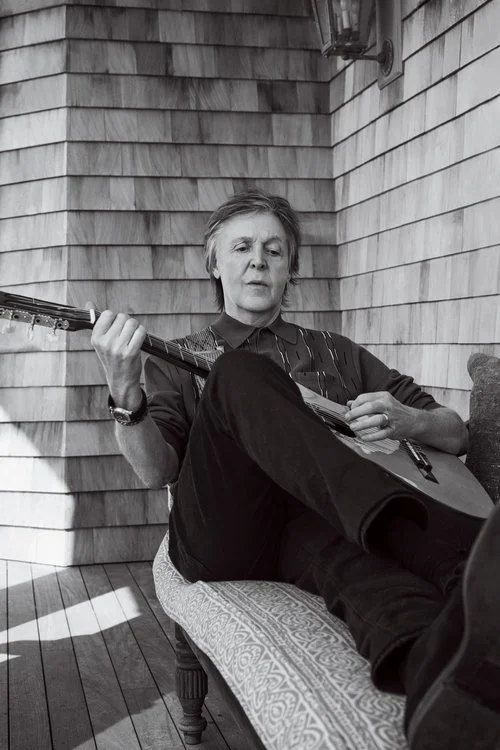
IN THIS PHOTO: Paul McCartney captured during a shoot for GQ in 2019/PHOTO CREDIT: Collier Schorr

If you had the chance to interview Paul McCartney now and ask him any one question, what would it be?

What does it feel like, in your body and mind, when you feel a song coming?

If you could get a single gift for McCartney for his eightieth birthday, what would you get him?

John Lennon back.

To end, I will round off the interview with a Macca song. It can be anything he has written or contributed to. Which song should I end with?

Maybe I’m Amazed.

Because when I think of Paul, I have lots of feelings – admiration, perplexity, gratitude – but, more than anything, maybe I’m amazed…

FEATURE: Inspired By… Part Fifty-Two: Lou Reed

FEATURE:


Inspired By…

PHOTO CREDIT: Gijsbert Hanekroot/Getty Images

Part Fifty-Two: Lou Reed

___________

ON 2nd March…

 IN THIS PHOTO: Lou Reed in 1982/PHOTO CREDIT: Waring Abbott/Getty Images

the world marks what would have been Lou Reed’s eightieth birthday. In 2013, we lost the iconic artist and former lead of The Velvet Underground. Releasing twenty solo albums in his lifetime and working with artists like David Bowie, there are few artists as influential as Lou Reed. I am going to come to a playlist of songs from artists/bands who have been influenced by the great Lou Reed. Prior to that, AllMusic provide us a detailed biography of Reed:

Few rock artists have been more influential without achieving superstardom than Lou Reed. While he flirted with mainstream success between 1970 (when he left the Velvet Underground) and 2013 (when he succumbed to liver disease), he most often played to a large cult following that only occasionally expanded into mainstream visibility. However, his songwriting -- unusually literate and often embracing themes that flouted society's conventions, especially in terms of drugs and sex -- broke fresh ground that other artists would follow, and his willingness to confront his audience made him a vitally important precursor to the punk revolution of the mid- to late '70s. (He often said that his goal was to apply the freedom and creative sensibility of literature to rock music.) Reed was not as celebrated as a guitarist, but the energetic report of his rhythm playing and the noisy grace of his leads and solos made him a hero to musicians who valued passion and feel over chops. And in his catalog, he covered a remarkable amount of stylistic ground -- introspective singer/songwriter (Lou Reed), glam (Transformer), art rock (Berlin), hard rock (Rock N' Roll Animal), noise (Metal Machine Music), confessional proto-punk (Street Hassle), jazz-infused rock (The Bells), upbeat pop/rock (New Sensations), social commentary (New York), and ambitious literary adaptations (The Raven). For all his creative shape-shifting, however, he never failed to sound like Lou Reed, with his ineffable downtown cool and dour outlook informing it all.

Lewis Allan Reed was born on March 2, 1942 in Brooklyn, New York. His family moved to Freehold, New York on Long Island when he was nine years old, and he didn't adapt well to his new surroundings; by the time he was in junior high, he was regularly targeted by bullies. He developed a variety of phobias and anxieties, and at the age of 16 he started to experiment with drugs. Hoping to deal with his problems, Reed's parents followed the advice of a psychiatrist and submitted him to electroconvulsive therapy; many years later, he would write about the traumatic effects of the treatments in his song "Kill Your Sons."

Reed would find solace in music, embracing early rock & roll, doo wop, rhythm & blues, and jazz, and by the time he was in high school, he was playing in bands and gigging professionally. One of his earliest groups, the Jades, cut a single when he was 16 years old, "So Blue" b/w "Leave Her for Me," with Lou playing guitar and singing backing vocals; legendary session musician King Curtis sat in on sax. The single flopped and it was their only release, but Reed kept writing songs, and in 1962, while attending Syracuse University, he cut a pair of tracks for producer Bob Shad, who released the Jades single, "Merry Go Round" and "Your Love." They were not released at the time, but Norton Records would issue them and the Jades single on a 2000 EP titled All Tomorrow's Dance Parties. After graduating from Syracuse, Reed moved to New York and took a job with Pickwick Records, a cut-rate record company who specialized in budget-price compilation albums. To fill out their LPs, Reed wrote and recorded songs following popular trends in music and teen culture. One of his compositions was a noisy would-be dance number called "The Ostrich," which among other things featured him playing a guitar with all the strings tuned to the same note. Pickwick thought the song had commercial possibilities and released it as a single under the group name the Primitives. Pickwick arranged for the Primitives to play some live dates to promote the disc, and while rounding up a band, Reed met John Cale, a Welsh musician who had come to New York on a scholarship from Aaron Copland and was playing in an avant-garde ensemble with LaMonte Young. Cale wasn't much impressed with "The Ostrich," but he was intrigued by Reed's alternate tuning, which was the same as one he was using with Young for his drone pieces, and when Reed wanted to form a band to play his own music that fell outside the boundaries of what Pickwick would release, Cale joined him.

Reed recruited a friend from his days at Syracuse, Sterling Morrison, to play guitar in the new band, with Cale on bass and viola and Reed on guitar and vocals. After briefly working with percussionist Angus MacLise, the group brought in Maureen Tucker to play drums. They adopted the name the Velvet Underground from a sensational paperback about the sexual revolution one of them found on the street, and after they were discovered by Andy Warhol in 1966, he became their manager and made them part of his pioneering multi-media show the Exploding Plastic Inevitable. With an aggressive sound at once primitive and adventurous, and lyrics that boldly dealt with sex, drugs, and the challenges of contemporary life, the Velvet Underground became one of the most controversial and talked-about bands of their day, and they released four studio albums (1967's The Velvet Underground & Nico, 1968's White Light/White Heat with Cale, 1969's The Velvet Underground, and 1970's Loaded with his replacement, Doug Yule) that sold modestly but would be regarded as influential classics in the years after the band broke up. In the summer of 1970, as the band was recording Loaded, they played a residency at Max's Kansas City in New York, and Reed, growing weary with the demands of the group and their lack of success, quietly dropped out of the VU in August 1970; while lineups of the group led by Doug Yule would stagger on until 1973, for most fans Reed's departure marked the end of the band.

Uncertain where to go next, Reed moved back to Long Island, staying with his parents and working as a typist at his father's accounting firm. By 1971, he was ready to make music again, and he landed a contract with RCA Records; he flew to London and cut his self-titled solo debut with a studio band that included Steve Howe and Rick Wakeman from Yes. Lou Reed was dominated by songs he wrote during his days in the Velvet Underground but didn't release, and the album came and went with little notice. He had significantly better luck with his second solo effort; David Bowie, who was in his first flush of superstardom after the release of The Rise and Fall of Ziggy Stardust and the Spiders from Mars, was an outspoken Velvet Underground fan, and he and Spiders guitarist Mick Ronson stepped in to produce 1972's Transformer. With Bowie's support, Reed embraced the trappings of glam rock and came up with a far stronger album that was a commercial success. The song, "Take a Walk on the Wild Side," became an international hit single, and "Perfect Day" would go on to become one of his most beloved songs. Reed used the success of Transformer to persuade RCA to bankroll a far more ambitious and elaborate follow-up. The grandiose Berlin, issued in 1973, was glossy and richly arranged and produced, but the unrelentingly depressing tone of the song cycle about a decadent love affair put off Reed's new fans and the album was a severe commercial disappointment.

Eager to win back his audience's good graces, he assembled a new band centered on the guitar team of Dick Wagner and Steve Hunter, with Reed confining himself to vocals. The new band approached Reed's tunes as crowd-pleasing hard rock, and 1974's Rock N' Roll Animal was a live album that showed off the strength of the material while making it more accessible and thus a success. Reed toured extensively in the wake Rock N' Roll Animal, and later the same year released Sally Can't Dance, a set of half-hearted glam-leaning tunes hardly up to the standards of his best work (except for the savage and personal "Kill Your Sons"). While a weak effort, it became Reed's highest-charting release to date. His next studio album, 1975's Metal Machine Music, was an unrelenting and uncompromised exercise in guitar-generated noise that alienated nearly everyone who came into contact with it and was seen by many as a deliberate act of career sabotage. He did an about face with 1976's Coney Island Baby; except for the unnerving "Kicks," most of the album was warm, gentle rock & roll, with the moving title track informed by the doo wop music he loved as a youth.

Coney Island Baby finished off Reed's deal with RCA, and he signed with Clive Davis' Arista label for 1976's Rock and Roll Heart, a largely upbeat but unremarkable effort that attracted little notice. However, with the rise of punk rock in New York and London, Reed was frequently cited as a hero and inspiration to many acts on the scene (especially his work with the Velvet Underground), and the attention emboldened him to make 1978's Street Hassle, a bitter and often deliberately offensive album in which he took an unblinking look at himself and his music. The album was too harsh to break through to mainstream listeners, but it earned strong reviews and signaled a new commitment to his muse after his uneven work since going solo. Though 1978's Live: Take No Prisoners was devoted more to Reed's acid-tongued stage banter than music, 1979's The Bells and 1980's Growing Up in Public found him dealing with personal issues and demonstrated a growing maturity in his writing. Growing Up in Public closed out Reed's deal with Arista, and it coincided with a period in which he finally overcame a longtime addiction to liquor and drugs, he married his girlfriend Sylvia Morales after years of publicly identifying as gay or bisexual, and moved from New York City to a farmhouse in New Jersey where he had peace and a chance to focus. He began working with former Richard Hell guitarist Robert Quine, who encouraged Reed to recommit himself to playing electric guitar, and after signing a new deal with RCA, they recorded The Blue Mask, an intense, revealing, and literate effort that was his most impressive music in years.

Reed and Quine worked together again on 1983's Legendary Hearts, another critical success, but at the last minute, Reed chose not to use him on 1984's New Sensations, instead multitracking lead and rhythm parts himself. The album was a relatively positive and accessible effort, and included "I Love You Suzanne," which became a minor hit. For the first time since he got clean, Reed toured extensively in support of the album, with Quine returning to his road band; a show from the New Sensations tour was documented on 1984's Live in Italy. He once again handled all the guitars on 1986's Mistrial, an uneven effort that closed out his second run on RCA. However, Reed soon struck a new deal with Sire Records, and rebounded with 1989's New York, an album full of political commentary and observations on his spiritual home town that won rave reviews and earned him a gold record. The final track, "Dime Store Mystery," was written in memory of his late friend and mentor Andy Warhol. Warhol's passing also brought Reed together with John Cale; the two had been on frosty terms since Reed's contentious departure from the Velvet Underground. The former bandmates teamed up to create a song cycle about Warhol's life and work, and 1990's Songs for Drella marked their first work together since 1968's White Light/White Heat. Later that year, Reed and Cale were invited to perform Songs for Drella as part of a celebration of Warhol's life and legacy staged by Foundation Cartier in Jouy-En-Josas, France. Sterling Morrison and Maureen Tucker were also invited to attend the event, and as an encore to the concert, the four original members of the Velvet Underground performed an impromptu version of "Heroin."

1992's Magic and Loss was a somber concept album about the death of two of Reed's close friends that received positive reviews but didn't match New York's sales or acclaim. Since the spontaneous performance in Jouy-En-Josas, rumors circulated that the Velvet Underground would reunite, and in June and July of 1993, Reed and his bandmates staged a tour of Europe that was rapturously received by fans, though reaction from critics was mixed. A string of American dates and an appearance on MTV Unplugged were to follow, but tensions in the band once again boiled over, and by the time Live MCMXCIII (recorded during a three-night stand in Paris) appeared the following October, the group was once again history, which became permanent after the death of Sterling Morrison in 1995. (The following year, the Velvets were inducted into the Rock & Roll Hall of Fame, and Reed, Cale, and Tucker performed a song they wrote in tribute to Morrison, "Last Night I Said Goodbye to My Friend.") Not long after the VU reunion tour, Reed and Sylvia Morales divorced.

Reed returned to duty as a solo artist with 1996's Set the Twilight Reeling, an album that focused on the joys and challenges of relationships; it appeared as Reed and musician/performance artist Laurie Anderson entered into a romantic relationship. (They married in 2008 and would remain together for the rest of his life.) A semi-acoustic appearance at the 1997 Meltdown Festival in London was recorded for the 1998 release Perfect Night: Live in London. That same year, Reed's life and art were celebrated in a television documentary for the PBS series American Masters, Lou Reed: Rock & Roll Heart, which was subsequently released on home video. Reed also collaborated with playwright and director Robert Wilson for his play Timerocker, penning songs for the piece. In 2000, Reed moved from Sire to Reprise Records (both offshoots of Warner Bros.), and released Ecstasy, a set of lyrically challenging, poetically informed songs set to rough rock & roll guitars. Reed collaborated with Robert Wilson again for a show informed by the writings of Edgar Allan Poe, POE-try, and much of the material for the play was revisited on Reed's 2003 album The Raven, which included readings from Willem Dafoe and Steve Buscemi. Reed staged an intimate concert tour following the release of The Raven, and a show at Los Angeles's Wiltern Theater was recorded for the 2004 album Animal Serenade.

In 2006 and 2007, Reed revisited the album Berlin in a series of concerts in which he performed the album in full, with original producer Bob Ezrin leading a small orchestra. Shows at St. Ann's Warehouse were filmed and recorded, and the album Berlin: Live at St. Ann's Warehouse came out in 2008. Reed also took a fresh look at Metal Machine Music when the German avant-garde ensemble Zeitkratzer created arrangements that allowed the LP's soundscapes to be performed on-stage. Reed and his frequent guitar foil Mike Rathke joined the group for several performances of the piece, one of which was released as Metal Machine Music: Live at the Berlin Opera House. And in 2007, Reed brought out Hudson River Wind Meditations, a collection of ambient pieces he created to accompany his tai chi exercises. In 2009, he performed several songs at an event honoring the 25th anniversary of the Rock & Roll Hall of Fame in New York City. He was accompanied by the iconic heavy metal band Metallica, and the collaboration inspired Reed to invite the band to work with him on his next album. Based on the work of playwright Frank Wedekind, 2011's Lulu was an aggressively confrontational and uncompromising work that received largely negative reviews and seemed to rub both Reed's and Metallica's fans the wrong way. A tour in support of the album never came to be, and the following year, Reed, who had been treated for hepatitis in the past, was diagnosed with a severe liver disease. He underwent a liver transplant at the Cleveland Clinic in April 2013, and although he subsequently proclaimed his strength and intention to return to performing and songwriting, he died of end-stage liver disease at the home in East Hampton, New York that he shared with Anderson in late October of that year. In September 2020, Rhino Records brought out an expanded edition of New York; in addition to a remastered version of the original album, it included a bonus disc of rough mixes, work tapes, and alternate versions, as well as a complete live performance of the album from 1989”.

Ahead of the eightieth birthday of one of the most influential and important people in music, I wanted to honour Lou Reed with a playlist featuring artists who have followed his lead. A magnificent songwriter and unforgettable and distinct singer, his influence will be felt for generations to come. Here is a pre-eightieth birthday nod to…

A music icon.

FEATURE: The Lockdown Playlist: Chris Martin at Forty-Five: Coldplay’s Best Cuts

FEATURE:


The Lockdown Playlist

PHOTO CREDIT: James Marcus Haney 

Chris Martin at Forty-Five: Coldplay’s Best Cuts

___________

I first became aware of Coldplay…

when they released their debut album, Parachutes, in 2000. With that successful album and its follow-up, A Rush of Blood to the Head, the band were taken to heart by so many. Identifiable and anthemic songs that still stand up today, the band have said they would release three more albums until 2025. That will be the end of the road for Coldplay by the sound of things. It will be sad for so many people. One of the band’s strengths is their lead, Chris Martin. Fronting the band since the start, he has been their driving force. He turns forty-five on 2nd March. I wanted to mark that with a collection of the best Coldplay tracks since their 2000 debut, through to their 2021 album, Music of the Spheres. Before getting to that, here is some biography of the fantastic lead of Coldplay:

Who Is Chris Martin?

Chris Martin is a British musician and the lead singer of the popular band Coldplay. He attended University College London, where he met Will Champion, Guy Berryman and Jonny Buckland, who would become his bandmates. With Martin as lead singer, rhythm guitarist and pianist, Coldplay's debut album, Parachutes, topped the charts in the U.K. and won a Grammy Award. Martin is also known for his collaborations with artists like Jay-Z and Avicii.

Early Life

Martin was born Christopher Anthony John Martin on March 2, 1977, in Exeter, Devon, England, the eldest of five children to a teacher and an accountant. His interests in music developed at a young age and he formed his first band, The Rocking Honkies, while he was attending the preparatory Exeter Cathedral School.

After continuing his studies at another independent school, Martin attended University College in London, where he graduated with a degree in Ancient World Studies. During the college's orientation week in 1996, he met guitarist Jonathan "Jonny" Buckland and the two decided to form a band, with the chosen name Pectoralz. By 1997, the band (renamed Starfish by this time) had recruited Guy Berryman on the bass and Will Champion on the drums.

'Parachutes'

In 2000, the band, now known as Coldplay, released their debut album, Parachutes. The album was a commercial success, peaking at No. 1 on the U.K. charts and entering the top half of the U.S. Billboard 200 with hits like "Yellow," "Trouble" and "Don't Panic." The album eventually became certified seven-time platinum. It received the Best British Album Award at the 2001 Brit Awards and won the 2001 Grammy Award for best alternative music album.

'A Rush of Blood to the Head'

The group released their second album, A Rush of Blood to the Head, in 2002. The album proved to be another success with songs including "In My Place," "Clocks" and "The Scientist," and the group went on a nine-month tour to North America, Europe and Australia. The tour was filmed for the Live 2003 DVD. They also picked up two more Grammy Awards: "Clocks" won record of the year and "In My Place" was named best rock performance by a duo or group with vocal.

'X&Y,' 'Viva La Vida,' 'Mylo Xyloto'

Coldplay continued to thrive, as their follow-up efforts, X&Y (2005) and Viva La Vida (2008) — featuring a title track that went to No. 1 in the U.S. and U.K. — both became the top-selling albums of the year in which they were released. Mylo Xyloto became the group's third album to top the Billboard 200 upon its debut in October 2011.

'Ghost Stories,' 'A Head Full of Dreams'

In 2014, Coldplay dropped Ghost Stories, which featured such songs as "Magic" and "A Sky Full of Stars." The following year, Coldplay put out A Head Full of Dreams. The band soon landed one of music's most high-profile gigs, performing as part of the halftime show at Super Bowl 50 in February 2016.

Shortly afterward, the band launched its A Head Full of Dreams Tour. The massively successful tour crossed five continents, logging 114 sold-out performances in 83 venues, before wrapping in November 2017. The undertaking generated a whopping $523 million, making it Billboard's third highest-grossing tour since the publication first started keeping track in 1990.

'Everyday Life'

Four years after their last studio effort, Coldplay delivered the double album Everyday Life in November 2019. This time, in stark contrast to their previous touring schedule, Martin said the band would only perform a few gigs, due to concerns about the environmental impact of undertaking a major tour.

Solo Work and Collaborations

Outside of Coldplay, Martin has written a variety of songs for solo acts including British pop group Embrace and the singer Jamelia. In 2006, he collaborated with Nelly Furtado on the track "All Good Things (Come to an End)" from her album Loose, and worked with Jay-Z on "Beach Chair," from his album Kingdom Come. Martin has also collaborated with rapper Kanye West, pop singers Kylie Minogue and Dua Lipa and electronic music DJ Avicii”.

To mark the upcoming forty-fifth birthday of Chris Martin, below is an assortment of celebrated and awesome Coldplay songs. I personally prefer their older work, though they have released some really strong albums over the past decade. The band have evolved through the years, yet they remain hugely popular. A lot of that is because of their incredible live sets. I would expect them to play quite a few gigs this year. Here are some brilliant Coldplay songs sung by…

THE terrific Chris Martin.

FEATURE: Revisiting... Pearl Charles - Magic Mirror

FEATURE:


Revisiting...

Pearl Charles - Magic Mirror

___________

RELEASED on 15th January last year…

I did put Pearl Charles in my Spotlight feature berceuse of the sheer and utter brilliance of her album, Magic Mirror. I wanted to put it back in the spotlight. My Second Spin feature is reappraising older albums that are underrated. This feature is more about revisiting albums of the past five years that deserve new light and love. Charles is a magnificent talent. The Los Angeles-born artist released one of 2021’s best albums. I am going to come to a couple of reviews for Magic Mirror, as the album did pick up a lot of positive reviews. Before that, there are a couple of interviews that I wanted to include. The first is from January of last year. The Forty-Five quizzed the amazing Pearl Charles about her musical start, and whether her songs are autobiographical:

Tell us about how you started making music

I was four years old when my older sister started piano lessons and I begged my parents to let me take lessons too. They told me if I still wanted to when I turned five they would let me, and the rest is history! From there I got really into musical theatre and started voice and guitar lessons as well. Eventually I sort of diverted off the path of musical theatre (I got in trouble for smoking pot at a classmate’s house whose father was a famous country singer/songwriter, but that’s a long story for another time!) and went more into the world of rock’n’roll and playing in bands which I do think is where I was meant to be.

 We’re getting some serious ABBA/Fleetwood Mac vibes from your music. What did you listen to growing up?

Though I definitely heard those bands when I was growing up, I didn’t actually really get into Fleetwood Mac or ABBA until I was in my 20s. My introduction to those bands were mostly just as oldies radio hits, so it wasn’t until I got more deeply into discovering and making music myself that I was able to appreciate the level of musicianship and songwriting both those bands exhibit. Growing up I listened to a lot of classic country and singer/songwriters as well as classic rock bands because that’s what my parents exposed me to. The Beatles, Bob Dylan, Leonard Cohen, John Prine and Hank Williams are some of the quintessential ones that come to mind. I remember the first CD I bought for myself was Eagles Greatest Hits.

Your songs have a really great story to them. Are they autobiographical?

Most of my songs are basically autobiographical or at least start out that way. I used to write a lot more about what happened to me, whereas lately I like to turn inward and look to what’s going on inside of me and how I feel to find inspiration on what to write about. Sometimes I’ve also noticed that life can imitate art. It’s almost as if writing certain songs can call that sort of energy or situation into being or that you’re almost psychically predicting what’s going to happen before it does in song.

You have an incredible home in Joshua Tree, California. Many artists before you have headed to the desert to record because they feel it has a mystical energy. What has your experience been as a creative in an environment like that?

Joshua Tree is such a magical place! My first experiences going out there were with my family when they bought a really unique house (it was built by the first Native American Playboy Bunny) in the area about 13 years ago. That was the place where I first felt really drawn to revisit the classic country music my mom had shown me when I was young, some of the artists I mentioned earlier and others like Patsy Cline, Loretta Lynn and Merle Haggard. It was only later that I found out about the significance of Gram Parsons and felt that somehow his spirit had guided me in the right direction. There is just this peaceful, calming feeling out there, you truly feel connected to the earth and surrounded by nature, whether it’s the plants, the animals or the stars. It’s those moments where you feel so small in the world, but in the best possible way, that make Joshua Tree an artistic and spiritual Mecca.

If people are just getting to know you, what song should they listen to first?

That’s a really interesting question! I definitely think listening to my most recent singles and the new album will give you the best insight to where I’m at currently as an artist and what’s closest to my heart at the moment. At the same time, I’d love to be able to be judged on the entire breadth of my work, so I think listening to my entire discography would be a very thorough way to get introduced to my music. Though part of me wants to say to listen from most recent to furthest back because I’m most excited and proud of my newest work, I think listening chronologically would probably also be insightful as to my progression.

And what is one thing you’d like them to know about you?

There’s a lot of celebrity for celebrities sake in today’s world. I’m most passionate about my music and I’d like to be most well known for my musical contributions, so I’d love for people to get to know these songs and I’d be very grateful if they did”.

 PHOTO CREDIT: Dana Trippe

I feel like we might get something from Pearl Charles in the way of an E.P. or album. She is such an amazing artist. Although Magic Mirror was played when it was released, one does not hear it exposed and shared as much as they should. It is an album where the deep cuts are all single-worthy. Before getting to some reviews, Inherent Bummer’s interview is really interesting. I have selected some bits from their chat of June 2021:

INHERENT BUMMER: Tell me about your new album, “Magic Mirror.” It came out in January, right? How’d that go?

PEARL CHARLES: It’s been continually going well, which is really awesome. I've never had this much love from an album and it's very heartening to see the upward momentum. And you've known me for a very long time and seen the path and it's not an easy one…

I've been watching you grow.

To be honest, I feel like it's a better record [than the last one], but that's just naturally how it's going to be when you get better and improve and hone in on your vision.

What was your vision going into this album?

Well, I used my touring band on this one.

You mean they all played on the album?

Yeah, and on my last record we used session guys, who are great, but there's just something to be said about really spending years on the road, playing songs with people and how much that really gels together. And on the last record I had toyed with the idea of doing an ABBA style thing, but we never got around to doing that. So now I feel like on this record, obviously I really went hard into that vibe, but people seem to really be liking it. So I'm excited about it. Like that song, “Only for Tonight.” It fits in, I feel like, and it really sets the stage for the kind of album that it's going to be. It's fun, it's dancy, but it's also... If you listen to the lyrics, they're introspective, and that's the whole theme of the record.

PHOTO CREDIT: Dana Trippe 

I know the lyrics are incredibly personal to you, and introspective. And revealing. But it gives off this uplifting sound. Was that a subconscious way to make it easier to release the songs?

That's a really great question. Probably. I'd never really considered it like that. I love the concept of “Magic Mirror” as the title of the album because I feel like there's two sides to everything. It's about duality and we are not ever one thing only. Of course, sometimes we feel very deeply one emotion, but I feel like I wanted to put forward something that's a little bit more complex and something that contains the Yin and the Yang just because I feel like that represents me. And I feel like that represents my life experience and hopefully other people can relate, and I think that they can.

Do you feel like this is your ‘coming of age’ album?

Well, I turned 30 two days ago. And it's really funny because I keep saying this, which is a weird thing to say, because it doesn't really mean anything. But if I turned 30 last year, I don't know that I would have been that stoked about where I was in my life. And that’s just partially because of the pandemic. I don't think anyone was that stoked about where their life was at, in May of last year. You know what I mean? Now? I mean, my record was supposed to come out in May of last year. So there was a lot of waiting and a lot of wondering how it was going to go. And then ultimately I think the timing lined up really, really well for me personally, and for the release into the world, because the album does have positivity contained in it. I didn't want to put that out at a time when it might seem inappropriate. I think the world is always going to need [positive] energy, but I didn't want to distract from all of the pain that was happening in the world and put something out that seemed tone deaf.

When it came out and I heard the title, Magic Mirror, I immediately thought of Snow White, and also Alice in Wonderland. But the way you just expressed the journey sounds so much more transformational. Do you feel like you transformed in the process of making this album?

Yes. I definitely do. And I think life is an ongoing transformation or at least I hope for it to be. And I believe it is, if you choose to continue to grow and you don't become complacent and get stuck, which can happen whether you want it to or not. But I think that, yeah, the transformational journey is such a big part of it for me. And I hope... Here I am at this writing retreat thinking about what I'm going to write about next. And I'm like, "Oh, I don't want to go over the same ground." But at the same time, it's just always going to be part of the story.

Do you feel like you expressed what you wanted to say with Magic Mirror?

Yes. I'm very proud of that record and I really think it shed a lot of light on what I wanted to say, at that time. But I do think that the next record is going to have some different content. What it is yet, I'm not sure. It's actually funny, [Magic Mirror] was supposed to have a song on it that ended up getting cut off. I say “fuck” in it. And it's a bit darker. And taking it off really... We switched it out for “Sweets Sunshine Wine,” which we'd released previously as a single, but we wanted to give it a vinyl release. Changing that one song really changed the whole vibe of the album and made it a much more sun-shiney and happy kind of thing, which I think was the right move for this album. But, lurking below the surface, there's some darker stuff that I might have to bring out next time around”.

It is worth getting to some reviews for Magic Mirror so that we can see what the critics had to say. I have not seen anything even slightly negative about an album that is as magic as its title! This is what The Line of Best Fit said in their review:

Long have protagonists in films stood weary, questioning choices made or journey’s travelled, in front of a decrepit piece of reflective glass. But that's not quite the plan for Pearl Charles’ new outing.

By inviting you to take a peek into her own Magic Mirror, Charles is offering the chance for you to adopt her tales of traversing the emotional potholes and speed ramps that growing and loving can offer.

On her debut, Sleepless Dreamer, the folk-soaked, pedal steel tinged sound felt like a familiar friend knocking on your door. With Magic Mirror, that friend has returned, with some stories to tell while ready to dazzle with a sparkle.

It’s impossible to not connect the Abba-dots on kick-starter “Only For Tonight”. As the melody delivers on all fronts - ear-worm settling in for the long haul - Charles greets us by looking back upon a one night stand, lamenting she “shouldn’t have played this like a man.” By erupting like a confetti canon coming at you the moment you walk into your house, a feeling sweeps over, ready to carry the party onward.

Notably, there’s now echoes of the sun-drenched California sparkle of Fleetwood Mac, Tom Petty et al - motioning to an express reach upwards for Charles and who she, as an artist, is now. No doubt, the romantic realisations within, particularly of “when I see your face it’ll be the last time I do / it’s easier to live this lie than to tell the truth” (“What I Need”) has also contributed to this new gloss - after all, when the truth feels so poignant, let it shimmer to make it more digestible.

Even on her self-titled debut EP, which dug its hands into the world of blues, there was a wish to reflect, and it feels like the steps made between then and now - the living of life, and figuring out her place in this world - has led to an evolution into a ‘70s radio-rock revival sound, featuring more swaying pedal steel and twanging clavichord en masse - with a delectable delivering of harmonies stacking where prudent.

The lack of reference to any of the issues involved in our ‘new reality’ creates the idea of a dream world, where life can once again by led without the ticking of a doomsday clock - especially following a week of (more) erupting political discourse; this glamour-tinged world of Charles’, reaches out and is telling you to ‘live in the past for a bit’ feels welcome.

While Magic Mirror's sparkling-sheen portrays the acceptance of life - Pearl Charles' diary, flinging open its pages to question long-drawn-out loves - the inclusivity means the eyes staring back from Magic Mirror flit between both yours and hers, all aided by her cool and breezy nature”.

Prior to wrapping things up, AllMusic had some nice things to say about Pearl Charles’ magnificent 2021 release. An artist who will grow and continue to put out wonderful albums, she is a talent that everyone needs to be aware of:

In a pleasing tangle of sun-warmed melodies and 1970s influences, Pearl Charles strikes a confident, if laid-back tone on Magic Mirror, her sophomore album. The Los Angeles native has been bubbling under the radar for nearly a decade, trying her hand in a variety of indie subsets from lo-fi Americana to garage and psychedelia before landing on a more polished amalgam of vintage-flavored country-pop and West Coast soft rock. Her 2018 debut, Sleepless Dreamer, showed plenty of promise and laid the framework for the more fully realized sound she achieves here. As merry a romp as it is, opener "Only for Tonight" sets a bit of a misleading tone as both its boisterous mood and ABBA-inspired disco-pop are never again repeated during the set. After this, Charles finds her groove, turning in a bevy of tightly crafted gems that flirt with various facets of '70s pop, from the Fleetwood Mac stylings of "What I Need" and "Slipping Away" to the sweet "All the Way," which pairs swooping George Harrison-esque guitar leads with bubblegum uplift. "Sweet Sunshine Wine" is another standout whose easy hooks give way to a marvelously campy psychedelic breakdown. The production and arrangements throughout are impeccable, warm, and well-suited to the kind of thoughtful, low-key songwriting at which Charles excels. Neither basking in its vintage flavor nor overplaying its strengths, Magic Mirror is the kind of subtle record that reveals its pleasures through repeated listens. Even Charles' voice is a comfort; after a decade of mainstream mumblers and overwrought affectations, her enunciated vocal style brings a conversational tone to the songs. While similar in feel to her debut, Magic Mirror is a significant step forward for Charles, who really steps up her game here”.

One of my absolute favourite albums from last year, go and check out Pearl Charles’ Magic Mirror if you have not done so already. Songs like Only for Tonight are played, though one does not hear much else nowadays. She released a new track, Givin’ It Up, last month. I wonder whether she is already planning another album. In any case, Magic Mirror is an album to be heard many times over. It is a stunning work from…

A fabulous young artist.

FEATURE: I Stand at the Gates Alone: Why Kate Bush's The Dreaming Should Garner As Much Love and Respect As Hounds of Love

FEATURE:


I Stand at the Gates Alone

IN THIS PHOTO: Kate Bush shot whilst promoting The Dreaming on the Italian T.V. show, Riva Del' Garda '82, on 28th September, 1982/PHOTO CREDIT: Guido Harari

Why Kate Bush’s The Dreaming Should Garner As Much Love and Respect As Hounds of Love

___________

ALWAYS considered her masterpiece…

I can see why people would laud and admire Hounds of Love. Released in 1985, this was Kate Bush’s fifth studio album. I will never not love and adore this album. I think that a lot of time and focus is spent on Hounds of Love, whereas its predecessor is not given as much love. I am writing this because there is a new edition of UNCUT that has a twelve-page feature about the making of The Dreaming, including interviews with people who were involved. I am going to get inspiration for that more when working up to fortieth anniversary in September. For now, I wanted to use this feature to look at The Dreaming and why, in its weird way, it is up there with Hounds of Love in terms of its brilliance. I say ‘weird way’, because that is sort of the way the album is seen. Kate Bush herself, looking back, felt that the period she was recording The Dreaming was a tough one. Eccentric and very different to anything she had committed to tape before, this was an artist free and pushing her music to new limits. Hounds of Love gets more acclaim and celebration because it is less tense than The Dreaming. Even though the album’s second side, The Ninth Wave, is quite epic and anxious at times, the singles on the first half have more space, air and light – even if a lot of the lyrics are not overly-positive. With hues and shades of purples, silvers and greens, Bush wrote songs for the album in the countryside and was in a happier space than she was a few years before.

Look at The Dreaming, and this is an album that Bush produced across different spaces, often performing and recording through the night; not giving herself much time or relief. Because of these conditions, a lot of the material on The Dreaming is seen as either strange or not as good as Hounds of Love. I think there is this conception that Hounds of Love is vastly superior or that an album like The Dreaming is a lot harder to digest. One cannot call The Dreaming underrated, although it is an album that, upon release, was a commercial disappointment and did not really engage in the way one would have hoped. Hounds of Love found some love in America, but it has been a rockier path to recognition for The Dreaming. In September, the album turns forty. I am keen to explore each song and really get into the making of the album, the year or so leading up to its release, and how Bush took massive leaps from 1980’s Never for Ever and made this bold and brilliant statement in 1982. In terms of how good The Dreaming is, I do honestly believe it has songs that match the best of Hounds of Love. Even though Bush was happier and, debatably, even stronger as a producer on Hounds of Love (she solo produced each album), I do think that the sheer intricacy and detail that one experiences throughout The Dreaming should be respected.

In terms of women producing their own albums in the 1980s, one could not point to too many examples. Not only did Kate Bush helm this stunning and quite complex album; one can revisit these songs and find new insights and qualities. The Dreaming is a nuanced album that is absolutely stunning to listen to! From the lead single and opening track, Sat in Your Lap, with its taut and propulsive percussion, to the frantic and fear-laden closer, Get Out of My House, it is a thrill-ride! That is not to say those two tracks are indicative of The Dreaming’s colour scheme, mandate and overall sound. Indeed, There Goes a Tenner and Suspended in Gaffa are much lighter tracks. They put me in mind of what might hear on The Kick Inside or Lionheart (her first two albums). The Dreaming is still an album where Bush was looking back to her earlier work, yet she was pushing bravely forward. That is one of the great strengths of The Dreaming. Even though it is ten tracks in total, the album last over forty-three minutes. Bush manages to pack so much into every song! Like Hounds of Love, Bush worked with a great range of musicians in order to ensure that her album was given as much life, range and depth as possible. A penny whistle, mandolin and bouzouki can be heard in the mix. There is not a weak track in the pack.

I feel The Dreaming is an album that could benefit both from a visual piece and a new release. By the visual piece, I mean its songs can thread together in a short film. You listen to the tracks and project yourself in the action. So scenic, head-spinning and memorable, only a few of the tracks from the album were brought to life through videos. What people would give to see tracks like Get Out of My House, Houdini, Leave It Open and All the Love committed to film. Also, there has not been any re-release of a Kate Bush album with demos and extra material. As the architect of an album where she was working all hours, you know that there are archives and bits in the vaults when she recorded out of Advision Studios, Odyssey Studios, Abbey Road Studios and Townhouse Studios (all in London). Bush definitely had more studio focus on Hounds of Love. Not wanting to go between studios or feel so stressed and tired, that album benefits from an artist more refreshed and happier. Not that the tension and fatigue is part of The Dreaming’s charm. I think Bush’s sheer dedication to taking her music to new levels and pushing the studio is admirable.  

At the time of its release, The Dreaming was seen by some as too experimental, impenetrable, pretentious and odd. Some bemoaned the lack of instantly commercial tracks and dense sound. Hounds of Love, on the other hand, was seen as genius and an instant classic by many reviewers in the U.K. (things were more mixed in the U.S.). The Dreaming is an album that both proved Bush was one of the most fascinating and original artists in the world. She also showed that she was very different to the artist many mocked in the press back in 1978. I think The Dreaming was too ahead of its time, perhaps. There was definitely a perception of what Kate Bush should have been making and what the world got. If she was another artist, I think The Dreaming would have been taking to heart a lot sooner. Artists like Big Boi and Björk have recognised the importance of the album. Sure, there is nothing as radio-friendly and sing-able as Running Up That Hill (A Deal with God) or Cloudbusting. Hounds of Love is nothing short of a masterpiece. I feel it is unfair to either see The Dreaming as a much weaker album or something that Bush had to ‘get out of her system’ before revealing her true genius on Hounds of Love. I do feel that, as it heads towards forty years, The Dreaming warrants reinspection and a wave of new reviews and features.

I will wrap it up soon. I thought it would be worthwhile sourcing parts of a positive review for The Dreaming. Pitchfork reviewed The Dreaming in 2019. Their words and assessments of individual songs show what detail, depth and diversity can be found throughout The Dreaming:

On The Dreaming, Bush’s self-proclaimed “mad” album, her mind works itself out through her mouth. Her cacophony of vocal sounds—at least four on each track—pushed boundaries of how white pop women could sing. Everything about it went against proper, pleasing femininity. Her voice was too high: a purposeful shrilling of the unthreatening girlish head voice; too many: voices doubled, layered, calling and responding to themselves, with the choruses full of creepy doubles, all of them her; too unruly: pitch-shifted, leaping in unexpected intervals, slipping registers until the idea of femme and masculine are clearly performances of the same sounding person; too ugly: more in the way cabaret singers inhabit darkness without bouncing back to beauty by the chorus in the way that female pop singers often must.

All this excess is her sound: a strongly held belief that unites all of the The Dreaming. Nearly half of the album is devoted to spiritual quests for knowledge and the strength to quell self-doubt. Frenetic opener “Sat in Your Lap” was the first song written for the album. Inspired by hearing Stevie Wonder live, it serves as meta-commentary of her step back from the banality of pop ascendancy that mocks shortcuts to knowledge. A similar track, “Suspended in Gaffa,” laments falling short of enlightenment through the metaphor of light bondage in black cloth stagehand tape. It is a pretty queer-femme way of thinking through the very prog-rock problem of being a real artist in a commercial theater form, which is probably why it’s a fan favorite.

“Leave It Open” is a declaration of artistic independence hinging on the semantic ambiguity of its pronouns (what is “it” and who are “we”?). Here’s the one solid rock groove of the album, and it crescendos throughout while a breathy, heavily phased alto Bush calls and high-pitched Bush responds in increasingly frantic phrases. “All the Love” is the stunning aria of The Dreaming—a long snake moan on regret. Here she duets with a choirboy, a technique she’d echo with her son on 2011’s 50 Words for Snow. The lament trails off with a skipping cascade of goodbyes lifted from Bush’s broken answering machine, a pure playback memento mori.

The other half of the album showcases Bush’s talent for writing narratives about historical and imagined characters placed in unbearable moral predicaments. This is often called her “literary” or “cinematic” side, but it is also her connection to character within the Victorian-era British music hall tradition, a bawdy and comic form of working-class theatre that borrowed from American vaudeville traditions and became the dominant 19th- and early 20th-century commercial British pop art. As much as she’s in prog rock’s pantheon, she’s also part of this very-pre rock‘n’roll archive of cheeky musical entertainment.

When it works, her narrative portraits render precise individuals in richly drawn scenes—the empathy radiates out. In “Houdini” she fully inhabits the gothic romance of lost love, conjuring the panic, grief, and hope of Harry Houdini’s wife Bess. Bush was taken by Houdini’s belief in the afterlife and Bess’s loyal attempts reach him through séances. Bush conjured the horrified sounds of witnessing a lover die by devouring chocolate and milk to temporarily ruin her voice. Bess was said to pass a key to unlock his bonds through a kiss, the inspiration for the cover art and a larger metaphor for the depth of trust Bush wants in love. We must need what’s in her mouth to survive, and we must get it through a passionate exchange among willing bodies”.

Rather than The Dreaming being difficult, too dense, strange or mad, it is a wonderful album from an artist who was pushing boundaries and entering wonderful new worlds. I don’t think the point of The Dreaming was to have hits or be commercial. Bush wanted to make something that challenging but could be appreciated and understood. She loved the music of David Bowie and Peter Gabriel, and I don’t think either of them would have got anything but love if they released The Dreaming in 1982. In fact, the theatre, layers and way Bush pushed away from what she had done before is to be saluted. I love The Dreaming. Such a brilliant writer, innovator, singer, musician and producer, this was such a dominant display of Bush’s endless creativity and talent! When The Dreaming turns forty on 13th September, I hope that it is (finally) given the credit it deserves and it is seen…

IN a whole new way.

FEATURE: Free You Mind: En Vogue's Funky Divas at Thirty

FEATURE:


Free You Mind

En Vogue's Funky Divas at Thirty

___________

LOOKING ahead to 24th March…

that is the day we celebrate the thirtieth anniversary of En Vogue’s Funky Divas. I am going to get to a couple of reviews for an album that, in 1992, did not get an overwhelmingly positive response. Looking back, it is strange critics did not see the wonder and sheer quality of Funky Divas! Following the success of their Grammy Award–nominated debut album Born to Sing (1990), En Vogue reteamed with their founders Denzil Foster and Thomas McElroy to work on the album. With classics like My Lovin' (You're Never Gonna Get It) and Free Your Mind in the pack, it is no wonder En Vogue (Terry Ellis, Cindy Herron, Maxine Jones and Dawn Robinson) inspired acts like TLC and Destiny's Child. With incredibly strong vocal work, I think that En Vogue were one of the strongest groups of the 1990s. All-female bands that would follow often had some vocal weakness. Maybe it was a lack of soul or something quite ordinary. En Vogue were pure class and there was no weakness anywhere at all! Funky Divas is rife with soulful and funky vocals that are sexy, smooth, fierce and phenomenal! Funky Divas became the second album from En Vogue to earn a Grammy Award nomination in the Best R&B Performance by a Duo or Group with Vocals category. With strong songs perfectly assorted through the album, there is no stronger side. You get this consistency the whole way through. Give It Up, Turn It Loose is one of my favourite tracks from the album. Before getting to a couple of positive reviews for a truly iconic album, there are some features worth bringing in.

Albuism marked twenty-five years of Funky Divas back in 2017. A big leap in terms of confidence and sonic range compared to Born to Sing, Funky Divas announced En Vogue as a huge force to be reckoned with:

Born to Sing had been piloted by the producer-songwriter duo of Denzil Foster and Thomas McElroy, formerly of Club Noveau. The gentlemen had also been the impetus behind founding En Vogue two years prior to Born to Sing. But was that all there was to the ladies? Four women simply singing material placed in front of them? Their second long player Funky Divas suggested that there was much more to the quartet. Though Foster and McElroy's pen and production style set the template for Funky Divas, the material was brought to life by Jones, Herron-Braggs, Robinson and Ellis. A producer is only as good as his or her artist, and En Vogue were never in short supply of personality or talent.

It was understood by the group, Foster and McElroy that a repeat performance of Born to Sing wouldn't make the grade for round two. For them to push through the din of competitive noise coming from their peer group in the R&B girl group market, they needed to innovate. Their second album saw En Vogue continue to mine the contemporary ore of the urban music landscape of the period, but they paired it with unforgettable grooves and melodies to guarantee the songs lasted past the epoch of their creation. There were also a few surprises tucked into Funky Divas too.

However, when En Vogue tapped “The Payback” (by James Brown), an R&B and hip-hop sample touchstone by 1992, it could have felt reductive, especially given that the sample had powered their inaugural charter “Hold On.” But, as always, En Vogue found a way to flip something established and make it work for them. The resulting soul sass of Funky Divas’ lead single, “My Lovin' (You're Never Gonna Get It)” (US #2, US R&B #1, US Dance #8), became another signature hit for the group. Aesthetically, the song seamlessly straddled the medium between classic and modern soul music. “My Lovin' (You're Never Gonna Get It)” was released on March 17, 1992, and Funky Divas arrived the following Tuesday on March 24, 1992.

The record was an immediate smash, commercially and creatively. Following “My Lovin' (You're Never Gonna Get It),” the record produced four more singles between June 1992 and February 1993, including “Giving Him Something He Can Feel” (US #6, US R&B #1), “Free Your Mind” (US #8, US R&B #23), “Give It Up, Turn It Loose” (US #15, US R&B #16) “Love Don't Love You” (US #36, US R&B #31).

Musically and visually, En Vogue were definitely holding their own. Funky Divas evinced that mainstream R&B could continually cross over to white listeners without losing its core constituency. A prime example of this is “Free Your Mind,” one of the album’s aforementioned surprises. A searing rock number that challenged racism, sexism and other social phobias head on was all at once, smart, sexy and provocative. Its Mark Romanek directed video left a lasting impression and contributed to the song's enduring pop culture visibility long after the 1990s concluded.

Their reworking of “Something He Can Feel” as “Giving Him Something He Can Feel” was also a coup. The song was written by Curtis Mayfield and initially rendered by the actresses/vocalists Lonette McKee, Irene Cara and Dwan Smith in the 1976 cult classic Sparkle. But, it found radio affection when Aretha Franklin, controversially, delivered it on the companion soundtrack. En Vogue's version restored the song to its girl group roots and brought it forward into a new decade, reverently, but boldly. They also tackled the Mayfield-penned “Hooked On Your Love” from the same film, again, bringing the song back to its original group approach. The additional non-single tracks fared strongly too, courtesy of the bright, black pop of “This Is Your Life,” hip-hop dance music on the appropriately titled “Hip Hop Lover,” an ambitious cover of The Beatles’ “Yesterday,” and the seductive jazz funk of “Desire.”

In the end, Funky Divas was certified platinum three times over in America and moved over five million copies worldwide. Sadly, behind the scenes of the success of their second album, En Vogue was contending with internal and external pressures that plagued the group as they moved further into the 1990s. Label disputes, in-fighting, and line-up shifts buffeted the three excellent albums that came in the wake of Funky Divas: EV3 (1997), Masterpiece Theatre (2000) and Soul Flower (2004). With Soul Flower, the group welcomed Rhona Bennett―a one-time Mouseketeer, actress and Rodney Jerkins protégé―to the fold. She, along with Terry Ellis and Cindy Herron-Braggs comprise En Vogue today, and the trio is currently putting the finishing touches on their much-anticipated sixth long player, Electric Café, due for release later in the year.

Regardless of the drama that has threatened to subsume En Vogue's legacy, Funky Divas was both an affirmation of the past and (then) present of R&B music. The album still captivates audiences inside and outside of the R&B genre, and stands as a truly classic girl group record that set the standard for others to follow in the years to come”.

Not to use an article so extensively, but a 2012 feature from Soul Culture brought in producers and songwriters Thomas McElroy and Denzil Foster. They gave their recollections and impressions of an album that has definitely been reassessed given its impact on other groups. Funky Divas is such a compelling work:

After selling over one million copies of their debut album, Born to Sing, En Vogue decided to experiment with their sound for their sophomore effort. Released on March 24, 1992 by Eastwest Records, with Funky Divas they delivered an album for the ages.

Upon releasing their follow up, expectations were elevated due to the instant commercial impact they made with their debut. En Vogue returned to the studio determined to broaden their listening audience and produce another high quality album not only for them, but for popular culture.

As a result, their careers landed them in esteemed company. This album would see En Vogue asserting their dominance over their contemporaries in the Pop and R&B genres respectively.

It was mutually agreed upon to take their sound in a more pop-friendly direction over the heavy R&B/Soul influence from their previous album. Alongside the transcendent production duo, Denzil Foster and Thomas McElroy, En Vogue was able to carve their names in the Mount Rushmore of great female groups of all-time. Funky Divas introduced the concept of an all Black female quartet touching on four different genres of music ranging from R&B/Soul to Rock.

En Vogue’s formula for success was based around the breathtaking beauty of the four group members and their incomparable vocal talents. Cindy Herron, a soprano, Dawn Robinson, Terry Ellis, and Maxine Jones all had five octave ranges that allowed the group to interchange lead and background singers instantaneously. Denzil Foster and Thomas McElroy were influential in the formation of this groundbreaking quartet. And together they ascended to the heights of superstardom.

As the story goes in 1989, En Vogue became a trio before the inclusion of Terry Ellis later on in the assembling process. Initially, the group name was For You then it was changed to Vogue, but after learning another group had claimed that moniker, Foster and McElroy settled on En Vogue as the final name. Under their tutelage and Sylvia Rhone’s influence, En Vogue arrived on the musical scene in 1990. Their debut album only foreshadowed what was to come and two years later they found themselves in a league of their own.

Between the months of May 1991-January 1992, Funky Divas was recorded at Fantasy Studios in Berkeley, California.

SoulCulture recently sat down with Denzil Foster and Thomas McElroy, the executive producers for the album to share their blueprint for creating a definitive record.

Foster and McElroy describe their thought process in formulating the group.

“When Tommy and I were in Club Nouveau, we were talking about what we wanted to do once we started producing,” says Foster. “One thing we kept talking about was there wasn’t a super girl group in the mainstream. There were the Supremes-like groups that had one lead singer and the rest were background singers. I can’t remember an all girl group where they all had powerhouse vocals and could sing lead. So when we left Club Nouveau and finished working with Toni, Tony, Tone! we were able to get another production deal and we were looking for acts to sign. This is when we decided to put the group together.”

“In the era that we’re talking about, girl groups were going out of style like The Labelles, The Pointer Sisters and dance groups like Vanity 6,” says McElroy. “There weren’t any girl groups that were truly singing at that point in time. We wanted to bring back that big girl group. Denny was big on having soulful harmonies and bringing in more lead singers that you could switch around on different songs. It was like a vision of having an all-star group of women that came together. We said, ‘What if you had Gladys Knight, Diana Ross, Patti Labelle and Chaka Khan all in one group?’

“Right at that time when we were putting the group together, we had to make a decision to do a cattle call or do it under the radar,” says Foster. “We ended up choosing the latter and we had 19-20 different submissions of tapes and pictures. From there, we interviewed them because the other part of the group would be their intellectual side. They had to be classy and have the demeanor for the group. It wasn’t just about the singing; it was about how they carried themselves as well.

Of the six girls we had, there was always a combination of two or three that sounded great in the studio together. The auditions were pretty brutal. Not only did they not know it each other, but they had to sit in a room and learn the songs we gave to them in two hours. And they had to listen to me sing the lead and I’m not a singer at all,” he laughs.

“They didn’t get two takes, they only had one take and we kept the tape rolling. If they forgot the lyrics, they had to improvise and make it work. Two hours later, some people started complaining. We had a microphone in one of the rooms where they were at so we could hear what they were talking about. The griping started big time. They were all great singers, but they couldn’t handle the pressure.

He continues. “We were sold on three of the girls after all of this took place. Another one showed up which was Terry and she was late. After she showed up late, she had a demeanor as if she wasn’t going to make the group because of what happened to her at the airport. She had less time than the others, but she tore up all of the songs we gave to her to sing including the background vocals. At that point, we sent them all home.

“Tommy and I went back and forth on our decision. We were sold on Cindy and Max, but we kept going back and forth between Dawn and Terry because both Dawn and Terry were so versatile and had such range with their vocals. One day, Tommy said, ‘Who said it had to be three?’ he laughs. “Then the lights went off and I said, ‘Yeah, you’re right.’ This is how it ended up being the four girls instead of three.

Foster and McElroy discuss their mindset and focus going into the second album

“The approach for their first album was much more of a raw, street approach,” says McElroy. “The grooves were a little bit more serious to me. To me, when we first did ‘Lies’ and ‘Hold On,’ I was thinking about making those tracks more Hip Hop sounding and a little bit grittier. If you listen to some of the ballads we did on the first album, they were a little gritty as well.

“On that album, we were still trying to get familiar with the girls too. Terry and Cindy got a little more play on there because their voices had a little more appeal. It was very concentrated effort to make them a little more pop sounding on the second album. I know for Denny, he wanted to show that not only Cindy and Terry could do leads, but Max and Dawn as well. He definitely wanted to showcase all four of them on the second album.”

“On the second album we had to graduate from our sound on their first album,” says Foster. “We were able to be more diverse because they had an audience and we wanted to expand their audience on the second album. Not only to show that the other girls were powerhouse singers, but they could sing traditional R&B and pop records as well.”

Foster and McElroy recall the techniques they used in the production phases for the album.

“We did a lot of the pre-production work in our heads,” says Foster. “We would go through things and before we decided to do a song; we made sure we were going to complete it. Our process was we didn’t record 50 songs and choose ten. If the songs didn’t make the cut musically for Tommy and me, the girls wouldn’t even hear those at all. Once the music made the cut, we knew that it could be a good song.

After that point, we would go through the process of making sure the lyrics and vocals were tight. On ‘My Lovin’ it was three different songs before it became what you heard. ‘Free Your Mind’ was the same way. There were 11 songs on the album and we had two different versions of each. Sometimes I would have to write new lyrics or a new melody to fit the various versions. We got this process from our days at Club Nouveau. We didn’t have the money to do 30 or 40 tracks for the album. We made it work.”

“We weren’t the type of producers to stay in the studio for a year working on an album,” says McElroy. “It wasn’t ever that serious. Some of the stuff we would work on at home and then take it to the studio. Three or four months in the studio for us is a long time. For that album, we were in the studio for three months. It was one of the longest times we spent in the studio for a group or artist.”

Foster remembers how the lead single “My Lovin’ (You’re Never Gonna Get It)” evolved in stages.

“My Lovin” was one of the most difficult songs to make,” says Foster. “It was three songs before it became one because we kept rewriting it over and over again. The track was always dope to us, but we would say something just wasn’t right. As producers, we would go in to listen and we had no problems about criticizing ourselves. We would be listening to this one song and the both of us would get this look on our face and say something still isn’t right. We would strip down the song and say it wasn’t the drum beat and the bass line was pretty hot.

“We would get to a point where we would add something and say, ‘Yea, now we’re getting somewhere.’ We did this for many of the songs on the second album. But when it came to ‘My Lovin’ it was really a nightmare because we really loved the track, but we felt like everything we would put down on the track sounded whack. It meant that the girls had to get back in and sing it and I had to get back to rewriting the lyrics or change it altogether. Then we went all the way to the mix of the song and we were done with the song, but there was this thing with the breakdown towards the end.

He adds. “It was just the breakdown of the musical chants and what not. The acapella sounds weren’t there yet. At that point, the girls were exhausted and said it was fine,” he laughs. “Tommy and I were talking and we were like yea it sounds good, but there was something about it that kept bugging me. It was the weakest part of the song to me because we took it to this high level and then the track goes into this insignificant breakdown. I felt like we needed to get something else going.

Tommy and I kept going back and forth with ideas. Finally, I said we didn’t have a signature acapella thing going on like we did at the beginning of “Hold On.” Tommy started playing a set of chords and I said, ‘Yea, like that!’ We ran them in the studio and we were still going through the mix. We were in the part of the studio where the piano was and we were going through this part. It sounded so cool and I came up with the lyrics ‘Never Gonna Get It…’ At that moment, I thought yea this is going to set it off really nice. We actually had an alternative version to this song just in case the record company didn’t like the original version.”

“My Lovin’ (You’re Never Gonna Get It)” went on to peak at #2 on the Billboard Hot 100 Chart, #1 on the Billboard Hot R&B Singles Chart and #4 on the UK Singles Chart. It charted in nine different countries and propelled sales for Funky Divas after it was released to music audiences in the early spring of 1992.

En Vogue’s second single from the album was the classic remake of a 1976 hit by Aretha Franklin, “Giving Him Something He Can Feel” and Foster tells a fascinating story of how the song came together with assistance from the movie Sparkle.

“Giving Him Something He Can Feel” was all traditional except for the bass I used on the track,” says Foster. “The horns were played live on the track. The hi-hat was live on there as well. I always liked how it had a nice sound to it because it sounded like the movie version of the song. We heard Aretha Franklin’s version, but I felt like the movie version of the song was more intimate. I told the girls that’s the way we were going to approach the song. They were happy because they weren’t trying to compete with Aretha vocally.

We didn’t know what we were going to talk about on the track. The free your mind part came out of us just writing lyrics down. Then we said to ourselves, ‘Free your mind about what?’ Prejudice. When they started to doing the song, we knew no one was going to accept it. We knew that we were going to get some backlash from the record company. We said to ourselves why are people so prejudice about music because they are. We think certain people should sing certain songs in different genres of music. Prejudice was about more than color so we decided to attack the song that way.”

“When Denny started “Free Your Mind,” he was playing that riff in the song, but neither one of us played the guitar,” says McElroy. “Our engineer at the time, Steve Pounder was a guitar player. He knew a guy named Jinx Jones and he played and overdubbed a bunch of guitar sounds. He was an older rock guy and he knew all of the classic tones. He knew guitars like we knew synthesizers and pianos. He came in and Denny produced all of those guitar tracks with him on there. They layered and stereo them and got all of the tones right. It was a big part of our sound. We got a good mix of the rock sound that he had and the R&B sound that we had. I kind of spruced up the drums a little bit.”

“Free Your Mind” went on to peak at #8 on the Billboard Hot 100 Chart, #23 on the Billboard Hot R&B Singles Chart and #6 on the UK Singles Chart. This song also charted in seven different countries.

The next single to be released would be “Give It Up, Turn It Loose.” Foster and McElroy remember the influences and how easy it was making the record.

“Give It Up, Turn It Loose” was our own version of a Soul II Soul type of beat,” Foster laughs. “We were saying to ourselves that we went a little too far with some of the other records on the album and that it was time to come back home to R&B tones. Soul II Soul was such an influence on the hip-hop part when it came to R&B that all the beats were going in that rhythm. We obviously needed to do that type of song for the album and the girls could sing. So it was a good time to showcase Maxine again and let her basically have her own song. It was fun and easy to do. It didn’t take us long to write the song either.”

“We’re both big Beatles fans,” says Foster. “We had something from the first album where we did the ‘Boogie Woogie Bugle Boy Company’ acapella rendition so we wanted to showcase the girls’ four part harmonies again. We could have gone in a thousand different directions with songs from the Beatles, but the girls and I liked the song ‘Yesterday.’ This song has passionate chords within in it. Something really grabs you about that song.

Once we started working with it vocally, the song allows you room to do whatever because it is so simple. We started working out the quartet parts on it. When they sung it without the drums, the song sounded great! It really didn’t need the music behind it, but then somebody would have said it was dead time on radio space if we didn’t put something behind it. I think Tommy just put some beat behind it and played keyboard.”

McElroy expresses his feelings on the record twenty years later: “If you really listen to the album, you could tell it was a fun album and we were having a lot of fun making it. There was a lot of humor in the way we did the tracks and in the skits we were doing. It was a good time in our lives… If you listen to the first album, we were more serious. On the second album, we had a certain ease about everything and it flowed naturally.”

Funky Divas peaked at #8 on the Billboard 200 Albums Chart and #1 on the Billboard R&B Albums Chart in the spring of 1992 and has went on to sell more than five million albums worldwide. The album has achieved multi-platinum status in three different countries proving its impact and effect on popular culture.

To this day, it’s regarded as the one of the greatest albums from the 1990s and remains the highest selling album of the group’s career. This album earned a plethora of Grammy, American Music Award and Soul Train Music Award nominations and wins. Funky Divas set the standard for other Pop infused R&B records for the remainder of the decade. It will continue to be a bellwether of what quality music sounds like when forces of nature collide to create a piece of art that has never been heard or seen before”.

I am going to finish off with a couple of reviews. This is what the BBC noted when they sat down with Funky Divas. The sense of fun and energy through the album is infectious and timeless:

By the time of this, their second album, En Vogue were on their way to becoming one of the most successful female vocal acts of all time. The group – Cindy Herron, Dawn Robinson, Maxine Jones and Terry Ellis – represented intelligence, beauty and liberation, with a selection of well-chosen material that showcased both their strength and independence.

En Vogue had been put together in Oakland, California by producers Thomas McElroy and Denzil Foster, who had previously overseen work by Club Nouveau and Tony! Toni! Toné!. They had been looking to update the soul girl-group template, which at that point in the US had remained largely static since Motown.

Born to Sing, En Vogue’s 1990 debut, was immediate and infectious. The group’s vocal blend and succulent choice of songs was designed for maximum commerciality, a silky antidote to the gangsta rap that was then so prevalent in the US. The fact that they looked stunning (Herron was a former Miss Black California) did them little harm, as each single was accompanied with videos devoured by MTV.

McElroy and Foster were magpies of the highest order and Funky Divas revels – in the most creative way possible – in its thievery. It borrows from new jack swing, hip hop, classic soul and, in the case of stand-out track Free Your Mind, heavy metal.  The blend was irresistible. From the smooth old-school groove of Give It Up, Turn It Loose, to the pop sensibility of My Lovin’ (You’re Never Gonna Get It) and the delicious cover of Curtis Mayfield’s Giving Him Something He Can Feel, there is an undeniable zest here.

The only real wrong-foot is the clanking new jack swing version of The Beatles’ Yesterday. Herron’s singing is fair enough, but the world really didn’t need another rendition of the song, and certainly not one with crunching drum machines giving their all.

En Vogue’s strain of soul and sassiness can be seen as a direct influence on both Destiny’s Child and, in the UK, All Saints and the Spice Girls. Aside from a few dated production tics, Funky Divas still sounds as much fun today as it did in 1992”.

Finishing off, AllMusic are among those who have given Funky Divas their acclaim and backing. Such is the depth and variety of material on the album, nobody can deny its class and quality! Almost thirty years after it came out, I cannot think of another R&B album like it:

The 1990s were a time when hip-hop infused with R&B became pop music, and at the forefront of this movement was En Vogue. Their most commercially and critically successful album, Funky Divas, stands as one of the best pop/R&B albums to emerge from that time, incorporating soul, hip-hop, pop, dance, and rock to create one of the era's most diverse, dazzling, and exciting pieces of work. The album, which is basically free of filler, scored no less than five hit singles, three of which became Top Ten pop hits. Additionally, several other album tracks became dance hits and received considerable airplay as well. These include the unstoppable "My Lovin' (You're Never Gonna Get It)," which combined perfect harmonies, street sass, and 1990s female assertion to create one of the biggest hits of 1992, as well as a catch phrase which became ubiquitous in popular culture. Other hits include their sophisticated, shimmering Top Ten remake of "Giving Him Something He Can Feel," a ghetto love fable initially popularized by Aretha Franklin, the doo wop good-feelin' "Give It Up Turn It Loose," the jazzy "Love Don't Love You," and the hard rock smash "Free Your Mind." The last was a hit which, following the summer of the Los Angeles riots, struck a chord with national audiences by coaxing people to let down their guards about racism and prejudice. Other highlights include the great opener "This Is Your Life," the hip-hop tracks "Hip Hop Lover" and "It Ain't Over Till the Fat Lady Sings," the house track "What Is Love," the sexy, Middle Eastern-influenced "Desire," and their wonderful, should-have-been-a-hit version of Curtis Mayfield's "Hooked on Your Love." Combining sass, elegance, and class with amazing vocals and perfect production, this delightful set stands as one of the 1990s definitive pop albums”.

On 24th March, Funky Divas turns thirty. Not only one of the best albums of the 1990s, I think it ranks up there with some of the best albums ever! It was the last album from the quartet. 1997’s EV3 marked their first album without Dawn Robinson, who decided to leave the group late into the recording of EV3 in favour of a solo recording contract. Funky Divas, therefore, is a moment when the incredible quartet were solid and in unison. It is a shame they could not continue on longer as they were. Listen to Funky Divas and play it loud. Such a remarkable album, it remains stunning and compelling…

THIRTY years on.

FEATURE: Cool McCartney! Paul McCartney at Eighty: Nine: Why the Icon Deserves New Respect

FEATURE:


Cool McCartney!

IN THIS PHOTO: Paul McCartney in the 1980s

Paul McCartney at Eighty: Nine: Why the Icon Deserves New Respect

___________

LET’S get one thing straight…

 PHOTO CREDIT: Capitol Records/Mary McCartney

Paul McCartney is cool! Ahead of his eightieth birthday in June, I am exploring him as an artist and his contribution to the music world. Beyond that, McCartney has given so much to society. As a prominent vegetarian, activist and general legend, the man is the epitome of cool. Whilst there are specific reasons for finding Macca cool, there is a need, I think, to reappraise him. If you saw The Beatles: Get Back and the eight hours of footage, surely one cannot deny the fact Paul McCartney (alongside the rest of The Beatles) is stylish, genius and a great guy. He showed what a prolific, spontaneous and extraordinary songwriter he is. As he has been promoting that, his book of lyrics and the Rick Rubin documentary where some of his songs are dissected, McCartney has been busy! Just shy of eighty, the man is still such a professional and wonderfully cool man! I think there have been periods where Macca has been attacked and seen as a bit square. Maybe the 1980s was not his greatest decade for music. Tie into that the fashions of the time, and there was a generation of journalists who took shots at him or doubted his brilliance. As he has released so many albums – between The Beatles, Wings and solo -, there is no way he would remain so consistent all these years! I love the fact that, today, McCartney is so relevant and exceptional. He has proven his cool through the years. Recently, he urged people to get vaccinated. He is also a very good and successful children’s author. I am sure we will see him perform live this year. Generations of fans come to see him. With his voice in fine form and his stamina not waning, he is one of the most remarkable live performers ever. Throw into the mix the fact he comes across as the nicest guy, and I hope that people respect McCartney for who he is and he is treasured by all.

Rather than being standoffish or jaded, he is enthusiastic about The Beatles and his music. Enthusiastic, constantly inspiring and showing no signs of slowing, I am surprised there was ever any antipathy towards McCartney. Of course, as many felt McCartney broke up The Beatles in 1970 (McCartney himself has said John Lennon was the one who did), he got a lot of sh*t from the press and people in general. Early albums like McCartney (1970) and Ram (1971) received some savage reviews. Almost public enemy number one for a long time, he got a lot of hate that he definitely didn’t deserve! I guess there was reappraisal later in the 1970s. The Beatles were not seen as cool during a lot of the ‘90s (until Britpop brought their sound back to the forefront); there were periods when McCartney was seen as past it or overrated. Maybe things like 1984’s Give My Regards to Broad Street album and film were low points. As such a historic figure and genius, any petty slight or attack on Macca is completely unwarranted. Whether he was being slagged off for dyeing his hair, releasing particular songs or being seen as cheesy at times, that is the charm and brilliance of the man. He is human, despite the fact he has achieved things no other moral being has! So why was it acceptable at one stage to hate one of the world’s greatest people!? This article from 2019 asks why it became fashionable to hate Paul McCartney:

There’s no denying it: Paul McCartney gets a lot of hate. Not just from outside the Beatles fan community, but within it too. But why? What is it about him that offends certain people so much compared with his bandmates?

In his excellent book, Dreaming the Beatles, Rob Sheffield writes that if you dislike The Beatles, it’s because you dislike Paul. Whatever problem you might have with them, it’s all because of him. I can’t disagree with that, because I’ve come across it so many times. Whenever I encounter people who don’t like The Beatles, they start ranting about how much Paul gets on their nerves. And when I meet people who are huge John Lennon fans in particular, they often tell me they don’t like Paul.

One theory I have, harsh though it may sound, is that some people dislike Paul simply because he isn’t John. We’ve all heard the clichés; John was the Smart Beatle, Paul was the Cute Beatle. John was the sharp, witty, sarcastic one who didn’t care what you thought of him, while Paul was the polite, image-conscious charmer who gave the press what they wanted. John was the rock and roller, and Paul was the purveyor of irresistibly catchy pop tunes. Anyone who has heard Paul channelling his hero Little Richard knows that it’s not as clear-cut as that, but these myths are still gospel for a lot of people.

After John was tragically killed in December 1980, two things happened. He was deified (which is not something he would have been comfortable with), and the anti-Paul hysteria reached its peak. This was prompted in part by Paul’s infamous TV reaction to John’s death, in which he said the words that would haunt him for years: “It’s a drag.” Of course, the man was clearly in shock, and anyone who had reporters in their face looking for an immediate response to the murder of one of their oldest friends would undoubtedly have said something similarly off the cuff. Yet Paul was vilified for supposedly not caring, and it was this single incident which defined his public image for a long time.

When a musician dies before their time, it’s easy to remember only the good things they did and forget that they were human beings with flaws like anyone else. This is certainly what happened with John, and he came to be viewed almost as a saint. As a result the narrative changed, and with John no longer around to set the record straight, it became easier for some to claim that the other three Beatles were lesser talents — and, because there was such an intense rivalry between John and Paul in particular, it was inevitably Paul who became the target of people’s misplaced bitterness. It’s only in the last few years that the general public has come around to the idea that Paul was probably the most experimental one of all.

For a long time, Yoko Ono was viewed as the one who broke up The Beatles. But there were also those who blamed Paul. Although he fought behind the scenes to keep the band together when everyone else was getting fed up with each other, he ended up being the one who announced to the press (via his first solo album) that he was finished with The Beatles. It didn’t matter that the others had been harbouring these feelings for quite a while; to actually come out and say it was over made Paul the bad guy who shattered the dream.

Paul has always had a reputation for being Mr. Enthusiastic. From very early on, he won over the press with his charm and cheerful attitude. But as the years went on, this became one of the things about him that people were most irritated by. Since the ’80s, his ‘thumbs aloft’ shtick has been much parodied, and he has been accused of being so overly conscious of his public persona that he can never let his true emotions show. I once spoke to someone who admitted to being “suspicious” of Paul for being so PR-savvy, but when you’ve been in the game for as long as he has, you’d have to be.

The fact that Paul has very rarely let his guard down in public doesn’t mean he’s unfeeling — in the case of both John Lennon and his late wife Linda, he has preferred to deal with his grief in private, and then when he has felt ready to do so, he has expressed his feelings on those relationships through his music.

Which brings us to another of the most common criticisms levelled at Paul: that he has lost his edge musically. Even before the end of The Beatles, John liked to sneer about what he called Paul’s “granny music”. Songs like ‘When I’m Sixty-Four’ and ‘Ob-La-Di, Ob-La-Da’ typically fit into this category, but those who like to defend Paul will say that they are examples of him experimenting with different musical styles.

He has also been accused of writing too many “silly love songs” (something he brilliantly turned back on his critics by penning the Wings song of the same name, which became a number one hit — no doubt annoying the critics even further). Sentimentality has never gone down too well with music writers, but you just have to admit that a good old-fashioned love song makes you feel better about the world, and where Paul’s career is concerned, there are plenty of them to choose from. Okay, he doesn’t always hit the target, but when he does, there really is nobody better.

As a writer, Paul is so prolific that it’s been said he seems to find it too easy. This has had its advantages, such as when the entire melody for ‘Yesterday’ came to him in a dream. But at other times, people have accused him of having no filter; of being lazy and releasing half-finished songs that don’t really go anywhere. It’s hard to deny that he has done this on more than one occasion, but sometimes a shamelessly catchy melody is all it takes to make you fall in love with one of his songs. Take ‘Let ‘Em In’, for example, a hugely successful Wings hit that he still plays live to this day. Those who hate this song seem to really hate it. They say there is absolutely no substance to it; it’s just a little ditty about people knocking on your door, and letting them in. And they’re right; that’s all it is. But I dare you not to whistle along and think, “Damn, that brass is really great!”.

Not that now is a period where McCartney receives anything like the sort of grief and bitterness he has got in the past. As he approaches eighty, the man should be commended and saluted for everything he has done. Sixty years after The Beatles first broke through, the albums, books, films and everything has put his name to is outstanding! I think that his latest studio album, McCartney III, is among his best. Macca is still so involved with The Beatles and showing his love. He, alongside Ringo Starr, were invested in The Beatles: Get Back. I think Paul McCartney is one of the coolest people in the world. If I have achieved so much, look so good and am so intelligent and funny as him when I am nearing eighty, then I will be very happy indeed! There are still some who are not fans of McCartney or they are a little cold towards him. I am in no doubt that the man is beyond criticism! If you are not a huge fan or have not explored his work, I would recommend spending some time listening through his catalogue. There is s much to enjoy. From the big hits through to the deeper cuts, it is a veritable treasure trove! A genius and legend who the world will come together to celebrate on his eightieth birthday on 18th June, two thumbs up to the man. I don’t think they come much cooler than him – though some may disagree. I think that we are very…

LUCKY to have him!

FEATURE Groovelines: Althea & Donna - Uptown Top Ranking

FEATURE:


Groovelines

Althea & Donna - Uptown Top Ranking

___________

A chart-topping hit…

 IN THIS PHOTO: Althea & Donna in 1977

in the U.K. Uptown Top Ranking is a song that some people might not know about. Recorded by Althea Forrest and Donna Reid, they were only teens when they made it. Seen by some as a one-hit wonder or novelty, I actually think the song is much more worthy and important than that. One of the best tracks of the 1970s, I listen to it now and it still sounds incredible and catchy as hell! A song one cannot help but sing along to, in the track, they are heard ad-libbing to deejay track, Three Piece Suit by Trinity. Penned by Althea & Donna and Errol Thompson, the record was initially meant to be a joke. Something throwaway that was never meant to see the light of day. Whether a case of serendipity and supernatural foresight or a happy accident, BBC Radio 1’s John Peel saw value in the track and played it. In February 1978, Uptown Top Ranking reached the top of the U.K. singles chart. I wonder what would have been were it not for John Peel! Althea & Donna became the youngest female duo to reach the number-one spot on the U.K. chart. Whether a one-hit wonder or not, there is no doubting that the story and success of the song is interesting. I love how it went from a potential lost song to one that topped the charts and stayed around for a long time. The public were clearly compelled by a song that it loose, swaggering, catchy, light and punchy at the same time. It is a wonderful cocktail of sounds and sensations that has endured. Forty-four years after it topped the chart, I wanted to dive deep into Althea & Donna’s classic.

There is not a great deal of information about Uptown Top Ranking. I have found a few pieces. Classic Pop Magazine included the song in their series where they look at one-hit wonders:

Jamaican singers Althea Forrest and Donna Reid were just 17 and 18 when they cut the track in 1977. Conceived as a mere light-hearted “answer song” to Trinity’s Three Piece Suit, it was an inauspicious beginning. Despite that, Uptown Top Ranking still sounds superb 40 years later.

The track, produced by Joe Gibbs, was essentially based on the 1967 Alton Ellis tune I’m Still In Love, which had already been repopularised by Marcia Aitken as I’m Still In Love With YouBoy. However, it was the Three Piece Suit version – itself a Joe Gibbs production – which sparked the new, improvised lyrics from Althea & Donna.

In another odd twist, Uptown Top Ranking was originally played by John Peel completely by accident (at the right speed for once from Peelie, though), and the legendary taste-making DJ was soon inundated with listener requests to give the record more spins on his show.

The song eventually hit No. 1 in the UK charts in February 1978 after a notable Top Of The Pops appearance. Despite spending 11 weeks on the charts, it enjoyed only a single week at the summit”.

Despite topping the chart for just a week, I hear Uptown Top Ranking on the radio all the time! I guess Britain adopted the song and took it to heart quicker than others. Because the country had a love of Reggae and Ska in the 1970s, perhaps it is no surprise they recognised and embraced a terrific song that was unique but also universal. As this article explains, Althea & Donna are in a rare position of being an act whose only hit was a chart topper:

Released : 1977

Britain’s love of reggae – a sound first imported by Jamaican immigrants in the fifties and sixties along with their sound systems – peaked in the seventies, Bob Marley & The Wailers No Woman No Cry starting a run of hit singles in late 1975 which continued long after his untimely death.

For the black communities from which it came reggae was also emblematic of the political and social conflicts which they experienced first hand, problems which home grown bands such as Steel Pulse and Black Slate articulated on songs such as Ku Klux Klan. Equally it’s popularity made for opportunities in the mainstream and Kingston teenagers Althea Rose Forrest and Donna Marie Reid would along with Pluto Shervington’s Dub released the year before, join a select group of artists whose only hit was a number one.

Produced by the legendary Joe Gibbs, the song was a tribute to peacocking round town but keeping it real and was supposedly written by the pair as a joke. But Uptown Top Ranking was a gloriously sun dappled skank, the singers locked in tight harmony to rocksteady brass and organ. Like all good stories however it’s success turned on a twist of fate; fabled DJ John Peel gave the song it’s radio debut by accident, playing the wrong side of a Gibbs exclusive platter, after which he found himself inundated with please for a repeat”.

A classic song that people are discovering fresh forty-five years after it came out, Uptown Top Ranking is an unexpected hit. With such an unlikely story and sense of luck, the track is a wonderful listen. Every time you come to it you are left wanting more. It is a shame that Althea & Donna did not record a lot more and have long careers. Anyway. They left the music world with a diamond of a track. To this day, it remains…

AN absolute stunner.

FEATURE: Highway 51 Revisited… Looking Back at Bob Dylan’s Eponymous Album at Sixty

FEATURE:


Highway 51 Revisited…

Looking Back at Bob Dylan’s Eponymous Album at Sixty

___________

RATHER than this being a grab-bag…

 IN THIS PHOTO: Bob Dylan in 1962/PHOTO CREDIT: Joe Alper

of articles about Bob Dylan’s eponymous debut album, I wanted to try and thread together some features that give us some background and details about a hugely important release. Released on 19th March, 1962, it is almost sixty years since a legend of music made his introduction. Even though Bob Dylan is not often ranked alongside Dylan’s best work, its immediacy, simplicity and importance puts it in my top ten Dylan works. With only a couple of originals (including Song for Woody), maybe people feel Dylan is at his best when showing his genius as a songwriter. A young man barely in his twenties making an album that would launch this incredible career, it is just Bob Dylan and producer John H. Hammond. Whereas Dylan would recruit other musicians for future albums, this is a more intimate and stripped-back record. Wikipedia provide some details regarding the recording of Bob Dylan:

Dylan met John Hammond at a rehearsal session for Carolyn Hester on September 14, 1961, at the apartment shared by Hester and her then-husband, Richard Fariña. Hester had invited Dylan to the session as a harmonica player, and Hammond approved him as a session player after hearing him rehearse, with recommendations from his son, musician John P. Hammond, and from Liam Clancy.

Hammond later told Robert Shelton that he decided to sign Dylan "on the spot", and invited him to the Columbia offices for a more formal audition recording. No record of that recording has turned up in Columbia's files, but Hammond, Dylan, and Columbia's A&R director Mitch Miller have all confirmed that an audition took place.

On September 26, Dylan began a two-week run at Gerde's Folk City, second on the bill to The Greenbriar Boys. On September 29, an exceptionally favorable review of Dylan's performance appeared in the New York Times. The same day, Dylan played harmonica at Hester's recording session at Columbia's Manhattan studios. After the session, Hammond brought Dylan to his offices and presented him with Columbia's standard five-year contract for previously unrecorded artists, and Dylan signed immediately.

That night at Gerdes, Dylan told Shelton about Hammond's offer, but asked him to "keep it quiet" until the contract's final approval had worked its way through the Columbia hierarchy. The label's official approvals came quickly.

Studio time was scheduled for late November, and during the weeks leading up to those sessions, Dylan began searching for new material even though he was already familiar with a number of songs. According to Dylan's friend Carla Rotolo (sister of his girlfriend Suze Rotolo), "He spent most of his time listening to my records, days and nights. He studied the Folkways Anthology of American Folk Music, the singing of Ewan MacColl and A. L. Lloyd, Rabbit Brown's guitar, Guthrie, of course, and blues … his record was in the planning stages. We were all concerned about what songs Dylan was going to do. I remember clearly talking about it."

The album was ultimately recorded in three short afternoon sessions on November 20 and 22. Hammond later joked that Columbia spent "about $402" to record it, and the figure has entered the Dylan legend as its actual cost. Despite the low cost and short amount of time, Dylan was still difficult to record, according to Hammond. "Bobby popped every p, hissed every s, and habitually wandered off mike," recalls Hammond. "Even more frustrating, he refused to learn from his mistakes. It occurred to me at the time that I'd never worked with anyone so undisciplined before."

Seventeen songs were recorded, and five of the album's chosen tracks were actually cut in single takes ("Baby Let Me Follow You Down", "In My Time of Dyin'", "Gospel Plow", "Highway 51 Blues", and "Freight Train Blues") while the master take of "Song to Woody" was recorded after one false start. The album's four outtakes were also cut in single takes. During the sessions, Dylan refused requests to do second takes. "I said no. I can't see myself singing the same song twice in a row. That's terrible”.

I often wonder whether we will see a biopic of the young Bob Dylan recording in 1961. Recorded over two days that year, the sound is Dylan inspired by New York's clubs and coffeehouses Folk musicians. Dylan arranged some of the numbers on the album, and he provided a couple of originals. His debut album did not get huge acclaim at the time. Many felt Dylan could not sing well. Surely one of the most important recordings ever, Bob Dylan received little attention when it came out. I am going to come to a feature that gives us facts about an album that launched a soon-to-be genius. Bob Dylan’s official website gives us the linear notes of an album that, years after its 1962 release, would be seen in a different light:

Produced by John Hammond

Columbia records is proud to introduce a major new figure in American folk music -- Bob Dylan.

Excitement has been running high since the young man with a guitar ambled into a Columbia recording studio for two sessions in November, 1961. For at only 20, Dylan is the most unusual new talent in American folk music.

His talent takes many forms. He is one of the most compelling white blues singers ever recorded. He is a songwriter of exceptional facility and cleverness. He is an uncommonly skillful guitar player and harmonica player.

In less than one year in New York, Bob Dylan has thrown the folk crowd into an uproar. Ardent fans have been shouting his praises. Devotees have found in him the image of a singing rebel, a musical Chaplin tramp, a young Woody Guthrie, or a composite of some of the best country blues singers.

A good deal of Dylan's steel-string guitar work runs strongly in the blues vein, although he will vary it with country configurations, Merle Travis picking and other methods. Sometimes he frets his instrument with the back of a kitchen knife or even a metal lipstick holder, giving it the clangy virility of the primitive country blues men. His pungent, driving, witty harmonica is sometimes used in the manner of Walter Jacobs, who plays with the Muddy Waters' band in Chicago, or the evocative manner of Sonny Terry.

Another strong influence on Bob Dylan was not a musician primarily, although he has written music, but a comedian -- Charlie Chaplin. After seeing many Chaplin films, Dylan found himself beginning to pick up some of the gestures of the classic tramp of silent films. Now as he appears on the stage in a humorous number, you can see Dylan nervously tapping his hat, adjusting it, using it as a prop, almost leaning on it, as the Chaplin tramp did before him.

Yet despite his comic flair, Bob Dylan has, for one so young, a curious preoccupation with songs about death. Although he is rarely inarticulate, Dylan can't explain the attraction of these songs, beyond the power and emotional wallop they give him, and which he passes on to his listeners. It may be that three years ago, when a serious illness struck him, that he got an indelible insight into what those death-haunted blues men were singing about.

-- His Life and Times --

Bob Dylan was born in Duluth, Minnesota, on May 24, 1941. After living briefly in Sioux Falls, South Dakota, and Gallup, New Mexico, he graduated from high school in Hibbing, Minnesota "way up by the Canadian border."

For six troubled months, Bob attended the University of Minnesota on a scholarship. But like so many of the restless, questioning students of his generation, the formal confines of college couldn't hold him.

"I didn't agree with school," he says. "I flunked out. I read a lot, but not the required readings."

He remembers staying up all night plowing through the philosophy of Kant instead of reading "Living With the Birds" for a science course.

"Mostly ," he summarizes his college days, "I couldn't stay in one place long enough."

Bob Dylan first came East in February, 1961. His destination: the Greystone Hospital in New Jersey. His purpose: to visit the long-ailing Woody Guthrie, singer, ballad-maker and poet. It was the beginning of a deep friendship between the two. Although they were separated by thirty years and two generations, they were united by a love of music, a kindred sense of humor and a common view toward the world.

The young man from the provinces began to make friends very quickly in New York, all the while continuing, as he has since he was ten, to assimilate musical ideas from everyone he met, every record he heard. He fell in with Dave Van Ronk and Jack Elliott, two of the most dedicated musicians then playing in Greenwich Village, and swapped songs, ideas and stylistic conceptions with them. He played at the Gaslight Coffeehouse, and in April, 1961, appeared opposite John Lee Hooker, the blues singer, at Gerde's Folk City. Word of Dylan's talent began to grow, but in the surcharged atmosphere of rivalry that has crept into the folk-music world, so did envy. His "Talkin' New York" is a musical comment on his reception in New York.

Recalling his first professional music job, Bob says:

"I never thought I would shoot lightning through the sky in the entertainment world."

In 1959, in Central City, Colorado, he had that first job, in rough and tumble striptease joint.

"I was onstage for just a few minutes with my folk songs. Then the strippers would come on. The crowd would yell for more stripping, but they went off, and I'd come bouncing back with my folky songs. As the night got longer, the air got heavier, the audience got drunker and nastier, and I got sicker and finally I got fired."

Bob Dylan started to sing and play guitar when he was ten. Five to six years later he wrote his first song, dedicated to Brigitte Bardot. All the time, he listened to everything with both ears -- Hank Williams, the late Jimmie Rodgers, Jelly Roll Morton, Woody Guthrie, Carl Perkins, early Elvis Presley. A meeting with Mance Lipscomb, Texas songster, left its mark on his work, as did the blues recordings of Rabbit Brown and Big Joe Williams. He speaks worshipfully of the sense of pace and timing the great blues men had, and it has become a trademark of his work already. His speed at assimilating new styles and digesting them is not the least startling thing about Bob Dylan.

The future:

"I just want to keep on singing and writing songs like I am doing now. I just want to get along. I don't think about making a million dollars. If I had a lot of money what would I do?" he asked himself, closed his eyes, shifted the hat on his head and smiled:

"I would buy a couple of motorcycles, a few air-conditioners and four or five couches."

-- His Songs --

The number that opens this album, "You're No Good," was learned from Jesse Fuller, the West coast singer. Its vaudeville flair and exaggeration are used to heighten the mock anger of the lyrics.

"Talkin' New York" is a diary note set to music. In May, 1961, Dylan started to hitchhike West, not overwhelmingly pleased at what he had seen and experienced in New York. At a truck stop along the highway he started to scribble down a few impressions of the city he left behind. They were comic, but tinged with a certain sarcastic bite, very much in the Guthrie vein.

Dylan had never sung "In My Time of Dyin'" prior to this recording session. He does not recall where he first heard it. The guitar is fretted with the lipstick holder he borrowed from his girl, Susie Rotolo, who sat devotedly and wide-eyed through the recording session.

"Man of Constant Sorrow" is a traditional Southern mountain folk song of considerable popularity and age, but probably never sung quite in this fashion before.

"Fixin' to Die," which echoes the spirit and some of the words of "In My Time of Dyin'," was learned from an old recording by Bukka White.

A traditional Scottish song is the bare bones on which Dylan hangs "Pretty Peggy-O." But the song has lost its burr and acquired instead a Texas accent, and a few new verses and fillips by the singer.

A diesel-tempoed "Highway 51" is of a type sung by the Everly Brothers, partially rewritten by Dylan. His guitar is tuned to an open tuning and features a particularly compelling vamping figure. Similarly up tempo is his version of "Gospel Plow," which turns the old spiritual into a virtually new song.

Eric Von Schmidt, a young artist and blues singer from Boston, was the source of "Baby, Let Me Follow You Down." "House of the Risin' Sun" is a traditional lament of a New Orleans woman driven into prostitution by poverty. Dylan learned the song from the singing of Dave Van Ronk: "I'd always known 'Risin' Sun' but never really knew I knew it until I heard Dave sing it." The singer's version of "Freight Train Blues" was adapted from an old disk by Roy Acuff.

"Song to Woody," is another original by Bob Dylan, dedicated to one of his greatest inspirations, and written much in the musical language of his idol.

Ending this album is the surging power and tragedy of Blind Lemon Jefferson's blues -- "See That My Grave Is Kept Clean." The poignance and passion of this simple song reveals both the country y blues tradition -- and its newest voice, Bob Dylan -- at their very finest.

-- Stacey Williams”.

It is amazing to think that, on 19th March, 1962, there was not a lot of love for Bob Dylan’s eponymous debut album. Mental Floss published a feature of ten facts concerning Bob Dylan:

Bob Dylan’s eponymous debut album, released on March 19, 1962, is Dylan before he became Dylan. The 20-year-old folk singer had clocked less than a year in New York City by the time he recorded it. Only two original songs are on the album, alongside 11 recordings of classic folk songs. Here are 10 facts about Bob Dylan, an album that only took two afternoons to record.

1. A POSITIVE NEW YORK TIMES REVIEW HELPED PUT DYLAN ON THE MAP

Robert Shelton, the folk music critic for The New York Times, was impressed by Dylan’s performances at house parties and hootenannies. According to Clinton Heylin’s biography of Dylan, Behind the Shades, the young Minnesota transplant pestered Shelton to write about him, but Dylan didn’t have a gig Shelton saw as worthy of the Times' attention until September 1961, when he opened for the Greenbriar Boys at Gerde’s Folk City. Shelton wrote a glowing review.

“Resembling a cross between a choir boy and a beatnik, Mr. Dylan has a cherubic look and a mop of tousled hair he partly covers with a Huck Finn black corduroy cap,” wrote Shelton. “His clothes may be in need of a bit of tailoring, but when he works his guitar, harmonica or piano and composes new songs faster than he can remember them, there is no doubt that he is busting at the seams with talent.”

Accounts vary about to what degree the review prompted Columbia Records executive John Hammond (who had already had been keeping tabs on Dylan) to offer the artist a five-year contract, but Dylan was signed by the record company shortly after the performance.

2. THE ADVANCE ALLOWED DYLAN TO GET HIS OWN APARTMENT

The singer/songwriter was sleeping on couches and staying with a series of friends in the folk music scene, according to Heylin. He moved to 161 West 4th Street, and the photo for the cover of his second studio album, 1963's The Freewheelin’ Bob Dylan, was shot around the corner.

3. DYLAN WROTE JUST TWO SONGS FOR THE ALBUM

As was typical before Dylan himself helped usher in the age of the singer/songwriter, most of the songs were takes on well-known standards. His own “Talkin’ New York” is a “talking blues” song about his early life in Greenwich Village. The line about “blowin’ my lungs out for a dollar a day” was likely a reference to his gig playing harmonica on Carolyn Hester’s third album. “Song to Woody” is a tribute to his idol, Woody Guthrie, whom he met shortly after arriving in the city.

4. DYLAN WROTE "SONG TO WOODY" IN A BLEECKER STREET BAR

The handwritten lyrics for the song wound up with Bob Gleason and his wife, Sidsel, a New Jersey couple who were friends with Guthrie and often hosted his Sunday get-togethers with emerging folk singers. They include the inscription: “Written by Bob Dylan in Mills Bar on Bleecker Street in New York City on the 14th day of February, for Woody Guthrie.”

5. IT WAS RECORDED OVER TWO AFTERNOONS

Hammond and Dylan used a studio in Columbia’s New York City headquarters and cut the album on November 20 and 22, 1961. Dylan was unaccompanied, musically. Dylan and Hammond recorded 17 songs and did only one take each. “Mr. Hammond asked me if I wanted to sing any of them over again and I said no,” Dylan said in 1962. “I can’t see myself singing the same song twice in a row.”

6. COLUMBIA'S PRESIDENT STOPPED BY, BUT DYLAN WAS MORE CONCERNED WITH IMPRESSING THE JANITOR

Goddard Lieberson, president of Columbia and a longtime friend of Hammond, stopped by and voiced his approval from the engineer’s booth. According to No Direction Home: The Life and Music of Bob Dylan by The New York Times’ Robert Shelton, Dylan found it more important that an elderly African-American janitor stopped his work to listen to him play “Fixin’ to Die,” a song popularized by blues singer Bukka White. According to Shelton, "It impressed [Dylan] more than anything Hammond or Lieberson said."

7. IT SOUNDS BETTER IN MONO

Hammond used just two microphones: one on Dylan’s voice and one on his guitar. Because of this, “[m]any hardcore fans will only listen to the record in mono,” writes Brian Hinton in Bob Dylan Complete Discography. “[T]he stereo separation of this album is brutal, with vocal and guitar each occupying a virtual exclusive zone.”

8. SHELTON HELPED OUT WITH THE LINER NOTES

Hammond enlisted Dylan's first reviewer, Robert Shelton, to write the liner notes for Bob Dylan. “The Times music department had an unwritten code that members should have nothing to do with the production of recordings that they might review,” Shelton wrote in No Direction Home. “But nearly every member earned supplementary income by writing liner notes, anonymously or pseudonymously.” As “Stacey Williams,” Shelton wrote that Dylan’s steel-string playing “runs strongly in the blues vein, although he will vary it with country configurations.”

9. DYLAN'S GIRLFRIEND AT THE TIME DISPUTED A TIDBIT FROM THE LINER NOTES

While Shelton wrote in the liner notes that Dylan's girlfriend Suze Rotolo lent the singer her lipstick holder to use as a bottleneck during the recording sessions, Rotolo disputes this claim. "I didn't wear lipstick," she wrote in her 2008 memoir, A Freewheelin' Time.

10. IT FAILED TO CHART

Bob Dylan flopped, and around the Columbia offices the young singer began to be known as “Hammond’s Folly.” By the time it was released, Dylan had already changed his focus to original material, according to Hinton's Bob Dylan Complete Discography. That April, Bob Dylan sat down in a café and began work on “Blowin’ in the Wind”.

Even though there are some mixed reviews for Bob Dylan, one cannot overlooked how important it is! Listening back, Dylan’s distinct voice gives these songs new gravitas and meaning. He is a fantastic interpreter! Originals like Song for Woody gave us a glimpse of where he would go and what he was capable of. In a positive review for Bob Dylan, this is what AllMusic wrote:

Bob Dylan's first album is a lot like the debut albums by the Beatles and the Rolling Stones -- a sterling effort, outclassing most, if not all, of what came before it in the genre, but similarly eclipsed by the artist's own subsequent efforts. The difference was that not very many people heard Bob Dylan on its original release (originals on the early-'60s Columbia label are choice collectibles) because it was recorded with a much smaller audience and musical arena in mind. At the time of Bob Dylan's release, the folk revival was rolling, and interpretation was considered more important than original composition by most of that audience. A significant portion of the record is possessed by the style and spirit of Woody Guthrie, whose influence as a singer and guitarist hovers over "Man of Constant Sorrow" and "Pretty Peggy-O," as well as the two originals here, the savagely witty "Talkin' New York" and the poignant "Song to Woody"; and it's also hard to believe that he wasn't aware of Jimmie Rodgers and Roy Acuff when he cut "Freight Train Blues." But on other songs, one can also hear the influences of Bukka White, Blind Lemon Jefferson, Blind Willie Johnson, and Furry Lewis, in the playing and singing, and this is where Dylan departed significantly from most of his contemporaries.

Other white folksingers of the era, including his older contemporaries Eric Von Schmidt and Dave Van Ronk, had incorporated blues in their work, but Dylan's presentation was more in your face, resembling in some respects (albeit in a more self-conscious way) the work of John Hammond, Jr., the son of the man who signed Dylan to Columbia Records and produced this album, who was just starting out in his own career at the time this record was made. There's a punk-like aggressiveness to the singing and playing here. His raspy-voiced delivery and guitar style were modeled largely on Guthrie's classic '40s and early-'50s recordings, but the assertiveness of the bluesmen he admires also comes out, making this one of the most powerful records to come out of the folk revival of which it was a part. Within a year of its release, Dylan, initially in tandem with young folk/protest singers like Peter, Paul & Mary and Phil Ochs, would alter the boundaries of that revival beyond recognition, but this album marked the pinnacle of that earlier phase, before it was overshadowed by this artist's more ambitious subsequent work. In that regard, the two original songs here serve as the bridge between Dylan's stylistic roots, as delineated on this album, and the more powerful and daringly original work that followed. One myth surrounding this album should also be dispelled here -- his version of "House of the Rising Sun" here is worthwhile, but the version that was the inspiration for the Animals' recording was the one by Josh White”.

Ahead of its sixtieth anniversary, I wanted to spend some time looking deeper at Bob Dylan’s eponymous debut album. With a fascinating range of songs reinterpreted by a passionate and wonderful young Folk artist, this is the album that started things. Dylan would follow his debut with 1963’s The Freewheelin' Bob Dylan. This album is much more fondly regarded. Dylan wrote most of the tracks on it. One knows he could have penned more originals for his debut, though I feel he wanted to salute Folk and Blues songs that meant something to him. It is intriguing step between that sparser debut and a follow-up that is bolder, slightly bigger and more of Bob Dylan. I did want to acknowledge his 1962 debut, as sixty years is a big anniversary to mark! Few listening to and reviewing the album on 19th March, 1962…

QUITE knew what was to come!

FEATURE: Spotlight: Tkay Maidza

FEATURE:


Spotlight

Tkay Maidza

___________

IT is remiss of me…

 PHOTO CREDIT: Daniel Dorsa

that I have not yet included Tkay Maidza in my Spotlight feature. Having released her debut album, Tkay, in 2016, and a three-E.P. project, Last Year Was Weird (Vol. 1) in 2018, Last Year Was Weird (Vol. 2) in 2020 and Last Year Was Weird (Vol. 3) in 2021, it is a perfect time to discover this wonderful artist and follow her work. I am going to end with a review of her latest E.P. There are interviews from 2020 and 2021 that I want to mention and include first. Born in Zimbabwe and based in Australia, Maidza’s brand of Hip-Hop is among the most fantastic and promising. She is an artist who released a strong of incredible singles last year. Apologies if there is a bit of randomness regarding the information sourced! There are some great and deep interviews out there. I wanted to include bits from a few of them. I will start with DIY’s chat with her from 2020. Released to coincide with Last Year Was Weird (Vol. 2), it was clear that here is an artist whose influences and sounds is one that instantly catches the eyes and ears:

Drawing on an impeccable set of influences including Outkast, Janelle Monáe, Janet Jackson and Kaytranada, one moment she can be found exploring soulful funk with Kari Faux (‘Don’t Call Me’), and the next she’s trading bars with JPEGMAFIA over twisted trap beats (‘Shook’). Tkay herself describes this latest installment as “a turbo version” of the first EP, which was more introspective in its outlook but drew from a similarly vast pool of musical inspirations, including gospel and reggae.

Yet though she’s purposely vague about the circumstances surrounding her debut album today, there’s definitely a sense that the whole ‘Last Year Was Weird’ project was born out of a frustration with her previous industry experiences. “Back then, I was more leaning towards dance-pop and whilst I like that, it’s not what I listen to daily or what I draw inspiration from,” she explains diplomatically. “So though what I’m doing now is still eclectic, I feel like the core of it is more true to who I am. It’s more soulful, and if it’s rap it’s really hard-hitting, and if I want to do a pop song, it still has elements that I have more say in.”

In an attempt to reclaim her creative autonomy, Tkay parted ways with her US label and several members of her team following the release of that first LP - an intensely trying period that ultimately inspired the title of this new series of releases, written with LA-based producer Dan Farber. “I just put a magnifying glass on everything,” she sighs, recalling the period. “And that was really stressful for me because then a lot of things started to unravel… It just felt like it was totally out of my control, and I was really upset and, basically, depressed.”

Though entirely inspired by personal circumstances, the title accurately reflects the political and social unease in the world too, and arguably becomes more prescient with each passing year. This coincidence isn’t lost on Tkay, who fully intends to channel wider global events and issues into its final instalment. “I’ve never really been an overly outspoken person politically, and I think that’s just from being really sheltered. But I think now, if you don’t know what’s happening in the world you’re being ignorant,” she nods. “And [with the next EP] there definitely will be moments of me addressing how 2020 has made me feel, because for me it’s brought up a lot of repressed trauma.”

PHOTO CREDIT: Dana Trippe 

Like millions all over the world, the recent Black Lives Matter protests have prompted Tkay to publicly confront her own experiences of racism. In a hugely brave Instagram post shared in early June, she detailed a horrific experience at US immigration while en route to her first SXSW, resulting in an invasive strip search. She was just 19 at the time.

“I didn’t really tell people [then],” she recalls today of the aftermath. “I was just so focused on writing the next song, playing the next show, and building my profile that I almost brushed these events off. I was going along with things like it was normal, but racism is definitely not normal. It’s not OK.

“In Australia there are much fewer [people of colour], and I think a lot of us - especially the ones of us that have been here since the early 2000s - we’ve learned to water ourselves down and blend in, just so we don’t make other people feel uncomfortable. But my tolerance is so low now. I’m happy to call people out if I feel like what they say is ignorant or racist or an uneducated point of view.

“I can definitely relate to the American experience too, because I spend so much time there. Like, there have definitely been times when a policeman has come up to me and I didn’t feel safe. And when you think about the Breonna Taylor and George Floyd stories you think, ‘What if that was me?’ But I feel like people just need to open their eyes, because it’s not about whether you can relate to it or not: people are literally dying.”

This determination to use her platform for good adds even more urgency to Tkay’s quest to break out far beyond the Australian hip hop scene, where she currently sits apart from both a glut of young battle rappers and the old school sounds of established stars Hilltop Hoods. Unsurprisingly, conquering the US is the ultimate goal, but even armed with an EP of weapons-grade bangers, she’s under no illusion that it’s going to be an easy task.

“I think a lot of Americans only want to hear stories from other Americans, so being from Australia you have to convince them that what you have to say is worth listening to,” she says. “But I think it’s doable. And I think what I and a lot of other Australians can do is just offer a different perspective on hip hop. I’m not trying to be an American rapper, I’m just trying to carve my own lane. And that’s what’s so exciting”.

I will come to an interview where we learn more about Maidza’s upbringing and childhood. What I notice from listening to the E.P. trilogy is how she has grown and become more eclectic and stronger between each. i-D spoke to her about her second of the three E.P.s (her third E.P. overall); how her debut album was followed by a somewhat scary and turbulent time:

What clicks in the second instalment of her Last Year Was Weird trilogy is Tkay’s dizzying versatility. It’s a mix that’s equal parts groovy and intense, with trap-infused tracks like “Awake” featuring JPEGMAFIA, balancing out smooth flows on the cheery “You Sad” or the taunting It Girl manifesto “Don’t Call Again” with Kari Faux. Throughout it all, Tkay swings breezily from blissed out bars to apocalyptic fearlessness, tying it all together with her percussive vocals. If that sounds like a lot, it’s because it is. “I’m a chaotic neutral, for sure,” she laughs. But under the ebb and flow of the EP is a soulful, vivid current that makes for easy listening all day, no matter the mood.

From the outside, it seems effortless, but Tkay’s dealt with her fair share of growing pains to get to a point where she’s happy with her music. Growing up gracefully under the pressure of producing content is a talent in itself, but it’s one that she’s honed since being catapulted into the spotlight at 17 with her first EDM banger, “Brontosaurus,” back in 2013.

Tkay’s not the type to be a one-hit-wonder, though. She managed not only to hold onto that first bit of momentum but to build on it. Almost immediately after pivoting from her studies to a full time music career, she found herself offering up flashy flows on Troye Sivan songs and performing alongside Charli XCX and Mark Ronson at festivals the world over.

PHOTO CREDIT: Morgan Sette 

The natural culmination of all that raw talent and hard work was a record deal and dance pop album all her own, the eponymous TKAY in 2016. But after it dropped, she panicked — branding herself an electro-pop artist prompted a deep existential crisis. “I’m into lyrics and authenticity, and I felt like what I was doing was too easy,” she says. “I was having a bit of imposter’s syndrome because I didn’t have to think too much about what I’m saying. For a while I found that fun, but then after a while I was like, wait, I feel really empty. I’d go into sessions and I didn’t really know what to talk about because I could talk about anything and it didn’t mean anything. It just became really confusing.”

It wasn’t until after months of touring and several sessions with producer Dan Farber that Tkay had the ‘aha’ moment that would change her course. The phrase she used offhand to describe the TKAY era of her life to Farber — saying that last year was really weird — would jumpstart a creative metamorphosis. “It’s normal for people in their early twenties to be like, everything that I was, I kind of hate it and need to become someone else. That’s so normal,” she says, thinking back to that feeling of disconnect. To counter it, she reintroduced herself to artists who had inspired her as a kid, like Lauryn Hill and Janet Jackson, and started laying the groundwork for melodies that meant more to her. With her eyes on then-emerging artists like Teyana Taylor and SZA, Tkay undertook a total artistic transformation. “I wanted to see if I could do that, and I believed I could,” she says of the shift.

The result was a more exploratory and reggae-style sound on 2018’s Last Year Was Weird Vol. 1, a relaxed, smooth EP straining against the pressures of her first electro-pop successes. As she put it in the opening lines of “Growing Up”: “I’m getting a bunch of BS/ Cooked up a cake and they wanted a pie.” That’s how she’d been feeling even up until this latest EP — like the people around her still expected her to be the explosive girl rapper collabing on club hits, instead of an experimental force to be reckoned with in the indie R&B and hip-hop spheres.

But her willingness to be vulnerable in organic flows resisted easy categorisation in a world where women rappers were finding the most success in peddling bad-bitch characters. With Last Year Was Weird, Tkay’s intensely self-aware lyrics and DIY green screen music videos launched her to the forefront of a new realm of alt-rappers, alongside trendsetters like Kari Faux and Tierra Whack. “They’re minding their own business and just want to figure out where they stand,” she says. “You can hear that in the music — we’re confused, but we’re so confident in being lost, if that makes sense. We’re empowered by the idea of admitting that we don’t know everything.”

There’s something fearless about feeling most in your element when you’re overwhelmed by the process of growing up and making a name for yourself. But Tkay is one of those rare artists who finds freedom in total honesty, and now walks into studio sessions for Last Year Was Weird Vol. 3 feeling grounded by whatever she’s about to get off her chest. “If I say something that’s really honest and makes sense, I’m not afraid to say it,” she says. I think that was my biggest problem with my earlier music — if it just didn’t feel like it fully aligned with me, that’s what made me feel worse”.

I want to bring things more up to date. Last year saw the Last Year Was Weird (Vol. 3) E.P. released into the world. The Guardian spotlighted Tkay Maidza back in July. They observed an artist who, musically and personally, has grown in confidence as the years have gone by:

Gaining comparisons to artists such as MIA and Azealia Banks, Maidza quickly became known for her rapid-fire flow and big EDM tracks. A string of buzzy releases, and a collaboration with pop innovator Troye Sivan, led to her 2016 debut album, TKAY, and what should have been her crowning glory. But something wasn’t right. “I thought: ‘Is this really who I want to be for the rest of my life?’” she says from her new home in LA. “I wasn’t happy with who I was surrounded by and a lot of things were starting to fall apart.”

Stifled by life on a major label and keen to reclaim her creative autonomy, she turned to producer Dan Farber (Lizzo, Dizzee Rascal). “We had so many conversations trying to figure out the best way forward. One day I was like: ‘Damn, last year was so weird’. And it gave me an idea: what if we turned the second album into three EPs? And by the end of it, hopefully everything will make more sense.” It was her way, she explains, to “almost start again, reposition myself”.

The resulting turbo-charged trilogy of Last Year Was Weird EPs finds Maidza relishing her musical freedom. “The way I see it, [my music is] left of anything. It’s alternative hip-hop. Alternative pop. Alternative R&B.” As if to prove her point, last year she found a new home with the revered indie label 4AD, home to the likes of the Breeders and Deerhunter.

With each EP, her confidence has grown. “The first one was: we’re coming out of the ground. The second one was: we’re vibing. And the third one is: we’re flying,” she smiles. “It’s more bratty, more bold, when it’s at its loudest. And then, when it’s more introspective, I’m more confident in what I’m saying.”

The two sides are reflected in part three’s singles; on the one hand you have the brash trap anthem Kim, with a video that sees Maidza take on the identities of Kims from pop culture, from Lil’ to Kardashian; on the other, the fluttering, blissful Cashmere.

Maidza now feels she’s “done the hard work of reintroducing myself” but, as she plots her second album proper, she wants to keep taking chances. “The moments when I have the least fear are when I do my best,” she says. That restless approach to creativity is one quality she can thank her eight-year tennis career for. “My coach would always tell me: ‘If you don’t try to return the ball you never know if you would’ve got it or not”.

I will work my way to a review soon. It is worth coming to NME’s long and great interview with Tkay Maidza back in May. Ensuring that more people in the U.K. were aware of the Australian-based star. Here is an artist who will definitely go on to rank alongside the best Hip-Hop artists of the past few decades:

In under a decade, Tkay Maidza has emerged as an international phenomenon. Retaining a down-to-earth charm, she commands respect and affection in music industry circles, consistently recognising her peers and warmly interacting with fans on social media. She exudes positivity. “I don’t engage in drama that doesn’t have anything to do with me,” Maidza quips.

Born Takudzwa Maidza in Zimbabwe, Tkay migrated to Australia at five – with her father a metallurgist and mother an industrial chemist, her parents’ qualifications were attractive to the mining sector. They resided in Perth and regional hubs before settling in Adelaide. Throughout, Maidza was surrounded by music: in Zimbabwe, her dad played guitar in bands, and gigs served as family outings (legendary musician Andy Brown is a relative).

Maidza’s folks encouraged commitment and excellence. “The way my parents have always raised me is: if you do something, make sure it’s the best of what it is.” At school she was on an accelerated academic track, graduating at 16. Her initial passion was tennis and she nearly went pro: “I’m just really competitive,” she explains. “I always wanna be a better me.” But she also latched onto hip-hop, cutting remixes, covers (including one of Kanye West’s ‘Power’) and “random demos” using Dad’s recording gear and uploading them to YouTube.

As a teen, she participated in a young artist development program and, linking with beatmaker Bad Cop, introduced her clever wordplay on 2013’s M.I.A.-ish rap-rave ‘Brontosaurus’ – which she posted on triple j’s Unearthed portal, generating industry buzz. Then studying architecture at uni, Maidza withdrew to pursue music. Her parents were “supportive” – but with caveats. “They just said, ‘If you’re struggling and we have to help you or pay for anything, that’s when you know this isn’t the job for you’,” Maidza relays. “I’ve been fortunate to never really be in a situation that bad where they have to help out.”

Bursting out of a male-dominated scene, Maidza was often hailed the “queen” of Australian hip-hop. It may be more accurate to call her one of several women on a new vanguard equipped with new tools – including social media and international networks – to better vault over the sexist parochialism that in the ’90s curbed Australian female rappers like MC Trey, Maya Jupiter and Layla. For her part, Maidza has built herself a global profile, showcasing early at New York’s CMJ Music Marathon and in 2016 earning a BET Awards nomination for Viewers’ Choice: Best New International Act.

Maidza is also bringing that clarity of vision to her music videos for ‘Last Year Was Weird’. Within a year, she went from the confident choreography of ‘Shook’ to the grotesque glamour of ‘Syrup’, establishing herself as a visual auteur with a carefree and nostalgic aesthetic.

 PHOTO CREDIT: Jonathan Weiner/NME

Locked down in Adelaide as the pandemic raged, Maidza had to be resourceful as she shot two “super-DIY” videos. “I felt like I was in my element, ’cause that’s how I started before triple j had discovered me.” She co-directed the Afrocentric clip for ‘Don’t Call Again’ remotely with Jordan Kirk, purchasing a green screen and filming in her old bedroom over FaceTime so they could combine live action and animation (featured artist Kari Faux was shooting Stateside). Maidza was galvanised by the Black Lives Matter movement and discussions about Black women in pop culture, channelling empowered Blaxploitation characters in the tradition of Pam Grier’s Foxy Brown.

“For me, that was a moment where I was like, ‘Oh my God, I’ve never really appreciated who I am’ – and maybe also I didn’t feel connected to my roots, because I was trying to blend in all the time,” Maidza reflects. “If I experienced any discomfort from other people, I would stonewall it or kind of just disassociate from it, but it doesn’t mean what I felt wasn’t real. [But] I was like, ‘I can step into my power and it’ll be super-cool to have another really cool Black girl who’s very outspoken and strong and you can tell that she’s very sure of herself.’ So I was really happy to get Kari on that song.”

Maidza also made her biggest video yet, for ‘Vol. 2’’s blithe bop ‘You Sad’. The avant-garde celebration of Black girl magic, showing the star basking in a “surreal” garden idyll amid obsolete phones, has racked up over 4million views on YouTube. For this one, Maidza liaised online with UK director Jocelyn Anquetil, and located a studio that could accommodate a larger screen. “I had to go to Bunnings,” she laughs. “I actually went by myself to get this two-metre artificial roll of grass.” Maidza and her bestie then ‘dug’ holes for the flowers. “It was a really fun process – because, in that situation, the amount of work I do is what I get out of it”.

Because Last Year Was Weird (Vol. 3) is her most-recent E.P. release, I want to highlight a review. There was a lot of positivity around it. An artist building in stature and reputation, it is her greatest work to date. Pitchfork were among those who had their say:

Tkay Maidza’s Last Year Was Weird trilogy is an open sandbox, a way for the Australian artist to try out as many genres as she likes without overcommitting. Since the first volume arrived in 2018, she’s paved a fresh, reliable lane: With a dexterous flow and a close ear for wordplay and melody, she infuses her music with a breezy, effortless mix of pop, rap, R&B, and reggae. The new Vol. 3 caps off the EP series with another round of plush, laid-back songs that mingle with some of her toughest rapping yet. Her bright, boastful personality remains front and center.

Vol. 3’s songs are newly tactile: Maidza is soft like cashmere and rich like syrup, comparing a lover’s bond to sticky honey. The lyrical flourishes give way to deeper ideas as she digs into the sense that she’s been overlooked, whether by a former flame or the public at large. “Yes Lord, I been slept on,” she sings over a jittery beat and choral backing vocals on “High Beams.” Maidza, of course, is nonplussed: “They late, can’t cope.” On the leisurely “Cashmere,” she allows a more vulnerable side through: “I disconnected myself,” she sings in a lilting voice before letting loose a haymaker: “And when I wanted your wisdom/You just gave me a reason to put a hole in your chest.” The delicate balance between big talk and forthright emotion colors the EP, closing the distance between Maidza as a person and a performer.

Her regular collaborator Dan Farber serves as executive producer, wiring the new set with bass-heavy undertows. The cheerleader stomp and rumbling buzz of “Syrup” nod to Timbaland and Missy Elliott’s future-shocked collaborations, but Maidza makes it her own, cruising in the pocket as she reels off boasts: “I want it all, can’t apologize/I’ll take the cake and the kitchen knife,” she vows. The standout “Kim” pays homage to the 2000s cartoon show Kim Possible with one of Maidza’s most swaggering hooks: “Bitch I’m, bitch I’m Kim,” she roars over ping-ponging synths and shuddering bass, her voice filtered as though shouting through a speakerphone. Like last year’s stadium-sized “Shook,” it’s electrifying proof of Maidza’s talent for catchy songs that punch above their weight.

Listening back through the entire LYWW series confirms that Maidza has found her artistic footing, evolving past the nondescript dance-pop of her 2016 debut toward a wide-ranging approach that serves both her creativity and her confidence. “Kim” exposes her stealth mission to the top in a springy cadence: “I been going hard and I ain’t slept/And they ain’t even know it, I’m a threat.” Though she has yet to notch a bona fide hit, Vol. 3 gives credibility to the claim. By building steady momentum at her own pace, Maidza has delivered her most bracing music yet”.

A phenomenal artist whose recent singles like Cashmere are among the very best of last year. I cannot wait to see what she comes out with this year! I am writing this on 9th February so, between now and the time this goes live, she could have announced something or released a new song. If you have not heard about Tkay Maidza, then do make sure that you…

KEEP a close eye.

_____________

Follow Tkay Maidza

FEATURE: Looking for Mythical America: U2's The Joshua Tree at Thirty-Five

FEATURE:


Looking for Mythical America

U2's The Joshua Tree at Thirty-Five

___________

ALTHOUGH I have already written about U2…

 PHOTO CREDIT: Anton Corbijn

fairly recently (as Pop turns twenty-five very soon), I wanted to mark another album that celebrates an anniversary in March. Arguably their best work, The Joshua Tree is thirty-five on 9th March.  A more widescreen, expansive and deeper than 1984’s The Unforgettable Fire, The Joshua Tree is inspired by American and Irish sounds; a search for a sort of mythical America. Influenced by American experiences, literature, and politics together with spiritual imagery, it is one of the Irish band’s most affecting and interesting albums. I usually work my way to a review of an album I am highlighting on its anniversary. Before that, the U2 Songs website let us know the history of one of the all-time best albums:

For U2, The Joshua Tree, their fifth studio album, released in the spring of 1987, came at precisely the right time. Though already hugely successful, particularly as a live act, there was a feeling abroad that they had not yet delivered the definitive, classic album. As Hot Press writer Bill Graham put it, U2 had been “surfing a wave” since their triumphant appearance at Live Aid: “Their Irish optimism, curiosity and adaptability gave them a special empathy with America… the chance for their breakthrough arrived just as their recording and songwriting skills reached maturity.”

The result of a new-found musical and personal exploration, these eleven songs made up U2’s strongest and most cohesive collection of songs to date. Epic in scope and unlimited in its ambition, the album and subsequent tour saw the quartet rise to the major league of international rock stardom. The Joshua Tree had it all: songs of love and loss such as “With or Without You” and “One Tree Hill”; politically inspired polemics like “Bullet the Blue Sky” and “Mothers of The Disappeared”; gospel songs of hope and faith like “I Still Haven’t Found What I’m Looking For.”

The decision to return to The Unforgettable Fire production team of Brian Eno and Daniel Lanois on The Joshua Tree was easy. The pair had forged strong relationships with the band during the making of the previous album.

With the production team in place, the next question was where the LP would be made. The first three U2 albums had all been recorded at Windmill Lane, a high-spec facility located in a narrow street by the River Liffey in Dublin’s (then) dilapidated docklands. For The Unforgettable Fire they had taken the unusual decision to work at Slane Castle, the ancestral pile of Lord Henry Mountcharles, located thirty miles north of Dublin. Slane was a once-off, and there seemed to be little enthusiasm for returning to Windmill Lane; the band, and Bono in particular, had often stated their distaste for the “sterile” environment of recording studios.

Instead, they elected to record in Danesmoate, a two-story-over-basement Georgian mansion in Rathfarnham on the southside of the city in the foothills of the Dublin Mountains. The house, a local landmark, was originally known as Glen Southwell after the family who once lived there. According to historical records, it was originally laid out with rustic follies, a viewing tower, and it even had a small stream flowing through the grounds. Curiously, the first recorded evidence of anyone living there is in 1787 — exactly two hundred years before The Joshua Tree was released — when it was occupied by a Capt. William Southwell. Danesmoate was familiar territory to at least one band member — the house was adjacent to St Columba’s College, Adam Clayton’s alma mater. So impressed was he with the house during the recording sessions that he later bought it for use as his own home and has since carried out extensive restoration work to the listed building.

For Lanois, Danesmoate offered the perfect location for getting down to some serious work. “It was a really nice set-up,” he recalls. “It has this large living room/drawing room, whatever you want to call it — a big rectangular room with a tall ceiling and wooden floors. It was loud, but it was really good loud, real dense, very musical. In my opinion it was the most rock and roll room of the lot. The castle [Slane] was a fun idea and everything but it was a massive place. Danesmoate sounded better than the castle. I think it was the best place of all the experiments we tried ‘cause we’ve always tried different sorts of locations [to record].”

What impressed Lanois most about the 200-year-old building was its unique sonic properties, particularly when it came to, what he describes as, “the low mid-range.”

“The low mid-range is where the music lives,” he explains. “In my opinion The Joshua Tree is a great rock and roll record, partly because of the beauty of the low mid-range of that room.”

Sessions began in earnest in early August 1986 with the usual U2 working method of a combination of sifting through tapes, re-visiting soundcheck jams, and trawling through Bono’s overflowing lyric book, as well as live jamming sessions. However, extracting new material from the band wasn’t always easy, as Eno later admitted on the Classic Albums TV special. “There were quite a few things in the bag, and that’s exactly where they were,” he recalled. “I remember everyone used to walk in with these enormous bags of cassette tapes, especially Edge, who somehow or other had managed to connect his to a black hole located somewhere around Dublin. Because once tapes were in that bag they never reappeared.”

Lanois arrived at Danesmoate about two weeks after the initial sessions had begun.

“As I remember it, Eno and I had decided to go in at different times,” he resumes. “Eno did a week or two and I went in and did a week or two. We did that on purpose. We said, ‘You go in and do some work with them and then I’ll go in and work with them and we’ll see what we’ve got.’ It’s a nice thing I like to do with Brian, which is to do something impressive for the other man (laughs).”

Despite the serious business in hand, the atmosphere was anything but tense, and the start of The Joshua Tree sessions had something of a vaudeville touch.

“The band were already there, playing in the band-room when I arrived at the house,” Lanois remembers. “I saw that there was a tray of tea about to be brought into the room, so I took the tray and walked in with the tea, just to get straight the fact that I was still in the trenches as the tea boy (laughs). I remember too that there was a bit of curiosity in the air because at the time I had a number one hit in America with Peter Gabriel (with the song ‘Sledgehammer’). Edge looked over at me and said, ‘Danny, you’ve got the number one hit in North America right now. You’re going to be a rich man.’ So humour is there right at the foundation of the sessions.”

A makeshift control room to house the tape machines, mixing desk and the usual array of outboard equipment was created by taking down the large doors to an adjacent room and replacing them with a glass screen. But in keeping with the relaxed, “non-studio” ethos of the sessions, rather than call it a control room, it became known simply as the “lyric room.”

“It meant we were able to jockey between the band room and what we called the ‘lyric room’,” Lanois explains. “At a certain point you’ve got to sit down and look at things like, ‘How are the lyrics looking?’ and stuff like, ‘That couplet’s great but you need another line here’ etc. Danesmoate was really good for that, you didn’t have to travel too far. As I recall, a lot of Edge’s guitar overdubs would happen in the lyric room too. For example the guitar, the infinite sustained guitar part on ‘With or Without You’ was done in the lyric room.”

Progress was swift at Danesmoate, and two of the key songs on the album, “With or Without You” and “I Still Haven’t Found What I’m Looking For,” were nailed relatively early on in the sessions. “That was a big help,” Lanois says. “Once you’ve got some strong songs under your belt you can relax a little bit and feel free to experiment.”

Also on board was Flood, who occupied the engineer’s chair during The Joshua Tree sessions. Initially recommended by Gavin Friday (he’d previously produced the Virgin Prunes), U2 had also been impressed by his work with Nick Cave.

Unusually, the songs were mixed as soon as they were recorded.

“It was house policy that we would do some really nice rough mixes along the way,” says Lanois. “The way I feel philosophically, is that mixes done along the way are just as much candidates as mixes in the end. Taking snapshots along the way will be your friend in the end, because sometimes you go too far with something and then you think, ‘Oh wait a minute, a couple of steps back, that was it!’.”

Not long after work began on The Joshua Tree, a distinguished visitor arrived at Danesmoate. Robbie Robertson, the former guitarist and chief songwriter with The Band had come to Dublin to work on his first solo album. Since leaving The Band, Robertson had devoted much of his time since to working in films, both as an actor in movies such as Carny, and on soundtracks to the likes of Martin Scorsese’s Color of Money. He was now keen to establish a solo career, with fellow Canadian Lanois in the producer’s chair.

Lanois: “I had started a record with Robbie but I had to leave because it was taking so long. I went to work in Europe, first with Peter Gabriel and then with U2. I felt bad for Robbie that his record wasn’t finished. So I said to him one day, ‘Why don’t you get out of Los Angeles, come out here and just visit for a couple of days?’”

Robertson arrived in Dublin in the middle of Hurricane Charlie, which resulted in the worst floods to hit the city in living memory. “There were cars floating down the streets,” he recalled in an interview with Hot Press, “…it was really frightening. Thank God these guys [U2] were up for some spontaneous combustion!”

Each member of U2, as well as Lanois, contributed to two tracks that would eventually appear on Robertson’s album, “Testimony” and “Sweet Fire of Love.” “It was all done in the band room,” as Lanois remembers. “We just put him in the corner and we all played together and it happened. I think we did well to get two songs in that short time — he was here for only about a week on the outside, with drinks at either end. You hope to maybe get one track and we got two. In my opinion, they’re the best sounding ones on Robbie’s record. The guys were so sweet and kind to him, they just opened the door and he was able to step into that world.”

As the sessions at Danesmoate progressed, Lanois began to note that each of the four members of U2 had made considerable advances in terms of their skills as musicians. This, he says, accounted for a more productive environment, with far less time wasted in trying to hone and shape the new material.

“On The Unforgettable Fire they were still kind of junior musicians,” he says. “Now they were better players and they had more knowledge. I was able to speak with Edge on a much more evolved level. You have to understand that when I came in to work with them on The Unforgettable Fire I was pretty much an educated musical mind. I don’t mean this to sound like I’m bragging, but hey, Danny Lanois went to school you know, while those guys had learned from the streets (laughs).

“The things I was talking to Edge about on The Unforgettable Fire, he knew what I was talking about on The Joshua Tree. We were able to fine-tune a record-making system. We could write out arrangements, do bar counts and say things like, ‘Now we’ll do the two-bar intro rather than the four-bar’ — that meant something to them at that point, whereas before it was mysterious. So they were able to fully comprehend anything that I would come up with in terms of lingo.”

As well as having better musical chops, Lanois says that he also detected a change in the personalities of each of the band members, who by now had hit their mid-twenties. “They were just starting to establish their lives,” he says. “It was a transitional time for everyone, a really great time of idealism and optimism. It was all about, ‘What could we do? What are Eno and Lanois going to contribute?’ They were a bunch of kids really and that’s what’s nice, thinking about it now. You can never repeat that as time moves on. There was a great balance; and the dedication was one hundred percent. The decorators had not yet moved in yet and you know, the cars were not as plentiful and the houses in France weren’t there. I’m not being critical of where things have gotten to now or anything — it’s just that when you talk about rock and roll, it’s largely about rolling up your sleeves and being there and wanting the best out of everybody and that’s what we had at the time.”

The sessions progressed through the autumn and winter of ’86, moving between Danesmoate and Melbeach, Edge’s newly-refurbished house by the sea in leafy Monkstown in South Dublin. The large house overlooking Dublin Bay, which was once owned by the Findlaters, a well-known Dublin merchant family, also became a key recording location for The Joshua Tree. “That’s where songs like ‘Mothers of the Disappeared’ and what ended up as ‘Bullet the Blue Sky’ were born,” Lanois recalls. “That was less of a rock ‘n’ roll room but we made it work. I think there were a lot of headaches, isolating people and having to build baffles around the place. The more that I talk about it, probably the bulk of the record was done at Edge’s house. Even though the Danesmoate sessions were the backbone of the tonality of the record — we got a lot of the drums done in there.”

According to Lanois, most of the mixing of the album was also done at Melbeach.

“If I remember correctly, Eno was not around much for the mixing, and I think Flood had to leave early as well, so Pat McCarthy came in. We were mixing at Melbeach on an AMEK 2500 desk and Steve Lillywhite was mixing back at Windmill on the SSL desk. Yeah, now I remember it — we didn’t have automation at Melbeach so that’s why we needed three guys at the console – it was more like performance mixing.”

While the album was being recorded, both Eno and Lanois pushed the band in the direction of older songs, particularly American roots music, for guidance and sonic inspiration.

Lanois: “We would always be referencing classics. Eno and I were always bringing in American records to listen to, and they weren’t contemporary ones by any means. We would always go back to listening to really good ‘feel’ records, soul records and I think that’s still to this day a great reference point for anybody. We were also referencing Morrissey and Johnny Marr — and their band the Smiths, that was a big reference for us and My Bloody Valentine as I recall were another big influence. We were fans of that textural guitar work.”

After the most intense and most productive period of recording in the history of U2, The Joshua Tree was finally completed early in the New Year 1987. By all accounts the final few weeks were frantic.

“It’s always stuff like, ‘Hey Eno’s leaving in a week, we’ve got to use him up and put him on things that can make a difference’,” says Lanois. “It’s really down to scheduling at a certain point.”

Lanois now says he clearly remembers the feeling of exhaustion among the band and the production team when the album was finally put to bed. “If I remember right, the only person who was left standing at the end is the Edge,” he laughs. “Everyone else is sick, overwhelmed, being carried out on stretchers and people have quit. Edge is the only man left standing because he’s the librarian in the band; he can actually still be level-headed after something like that. So he goes off and sequences the album on his own and sends it off for mastering.”

The eleven songs that eventually made the cut for The Joshua Tree showcase a band at the height of their artistic powers. More than any other U2 album before or since, they capture a feeling and a mood perfectly in tune with the times — and yet completely at odds with the prevailing musical zeitgeist. As Bill Graham wrote in 1996: “It’s the first conclusive evidence that the best young live band of their era had graduated as masterful pop mimics in the studio. With The Joshua Tree, their recorded work finally catches up and even outstrips their live reputation.”

“We approached arranging and producing each song like it was unique,” Edge told Hot Press, “We just hoped the album would have a sonic cohesiveness based on the idea that we were playing it. There was definitely a strong direction but equally we were prepared to sacrifice some continuity to get the rewards of following each song to a conclusion. I hate comparisons but like the Beatles at their height, in terms of unusual production techniques, we wanted to do what was right for the song”.

That was quite a lot of background and information, I know! The article also goes into detail about the songs on The Joshua Tree. Containing U2 classics, Where the Streets Have No Name, I Still Haven’t Found What I’m Looking For and In God’s Country, it was a big moment for the band. Their best-selling album with twenty-five  million copies sold worldwide, it is one of the biggest-selling albums ever. The Joshua Tree has been selected by writers and music critics as one of the greatest albums of all time. It is my favourite U2 album, as Bono lyrics and the band’s (The Edge – guitars, backing vocals, piano, Adam Clayton – bass guitar and Larry Mullen Jr. – drums, percussion) music is extraordinary! UDiscovermusic.com looked back at U2’s fifth studio album early last year:  

There was, indeed, an unforced and sometimes unadorned nature about the results, on which tints of folk music blended into the rock canvas, especially on the introspective, Dylanesque “Running To Stand Still.” The flavours ran from the blues to the biblical, and even the celebrated “With Or Without You” and “I Still Haven’t Found What I’m Looking For,” which became their first American No.1 singles, burned slowly but surely.

The recurring spiritual themes were a perfect fit for the album’s visual imagery, inspired by a photo shoot with Anton Corbijn in the Mojave desert amid the unyielding, aged trees of the title, named after the Old Testament prophet.

Joshua was also home to the more confrontational and outspoken “Bullet The Blue Sky” and ebullient pieces such as “In God’s Country” and another in their expanding catalogue of anthems, “Where The Streets Have No Name.” There was sadness, too, in the album’s dedication to Greg Carroll, the group’s PA, killed in a motorcycle accident in Dublin as the album was being created in July 1986.

“In The Joshua Tree, U2 fills in the sketches with sometimes breathtaking signs of growth,” wrote Robert Hilburn in the Los Angeles Times. “Bono Hewson’s lyrics are also more consistently focused and eloquently designed than in past albums, and his singing underscores the band’s expressions of disillusionment and hope with new-found power and passion.” Rolling Stone said that the album “could be the big one, and that’s precisely what it sounds like.”

Britain’s fastest-selling album

How right they were. On its release on March 9, 1987, The Joshua Tree went platinum in the UK in 48 hours and sold 235,000 copies in its first week, becoming Britain’s fastest-selling album ever to that point. It topped the charts throughout Europe and positively tore through the platinum certifications in America, with four million shipments by the end of the year and the hallowed, rarely bestowed diamond certification, for ten million, in 1995.

Underpinning it all was the unstoppable force that was U2 on the road, now embracing stadia as well as arenas. Ninety-six shows, 11 countries and three legs, starting, as the tree took root, in North America in April 1987: five nights at the Los Angeles Arena, the same number at Meadowlands in New Jersey, then on into Europe through the summer, incorporating two mighty nights at Wembley Stadium

Then it was back to the coliseums and stadia of North America for another two and a half months. No one could ever say U2 did not become the biggest band in the world without putting in the miles, or the meticulous devotion to spectacular rock events.

Soon, MTV and BRIT Awards would precede their double-Grammy honours for The Joshua Tree, which also included Best Rock Performance. They were the first two Grammys in a collection that, to 2020, totals 22 trophies”.

Before ending this feature, I was eager to find a couple of reviews that were positive and had different things to say. This is what BBC said in their review of one of the best albums of the 1980s:

It’s hard to imagine these days, but at one time the world didn’t belong to Paul ‘Bono’ Hewson and his pals. By 1987 the band had undoubtedly become stadium–fillers Europe, but it was America that was their heartland, and they were on the verge of cracking it wide open.

Having already establishing their cavernous sound with producer Steve Lillywhite, by 1984 The Unforgettable Fire had the band opting for the more ambient (and subtle) team of Brian Eno and Daniel Lanois. It was a canny move that both allowed them more space to emote in the studio and also perfectly suited the student population in the States, reared on FM radio.

In time-honoured fashion the band toured the US like madmen, and by 1987 the bands’ American citizenship-by-osmosis had magically occurred. The Joshua Tree’s songs augmented their political stance with bigger subjects such as right-wing intervention in El Salvador (“Bullet The Blue Sky”) and the Mothers Of The Plaza De Mayo in Argentina (‘’Mothers Of The Disappeared’’) In other words, even if the world didn’t yet know it, U2 were now a global brand.

But it wasn’t mere posturing. The Joshua Tree, with its black and white Anton Corbijn sleeve set in Death Valley was a truly widescreen experience. The Edge’s arpeggios (here used to great effect on the opener, Adam Clayton’s rattling traps and Larry Mullen’s rumbling, single note runs were alchemically transformed by Eno and Lanois into pure Americana, complete with wailing harmonicas (''Trip Through Your Wires”) and endless references to deserts and water.

With the first three tracks all conquering the singles charts on both sides of the Atlantic, U2 were now here to stay. Unfortunately it also signalled a point where they began to take themselves a little too seriously (as evinced by their ponderous Rattle And Hum film). But The Joshua Tree – voted number 26 in Rolling Stone’s top 500 albums of all time - 20 years on, it remains their finest moment to this day”.

I am going to finish with a review from AllMusic. Rather than go from scratch and complete a very different album to The Unforgettable Fire, U2 used that as a building block (for The Joshua Tree):

Using the textured sonics of The Unforgettable Fire as a basis, U2 expanded those innovations by scaling back the songs to a personal setting and adding a grittier attack for its follow-up, The Joshua Tree. It's a move that returns them to the sweeping, anthemic rock of War, but if War was an exploding political bomb, The Joshua Tree is a journey through its aftermath, trying to find sense and hope in the desperation. That means that even the anthems -- the epic opener "Where the Streets Have No Name," the yearning "I Still Haven't Found What I'm Looking For" -- have seeds of doubt within their soaring choruses, and those fears take root throughout the album, whether it's in the mournful sliding acoustic guitars of "Running to Stand Still," the surging "One Tree Hill," or the hypnotic elegy "Mothers of the Disappeared." So it might seem a little ironic that U2 became superstars on the back of such a dark record, but their focus has never been clearer, nor has their music been catchier, than on The Joshua Tree. Unexpectedly, U2 have also tempered their textural post-punk with American influences. Not only are Bono's lyrics obsessed with America, but country and blues influences are heard throughout the record, and instead of using these as roots, they're used as ways to add texture to the music. With the uniformly excellent songs -- only the clumsy, heavy rock and portentous lyrics of "Bullet the Blue Sky" fall flat -- the result is a powerful, uncompromising record that became a hit due to its vision and its melody. Never before have U2's big messages sounded so direct and personal”.

On 9th March, U2 fans around the world will share their favourite songs from The Joshua Tree. A truly wonderful album that is still among the most adored ever, I think that it will be shared through the generations and still be discussed decades on. I heard it first in the 1990s, and I have loved it ever since then. I wanted to show my respect and love for…

A classic release.

FEATURE: The Kate Bush Interview Archive: 1980: Sounds (Phil Sutcliffe)

FEATURE:


The Kate Bush Interview Archive

IN THIS PHOTO: Kate Bush performing Babooshka at the Dr. Hook T.V. studio in 1980

1980: Sounds (Phil Sutcliffe)

___________

EVEN though…

I have not done this run of Kate Bush features for a while, there is an interview I came across that I want to include. I have sourced a Phil Sutcliffe interview before, but this one is earlier. In 1980, he profiled her for Sounds magazine. Published in September of that year, it came out a week before she released her third studio album, Never for Ever. One reason why this interview is illuminating is that Never for Ever was an album that shifted Kate Bush. Coproducing with Jon Kelly, sonically and production-wise, it was a move away from her first two albums (1978’s The Kick Inside and Lionheart). There was perception from the press that Bush was somewhat soppy, lightweight and weird. After the successful The Tour of Life in 1979, there could be no doubt that here was an artist blossoming, maturing and proving her full potential. 1980’s Never for Ever is Kate Bush having much more artistic and production control. The album’s lyrics and themes are broader than ever. Her sound assortment and confidence are heightened. In spite of the interview with Sounds looks back at songs from The Kick Inside, there is this excitement around the new album, Never for Ever, and just how far Kate Bush can go. It is odd to think there was ever a time when there was doubts or a sense that she might be a short-term artist. I have selected various portions of Phil Sutcluffe’s interview with Bush:

 “WHAT THEY say about Kate Bush is that she's a lisping innocent, a born-with-a-silver-spoon, a too-good-to-be-true, a safe and uncontroversial, soppy, record industry banker.

What l reckon is she's brave and honest, the most sensual writer/performer around. For her, forget politico-socio-economics (which is crucial but not the only crux). Just feel her. She's very tactile, music you can touch, sometimes smell and taste too. All the senses embraced, like making love -- not as complete as experience by any means, sure, but . . . reminiscent.

As she wrote in 'Symphony In Blue': 'The more I think about sex/ The better it gets/ here we have a purpose in life/ Good for the blood circulation/ Good for releasing the tension'.

Doubters should see the front cover of her new LP, 'Never For Ever', out next week. Then they might recognize her. There's a painting of a cartoon Kate on a hill, the wind blowing her skirt and hem beneath it issues a billowing spume of people, devils, animals, monsters, birds, fish, butterflies --- the raw material of her songs intact, spreading and curving like the cornucopia, horn of plenty. The message is sensually true (hear, see, feel, taste, smell). Kate Bush's music flows like love juice.

'Breathing

Breathing my mother in,

Breathing, my beloved in,

Breathing, breathing her nicotine,

Breathing,

Breathing the fall-out, out in'

This is how the readers of teeny girl's magazine Look In were told to think about Kate Bush: 'To every young girl working hard at dance classes and learning music, the story of Kate Bush's rise to fame must seem like the ultimate fairy story. Few may look as striking as Kate, and it's unlikely that many have her incredible vocal range, but her rise to acclaim gives us all a model to aspire to -- showing just how much sheer hard work is involved in reaching the top.'

Arsenic and old lace, slow-poisoning gentility. Encouraging aspiration, encouraging hard work, while quietly easing the rug from under you. It's nice to dream, but honestly you don't have the looks or the talent or the determination, do you dears? What you're really rehearsing for, when these childish games are over, is a long stint behind me cheese counter and in front of the kitchen sink. Your only chance is no chance.

Or, as Kate said when I'd finished quoting it at her: "If I was still at school and I read that I'd think 'Christ, I'll just give up and work in Woolworth then'. It would scare me life out of me."

She becomes ever more aware of the difference between Kate Bush the public image and Kate Bush the self she knows (which includes the artist). How could she be anything but bemused to find herself described in the Sun as 'top sexpot of the year' -- what's that? --and in Sounds voted Number 2 'Sex Object (Female)' -- what's that?

The ephemeral quality of celebrity had just reached a new level in fact, she said: "A couple of weeks ago I read the first interview with me I've seen which was entirely made up. I had never spoken to this magazine and there I was talking about my life and fame and so on."

For the past two years she's been coming to terms with the half-truth. Now it seems she will have to develop her acceptance of the complete lie. She's working on it: "It does still worry me that people read things and take it as gospel. So much of what you read is propaganda whether it's political or show biz."

She's been taken advantage of by people striding in with an 'I'm your greatest fan' smile, then tearing her apart in print. Very nasty, but she insist to herself that "they are all forgivable", even the ones who go away and give her a hard time for being too nice to them.

IN THIS PHOTO: Kate Bush in August 1980

"What do they expect? Do they want me to rip the place apart? The thing is when I'm on stage I can do anything. I have a role to play. Off-stage it's hard for me to be anyone but myself which is a rather shy, philosophical...little thing."

'Little thing'! In moments like that you can see how she has set some people's teeth on edge with a mawkish word and a flash of the dimple high on her left cheek. We were setting out on a five-hour interview. If the schoolgirl coquette had struck the keynote it would have been unbearable. But Kate Bush was 22 on July 30. She's not like that anymore. The jokes about her saying amazing' and 'wow' all the time have worn thin.

Her own genuine fear that she is boring when she doesn't have a role to play is quite wrong now, if i twas ever true except in the self-fulfiling anticipations of many journalists. The feat itself may still be hampering her though. For instance, she invariably chooses the matt-finish neutral territory of the EMI office for interviews: she takes her self out of context. So I can offer you no significant details, no atmosphere. We were plonked down among someone else's business clutter with sandwiches wrapped in plastic and drinks from the tin.

Kate was wearing a lot of red and a lot of make-up -- one rough soul in the vicinity remarked that she seemed to have 'tarted herself up' way beyond her usual daily casualness, probably because she knew Mike Laye would be sitting in (although he didn't take any pictures as it happened). Later she did say she had been nervous because we had both deliberately built it up to her as 'a big one'.

'My radar sends me danger

But my instincts tell me to

Keep breathing'

So let me introduce you first to Kate Bush the professional. Of course, there are many in her position who, if they were worried enough by an interview to be nervious, wouldn't do it. She does have the power to decide not to be bothered with any of the show biz process apart from the music. Instead she quotes from whoever-it-was and steps out saying "As long as they spell my name right!"

She's the girl who goes along to pick up the awards in person when others send their fridges to take delivery. She's the one you see in the papers the next morning pulling silly faces and pointing at Alan Freeman who's pointing at her, or standing with her arm matily round fellow EMI earner Cliff Richard's shoulder, or scrunched between Bob Geldof, Paul McCartney and an armful of shields and plaques. Usually at these moments she looks quite barmy, but at least a hundred percent more alive than the company she's keeping.

Why?

"I'll always play up for photographers. I can't stand there looking miserable, it'll get printed anyway. To cope I have to play the complete loon, I do have to keep my face in the papers you know. I need the publicity."

She meant it, although the last couple of phrases did come out rather as if they'd been learnt by rote from 'Teach Yourself Show Biz'. Tactically it seemed to me she was underrating herself again. On the other hand the bare-faced, uncool honesty of her was more than striking.

"I don't like show biz. I very rarely go to parties. If I go to one of these dos it's because people have been good to make the effort for vote for me and I think I should say 'Thank you' rather than 'I can't be bothered to come, send it round.' "

A FEW DAYS before the interview I'd watched the Peter Finch film of Oscar Wilde's life on TV. In court a poem by Oscar's young lover Bosey is read out which refers to 'the love that dares not speak its name'. Kate Bush dares, dares speak the name of any love -- even when she doesn't know it ('Infant Kiss' is about paedophilia all right, but she claimed she'd never heard the word before we mentioned it to her).

The technical terms and harsh 'morals' don't enter into it, sensual love is supreme, the juice flows, the treasures of the horn of plenty are boundless . . . do you remember the 'Wow' video, when at the fine 'He's too busy hitting the vaseline', she cocked her bum out and slapped it saucily to tell interested, slow-witted parties like me that it was nothing to do with the clapped-out star taking his make-up off after all.

Dangerous territories? "That's why I think they're so fascinating. So many love songs stay in such a light, unreal area. If I write one it has to be focused on an energy I can really feel. Mostly it can't be just 'a man and a woman'."

'Kashka From Baghdad' is about a happy homosexual couple who overcome prying eyes and vicious tongues by keeping themselves to themselves and enjoying it: 'At night they're seen / Laughing, loving/ They know the way/ To be happy'.

I asked her why she'd taken the objective role of the outsider looking in rather becoming the voice of the central character as she often does. No cop-out she said: "It would have been very difficult to make people understand I was singing as a man in that scene. That's a problem sometimes. A lot of people don't realise I'm a little boy in 'Peter Pan' and a male who a female is trying to poison in 'Coffee Homeground'."

The voice of 'The Kick Inside' comes from a girl who is pregnant by her brother and is about to kill herself to save her family from the scandal of exposure. Kate curved in towards the topic via some reflections on the delicate balance of sexuality in every relationship:

"Men, friends, get very close to each other. At what point does it become sexual? Love can be very strong and not sexual.

"It's the same with my brothers. I see them as men and I see them as attractive, but there is no sexual content in the relationship. I suppose there's never been much physical contact . . . well, most relationships are platonic.

"The story of 'The Kick Inside' was taken from a folk song. It is a pure love, it starts so innocently ('You and me on the bobbing knee') There are no demands between them except the most basic ones. I mean, I find I can trust my brothers more than anyone else because they know me so well. We were brought up in the same way, in the same house, with the same games and just a few years between us. It's as if we were reflections of each other."

In 'Infant Kiss' a woman is tucking a child in for the night when something happens which sets her whole life sliding away: 'What is this? an infant kiss/ That sends my body tingling/ I've never fallen for/ A little boy before/ No control/ ...All my barriers are going/ It's starting to show/ Let go, let go/ ...There's a man behind those eyes/ I catch him when I'm bending/ Ooh, how he frightens me'.

BREATHING' is Kate Bush's triumph. Its sensuality so intense it becomes sense, a higher meaning than moral or political analysis. It's not perfect. Very few will be convinced that she's got the whole nuclear power/weapons situation sussed because she can lob out a line like 'Chips of plutonium are twinkling in every lung'.

But what she's got vibrating in every cell of her body is the positive, her feeling for life force, her awareness and concentration on the elemental process of breathing as pure as a new-born baby or a wrinkled yogi, her entranced absorption in it until the mundane chemistry, oxygen in carbon dioxide out, becomes the ultimate love making love.

"When we were doing the track in the studio someone from EMI came down and caught the 'in-out, in-out' bit and said 'You're not seriously thinking of releasing this are you?' He really thought it was all pornographic! I suppose it's that Freudian thing. But 'Breathing in-out', it's like the tide, the elements are so sensual more than anything humans' can do -- like snow, it doesn't just change the look of everything, the acoustic is completely different too. Just touch textures, it's so sensual and often it comes back to sex.

"The misinterpretation I was worried about was that people would think I was exploiting the nuclear issue being in the news. I certainly had no intention of exploiting tragedy -- though I do wonder how much good someone like me can do. People have said to me 'Send a copy to the Ayatollah' or whoever . . . music can get through but those leaders are on such a strange level . . . I don't know "

Dabbling, naive, way adrift of reality in moments like that, no doubt. But if destructive cynicism is your reaction it's a nosedive on to concrete. Under the house-of-cards argument the positive is pulsing.

"It was uncanny making the video because it was so apt. I was inside three transparent plastic inflatables to represent the womb. Zipped up tight and they were pumping oxygen in to me. Then it would steam up and they had to open it out so the air blasted into me and it felt so good. That really helped me -- like when I was young there was a stage when I would lie in bed and suddenly think 'My God, I'm breathing', and become very aware of it . . .

"That song was terribly important to me. more than anything else. From the writing, arranging, production viewpoints, everything, that's my little symphony. Before I put the lead vocal on the backing track alone made me want to cry it was so perfect.

"From all the hard talking we had with the musicians they suddenly stopped thinking about the technical side and played from their hearts, so much love in it. Music is . . . you have to break your back before you even start to speak the emotion”.

I think 1980 was a very important year in Kate Bush’s career. Her third album was very different from anything she released to that point. I love the Sounds profile and interview. We get a lot of honesty from Bush. She is always a compelling and really interesting interviewee. Here, she talks about her past songs and looks ahead. The next five years of her career would see her music change even more. Never for Ever is an album that is still underrated, as it contains some of Bush’s best work. In 1980, she was promoting the album quite a bit and doing T.V. interviews and performances. Not that there was ever a loss of respect, affection and confidence in Bush (not from the public at least), but her third studio album made people fall in love with her…

ALL over again.

FEATURE: Paul McCartney at Eighty: Eight: Paul McCartney’s Significant Role During The Beatles’ Sgt. Pepper's Lonely Hearts Club Band

FEATURE:


Paul McCartney at Eighty

IN THIS PHOTO: Paul McCartney in his Sgt. Pepper costume in 1967/PHOTO CREDIT: Parlophone

Eight: Paul McCartney’s Significant Role During The Beatles’ Sgt. Pepper's Lonely Hearts Club Band

___________

I think I will talk about Wings…

in the next (of forty) feature about Paul McCartney, ahead of his eightieth birthday in June (or at least soon enough!). I cannot do a run of features about McCartney and overlook The Beatles. I will come to his solo work and Wings material, though The Beatles’ Sgt. Pepper’s Lonely Hearts Club Band is an important album. It turns fifty-five on 26th May. Following the exceptional and faultless Revolver (1966) and a year before The Beatles (The White Album) arrived, this seismic Beatles release came out. Not to credit McCartney with every asset and genius aspect of the album, but he was definitely the driving force. I associate the most astonishing moments of Revolver with John Lennon. In terms of The Beatles, it was quite even between McCartney and Lennon. Even though Lennon became a little less prolific for Let It Be and Abbey Road, he did contribute some truly amazing songs. I will come to Sgt. Pepper’s Lonely Hearts Club Band’s iconic cover soon. To me, one of the most important albums in music history was a moment that, whether through necessity or inspiration, McCartney assumed the role of the band’s leader. From the black and white cover of Revolver, Sgt. Pepper’s Lonely Hearts Club Band was a bright and psychedelic masterpiece. Lennon was experimenting more with LSD, and George Harrison was still blossoming as a songwriter. There was not a lot of tension and struggle within The Beatles, though it was clear that such an important and revolutionary album needed a leader and focus. Before exploring more, the Beatles Bible looks inside Sgt. Pepper’s Lonely Hearts Club Band. I have chosen a few sections that give one an insight into how important and extraordinary the album is:

The Beatles’ eighth UK album caused a seismic shift in popular music. Recorded in over 400 hours during a 129-day period, Sgt Pepper’s Lonely Hearts Club Band helped define the 1967 Summer of Love, and was instantly recognised as a major leap forward for modern music.

The mood of the album was in the spirit of the age, because we ourselves were fitting into the mood of the time. The idea wasn’t to do anything to cater for that mood – we happened to be in that mood anyway. And it wasn’t just the general mood of the time that influenced us; I was searching for references that were more on the fringe of things. The actual mood of the time was more likely to be The Move, or Status Quo or whatever – whereas outside all of that there was this avant-garde mode, which I think was coming into Pepper.

There was definitely a movement of people. All I am saying is: we weren’t really trying to cater for that movement – we were just being part of it, as we always had been. I maintain The Beatles weren’t the leaders of the generation, but the spokesmen. We were only doing what the kids in the art schools were all doing. It was a wild time, and it feels to me like a time warp – there we were in a magical wizard-land with velvet patchwork clothes and burning joss sticks, and here we are now soberly dressed.

Paul McCartney
Anthology

Even more so than its predecessor, Revolver, Sgt Pepper’s Lonely Hearts Club Band saw The Beatles pushing boundaries within the studio, creating sounds which had never before been heard. They made extensive use of orchestras and other hired musicians, and combined a variety of musical styles including rock, music hall, psychedelia, traditional Indian and Western classical.

From the fairground swirls of ‘Being For The Benefit Of Mr Kite!’ to the animal stampede that closes ‘Good Morning Good Morning’, Sgt Pepper’s Lonely Hearts Club Band signalled to the world that The Beatles were no longer the loveable moptops of old, unwilling to sing simple love songs and perform for crowds who were more interested in screaming than listening.

The album was always going to have ‘Sgt Pepper’ at the beginning; and if you listen to the first two tracks, you can hear it was going to be a show album. It was Sgt Pepper and his Lonely Hearts Club Band with all these other acts, and it was going to run like a rock opera. It had started out with a feeling that it was going to be something totally different, but we only got as far as ‘Sgt Pepper’ and Billy Shears (singing ‘With A Little Help From My Friends’), and then we thought: ‘Sod it! it’s just two tracks.’ It still kept the title and the feel that it’s all connected, although in the end we didn’t actually connect all the songs up.

Ringo Starr
Anthology

IN THIS PHOTO: Mal Evans, Paul McCartney and Michael Cooper during the Sgt Pepper cover shoot on 30th March 1967 

At the core of Sgt Pepper is the sound of The Beatles’ English background, with tales of runaway girls, circus attractions, Isle of Wight holiday cottages, domestic violence, home improvements, Daily Mail news stories, memories of school days, and favourite childhood literature – far from the riches they enjoyed as the most famous foursome on the planet, but remembering times past and wondering what the future would hold.

Prior to the release of Sgt Pepper, however, many commentators believed The Beatles to be over as a group. They had ceased touring and largely retreated from public view, and ‘Penny Lane’/‘Strawberry Fields Forever’ had failed to top the UK singles chart after its February 1967 release.

After the record was finished, I thought it was great. I thought it was a huge advance, and I was very pleased because a month or two earlier the press and the music papers had been saying, ‘What are The Beatles up to? Drying up, I suppose.’ So it was nice, making an album like Pepper and thinking, ‘Yeah, drying up, I suppose. That’s right.’ It was lovely to have them on that when it came out. I loved it. I had a party to celebrate – that whole weekend was a bit of a party, as far as I recall. I remember getting telegrams saying: ‘Long live Sgt Pepper.’ People would come round and say, ‘Great album, man.’

Paul McCartney
Anthology

At the time John Lennon was at the height of his extended dalliance with LSD, although he did play a key role in a number of songs – not least ‘A Day In The Life’, widely held to be one of The Beatles’ finest works.

It was a peak, and Paul and I definitely were working together, especially on ‘A Day In The Life’… I don’t care about the whole concept of Pepper. It might be better, but the music is better for me on the double album, because I’m being meself on it… I felt more at ease with that than the production. I don’t like production so much, but Pepper was a peak, all right.

John Lennon, 1970
Lennon Remembers
, Jann S Wenner

For The Beatles themselves, it was harder to escape the album’s legacy. Magical Mystery Tour was made in the same heady spirit, but for their next long-player, the eponymous release commonly known as the White Album, gone were psychedelia, elaborate artwork and much of their enthusiasm for collaboration.

Looking back on Pepper, you can see it was quite an icon. It was the record of that time, and it probably did change the face of recording, but we didn’t do it consciously. I think there was a gradual development by the boys, as they tried to make life a bit more interesting on record. They felt: ‘We don’t have to go up onstage and do this; we can do it just for ourselves, and just for the studio.’ So it became a different kind of art form – like making a film rather than a live performance. That affected their thinking and their writing, and it affected the way I put it together, too.

I think Pepper did represent what the young people were on about, and it seemed to coincide with the revolution in young people’s thinking. It was the epitome of the Swinging Sixties. It linked up with Mary Quant and miniskirts and all those things – the freedom of sex, the freedom of soft drugs like marijuana and so on.

George Martin
Anthology
”.

Although one cannot categorically call the 1967 masterpiece a Paul McCartney album, I feel it marked a slight leadership shift between John Lennon and Paul McCartney. Even if the best song on the album, the epic finale, A Day in the Life, was led by Lennon, the best of the remaining songs were McCartney’s – from She’s Leaving home to the incredible title track. McCartney came up with the concept of the album. One can argue there isn’t much of a concept, through Sgt. Pepper’s Lonely Hearts Club Band, though it is more about The Beatles assuming the mantle of a fictional band – which they definitely did. He seemed to be the most active and engaged in the studio (alongside George Martin), and many associate Sgt. Pepper’s Lonely Hearts Club Band with McCartney. The cover was spearheaded by Paul McCartney. He took some ideas to his art dealer friend Robert Fraser, who suggested they use Peter Blake, Jann Haworth and Michael Cooper to realise the concept. It remains one of the finest and most acclaimed covers ever! The pride McCartney has when talking about Sgt. Pepper’s Lonely Hearts Club Band is clear. As he told National Public Radio's Terry Gross recently, the 1967 had to be something different to what had gone before:

 “The Beatles were a very special combination of talents. You had me doing what I do, John doing what he does and then you had George, who by then had come on as a very strong songwriter, and then gluing it all together you had Ringo. That was something very special, as has been proved by its longevity and the stuff we did together still sounds good and still lives today."

The combination was so strong, McCartney knew he could never top it, even when he formed his next band, Wings.

"It was a question of how can you get better than that? And I think I just had to say, well you can't but if you want to keep going maybe you should think about starting something else. So I did, I talked to my wife, Linda, and said, 'Do you want to be in a band? Do we want to start a band?”.

I am going to talk a lot more about Paul McCartney and his significance in The Beatles before his eightieth birthday. One of the most important albums in history is Sgt. Pepper’s Lonely Hearts Club Band. I feel, were it not for McCartney’s concepts, leadership and drive, then the album would not have sounded like it did. It might not have been as popular…and I reckon the direction and sound of The Beatles might have been different after. What he and The Beatles came up with, created and released in 1967 is nothing short of…

AN undeniable masterpiece.

FEATURE: A Buyer’s Guide: Part Ninety-Three: Diana Ross

FEATURE:


A Buyer’s Guide

PHOTO CREDIT: PA 

Part Ninety-Three: Diana Ross

___________

FOR this A Buyer’s Guide…

 PHOTO CREDIT: Paul Natkin Images

it is time to select the essential albums of a music icon. Diana Ross is someone who is among the most respected and loved artists ever. I am focusing on her solo albums, rather than her work with The Supremes. Before coming to the four studio albums worth owning, an underrated gem to look out for, her current studio and a great book to seek out, here is some biography from AllMusic:

Indisputably a legend, Diana Ross achieved stardom with the Supremes, a vocal group who during the 1960s grew from struggling hopefuls to Motown leaders to one of the most successful recording acts of all time. The singer broke from the group in 1970 and had immediate solo triumphs leading to more than two-dozen solo Top 40 pop hits. Among them are "Ain't No Mountain High Enough" (1970), "Love Hangover" (1976), "Upside Down" (1980), and "Endless Love" (1981), chart-topping classics traversing pop-soul, disco, and adult contemporary ballads. No matter the style or emotion, Ross has exuded uncommon levels of glamour and poise, always sounding connected to her material while conveying a sense of perseverance through even the most distressed romantic scenarios within her rich discography. Nominated for a dozen Grammy awards through her work with and without the Rock & Roll Hall of Fame-inducted Supremes, and nominated for an Academy Award via her starring role in Lady Sings the Blues, Ross has also been honored by the Recording Academy with a Lifetime Achievement Award. Her still-thriving, six-decade career was celebrated in 2019 with the documentary Diana Ross: Her Life, Love and Legacy and in 2021 she released her 25th solo album, Thank You.

A brief period in Bessemer, Alabama excepted, Diane Ernestine Earle Ross was brought up in Detroit, her place of birth. In 1959, shortly after she and her family had moved to the city's Brewster-Douglass Housing Projects, she joined Florence Ballard and Mary Wilson in the Primettes, who became the Supremes. From 1964 through 1969, the Motown group topped the Billboard Hot 100 a dozen times, beginning with "Where Did Our Love Go." They repeated that feat with the Grammy-nominated likes of "Baby Love" and "Stop in the Name of Love," continued with the immediate classic "Reflections" -- by which point they were billed as Diana Ross & the Supremes -- and concluded their run with "Someday We'll Be Together." Along the way, the Supremes became one of the most commercially successful groups of all time.

Primed for a solo career, Ross performed with the Supremes for the last time in January 1970. That June, Motown released Diana Ross, the singer's solo debut. Written and produced almost exclusively by Nickolas Ashford and Valerie Simpson, it yielded hit singles with "Reach Out and Touch (Somebody's Hand)" and a remake of "Ain't No Mountain High Enough," previously a smash for Marvin Gaye and Tammi Terrell. The latter A-side topped Billboard's Hot 100 and R&B charts and earned Ross a Grammy nomination in the category of Best Contemporary Vocal Performance, Female. The three LPs Everything Is Everything, the soundtrack to the television special Diana!, and Surrender (all 1971-1972) quickly followed and were eclipsed by Lady Sings the Blues (1972), the chart-topping soundtrack to the Motown-produced film of the same name. Ross made her acting debut as Billie Holiday and was nominated for an Academy Award for Best Actress.

Touch Me in the Morning, the Marvin Gaye duets LP Diana & Marvin, and Last Time I Saw Him (all 1973) soon followed. The biggest hit off these three was "Touch Me in the Morning" itself, written by Michael Masser and Ron Miller. Ross' second solo number one, it too resulted in a Grammy best-performance nomination, this time in the pop field. Live at Caesars Palace (1974), Ross' first solo concert recording, acted as a stop-gap before the romantic drama Mahogany, another big-screen Motown production with Ross as the lead actor. Composed by Masser and Gerry Goffin, the film's "Theme from Mahogany (Do You Know Where You're Going To)" returned Ross to the top of the pop charts and was Academy Award-nominated for Best Original Song.

Ross' breathy vocals and natural theatricality proved to be perfectly suited for disco. She made another smooth transition with the Marilyn McLeod/Pamela Sawyer-written, Hal Davis-produced "Love Hangover." One of the style's exemplary epics, it went to the top of Billboard's disco, R&B, and pop charts, sending its parent release, Diana Ross (1976), to the Top Ten of the corresponding R&B and pop album charts, and resulted in Ross' fourth performance-related solo Grammy nomination. The singer responded with Baby, It's Me (1977), on which she was paired with Richard Perry, just before the producer helped revitalize the Pointer Sisters. Among the album's three charting A-sides was another song targeting dancefloors, "Your Love Is So Good for Me," which made Ross a best-performance Grammy nominee yet again. Next up was Ross (1978), evenly split between new recordings and sweetened versions of previously unreleased material recorded earlier in the decade.

Ross continued to alternate between careers with The Wiz (1978), a loose film adaptation of the like-titled Broadway musical production, itself a re-telling of The Wonderful Wizard of Oz placed within an African-American context. Another Motown production, it was a success outside standard industry box-office measures with an impact deepening across the years. Its soundtrack, certified gold, featured a version of "Ease on Down the Road" -- with Ross joined by co-star Michael Jackson, assisted by co-production from Quincy Jones -- that topped the disco chart and was nominated for a Grammy. Ross' club appeal continued with a further set written and produced by Ashford & Simpson, The Boss (1979), and the following Chic Organization collaboration Diana (1980). The former became her first solo gold album in the U.S. The latter, powered by the number one pop hit "Upside Down" and number five follow-up "I'm Coming Out," trumped it by going platinum, another solo first for the singer. "Upside Down" became her ninth Grammy-nominated recording. The same month the ceremony was broadcast, Motown issued a second patchwork LP of new and polished archival material, To Love Again (1981).

Ross left Motown for RCA, but not before recording "Endless Love," written by duet partner Lionel Richie for the film of the same title. A number one hit on the Hot 100, R&B, and adult contemporary charts, it reappeared on Ross' otherwise self-produced RCA debut, Why Do Fools Fall in Love (also 1981), and was nominated for two Grammy awards: Best Pop Performance by a Duo or Group with Vocal and one of "the Big Four," Record of the Year. Like Diana, Why Do Fools Fall in Love went platinum. Ross continued to crank out albums for RCA on a nearly annual basis. Silk Electric (1982) was the source of "Muscles," a Top Ten pop, Grammy-nominated hit written and produced by Michael Jackson. She then worked with fellow Detroiter Ray Parker, Jr. and Gary Katz on another album titled Ross (1983), released the same year she gave two historic performances in New York City's Central Park. Swept Away (1984) went gold on the strength of the Top 20 title song and number ten hit "Missing You," recorded respectively with the teams of Daryl Hall and Arthur Baker and Lionel Richie and James Anthony Carmichael. Her RCA phase trailed off with Eaten Alive (1985) and Red Hot Rhythm & Blues (1987), highlighted by "Eaten Alive," featuring supporting vocals from Michael Jackson and additional writing from Barry and Maurice Gibb.

In 1988, Ross and her Supremes partners Florence Ballard and Mary Wilson were inducted into the Rock & Roll Hall of Fame. Coincidentally, Ross signed a new deal with Motown and made her return to the label with Workin' Overtime (1989), a new jack swing-flavored album produced by Chic's Nile Rodgers. The title track was a Top Ten R&B hit. The Force Behind the Power (1991) began a lengthy association with producer Peter Asher, but Ross also aimed toward the charts throughout the decade by working with other established studio veterans and emergent hitmakers, from Arif Mardin and Nick Martinelli to Al B. Sure! and Chuckii Booker. "No Matter What You Do," a duet with Sure!, became her final Top Ten R&B hit.

Through the end of the '90s, Ross issued two more studio albums, Take Me Higher (1995) and Every Day Is a New Day (1999), but she spent the majority of the decade successfully positioning herself as a legacy artist. She celebrated the 20th anniversary of Lady Sings the Blues with a Ritz Theatre concert documented as Stolen Moments: The Lady Sings...Jazz and Blues. Less than three weeks after that performance, she recorded Christmas in Vienna with Plácido Domingo and José Carreras. Around the same time, she published the book Secrets of a Sparrow, synchronized with a career-spanning box set, Forever Diana: Musical Memoirs. The single-disc anthology One Woman: The Ultimate Collection summarized the box and was particularly successful in the U.K., topping the pop chart on its way to quadruple platinum certification.

The 2000s began with a Supremes tour for which Ross was joined by later members Lynda Laurence and Scherrie Payne, and continued with numerous high-profile solo performances and accolades. Most notably, Ross performed "God Bless America" at the 2001 U.S. Open women's singles final and two weeks later sang the same song at the first professional baseball game in New York -- at Shea Stadium -- following a break prompted by the September 11 terrorist attacks. Duets with Rod Stewart and Westlife were followed by Blue (2006), a standards-oriented project that had been shelved for three-and-a-half decades, intended as the follow-up to Lady Sings the Blues. Shortly thereafter came I Love You (also 2006), Ross' first studio album in seven years. Produced by Peter Asher, the set consisted of covers of classic love songs, including Burt Bacharach and Hal David's "The Look of Love," Harry Nilsson's "Remember," and Heatwave's "Always and Forever." Ross' contributions to the performing arts were subsequently acknowledged at the annual Kennedy Center Honors, and she earned a Lifetime Achievement Award from both the Recording Academy and BET. Over the course of the 2010s, Ross toured regularly and held multiple Las Vegas residencies. President Barack Obama awarded her with the Presidential Medal of Freedom in 2016. Motown continued to issue catalog titles, including Diamond Diana: The Legacy Collection (2017). The documentary Diana Ross: Her Life, Love and Legacy closed out the decade. Contemporary dance remixes from Eric Kupper were then compiled for Supertonic: Mixes (2020), containing numerous tracks that topped Billboard's club chart. In June 2021, Ross released "Thank You" before the appearance of her her 25th solo album. Produced with Jack Antonoff, Thank You also featured collaborations with Jimmy Napes, Tayla Parx, and Spike Stent”.

Below are my recommendations when it comes to the Diana Ross albums that you need to own. If you are fairly unfamiliar with Ross’ work or you are an ardent fan, I hope that my tips below are of use. Here is my guide when it comes to the very best work…

OF a supreme talent.

_______________

The Four Essential Albums

Diana Ross

Release Date: 19th June, 1970

Label: Motown

Producers: Nickolas Ashford & Valerie Simpson/Johnny Bristol

Standout Tracks: You're All I Need to Get By/These Things Will Keep Me Loving You/Ain't No Mountain High Enough

Buy: https://www.discogs.com/sell/list?master_id=99260&ev=mb

Stream: https://open.spotify.com/album/2fRnRS1s58KLndlxOi8c36?si=78cjofVFRhWZGg9hIUW63Q

Review:

Diana Ross was one of the most eagerly anticipated records of the then-new decade, the 1970s. At the very start of the year Ross had played her farewell gigs with the group that she had led throughout the 60s, the Supremes, in Las Vegas. The Supremes, in all their chiffon and finery were already by this time the most successful female vocal act of all time (a record they still hold). And in Diana Ross, they had a true star as their leader. Groomed for superstardom by Motown boss Berry Gordy far beyond the confines of the trio format, it was a question of what approach she would take when her first solo record was released. 'Grand yet intimate' was the answer.

Released in June 1970, its cover could not have made it plainer. This was a new Diana. Shorn of all the dresses and gladrags, here she was in sepia sitting in a tye-die and shorts eating an apple with an impish look and her hair brushed forward. The music inside – full of going-it-alone, inner strength messages – typified the ornate, manicured ballads would become her trademark.

It is producers Ashford and Simpson's album, writing ten of its 11 tracks – the only outsider is the song she cut a year earlier with Johnny Bristol, These Things Keep Me From Loving You, which sounds most Supremes-like. Three tunes stand out: Her re-recording of Marvin Gaye and Tammi Terrell's You're All I Need To Get By and the opener, Reach Out And Touch (Somebody's Hand) were both powerful and poignant.

But it was the last track recorded for the album that was not simply a case of show-stealing but larceny on the grandest scale. Ain't No Mountain High Enough gave Ross an enormous anthem, one that proved she was a superlative song stylist. The arrangement is so over the top it almost beggars belief; with its spoken word passages and gospel choirs, it demonstrated that Ms Ross and her writing and production team were a force to be reckoned with” – BBC

Choice Cut: Reach Out and Touch (Somebody's Hand)

Diana & Marvin (with Marvin Gaye)

Release Date: 26th October, 1973

Labels: Motown/Universal Music

Producers: Hal Davis/Berry Gordy/Margaret Gordy/Bob Gaudio/Ashford & Simpson

Standout Tracks: You Are Everything/You're a Special Part of Me/Stop, Look, Listen (to Your Heart)

Buy: https://www.discogs.com/sell/list?master_id=66698&ev=mb

Stream: https://open.spotify.com/album/1jbl32APgmqzDulRIqLQwC?si=JjwqKYRWQDSaXYSb2ufHQA

Review:

By the early '70s, Diana Ross and Marvin Gaye were in completely different creative territories. Ross was settling down as a professional diva, while Gaye was pushing his art forward with What's Going On, Trouble Man, and Let's Get It On. What they shared, apart from a mutual admiration, was that they were two of the biggest artists on Motown and that their voices sounded terrific together. So it wasn't entirely surprising that the duo teamed up in 1973 for the Diana & Marvin album. Although the album didn't produce any timeless classics, the results were still very good -- good enough for the record to be one of Ross' best efforts of the era. The highlights are the three singles ("You're a Special Part of Me," "My Mistake (Was to Love You)," "Don't Knock My Love"), but even the weaker tunes are redeemed by the duo's indelible chemistry, and that's the reason why it's worth a listen” – AllMusic

Choice Cut: Pledging My Love

Diana

Release Date: 22nd May, 1980

Label: Motown

Producers: Nile Rodgers/Bernard Edwards

Standout Tracks: Upside Down/Tenderness/My Old Piano

Buy: https://www.discogs.com/sell/list?master_id=99253&ev=mb

Stream: https://open.spotify.com/album/3zgDLoVcpVGfFbDZJf3uHI?si=xDrelz_VQoCtlZDlVBdq2A

Review:

It’s ironic, then, that both “I’m Coming Out” and “Upside Down,” two of Ross’ most enduring songs, caused an irreparable rift in the album’s process. After Ross brought a rough mix of the album to the popular radio DJ Frankie Crocker, she came back to Rodgers and Edwards with a changed outlook. In the wake of Disco Demolition Night, Crocker thought Chic was set on ruining her career with this new set of disco pop (it didn’t help that he’d also pointed out the subtext of “I’m Coming Out,” assuming Ross was coming out on the record herself). Once Gordy also derided “Upside Down,” Motown demanded the demos back and ceased communication with the group, succinctly bringing a rude awakening to a dream collaboration.

They didn’t hear back until Rodgers and Edwards received a new mix of the album in the mail, reworked by Ross and Motown engineer Russ Terrana. The songs were shortened and radio-primed; Ross’ voice was more up-front in the mix and there were new vocal parts spliced together. After devoting themselves so completely to the project, all of their work had been Frankensteined into something slimmed down to appease as broad and commercial an audience as possible. Rodgers and Edwards even sought out an attorney to remove their name from the record in a last-ditch attempt to stand their ground.

Nonetheless, diana was released with the new Motown mix in May 1980 and remains Ross’ best-selling album to this day, lasting on the charts for 52 weeks. The album is a masterpiece of pop and dance music, even without Chic’s punchier mix (both versions of the record are available to cross-compare, released as a deluxe edition in 2003). “Upside Down” topped the pop and R&B charts by September, and “I’m Coming Out” reached No. 5, even after it was clocked as a gay anthem by critics as soon as it was released. That the song prevails today is testament to Rodgers’ canny songwriting and Ross’ infectiously joyous performance, carrying out the ecstatic message over an exacting guitar line and bellowing trombones.

Listening to the album provides endless pleasures, from the loungey deep cut “Now That You’re Gone” to the refined ballad “Friend to Friend,” written as a tribute to the close relationship between Ross and de Passe. Rodgers and Edwards understood how to bring the pop star into their elegant arrangements, where she infused them with her outsize personality. Ross practically transcends time on the buoyant floor-filler “Give Up”—you can picture her swaying and gyrating to the restless bassline in the studio, giving it life with each breathless chorus.

diana represents a union of two generations: Ross’ unfettered sophistication and Chic’s uptown disco-funk, stirred into an instantly enjoyable cocktail. “She represented the perfect blend of soul and style, everything we wanted Chic to be,” Rodgers said of the diva. Their resulting collaboration is still one of the band’s most memorable and all but guaranteed Chic’s long-standing career, a status ensured once Sugarhill Gang sampled “Good Times” for “Rapper’s Delight” and jump-started hip-hop. “I’m Coming Out,” too, was later sampled for a rap classic in 1997 with Biggie’s “Mo Money Mo Problems,” further proof of the album’s far-reaching alchemy.

Ross eventually returned to Motown and teamed up with Rodgers again on 1989’s Workin’ Overtime, but diana persists as their stone-cold classic. The album both set a new bar for her musical career and established a template for the dance and pop music of the next decade, and the next decade, and the next. diana stands out among its peers in the ’80s because it comes underpinned by the intimate bond she formed with both Chic and her audience, delivered with indefatigable grace. Today, Ross still reliably opens her live performances with “I’m Coming Out,” a timeless anthem that continues to resonate with precise, dazzling magic” – Pitchfork

Choice Cut: I’m Coming Out

Blue

Release Date: 20th June, 2006

Label: Motown

Producer: Gil Askey

Standout Tracks: Let's Do It/I Loves Ya Porgy/Smile

Buy: https://www.discogs.com/sell/list?master_id=145015&ev=mb

Stream: https://open.spotify.com/album/3qKmttMYDiDumiewIcyDdw?si=bpi57YseTO2sb16Sz0yPPA

Review:

In late 1971, after Diana Ross completed filming the Billie Holiday bio-pic Lady Sings the Blues, Motown put her in the studio to record an album of jazz standards to coincide with the movie's release. The material was shelved after the producers decided to keep Ross on the pop-star track, which soon produced the #1 hit "Touch Me in the Morning."

This summer Motown is releasing that long-lost album, entitled Blue. A welcome attempt to cash in on the recent standards successes of Rod Stewart, Carly Simon, Queen Latifah and others, it's a tastefully recorded piece of jazz-lite. Produced by Gil Askey, the album burbles with orchestral swells, but never to the point of overwhelming the material. Ross' voice is sugary-sweet throughout, and she favors succinct phrasing over straining melisma—clarity of tone is her touchstone. Thankfully she makes no attempt to imitate Lady Day's delicate growl; she sticks to clear lines and rarely plays with the beat, letting the song do the work for her.

And these songs do plenty, with gems like "What A Difference A Day Makes," "But Beautiful," "Love Is Here To Stay" and "My Man." The formula is flawless, and while it never touches Holiday's emotional depths, it never descends into decorative kitsch, either. Risk-taking should be reserved for those who can pull it off—and the professionalism on display here plays it safe with style and sincerity.

"Let's Do It is a prime example. Anchored by an acoustic guitar strum, murmuring strings and a muted trumpet, Ross' voice lightly bounces as it talks of those "goldfish in the privacy of bowls falling in love. She modulates her voice within a limited range, but each tweak adds wry humor, allowing the graceful turns of phrase an ideal setting to make their impact. These renditions don't bear much of a personal stamp, but they shimmer with life regardless. That's what a beautiful voice can do for you” – All About Jazz

Choice Cut: What a Difference a Day Makes

The Underrated Gem


Baby It's Me

Release Date: 16th September, 1977

Label: Motown

Producer: Richard Perry

Standout Tracks: Too Shy to Say/Your Love Is So Good for Me/The Same Love That Made Me Laugh

Buy: https://www.discogs.com/sell/list?master_id=99248&ev=mb

Stream: https://open.spotify.com/album/0z4TlSNxbGiVropWXW3xxF?si=8TJGPW4eSJ20M5r1X0STxg

Review:

Diana Ross' gifts aren't easy to capture on record. In fact, it's been a decade since anybody has done it consistently. She's campy and prone to self-parody. And though Ross is a limited vocal technician (her voice is as light and reed-thin as her skinny body), she can alternately be sullen, sultry, dramatic and just plain silly. Still, it's a shame that her abundant gifts have gone unchallenged for so long.

Richard Perry wouldn't have been my first choice as producer for this type of project. For one thing, Perry always seems to be too self-consciously arty in his approach, and then there was his work with Martha Reeves, a fiery renegade who suffered from Perry's teak-and-glass production. But these days Diana Ross is a lot closer to Barbra Streisand than Martha Reeves, and try as I might, I find much of Baby It's Me hard to resist.

The instrumentation is surprisingly sparse and at times quite odd. Strings rather than horns (with few exceptions) are used for punctuation and momentum, a device that works just fine at times ("All Night Lover") and badly elsewhere. On Stevie Wonder's "Too Shy to Say," keyboards and strings provide the only backdrop, creating a campy piece of torch. The only real lapses in taste are the title song, an awkward attempt at mixing Diana Ross and funk (it's like staging a showcase performance by Ross in a rib joint—a second-rate one at that) and "Your Love Is So Good for Me," a perfunctory four-minute disco number.

At least three songs on Baby It's Me are meant to recall the Supremes (an idea that fits well here but would wear thin if repeated). The best are the two cowritten by Jerry Ragovoy (a Sixties soul producer responsible for a number of cult classics by Lorraine Ellison and Howard Tate), who, with one seemingly trite couplet ("Every time you hold me/You just about control me") brings Diana Ross right into focus. Of course there are more grandiose and melodramatic moments. Not only "Too Shy to Say" and Melissa Manchester's "Confide in Me," but also "Come in from the Rain" (written by Manchester and Carole Bayer Sager), the album's finale, which sports a production so unashamedly stagy and manipulative that it's hard to resist.

You don't listen to Diana Ross for great truths, and she sure doesn't heal wounds like Aretha Franklin. What Diana Ross does better than anybody, though, is provide her audience with an immediate (if not very lasting) emotional gratification. On that level, Baby It's Me is a minor triumph. (RS 253)” – Rolling Stone

Choice Cut: Gettin' Ready for Love

The Latest Album


Thank You

Release Date: 5th November, 2021

Label: Decca

Producers: Charlie McClean/Diana Ross/Fred White/Jack Antonoff/Rodney Kendrick/Theron Feemster/Triangle Park/Troy Miller

Standout Tracks: If the World Just Danced/All Is Well/I Still Believe

Buy: https://www.discogs.com/sell/list?master_id=2367175&ev=mb

Stream: https://open.spotify.com/album/3IHDaf8CClvaSdgrewRPjl?si=PL4FAQxcR-qJhhhWzrwgJg

Review:

Recent news reports had claimed that Diana Ross’ first album of new material in over 20 years would see her chancing her arm creatively by working with Tame Impala’s chief cosmonaut Kevin Parker. Alas, there’s no such surprise collaboration on ‘Thank You’, with the singer instead opting to go big on cloying showbiz-trooper gratitude and saccharine co-writes with songwriters who’ve previously worked with the likes of Ed Sheeran and Sam Smith.

Recorded at Ross’ home studio during lockdown and produced by the omnipresent Jack Antonoff, there are flourishes and call backs to moments from the 77-year-old’s storied career throughout her 25th studio album. The nostalgic groove of its title track could have fallen through a wormhole from 1970, while the honeyed R&B of ‘In Your Heart’ sees Ross huskily sing “reach out and touch somebody” – a likely nod to her 1970 hit ‘Reach Out and Touch (Somebody’s Hand)’.

Barring the upbeat reggaeton of ‘If The World Just Danced’, the R&B-inflected ‘Let’s Do It’ and the pass-the-Quaaludes campstravaganza of ‘I Still Believe’ (which sounds like it should be played under the moon and spoon of Studio 54), the emphasis of ‘Thank You’ is on schmaltzy, mid-tempo diva empowerment. There’s a fine line between ‘timeless’ and MOR, and Ross’ kitten heel is firmly on it with earnest, loungey paeans to the power of love like ‘Count On Me’ and ‘Just In Case’.

When she reaches the Siedah Garrett (the veteran songwriter responsible for Michael Jackson’s ‘Man In The Mirror’)-penned torch song ‘The Answer’s Always Love’, Ross goes full grand dame histrionics. “You can ignore the dreamer / But you can’t deny the dream,” she sings, as you imagine fans weeping down in the front row of her Las Vegas residency.

The biggest problem, however, are the lyrics, which leave no cliché uncoined throughout the record. By the time you get halfway through ‘Thank You”s 13 tracks it feels like you’re being held hostage by a Little Book of Inspirational Quotes at ear-point, and you begin to yearn for some of Chic’s patented “Deeper Hidden Meaning” that they brought to 1980’s ‘I’m Coming Out’’.

Ultimately, it feels as if everybody involved in ‘Thank You’ has reverentially tried to make the platonic ideal of a Diana Ross album, but instead fallen into the late-career artist deadzone of a pleasant record that neither particularly updates nor diminishes her legacy. Don’t get us wrong, it’s great to have Ross back – and she’ll slay Glastonbury when she finally gets her COVID-scuppered chance next year. But you do wonder what more could have been achieved here if everybody had thought outside the box and added a little more attitude instead of gratitude” – NME

Choice Cut: Thank You

The Diana Ross Book


Diana Ross: The Unauthorized Biography

Author: J. Randy Taraborrelli

Publication Date: 19th January, 2007

Publisher: Sidgwick & Jackson

Order: https://www.amazon.co.uk/Diana-Ross-Unauthorized-Randy-Taraborrelli/dp/028307017X/ref=tmm_hrd_swatch_0?_encoding=UTF8&qid=1644307922&sr=1-2

FEATURE: Groovelines: The B-52's – Private Idaho

FEATURE:


Groovelines

The B-52's – Private Idaho

___________

ON 28th February…

IN THIS PHOTO: The B52’s in 1980 (featuring Cindy Wilson, bottom left)/PHOTO CREDIT: Lynn Goldsmith

the amazing Cindy Wilson turns sixty-five. She is best known as one of the founding members of The B 52’s. The band hail from Athens, Georgia (the same area as R.E.M.), and they have recorded some classic albums through the years (most notably 1979’s The B52’s and 1980’s Wild Planet). To honour the approaching sixty-fifth birthday of a fantastic artist, I wanted to feature a song from The B52’s’ Wild Planet. The first single from the album – and written by the band (Fred Schneider, Kate Pierson, Keith Strickland, Cindy Wilson and Ricky Wilson) -, Private Idaho is one of their best-known songs. Even though The B52’s never played in Idaho until 2011,  frontman Fred Schneider felt intrigued by the mystery of Idaho. The fact it could be crazy and right-wing but also was not that explored as a state. Not taking shots at it, I love the fact we can puzzle over the song over four decades after it was released. I am going to bring together a couple of features that look at Private Idaho in more detail. The second provides us the lyrics. Not only is the track so dance-worthy and energetic; the lyrics also stand out. In their feature, Classic Rockers start by underlining how The B52’s were not attacking or parodying Idaho:

Credited to all five members of the band (Kate Pierson, Fred Schneider, Keith Strickland, Cindy Wilson, and Ricky Wilson), “Private Idaho” is – and we cannot emphasize this enough – not in any way a dismissal of or an insult to the state of Idaho. Indeed, the B-52’s had never even played a show in the state until 2011, and when they finally did so, it was a big enough event that a reporter from The Idaho Statesman made a point of interviewing Schneider to ask him exactly what the deal was with the song.

“Idaho is pretty mysterious to all of us," Schneider told the Statesman. "I know it's a beautiful state, but then I know there's also a lot of crazy right-wingers and all that stuff...The song's about all different things. It's not like a parody of Idaho or anything."

As far as the actual composition of the song, Pierson told The A.V. Club in 2011 that “Fred came up with the title [and] started out with 'You’re living in your own private Idaho,’ and I came up with, ‘Underground like a wild potato / Don’t go on the patio / Beware of the pool.’ It’s all sort of dark and mysterious – and silly, too, in a way. But where it takes about ‘watch out for signs that say "Hidden Driveway,"’ and then the pool, I guess it’s really kind of a reference to the subconscious being like living in your own world.”

Pierson also revealed that the reference to the radium clock in the lyrics was tied to a clock factory in Athens with a dark secret.

“[The clocks] had glow-in-the-dark dials, and these women were dying of cancer, and I don’t know when this was, exactly, but I remember it was in the news about how the women who were painting the radium onto these dials, they were licking their brushes before they dipped the brushes into the radium,” said Pierson. “So that was a reference to that, and kind of a reference to, I guess, environmental pollution and toxic things. So it has this dark feeling, in a way. And yet we sing it with such glee!”

“Private Idaho” provided The B-52’s with the second Hot 100 appearance of their career, with the single climbing to No. 74, but the song did far better in the clubs: the tune ascended all the way to No. 5 on Billboard’s Hot Dance Club Play chart”.

When thinking about my favourite songs from The B52’s, Private Idaho comes somewhere near the top. Maybe I have a bit more love for Love Shack (from 1989’s Cosmic Thing), though Private Idaho is terrific. This article reminded me of a great film that took its name from The B52’s’ song. The lyrics, the more I read them, get into my head and provoke all kind of images:

While ‘Rock Lobster’ from the band’s debut became an underground hit, ‘Private Idaho’ from Wild Planet made its mark a decade later as the inspiration for the title of Gus Van Sant’s 1991 film, My Own Private Idaho.

Hoo Hoo Hoo Hoo Hoo Hoo Hoo Hoo Hoo
You’re living in your own Private Idaho
Living in your own Private Idaho
Underground like a wild potato
Don’t go on the patio
Beware of the pool
Blue bottomless pool
It leads you straight
Right throught the gate
That opens on the pool

You’re living in your own Private Idaho
Keep off the path, beware of the gate
Watch out for signs that say “hidden driveways”
Don’t let the chlorine in your eyes
Blind you to the awful surprise
That’s waitin’ for you at
The bottom of the bottomless blue blue blue pool

You’re livin in your own Private Idaho. Idaho
You’re out of control, the rivers that roll
You fell into the water and down to Idaho
Get out of that state
Get out of that state you’re in
You better beware

You’re living in your own Private Idaho

Keep off the patio
Keep off the path
The lawn may be green
But you better not be seen
Walkin’ through the gate that leads you down
Down to a pool fraught with danger
Is a pool full of strangers

You’re living in your own Private Idaho
Where do I go from here to a better state than this
Well, don’t be blind to the big surprise
Swimming round and round like the deadly hand
Of a radium clock, at the bottom of the pool

I-I-I-daho
I-I-I-daho
Woah oh oh woah oh oh woah oh oh
Ah ah ah ah ah ah ah ah
Get out of that state
You’re living in your own Private Idaho
Livin in your own Private…. Idaho
”.

Ahead of the upcoming sixty-fifth birthday of Cindy Wilson, I was eager to include a song from The B52’s in this Groovelines (as she was one of the founding members). Private Idaho is one of the group’s defining moments. A stunning track that sounds fresh and compelling to this day, the 1980 single is a real gem. Go and spin it and, if space and privacy allow, have a dance along! It is a song that, to me, stands out as…

A true classic.

FEATURE: Vinyl Corner: Lykke Li - Wounded Rhymes

FEATURE:


Vinyl Corner

Lykke Li - Wounded Rhymes

___________

THERE are two reasons…

for including Lykke Li in this Vinyl Corner. Not only is it her birthday on 18th March; her amazing second studio album, Wounded Rhymes, is one that people should get. I am going to point people in the way of the Anniversary Edition which came out last year. If supply is short, you can buy the album here. This is what the Anniversary Edition offers:

“LA-based, vocalist, producer, and songwriter Lykke Li releases the 10th Anniversary Deluxe Reissue of her seminal album Wounded Rhymes. The critically acclaimed album was produced by Bjorn Yttling and named one of the Best Albums of 2011 by The New York Times, Pitchfork, Entertainment Weekly, The Guardian, Clash, Paste, SPIN, and more. The album yielded singles I Follow Rivers, Get Some, Sadness is a Blessing, and Youth Knows No Pain. The first LP features the original album, along with a bonus LP featuring unreleased demo versions of Youth Knows No Pain, Jerome, I Follow Rivers and remixes by The Magician and Tyler, The Creator. The vinyl release features the original artwork on the sleeve, plus an o card wrapping the release with the brand new anniversary artwork.

Track-listing

Disc 1

Side A
1 - Youth Knows No Pain
2 - I Follow Rivers
3 - Love out of Lust
4 - Unrequited Love
5 - Get Some

Side B
1 - Rich Kids Blues
2 - Sadness Is A Blessing
3 - I Know Places
4 - Jerome
5 - Silent My Song

Disc 2

Side A
1 - Youth Knows No Pain (The Lost Sessions)
2 - Jerome (The Lost Sessions)
3 - I Follow Rivers (The Lost Sessions)
Side B
1 - I Follow Rivers (The Magician Remix)
2 - I Follow Rivers (Tyler, The Creator Remix)”
.

A remarkable follow-up to her 2008 debut, Youth Novels, the Swedish musician created something of a masterpiece with her second album. Lykke Li spoke with The Guardian in 2011 and she talked about the sound and direction of Wounded Rhymes:

No, it's easy to make a dark album," she laughs. "I love pouring my heart out. People don't want to hear you whine when you're with friends, so you can sing about it instead – it's the best outlet."

The first album was also preoccupied by painful love affairs, though sweetened by cute-sounding hits such as "Little Bit". At the time, she talked about a "really weird relationship" that had been torturing her for years. Is it the same heartbreak haunting her on this album?

She furrows her brow. "The problem is, when I talk about heartbreak or whatever, people want to melt it down to some break-up of a relationship, but it's not about that. If you're a sensitive person, just stepping outside can be heartbreaking."

All this makes Wounded Rhymes sound like a decidedly gloomy prospect, but actually it's a captivating album full of beautiful moments despite – or perhaps because of – Li's unconventional voice, which was childlike on Youth Novels but has become harder and huskier. ("I think I sing like shit," she tells me at one point, though her numerous fans might disagree.) And it's not all melancholy. "Youth Knows No Pain" and "Get Some" are rousing songs with big crashing drums and punchy choruses.

"Like a shotgun/ Needs an outcome/ I'm your prostitute/ You gon' get some," she drawls on the latter track. It sounds very much like a threat, but some have interpreted the line in a less complicated way. What did she mean by it?

"It's my comment on how men, and especially journalists, look on women and write articles about female artists," she says, fixing me with a flinty stare.

I tug at my collar uneasily. Could she explain further?

"How much can you explain? If that's what you think, if that's your opinion, then I'm your prostitute, you're gonna get some. It's not about sex, or being a victim, it's actually really powerful, you know. It's kind of like Scarface or something: 'You want some of this, I'm going to get you some of this.'

"I just want to be free," she goes on. "Men can be whatever they want to be. Like David Bowie. He can have no shirt or go dressed as a woman. Why can't I do that?”.

Before I end this feature, I want to bring together a couple of effusive reviews for an album that ranked alongside the best albums of 2011. Many publications and sites placed Wounded Rhymes in their top twenty of the year. A  top forty album in the U.S. and U.K., it contains the stunning song, I Follow Rivers. This is what The A.V. Club had to say about Wounded Rhymes:

When Sweden’s Lykke Li first appeared, she seemed like an indie-pop dream—slight of stature, big on heart. Adorable, energetic, and just artsy enough, she was effortlessly able to weave radio buoyancy through a comely web of electro, folk, and rock. Bloggers and critic types were sure they’d discovered their chart-conquering heroine, and then… she disappeared. Wounded Rhymes is the overdue follow-up to Li’s 2008 debut, Youth Novels, (recorded while she was 19; she’s now 24) and it might as well belong to someone else entirely. That Lykke Li was looking for love. This one found it, then sent it back after discovering it was a bad fit. “Sadness is my boyfriend,” she sings on “Sadness Is A Blessing,” a song that owes its big drums, dramatic piano hits, and copious reverb to The Shangri-Las, or perhaps Björn Yttling’s take on the Phil Spector sound. It seems impossible that the girl who sung “Little Bit” would become the woman of “Unrequited Love,” a spare country ballad which concludes that her heartache “must mean I live again / And get back what I gave my men / Get back what I lost to them.” The fact that this is followed by the darkly bouncy single “Get Some,” in which she casts herself as a prostitute employing “pussy power” (her words, via Pitchfork), only widens the gulf between then and now. At its core, this is an album about innocence lost—the opener, “Youth Knows No Pain,” is hardly celebratory; it’s a message to her old self, essentially saying, “You have no idea”—set to a cavernous, damaged pop score. At her core, this new snarling, burned Lykke Li is unfamiliar, perhaps even to herself, but it’s to our benefit. We get to meet her all over again”.

Pitchfork had some interesting observations about Wounded Rhymes. Even though it is over ten years old, I listen back to the album now and it keeps revealing new things. Certain songs have grown in stature and meaning all of these years later! This is part of Pitchfork’s review:

Like Joss Whedon's show, Wounded Rhymes is an album of stark, scintillating contrasts: between fantasy and reality, between the powerful and the vulnerable, between the brash and the quiet, between the rhythmic and the melodic. Audacious anthems jostle next to heartbreak ballads like "Unrequited Love", with its simple guitar and shoo-wop backing vocals. Dense, busy numbers give way to emotionally and musically stripped tracks like "I Know Places". "I'm your prostitute, you gon' get some," she sings on "Get Some", a come-on so blunt that it's become the talking point for this album. As a single, the song brazenly grabs your attention, but in the context of this album, alongside such forlorn songs, it becomes a desperate statement, disarmingly intimate in its role-playing implications but also uncomfortably eager to shed or adopt new identities to ensure a lover's devotion.

Rather than adjust or reconcile them, Li lets all those contradictions ride, having grown more comfortable in her musical skin. While there are no highs here quite as high as Youth Novels' "Little Bit" or "Breaking It Up" (and no low nearly as low as "Complaint Department", though "Rich Kids" comes pretty damn close), there is a sense of cohesion missing from that debut, as well as an understanding that a record can be a document of a particularly tumultuous time and place. To write these songs, Li spent long months in New York and Southern California, spending a great deal of time alone in the desert. The result is depressive without being depressing, dark without being bleak, as it rejuvenates, refines, and redirects her eccentricities.

The biggest moments on Wounded Rhymes take the form of slower ballads, whether stripped down like "I Know Places" or grandiose like "Sadness Is a Blessing". But they gain their power in contrast to the more upbeat tracks like opener "Youth Knows No Pain". Dropping some of the coy affectations of Youth Novels, Li proves a surprisingly dramatic singer with a powerful voice and strong phrasing, able to render the emotional pain of "Sadness Is a Blessing" as somehow exultant-- a transcendent state of being.

Like any good vocalist, she knows when to bow out and let the music speak for her. "I Know Places" cuts off early to set up a long, dreamy coda that acts as both a quiet promise of escape and an album intermission that sets up the penultimate "Jerome", which seems to synthesize every single emotional and musical urge on the album. Both ballad and banger, the song sheds its elements until only the thunderous heartbeat rhythm remains. That moment bleeds into the finale, "Silent My Song", a nearly a cappella closer that swells and fades dramatically. "No fist needed when you call," Li sings. "You silent my song." It's a devastating statement, yet ultimately an untrustworthy one: She has harnessed her heartache and her happiness to amplify her voice, not to lose it”.

Go and see if you can go and get a copy of Lykke Li’s Wounded Rhymes. It is a beautiful album that people should hear. Although a lot of the sounds and lyrics are quire dark at times, there is a lot of different emotions and textures throughout. Lykke Li’s voice is at its very best throughout the album. Ensure that you put Wounded Rhymes

IN your collection.

FEATURE: Man in the Mirror: Wil a Planned Michael Jackson Biopic Prove Too Controversial?

FEATURE:


Man in the Mirror

IN THIS PHOTO: Michael Jackson performs in Germany in June, 1988/PHOTO CREDIT: David Baltzer/Zenit/IAIF IAIF/Redux

Will a Planned Michael Jackson Biopic Prove Too Controversial?

__________

THE fact that Michael Jackson’s…

best-known album, Thriller, is forty in November makes new of a biopic well-timed and appropriate. Although the news broke a couple of weeks or so back, I have been thinking about it a lot. It is fair to say there has been a lot of controversy around Jackson’s legacy the last few years or so. Following the Leaving Neverland documentary where allegations of sexual abuse were levied at him, there was a long period after 2019 when his songs were not played on radio. I have heard his tracks played on BBC Radio 2, though many of the other major stations have him blacklisted. It may be some time before that decision is overturned. It makes the timing of a biopic interesting. Will there be critical and public appetite and understanding for the new project? This NME article reported news of a biopic that has been greenlit by the Michael Jackson estate:

A new Michael Jackson biopic is in the works, with Bohemian Rhapsody‘s Graham King on board to produce the film.

According to Variety, the forthcoming movie – titled Michael – is being made with the blessing of the Michael Jackson estate. The screenplay is being written by John Logan (Gladiator, Skyfall), who previously worked with King on Martin Scorsese’s The Aviator (2004).

John Branca and John McClain, co-executors of Jackson’s estate, will produce the biopic alongside King, who first met the Jackson family in 1981. Lionsgate will distribute Michael globally.

“I’m humbled to bring their legacy to the big screen,” King explained. “Sitting at Dodger Stadium watching the Victory Tour, I could never have imagined that nearly 38 years later I would get the privilege to be a part of this film.”

Per a press release, “Michael will give audiences an in-depth portrayal of the complicated man who became the King of Pop. It will bring to life Jackson’s most iconic performances as it gives an informed insight into the entertainer’s artistic process and personal life.”

The late singer’s mother, Katherine Jackson, said: “Ever since Michael was little, as a member of The Jackson 5, he loved the magic of cinema. As a family, we are honoured to have our life story come alive on the big screen.”

The involvement of Jackson’s estate in the project suggests that the movie won’t deal with the allegations of child sexual abuse that were levelled against the singer during his career and after his death in 2009.

Back in 2019, the four-hour documentary Leaving Neverland included testimony from James Safechuck and Wade Robson, who claimed they were sexually abused by Jackson as children in the 1990s.

Michael Jackson denied any wrongdoing prior to his death aged 50.

It was reported in November 2019 that Graham King had secured the rights to make a film about Jackson’s life and career. At the time, it was said that the movie was not “intended to be a sanitised rendering of Jackson’s life”.

Of course, there is more to the legacy and name Michael Jackson than controversy. Since he started recording with The Jackson 5 and released solo material, he rightly was crowned the King of Pop. Selling millions of albums, producing pioneering live shows and some of the very greatest songs we will ever hear, I am glad that there is a biopic happening. It is not to say it will whitewash and overlook allegations, controversy and darker moments. This is the thing with music biopics. Whether it concerns Elton John, Freddie Mercury or another artist, a lot of the more salacious, troubling and darker times. Michael Jackson is someone who, for good and bad, courted media obsession right through his career. He himself put himself on a pedestal and did let ego and popularity get to him. I wonder whether Michael is going to be a look at Jackson from the start to end of his career or it will be a particular time period. It does sound like it will be pretty deep. The fact the estate is backing it means that there could be subjectiveness in terms of what is omitted. One would not assume that any of the abuse allegations through his career will be covered - though I think we will see a more complex and disturbed artist, rather than painting him as this saint and icon. He was a genius and master of his craft, so I would be interested seeing someone portray Jackson as he works in the studio on albums like Thriller alongside produce Quincy Jones.

I think Michael will be a chance for reflection. Neither portraying Jackson as spotless or a blighter and maligned figure, there will be multiple sides of his character examined. Although I do not want the biopic to shirk from looking objectively at Jackson, I also feel that the music should be the main focus. Almost forty years after one of his greatest masterpieces, Thriller, Michael Jackson remains unsurprised as a Pop artist. I have to ask the question as to whether the public and critics will be on board. We are not sure when it is coming out, though the memories are fresh and the scars raw regarding Leaving Neverland. If the biopic is too clean-cut and sanitised, then that will lead to criticism. If it is too honest and open, then that could also put people off. If it is released this year or next, we may see opinions and consensus change enough so that Jackson is  re-evaluated or accepted. For those like me who grew up with his music, it is bittersweet news. There will be a lot of questions asked about whether Jackson is worthy; whether we should be putting him on the big screen. As someone who discovered Pop in a big way through him, it is only right that he is celebrated and honoured. Some quarters will protest and scathe the biopic. It will be popular in the box office and, as music biopics often do, see Jackson’s albums bought in bulk. He will definitely make appearances on the chart again. Let’s hope that Michael is not black and white, and it does look at the layers and different sides to a musician who is compelling and troubled in equal measures. Getting the balance right and making the biopic truthful is key! In that sense…  

NO message could have been any clearer.

FEATURE: Spotlight: Paris Jackson

FEATURE:


Spotlight

PHOTO CREDIT: Janell Shirtcliff 

Paris Jackson

___________

BECAUSE she just released…

 PHOTO CREDIT: Djeneba Aduayom

the dreamy new work, the lost ep, I think it is a perfect time to feature the incredible Paris Jackson. It is a weird couple of days. Tomorrow, I am releasing a future about her late father, Michael, as a new biopic is in the works. I adore Michael Jackson, and I was a massive fan right from childhood. I ask whether the public reception of the biopic will be kind and whether it is the right time to release it. Whilst an icon, there is still controversy attached to his name – is that something that the public and critics will negatively respond to? I think that such an influential artist deserves a biopic, yet it may be a difficult time to release a project. We shall see what happens. I want to spotlight his stunningly talented daughter, as she is an artist in her own right – even though, clearly, her father was a big influence and source of guidance for her (she was just eleven when he died in 2009). Aged only twenty-three, she is someone with a busy and hugely prosperous future ahead! In addition to music, she is an actor and model. I think her music career is starting to take off; her new music is her strongest work yet. I want to work up to some great interviews. Prior to coming more up to date, I wanted to look back at her debut album, wilted, of 2020. It is a really strong album, and I think that it is actually a bit underrated. Whether the lost ep is a transition between albums, I am not sure. It is a gorgeous trio of tracks that showcases her amazing vocal and songwriting prowess.

Before working my way up to her new E.P., Republic Records gave us the skinny when it came to her amazing debut album, wilted:

Over the course of 11 exquisitely composed tracks, Jackson illuminates her journey from sorrow to strength with a specificity that’s often heartrending. But when absorbed as a complete body of work, Wilted radiates a deep sense of wonder that Jackson traces back to her fascination with one of nature’s strangest phenomena: the possibility of rebirth from decay, as manifested in the life cycle of her most beloved plant. “I love mushrooms and what they represent, which is decay as an extant form of life,” says Jackson. “You take a wilted flower that’s deprived of sunlight and water and everything it needs, and as it breaks down and rots away, a mushroom will grow from that. A new life is born, and it’s an unconventional sort of life. Maybe the daytime the flower existed in wasn’t the right place for it to grow, but now it’s nighttime and everything’s neon and happy and so beautiful. This mushroom gets to live its best life.”

Building off a batch of demos she’d recorded on her own, Jackson created  Wilted at Hull’s Atlanta studio with the help of his longtime collaborator/producer Dan Hannon. As a massive fan of Manchester Orchestra—her left arm bears a tattoo of the cover art from their 2017 album A Black Mile to the Surface—Jackson sought out Hull and McDowell based on the relentless imagination behind their output, and felt an immediate creative chemistry with both musicians. “Straight out of the gate we were all on the same page, and by day three we all started getting weird—but the exact same kind of weird,” Jackson recalls. “There were certain songs on the record where I told them, ‘If there’s anything you ever wanted to try in the studio before but felt like it was way too out there, just run with it.’ We were all so excited about trying new things, and we felt free to experiment with whatever we wanted.”

Like all of  Wilted, the luminous lead single “Let Down” balances that unbridled experimentation with Jackson’s elegant sense of songcraft and gift for sculpting indelible melodies. A portrait of precarious longing, “Let Down” unfolds in a graceful convergence of textures inspired by the music of Radiohead (a factor Jackson lovingly nodded to by taking the track’s title from a cut on OK Computer). “That album is one of my favorites, and it was definitely a reference point for some of the sounds on this record,” she says. “I love how they combine acoustic and electric guitar and layer in a lot of synth, and how Thom Yorke will hit all the notes in his vocal range in just one song.” When matched with the dreamlike quality of her lyrics (“Head hanging down/Shredded evening gown/Eyes painted black/A tragic paperback”), the impact of Jackson’s own voice is doubly powerful, transmuting heartache into something impossibly lovely.

While much of  Wilted embodies a heavy-hearted mood, the album opens on the unfettered hope of “Collide,” a gentle reverie whose tumbling piano tones and sweetly lilting harmonies capture the pure rush of falling in love. “I wanted to start out on a happy note, and then as the story goes on the hope starts to fade and you’re trying so hard to hold onto something that’s just falling apart,” says Jackson. An anguished plea for peace of mind (“I wanna hold my head up high/I want the truth/I want a goddamn lullaby”), “Repair” hints at the devastation to come, the track’s tender urgency intensified by its ingeniously crafted rhythms (“It sounds like chains rattling, but really it’s us shaking a giant box of tambourines,” Jackson points out).

With “Let Down” serving as the album’s centerpiece, the latter half of  Wilted fully immerses the listener in its unsparing catharsis. On “Eyelids,” for instance, Hull joins Jackson for a hushed meditation on the unbearable pain of memory, their voices blending in a beautifully haunting duet. One of the album’s most exhilarating moments, “Scorpio Rising” speaks to the mind-warping effects of despair, building a potent momentum from its jagged riffs and wildly frenetic percussion (an element partly formed by sampling Jackson’s sharply inhaled breath). That volatile energy also infuses the title track to Wilted, a glorious epic whose spectral harmonies and shapeshifting sonic layers ultimately give way to a self-possessed clarity (“A new flower manifests/One that won’t need the sun…I’ll be my own sun”). And on “Another Spring,” Jackson closes out with a bright and soulful piece of folk-pop imbued with clear-eyed resolve (“I’ll rearrange and let my wounds shine through/Let my wounds bring another spring”).

In bringing Wilted to life, Jackson continually tapped into her fine-honed intuition. “The songs tend to come when I suddenly feel the need to sit down and play guitar,” she says. “If I ever try to force it, then nothing really happens. I’ll usually find a chord progression that feels good and then a melody that works with it, and the lyrics just happen on their own.” A lifelong singer who names such eclectic songwriters as George Harrison, Ray LaMontagne, and Mötley Crüe’s Nikki Sixx among her inspirations, Jackson has embraced a deliberately free-spirited creative approach since penning her first song at age 13. “It’s never been an ambition of mine to find a certain sound or formula to stick to,” she says. “I know that my music is always going to keep changing with each new thing I make. I just want to try everything.”

With the release of  Wilted, Jackson remains passionately focused on pushing forward in her artistry. “I experienced a lot of healing through making this record, and in an ideal world it would be amazing if people experienced a similar kind of healing from listening to it—but I’d rather leave it up to them to take whatever they want from the album,” she says. “I put so much of myself into these songs and got as raw and vulnerable as I possibly could, and we ended up taking them to a level that I never could have imagined”.

I have a lot of love and respect for Paris Jackson. Children of incredibly famous artists have that extra pressure on their shoulders. They will always be compared to their famous parent or asked about them all of the time. Having lived so much of her young life in the spotlight, she has shown incredible strength and dignity. This is an artist that we need to support and show affection for. Variety published a fantastic interview with Paris Jackson (she spells her name in all lowercase on some of her channels; I will keep it as is). I have highlighted a few questions and answers from that chat:

Did COVID factor into your writing at all?

Not really so much in the writing, but it definitely gave me more free time.

How long have you been writing songs prior to this?

Maybe a little less than 10 years, I think.

But this felt like the right time to make your debut with a record?

Yeah, I guess. It really just worked out the way it did. The album was just ready, so we were just like: okay, let’s release it.

Did you see the album as having a concept or a story to it?

No, at first I didn’t, because I wrote all the songs as I was going through just life. Then when it came time to actually get in the studio and start recording demos, it was a matter of: Okay, well, out of all the songs I’ve written this year, which ones am I going to choose to record? And as I was writing down which songs I wanted to record, it started to seem a little bit like a concept record. So I was like, Okay, I’m going to intentionally make this, you know, a story. It’s my experience with love and betrayal and heartbreak. And, in that sense, it is autobiographical. But I feel like it’s also written in a way that can be all-encompassing, because everybody experiences that in some form or another, you know?

Do you write your songs on a particular instrument?

Guitar. That’s the only one I know well enough to be able to write on. I’m kind of slowly picking up piano here and there, but I don’t know it well enough to be able to write on the piano.

So you went to Andy with a batch of demos. What kind of form were they in?

I had gone into a studio out here with an engineer, and recorded just very basic ideas of what I wanted to do with the songs. I had guitar and vocals. And for “Another Spring,” for example, I didn’t have a banjo, so we took the guitar, I did some plucking, and then we tuned it up using autotune, and added filters over it to make it sound like a banjo. We used sample percussion to get the ideal sound that I was trying to go for, and then we used a synthesizer to get the cello sounds that I wanted. I would just sing to the engineer what I heard and what I wanted, and he would play it on the synthesizer. So they were just like really standard demos. But Andy said that normally when he works with someone new, they just come with like a voice memo from their phone. So he said it was really helpful that I had basically full songs. … Some songs, as I’m just playing it on guitar after it’s been written, I’ll hear what I want the bass to sound like, and if I want there to be electric guitar. I’ve been told I have the producer brain, so I definitely hear the song before it’s made.

What was the stamp you felt Andy could give these songs?

I am obsessed with his music. Honestly, he can do no wrong in my eyes. So when I brought the songs to him, I was just like, “Whatever you want to do with these songs, let’s do it.” There were some songs where he was like, “I don’t want to change anything at all.” And then there were some songs where he’s like, “All right, well, let’s work on the lyrics,” or “let’s improve this in some way.” Or he’ll just totally take the producer standpoint and enhance the sound. And then, like “Eyelids” for example, he totally wrote his own verse, and we worked on the harmonies together. But I trust his instincts. We connected in a really cool artist way. Most of the time, if someone tries to tell me to change something, depending on the person, it can feel like they’re not respecting my art, you know? But with Andy, there was so much trust there that I was very open-minded to what he had to say.

Did you envision a certain palette of sound, or a genre of music you wanted the songs to end up in?

I knew I wanted “Undone” to be more upbeat, a little bit more on the rock side. I knew I wanted “Scorpio Rising” and “Wilted” to be the weirder ones on the record. I wanted to really experiment with textures and just weird sounds, and I really wanted to make the listener feel uncomfortable in a comforting way. I believe that art is supposed to comfort the disturbed and disturb the comfortable. I wanted to try and capture the feelings that I get when I listen to certain Radiohead songs, and howI’ve seen some people react where it just makes them uncomfortable and uneasy, but it feels so comforting to me. I knew I wanted “Another Spring” to just be like super folky. And then there were just some other ones where I’m like, “Yeah, I just want it to be a mashup of Radiohead and Manchester Orchestra, so, I trust you, Andy. Do your thing.”

Manchester Orchestra. Radiohead. What other kind of music do you gravitate to? Which artists speak most to you?

Honestly, I have so, so, so many influences. But for specifics, “Undone” was very heavily influenced by the band Grandaddy, and the lead singer Jason Lytle and his music. “Another Spring” was very influenced by Caamp and the Lumineers.

What adjectives would you use for what this record is?

Mmm… just a good starting point. Because I want to keep growing. I want to keep expanding. I want to keep experimenting. I want to try as many things as I can, while staying true to myself and what I think sounds and feels right. I mean, just for the sake of naming a genre, I’d say it’s more alternative folk, but I don’t plan on staying with just that. I’m definitely going to keep some of those elements, but I really, really want to expand, and just try everything out.

Talk about the little touches and textures on the album, like the glass jangling or whatever that sound is on “Repair.”

That was a really fun one to record. That one was very heavily influenced by Cage the Elephant — and Radiohead, of course. The sound that you’re thinking of, the percussion, was actually a box filled with tambourines and shakers and little percussion thingies, and we just shook the whole box in front of a mic. It was really fun.

I was also really struck by the quality of your voice. I hadn’t heard you sing before. Who would you say are some of the inspirations for you as a singer?

I guess Thom Yorke, for sure. And Andy. I don’t know. I mean, I grew up hearing my dad’s voice all the time, so I imagine that’s definitely got to have an influence on me, subconsciously — and just picking up things here and there because that was my childhood. I think all the music that I listen to, in some way, just influenced my sound.

Your singing voice feels very unaffected. It doesn’t have a put-on to it. A lot of popular singers do a voice, and yours is a little bit more pure.

First of all, thank you — I appreciate that. That is definitely my intention, is to be as honest as possible with my music, and to just be myself. But I definitely, in the future… I’m starting to try out different sounds with my voice, and see how far I can go before it starts sounding bad and weird. When I’m by myself in my car, I’m trying out different voices to see what sounds right. Up until this point, I’ve just been 100 percent myself, and just singing how I sing. But I’m trying more raspy stuff, and just trying to see what my voice can do, and really explore.

You mentioned Thom Yorke, who goes up into falsetto a lot. There’s something very vulnerable about that — especially for a man, I guess — but something kind of pure and vulnerable about his voice.

Oh man, he’s so incredible. If you haven’t gotten a chance to check out “In Rainbows – From the Basement,” which they released earlier this year, he does exactly what you’re talking about. It’s kind of like a wailing. It’s the most beautiful thing I’ve ever heard”.

Paris Jackson’s music is incredible and shows that she has a long future. Of course, her dad would have been a big reason why she wanted to make her own stuff. As we learn from this TODAY article of March 2021, Paris Jackson has been influenced by her father a lot. She also earns everything herself and does not want anything handed to her.

The model, actor and singer noted that she was conceived in Paris, born in Los Angeles and was raised “kind of everywhere but” those iconic cities.

“It was also like we saw everything,” she said of the upbringing she and her brothers, Prince, 24, and Bigi, 19, enjoyed. “We saw third world countries. We saw every part of the spectrum.”

Looking back now, she regards it as “a blessing and a privilege to be able to experience so much at a young age.” And she feels fortunate that her father gave her so much more than just a material inheritance. The music legend left her with enough life lessons to last a lifetime.

“I’m also a full believer that I should earn everything,” she said of her position in life now, as she pursues a number of careers in entertainment and fashion. “I need to go to auditions. I work hard. I study scripts. I do my thing.”

“Even growing up it was about earning stuff,” she recalled. “If we wanted five toys from FAO Schwarz or Toys ‘R’ Us, we had to read five books. It’s earning it, not just being entitled to certain things or thinking, ‘Oh, I got this.’ It’s like working for it, working hard for it, it’s something else entirely. It’s an accomplishment”.

 PHOTO CREDIT: Karwai Tang/Getty Images

It is important learning about Paris Jackson’s musical influences and her writing process. I also think that, for someone who is already famed and has an iconic father, there is going to be a lot of concentration and intrigue about her childhood and personal life. In April 2021, Jackson spoke with the Evening Standard. She talked about addiction and living at Michael Jackson’s Neverland. As we become aware, she is someone who is her own artist and has crafted her own credential. She is a very cool, compelling, inspiring and artistic soul:

World famous from the moment she was born, Michael Jackson’s only daughter says she has become accustomed to battling preconceived ideas about her character. ‘I’ve had more than a handful of people tell me, “Wow, when I met you I thought you were gonna be a bitch!”’ she says, the expletive barely past her lips before she starts trying to reel it back in. ‘Excuse my language. They’re like: “When I met you I thought you were gonna be a spoiled brat.” While that’s nice to hear, it’s also like, oh, people already think that before they even meet me. A lot of times I don’t have a chance to show people who I really am.’

Now aged 22, Jackson is taking her chance to show the world her true self — musically, at least. Her debut album, Wilted, is a collection of melancholy indie-folk inspired by the likes of Radiohead’s Thom Yorke and Californian band Grandaddy. While that may sound like a far cry from her father’s remarkable pop oeuvre, she counts his work among her influences, too. ‘I think he’ll always influence everything I do in some way, whether it’s subconscious or intentional,’ she reasons. ‘I was around that creativity all the time, so I’m sure I learnt a lot of what I have from that”.

Jackson’s teenage years were particularly difficult. In 2013, aged 15, a debilitating combination of grief, depression and intravenous drug addiction eventually led her to try to kill herself. In the wake of the suicide attempt she was sent to a reform school much like the one where her friend Paris Hilton has alleged she suffered ongoing abuse. When Hilton went public with her allegations last year, Jackson posted her support on Instagram and said she had been through something similar, writing: ‘As a girl who also went to a behaviour modification “boarding school” for almost two years as a teenager, and has since been diagnosed with PTSD because of it and continue to have nightmares and trust issues, I stand with @ParisHilton and the other survivors.’

Today, she stops short of saying these kinds of institutions should be banned outright. ‘I think it depends on every situation,’ she says, taking a drag from her pink-hued nicotine vape. ‘I will say that I understand the necessity of the idea of it. You just have to go about it a certain way, and this was not the way to go about it. The idea is to rehabilitate, not to cause more harm”.

Among those encouraging her musical endeavours is her godfather, Macaulay Culkin. ‘His music taste is really cool,’ she says. ‘He listens to stuff like Devendra Banhart and The Orwells, so when I do stuff closer to that kind of stuff I send it to him. He’s been really, really supportive.’

PHOTO CREDIT: Djeneba Aduayom 

Alongside her music career, Jackson is also a model and actor. She appeared in the 2018 crime caper, Gringo, and in 2019 guest-starred in an episode of slasher series Scream. ‘I love acting,’ she says. ‘I definitely would love to keep doing that, and the modelling thing. The older I get and the more I do it, the more I start to actually understand fashion and the art behind it.’

She has come to terms with the incredible fame that was her inheritance, in part by using it to draw attention to causes she believes in. She credits her faith in the power of activism in part to her godmother, Elizabeth Taylor (she is an ambassador for Taylor’s Aids Foundation), but mostly to her father for bringing her up to be anything but a spoiled brat”.

Go and follow the magnificent Paris Jackson. With a new E.P. hot off the press, it is another chapter and development from the rising artist. As she progresses through her twenties and thirties, we will see her music blossom, evolve and expand. I think that, in a way, she will take a similar course to her aunt, Janet. Her music became more political, raw and harder-hitting; maybe more sensual, sexual, personal and challenging from the late-1980s. It would be great to hear Paris and Janet Jackson on record together soon. The California-born multi-talented artist will go into films, T.V. and do a lot in the coming years. You can tell music is her true passion. Always growing stronger and more confident and distinct as an artist, the lost ep is sign that she an outstanding artist! Do not miss out on…

THIS musical treasure.

_____________

Follow Paris Jackson

FEATURE: Inspired By… Part Fifty-Two: TLC

FEATURE:


Inspired By…

PHOTO CREDIT: Getty Images 

Part Fifty-Two: TLC

___________

I have done a few…

Inspired By… featured in short succession. The reason is because there are particular artists whose influence and importance has struck me. For this edition, I am ending with a playlist of songs from artists who have followed TLC. One of the greatest groups of the 1990s, they comprised  Tionne ‘T-Boz"’ Watkins and Lisa ‘Left Eye’ Lopes. They formed in Atlanta, Georgia in 1990. After adding Rozonda ‘Chilli’ Thomas to the mix, TLC enjoyed a string of big hits. They are one of the most influential groups ever. On 25th April, it will be twenty years since we lost the amazing Lisa ‘Left Eye’ Lopes. I am including them now as their amazing debut album, Ooooooohhh... On the TLC Tip, is thirty on 25th February.  The group’s final album, TLC, was released in 2017. Looking back, it is amazing how much TLC achieved with albums like their 1992 debut, 1994’s CrazySexyCool and 1999’s FanMail. To show how impactful they were, the playlist is composed of some artists who definitely have been influenced by TLC. Before that, I wanted to include AllMusic’s biography of the spectacular trio:

One of the biggest-selling female groups of all time, TLC rode a blend of post-new jack swing R&B and pop to superstardom during the '90s. Tionne "T-Boz" Watkins, rapper Lisa "Left Eye" Lopes, and Rozonda "Chilli" Thomas appealed equally to pop and R&B audiences, blending catchy hooks and bouncy funk with a playful and confident attitude. Their sound was reflected in their image, equal parts style and spirit, bolstered by a flamboyant, outrageous wardrobe. After their star-making second album, CrazySexyCool, the group fell into disarray and took over four years to record their follow-up, Fanmail, though the hits kept coming. By the end of the '90s, they had three multi-platinum albums and nine Top 10 Hot 100 hits to their credit. Tragedy struck in 2002 when Lopes was killed in a car accident, but Watkins and Thomas sporadically performed and recorded as TLC into the late 2010s.

TLC formed in Atlanta, Georgia, in 1991, when Watkins and Lopes split off from another group. In short order, they met Thomas, locally based producer Dallas Austin, and singer, songwriter, and producer Pebbles, who became their manager. They quickly scored a record deal with L.A. Reid and Babyface's new label, LaFace, and in February 1992 issued their new jack-styled debut album, Ooooooohhh...On the TLC Tip. The video for the provocative and aggressive lead single, "Ain't 2 Proud 2 Beg," established their quirky, colorful fashion sense, and true to her nickname, Lopes stirred up some attention by wearing a condom over her left eye to promote safe sex. The song became a Top Ten Hot 100 hit, as did its follow-ups, the ballad "Baby-Baby-Baby" (a number two hit) and "What About Your Friends."

The group's second album, CrazySexyCool, followed in November 1994 and was a blockbuster success. Taking a cue from Salt-n-Pepa's makeover on Very Necessary, CrazySexyCool toned down the boisterousness of their first album in favor of a smoother, more mature presentation. They were still strong and sexual, but now fully adult as well, and were more involved (especially Lopes) in crafting their own material. The slinky lead single, "Creep," became TLC's first number one pop hit, topping the chart for four weeks. It was followed by three more Top Five singles: "Red Light Special," "Waterfalls" (which became their biggest hit ever, spending seven weeks at number one), and "Diggin' on You." TLC were a bona fide phenomenon, and their stylish videos and live performances kept upping the ante for their outrageous fashion sense. CrazySexyCool eventually sold over 11 million copies in the U.S. alone, and won a Grammy for Best R&B Album.

TLC spent much of 1996 getting their financial affairs in order, and were set to re-enter the studio in the summer of 1997, but the sessions had trouble getting off the ground due to a public spat with Dallas Austin, who did wind up handling the vast majority of the sessions. Still, it took quite some time to put together. Lopes announced in the summer of 1998 that she was working on a solo album, and Watkins tried her hand at acting with an appearance in the Hype Williams-directed Belly. All the delays, tension, and side projects fueled rumors of an impending breakup. Fanmail, TLC's hotly anticipated third album, was finally released in February 1999 and debuted at number one. Its first single, "No Scrubs" -- a dismissal of men who didn't measure up -- topped the Hot 100, as did the follow-up "Unpretty," which tackled unrealistic beauty standards. Fanmail wound up going six-times platinum, and won another Best R&B Album Grammy. As TLC prepared to tour, tensions between the individual members spilled over into a public feud. Lopes blasted TLC's recent music and challenged her bandmates to record solo albums, so that fans could see who had the real talent. The blowup was only temporary, but rumors about the group's future continued to swirl.

In 2001, TLC nonetheless regrouped and entered the studio together to work on material for a new album. Meanwhile, Lopes' solo debut, Supernova, was scheduled for release and then scrapped on several occasions. It eventually came out overseas, but domestically Arista pulled the plug. Meanwhile, TLC's recording was halted when Watkins was hospitalized for complications with her anemia. At the beginning of 2002, Lopes announced that she had signed a solo deal with the infamous Suge Knight's new label, Tha Row, for which she would begin recording a follow-up to the unreleased Supernova under the name N.I.N.A. (New Identity Non-Applicable). She never got the chance. While vacationing in Honduras, Lopes lost control of a vehicle she was driving and died after a head trauma on April 25, 2002. The surviving members of TLC completed 3D, the album on which they had been working, and released it that November. Although none of its singles entered the Top Ten, the album itself debuted at number six and went double platinum.

Watkins and Thomas performed as TLC at New York radio station Z100's Zootropia concert in June 2003. Said to be TLC's last performance, the duo performed with a video projection of Lopes. Two years later, they co-starred in R U the Girl, a nine-episode reality television program on the UPN network, in which singers competed for the award of contributing to a TLC single. Tiffany "O'so Krispie" Baker won and subsequently appeared on "I Bet." Watkins and Thomas continued to perform together and occasionally recorded. The anniversary tie-in 20, an anthology released in October 2013, included the Ne-Yo collaboration "Meant to Be," which played during the closing credits of VH1's original movie CrazySexyCool: The TLC Story. After additional touring, TLC recorded a new album supported with crowdfunding. The self-titled set was released in 2017, led by the nostalgic single "Way Back," featuring Snoop Dogg”.

Nearly thirty years after their debut album, I was excited to put TLC in this Inspired By… Below is a small selection of tracks from those who I feel have an element of TLC in their own music. Whether they have name-checked TLC or have been compared to them, this is a salute to…

A legendary group.