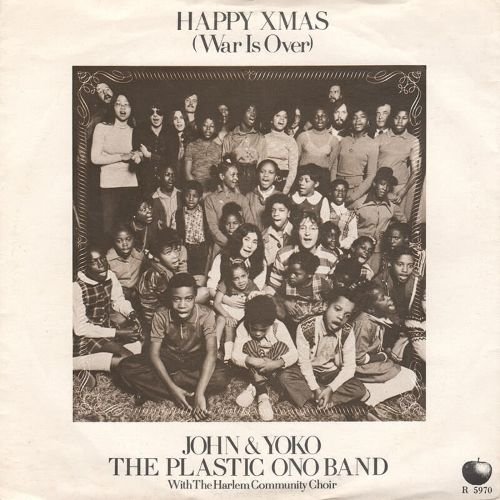
Released on 24th November, 1971 in the U.K. and 1st December, 1971 in the U.S., there are a couple of other features I want to come to. The Beatles Bible provide the details about personnel and recording dates of Happy Xmas (War Is Over). Nearly fifty-five years after its release, you do wonder whether its messages will connect with the wider world. I think that John Lennon and Yoko Ono inspired a lot artists with this song. Think of the other three Beatles, Paul McCartney, George Harrison and Ringo Starr, and how they have all campaigned for peace and bring that into their music. Or have done. During such a turbulent time in the late-1960s and early-1970s, Happy Xmas (War Is Over) seemed like something Lennon and Ono simply had to write:
“Although ‘Happy Xmas (War Is Over)’ was ostensibly about the Vietnam war, it proved a universal message understood worldwide. Lennon had experimented with anthemic messages in songs such as ‘Give Peace A Chance’ and ‘Power To The People’, and again produced a simple lyrical refrain which he hoped anyone could understand.
‘Happy Xmas’ Yoko and I wrote together. It says, ‘War is over if you want it.’ It was still that same message – the idea that we’re just as responsible as the man who pushes the button. As long as people imagine that somebody’s doing it to them, and that they have no control, then they have no control.
John Lennon, 1980
All We Are Saying, David Sheff
Lennon recorded a home demo of ‘Happy Xmas (War Is Over)’ in early October 1971. Few of the words were in place, but the melody and structure was mostly complete. Lennon evidently had trouble singing the high notes of the middle section, as sung by Ono in the final version.
Both Lennon and Phil Spector claimed the song’s melody was based on The Paris Sisters’ 1961 hit ‘I Love How You Love Me’, which Spector produced. However, the verses are more closely related to Peter, Paul and Mary’s version of the American folk song ‘Stewball’.
A rough mix of the song, titled simply ‘Happy Xmas’, was included on the 1998 box set John Lennon Anthology.
In the studio
The basic track for ‘Happy Xmas (War Is Over)’ was recorded at the Record Plant East in New York City on 28 October 1971. The balance engineer was studio owner Roy Cicala, and Phil Spector was the producer. Spector, of course, had previously recorded the classic 1963 album A Christmas Gift For You.
The backing track was recorded in seven takes, with take six selected as the best. Takes 2, 3, and 4 were incomplete, and take 5 was a false start.
John Lennon had wanted Klaus Voormann to play bass guitar on the recording, but his flight from Germany to New York was delayed. The bass part was initially recorded by one of the guitarists recruited for the session, but was later replaced.
The 16-track master tape had Hugh McCracken’s acoustic guitar on tracks 1 and 2, and Chris Osborne’s on tracks 3 and 4. Other acoustic guitars, played by Lennon, Teddy Irwin, and Stuart Scharf, were recorded to tracks 11, 6, and 12 respectively.
Voormann’s bass guitar was on track 5, and Jim Keltner overdubbed a sleigh bell onto track 13.
Nicky Hopkins’ piano was on track 7, and he also added glockenspiel and chimes to the same track during a reduction mix. More piano by Hopkins was added to track 9, along with vocals by Lennon and Yoko Ono.
Tracks 8 and 10 were used by Spector as echo tracks. The remaining three tracks, 13-14, were used for Jim Keltner’s drums.
On 29 October the single’s b-side, ‘Listen, The Snow Is Falling’, was recorded. The composition, written by Ono in 1968, featured the same musicians as on ‘Happy Xmas (War Is Over)’, minus the acoustic guitarists and children.
On 30 October Voormann recorded his bass guitar part for ‘Happy Xmas (War Is Over)’. That session also saw the recording of strings and the Harlem Community Choir, and the whispered introduction for Lennon and Ono’s children: “Happy Christmas Kyoko”; “Happy Christmas Julian”. The sleeve photography for the single was also taken during this session by Iain Macmillan”.