FEATURE: Spotlight: Honeyglaze

FEATURE:


Spotlight

Honeyglaze

___________

ONE band who are going to be…

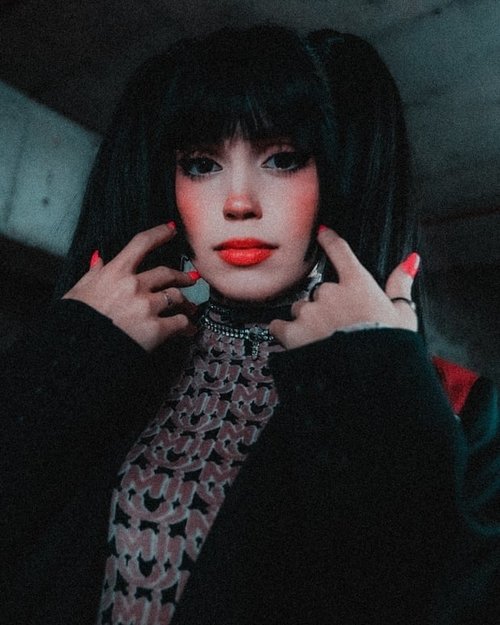
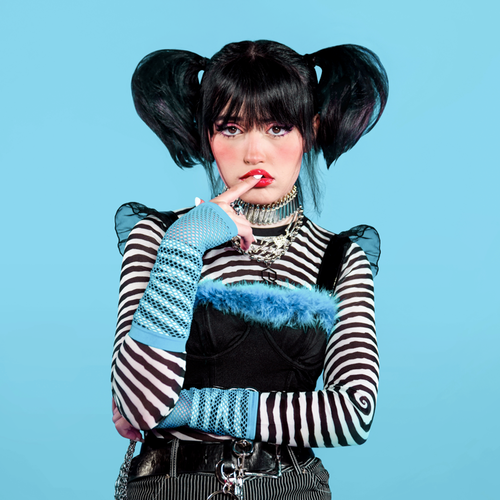
 PHOTO CREDIT: Holly Whittaker

making big splashes this year are Honeyglaze. The London trio are a hugely original group that I have been following for a bit. Whilst a lot of sites are tipping solo artists when it comes to the sound of 2022, I do think there are quite a few bands that deserve mention and support. Honeyglaze should definitely be on everyone’s radar. Red Light Management wrote this about the trio last September:

Born out of lead songwriter Anouska’s un-desire to be a solo-act, Honeyglaze met officially at their first ever rehearsal, just three days ahead of what was to become a near-residency at their favoured ‘The Windmill’, Brixton.

Forming a mere eighteen-months ahead of a subsequent eighteen-months of mandatory solitude, Honeyglaze have since been making up for lost time, recently performing to a rammed crowd at Green Man festival, and at the iconic 100 Club for Fred Perry’s ‘All Our Tomorrow’s Festival’, with a busy schedule ahead inc. Live at Leeds, and SWN Festival.

Beckoning, becoming and utterly bewitching, their debut single ‘Burglar’ is the coming-of-age lovechild of Whitney’s ‘Forever Turned Around’, and the stylistically-subdued existentialism of Julia Jacklin, or Oregon’s Haley Heynderickx.

In their own words, they describe Honeyglaze as “the ungodly fusion of 3 humans into a clamouring superorganism. It eats only fish, and demands undistracted and constant worship. FFO Power Rangers, Salvador Dalí”.

Speedy Wunderground’s Pierre Hall says of the signing, “We’re so excited to announce Honeyglaze as our next proper signing to the label. We were blown away as soon as we heard their music, and then furthermore when we met them in person. It’s felt like such a natural partnership and they’ve created something really special. We can’t wait for the world to hear. Be prepared to fall in love”.

Recently, Honeyglaze released their new single, Shadows. They also announced their self-titled album will arrive in April. NME reported the news. I think that the Honeyglaze album is going to be one of the most exciting and well-reviewed of this year. There is a lot of excitement around this young band:

Honeyglaze have announced their self-titled debut album and shared a video for their new single, ‘Shadows’ – scroll down the page to watch it now.

The London band are signed to Speedy Wunderground, the label co-run by respected producer Dan Carey.

‘Shadows’ is accompanied by visuals that follow the band as they create shadows against a collapsible reflector, using hats, head coverings with bunny ears and more. “Mornings always feel like paradise,” Anouska Sokolow sings on the jangly indie song. “Cos shadows always haunt me late at night.”

The video for the track was directed by Sorry’s Asha Lorenz. In a press release, the band said: “For the ‘Shadows’ video, we wanted to be a bit more playful and match the jauntiness of the song. We got together with directors Asha Lorenz and Flo Webb and a load of random props, and improvised shadow play scenes together. We just wanted to go out and have fun. We had no idea it would end in death. It was never our intention to kill Yuri. It just all happened so fast.”

 Singer and guitarist Anouska Sokolow added of the track itself: “‘Shadows’ was written during a time when I had just moved house. I had no curtains in my bedroom and the streetlights would cast shadows into my room. I began to associate shadows with the inability to sleep and the feeling of waiting for the relief that the morning brings.”

The band’s self-titled debut album will be released on April 29 and can be pre-ordered here. The tracklist for ‘Honeyglaze’ is as follows:

‘Start’

‘Shadows’

‘Creative Jealousy’

‘I Am Not Your Cushion’

‘Female Lead’

‘Burglar’

‘Half Past’

‘Deep Murky Water’

‘Young Looking’

‘Souvenir’

‘Childish Things’

Honeyglaze are also set to head out on tour later this month, with support dates for Katy J Pearson and The Lounge Society. A headline tour will follow in May”.

There are a couple of other interviews that I want to bring in before closing off. I would urge people to check out Honeyglaze’s music. They are so different to other bands out there. Once you hear their music, it will definitely not leave your head! I was interested knowing what sounds and artists have inspired Honeyglaze. In an interview with Fred Perry, we learn a bit more about their sonic influences:

Name, where are you from?

Anouska, Yuri and Tim. We're from London.

Describe your style in three words?

Tall, dark and handsome.

Which Subcultures have influenced you?

We've grown up in the South London rock scene, and all the acts share this paradox of irreverence and darkness that we love. All the jazz jams around London in the past 5 years have also been so inspiring because they prove a supportive community can exist in a big city like this. Our own sound is more inspired by a deep love of 60s soul and 90s dream pop, but it's harder to pick specific subcultures out of that.

A song you wished you had written?

'This Must Be The Place' by Talking Heads. It's just a perfect song in every way. There are emotions in there I've never heard in another song.

Any new bands you are into at the moment?

The Cactus Channel, Drug Store Romeos, Opus Kink, The Soundcarriers, Saul, Katy J Pearson, Ego Ella May, DOG. So many good sounds, so close to home”.

The Line of Best Fit profiled the band late last year. A rising group who are turning heads, I am looking forward to what they deliver on their debut album. If you are looking for a new band who are going to go the distance and are worth sticking with, then I would point you the way of Honeyglaze. The group have a fascinating dynamic and relationship:

Themselves, three cooly relaxed pieces making up a trifecta built out of vocalist and guitarist Anouska ‘Noush’ Sokolow’s wanting to “avoid the singer/songwriter kind of route.” Starting up the initial solo project under the same moniker - Honeyglaze - “Then I was asked to play a show. And I was like, I want to play with the band,” she laughs.

“I tried playing with a band because I only played like one show, as Honeyglaze anyway. And then I brought Tim and Yuri together in a beautiful fusion one week before our first gig. We had two practices. And then yeah, we just kept playing!”

The other two pieces of this trifecta, drummer Yuri Shibuichi and bassist Tim Curtis are equally representative of Honeyglaze’s smooth surface dichotomy. Shibuichi is the most forthcoming, while Curtis focuses, plotting his conversation. Sokolow retains a similar delicate pointedness.
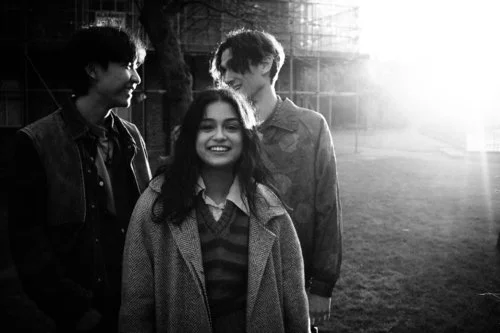
Coming together for that first show as Honeyglaze - after seeing each other around in other bands - the mutual respect helped them go from assembled pieces to signing to London’s taste-making label Speedy Wunderground, ready for their debut self-titled debut album. “I see us as just progressing towards a slightly more ambitious attitude,” Curtis says. “But not in terms of like, success, but just in terms of expression; just in terms of trying to make music that we really think is good rather than going strictly with the flow. Just really wanting to have a really good live performance basically.”

Honeyglaze are the kind of band that doesn’t pay any mind to following the hype train that’s started up; ignoring any personal push and pull of either being true to themselves or being cliches. “Honestly we come up quite straight edges sometimes. In the venue, just not drinking, sort of being really quiet,” Curtis chuckles.

The natural forces opposing those benchmarks also takes the form of shock value. Shibuichi explains “Personally, I feel like there isn't specifically an inspiration or an influence on how far [we go]. I feel like one thing's for sure for me, [and] it’s that I want people who see us to sort of maybe slightly be a bit surprised or shocked sometimes, or to go away from the show and feel a bit like, ‘wow, like that was a bit as amazing’. Like that was a bit surprising, I guess. Just it's really intense both ways, like just really loud and in your face, or being really, really intimate and pulling it in that direction. I think it's just the play of pulling all those together.”

“I think yeah, playing with the audience's emotions as much as with our own emotions because the more we put in like, the more the audience gets out of it as well. So it's interesting when we have a really intense show people come up to you afterwards. They're like, Oh my god, that was like, really sad...are you okay?” Sokolow laughs”.

A terrific group with a very long future ahead, go and follow them on social media and check out their music. Whilst solo artists emerging are great and warrant focus, there are bands like Honeyglaze that are really strong and are bound for festivals around the country. It may be early days for Honeyglze, but all signs suggest that they are going…

TO go far.

________________

Follow Honeyglaze

FEATURE: Place to Be: Nick Drake’s Pink Moon at Fifty

FEATURE:


Place to Be

 Nick Drake’s Pink Moon at Fifty

___________

THERE are quite a few classic albums…

celebrating big anniversaries this February. Although it is not fifty until 25th February, I wanted to write about Nick Drake’s third and final studio album, Pink Moon. Sparser and shorter than his other two albums, over eleven tracks spanning just over twenty-two minutes, we get this incredibly beautiful album that features Drake without a backing band. It is just him, an acoustic guitar and  a bit of piano on the title track. Pink Moon is definitely a great album to have on vinyl. Ahead of its fiftieth anniversary, I wanted to pay tribute to one of the best albums ever. Drake sadly died in 1974 at the age of twenty-six. It is fascinating to think what he could have gone to create if he had lived. Whilst some prefer his 1969 debut, Five Leaves Left, other pip for 1971’s Bryter Layter. I think that his most affecting and memorable album is Pink Moon. It is the gravity and focus on his voice and acoustic guitar that makes it such a spellbinding listen. Rather than it being haunting and morbid, it is an album that is so evocative and nuanced. You need to play it through a lot so that all of the songs can reveal their layers. Sadly, Drake's first two albums with Island Records sold poorly. This, together with Drake's reluctance to perform live or engage in album promotion, meant that the label was not confident of another album from him.

The songwriter was suffering from severe depression, so it is understandable that he did not want to tour or conduct interviews. Many associate Pink Moon with depression and this very bleak time. Cally Calloman of Bryter Music, which manages Drake's estate, has stated Drake could not write whilst badly depressed. He was not in a bleak state whilst writing Pink Moon. In fact, he was hugely pleased and proud of the album. There are a range of articles that I want to pepper in (well, they are actually quite long!), to give us an idea of how Pink Moon came to be. This first piece actually nods to Drake’s mental-health issues prior to recording Pink Moon:

By 1971, the 23-year-old was overwhelmed by depression and had lost all confidence as a live performer. His final public gig, at Ewell Technical College, in Surrey, in June 1970, had been abandoned halfway through the song “Fruit Tree” before a disconsolate Drake walked off stage.

With no immediate plans to make a new record to follow 1969’s Five Leaves Left and 1971’s Bryter Layter, Drake spent time recuperating at Chris Blackwell’s Spanish villa, at the personal request of the concerned Island Records chief. Drake then snuck away with producer John Wood to lay down a new album, which was recorded over just two late-night sessions at Sound Techniques in London’s Chelsea, in October 1971. Wood later said that “it felt like there was a kind of urgency about it.”

Pink Moon is Drake’s music at its starkest and most uncompromising: no other musicians, no arrangements, just Drake and his acoustic guitar and one piano solo on the title track, with its ill-omened pink moon a portent of disaster. Drake did not know what he wanted on the cover of his new album, except that it had to feature a pink moon. In the end, a surrealist painting by Michael Trevithick, who was the boyfriend of Drake’s sister Gabrielle, was chosen and seems fitting.

The album, which is only 28 minutes long, has an unsettling simplicity. Drake said he didn’t want it arranged, just to stand “naked.” In the brilliant and bleak “Parasite,” Drake uses the device of a journey on the Northern Line of the London Underground to offer a chilling view of the emptiness of contemporary life.

Pink Moon received good reviews, but its intimations of darkness (“Now I’m weaker than the palest blue,” Drake sings in the masterful “Place To Be”) left people feeling uncomfortable. Nevertheless, Island Records kept faith in the young singer, and the company knew that with such exceptional songs (“Road,” “Which Will”) they had something special on their hands. One of the highlights is “Things Behind The Sun,” on which Drake plays some beguiling picking guitar as he sings:

Please beware of them that stare

They’ll only smile to see you while

Your time away

And once you’ve seen what they have been

To win the earth just won’t seem worth

Your night or your day

Drake was a talented technical guitarist and a painstaking musician. For example, he tuned his bottom string down to a low A just so he would get the right fret on one line of “Free Ride,” to emphasize one of the lines. Danny Thompson, who worked with Drake on Five Leaves Left and played bass on John Martyn’s classic Solid Air, which is an album about Drake, said: “Ultimately, it’s the real beauty of his music that draws people in, and his stunning guitar playing, which was so clean.”

The lack of sales for Pink Moon disappointed Drake, whose depression was deepening. He died on November 25, 1974, at the age of 26, from an overdose of anti-depressants. It was a tragedy that passed largely unnoticed at the time.

The three albums which Nick Drake had made in his short lifetime were all, in commercial terms, unsuccessful, even though leading musicians such as Martyn and Richard Thompson urged people to listen to Pink Moon. Eventually, long after his death, people took notice and Pink Moon posthumously went Platinum”.

There is a genius to Drake’s guitar playing throughout 1972’s Pink Moon. A lot of people remark on his vocals and lyrics, though I do not often see people commending his inventive and expressive guitar style. Guitar were in awe of Drake’s playing when they revisited Pink Moon in 2020:

After his great bid for commercial success, Bryter Later, was met with a slightly perplexed critical reception and commercial failure, Drake vowed to strip his sound down to its basic elements of guitar and voice. In the one interview with the press he did in his life, he told Sounds that for his next release: “I had the idea of just doing something with John Wood, the engineer at Sound Techniques.”

Reenergised by time recuperating in Chris Blackwell’s villa in Spain, Drake returned to London in October 1971 and recorded the entire 11-track, 28-minute album across two nocturnal sessions that began at 11pm. And apart from the luminous 10-second piano part he played on its title track, that’s all Pink Moon is – one man playing his guitar and singing.

Legend has it that Drake wordlessly dropped the album’s masters off at Island’s reception in a bag and scurried away. Island’s press officer David Sandison recalls that in fact, he saw Nick at the reception with the masters under his arm and invited him up to his office, where he stayed for half an hour before leaving. “About an hour later, the girl who worked behind the front desk called up and said ‘Nick’s left his tapes behind.’ So I went down and it was the big 16-track master tape and it said ‘Nick Drake Pink Moon’, and I thought, ‘that’s not an album I know.’”

The press release that accompanied the album’s release recounted the incident, bluntly adding: “His first two albums haven’t sold a shit. But if we carry on releasing them, then perhaps someone authoritative will stop, listen properly and agree with us.”

Supernatural picking

By all accounts, Drake was a faultless studio performer, the fact that he rarely dropped a note testament to the hours he would (cue montage) smoke weed and repeat and cycle complex riffs in his dorm room at university, in his bedroom at Far Leys, in his bedsit in London. Despite the hours of hypnotic repetition this implies, according to Robert Kirby, a friend from Drake’s uni years who contributed string arrangements for his earlier albums: “Don’t think for one minute that Nick lacked artistic spontaneity. He could dazzle for hours with electrifying improvisations in many styles (including his own) and play many authentic blues styles.”

He was a musician whose music, for all its approachable outward simplicity, possesses a level of detail and inner complexity that renders it essentially uncoverable. As with his lyrics, there are so many paradoxes in his guitar playing alone: diverse alternate tunings facilitate simple, often single-finger chords; classical sensibilities meld with the physicality of the blues; the ambiguity between major and minor in his chord voicings hover, unresolved; he could orchestrate complex fingerpicking (Road) or just repeat four rattling notes (Know). That last song is even constructed of oppositions: (‘Know that I love you, Know I don’t care…’).

His producer Joe Boyd summarised his playing in the A Skin Too Few documentary: “When you listen back to the records one of the things that’s most extraordinary is the guitar. Because it’s so clean and so strong and all the notes are so equally balanced. It’s so unusual to have such complicated fingerpicking parts played in such a clear and strong way – every note – so that you really can construct the whole recording around the guitar”.

There are a couple of reviews that I want to finish off with. The first, from Beats Per Minute is extremely extensive. Every song on Pink Moon is outstanding. The music provokes so many emotions! An excellent and informative feature, I wanted to use quite a bit of it:

Pink Moon” is a song with a straightforward message, but an uncertain meaning. Sung in Drake’s distinct smooth soulful voice, he tells us that our fate is coming soon: “Saw it written and I saw it say/ Pink moon is on its way/ And none of you stand so tall/ Pink Moon gonna get you all.” Like most of his songs off this album, they come off as poetic and bleak, like a dark sorrowed soul that lived within him. This song might be about a malicious feeling infecting the people who surround him, or it could simply be a metaphor for death coming for them no matter how tall they stand. As terrible as that sounds, he doesn’t sing it in just a sad way, but more haunting with a heavy heart, like he’s given up on saving himself and others, which reflected well on his own life at the time. Similarly, his guitar gives a chord-filled, harmonic melody while the piano break in the middle of the song offers a nice break and sets the mood for this depressing outlook into the near future.

“Place To Be” is a much more structured song than the previous track, with three stanzas describing three different parts of his life: naivety, rejection, and desperation. The love for this girl that Drake missed so much makes this one of the more emotional tracks on Pink Moon. In each verse, he compares moments of times before when he was happy to the moments present where he is in need for the girl he has lost. In “Road,” he takes a different approach about love where it makes him seem okay with the loss, as opposed to felling heartbroken about it, telling her “You can take the road that takes you to the stars now/ I can take the road that’ll see me through.”

After “Which Will,” a mellifluous song about indecisiveness with life’s given choices (clearly another page ripped out of his book), Drake plays his only instrumental of the album, “Horn.” Although the entire album is done with his acoustic guitar, and this is no different, the delicately strummed, soft guitar of “Horn” can act as the beautiful transitional period in between the album.

Following the short piece, “Things Behind The Sun” clocks in at just under four minutes, making it the longest song on the album. Here, Drake again sings about the shallow people who surround his life (“them that stare”) and how they can be however they want, but he can see past the sense of semblance and see that they’re all still sad inside. The depression that slowly filled his own life made it that much easier to see how everyone else in the world is just as depressed as him, with only their phony façade covering up their real feelings. The way he describes it all in song is extremely poetic and mysterious, ultimately asking “Who will hear what I say?” which makes everything look even more desolate.

“Know” is the least difficult song to understand, but also one of the most clever. There are no complex guitar chords, but just a simple two-second long bluesy beat played repeatedly over the course of the song. For the first half, he hums to himself for awhile, then declares painfully “Know that I love you/ Know I don’t care/ Know that I see you/ Know I’m not there.” These unsettling lyrics need nothing more to say to get the point across. Lines one and three are the role of him, while lines two and four are told from the point of view of the one he desires. The juxtaposition of these lines not only show how he is so rejected from the people he loved, but it can also be interpreted that it’s “no” instead of “know” for the opposite’s lines. It is brilliant lyrics like these that make this one of the strongest songs on Pink Moon.

Further on in the record, he relates himself as being a worthless bug, better off dead (“Parasite”), and an effortless weak soul who contributes to nothing (“Free Ride”), but what finishes his deed is “Harvest Breed.” While some of the songs featured prior to this one develop some slight chance of hope, “Harvest Breed” is without question the song about his acceptance and acknowledgement of his impending death. Singing simply that “he’s ready” and that “this could be the end” makes this a dramatic finish to his life through song. His hopelessness clouds any positive thoughts he might have had before and, as if the previous nine songs projected his outlook on the unwelcoming life he lived, this is the point where he lets go and starts “falling fast and falling free.”

After what can only be assumed as a strikingly ominous, eerie ending to the album, along comes the real last track of Pink Moon “From the Morning,” which takes on a completely different change of pace. After hearing ten tracks of depression, emotionally sick times, and anguish, “From the Morning” is sung with the most upbeat approach imaginable for Drake. The guitar is colorful and rhythmic and Drake’s lyrics reflect this as well, clearing up his cloudy mind and singing about what life has to offer that is beautiful: “So look see the days/ The endless colored ways/ And go play the game you learnt/ From the morning.” It’s as if the Pink Moon shone over Drake during the gloomiest moments of his life and throughout the album, while the sun rising in “From the Morning” represents a new life, a new direction to take. It may even just be Drake’s soul ascending to the heavens and relaying how this might not be the place for him, but don’t give up your own life for what he couldn’t appreciate. It’s such an impressive way to end an album that seemingly acts as one big story for Drake’s disheartened life at the time and still giving himself that extra message to keep on going, because the sun will rise again.

Unfortunately, the sun never did rise for Nick Drake again. Pink Moon had worse initial sales than his first two albums originally sold, which sent him into a worse depression and insomnia. On November 25, 1974, at the young age of 26, he died of an overdose of his prescribed antidepressant. Whether it was an accident or suicide was never determined, but looking back on the songs he sang, it acted more like what was to come of Drake than anything. Two years before his death, he knew he wasn’t going to last very long.

More importantly though, his fame slowly rose as big artists from the ’80s and ’90s, such as R.E.M., The Cure, Jeff Buckley, and Elliot Smith began recognizing him as a big influence for their music. He hit an even bigger audience when his song “Pink Moon” was used for a Volkswagen Cabrio commercial in 1999 titled “Milky Way” and eventually led his album to receive huge sales. Slowly he became a more noticeable figure in the music world and by the end of the ’90s, he was a household name to fans and critics, receiving high honors from multiple acclaimed sources, such as the 13th best album of the ’70s by Pitchfork and 320th best album of all time by Rolling Stone.

For a man who felt so small in his time, looking back on it now, Nick Drake created for many more people what is considerably one of the most emotionally draining and most influential folk albums of all time. This is the classic example of how one person can pour every last bit of themselves into an album with such raw despondency and without all of the unnecessary amounts of overproduction to make up for it. No one at Island Records or his producer expected him to make this album, but it’s possible he did it to preserve his life and dying wish before he knew he’d soon be gone. He may have died a tragically early death, but it’s great to see that he became recognized for his genius lyrics and albums like Pink Moon, even if he thought it was certain it would never go his way”.

I am going to round off with a final review. There are others who will mark the fiftieth anniversary of Pink Moon before 25th February. They might look at the album’s legacy, or the position it occupies alongside Nick Drake’s other studio albums. I wanted to give a more general overview of one of the 1970s’ most astonishing albums. This is what AllMusic had to offer in their review:

After two albums of tastefully orchestrated folk-pop, albeit some of the least demonstrative and most affecting around, Drake chose a radical change for what turned out to be his final album. Not even half-an-hour long, with 11 short songs and no more -- he famously remarked at the time that he simply had no more to record -- Pink Moon more than anything else is the record that made Drake the cult figure he remains. Specifically, Pink Moon is the bleakest of them all; that the likes of Belle and Sebastian are fans of Drake may be clear enough, but it's doubtful they could ever achieve the calm, focused anguish of this album, as harrowing as it is attractive. No side musicians or outside performers help this time around -- it's simply Drake and Drake alone on vocals, acoustic guitar, and a bit of piano, recorded by regular producer Joe Boyd but otherwise untouched by anyone else. The lead-off title track was eventually used in a Volkswagen commercial nearly 30 years later, giving him another renewed burst of appreciation -- one of life's many ironies, in that such an affecting song, Drake's softly keened singing and gentle strumming, could turn up in such a strange context. The remainder of the album follows the same general path, with Drake's elegant melancholia avoiding sounding pretentious in the least thanks to his continued embrace of simple, tender vocalizing. Meanwhile, the sheer majesty of his guitar playing -- consider the opening notes of "Road" or "Parasite" -- makes for a breathless wonder to behold”.

Whilst its creator is no longer with us, the sheer majesty and perfection of Pink Moon lives on. It is gentle yet powerful; it is hushed yet carries so much weight. Everyone will have their own words to describe Pink Moon. My favourite lyrics are at the end of the final track. From the Morning: “So look see the sights/The endless summer nights/And go play the game that you learnt/From the mornin’”. There are so many beautiful and standout lines and moments through Pink Moon. It is an album that will be cherished and discussed…

FOR so many years to come.

FEATURE: On a Plain: Kurt Cobain at Fifty-Five: His Legacy and Genius

FEATURE:


On a Plain

IN THIS PHOTO: Kurt Cobain during the taping of MTV Unplugged at Sony Studios in New York City/PHOTO CREDIT: Frank Micelotta/Getty 

Kurt Cobain at Fifty-Five: His Legacy and Genius

___________

ON 20th February…

 IN THIS PHOTO: Kurt Cobain alongside Nirvana bandmates Krist Novoselic and Dave Grohl/PHOTO CREDIT: Jesse Frohman/Trunk Archive

the world will mark what would have been Kurt Cobain’s fifty-fifth birthday. A ‘90s icon who was the lead of one of the most influential bands of their time, Nirvana, his songwriting brilliance, feminist attitude and captivating personality made him a hero to millions. Before coming to features about his legacy and what made Cobain so special, it is worth knowing more about one of the most iconic and revered songwriters ever. AllMusic’s biography provides great detail:

As the lead singer and guitarist of Nirvana, Kurt Cobain's musical success began in his twenties and was heightened when he formed the band Nirvana. Hits such as "Smells Like Teen Spirit," "Come as You Are," and "Heart Shaped Box" helped the group achieve international success.

Cobain was born in Aberdeen, Washington. Hyperactive as a youngster, he was given Ritalin to help him concentrate in school and sedatives to help him sleep at night. At the age of seven, his parents got divorced. He became so difficult to live with that his parents sent him to live with relatives. This period in his life is reflected in songs such as "Sliver." With a dislike for school, Cobain spent his time painting and singing. He listened to the Beatles and the Monkees, but changed to bands such as Kiss, Black Sabbath, the Sex Pistols, and the Clash in 1979. On his 14th birthday, Cobain bought his first guitar and started experimenting with different musical styles. He also was a roadie for a Seattle group called the Melvins. He dropped out of high school a few weeks before graduation to get a job, but his efforts were unsuccessful because he couldn't hold a job for very long.

In 1986 the group Nirvana was formed with Cobain on vocals and guitar, Krist Novaselic on bass guitar, and various drummers. Their first album, Bleach, was released in 1989. They toured the U.S. and had their first international concert in Newcastle, England. Their second single was unsuccessful, so they changed record companies. After signing with Geffen Records in 1991, and adding permanent drummer Dave Grohl, they produced their second album, Nevermind, which received rave reviews with the hits "Smells Like Teen Spirit," "Come as You Are," and "Lithium." Their popularity grew after the group made appearances on MTV's Headbanger's Ball and NBC's Saturday Night Live. The success of the band was intimidating to Cobain, who liked the intimate setting of nightclubs; it was the money that guided them to do concerts and shows in the rock arena. It was in the early '90s that Cobain began doing heavy drugs such as morphine and heroin, but in 1992 his personal life brightened as he married Courtney Love in Hawaii, and their union brought a daughter, Frances Bean. With a wife and daughter, Cobain calmed a bit, and the group released Incesticide.

Things took a turn for the worse in 1993 when Cobain overdosed on heroin. After seeking rehabilitation for a time in a center, he left without completing the program. During this time the band played on. In 1993, the band released In Utero, their last studio-recorded album. Nirvana played an MTV Unplugged concert and a concert in Munich in 1994. One week after the concert in Munich, Kurt Cobain was hospitalized in a coma. After waking up and leaving voluntarily, he was reported missing and was found three days later in his house, dead of a gunshot wound.

Over the next two decades, Cobain's legend only grew, thanks in part to posthumous Nirvana recordings. The live albums MTV Unplugged in New York and From the Muddy Banks of the Wishkah appeared in 1994 and 1996, respectively, and in 2002, an eponymous greatest hits album appeared. Two years later, the rarities and outtakes box With the Lights Out saw release and that was the last major archival release until 2015, when Brett Morgen directed the documentary Montage of Heck. The film was accompanied by the release of a soundtrack album, containing home recordings and demos by Cobain; it was the first-ever album to be credited to Cobain alone”.

Whilst, in 2022, there might not be more to say about Cobain’s legacy and brilliance, it is worth noting what he left the world following his premature death in 1994. Ahead of a big birthday where fans will mark his passing in addition to celebrating his music and the words he put out into the world, I wanted to source a few articles where writers have tried to explain what his legacy and influence is. Last year, twenty-seven years after Cobain’s suicide, this article tells how Cobain and Nirvana inspired their peers, and how Nirvana’s iconic MTV Unplugged set showed new talents and multiple sides of Cobain:

From the yellow wiggly smiley face you see everywhere to their infamous naked baby 1991 album Nevermind still seen in music shops, there is no denying that Nirvana is the most influential grunge band of all time. As of 31st March 2021, the band has just over 17,255,000 monthly listeners and their most well-known song ‘Smells Like Teen Spirit’, has just over 933,525,000 plays on Spotify! They are certainly not going away any time soon.

While the hot debate surrounding what can be defined as grunge has been going on since the mid-80s, Nirvana embraced it for what they assumed it to be. Musically, grunge is an underground genre that borrows from punk, metal, rock and to a certain extent, pop. Under the talent of Cobain, Nirvana surprised the world with their second album, Nevermind breaking tradition by having huge success on radio, MTV, CD, and tape recordings, thus launching the genre into the mainstream. They were raw and unpolished; that’s what was needed then.

Furthermore, their iconic Nirvana MTV Unplugged 1993/1994 set reminded viewers and listeners that they were more than your average Joe. Although the infamous 1992 MTV Awards (when Nirvana performed) may lead many to question why the band would agree to perform for MTV Unplugged, it came at a time where the TV station’s popularity was dipping. Cobain’s motives will never be clear, but one thing is for sure – they rocked the roof off! Viewership for this much-anticipated release did wonders for MTV and showed the entire world that Nirvana were not just some shouty, rowdy men who turned the volume up to 100. This was their time to shine and show their talent off. From ‘All Apologies’ to ‘About A Girl’, they were stripping back and showing off the incredible vocal skills and writings of Cobain. Oh, and the band were willing to take risks by performing covers of David Bowie, who, according to The Independent, was ‘regarded as a sort of super-naff crazy uncle to Phil Collins. It is hard to convey just how uncool he still was in the early Nineties.’ They made it their own.

Cobain became an icon himself. With his clothing style, unphased attitude and his refusal to be inauthentic – many idolised him, and still do. He was ahead of his time; he was even arrested for spray-painting ‘God is Gay’ on police cars in Washington state. He was also modest about his own talent, saying that ‘We’re from the learn-as-you-play school. We’re still in it.’ Cobain came from a small town and dreamed of making it big time. That’s what he did; he never gave up”.

Arts & Culture wrote about Kurt Cobain’s legacy back in 2019. It is clear that the world has not witnessed anyone like him since. Even if he was a reluctant voice of a generation, Cobain had a power and pull that has lasted to this very day:

The grunge wave Cobain fronted kicked out 1980s pop and rock, and set the glum tone for modern guitar music forevermore, from Korn, Linkin Park and Nickelback to early Radiohead and beyond. What then seemed like a passing trend was arguably rock's last hurrah – a milieu today held up with more misty-eyed affection than any movement in guitar music since. In truth, grunge was a nebulous conceit, coined by journalists lazily clumping together scruffily dressed rockers of different musical allegiances – Seattle also-rans Pearl Jam, Cornell's Soundgarden and Alice in Chains owed more to the big riffs of commercial 1970s rock and heavy metal.

IN THIS PHOTO: Kurt Cobain and Courtney Love/PHOTO CREDIT: Michael Lavine 

It's not easy for anyone to serve as the spokesperson for a generation, but quick-witted Cobain seemingly made maladjusted discontent and media antagonism appear an art-form. His widow Courtney Love implies he "chose" a life of drug abuse, and Cobain's strung out visage is the epitome of the oxymoronic phrase "elegantly wasted". Marc Jacobs's high-end grunge clothing range may have little to do with Cobain's thrift-store rags that inspired them – but like a Che Guevara or Bob Marley T-shirt, a Cobain image today represents a statement more cultural than musical. And it's not One Love or socialist revolt that Cobain stood for.

"Teenage angst has paid off well, now I'm bored and old," Cobain sang on In Utero's opener Serve the Servants. He always had a shrewd awareness of his legacy and repute, as the theatre of Unplugged and the scrawl of his suicide note show – complete with that priceless Neil Young quote, "It's better to burn out than to fade away”.

There is one more article that I want to illustrate. In 2020, The Boar also had their say when it came to explaining the relevance and influence of Kurt Cobain. One reason why so many people admired Cobain was his very progressive thinking (in a decade where not all male Rock and Grunge artists would have shared his worldview and intelligence):

As the anniversary of his death comes around again – is this really how we want to remember him? Is this how we preserve him in history, as a tragic young man and a member of the fabled 27 Club? Speculating over the circumstances of his death, even now, won’t do anything. It won’t bring him back.

It is important to acknowledge the tragedy of his suicide and to understand that Cobain was a troubled man. He suffered from depression and addiction. His life was oftentimes difficult. That shouldn’t be ignored but it also shouldn’t be glamorised.

It is more important to instead remember how Kurt Cobain lived, rather than how he died. His legacy is first and foremost the music he made with Nirvana, that to this day still has the ability to inspire and empower. For some, it is the gateway to a love of rock music that lasts a lifetime. I still remember the first time I heard ‘Smells Like Teen Spirit’ when I was 15. I thought: “Where has this band been my entire life?” He gave us even more great music than just their signature song: ‘Heart-Shaped Box’, ‘Lithium’, ‘Breed’, ‘Come As You Are’, ‘Negative Creep’, just to name a few. These songs, two decades after their initial release, are still relevant and still capture people’s attention. That takes talent.

Something we should also acknowledge when we talk about Kurt Cobain is his political progressiveness

Nirvana also pushed the grunge genre forward more than any other band. Their commercial breakthrough, 1991’s Nevermind, is credited with establishing the commercial potential of rock music, taking it from its underground roots and the specialist sections of record stores to the bright lights of the mainstream. That is a big ask for a genre that is perhaps not the most palatable to every taste (try playing ‘Territorial Pissings’ to your parents – or, on second thought don’t). What it is, then, is a testament to the power of their underground fanbase, as well as the band’s music itself for resonating with enough people to make that happen.

Something we should also acknowledge when we talk about Kurt Cobain is his political progressiveness. In the liner notes of compilation album Incesticide, he writes “If any of you in any way hate homosexuals, people of a different colour or women, please do this one favour for us… don’t come to our shows, don’t buy our records.” He continued to speak up for feminism, having often associated himself with bands of the Riot Grrrl movement, and was even known to wear dresses on stage. He also spoke up for LGBT rights in a time where it was a far more contentious subject than today, and once admitted in an interview that he ‘could be bisexual’. He also penned two anti-rape songs, ‘Polly’ from Nevermind and ‘Rape Me’ from In Utero that denounced sexual violence while also acknowledging the strength of rape survivors.

Even if he is no longer around, Kurt Cobain’s voice, his words, and his melodies can never be taken from us. When we remember him, let’s celebrate him both for the person he was and the music he made. Let that be his legacy”.

As we get closer to 20th February, there will be various articles and new pieces that talk about Kurt Cobain from a number of angles. From the sense of torture and doom that he felt towards the end of his life through to Nirvana’s brilliance, all the way to how he affected the new generation of artists coming through, his death definitely left a huge gulf in the world. Even from Nirvana’s 1989 debut album, Bleach, we could definitely tell Cobain was a rarefied talent. 1991’s Nevermind and 1993’s In Utero solidified that. Although he quoted a famous Neil Young quote/lyric in his suicide note, “It's better to burn out than to fade away”, the genius and importance of the peerless Cobain…

COULD and never will fade.

FEATURE: Between the Bars: Elliott Smith's Either/Or at Twenty-Five

FEATURE:


Between the Bars

Elliott Smith's Either/Or at Twenty-Five

___________

BACK in 2003…

the world received the heartbreaking news that Elliott Smith had died (from suspected self-inflicted stab wounds). The Portland-born songwriter was only thirty-four. In his short lifetime, he left us with some phenomenal albums. One of his very best turns twenty-five on 25th February, 1997. Either/Or was recorded in several locations, mostly in Portland, Oregon, and it was produced by Smith, Tom Rothrock and Rob Schnapf. Containing tracks such as Angeles, and the immortal Behind the Bars, Either/Or is regarded as one of the best albums ever. It is possessed of masterful and beautiful songwriting throughout. I think that, prior to its twenty-fifth anniversary, more people should listen to it. I am a recent convert of Elliott Smith, and I have spent a lot of time with Either/Or. It is one of the most affecting albums that I have ever heard. To show its reputation and impact, there are some reviews that I want to source, prior to rounding things off. The Observer looked back at Either/Or on its twentieth anniversary in 2017:

When Slim Moon and Tinuviel Sampson founded Kill Rock Stars in 1991, the record label was distinct among the American indie scene with its roster made up almost exclusively of female artists. That all changed the day Moon signed singer-songwriter Elliott Smith.

The guitarist and vocalist of esteemed Portland indie-pop outfit Heatmiser was no stranger to recording under his own name, crafting a stark, brittle solo debut in 1994 with Roman Candle for the Cavity Search imprint utilizing nothing more than a cheap four-track and a Radio Shack microphone to capture the sound.

Smith expanded his lo-fi setting to include elements of drums, harmonica, cello and organ upon debuting on Kill Rock Stars with his self-titled second solo LP in 1995. Nevertheless, it was an album unique to the company line not only in gender but style as well; the folky wisp of Elliott Smith was a stark contrast to the more aggressive punk energy of popular groups like Huggy Bear, Bikini Kill and Sleater-Kinney.

But it wasn’t until Smith released Either/Or on February 25, 1997 that his legend was carved in stone.

A genuine pop masterpiece boasting a fuller, richer sound, Either/Or was the launching pad that catapulted Smith from the tiny clubs of Portland to playing the Oscars at The Shrine Auditorium when we was nominated for a song he wrote for Gus Van Sant’s Good Will Hunting.

It became the Cinderella story of 1997: the first male marquee act on Kill Rock Stars ascends from the CMJ charts to the Academy Award nomination for Best Original Song with “Miss Misery”—a song that wasn’t on Either/Or, but which embodies everything that has rendered the LP as Smith’s singular masterpiece to this very day.

Massachusetts alt-folk icon Mary Lou Lord once quipped about her longtime friend that Smith was a quintessential balance of Nick Drake and Lou Barlow. But with Either/Or, Smith established himself as far more than just a master of pastiche. He pushed his deep love for The Beatles to the fore with a sweet, scraggly variation of the kind of intimacy Paul McCartney leaned toward on McCartney and RAM, but his disarming, evocative lyrics and elegant yet vulnerable delivery were pure Elliott Smith”.

Whilst Either/Or was a transitional album from Smith, that did not mean a lack of focus, quality or cohesiveness. Quite the opposite in fact. 1998’s XO was Smith’s first album with a major label, DreamWorks. The A.V. Club discussed how Either/Or was the end of one particular phase of Smith’s career:

Either/Or represents many poles in Smith’s career. His first release post-Heatmiser would be his last for Kill Rock Stars, the indie stalwart founded by Slim Moon and Tinuviel Sampson in 1991. It’s the beginning of a three-record run with producers Tom Rothrock and Rob Schnapf (who’d also worked on Mic City Sons), and the end of Smith’s time in Oregon. The liner notes of Either/Or trace a farewell tour around the singer-songwriter’s adopted hometown, from references to geographic locations (“Alameda”) and local rituals (“Rose Parade”) to the names of fellow scene fixtures who gave him the space to lay down tracks (Joanna Bolme of Stephen Malkmus And The Jicks and Quasi; Larry Crane, with whom Smith would build Jackpot! Recording Studio). While Either/Or says goodbye, it makes a sideways introduction to the geographic muse on Smith’s horizon: “So good to meet you / Angeles.”

Either/Or is, in the purest sense of the word, a transitional work. (Something this very publication noted at the time of its release.) Whereas that term could connote incompletion and uncertainty, for Either/Or, it’s progression. No album so capricious—from the Kiekergaardian disjunction of its title to the “They want you or they don’t” of its closing track, “Say Yes”—should sound so confident, accomplished, and driven. But Smith was nothing if not confident, accomplished, and driven in the studio in the mid-1990s, qualities that are once more evident in the remastered tracks on Kill Rock Stars’ 20th-anniversary edition of Either/Or (due March 10). “He would record one live take of vocal and guitar together, and then he would just double to it once we got it,” producer Schnapf told Pitchfork in 2013.

“It was just absurd. The guitar stuff isn’t even easy. It was ridiculous that he was able to just nail a vocal and guitar performance live, and he was able to double it live again. I mean, it’s not like he’s strumming G, C, D. There’s intricate little fills. It sounds so natural, and so simple—then you try to play it. And sing at the same time. He was just really good. Understated, but really good.”

There’s a modesty to Either/Or that keeps the technical proficiency from overwhelming the proceedings. “It could easily have been bigger-sounding,” Schnapf says in the Pitchfork oral history. “We could have blown it up more, but he wasn’t ready to do it just yet.” Though its instrumentation is bulked-up from the folk-busker arrangements of Smith’s first two records, that instrumentation gets no more ornate than a few keyboard parts. Smith’s chops are always in service of his songs, the complex picking on “Alameda” and “Angeles” or the ripping solo on “Cupid’s Trick” born from and enhanced by his ear for melody and composition. The instrumental breakdown in “Pictures Of Me” is particularly impressive in this respect, as Smith pulls together a few measures of Beatles pastiche that calls to mind multiple eras of the band”.

I hope that, through this feature, I have persuaded a few people to check out Elliott Smith’s Either/Or. It is a sublime album that will definitely receive closer scrutiny ahead of its twenty-fifth anniversary on 25th February. I wanted to write something ahead of time. To round off, I want to bring in a review from AllMusic. This is what they had to say about one of Smith’s masterpieces:

Elliott Smith's third album sees his one-man show getting a little more ambitious. While he still plays all the instruments himself, he plays more of them. Several of the songs mimic the melody mastery of pop bands from 1960s. The most alluring numbers, however, are still his quietly melancholy acoustic ones. While the full-band songs are catchy and smart, Smith's recording equipment isn't quite up to the standards set by the Beatles and the Beach Boys. The humbler arrangements are better suited to the sparse equipment. "Between the Bars," for example, plays Smith's strengths perfectly. He sings, in his endearingly limited whisper, of late-night drinking and introspection, and his subdued strumming creates a minor-key mood befitting the mysteries of self. "Angeles" is equally ethereal -- Smith's acoustic fingerpicking spins out notes which briskly move around a single atmospheric keyboard chord, like aural minnows swimming toward a solitary light at the surface of the water. The lyrics are a darkly biting rejection of the hypercapitalist dream machinery of Los Angeles (it would make a great theme song for Smith's label, Kill Rock Stars). Ironically, "Angeles" was included on the Good Will Hunting soundtrack, which won Smith the acclaim of Hollywood's biggest, brightest, and best connected voting body, the Academy of Motion Picture Arts & Sciences. Smith's stock in L.A. soared after he took his bow at the Oscars with Celine Dion and Trisha Yearwood. It might have been more interesting had he sung "Angeles”.

When people think of the defining albums of the 1990s, I wonder how many people talk about Elliott Smith’s Either/Or? To me, it is as important as anything released in the decade. An album that still sounds so powerful and moving to this day, his final release with the Kill Rock Stars label is absolutely stunning. Even though it is nearly twenty-five years old, the incredible Either/Or

WILL not fade or age.

FEATURE: The Lockdown Playlist: Graham Nash at Eighty: His Finest Cuts

FEATURE:


The Lockdown Playlist

PHOTO CREDIT: Gareth Cattermole/Getty Images

Graham Nash at Eighty: His Finest Cuts

___________

BECAUSE the legendary Graham Nash

 IN THIS PHOTO: Crosby, Stills, Nash & Young/PHOTO CREDIT: Michael Ochs Archives/Getty Images

is eighty on 2nd February, I wanted to put together a playlist of his best solo and group work (including tracks from The Hollies, Crosby, Stills & Nash and Crosby, Stills, Nash & Young). The Blackpool-born songwriter has penned classics like Marrakesh Express. Rather than include songs that he has written, I wanted to broaden it out and feature those he has appeared on. Before that, here is some biography from AllMusic:

Graham Nash played a pivotal part in at least two of the major musical movements of the classic rock era. He started his professional career as a member of the Hollies, a pioneering British Invasion group who defined a specific segment of '60s harmony-laden guitar pop. Once he left the band, he joined forces with Stephen Stills of Buffalo Springfield and David Crosby of the Byrds to form the supergroup Crosby, Stills & Nash, a trio that helped usher in the transition from hippie folk-rock to the reflective singer/songwriters of the '70s. Nash entered the Rock & Roll Hall of Fame with both groups but his career wasn't limited to those two bands. Beginning with 1971's Songs for Beginners, he maintained a concurrent solo recording career, releasing new albums every so often, and he also busied himself with philanthropy and photography. The latter endeavor proved particularly lucrative, resulting in auctions in Sotheby's, exhibitions, and publications of his own work, but his success as a photographer couldn't overshadow his long musical legacy. The 2006 collection On a Carousel, 1963-1974: The Ultimate Hollies is an excellent sampler dominated by his era with the group, 1969's Crosby, Stills & Nash was the trio's defining work, and Nash's solo career was bookended by a pair of his strongest efforts, Songs for Beginners and 2016's This Path Tonight.

Born in Blackpool, England but raised in Manchester, Nash started playing music as a teenager, picking up the guitar during Britain's skiffle craze of the mid-'50s. In 1955, he formed the Two Teens with his schoolmate Allan Clarke and the pair performed regularly over the next few years, eventually drifting from skiffle to rock & roll. When they attempted to sound like the Everly Brothers they called themselves Ricky & Dane and after they bought Guytone electric guitars, they switched their name to the Guytones. By 1960, the duo were playing in a band called the Fourtones when they were recruited to supplement the Deltas, which featured bassist Eric Haydock and drummer Don Rathbone. Once the group added lead guitarist Tony Hicks in 1961, the band underwent one final name change, dubbing themselves the Hollies in a salute to chief inspiration Buddy Holly.

Signing with EMI in 1963, the Hollies had their first U.K. Top Ten hit later that year with a cover of Maurice Williams & the Zodiacs' "Stay." Their subsequent 1963 and 1964 British hits were covers, with the band releasing their first original, "We're Through" -- written by Nash, Clarke, and Hicks under the pseudonym "L. Ransford" -- in late 1964. The Hollies' golden era began in 1965, when "I'm Alive" became their first -- and only -- number one British hit, and "Look Through Any Window" brought them into the American Top 40. Over the next few years, the band racked up big hits on both side of the Atlantic, most of them written by Nash, Clarke, and Hicks: "Stop Stop Stop" in 1966, "On a Carousel," "Carrie Anne," and "King Midas in Reverse," all from 1967.

Following the Nash/Clarke collaboration "Jennifer Eccles," a hit in March of 1968, Nash grew creatively frustrated in the Hollies, finding them not suited for his new material and desiring to be solely credited for his compositions. He was also finding kindred spirits in California, particularly in the form of David Crosby and Stephen Stills. By the end of the year, Nash departed the group and officially formed a trio with this pair of folk-rockers.

Crosby, Stills & Nash released their eponymous debut in May of 1969 and it slowly became a sensation. Its singles -- Nash's "Marrakesh Express," which was rejected by the Hollies, and Stills' "Suite: Judy Blue Eyes" -- didn't crack the Billboard Top 20, but the album received strong word of mouth, working its way to number six on the Billboard Top 200 and quadruple platinum certification on its way to legendary status. As crucial as the album's commercial performance to Crosby, Stills & Nash's popularity was the group's appearance at the Woodstock Festival in August 1969. As a studio creation, CSN had yet to play live, so they decided to recruit a fourth member to help fill out the group's sound. After some negotiation, the trio agreed to bring Stills' former Buffalo Springfield sparring partner Neil Young aboard. Young played at Woodstock and recorded 1970's Déjà Vu with the group. Two of Nash's songs, "Teach Your Children" and "Our House," were chosen as singles and while neither made it onto the Billboard Top 10, they'd turn into enduring classics of the era.

Crosby, Stills, Nash & Young supported Déjà Vu with a tour in 1970, but by the time the concert souvenir Four Way Street -- a double album assembled by Nash -- appeared in 1971, the group had split due to interpersonal tensions. Nash delivered his solo debut, Songs for Beginners, an album featuring cameos by Dave Mason, Jerry Garcia, and Rita Coolidge, in May 1971. Reaching number 15 on Billboard's Top 200 and eventually going gold, Songs for Beginners was the most successful of Nash's solo albums but during the '70s, he only released one other: Wild Tales, which arrived in 1973, peaking at number 34. When Crosby, Stills & Nash weren't active as a group, Nash worked in a duo with Crosby. Their first album, Graham Nash/David Crosby, appeared in 1972; it topped out at number four, earning a gold certification that first year of release.

Neil Young rejoined Crosby, Stills & Nash for a groundbreaking 1974 tour that helped push rock into sports stadiums. Once their road obligations were fulfilled, the quartet went their separate ways, with Crosby & Nash releasing two additional studio albums -- Wind on the Water (1975) and Whistling Down the Wire (1976) -- along with a live album. By the time Crosby/Nash: Live appeared in 1977, the duo patched up their relationship with Stills, and the trio put out CSN, which turned into a hit thanks in part to the number seven hit "Just a Song Before I Go." The group splintered after completing tours in 1977 and 1978, and the alliance between Crosby and Nash didn't last much longer, either, due to Crosby's increasing substance abuse problems. A fourth Crosby & Nash album turned into the third Graham Nash solo album Earth & Sky; it peaked at number 80 upon its 1980 release.

Nash and Stills planned to record their first album as a duo in 1980 but Atlantic insisted on Crosby's participation, so 1982's Daylight Again turned into a Crosby, Stills & Nash record. Thanks to a pair of hits -- Nash's "Wasted on the Way" and Stills' revision of the Curtis Brothers' "Southern Cross" -- Daylight Again turned into a success, and this time the trio were able to sustain a partnership for regular tours, a union that withstood solo projects and personal problems. As CSN toured steadily, Nash continued to pursue photography and philanthropy along with extracurricular musical projects. He joined the reunited Hollies in 1983 for the What Goes Around album and its supporting tour, then released Innocent Eyes, his fourth solo album, in 1986. Young unexpectedly returned to the fold for the 1988 American Dream album, but he refused to support the album with a tour. Crosby, Stills & Nash carried on without him, releasing Live It Up in 1990 and After the Storm in 1994, and touring annually.

CSNY reunited for 1999's Looking Forward and the band supported it with tours in 2000. The group also toured in 2002, the same year Nash revived his solo career with Songs for Survivors. Over the next decade, Nash toured with CSN while turning his attention toward archival projects, curating comprehensive box sets concerning the solo work of the trio, along with a hefty set documenting their 1974 tour. Nash published an autobiography, Wild Tales: A Rock & Roll Life, in 2013 and not long afterward, long-simmering tensions boiled over in the group. In early 2016, Nash announced he would never work with Crosby again, effectively bringing an end to CSN. This announcement coincided with the release of This Path Tonight, Nash's first album in 14 years.

In 2018, Nash issued the collection Over the Years, a sampler of his best and best-known post-Hollies recordings, which included a bonus disc of unreleased songwriting demos. In December of that year, Nash made a surprise appearance with venerable indie rockers Yo La Tengo at one of the group's Hanukkah shows. To celebrate the 50th anniversary of the release of Déjà Vu, Nash helped coordinate a 2021 expanded reissue that included enough demos, outtakes, and alternate versions to fill a three-CD and two-LP box set”.

To mark the upcoming eightieth birthday of a true legend of music, here are some tracks that Graham Nash has had a hand in. I have had to cut it down to the very best, but I would encourage people to investigate all of Nash’s brilliant from throughout the year. Ahead of his eightieth, I wanted to wish the magnificent Graham Nash…

A very happy birthday.

FEATURE: The Only One I Know: Looking Ahead to the Thirtieth Anniversary of Later... with Jools Holland

FEATURE:


The Only One I Know

PHOTO CREDIT: BBC 

Looking Ahead to the Thirtieth Anniversary of Later... with Jools Holland

___________

I know I am over eight months early…

 IN THIS PHOTO: Jools Holland and crew on the Later… with Jools Holland set (the first forty-one series of the show were filmed in Studio 1 at London's Television Centre)/PHOTO CREDIT: BBC 

when it comes to marking thirty years of one of the longest-running music T.V. shows ever. In fact, Later… with Jools Holland is the only music show on British mainstream T.V. In terms of the format where artists perform and there is this programme solely about live music, I cannot think of another one. That is quite shocking to hear in 2022! For that reason, marking thirty years of an institution is very important. The first broadcast was back on 8th October, 1992. Little did people know back then that the show would still be on air now. Before writing about why we need to give a proper celebration to Holland’s music series, here is some Wikipedia background about Later… with Jools Holland:

Later... with Jools Holland (also known as Even Later... with Jools Holland, and previously known as Later Live... with Jools Holland and ...Later with Jools Holland) is a contemporary British music television show hosted by Jools Holland. A spin-off of The Late Show, it has been running in short series since 1992 and is now part of BBC Two's Saturday Night Music block, usually broadcast at around 10pm. The day of transmission has varied over the years, but it is usually recorded on a Tuesday for Saturday broadcast and features a mixture of both established and new musical artists, from solo performers to bands and larger ensembles.

The show is considered an institution, having notched up millions of fans around the world. It is currently broadcast in America on MTV Live (formerly known as Palladia); previously it had been shown on Ovation, BBC America, Fuse, and Dave. The Ovation and Fuse broadcasts leave out several performances (and usually one or two performers entirely) to air commercials within a one-hour timeslot. It is also shown in Australia on the UKTV channel and ABC2, in Canada on HIFI and AUX TV, in Germany on ZDFkultur, in Spain on Canal+ Xtra, in Croatia on HRT 2, in Latin America on Film&Arts and in Belgium, France, Portugal, Switzerland, and the United Arab Emirates on iConcerts HD, and in Ireland on TG4.

The 200th programme was broadcast on 1 February 2008. The 250th edition was broadcast in September 2010”.

I first saw Later… with Jools Holland in the late-‘90s. I was aware of other shows like Top of the Pops…but this programme seemed less shiny and smiley. It was a bit rawer and closer to what one would expect from a live gig. The range of guests tended to err on the cooler side – rather than the more mainstream Pop one would hear on Top of the Pops. I loved the fact Holland was there with his guests and would often play too. An amiable and knowledgeable host, it was more about the guests and them delivering a performance which was real and live. I discovered a lot of new music through the show. Whilst YouTube and other platforms have meant live performances are available freely online, there is something sad about the fact Later… with Jools Holland remains a bit of an enigma and rarity today. There have been attempts to launch similar shows over the decades. Nothing has really stuck or remained. There are some who say the show is out of touch and has been running too long without any real changes or improvements. To be fair, the format is simple and popular enough, one does not need to see the series overhauled! At a time when there are more new artists than at any other time, it is odd that there is no real attempt to add to the number of music shows on the box. I think that seeing an artist perform live and be interviewed is a great way to bond with them, and decide whether you would like to see them at a gig.

A great way of discovering some brilliant artists, Later… with Jools Holland remains essential – as it heads to the end of its third decade on our screens. There are legends and newcomers mixing on the same show. I am sure, as we get closer to its thirtieth anniversary, there will be plans for a celebration. Maybe classic performances or a special night dedicated to the series. I really love the show. If you look on the website of the show, you can see videos from artists celebrating its twenty-fifth anniversary back in 2017. It will be exciting to see what is planned this year. There is no telling how long Later… with Jools Holland will run. When the pandemic starts to ease, there will be more live performances. It will be nice to think that, before its thirtieth anniversary, we will see audience members pack into the studio (the show back to how it was pre-pandemic). I want to bring in an article from last year that argued why Jools Holland’s long-running show was one of the most important music series on the television:

On Friday 19 February Later…with Jools Holland returned for its 57th season on BBC Two. A series well known for introducing viewers to new music as well as popular established artists, this programme is one of the only true bastions of music TV left. Running at a paltry six episodes per season and forced to air fewer live performances due to Coronavirus, Later…with Jools Holland is still going strong nonetheless. It’s essential viewing for anyone interested not only in discovering new music but in engaging with music at a level few other platforms can create.

Quirky, vibrant, and excitable, Jools Holland holds appeal for music lovers of all ages. Having watched his programmes and seen his Rhythm and Blues Orchestra live myself, I feel a particular affection with his programmes and unique style of hosting. Usually brought to us from a studio brimming with people, bands, artists, and various celebrities, the new Covid-safe format of the show is not only more intimate but more successful at introducing viewers to musicians. In the first episode of the latest season, Jools is joined by Arlo Parks for an exploration into some of her favourite ‘Later… Live’ performances and a conversational interview which introduces Parks to the audience and provides a great insight into her personal life and career in music.

Jools brings to his show a range of music that, despite its immense variety, always maintains one thing in common: unashamed love of and practice of real, live music

Music that is not in the charts relies heavily on word of mouth or simply being ‘noticed’ by potential listeners – while social media can only do so much and with little mainstream TV dedicated to live or new music, Jools Holland really stands out. The nature of more unconventional or even new music, as typically seen on ‘Later… Live’, is that it can be hard to come by. Listening to new music can be a hard and even stressful process and it can be easy to stick with what you know, maybe trying the occasional new band here or there but rarely deviating from genre or sound. However, to do this undermines the great range of music out there. Growing up, it was instilled in me that if an artist was on TV with Holland, they were one to listen to. I recommend Later…with Jools Holland not only because it introduces the viewer to new music and new sounds, but because as a programme it welcomes its viewers into a community of music which, once in, you will never leave. 

This latest episode is a demonstration of everything that is special about Later…with Jools Holland. With specially recorded performances from Sleaford Mods and Kings of Leon, Parks also selects some classic ‘Later… Live’ performances from the show’s extensive records to play. With these old performances from Radiohead, Anderson .Paak, St Vincent, Erykah Badu and Little Simz ft. Michael Kiwanuka, any first timers to the programme will have a cornucopia of sounds and new music to view. The sheer distinctiveness of the music on offer would be enough for any hipster to drone on about and certainly the range of artists and especially non-western music is impressive.

Jools brings to his show a range of music that, despite its immense variety, always maintains one thing in common: unashamed love of and practice of real, live music, demonstrable of the true skill required to maintain a career as well as integrity in such an industry. Compared to the glitzy and underwhelming performances of old episodes of Top of the Pops, ‘Later… Live’ is gritty and real. Jools Holland shows us how intelligent, complex, and familial music can be. He shows that people from any walk of life can make music and good music at that. It reminds the viewer that music is more than just the sound. The artistry, the performance, the people, and the moves all make music more than just something that is pleasing to the ear. By far one of the most beautiful and artistic things that Jools Holland does is to bring musicians together. The live performances and collaborations between artists on the show are a famed tradition, rendering Later…with Jools Holland particularly unique amongst other forms of music media”.

The deficit of music T.V. shows is glaring and troubling. I think that it is a pity man artists either have to rely on word of mouth or YouTube. There is nothing quite like watching live performances on T.V. and getting that connection with the music. At a time when many gigs are being cancelled or rescheduled, this is a good way of ensuring that live music continues. I feel that the approaching thirtieth anniversary will provide the opportunity for some real music legends to perform. Let’s hope the BBC have no plans to move or cancel Later… with Jools Holland! It is such an important series that, through the years, has seen some of the greatest artists ever perform. I will do other features about the series closer to its thirtieth anniversary in October. I wanted to write about it now, as the show has been essential through the pandemic. Whilst it hasn’t been able to operate as it usually would, there have been some great performances and episodes. Long may it reign! I shall leave things there. A BBC staple that was first shown on T.V. during a great year for music (1992), the one constant has been its genial and enthusiastic host. Jools Holland’s commitment to the series is brilliant. I think many of us would hope Later… with Jools Holland can survive for another decade at least. If it were to leave our screens, what else is there in terms of live music!? Rather than this legendary show going, I hope it inspires other series. We do not have platforms for artists new and established to perform live on T.V. Whereas established music shows like Top of the Pops and The Old Grey Whistle Test are consigned to history, Later… with Jools Holland remains strong. I hope this wonderful and must-watch show is not going anywhere…

ANYIME soon!

FEATURE: Kate Bush’s The Kick Inside at Forty-Four: A Possible Third U.K. Single: Wuthering Heights, The Man with the Child in His Eyes, Then…?

FEATURE:


Kate Bush’s The Kick Inside at Forty-Four

A Possible Third U.K. Single: Wuthering Heights, The Man with the Child in His Eyes, Then…?

___________

I am going to bring in…

 IN THIS PHOTO: Kate Bush in March 1978

information about the two U.K. singles that were released from Kate Bush’s amazing 1978 debut album, The Kick Inside. As the album turns forty-four on 17th February, I want to look at a subject that interests me. The two best-known songs from the album were released as U.K. singles. Wuthering Heights (20th January) and The Man with the Child in His Eyes (28th May) were very successful – Wuthering Heights is Bush’s only U.K. number one as a solo artist – and were good choices as singles. There were singles released in Japan (Moving and Them Heavy People) and Brazil (Strange Phenomena). Whilst the international singles fared well, America was a nation that didn’t connect with or buy Kate Bush’s music. It is a country that would take a long time – if it has ever done – to catch up and appreciate Bush. I can understand that Japan was a big market and, to be fair, Bush was taken to heart there. Maybe releasing the U.K. singles in Japan might have meant lower chart positions. By releasing different songs in Japan as singles, it meant more of the album was out there. I always wonder why EMI only decided to release two singles in the U.K. That was also true of the 1978’s follow-up, Lionheart. Maybe it took until Bush really started to get attention and commercial success that EMI had more faith. By 1980’s Never for Ever, there was no doubt that Bush’s music was being appreciated around the world – and, as such, more singles were released from the album.

One reason why I bring up the subject is because a third single would have meant another music video. After captivating in the videos for Wuthering Heights and The Man with the Child in His Eyes, another video would have been intriguing. A live version of Them Heavy People was released, though there were no videos made for Moving or Strange Phenomena. It might be an obvious to the question as to which song could have been the third U.K. single: one of the songs released in Japan or Brazil. In theory, that makes sense. I think that Moving and Them Heavy People are in the top five best songs from the album. Whilst there is a video for the latter, I would love to have seen what could have been created for Moving. Moving, to me, would seem like an obvious third single. I am going to select the song that I actually think should have been the third U.K. single soon. Before that, here is some information – in the form of interview snippets – where Bush talked about Wuthering Heights:

 “I wrote in my flat, sitting at the upright piano one night in March at about midnight. There was a full moon and the curtains were open, and every time I looked up for ideas, I looked at the moon. Actually, it came quite easily. I couldn't seem to get out of the chorus - it had a really circular feel to it, which is why it repeats. I had originally written something more complicated, but I couldn't link it up, so I kept the first bit and repeated it. I was really pleased, because it was the first song I had written for a while, as I'd been busy rehearsing with the KT Band.

I felt a particular want to write it, and had wanted to write it for quite a while. I remember my brother John talking about the story, but I couldn't relate to it enough. So I borrowed the book and read a few pages, picking out a few lines. So I actually wrote the song before I had read the book right through. The name Cathy helped, and made it easier to project my own feelings of want for someone so much that you hate them. I could understand how Cathy felt.

It's funny, but I heard a radio programme about a woman who was writing a book in Old English, and she found she was using words she didn't know, but when she looked them up she found they were correct. A similar thing happened with 'Wuthering Heights': I put lines in the song that I found in the book when I read it later.

I've never been to Wuthering Heights, the place, though I would like to, and someone sent me a photo of where it's supposed to be.

One thing that really pleases me is the amount of positive feedback I've had from the song, though I've heard that the Bronte Society think it's a disgrace. A lot of people have read the book because of the song and liked it, which I think is the best thing about it for me. I didn't know the book would be on the GCE syllabus in the year I had the hit, but lots of people have written to say how the song helped them. I'm really happy about that.

There are a couple of synchronicities involved with the song. When Emily Bronte wrote the book she was in the terminal stages of consumption, and I had a bad cold when I wrote the song. Also, when I was in Canada I found out that Lindsay Kemp, my dance teacher, was in town, only ten minutes away by car, so I went to see him. When I came back I had this urge to switch on the TV - it was about one in the morning - because I knew the film of Wuthering Heights would be on. I tuned in to a thirties gangster film, then flicked through the channels, playing channel roulette, until I found it. I came in at the moment Cathy was dying, so that's all I saw of the film. It was an amazing coincidence”.

I have speculated and tossed about song suggestions when it comes to that theoretical third U.K. single from The Kick Inside. I have come to a firm decision – which I shall explain and explore in a bit. Prior to that, again, here is some more information revelation. Bush talked about what influenced The Man with the Child in His Eyes:

The inspiration for 'The Man With the Child in His Eyes' was really just a particular thing that happened when I went to the piano. The piano just started speaking to me. It was a theory that I had had for a while that I just observed in most of the men that I know: the fact that they just are little boys inside and how wonderful it is that they manage to retain this magic. I, myself, am attracted to older men, I guess, but I think that's the same with every female. I think it's a very natural, basic instinct that you look continually for your father for the rest of your life, as do men continually look for their mother in the women that they meet. I don't think we're all aware of it, but I think it is basically true. You look for that security that the opposite sex in your parenthood gave you as a child. (Self Portrait, 1978)

I just noticed that men retain a capacity to enjoy childish games throughout their lives, and women don't seem to be able to do that. ('Bird In The Bush', Ritz (UK), September 1978)

Oh, well it's something that I feel about men generally. [Looks around at cameramen] Sorry about this folks. [Cameramen laugh] That a lot of men have got a child inside them, you know I think they are more or less just grown up kids. And that it's a... [Cameramen laugh] No, no, it's a very good quality, it's really good, because a lot of women go out and get far too responsible. And it's really nice to keep that delight in wonderful things that children have. And that's what I was trying to say. That this man could communicate with a younger girl, because he's on the same level. (Swap Shop, 1979)”.

I have previously said how either Moving or Them Heavy People would seem like a likely third single choice in the U.K. Thinking deeper, I think Moving is too close in tone to The Man with the Child in His Eyes. Bush expressed desire for Them Heavy People to come out as a single. Of course, EMI wanted James and the Cold Gun to be the first single. Bush won the battle to have Wuthering Heights as that debut single. If you go for a third single, it has to be different in tone to the others. Both of the U.K. singles are from the first half of The Kick Inside (tracks five and six), so the third single should come from the second half, I feel. Although it has a similar energy to Them Heavy People, I think that Oh to Be in Love should have been the third single in the U.K. Oddly, it was the only song from The Kick Inside Bush did not perform live for 1979’s The Tour of Life. I don’t think that signals a dislike. I feel a good video concept could have come from the song. It is a cut that has a good energy and a great, soaring vocal. One of my favourite songs from The Kick Inside, it shows a different lyrics angle to the other tracks. Even though it was not a single, it was included in a four-track E.P. called 4 Sucessos, released in Brazil. Bridging a commercial sound with something distinctly that of Kate Bush, I predict Oh to Be in Love could have been a top-twenty success. It also kind of pairs nicely with Hammer Horror. The first single from her second album, Lionheart, the two have a similar sort of pace. That song was released on 27th October, 1978. Strange Phenomena (the last single from The Kick Inside) was released on 1st June, 1978. I reckon an August release of Oh to Be in Love could have worked. Although Bush was recording Lionheart in France then and may not have been able to go on Top of the Pops, she could have done some promotion.

I think there are a few songs on The Kick Inside that are overlooked. I am not sure whether Oh to Be in Love has ever been played on U.K. radio. Maybe it has, though I have not encountered that. I love some of the images Bush paints with her lyrics. This is a great example: “All the colours look brighter now/Everything they say seems to sound new/Slipping into tomorrow too quick/Yesterday always too good to forget/Stop the swing of the pendulum! Let us through!”. It is a shame that the song did not get a chance to be staged and fully brought to life. A song that seems to indicate a fear of being trapped in a bad relationship, this is a track that I have a lot of love for. Even though one cannot turn back time and make suggestions about the single releases from The Kick Inside, Oh to Be in Love would have been great after The Man with the Child in His Eyes. The three U.K. singles would have shown the full sonic, lyrical and vocal range of Bush. Perhaps EM felt that a third U.K. single would give too much away. The runaway success of Wuthering Heights took over a lot of Bush’s 1978. Maybe I will explore this concept more in a future feature: which ‘lost’ or possible singles could have been released from her studio albums, were there to be another one? It is curious to ponder. The Kick Inside is forty-four on `17th February, so I wanted to write one more feature about my favourite ever album. On an album full of great tracks, maybe the brilliant Oh to Be in Love could have been a popular single. Who knows. All I do know is that it is a track that…

PEOPLE need to listen to!

FEATURE: Groovelines: Britney Spears – Toxic

FEATURE:


Groovelines

Britney Spears – Toxic

___________

I have various features that I want to combine…

 IN THIS PHOTO: Britney Spears shot by GQ in November 2003

to tell a full story about one of the biggest songs of the ‘00s. Arguably one of Britney Spears’ finest tracks, Toxic was still sounds remarkable now! I have not heard a Pop song since that has the same sort of catchiness and hooks. Spears’ great lead vocal and an instantly addictive chorus makes Toxic a song that nobody can dislike! It is the Indian musical influences that go into Toxic that makes me most intrigued. I am going to come to an article soon that discusses that. Before that – and I will source Wikipedia a couple of times -, I did not know that Kylie Minogue was offered the song and rejected it. Given the fact Toxic was a number one hit in the U.K. and U.S., maybe this is a decision she regrets! I don’t think that Minogue has the same confidence and vocal ability of Spears. I also don’t think she would have done as good a job as Spears:

Toxic" is a song by American singer Britney Spears from her fourth studio album, In the Zone (2003). It was written and produced by Bloodshy & Avant, with additional writing from Cathy Dennis and Henrik Jonback. Released as the second single from In the Zone, the song was initially offered to Kylie Minogue for her album Body Language, but she turned it down. After trying to choose between "(I Got That) Boom Boom" and "Outrageous" to be the second single, Spears selected "Toxic" instead. A dance-pop and techno-pop song with elements of bhangra music, "Toxic" features varied instrumentation, such as drums, synthesizers and surf guitar. It is accompanied by high-pitched Bollywood strings, sampled from Lata Mangeshkar and S. P. Balasubrahmanyam's "Tere Mere Beech Mein" (1981), and breathy vocals. Its lyrics draw an extended metaphor of a lover as a dangerous yet addictive drug”.

Released as a single on 12th January, 2004, Toxic recently celebrated its eighteenth birthday. As Spears has endured a bad time recently (and for many years in fact!) and is rumoured to be writing a book and looking to a brighter future, I hope that recording an album is part of her plans. Her most recent album, Glory, was released in 2016. I feel a future album could be among her most revealing, honest and explosive. One of the great things about Toxic is that it is fun and sees Spears completely in control. As this article explains, Toxic could have ended up with other artists. They spoke with one of its writers, Cathy Dennis, who reveals which American icon she had in mind when writing:

Cathy Dennis is a professional songwriter. She’s co-written hits such as Kylie Minogue’s “Can’t Get You Out of My Head” and “I Kissed a Girl” by Katy Perry, as well as lesser-known songs by Kelly Clarkson, Adam Lambert, and the Jonas Brothers. “[‘Toxic’] was written in Sweden with Bloodshy & Avant [Christian Karlsson and Pontus Winnberg] and Henrik Jonback,” she told Ivors Academy.

“I went over there to write with Janet Jackson in mind,” she said. “I was there for about 10 days in total. I’d had a meeting with Janet, I think in London, but it may have been in New York. I thought I’d have a go at writing something that would work for her and it didn’t come out at the time.

“We did have this song ‘Toxic,’ though,” Dennis continued. “It was started on day one of seven … then took part of day two to try to finish it. And because I couldn’t quite finish it, I said: ‘Look, let’s start on something else.’ So we wrote another three songs that week and in my spare time while I was in my hotel room I was very busy editing my lyrics on ‘Toxic”.

“Toxic” became a massive hit. The track peaked at No. 9 on the Billboard Hot 100, staying on the chart for 20 weeks. Its parent album, In the Zone, was a hit too. It spent 45 weeks on the Billboard 200, spending a week at the top of the chart.

“Toxic” was popular in the United Kingdom as well. The Official Charts Company reports “Toxic” spent 14 weeks on the U.K. chart, lasting one week at No. 1. Meanwhile, In the Zone hit No. 13 in the U.K. and lasted on the chart for 43 weeks. “Toxic” later appeared on Spears’ greatest hits albums Greatest Hits: My Prerogative and The Singles Collection. In the same vein, a remix of the song appeared on the album B in the Mix: The Remixes”.

Prior to ending up with some more Wikipedia information about the reception to Toxic and its legacy, there is an article from INSIDER where Meredith Geaghan-Breiner and Dilan Garcia Lopez talk about how Bollywood helped provide Britney Spears with one of her biggest hits:

- ♪ Baby, can't you see ♪

Meredith Geaghan-Breiner: Rewind to 2003. Britney Spears hasn't had a big hit in almost four years, and critics say her career is slumping. This all would change when she dropped her song "Toxic."

♪ It's dangerous ♪ ♪ I'm falling ♪

["Tere Mere Beech Mein"]

Meredith Geaghan-Breiner: The real story behind "Toxic" begins in 1981 in India with a blockbuster Bollywood musical. Those high-pitched strings in the score? You've heard them before, at the opening of Toxic, then repeated throughout the song. It's this musical number, "Tere Mere Beech Mein," that's the source of "Toxic"'s unmistakable hook and riff and a lot of the song's intensity.

Manasi Prasad: "Tere Mere Beech Mein," it's from a classic film called "Ek Duuje Ke Liye."

Meredith Geaghan-Breiner: This is Manasi Prasad, a classical Carnatic vocalist with an encyclopedic knowledge of Indian music.

Manasi Prasad: This song is actually based on an Indian classical rāga, or melody. It's ♪ La la la ♪ ♪ La la la la la la ♪ ♪ La la ♪ So you'll find a lot of other Indian songs which are in this rāga. It's used to convey feelings of very intense emotions. I think one of the reasons why, you know, Bollywood songs work so well is the range or the pitch of the songs tends to be really high, and it brings an intensity and a brightness.

Meredith Geaghan-Breiner: Britney's team of songwriters, led by hit maker Cathy Dennis, took two tiny sections of the musical number and expertly merged those two sections together.

["Tere Mere Beech Mein"] ["Tere Mere Beech Mein"] ["Toxic"]

Adam Ragusea: There's a string hook that's got the low, fast part, which is the ♪ Bum bum ba da da da dum ba da da dum ♪ and then there's a very high keening part that goes ♪ Da da ba ♪

Meredith Geaghan-Breiner: In the movie, love is danger, and that's reflected in the music, especially in the glissandos, these sliding figures in the strings, which are pretty much the signature of "Toxic"'s sampled hook. They sound slippery and precarious, which fits since Britney's singing about slipping under and falling.

♪ It's dangerous ♪ ♪ I'm falling ♪

Meredith Geaghan-Breiner: Somehow, these notes sound even more treacherous when the sample's played backwards halfway through the track. Beyond the screechy orchestral parts borrowed from Bollywood, the other big source of danger in "Toxic" comes from the buzzing, ominous-sounding guitar.

♪ I'm addicted to you ♪ ♪ Don't you know that you're toxic ♪

♪ And I love what you do ♪ ♪ Don't you know that you're toxic ♪

Meredith Geaghan-Breiner: If that guitar bit sounds kind of old-school to you, that's because it's surf, a rock subgenre that was biggest in the late '50s and early '60s, when there was a boom of interest in West Coast wave culture”.

Alongside the great songs released in 2004, Britney Spears’ Toxic stands aside as one of the very best. It is a track that hits you the first time that you hear it. Small wonder it made such an immediate impact on critics and the public. As we can see, critics were fully behind a song that showed Spears was an artist you could never predict or write off:

Toxic" has been met with widespread acclaim from music critics. Heather Richels of The Paly Voice complimented its hook and catchiness while deeming it the most appealing song on In the Zone. While reviewing The Onyx Hotel Tour, Pamela Sitt of The Seattle Times called it the album's strongest single. Eric Olsen of msnbc.com stated the song could be the biggest hit off of its parent album while calling it "powerfully addicting." Caryn Ganz of Spin commented, "Spears hits pay dirt on 'Toxic'". Christy Lemire of Associated Press stated it was one of Spears' greatest hits and deemed it "insanely catchy", remarking that the chorus alone "makes you want to forgive the Alias wannabe video that accompanies the song." Stephen Thomas Erlewine of Allmusic called it along with "Showdown", "irresistible ear candy in what is surely Britney's most ambitious, adventurous album to date". In a separate review of Spears' greatest hits album Greatest Hits: My Prerogative (2004), Erlewine selected it as one of the "track picks" and described it as "a delirious, intoxicating rush". Jeffrey Epstein of Out compared the innovative sound of "Toxic" to Madonna's "Vogue".

 IN THIS PHOTO: Britney Spears shot by GQ in November 2003 

Sal Cinquemani of Slant Magazine said that "Toxic" and "(I Got That) Boom Boom", "find Britney dabbling in hip-hop, but it's clear her heart lies in the clubs." Jamie Gill of Yahoo! Music Radio commented, "In the name of fairness, it will be noted that 'Toxic' and 'Showdown' could well have been good pop songs in the hands of any other singer than Spears." Joan Anderman of The Boston Globe named it "a well-titled cascade of frantic, mechanized glissandos and dreadful canned strings that buries the album's coolest (only?) chorus under a joyless mass". The song was ranked at number five in the 2004 Pazz & Jop poll by The Village Voice. "Toxic" was nominated for Best Song at the 2004 MTV Europe Music Awards, but lost to Outkast's "Hey Ya!". However, it won Best Dance Recording at the 2004 Grammy Awards, making it her first-ever won Grammy. It won Best Single at the 2004 Teen Choice Awards. Pitchfork listed the song at number three on their Top 50 Singles of 2004 list. Rob Mitchum commented that Spears "finally, she just acted like an adult, rather than constantly reminding us she wasn't a girl anymore”.

"Toxic" won Spears her first, and to date only, Grammy Award at the 2005 ceremony in the Best Dance Recording category and gained her credibility amongst critics. The song also won Most Performed Work at the 2004 Ivor Novello Awards. "Toxic" was ranked at number fourteen on Stylus Magazine's Top 50 Singles between 2000 and 2005. In a 2005 poll conducted by Sony Ericsson, "Toxic" was ranked as the world's second favorite song, only behind "We Are the Champions" by Queen. Over 700,000 people in 60 different countries cast their votes. The song was also included on The 500 Greatest Songs Since You Were Born list by Blender. Pitchfork listed the song on The Top 500 Tracks of the 2000s. Jess Harvell commented that Spears had great pop instincts and that "Toxic" showed how "Britney always had more individualist pep than her peers, important when you're dealing with steamroller productions from the mind of Max Martin”.

As the world looks ahead to see what Britney Spears releases and whether we will see new music from her in 2022, I wanted to revisit a song that all fans must include in their top five. Toxic is the standout track from the underrated In the Zone. To this day, Britney Spears’ 2004 smash remains…

ONE of the all-time great Pop tracks.

FEATURE: Paul McCartney at Eighty: One: No More Silly Love Songs – The Best of Paul McCartney

FEATURE:


Paul McCartney at Eighty

PHOTO CREDIT: Mary McCartney 

One: No More Silly Love Songs – The Best of Paul McCartney

___________

I have set myself a bit of a challenge…

 IN THIS PHOTO: Paul McCartney with The Beatles/PHOTO CREDIT: Michael Ochs Archives/Getty Images

ahead of Paul McCartney’s eightieth birthday on 18th June. As he is the greatest songwriter in the world and one of the most important human beings who has ever lived, I am keen to do forty features in the run-up to that date. Among them, I will explore various albums, aspects of his career and sides of his personality. Apart from spotlighting albums, I will do rankings features and a string of interviews with various people who will discuss their love of Paul McCartney and what his music means to them. On 18th June itself, I will end with a feature about what McCartney means to me. A huge fan of The Beatles, Wings and his solo work, it is almost too hard to put into words what he means to me! To get the ball rolling, I am starting more general with an ultimate Paul McCartney playlist split into two halves – a selection of his best tracks, from The Beatles’ 1963 debut album, Please Please Me, to his latest solo album, McCartney III (2020). Before that, I want to draw in AllMusic’s detailed biography of a music pioneer and peerless genius:

Out of all the former Beatles, Paul McCartney by far had the most successful solo career, maintaining a constant presence in the British and American charts during the 1970s and '80s. In America alone, he had nine number one singles and seven number one albums during the first 12 years of his solo career, and in his native United Kingdom, his record was nearly as impressive. McCartney's hot streak began in 1970, when he became the first Beatle to leave the group. A little more than a year after the Beatles' breakup, McCartney formed Wings with his wife Linda and Moody Blues guitarist Denny Laine, and the group remained active for the next ten years, racking up a string of hit albums, singles, and tours in the meantime. Wings disbanded in 1980, but McCartney stayed near the top of the charts over the next five years, thanks in part to a couple big duets with Michael Jackson. McCartney revived his solo career in 1989 via Flowers in the Dirt and its accompanying international tour, setting a template he would follow into the new millennium, when he'd support his records by playing concerts around the world. Between these massive endeavors, McCartney pursued other projects, including classical compositions, an electronica outfit with Youth called the Fireman, and overseeing archival projects such as the Beatles' Anthology series. As the 21st century rolled on, McCartney continued to take risks, including recording an album of standards from the Great American Songbook and collaborating with rapper Kanye West, proving that there was no area of popular music he couldn't touch.

Like John Lennon and George Harrison, McCartney began exploring creative avenues outside the Beatles during the late '60s, but where his bandmates released their own experimental records, McCartney confined himself to writing and producing for other artists, with the exception of his 1966 soundtrack to The Family Way. Following his marriage to Linda Eastman on March 12, 1969, McCartney began working at his home studio on his first solo album. He released McCartney in April 1970, two weeks before the Beatles' Let It Be was scheduled to hit the stores. Prior to the album's release, he'd announced that the Beatles were breaking up, against the wishes of the other members. As a result, the tensions between him and the other three members, particularly Harrison and Lennon, increased and he earned the ill will of many critics. Nevertheless, McCartney became a hit, spending three weeks at the top of the American charts. Early in 1971, he returned with "Another Day," which became his first hit single as a solo artist. It was followed several months later by Ram, another homemade collection, this time featuring the contributions of his wife, Linda.

By the end of 1971, the McCartneys had formed Wings, which was intended to be a full-fledged recording and touring band. Former Moody Blues guitarist Denny Laine and drummer Denny Seiwell became the group's other members, and Wings released their first album, Wild Life, in December 1971. Wild Life was greeted with poor reviews and was a relative flop. McCartney and Wings, which now featured former Grease Band guitarist Henry McCullough, spent 1972 as a working band, releasing three singles -- the protest "Give Ireland Back to the Irish," the reggae-fied "Mary Had a Little Lamb," and the rocking "Hi Hi Hi." Red Rose Speedway followed in the spring of 1973, and while it received weak reviews, it became his second American number one album. Later in 1973, Wings embarked on their first British tour, at the conclusion of which McCullough and Seiwell left the band. Prior to their departure, McCartney's theme to the James Bond movie Live and Let Die became a Top Ten hit in the U.S. and U.K. That summer, the remaining Wings proceeded to record a new album in Nigeria. Released late in 1973, Band on the Run was simultaneously McCartney's best-reviewed album and his most successful, spending four weeks at the top of the U.S. charts and eventually going triple-platinum.

Following the success of Band on the Run, McCartney formed a new version of Wings with guitarist Jimmy McCulloch and drummer Geoff Britton. The new lineup was showcased on the 1974 British single "Junior's Farm" and the 1975 hit album Venus and Mars. At the Speed of Sound followed in 1976; it was the first Wings record to feature songwriting contributions by the other bandmembers. Nevertheless, the album became a monster success on the basis of two McCartney songs, "Silly Love Songs" and "Let 'Em In." Wings supported the album with their first international tour, which broke many attendance records and was captured on the live triple-album Wings Over America (1976). After the tour was completed, Wings rested a bit during 1977, as McCartney released an instrumental version of Ram under the name Thrillington, and produced Denny Laine's solo album Holly Days. Later that year, Wings released "Mull of Kintyre," which became the biggest-selling British single of all time, selling over two million copies. Wings followed "Mull of Kintyre" with London Town in 1978, which became another platinum record. After its release, McCulloch left the band to join the re-formed Small Faces, and Wings released Back to the Egg in 1979. Though the record went platinum, it failed to produce any big hits. Early in 1980, McCartney was arrested for marijuana possession at the beginning of a Japanese tour; he was imprisoned for ten days and then released, without any charges being pressed.

Wings effectively broke up in the wake of McCartney's Japanese bust, although its official dissolution was not announced until April 27, 1981, when Denny Laine left the band. Back in England, McCartney recorded McCartney II, which was a one-man band effort like his solo debut. Ironically, the hit single associated with the album was a live take of the song "Coming Up" that had been recorded in Glasgow with Wings in December 1979 and was intended to be the B-side of the 45, with the solo studio recording as the A-side. DJs preferred the live version, however, and it went on to hit number one. Later in 1980, McCartney entered the studio with Beatles producer George Martin to make Tug of War.

Released in the spring of 1982, Tug of War received the best reviews of any McCartney record since Band on the Run and spawned the number one single with "Ebony and Ivory," a duet with Stevie Wonder that became McCartney's biggest American hit. In 1983, McCartney sang on "The Girl Is Mine," the first single from Michael Jackson's blockbuster album Thriller. In return, Jackson duetted with McCartney on "Say Say Say," the first single from McCartney's 1983 album Pipes of Peace and the last number one single of his career. The relationship between Jackson and McCartney soured considerably when Jackson bought the publishing rights to the Beatles' songs out from underneath McCartney in 1985.

McCartney directed his first feature film in 1984 with Give My Regards to Broad Street. While the soundtrack, which featured new songs and re-recorded Beatles tunes, was a hit, generating the hit single "No More Lonely Nights," the film was a flop, earning terrible reviews. The following year, he had his last American Top Ten with the theme to the Chevy Chase/Dan Aykroyd comedy Spies Like Us. Press to Play (1986) received some strong reviews but was another flop. In 1988, he recorded a collection of rock & roll oldies called Choba B CCCP for release in the U.S.S.R.; it was given official release in the U.S. and U.K. in 1991. For 1989's Flowers in the Dirt, McCartney co-wrote several songs with Elvis Costello; the pair also wrote songs for Costello's Spike, including the hit "Veronica." Flowers in the Dirt received the strongest reviews of any McCartney release since Tug of War, and was supported by an extensive international tour, which was captured on the live double-album Tripping the Live Fantastic (1990). For the tour, McCartney hired guitarist Robbie McIntosh and bassist Hamish Stuart, who would form the core of his band through the remainder of the '90s.

Early in 1991, McCartney released another live album in the form of Unplugged, which was taken from his appearance on MTV's acoustic concert program of the same name; it was the first Unplugged album to be released. Later that year, he unveiled Liverpool Oratorio, his first classical work. Another pop album, Off the Ground, followed in 1993, but failed to generate any big hits, despite McCartney's successful supporting tour. Following the completion of the New World tour, he released another live album, Paul Is Live, in December 1993. In 1994, he released an ambient techno album under the pseudonym the Fireman. McCartney premiered his second classical piece, The Leaf, early in 1995 and then began hosting a Westwood One radio series called Oobu Joobu. But his primary activity in 1995, as well as 1996, was the Beatles' Anthology, which encompassed a lengthy video documentary of the band and the multi-volume release of Beatles outtakes and rarities. After Anthology was completed, he released Flaming Pie in summer 1997. A low-key, largely acoustic affair that had some of the same charm of his debut, Flaming Pie was given the strongest reviews McCartney had received in years and was a modest commercial success, debuting at number two on the U.S. and U.K. charts; it was his highest American chart placing since he left the Beatles. Flaming Pie certainly benefited from the success of Anthology, as did McCartney himself -- only a few months before the release of the album in 1997, he received a Knighthood.

On April 17, 1998, Linda McCartney died after a three-year struggle with breast cancer. A grieving Paul kept a low profile in the months to follow, but finally returned in fall 1999 with Run Devil Run, a collection that primarily included cover songs. The electronica-based Liverpool Sound Collage followed a year later, and the pop album Driving Rain -- a successor, of sorts, to Flaming Pie -- came a year after that. The live album Back in the U.S. appeared in America in 2002 with the slightly different international edition, Back in the World, following soon after.

McCartney's next studio project included sessions with super-producer Nigel Godrich, the results of which appeared on the mellow Chaos and Creation in the Back Yard, released in late 2005. The album reached the Top Ten in more than a dozen countries, including the U.S. and U.K. McCartney performed every instrument (not including the strings) on 2007's David Kahne-produced Memory Almost Full, a bold but whimsical collection of new songs, some of which had been recorded before the Chaos and Creation in the Back Yard sessions. It too reached the Top Ten across the world. A live CD/DVD set, Good Evening New York City, appeared in 2009. The following year, McCartney kicked off an extensive reissue campaign with a box set of Band on the Run, and he supported the reissue with an American tour in the summer of 2011.

Later in 2011, McCartney released his first ballet, Ocean's Kingdom, and less than a year later followed with another first -- his first collection of pre-WWII standards. The latter work, titled Kisses on the Bottom, topped the U.S. jazz charts and reached the Top Five in seven different countries. His busy year continued during the summer, when he ended the opening ceremony of London's 2012 Olympics with a set that included a customary extended version of "Hey Jude." A surprising cap to 2012 came that December when he appeared on-stage with the surviving ex-members of Nirvana as part of a benefit concert for victims of Hurricane Sandy.

The year 2013 brought recording sessions with four of McCartney's favorite producers: Paul Epworth, Ethan Johns, Giles Martin, and Mark Ronson. His initial intention had been to hold trial sessions with each producer, aiming to select one of them to oversee the whole of his next album. However, each of them had a hand in producing New, his first album of original material in six years, which appeared that October. New debuted in the Top Ten in more than a dozen countries and McCartney supported the album over the next two years with a series of international tours. In 2015, he continued his ongoing Paul McCartney Archive Collection with deluxe reissues of Tug of War and Pipes of Peace. The next summer, he released Pure McCartney, a personally curated overview of his solo career available in two separate incarnations: a double-disc set and a four-disc box. Flowers in the Dirt arrived in early 2017 as part of the singer's Archive Collection. In September 2018, he delivered the Greg Kurstin-produced Egypt Station, his 17th solo album; it was preceded by the singles "I Don't Know," "Come on to Me," and "Fuh You." Egypt Station became McCartney's first number one album in the U.S. since Tug of War; in the U.K. it debuted at three.

A couple of non-LP tracks from the Egypt Station sessions appeared in 2019, then McCartney released an Archive edition of Flaming Pie in July 2020. The bigger news for 2020 was the recording and release of McCartney III, an album McCartney wrote and recorded on his own during the global lockdown of 2020. McCartney III appeared on December 18, 2020, giving McCartney his first number one album in the U.K. since Flowers in the Dirt; it debuted at two in the U.S. and spawned a 2021 album of "reinterpretations, remixes, and covers" called McCartney III Imagined”.

Ahead of Paul McCartney’s eightieth birthday, there will be features and planned celebrations. I am excited to see how the world marks the eightieth of a master. I wanted to do my bit and string features together that covers so many sides of McCartney. Starting off with some biography and a couple of playlists, I hope that the song selection below satisfies your hunger. From his wonderful work with The Beatles to his amazing (and sometimes divisive) solo work, these are the ultimate cuts from…

A songwriter with no equals.

FEATURE: A Great Array of Stunning Talent… The Great Escape 2022 Playlist

FEATURE:


A Great Array of Stunning Talent…

The Great Escape 2022 Playlist

______________


IT is the time of the year…

 IN THIS PHOTO: Baby Queen

when festivals start to announce their line-ups. Luckily, it seems like many are in a confident position to go ahead this year. One of the most interesting festivals is The Great Escape. Based in Brighton, its biggest strength is the bill. So much great new and rising talent sit alongside one another across so many different styles and scenes. This year’s announcement and line-up is among the most exciting and golden yet:

The Great Escape 2022 line up is getting bigger and better, with 100 artists added to the bill. Featuring some of the most exciting names in the world of new music, we’ll be joined in Brighton this May by the likes of Yard Act, Lola Young, The Amazons, Crawlers, Rebecca Black and more!

From the UK live return of American queer hyperpop artist Rebecca Black, to rock riffs and licks from Reading’s The Amazons, The Great Escape 2022 line-up champions upcoming talent from a wide variety of genres. Artists announced include Gen Z grunge pop singer Baby Queen, observational and acerbic post punk from Leeds’ Yard Act, post-punk poet Sinead O’Brien, TikTok star-turned-solo musician Abby Roberts, Scottish singer-songwriter Dylan Fraser, rising star Lola Young, American singer-songwriter Indigo De Souza, Liverpool alt rockers Crawlers, Irish rapper Malaki, Belfast post-punk rockers Enola Gay, folk-rock singer-songwriter Madison Cunningham and many many more incredible artists.

The Great Escape will make it’s long awaited return on May 11th – 14th. With more than 250 acts still to be announced, there’s much more to come for The Great Escape 2022.

3 days festival tickets are available now. Secure your spot with us this May by snapping up your tickets here!

See the full list of new line up additions below:

ABBY ROBERTS / ALEX AMOR / AZURE RYDER / BABY QUEEN / BAD WAITRESS / BALIMAYA PROJECT / BALMING TIGER / BANKS ARCADE / BLAIR DAVIE / BLEACH LAB /  BONNIE KEMPLAY / BRYAN’S MUSIC TEARS / BUDJERAH / CAT BURNS / CHRISTIAN LEE HUSTON / COACH PARTY / COCO AND THE LOST / CRAWLERS / DAMOS ROOM / DEAD PONY / DOWNTOWN KAYOTO / DYLAN FRASER / ELI SMART / ENGLISH TEACHER / ENOLA GAY / FITZROY HOLT / FRANKIE BEETLESTONE / GEN & THE DEGENERATES / GRACE CUMMINGS / GROVE / HMD / HONEYGLAZE / ILLUMINATI HOTTIES / INDIGO DE SOUZA/ IRIS GOLD / JOE & THE SHITBOYS / JOY ANONYMOUS / KATHLEEN FRANCES / KATHRYN JOSEPH / KATY J PEASON / KIDDUS / KINGS ELLIOT / KYNSY / L’OBJECTIF / LITTLE QUIRKS / LOCK-IN / LOKOY / LUCY GOOCH / LUCY MCWILLIAMS / MADI SASKIA /MADISON CUNNINGHAM / MALAKI /  MARGO CILKER / MARIA BC / MARK CAKE / MATTIEL / MEGAN WYN / MEMES / MICKEY CASLLISTO / MURMAN TSULADZE / NEONE THE WONDERER / NUTRIBE / ORIONS BELTE / PANIC SHACK / PHOEBE GREEN / PIRI & TOMMY VILLIERS / PIXEY / PLUMM / PORCHES / PORCHLIGHT / PORTRON PORTRON LOPEZ / POUTYFACE / PRIMA QUEEN / QUINZEQUINZE / REBECCA BLACK / ROLLA / SAD BOYS CLUB / SHAKIRA ALLEYNE / SINEAD O’BRIEN / SOFT CULT / SOFY / SPRINTS / SWIM SCHOOL / TAAHLIAH / TAMZENE / TEAM PICTURE / THE AMAZONS / THE BOBBY TENDERLOIN UNIVERSE / THE BYKER GROVE FAN CLUB / THE GOA EXPRESS / THE LET GO / THE SHAKES / THE VANNS / TOMMY LEFROY / ULTRA Q / VLURE / YARD ACT

You can see the full line up for The Great Escape 2022 so far here

Also announced today is The Road To The Great Escape. Join us in Glasgow and Dublin for a series of live music showcases in the lead up to the return of TGE in Brighton this May. Find out more about The Road To The Great Escape here”.

Because the names were announced today, this playlist is a song from those on the bill. If you are able to go along, you will be treated to so much terrific music! Not only are there are a few more established acts; there are some artists coming through that many might not have seen live or know too much about. The Great Escape is one of the U.K.’s best and most varied festivals. On the line-up this year are some…

 IN THIS PHOTO: Cat Burns

MAJOR artists of the future.

FEATURE: Spotlight: Mia Rodriguez

FEATURE:


Spotlight

 Mia Rodriguez

___________

MY next Spotlight feature will include a band…

but, on this outing, I wanted to focus on another great Pop artists who is primed for great things through this year. Mia Rodriguez is a Sydney-born nineteen-year-old who started her career posting covers and other content on TikTok. She started releasing music in 2019. The past year or so has seen quite a few young and original Pop artists break through. I think that Rodriguez is among the most promising and interesting. At the moment Rodriguez has released a series of singles. I think that we will see at least one E.P. this year. I have seen Rodriguez mentioned as one of the names to look out for this year. If you have not discovered her music yet, then have a look and listen. She is an artist that we will hear a lot more from in the years to come. I want to source a few interviews with the wonderful Australian artist. In June, Rolling Stone Australia spoke with Mia Rodriguez about her path into music. It is interesting reading how social media platforms, TikTok especially, has been responsible for Rodriguez becoming better known and getting her music to a massive audience:

The 18 year old from Western Sydney was a star in her own right before landing a record deal that now sees her represented by City Pop Records in Australia, and Atlantic Records globally. To her fiercely engaged TikTok army that’s surpassed two million, the teenager was just ‘Mia’ when she made her debut a few years ago.

Jumping on board back when TikTok was the App Formerly Known As Musical.ly, Rodriguez became part of a new generation of content creators who were producing material for an audience who remained hungry. Moreover, they were constantly switched on. There’s no better way to build and curry favour with a fanbase than by being hyper accessible, and it was online on this platform that Rodriguez found her tribe.

It wasn’t a smooth journey, though. Like many young people growing up in an, let’s be honest, unforgiving digital age, Rodriguez experienced a severe level of bullying through her childhood and teen years. The years where we’re supposed to be experimenting, discovering our identities and flourishing were, for Rodriguez, spent being mercilessly mocked and denigrated, just because she was different – proudly so.

Propelling herself from YouTube to TikTok, the momentum for Rodriguez as a creator and musician picked up swiftly. From the beginning, Rodriguez has been driven by a desire to inspire others; to influence others who may feel like outsiders to embrace their uniqueness.

Her music, blending pop and electronic vibes together seamlessly, fits under the umbrella artists like Billie Eilish made a global sensation over. Rodriguez’s vocals, flitting between coquettish and powerfully dynamic, reflect the empowered youth of today. They’re ready to rail against convention, but relish their journey of self-discovery at the same time.

With over 11 million streams on her single ‘Psycho’ alone, Rodriguez is still gearing up: we’re only just witnessing her ascent. Recently, her successes were acknowledged and celebrated at the Rolling Stone Awards where she was named Best New Artist. As the accolades and achievements continue to come in, Rodriguez is still mildly bemused that all of this is happening to her.

She owes her career to social media and TikTok, this she can admit, but of course – you’ve got to have the personality and core talent to flip streaming and follower success into an actual sustainable career. Rodriguez has already proven she’s got what it takes to take this thing a long way.

“[When] I started putting covers out there, I was like, ‘This could get me somewhere because I really love to sing, and I’d really like to do that as my career’. I was so fortunate to have been found and then signed by City Pop Records, which is crazy. I did not expect it to happen that fast. And then I got signed to Atlantic Records, which is also really insane.”

“It’s been so much fun, I’ve had so many opportunities. I’d had the chance to move out…growing up, my family didn’t have much money at all, so moving out at 18 was super huge to me. Being able to support myself was also crazy, just off of expressing myself”.

One of the biggest Pop singles of last year came in the form of Billion Dollar Birch. With its evocative and striking music video, it is the most confident release so far from Mia Rodriguez. I am going to bring in other interviews around the release of that track. Women in Pop featured Rodriguez back in September. They asked about music during her childhood, in addition to her thoughts on gender inequality in the industry:

And what steps did you take to get to that break through moment - was a music career always on the cards for you or did it develop more spontaneously?

I actually worked my way up from starting on TikTok, when it was called Musical.ly at the time. It was way before the TikTok hype and I was bored… it was 2018 and the app was dead at the time so I made a couple videos hoping no one would see them ha ha. But my account pretty much exploded. I enjoyed singing too so I sung covers here and there, and boom! Record labels came swarming in, it all happened really fast and I’m still processing it.

What role did music play in your childhood, and who were your favourite artists growing up?

I absolutely loved to sing, and I’ve always had a thing for it. I was a very shy kid so I never sung in front of anyone. I would come home from school and sing karaoke before my mum got home from work! I was always peeping out the window. My favourite artists as a kid were actually stars from the Nickelodeon show Victorious, that’s where it all started for me!

The world is very slowly opening up again after the pandemic, from a creative point of view what are you looking forward to doing as we get more freedoms?

Oh my god, it makes me so excited knowing that I can finally live my life as an adult. I turned 18 and moved out into my own place during this whole pandemic, and I have never experienced the freedom of living! I’m honestly looking forward to do anything, even just seeing my friends. But especially international travel. I’m planning to go to LA soon.

The music industry has traditionally been a difficult space for women to exist in due to it being run by older, straight, white men for decades. What are your thoughts on gender equality and sexism in music?

Wow, honestly this question made me realise it was normal. I just thought I kept getting unlucky ha ha. Because of covid, I haven’t had the chance to talk to many artists at all. I’ve kinda just been rolling with everything. It is really challenging working and being surrounded with men in my field of work. I started my career in the music industry when I was a 17 year old girl, I grew up without much of a male figure in my life too. So it can be really scary. Especially because I feel misunderstood a lot of the time. I try to communicate more to women as much as possible!

What else is on the horizon for for Mia Rodriguez?

I have recently made an ultimate game plan with my team, and I’m going to release quite a lot of music very soon - with music videos - so I’m really excited for that!”.

There are a couple of other interviews that I am eager to share. In this interview, Rodriguez talks more about Billion Dollar Bitch, alongside why her discovery and success through TikTok was fortuitous and a blessing:  

Billion Dollar Bitch” comes after the TikTok trailblazer’s official signing with Atlantic Records and the success of her song “Psycho,” reaching over 9.7 million global streams. Recently named “Best New Artist” at the inaugural edition of The Sailor Jerry Rolling Stone Australia Awards, Mia Rodriguez creates quirky dark-pop that spans the divide between alternative indie and melodic mainstream styles. Inspired by a wide range of musical approaches, from K-pop to hip-hop, the 18-year-old Sydney-based singer-songwriter-musician began posting inventive videos on TikTok, quickly building a fervent fan following now exceeding two million.

Signed as the first artist to the new City Pop Records label (co-founded by legendary Australian concert promoter Michael Chugg and his business partner Andrew Stone), Rodriguez unveiled her captivating debut single, “Emotion,” in late 2019 alongside an official music video streaming now at YouTube HERE. “Psycho” followed and immediately catapulted Rodriguez to the forefront of Australia’s contemporary pop scene. A third single, “Beautiful & Bittersweet” – like both “Emotion” and “Psycho,” – dropped alongside an official video streaming now at Rodriguez’s popular YouTube channel HERE.

Among the many accolades accrued by Rodriguez in just one short year include being named by Australia’s national radio station as a “triple j Unearthed Feature Artist” as well as a prestigious “Unearthed Artist of the Year” nomination at the Australian Broadcasting Company’s annual J Awards. Rodriguez recently offered a spectacular rendition of Rex Orange County’s “Corduroy Dreams” as part of triple j’s famed “Like A Version” series, streaming HERE; the session also featured a unique live take on “Psycho,” streaming HERE.

o    You are rising in the industry as someone who blends between different genres, such as K-Pop, hip hop, pop and more things on the alternative: what are some influences and life experiences that inspired this sound?

I absolutely love anything that gives me goose bumps. Heavy sub bass, meaningful lyrics that hype me up, songs that just make you feel different. I really wanted to incorporate that into Billion Dollar Bitch, I wanted to share the adrenaline! The bass is absolutely booming in that song.

o    What got you started in the TikTok world? Tell us about the process behind your content and creation.

I downloaded it when it was called Musical.ly at the time, and the app was really dead. I downloaded it for fun and I didn’t think anyone was on it anymore. And then BAM, 100 followers a week turned into 100 thousand. I didn’t think I was that funny honestly, I was just really bored! But people liked it so I kept going. I’m just so glad I started at the beginning of the whole new TikTok wave. That was such a lucky mistake.

o    How has the pandemic affected your creative process as a musician?

Even though it ripped out my chances of performing live and touring, I’m actually pretty grateful for it. It gave me a chance to perform i front of cameras first, where I could just do over and over again until I got it right. It really helped my confidence for the days I actually do start performing live more.

o    You are about to release your latest single, “Billion Dollar Bitch.” Could you tell us a bit about the creative process behind it?

I wanted a song the gals and gays could dance to (and everyone else of course, I don’t judge). So I turned up the bass, called myself a Billion Dollar Bitch, and got my bad bitch Yung Baby Tate to rap on the track. The music video is also super weird, I can’t wait for people to see it. Surgeons pulling jewellery out of my stomach can get pretty wild.

o    How will this single influence the messages in your music in the future? When people listen to your music, what messages do you want to tell your audience, especially in this upcoming project?

I want to show people that you can achieve anything with confidence. I’ve heard so many people doubting themselves saying “I want to do acting, but I’m scared and I’m not good enough blah blah”. I pushed to get to where I am. I’ve went through bullying, rejection, being extremely shy, my parents separating, abusive relationships, living poor, dealing with panic disorder and undiagnosed ADHD my whole life until now. I want to let everyone know that life is short so act like a Billion Dollar bitch until you feel like one”.

PHOTO CREDIT: Billy Zammit

The final interview from last year that I want to source is from The Guardian. Even though Mia Rodriguez is an Australian artist, she has a definite fanbase in the U.K. I wanted to highlight this interview, as she discussed her pandemic routine, and how she feels about her generation being viewed lazy and Internet-obsessed:

Despite beckoning stardom, Rodriguez’s typical day now involves waking up at 2pm, responding to fans on social media, playing simulation games like The Sims or Stardew Valley, chatting with friends on Discord, and crashing at 4am. Occasionally she’ll work in the studio, or perform to a small Twitch audience, but essentially she’s wallowing in the same developmental ennui as young people everywhere.

“It’s like being a teenager in an adult’s body. The whole world has been put on pause and you’re kind of just wasting away your adolescence.”

People who experienced pre-pandemic adulthood have been longing for old joys like travel, nights out and surprise encounters. But Rodriguez and her peers have had a profoundly different experience – their entire adulthoods have been shadowed by pandemic restrictions, leaving them dreaming of lives unlived.

She feels her generation is unfairly accused of laziness: simultaneously chastised for a preoccupation with life online, while being told not to take that same technology for granted.

“We don’t really have a choice – we’ve grown up with social media,” she says. “I feel older people are just like: ‘they’re complaining, they have it all, they have all this technology to keep them company’… [but] we’re doing it constantly, every day, and we can’t escape.”

So music remains her outlet. Her new video for Billion Dollar Bitch (co-written with Mad at Disney singer Salem Ilese) continues her established persona – a kind of deranged innocence on a Halloween-high, gulping down bling in place of sweets. US rapper Yung Baby Tate drops bars, while Rodriguez sings playful, self-affirming lyrics over bass and skittering snares.

“I wanted to feel like a Billion Dollar Bitch. I needed a song that can hype me and my fans up and just bring more confidence out into the world,” says Rodriguez. “I wanted to bring a really bad bitch energy to this shitty, sick world right now”.

An artist who is getting better and more memorable with every song she delivers, Mia Rodriguez is definitely someone to watch closely. I hope that she is able to perform internationally at some point this year. There will be questions as to whether we will get an E.P. soon. I suspect that she is quite keen to get one out there. With songs like Billion Dollar Bitch and Psycho out in the world, here is an artist who…

MEANS serious business.

______________

Follow Mia Rodriguez

FEATURE: The Return of the Black Eyed Boy: Texas’ White on Blonde at Twenty-Five

FEATURE:


The Return of the Black Eyed Boy

Texas’ White on Blonde at Twenty-Five

___________

THIS will be a lot shorter…

than any other album anniversary feature, as there is not a great deal online regarding Texas’ fourth studio album, White on Blonde. The Glasgow band, I feel, reached a commercial and creative peak on White on Blonde. Released on 3rd February, 1997, it is hard to think that the album is twenty-five very soon! It was one of those albums I remember buying when I was a teenager. Led by the captivating and hugely powerful presence of Sharleen Spiteri, the band  (Ally McErlaine – guitar, Johnny McElhone – bass guitar, Eddie Campbell – keyboards, vocals, and Richard Hynd – drums) are so strong and connected throughout. Singles like Say What You Want and Black Eyed Boy are among the most notable and memorable of the 1990s. Though Texas’ fifth album, The Hush (1999), was another cracker, I think their finest work is White on Blonde. A chart success around the world, it would be interesting to find more interviews and archive reviews from 1997. I know that there was a lot of praise for White on Blonde at the time. On its twenty-fifth anniversary, I hope that the band are able to look back fondly on an incredible album. Prior to continuing on, this Wikipedia article gives us some idea of the success that was afforded to White on Blonde:

The album includes five UK Top Ten singles: "Say What You Want" (UK No. 3), "Halo" (UK No. 10), "Black Eyed Boy" (UK No. 5), "Put Your Arms Around Me" (UK No. 10) and "Insane" (UK No. 4), the latter released as a double A-sided single with "Say What You Want (All Day, Every Day)", a new version of the 1997 hit featuring additional rap vocals by the Wu-Tang Clan.

White on Blonde has been certified 6x Platinum in the UK, which indicates sales of over 1.8 million copies in that territory. The album was also a major success in various European countries, such as France where it peaked at #2 on the French Album Charts. The album was produced by the band themselves, along with Mike Hedges and former Eurythmics star Dave Stewart.

Honours

White on Blonde has received many honours since its release in 1997. It was voted the 86th greatest album of all time by Q magazine readers in 1998. The album is also ranked #34 in Q's "Best 50 Albums of Q's Lifetime," included in Q magazine's "90 Best Albums of the 1990s," and included in Q magazine's "50 Best Albums of 1997."

White on Blonde became the first Texas album to top the UK Album Charts and is one of only two Texas albums (along with The Greatest Hits) to be certified 6x Platinum in the United Kingdom.

In 2010, White on Blonde was nominated in the BRIT Awards Best Album in the past 25 years.

On the other hand, White on Blonde was voted the worst Scottish album ever in a 2007 online poll of music fans”.

Some say 1997 was the best year ever for British music. There is some truth in that. With classic albums from Blur (Blur) and Radiohead (OK Computer) coming later in the year, there was definitely some massive movement and wave of timeless albums. Not similar to Britpop at the time or the likes of Blur and Radiohead, Texas created their own sound and niche. White on Blonde is a definitely classic that is packed with tracks that will be played for years. Alongside the singles are terrific deep cuts such as White on Blonde (the album and its title cut are a nod to Bob Dylan’s Blonde on Blonde) and Ticket to Lie (I suspect, a nod to The Beatles’ Ticket to Ride). Prior to rounding off and saluting a brilliant album that saw Texas ascend to new heights of acclaim and success, this article from last year discussed Texas’ commercial comeback with White on Blonde:  

The 2017 release of Jump On Board, the ninth studio album by Texas, continued the long-running adventures of the Scottish pop-rock band. One of the most memorable occurred on February 15, 1997, when they went to the top of the UK album chart for the first time, with White On Blonde.

It had been a long road to the summit for the band fronted by Sharleen Spiteri, coming nearly eight years since their first album chart appearance in the UK with Southside, in 1989. It was also a dramatic comeback in commercial terms. That debut album, which reached No.3, contained the No.8 hit single “I Don’t Want A Lover,” but ten subsequent chart singles had all peaked below the Top 10, as did the albums Mothers Heaven and Ricks Road. So the stakes were high for White On Blonde, and Texas delivered – to the tune of six-times platinum.

The album got off to a hot start early in the new year of 1997 when “Say What You Want” became a No.3 smash, still the biggest of the band’s career. That created the momentum for the album to crash into the chart at No.1, where it spent a week, returning to the top for another week in August, by which time it had two more top ten hits on it, in “Halo” and “Black Eyed Boy.”

They were far from done even then, as the album was certified for UK shipments alone of 1.8 million copies (it was also platinum in France and Switzerland) and ended with an extraordinary tally of five Top 10 singles. “Put Your Arms Around Me” and “Insane” both made that grade, the latter accompanied by a remix of the initial hit, now renamed “Say What You Want (All Day Every Day).”

“It’s our time now,” Spiteri proudly told Q magazine in the summer of 1997. “When our first album, Southside came out, the record company said, ‘She’s the girl, let’s plaster her face everywhere.’ I wasn’t ready. Now it’s not their decision, and I am ready. We all knew we couldn’t just go to the studio and say ‘Here we go again.’ I never gave up, because I knew we could make a great record”.

One of those albums that everyone knows about and can connect with the songs, I am glad that Texas are still going. They have released great albums since 1997, though I think White on Blonde is their crowning achievement. The band are terrific throughout White on Blonde, though I keep coming back to Sharleen Spiteri and her stunning voice. One of the very best band leaders I have heard, I wanted to mark the upcoming anniversary of Texas’ wonderful fourth studio album. I listen to White on Blonde quite a bit, and it still sounds essential, fresh and highly nuanced…

AFTER twenty-five years.

FEATURE: Revisiting… Kinlaw – The Tipping Scale

FEATURE:

Revisiting…

Kinlaw – The Tipping Scale

___________

THIS feature…

is normally about albums from the last few years that are either underrated or have not been played a lot recently. For the next few parts, I am looking back at albums from last year that some missed out on and were not reviewed widely. Not on everyone’s radar was the debut album from Kinlaw. The Tipping Scale was released back in February. Available on vinyl, this is how Rough Trade describe an exceptional album from a very compelling artist:

Recommended If You Like: Choir Boy, Jenny Hval, Kate Bush, Boy Harsher, Caroline Polachek, Black Marble, Julia Holter, Grouper, Pop. The Tipping Scale is the definition of dark pop - it’s an epiphany in a public space and an unraveling on the dance floor. Kinlaw’s unstoppable singing will guide you through an introspective and very strange dance party, complete with synths, whispers, and high energy beats. A deafening debut, these are songs to move your body to.

Kinlaw is a smart, conceptual writer, one not afraid to explore deep emotions like loss, regret, and confusion. She explains that The Tipping Scale is an ideal metaphor for the record, the idea of an ever-present slipping in and out of change and acceptance. Kinlaw is a composer, choreographer, and artist focusing on empathic potential and agency developed by performance through audio, dance, and sculptural installation. Known for solo works and productions, she studies themes of power, memory, trauma, and connection. Her performances have been featured in institutions like MoMA and MoMA PS1”.

The Tipping Scale is an album that I only found a few weeks back. I have been listening to it since. I have been struck by the power of her voice, in addition to the incredible music videos. Prior to coming to a couple of reviews for The Tipping Scale, I want to bring in a review from November 2020. Them. introduced us to a the queer performance artist who was brewing and building this amazing album - one that a lot more people should be conscious of:

The North Carolina-born artist is upbeat, even, as she tells the story of how it happened: While having a “confident morning” over at her sister’s studio in Bushwick, she picked up a Roomba (one of those robot vacuums) the wrong way and dropped it on her foot. She pantomimes the whole incident with her slender fingers, which flit gracefully through the air throughout our entire conversation as an instinctual part of the way she communicates. “This is not a big deal, it will heal,” she tells them. “If I have the chance — while it’s healing and getting stronger — to work with what I have, I will do that, because that's what I've always done.”

Rising out of disaster and trauma also happens to be the focus of Kinlaw’s new music video for her single “Permissions,” taken from her forthcoming debut solo album The Tipping Scale, out January 22 via Bayonet. The visual, directed by close collaborator Kathleen Dycaico, sees Kinlaw emerging bloody and bruised from a devastating car crash. While she tries to regain composure, a few people descend upon the scene to dance and take pictures. One couple begins kissing right next to the wreckage, while a news anchor grabs Kinlaw to ask her what happened, although she’s visibly dazed.

What was the start of your artistic journey? Where were you physically? What inspired you?

I'm gonna bring it way back to seven years old. I had been singing privately, and I don't really think anyone from my family knew that I sang yet. My aunt brought me to sing for a musical, Charlie Brown. I think I was auditioning as Snoopy, because I was so small. I started singing, and I distinctly remember my aunt turned around and her eyes were all big. The pianist turned around and their eyes were big. I was just like, “Damn, they're really listening.” I talked earlier about communication and exchange, and songs being kind of like a bridge, that connection with others. So I'd say it started the first moment I saw someone pay attention.

How do you think your queer identity informs your work?

Well, it both builds my heart and breaks it every day. It does. What growing and maturing does for some of us is, we start to feel like there is no separation between queer identity and just identity. For me, when that bonds together, you get in a place where you can really honor yourself and your needs. I don't feel like I need to separate it.

What advice would you give to people who might want to use movement in order to cope with the stress of the world today?

First of all, I’m no doctor. Yeah, not a doctor yet. But we really can regulate our own physiology, by the way that we move. To move through this great time of despair and difficulty with COVID, with Trump, with the things that come to us in the daily... The way I see it, the best way that we can work through this and with it is through reactivation of our bodies. We do that by letting ourselves move around, vocalize, and speak. Empower yourself through movement and surround yourself with a community of people who believe in curiosity and who believe in empowering you”.

I am including quite a few words when it comes to Kinlaw and The Tipping Scale. It is a fantastic release that ranks alongside the most underrated of last year. Although not every review was glowing, there were a lot of positives from critics. This is an album that needs several listens so you can absorb it. Audiofemme gave their thoughts about The Tipping Scale in February:

As an artist whose primary medium is choreography, it comes as no surprise that Kinlaw’s process for writing this record was anything but orthodox, beginning with mere movement. “Years ago, working with a band, [songwriting] would start with someone having an idea and then suddenly there’d be a lot of sound, and quite a lot of noise, and then [we’d] kind of shape it down,” she explains. Their songwriting process as a solo artist happens nearly in reverse. “The entry point for a lot of these is really super quiet,” they explain. “I would start with a gesture, and let it build until a memory attached itself to it.” Different gestures intuit different sounds, associating smoother gestures with vowel sounds and those that were more “crinkled and quick” with consonants. “It’s all just a huge trip but it works for me,” she says. “It makes it so I don’t feel intimidated by the songwriting process. It makes it so that I feel like I’m making material that feels of the moment to me.”

The depth of The Tipping Scale is such that it’s difficult to articulate in words; Kinlaw refers to it as “an introspective and very strange dance party.” Wrapped in pop music that is both accessible but somehow wholly original, it combines lyrics deeply personal to Kinlaw with universal themes like loss, regret, identity, and more than anything else, change. The title itself is a metaphor for change, the idea of an ever-present slipping in and out of change, and the acceptance of it, what they describe as a constant “pull-tug” between past and present versions of ourselves. The songs are fluid, ripe with meaning never meant to sit stagnant, but rather to evolve with the listener and their environment.

For instance, Kinlaw says, “What I might have written ‘Blindspot’ about initially, is not always what it’s going to continue to be.” The video for this track was directed by her dear friend Kathleen Dycaico, who provided a mirror to reflect these ever-changing meanings. “I think working with Kathleen was a really really great thing for me, because I’m able to see that the relationships I have with other people so often parallel the ones I have with myself,” Kinlaw says. “And so even the difficulties or the grief, or the loss or the frustrations I have with things, relationships that have died, I can see them mirrored so clearly in so many things I experience on my own, with myself.”

Change is a strong theme on the album, but also configured heavily into how Kinlaw has released and promoted it; the events of the past year altered their intentions regarding The Tipping Scale. She began filming the visual component as an alternative to the live performance it was supposed to be, and the realization that a performance would not happen as soon as she had hoped. “People who were part of the developmental phases, I told them the album was a script. And that really for me, the reason I was doing it was so I could create a live show in accordance with the script,” she explains. “So for me to make a record was a really exciting thing because, like, how fabulous to have a new starting point to spend a lot of time and consideration on these songs and to allow them to have another phase, like when you do the performance.”

While I have no doubt that whatever live performance Kinlaw would have crafted (and will certainly craft, once we’re allowed live performance again) would have been powerful in its own right, I would argue that the transition to produced videos has opened up a previously unimaginable realm of possibilities for these songs. The medium provides her a vehicle to really delve into the meaning of change, the different characters she portrays and the different worlds she inhabits. Like Kinlaw says, “Music videos are great – you could do anything in three to four minutes. Whatever world you say, then that’s the way it’s gonna be.”

As a visual metaphor, hair factors strongly into these videos, changing from track to track and sometimes in the middle of the video. In “Permissions,” they crawl from a wrecked vehicle in a choppy red wig. In “Blindspot,” she and her childish counterpart begin with sleek ponytails before they take turns chopping at each other’s thick blonde braids, until Kinlaw emerges with her hair curled. In “Haircut,” her hair remains natural, but they articulate this sentiment in lyrics: “There’s a rule/That when you cut off your hair/You let the old things go.”

The strong imagery resonates with anyone who ever got a new haircut in the midst of a bad break-up, or hacked some ill-advised bangs with a pair of craft scissors on some uneventful childhood afternoon. “I think it brings to mind a lot of the symbolic ways that we try to cope as people, and it’s been interesting, since writing [‘Haircut’] and talking about it with some folks,” they say. “It’s been really interesting to see people be like, ‘Oh yeah, I totally get it,’ and they’ll tell me a story: ‘Oh I chopped off my hair that one time in like 2005, I was so upset’… I guess it’s just like identity, and an extension of, and memories. I’m also really quite stubborn with my hair, like I refuse to cut it for long stretches of time.” This last statement is thick with irony, given the artist’s dynamism and penchant for constant reinvention.

Reinvention can surely be at least partially attributed to Kinlaw’s commitment to a rigid therapy practice. I felt it reductive to ask an artist of Kinlaw’s caliber who her sonic influences were in the creation of The Tipping Scale, and I told her so when I asked, to which they unsurprisingly responded, “I can honestly say I don’t [have any].” Rather, warning that what she would say might be construed as “cheeseball,” she listed therapy as their greatest influence in the writing of this album, particularly EMDR therapy, which utilizes binaural sounds to create a pattern of eye movements and from that, spawn memories. “That, to me, is what spawns storytelling,” they say, “understanding firsthand what the crazy connection is between a body and your thoughts, and sound, and how sound influences your body.”

Pop music can be its own kind of therapy, a means of transporting oneself across energy levels and moods, something anyone who has ever turned on Top 40 radio to dance away the blues knows well. Describing pop music as a “raft boat,” Kinlaw explains, “I purposefully chose pop music because I wanted to feel like I could move, dance, party forward into the next chapter of my life. The juxtaposition of having these confessional songs paired with pop sounds was a really strange space that I wanted to learn more about.” But did the process of setting traumatic memories to music designed to lift the mood provide therapeutic relief for the artist? “I don’t know, but it’s like I wanted to float these songs on the lens of pop because I hope it will make me feel better,” they say. “Talk to me in a year and I’ll tell you if this worked out for me or not”.

The reviews that are out there for The Tipping Scale are appropriately long and deep. It shows that those who listened have really connected with the music! I think it is an album that deserves more airplay and focus this year. Pitchfork provided their impressions on Kinlaw’s impressive debut album:

A crucial bit of Sarah Kinlaw biography is that she’s a choreographer with an operatically trained voice. She’s become a fixture of the Brooklyn art scene; her best-known project to date is Authority Figure, an interactive dance-performance piece co-created with Monica Mirabile (of experimental dance duo FlucT with Sigrid Lauren), which cemented her as somewhat of a luminary in the milieu. Kinlaw exercised her vocals and songwriting in an art-pop band she had for many years called SOFTSPOT, with Bambara’s Blaze Bateh and Bryan Keller Jr. But when the small experimental tape label Soap Library released her 2017 debut EP as Kinlaw, a trigger for every body—which came with a lemon-jasmine aromatherapy sniffer—it was clear she was much more striking as a solo performer, her sound somewhere between Jenny Hval, FKA twigs, and Cate le Bon.

On Kinlaw’s debut album, The Tipping Scale, she’s incorporated all this experience. As any artist deeply in tune with their body, she’s clearly aware of the ways in which sound has a physical effect, as well as the many sounds our corporeal selves can produce. Kinlaw has a keen ear for texture, which grounds this record. And along with all the humming synths and stuttering beats, she stretches her vocals to great impact.

The way she refers to the creation of this record is almost philosophical: she speaks of vowels and consonants the same way she does melodies and key changes, and calls the making of The Tipping Scale a construction of gestures. She turned the writing of “Permissions” into a “game,” only allowing herself to work on it while she was physically moving: every lyric and melody written “on a bus, in the back of a car, on a plane...while walking or running.” In the song’s excellent video, directed by longtime collaborator and fellow dancer Kathleen Dycaico, she crawls from the wreck of an overturned car and bounds down the middle of the street, as though reclaiming her body, her story, her right to shift and change. This is what The Tipping Scale is about.

If The Tipping Scale is constructed of gestures, shaped and honed from spurts of sound, then it makes sense to think of it as choreography, architecture, and story, all at once. Each song feels like a room on wheels, especially “Haircut” and “Home,” the album’s softest moments, with twinkles, sighs, and echoes giving them a chamber-like quality. “Home is where we put things together,” sings Kinlaw on the latter. The concept of storytelling through the body is key. It is only through memory—intrinsically attached to bodily experience—that one can form a narrative of self. As she intones on “Oleander,” a feathery-crunchy choice cut, “This episode is a new memory collection/A tapestry/The lines weave in and through me/Remembering the time in my house.” She’s on par with Austra, a like-minded operatic synth whiz. It feels like the record’s core, especially when Kinlaw says: “I feel like I’ve got five bodies in mine.” That sense of self is in constant flux, and that’s a beautiful thing”.

A gem from 2021 that did not get as much spotlight and column inches as it deserved, I would encourage anyone to listen to the album – as it is such a moving experience. An artist who is going to put out a lot more music (I predict), I really love Kinlaw’s The Tipping Scale. It is an album that is…

UNDENIABLY incredible.

FEATURE: Will You Never Be Mine? Kate Bush and the Divide Between the U.K. and U.S. in Terms of Perception and Reputation

FEATURE:


Will You Never Be Mine?

IN THIS PHOTO: Kate Bush performing Wow 

Kate Bush and the Divide Between the U.K. and U.S. in Terms of Perception and Reputation

___________

A subject I have covered a few times before…

 IN THIS PHOTO: Kate Bush in a promo photo taken during a visit to Holland in spring 1978

is how Kate Bush is received in America compared to the rest of the world. A new podcast from National Review in America is, in their own words, a chance for U.S. audiences to reappraise Kate Bush. How much is known about her there in 2022? Whilst she has a lot of American fans, do artists there follow Bush and carry her D.N.A. like they do here? I do feel that, in terms of population size, far fewer Americans know about Bush’s work. She is almost a national treasure and institute here in Britain. Before exploring this point more, here is some detail about a podcast episode that was released earlier in the month:

Introducing the Band:

Your hosts Scot Bertram (@ScotBertram) and Jeff Blehar (@EsotericCD) are joined by Andrew Prokop. Andrew is Senior Politics Correspondent for Vox, and you can find his work here. Follow him on Twitter at @awprokop.

Andrew’s Music Pick: Kate Bush

Who? Unless you’re an art-rocker, Englishman, or Lisa Simpsonesque girl-poet-dreamer, the name “Kate Bush” quite likely means nothing to you. Bush is something close to a beloved institution in the United Kingdom, where she has grown up in public to become the nation’s officially designated Eccentric Bookish Aunt, but in the United States she is almost a pure cipher outside of music fanatics, a weird lady with a flute-like voice who occasionally shows up on ’80s-era Peter Gabriel singles.

Well get ready for a massive course-correction then, because this is an episode of Political Beats that has been brewing since the day the show began. And it doesn’t take a psychic to figure out which of your hosts has been quietly lying in wait, ready to explain the deeply committed art-rock genius of Kate Bush to you for four years now. Bush began her career as a downright creepily preternatural child prodigy (she was writing at age ten, recording by age 13, professionally recording at age 15, and released her debut LP at age 18), swiftly gathered up complete creative control into her hands, and went to work from 1980 onwards shaping a career that stands for so many things, but perhaps most of all for the miraculous idea that gallery/exhibition-level art and “pop music” can still coexist within the same skin without shedding representation altogether. Instrumentally, this is piano-based music, but the real instrument here is the Fairlight CMI, a synthesizer program set that allowed her to retreat into near-complete isolation and play every single note of any instrument herself; Bush, more than nearly any other rock or pop artist with mainstream success during the 1980s, is the sound of Virginia Woolf’s A Room Of One’s Own made good.

Ah, but it’s not just about art! It’s about love and beauty! Bush balanced all of her arty instincts with an achingly pure lyrical vision that magpied from every influence imaginable to take form in her own unique style: a literary fascination with artifice — with the self-construction that knowledge and imposture makes possible — combined with an elementally deeply fascination with men and the inscrutable mysteries of masculine anxieties, ambitions, and inchoate needs.

So here we go! It’s coming for us through the trees! Take your shoes off, throw them in the lake, click play, and before you’re 20 minutes in, hopefully you’ll be two steps on the water as well”.

I have written about America’s view of Kate Bush. I drew articles where it was noted that, as Tori Amos arrived in the 1990s and sounded a lot like Bush, the originator was not taken to heart. In 1978, when Wuthering Heights was released, it did nothing in America. There have only been a few albums and singles that have made any impact there. Hounds of Love (1985) as a commercial success, as was The Red Shoes (1993) and Aerial (2005). I don’t think America struggles to embrace anything quintessentially English or eccentric. They have adopted a lot of experimental music and Art-Rock that owes a debt to Kate Bush. Modern U.S. artists like St. Vincent definitely can be compared with Bush. Not only did I want to mention that recent podcast episode – as not many Kate Bush podcast episodes are out there -, but it does seem that there is this vacuum in the U.S. Although Bush did visit America at times through her career, she did not tour there or try to crack the country. I look on social media, and there is a lot of love from America. One of the biggest mysteries is why there is not more knowledge of Bush’s music across the American media and radio stations. The fact that National Review mention how Bush is seen as a bit of an oddity of side-act makes me think what can be done to correct that.

Podcasts are a positive and productive way to make sure that listeners know more about an artist who, in the U.K., is a massive success and is considered to be one of our best artists ever. I don’t think it is the case that, as Bush was born in the U.K., we understand her better than anyone else. America has always been a fan of British music, but there is something about Kate Bush that means she has taken longer to embed. If her ten studio albums were not huge chart successes or celebrated a tonne upon release, now is the time to think twice! Although one can hear some brand-new artists in America who are inspired by Kate Bush, there are far fewer than in the U.K. I think. I do wonder whether record shops stock her albums; whether stations play a lot of her music. One cannot imagine many deep cuts cropping up on American radio! Whilst I cannot really understand why there is not as great an understanding of Kate Bush in America as there should be, I feel the solution going forward is more exposure and re-investigation. We are long-overdue a documentary and I think, if produced by Netflix or Apple+, it would reach a lot of new fans and ears in America. There is a hangover from past years where people perceive Bush as odd; her music being strange and inaccessible. We are, perhaps, more cultured and less judgemental here. The truth is that Bush’s music is so varied, it is impossible to label it or define so easily. Nearly forty-five years since Kate Bush’s debut album came out, the U.S. does seem to be lagging behind a lot of the rest of the world when it comes to appreciation and mass digestion of all of her albums. I hope that, with people out there trying to change attitudes, we see the music and genius of Kate Bush earning…

A bigger profile in America.

FEATURE: The Act You've Known for All These Years… Fifty-Five Years Since the Recording of The Beatles’ Track, Sgt. Pepper’s Lonely Hearts Club Band

FEATURE:


The Act You've Known for All These Years…

IN THIS PHOTO: The Beatles in 1967/PHOTO CREDIT: David Magnus 

Fifty-Five Years Since the Recording of The Beatles’ Track, Sgt. Pepper’s Lonely Hearts Club Band

___________

MAYBE it is a strange anniversary to mark…

yet, on 1st February, 1967, The Beatles started recording the title track to their iconic album, Sgt. Pepper’s Lonely Hearts Club Band. One of the most important and influential albums ever, the foundations of a track which kicked off the album should be celebrated. It is almost fifty-five years since The Beatles began work on what would ignite an album that, to this day, is seen as one of their very best. Maybe the ‘concept’ of Sgt. Pepper’s Lonely Hearts Club Band is quite loose. It is, in effect, The Beatles being another band. We get the title track at the top and the reprise comes before the finale, A Day in the Life. Apart from that, there is not too much linked to the themes of a fictional band. I am not sure what the concept could have been. As the theme is a band rather than a subject or event, it is hard to write songs that would form a cohesive and clear concept. Rather, The Beatles introduced themselves (Billy Shears, who was played by Ringo, then sang lead on the second track, With a Little Help from My Friends) and then we got songs from a fictional band, rather than the Liverpool foursome we knew and loved. That’s how I see it. Even though the title track is only 2:02, it is an important song in their cannon. It opens up an album that contains some of The Beatles’ very best work. I have always loved Sgt. Pepper’s Lonely Hearts Club Band, as it was released during the Summer of Love (May 1967), and there is this trippy, psychedelic sound and feel. The album cover is iconic, whilst this might be the last album before Abbey Road (1969) where the band sound harmonious for the most part.

I will give further thoughts in a second. Recorded over four separate days, Beatles Bible gives us some more information and insight into a song that starts one of the greatest albums that was ever released into the world:

Recorded: 1, 2 February; 3, 6 March 1967

Producer: George Martin

Engineer: Geoff Emerick

On The Beatles’ final US tour in 1966, Paul McCartney was struck by the inventiveness of the West Coast hippy groups, with names such as Quicksilver Messenger Service, Jefferson Airplane, and Big Brother and the Holding Company. In November that year, on a post-holiday flight from Nairobi to England, he came up with the idea of an alter-ego for the band, which would perform an entire album before an audience.

Sgt Pepper is Paul, after a trip to America and the whole West Coast, long-named group thing was coming in. You know, when people were no longer The Beatles or The Crickets – they were suddenly Fred and His Incredible Shrinking Grateful Airplanes, right? So I think he got influenced by that and came up with this idea for The Beatles. As I read the other day, he said in one of his ‘fanzine’ interviews that he was trying to put some distance between The Beatles and the public – and so there was this identity of Sgt Pepper. Intellectually, that’s the same thing he did by writing ‘He loves you’ instead of ‘I love you.’ That’s just his way of working. Sgt Pepper is called the first concept album, but it doesn’t go anywhere. All my contributions to the album have absolutely nothing to do with the idea of Sgt Pepper and his band; but it works ’cause we said it worked, and that’s how the album appeared. But it was not as put together as it sounds, except for Sgt Pepper introducing Billy Shears and the so-called reprise. Every other song could have been on any other album.

John Lennon

All We Are Saying, David Sheff

In the studio

The song ‘Sgt Pepper’s Lonely Hearts Club Band’ was recorded over four days. On 1 February 1967 The Beatles taped nine takes of the rhythm track, though only the first and last of these were complete. They recorded drums, bass and two guitars – the latter played by Paul McCartney and George Harrison.

The next day McCartney recorded his lead vocals, and he, Harrison and John Lennon taped their harmonies. The song was then left for over a month, until the French horns were overdubbed on 3 March. McCartney also recorded a lead guitar solo, leaving the song almost complete.

On 6 March they added the sounds of the imaginary audience and the noise of an orchestra tuning up, a combination of crowd noise from a 1961 recording of the comedy show Beyond The Fringe and out-takes from the 10 February 1967 orchestral overdub session for ‘A Day In The Life’”.

Nearer to May, I will put out a feature or two regarding Sgt. Pepper’s Lonely Hearst Club Band. I may put out a track ranking piece, as there are some definite highlights. I think that the title track is among the best five on the album. I like how Sgt. Pepper’s Lonely Hearts Club Band does not have a traditional chorus or familiar structure. It is an introduction and overview of what to expect going forward. One of the best tracks from The Beatles, I aim imagining them going into the studio on 1st February, 1967 and the seeds being planted. As the concept was McCartney’s – and he contributed most of the songs -, I can imagine that he was especially pleased and excited realising that The Beatles’ eighth studio album would be something very special indeed. Whilst many Beatles fans will argue albums such as Revolver and Abbey Road are more consistent and better, I do not think they are more era-defining and important as Sgt. Pepper’s Lonely Hearts Club Band. The title track is the beginning of this imagine voyage through various scenes, moods, characters and sounds. It is hard to say how an album will sound and shape up when an artist starts work in the first days. I wonder whether The Beatles and George Martin, when they started recording the title track of Sgt. Pepper’s Lonely Hearts Club Band, quite knew…

WHAT was to come!

FEATURE: Stay Beautiful: Manic Street Preachers’ Generation Terrorists at Thirty

FEATURE:


Stay Beautiful

Manic Street Preachers’ Generation Terrorists at Thirty

___________

MAYBE not the huge success…

that Manic Street Preachers hoped their debut album, Generation Terrorists, would be, it did do well on the U.K. album chart. It has since been certified Gold. Released on 10th February, 1992, this was an ambitious and sprawling double album from the Welsh legends. Perhaps Motorcycle Emptiness overshadows the rest of the album and is the biggest track. Not that the other tracks suffer by comparison. Charged and full of life, there have been a lot of positive reviews for Generation Terrorists. Whilst some of the mixed reviews point to the overly-long running time and lack of tight editing, I really like the sheer determination and confidence showed prior to the release of Generation Terrorists. A hungry and hugely talented young band, James Dean Bradfield, Richey Edwards, Sean Moore and Nicky Wire, I like the fact they were spit down the middle regarding writing credits. The more musically-minded James Dean Bradfield (lead, rhythm and acoustic guitars) and Sean Moore (percussion and drums) wrote the music for Generation Terrorists, whereas the more lyrically-minded Richey Edwards and Nicky Wire penned the words. I can’t think of too many other bands who have operated in that way. In spite of a few too many tracks in the pack, Generation Terrorists does boast some of the Manic Street Preachers’ best songs. Slash 'n' Burn is a great opener, whilst Love’s Sweet Exile and Stay Beautiful are phenomenal. The band would gain almost universal approval for their third studio album, The Holy Bible, in 1994.

In 1992, there was this  curiosity as to who the band were and whether they would endure. I am going to come onto a review of the twentieth anniversary release of the Manics’ debut album. Before that. In 2019, Wales Arts Review highlighted Generation Terrorists as one of the great Welsh albums. It is clear that, in 1992 (and in the year before the album was released), there were no other bands quite like Manic Street Preachers:

In 1991, the notion of Cymru being in any way ‘cool’ seemed as likely as the Welsh rugby team ever achieving another Grand Slam; the denigration of the band’s hometown by Richey Edwards, the Manic Street Preachers’ part-time guitarist and full-time Minister of Information, being suitably emblematic of the nation’s fragmented declining self-image and its (then) lowly status within the wider United Kingdom. The flag-waving national pride demonstrated by the band in its later incarnation would have been anathema to the four wide-eyed media pariahs in stencilled nylon blouses and skin-tight white Levis who detonated like a car bomb onto the alternative/indie scene of that year.  James Brown, founding editor of Loaded, then of NME, and an early champion of the band was nevertheless convinced that the fact that they hailed from Wales incited them from the outset: “In the early 90s, the Welsh were well on their way to becoming the new Pakistanis or the new Irish. It was quite prevalent, I think it probably started with bashing Neil Kinnock, it’d become very common to just slag the Welsh off and I’m sure that probably built up their sense of alienation. They came from Blackwood, where’s Blackwood?”

To a tiny cabal of early acolytes who bought wholesale into the band’s erratic scattergun philosophy of glitter, spray-paint and Marxist polemic the irresistibly magnetic pull of the Manic Street Preachers was a dazzling shaft of light in the prevailing cultural fog of conformity and under-achievement.  Yet to many in the music press and in particular their older, more joyless, peers they were nothing more than a bunch of jumped-up mouthy kids, infamously “doing The Clash in a school play”, a fleeting industry in-joke and proof positive that the practically non-existent Welsh music scene was never going to get any bigger than The Darling Buds.  A convenient focus of universal derision at first, not least in their homeland where initially the ridicule was at its most acute – the band notably resisted playing any significant Welsh dates until a Cardiff University show on the ‘Generation Terrorist’ tour – by the end of 1991, despite (and possibly, because of) signing a lucrative multi-album deal with Sony, the Manic Street Preachers were, without doubt, the most hated band in Britain.

“The Manics talked lipstick and they talked Lenin, they talked Marilyn and they talked Marx, and they threw it all together and understood that rather than just droning on about the politics, it was the combination of the politics with the iconography that made it exciting.  They were full of hate and desire.”

When Generation Terrorists was released in early 1992 it confused and confounded, as the band had no doubt hoped that it would, but possibly not in the way that they’d initially intended.  The much-touted aim to sell 16 million copies of this, their debut album (a double album, no less) and then split up in a blaze of wanton self-destructive glory convinced no-one, least of all the band themselves, of the true nature of their master-plan of cultural entryism, yet to those who had only ever viewed the band as nihilistic punk rock outlaws the slick big-budget transformation of the intense syntax-mangling songs that had previously only been heard on the tinny in-house sound systems of the likes of the Bristol Fleece and Firkin seemed a world away from the breathless heart-bursting rage of their initial Heavenly singles. Though with hindsight, the band now regrets the thick layers of industrial major-label polish that was liberally applied to its raw material, it was very much in keeping with the colossal, unapologetic ambition they espoused as part of their calculated ‘year zero’ bedroom manifesto; itself a confrontational rejection of what they felt to be the meek and dreary aimlessness exemplified by much of the British indie scene.  The very fact that the embryonic Manics opted to align themselves with the iconic commercial enormity of Guns ’n’ Roses and Public Enemy rather than the anaemic crusty/baggy axis of 1991 was a knowingly confrontational act at the time; America, and black America in particular, being the longstanding nemeses of the UK’s white, provincial indie scene of that period.  The band’s other improbable goal, to get ‘Repeat’ and its recurring radio-unfriendly refrain of ‘Repeat after me! / Fuck queen and country!’ to the top of the charts stalled at number 26 though its ‘Stars and Stripes’ album remix by The Bomb Squad at least succeeded in making a tangible link between the band and the broader Public Enemy church that they so devoutly worshipped at.

Like many debut albums, its undoubted high-points (and in Little Baby Nothing and Stay Beautiful those highs are sporadically giddy) are inadvertently diluted by the band’s determination to fatten it up with pretty much everything they’d written up to that point, “to say everything we had to say”.  It’s one of the less obviously sloganeering inclusions that most plainly benefits from the major label ‘big bucks’ makeover though; one that showcased the real artistic potential of the band and which for many redefined the perception of the Manics as something other than a comedy Welsh punk band.  Motorcycle Emptiness, a game-changing studio construct fused from embryonic songs written on a bunk bed in the bedroom that James Dean Bradfield often shared with his cousin Sean Moore, was initially going to be held back for the band’s second album (proof, if proof were needed, that the ‘one album apocalypse’ was always a commercial non-starter) on the basis that it was thought to be ‘unrepresentative’ of the nascent Manics and a jarring quantum leap in their musical capabilities.  Its accessible commercial veneer led by a timelessly killer guitar hook masks a fatalistic treatise on alienation, resignation and despair that had not been so magnificently broached since the earliest days of The Smiths.  This populist Trojan horse was, for many, their initiation into the steadily growing cult of the band and coupled with a quote-laden gatefold sleeve that in its promotion of Larkin, Pollock and Henry Miller read like a suggested concise reader for the furiously intellectual insurrectionist–about-town, it laid the foundation for the true commercial success that would see the band lay waste to the mainstream less than five years later.  That they did so without the iconic Richey Edwards their precariously driven poster-boy, and alongside Nicky Wire, one half of the band’s compulsive kohl-smeared lyric factory, is an eternally tragic missed opportunity for the cultural insurgency of titanic proportions”.

I will end with a 2012 NME feature, where they name twenty great things about Generation Terrorists. Ambitious, angry and so rich, I think that Generation Terrorists has gained more acclaim and understanding since its release. Thirty years later, it is an album that is still being talked about. The BBC had this to say in their 2012 review:

Hailing from the former mining town of Blackwood, Manic Street Preachers were always outsiders, but they arrived fully formed in everything but their music. At least two of them, bassist Nicky Wire and lyricist/conscience Richey Edwards, were politically turbo-charged and they had a look which was part New York Dolls, part Cardiff city centre drag act, part The Clash.

The music was the dog being wagged by the tail and as some of the demos on this reissued, repackaged remembrance show, it was angry but literate situationist punk in search of a benevolent producer.

Those demos remind us that sometimes “more” can mean “less”, but the deluxe version DVD’s mix of videos, BBC performances and a 76-minute documentary is engrossing. Somehow – and the documentary confirms that nobody actually seems to know how – this splurge of a proposition found itself signed to an eight-album, major-label deal.

As we now know, Manic Street Preachers were not just for show. They recruited Steve Brown to produce, as much for his work with Wham! as on The Cult’s She Sells Sanctuary and in what still seems like breathtaking hubris, the upstarts demanded that Generation Terrorists be a 71-minute double album. Matching them in giddy recklessness, Columbia acceded.

All these years later, it’s a remarkable work albeit one that’s undeniably flawed and in need of an editor as much as a producer. But its anger (Nat West-Barclay-Midlands-Lloyds railed against bankers decades before fashion caught up), its self-belief (You Love Us, indeed) and its sense of impish fun (porn star Traci Lords co-sang Little Baby Nothing like a Shangri-La) make it an gloriously exhilarating listen two decades on.

And then there was the six minutes of perfection that was Motorcycle Emptiness. The first appearance of the seductive, compassionate, elegiac Manics which dominated their great albums, Everything Must Go and This Is My Truth Tell Me Yours, Motorcycle Emptiness tempered the swagger with rue, singer James Dean Bradfield crooned rather than shouted and his guitar solo was celestially heartbreaking.

Motorcycle Emptiness towers over Generation Terrorists, but without it, the album would still have triumphed”.

Before finishing things off, I want to source a few points NME made in 2012. They listed twenty reasons why Generation Terrorists is so good and fascinting:

It didn’t sell sixteen million copies. They didn’t split up. They only just killed Slowdive. ‘Generation Terrorists’ wasn’t the one-off cultural extinction event The Manics had hoped it’d be. No, it’s way more special than that. It’s ours.

‘Love’s Sweet Exile’ was originally ‘Faceless Sense Of Void’. ‘Motorcycle Emptiness’ was once ‘Go, Buzz Baby, Go’. The album itself was going to be called ‘Culture, Alienation, Boredom And Despair’. For fun, can someone re-name all of Adele’s songs on iTunes with old Manics working titles and watch popular culture explode?

Check out the ack-ack-ack hi-octane piston pummel driving ‘Love’s Sweet Exile’ out of the speakers, across the room and straight through the wall and tell me the little Welsh munchkin couldn’t out-drum Grohl.

A double-album debut released with the firm intent of selling sixteen million albums, killing Slowdive and then splitting up. That, Egyptian Hip-Hop, is how you do it”.

I wonder how the band members (James Dean Bradfield, Nicky Wire and Sean Moore) will mark thirty years of their debut. Whilst they all may cite other albums as being their favourite, there is no doubting the importance of 1992’s Generation Terrorists. It introduced us to a band who, to this day, are putting out music and wowing fans around the world. As Wikipedia explain regarding the album’s legacy:

NME listed Generation Terrorists as the 18th greatest debut album from the last 50 years, describing the record as "angry as it was bright, the Manics blowtorched their manifesto in pulverising punk guitar squeals.” In a 2012 "In Depth" feature, Dom Gourlay of Drowned in Sound declared Generation Terrorists to be the most important debut of the 1990s. In a February 2011 issue of Q it was voted by readers at #77 in "The 250 Best Album's of Q's Lifetime" featuring albums between 1986 and 2011. The same magazine gave the record the award for Classic album in the Q Awards in 2012”.

Definitely among the most important debut albums of the 1990s, I wanted to throw ahead to the thirtieth anniversary of an album that, after all of these years, still sounds so exciting and wonderful! In spite of some bloating and the odd track that could have been nixed, Generation Terrorists is an album that you…

JUST have to love.

FEATURE: A Guiding Light: Television’s Marquee Moon at Forty-Five

FEATURE:


A Guiding Light

 Television’s Marquee Moon at Forty-Five

___________

IT is difficult to know…

 IN THIS PHOTO: Television in 1977. Left to right: Billy Ficca, Richard Lloyd, Tom Verlaine and Fred Smith

where to start when it comes to Television’s remarkable and hugely influential debut album, Marquee Moon. Released only a few days after Fleetwood Mac’s Rumours, this extraordinary album came into the world on 8th February, 1977. Ahead of its forty-fifth anniversary, I wanted to bring in some reviews and features that tell the story of Marquee Moon and why it is such a special album. The New York band, led by the songwriting brilliance and musical virtuosity of Tom Verlaine, produced this masterpiece. One would think it would be easy for Television to get a record deal and get noticed. I guess, at a time when there were no bands that sounded like them, there was hesitation. Classic Album Sundays revisited Marquee Moon for a feature that explored the roots of one of the best albums ever:

The band and its members wove themselves into the fabric of downtown music. Brian Eno produced demos while the band were being courted by Island Records although this failed to result in a signing. Hell’s frantic stage antics began to seem increasingly out of sync with the other band member’s growing musical virtuosity and eventually the band refused to play his songs. This led Hell to leave and form The Heartbreakers featuring former New York Dolls Johnny Thunders and Jerry Nolan.

Hell was replaced by former Blondie bassist Fred Smith and Verlaine recalled, “At the first rehearsal me and Lloyd were looking at each other and thinking, ‘God this is a real relief’. It was like having a lightning rod you could spark around. Something was there that wasn’t there before. Fred could follow stuff. I remember starting up in the longer songs and being able to do stuff that wouldn’t throw everybody.”

Another early CB’s and Max’s stalwart was Patti Smith who had a soaring talent matched with a relentless drive that propelled her to be everywhere all at once. She performed for and wrote with playwright Sam Shepard, roomed with photographer Robert Mapplethorpe, recited her poetry with the St. Mark’s Poetry Project, wrote songs for Blue Oyster Cult and took a turn in rock journalism writing for Rolling Stone and Creem. Like Verlaine, she was inspired by the poetry of Arthur Rimbaud, and this passion helped unite them both romantically and professionally.

Smith championed Television as the real deal; authenticity in the face of a penchant of style over substance. After experiencing Television live at CBGB’s she wrote, “As the band played on you could hear the whack of pool cue hitting the balls, the saluki [Hilly’s dog] barking, bottles clinking, the sound of the scene emerging. Though no one knew it, the stars were aligning, the angels were calling.”

Smith’s championing of the group, her unique form of PR and her alliance with Verlaine helped grow Television’s fan base possibly more for which she may have been given credit. And of course Smith also enjoyed kudos and support flowing from the other direction. She formed her own group with Lenny Kaye and for her first album ‘Horses’ recorded ‘Break It Up’, a composition she penned with Verlaine.

The growing significance of the downtown music scene saw A&R scouts flocking to the Bowery and many of the acts such as The Patti Smith Group, The Ramones and Blondie were getting snapped up by the major record labels. But despite being courted by Island Records and being touted as the forefathers of the now critically hailed CB’s scene, Television were still waiting to get signed. Ramones manager and downtown kingpin Danny Fields lamented, “Why are the labels so slow in grabbing Television? Everybody raves about how great the Velvet Underground was, and here is another great New York band that musically picks up where the Velvet Underground left off.”

However, even groundbreaking alternative underground scenes have their own set of rules, and Television broke nearly all of them. Rather than wait for a record label, Television followed Smith’s lead in releasing an independent single on their friend Terry Ork’s label in the hopes of perking interest. But what they released did not translate into the type of pop-rock-punk single that was making noise at the time.

Instead, they released “Little Johnny Jewel”, a song in two parts that ran seven minutes and had more in common with free jazz. A decade earlier, Dylan’s “Like a Rolling Stone” reached number two in the charts despite clocking in at 6:13, three minutes over the standard pop single. Television would not enjoy the same success.

Finally, Television signed to Elektra Records and released their debut album ‘Marquee Moon’. By the time of the record’s release in 1977, punk rock had somewhat become a caricature of itself and thankfully Television did not follow suit. Onstage they had a similar snarl, but rather than performing theatrical stage antics in the manner of The Sex Pistols, Television preferred to remain cooly detached from their audience.

They also benefitted from years of developing their unique musical style through their live shows and the record revealed a confident artistic maturity not often found on debut records. Unlike many punk musicians, they were not embarrassed to play their instruments well, slipped in references to jazz, prog rock, and psychedelia with lengthy solos and elected a cleaner, more sophisticated sound. Inject this musical fusion with lyrics that revealed literary prowess and a love of poets Rimbaud and Paul Verlaine, and we may be able to understand why Television puzzled audiences.

The album was not a commercial success, selling only 80,000 copies in the USA. (That ‘only’ is put into context when we consider that 2013’s top selling vinyl album in the USA was Daft Punk’s ‘Random Access Memories’ with 49,000 sold. Oh how times have changed.) Alas they followed in the wake of some of the groups to which they paid homage, VU and Love, and other massive talents such as Nick Drake, in that their popularity and significance grew after they stopped recording. Like Arthur Russell, another cross-pollinating artist from that era’s lower Manhattan music scene, Television’s blended sonic styles drawing not only from rock but also funk and the minimalism of Steve Reich. This breakdown of musical boundaries has since become a defining characteristic of ‘Downtown Music”.

It is well worth getting Television's Marquee Moon - 33 1/3 book by Bryan Waterman. It provides great detail about a sensational album. Before coming to reviews, there is another in-depth article about Marquee Moon that caught my eye. Soundblab took us inside Television’s 1977 magnum opus for a feature in 2019. They provide a bit of an overview and review:  

Isn’t amazing how the birth of indie rock can be traced all the way back to 1977? The 70s were already the genesis (and to some, apex) of punk music and all of its subsequent offshoots. During the 70s there was no shortage of legendary acts churning out would-be classics at a rapid-fire rate: Iggy Pop delivered four LPs that would change the face of punk music, two with the Stooges, and two solo efforts; Joy Division would birth post-punk and goth rock with Unknown Pleasures, The Ramones were banging out repeated young anthems and lets not forget the Clash released their three most revered albums at the tail end of the decade. Yes, the 1970s were THAT great.

On the American side of things, the New York music scene was responsible for a lot of the sounds and feels we get from punk music today nationally. It’s where it all funneled through to determine success - pioneering clubs like CBGB housed future leaders of the genre, and while these acts didn’t extend much further sometimes, their place in history is cemented to this day with their short but bountiful discographies.

This isn’t a history lesson though. If you want to learn about punk, and post-punk, and proto-punk, and skate-punk, and horror punk - Google it. This is space is reserved specifically for the all-time classic Marquee Moon, but the short-lived NYC four-piece Television. Originally consisting of Tom Verlaine, Billy Ficca, and Richard Hell, and calling themselves The Neon Boys, Television set out to define what makes a legend. Hell would leave over disputes and whatnot, eventually forming The Heartbreakers, and then Richard Hell and the Voidoids. Before that, they’d bring in Richard Lloyd as a second guitarist, and to replace Hell they’d bring in Fred Smith for bass. In 1975, they achieved cult status in NYC which lead to the eventual recording of their most notable album Marquee Moon.

To review Marquee Moon, one has to consider just how daring it was in 1977. Punk was on the rise, and the scene was redefining youth culture. But Television weren’t “punks.” Television was just a group of musicians who didn’t adhere to labels, even when performing they made sure it was a group effort. The title track alone is evidence of this comradery, this homogenous idea of a band, as the rhythm and lead guitars weave into each other over the course of the 10-minute epic. It’s this approach that makes Television, most specifically on Marquee Moon that much of a revelation. Today’s music often highlights enigmatic frontman, lavishly pouring over their antics in positive and negative ways. It’s not the case with Television. Verlaine may be the lead vocalist, but everyone plays a part strongly on Marquee Moon.

What fascinates me the most about Marquee Moon is how fresh it still sounds in 2019. The boom of post-punk revival in the early 2000s brought us countless imitators, some good, some bad. But no one’s ever truly been able to mimic the grand explosiveness of Marquee Moon, not even Television themselves as their follow-up, 1978’s Adventure, is often forgotten about because of how much it lacks compared to their debut. At only 45 minutes, and 8 songs, Marquee Moon sets the bar for epic, without droning on as prog rock does. Instead, outside of the title track, tracks are kept to reasonable standards. This allows a more digestible listen for those uninitiated.

Obviously, the most commanding thing about Marquee Moon is its title track. Still a magnificent feat by today’s standards, the opus tackles so much in it’s near 11 minutes.

Recorded in one take, “Marquee Moon” transcends the typical paranoia of the 70s with a powerful intro, balanced perfectly by Verlaine’s vocals. Having rehearsed it and played it so often before recording, Television’s greatest moment feels so natural in the studio - something rarely replicated by modern bands. It’s equal parts jazz, post-punk, punk, and alt-rock, “Marquee Moon” defies the standards of what makes a great single. Released as the lead single, it’s hard to fathom any edited version of “Marquee Moon” being worthwhile. Its massive nature is booming, it towers over the rest of the album, and acts as that warm center of the album. It never overstays its welcome, even halfway through it still keeps your attention thanks to the innovative jamming from Verlaine and Lloyd.

Thankfully, the rest of Marquee Moon is no slouch either. Often overlooked because of how tremendous it’s centerpiece is, Marquee Moon’s other seven tracks range in playful proverbs like “See No Evil” to double entendres like “Friction.” But if listening to Marquee Moon for the first time is the approach, all of these songs fall to the wayside. There’s plenty to come back to on the album, the imagery that “Venus” conjures up is relatable to anyone aimlessly wandering the streets of their city with a tiny bit of angst hiding behind their eyes. The pensiveness of “Elevation,” the weariness of “Guiding Light,” all make Marquee Moon one of the quintessential albums of the 70s, if not all time. It’s a mass representation of identity in an ever-changing landscape. Those last 3-4 years of the decade saw so much transition, not just for the scene, but the country saw the reverberations of the Vietnam War shocked the nation. Jimmy Carter struggled as the 39th president of the country, due to some questionable pardonings he did early on, as well as the malaise of corrupt officials took hold.

So not only is Marquee Moon a landmark album for all of its associated genres, it’s a time capsule of life in the 1970s amidst turmoil and the evolving culture around them. Television was short-lived, breaking up after Adventure and laying low until the early 90s for a reunion album. Every member would find their place in other projects, but thanks to the internet, Television have resurfaced in the 21st century to play their iconic album in full at festivals and various venues on the Eastern United States. The feeling of hearing “Marquee Moon” performed live is something everyone should bear witness to. It’s life-altering and offers a comforting blanket to these relevant times. Television were never able to escape Marquee Moon, nor did they need to. It’s timeless, even in 2019, it still sounds crisp. The true definition of a classic”.

There is one more feature that I want to include. In 2019, Spectrum Culture proclaimed Marquee Moon the best guitar album ever. One cannot argue against what Nathan Stevens observes throughout:

Venus” provided the first detour into romanticism. In contrast to the youthful corruption of “See No Evil,” “Venus” matched Verlaine’s mumbled musings on apathy, giddiness and love. The emotive solo and cascading chorus lick made it a dead ringer for a proper power ballad. Second half duo “Guiding Light” and “Prove It” carried on those lush feelings, making the guitar interweave with piano until they couldn’t be separated. “Guiding Light” could have been Bob Seeger on amphetamines and “Prove It” unfurled from a jaunty surf-rock tune into an expansive, proto-Modest Mouse sprawl. Add the gothic closer “Torn Curtain” and Television were playing with all of the dark arts that would soon envelope Post-Punk. All of it narrated by these little silvery aliens, burbling in your ear.

“Friction,” meanwhile, could have just rode its prowling, bluey riff, but Verlaine let loose a colorful string of noir-ish melodies leading to his desperate plea of “gimme friction!” in his best Patti Smith. The threat of violence is incensed by the thrashing guitars, lurking behind Verlaine like mob goons. If Spider-Man had swung through this New York, he would have been swatted. It’s intoxicating danger, all tightrope licks and hinted bloodshed.

None of this is to dismiss Billy Ficca or Fred Smith. Ficca’s drumming was as impish as the guitars, a devilish mix of jittering disco flashes and heavy rock thwamp. And Smith seemed to be the only sane one in the studio. Between Verlaine’s yelps, the guitar maelstrom above and Ficca egging it all on, there’s a sense that without Smith’s impeccably in-pocket, rocksteady performance the whole thing would have collapsed under its own weight.

The shifting textures between exuberance and melodrama has a tome worth of music theory behind it. Verlaine was originally a saxophonist and it shows in (mostly) less nerdy ways, but he still had to notate a few of his solos. Lloyd also hefted more muscle unto the mix with clever overdubs. But getting too much into the weeds is useless for two reasons: it’s no fun, diminishing how the technical and emotive excellence is obvious without any music theory needed. And “Marquee Moon” was recorded in one take.

This sterling ascension, a true epic yet to be eclipsed in rock that unwound and exploded over 10 minutes, was done live. Sweet Strawberry-flavored Christ.

“Marquee Moon” is 10 percent of the time the greatest song ever recorded. It molded the guitars into voices, singing countermelodies and counterpoint to each other, rather than the usual layer of root to chord to solo. Lloyd and Verlaine traded rhythm, solos and melodic duties, the lead ping-ponging between guitars and channels. Verlaine’s iconic opening line, “I remembered how the darkness doubled/ Lightning struck itself,” was an accurate summation of the sound. It’s winding, yet precise. The ever-soaring chorus rising to glory out of the grime of the verse before lounging back into grit and asphalt. That’s before the nearly meandering solo takes every dynamic trick they’d pulled out into one gauntlet. It builds, and builds and builds from frayed ends until it reforms as Lloyd and Verlaine fuse again. Ending with a pastoral flickering of guitars and Verlaine staring up at the titular celestial body. And of course it had to be recorded in one take. The sparks of genius that had been showering that studio formed a bolt of brilliance that could only be contained in that one take.

The great guitar moments of the late 20th and early 21st centuries can all find some hint of residual DNA here. Johnny Greenwood’s flexible dread on “Paranoid Android,” St. Vincent’s serial-killer pop “Cruel” or Living Colour’s sensory destruction from “Cult of Personality” owe something to Marquee Moon. Hell, The Strokes’ entire guitar tone is right there in “Elevation.” But there’s a reason that the post-punk dejour of the modern age has stuck to the icepick stab of Gang of Four or Joy Division’s gloom. Television is just too damn hard to recreate. You don’t just need an understanding of Ornette Coleman that matches a devotion to “Cortez the Killer,” you’ve got to play it with a smile. And though Slint and Sonic Youth wouldn’t exist without this album, all of them could only grasp at fragments of the glorious whole.

Verlaine said he wanted the album to be made of “little moments of discovery.” And he succeeded, emphatically. Though it came at the end of a decade, Marquee Moon was an arrival, rather than a departure. It crafted new genres with one hand, created a generation of guitar nerds with the other. It’s an album of contradictions. Of Friction. No, the guitar wasn’t made for Television. They reinvented it”.

I wanted to look at and inside an album that has yet to be equalled or bettered in terms of its sound and influence. One of the defining releases of the Post-Punk era, there is no telling just how long Marquee Moon will resonate and inspire! It only takes a few seconds of See No Evil (the opening track) to understand that you are listening to…

A real classic.

FEATURE: Vinyl Corner: Scritti Politti - Cupid & Psyche 85

FEATURE:


Vinyl Corner

Scritti Politti - Cupid & Psyche 85

___________

FOR those who don’t know…

Scritti Politti are a legendary British band, originally formed in 1977 in Leeds, England, by Welsh singer-songwriter Green Gartside. He is the only constant member of the band. Their fifth studio album, White Bread Black Beer, came out in 2006. Most people would consider the group’s second album, Cupid & Psyche 85, to be their best. Released on 10th June, 1985, it features two of Scritti Politti’s best-known tracks: The Word Girl and Wood Beez (Pray Like Aretha Franklin). Soulful, sweet, spellbinding and catchy, Cupid & Psyche 85 is one of the albums from the 1980s that you could play to someone who has never heard it and they would like it. I think that Gartside’s songwriting transcends time and history. There is something wonderfully hypnotic about it and his singing. The band are incredible throughout Cupid & Psyche 85. It is an album that I would encourage people to go and get on vinyl. There are a couple of features that I want to highlight. They give some background to Cupid & Psyche 85, and what Scritti Politti accomplished on the follow-up to 1982’s Songs to Remember. Whilst researching for this feature, I have listened to the deeper cuts on Cupid & Psyche 85. There is not a weak moment on the album!

Spectrum Culture wrote about Cupid & Psyche 85 in 2014. They discussed Green Gartside’s instantly recognisable soulful voice, recording some of the album in the U.S., and why its lack of a top-forty place on the U.S. album chart was no bad thing:

One of the brightest synth-pop confections of the ’80s deconstructs the very pop constructs it celebrates. Its layered dance music productions marry the sacred and the profane, its love songs aware that love songs are illusions, and pop music propaganda. But its auteur’s personal and political message is couched in the most glorious pop music.

In 1984, Green Gartside (credited on Cupid & Psyche 85 as simply Green) told the London music rag Smash Hits that, “if you’d played me ‘Wood Beez’ six years ago, I think I’d have spat at it or something.” “Wood Beez (Pray Like Aretha Franklin)” is one of the album’s most dense accomplishments, it’s music bombastic and light, vulgar and soaring, mechanical and human. The dedication to Aretha Franklin speaks to Green’s conflicted emotions about pop music, and to the conflicted emotions in pop music. “It’s the whole question of what pop is,” he told the New Musical Express. “Its relationship to language, power and politics. It’s also a question of music’s transgression and abuse of some of the rules of language. Aretha was singing what are arguably inane pop songs and had left her gospel roots. But she sang them with a fervor, a passion, though I hate to use that word because it’s been hideously tarred in recent usage. To a committed materialist whose interest had come round to language again—perhaps because of a bankruptcy in Marxism to deal with ideology or any artistic community—hearing her was as near to a hymn or a prayer as I could get. Obviously I couldn’t make that point in a three minute pop song.”

But he did. Green’s swooning blue-eyed soul works against the mechanical drum beats and real drum beats. “Wood Beez” has some appropriately wooden beats, but the vocals and synth melodies soar, the bright rhythm guitar line propelling the track through its hit-single contradictions.

Green formed Scritti Politti in 1977, naming the band after a collection of Marxist writings by Antonio Gramsci. You wouldn’t know from their early tracks for Rough Trade that he’d be the genius behind such enduring ear candy. But he always had pipes, and philosophy. Their first album, Songs to Remember, featured an homage to “Jacques Derrida” alongside smart love songs like “The Sweetest Girl.” But Gartside had musical ambitions that he couldn’t fulfill at Rough Trade. While making Songs to Remember he met David Gamson, who with Material drummer Fred Maher released a shimmering synth-pop cover of the Archies’ bubblegum classic “Sugar Sugar.” Gamson and Maher joined pop forces with Green, and the pieces fell into place.

The band recorded three singles in New York with legendary producer Arif Mardin, who had produced sides for Aretha Franklin. These sessions resulted in three of the album’s strongest singles: “Absolute, “Wood Beez” and “Hypnotize.” The album sequencing brings Green’s vision into an album that wasn’t just catchy and danceable but logical. Cupid & Psyche 85 begins with “The Word Girl,” its reggae beat suggesting the high of romance, its rising synth washes suggesting the search for love and almost biblical meaning evident in lyrics like, “How her flesh and blood became the word.”

“The Word Girl” was the album’s biggest UK hit, but this is a love song about the lies that love songs tell (“A name the girl outgrew/ The girl was never real).” Flesh and blood leads off the album, but the record ends with the girl who made you forget to believe in heaven in “Hypnotize.” The final words sum up the record and the quintessential pop sentiment: “It’s so hard to tell you that I love you.” Cupid & Psyche 85 has some of the most gorgeous pop melodies of the ’80s in “Absolute” and “Wood Beez,” but Green’s Romeo finally finds them inadequate to express his love.

But this is where Green was wrong. “Perfect Way,” the biggest US single from Scritti Politti’s second album Cupid & Psyche 85, plays on the most basic of love song tropes: “I’ve got a perfect way to make a certain a maybe/I’ve got a perfect way to make the girls go crazy.” But the Welshman’s inventive and catchy wordplay is more personal and challenging than it first appears. The concerns that Green brought to Cupid & Psyche 85 may have gone over the heads of its Top 40 audience. But it succeeds through one of the great means of communication: music, accessible enough to sing along to, dynamic enough for the dance floor. If Green’s lyrics express frustration with pop music, the ambitious production values of this classic album show that he knows of no better way to communicate after all”.

I like Wales Art Review’s assessment from 2019. They note that, whilst there are musical touches and hallmarks of the 1980s (not all of them good!), the lyrics from Gartside transcends the album beyond anything commercial and cliched:

How very 1980s. And the sound of the album is no less redolent of the period. Let the listener beware: there are keyboard bends and there is heavily processed rock guitar, and in one place there may even be a steel drum sample. But the glory of the record is its musical and rhythmic sophistication; not every LP released in 1985 sounded as exciting as this. Green and his collaborators likened the process of assembling the tracks to the workings of a Swiss watch. Individual parts of only two or three notes accent and punctuate the vocals, instruments leap from one speaker to the other, and hidden melodies are revealed only on repeated playbacks. It’s clearly the result of hours spent at the mixing desk but the hard work is made to sound effortless.

And then there are the words. In 1984 Green had told the NME that he was ‘steeped in language’ and the evidence of this is scattered across the album’s lyrics. There are references to love letters left incomplete, margins of error, pages torn out of rule books, and (on ‘Lover to Fall’) ‘a new hermeneutic’. Even the copyright for the album is credited to a company called Jouissance Ltd. Green was happy to expound on all this in interviews at the time of the record’s release. This is how he explained the origins of album opener ‘The Word Girl’ to Sounds:

I was taking stock of all the lyrics of the songs for the new album and, lo and behold, in every song there was – this girl, or that girl. It seemed a good idea to show awareness of the device being used, to take it out of neutral and show it didn’t connote or denote certain things. It was important to admit a consciousness of the materiality of referring to ‘girls’ in songs.

It’s fair to say that you didn’t get this kind of thing from Billy Idol. The sheer weight of references and allusions on the album should suffocate it, but Green had by this time found a surprisingly light touch with a lyric, and coupled with the inventiveness of the music, ensures that it’s anything but a deadly listen. It doesn’t matter if you don’t know that in the song ‘Small Talk’ the line ‘If a thing’s worth doing / It’s worth doing badly’ is his attempt, as he told another interviewer, to summarise an idea of the philosopher A N Whitehead. And most people who bought the album wouldn’t have had a clue that the photo on the back cover is inspired by Marcel Duchamp’s unused image for the cover of Vogue depicting a piece of meat wrapped in cloth. What counted were the songs, and there was plenty of evidence that people understood those well enough as the album reached number 5 in the UK. In the chorus of ‘Perfect Way’, the band’s biggest hit in America, Green sings that he’s found ‘a perfect way / To make the girls go crazy’. If you want proof of that, just go online and witness the screams that greet his appearance on Mike Read’s Pop Quiz.

Sadly, the sheen would eventually wear off Scritti Politti’s pop crown. The next album, 1988’s Provision, has many of the sonic devices and lyrical complexity of its predecessor, but little of its beauty, with the exception of the exquisite ‘Oh Patti (Don’t Feel Sorry for Loverboy)’ and an accompanying trumpet solo from Miles Davis. The album had taken a long time to make and Green sounds tentative on much of the record, his voice mixed curiously low in places as if even he doesn’t completely believe in it. Of course, we know now that the attention that came with the popularity of Cupid and Psyche had not brought Green much pleasure, and he had not been able to maintain the ironical distance from the corporate side of the music industry that he had envisaged. At the time of the release of 2006’s White Bread Black Beer, he said of the earlier period that success had felt as bad as failure. After Provision, he again fled to Wales and it would be another eleven years before the release of the eclectic Anomie and Bonhomie.

Cupid and Psyche ‘85 remains a hugely satisfying listen, and one which possesses magic that has outlived the particular time and place in which it was made. I bought the album when it first came out – my copy of the LP still bears the £5.99 price sticker from Andy’s Records in Norwich – and though I was a gauche, suburban 15-year old, even I could tell that its production values represented some new high-water mark and that the lyrics were a playful, brainy delight. I still smile at the line ‘There’s nothing I wouldn’t do / Including doing nothing’ in ‘Wood Beez’, but if there’s a French poststructuralist lurking behind it, I couldn’t tell you who it was”.

A wonderful album that is so full of rich and quotable language and imagery. Such a gorgeous sound and some of the finest music of the 1980s. Cupid & Psyche 85 is an album that should be in everyone’s vinyl collection. Failing that, definitely spend some time now listening to it. A wonderful L.P. that immerses you from start to finish, Cupid & Psyche 85 contains…

NO wasted moments.

FEATURE: Warm Weather in the Forecast: Ten of the Best: Early Mercury Prize 2022 Predictions

FEATURE:


Warm Weather in the Forecast

IN THIS PHOTO: Little Simz 

Ten of the Best: Early Mercury Prize 2022 Predictions

___________

LAST September…

 IN THIS PHOTO: Self Esteem (Rebecca Lucy Taylor)/PHOTO CREDIT: Olivia Richardson

Arlo Parks won the Mercury Prize for her debut album, Collapsed in Sunbeams. It was a toned-down ceremony, as the pandemic meant things could not proceed as normal. Even though there is a long way to go until this year’s ceremony, there is every hope that things will return to how they were in 2019. I think that, as we are more than halfway between the last Mercury Prize ceremony and this year’s, I wanted to forecast ten albums that I feel will be in the shortlist when the announcements are made. If you are not familiar with the Mercury Prize, here are some rules and dates from last year:

Saturday 18 July 2020 and Friday 16 July 2021 inclusive (although entries must be received by 12 May 2021). Entries received after 12 May 2021 will not be considered for the 2021 Mercury Prize

Artists must be of British or Irish nationality. Artists are considered to be of British or Irish nationality if (i) they hold a passport for either the United Kingdom or Ireland and/or were born in the United Kingdom or Ireland (“British” or “Irish” respectively) or (ii) they have been permanently resident in the United Kingdom or Ireland for more than 5 years”.

Although a lot of great albums from British and Irish artists will arrive between now and July, quite a few awesome ones have already come out. I reckon that the ten albums (one is a mixtape, but I think that it is eligible) below are primed to be in the running for the Mercury Prize 2022. We have the BRIT Awards coming soon, though I think the Mercury Prize is more varied and important. In recent years – and most years – the award has been given to a London-based artist. Will that change this year? We will have to wait and see! This year is going to some other shortlist inclusions come to the fore (including Wet Leg’s eponymous debut album and Charli XCX’s Crash). The second half of last year presented us with plenty of wonderful albums that, in my view, are likely to be among the shortlisted…

 IN THIS PHOTO: Sam Fender

FOR this year’s Mercury Prize.

________________

Self EsteemPrioritise Pleasure

Release Date: 22nd October, 2021

Label: Universal

Producer: Johan Karlberg

Standout Tracks: Prioritise Pleasure/Moody/Just Kids

Buy: https://www.musicglue.com/self-esteem/?utm_source=Website&utm_campaign=SelfEsteemPrioritisePleasure20210705&utm_medium=referral&utm_content=&utm_umguk=www.selfesteem.love%2F

Review:

On her 2019 solo debut ‘Compliments Please’, Rebecca Lucy Taylor set out the stall for her project Self Esteem as an assertive but nuanced pop star. It’s with ‘Prioritise Pleasure’ that she’s upped the ante considerably. A powerful and potent look at - quite simply - the experience of being a woman in the present day, this is an album that encapsulates the fear, anger, dread and exhaustion that has become so commonplace in so many female lives. And yet, it’s a record that still offers comfort and levity; there’s a wittiness and dark humour that traverses the likes of ‘Moody’ - its opening line being the iconic “Sexting you at the mental health talk seems counter-productive” - and ‘Fucking Wizardry’, all the while remaining honest and raw, but free of judgement. When the record’s opener ‘I’m Fine’ closes with a voice note of a woman in her early twenties explaining that - if approached by a group of men - her friends’ reaction is to begin barking like a dog - because “there is nothing that terrifies a man more than a woman who appears completely deranged” - Rebecca’s response is to begin howling herself.

It’s also an album that sees Rebecca continually pushing herself to explore new sonic avenues; eclectic instrumentation and bold sonics are the backbone of the record, with tracks switching from spoken-word manifestos (‘I Do This All The Time’) through to more traditional R&B pop formats (‘Still Reigning’) via gigantic gospel-backed offerings (‘Prioritise Pleasure’), and back again. Most importantly, though, this is a record that doesn’t compromise. An uncomfortable and unnerving listen at times - as any album dealing in this level of openness arguably should be - it’s also an absolutely necessary one. Through her own personal stories - and those of others - ‘Prioritise Pleasure’ manages to challenge accepted norms and help to exorcise long-buried demons; it’s powerful to the last drop” – DIY

Key Cut: I Do This All the Time

Little SimzSometimes I Might Be Introvert

Release Date: 3rd September, 2021

Labels: Age 101/AWAL

Producers: Inflo/Jakwob/Miles James

Standout Tracks: Woman (featuring Cleo Sol)/Protect My Energy/Point and Kill (featuring Obongjayar)

Buy: https://store.littlesimz.com/?ffm=FFM_902095af2ef34bcc0152372db822135e

Review:

An uncompromising artist with a broad sense of scope, Little Simz came into her own on 2019's Grey Area; her Mercury Prize-nominated third album was a universally praised gem that seated her among Britain's top rappers. Arriving two years later, her follow-up is, if anything, more ambitious, with a personal nature that helps it connect squarely. While a range of subjects are explored within, Sometimes I MIght Be Introvert is, above all, a reckoning of Simz' public and personal selves, especially in relation to her recent success. Born Simbiatu Abisola Abiola Ajikawo, the album's title is a nod to both her identity and an acronym of her nickname "Simbi." A sprawling 65-minute opus that somehow never wears out its welcome, Introvert doubles down on Simz' preference for organic production, utilizing analog drums, bass, and guitar over which sweeping orchestral and choral arrangements expand and contract. Opening track "Introvert" acts as a sort of symphonic overture, introducing both Simz' internal struggles ("one day I'm wordless, next day I'm a wordsmith, close to success, but to happiness, I'm the furthest") and the album's cinematic richness. The journey that follows winds and weaves through past and present, examining the trauma of an absent father on the dazzling "I Love You, I Hate You" or radiating bravado on the compact "Speed" and the nimble "Standing Ovation." A bevy of interesting guests appear throughout, including dulcet-voiced Nigerian singer Obongjayar on the Afrobeat-inspired "Point and Kill" and British actress Emma Corrin (The Crown), whose theatrical diction on the album's various interludes serves as a sort of tonal counterpoint to Simz' earthy flow. Working with longtime producer Inflo, the two present a formidable pair, with innate chemistry and a tightly focused collaborative energy. As on Grey Area, there are no dry spells or dips in quality, just a master class in modern songwriting with heaps of poise and a beating, soulful heart” – AllMusic

Key Cut: I Love You, I Hate You

Adele30

Release Date: 19th November, 2021

Labels: Columbia/Melted Stone

Producers: Tobias Jesso Jr./Ludwig Göransson/Inflo/Greg Kurstin/Max Martin/Shellback

Standout Tracks: Cry Your Heart Out/Oh My God/Woman like Me

Buy: https://store.hmv.com/store/music/vinyl/30-limited-edition-clear-vinyl

Review:

Because of the events in her personal life, 30 was initially pegged as a divorce album. But Adele goes far beyond wallowing in heartache, instead showing the entire spectrum of feelings that come with having one's life completely altered. Appropriately, it also periodically switches up her sound, and often to surprising effect. Her voice, able to wring an entire diary's worth of highs and lows from a single syllable, remains the focal point, but it's framed in new ways. Adele's endlessly lip-syncable music might be made for the more theatrical moments posted to TikTok, which caught fire and became a fresh vehicle for pop stardom in the interregnum between 25 and 30. As it turns out, though, her singing works well inside the stripped-down sonics of bedroom pop, which soundtracks so many of that video-sharing app's brief clips.

Take "All Night Parking," which arrives at 30's midpoint. Structured around a sample of "No More Shadows," a fluttering composition by the late jazz pianist Erroll Garner, it's an open-hearted love song dedicated to someone who's chipped away at Adele's post-breakup armor. Her voice lilts as she enthuses over the blush of first love, a girl-group chorus finishing her thoughts as they tumble from her. These refrains pop up all over 30, sometimes soothing, sometimes sassing; it's worth noting that most of the songs featuring them have vocals credited entirely to Adele, adding to the home-recording vibe.

There's also "My Little Love," a stretched-out R&B track that portrays the constant-learner status attendant to being a first-time parent. It has a windswept feel, with arpeggiated pianos and a gently rolling bassline accompanying her musings on motherhood; it also incorporates voice memos of Adele alone and with Angelo, with Adele telling her child at one point, "I feel like I don't really know what I'm doing" and, later, breaking down the anxiety she's felt since her divorce. It's a heavy, intense song that shows how even "happier" types of love can walk hand in hand with deep pain.

30 does have quite a few grand pop moments, too. "Easy on Me," the album's lead single, is a barn burner flaunting Adele's pipes; "Can I Get It," which pivots on a sneaky whistled hook, struts confidently as she looks for new romance, its carefreeness giving more juice to her longing for true connection; and "Hold On" combines gospel splendor with majestic strings as it provides a supportive shoulder for anyone plagued by self-doubt. The latter is one of three 30 tracks produced by Inflo, of the British funk collective Sault, and his dual embrace of retro aesthetics and of-the-moment reflections gives 30 an added charge.

"Complacency is the worst trait to have," Adele warns over the gathering-cloud guitar loop of "Woman Like Me." On that steely-eyed track, she's addressing a lover who isn't giving her the right amount of attention, standing up for herself as an object of desire and a woman worthy of devotion. But that mantra could also double as a mission statement for 30, a surprisingly personal album that showcases how Adele has matured, both as an artist and as a person, since the middle of the last decade. She could have built on her blockbuster success in a cynical way, copy-and-pasting "Rolling in the Deep" and "Hello." Instead, she lets her emotions guide her, with triumphant results. Grade: A-“ – Entertainment Weekly

Key Cut: Easy on Me

Joy CrookesSkin

Release Date: 15th October, 2021

Labels: Sony/Insanity/Speakerbox

Producers: Barney Lister/Blue May/Eg White/Jonny Lattimer/Joy Crookes/Sam Beste/Tev'n

Standout Tracks: Poison/Feet Don't Fail Me Now/Skin

Buy: https://www.roughtrade.com/gb/joy-crookes/skin

Review:

Joy Crookes radiates a self-confidence that defines herself in terms of who she isn’t. Transcending labels with her blend of neo-soul and R&B, she takes all the hooks, choruses, and high value associated with pop and packages them into something wiser. After all, calls to soul, jazz, and Motown are considered the province of generations past, right? Wrong. Spiced up with modern production and relatable reference points, 22-year-old Crookes is the real thing.

In the past two years alone, she has been nominated for the BRITs Rising Star Award, was due to support Harry Styles pre-pandemic, and has sold out her headline shows across the UK and Europe. She imbues her music with a genuine soulfulness, all the while touching on vulnerable topics including mental health, generational trauma, politics, and sex.

Honouring her Bangladeshi-Irish heritage, ‘Skin’ places this pertinence front and centre. The title track’s lyrics are evident: "Don’t you know the skin that you’re given was made to be lived in? You’ve got a life. You’ve got a life worth living". Crookes dispenses wider encouragement and, despite the pain, remains optimistically intimate with her featherlight tones as orchestral soul-jazz weaves around her. Later in the album, her skin becomes the subject of a political narrative in ‘Power’, where she makes an ode to the female figures in her life while exploring the misuse of authority in the current social climate.

The misty-eyed haze lifts on songs like ‘Kingdom’ and ‘Wild Jasmine’ which are filled with guitar riffs and experimental sonics. Crookes twists through narratives of both new beginnings and old flames, finding value in tumultuous times. Inviting listeners to daydream, ‘19th Floor’ laments on belonging. With a string arrangement that wouldn’t feel out of place on the discography of Portishead, Crookes vocal comparably reaches untold altitudes. Across ‘Skin’, the 13 smooth jams showcase Joy Crookes not only as a vocalist or candid writer but as the new face of British soul. While many artists chase nostalgia, Crookes offers a different way forward by disregarding the traditional boundaries of classicism” – CLASH

Key Cut: When You Were Mine

IDLESCRAWLER

Release Date: 12th November, 2021

Label: Partisan

Producers: Kenny Beats/Mark Bowen

Standout Tracks: Car Crash/Stockholm Syndrome/Meds

Buy: https://roughtrade.com/gb/idles/crawler/lp-plus-2?channable=409d926964003332313637349b&gclid=CjwKCAiA866PBhAYEiwANkIneN0_xU4z67ABZHwvxLm7yoh8cEyvAjcTpGeF1T55xsYD3LaHa0tMuxoCU0kQAvD_BwE

Review:

CRAWLER certainly offers that needed change, even from its first moments. Fans have come to expect tremendous gut-punches from IDLES openers, but “MTT 420 RR” abandons the band’s roaring rock machine for a textured, quietly buzzing introduction. It’s dark and dense, dissecting a car crash in gruesome detail. The same motif reappears for “Car Crash,” this time framed amidst an abrasive industrial maelstrom and rapped verses, courtesy of Talbot.

CRAWLER is IDLES at their most bracing and destructive, set directly against their most intimate and adventurous material. Fans may recall when Talbot sang “Look Ma, I’m a soul singer!” on “The Lover.” Well, the record’s emotional cornerstone, “The Beachland Ballroom” makes good on that promise; Talbot takes on a hoarse, crooning howl while the band backs him up with their best Motown impression. Meanwhile, “Progress” is an otherworldly electronic dreamscape, one that transitions with a final click into the 30-second grindcore frenzy of “Wizz.” Of course, there are also the requisite amped-up highlights like “The Wheel” or “Crawl!,” as well as the unhinged dance-punk grooves of “The New Sensation,” all of which will fit well in the band’s blistering live sets.

Though there are no outright anthems on the level of “Danny Nedelko” or “Model Village,” the band’s more experimental bent also finds them looking inward more than they have since Brutalism. As much as CRAWLER is another step in the band’s evolution, it is equally an exploration of the dark corners of addiction and trauma. The record is largely devoid of IDLES’ signature political “sloganeering” and blaring affirmations. Hints of the band’s humor bleed through the lyrics, but they’re largely tinged with the edge of bitter self-analysis, as on “Crawl!” (“God damn I’m feeling good, said the liar to the congregation").

Yet, after all the record’s drug-addled nights, bloody car crashes, and searing self-hatred, the band once again ends the proceedings with a moment of hard-won hope. As Talbot explains, “Before his assassination, Trotsky knew that Stalin's men were coming over to kill him. He knew he was going to die. What did he do? After watching his wife out in the garden, he wrote in his diary, ‘in spite of it all, life is beautiful.’” Talbot closes the record on those same words. Once again, the band finds healing and beauty in their own chaotic vortex, and once again they invite everyone listening to do the same, joining them on their most exploratory and cathartic ride yet” – The Line of Best Fit

Key Cut: The Beachland Ballroom

CHVRCHES - Screen Violence

Release Date: 27th August, 2021

Labels: EMI/Glassnote

Producers: CHVRCHES

Standout Tracks: How Not to Drown (with Robert Smith)/Good Girls/Lullabies

Buy: https://chvrch.es/

Review:

The best dance music is the kind that simultaneously gets you moving and breaks your heart. Some of the greatest club songs have infectious beats, innovative production, but more importantly, meaningful lyrics, and passionate performances. There’s nothing greater than a heartbreaking dance ballad, where the euphoric crescendo feels earned. The first track from Chvrches‘ fourth studio release, Screen Violence, the beautiful “Asking for a Friend”, starts with soft, ethereal synths, rising slowly like a beguiling sunrise, before Lauren Mayberry’s tart, soulful voice clears through the sound with moving words. “I don’t want to say that I’m afraid to die / I’m no good at goodbyes.”

As the achingly gorgeous song continues, the sentiment is heartbreaking. Yet, the shiny, glossy pop keeps the song moving and grooving, marrying the Stranger Things-esque atmosphere with the blissful feeling of a prime on-the-floor banger. Creating warm, emotional synthpop is Chvrches’ forte, and their latest album, Screen Violence, is the kind of bruised pop record that can only be made after a year in which loss defined so much pop art.

Screen Violence delivers for fans of soulful synthpop because it’s the kind of collection that feels emphatic and sympathetic. So much of synthpop can feel cold and distant, but Chvrches’ patented sound reaches for the heart: pulsing, thumping beats, swirling synths, bracing lyrics, and emotional vocals. Though so much of Screen Violence sounds synthetic, there’s a strong emotional core due to the performances and lovely lyrics. The synthesizers work to support the songs. It’s a gentle use of fuzzy, brushed synths that move away from the sharp, glassy sounds often associated with this kind of return to the New Romantic sound.

Although the 1980s impact Screen Violence, this record is not some dusty look back but a forward-thinking album that uses some important musical tropes of the decade to create vibrant and fresh music. Much of that vitality is due to the record’s address of the culture, particularly sexual and gender mores and roles. On the plaintive first single, “He Said She Said”, Mayberry sings of the complicated and contradictory standards on which women are judged. The lyrics are equal parts frustration and resentment, as she slams a lover who is gaslighting, the poignancy underscored by the repeated mantra, “I feel like I’m losing my mind.”

Despite the prettiness of Mayberry’s voice, the spirited spark is glorious to hear on “Good Girls”, which rips apart societal, gendered expectations of “nice” girls by acknowledging sharper and sourer feelings and thoughts. Something is bracing and affirming of a defiant Mayberry insisting that “I won’t apologize again/and/I had never had a taste for liars.” The song’s righteous rebuke of hypocrisy is another moment when Chvrches find that fantastic meeting point in dance-pop when brainy, intellectual lyrics intersect with catchy beats.

Because so much of Screen Violence looks to the New Romantics, it seems fitting that Cure frontman Robert Smith joins Chvrches on the urgent single “How Not to Drown”. The song benefits from darker production than the other songs on the album; the music is slightly harder, the synthesizers somewhat more industrial, the beats hit tougher. There’s a beautiful, baroque feel to the expansive chorus, and Smith’s tight howl adds an invaluable drama to the epic song.

What makes Screen Violence such a successful album is that the songs reach for honesty and candor whilst simultaneously working overtime to get people moving. So much dance music chooses the hooks and beats over the heart, but Chvrches makes some of the most expressive pop music for the dance clubs. There are some gorgeous highlights on this album; there’s no filler, an impressive feat for a record with ten tracks. But the best is the touching final track, “Better If You Don’t”, in which the lyrics explore the despair of lost love, as Mayberry faces challenges such feeling “never as alone as I am back home” and admitting that “no one broke my heart quite like that man.” It’s a powerful capper to a record that embraces all of the sticky, torchy emotions of being human” – PopMatters

Key Cut: He Said She Said

Sam Fender - Seventeen Going Under

Release Date: 8th October, 2021

Label: Polydor

Producer: Bramwell Bronte

Standout Tracks: Get You Down/Long Way Off/Spit of You

Buy: https://shop.samfender.com/*/*/Seventeen-Going-Under-DIY-Black-Vinyl-Signed/745F0000000

Review:

In a recent NME cover story, Fender said that this reflective period was influenced by the pandemic and his own experience shielding due to a previous serious illness: “It was such a stagnant time that I had to go inwards and find something, because I was so uninspired by the lifetime we’re living in,” he said. It forced him to reconsider why certain formative “stories keep appearing” and the humbling process of growing up. Young men think they know the world, but they rarely take time to get to know themselves.

You can pinpoint the stories that have shaped Fender the most, particularly the father and son dynamic on ‘Spit Of You’, where he ruminates on the passing of his grandmother and his father’s reaction to that seismic loss. He recognises both their flaws (“smashing cups off the floor / And kicking walls through / That’s me and you”) and compassion: “you kissed her forehead”, he remembers, knowing that “one day that’ll be your forehead I’m kissing / And I’ll still look exactly like you”. Finding common ground to communicate doesn’t come easy to sons with fraught relationships, though. “I can talk to anyone / I can’t talk to you”, Fender sighs in the chorus, no resolution in sight.

Defeatism rears its head often in Fender’s writing – he knows what he’s doing is deviant or flawed – but to point them out is not a display of machismo and cockiness, instead highlighting his own remorse. On ‘Mantra’ he flags that he’s “trying to be better but I fall at every hurdle” and is unable to shake the pressures of social media; there’s a knowingness in ‘Last To Make It Home’ also: “I am a soundboard to some / With myself I am not so forgiving”. A ray of hope occasionally breaks through, as on The Boss-aping album closer ‘Dying Light’, but it does so with a certain dimness: “I must admit I’m out of bright ideas to keep the hell at bay”

The world-weariness comes with slightly less conviction on the politically-motivated ‘Aye’ and ‘Long Way Off’, falling into the trap of “pointing at stuff angrily”, as he described some of his debut album to NME. But it doesn’t have to be all doom and gloom; two of the finest, funniest songs from this purple patch, ‘Howdon Aldi Death Queue’ and ‘The Kitchen’, exist solely as B-sides. It’s a testament to the conviction of this project that he can leave these songs out.

The musical reference points are similar to his those of debut – The War On Drugs, the aforementioned Bruce Springsteen – but the connection with producer and confidant Bramwell Bronte grows only stronger throughout this album. There are shades of Echo and The Bunnymen on the string-laden ‘The Leveller’, and The National on the stuttering drumbeat of ‘Paradigms’; his voice has the space to soar on these darker, grandiose compositions. This appears to be a musical friendship that could run and run for years.

If ‘Hypersonic Missiles’ was the sound of a young boy kicking out at the world, ‘Seventeen Going Under’ sees Fender realise that it can kick back a lot harder, and he counts every blow and bruise. But he seems to have found that time passes and that most wounds – even the deepest – will eventually heal, if he can allow them to” – NME

Key Cut: Seventeen Going Under

TirzahColourgrade

Release Date: 1st October, 2021

Label: Domino

Producer: Mica Levi

Standout Tracks: Colourgrade/Hive Mind (featuring Coby Sey)/Sink In

Buy: https://store.hmv.com/store/music/vinyl/colourgrade?gclid=CjwKCAiA866PBhAYEiwANkIneHTBNG2mAeNpfKTUmS0X7vbzz1PAUXW9yR5c_K9hTHOn1JUJLx1xHRoC718QAvD_BwE&gclsrc=aw.ds

Review:

Though Tirzah continues to work closely with Mica and Sey (who sang on Devotion’s title track), her approach to song-making has changed drastically. Devotion was compiled from 10 years’ worth of material, with the intention of allowing each song to stand alone. Here, she aimed to leave things unpolished: “The roughness, the accurate recording, the time it takes to get places, it’s a bit of a statement on how things feel live,” she’s said. In this way, Colourgrade has a certain organismal quality: the mid-sentence throat clearing on “Beating,” or the sirening synths that illuminate Tirzah and Sey on “Hive Mind.” Bookended by a pair of tracks emulating conception and death, the album’s sequencing is reminiscent of life itself. The titular opener is Tirzah at her most unfamiliar: abstract lyricism, Auto-Tuned vocals, and uncanny, bird-like synth whistles signal a new beginning. On the other hand, saccharine closer “Hips” zaps all over the place, like a sudden rush to settle all your accounts: “Cold grips my mind/Cold hits my chest.”

But Tirzah leaves the middle tracks tantalizingly open-ended, as rootless as driftwood. She meditates on the existential, everyday life of a parent, bringing us into her new and ever-changing world. On “Recipe,” granular synths drenched in reverb seep through her voice, as if to wash away her anxieties. Or take “Crepuscular Rays,” a long, meandering song in the album’s second half that, according to Tirzah, is foundational to its structure. Moving through droning vocal manipulations and skeletal instrumentation, it unites the unearthly production with the fleshiness of the vocals. In nature, crepuscular rays are the angled beams of sunlight that appear near dusk or dawn. It’s no coincidence that Tirzah named one of Colourgrade’s defining tracks after a phenomenon of change.

We tend to measure life by the dots on the timeline, but Colourgrade studies all the distance in between, absorbing each moment and making space for it to settle. The songs move between rumination and enchantment, simulating the multiplicities of being alive. And while it’s a feat to watch these experimental songs come together, Tirzah isn’t trying to be anything beyond her music; the wonder is in the process. While she remains a very private individual, her music is generous even through its haziness. As Colourgrade highlights, love, family, intimacy are central to her everyday. Luckily, she allows us to partake in these familial affairs, and the outcome is spellbinding” – Pitchfork

Key Cut: Send Me

Yard Act - The Overload

Release Date: 21st January, 2022

Label: Island Records

Standout Tracks: The Overload/Dead Horse/The Incident

Buy: https://www.roughtrade.com/gb/yard-act/the-overload

Review:

For all the expectation that surrounds The Overload, it’s sometimes clear that it’s the work of a band that’s barely been together two years. Yard Act are sporadically consumed by their own influences, particularly on Rich which, with its hypnotic two-note bassline, percussive clatter and distinctly Mark E Smith-ish vocal intonation – “skilled lay-BUUH in the private sec-TUUH” – sounds so much like the Fall circa Perverted By Language you start wondering if it’s actually a knowing double bluff, a wry comment on the media’s eagerness to bring up the Fall whenever a band with a vocalist who speaks rather than sings appears.

At other points, however, the sense of a band not yet fully developed feels oddly exciting. The Overload is a starting point for a number of routes, rather than a perfectly formed end in itself. Certainly, there are flashes of a smartness and depth to Smith’s writing that go beyond scabrous one-liners. Tall Poppies retells the saga of a provincial David Watts figure – confident, handsome, a skilled footballer – who decides to stay put in his home town, become an estate agent and settle down. Initially, it sounds perilously close to sneering at “little world” ambitions, as though there’s something unconscionable about wanting to own your own home and have kids. But the music slows, then collapses entirely, and Smith flips the script, in a way that recalls Arctic Monkeys’ A Certain Romance. The protagonist dies young, of cancer, and the narrator attends his funeral. “He wasn’t perfect but he was my friend / He wasn’t perfect but he was one of us,” offers Smith, before noting that the friend wouldn’t have liked the inscription on a commemorative bench, “because he wasn’t too bothered about long songs with loads of words”: Tall Poppies lasts nearly seven minutes and its lyrics cover two sides of A4 paper. It isn’t the most complicated message – we’re all different, we can all theoretically get along – but it feels genuinely affecting and powerful in the context of an album so obsessed with divisions and spitting bile at the other side.

It’s a theme picked up – albeit with the winning caveat “it’s hippy bullshit, but it’s true” – on the closing 100% Endurance, both the album’s best moment and its most atypical. Decorated with gentle electric piano, it’s a song that seems to have its musical roots less in the post-punk era than an aspect of Pulp’s oeuvre, long buried in the popular imagination beneath the radio-friendly anthemics of Common People and Do You Remember the First Time?: the lengthy, conversational storytelling of Inside Susan and David’s Last Summer. Its narrator is hungover after a night digesting the news that sentient life had been discovered on other planets: rather than teaching humanity anything about the universe or the meaning of life, “not one of them had any clue what they’re doing here either”. This development doesn’t bring about an existential crisis, but a glorious, warm crescendo about the power of the human spirit: “Grab anybody that needs to hear it … scream in their face: / death is coming for us but not today … all that you ever needed to exist has always been within you.” It’s a sharp U-turn from the preceding track’s suggestion that everything is “so bleak that giving your two pence on anything isn’t worth a fucking thing”: a sudden, infectious blast of optimism, from a band who currently have a lot to be optimistic about” – The Guardian

Key Cut: Rich

PinkPantheress to hell with it (Mixtape)

Release Date: 15th October, 2021

Label: Elektra/Parlophone

Producers: PinkPantheress/Oscar Scheller/Izco/Jkarri/Mura Masa/Zach Nahome/Dill Aitchison/Kairos/ Laferme/Adam F

Standout Tracks: Pain/Just for Me/Reason

Buy: https://shop.pantheress.pink/uk/to-hell-with-it.html

Review:

All aboard the hype train; Pinkpantheress is driving, and she knows exactly what direction she wants to go in.

Every now and then, there's an artist that comes along that gets all the music editors excited. They'll be young, smart, their music will cover a variety of bases, and they may well be at the forefront of a new internet or social media trend.

There's no doubting Pinkpantheress ticks all of these boxes. Born in 2001, the London based artist has come to prominence over the last 10 months, utilising TikTok to astounding effect; from dropping clips of tracks into the void in December until "someone notices", to her song being sampled by a track hitting number four in the UK charts in July, her career so far has been as shortly effective and smartly curated as her songs. All whilst still studying film, and managing to maintain a degree of anonymity; her debut mixtape 'To hell with it', released on a major label, comes with a lot of external pressure and expectation - both from an industry of suits eager to hold on the coattails of the next youth phenomenon, but more importantly, of a young, savvy and diverse fanbase.

There is a simple reason why her music has captured the attention so quickly; it is very, very good. It also just happens to be music that absolutely captures much about current youth culture; her sound genre hops, picking pieces from UK garage, K-Pop, 2-step, and emo. Her use of samples is both sweetly nostalgic and knowingly urbane; from Sweet Female Attitude's UK garage classic 'Flowers' in Pain, through the 'Hybrid Theory' era Linkin Park on 'Last Valentines', to Pain's sample of the 90s drum and bass classic 'Circles' (which in itself sampled its hook from 70's jazz-funk classic 'Westchester Lady'), there's a complete lack of pretension here, mirroring a generation of music fans no longer divided by the tribal fan culture of the past. Pinkpantheress is younger than half of the samples here - she doesn't care if you were a mosher or a raver, she just knows if the music makes you feel good, then that's all you need.

But this mixtape is much more than just an astute collection of samples; her voice is a key ingredient here. Much like the UK garage vocalists of yore, her tone is sweet and clear, but with a conscious detachment, owing a debt to the likes of PC Music's Hannah Diamond and QT. Her melodies are catchy, simple, and effectual; while she might mine her Spotify library for musical ideas, there's no doubt she's capable of littering her songs with memorable hooks. The production too is fantastic; clean and uncluttered, it allows the multicolour palate of influences to shine through. And while the overall effect is both at once evocative and euphoric, it's also a much calmer and more sober experience than ketamine daze of vaporwave, or the MDMA whirl of PC Music.

It's exciting to hear an artist so assured at such an early stage of her career. Yet to play live, she's letting this project do the talking on its own terms. She's acknowledged that she's an internet kid, and this is truly an internet album - full of self-aware wistfulness and post-ironic references, it avoids the pitfalls of many other flash-in-the pan internet culture records by also being genuine; genuinely nostalgic, genuinely sweet, genuinely interesting, and genuinely great” – CLASH

Key Cut: Passion

FEATURE: Alright on the Night… My BRIT Awards Predictions

FEATURE:


Alright on the Night…

IN THIS PHOTO: Dua Lipa is nominated for the Best Pop/R&B Act 

My BRIT Awards Predictions

___________

ON 8th February…

this year’s BRIT Awards will take place. Able to house a big audience and have artists playing, it will almost like being back to normal for the decades-running ceremony. This year has seen some changes this year, including the removal of gender-specific categories. Instead, there is an Artist of the Year prize. I think this year also marks forty-five years of the BRIT Awards. You can learn more about the history of one of the most prestigious and watched annual award shows. Before coming to the award categories and my predicted winners in each, here is some news regarding some performances that have been announced:

The BRIT Awards with Mastercard today announce the first wave of performers for this year’s BRIT Awards ceremony, taking place Tuesday 8th February, live from The O2 arena, broadcast exclusively on ITV and ITV Hub, and streamed for non-UK viewers via The BRITs’ YouTube channel.

Performing to millions of fans and viewers will be Dave, Doja Cat, Ed Sheeran, Holly Humberstone, Liam Gallagher and Little Simz, in what is set to be another monumental show to celebrate the best of British and international music.

With Omicron continuing to present many challenges in terms of planning, organisers are working around the clock to pull together the best possible show and The BRITs will continue to lead the way in terms of putting on a live music event safely as the UK navigates the ongoing effects of the Covid-19 pandemic. Artists, Nominees and all guests will be asked to show a negative LFT test on arrival to the venue, and fans will this year be offered to purchase stall seats on the arena floor, where nominated artists will also take their seat in an exclusive area. The BRITs are this year working with Blue Light Tickets where the emergency services are invited to enter a ballot to come to the show, following the gifting of tickets to NHS front-line workers in 2021.

Audience members will not be socially distanced but will be asked to wear their masks when not eating or drinking, or in their seats. They will be required to follow existing Government guidance when travelling to the venue and adhere to rules set out by the event organisers.

Audience tickets are now on sale to the public via the AXS website HERE.

The livestream, which will be hosted exclusively on YouTube for the 9th year in a row, will give non-UK viewers a front row seat to all the performances as they happen, as well as giving them access to the red carpet and backstage, with hosts to be announced soon.

About the Performers…

Nominated for Artist of the Year, Mastercard Album of the Year, Song of the Year and Hip Hop/Grime/Rap Act, Dave returns to the BRITs following his win at the 2020 show for Mastercard Album of the Year (for his debut no1 album ‘Psychodrama’) and a spell-binding performance of ‘Black’. The multi-talented rapper, performer, songwriter, producer and actor released his second album We’re All Alone In This Together last year to universal critical acclaim, becoming the biggest selling week 1 in 2 years (Oct 2019-Oct 2021), sitting at the #1 spot for 2 weeks and becoming the biggest seller of Q3.  Dave recently surpassed 1 Million album sales worldwide and 3 Billion streams.

Making her first UK performance and BRITS debut will be Global Superstar Doja Cat in celebration of her two BRIT nominations. Doja Cat is the best-selling female R&B and hip-hop star of last year having garnered accolades and award nominations across the board including three Top Ten singles.

Another world-dominating British act with four nominations this year, Ed Sheeran will be performing at the ceremony, following another record-breaking year on the UK and international charts. His fifth studio album, = , was released last year along with chart topping singles ‘Bad Habits’, ‘Shivers’ and ‘Merry Christmas’, the Christmas collaboration with Elton John. Ed’s fourth BRITs performance will be followed by a UK & Ireland stadium tour in the Spring/Summer, including five nights at London’s Wembley Stadium.

BRITs 2022 Rising Star winner Holly Humberstone will premiere her music to her biggest audience yet, having won the prestigious prize late last year and following in the footsteps of Griff and Celeste who performed on the BRITs after winning the Rising Star award previously. Beating off competition from Bree Runway and Lola Young, over the past year the alt-pop star has garnered over 200M global streams to date as well as being shortlisted for BBC Sound of 2021 and the Ivor Novello Rising Star award.

Following his emotional performance at the 2018 BRITs, Rock’n’Roll royalty Liam Gallagher will be back for what is bound to be another memorable moment, ahead of his third studio album release coming late Spring and two huge Knebworth headline shows in June. His first two solo albums both went to No. 1 in the UK upon release.

London based Simbiatu Ajikawo, aka Little Simz had already been slowly and steadily building a reputation as one of the best and brightest talents of her generation until last year’s Sometimes I Might Be Introvert came along and changed the game completely. Hailed as an instant classic, it rocketed Simz from cult hero to international superstar overnight, landing at No. 4 in the UK Official Albums Chart, earning her four BRIT nominations, with nods for Artist of the Year, Mastercard Album of the Year, Hip Hop/Grime/Rap Act and Best New Artist, and making her the first female to sell out three headline shows at the legendary Brixton Academy. 

Little Simz: “Thank you BRITs. It's an honour to be nominated for 4 BRIT Awards and I can’t wait to be performing on the night too. I'm so happy and grateful the music has connected and resonated. Congratulations to everyone nominated. Simz x”

Nominations for this year’s BRIT Awards were unveiled before Christmas, with the above names joined by artists including Coldplay, Billie Eilish, Olivia Rodrigo, Central Cee and Little Mix who will battle it out for a prestigious BRIT. The 2022 BRIT Awards will be hosted by Mo Gilligan, with Clara Amfo and Maya Jama set to present The BRIT Awards Red Carpet show on ITV2.

Mastercard return as headline partner for the 24th year having supported The BRITs for over two decades, bringing cardholders closer to music through a range of Priceless BRITs experiences. This year, Mastercard will continue to sponsor the much sought after Mastercard Album award, as well as Song of the Year with Mastercard for the second time and is proud to carry on connecting people to priceless possibilities. 

YouTube Shorts is the Official Digital Music Partner and will bring fans closer to the BRITs than ever before. As the home of the official livestream on YouTube, audiences around the world will be able to watch the whole journey of the BRITs unfold, from the nominations, through the run-up, to the awards themselves and the performances on demand afterwards. In an exciting first, fans will also be able to watch exclusive behind-the-scenes footage on the night on YouTube Shorts, a new short-form video experience right on YouTube, as well as listening to their favourite artists' playlists on YouTube Music. YouTube Shorts sponsors the 2022 Artist of the Year award.

The BRIT Awards 2022 with Mastercard take place Tuesday 8th February at The O2 arena, exclusively broadcast on ITV and ITV Hub and hosted by Mo Gilligan
”.

Ahead of the ceremony early next month, below are the categories that will be contested. I have listed all the artists and runners in each; predicting my winner at the end. I am not sure how accurate my forecast is - though I am confident that many are right. Whilst there is some great international talent nominated, there is also a showcasing of some…

BRILLIANT British talent.

__________________

Mastercard Album of the year

Adele30

Dave - We're All Alone In This Together

Ed Sheeran - =

Little Simz - Sometimes I Might Be Introvert

Sam Fender - Seventeen Going Under

Who Is Likely to Win: Ed Sheeran - =

Who I Think Should Win: Little Simz - Sometimes I Might Be Introvert

Artist of the Year


Adele

Dave

Ed Sheeran

Little Simz

Sam Fender

Who Is Likely to Win: Ed Sheeran


Who I Think Should Win: Little Simz


International Group of the Year

 ABBA

BTS

Måneskin

Silk Sonic

The War on Drugs

Who Is Likely to Win: BTS


Who I Think Should Win: ABBA 

International Artist of the Year

 Billie Eilish

Doja Cat

Lil Nas X

Olivia Rodrigo

Taylor Swift

Who Is Likely to Win: Taylor Swift


Who I Think Should Win: Billie Eilish

 Best New Artist

Central Cee

Griff

Joy Crookes

Little Simz

Self Esteem

 Who Is Likely to Win: Self Esteem


Who I Think Should Win: Self Esteem

 Song of the Year

A1 & J1 - Latest Trends

Adele - Easy on Me

Anne-Marie, KSI, Digital Farm Animals - Don't Play

Becky Hill & David Guetta Remember

Central Cee - Obsessed with You

Dave ft Stormzy Clash

Ed Sheeran - Bad Habits

Elton John & Dua Lipa - Cold Heart (Pnau Mix)

Glass Animals - Heat Waves

Joel Corry, RAYE, David GuettaBED

KSI Holiday

Nathan Evans, 220Kid, Billen Ted Wellerman

Riton x Nightcrawlers Ft Mufasa & Hypeman - Friday (Dopamine Re-Edit)

Tion Wayne & Russ MillionsBody

Tom Grennan - Little Bit of Love

Who Is Likely to Win: Adele - Easy on Me


Who I Think Should Win: Adele - Easy on Me

 International Song of the Year

ATB, Topic, A7S - Your Love (9PM)

Billie Eilish - Happier Than Ever

Ckay - love nwantiti (ah ah ah)

Doja Cat ft SZA - Kiss Me More

Drake ft Lil Baby - Girls Want Girls

Galantis, David Guetta, Little Mix - Heartbreak Anthem

Jonasu - Black Magic

Kid Laroi & Justin BieberSTAY

Lil Nas X - MONTERO (Call Me By Your Name)

Lil Tijay & 6LACK - Calling My Phone

Maneskin - I Wanna Be Your Slave

Olivia Rodrigo - good 4 u

Polo G Rapstar

Tiesto - The Business

The Weeknd - Save Your Tears

Who Is Likely to Win: Olivia Rodrigo - good 4 u


Who I Think Should Win: Olivia Rodrigo - good 4 u

Best Group

Coldplay

D-Block Europe

Little Mix

London Grammar

Wolf Alice

Who Is Likely to Win: Little Mix


Who I Think Should Win: Wolf Alice

 Best Pop/R&B Act

Adele

Dua Lipa

Ed Sheeran

Griff

Joy Crookes

Who Is Likely to Win: Dua Lipa


Who I Think Should Win: Griff

 Best Rock/Alternative Act

Coldplay

Glass Animals

Sam Fender

Tom Grennan

Wolf Alice

Who Is Likely to Win: Sam Fender


Who I Think Should Win: Sam Fender

 Best Dance Act

 Becky Hill

Calvin Harris

Fred Again..

Joel Corry

RAYE

Who Is Likely to Win: Becky Hill


Who I Think Should Win: RAYE

 Best Hip Hop/Rap/Grime Act

AJ Tracey

Central Cee

Dave

Ghetts

Little Simz

Who Is Likely to Win: Dave


Who I Think Should Win: Little Simz