FEATURE: A Score to Settle: Kate Bush and How Her Talent Would Translate Into Film Composition

FEATURE:


A Score to Settle
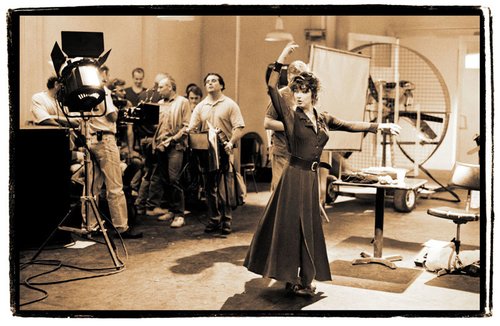
IN THIS PHOTO: Kate Bush on the set of the 1993 short film, The Line, the Cross and the Curve/PHOTO CREDIT: Guido Harari 

Kate Bush and How Her Talent Would Translate Into Film Composition

___________

KATE Bush…
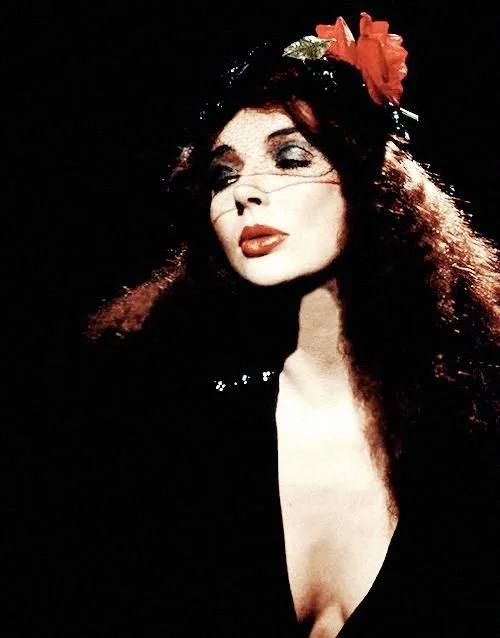
 IN THIS PHOTO: Kate Bush in the video for Hammer Horror (a single released from 1978’s Lionheart)

is a big film and T.V. fan. Since her childhood, she has taken influence from the screen when it comes to her songwriting. I am not sure how much of a film buff she is today, but one suspects the Bush family does get to the cinema now and then. She understands the importance and impact film and T.V. can have on someone. I think she is someone who owes a lot to that medium. Although she does not give permission much for her songs to be used on screen, we have seen her music feature. This Woman’s Work first appeared on the film, She’s Having a Baby, before it was on The Sensual World in 1989. Bush is more used to composing traditional songs, yet she did a series of commercials for a drinks company, Fruitopia, in 1994. This consisted of a few short musical pieces that soundtracked particular flavours. It was an unexpected move for Bush, though she must have been intrigued by the chance to compose scores rather than songs. I feel she is an artist who would excel when it came to a film score. It is not unusual for artists to do this. Radiohead’s Thom Yorke and Jonny Greenwood have done so. Listen to Bush’s albums where strings come to the fore on various songs (2005’s Aerial is a prime example) and you can feel this sort of classical composer working away.

Even on albums without much strong work, the musical innovation throughout is incredible. I am not sure which genre Bush is a bigger fan of, though I could see her composing something for a thriller or horror film. Thom Yorke’s score for Suspiria (2018) could act as a guide. Maybe working out of Abbey Road Studios, a film with Kate Bush composing the score would be a real treat! Of course, fans would probably prefer a studio album from her where we get to hear new songs. It wouldn’t be to far-fetched to imagine Bush adding her name to a film score. She worked with the Trio Bulgarka (a Bulgarian vocal ensemble) on The Sensual World (1989) and The Red Shoes (1993). Adding a flavour of that to a stirring song could prove interesting! Think about how horror has inspired her music through her career. Hammer Horror, Get Out of My House and Hounds of Love are either influenced by or included references to horror films or literature. In truth, there I no genre Kate Bush could not own and do a wonderful job on! I am surprised she has not recorded a score before. She has had offers to appear in films herself. She did contribute a song, Be Kind to My Mistakes, to the 1987 film, Castaway (which she was approached to appear in).

In terms of 2022, I keep saying that we will see music from her at some point. Maybe the tragedy in Ukraine will prove sobering and affect her in terms of drive and inspiration. I am not certain whether we will get a new album this year. Let’s hope that we do. Maybe she has been approached to compose for a film. Perhaps people are a bit scared to do so. I can picture Bush in a studio listening to an orchestra or working alongside musicians from various areas of the world to create a rich, colourful and unique cocktail that is very much her own vision! Bush, I feel, is a visual writer where she projects images and scenes in her head when she is writing. As inspired by the visual mediums as much as any artist, a natural translation into score composition would delight fans. She would definitely excel in that role. Who knows when it comes to Kate Bush. I thought about this career expansion when listening to albums like The Dreaming (1982), Hounds of Love (1985) and Aerial. There are symphonic qualities to those albums. Such interesting compositions throughout. She can rouse the spirits and build big scenes; she can also take things down and portray intimacy and something much less atmospheric. All of this experience and ability would aid and heighten any film score. So many people would relish the opportunity to hear Bush’s music on the big screen. Whilst her studio tracks have appeared in films, she herself has not created original scores for any motion picture. Hearing a brilliant film score from the iconic Kate Bush is something that we…

MAY see one day.

FEATURE: Friends and Neighbours… Why the Loss of a Television Icon Is Not Only a Big Loss to the Acting World

FEATURE:


Friends and Neighbours…

PHOTO CREDIT: Channel 5

Why the Loss of a Television Icon Is Not Only a Big Loss to the Acting World

___________

EVEN though…

 IN THIS PHOTO: Jackie Woodburne and Alan Fletcher have played Susan and Dr. Karl Kennedy on Neighbours since 1994/PHOTO CREDIT: Channel 5

the news of Neighbours’ forthcoming end is not in the same leagues as what is happening in Ukraine and wider afield, I feel that some have taken that announcement too casually. Sure, one cannot match and compare a television series finishing with a war. Ironically, for so many of us right now, the long-running and iconic Neighbours has been a lifeline and much-needed dose of sunshine, escape and company. I am a music journalist, so I am going to tie this to music and why, through its thirty-seven year run, the Australian series has provided the music world with some superstars. Its end, therefore, also denies us of more potential artists. Some may say that great artists will be discovered either way, though the fact that Neighbours is a hugely loved platform with a big audience means that they can discovered quicker. That acting experience also is hugely beneficial regarding their music careers. It is not only about the potential loss of artists that is sad. Before I go on, and in case you were not aware, Variety were among the many who reported the news:

The future of long-running Australian soap opera “Neighbours” is in question following its cancellation by ViacomCBS-owned U.K. broadcaster Channel 5.

The soap, produced by Fremantle and now in its 37th season, is watched by 1.5 million viewers a day in the U.K. but Variety understands that its Australian audience is on the wane. Although “Neighbours” is produced in Australia, it is largely bankrolled by Channel 5.

Australia’s Network 10, which airs the soap on its 10 Peach channel, is only a part funder

A Channel 5 spokesperson told Variety: “’Neighbours’ will no longer air on Channel 5 beyond this summer. It’s been a much-loved part of our schedule for more than a decade, and we’d like to thank the cast, Fremantle and all of the production team for their fantastic work on this iconic series.”

“We’d also of course like to thank the fans for their loyal support of ‘Neighbours’ across the years,” the spokesperson added. “We recognize that there will be disappointment about this decision, however our current focus is on increasing our investment in original U.K. drama, which has strong appeal for our viewers.”

News of the show’s cancellation has come as a shock to cast and crew, which total around 150 people. Sources tell Variety that conversations have been ongoing about the program’s future beyond Channel 5, but no decisions have been made as of yet and aren’t thought to be imminent.

Channel 5 first began airing “Neighbours” in 2008, and struck a new deal for the program in 2018 that allowed it to air all year round. In the last few years, however, priorities have changed for the channel, which has enjoyed success with new dramas such as “All Creatures Great and Small.”

In an email to the “Neighbours” cast and crew, Fremantle said: “Our audience remains steady and Channel 10 would love the show to continue if we could find another broadcast partner to replace. These discussions are ongoing however there is no new broadcaster at the moment and production must end, effectively resting the show.”

The soap featured several performers who would go on to stardom including Kylie Minogue, Margot Robbie, Russell Crowe and Guy Pearce”.

It is real tragic that Channel 5 here have decided not to fund and broadcast Neighbours anymore. Being British, there is almost this sense of guilt that we have let down our Australian cousins! Yesterday (18th Mach) was the thirty-seventh anniversary of the series. It was a bittersweet day; one where fans around the world remembered and paid tribute to the show, in addition to expressing sadness of its forthcoming end. The fact that the U.K. and Australia have a bond and there are similarities between the nations accounts for the fact that Neighbours is so adored here. More popular in the U.K. than Australia in a lot of ways, I am surprised the BBC did not help rescue the show. Before getting to the music, it is worth addressing a couple of points. I do not think a T.V. show should be belittled or mocked if you do not like it. There have been long-running comedies that have ended I was gutted about (Brooklyn Nine-Nine and Black-ish in the U.S.). It is the familiarity and routine of watching a show like Neighbours that means its (in my view) premature end is moving. Even though it has run for almost four decades, it is showcasing a crop of incredible young actors who, together with the established legends, could keep the show going for many more years. Richie Morris (Levi Canning), Charlotte Chimes (Nicolette Stone) and Freya Van Dyke (Zara Selwyn) are bright and promising actors who have helped keep Neighbours fresh and appealing.

Ben Turland (Hendrix Grayson) and Georgia Stone (Mackenzie Hargreaves) are amazing together – they play a couple in the show -, and I could well see them having careers in film. One of my favourite actors on the show is April Rose Pengilly. Having played Chloe Brennan since 2018, she is one of the show’s most popular cast members and characters. With an incredible range, presence and charm, she is an actor who can play any emotion with perfection. Eminently likable and hugely powerful, it would have been interesting to see her character’s arc in the coming years. I am sure Pengilly will have offers from the U.S. She could make it there in the U.K. without doubt. She is also someone who would have a career in the U.K. That said, being based in Australia, perhaps uprooting and living in the U.K. might not be on her radar at the moment! I know there is a great range of Australian shows being made and shown at the moment. Although the industry is not as big as it is here or America, many of the cast will be able to find new homes. That is not the point. Watching actors like Pengilly every weekday in a very warm and familiar setting has been a blessing! The sense of escape has been very much needed. One can imagine themselves in Ramsay Street (the focal point of Neighbours) and becoming immersed. I started watching the show when I was about seven or eight. This would have been right at the start of the 1990s. Perhaps the character that first struck me was Jarrod ‘Toadfish’ Rebecchi (Ryan Moloney). Back in the 1990s, he sported a mullet and some pretty loud shirts! His character has calmed down a bit. Seeing actors like that still on a show I remember vividly as a child keeps me connected with that past. One that was carefree and filled with memories and friends.

That is one of the things about Neighbours. It does feel like you are watching friends and neighbours on the screen! It is a show that has fostered tremendous actors like Margot Robbie and Guy Pearce. An invaluable way to cut their teeth and get that essential training and exposure, I look at the current young cast and there are several that are primed for bigger things. As we have to say goodbye to a show that has some legendary characters (from Paul Robinson through to the Susan and Karl Kennedy) this summer will be very hard! Not only have award-winning actors and major stars passed through the Neighbours doors through the decades; the musicians who started out there is amazing! Neighbours is a show that gives this opportunity to actors who have the promise to be among the world’s very best. Its loss is going to be a big blow to Hollywood and the acting world. From Natalie Imbruglia, to Kylie Minogue, to Delta Goodrem, Neighbours has been on their C.V. longer than their professional music careers! Minogue is probably the most famous export. I do not think her career in music would be as big and successful were it not for Neighbours. I can imagine there are young members in the cast or actors that were going to come through that would have ended up in music. I feel Bonnie Anderson is the latest cast member who has departed Neighbours and pursued music. Maybe we may not have seen icons like Kylie Minogue start their life in Neighbours, though we definitely would have seen some big musicians begin here!

The Australian music scene is definitely fertile and varied. Maybe not as championed in the U.K. and U.S. as homegrown artists, each state and territory offer a different flavour and sound. I have always been fascinated by artists coming out of Brisbane, Hobart and Sydney. Neighbours is filmed in Melbourne. No surprise that some spectacular artists from Melbourne (Kylie Minogue for example) started on Neighbours and found music fame. Some great bands and artists are coming out of Melbourne right now. It is a city with such a proud history. I have never been, but it is top of my lift of places to visit. Although blogs and music magazines mean artists from Melbourne will never be ignored or lost, series like Neighbours can showcase artists first-hand. It is also a way for potential artists to get acting experience that they can bring to their music. As someone who loves what is coming out of Melbourne, I think we would have seen a lot of great young artists begin their path on Neighbours. The show also features music both diegetic and sound-tracked. We get to hear artists played in the show. Another invaluable resource for them and music fans! As much as I love the show and think cast members like April Rose Pengilly and Ben Turland will continue their careers in Australia, the U.S. or U.K., the hole and void that will be on the T.V. screens who have watched the show for years will be immense! The sun, smile and, yes, drama that we get from shows like Neighbours has been more essential since the pandemic struck than ever before! It has given us some fine actors, brilliant and timeless scenes, great moments and, also, wonderful artists. It will be interesting to see how Neighbours winds down and what happens in the final episode around August. I think they are shooting that episode in June. Having acquired a legion of fans since its start in 1985, Neighbours is a television institute that so many people will be…

SO sad to see it go.

FEATURE: People Everyday: Arrested Development’s 3 Years, 5 Months and 2 Days in the Life Of... at Thirty

FEATURE:


People Everyday

Arrested Development’s 3 Years, 5 Months and 2 Days in the Life Of... at Thirty

___________

ON 24th March…

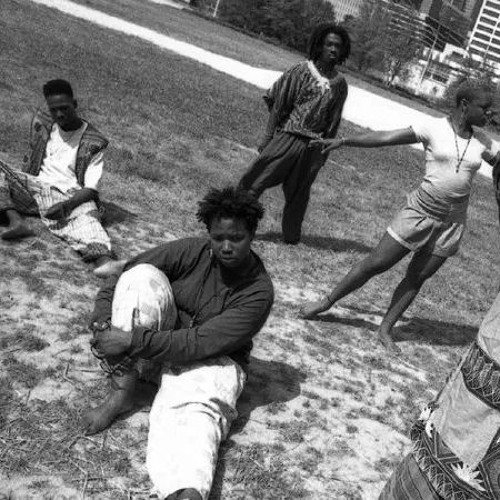
one of the greatest Hip-Hop albums ever turns thirty. As opposed a lot of the Gangsta Rap that was around in 1992 (Dr. Dre is an example), Arrested Development’s amazing debut, 3 Years, 5 Months and 2 Days in the Life Of... was more concerned with fostering peace and love; changing the bad things around us and opening eyes to injustices. If a lot of Hip-Hop at that time was concerned with darker and more violent themes, Arrest Development were more like preachers. Trying to calm things down and offer a more positive thing into the world. The title refers the length of time it took for the Atlanta group to get a record deal. Their debut was released through Chrysalis/EMI on 24th March, 1992. Produced by Speech and with terrific performances from everyone in the group (with especially fine and memorable vocals from Dionne Farris), 3 Years, 5 Months and 2 Days in the Life Of... is an album that offers up so much. Whilst it does not seem revolutionary today, Arrested Development’s stunning debut did offer an alternative Hip-Hop take. Classic songs like People Everyday, Tennessee, and Mr. Wendall are played widely to this day. Speech’s songwriting and the efficient and effective use of samples (Sunshine by Earth, Wind & Fire features on Natural; Alphabet St. by Prince (among others) can be heard on Tennessee) means we get this marriage of different worlds. Fusing older records with this modern and forward-looking set of lyrics makes 3 Years, 5 Months and 2 Days in the Life Of... very special. I will draw in a couple of reviews of a truly awesome and awe-inspiring album.

Maybe, given the Hip-Hop we hear today, Arrested Development’s debut has not dated as well as some other albums of the time. I love the Daisy Age work of genius from De La Soul, 3 Feet High and Rising. By 1992, that was very much dead in the water. There was definitely more of an edge and attitude coming through in Hip-Hop. 3 Years, 5 Months and 2 Days in the Life Of... was definitely something different reactionary. To mark its anniversary last year, Udiscovermusic.com contextualised the 1992 album. They explain what was happening in Hip-Hop when Arrested Development broke through:

Hip-hop was in a state of flux in 1992. The conscious, Afrocentric rap of Jungle Brothers had failed to catch fire in a major label environment. De La Soul had renounced their DAISY Age agenda, and even A Tribe Called Quest, for many fans the best of this new, less aggressive generation of rap acts, were struggling to get their voice heard amid a slew of gangsta stars such as Dr. Dre, Ice Cube, and Geto Boys. The term “alternative rap” was starting to sound more like a put-down than a description. You may have been forgiven for thinking that 3 Years, 5 Months And 2 Days In The Life Of… was not the name of the debut album by Arrested Development, rather the lifespan of the alternative acts who seemed to be facing their demise.

Into this uncertain arena came a thoughtful collective that not only spoke of revolution, humanity, roots, spiritual matters, and unity, but also came from the South rather than the rival rap hubs on the East and West coasts. Why, their debut album featured songs about the homeless, put-upon women, the importance of childcare, and more unfashionable topics, and didn’t even look like a hip-hop record, with a cover depicting endless blue sky and sun-parched grass. What chance did Arrested Development stand?

Quite a big one, it turned out. Fronted by the busy, buzzing Speech, who also produced their records, with two prominent female members in Montsho Eshe and Aerle Taree; plus co-founder turntablist Headliner and, from their parents’ generation, Baba Oje as spiritual adviser, together with various vocalists and instrumentalists, stylists and dance-have-yous, compared to most hip-hop acts they might have fallen to earth from space. But once they began releasing records, their impact was immediate: their debut single, “Tennessee,” went Top 10 in the US and topped the rap and R&B charts. Quite an achievement for a record covering the oppression and roots of black people in the South, and inspired by the deaths of two of Speech’s close relatives. This group was not just acting different: their feel came from the heart.

The single was released on March 24, 1992, the same day as their debut album, 3 Years, 5 Months And 2 Days In The Life Of…, which opened with cut-ups including the words “man’s final frontier is the soul,” a message that resonated throughout this album.

While they soon became known for mellow, even tender-hearted singles, the point needs to be made that Arrested Development’s debut album is actually pretty raucous, as the second track, “Mama’s Always On Stage,” makes clear, sampling a honking Buddy Guy and Junior Wells tune and hurtling like a skydiver without a ’chute. The anthemic “People Everyday,” reversing the title but not the message of Sly & The Family Stone’s “Everyday People,” is not the laidback remix of the single version, but a grittier, harder-edged cut that emphasizes the tougher side of Speech’s lyric that often passed unnoticed. On the other hand, “Mr. Wendal” is every bit as accessible as its single sibling, but the mellow groove is used to make a point about homelessness and respect; putting their money where their mouths were, the group gave half their royalties from the song to homeless charities.

So, a light feel delivers a heavy message. That combo comes up again on “Raining Revolution,” a meditation on precipitation and its place in feeding body, soul, and spirit. More water metaphors appear on the upbeat “Fishin’ 4 Religion,” which demands a belief system that nurtures improvement for people – again, “revolution” is mentioned. Further piscine poetry follows on “Give A Man A Fish,” a Minnie Riperton-sampling set of thoughts on how to make the nation rise, which rejects gangsterism and talks politics and armed rebellion. Love, a little-mentioned rap topic in 1992, crops up in “U,” a whirling jazzy loop courtesy of Ramsey Lewis and whipped into a frenzy of desire in an onrushing tale of emotional longing.

There’s back-to-nature roots material on 3 Years, 5 Months And 2 Days In The Life Of… too. “Eve Of Reality” is a shimmering tribal instrumental that sounds like it dates from the dawn of human existence, and “Children Play With Earth” calls for raising your kids to respect the soil we’re rooted in: a literal hands-on environmentalism. “Natural” hits a different note, both musically and lyrically, noting the craving for a love partner that’s as old as time. “Dawn Of The Dreads” links the pan-Africanism of early 90s hip-hop with Rastafarianism through an encounter with a woman who understands Speech’s vibe. This is complex stuff and the group aren’t afraid to just let it unfold: the closing “Washed Away” is more than six minutes of spiritual thought, which sounds dry on paper but is actually compelling listening; hip-hop had barely attempted material like this since The Last Poets’ “Delights Of The Garden” in 1977.

3 Years, 5 Months And 2 Days In The Life Of… was no ordinary hip-hop album in 1992. And that remains the case today. There’s a lot to absorb; repeated listening delivers aspects you’d previously not noticed: a wailing vocal here, a blues lick there (and there’s quite a lot of blues present, not a musical form rap often acknowledged). It might take you just as long as the title suggests to soak it all up”.

Some people who have not rated 3 Years, 5 Months and 2 Days in the Life Of... as a classic feel that it was niche and is dated. Not as hard-hitting and political as other albums of the time, perhaps it was part of a much-needed movement and moment in 1992…though that has shifted and we do not hear much Hip-Hop like it anymore. It is a shame, as the best moments from 3 Years, 5 Months and 2 Days in the Life Of... are remarkable and absolutely timeless. From People Everyday to Give a Man a Fish, through to Mr. Wendall and Tennessee, to the incredible, Children Play with Earth, 3 Years, 5 Months and 2 Days in the Life Of... is such an amazingly strong album. The BBC said this in their review of the album back in 2009:

Arrested Development breezed on to the scene in 1992 and made the year their own with this, their super-confident debut. 3 Years, 5 Months and 2 Days In The Life Of... (the exact length of time it took for the group to get a recording contract) was one of those records that arrived fully-formed, making everything that had gone before in the world of hip-hop sound rather passé.

Formed by rappers Speech and Headliner and inspired by Public Enemy, Arrested Development espoused afro-centricity, feminism, love and harmony, and were an antidote to the machismo of Gansgta Rap, then very much on the rise.

3 Years... was rightly lauded at the time; it is resolutely upbeat – none more than on Give A Man A Fish with its chorus, ''give a man a fish he’ll eat for a day, teach him how to fish he’ll eat forever''. The three US Top 10 singles, People Everyday, Mr Wendal and Tennessee seemed to be everywhere. People Everyday, which updated Sly and The Family Stone's Everyday People, showed how they could embrace the past while modernising the message. The tale of a man having to use violence in self defence against a gang is like most of their work, deeply thoughtful with a generous splash of wit (''I had to take the brother out for being rude'')”.

To end things, I will source one more review. AllMusic are among those who have provided Arrested Development’s iconic debut album with a positive review. This is what they wrote:

Widely adored when it appeared in 1992, Arrested Development's debut album, 3 Years, 5 Months & 2 Days in the Life Of... seemed to herald a shining new era in alternative rap, when audiences and critics of all colors could agree on the music's importance. Of course, that didn't happen, as Dr. Dre instead took gangsta rap to the top of the charts with The Chronic. In retrospect, 3 Years... isn't quite as revolutionary as it first seemed, though it's still a fine record that often crosses the line into excellence. Its positive messages were the chief selling point for many rock critics, and it's filled with pleas for black unity and brotherly compassion, as well as a devotion to the struggle for equality. All of that is grounded in a simple, upbeat spirituality that also results in tributes to the homeless (the hit "Mr. Wendal"), black women of all shapes and sizes, and the natural world. It's determinedly down to earth, and that aesthetic informs the group's music as well. Their sound is a laid-back, southern-fried groove informed by rural blues, African percussion, funk, and melodic R&B. All of it comes together on the classic single "Tennessee," which takes lead rapper Speech on a spiritual quest to reclaim his heritage in a south still haunted by its history. It helped Arrested Development become the first rap group to win a Grammy for Best New Artist, and to top numerous year-end critical polls. In hindsight, there's a distinct political correctness -- even naïveté -- in the lyrics, which places the record firmly in the early '90s; it's also a bit self-consciously profound at times, lacking the playfulness of peers like the Native Tongues. Nonetheless, 3 Years... was a major influence on a new breed of alternative Southern hip-hop, including Goodie Mob, OutKast, and Nappy Roots, and it still stands as one of the better albums of its kind”.

As it turns thirty on 24th March, I wanted to look at the important, moving, wonderous and accomplished 3 Years, 5 Months and 2 Days in the Life Of... Against the bravado and macho Hip-Hop of the early-1990s, Arrested Development pushed back. They offered something much more spiritual and inspiring. That is why 3 Years, 5 Months and 2 Days in the Life Of... will always remain relevant, influential and…

GREATLY loved.

FEATURE: Where Do I Begin? The Chemical Brothers’ Dig Your Own Hole at Twenty-Five

FEATURE:


Where Do I Begin?

The Chemical Brothers’ Dig Your Own Hole at Twenty-Five

___________

TWO years after…

 PHOTO CREDIT: Dave Tonge/Getty Images

their amazing debut album, Exit Planet Dust, The Chemical Brothers (Tom Rowlands and Ed Simons) keep that hot streak going with Dig Your Own Hole. I think the best three albums from the duo include their first two, plus their third studio album, Surrender (1999). I think that Dig Your Own Hole might be their strongest and most important album. Released on 7th April, we mark twenty-five years of a classic. I feel 1997 was a year when things changed a lot in music. Britpop and other scenes were dying out. We were seeing more Electronic and Big Beat albums coming through. Bands who started recording a particular way pushed their boundaries and adopted new sounds (Radiohead’s OK Computer (1997) is a great example). Featuring some of the duo’s biggest songs, Block Rockin' Beats and Setting Sun are classics. An album that every fan of music should have in their collection, I want to use this feature to combine a couple of retrospective articles together with some positive reviews.  To start, this article form last April talks about how inspired The Chemical Brothers are on Dig Your Own Hole. The use of guest spots (Noel Gallagher appears on Setting Sun for instance) works brilliantly well:

The Chems had their roots in blazing dance music, so they still sounded freshest of all on the classic, punishing opener and single, “Block Rockin’ Beats,” which smoothed their formula slightly for the benefit of the masses, but kept all the raw bass, the breakbeats, and the flickers of scratching. The title track then upped the BPMs convincingly, before “Elektrobank” blasted the doors off their hinges. An early harbinger of the electro revival, which only reached full momentum in the new millennium, “Elektrobank” featured the voice of Kool Herc in a nod to hip-hop’s earliest days, and was so propulsive that it nearly juddered itself into pieces, before slurring into a brain-bashing arc of psychedelia.

This signaled the direction for much of the rest of the set, segueing, in traditional Chems fashion, into the mind-expanding glitches of “Piku.” Then the older Gallagher brother loomed over the skyline, heralding the album’s lead single, “Setting Sun.” The Chems had him freefalling into deep water, before he emerged transformed by – and slathered in – electronic trickery. It was a clear update of The Beatles’ late 60s psychedelic period, yet made the group’s own by the undeniable power of their mountain-destroying guitars and lashing beats. Who needed the 60s now?

(Beth) Orton graced the more pastoral, gently pulsating psych piece “Where Do I Begin,” which almost had a touch of 80s indie-pop to it, before the beats crashed in once more. The indie-psych crossover theme was, however, most notable of all on album closer “The Private Psychedelic Reel,” a nine-minute single which featured reverb-soaked clarinet input from hazy American psych-rockers Mercury Rev.

Dig Your Own Hole built on the duo’s debut, and set the tone for the rest of their career to date. Time and again, The Chemical Brothers have produced collections that start out from dance music’s sometimes forbidding fortress, and yet offer variety, depth, and inspired guest spots, both from established acts and glittering new arrivals”.

DJ Mag featured Dig Your Own Hole back in 2018. They argue that, whilst it might not be The Chemical Brothers’ greatest album (I argue it is), it is one of their most important and inspired:

Dig Your Own Hole' was perhaps not the best electronic album of the 1990s. But there is an argument to be made that it was the most representative, an album that united many of the dance music trends of the decade, while simultaneously blazing brilliant new trails for other acts to follow.

With the release of their debut album, 1995’s ‘Exit Planet Dust’, The Chemical Brothers were still seen in many quarters as representing the lingering remnants of big beat: a fun, if rather shallow, mid ’90s dance phenomenon that combined rock music structures with electronic production. After 1997’s ‘Dig Your Own Hole’, however, it was impossible to see The Chemical Brothers as anything but their own men, a legacy that has stayed with them until today. Open up a new Chemical Brothers album in 2018 and you genuinely don’t know what to expect, from shiny trance fusion to soil-worn psychedelia. This is the legacy of ‘Dig Your Own Hole’, an album that radiated ambition and adventure, as Tom Rowlands and Ed Simons matured as producers, growing up without ever growing old.

‘Dig Your Own Hole’ is an album that can be cut in many different ways, an album that is packed with stories. Within the album’s opening five tracks alone you can find big beat Chemicals (opener ‘Block Rockin’ Beats’, an improbable minor hit on Billboard’s Modern Rock Tracks); electro Chemicals (‘Elektrobank’); hip-hop Chemicals (‘Piku’, whose lolloping groove foreshadows later collaborations with MCs Q-Tip and k-os); and Britpop Chemicals (‘Setting Sun’ with Noel Gallagher, a vast UK hit in the summer of 1996). What is telling is that, even when The Chemical Brothers aren’t at their most adventurous — ‘Block Rockin’ Beats’ could have fit fairly squarely on ‘Exit Planet Dust’, while the duo had already gone down the indie guest vocal route on ‘Life Is Sweet’ with The Charlatans’ Tim Burgess — there is a real confidence to their sound, as if they had taken everything they achieved on their debut album and rendered it in Technicolor.

The song’s waft of psychedelia continues into ‘The Private Psychedelic Reel’, the most ambitious song The Chemical Brothers have ever recorded, combining a sitar hook, great shimmering walls of noise, a clarinet freak out and a stirring chord sequence into a nine-minute masterpiece of psychedelia that you can genuinely lose yourself in. The song takes its name from a recording The Beatles were alleged to have made to soundtrack their acid trips and, incredibly, it actually lives up to its moniker. The Chemical Brothers were big Beatles fans, referencing Ringo’s driving, lopsided beat to ‘Tomorrow Never Knows’ on ‘Setting Sun’. But it is on ‘The Private Psychedelic Reel’ where they approach their idols’ grandiose sense of psychedelic adventure, creating an absolute monster of musical liberty.

It is a fitting closer for an album that remains almost unparalleled in electronic music for scope and adventure. Individually, the 11 tracks on ‘Dig Your Own Hole’ are fantastic; collectively they add up to a milestone of musical ambition, one that stinks of the sheer possibility of the electronic sound. In many ways, ‘Dig Your Own Hole’ is a nostalgic album, a reminder of an age in which Britpop, rock, beats, clarinets and psychedelic reels were united in the hearts of open-minded ravers. But it is very forward-looking too, its genre-hopping foreshadowing the post-genre pop world in which we now live. The Chemical Brothers didn’t just dig their own hole back in 1997, then; they dug out a new space for everyone”.

Even if you are not a big fan of The Chemical Brothers or genres like Big Beat and Breakbeat, there are songs on Dig Your Own Hole that will capture you. Mixing different effects, vocals and layers, it is a sublime album that still sound remarkable and layered. I heard the album when it came out in 1997, and I am still picking up on new things twenty-five years later. On 7th April, we get to mark a quarter-century of a ground-breaking album. In their review, AllMusic wrote this in their review:

Taking the swirling eclecticism of their post-techno debut, Exit Planet Dust, to the extreme, the Chemical Brothers blow all stylistic boundaries down with their second album, Dig Your Own Hole. Bigger, bolder, and more adventurous than Exit Planet Dust, Dig Your Own Hole opens with the slamming cacophony of "Block Rockin' Beats," where hip-hop meets hardcore techno, complete with a Schoolly D sample and an elastic bass riff. Everything is going on at once in "Block Rockin' Beats," and it sets the pace for the rest of the record, where songs and styles blur into a continuous kaleidoscope of sound. It rocks hard enough for the pop audience, but it doesn't compromise either the Chemicals' sound or the adventurous, futuristic spirit of electronica -- even "Setting Sun," with its sly homages to the Beatles' "Tomorrow Never Knows" and Noel Gallagher's twisting, catchy melody, doesn't sound like retro psychedelia; it sounds vibrant, unexpected, and utterly contemporary. There are no distinctions between different styles, and the Chemicals sound as if they're having fun, building Dig Your Own Hole from fragments of the past, distorting the rhythms and samples, and pushing it forward with an intoxicating rush of synthesizers, electronics, and layered drum machines. The Chemical Brothers might not push forward into self-consciously arty territories like some of their electronic peers, but they have more style and focus, constructing a blindingly innovative and relentlessly propulsive album that's an exhilarating listen -- one that sounds positively new but utterly inviting at the same time”.

The final thing I am including is a review from NME. I remember the excitement from fans and the music press when The Chemical Brothers followed their 1995 debut (which was hugely successful) with Dig Your Own Hole:

 “The world of 'Dig Your Own Hole', that is - bruised, pissed, moody, stubborn, phenomenally cocksure. A trashing of all dance music's spiritual, pacifying potential. A record designed not to calm savage beasts, but to make them even madder...

It's fabulous, actually. The images we customarily imagine techno to soundtrack - great empty vistas of space, a stainless, genteel vision of the future - don't apply here. Rather, the Chemicals conjure up a grimy, urban and unavoidably violent nightworld. As the speedy, sliding title track whizzes by - a bit like 'Firestarter' but meaner, less camp - it evokes cars crashing, buildings collapsing, faces melting... everything, with compelling inevitability, exploding. Edge-of-the-seat stuff, if you're still sitting down.

Which is unlikely, frankly. If 1995's 'Exit Planet Dust' was a rough'n'ready story-so-far, 'Dig Your Own Hole' is the fully-honed full-on block-rocking cortex-hammering take-no-prisoners real deal, the album whose party omnipotence will only be matched in '97 by The Prodigy's tortuously awaited third excursion. The first three-quarters - 45 seamless minutes

Reaching number one in the U.K. and hitting the top twenty in the U.S., Dig Your Own Hole arrived ta a perfect moment. There was as shift and evolution in the musical landscape. 1997 also saw Björk release Homogenic. It was a time when these amazing artists were releasing immense work. I think that Dig Your Own Hole is one of the best albums of the 1990s. It is such a mesmeric and mind-blowing album that is beyond criticism. Eleven incredible tracks that take you somewhere else, I was eager and excited to mark the upcoming twenty-fifth anniversary of The Chemical Brothers’…

GLORIOUS second album.

FEATURE: Groovelines: Elton John – Rocket Man (I Think It's Going to Be a Long, Long Time)

FEATURE:


Groovelines

Elton John – Rocket Man (I Think It's Going to Be a Long, Long Time)

___________

THERE are a couple of reasons…

 IN THIS PHOTO: Elton John in 1972/PHOTO CREDIT: Terry O’Neill/Iconic Images/Getty Images

why I am celebrating Elton John’s hit, Rocket Man (I Think It's Going to Be a Long, Long Time). I have not featured it on Groovelines before. It turns fifty next month, so I wanted to look ahead to the anniversary and celebrate a classic song. As an article I am about to bring in attests, there were a few songs about space exploration out in the early-1970s. As the Moon landing happened in 1969 and the possibility of space exploration was opened, this boundary-breaking history meant that artists were fascinated and reflecting the times. Also, Elton John turns seventy-five on 25th March. I wanted to salute an iconic songwriter who, through the years, has released some of the most memorable music ever. Reaching number two in the U.K., Rocket Man (I Think It's Going to Be a Long, Long Time) is a gem of a track. Released on 17th April, 1972, it was the lead song from John’s fifth studio album, Honky Château. In this feature, Far Out Magazine tell the story of one of the greatest songs ever released:

Space curiosity was at its peak during the time of the production of the song. When it was released, the Apollo 16 Mission landed men on the lunar surface for the fifth time. The song narrates the tale of a young boy called Doug, whose astronaut father is sent to space frequently as a part of an exploration programme that requires him to take three months journey at a regular interval. Although Doug feels his father’s absence, he still aspires to be like him one day. The father, on the other hand, has mixed feelings about this entire adventure. It breaks his heart to leave his family behind, but the call of the stars and endless void tempts him as well: “You don’t know what it is. Every time I’m out there I think, if I ever get back to Earth I’ll stay there; I’ll never go out again. But I got out, and I guess I’ll always go out.” He commits to one last mission that ends with dire consequences.

Taupin talked about the influence behind the song in 2016, explaining: “People identify it, unfortunately, with David Bowie’s Space Oddity. It actually wasn’t inspired by that at all; it was actually inspired by a story by Ray Bradbury, from his book of science fiction short stories called The Illustrated Man. In that book, there was a story called The Rocket Man, which was about how astronauts in the future would become a sort of everyday job. So, I kind of took that idea and ran with that.” However, John admitted to being unaware of this fact: “Do you know, I never knew that?”

Ray Bradbury’s story was the basis of another song of the same name that pre-dated John’s record and was released by the folk group Pearls Before Swine. In their song, the child can no longer look at the stars admiringly after being disillusioned by his father’s death. Taupin openly admitted to borrowing ideas from Pearls’ 1970 song, saying: “It’s common knowledge that songwriters are great thieves, and this is a perfect example.”

The opening lines, which read: “She packed my bags last night, pre-flight. Zero hour: 9am. And I’m gonna be high as a kite by then,” was conceived by Taupin while he was driving to his parents in Lincolnshire, England. Anxious that he’ll forget the lines, he drove some back roads as fast as he could to put it down on paper. Until he reached their house he had to “repeat it to himself for two hours,” which was “unfortunate” but also worthwhile given the magnanimous status the song achieved.

A ballad rooted in piano, the song added extra textures through an atmospheric synthesiser and processed slide guitar. The synthesiser was played by the recording engineer David Hentschel while the backing vocals featured Dee Murray, Nigel Olsson and Davey Johnstone, the trio that was to become signature backing voices in John’s other songs. It was produced by Gus Dudgeon, the same person who worked with Bowie on his 1969 release ‘Space Oddity’”.

Kate Bush released Rocket Man (I Think It's Going to Be a Long, Long Time) as a single in 1991. Reaching number twelve in the U.K, it weas released for the Two Rooms: Celebrating the Songs of Elton John & Bernie Taupin album. Her version is brilliant and has this Reggae vibe. She is a big fan of Elton John and has loved his music since she was a child. The two worked together on her 2011 album, 50 Words for Snow. I think that this is a track we will be playing and remembering decades from now. It is definitely one of Elton John’s greatest tracks. Before wrapping up, it is worth bringing in some Wikipedia information about the video for the song (which was released five years ago):

In May 2017, an official music video for "Rocket Man" premiered at the Cannes Film Festival as a winner of Elton John: The Cut, a competition organised in partnership with AKQA, Pulse Films, and YouTube in honour of the fiftieth anniversary of his songwriting relationship with Bernie Taupin. The competition called upon independent filmmakers to submit treatments for music videos for one of three Elton John songs from the 1970s, with each song falling within a specific concept category. "Rocket Man" was designated for the animation category, and was co-directed by Iranian refugee Majid Adin and Irish animation director Stephen McNally; the video was inspired by Adin's own migration to England, portraying a character envisioning himself as an astronaut to draw parallels between the song's lyrics and the experiences of a refugee”.

As it turns fifty next month, I wanted to highlight and explore the legendary track, Rocket Man (I Think It's Going to Be a Long, Long Time). Its performer turns seventy-five on 25th March. When it comes to the all-time best Elton John songs, this 1972 slice of brilliance…

IS hard to beat.

FEATURE: Spotlight: MICHELLE

FEATURE:


Spotlight

MICHELLE

___________

A group I have not featured before…

 PHOTO CREDIT: Daniel Dorsa

the amazing MICHELLE released the album, AFTER DINNER WE TALK DREAMS, in January. The N.Y.C.-based group have released an incredible album. I will come to a review for it at the end. Before that, there are a few interviews that I wanted to include. Before that even, here is some biography about the stunning MICHELLE:

Born-and-bred New Yorkers, MICHELLE formed in 2018 and is comprised of Sofia D'Angelo, Julian Kaufman, Charlie Kilgore, Layla Ku, Emma Lee and Jamee Lockard. The predominantly POC and queer collective mix and match the writing and production groups amongst the six of them.

The hallmarks of MICHELLE's music—layered vocal harmonies, analog synthesizers, vibrant percussion, smoldering hooks—dominate the sonic landscape of their upcoming album, with the four female vocalists pushing the boundaries of their considerable singing talents as Charlie and Julian’s shared production explodes with fearless creativity and exploration. Despite all the tinkering elsewhere, it is important to note that the vocals remain largely untouched and appear in their organic state. Songs hop across genres, from funky R&B to bedroom slow jams to amped-up beat-heavy anthems and more. The songwriting on AFTER DINNER WE TALK DREAMS has been elevated, as there is a depth and prowess at work that makes good on the promise of the band’s early songs, something they admit was learned by reflecting and allowing room for artistic growth”.

The first interview I want to bring in is from DIY. They spoke with MICHELLE back in November 2020. One of the most interesting and appealing aspects of the group is how they represent modern-day New York. A  diversity in terms of P.o.C, the L.G.B.T.Q.I.A.+ communities, in addition to the eclectic and variegated sound:  

The first time all six members of MICHELLE were in the same room, their debut album had already been released. “We didn’t meet each other until the day of our first show in the middle of November 2018,” reflects singer Layla Ku. “We were all strangers!”

Having been wished into existence earlier that year by producers Julian Kaufman and Charlie Kilgore, the collective formed as the result of a crackpot plan to conjure up a record (September 2018’s resultant ‘HEATWAVE’) that would document Big Apple life in two weeks flat. They assembled a group of singers that they separately knew - some well, others more peripherally - and set up a series of homemade recording sessions, with no more than one or two of the four MICHELLE vocalists included at any one time. Songs would often be written and recorded on the same day and, by the end of the fortnight, all of the ten tracks had been locked down.

Was it touch and go to get it finished in time? “Really, it was just barely, by the drawstrings of our ten year old sweatpants,” laughs Julian. “There was still a lot of post-production to be done afterwards.”

As a band, MICHELLE reflect the modern reality of a city like New York, bringing an eclecticism of interests, upbringings, ethnicities and sexualities together; it electrifies their music with an unconstrained, pan-genre freedom, where slick R&B, cool jazz and angular rock all jostle for supremacy. The diversity of the sound matches the diversity of the six members’ personalities: Julian, they describe as the helping hand - the guy that “brings the sauce” - and Charlie as the “mad scientist”, whereas Layla is “the commissioner”, Sofia D’Angelo “the star”, Jamee Lockard “the student of the month” and Emma Lee “the triple threat” (dancer, visual artist and singer). “If we were all given the same track to write on, I think we would all create very different songs,” says Jamee.

Recent singles ‘UNBOUND’ and ‘SUNRISE’ mark the first two glimpses into the group’s as-yet-unnamed second LP that’s currently in the “cutting down phase”. Their first original album for Transgressive (who also re-released ‘HEATWAVE’ earlier this year), the band enthuse that the production is set to be much larger this time around due to the additional gestation time for the writing process. “We had the time to craft this thing in a way we didn’t before, which will hopefully be rewarding,” says Emma”.

It is impressive that a band who had such an unusual start (in the sense they didn’t meet each other right at the root of their formation) are together now and are stronger than ever. When speaking with The Forty-Five in August 2020, they were asked about how they acquired the confidence to keep going:

The best in sunny, summer anthems. Blending funk, dream pop and simmering jazz sounds, their debut album ‘Heatwave’ gave the collective a platform to spread messages on social justice, and a little bit of joy with musical themes highlighting the stories of young people in New York.

A predominantly queer band with Black members and members of colour, their rise has marked a renewed approach to pop, where representation is not a performative focus and visibility becomes a beautifully normalised element of their group. In anticipation for the release of their new single next month, we caught up with all six members of MICHELLE over Zoom – Julian Kaufman and Charlie Kilgore on production and vocalists Sofia D’Angelo, Jamee Lockard, Layla Ku and Emma Lee – to chat about self confidence, fundraising and their journey so far.

How did you all meet?

Jamee: So we all either knew Charlie or Julian, and this was our summer 2018 project. I knew Charlie from our freshman year of college that we’d just finished, Charlie and Layla went to high school together and Sofia and Layla met organically as part of the New York City music scene. We got together separately, pockets of us got together with Julian and Charlie, recorded the songs the day we wrote them and we didn’t actually all meet until our first concert a couple of months after we released the album!

As a band only a couple of years into your career, how do you find the self confidence to keep going?

Sofia: Interesting question. I never really thought of it in that context before because like Jamee said, we all just came together in 2018 to make a record. None of this was really supposed to happen, we weren’t expecting all of this to get to where it is now. When I left the studio… well, Julian’s apartment, after writing and recording ‘Ideal’, I didn’t think the songs we were playing together would be playing on BBC Radio 1. That was always a dream of mine for music generally, but I never expected it to happen with this. Now that we have this new platform, we want to share the fun that we have with each other, with the world, but also use the platform to empower our fans and our listeners. I think that’s where we get the confidence from – taking advantage of our social media platforms to share resources, share music that we love, share inspiration, share artists of colour that we admire, queer artists that we admire, and share the stage. That’s something that gives us all more confidence in being MICHELLE out there.

You’re a predominantly queer BIPOC band. Do you see your band as a bit like an act of resistance, considering you produce such happy music and you’re being visibly queer BIPOC?

Layla: We were recently talking about how we are such an authentic reflection of where we come from in the sense that it’s not forced and it’s not a product of “oh there’s a demand for representation of these communities, let’s put together a group that amplifies that and meets that demand”. It was actually more “these are the people who were brought into this project because of their talents and their abilities and their skills and desire to work on this together”.

We just all happened to be of very diverse backgrounds, and happened to meet that need for representation that is being pushed to the forefront and is being listened to a little bit more than it has been in the past. But I take a lot of comfort in knowing that we make this music because we want to make that music and that’s what’s come to us and what we’ve gravitated towards and created together. The people behind it and the people making it is an afterthought. What we look like isn’t the first thing we bring to the table. It’s not everything we are”.

I will end with a positive review for MICHELLE’s new album. Just before then, V MAGAZINE celebrated a group that we can celebrate and find joy in. There is plenty of evidence of this on AFTER DINNER WE TALK DREAMS. V MAGAZINE chatted with the group in September last year:

MICHELLE is a band born of unique circumstances in this regard. All the members know each other through either Kaufman or Kilgore, who decided to make an album in 2018; in the early days, there was consideration of calling themselves GERTRUDE. Scattered across the country, the six musicians came together virtually, sharing recordings and sounds until HEATWAVE was born in September—and the first time they were all in a room together wasn’t until months later, in November 2018.

“A lot of people were part of the making of that record, and the record did pretty well,” says D’Angelo. “And then we started doing shows and getting more attention, which required us to make some sacrifices and make some hard choices and make some awesome choices and share some delicious feasts, and also just do a lot of things we’ve never done before, until eventually MICHELLE became the group that it is today with the six of us. Now we’re embarking on a tour in two weeks and releasing our second full-length album.”

While AFTER DINNER WE TALK DREAMS isn’t due until January 2022, the first single from the sophomore album, “SYNCOPATE,” dropped alongside a music video today. For MICHELLE, everything is warm and sunny; their sound is a conglomeration of influences of all six members, from Sza to Stevie Wonder to NSYNC (“nsync is julians hair influence,” joked Kilgore in the Zoom chat, before hastily adding that “it looks great dont worry”), and their visuals are a dream of New York City friendships dipped in the sweetness of summer.

The songs on the album are essentially a time lapse of what MICHELLE has been up to since 2018; not all the songs are brand new. “SYNCOPATE,” for instance, was written in November 2020, launched from a melody Kaufman woke up with in his head, a track not added until much later—the vocals led the single to what it is today, a spirited September single with whimsical, groovy vibes, lightheartedness resting behind the force of MICHELLE’s sound.

The music video fits MICHELLE’s sound entirely: Manhattan rooftops (the perfect summer hangout setting, if you’re lucky enough to have one) alternate screen time with the interior of an apartment where the group hangs out, lounging and dancing. It’s warm and intimate, much like our Zoom interview; whether you’ve been a listener to MICHELLE for years or are just being introduced to them, the presence of all six members at once feels like you’re on a group FaceTime call with friends, idly chatting and glimpsing into each other’s days.

“We had a MICHELLE manifesto going into the video,” says Lockard. “It had things like New York being our backdrop, but also the seventh member of MICHELLE. New York is a big part of the reason why the group exists and a big part of our lives, so we wanted the music video to reflect New York.”

If “SYNCOPATE” is any indication, AFTER DINNER WE TALK DREAMS is going to usher in an entirely new era of MICHELLE, emphasizing their creative maturity and growth as a collective.

“One of the biggest differences [between both albums] is that it’s going from being a fun summer project that we just kind of did and didn’t think much about to our second album, us being a band and really doing it intentionally,” says Lee. “Knowing that it’s the six of us working on this project, solidifying ourselves as a band and actually taking more than two weeks to write and record the album, and being very intentional.”

And how does this new intentionality manifest itself between HEATWAVE and ADWTD? According to Kilgore, “It’s totally different…and also very much the same.”

“A beautiful thing about MICHELLE is that because there are so many members and because the process is always shifting, you hopefully get something different, but that still feels like home,” says Lee. “Something comfortable, like ‘Oh, I know these people, and I’m excited to grow with them.’”

The band agrees that if you find one track extremely weird and another unbelievably perfect, your best friend might find them to be opposite, the weird perfect and the perfect weird. It’s an album for everybody, with something kind enough for all ears, a “galaxy that has all these little worlds in it.” But still, the band carries hopes for what might be a collective takeaway by listeners.

“Happiness,” sums up Kaufman. “I do think that as musicians, we have a duty to make people feel better about everything. In a certain way, uplifting people. I hope some of the songs make people feel uplifted and happier, because the world can be so difficult and sometimes a good song really can make you feel happier.”

D’Angelo adds on that she wants the album to feel like a comfort. “For me, whenever I put on a certain record, it feels like home and it’s something that I can always go back to,” she says. “The dream would be for this record to be that for somebody. I want this to be a record that people revisit when they want to feel safe.”

Whether upbeat or mellow, September or January, MICHELLE or GERTRUDE, one thing is certain: everything is right on the horizon for the band.

“We’re going to see an influx of the MICHELLE vibe being taken in full force to things beyond the music,” promises Kaufman. “In the past, we’ve had a really strong focus on the music and everything else was kind of in the background, but now we’re taking everything and the music and making it just as powerful”.

There have been some really positive reviews for MICHELLE’s AFTER DINNER WE TALK DREAMS. It is an amazing album that people should check out. This is what Loud and Quiet wrote when they listened to the album:

There’s an easy kinship between Arlo Parks and New York collective MICHELLE. The labelmates share similar influences, and the award-winning British artist guested on a new version of their single ‘Sunrise’ last year.

The parallels are most obvious on the smooth beats of ‘Mess U Made’, the opening track on second album After Dinner We Talk Dreams, and in the way they write relatable relationship lyrics. “Now you’ve left I’ve no idea / Who to text when I’m feeling blue,” they mourn over slick backing on ‘Expiration Date’. By the time they reach the breezily harmonised ‘No Signal’ their phone is “off the grid” in an attempt to get “one night to myself.”

Yet while Parks makes downtempo music for the head, the predominantly queer, POC six-piece capture the cool sound of the heart and streets. Unashamedly commercial, ‘Pose’ shows their fun side with the sweetness of Janet Jackson. ‘Layla in the Rocket’, meanwhile, has the organic instrumentation and sisterly vibe of Haim.

The layered four-part vocals, which they’re at pains to point out remain untouched, illustrate their musicianship at a distinctly human scale. The breadth of their individual interests is meanwhile reflected in the way they push against genre. This can be heard in the funky bassline on ‘End of the World’, jazzy guitar on ‘Spaced Out, Phased Out’, and ’80s synths on the darker mood of ‘Looking Glass’.

There are moments that would work on the club floor but, as the title suggests, the album is mainly intended for after dinner intimacies”.

Go and follow and listen to the amazing MICHELLE. Maybe not a big name in the U.K., that will change soon enough. I hope that they get some tour dates over here very soon. Making music of the highest order, the N.Y.C.-based MICHELLE are…

AN incredible group.

_______________

Follow Michelle

FEATURE: meta angel: FKA twigs: Godlike Genius

FEATURE:


meta angel

PHOTO CREDIT: Zoe McConnell for NME

FKA twigs: Godlike Genius

___________

ALTHOUGH this happened…

 PHOTO CREDIT: orograph for NME

a few weeks back, I wanted to reflect on the Godlike Genius honour FKA twigs won at the BandLab NME Awards. I am going to bring in a couple of fairly recent interviews with her, in addition to ending with a playlist of some of her best tracks. Even though I have included her in Modern Heroines and covered her in the context of someone who will be an icon soon enough, the award win in London earlier this month seems to confirm that she has already reached that level. In terms of the importance of her music and pioneering talent, she has been elevated to deified heights. Before moving on, NME looked back at a night when Soul II Soul legend Jazzie B introduced and acknowledged a modern-day genius:

Jazzie B spoke to NME from the winner’s room at the awards show held March 2 at O2 Academy Brixton. It was his first time ever attending the Awards, which he joked, on the red carpet, made him “an NME virgin”.

At 34, FKA Twigs is the youngest person to ever be crowned Godlike Genius, and also the first Black woman to receive the honour. Jazzie B was effusive about Twigs’ talent. “Her innovation is incredible. It’s off the Richter scale,” he told NME.

He continued: “I know her and the efforts and hard work she puts into what she does. She deserves that Genius Award. A person that young that talented and so driven – it’s interesting to watch that evolve in today’s very fickle, even more so than my day.”

Jazzie B praised FKA Twigs’ “almost thespian-like” approach to art, “because she almost consumes everything that she [then] oozes, which is very rare for a musical artist these days. It’s often a lot short-lived, and not as deep and hasn’t had the textures and depth.

“But I find with Twigs, she does – she goes to the limits. She really forces the envelope. And it’s so wonderful for her to be from the UK with this level of innovation. [She] truly has my support all the way 100 per cent.”

He added: “There’s still so much more to come. And you know, we should really truly in Britain be super proud of Twigs.” Watch Jazzie B’s full winner’s room interview above – and his red carpet chat with NME below.

FKA Twigs proved why she was a Godlike Genius with a surprise performance at the BandLab NME Awards 2022, taking to the stage with her dancers for an ethereal rendition of ‘Meta Angel’ and ‘Tears In The Club’, both from ‘Caprisongs’ – which was nominated for Best Mixtape. ‘Tears In The Club’, which features The Weeknd, got a nod for Best Collaboration.

Before presenting Godlike Genius to FKA Twigs, Jazzie B said on the podium: “This is a young lady at the very top of her game. You’re blessed baby, you truly are blessed.”

FKA Twigs accepted the trophy with a moving speech. “I don’t know a godlike genius but it’s a godlike strength to carry on throughout difficult times, the personal experiences, through world experience, the hardest thing to do is to keep going,” she said. Watch it above”.

Following two successful and remarkable albums – 2014’s LP1  and 2019’s MAGDALENE -, twigs released the phenomenal mixtape, CAPRISONGS, earlier in the year. Her first mixtape, it was a chance for her to diversify in terms of format and sound – the mixtape includes interludes and has a more conceptual and conversational arc to it. On the mixtape, FKA twigs (Tahliah Barnett) is joined by a number of writers and producers. It is a busy and eclectic project that was recorded between Hackney, Los Angeles, New York and Jamaica. It confirms her status as one of the world’s most important and inspired talents. Before coming onto an interview where twigs discussed CAPRISONGS and astrology, NME chatted to her as they conferred the Godlike Genius award on her (it was conducted the day she found out; the ceremony came later). Learning more about FKA twigs’ personal life, development and past work contextualises her new work and reveals more about a fascinating, strong and hugely accomplished artist:

When ‘LP1’ landed in 2014, it marked the crystalisation of FKA Twigs’ remarkable artistic visions: glistening, slippery, futuristic R&B music co-produced with fellow left-field pop architects including Arca, Sampha and Dev Hynes. It also heightened the beguiling mystique she had seemingly cultivated from the start.

Arriving in 2019, more than five years after ‘LP1’, Twigs’ second album ‘Magdalene’ was a panoramic art-pop masterpiece rooted in pain, heartbreak and, above all, recovery. “And I don’t want to have to share our love,” Twigs sings on ‘Cellophane’, presumably alluding to her high-profile relationship with Robert Pattinson which ended in 2017.

Last year, Twigs revealed on Louis Theroux’s Grounded podcast that she was targeted by racist trolls while she and Pattinson were dating. “People just called me the most hurtful and ignorant and horrible names on the planet,” she said. “He was their white Prince Charming and they considered he should be with someone white and blonde.”

Twigs first realised her own strength when she moved from sleepy Gloucestershire to buzzing south London as a 17-year-old. “I was like, ‘Oh, wow – I’m so resilient! You can drop me anywhere and I’ll be OK – like a cat,” she says.

She took solo trips to New York, Paris, Berlin and LA “maybe twice a year” and always met people she connected with. When she was 21, she was so fascinated by a documentary about krumpers – US street dancers – in clown makeup that she flew to LA to track them down. “This was like pre-internet, before Uber, so I got on a bus to Inglewood by myself, walked around the streets and asked people where the krumpers were,” she recalls. “And I found them.”

On ‘Darjeeling’, a ‘Caprisongs’ bop that cleverly borrows from Olive’s ’00s Eurodance banger ‘You’re Not Alone’, she namechecks Croydon College, where she did her A-levels, and credits London with “diallin’ my confidence up / About my hair and my skin”. Last year, in an interview for The Face, Twigs, the daughter of a Spanish mother and Jamaican father, told I May Destroy You’s Michaela Coel that she “100 per cent” has memories of experiencing racism and feeling othered as a child. “The first day I went to school, someone wouldn’t hold my hand in case the brown came off,” Twigs recalled, heartbreakingly.

So it’s a little surprising, at least initially, to hear her describe her childhood in Cheltenham as “absolutely my secret weapon”. How so? “Because I never take anything for granted,” she replies. “I think everything in culture is absolutely incredible. Always. All the time.” Twigs makes her voice go high-pitched in a parody of excitement: “Oh my God – a new shop just opened and it’s got all these amazing clothes!”

Her guiding principle is an expression she once heard on a documentary: “As an artist, you drink from your own thumb.” “Like, if the inspiration is coming from yourself, if you’re drinking from your own thumb, then your art is always going to feel very honest and authentic and real,” Twigs says. “So that’s how I stay in tune with what I should do next”.

Rather than bring in a review for CAPRISONGS as I would do for other similar features, I want to hear more from FKA Twigs herself. Featuring collaborators such as Pa Salieu, The Weeknd, Shygirl, Dystopia, Rema, Daniel Caesar, Jorja Smith, and Unknown T, twigs spoke with Variety about one of this year’s most remarkable releases:

With her just-released “Caprisongs” mixtape and a fresh affiliation with a new label, Atlantic, British singer-songwriter-producer FKA Twigs ups the ante on her eerily experimental sound and intimately nuanced lyrics and goes big. That’s not only because the genre-jumbling, multi-octave performer has invited brand-name featured guests such as Jorja Smith and the Weeknd to the party that is “Caprisongs.” Rather, it’s because the Gloucester, U.K.-born artist — real name Tahliah Barnett — is having any kind of party at all.

The bottom line on Twigs has long been that her most ambitious music was deeply emotional and uncompromising. Darkly avant-garde, aggressive and atmospheric, the scorched earth-soul of 2014’s “LP1” and 2019’s “Magdalene” positioned her as a cross between Billie Holiday and Siouxsie and the Banshees produced by Lee Scratch Perry. Incidents with a private life made public (accusations of sexual assault and emotional distress against actor Shia LaBeouf) made it appear that the supercharged sentiment of her music carried over into, or came from, real life. With all of this harsh reality, what may have come off as distanced to some was perhaps a defense mechanism for the sake of self-survival.

Which brings us to “Caprisongs.” While not sunny in an obvious way, FKA Twigs and her co-conspirators – old friends such as Arca, and newer associates like Mike Dean, El Guincho and the Weekend – have created a mixtape filled with bold, blunter melody and open-faced, truth-telling lyrics touched by the smiling spirit of the zodiac. To call it mainstream, as the music has been described going into “Caprisongs’s” release, skirts the fact that it is glowingly theatrical and touched by idiosyncratic new musical expressions such as squeak-rap, hyperpop and Afrobeat. With that, “Caprisongs” is her liveliest, most spirited recording.

Even though “Caprisongs” was made during a challenging time, it’s brighter, more optimistic and less angular than your previous music. How did that happen?

My other projects really touched on personal, very specific things that I’ve gone through in my life. That’s usually how I write. In the pandemic, though, there was a shared adversity, a shared sadness and loss. Because we all lost something on some scale — be it our freedom, our routine, love, a sense of security. I think it was the first time as an artist that I felt the desire to create something for other people. It would be naïve to believe that it made them feel better… but I did want to provide truth, honesty, light and joy to people, to remind them what we had, and are grateful for. Everybody needed support during this time. I certainly had with my friends and family, and I wanted to share that with the world.

Along with “Caprisongs” came news that you’ve partnered with Atlantic Records in the U.S. for “this next exciting phase of [your] art.” What were you looking for in a label?

The pandemic, for me, was a time to really think about what I wanted as an artist. When I went into my career in my youth… look, I’m from a small town in England, Gloucester. When I first got signed I was just grateful to be signed — I wanted to please, to fit in. I was happy just to have a seat at the table. It has taken me this long to think about what I would truly like. I’ve had a beautiful career, and haven’t wanted for much. But I wanted to dream big, to make music around people that look like me, think like me and understand my cultural background more. The ambition that I have — to be a girl from a small town in England, to get to New York when I was 20, it all took ambition. Maybe I wanted to experience that on a bigger level. Don’t get me wrong: Young Records [formerly called Young Turks, which will continue to be her label in the U.K.] is incredible, and we’ve had a beautiful journey, but in my heart, it was time for me to move on in certain aspects: Push myself, dream bigger, have more people experience my art.

Advance word on “Caprisongs” was that it was more mainstream. Were you aiming for a broader audience?

I’ve never really been able to turn pain into joy in the past. I’ve managed it this time, though, so I’ve learned a lot. Many of the lyrics on “Caprisongs” are still sad, definitely not ignoring how I feel and what’s been going on, but I’ve taken rhythms that I really love and tried to approach them in different ways here. The fact that I’m singing opera over some of the tracks says it all. “Caprisongs” is an expression of me returning to a side of myself that I lost over the past several years. I’ve kept who I am away, for the most part. In reality, I am a very funny, goofy person. I was a class clown growing up. Even when I’ve gone through traumatic experiences, my sense of humor gets me through and makes me strong. In that way, “Caprisongs” is about me laughing again, rediscovering that cheeky side of myself”.

It is quite right that the Gloucestershire-born Tahliah Debrett Barnett has been bestowed such a high honour by NME recently. As FKA twigs, she is an artist who has evolved since her debut. A truly unique and amazing artist, she is an inspiration to so many. Having faced quite a lot of personal struggle and some truly awful things, it is encouraging that she has been able to speak about it. In terms of the music, I truly think she is an original and innovator on the same plain as Björk. In terms of going forward, there will be a lot more albums and some huge shows. She will get a Glastonbury headline slot in the coming years and big festival bookings will come. Her fanbase will continue to swell. A remarkable human who is one of the prides of British music, I can imagine her relocating to the U.S. in the future. I think this might afford her more opportunities and convenience when it comes to working alongside big producers and artists. It will be exciting to see how FKA twigs grows and moves in the next few years. CAPRISONGS is a mixtape that everyone needs to spend time with, as it is intimate and accessible at the same time. Moving closer to the Pop mainstream, twigs definitely retains her sonic oddness, originality and personality. It is a typically intriguing and wonderful release from…

A godlike genius.

FEATURE: Second Spin: Whitney Houston - Just Whitney

FEATURE:


Second Spin

Whitney Houston - Just Whitney

___________

SHE has featured…

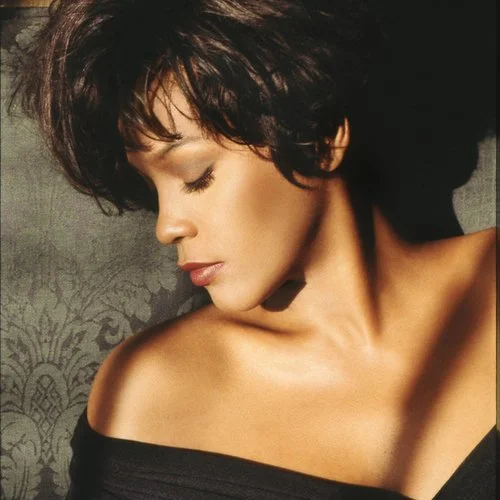
a fair few times on my blog. I love Whitney Houston’s music, though I feel one or two of her albums are underrated and should get re-evaluated. Following the brilliant My Love Is Your Love of 1998, Just Whitney arrived in 2002. Houston's fifth studio album, it was recorded after renewing her contract with Arista for a record $100 million. In terms of the sound, Just Whitney mixes R&B ballads, R&B mid-tempo numbers, and Dance songs. It did get some good reviews, though a lot were more critical. Maybe not as strong as her earlier albums – and with few songs on Just Whitney that match her peak –, the album is still really strong and contains some of Houston’s finest vocal performances. Of course, we sadly lost Houston a decade after Just Whitney came out. I often wonder what sort of music she would be putting out were she still with us. Reaching nine on the Billboard 200 in the U.S., Just Whitney did do well commercially. It is an album that was not met with similar critical affection. I am going to bring in a couple of contrasting reviews. For anyone who has not heard Just Whitney, I would definitely urge them to. Songs like One of Those Days and Love That Man are classic Houston. I think some of those who did not view Just Whitney as great felt it was a step backwards from My Love Is Your Love. Others noted how it was four years since her previous album. Perhaps some momentum was lost. With a host of producers on Just Whitney, there was a great team behind her. The legendary Babyface was among them (he produced Try It on My Own).

I will source a couple of reviews, just to give an idea of what people said about 2002’s Just Whitney. This is what AllMusic said in their three-star review:

The four-year wait between 2002's Just Whitney and her previous album, 1998's My Love Is Your Love, was half that between that record and its predecessor, 1990's I'm Your Baby Tonight, but it felt twice the length, since Whitney Houston's career nose-dived during those four years. She retreated from the spotlight and as she cancelled concerts, scrapped albums, and pulled out of public appearances, rumors swirled that she and husband Bobby Brown were dangerously addicted to drugs. Following a disastrous performance at the September 2001 Michael Jackson tribute concert, where she looked as if she had already wasted away, the chattering reached a fever pitch and she needed to restore her reputation -- hence the title of Just Whitney, an assertion that she's returning to her basics. But that's not the half of it. As her trainwreck interview with Diane Sawyer on PrimeTime Live the week prior to Just Whitney's release proved, she's arrogantly defensive about her "bad habits" and is "Unashamed" of "the life that [she] leads," as she sings on the eighth song on this odd, disarmingly brief (under 40 minutes) self-styled comeback album. Just listen to the first single, the roundly ignored "Whatchulookinat" (produced by husband Brown, who Whitney thanks for being the best producer in the world, although he only helmed this track on the album), where she plays the victim, claiming that the gossip-mongers "messing with my reputation/ain't you got no education...don't even have a clue about what I'm facin'," coming across as if she had something to hide.

It's a sentiment that runs throughout the album -- phrases like "you don't know what I'm goin' through" and "you criticize my actions/even though you don't stand in my shoes" pop up regularly -- and undermines an album that's otherwise a not-bad set of contemporary soul. Certainly, Whitney is in better voice than rival diva Mariah Carey (whose near simultaneously released Charmbracelet found her voice in tatters) and she's fortunate enough to have Babyface for four productions, three of which are among the highlights of the album. Though Missy Elliott produces a track here, this is nowhere near as concerned with hip production as My Love was and who can blame her? When a career is on the rocks, it's best to play it safe. And that's what Just Whitney is: a measured attempt to salvage a career that's on the verge of destruction. Does it work? Well, musically, it's not bad, though few songs are memorable. It would be a good standard-issue Whitney album if it wasn't for her disarming, defensive attempt to defuse every rumor hurled in her direction. Even an otherwise innocuous duet with Brown is presented like it's the two of them against the world, nearly celebrating the fact that Bobby's voice is very strained these days. Worst of all, there seems to be nobody to check Whitney and prevent her from indulging in bad ideas. After all, surely somebody in the Houston camp should have realized that at this crucial time in her career, as she admits drug "habits," that covering "You Light Up My Life" might not be the smartest move to make right now”.

I first heard Just Whitney when it came out in December 2002. Since then, I have never really lost any attachment and respect for it. With Houston’s vocal power and brilliance very much at its best, it is an album that needs to be dug and get some love. The BBC’s review was more positive (than a lot of others):

Once upon a time there lived an extremely gifted pop princess who possessed beauty, poise and a set of vocals that would make the clouds smile. Critics were perplexed by this seemingly perfect specimen, and swiftly termed her bland and banal. However, a bad-boy husband, 120 million album sales, and rumours of a dubious lifestyle ensured that Whitney Houston never leaves the headlines.

With one of the most exceptional voices in contemporary music, her latest album, aptly titled Just Whitney sees the diva return to her former glory with a combination of high-voltage ballads and smooth-liqueur R&B.

'Love That Man' sounds suspiciously like an ode to her much criticised hubby. Here Whitney comes across as soulful and sincere as she ooohs and aaahs in the right places. The mid-tempo track harks back to 80s soul with its simple bass line, and unfussy production.

'One Of Those Days' also has a slight retro feel to it, cleverly sampling the Isley Brothers' Between the Sheets. Modern day women will be able to relate to this one, as Whitney croons about the need to withdraw from the pressures of day-to-day living for a spot of girlie pampering.

Whitney has been experiencing her own fair share of pressure-cooker environments recently. For evidence, look no further than 'Whatchulookinat', an assertive, defiant statement against her critics. The gentle vocals, which appeared on previous tracks, have now been replaced by an authoritative Whitney stating: 'Unashamed by the life that I lead, the choices I've made, the things I have done, my belief in the one'.

The most welcomed return on Just Whitney is the incorporation of big love ballads; with the melancholic "On My Own" providing one of the album's highlights. The big-band orchestral feel to this track provides the perfect platform for Whitney to deliver vocally. Climaxing with one of those highly sustained notes sung in an octave that only the likes of Mariah, Celine and Aretha are capable of, she renders this track truly awesome.

The moral of this story is always stick to what you do best. Whitney's return to big ballads will hopefully ensure that this pop princess will be able to lead the rest of her life like a clichéd fairy tale - happily ever after”.

Nearly twenty years after it arrived, Just Whitney is an album I love. It is so sad that its creator is no longer here. One of the most influential artists of her generation, I think we need to treasure the world she left behind. Maybe not as cohesive, consistent and great as albums like 1985’s Whitney Houston, Just Whitney is still a very worthy and solid album. If it is one that you have not heard or have avoided until now, I would definitely encourage you to…

CHANGE your mind.

FEATURE: Paul McCartney at Eighty: Sixteen: Live and Let Live: An Unforgettable Stage Experience

FEATURE:


Paul McCartney at Eighty

Sixteen: Live and Let Live: An Unforgettable Stage Experience

___________

I am writing this…

 PHOTO CREDIT: (Pete Still/Redferns

on 4th March. It has been announced that Paul McCartney will headline Glastonbury. I wanted to use the feature to explore his live work. One of the most engaging live performers ever, I have never seen him myself. I would love to see Paul McCartney in concert. I am going to look at McCartney and bring in a few videos of his great live sets. A while ago, I asked on Twitter anyone who had special memories of seeing Paul McCartney live. Richard K. White said that the special '89 dress rehearsal show at Elstree Film Studios, Oct ‘93 in Paris, 2003 at Earl's Court, and the 1997 classical premiere of Standing Stone, plus the 1999 album launch of Run Devil Run at Leicester Square in London are his favourite. I am not sure when McCartney’s first live show was, but I suspect it was with The Beatles in the early-1960s. It may well date before that even! Over sixty decades of live sets, he is still on the road and thrilling fans! Next month, McCartney heads to North America for his Got Back tour. That ends on 16th June. After that, McCartney will head back to the U.K. Although he lost a couple of millions in touring revenue because of the pandemic, he will have a much busier 2022. When he turns eighty on 18th June, it will be a couple of days after his final U.S. date. I am sure he will want to relax and spend time with the family. One suspects that, Paul being Paul, half of his mind will be on the stage and delivering music to the fans! He has a Glasto headline slot to prepare for on 25th June!

As it is such a stressful and strange time in the world, he will not be able to play any war-affected countries like Ukraine. He did recently share a post where he performed in the Ukraine in 2008 in Independence Square. Everyone who has seen McCartney play has their views as to which gig was best. I have heard some say McCartney’s voice has deteriorated and he is not as good as he was. I have heard from many more who say his voice is as fine as ever! As he is nearly eighty, he is hardly going to have the same range and power. Even though he is older than he once was, McCartney’s stamina and charisma is as strong as it ever was! I have read reviews of recent gigs where reviews are blown away. Here is what Variety had to say when Macca played Dodger Stadium in 2019:

Dodger Dogs were doing a robust business Saturday night during Paul McCartney’s appearance at the stadium that shares the delicacy’s name. He is not one of those performers who tries imposing dietary restrictions on the venues he plays, if that were even possible on the rarefied stadium tour circuit. Nor did food or any kind of health regimen arise as a subject as he bantered with the crowd. Nonetheless, it was the best 170-minute commercial that going meatless ever had, implicitly, as 57,000 mostly younger attendees scratched their heads in shared wonderment at how they, too, might be able to pull off a pretty unassailable three-hour show — or whatever its commoner equivalent would be — when they get to 77, seeing the superstar in all his vegetarian fighting trim.

 It wasn’t just McCartney that was paunchless. That could be said for the 38-song set itself, which flew by as if it were dashed off in a half-hour — something we promise to never say about anybody else’s 38-song set, should we ever come across another one, because it won’t be true. The food and merch lines were so ridiculously long ahead of showtime because anyone who’d done any kind of recon at all knew this would be three hours without potty breaks built in — that is, without any costume changes (McCartney joked, as he always does, that taking his jacket off constituted the only one), but also without any duff tracks. If anyone had written the equivalent to one of those “When can you go to the bathroom during the new “Avengers’ movie?” articles… well, they might have written in “Come On to Me,” or one of the five other 21st century songs sprinkled in among the classics, but they would have been wrong. When you have the fellow who is the singularly most multi-talented artist in the history of popular music passing through town, as Steven Tyler would say, you don’t want to miss a breezy thing.

There is an inevitable sense of disappointment that accompanies any McCartney tour, though, maybe especially now that we might reasonably wonder how many more he has left in him. That’s right, disappointment. (Put the pitchforks away.) He fosters it by populating the hours leading up to showtime inside a stadium with a DJ set of his other greatest (and some not-so-great) hits — literally hundreds of songs beloved by somebody, if not the world, that he is not going to play later that night. And so the hardcore fan sits there thinking, “Damn  — I guess ‘Big Barn Bed’ over the PA means he’s not going to celebrate the recent deluxe re-release of ‘Red Rose Speedway’ in this show?” That is exactly what it means, and the odds of our ever getting the full-album “Back to the Egg” tour we’ve been waiting for also diminish by the day. The less hardcore fan may also notice that not only does McCartney’s show not have much room for truly deep cuts, but it also doesn’t leave space for some of the less deep ones that are being rotated out, like, on this tour, “Yesterday.” But they probably aren’t noticing till the next day. Three assaultive hours of pop greatness has a way of making you forget an expectation or two.
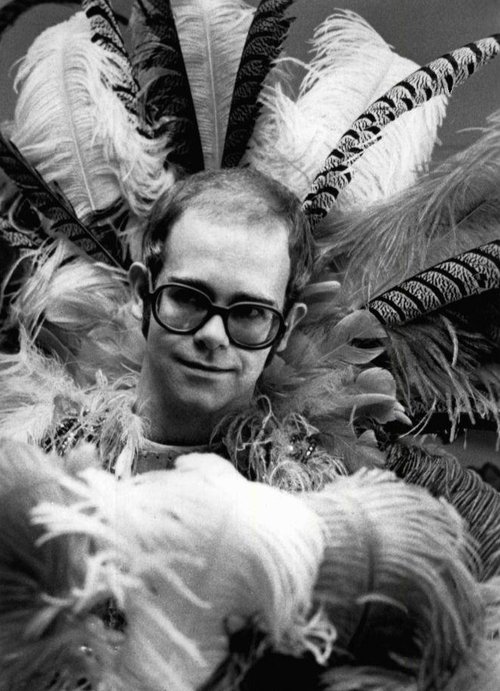
So much of the show did fall along the lines of what McCartney buffs have come to expect that, although big surprises aren’t necessary, it was a joyful occasion when they arrived. Nothing was deviated from in the actual set list, but McCartney is building up a pretty good track record now for who might show up to help out on “Helter Skelter” in the encore segment. In Las Vegas June 28, it was Tyler, taking a night off from Aerosmith’s residency to sit in. At Dodger Stadium, it was Ringo Starr, taking a night off from not being a Beatle so that he could help half-reform the band by playing drums on both that and “Sgt. Pepper’s Lonely Hearts Club Band (Reprise).” It was difficult to actually hear whatever had been mic-ed up on the drum kit that was rolled in for Starr over the steady beat that tour drummer Abraham Laboriel Jr. was kicking up, but we could at least see Ringo, grinning up a storm and seeming to want to renew the blisters he’d worked up when first recording “Skelter,” despite his limited time to do so. There were at least a few folks on hand, going up into the eightysomething fan division, who’d seen Ringo and Paul the last time they played together at Dodger Stadium, in 1966, at what turned out to be the Beatles’ next-to-last show. You didn’t have to be there, then, of course, to find this reunion deeply sentimental — and to get a thrill out of the fact that it was expended on two rockers as unsentimental as the “Pepper’s” reprise and “Helter Skelter.” Bono stole (okay, borrowed) that song, and finally the freakin’ Beatles were stealing it back”.

I could bring in a load of reviews from those glowing about McCartney’s live wonder. In 2018, McCartney made a surprise return to the Cavern Club (which The Beatles helped to make famous). That gig was shown on T.V., but it is not available on the BBC iPlayer at the moment. I would love to see that put back up. I am sure the BBC or other stations will dedicate a night to McCartney in June when he is eighty. His stage performances are such a big reason why he is so adored and respected! Whether, as a fan of McCartney, you prefer his gigs with The Beatles, Wings or solo, he has delivered more than his fair share of classics through the years! PopMatters listed their ten favourite McCartney live performances back in 2014. I have selected a few:

I’m Down” (The Beatles, Shea Stadium, 1965)

Due to the Beatles’ short-lived touring period and a lack of technology at the time, there are few live recordings of the biggest band in rock ‘n’ roll history. However, their 1965 Shea Stadium concert was filmed for a rarely seen/heard TV special. And this dizzying spectacle was the highlight. Spoilsports usually point out that the band clearly acts as if they are under the influence of some illegal drug here, but what a true music fan sees/hears are master musicians celebrating their relatively newfound immense fame. Paul later played homage to his part of that epic performance four decades later on his Good Evening New York City CD/DVD set.

“Soily” (Wings Over America, 1976)

There’s rumored to be at least seven different studio versions of “Soily” recorded, but this live cut remains the definitive release. Paul performs lyrics like “the cat in satin trousers says it’s oily” as if his very life depends upon it. And perhaps those lyrics are purposely nonsensical. It leaves fans with nothing to do but rock out.

“Freedom” (The Concert for New York City, 2001)

It’s a little ironic that an Englishman wrote a song that perfectly expresses the spirit of American freedom, but that’s just what everyone needed to hear in the days following 9/11. Assisted by a stomping, cheering crowd of family members affected by the tragedy, first-responders, and those out to help a good cause, this simple song turned into an uplifting moment of unity”.

Very soon, those in North America will get to see Paul McCartney play for them. He played the U.S. in 2002 (and has done a lot since). The Back in the U.S. live album is brilliant! 2022 is a year when we are experiencing horror and tragedy in Ukraine and around the world. It will be sobering to play gigs - though McCartney has this ability to bring people together. An affinity for other people and cultures. I am sure Glastonbury is on the cards, and it will be one of the most emotional and important dates of his life. A peerless live performer who, from the late-1950s and early-1960s to now has enraptured people around the globe. Cutting his teeth with The Beatles and racking up hundreds of dates since then, he is such a professional! Late last year, The New Yorker spoke with McCartney. In a detailed interview, we discover more about the great man. I forgot to mention Peter Jackson’s The Beatles: Get Back documentary-film. It culminates in The Beatles playing their legendary rooftop gig. That is, perhaps, one of the most famous live performances ever. McCartney, throughout, is having a great time, and he is definitely in his element (you can feel the relief when the band get together and gel on the roof, after a difficult period trying to get songs recorded for Let It Be). In the feature from The New Yorker, they make reference to McCartney as a live performer:

As a musician and a performer onstage, McCartney remains phenomenal, playing three-hour concerts—five or six times longer than the Beatles’ shows in their heyday—to enormous crowds. He sings Beatles songs in their original keys and at the top of his register: “I can’t be bothered to transpose them.” He seems eager never to disappoint. As his daughter Mary told me, “Look, he’s an entertainer! You’ll see him play ‘Live and Let Die’ and he’s surrounded at the piano by all these pyrotechnics, all these flames, and I’m, like, ‘Dad, I can feel the heat from those flames! Do you have to do that?’ But he says the audience loves it. I say, ‘Don’t do that to yourself, it’s a huge risk!’ But he won’t be told”.

Before he turns eighty, I wanted to explore and celebrate Paul McCartney in a number of ways. I had to mention him as a live artist and how the audiences love him – and he, in turn, loves them. He was born to be on the stage it seems. I have not seen him myself, though those who have all agree it is among the greatest experiences of their lives. We will see the master play the U.S. next month and here in the U.K. soon after. Whilst the catalogue has expanded and the demand has increased, McCartney still produces a dazzling show and has this verve and dedication to the road and fans around the planet. The iconic McCartney is still going strong…

AFTER all of these years.

FEATURE: Before We Flip the Vinyl… Kate Bush’s Best Side One/First Half Closers

FEATURE:


Before We Flip the Vinyl…

IN THIS PHOTO: Kate Bush in a promotional shot for 2011’s 50 Words for Snow/PHOTO CREDIT: Ken McKay 

Kate Bush’s Best Side One/First Half Closers

___________

IN previous features…

 IN THIS PHOTO: Kate Bush in 1978/PHOTO CREDIT: Gered Mankowitz

I have ranked Kate Bush’s opening and closing tracks. I have ranked her albums and pretty much covered every angle. I have not ranked her album side one closers. These are the songs that would end the first side of a vinyl or, in the case of a double vinyl, the first side of the first vinyl (rather than the second side). Maybe we would not notice on a CD or streaming, but there is great importance when it comes to the tracks that end the first side/half. It keeps us gripped at the end, so that we are excited flipping over that album! Bush is masterful when it comes to sequencing and making sure the strongest tracks are assorted so that you get this even experience. Because of that, it has been tough ranking the songs! In the case of the 2005 double album, Aerial, it is the final song on the first side of the first vinyl; the same goes for Director’s Cut and 50 Words for Snow. Some might be surprised regarding the number-one choice. I am not necessarily judging it based on which side closer is my favourite song. More, which track, in the context of the entire album, ends the first side best. Here are the side one closers from her amazing…

 IN THIS PHOTO: Kate Bush in 1985

TEN studio albums.

_____________

10. EgyptNever for Ever

Album Release Date: 8th September, 1980

Producers: Kate Bush/Jon Kelly

Label: EMI

Buy: https://www.roughtrade.com/gb/kate-bush/never-for-ever-0e80c456-fc19-41c7-85b8-6574e9091658/lp

Review:

You listen to all of these records in sequence and good as The Kick Inside is, it’s just very apparent that the songwriting has gone up a gear with Never Forever. Strident, diverse, and intense Never Forever is the last Bush album with batshit mental prog art, the last album with an outside producer (though she co-produced with Jon Kelly), and the last record before she started using her beloved Fairlight synthesiser/sampler. It was also her third album in three years, that preempted the first meaningful gap in her career - you could point at the ways in which it predicts The Dreaming and call it a transitional album, but the truth is Never for Ever feels like the [apotheosis] of Leotard-era Kate Bush. The songs are just dazzlingly strong and distinctive. There are singles: ‘Babooska’ is a lot of fun, and the closing one-two of the eerie ‘Army Dreamers’ and the apocalyptic ‘Breathing’ is remarkable. But there’s a hell of a lot of little-remembered gold amongst the album tracks: the breakneck ‘Violin’ and tongue-in-cheek murder ballad ‘The Wedding List’ are really extraordinarily good pieces of songwriting. (8)” – Drowned in Sound

9. Heads We're DancingThe Sensual World

Album Release Date: 17th September, 1989

Producer: Kate Bush

Label: EMI

Buy: https://www.roughtrade.com/gb/kate-bush/the-sensual-world-e4747d6f-f1a1-4c91-bc7d-c5562cef6288

Review:

An enchanting songstress, Kate Bush reflects the most heavenly views of love on the aptly titled The Sensual World. The follow-up to Hounds of Love features Bush unafraid to be a temptress, vocally and lyrically. She's a romantic, frolicking over lust and love, but also a lover of life and its spirituality. The album's title track exudes the most sensually abrasive side of Bush, but she is also one to remain emotionally intact with her heart and head. The majority of The Sensual World beams with a carefree spirit of strength and independence. "Love and Anger," which features blistering riffs by Bush's mentor and cohort David Gilmour, thrives on self-analysis -- typically cathartic of Bush. Michael Nyman's delicate string arrangements allow the melodic "Reaching Out" to simply arrive, freely floating with Bush's lush declaration ("reaching out for the star/reaching out for the star that explodes") for she's always searching for a common peace, a commonality to make comfort. What makes this artist so intriguing is her look toward the future -- she appears to look beyond what's present and find a peculiar celestial atmosphere in which human beings do exist. She's conscious of technology on "Deeper Understanding" and of a greater life on the glam rock experimental "Rocket's Tail (For Rocket)," yet she's still intrinsic to the reality of an individual's heart. "Between a Man and a Woman" depicts pressure and heartbreak, but it's the beauty of "This Woman's Work" that makes The Sensual World the outstanding piece of work that it is. She possesses maternal warmth that's surely inviting, and it's something that's made her one of the most prolific female singer/songwriters to emerge during the 1980s. She's never belonged to a core scene. Bush's intelligence, both as an artist and as a woman, undoubtedly casts her in a league of her own” – AllMusic

8. LilyDirector’s Cut

Album Release Date: 16th May, 2011

Producer: Kate Bush

Labels: Fish People/EMI

Buy: https://www.roughtrade.com/gb/kate-bush/director-s-cut-23cb82bf-539f-4cfd-a97b-a846f8e0dbdf

Review:

During her early career, Kate Bush released albums regularly despite her reputation as a perfectionist in the studio. Her first five were released within seven years. After The Hounds of Love in 1985, however, the breaks between got longer: The Sensual World appeared in 1989 and The Red Shoes in 1993. Then, nothing before Aerial, a double album issued in 2005. It's taken six more years to get The Director's Cut, an album whose material isn't new, though its presentation is. Four of this set's 11 tracks first appeared on The Sensual World, while the other seven come from The Red Shoes. Bush's reasons for re-recording these songs is a mystery. She does have her own world-class recording studio, and given the sounds here, she's kept up with technology. Some of these songs are merely tweaked, and pleasantly so, while others are radically altered. The two most glaring examples are "Flower of the Mountain" (previously known as "The Sensual World") and "This Woman's Work." The former intended to use Molly Bloom's soliloquy from James Joyce's novel Ulysses as its lyric; Bush was refused permission by his estate. That decision was eventually reversed; hence she re-recorded the originally intended lyrics. And while the arrangement is similar, there are added layers of synth and percussion. Her voice is absent the wails and hiccupy gasps of her youthful incarnation. These have been replaced by somewhat huskier, even more luxuriant and elegant tones. On the latter song, the arrangement of a full band and Michael Nyman's strings are replaced by a sparse, reverbed electric piano which pans between speakers. This skeletal arrangement frames Bush's more prominent vocal which has grown into these lyrics and inhabits them in full: their regrets, disappointments, and heartbreaks with real acceptance. She lets that voice rip on "Lilly," supported by a tougher, punchier bassline, skittering guitar efx, and a hypnotic drum loop. Bush's son Bertie makes an appearance as the voice of the computer (with Auto-Tune) on "Deeper Understanding." On "RubberBand Girl," Bush pays homage to the Rolling Stones' opening riff from "Street Fighting Man" in all its garagey glory (which one suspects was always there and has now been uncovered). The experience of The Director's Cut, encountering all this familiar material in its new dressing, is more than occasionally unsettling, but simultaneously, it is deeply engaging and satisfying” – AllMusic

7. Oh England My Lionheart - Lionheart

Album Release Date: 13th November, 1978

Producer: Andrew Powell (assisted by Kate Bush)

Label: EMI

Buy: https://www.roughtrade.com/gb/kate-bush/lionheart-60077c9a-5fb5-4714-821a-280d80024a96

Review:

Proving that the English admired Kate Bush's work, 1978's Lionheart album managed to reach the number six spot in her homeland while failing to make a substantial impact in North America. The single "Hammer Horror" went to number 44 on the U.K. singles chart, but the remaining tracks from the album spin, leap, and pirouette with Bush's vocal dramatics, most of them dissipating into a mist rather than hovering around long enough to be memorable. Her fairytale essence wraps itself around tracks like "In Search of Peter Pan," "Kashka From Baghdad," and "Oh England My Lionheart," but unravels before any substance can be heard. "Wow" does the best job at expressing her voice as it waves and flutters through the chorus, with a melody that shimmers in a peculiar but compatible manner. Some of the tracks, such as "Coffee Homeground" or "In the Warm Room," bask in their own subtle obscurity, a trait that Bush improved upon later in her career but couldn't secure on this album. Lionheart acts as a gauge more than a complete album, as Bush is trying to see how many different ways she can sound vocally colorful, even enigmatic, rather than focus on her material's content and fluidity. Hearing Lionheart after listening to Never for Ever or The Dreaming album, it's apparent how quickly Bush had progressed both vocally and in her writing in such a short time” – AllMusic

6. Mrs. BartolozziAerial

Album Release Date: 7th November, 2005

Producer: Kate Bush

Label: EMI

Buy: https://www.roughtrade.com/gb/kate-bush/aerial-90730658-35e2-49ab-93d8-9c3e7897c0f4

Review:

In the gap since 1993's so-so The Red Shoes, the Kate Bush myth that began fomenting when she first appeared on Top of the Pops, waving her arms and shrilly announcing that Cath-ee had come home-uh, grew to quite staggering proportions. She was variously reported to have gone bonkers, become a recluse and offered her record company some home-made biscuits instead of a new album. In reality, she seems to have been doing nothing more peculiar than bringing up a son, moving house and watching while people made up nutty stories about her.

Aerial contains a song called How to Be Invisible. It features a spell for a chorus, precisely what you would expect from the batty Kate Bush of popular myth. The spell, however, gently mocks her more obsessive fans while espousing a life of domestic contentment: "Hem of anorak, stem of wallflower, hair of doormat."

Domestic contentment runs through Aerial's 90-minute duration. Recent Bush albums have been filled with songs in which the extraordinary happened: people snogged Hitler, or were arrested for building machines that controlled the weather. Aerial, however, is packed with songs that make commonplace events sound extraordinary. It calls upon Renaissance musicians to serenade her son. Viols are bowed, arcane stringed instruments plucked, Bush sings beatifically of smiles and kisses and "luvv-er-ly Bertie". You can't help feeling that this song is going to cause a lot of door slamming and shouts of "oh-God-mum-you're-so-embarrassing" when Bertie reaches the less luvv-er-ly age of 15, but it's still delightful.

The second CD is devoted to a concept piece called A Sky of Honey in which virtually nothing happens, albeit very beautifully, with delicious string arrangements, hymnal piano chords, joyous choruses and bursts of flamenco guitar: the sun comes up, birds sing, Bush watches a pavement artist at work, it rains, Bush has a moonlight swim and watches the sun come up again. The pavement artist is played by Rolf Harris. This casting demonstrates Bush's admirable disregard for accepted notions of cool, but it's tough on anyone who grew up watching him daubing away on Rolf's Cartoon Club. "A little bit lighter there, maybe with some accents," he mutters. You keep expecting him to ask if you can guess what it is yet.

Domestic contentment even gets into the staple Bush topic of sex. Ever since her debut, The Kick Inside, with its lyrics about incest and "sticky love", Bush has given good filth: striking, often disturbing songs that, excitingly, suggest a wildly inventive approach to having it off. Here, on the lovely and moving piano ballad Mrs Bartolozzi, she turns watching a washing machine into a thing of quivering erotic wonder. "My blouse wrapping around your trousers," she sings. "Oh, and the waves are going out/ my skirt floating up around my waist." Laundry day in the Bush household must be an absolute hoot” – The Guardian

5. Leave It OpenThe Dreaming

Album Release Date: 13th September, 1982

Producer: Kate Bush

Label: EMI

Buy: https://www.roughtrade.com/gb/kate-bush/the-dreaming-03e10ee0-e2d3-4b54-948e-0afcb7e7c290

Review:

In her borrowing further afield, her characters are less accurately rendered. This has been an unabashedly true part of Bush’s artistic imagination since The Kick Inside’s cover art, vaguely to downright problematic in its attempts to inhabit the worlds of Others. On “Pull Out the Pin” she uses the silver bullet as a totem of one’s protection against an enemy of supernatural evil. In this case, the hero is a Viet Cong fighter pausing before blowing up American soldiers who have no moral logic for their service. She’d watched a documentary that mentioned fighters put a silver Buddha into their mouths as they detonated a grenade, and in that she saw a dark mirror to key on the album cover. While the humanizing of such warriors in pop narrative is a brave act, it’s also possible to hear her thin arpeggiated synth percussion and outro cricket sounds as a part of an aural Orientalism that undermines that very attempt.

Then there’s “The Dreaming,” a parable of a real, historical, and contemporary group of Aboriginal people as timeless, noble savages in a tragically ruined Eden that lectures the center of empire about their (our) political and environmental violence. Bush narrates in a grotesquely exaggerated Australian accent over a thicket of exotic animal sounds, both holdovers from music hall and vaudeville’s racist “ethnic humor” tradition, a kind of distancing that suggests that settler Australians are somehow less civilized and thus more responsible for their white supremacist beliefs than the Empire that shipped them there in the first place. In telling this story in this way—without accurate depictions of people, and without credit, understanding, monetary remuneration, proper cultural context, or employment of indigenous musicians—she unfairly extracts cultural (and economic) value from Aboriginal suffering just as the characters in the song mine their land. As a rich text to meditate on colonial, racial, and sexual violence, it is actually quite useful—but not in the way Bush intended.

The closer “Get Out of My House” was inspired by two different maternal and isolation-madness horror texts: The Shining and Alien. In all three stories, a malevolent spirit wants to control a vessel. Bush does not let the spirit in, shouts “Get out!” and when it violates her demand, she becomes animal. Such shapeshifting is a master trope in Kate Bush’s songbook, an enduring way for her music and performance to blend elements of non-Western spirituality and European myth, turning mundane moments into Gothic horror. It’s also, unfortunately, the way that women without power can imagine escape. The mule who brays through the track’s end is a kind of female Houdini—a sorceress who can will her way out of violence not with language, but with real magic. At least it works in the world of her songs, a kingdom where queerly feminine excess is not policed, but nurtured into excellence” – Pitchfork

4. LilyThe Red Shoes

Album Release Date: 2nd November, 1993

Producer: Kate Bush

Label: EMI

Buy: https://store.hmv.com/store/music/vinyl/the-red-shoes

Review:

The album’s musical unwieldiness is set against Bush’s relatively diaristic songwriting.The Red Shoes is the most confessional album by an artist not known for, or especially interested in, confession. Bush has always taken advantage of the elusive space between art and reality, conjuring characters, rarely doing interviews, always aware of getting burned by a lingering spotlight. “That’s what all art’s about—a sense of moving away from boundaries that you can’t, in real life,” she said around the time of The Red Shoes. “It’s all make believe, really.” The album falters when she falls short of this magical realism. When it comes to her songwriting, Kate Bush’s stories are almost always more engrossing than Kate Bush.

The record’s personal themes of loss, perseverance, and memory coalesce on “Moments of Pleasure,” one of Bush’s most affecting ballads. She sings of the small memories of life—laughing at dumb jokes, snowy evenings high above New York City, a piece of wisdom from her mother—as Oscar-nominated composer Michael Kamen builds these quiet moments into monuments with a heroic string arrangement. Bush ends the song with a series of mini eulogies: for her aunt, her longtime guitarist, her dance partner. “Just being alive, it can really hurt,” she belts at the center of the track, stating the obvious with such conviction that it sounds revelatory” – Pitchfork

3. CloudbustingHounds of Love

Album Release Date: 16th September, 1985

Producer: Kate Bush

Label: EMI

Buy: https://www.roughtrade.com/gb/kate-bush/hounds-of-love-d3743f1e-51e3-4337-b759-f47b26c0a247/lp

Review:

Kate at the young age of 22 had already recorded four albums with Hounds of Love being the follow up to her 1982 release The Dreaming. The Dreaming was the first time Bush had been in complete control in the sound booth as a producer. The success of her debut album The Kick Inside won her significant creative independence and patience from her record label a rarity in this period of popular music. From the beginning of her career, Kate was known as a renegade who did not play by the usual record industry rules.

A topic that is not often discussed when looking at Kate’s accomplishments was her ability to create a way to use the corrupting music label industry for her own devices. That skill alone is enough to make her a legend. Her musical abilities and risk-taking in her music make her a trailblazer. Very early in her fledgeling career, she realized the importance of artistic control. She set up her own publishing company and management after her disappointment in her treatment by the marketing at EMI and additionally being rushed by the label to record Lionheart. She always felt that Lionheart had not turned out as good as she would have liked. Her success on the charts would enable her to demand more time to record and enable her to release music only when it met her high standards.

In 1978 Kate was all of 19 when she topped the UK charts with Wuthering Heights off of The Kick Inside becoming the first female to achieve a UK #1 with a self-written song. As she moved through her various releases she looked to pushing the envelope and attaining artistic perfection. She quickly became know for her amazing vocal range, exquisite stylings and need to control and make perfect all her recording efforts. EMI was relatively undemanding about Kate’s work and level of success until the aftermath of The Dreaming. The Dreaming was ambitiously unlike Kate’s prior works and did not have a recognizable hit single. The album did not perform commercially as well as her prior efforts and the label put pressure on Bush to knock the next release out of the park. It was not for lack of effort that The Dreaming failed to find an audience; unfortunately, the surreal sonics and themes did not make for easy listening. Bush was exhausted after touring for The Dreaming. She decided after three years of unrelenting work to take a break. With the decision, she found her self in unmoored territory and was confused and disoriented by not to have do promotional work or perform studio duties. She also experienced writer's block for a period of about five months. Bush described this period as such, “It’s very difficult when you’ve been working for years doing one album after another. You need fresh things to simulate you. That’s why I decided to take a bit of the summer off and spend time with my boyfriend and with family and friends, just relaxing. Nor being Kate Bush the singer, just being myself.” In the summer of 83, she built a 48 track studio in the barn behind her newly purchased farmhouse. This event energized and inspired Bush to begin what would become Hounds of Love.

In January of 1984 Kate in her home studio at Wickham farm, Welling, England she began recording demos and enhancing them rather than re-recording them. Five months into the work she began overdubbing and mixing the album. The entire process took a year. Musically the album would be a marriage of traditional world instruments and utterly futuristic machinery, particularly the Fairlight synthesizer, which was the 80’s version of today’s Pro Tools. Always looking to expand her sonic palette she utilized everything out there that was available and a few things only she seemed to know existed. In the studio, Kate performed alchemy blending literary influences and a definite storyline especially on side two of the album. Throughout “Hounds of Love” would be loaded with Kate’s trademark melodramatic emotionalism and surreal musicality. The result was not only a winning release but a masterwork. “Hounds of Love” would be Bush’s 2nd chart-topper in the UK and her best selling studio album to date. It would go double platinum and by 1998 sell 1.1 million worldwide and actually make it across the pond reaching the top 40 on the Billboard 200. The singles are all taken from the first side of the album and were; Running up that Hill, Cloudbursting, Hounds of Love and The Big Sky. It was the great success that Kate achieved that finally brought her to the attention of a larger American audience. As per usual American exposure to a seminal British artist was a day late and a dollar short but led to a significant following of dedicated new fans on the US side of the pond.

There is an inherent dichotomy to “Hounds of Love” and it has a definite split personality. Kate fully utilized the format of two sides on a recording. The first side is the most approachable yet contains numerous deep and esoteric themes. That side presented everything anyone familiar with Kate’s prior work had come to expect. It examined many Freudian themes, the relationships of parents and their children, anxiety, Eros, ecstasy and nature. Throughout there is a total emotional commitment from Bush that is physically palpable. The second side would be more ambitious and more difficult for the indifferent less adventurous listener to grasp. The second side or as it is titled, The Ninth Wave is beyond almost anything attempted at the time. It was a concept album to the nth degree, cohesive and evocative as it dealt with death and the unimaginable. Where the first side was life and Eros The Ninth Wave is Thanatos and facing imminent death; the loss of control. The Ninth Wave is extraordinary, mystic and ultimately epic” – XS Noise

2. Wuthering HeightsThe Kick Inside

Album Release Date: 17th February, 1978

Producer: Andrew Powell

Labels: EMI (U.S.)/Harvest (U.S.)

Buy: https://www.roughtrade.com/gb/kate-bush/the-kick-inside-7a5278e6-76b3-40e7-a55f-2d9471a311ae/lp

Review:

In the beginning she was seen as a prodigy, not an enigma, but this would change as she gradually faded from view. The touring stopped first, the interviews became less frequent and less revealing; eventually, after 1993, she dropped out of sight altogether, only reconnecting with the world unexpectedly, at great intervals.

We are currently experiencing a minor reconnection. There is no new album, or live show, but there is, How to Be Invisible, a book of her lyrics, plus her albums remastered and reissued as three boxed sets.

Part of me frets this ordering of her legacy might be a coded retirement – would she do this if a new record was underway? The less tinfoil hat bit of me notes she has always tinkered with her back catalogue, and that there’s probably no higher meaning beyond some fairly typical pre-Christmas action from a heritage artist.

Anyway, whether by accident or design, Volume One binds the leotard years up as a distinct phase. The Kick Inside, (1978), released when she was just 19, and The Dreaming (1982), which came out when she was 24, are vastly different records, but they were marked by a relatively cohesive aesthetic that she’d largely leave behind afterwards

I am banging on about leotards because again, it’s much easier to stick to mundane facts than actually explain Kate Bush. And ‘Wuthering Heights’, her debut single, most famous song, and sole number one, sounds borderline comical if you stick to the mundane facts.

You can call it a musical adaptation of Emily Brontë's sole novel, but is that really why it works? It’s easier to laugh it off as an eccentric endeavour than really interrogate its power, than admit the way she sings the word "window" is genuinely astonishing, than contemplate the fact she’s somehow drilled her way into deeper emotional chambers simply inaccessible by most artists. I think maybe the key to ‘Wuthering Heights’ - and most of her music - is that it goes too far: the voice, the dance, the subject matter; anybody else would have stopped way before; it’s Wagnerian in scale and intensity, only tangentially bound to the mortal form of a pop song. It’s beyond most artists’ imaginations to write this sort of stuff, and I think it’s beyond most writers’ imaginations to write about this sort of stuff.

I am absolutely including myself in that, btw. But her PR has sent me these lovely vinyls and I guess I need to pass critical comment, so here we are, maybe let’s not drag this out.

One funny thing about The Kick Inside is that from the atmospheric bleed in of ‘Moving’, it sounds like a Kate Bush-produced album - which of course it isn’t, the little-known Andrew Powell doing the honours.. There is a maturity to the songwriting that is matched by the musicianship: it doesn’t feel like there’s any attempt to patronise the teenager, or market her as such. I think it must have been a pretty extraordinary record to hear at the time. Peculiarly, though, The Kick Inside is almost dated by the strength of its fundamentals: in some respects it sounds like a less good version of what she’d do later, and I wonder if a less slick version of her debut might have stood up a bit better, historically. But detail and polish were always her thing, in a good way, and to say she'd bottled nothing of her youth would be wrong: both ‘Wuthering Heights’ and ‘The Man with the Child In His Eyes’ have a gorgeous gaucheness. At the end of the day it still just about nudges classic status, but it would be eclipsed soon enough (plus sue me but the ’86 ‘Wuthering Heights’ is way better) (8)” – Drowned in Sound

1. Lake Tahoe 50 Words for Snow

Album Release Date: 21st November, 2011

Producer: Kate Bush

Label: Fish People

Buy: https://www.discogs.com/sell/list?master_id=386159&ev=mb

Review:

Six years after Aerial’s bursts of summer sound, Kate Bush’s winter album arrives, each track exploring the long Christmas months. They reflect a season which brings out the profound and absurd in equal measure – the feelings of longing and loneliness that emerge as the dark nights bed in, the party-hat silliness that pops up when the same nights stretch out. 50 Words for Snow initially aims for the former value, with Bush’s son Bertie taking the opening vocal on Snowflake. "I was born in a cloud," he sings eerily, like the ghost of Little Lord Fauntleroy; he is constantly falling, all "ice and dust and light". His mother keeps appearing – he sees her "long white neck" – promising to find him, but we don’t find out if she does. On paper, it’s a lovely concept. On record, it treads an exceedingly fine line between the sublime and the ridiculous.

But this is classic Kate. On 1993’s The Red Shoes, Prince had to play second fiddle to Lenny Henry on Why Should I Love You?; on Aerial, Rolf Harris performed on two songs. But Bush has always been almost wilfully uncool, and this time around is no different. Take Stephen Fry taking the lead on the title-track, whispering fifty synonyms for the white stuff, from the lovely "blown from polar fur" to the frankly daft "phlegm de neige". It sounds embarrassingly cold, perhaps because of his ubiquity – if only Vincent Price was still alive, or Ian McKellen was available. Another guest, Elton John, fares much better on Snowed in at Wheeler Street, partly because his voice takes on a gentler quality than usual, partly because the song maps the movements of lost love very beautifully, and partly because John was Bush’s first hero; you can hear this depth of feeling as their voices mesh together.

The album only really reaches the heights Bush has set for herself when she appears centre stage. Her voice is noticeably older now, full of earth, heft and husk, and works stunningly well with little more than her piano’s sustain pedal – especially in Misty, her already widely-commented-upon love song for a snowman. Giving Raymond Briggs’ famous concept an X-rated twist – he is "melting in my hand", the next morning "the sheets are soaking" – its 13 minutes are spellbinding. The album’s finale, Among Angels, is even better, a torch-song for a friend in need, with a stunning central lyric: "I can see angels standing around you / They shimmer like mirrors in summer / But you don’t know it." Throughout, the piano sets a magical mood, all dark, loud and heavy.

Just after the song’s start, you also hear Bush stop for a second, take her fingers off the keys, and whisper the word "fine". In Lake Tahoe, the song also breaks suddenly at 8.44, leaving Bush to exhale one sharp, startling breath. 50 Words for Snow may threaten to lose its way in the blizzard sometimes, but it is moments like these – jolting us from her world for a moment, reminding us of how all-embracing her talent can be – that show just how much she can move us with her fire and ice” – BBC

FEATURE: Now There You Go Again… Fleetwood Mac’s Dreams at Forty-Five: The Iconic and Timeless Popularity of a Masterpiece

FEATURE:


Now There You Go Again…

IN THIS PHOTO: Fleewtood Mac’s Stevie Nicks on board a press boat in the Rotterdam Harbor in April 1977/PHOTO CREDIT: Barry Schultz 

Fleetwood Mac’s Dreams at Forty-Five: The Iconic and Timeless Popularity of a Masterpiece

___________

EVEN though I recently…

 IN THIS PHOTO: Fleetwood Mac (John McVie, Christine McVie, Mick Fleetwood, Stevie Nicks and Lindsey Buckingham) in 1977/PHOTO CREDIT: Mick Hutson/Getty

wrote about Fleetwood Mac’s Rumours turning forty-five, I wanted to supplement and accompany it with a feature about, in my view, its greatest song. Released as a single on 24th March, 1977, I will mark the forty-fifth anniversary of a song that is timeless and hugely iconic. A dreamy and beautiful song from Stevie Nicks, I am amazed by Dreams. Given the fact there was turmoil in the group, and she and Lindsey Buckingham were going through a painful break-up, it is brilliant that such a beautiful moment came from it! Buckingham took the lead when it came to a lot of the decisions around the recording and propduction of Rumours. I think that he would have had very little time for collaborating with Nicks and entertaining songs from her. Dreams is only one of several brilliant tracks she wrote (another album highlight, Gold Dust Woman, is hers). Following the album opener, Second Hand News, we get this wonderful song from Nicks. The fact that songs from Buckingham and Nicks open the album shows that, in some respects, there was a connection between them. It is the perfect opening couple of tracks. I love Dreams more than any other song on Rumours. The timeless cut is so adored decades after its release. It gained new attention in late-2020 because of a viral TikTok video created by Nathan Apodaca. Dreams was ranked number nine on Rolling Stone's 2021 list of The 500 Greatest Songs of All Time.

I want to bring in a couple of interesting articles that tell the story of Dreams, and why it has such a famed and beloved legacy. Rhino wrote about Dreams for a feature on 24th March, 2021:

It's the Fleetwood Mac meme that perfectly encapsulates the vast dichotomy between what it took to create the band's Rumours album, and the effect all of that internal turmoil has had on its listeners for years: A woman is blissfully listening to music on headphones, completely unaware of the massive brawl that's erupted behind her.

The drama that was tearing Fleetwood Mac apart served as fuel for one of the greatest and best-selling rock albums of all time. Among the five members, there was a pair of couples: singer Stevie Nicks and guitarist Lindsey Buckingham, and keyboardist Christine McVie and bassist John McVie. Both were going through brutal separations during the making of Rumours. As if that wasn't enough, drummer Mick Fleetwood--whose own marriage was falling apart--would make things even more volatile by having an affair with Nicks in the middle of the chaos.

Those personal power struggles spilled over into the recording process. It didn't help that the band was obsessed with consuming hard drugs at a record pace: "It was the craziest period of our lives," Mick Fleetwood admitted to Q in 1997. "We went four or five weeks without sleep, doing a lot of drugs. I'm talking about cocaine in such quantities that, at one point, I thought I was really going insane."

For Stevie Nicks, the chaos would drive her to find peace elsewhere in the Record Plant recording studio: "One day when I wasn't required in the main studio, I took a Fender Rhodes piano and went into another studio that was said to belong to Sly of Sly and the Family Stone," Nicks told Blender in 2005. "It was a black-and-red room, with a sunken pit in the middle where there was a piano, and a big black-velvet bed with Victorian drapes."

Alone in Sly Stone's old space, Nicks went to work: "I sat down on the bed with my keyboard in front of me," she recalled. "I found a drum pattern, switched my little cassette player on and wrote 'Dreams' in about 10 minutes. Right away I liked the fact that I was doing something with a dance beat because that made it a little unusual for me."

Nicks knew she had something special, so she presented the demo to the rest of the band. Christine McVie, for one, was not impressed: "It was just three chords and one note in the left hand I thought 'This is really boring.'"

Even though Nicks and Buckingham were in the middle of their bitter breakup, the artist in him had no choice but to agree that the song was good.

 "It was a rough take, just me singing solo and playing piano," Nicks said of the moment. "Even though he was mad with me at the time, Lindsey played it and then looked up at me and smiled."

For Nicks, it was a bittersweet validation" "I wrote 'Dreams,' and because I'm the chiffony chick who believes in fairies and angels, and Lindsey is a hardcore guy, it comes out differently," she wrote in the liner notes to the Rumours reissue in 2013. "Lindsey is saying go ahead and date other men and go live your crappy life, and [I'm] singing about the rain washing you clean. We were coming at it from opposite angles, but we were really saying the same exact thing."

Rumours came out in early February 1977. "Dreams" was released as the second single from the album on March 24, 1977. It took a quick trip up the charts, peaking at #1 for the week of June 18, 1977. It held the top spot for just a single week, replaced by Marvin Gaye's "Got to Give it Up (Pt. 1)" on the following chart. "Dreams" still stands as Fleetwood Mac's sole US #1 on the Hot 100.

"What was going on between us was sad," Nicks sighed to the Daily Mail in 2009. "We were couples who couldn't make it through. But, as musicians, we still respected each other -- and we got some brilliant songs out of it”.

Because of platforms like TikTok and the endless popularity of Rumours, Dreams will always be played and reach new people. I think, more than any other song on Rumours, it has this different life and significance of its own. One of Stevie Nicks’ most moving and beautiful songs, I hope that it gets a lot new love on its forty-fifth anniversary. This Wikipedia article discusses the legacy of the incomparable Dreams:

In the United States, "Dreams" reached the number-one spot on the Billboard Hot 100 chart on 18 June 1977, and held it for one week. On the Adult Contemporary chart, "Dreams" was Fleetwood Mac's highest-charting single during the 1970s where it reached number 11. In the UK Singles Chart, "Dreams" went to number 24, staying in the top 40 for eight weeks.

Since its initial release, "Dreams" has re-entered the charts on various occasions. It picked up two additional weeks on the UK charts in 2011 following the airing of the Glee Rumours episode. In 2018, "Dreams" returned to the Billboard Hot Rock Songs chart at number 14, re-popularized by a viral tweet. The song also returned to the New Zealand charts for one week in 2019 at number 40. The song then re-entered the New Zealand charts on 5 October 2020 at number 28, and has since spent 71 consecutive weeks in the top 40, whilst also reaching a new peak of 3 consecutive weeks at number 6. The same year, it also entered the Irish charts for the first time”.

A happy anniversary to one of the most enduring and greatest songs ever. During the strain and struggle of recording Rumours, something truly astonishing was created by Stevie Nicks. A number one track in the U.S., Dreams boasts one of the best performances from Fleetwood Mac on Rumours. Gaining new life and relevance forty-five years after its release, the staggering Dreams will ensure and move people…

FOR ever more.

FEATURE: Your Songs: Elton John at Seventy-Five: His Five Essential Albums

FEATURE:


Your Songs

IN THIS PHOTO: Elton John in 1975 

Elton John at Seventy-Five: His Five Essential Albums

___________

WHLST I have…

 PHOTO CREDIT: David Redfern/Redferns

sort of already done this when I included Elton John in A Buyer’s Guide, because he is seventy-five on 25th March, I wanted to highlight his five greatest studio albums. 2016’s Wonderful Crazy Night is his most-recent album in terms of new recordings (2021’s Regimental Sgt. Zippo is composed of material from 1967 and 1968 and is a vinyl-only release). With thirty or so studio albums under his belt, I will drill down to the best five from the regal and supreme Elton John. I am sure there will be features and celebrations when it comes to marking his seventy-fifth birthday closer to 25th March. For today, I wanted to highlight his albums that you need to listen to and get. From his 1969 debut, Empty Sky, to the 2021 collaboration album, The Lockdown Sessions, John has given the world so much phenomenal music. Here are the greatest five albums from…

 A true music icon.

______________

Elton John

Release Date: 10th April, 1970

Producer: Gus Dudgeon

Label: DJM

Buy: https://www.discogs.com/sell/list?master_id=84203&ev=mb

Standout Tracks: Your Song/Border Song/The Greatest Discovery

Review:

Empty Sky was followed by Elton John, a more focused and realized record that deservedly became his first hit. John and Bernie Taupin's songwriting had become more immediate and successful; in particular, John's music had become sharper and more diverse, rescuing Taupin's frequently nebulous lyrics. "Take Me to the Pilot" might not make much sense lyrically, but John had the good sense to ground its willfully cryptic words with a catchy blues-based melody. Next to the increased sense of songcraft, the most noticeable change on Elton John is the addition of Paul Buckmaster's grandiose string arrangements. Buckmaster's orchestrations are never subtle, but they never overwhelm the vocalist, nor do they make the songs schmaltzy. Instead, they fit the ambitions of John and Taupin, as the instant standard "Your Song" illustrates. Even with the strings and choirs that dominate the sound of the album, John manages to rock out on a fair share of the record. Though there are a couple of underdeveloped songs, Elton John remains one of his best records” – AllMusic

Key Cut: Take Me to the Pilot

Honky Château

Release Date: 19th May, 1972

Producer: Gus Dudgeon

Labels: Uni (U.S.)/DJM (U.K.)

Buy: https://www.discogs.com/sell/list?master_id=85555&ev=mb

Standout Tracks: Honky Cat/I Think I'm Going to Kill Myself/Mona Lisas and Mad Hatters

Review:

The fifth Elton album, and the first since the debut Empty Sky not to be drowned in strings, 72’s Honky Château stands up as one of his most eclectic, durable collections. Best-known for the hits Rocket Man and Honky Cat, it witnesses the singer finding the balance between camp pop-rock and gushing ballads which would subsequently serve his career so well. It was also the first on which his finest touring band was allowed to gel in the studio, and session musicians weren’t to the foreground.

Named after Château d’Herouville in France, where Elton was to record his next two albums (and which subsequently hosted Pink Floyd, T.Rex, David Bowie and Iggy Pop), it has a warm, relaxed feel which complements both the sincere and the ironic songs. Rocket Man somehow slots into both categories. A curious classic, clearly indebted to Bowie’s Space Oddity, its melodic power and sadness are undeniable, but its lyrics get in a right old tangle. Chief among many clumsy clunkers has to be: "Mars ain’t the kind of place to raise your kids / and there’s no-one there to raise them if you did."

Honky Cat is a flippant piano boogie in the style of Dr. John, but there are darker, deeper shades to come, with Bernie Taupin minimising the private jokes. I Think I’m Going to Kill Myself is a satire of teenage angst, but hits a few nerves on its way. Susie (Dramas) is another song of infatuation which beneath its honky-tonk nuances locates grit. Salvation is white gospel, taking a mild dig at religion, while Slave sees Taupin revisiting his Americana obsessions and Amy is Elton mimicking Mick Jagger.

The outstanding Mona Lisas and Mad Hatters is a textbook showcase of the writing pair’s talent: on paper, it’s maudlin and hymn-like. In reality, it works. Only Elton John could follow this with a silly, doo-wop finale, Hercules, which the most ardent fan couldn’t defend. No matter: a number one in the US and number two in the UK, Honky Château was where John laid down solid foundations” – BBC

Key Cut: Rocket Man (I Think It’s Going to Be a Long, Long Time)

Goodbye Yellow Brick Road

Release Date: 5th October, 1973

Producer: Gus Dudgeon

Labels: MCA (U.S.)/DJM (U.K.)

Buy: https://www.discogs.com/sell/list?master_id=30577&ev=mb

Standout Tracks: Funeral for a Friend / Love Lies Bleeding/Candle in the Wind/Bennie and the Jets

Review:

Born Reginald Kenneth Dwight, Elton John became one of the biggest stars of the glitz n’ glamour fueled ‘70s, racking up seven consecutive number one albums and scoring at least one Top 40 hit every year until 1996. Following his 1972 U.S. breakthrough, Honky Chateau, which spawned the hits “Rocketman” and “Honky Cat,” John released two back-to-back albums, Don’t Shoot Me I’m Only The Piano Player and the now-classic Goodbye Yellow Brick Road, which displayed the singer’s talent for crafting infectious pop/rock ditties that evoked a diverse span of genres ranging from mellow piano music to full-out rock n’ roll. The double-album begins with the dirge-like, 11-minute “Funeral for a Friend,” which opens with a foreboding organ that later gives way to swirling prog-rock guitars, piano, and psychedelic keyboards. The complex song is instantly juxtaposed by the album’s second track, the simple “Candle in the Wind,” John and perennial songwriting partner Bernie Taupin’s famously sentimental homage to Marilyn Monroe. (The song would later become the fastest selling single in history after John revised it as an ode to the late Princess Diana in 1997.) Accentuating Goodbye’s impressive diversity is the smooth, lounge-y “Bennie and the Jets,” with John’s high-reaching falsetto giving the track a cabaret feel. The album doesn’t shy away from John’s signature subversion either: “All the Girls Love Alice” is a masked sweet ballad that’s really about a teenage lesbian who does “favors” for older women, while the hit “Sweet Painted Lady” is a jaunty song about prostitution: “Getting paid for being laid/Guess that’s the name of the game.” From the catchy title track and the orchestral “I’ve Seen That Movie Too” to songs like “Grey Seal,” with its high-adrenaline rush of pounding piano keys and won’t-leave-the-head-for-days hook, it’s the balance between melancholic ballads (where John’s vocals and strong narratives take center stage) and the pure rock n’ roll tunes that makes the album work as a whole. Goodbye Yellow Brick Road is such an epic, varied display of emotional depth and soul that it should be classified as some sort of operetta” – SLANT

Key Cut: Goodbye Yellow Brick Road

Too Low for Zero

Release Date: 30th May, 1983

Producer: Chris Thomas

Labels: Geffen (U.S.)/Rocket (U.K.)

Buy: https://www.discogs.com/sell/list?master_id=87201&ev=mb

Standout Tracks: Too Low for Zero/I Guess That's Why They Call It the Blues/Kiss the Bride

Review:

Elton John began inching back into the mainstream with Jump Up, an uneven but strong record highlighted by "Empty Garden." Its success set the stage for Too Low for Zero, a full-fledged reunion with his best collaborator, Bernie Taupin, and his classic touring band. Happily, this is a reunion that works like gangbusters, capturing everybody at a near-peak of their form. That means there aren't just hit singles, but there are album tracks, like the opener, "Cold as Christmas (In the Middle of the Year)," that strongly (and favorably) recall Goodbye Yellow Brick Road. John hadn't been this engaging in years, not since Gerald Ford was in office. Why does this work so well? Well, the question isn't just consistency, since records like A Single Man were strong, but it's because each cut here showcases John at a peak. He's rocking with a vengeance on "I'm Still Standing" and "Kiss the Bride," crafting a gorgeous romantic standard with "I Guess That's Why They Call It the Blues" -- songs that anchor this album, giving the hits context. While this may not be as rich as his classic early period, it's a terrific record, an exemplary illustration of what a veteran artist could achieve in the early '80s” – AllMusic

Key Cut: I’m Still Standing

Songs from the West Coast

Release Date: 1st October, 2001

Producer: Patrick Leonard

Labels: Rocket/Mercury

Buy: https://www.discogs.com/sell/list?master_id=126938&ev=mb

Standout Tracks: Dark Diamond/Original Sin/This Train Don't Stop There Anymore

Review:

Not counting two soundtrack albums and a live release, 2001’s “Songs from the West Coast” is the first formal Elton John studio album of the 21st century.

A throwback to his 1970s’ sound, “Songs from the West Coast” boasts a warm, crisp and organic sound that had been sorely lacking on his 1980s’ and most of his 1990s’ works. Especially prominent is the return of an acoustic piano sound, which has always served Elton’s richly textured melodies much better than the hollow clinical electronic keyboard sound he began using in the early 1980s’. Elton also wisely invited back arranger Paul Buckmaster back into the fold, giving several songs the lush orchestral treatment he gave to classics such as “Levon” and “Tiny Dancer,” and reunited with peak era drummer Nigel Olsson, who along with Davey Johnstone and Dee Murray formed the backbone of Elton’s classic sound.

Of course, the most crucial component for Elton’s albums isn’t the sound, but the songs. Even with the impressive roster of musicians and collaborators, “Songs from the West Coast” could only succeed if the material matched the pedigree of those playing it. From the opening strains of “The Emperor’s New Clothes,” it’s clear that everyone involved is firing on all cylinders: Taupin’s lyrics are clever, introspective and evocative, Elton’s melody is gorgeously layered, his voice is in fine shape, and Johnstone and Olsson’s harmonies are reminiscent of their soaring accompaniment on songs such as “Someone Saved My Life Tonight.”

The rest of the record delivers admirably on its promise; the songs all range from good to outstanding, with even the weakest tracks having something enjoyable to offer, whether it be a clever or moving lyrical passage, a catchy melodic hook, or a robust vocal from Elton’s now fully ripened baritone. The best songs are the reflective ballads, such as the cinematic, elegant “Original Sin,” the Lennon esque confessional “I Want Love,” the nostalgic “Mansfield,” and the surprisingly cynical closer “This Train Don’t Stop There Anymore.” Lyrically and melodically, these are all first rate songs that hold their own against previous John-Taupin peaks. There are also two tracks inspired by current events, “American Triangle” and “The Ballad of the Boy in the Red Shoes.” “Ballad” is a quietly angry damnation sung from the perspective of a AIDS victim who suffered at the hand of Ronald Reagan’s ignorance, while “Triangle” is an absolutely chilling account of the murder of homosexual teen Matthew Shepherd, a critical moment in the fight for gay rights and the acknowledgement of hate crimes within the gay community. Both songs are successful, particularly for Taupin, whose lyrics handle the songs’ delicate subject matter with grace, empathy, and tastefulness.

With its excellent material and outstanding production, “Songs from the West Coast” is one of the watershed moments in the last 25 years of Sir Elton’s career, and can easily hang with his best records of the 1970s’. While his subsequent records have been very solid, none have the sense of purpose or consistent quality that “Songs” has from start to finish” – Sputnikmusic

Key Cut: I Want Love

FEATURE: Revisiting… Gwenno - Le Kov

FEATURE:


Revisiting…

Gwenno - Le Kov

___________

BECAUSE the forthcoming…

 PHOTO CREDIT: David Levene/The Guardian

Tressor is released in July, I wanted to use this opportunity in Revisiting… to look back at Gwenno’s current studio album, Le Kov. Released in 2018, it is a stunning album from the Cardiff-born artist. Her second studio album (following from 2015’s Y Dydd Olaf), I heard a few of the songs from Le Kov played on the radio when it was released a few years back. Now, whilst you might catch the odd track here and there, it does not get the airplay and examination it deserves. It is an album where its deep cuts are so interesting and original. Recorded all in Cornish (Gwenno Saunders grew up in a Cornish-speaking family, with her father Tim Saunders writing Cornish poetry), maybe the dialect means that some people find Le Kov less accessible than other albums. I feel the greatest strength of Le Kov is that it celebrates Cornwall and we get to hear the accent and dialect. With compositions that go between dreamy and trippy, and stunning vocals from Gwenno throughout, Le Kov is an intoxicating experience! A tribute and representation of a displaced people whose language has been marginalised. Gwenno was also inspired by the Government’s decision to cut funding towards the Cornish language in 2016. Seemingly seeing it as a dead language, it means Le Kov is a very valuable, educational and important album. The melodies and hooks are there to keep you coming back, whilst the heart of the album is this beautiful and heartfelt representation of the Cornish dialect (or language).

Before getting to a couple of positive reviews for the exceptional Le Kov, I have found a couple of interviews where Gwenno talked about the inspiration behind the album and her relationship with the Cornish. The Guardian chatted with her in 2018 and, quite rightly, noted the fact Le Kov is probably the first Psych-Rock/Pop album in Cornish:

To that end, Saunders has just recorded her second solo album entirely in Cornish, the language she learned as a child. The follow-up to Welsh-language Y Dydd Olaf (2014), which won the Welsh Music prize, Le Kov would be a fantastic album whatever it was sung in – spacey, strange and richly melodic – but there’s no doubt that the language gives it an added sense of purpose. Without wishing to make any rash claims, it seems likely that it’s the first ever Cornish electronic psych-pop concept album.

Indeed, it seems likely it’s the first ever Cornish rock album full stop. There has been a vibrant Cornish-language folk scene for decades. The late singer and poet Brenda Wootton was its best-known exemplar, while Saunders has a soft spot for a band called Bucca, who released a solitary album, An Tol Yn Pen An Telynyor, in 1980. But, perhaps unsurprisingly, given how few native speakers there are, it never crossed over into pop.

The website Kernow Beat has assembled an exhaustive database of wildly obscure bands from Cornwall, pulling back the curtain on a vibrant regional music scene: who knew punk took such a grip on Penzance in the late 1970s? But, alas, not one of the frequently mind-boggling names it lists (Constable Zippo’s Electric Commode Band, Furry Vermin, Big Dick and the Deviants) seems to have used Cornish. Its solitary appearance in something approaching pop was on Aphex Twin’s 2001 album Drukqs, the track listing of which contains a few Cornish titles, albeit frequently misspelt and easy to miss among the titles comprising entirely made-up words.

Aphex Twin actually turns up on Le Kov, one of an array of real-life figures who haunt the album’s songs. They are the inhabitants of the titular imaginary city “where Cornish is spoken by everybody”: Peter Lanyon, a painter of abstract landscapes from St Ives who died after crashing the glider that he flew to “get a more complete knowledge of the landscape”; Michael An Gof, commander of the doomed Cornish rebellion of 1497; and Georg Sauerwein, a 19th-century German linguist who was the first person to write a letter in Cornish for a century, the words of which inspired the song Koweth Ker.

As the cast list suggests, Le Kov is an album teeming with ideas. As she discusses it, Saunders flits from Brexit to JG Ballard, from Constant Nieuwenhuys, a Dutch artist who imagined an anti-capitalist utopia where no one had to work, to cheese. (One of the few surviving traditional sayings in the Cornish language is “Eus keus?” or “Is there cheese?”)

There is also a preponderance of the lost, sunken cities that pepper Cornish mythology: Lyonesse, reputed to be the home of King Arthur, and Langarrow, “which I thought was more interesting, because the people there really went for it and had a good time. It was built by convicted criminals, who then mixed with the natives and it all went wrong. It became like the Cornish Sodom and Gomorrah.”

Saunders says the album was partly inspired by the government’s decision to cut its meagre funding for the Cornish language in 2016. “There’s that argument that I think is really stupid: why do you have to learn Cornish or Welsh, why don’t you learn Mandarin? It’s like everything you do has to have monetary value. I think you have to find the non-monetary value in things.” But mostly it’s rooted in something more personal: her desire to “accept what I actually am – and my upbringing, which always felt slightly at odds with other people’s”.

It certainly sounds unconventional. Saunders is the child of a Cornish poet and a Welsh language activist who was imprisoned “a couple of times for vandalising the Welsh Office”. She elaborates: “My mum was always complaining about being in the house and having to look after the kids, so I think she really quite looked forward to going to prison, just to get a break.” In her house, Anglo-American culture and the English language were forbidden, the TV was turned down if S4C wasn’t broadcasting, and everyone spoke Cornish, a language that virtually died out in 1770, before undergoing a minor – but ongoing – revival 150 years later.

“It was like living in a sort of cult of four people, in Riverside in Cardiff,” she says. “I had no idea about popular culture. Years later, I said to my mum, ‘Why didn’t you tell me about David Bowie or people like that?’ And she said that it was all just around, that I was always going to find out about that stuff myself. But it was really annoying for a while, because I’d meet people and have no idea what they were talking about – you know, ‘Who are Pavement?’.

I am looking forward to seeing what her new album, Tresor, offers. Although it was recorded in Cornwall, it is about her experiences of motherhood and how this has affected and changed her. Even so, the album is almost entirely recorded in Cornish. As preparation for Tresor (the Cornish for ‘treasure’), have a listen to the gorgeous Le Kov (Cornish for ‘a  place of memory’). The Quietus sat down with Gwenno and, as I suggested earlier, asked about that ill-advised 2016 Government decision:

Did the decision coincide with the government withdrawing Cornish language funding in 2016?

G: I think that a lot of things contributed to it. I found a lot of Cornish speakers on social media, which sounds like a really uneventful thing, but it was eventful for me having not known a huge amount of Cornish speakers growing up. I met people in Cardiff who spoke Cornish. And yeah, it was related to the funding thing. But also the last song on my last album was in Cornish [‘Amser’] and it was really amazing every time I played that song live. People would really listen when I’d announce it, so that excited me because it was suggesting a conversation. I think you learn quite a lot when you play live.

To me it’s astonishing that you grew up speaking Cornish, because I assumed it was ancient history growing up. I certainly didn’t know anybody who spoke it.

G: Not as a first language among native speakers where you use it with parents or whatever and you're using it every day. Now I have a son and I speak Cornish with him. So I thought a lot about that; about what you're given. When you have children you think a lot about your own childhood. So that fed into it because Cornish to me is a family thing. I instinctively think of the home because I didn't use it in school. It's a very homely thing.

I don’t speak Welsh or Cornish, but I know the salutary “Iechyd da!” and “yeghis da!” mean the same thing (Good health). I suspect they’re quite similar so do you mix them up ever?

G: I don't think you do. Someone asked me that the other day. I don't think you do mix your languages up if you speak more than one do you? They're both Brittonic languages so Welsh is related to Cornish.

It’s a part of my heritage so I should probably learn it really.

G: It's a tool isn't it? And if you've got a couple of tools you may as well use them all. I overthink things a lot and so I found that singing Welsh initially helped me feel freer in the creative process, and I became less conscious of what I was doing. And I felt that with Cornish too, because it was such uncharted territory for me. There's not a lot of Cornish language music, so as a creative process I became a lot less conscious of what I was doing.

One of the biggest disappointments of the Brexit vote for me was that Wales and particularly Cornwall voted out.

G: But you know what, Richard Wyn Jones - who's the head of politics at Cardiff University - did a study of who voted for what, and you can't forget there are quite a lot of people who are retired who have moved to rural areas. The joke is they'll move to somewhere like north west Wales - "I just want to go somewhere away from the foreigners" - and they'll end up in a predominantly Welsh speaking area. I think the percentage of people who weren't born in the area was quite high and I just wonder if that would apply to Cornwall as well. I think there are two things going on: that and the fact there wasn't much in it. For me more than anything else, people were manipulated by state media.

There certainly was a lot of sneering at the Cornish after the referendum.

G: A friend was going door-to-door in Holyhead trying to convince people to vote remain. And when asked why they were voting Brexit people would answer "because of the muslims". And that epitomises people in disenfranchised areas where they can't really work out what's wrong. They're believing what they're reading. It's very complicated so you can’t just to say people were cutting their noses off to spite their face”.

I shall move on to a couple of reviews. Voted one of the best albums of 2018 by several publications, there was a lot of praise for Le Kov. This is what Loud and Quiet had to say in their review:

Those who’ve been to Cornwall will know its beauty is subtle and serene, and those who haven’t will get a pretty good idea if they let ‘Le Kov’ – the second album from former Pippettes member Gwenno Saunders – immerse them in all the hidden charm the southern coastal county has to offer.

The first thing you fall in love with about Cornwall is the sea, so it’s no surprise that the album’s opener ‘Hy a Skoellyas Lyf a Dhagrow’ perfectly captures its tranquility with sun-tinged psychedelia. From there, ‘Le Kov’, an album sung entirely in Cornish, becomes a record of two halves. There’s the pop-infused, groove-laden soundtrack to a quintessentially British day out by the sea on one side – captured in glistening lye in the infectious art-pop of ‘Tir Ha Mor’ or the fairground nostalgia of ‘Daromres y’n Howl’. Then there’s the hypnotic lure of Cornish mythology on the other (the Brythonic city legends are a great place to start digging deeper). Of course, no Cornish experience would be complete without cheese, and “Eus Keus? (Is There Cheese?)” provides one of the record’s most unabashedly fun tracks in its dedication to fromage.

Gwenno effortlessly glides between styles on ‘Le Kov’ – the seamless transitions between forlorn piano and frosted beats (Aphex Twin was an inspiration) to pristine drums and discordant brass evoke a Cornwall that’s as easily accessible as it is steeped in tradition and folklore.

Like her debut, ‘Y Dydd Olaf’, delivered in her native welsh (the Cornish comes from her parents, it was spoken around the house, and her father is a Cornish poet), the fact that the majority of people won’t understand the lyrics matters not. ‘Le Kov’ would be a wonderful album even if it were sung in Gallifreyan”.

The Skinny with impressed with the beguiling Le Kov. An album that turned four earlier this month, go and listen to it in full if you have not done so already. You will definitely find yourself coming back for further spins:

On her solo debut Y Dydd Olaf, Gwenno Saunders explored the importance of preserving a sense of cultural identity almost entirely in Welsh. Closing track Amser, though, was sung in Cornish. It’s this thread that Gwenno picks up again on her new album Le Kov, journeying through both the individual and collective subconscious entirely in the Cornish language.

Much like Y Dydd Olaf, Gwenno’s often languid vocal style ensures the language is delivered beautifully, both tuneful and entrancing, continuing to ensure that her music is accessible to the non-Cornish speaker. On the sparkling pop of Tir Ha Mor, her voice and the seemingly intuitively musical nature of the words give the album one of its strongest hooks. She draws inspiration from Aphex Twin’s Drukqs on Hy a Skoellyas Lyf a Dhagrow, delivering a dream-like landscape alongside her hushed vocals. Eus Keus? (or “is there cheese?”) is more playful, building on propulsive melodies and continually reintroducing warped guitar around Gwenno’s own more exuberant voice.

Le Kov is a cinematic and atmospheric collection, crisply produced while also maintaining a sense of mystery. Its cosmic blend of psychedelia and strong synth-pop sensibilities once again bring the listener firmly into Gwenno’s psychological territory. She places another Brythonic tongue firmly in the spotlight, continuing to break through language barriers with sparkling psych-pop”.

Undoubtedly one of the best L.P.s of 2018, Le Kov is an album we all need to hear. Ahead of the release of her third studio album in July, go and listen to the moving and wonderful Le Kov. Not too many of its tracks make its way onto radio now. It is a shame, as every track on the album is engrossing (and something that people need in their lives). Le Kov is a remarkable album from…

THE brilliant Gwenno.

FEATURE: Inspired By… Part Fifty-Six: Elton John

FEATURE:


Inspired By…

Part Fifty-Six: Elton John

___________

I will include an inspirational woman…

 PHOTO CREDIT: Ben Gibson

in the next edition of this feature. The reason for including Elton John today – aside from the fact that he is incredible! – is that he turns seventy-five on 25th March. To celebrate that, I am releasing a few features that look at his influence and brilliance. I will start with Inspired By…, and a list of songs from artists who are influenced by him. Before getting there, AllMusic provide a detailed biography about the iconic Elton Jonh:

Elton John exploded like a supernova in the early 1970s, generating headlines and hits with ease. As "Your Song," "Rocket Man," "Crocodile Rock," "Daniel," "Goodbye Yellow Brick Road," and "Bennie and the Jets"--songs John wrote with his lifelong collaborator Bernie Taupin--climbed into the Top Ten on either side of the Atlantic, John was inescapable during the first half of the '70s, five years that turned out to be the first act in a remarkable career that kept him at the top of the charts for decades. He had a Billboard Top 40 hit single every year between 1970 and 1996, a sign that he knew how to both change with the times and mold the times to fit him. John's earliest records were part of the moody, introspective post-60s singer/songwriter movement yet once he had a hit with "Your Song," the pianist revealed he could also craft Beatles-like pop and pound out rockers with equal aplomb. Over the ensuing decades, he delved into soul, disco, and country, as well as classic pop balladry, progressive rock, and even musical theater, writing songs for Disney's The Lion King and collaborating with Tim Rice on Aida. His versatility, combined with his effortless melodic skills, dynamic charisma, and flamboyant stage shows, became his calling cards; many of his songs became contemporary pop standards.

The son of a former Royal Air Force trumpeter, John was born Reginald Kenneth Dwight in 1947. He began playing piano at the age of four, and when he was 11, he won a scholarship to the Royal Academy of Music. After studying for six years, he left school with the intention of breaking into the music business. In 1961, he joined his first band, Bluesology, and divided his time between playing with the group, giving solo concerts at a local hotel, and running errands for a London publishing house. By 1965, Bluesology was backing touring American soul and R&B musicians like Major Lance, Doris Troy, and the Bluebells. In 1966, Bluesology became Long John Baldry's supporting band as they toured cabarets throughout England. Dwight became frustrated with Baldry's control of the band and looked for other groups to join. He failed his lead vocalist auditions for both King Crimson and Gentle Giant before responding to an advertisement by Liberty Records. Though he failed his Liberty audition, he was given a stack of lyrics left with the label courtesy of Bernie Taupin, who had also replied to the ad. Dwight wrote music for Taupin's lyrics and began corresponding with him through mail. By the time the two met six months later, Dwight had changed his name to Elton John, taking his first name from Bluesology saxophonist Elton Dean and his last from John Baldry.

John and Taupin were hired by Dick James to become staff songwriters at his fledgling DJM in 1968. The pair collaborated at a rapid rate, with Taupin submitting batches of lyrics -- he often wrote a song an hour -- every few weeks. John would then write music without changing the words, sometimes completing the songs in under a half-hour. Over the next two years, the duo wrote for pop singers like Roger Cook and Lulu. In the meantime, John recorded cover versions of current hits for budget labels to be sold in supermarkets. By the summer of 1968, he had begun recording singles for release under his own name. Usually, these songs were more rock- and radio-oriented than the tunes he and Taupin were giving to other vocalists, yet neither of his early singles for Philips, "I've Been Loving You Too Long" and "Lady Samantha," sold well. In June of 1969, he released his debut album for DJM, Empty Sky, which received fair reviews, but no sales.

For his second album, John and Taupin hired producer Gus Dudgeon and arranger Paul Buckmaster, who contributed grandiose string charts to Elton John. Released in the summer of 1970, Elton John made inroads in America, where it appeared on MCA's Uni subsidiary. In August, he gave his first American concert at the Troubadour in Los Angeles, which received enthusiastic reviews, as well as praise from Quincy Jones and Leon Russell. Throughout the fall, Elton John continued to climb the charts on the strength of the Top Ten single "Your Song." John followed it quickly in late 1970 with the concept album Tumbleweed Connection, which received heavy airplay on album-oriented radio in the U.S., helping it climb into the Top Ten. The rapid release of Tumbleweed Connection established a pattern of frequent releases that John maintained throughout his career. In 1971, he released the live 11-17-70 and the Friends soundtrack, before releasing Madman Across the Water late in the year. Madman Across the Water was successful, but John achieved stardom with the follow-up, 1972's Honky Chateau. Recorded with his touring band -- bassist Dee Murray, drummer Nigel Olsson, and guitarist Davey Johnstone -- and featuring the hit singles "Rocket Man" and "Honky Cat," Honky Chateau became his first American number one album, spending five weeks at the top of the charts.

Between 1972 and 1976, John and Taupin's hitmaking machine was virtually unstoppable. "Rocket Man" began a four-year streak of 16 Top 20 hits in a row; out of those 16 -- including "Crocodile Rock," "Daniel," "Bennie and the Jets," "The Bitch Is Back," and "Philadelphia Freedom" -- only one, the FM hit "Saturday Night's Alright for Fighting," failed to reach the Top Ten. Honky Chateau was the first a streak of seven consecutive number one albums -- Don't Shoot Me I'm Only the Piano Player (1973), Goodbye Yellow Brick Road (1973), Caribou (1974), Greatest Hits (1974), Captain Fantastic and the Brown Dirt Cowboy (1975), and Rock of the Westies (1975) -- that all went platinum. John founded Rocket, a record label distributed by MCA, in 1973 in order to sign and produce acts like Neil Sedaka and Kiki Dee. John didn't become a Rocket recording artist himself, choosing to stay with MCA for a record-breaking eight-million-dollar contract in 1974. Later in 1974, he played and sang on John Lennon's number one comeback single "Whatever Gets You Through the Night," and he persuaded Lennon to join him on-stage at Madison Square Garden on Thanksgiving Day 1974; it would prove to be Lennon's last live performance. The following year, Captain Fantastic became John's first album to enter the American charts at number one. After its release, he revamped his band, which now featured Johnstone, Quaye, Roger Pope, Ray Cooper, and bassist Kenny Passarelli; Rock of the Westies was the first album to feature this lineup.

Throughout the mid-'70s, John's concerts were enormously popular, as were his singles and albums, and he continued to record and perform at a rapid pace until 1976. That year, he revealed in an interview in Rolling Stone that he was bisexual; he would later admit that the confession was a compromise, since he was afraid to reveal that he was homosexual. Many fans reacted negatively to John's bisexuality, and his audience began to shrink somewhat in the late '70s. The decline in his record sales was also due to his exhaustion. After 1976, John cut his performance schedule drastically, announcing that he was retiring from live performances in 1977, and started recording only one album a year. His relationship with Taupin became strained following the release of 1976's double album Blue Moves, and the lyricist began working with other musicians. John returned in 1978 with A Single Man, which was written with Gary Osborne; the record produced no Top 20 singles. That year, he returned to live performances, first by jamming at the Live Stiffs package tour, then by launching a comeback tour in 1979 accompanied only by percussionist Ray Cooper. "Mama Can't Buy You Love," a song he recorded with Philly soul producer Thom Bell in 1977, returned him to the Top Ten in 1979, but that year's Victim of Love was a commercial disappointment.

John reunited with Taupin for 1980's 21 at 33, which featured the Top Ten single "Little Jeannie." Over the next three years, John remained a popular concert artist, but his singles failed to break the Top Ten, even if they reached the Top 40. In 1981, he signed with Geffen Records and his second album for the label, Jump Up!, went gold on the strength of "Blue Eyes" and "Empty Garden (Hey Hey Johnny)," his tribute to John Lennon. But it was 1983's Too Low for Zero that marked his last great streak of hit singles, with the MTV hit "I'm Still Standing" and the Top Ten single "I Guess That's Why They Call It the Blues." Throughout the rest of the '80s, John's albums consistently went gold, and they always generated at least one Top 40 single; frequently, they featured Top Ten singles like "Sad Songs (Say So Much)" (1984), "Nikita" (1986), "Candle in the Wind" (1987), and "I Don't Want to Go on with You Like That" (1988). While his career continued to be successful, his personal life was in turmoil. Since the mid-'70s, he had been addicted to cocaine and alcohol, and the situation only worsened during the '80s. In a surprise move, he married engineer Renate Blauel in 1984; the couple stayed married for four years, although John later admitted he realized he was homosexual before his marriage. In 1986, he underwent throat surgery while on tour, but even after he successfully recovered, he continued to abuse cocaine and alcohol.

Following a record-breaking five-date stint at Madison Square Garden in 1988, John auctioned off all of his theatrical costumes, thousands of pieces of memorabilia, and his extensive record collection through Sotheby's. The auction was a symbolic turning point. Over the next two years, John battled both his drug addiction and bulimia, undergoing hair replacement surgery at the same time. By 1991 he was sober, and the following year he established the Elton John AIDS Foundation; he also announced that he would donate all royalties from his single sales to AIDS research.

In 1992, John returned to active recording with The One. Peaking at number eight on the U.S. charts and going double platinum, the album became his most successful record since Blue Moves and sparked a career renaissance for John. He and Taupin signed a record-breaking publishing deal with Warner/Chappell Music in 1992 for an estimated 39 million dollars. In 1994, John collaborated with lyricist Tim Rice on songs for Disney's animated feature The Lion King. One of their collaborations, "Can You Feel the Love Tonight," won the Academy Award for Best Original Song, as well as the Grammy for Best Male Pop Vocal Performance. John's 1995 album, Made in England, continued his comeback, peaking at number three on the U.K. charts and number 13 in the U.S.; in America, the album went platinum. The 1997 follow-up, The Big Picture, delivered more of the same well-crafted pop, made the Top Ten, and produced a hit in "Something About the Way You Look Tonight." However, its success was overshadowed by John's response to the tragic death of Princess Diana -- he re-recorded "Candle in the Wind" (originally a eulogy for Marilyn Monroe) as a tribute to his slain friend, with Taupin adapting the lyrics for what was planned as the B-side of "Something About the Way You Look Tonight."

With the profits earmarked for Diana's favorite charities, and with a debut performance at Diana's funeral, "Candle in the Wind 1997" became the fastest-selling hit of all time in both Britain and the U.S. upon the single's release, easily debuting at number one on both sides of the Atlantic; with first-week sales of over three million copies in the U.S. alone and 14 weeks in the top spot, it was John's biggest hit ever. For his next project, John reunited with Lion King collaborator Tim Rice to write songs for Disney's Broadway musical adaptation of the story of Aida; an album of their efforts featuring a who's-who of contemporary pop musicians was released in early 1999, going gold by the end of the year. In late 2000, John landed a TV special with CBS, performing a selection of his greatest hits at Madison Square Garden; a companion album drawn from those performances, One Night Only, was issued shortly before the special aired. Released in 2001, Songs from the West Coast was a return to form for John, who found critical success for the first time since the '80s. However, it wasn't until 2004's popular Peachtree Road album that he managed to match that success commercially. In 2006, John and Taupin released The Captain & the Kid, a sequel to 1975's Captain Fantastic and the Brown Dirt Cowboy. John busied himself with stage work and a Vegas show before he unexpectedly recorded a duet album with Leon Russell, releasing the T-Bone Burnett-produced The Union in the fall of 2010.

The Union revived Russell's career and the duo supported the record with a limited tour. John settled into another Vegas stint in 2011, signing a contract with Caesars Palace to deliver a show called The Million Dollar Piano over the next three years. Despite this long-term commitment, Elton pursued other projects: He published an autobiography called Love Is the Cure in the summer of 2012 and, around the same time, the Australian dance duo Pnau reworked many of his classic '70s recordings on the Good Morning to the Night album. He also completed another collection of new songs, The Diving Board; the T-Bone Burnett-produced album appeared in September 2013. Three years later, John again reunited with Burnett to record Wonderful Crazy Night, the first album of his to feature his touring band since The Captain & the Kid. Wonderful Crazy Night saw release in February 2016. A year later, PBS aired the Burnett-produced documentary The American Epic Sessions, which yielded a number of unique collaborations between prominent artists, including the Elton John and Jack White duet "2 Fingers of Whiskey." In November 2017, Universal released the Diamonds compilation -- available as a double-disc and as a deluxe triple-CD set -- to mark the 50th anniversary of John's songwriting career with Taupin.

Elton John launched his final tour, dubbed Farewell Yellow Brick Road, in September 2018, the first in a series of retrospective events that ran through 2020. The splashiest of these was Rocketman, a Dexter Fletcher-directed 2019 biopic starring Taron Egerton as the rocker and Jamie Bell as Taupin. John and Taupin contributed a new song, "(I'm Gonna) Love Me Again" -- performed as a duet with Egerton -- which later won the Academy Award for Best Song. At the end of 2019, John published his memoir, Me. Jewel Box, a hefty box set containing non-LP B-sides and previously unreleased early collaborations with Bernie Taupin, appeared in time for the holiday season of 2020. Among the highlights on Jewel Box was John's scrapped debut album Regimental Sgt. Zippo, a record cut in the wake of Sgt. Pepper; it was released on its own for Record Store Day in 2021.

During the COVID-19 pandemic of 2020 and 2021, Elton John collaborated long-distance with a variety of artists, a roster ranging from Lil Nas X and Miley Cyrus to Eddie Vedder, Stevie Nicks, Gorillaz, Brandi Carlile and Stevie Wonder. These recordings comprised his 2021 album The Lockdown Sessions”.

To mark the upcoming seventy-fifth birthday of the legendary Elton John, below are artists who definitely have followed John, or they have been influenced by his sound. We will see artists come through for years to come who are influenced the iconic artist. This is an Inspired By… salute to…

THE magnificent Elton John.

FEATURE: Precious: Annie Lennox’s Diva at Thirty

FEATURE:


Precious

Annie Lennox’s Diva at Thirty

___________

I have written about Annie Lennox’s…

1992 album, Diva, before, but its thirtieth anniversary occurs on 6th April. I am looking ahead to a phenomenal album from the former Eurythmics lead (she and Dave Stewart dissolved in 1990). Diva is her debut solo studio. It entered the U.K. album chart at number one. It has since sold over 1.2 million copies in the U.K. alone, being certified quadruple platinum. One can read into a few of the songs on Diva being about the break-up of Eurythmics or a certain pain from that split. Maybe others interpret the tracks as being about trust and relationships. Two of the biggest songs, Why and Walking on Broken Glass, seem to straddle either world. It is clear that Annie Lennox had nothing to prove as a solo artist. Demonstrating her remarkable songwriting ability, Diva sounds very much like her stepping out and doing something new – though one can still hear influences of her former group. I am not sure whether there are anniversary plans for the thirtieth of Diva. Such a sensational album that has Why, Walking om Broken Glass and Precious as its opening three tracks. One of the strongest opening trio of songs on any album in my book! Bar a couple of co-writes/credits, Lennox penned all the songs on Diva. It is such a fine and memorable album.

I am going to come to a positive review of the hugely impressive debut from Lennox. The Scottish icon’s latest work was the 2019 Lepidoptera E.P. I hope that we hear more music from her in the future. I feel she was at her absolute strongest on her debut solo album. Diva is a moment when she seemed to defy any sense of doubt. Could see go from a successful duo to making in on her own? All doubts were emphatically answered! Diffuser wrote about Diva around the time of its twenty-fifth anniversary in 2017:

When the Eurythmics drifted into hiatus following the release of 1989's We Too Are One LP, singer Annie Lennox didn't hurry into a solo career.  But as she proved with her 1992 debut Diva, she hadn't lost her muse.

Released in the spring of 1992, Diva offered an emphatic statement of independence — not only from the duo that had defined her in the public eye over the previous decade, but from many of the constraints the music industry placed on female artists in terms of marketing and image. As she'd done so often throughout her career, Lennox adopted a heavily stylized image that was equal parts fashion statement and artistic commentary; on the album cover, she wore a large headdress and heavy makeup — neither of which, she pointed out in an interview surrounding the record's release, were necessarily intended to be taken at face value.

"It's meant to be partly ironic," said Lennox. "My life is divided into the public me and the private me. In the public me, I am seen as a woman on a pedestal, an artifice, who glides from place to place, a grandiose creature with no other life. That’s the one I’m projecting. It’s not me, of course. It’s myth-making, the lifestyle of the persona I am creating."

Lennox's Diva makeover also acted as a layer of artifice between herself and the gears of the industry, mitigating what she described as the "Faustian deal" female artists strike when exposing themselves to public physical scrutiny. "It's daunting for me to be exposed in public again," she admitted. "I want to go carefully, slowly-slowly."

If she was physically guarded, Lennox was nakedly personal when it came to Diva's songs, the majority of which were solo compositions. Although she co-wrote with Jethro Tull member Peter-John Vettese on "Legend in My Living Room" and collaborated with members of the Blue Nile on "The Gift," the rest of the 10-track set was all Lennox — the beginning of a new creative phase after her lengthy partnership with fellow Eurythmic David A. Stewart. Her move into the solo spotlight was underscored with the lyrics of opening track and leadoff single "Why," which — although Stewart later claimed it had been written about him — Lennox described as a response to "feeling misunderstood."

"For me, words are very powerful," said Lennox. "One person can misinterpret what the other person’s saying so easily."

She found an eager audience for that message — and for Diva in general, which surged into the U.S. Top 40 on its way to more than two million copies sold. Although the album was a far bigger hit in her native U.K., where it topped the charts, it represented a commercial rebound in America, where the Eurythmics' fortunes had flagged later in their career. "Why" gave Lennox her first solo Top 40 single, while follow-up single "Walking on Broken Glass" peaked at No. 14. Although she'd never obviously gone out of her way to court pop stardom, Lennox admitted the warm reception offered a surprise measure of vindication after years of feeling somewhat abandoned by her U.S. fans.

"I just felt rejected. I thought, 'Look at all that crap on the charts. I can do better than that. It’s rubbish.' And then I got very blasé about it," she later recalled. "I thought, 'Oh well, they’re all f---ed up anyway. Their culture’s a mess,' and I really didn’t care. In fact, I said I’d rather not put it out in America. But I couldn’t do that, because I’m contracted. I had to put it out there."

Ultimately, Diva announced Lennox as a vital solo artist in her own right, proving her creative strength remained undimmed outside the context of her work with Stewart. Yet as gracefully as she entered the solo spotlight, she was already planning to recede; having started a family in the years immediately following the Eurythmics' split, she understood she'd entered a chapter in which releasing new music took a back seat to her life at home. In the years following its release, she'd move at a measured pace, resurfacing at irregular intervals — and almost as often as not, she'd do so as a vocal interpreter rather than a songwriter, releasing albums of covers between new collections of original material. When she hinted at retirement in 2014, it was just the latest step in a long journey away from pop stardom”.

Prior to rounding off, it is worth sampling a review. There were a couple of mixed reviews – some noting Diva’s best songs are near the top and it is a little uneven -, but the overall reaction was hugely positive. Diva still sounds remarkable and uniquely Annie Lennox thirty years later. This is SLANT’s take on a beautiful and timeless album:

To pick apart a deceptively simple album by its musical structure, Diva opens with the simplest of chord progressions. A major fifth is sustained throughout the riff and only the descending bassline provides the tension (turning the fifth into an aroused and introspective sixth, and then resolving with a resigned seventh). That’s it. Nothing more complicated than that until the bathetically optimistic bridge. Stephen Lipson’s icy, new wave use of synthesizers—unfettered, tubular artificiality that’s poised directly between crystalline austerity and late-night Cinemax sleaziness—does very little to murk up the composition. The song, “Why,” is hardly the sort of melodramatic setting we’d imagine from an album whose very name evokes histrionic pretense. But Annie Lennox isn’t and has never been a representative pop diva. Her body is lanky and angular instead of curvaceously plush. Her exaggerated facial features (capped off with a most spectacular set of cheekbones that she wisely never allowed her hair to grow long enough to cover) are matched in androgen-fabulousness only by her tremulously guttural alto.

The first album Lennox released after the Eurythmics called it quits, Diva’s relative quietude is reflective of a woman in full awareness—if not complete control—of the occasional ostentation of her emotional whims. It’s musically analogous to All About Eve’s ferocious Margo Channing during those rare moments when she’s alone and contemplating the social consequences of her violent temper. It speaks exactly what she (Margo, Annie, every woman…) wished she could convey, but the music underneath most of the album’s tracks is filled with the rumbling turbulence that betrays her best intentions.

Practically speaking, the music video for Lennox’s baroque dance hit “Walking On Broken Glass” harnesses this stress to a T. Dressed in Amadeus boudoir finery (not to be confused with the Vegas headdress crowning Lennox on the album’s disingenuously gaudy cover), the clip’s heroine finds her flirtations ignored until she gets her paramour alone in her chambers. He mistakenly reads her interest as sexual heat and, outraged, she casts him away, banging her fist against the wall in synchronization to the song’s rimshots. “Every one of us was made to suffer,” she reasons. “Every one of us was made to weep.” One of the most brilliant singles of the era, “Walking On Broken Glass” and its video cast a suspicious eye on the deliberate façade-maintenance of modern pop by playing up the same mixed signals that equips Diva with its power.

Elsewhere on the album, the brooding “Legend In My Living Room” seems to address the false hopes Lennox experienced early in her career from the promises of fame, fortune, and ultimately self-definition (i.e. the notion that she would find her soul in her image), while the lyrics to “Primitive” (“Wipe your tears and let the salt stains dry”) almost seem to address Lennox’s performance in Amos Gitai’s Birth of the Golem, in which she personified the creature born of clay (another role played, another legend in her screening room). Ultimately, the album (well, the CD version of it, anyway) lands on its soft shoes with an incongruous cover of the 1930s MGM showtune “Keep Young And Beautiful,” which ends the introspection on a note of carefree self-parody. As befitting any diva, Lennox isn’t above a little bit of self-deprecation, but Diva glides with a rich, feminine dignity that stands tall in pop history”.

One of the finest albums ever, Annie Lennox’s songwriting brilliance, soulful and powerful voice and magnetic presence is all over an album that stops you in your tracks. Lennox followed Diva with 1995’s Medusa. An album of covers, it is a great work, though I feel Lennox is at her strongest when performing her tracks. On 6th April, we celebrate thirty years of a classic album. Diva was and still is…

ONE of the all-time greats!

FEATURE: But Love's Alright Too, It's Just, Everything I Do… Kate Bush: The Singles Collection

FEATURE:


But Love's Alright Too, It's Just, Everything I Do…

IN THIS PHOTO: Kate Bush in a photo around the time of The Sensual World (1989)/PHOTO CREDIT: John Carder Bush 

Kate Bush: The Singles Collection

___________

I have speculated whether…

 IN THIS PHOTO: Kate Bush in a The Red Shoes-era publicity photo in 1993. This is the dress she wears in the Eat the Music portion of the short film, The Line, the Cross and the Curve

we would ever see another Kate Bush greatest hits album. The 1986 album, The Whole Story, is really the only one we have. There is This Woman's Work Anthology 1978-1990. That is Kate Bush’s albums from 1978 and, I guess, it can be seen as a greatest hits selection. Apart from that, there has not been an awful lot. The Single File 1978-1983 is a box-set released in 1984, containing all of Kate Bush's 7" singles from Wuthering Heights (1978) to There Goes a Tenner (1982). I do not feel there was much of a demand or call from EMI after The Whole Story in 1986. That was released as a reaction to the success of 1985’s Hounds of Love. Bush’s albums did well after that point…but would the public have wanted another greatest hits albums after The Red Shoes in 1993? I still think there is a market and definitely place for a more extensive compilation that collates her very best tracks. What I think would be even cooler is something similar to what The Beatles did with The Singles Collection. That was released in 2019, and it is their singles with each one featuring a cool cover from different countries. A huge box containing forty-six songs, it is a real must for every Beatles fan! Bush has put out box-sets through the years. The Singles File 1978-1983 celebrated her early career, whilst the 1990 compilation misses out on the last few decades.

Remastered Part I and II joins together her albums; the second of the two also includes rarer tracks and her Before the Dawn residency live album. I guess, as they were put out in 2018, that is quite a lot of goodness for Kate Bush fans! As four years have passed, I have seen how her popularity and adoration has increased. There is definitely a lot of love out there for her. I would love to see a box-set like The Beatles one, where we get everything from Wuthering Heights (1978) to Running Up That Hill (2012 Remix). We could also include the live version of And Dream of Sheep for 2014’s Before the Dawn, in addition to the duet with Peter Gabriel, Don’t Give Up. Each single would be given their own 7”, with artwork corresponding to a different nation. There are some seriously good covers of her singles, so having it together in a great set would be something to treasure. Some might say that it would be a lot of money for such a selection. With around thirty-five songs in the box, it would not be as pricey as The Beatles’ one. Instead, it would be something that could hook in new fans – and it would be one for the collection for existing fans! Given the comparative lack of retrospection and archiving when it comes to Kate Bush releases, this would be something that could not be balked at. I am not sure whether Bush is going to release another album in her career. Let’s hope that she does!

Kate Bush: The Singles Collection could come out later this year – if there was such an intuitive –, as The Dreaming turns forty in September. It would be good to follow that anniversary with a box-set that shows how varied and incredible her singles are. It could also include a B-side on each single. That would provide amazing value if, say, the box-set was priced at under £100. Beautifully packaged with a booklet or linear notes that discuss her singles through the years and give us some photos and quotes; this cornucopia for Kate Bush fans would be a real treasure trove! I am not sure what Bush would say on the matter but, if it was released through her Fish People label, she could oversee everything and remaster the tracks if she wants. Maybe she would want to put out new material before anything that relates to her old work, but there is constant call for more when it comes to the singles, greatest hits and anything like that. I really think something will come from her this year, whether it is new material or something else. I have been thinking about Kate Bush’s singles and how many of them deserve new acclaim and attention. Having a box-set like Kate Bush: The Singles Collection would afford that opportunity. A timely reminder of why Bush is so loved and is such a genius, a lovely box-set of all of her singles would be…

SOMETHING to pass through the generations.

FEATURE: Second Spin: Le Tigre – This Island

FEATURE:


Second Spin

Le Tigre – This Island

___________

THE final album from the legendary Le Tigre…

This Island is one that did not get the true positivity and reception it deserved. Released on 19th October, 2004, it was the only one from the New York icons put out on a major label (Universal). Although it only reached 130 on the Billboard 200, it is amazing album that has some of Le Tigre’s best work on it. After their second album, Feminist Sweepstakes, in 2001, the band finished touring duties and they were going to head to North Carolina. As New York studios were expensive, this would allow the trio more flexibility and time. Armed with poppier songs that their previous work, Kathleen Hanna, Johanna Fateman and JD Samson created something spectacular. Instead of moving, they stayed in New York and used their touring money to record at home studios and use Pro Tools. Rather than go into a studio and record in a formulaic or ordered way, Le Tigre could patch together and work on an album at their own pace and how they wanted. Whilst not as radical and urgent as their epic and hugely influential eponymous debut of 1999, This Island is an album that is worthy of new listening and wider reach. I have not heard any of the songs from the album played on the radio recently. Seconds, New Kicks and TKO are golden Le Tigre cuts! Before coming to a couple of positive reviews for This Island – the reception was mostly positive, though there were quite a few less enthusiastic reviews -, DIY revisited the importance of Le Tigre’s final studio album back in 2017:

From the very beginning - since their self-titled debut album in 1999 - Le Tigre have turned brash, abrasive electropop into their own form of rebellion. After the exit of original member and visual artist Sadie Benning, the trio we still recognise today was complete. Kathleen Hanna and musical zine-making badass Johanna Fateman were joined by activist and artist J.D. Samson, who became an integral part of the band for their second album ‘Feminist Sweepstakes’. Parodying tunnel-vision hero worship (“Misogynist!” “Genius!” yelled their debut album cut ‘What’s Yr Take On Cassavetes?’) and proudly refusing to stop creating on the now-infamous ‘Hot Topic’, theirs was a band fuelled by aggressive, visceral wit; serious debate dissolving into comical silliness at a moment’s notice. Hilarious, political, and a danceable revolution, Le Tigre kept it short and sickly-sweet with a trio of brilliant records, never ones to fade out in a half-arsed fizzle.

Their final outing before going on hiatus in 2006 was ‘This Island’, a jarring (and, bizarrely) major label album that sounded more like an underground smash. Deliberately isolating itself by title, and sonically infiltrating the mainstream pop world, it’s a whip-smart record that both embraces and parodies radioplay and fame, all while donning fight-ready boxing gear and prom-worthy suits for ‘TKO’s video.

Hilarious, political, and a danceable revolution, Le Tigre kept it short and sickly-sweet with a trio of brilliant records.

So limb-possessing is ‘This Island’ in fact, that’s it’s easy to miss the dry humour that surges through the whole record; at clear odds with the idea that political music must be earnest and sombre. On ‘Nanny Nanny Boo Boo’, Le Tigre boast of having “dicks done by C.P. Caster” (an American artist who creates plaster-casts of rock stars’ penises, fyi), while protest anthem ‘New Kicks’ samples a newsreader listing off countless cities where anti-war protesters have taken to the streets, before she concludes “AND I AM ONLY NAMING A FEW!” Meanwhile, in ‘Viz’, J.D Samson’s ubiquitous moustache sees her instantly ushered straight into a lesbian bar where freedom and debauchery awaits: “they call it way too rowdy, and I call it finally free”. And then, who can forget their brilliantly ludicrous take on The Pointer Sisters’ ‘I’m so Excited’?

Wonky, tricky-to-palate pop warped through the ferocious bleeps of an early noughties internet modem, several gas turbine combustors, and a synth cranked up to breaking point, Le Tigre were the very essence of refusing to conform. After all, what could be more rebellious than cloaking sex and provocation in big, bold, commercial pop? While they won’t rule out a reunion altogether - and the trio did briefly get back together last year to release ‘I’m With Her’ in support of Hillary Clinton - don’t count on it happening until they’ve got something new to say. This lot do not do things by halves”.

Ending on a high with an album that had to fit into the scene of 2003/2004 – more Pop-driven and different-sounding to the one they launched into in the late-1990s -, This Island is a fine album with many highlights. This is what The A.V. Club offered in their 2004 review of This Island:

The distance between Kathleen Hanna's old band, Bikini Kill, and the hooky dance-pop of her trio Le Tigre seems considerable, but it may not be as profound as it first appears. Bikini Kill grated on the ears with angry noise and angrier rhetoric. Le Tigre happily covers the Pointer Sisters and signs to a major label. But the message hasn't really changed much—only the delivery system has. A crowd that will move to "I'm So Excited" is easy to motivate to dance as it shouts down Bush, contemplates the sexual politics of personal presentation, and chants along to righteous feminist statements.

Ahead of the New York hipster curve, Le Tigre looked to post-punk experimentalism and new-wave theatricality for inspiration on its self-titled 1998 debut. The band hasn't learned many new tricks since then, but it hasn't really needed any. After the hit-or-miss sophomore disc Feminist Sweepstakes, This Island finds Hanna, Johanna Fateman, and J.D. Samson further refining their pop instincts while increasing the intensity. Hanna screams "You make me sick" over and over again on "Seconds," but the band remains committed to making its political pill go down as easy as possible. "New Kicks" glues mile-wide guitar riffs to a skittering beat, chanted slogans, and anti-war spoken-word samples from Susan Sarandon, Al Sharpton, and others.

Only one track—the sultry, defiant "Tell You Now"—survives from some sessions produced by Ric Ocasek, but the rest of the album uses memorable tunes to smuggle in messages of hope and rage by the same method Ocasek used to sneak in lyrics of obsession and sadness. Le Tigre even tips its hand on the unnervingly catchy "Nanny Nanny Boo Boo," singing "we synchronize our movements 'til they're super-sick… we love to see the crowd move" before suggesting "it's just a joke." Of course, there's more to This Island than that. It's a crossover gesture with no interest in compromise, and though it could probably only have come from the Manhattan Island of the title, it should find an audience far beyond the banks of the Hudson”.

The final inclusion is Drowned in Sound’s take on This Island. It is an album that is a fitting and very strong farewell from the very much-missed and unique Le Tigre:

There’s a pretty big leap between the strong woman and the woman brave enough to throw around the F word. Yes that’s right, whisper it, we’re talking about…_ feminism. Bringing up the secret – but very real – war on women’s rights is tantamount to telling your friends to go buy bottled water and gaffer tape in preparation for a terrorist attack in Alabama… _oh wait!

OK, so Fred Durst And The Misogynist Boy Brigade have been temporarily thwarted. That’s all well and good, but there’s still the pressing threat of messer Bush removing that rather controversial of rights, abortion, along with a whole list of legislature to keep women’s pay low and those pesky ‘liberals’ at bay.

Kathleen Hanna is a woman who has never been afraid to stand up for what she believes in and shout it from the rooftops. Whether thrashing out punk anthems Bikini Kill or turning out dancefloor-ready disco pop as on ‘This Island’, Hanna has always had something to say, and never has her message sounded so clear.

When Kurt Cobain noted that “even liberals don’t like smart women,” he wasn’t lying. Those people who tut about the war from their armchairs would cringe at much of this album, particularly ‘Viz’ – a butch lesbian anthem written from the firsthand experience of Le Tigre’s JD Samson. Nor would they likely appreciate the rather blunt protest song ‘New Kicks’. But if we can’t rely on these gals to tell it like it is, who exactly can we?

All of which is rather a shame, considering that those same people will be missing out on the rather brilliant ‘TKO’, the after hours charm of ‘Tell You Now’ and their rather smashing cover of The Pointer Sisters’ ‘I’m So Excited’. Still, striking the balance between preaching to the converted and selling a million albums has never really been top of Hanna’s agenda”.

If you have not listened to Le Tigre’s final album, This Island, then I would advise you to do so. One of the best albums from 2004, it is still sounds incredible to this day. With the peerless Kathleen Hanna in your ranks, I think it is impossible to make anything other than amazing music! Although it has not sold a massive amount, and there are no signs of Le Tigre returning, This Island is a brilliant finale from a group who are staggering. I definitely miss…

THEIR brilliant music.

FEATURE: Inspired By… Part Fifty-Five: Primal Scream

FEATURE:


Inspired By…

Part Fifty-Five: Primal Scream

___________

FORMED in 1982…

the world is going to celebrate forty years of Primal Scream this year. Established and rooted in Glasgow, the band started life with Bobby Gillespie (vocals) and Jim Beattie. The band's current line-up consists of Gillespie, Andrew Innes (guitar), Martin Duffy (keyboards), Simone Butler (bass), and Darrin Mooney (drums). With classic and hugely influential albums like Screamadelica (1991) under their belt, the group are one of the most important ever. I am going to end with a playlist of songs from artists influenced by Primal Scream. Either they sound similar or have named them as influences, it is a broad collection of tracks from some terrific artists! Before getting to that, AllMusic provide some useful biography:

Primal Scream's career has been a series of adventures that have seen the band recording era-defining albums like 1991's Screamadelica, digging deep into the past to excavate classic rock tropes, and playing music that sounds like it was beamed in from the future. No matter what path they follow, their love of music and daredevil spirit never wane. Formed by vocalist Bobby Gillespie, they started off playing a Byrds-like brand of indie pop that jangled with all the sweetness that Gillespie's former group the Jesus and Mary Chain lacked. In a move the group repeated over and over, they changed sounds drastically, becoming hard rockers à la the Stooges. Swept up in the blossoming acid house scene, and with the help of producers like Andrew Weatherall (who worked on their landmark single "Loaded"), the Orb, and Jimmy Miller, they created a sound that mixed indie pop, country ballads, techno, dub, and psychedelia on Screamadelica. The album broke down musical boundaries, helped fuse the techno and indie scenes, and made the band worldwide stars. From there, the group shifted gears relentlessly, swerving from straight-ahead boogie rock on 1994's Give Out But Don't Give Up to electro rock on 1997's Vanishing Point to experimental noise on 2000's XTRMNTR in what seemed like a breathless rush. The band continued this unpredictable pattern as they gained legendary status, alternating new albums like 2013's More Light -- which bends genres with the same flair as Screamadelica -- with commemorative reissues like Demodelica, a rarities collection released as part of Screamadelica's 30th anniversary.

On its initial releases, Primal Scream were a group of '60s revivalists crafting hooky, guitar-driven pop songs. The band signed to Creation in 1985, and over the next year they released a pair of singles. However, the band didn't really take off until the middle of 1986, when Gillespie left the Mary Chain and guitarists Andrew Innes and Robert Young joined the band. "Velocity Girl," a rush of jangly guitars, was a B-side that wound up on NME's C-86 cassette compilation, a collection of underground pop groups that defined the U.K.'s mid-'80s indie pop scene. The band's debut, Sonic Flower Groove, fit into the C-86 sound. After the band rejected the initial version recorded with Stephen Street, they re-recorded it with Mayo Thompson, and the record was finally released in 1987 on Creation subsidiary Elevation. The album was well-received in the British indie community, as was its 1989 follow-up, Primal Scream, which demonstrated hard rock influences from the Rolling Stones and New York Dolls to the Stooges and the MC5.

As the '80s drew to a close, Britain's underground music scene was dominated by the burgeoning acid house scene. Primal Scream became fascinated with the new dance music, and they asked a friend, a DJ named Andrew Weatherall, to remix a track from Primal Scream, "I'm Losing More Than I'll Ever Have." Weatherall completely reworked the song, adding a heavy bass groove echoing dub reggae, deleting most of the original instrumentation (even the layers of guitars), and interjecting layers of samples, including lines of Peter Fonda's dialogue from The Wild Angels. The new mix was titled "Loaded," and it became a sensation, bringing rock & roll to the dancefloor and dance to rock & rollers. "Come Together," the first single from their forthcoming third album, was in much the same vein, and was similarly praised.

For their third album, Screamadelica, Primal Scream not only worked with Andrew Weatherall and Hugo Nicholson, the pair who essentially designed the sound of the album, but also the Orb and former Stones producer Jimmy Miller. The resulting album was a kaleidoscopic, neo-psychedelic fusion of dance, dub, techno, acid house, pop, and rock, and it was greeted with rapturous reviews in the U.K. Released in the spring of 1991, Screamadelica also marked an important moment in British pop in the '90s, helping to bring techno and house into the mainstream. The album was a massive success, winning the first Mercury Music Prize in 1992.

In the wake of the groundbreaking Screamadelica, many wondered what Primal Scream would do next, yet few would have predicted their retreat to '70s hard rock for Give Out But Don't Give Up. Released in 1994, the album was eagerly awaited, but its Stones-y hard rock was not well-received, and it was a relative commercial failure. More importantly, it hurt the group's reputation as innovators, a situation they reacted to with the title track to the hit 1996 film Trainspotting. The band's contribution to the soundtrack was a return to the dance stylings of Screamadelica, only darker. They continued to work on their next album, titled Vanishing Point, over the course of 1996, finally releasing it to enthusiastic reviews in the summer of 1997.

The ultra-aggressive XTRMNTR followed in the spring of 2000. Two years later, Primal Scream released Evil Heat, a guest-laden (even supermodel Kate Moss makes an appearance) album in line and on par with XTRMNTR, and in 2006, Riot City Blues came out. Festival shows and gigs with My Bloody Valentine's Kevin Shields filled out the following year, capped off with the release of the single "Can't Go Back." That single reappeared on the 2008 Suicide- and Alan Vega-informed full-length Beautiful Future. In 2011, the band toured in support of the 20th anniversary of Screamadelica, which resulted in a live DVD. The following year, Mani left to focus on a reunion of the Stone Roses, whom Primal Scream went on to support with Deb Googe from My Bloody Valentine on bass. 2013 began with news that the band were working on their tenth album with producer David Holmes. The resulting More Light was released in the U.K. in May 2013, appearing in the U.S. a month later. Sporadic touring followed in support for More Light, and the group spent 2015 recording their next album, Chaosmosis, which appeared in March of 2016.

Primal Scream dug out their original Tom Dowd-supervised mixes of the 1994 album Give Out But Don't Give Up for an archival release in October 2018. In keeping with the nostalgic spirit, the group issued the double-disc career-spanning collection Maximum Rock 'n' Roll: The Singles in May 2019. Gillespie turned to non-Scream projects after that, in 2021 releasing Utopian Ashes, an album of duets with Savages' vocalist Jehnny Beth, and a memoir of his early life titled Tenement Kid. That same year, the band celebrated the 30th anniversary of Screamadelica with a series of reissues including a set of rarities called Demodelica”.

To celebrate the Scottish icons who, to me, are one of the most influential bands of their time, the playlist below features tracks from those who have either followed Primal Scream or have been inspired heavily by their sound. Their eleventh studio album, Chaosmosis, was released in 2016. Let’s hope we hear more from Primal Scream and the band keep…

MOVING on up.

FEATURE: Spotlight: Kat & Alex

FEATURE:


Spotlight

Kat & Alex

___________

NOT too many Country acts…

have been featured in my Spotlight feature. I am quite new to the music of Kat & Alex. The Nashville-based duo unite Country values with a Latin twist. It is a fresh, exciting, multicultural and colourful blend that has helped to bring Latin sounds and music to a different audience. I wonder whether we will see any other acts like Kat & Alex come through. An inspiring and very close duo, their relationship works in the music’s favour. They have that natural and deep chemistry that one can hear in every song. There are a couple of interviews I want to get to so that we can get to know the duo a lot better. Before that, and from their official website, here is some bio about Kat & Alex:

For as much as Kat & Alex embody classic country stylings and values, the Nashville-based duo also rewrite the rules altogether with a Latin twist. The husband-and-wife pair shake up country with full-bodied soulful delivery, inventive live instrumentation, and bilingual lyrics, introducing themselves as outliers with just the right amount of outlaw glee. Before their paths finally crossed, Alex worked as a police officer for two years and logged time as a social media influencer for Harley Davidson Corporate in Milwaukee, WI, before he created art around Miami as “Space Cowboy.” Meanwhile, Kat honed her voice and took advantage of any opportunity to perform. She witnessed Alex sing one day, and the two forged an eternal bond after one date. They appeared on American Idol before returning home to focus on writing and recording original music. In 2020, they signed to The AMG for management and inked a publishing deal with Warner Chappell between numerous sessions with producer Brad Hill [Maren Morris, Brothers Osborne]. Kat & Alex made their official debut with the single “How Many Times” and its accompanying Spanish Version. Right out of the gate, it gathered 7.9 million Spotify streams as they claimed coveted real estate on playlists such as “Hot Country” and “New Boots” in addition to rubbing elbows with Bad Bunny and Camilo on Latin playlists. Amassing nearly 20 million streams independently and receiving acclaim from Billboard, CMT, and more, they introduce a scorching signature style in 2021 with new music for Sony Music Nashville ignited by “Heartbreak Tour”.

With some of their best and most personal material released last year, there was a lot of press interest. They will have more dates later in the year but, as far as I can see, the only confirmed short-term date is 8th April at the Tortuga Music Festival 2022. Sounds Like Nashville chatted with Kat Luna and Alex Georgia last year. Since their debut in 2020, they have risen, accrued a lot of news fans and grown as songwriters and performers:

The duo’s Kat Luna and Alex Georgia rose to national fame during their 2020 American Idol audition. All three judges were completely smitten by their chemistry and vocal prowess, advancing them to Hollywood. Since coming off the television singing competition, the newly-wed singers signed a recording contract with Sony Music Nashville, a publishing deal with Warner Chappell, and management deal with The Artist Management Group (AMG), which formed by reputable industry professionals Rob Beckham and Bill Simmons, and is home to superstars Brad Paisley and Chris Young.

In October last year, Kat & Alex unveiled their official debut single and first ever release, “How Many Times.” A stellar mid-tempo offering, the poignant tune captures the essence of a breakup and the gripping emotions that follow after. Though both singers are happily married to each other now, they say it is something they “can relate to in [their] own separate pasts.” Since its release, the song has been spotlighted on SiriusXM The Highway’s new music discovery show, On The Horizon. 

Last month, the rising country duo released two brand new tracks — the larger-than-life ballad “Heartbreak Tour” and the summery, roll-your-windows-down bop, “You and the Radio.”

Sounds Like Nashville got to chat with the singers earlier this month all about their individual journeys to music, American Idol audition, new music and of course, how they met. Hint: Kat saw Alex leading worship in a church, and thence began, as Katy Perry cheekily dubbed it, their “digital love affair.”

How did each of you get into music?

Kat: At a very young age, I was always singing and tapping on chairs. I always loved music. When I was in middle school, I auditioned for this high school, which was a Magnet School of the Arts. I had my audition, sang for them and they were like, “OK, perfect! We want you in our vocal program.” So after that day, I knew I wanted to do music for the rest of my life as a career. Later, I jumped on a show called La Vos (The Voice in Spanish), where I [found out] I really loved performing on stage. I met Alex shortly after, and after I started singing with him, I knew I didn’t want to and couldn’t do it with anybody else.

Alex: Music has been a part of my life ever since I was little. My dad was a drum major in high school and played the cello and flute. Any instrument he picked up, he pretty much learned. He had an acoustic nylon string guitar lying around that his brother had given him. So, I saw it and said, “I want to learn that instrument!” I was maybe 11 or 12. And he was like, “Yeah, here you go! You can learn the guitar, here’s some books, and we’ll get you lessons if you’re interested in it.” So that was really the beginning of me really taking music seriously. 

How did y’all meet each other and end up dating?

Alex: I was painting at a place called Wynwood, Miam’s Art District. So, I started attending a church in that area, got on the worship team, played for a Sunday, and it just so happened that that Sunday was the day Kat was able to go back for service since she had not been to [one] in a while. That very day, she picked that very service that I was playing at. She normally goes to evening services, but she went that morning, and that’s where she saw me on stage! So, [it went] from Kat seeing me, to her friend having her add me on Instagram, to I adding her back. We had a “digital love affair”- that’s what Katy Perry called it. (chuckles)

PHOTO CREDIT: Matthew Berinato

How would you describe the sound of Kat & Alex?

Kat: I feel like it’s a mix of latin, soul and country. A latin fiesta!

Alex: Yeah, it’s an explosion! Imagine a cowboy and a cowgirl riding horses together on a rainbow and there’s this sound of country music flowing under it, and Adele is screaming and singing in the background! (laughs)

How much of a role has faith played in both of your journeys?

Kat: I feel like in my life, faith has gotten me through every single thing that I’ve gone through. Every challenge and every bad thing. If it wasn’t for my faith in God, I wouldn’t be who I am today, and as happy as I am today.

Alex: Faith plays a large role [in my life]. When I was in law enforcement and got that injury and concussion, I hit rock bottom. I was depressed and wanted to commit suicide. I honestly wanted to end everything. God really got me through that season because I believe God had a bigger purpose for my life—bigger than what I could imagine. And little did I know, it was to meet Kat and start playing music that would impact so many people. And that’s why, even now, God plays such a big role in our marriage and our career. This is all faith-based. This is a purpose that God gave to us. It’s a responsibility, really, and we don’t take that lightly. So, we put all our faith and trust in Him and know that He’s got big plans for us.

What else do you want fans to know about Kat & Alex?

Alex: As a country duo, like what Luke Combs says, “What You See Is What You Get!” We are as real as it is and we really try to be as transparent as possible with our fans.

Kat: We want people to feel like we’re a part of their family and we want them to feel like they’re a part of ours.

Alex: Yes! Because in the Latin culture, for example, if you’re going to a Latino’s house, they’re going to treat you like family. “You want to eat? You want to drink? You want a pillow to lay your head on? I got you.” So we want everyone to feel like that”.

Before rounding off, there is another interview that I really like. Country Now interviewed Kat & Alex as they were picking up some serious traction and attention. As they were (and are) married, it must be quite a feat to balance and separate their personal relationship with the professional one:

No one in country music right now sounds like you. What is it like to be trailblazers as artists mixing country and Latin influences?

It’s an honor to hear how we are trailblazing in country music. To be honest, we are just making sure that we stay true to who we are. Even before we came to Nashville, we talked about incorporating our native language into country music because it mixed two of our favorite things. It’s the best of both worlds, and we wouldn’t want to have it any other way. We are humbled and happy to know that everyone else enjoys the mix just as much as we do!

How does it feel when you connect with non-English listeners and introduce them to the country genre?

Being able to connect with non-English speaking listeners and introduce them to country music is an indescribable experience. Music is so powerful, and it truly unites everyone. When we get messages from people saying things like, ‘I am so excited to have found you guys because now I can show my family country music,’ and they can connect with the lyrics, it warms our hearts. People get just as fired up about this blend as we do!

What do you want fans to take away from your music?

We want them to feel like they are a part of the song. We want them to connect with our music and feel like they helped write it. They are our “familia,” which means “family” in Spanish.

As husband-and-wife, how do you balance your personal lives with your musical lives?

It is truly an incredible thing to be able to play music together. Music was already such a large part of our personal lives. Since we get to play music for a living, it feels like we never have to go to work. We get to live out our dreams every day and create music just like we always have since the day we met”.

With one of their best singles, I Want It All, released recently. I wonder if Kat & Alex have an album planned this year – or whether they are going to work on some more singles and tour as much as they can. I hope they get an opportunity to come to the U.K. soon, as there is an audience for them here. Country radio aficionados like the legendary Bob Harris would definitely back their music and support them. Go and back Kat & Alex and follow them. They are a wonderful, close-knit and hugely talented pair whose unity of Latin and Country is quite ground-breaking. The brilliant Kat & Alex are…

AN amazing Country force.

 _____________

Follow Kat & Alex

FEATURE: The Lockdown Playlist: The Spring Collection

FEATURE:


The Lockdown Playlist

PHOTO CREDIT: @eyeforebony/Unsplash 

The Spring Collection

___________

BECAUSE next Sunday (20th)…

 PHOTO CREDIT: @mayear2019/Unsplash

marks the first official day of spring in the Northern Hemisphere. Because of that, I am looking ahead to a long-awaited change of the season. This Lockdown Playlist has songs that include the word ‘spring’ in their title, are about the new season, or evoke a sense of change and optimism after a hard time. Projecting a sense of blossoming, blooming and warmer weather, the songs below should (hopefully) get you in the mood for the approaching spring! After such a terrible two years and a pretty rough winter, we are all looking forward to spring. Hopefully it will bring warm weather, calmer conditions and greater optimism and stability. The Spring Collection assortment of songs is here to beckon a season that we all…

 IN THIS PHOTO: @rodlong/Unsplash

DESPERATELY need right now.