
FEATURE:
Chips of Plutonium Are Twinkling in Every Lung

IN THIS PHOTO: Kate Bush in 1980/PHOTO CREDIT: Getty Images
How Criticism Against Her Endless Positivity Affected and Changed Kate Bush’s Music
__________
NOT to say that…
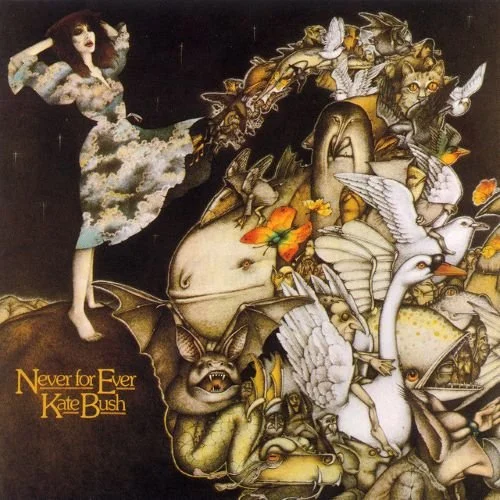
Kate Bush’s music dramatically shifted after one encounter, though there was this awkward clash in the late-1970s and 1980s where a lot of the music press saw her as too optimistic and lacking any depth. One could say that it not only motivated her to include more political and socially conscious songs. In terms of her production and the scope of her work, maybe she was proving to the dismissive and misogynistic critics that she was serious and was not this slight and empty artist. I have included the interview before, but on 20th October, 1979, Danny Baker interviewed Kate Bush for NME. This was not long after she completed The Tour of Life and whilst she was recording 1980’s Never for Ever. To this point, the singles that had been released were quite theatrical in a way. Different to what was being offered by artists of the time, I guess publications like NME were more favourable to Rock bands and Punk artists. To them, Kate Bush must have seemed slightly ridiculous. Though Danny Baker has since regretted his attitude and tone in this interview – though this is no excuse as he was disgraceful and hugely unprofessional! -, there was something in it that provoked Kate Bush to shift. Not going from nice to sharp. If some quarters of the press saw her as too optimistic and shallow in a way, a few of the tracks on Never for Ever was an answer to those who asked if she could be serious. The entire interview is a hatchet job and car crash. Bush, only twenty-one at the time, is incredibly professional (much more so than Danny Baker) and navigates perhaps the most insulting, sexist and worst interview she has been involved with.
There are some segments of the interview that are especially galling and significant. Even if Danny Baker was inexcusable misogynistic and completely unprofessional in every respect, there are some positives that did come from the aftermath:
“Hey Kate. Do you feel obliged to sing like that these days?
"What? You mean…"
Y'know, like you could age the nation's glassblowers.
"Oh, yeah, sure. I mean, I don't feel obliged – that is me. See, like in a recording studio, when it's all dark and there's just you and a couple of guys at the desk, well, you get really so involved that to actually plan it becomes out of the question. It just flows that way. As a writer I just try to express an idea. I can't possibly think of old songs of mine because they're past now, and quite honestly I don't like them anymore."
Have you still got people around you who'll tell you something's rubbish?
"My brother Jay, who's been with me since I was writing stuff that really embarrasses me – he'd let me know for sure… Yeah, there's a few I can really trust."
She smiles again and I was warm to her. Mind you, she speaks my language, so I could be sympathetic because she's one of the south London rock mafia. I ask her what it's like to be paraded in the Sun and suchlike as the Sex Goddess of POP!
"Hmmm. You see, you do a very straight interview with these people, without ever mentioning sex, but of course that's the only angle they write it from when you read it. That kind of freaks me out, because the public tend to believe it…"
Asking a few more questions, I begin to realise that this isn't the kind of stuff that weekloads of Gasbags [NME letters page] are made of. I'm searching for a key probe, but with Kate Bush – well, there's not likely to be anything that will cause the 12-inch banner-headline stuff, is there now? I recall Charlie Murray's less than enthusiastic review of her Palladium shows, which were apparently crammed with lame attempts to "widen" the audience's artistic horizons – y'know, lots of people dressed as violins and carrots an' that. CSM reckons it was one of the most condescending gigs in the history of music. Kate had read the review, but she didn't break down.
For a start I have cut about a hundred "wows" and "amazings" from her speech. She talks at length about how important she feels it is to be "creating" all the time, and when I asked her if she looked to the news for any song inspiration I got this curious answer:
"Well, whenever I see the news, it's always the same depressing things. War's hostages and people's arms hanging off with all the tendons hanging out, you know. So I tend not to watch it much. I prefer to go and see a movie or something, where it's all put much more poetically. People getting their heads blown off in slow motion, very beautifully."
She grins broadly again. Kate is an artist through and through, seeing the world as a crazy canvas on which to skip. Her outrageous charm covers the fact that we are in the midst of a hippy uprising of the most devious sorts. I approach her on the question of being a woman in pop music once more. How do her workmates treat her?
"Well, when I started, I felt really conscious of being female amongst all these fellows. But these days I feel like one of the lads”.

IN THIS PHOTO: Kate Bush at the 1980 British Rock and Pop Awards/PHOTO CREDIT: Mirrorpix/Getty Images
Something Graeme Thomson notes in Under the Ivy: The Life and Music of Kate Bush is how Danny Baker felt Kate Bush was hippy-dippy and pampered. Someone who was perhaps a spoilt rich girl, Bush did not go from writing about one thing and completely concentrated on another thing. There was a sensibility and determination that grew. However, two hugely politically and powerful songs were written for Never for Ever. Early on the morning of 9th November, 1979, four American command centres received signals that a full-scale nuclear attack by the Soviet Union was on its way. This was the time of the Cold War. A terrifying time when nuclear destruction was a constant threat and possibility, Kate Bush would have been well aware of it, however, she kept it out of her music. Making her first two albums similar in nature when it came to the themes addressed (alongside songs of desire and love was the fantastical, sometimes gothic and darker; always unique but never really political), Never for Ever consciously ended with two songs that could be deemed ‘political’. However, as Graeme Thomson notes, neither as potent and cohesive perhaps as artist like Elvis Costello and her peers. However, Breathing was very much an observation of potential nuclear holocaust. A foetus protected by her mother’s womb, this unborn child is breathing in their mother’s nicotine. “We're the first and last, ooh-ooh-ooh/After the blast/Chips of plutonium are twinkling in every lung”. Army Dreamers is perhaps more of a reaction to numerous casualties of young men in numerous conflicts in 1979 and 1980. Maybe The Troubles in Northern Ireland were moving Bush. Or the Iran-Iraq War.
Rather than her music being entirely positive – or at least neutral and not really having too much anger or political drama -, there was a change. Bush co-produced Never for Ever and you can tell that she wanted her albums to be much more in her control. Bigger and more diverse. Moving her voice slightly from the high-pitched impression people had of her, you can hear growl and grit in Breathing. Army Dreamers’ narrator is quite high-pitched, though I think Bush is using her mother’s voice. This idea of a mother losing a young son. Bush acting as this mother figure. The Irish accent makes me think Bush is focusing on The Troubles. I do think there was an issue with critics writing Bush off as nice and naïve. Perhaps someone who was prancing and leaping around without saying anything significant, I feel the likes of Danny Baker forced Bush to put distance between her and her first two albums (1978’s The Kick Inside and Lionheart) and almost apologise. Even if she did not compromise her vision and sound because of idiots in the press, I do think a fire was lit. Actually, more politics did come into her music. You can hear it on 1982’s The Dreaming. Pull Out the Pin is one example. I feel Bush’s vocal style changed because she no longer wanted to be diminished and infantilised in the press. A more masculine energy and harder percussive sound would come in. Never for Ever hardly contains anything that thematically could be linked to her first two albums. In terms of talking about love, most of Never for Ever looks at characters and other people and not so much Kate Bush herself. The strangeness of The Infant Kiss. The revenge drama of The Wedding List. The deceit and mistrust of Babosohka. Regarding All We Ever Look for, Bush said the following in a 1980 interview: “Our parents got beaten physically. We get beaten psychologically. The last line – “All we ever look for – but we never did score”. Bush definitely evolving. In terms of getting more serious in a way. Darker too in some ways. Being labelled a sex symbol, there were no lustful or sensual songs. Nothing you must hear on The Kick Inside or ever Lionheart. It is a shame in a way.
However, maybe Bush did force herself to kick against those who wrote her off. Never for Ever went to number one. Bush became the first British female artist to have an album reach the top spot in the U.K. The Dreaming, whilst not a chart-topper, was so much more experimental and darker than what went before from her. Integrating different influences and embracing technology like the Fairlight CMI and influences like Peter Gabriel. Maybe her first two albums were more feminine and female. More neutral for Never for Ever, and there was this transition. Definitely more masculine for The Dreaming and 1985’s Hounds of Love. 1989’s The Sensual World a definite shift back to the more female. I wonder how influential negative and sexist critical attack was, not only in terms of Bush addressing politics, conflict, violence and breaking away from this idea she was a caricature or hippy. Indeed, as a producer and songwriter, there was a transmutation. One can say that motivation, wherever it came from, resulted in some of Kate Bush’s best music. Many will argue that critics had nothing to do with that and it was Bush naturally evolving and building. That is fair. What is clear how a 1979 NME interview directly impacted Never for Ever which, in turn, was a bridge to a new era or a departure and disconnection from the past. A past that I am very fond of. What hurts most is how this criticism and sexism was seen as normal or cool. Baiting an artist that was so inventive and original because she didn’t’ seem to fit their impression of what music should be. Kate Bush definitely had the last laugh! Her music and influence far outweigh the words or reputation of any of those journalists who attacked or mocked her! If she is seen as this genius and one of the most influential and important artists ever today, that sadly was not the case in the eyes of some…
IN 1979.