
FEATURE:
My Artist of the Year 2025
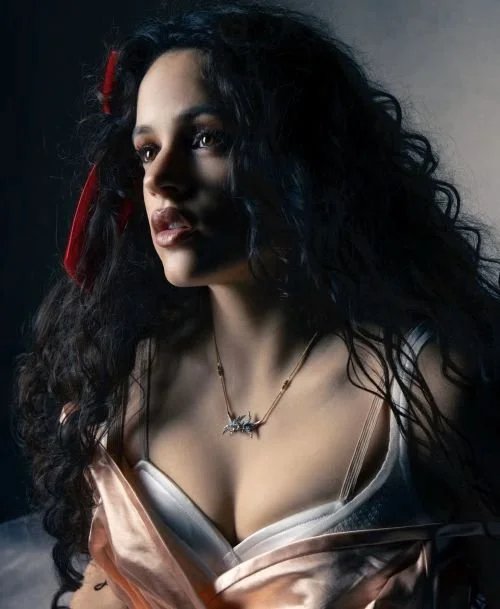
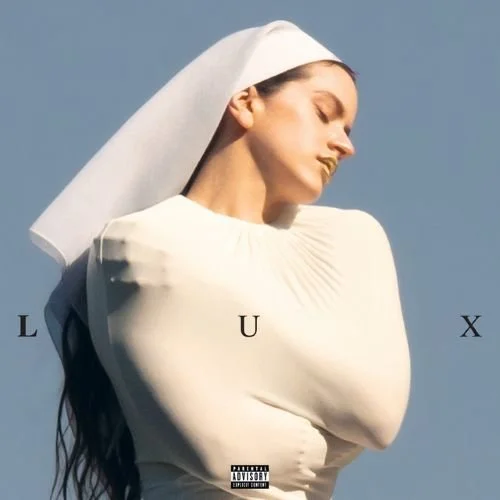
there are many new artists who I have followed this year and have done amazing work, just because of the weight of LUX and the impact it had on me (and so many others), ROSALÍA is my artist of 2025. I can’t remember if I did one of these features last year but, in 2023, Iraina Mancini was my artist of the year, and I got to interview her around that feature. However, I do not have access to ROSALÍA, so I have to rely on other interviews. I may bring in some text I have used in other features. However, I am such an admirer of ROSALÍA and LUX. I am going to end with a review for the album, as it gained so much love. Fervent and impassioned praise for an album I feel is the very best of this year. ROSALÍA is my artist of 2025, not only because of the album. The interviews she has been involved with and how she talks about her music and career. Her words and work has made such an impression on me this year. It is going to be so fascinating to see what comes after LUX. I don’t think that she will repeat this album. Instead, there might be this whole new revelation and reinvention. I am going to start off with an interview I have not sourced so far. LUX was released on 7th November, so it has made this very fast impact. ELLE spoke with ROSALÍA in August, as she was back in the studio. Little did they know what would come! ELLE talked to her about filming a new role in Euphoria:
“In L.A. last summer, paparazzi caught Rosalía outside Charli XCX’s 32nd birthday party wielding a bouquet of black calla lilies filled with cigarettes, sparking a microtrend. (“If my friend likes Parliaments, I’ll bring her a bouquet with Parliaments,” Rosalía says. “You can do a bouquet of anything that you know that person loves!”) She also made frequent stops at the local farmers market, where she says she tapped into her primordial gatherer spirit.
“Many times, the more masculine way of making music is about the hero: the me, what I’ve accomplished, what I have…blah blah blah,” she says. “A more feminine way of writing, in my opinion, is like foraging. I’m aware of the stories that have come before me, the stories that are happening around me. I pick it up, I’m able to share it; I don’t put myself at the center, right?”
It is a method she cultivated as an academic, which directly informs her approach to composition. Like works of found-object art, her songs are assemblages of sounds with seemingly disparate DNA, brought together by her gymnastically limber voice. In her 2018 single “Baghdad,” she interpolated an R&B melody made famous by Justin Timberlake; in her 2022 smash “Saoko,” she rapped over jazz drum fills and pianos with sludgy reggaeton beats.
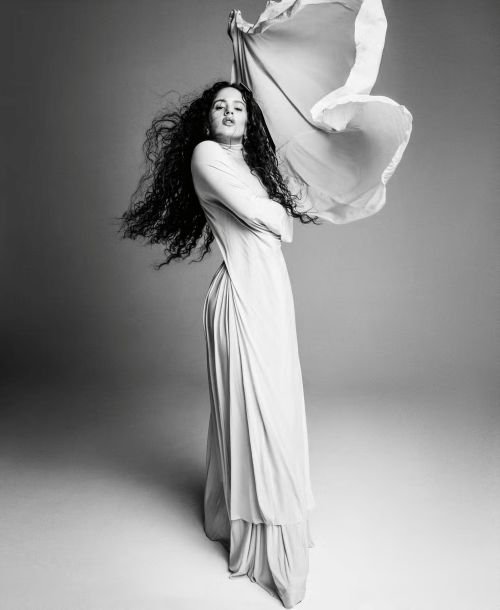
PHOTO CREDIT: Inez & Vinoodh
The visual culture of Rosalía’s work is executed with similarly heady intentions, inspired by TikTok videos and the fractured nature of her own presence on the internet. A staple of her Motomami world tour was the cameraman and drones that trailed her and her dancers across the stage. One of my most lasting memories from her shows was just the internal frenzy of deciding whether my eyes would follow Rosalía, the real live person on stage, or Rosalía, the image replicated and multiplied on the screens behind and around above her.
“In a cubist painting, which part do you choose?” says Rosalía of her concept. “Everything is happening at the same time, right? So you just choose what makes sense for you, where you want to put the eye and where you want to focus your energy.”
She’s gone mostly offline since her last project. “Björk says that in order to create, you need periods of privacy—for a seed [to] grow, it needs darkness,” she says. She has also shed some previous collaborators, including Canary Islander El Guincho, the edgy artist-producer who was her main creative copilot in El Mal Querer and Motomami. She says there is no bad blood, though “we haven’t seen each other [in] years. I honestly love working with people long-term. But sometimes people grow apart. He’s on a journey now, he’s done his [own] projects all these years. And yes, sometimes that can happen where people, you know, they grow to do whatever their journey is. Right now, I’m working by myself.”
Going it alone poses a new challenge for Rosalía, who, in true Libran fashion, derives inspiration from the synergy she experiences with others. She has famously collaborated with past romantic partners, like Spanish rapper C. Tangana, who was a co-songwriter on El Mal Querer. In 2023, she released RR, a joint EP with Puerto Rican singer Rauw Alejandro, to whom she was engaged until later that year. She does not speak ill of her exes, if at all, but simply says, “I feel grateful to each person with whom life has made me find myself”.
I think that ROSALÍA is this visual artist. In terms of her music, she thinks about the lyrics and music, though there is also this cinematic aspect. Bringing her songs to life in a visual way, through music and social media. The interviews with her from this year have such incredible photos. ROSALÍA is this artist who is so engage and hypnotic! Her music moves and changes you. Her words do the same. Seeing her in photoshoots, you are stunned by her connection with the camera and how she is so engaging. So stylish and individual too. You can see that in this interview from Billboard that was released early last month:
“This record takes you on a complete journey; the singing on it is just astounding,” says Jonathan Dickins, who runs September Management, home to Adele, and who began representing Rosalía in June. “I think she’s a generational artist. I’m lucky enough to have worked with one, and now I’m lucky enough to work with another. She is an original.”
To make Lux, Rosalía relied on several of her longtime collaborators — producers Noah Goldstein and Dylan Wiggins and engineer David Rodriguez among them — and tasked them with taking a new approach. “The whole process helped me grow as a musician, as a producer, as a sound engineer,” says Goldstein, who has also worked with Frank Ocean, Jay-Z and FKA twigs. “That’s one of my favorite things about working with Rosalía: I’m always learning things from her.”
She also tapped new collaborators such as OneRepublic singer and decorated songwriter Ryan Tedder (who spent three years DM’ing Rosalía, hoping to eventually work together) and urged them to push their boundaries. “For an artist to give me the freedom to just express myself in that way, God, that is the most fun I’ve ever had,” says Tedder, who has worked on mammoth albums by Adele, Beyoncé and more throughout his career. “I’ve been asked by everybody, ‘What does the new Rosalía stuff sound like?’ And I literally say to everybody, ‘Nothing that you possibly would imagine.’ ”

PHOTO CREDIT: Alex G. Harper
For Rosalía, challenging preconceptions about the type of music she, or anyone, can make is part of the point — thinking outside the box, following her inspiration and constantly learning, finding and creating from a place of curiosity and openness to new experiences and ideas. “I think that in order to fully enjoy music, you have to have a tolerant, open way of understanding it,” she says. “Because music is the ‘4’33” ’ of John Cage, as much as the birds in the trees for the Kaluli of New Guinea, as much as the fugues of Bach, as much as the songs of Chencho Corleone. All of it is music. And if you understand that, then you can enjoy in a much fuller, profound way, what music is.”
When did you start working on this album?
I don’t think that it’s easy to measure when something like this happens or starts. The album is heavily inspired by the world of mysticism and spirituality. Since I was a kid, I’ve always had a very personal relationship with spirituality. That’s the seed of this project, and I don’t remember when that started.
How did you approach Lux differently?
This album has a completely different sound than any of the projects that I’ve done before. It was a challenge for me to do a more orchestral project and learn how to use an orchestra, understand all the instruments, all the possibilities, and learn and study from amazing composers in history and say, “OK, that’s what’s been done. What can I do that feels personal and honest for me?” And also the challenge of having that inspiration in classical music and trying to do something that I haven’t done before, trying to write songs from another place. Because the instrumentation is different from all the other projects I have done. But also the writing, the structures, it’s very different.
You’ve said Motomami was inspired by the energy of L.A., New York, Miami. What was your mission in making Lux?
It’s made from love and curiosity. I’ve always wanted to understand other languages, learn other music, learn from others about what I don’t know. It comes from curiosity, from wanting to understand others better, and through that I can understand who I am better. I love explaining stories. I like to be the narrator. I think as much as I love music itself, music is just a medium to explain stories, to put ideas on the table. So that’s what this project is for me. I’m just a channel to explain stories, and there’s inspiration in different saints from all across the world. So you could say it feels like a global thing, but at the same time, it’s so personal for me. Those stories are exceptional. They are remarkable stories about women who lived their lives in a very unconventional way, of women who were writers in very special ways. And so I’m like, “Let’s throw some light there.”
What I know is that I am ready, and this is what I needed to do. What I know is that this is what I was supposed to write about. This is my truth. This is where I am now.
The album is so operatic and orchestral. How did you begin to immerse yourself in those styles and find the people that you worked with to deliver that?
They’re the people I feel comfortable with, so I love sharing time with them in the studio. For example, I worked on [Lux song] “Mio Cristo” for months by myself in Miami and L.A., and I delayed the moment when I would share it. I wanted to make a song that was like my version of what an aria could be. So I remember just going to the studio after so much work, after so much back and forth with an Italian translator, and I [had been] improvising on the piano, trying to find melodies, to find the right chords and notes. I went to the studio and I shared it with Dylan [Wiggins], with Noah [Goldstein], with David [Rodriguez], and I remember they were like, “Yes. That’s the song. There it is.” So it’s been a lot of isolation on one side — a lot of writing — and then on the other side a lot of collective effort in the studio.
In releasing this album, what would success look like for you?
Success, for me, is freedom. And I felt all the freedom that I could imagine or hope for throughout this process. That’s all I wanted. I wanted to be able to pour what was inside, outside. And those inspirations, those ideas, make them into songs. I was able to do that, and I will not ask for more”.
Before getting to a review of LUX, I am want to include this interview from Rolling Stone en Español. There are a range of interviews to choose from, but I think that this one is especially important. There may be some people who have not yet heard LUX. It is not just a brilliant album. I think that it is groundbreaking in terms of how it will impact artist going forward. We will see it transform the music scene:
“LUX doesn't seek to be understood on the first listen. It's a work that demands attention and dedication, that requires time and reflection. Every detail seems to have been carefully considered, and every emotion feels sincere. Centuries of history resonate within its layers, diverse genres and styles, verses in fourteen languages. All interwoven with absolute intention, with the desire to make music a vehicle for the transcendent. In an era where pop is consumed at breakneck speed, Rosalía chooses to stop time and look upwards.
'Lux' means light in Latin. It has a super orchestral palette and is very inspired by spirituality. It's not the first time spirituality has been present in your music, but it's certainly very, very present in 'Lux'. Why did you feel that creative need?
I think it's true that spirituality has always been very present in my music, but I'd never dedicated an entire project to it. Perhaps I simply felt it; it was like, "Come on, now's the time." I feel capable of developing something like this, of composing from this place. I also really wanted to understand how others have written about God. There are many women who are an inspiration on this album, nuns who were poets, who wrote and wrote incredibly, and they've been a reference for me and have also allowed me to understand that there's this possibility of writing from devotion. I was excited to do a project like this. I think God has blessed me greatly, and what better way to show my gratitude than to make an album for Him?
Yes, that depth is very noticeable. The first ray of 'Lux' that you presented to the world is 'Berghain'. Absolutely insane, breathtaking. In that universe, Snow White, Da Vinci's Lady with an Ermine, the techno section of Berghain, and the irreparable heart all coexist. I've seen many interpretations people make, but something I've noticed is that they all talk about a duality between innocence and passion. Does that interpretation resonate with you?
It could be, but I think everyone has to make their own journey. Perhaps 'Berghain' is ultimately the most violent or aggressive passage on the album. On one hand, there's that tension between the divine and the inanimate, the mundane and the otherworldly, light and darkness. We tried to explain it through the video in this way, with these images, with this imagery, but in the end, people have to have their own experience, their own interpretation. I wouldn't want to limit the journey others need to take when they watch the video. That's what it's for. Ultimately, that's what symbols are for.
Yes, everyone interprets them. And they certainly have. I've seen several very interesting interpretations.
Yes, yes, yes. That's the beauty of it. That's where the beauty lies. That they are participants in the work. By giving it meaning or interpreting it, they are participating. That's what interests me, reclaiming the listener as a producer, as a composer. It's part of it.
Yes, absolutely. From the evolution of the work, right?
Exactly. Very well said, yes.
Listening to the album, the phrase "I was made to divinize " immediately came to mind. Are you talking about empowerment, self-belief, or where does that come from?
To divinize. It's a verb I learned while working on this project, and I loved how it sounds, I loved what it means. When you're centered, I think you can let light through. We all have the potential to be creative. In our daily lives, in the little things, in so many contexts, we can be creative. Creation, in the end, is something divine. Creation is connected to divinity. So, that's why I think we're all capable of divinizing. Of allowing something to pass through you, of being able to shed more light. And that's why that phrase is there”.
I am going to end with a review of LUX from PASTE. They note how ROSALÍA is reinventing Pop and confronting the divine. On her fourth album, we witness “her usual genre-smashing instincts to create an ambitious, masterful classical avant-pop work exploring the confounding mysteries of love, God, and the divine feminine”. The Catalan artist is at the peak of her brilliance, though you feel we may hear another album from her even more astonishing:
“To make LUX, ROSALÍA began by reading hagiographies of female saints. “Making albums for me is like excuses to do what I actually want to be doing,” she told the The New York Times earlier this month, and for the 33-year-old Catalan superstar, that simply meant reading. She studied up on saints such as Hildegard of Bingen, Joan of Arc, Claire d’Assise, and Rosalie de Palerme; she pored through the lives of Olga of Kyiv—an Eastern Orthodox saint who slaughtered thousands of men from the tribe responsible for her husband’s death—and the Buddhist nun Vimala, who was a prostitute before eventually becoming a poet and a nun. These were women—totally unconventional, often tragic—that challenged ROSALÍA’s ideas of sainthood and offered an unorthodox view of holiness.
And unorthodoxy, of course, has always been ROSALÍA’s modus operandi. Her 2018 breakout album, El Mal Querer, catapulted her onto an international stage by reinventing flamenco with slinky electronic production. 2022’s MOTOMAMI, meanwhile, broke the mold by collaging and remixing an eclectic array of Caribbean genres, from reggaeton to dembow to bachata. LUX, ROSALÍA’s fourth album, continues this trend of constant artistic transformation. Rife with strings as stormy as Vivaldi’s and vocal performances as dramatic as Carl Orff’s cantatas, this ambitious avant-pop work could be categorized as classical above all else. Yet, in the lineage of artists such as Kate Bush, FKA twigs, and Björk—who features on the track “BERGHAIN” and can be seen as a patron saint for this type of pop experimentation—ROSALÍA appears uninterested in these cumbersome musical boundaries, soaring instead towards a far more elusive, fearless vision of what pop can be. Yes, she’s working with the London Symphony Orchestra, but she’s also calling on producers like Noah Goldstein (Yeezus, Blonde) and Dylan Wiggins (SZA, Justin Bieber). Divided across four movements and sung in 13 different languages, LUX is an explosive, experimental album that demands a lot from its listeners, but not without offering resplendent gifts of beauty, drama, and grace.
LUX’s themes float around love, God, faith, and the divine feminine, and the album’s cover—ROSALÍA in a skin-tight habit, eyes closed in sensuous devotion, hitting that Sade Love Deluxe pose—should give good indication of its preoccupation with what is both bodily and holy. During the leadup to LUX, ROSALÍA devoured the works of cult feminist writers including Simone Weil, Clarice Lispector, and Chris Kraus. Much like these women, ROSALÍA is concerned with questions of the mystical and the erotic, and here in LUX, desire—despite all its chaos and brutalities—is undeniably divine. On the glistening and ghostly “Divinize,” ROSALÍA whispers over pulsing kick drums, “Through my body, you can see the light” and “Pray on my spine, it’s a rosary.” And “Reliquia,” which opens with jaunty strings, sees ROSALÍA losing parts of herself across the world—her tongue in Paris, her time in LA, her heels in Milan, her smile in the UK—much like saints’ relics; yet ultimately, she offers her own heart for both love and veneration: “But my heart has never been mine, I always give it away, oh / Take a piece of me, keep it for when I’m gone / I’ll be your relic.”
The album’s soundscapes are lush and symphonic, for sure, but ROSALÍA continues to draw from her entire artistic repertoire, making LUX seem less like the classical antithesis to her oeuvre and more like the synthesis of everything that’s come before. MOTOMAMI-esque electronic production—from the scuzzy bassline and AutoTune-crunched vocals of “Porcelana” to the scrambled, glitchy breakdown at the end of “Reliquia”—grounds the operatics, fusing the hedonistic with the heavenly. Other tracks borrow from the flamenco world of El Mal Querer: “La Rumba Del Perdón” places ROSALÍA alongside legends Silvia Pérez Cruz and Estrella Morente, and on “Madruga,” charging strings find their opposing force in palmas and heavy panting as ROSALÍA spins a tale of revenge and divine fury.
Despite all the symphonics and electronics, the album’s theatrics never overshadow its most tremendous instrument: ROSALÍA’s voice, which shines over this lush backdrop. She intones from the heavens over a thunderous cloud of choir and strings on “Mio Cristo Piange Diamanti,” declaring the power of God’s grace. And on the beautiful piano ballad “Sauvignon Blanc,” her pristine soprano soars as she promises to relinquish everything—Jimmy Choos, a Rolls-Royce, pearls and caviar—for love. The song draws from the story of Teresa of Ávila, who gave up her earthly possessions to follow God. It feels like the pious older sister to MOTOMAMI’s horny “HENTAI,” yet the two tracks are perhaps surprisingly similar, matched both by their yearning balladry and the depth of their devotion. Then there are all those other delightful details throughout the album: ROSALÍA’s harmonizing alongside Portuguese fado singer Carminho on “Memória,” her plaintive melismas in “Magnolias,” and even her witchy Latin rapping on “Porcelana”.
On “La Yugular,” ROSALÍA samples a 1976 Patti Smith interview, where the punk rocker and poet says, “Seven heavens—big deal! I wanna see the eighth heaven, tenth heaven, thousandth heaven. You know, it’s like, break on through the other side.” Smith was discussing how important it was for artists not to merely rest on their laurels but to instead push themselves to keep evolving and searching for more. It’s no wonder ROSALÍA clipped those lines; their message feels fitting for LUX, an album that is so insistent in its demands for more, more, more of everything: more reinvention, more pop, more devotion, more heavens, more love”.
LUX is my favourite album of the year. ROSALÍA is my artist of the year. Despite the fact the album came out very recently, it did hit me so hard and I feel LUX has shaken so many people. In the best possible way. Go and listen to the album if you have not done so already. Even though she has released this masterpiece, I think there will be even greater curiosity to see…
WHAT comes next from ROSALÍA.