FEATURE:
Spotlight
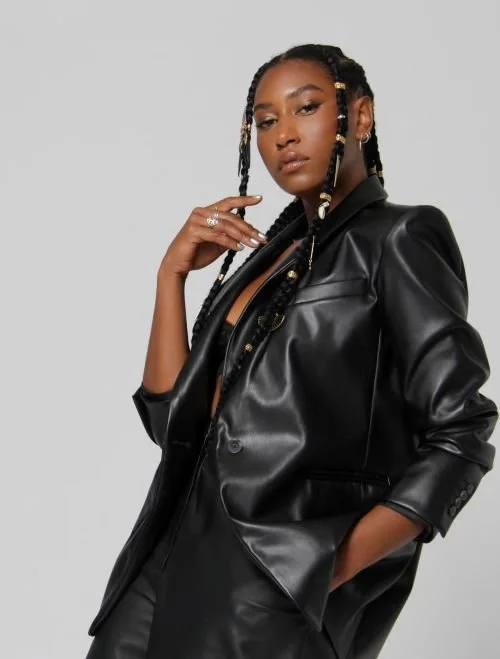
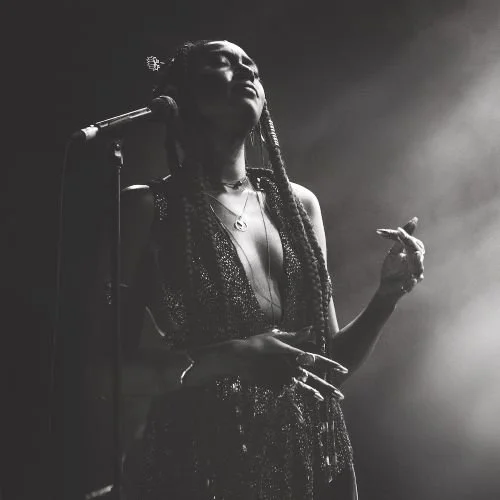
IN THIS PHOTO: Dominique Fils-Aimé at the Montréal International Jazz Festival in 2024/PHOTO CREDIT: Cecilia Baguerre Martinez
Canadian tour dates and some European shows after, it is a busy start to the year for Dominique Fils-Aimé. I am going to start out with some biography about this incredible Canadian songwriter and artist. Even though her debut album, Stay Tuned!, was released in 2019, I think of Fils-Aimé as rising or still coming through. In the sense that she is putting out her best music at the moment. Before getting to some interviews with Dominique Fils-Aimé, let’s discover more about her:
“Two-time JUNO Award-winning Montreal singer-songwriter Dominique Fils-Aimé has established herself as one of today’s leading voices in vocal jazz. Her latest album, Our Roots Run Deep (2023), earned the 2024 JUNO Award for Vocal Jazz Album of the Year as well as the 2024 Félix Award for Best Jazz Album at ADISQ, affirming the importance of her artistic vision at the crossroads of jazz, soul, and blues.
In February 2026, she will unveil the second chapter of her sophomore trilogy with a new studio album My World Is The Sun, preceded by the single Going Home, released on November 20, 2025. With this project, Fils-Aimé continues her exploration of sonic, creative, and spiritual freedom.
On stage, she offers an immersive performance that invites audiences to delve into the roots of their soul, guided by a profound quest for connection. Live at the Montreal International Jazz Festival (2025), her first live album, is a testament to the strength of her stage presence and her ability to forge an intimate bond with her audience.
In recent years, she has performed on prestigious stages including the Blue Note New York, Blue Note Los Angeles, and the Monterey Jazz Festival, as well as Jazz à Vienne (opening for Jamie Cullum) and the North Sea Jazz Festival.
In 2026, Dominique Fils-Aimé will bring her new album to the stage on a world tour, with concerts announced in Europe at La Maroquinerie (Paris) and Le Botanique (Brussels), in Canada at the Montreal International Jazz Festival, and across the United States”.
I will come to some interviews from last year. However, first, I want to focus on one from 2023. Speaking with KLOF Mag around the release of the album, Our Roots Run Deep, it definitely has one of the most striking and beautiful covers of that year. I especially love the title track, as it is so atmospheric and immersive. In the sense you can step inside what Dominique Fils-Aimé is singing and walk alongside her:
“Born in Canada to Haitian parents, Dominique was meant to learn the piano from her sister. “But I didn’t practise and there was too much structure around my fingers; it was very technical,” she says. “So my sister retired from teaching very early on. My mum played music from everywhere – Haiti, Nigeria, Mexico, France. My sister had the biggest collection of CDs and I’d borrow one at a time for weeks, obsessing over it.” The adult Dominique worked in psychological support for employees in corporate life and turned quite late to making music. Then, a researcher from the TV talent show La Voix asked her to apply, and she ended up in the semifinals of the 2015 edition. Signing to Montreal label Ensoul Records, Dominique’s debut album Nameless came out in 2018, followed by Stay Tuned! and Three Little Words.
The trilogy was devised to trace African-American music from nineteenth-century slave songs to the birth of hip-hop. Composing orally, Dominque layered chords of vocables from invented sounds and syllables to form haunting modern parables. Into the mix came catchy tunes with sparse accompaniment from bass, percussion and Ensoul founder Kevin Annocque on didgeridoo. Each record’s artwork reflected its musical themes in colour and photography. Blue for the blues, water and the weight of history; red for jazz revolution, passion and liberation; yellow for heat, happiness and a sunny explosion of styles.
Dominque explains this further: “Each cover is planned from the beginning, so I know where each album is going and what it’s exploring. The designs are by Siou-Min Julien, a talented and sensitive artist. On the Nameless album there was a desire to hide part of my face, as my beginning. There’s also an association there with the moon’s different quarters. Then the half-turn on Stay Tuned! has an energy that’s defiant but not in a bad way, feeling proud as a woman and standing tall. Three Little Words looks like a face-to-face conversation, the journey to becoming more direct and vulnerable about my intentions. I started out wanting to be anonymous and debated this with my manager. He raised the point of how few black women are visual in the city’s landscape and how having posters of my albums might relate to someone who doesn’t feel represented. So displaying your face does matter.”
Our Roots Run Deep is an exuberant hymn to the natural world and personal growth, soaked in verdant grooves and ripe melodies. “We talk about going into nature as if we’re separate from it and not organic ourselves,” says Dominique. “We’ve recently discovered how much trees talk to each other and feed each other underground. Their roots were hidden from us for a long time, we didn’t know them or think of them. Forests were just seen as rows of trees next to each other, without connection. Humans are the same, we see them standing together in a crowd, but don’t see what connects us to our ancestors, everything they built for us to be in this modern world. A lot of my strengths and blessings are thanks to my mother and grandmother. Through talking or meditation they bring me great advice when I see challenges coming. I wanted this album to represent me as a plant from those bottom roots to the top branches, reaching towards the sun”.
There were some interviews published last year around the release of Live at the Montreal International Jazz Festival. I have never seen Dominique Fils-Aimé play live, though she is someone that I definitely watch to catch if she comes to the U.K. this year. All About Jazz spoke with Fils-Aimé about her music. Jazz gives her a real sense of healing and freedom. I have spotlighted a few artists recently who see their music as this form of release and something that they connect to in a very deep and healing sense:
“When asked what she hopes people hear when they call her music "jazz," she responds immediately: "Freedom." Shortly after, she emphasizes again: "Freedom. It's the number one... that's what I'm hoping listeners are inspired to seek for themselves. I believe jazz resonates with us in a way that reminds us to pursue freedom in all its forms."
Fils-Aimé did not come to music by following a technical checklist. Before pursuing music as a career, she worked in psychological support for families, and the idea of music as a form of care remains central. She describes her creative process as something that starts with an impulse and then transitions into a meditative state—repetition and breath opening a pathway to meaning. "There is definitely a meditative aspect to even the creation process... there's always this notion of repetition... similar to breathwork," she explains. "It always begins with just a random impulse... and then from that point, it's as if I begin a meditative process that can last for hours."
Two recent touchstones exemplify that blend of rigor and receptivity. Our Roots Run Deep (Ensoul Records, 2023) portrays growth through an ecological perspective. "The whole album itself and this song specifically were inspired by nature... the color green is associated with the heart chakra... I'm being a little more open with my heart and sharing the messages and the lessons that I keep learning from my plants," she says. From there, she extends the metaphor below ground: "All the roots are actually connected... with the older ones feeding the younger ones. This felt like a clear metaphor... our ancestors are also feeding us... We are all connected, even if we can't see it with our eyes the same way." The takeaway is patient and practical: "Even if there is a tiny little leaf, we cannot expect to be a tree tomorrow."
For readers discovering Fils-Aimé at a concert or years before the next one, the live album Live at the Montreal International Jazz Festival (Ensoul Records, 2025) functions as a compass, not a summary. It is a record of a moment that "will never be the same again," a sketch of how she treats presence as the point and "imperfections" as the human fingerprint that lets a song breathe.
And for anyone who approaches jazz with equal parts curiosity and care, Fils-Aimé offers a compelling vision of what the music can be today. Freedom, in her hands, is not just a slogan; it is clearly built into her approach—using audience loops that democratize the texture, trusting improvisation to reveal what truly matters, and crafting strong songs that move like mantras through the body. If you heard her live, you likely felt it in the room; if you are listening at home, you can still sense it in her choices. Either way, the invitation remains: "Freedom”.
I am going to wrap up with an interview from SPIN. Dominique Fils-Aimé discusses, among other things, why love is the cure/answer for everything. She also talks about being her true self and creating without limitations. Such a staggering and original musical talent, though I only found her music last year, I am instantly hooked. I do hope I get the chance to see her perform one day. Everyone needs to make sure Dominique Fils-Aimé is on your radar:
“What can you tell us about the new album you’ve just finished?
It’s the second album of my second trilogy, and it’s a continuation. I’m trying to reconnect and explore the depth of personal freedom through creation.
What does that mean to you?
To me, it means reconnecting to the inner child that creates without any limitations or without having the outside world. This is how I started, then I started putting some map in my head of where I wanted to go, what I wanted to explore, which area, and perhaps at some point letting go of that part allows me to be even freer. I was free, but within a context I had established before. Now I just want to seek freedom where it is less the cerebral aspect and more in the feeling and intuition, letting it guide me from that instinctual place.
What brought you to jazz?
Freedom. When I understood jazz is not about the way people academized it or made it into academia. The music was there before the books. When people are reproducing sounds in a very academic way, like unlearning the structure of jazz in a way that is cerebral, I feel like this is a big misconception. Jazz was about the quest for freedom, the desire to break out of a specific way of doing things. This is the legacy and the type of jazz I received. This is what I want to protect and cater to as my definition of jazz and as the type of art I want to make. That’s what jazz is. It’s the freedom of transcending every box and doing what is authentic to you and what is part of your quest to create as freely as possible with what you are and who you are.
The live album feels incredibly intimate, almost like there’s no barrier between you and the listener. How did you achieve that?
I felt a comfort there. There was so much love. I didn’t know it would be an album. They were recording it anyway. We record every show. We have hundreds of shows recorded. Especially big ones like that, we make sure we have it, at least for the memory of it. Vocally, there’s a lot of things that did not go as I usually would. I didn’t hear myself as well as I would have liked. There were all these technical elements. But they did not matter, because of the feeling. That’s why I was able to welcome that idea, although there was a little perfectionist voice behind being like, “It was not your ultimate performance, vocally. But emotionally, you were there 1000%.” And the people were there with us. There was an energy, a chemistry going on. It felt a fluid space between the musicians. Everyone on stage and everyone in the crowd, there was a connection, something special happening. I’m happy we kept it as an album. It needed to happen.
Are you hoping to capture the spirit of that Jazz Festival performance on your upcoming tour?
It’s a little different because the new album, the fourth album, the first of the second trilogy, Our Roots Run Deep, is different. It’s one single story. The songs are synced, one into the other, and they’re also mingled with little interludes that are poems that help me ground the people into which stage of the journey we are. It’s meant to be more of an immersive, meditative experience where I ask people to sink into their seats. There’s two or three times where people have space for applause. Your presence is already the loudest applause an artist can wish for. I want them to close their eyes and come on a journey with us throughout the show, which is easier to do in smaller spaces. Jazz Fest was a huge show, but I enjoy the intimacy of taking people on a journey on a more peaceful little river, on a little boat, where we’re going from point A to point B together. Take this moment to let go of everything outside this room and be in the moment with us.
Does singing in French make it easier or harder to express your true self?
It’s as if it’s another part of me. You know how they say you have two parts of the brain? Left and right, even when you look at it, they’re literally separate. They have different priorities, different interests. You have the left side that is more about here today in the real, physical world and the emotions and the need to see me as a person. Then you have the right side that is more connected to everything around us. The energies in things and colors and shapes. Usually for me, art is about tapping into that more connected place. Because I wish to create things that will connect with people, and connect people between themselves and with their emotions. There’s a universal aspect on that side of the brain, and it’s as if singing in French is the other part of my brain, the right brain. This part is more about my personal experiences, my very intimate, personal emotions. But also, there is a desire or pressure to be somewhat more poetic or precise with the word, because the French language can be a little more picky on the right word. That’s a form of pressure I didn’t want in my art. That’s why I stayed away from it for so long. But then I realized I need to also make sure that whenever a song comes in another language, I need to follow that intuition too, because that means something in me needs to express something from that place. Allowing it to come as it comes, turns out that eventually some of it came out in French, so I welcomed it, and discovered a new part of me”.
I am going to leave things here. Anyone who has not heard Dominique Fils-Aimé needs to check out her music. There are a lot of fascinating artists to keep an eye out for this year. Some will get missed, or they will not receive as much attention as they should. Dominique Fils-Aimé is someone to behold and cherish, as she is such an immense talent. Do go and listen to her music, as My World Is The Sun is out on 20th February. I am really looking forward. This brilliant Canadian artist is someone that you…
CAN’T afford to miss out.
___________
Follow Dominique Fils-Aimé
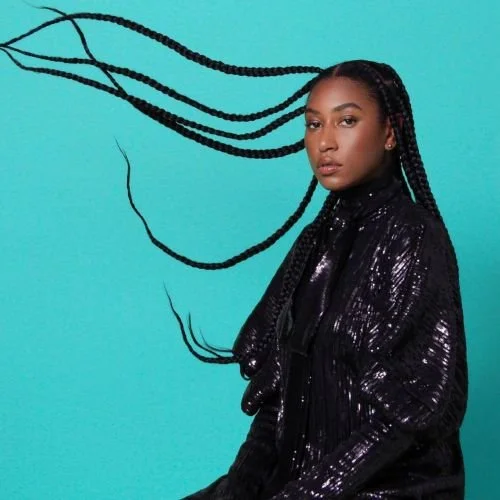
PHOTO CREDIT: Jetro Emilcar
Official:
Instagram:
https://www.instagram.com/sing.with.mi/
TikTok:
https://www.tiktok.com/@sing.with.mi
Spotify:
https://open.spotify.com/artist/10tvYvaoSO32hlvu3NrrPC?si=h2ii3V8RTjiFdUmvUUl2Cg
Facebook:
https://www.facebook.com/domiofficialpage
YouTube: