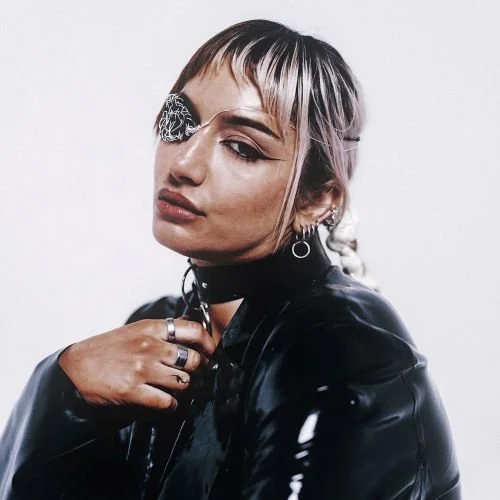
FEATURE:
Spotlight
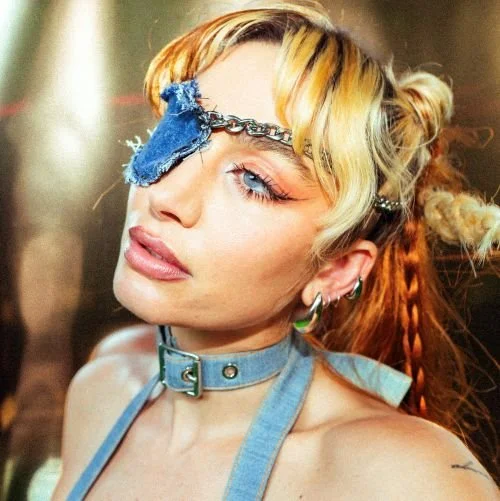
BIIANCO
__________
ANOTHER incredible D.J. that…
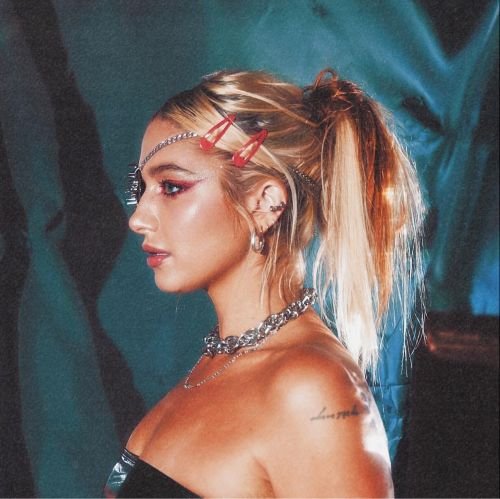
I feel people should know about and is going to have a phenomenal 2026, BIIANCO is someone whose work I have known about for a while. I am going to come to a couple of 2025 interviews with her. However, I will head further back to start out. They are an amazing D.J. that I do think is going to have a very busy year. Before getting to this must-know artist and D.J. who has overcome challenges to become one of the most respected and influential modern-day D.J.s, I want to bring in an interview from 2024. The partially blind, proudly queer and inclusive BIIANCO spoke with Broke Magazine about their new music and why it is important for them to represent diversity and queer identity through their work:
“BIIANCO is an artist who recently skyrocketed into viral attention last December with the hit track ‘Against The Wall, gathering an impressive 10 million views, over 500,000 shares, and gaining 150,000+ new followers across socials. These crazy numbers very soon led to international chart inclusions on platforms like Apple Music, iTunes, and Beatport as well as earning coveted spots like a Danny Howard Mini Mix and Jack Saunders’ Next Wave pick.
This dynamic talent—partially blind, proudly queer, and identifying as femme (they/them)—is back with a new dance-floor summer hit titled ‘Got Me Like’. The track has wasted no time leaving its mark, with the Instagram teaser raking in a staggering 1 million views and 40,000 likes in just five days.
But even before the viral explosion, BIIANCO had been carving out a niche in the industry with their high-energy trance sound and musical prowess. Their live performances, often featuring multiple instruments and vocals showcased to their dedicated fanbase through Insta and TikTok, have allowed them to champion inclusivity within the music scene.
Tell us about your upbringing and journey into music…
Honestly, music has been the most constant thing in my life. I grew up outside of NYC and was a classically trained pianist since age 5. Learned guitar, bass, and voice lessons and started producing music on a very old Mac by age 15. I ended up going to UCLA for music and then was in a band for many many years after graduating. I don’t think there’s ever been in a time in my life when I haven’t been making music.
Who do you draw the most influence from?
I have two pillars of inspiration for BIIANCO music — the first is emotional intensity. Whether it’s euphoria, rage, dejection, or limerence, I am a person who naturally feels things on 10 and I’ve always wanted my music to reflect that. A lot of dance music can be very surface-level emotionally, which is wild to me because people experiencing it in these spaces usually feel so much emotion! So, I’ve always wanted to stay true to that. The second inspiration is the 90s / Y2K trance culture. I love the combination of speed, melody, high-octave energy and emotion in that music. I think that’s always going to be my biggest sonic inspiration.
You’re known for your mad scientist tech skills in music production. Can you share a bit about your creative process when you’re in the studio?
I try to write at least 3 songs a week. I’m at a place now where I feel like I really know my sound so my palate of tones and musical elements to choose from is super specific. But honestly, what’s been happening lately is I’ll be out watching people perform or I’m going for long runs listening to people’s mixes and inspiration strikes and I go in the studio with a very very specific idea and execute it. This happened to me the other day when I was listening to a FJAAK set. I was like I need a song that dynamically moves its energy like that — that’s what’s missing from my set. And I went home and made it.
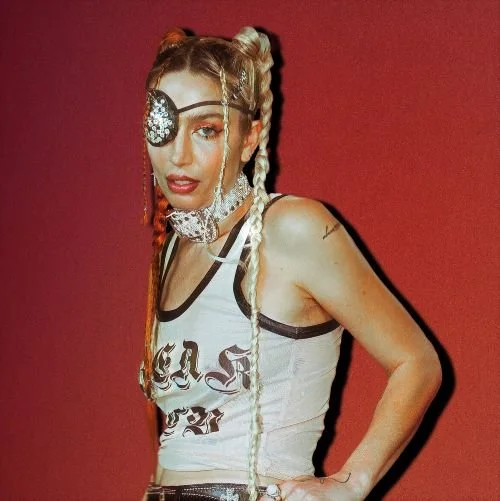
It’s amazing how you’ve overcome challenges like losing sight in one eye and continued to pursue your passion. What keeps you motivated during tough times?
Well, I feel like I was just on the brink of discovering my sound and was just starting to gain traction. So, when the accident happened I was like absolutely not this is a VERY inconvenient time to be interrupted and have this fire lit to move forward as quickly as I could. It meant very very long hours of relearning to play drums and instruments that really do require full eyesight. Only years later now, does the grief of losing my sight and learning to live with a disability fully hit me. I’ll find myself crying sometimes and be like oh what a delayed impact.
As a champion of inclusion in the industry, how important is it for you to represent diversity and queer identity through your music and platform?
To be honest, I’ve been queer my whole life so it’s really all I know. I think it comes naturally because if I’m being true to myself that’s just what I’ll choose. However, if I’m thinking with intention, I think it’s so important to represent diversity and queer community very fluidly. I think we’re all a bit exhausted of only being included when there’s a “diversity”, “queer” or “femme” title attached. True inclusion is seamless. I feel very passionately and intentionally about breaking down the performance of inclusion and helping build a music community where it just simply is”.
The first of two interviews from last year I am including is from DJ Mag. Taking us into BIIANCO’s studio, they guided Mick Wilson and “talked through their setup, creative process, and approaches to sound design, as well as transferring this into a live setting”. It is a fascinating interview with one of the most distinct and awe-inspiring D.J.s in the world:
“BIIANCO is a London-based, LA-trained producer, DJ, and multi-instrumentalist. Known for their high-energy releases, live sets and studio skills, their sound pulls from high-octane acid, trance and techno as confidently as it does from house and luminous pop.
A champion of inclusion in the music industry, BIIANCO also proudly shares their experiences of navigating clubland as a queer, neurodivergent and disabled artist, helping to blaze a trail for others to embrace their authentic, creative selves in the process. It’s a theme the self-proclaimed synth head regularly explores within their releases, including unleashing body positive club bangers with Marlon Hoffstadt, and October’s techno-leaning single, ‘Get You Out’ on Ultra Records, which wrestles with questions of identity amidst a whirlwind romance.
While touring the globe with their thrilling live and hybrid DJ sets, BIIANCO took us through their innovative approach to on-stage performance during an IRL edition of DJ Mag’s How I Play Live series at ADE last October — diving into sequencing, building energy, DAW-based and DAW-less options, and the art of balancing live and DJ elements. Below, they invite us into their studio as part of our new series, taking us through their setup, creative process, and approaches to sound design, as well as transferring this into a live setting.
Your music has a distinct sonic identity. How do you approach sound design in the studio? What tools or techniques are essential in shaping your sound?
“I think the most important thing you can do for building a distinct sonic identity is to know what you want to sound like and then to understand the history and musicology of that sound and what tones, synths, characteristics make that sub-genre. I really try to abide by this. I spend a lot of time studying the original authentic trance, acid, rave and hard house synths of the ’90s and early 2000s so I can incorporate those elements into my music.
“I also try to use real 303 acid synths to make my acid layers, to enhance that authentic sound. Most importantly, over the past year-and- a-half, I’ve been extremely particular about the BPMs I’m making my music at 140-150bpm, always. As a percussionist, I know this means the drums — especially the kick and bass patterns — must stay within some constraints to avoid them sounding chaotic. I think all these intentional decisions are the building blocks to the BIIANCO sonic identity.”
How do you channel personal experiences into your studio work? Is there a specific process you use to translate feelings into sound?
“As a neurodivergent person, I feel emotions very strongly and always have — therefore, music became a utility for me to process them at a young age. So, music has never existed for me without emotion. I have classical training, and that comes in handy when trying to translate my emotions into musical elements. For example, in a song conveying heartbreak, I’ll lean heavily into certain minor key progressions or timbres that can evoke that psychological response. I try to marry the emotion to the musical theory. This is a technique we studied heavily at university in our film scoring and composition-focused classes.”
How do you translate your studio work into a live setting, especially with a hybrid live set? What elements do you keep from the studio, and what changes to adapt to the energy of a live audience?
“I try to preserve the sounds I spend so much time crafting in the studio when going into a live environment, so I love tools that allow me to bring in my sounds. That’s why the Roland TR-8S sequencer is so clutch for performing drums and bass, as I load and sequence all those patterns with my original studio elements.
“For acid, I play the 303 live and in the studio specifically, so the tone is consistent no matter the environment. A lot of the acid people hear on tracks is super hard to recreate with real hardware, so I try to stay away from falling into that trap so I can give audiences authentic experiences.
“I tend to very slightly adjust my song formats to give myself padding in live settings that may not exist in the original song structure. For example, if I need to bring up the fader on the bass, hit the synth at the top of the phrase and start singing all at the same time in the original form, that would be super unrealistic in a live setting. So, I might adjust the structure to stagger the start. I basically finesse the structure so I can deliver a precise and powerful performance where I’m not overthinking what I need to do, and can get lost in the moment.”
hat are the biggest challenges you face when performing a hybrid set compared to a traditional DJ set or a full band performance? How do you overcome these challenges?
“Introducing any live elements means introducing risk into the performance, so an assessment of risk vs reward is the most important first step. For every risky live decision you make, there is extra hardware you need to bring, maintain and set up. Live also requires exponentially more rehearsal. I always tell people, ‘You want to use live elements, then be prepared to practice, practice, practice’. You need to be prepared for every single problem to occur at least once, and you can only do that when you know what could potentially occur. If I am doing live sampling in a performance, I will practice those live movements hundreds of times until it is muscle memory I can do with my eyes closed. That is the only way everything is as clean and smooth as loading up a CDJ with a pre-recorded track.
“A good example of a live challenge occurred when me and Marlon Hoffstadt recently performed our song, ‘Touch My Body’, at Amsterdam Dance Event. I was sampling the vocals while he DJed the instrumental track, and there’s a really cool part in the track where everything drops out but the vocals for a few bars. In a studio setting, this sounds awesome, but it poses a challenge in a live setting without a click track, because you want to drop back in perfectly in time with the track but have no way to know when that is. We could have added some hi-hats to the silence in the track to keep time, but honestly that sounded so blah, and we preferred to find a cooler solution. So after rehearsing it a few times, we figured out I could lean into a repeat roll effect using an RMX-1000 if we matched the tempo of the CDJ with the tempo of the roll. It worked perfectly to help us preserve the timing and even elevated the dynamics in the live performance. It just required us to decide ahead of time what BPM we would play the track at during the set and stick to that decision”.
How do you utilise sampling and looping in both your studio work and live performances? Are there any differences in how you approach this technique in each context?
“Studio performances are actually really different to live setting performances. For example, a lot of my TikTok loops are done with an entirely different method than what I would do on a real stage. Studio looping leans more heavily into controlling Ableton than my live stage elements. With my social media loops, I’ll set up an Ableton session and automate exactly how many bars I’ll be recording the MIDI before it starts looping. I can also set up the session to immediately quantise the loop after it records. So most of what I’m doing in studio loops is arming a track, performing the audio or MIDI live, then I’ll loop it based on my Ableton session, and I’ll also write in automation like fader cuts.
“Sometimes with studio loops based around the Maschine+, there is no prep work that goes into Ableton and I’m really just using the Maschine+ as the performance brain for tempo and recording its master out into Ableton. In a stage setting with both decks and live elements, I try to keep it completely DAW-less and lean into the Maschine+ and hardware only to create the performances. I usually just beat-match the loops into the mix like you would a vinyl or CDJ element”.
I am going to finish with Magnetic Mag and their interview with BIIANCO. I am going to recommend people check out sites like this, where you can hear episodes featuring their music and mixes. Back in June, they published an interview with an artist and D.J. who was coming off the back of some high-octane sets. Their newest single, Bassline Vandal (released via Ultra Records), is absolutely fantastic and demands to be heard. As Magnetic Mag say, “It is the kind of track that makes you move first and think later”. BIIANCO’s work is tied to movement and their body – as is also noted -, so this aspect was spotlighted. The physicality and mobility of their sets and work is vitally important:
“Do you move around a lot during sessions, or are you more locked into your chair once you’re in it?
I have my hardware located around the studio so there’s some natural movement when I’m working out of my personal studio. But lately, I’ve been doing a lot more sessions while on tour, and with those I tend to sit stationary for far too long. I do like to stand in the best spots in the studio sonically so I can hear the mix once it’s ready, and during that I’m always dancing.
Have you found that certain gear setups encourage more physical interaction or flow?
I think the best setups are ones that are in a U shape with the DAW and computer at the center because the movement becomes very circular – allowing you to move fluidly from synth to synth. I am a huge fan of hardware and synths in my production, so I nearly always make my music in my studio with my hardware.
When you’re physically tired, do you notice your music sounding different?
When I’m physically tired I’m more indecisive about creative choices in producing. It creates a brain fog, and I tend not to finish those songs in one sitting. If I’m rested and thinking clearly, I can finish a working mix of a song in one session.
Do you think movement helps you make decisions faster—or slow things down to be more intentional?
This is an interesting question. When writing, I think at first being too intentional works against the writing process and impedes the stream of consciousness flow. I try not to have too much intention in the beginning of the songwriting process. That comes out later when I am cleaning everything up and mixing things down.
So most likely, I am not moving a lot at first but towards the time I start getting more intentional with the mixing, I start stepping back and moving more”.
As we are into a new year, there is going to be a lot of emphasis on artists and their promise. Those who are D.J.s and artists are perhaps not given as much oxygen. BIIANCO is a tremendous and inspiring D.J. I am actually writing this on 29th December. As I write, BIIANCO actually has a New Year’s Eve set in Utah. They play in the U.K. later this month (as in January). A combination of British and European dates, it is a busy start to 2026. I am excited to see what the summer holds for BIIANCO. It is going to be thrilling to see…
HOW far they will go.
____________
Follow BIIANCO