FEATURE:
Groovelines
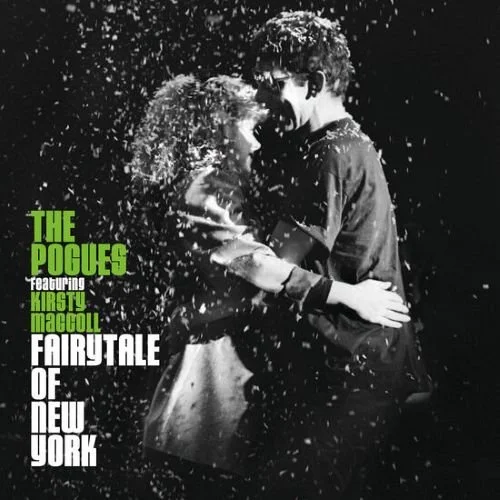
The Pogues (ft. Kirsty MacColl) – Fairytale of New York
__________
THIS is a Christmas classic…
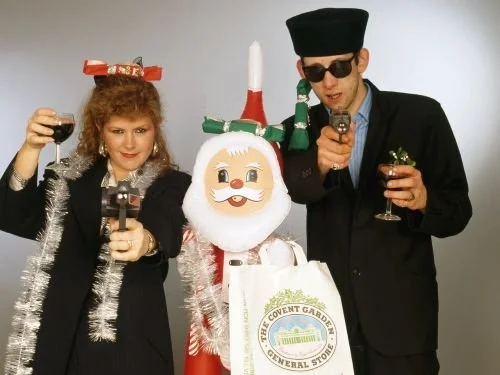
IN THIS PHOTO: Kirsty MacColl and Shane MacGowan/PHOTO CREDIT: Tim Roney/Getty Images
that does not get talked about as much as others. Written by the late Shane MacGown and Jem Finer, it features the wonderful vocals of Kirsty MacColl. It is sad that the two artists who sing on the track are no longer with us. However, there is this timelessness when it comes to Fairytale of New York. Released on 23rd November, 1987, this song went through a troubled development. Losing its original female vocalist and with these aborted attempts, it was eventually completed in October 1987. I want to start out with an article from The Guardian published in 2012. They look at the story behind Fairytale of New York. I am not including the whole feature, though there are parts of it that I feel are revealing and illuminating:
“That song, Fairytale of New York by the Pogues, has just been reissued to mark its 25th anniversary; it has already re-entered the Top 20 every December since 2005, and shows no sign of losing its appeal. It is loved because it feels more emotionally "real" than the homesick sentimentality of White Christmas or the bullish bonhomie of Merry Xmas Everybody, but it contains elements of both and the story it tells is an unreal fantasy of 1940s New York dreamed up in 1980s London. The story of the song is a yarn in itself: how it took more than two years to get right and became, over time, far bigger than the people who made it. As Pogues accordion-player James Fearnley says: "It's like Fairytale of New York went off and inhabited its own planet."
Appropriately for a song that pivots on an argument, there is disagreement as to where the idea originated. Fearnley, who recently published a memoir, Here Comes Everybody: The Story of the Pogues, remembers manager Frank Murray suggesting that they cover the Band's 1977 song Christmas Must be Tonight. "It was an awful song. We probably said, fuck that, we can do our own."
Singer Shane MacGowan maintains that Elvis Costello, who produced the Pogues' 1985 masterpiece Rum, Sodomy & the Lash, wagered the singer that he couldn't write a Christmas duet to sing with bass player (and Costello's future wife) Cait O'Riordan.
Either way, a Christmas song was a good idea. "For a band like the Pogues, very strongly rooted in all kinds of traditions rather than the present, it was a no-brainer," says banjo-player and co-writer Jem Finer. Not to mention the fact that MacGowan was born on Christmas Day 1957.
The Pogues had formed amid the grimy pubs and bedsits of London's King's Cross in 1982. Although their name ("Pogue mahone" means "kiss my arse" in Gaelic) and many of their influences were Irish, most of the band weren't, and their interest in folk songs and historical narratives roamed far and wide. They aspired to timelessness.
Finer first tried writing a song about a sailor missing his wife at Christmas but that was dashed on the rocks by his own wife, Marcia Farquhar, who called it "corny", says Finer. "So I said OK, you suggest a storyline and I'll write another one. The basic plotline came from her: this idea of a couple falling on hard times and coming eventually to some redemption." He says there's a "secret history" to the story: "a true story of some mutual friends living in New York."
MacGowan, whose contribution to this piece comes in the form of a dialogue written by long-term partner and biographer Victoria Mary Clarke, declines to elaborate: "Really, the story could apply to any couple who went anywhere and found themselves down on their luck."
While Finer retained the uptempo reel from his abandoned maritime tale, MacGowan worked on the slower verses and chorus. The singer had never seen New York but it was on his mind. As the Pogues toured Europe in autumn 1985, they almost wore out a video of Once Upon a Time in America, Sergio Leone's epic tale of Jewish mobsters in interwar New York. (Ennio Morricone's elegiac title theme seeped into Fairytale's opening melody: don't all good fairytales start with "Once upon a time"?)
In Here Comes Everybody, Fearnley writes: "A stable perception was never reachable as to whether Shane was a genius or a fucking idiot." There is the public image of MacGowan as a wayward alcoholic with a bombsite of a mouth and a wheezing ghost of a laugh. Then there is the clever, diligent craftsman who sweated for two years to make Fairytale of New York perfect.
The first demo was recorded by Costello at the same time as The cinematic romance of A Rainy Night in Soho, MacGowan's first song to draw on his love of Frank Sinatra and Judy Garland. When he brought that song into the studio in early 1986, Fearnley remembers: "He meant business, much more than before. It was awe-inspiring to see him in the rehearsal room with his suit on and an attitude."
A short time later, in February 1986, the Pogues finally made it to New York itself, to start their first ever US tour, and they weren't disappointed. "It was a hundred times more exciting in real life than we ever dreamed it could be!" says MacGowan. "It was even more like New York than the movies!" After their debut at a club called the World, their backstage visitors included Peter Dougherty, who came to direct the video for Fairytale of New York, and actor Matt Dillon, who appeared in it. MacGowan remembers Dillon, the rising star of Rumble Fish and The Outsiders, kissing his hand and saying: "I dig your shit, man, I love your shit!"
It was a year later that Murray approached U2 producer Steve Lillywhite to helm the next Pogues album. The sessions at London's RAK studios in the unusually hot summer of 1987 went so well that the band decided to have another crack at Fairytale. When they said they were struggling to blend MacGowan and Finer's sections, Lillywhite's solution was absurdly simple: record them separately and edit them together later. "It was a beautiful time," says Lillywhite. "I got the Pogues when they were really firing and before too much craziness got involved. As long as I got them early in the day it was great."
Fearnley was tasked with arranging the strings (a job completed by Fiachra Trench) and colouring in the scene- setting piano part, drawing on Tom Waits, Aaron Copland and Leonard Bernstein's score for On the Waterfront. "I wanted to get American music into it," he explains. MacGowan originally wanted the orchestra to interpolate the refrain from Have Yourself a Merry Little Christmas but "Phil Chevron [Pogues guitarist] told me that was a bad idea. He was right."
Only one hurdle remained. Cait O'Riordan had left the band in October 1986, leaving nobody to complete the duet. "I think at some point almost any female with a voice was a contender," Finer jokes, mentioning fellow RAK clients Chrissie Hynde (feasible) and Suzi Quatro (less so). "One person I certainly hadn't thought of was Kirsty [MacColl] and I don't think anyone else had."
"To be honest they weren't 100% convinced that Kirsty was the right person," says Lillywhite, who was married to MacColl. She was well-liked but her solo career was becalmed due to stage fright and contractual problems. Lillywhite suggested recording MacColl's part at his home studio over the weekend and seeing what the band thought. "I spent a whole day on Kirsty's vocals. I made sure every single word had exactly the right nuance. I remember taking it in on Monday morning and playing it to the band and they were just dumbfounded."
But MacGowan, who was so impressed that he re-did his own vocals, insists: "I was madly in love with Kirsty from the first time I saw her on Top Of The Pops. She was a genius in her own right and she was a better producer than he was! She could make a song her own and she made Fairytale her own." (Since MacColl's tragic death in 2000, her part has been taken by singers including Sinéad O'Connor, Cerys Matthews, Katie Melua, Victoria Clarke and Jem Finer's daughter Ella.)
In the finished version the story finally acquires the ring of truth, but it's still teasingly elliptical. Does the argument take place after the man leaves the drunk tank or does the whole song unfold in his sozzled head? After all, Once Upon a Time in America is told almost entirely in flashback. And while the "cars big as bars" and the singing of Galway Bay (a 1948 hit for Bing Crosby, beloved of Irish immigrants) place the action in the 1940s, MacGowan suggests that the characters are much older, remembering their glory days.
And can we trust the narrator anyway? "The guy is a bum who is living on the street," says MacGowan. "And he's just won on a horse at the unlikely odds of 18-to-one, so you're not even sure he is telling the truth." He says that both characters are versions of himself. "I identified with the man because I was a hustler and I identified with the woman because I was a heavy drinker and a singer. I have been in hospitals on morphine drips, and I have been in drunk tanks on Christmas Eve."
The song's brilliance is sealed by its final verse when MacGowan protests, "I could have been someone", and MacColl shoots back: "Well, so could anyone." Then MacColl accuses, "You took my dreams from me," and MacGowan responds, with all the warmth he's been withholding: "I kept them with me babe/I put them with my own." So in its final iteration the chorus is no longer a tauntingly ironic reminder of better times but the tentative promise of reconciliation. "You really don't know what is going to happen to them," says MacGowan. "The ending is completely open."
The Pogues shot the video in New York during Thanksgiving week. The air was bitterly cold and fairy lights twinkled in the trees. Matt Dillon played the NYPD officer who arrests MacGowan but he was too nervous to manhandle him until the shivering singer snapped: "Just kick the shit out of me and throw me in the cell and then we can be warm!" Contrary to the lyrics, the NYPD didn't have a choir, so Dougherty hired the force's pipe band instead. When it turned out that they didn't know Galway Bay, they mouthed the only lyrics they all knew: the Mickey Mouse Club chant”.
It is clear that Fairytale of New York is unorthodox. In terms of its lyrics and sentiments, it differs from the more traditional songs. The argumentative and occasionally bitter nature of the song clashing against the more optimistic and wholesome images projected in Christmas songs. However, that is what makes Fairytale of New York so special. In 2023, The New York Times published a feature about this enduring classic:
“Fairytale of New York” was a departure, quite literally in one sense: If England was for seeking work, America was for seeking dreams. (“They’ve got cars big as bars/ They’ve got rivers of gold.”) It was also a move away from documenting the reality of their lives. Mr. MacGowan had apparently never been to New York when he started writing it but dreamed up an enchanted place and a down-on-their-luck couple who’d tried to make it there and failed.
The song’s title was inspired by a novel of the same name by the Irish American writer J.P. Donleavy. Some of what we know about the song is somewhere between fact and lore: There was either a bet, from Elvis Costello to Mr. MacGowan, that he couldn’t write a downbeat Christmas song, or the band’s managers had simply appealed to them to write a hit. Jem Finer, the band’s banjoist, initially wrote the music as a maudlin sailor’s song, but his wife, Marcia Farquhar, nudged him toward the version we know. Mr. MacGowan wrote the lyrics in a feverish struggle with pneumonia in Malmo, Sweden.
The lines Mr. MacGowan trades with the singer Kirsty MacColl are as much fencing (“You took my dreams from me”) as dance (“I kept them with me, babe/I put them with my own”). It’s as intimate and uneasy as hearing an argument through thin walls, and yet it’s epic, too, conjuring the snowbound canyon streets of Manhattan. It rejects the Christmas song as snow globe fantasia as effusively as it rejects the delusion of youthful, dewy-eyed romance.
That it is a duet is a perfect expression of another thing that made the Pogues great. The magnetic force of opposites: punk and folk; love and destruction; beauty and brutal honesty; falling snow and pools of vomit.
It’s a fairy tale in the manner of the Brothers Grimm, an unsparing lesson in how life is rather than how it should be. Years wasted in dead-end, badly paid jobs. The self-obliteration that follows in the free time you do have. The falling-apart surroundings and the vulnerability of needing someone else (“Can’t make it all alone/I’ve built my dreams around you”). It’s a song of exile, too. But it’s not necessary to leave the country you’re from for it to mean something to you. You don’t even have to leave home — age will do it.
Some of the London-Irish pubs of the ’80s that the Pogues would have known are still the same today, but the workplaces and digs around them have changed — new precariousness for newer migrants. And “Fairytale” is no longer a cult, alternative Christmas song; it’s ubiquitous. But there are still moments when a line from it can steal upon my soul (“When the band finished playing/They howled out for more”) and remind me of the lesson I first half-wittingly gleaned as a kid in that record store. The life in all of us is worthy of a song”.
I am ending with a review of Fairytale of New York from The Mix Review that looks more at the composition and the complexity of the music. In terms of its structure, it is not as straightforward as you might imagine. One of the best Christmas songs, I guess we need to finish by talking about some of the controversy:
“First off, the song’s structure is unusual in many respects. To be honest, the traditional ‘verse/prechorus/chorus’ section labels feel a bit inadequate here, but just for the sake of discussion let’s say we have verses at 0:10 (“It was Christmas Eve”), 0:44 (“Got on a lucky one”), and 2:48 (“I could have been someone”); prechoruses at 1:29 (“They got cars big as bars”), 1:41 (“You were handsome”), and 2:15 (“You’re a bum, you’re a punk”); and choruses (“The boys of the NYPD choir”) at 1:53, 2:27, and 3:13. Broadly speaking, that leaves us with the following basic song layout:
Verse 1
Verse 2
Prechorus 1
Prechorus 2
Chorus 1
Instrumental based on the Prechorus
Prechorus 3
Chorus 2
Instrumental based on the Verse
Verse 3
Chorus 3
Outro
Honestly, I can’t think of any other song quite like it, and things are made even more unorthodox by the transition from slow 4/4 simple time for the opening two verses into a faster 12/8 compound time of the remainder of the song – in particular, I love the way this recasts the verse material in compound time at 2:48. Not that this kind of tempo/metre gearshift is uncommon in the folk music styles from which The Pogues drew so much inspiration. It’s just that this tactic has so rarely made its way into the charts! There’s also a metric flexibility here that I strongly associate with the folk-music traditions of many different cultures. For example, The Pogues aren’t afraid to drop a beat from the end of the second verse, thereby starting the little intro recap at 1:17 a little earlier than expected – or indeed to drop three beats from the end of that intro recap compared with its initial two-bar statement at the very start of the song. And then when the verse section repeats in its compound-time version at 2:48, it’s extended by a beat instead, effectively building anticipation towards the final chorus.
I also like how the chorus always feels like it’s going to be four bars long, but each time its fourth bar is kind of stolen to be the first bar of the subsequent song section, in other words the instrumental prechorus at 1:53, the instrumental verse at 2:36, and the outro at 3:22. And, in a sense, this same technique is at play with that shortened intro recap, where the intro section’s original second-beat move to the tonic D major chord is repurposed in the recap as the first downbeat of the 12/8 section.
Another great feature of this song is that, although it only uses pretty straightforward D, G, A, and Bm chords, their harmonic rhythm (ie. the rhythm with which those chords change) greatly improves the musical impact and interest. A lot of songwriters aren’t very imaginative in this respect, sticking to some kind of regular rhythmic pattern for the whole timeline. Maybe they’ll use a simple chord-per-bar scheme, as in Harry Styles’ 'As It Was'; or two bars per chord like Wham’s ‘Last Christmas’; or two chords per bar like Imagine Dragons’ 'Radioactive'. And there’s an army of songs that alternate straight and pushed chords – just off the top of my head I can think of Billie Eilish’s 'Everything I Wanted', Ed Sheeran’s 'Thinking Out Loud', Otis Redding’s '(Sittin' On) The Dock Of The Bay', the Spin Doctors’ ‘Two Princes’, and Tracy Chapman’s ‘Fast Car’.
The Pogues, on the other hand, are much more inventive, contrasting the general chord-per-bar feel of their verses with the faster chord-per-beat prechoruses, but also speeding up the chord changes towards the end of each verse section as a kind of structural punctuation as well. The chorus is my favourite moment in this regard, however, with a cool sort of accelerating harmonic rhythm where a full bar of G is followed by two half bars of D and Bm and then a chord-per-beat rhythm for the remaining D, G and A chords.
So all in all, I think I can see where MacGowan was coming from when he referred to this song as the band’s ‘Bohemian Rhapsody’, because I think there’s a lot of musical nuance hiding under its veneer of simple Christmas singalong”.
There is controversy around Fairytale of New York which centres on homophobic slurs and strong language used in the lyrics. Those depicting a drunken, bitter argument between a man and woman. It has led to debates about artistic freedom, censorship, and cultural sensitivity. The BBC has (perhaps controversially) censored and edited the words for radio play, despite listener backlash and The Pogues’ defence of the song's authentic, albeit harsh, portrayal of marginalised characters. Whatever you think about the homophobic content of the song and whether Fairytale of New York should remain unedited, there is no denying the fact it is a classic. One that I feel is as strong as any other Christmas song. Even though it is not going to win any chart battles, it is this alternative favourite that it has been great learning more about. Despite the fact Shane MacGown and Kirsty MacColl are no longer here, their legacy and incredible voices remain. Their chemistry on the track is clear. They released something magical thirty-eighty years ago. Go and put on Fairytale of New York and…
LET it into your heart.