FEATURE:
Well, Just Take a Walk Down Lonely Street
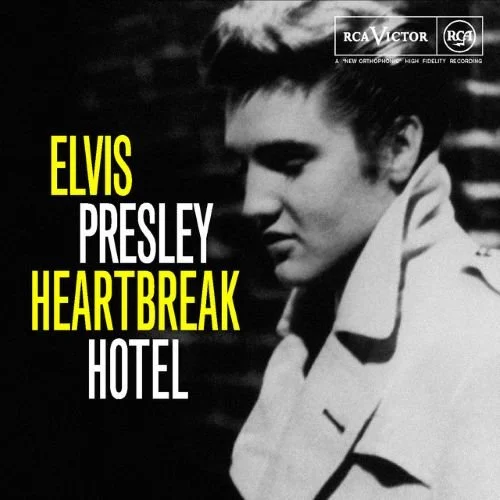
Elvis Presley’s Heartbreak Hotel at Seventy
__________
PERHAPS one of…
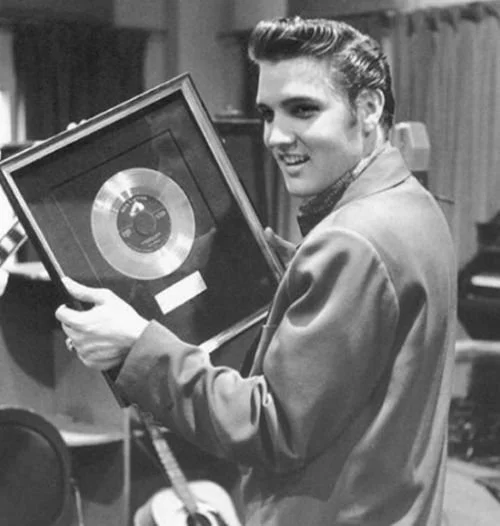
the most groundbreaking and important songs in music history, I am spending some time shining a light on Elvis Presley’s Heartbreak Hotel. Whilst the King of Rock & Roll has a complex legacy and someone I cannot comfortably celebrate without hesitation, I have to salute how influential his music is. What a cultural impact he made in his lifetime. Whilst he released better songs than Heartbreak Hotel, there are few that are more significant. In terms of the way it was this thrilling and revolutionary record. Heartbreak Hotel was released on 27th January, 1956, and it was his first single for RCA Victor, following his contract purchase from Sun Records. Elvis Presley’s first number one hit, it sold over a million copies. Even though it was not included on his eponymous album of 1956, it is worth noting that it turns seventy on 23rd March. I will spend some time with Heartbreak Hotel. Seventy years after its release, I wanted to focus on a single that stunned listeners and was a revelation. It was like nothing else released in the mid-'50s. I want to start off with this 2016 article, that tells the strange inspiration behind one of the greatest songs ever recorded:
“A suicide note was the unlikely inspiration behind the song that became Elvis Presley’s first No. 1 hit and million-selling single.
Steel guitarist and session musician Tommy Durden read a newspaper article about a man who had killed himself, leaving behind a piece of paper with the haunting words: “I walk a lonely street.”
Durden brought the article to his friend and cowriter Mae Boren Axton. A 41-year-old high school English teacher who moonlighted as a journalist and a songwriter, Axton had notched a few hits in the early ’50s with artists such as Perry Como and Ernest Tubb. In late 1955, she took a part-time position as a public relations secretary for Elvis’ manger, Colonel Tom Parker. When Mae first met Elvis, she felt he had everything he needed to become a star except a hit song. “You need a million-seller and I’m going to write it for you,” she promised.
As Axton and Durden discussed how they could turn the newspaper article into a song, Axton suggested that there be a “heartbreak hotel” at the end of the lonely street. With that flash of inspiration, the pair was off and running. Painting a picture of a place where “broken-hearted lovers cry away their gloom” and “the desk clerk’s dressed in black,” they managed to convey in very few words a mood that was both romantically charged and funereal.
Though the duo is responsible for penning the song, Elvis’s name would appear on the finished record as a third writer. It’s common knowledge that the Colonel often insisted that his boy get cowriting credit in exchange for cutting a song. But in later years, Axton insisted that the shared credit was her promise made good to help Elvis buy a house in Florida for his parents.
Axton took a demo of the song to Elvis while he was on the road. His reaction was immediate. “Hot dog, Mae, play it again,” he said. It reminded him a little of Roy Brown’s “Hard Luck Blues.” He quickly added the song to his live repertoire, changing one line of the lyric, from “they pray to die” to “they could die.”
On January 10, 1956, two days after his 21st birthday, Elvis recorded his first five sides for the RCA label at RCA Studio B in Nashville. Among them was “Heartbreak Hotel.” The producer was Steve Sholes, with Bob Ferris engineering. The band included guitarist Scotty Moore, bassist Bill Black, drummer D.J. Fontana, plus Chet Atkins on guitar, Floyd Cramer on piano and vocal group the Jordanaires. The echoey atmosphere punctuated by Fontana’s rim shots and Moore’s tinny guitar lent a despair to the track that perfectly matched Elvis’s heart-rending vocal.
The gloomy song was markedly different from anything Elvis had done previously at Sun Records. When his former label boss Sam Phillips heard an acetate from the Nashville session, he pronounced “Heartbreak Hotel” a “morbid mess.”
Back in the RCA Records boardroom in New York, there was a similar consensus. Producer Steve Sholes recalled, “They all told me it didn’t sound like anything, it didn’t sound like his other records, and I’d better not release it. I better go back and record it again.”
Elvis was unfazed, certain that the song was the right one to catapult him into the big time.
It was released on January 27, 1956. The next day, Elvis made his network television debut, performing live on the Dorsey Brothers Stage Show. It was the first of six appearances over the next few months, and he sang “Heartbreak Hotel” on three of those. On April 3, he did the song on the Milton Berle Show. Two weeks later on April 21, thanks in large part to his exposure on the new medium of TV, Elvis had his first No. 1 pop single (it also topped the country chart and went Top 5 on the R&B chart)”.
On 10th January, 1956, a twenty-one-year-old Elvis Presley walked into RCA's McGavock Street, Nashville and laid down the vocals of this incredible song. Although it is quite melancholic and moody, it is a masterpiece that you are utterly transfixed by! The brilliance of Presley’s vocals. Seductive and powerful at the same time. I want to move this article, that writes however iconic Heartbreak Hotel is now, it was not an instant chart smash in 1956:
“While Heartbreak Hotel was having trouble making the Top 100 in the early months of 1956, it was not Billboard’s fault. The publication repeatedly touted Presley first record in the weeks after its release. On February 1, just a few days after the single was shipped, Billboard listed the record in its “Best Bets” section. “Elvis Presley, country singer, is a compelling stylist who tears his tunes to tatters a la Johnnie Ray,” the magazine noted. “‘Heartbreak Hotel’ is an ideal piece of material and he goes to town with the help of an excellent background. It could establish Presley in the pop picture.”
On February 11, Billboard again praised Presley's recording in its “Review Spotlight” column. “Presley’s first Victor disk might easily break in both markets. ‘Heartbreak Hotel’ is a strong blues item wrapped up in his usual powerful style and a great beat … Presley is riding high right now with network TV appearances, and this disk should benefit from all the special pluggings.”
A week later, Billboard again endorsed Heartbreak Hotel, this time on its “This Week’s Best Buys” list. “Another record that has demonstrated Presley’s major league stature,” the magazine stated. “Sales have snowballed rapidly in the past two weeks, with pop and r.&b. customers joining Presley’s hillbilly fans in demanding this disk.” In a March 3 article, Billboard reported that the Presley record was RCA’s number 2 seller, right behind Perry Como’s “Juke Box Baby.” On March 7, the magazine noted that Heartbreak Hotel had reached the 300,000 sales mark.
• Presley finally broke into Billboard’s pop chart
In those days, Billboard’s Top 100 was tabulated through a combination of record sales and disk jockey surveys. By early March 1956, DJs who had been reluctant to accept the odd sounding Presley record, could no longer hold out in the face of the record’s massive sales and Presley’s growing popularity. On March 3, 1956, Heartbreak Hotel made its first appearance in the Top 100 at #68. By the end of the month, it was in the top 10 at #9. It would take another month to fight its way to the top, but on May 5 it took over the #1 spot, displacing Les Baxter’s instrumental, “The Poor People of Paris.” (Ironically, the day his record went to #1, Elvis was laying an egg on stage at the Frontier Hotel in Las Vegas.)
Heartbreak Hotel then settled in at #1 for nearly two months. It wasn’t until June 23 that Gogi Grant’s “The Wayward Wind” toppled Elvis’s recording from its lofty perch. Elvis's first hit single remained on the Top 100 for another three months, finally disappearing from the list on September 8, 1956. When all was said and done, Heartbreak Hotel had spent 27 weeks on the Top 100, 14 weeks in the top 10, 11 weeks in the top 5, and 7 weeks at #1. In Presley’s long and successful recording career, only All Shook Up would top the performance of his first RCA single on the Billboard chart.
In 1956 Billboard had many other charts besides the Top 100, and Heartbreak Hotel reached #1 on many of them. On May 26, 1956, the magazine announced that Presley’s disk had set a multiple chart-topping record. “This week, for the second time,” the music journal reported, “the RCA Victor artist hit the No. 1 spot on six charts with his version of ‘Heartbreak Hotel.’ This makes E.P. the first ‘double-Triple Crown’ winner in the history of The Billboard’s record charts. He topped the retail, jockey and juke box lists in both the pop and country and western categories.”
An interesting coincidence regarding Heartbreak Hotel on the Top 100 occurred on August 25, 1956. On the chart that week, two versions of the song were listed side by side. Elvis’ version sat at #96 on its way off the chart two weeks later. One notch above it, at #95, was comedian Stan Freeberg’s novelty version. While humorous, Freeberg’s recording, during which he repeatedly asks for a “little more echo in my voice,” served as a tribute to Presley’s trendsetting hit.
• Heartbreak Hotel made Elvis an overnight success
It is probably overstating the case to suggest that Heartbreak Hotel made Elvis Presley a star. With wildly popular stage shows, network TV appearances, and the resources of RCA Victor solidly behind him, he probably was destined for stardom even if his first recording on his new label had flopped. Heartbreak Hotel’s phenomenal achievement merely accelerated his ascendancy to fame. It made him appear an overnight success, when, in fact, fame came only after two years of working tiring one-nighters across the South and honing his craft in a small recording studio in Memphis”.
I am going to include parts of this article prior to highlighting the Wikipedia page on Heartbreak Hotel, where they mention the legacy of this song. It moved, among other musicians, John Lennon and George Harrison. A half of the greatest band in history (The Beatles), it is clear that Heartbreak Hotel caused quite a sensation for young and impressionable music fans in the 1950s. I still think it has the power to move seventy years later:
“While author Tony Plews in his amazing 700-page book 'Walk A Lonely Street: Elvis Presley, Country Music & The True Story of Heartbreak Hotel' comments..
'From the opening notes, sung acapella (Elvis had lifted the key from c to e), it was clear this was a song unlike any other on the charts, be it pop, country or blues; and although it was not rock ‘n’ roll music per se (you couldn’t dance to it), it carried all of the rebelliousness and inherent sexiness of that new genre. It sounded savage, primal, and it came straight from the gut. It was the most prepared he’d been with any recording since “That’s All Right”. He had worked out which syllables to stretch and which beats to accentuate. Taking his cues from “Only You”, he’d established how to mangle words and add nonsensical sounds to the lyrics, transforming “I’ll be so lonely, baby” into something like “I’ll be-kuh so lonely, bay-beh”, which added to the rhythm while making the narrative yet more mysterious. He had streamlined some of the chorus pronouns, removing the “we” from the final line, ensuring it was more radio-friendly. But the one lyric that still remained unfixed in his mind was “pray to die”, and he wondered whether it was just too deep: but on take one it was present and correct.
For such a stark, unornamented song, he’d gone to great lengths to assemble the arrangement, but this was indicative of its importance to him. Even on the early takes, he spat out the first verse with absolute and shocking conviction, the band punctuating each line with a perfectly timed double strike (slightly behind the beat in best Fats Domino style), and as he slid into the chorus, Elvis was almost naked vocally, backed purely by the double-echo and Bill’s descending bass. Aside from the “kuh” affectations, his diction was immaculate, especially on the title words'.
The second verse was equally powerful, and on the chorus D.J. (on brushes) and Scotty Moore crept in to fill out the sound. By the third chorus, Chet Atkins was strumming and Floyd Cramer had added pitter-patter keyboard figures to complete the picture. The fourth verse and chorus maintained the full band, but it was the unrehearsed pianist who came unstuck during the following instrumental passage. Scotty carried the first part of this section leaning heavily on the staccato notes Elvis had suggested (as per his conversation with Mae Axton), but Floyd couldn’t find his mojo, having literally just learned the song. For the fifth verse, Elvis had decided to repeat the second, but instructed the band to add a flourish, D.J. again using his cymbals, to accentuate the finale.
The studio was hushed as the last note tailed off. Mae smiled. Steve raised his eyebrows. Elvis asked for a playback. The sound caught him unawares: the heavy echo wasn’t necessarily what he’d heard in his head during the weeks of preparation, but he recognised that it brought something otherworldly to the recording.
Right from the beginning, the record grabbed listeners by the throat: Scotty Moore's guitar raged and rocked; Elvis' vocal swaggered, but also reached out with the longing of those lyrics. 'Heartbreak Hotel' was full of alienation, loneliness and despair.
And the kids absolutely loved it. In their millions.
If there had been a rock'n'roll hero previously, it was James Dean, who died in a car crash three months before Elvis recorded 'Heartbreak Hotel'. The actor only lived to see one of his three films released, but in the tragic aftermath of his death, the cult of James Dean had flourished.
Youngsters on both sides of the Atlantic found solace in James Dean's moody, misunderstood martyr in Rebel Without A Cause, but they knew that after ‘Giant' there would be no more Dean films. And looking around for another idol, they happened upon that record, that voice, that man... The newly identified teenagers of the 50s had, at last, found their role model”.
Let’s end this seventieth anniversary celebration of Heartbreak Hotel by considering its legacy. Not only viewed as one of the best songs ever released, it has influenced plenty of musicians. Who themselves have also inspired generations. This Wikipedia article includes a bit about the legacy of Heartbreak Hotel. It would not be overstating it to say this is one of the most important songs ever. I hope other journalists write about Heartbreak Hotel on its seventieth anniversary:
“In a 1975 interview, John Lennon recalled his friend Don Beatty's introducing him to Presley's music. Lennon said that his family rarely had the radio on, unlike other members of the Beatles who grew up under its influence. Beatty showed Lennon a picture of Presley that appeared along with the charts on the New Musical Express, and Lennon later heard "Heartbreak Hotel" on Radio Luxembourg. Lennon has said:
When I first heard "Heartbreak Hotel", I could hardly make out what was being said. It was just the experience of hearing it and having my hair stand on end. We'd never heard American voices singing like that. They always sang like Sinatra or enunciate very well. Suddenly, there's this hillbilly hiccuping on tape echo and all this bluesy stuff going on. And we didn't know what Elvis was singing about ... It took us a long time to work what was going on. To us, it just sounded as a noise that was great.
George Harrison described "Heartbreak Hotel" as a "rock n roll epiphany" when in 1956, at age 13, he overheard it while riding his bike at a neighbor's house. Some have said that "Heartbreak Hotel" turned that well-mannered schoolboy into a guitar-crazed truant who would audition for John Lennon's Quarrymen the following year.
The Rolling Stones' guitarist Keith Richards wrote in his 2010 autobiography Life that "Heartbreak Hotel" had a huge effect on him. Beyond Presley's singing itself, it was the total effect of his sound and his silence that so totally affected Richards:
Then, "Since my baby left me"—it was just the sound ... That was the first rock and roll I heard. It was a totally different way of delivering a song, a totally different sound, stripped down, no bullshit, no violins and ladies' choruses and schmaltz, totally different. It was bare right to the roots that you had a feeling were there but hadn't yet heard. I've got to take my hat off to Elvis. The silence is your canvas, that's your frame, that's what you work on; don't try and deafen it out. That's what "Heartbreak Hotel" did to me. It was the first time I'd heard something so stark.
Led Zeppelin's lead singer Robert Plant stated that the song "changed his life". He recalled hearing it for the first time when he was 8 years old:
It was so animal, so sexual, the first musical arousal I ever had. You could see a twitch in everybody my age. All we knew about the guy was that he was cool, handsome and looked wild.
Critic Robert Cantwell wrote in his unpublished memoir Twigs of Folly:
The opening strains of "Heartbreak Hotel", which catapulted Presley's regional popularity into national hysteria, opened a fissure in the massive mile-thick wall of post-war regimentation, standardization, bureaucratization, and commercialization in American society and let come rushing through the rift a cataract from the immense waters of sheer, human pain and frustration that have been building up for ten decades behind it.
The song was mentioned in the chorus of Patty Loveless's 1988 single "Blue Side of Town" from her album Honky Tonk Angel.
President Bill Clinton performed the song on tenor saxophone during his appearance on The Arsenio Hall Show on June 3, 1992. In 2004, it was ranked number 45 on Rolling Stone's list of "The 500 Greatest Songs of All Time", the Rock and Roll Hall of Fame included it in its unranked list 500 Songs that Shaped Rock and Roll and in 2005, Uncut magazine ranked the first performance of "Heartbreak Hotel" in 1956 by Presley as the second greatest and most important cultural event of the rock and roll era. Paul McCartney, who participated in Uncut's poll stated, "It's the way [Presley] sings it as if he is singing from the depths of hell. His phrasing, use of echo, it's all so beautiful. Musically, it's perfect”.
On 27th January, 1956, I wonder how those listening to Heartbreak Hotel reacted. When they heard it on the radio or bought it. Whilst there was some warm praise in the U.S., the press reaction in Britain was colder. The single was written off and seen as insufficient, poorly sung and not fit to be played. It is amazing that critics were so tin-eared in 1956. In years since, Elvis Presley’s Heartbreak Hotel is seen as a classic. Something that changed Rock & Roll. In 2025, perhaps it sounds a little dated or slow. However, you cannot deny how significant the record is and how it introduced many to Presley. In 1995, Heartbreak Hotel was inducted into the Grammy Hall of Fame. A staggering song considering the slightly unusual and unorthodox inspiration. Heartbreak Hotel is a song that, I feel, still sounds…
UTTERLY remarkable.