FEATURE:
Modern-Day Queens
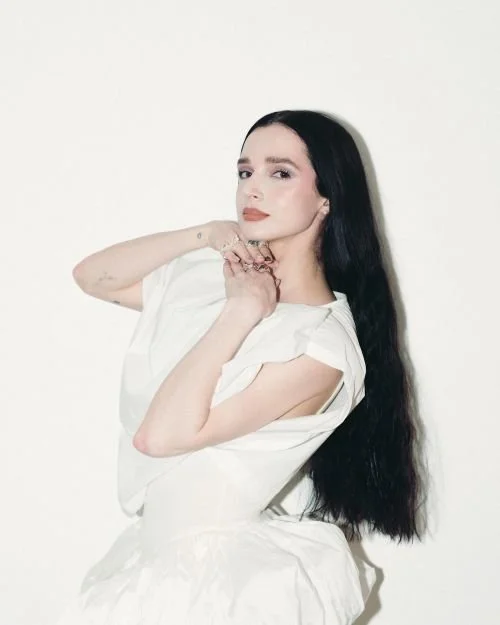
Poppy
__________
I have talked about…
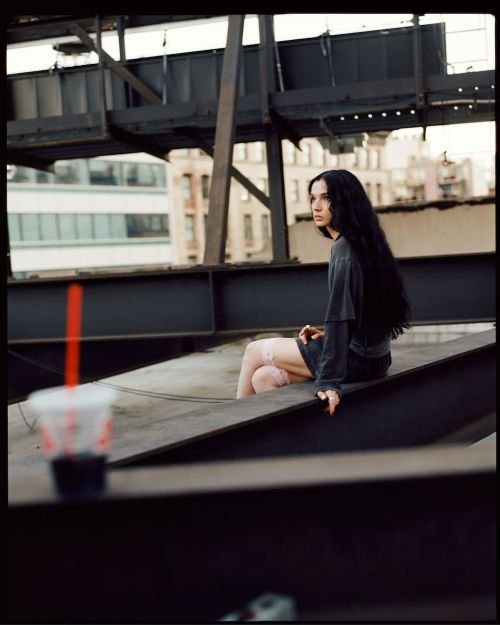
PHOTO CREDIT: T-bone Fletcher
Poppy before, though never in this feature. I know she is not a fan of journalists that note she likes heavy music and then get her to name bands. Instead of being this basic, I am going to select some interviews from last/this year from Poppy. She released her new album, Empty Hands, on 23rd January. Boston-born Moriah Rose Pereira followed up her acclaimed sixth studio album, Negative Spaces, with another tremendous album. I am ending with a review of Empty Hands. In May last year, CLASH spoke with Poppy. Noting how she survives on defiance, it is a really fascinating chat:
“Poppy is a child of the digital age. After being bullied into homeschooling due to her shy demeanour in public school, Poppy was weaned by the 2000s web. Though her love of the internet has declined in recent years (“it’s too cluttered”), it’s where she’d find her voice. From ASMR-esque videos of her silently eating cotton candy, to adverts for gravity-defying shoes, the early days of Poppy were ludicrously absurd. The Lynchian genesis of the project could have been deemed an act of AI in the modern age, with instalments taking the form of ten minute montages of the singer asserting “I’m Poppy” on a loop. “The internet was the Wild West,” Poppy says, an air of whimsy in her voice. “There were no rules.”
The videos and initial singles came as a perplexing search for meaning. Poppy’s sonic debut, ‘Everybody Wants To Be Poppy’, would blend squeaky-clean pop hooks into social commentary on mass-produced popstars. Yet there would also be cuts like the reggae fusion of ‘Lowlife’ and EDM-inflected ‘Interweb’ down the line. After luring in the masses as a family-friendly pop-bot, Poppy would eventually tear the rug out from under her fans. “I’ve always known where I’ve wanted to go,” she explains. 2018’s ‘Am I A Girl?’ threw in a burst of raw heavy metal right at the very last second, closing track ‘X’ an utter shock to the system. Poppy’s response to the blood-thirsty riffs? A giddy, butter-wouldn’t-melt exclamation of “ooo – heavy!”
Ever since slamming the brakes on her term as a plastic-fantastic popstar, Poppy has retained her discordant title and femininity as a badge of defiance. Poppy floats onstage in flouncy dresses like a fairytale, before channelling gutturals straight from the depths of hell. Her softer side has never hindered her success. In fact, Poppy has become the metal world’s favourite collaborator, previously hopping on tracks with Bad Omens, HEALTH and Fever 333.
2024’s ‘Negative Spaces’ is the culmination of this juxtaposition. It’s candy floss dissolved in engine oil, offering tar-smeared anthems with sugary-sweet centers: ‘vital’ feels like pop-rock cuts from the Avril Lavigne playbook, and ‘crystallized’ glistens with an ‘80s synthwave sheen, positively melting in your mouth. But that’s all before ‘the centre’s falling out’ absolutely rips the record to shreds, delving into cold, hard metallic hardcore in the same vein of Converge – a frazzled wall of guttural wails, scraping riffs and booming drums.
It’s a bittersweet meeting point of Poppy’s conflicting sides; gentle introversion melding with abrasive fury. “I never want to be predictable,” Poppy asserts. It’s why she’s always mixing things up, pushing out more unique content, like her Improbably Poppy TV series and comic books alongside her music. “If something I’m creating becomes unexciting, I’m no longer fond of it. When it comes to a record, every one should feel brand new.” On ‘Negative Spaces’, Poppy proudly claims she feels “uncharted” yet again. Aided by ex-Bring Me The Horizon producer Jordan Fish, Poppy was able to rediscover herself on track. “It honestly feels like my true debut,” she explains. “The saccharine is there, the aggression is there, and I’m sitting somewhere in between it all. It’s incredible to feel like your sixth record is just as exciting and expressive as your first release.”
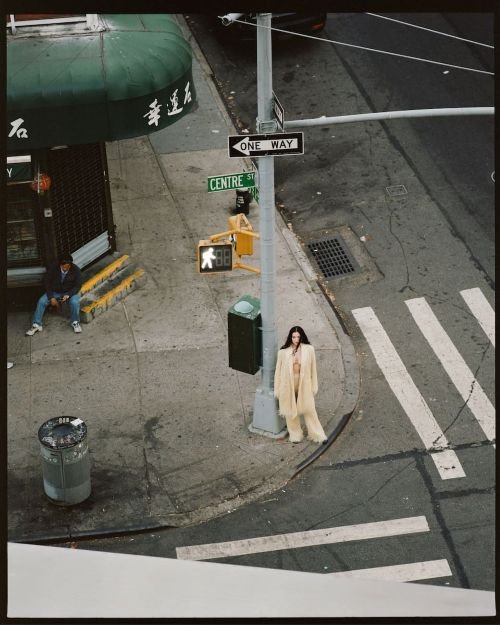
PHOTO CREDIT: T-bone Fletcher
Poppy notes that ‘Negative Spaces’ is an effort to understand her “relationship with darkness” and comprehend the “unexplainable things” in life. “Of course, things don’t always make sense,” she’s quick to note. “We’re spinning in space on a rock, and that doesn’t really make any sense. You have to strike a balance, and allow yourself to have a fantastical, surface-level relationship with certain things. Sometimes the depths might be too heavy to handle.” The record is also a “very confrontational” dose of self-reflection. It’s a girl coming to terms with the sum of all her parts, even the more challenging fragments. “I accept myself for who I am now, but it’s interesting how you reflect on the past as you mature,” she muses. “You re-examine things you didn’t like when you were younger, consider the negative environments you’ve been in, and realise that they’re the things that make you unique today.”
As Poppy has evolved, she’s started to feel less alien than she felt as a young girl. “It was quite lonely when I was small,” she reflects. “I used to dream of having the friends I have now. So, I’ve gotten softer and more compassionate towards humans in recent years. But I’m still standing my ground, defending what matters to me.” While Poppy has finally “found her voice”, happily speaking out about shitty record labels and predatory industry men, she’s aware the space she exists within doesn’t take kindly to outspoken women. “I’ve become a lot more aware of my femininity, being in this industry,” she admits. “It can be a tricky balancing act because you’re expected to be soft but you need to be aggressive. Sometimes I get asked about being a ‘female in music’, and I always hope it’s a genuine desire to learn; to allow me to voice the disgust that I may possess, rather than a way of tricking me into complaining about being a woman in this industry.”
“I chose this path for a reason,” she affirms. “I want to write authentically about my experience, through my own eyes. I just make sure my aggression is targeted. Anger should never be misdirected or it loses its power. As a female, there are lots of things that I disagree with along the way.” It’s a statement that can be linked back to 2020’s ‘I Disagree’; a testament to how Poppy has grown into her voice, no longer afraid to speak up for herself. “There’s a power in saying it,” she declares. “Sometimes, when I get into debates with people, I’ll just say: I disagree. Not even politely or respectfully. That’s it. And I love meeting other women in the industry that disagree with what they’re witnessing as well”.
Empty Hands is one of the best albums of this year so far. The stunning Poppy is an artist I am surprised has not been asked to headline a major festival like Glastonbury. Maybe in 2027? There are a couple of interviews from this year that I want to get to. When speaking with Kerrang! earlier this year, Poppy said how she was like an explorer who has not yet found her place. Navigating all these territories, having played over a hundred shows last year, this artist knows all too well that there is a whole world out there. As Kerrang! say in their headline, Poppy is “digging into fresh territories with her music, she is adventurous, curious and thrillingly unpredictable. Is imminent new album Empty Hands any different?”. Another compelling interview with a remarkable artist who will be in the industry for decades more:
“Perhaps the jewel in the crown of Poppy’s year, however, was forming a power trio of sorts with Evanescence’s Amy Lee and Spiritbox’s Courtney LaPlante for a scene-shaking collaboration in the form of End Of You. It was Poppy who instigated the idea, writing with Amy at her house before Courtney added her parts remotely.
“I think it’s exciting when there are certain obstacles with it, but then it’s also exciting when you check your inbox for an updated version of what the other artist had done, and you’re like, ‘Wow!’” she says.
While she’s never been one to concern herself with external appraisal, she did get a slant of a sense that what they did was going to be received feverishly.
“I know three women in heavy music coming together to be on a song like this hadn’t been done before in this capacity.”
It would be easy to join the dots between these collabs, each connected to a tour entirely made up of female and non-binary artists, and see Poppy as someone helping to tip the scale in metal towards a more egalitarian future. The notion of women selling out arenas and headlining festivals becoming more of a normality than a novelty is closer to being a reality than ever. Yet, for Poppy, it’s always been more important for her to be seen as she is, on her own terms rather than on gendered ones.
“I just focus on what I have to say and what I’m creating,” she reasons. “And if that’s inspiring to others to want to join, then that is inspiring to me back, so it’s a little bit of a circle and a share. Some people will focus on the gender element of it because it’s easy and topical, but there’s more to offer than just that perspective, of course, at least for me. It’s nice to see more females in and around the space, but I think it’s a little bit low hanging to only focus on that as a fact. I hope that people look beyond just the gender to actually see what I’m saying.”
Poppy’s methods of ideating are tactile and analogue. She favours journalling, drawing and scrapbooking, pooling inspiration from photos and colours as she constructs her stories.
“Certain songs I will see as a collective of different colours, but not in a way that some people have synaesthesia,” she says. “I don’t know if that’s something more to it, just how I feel the song reflects a colour palette to me or the album.”
Without rhyme or reason, Empty Hands felt like a pastel blue album – it’s why it’s so prominent on the cover. It certainly suits the record’s tender moments, such as the courageous, loving sentiment of Guardian, a song whose melody couldn’t leave Poppy alone after she wrote it, to the point where she’d sing it in funny accents around the house. It seems a paradoxically soft shade for an album that often spikes to eye-widening levels of aggression. There’s the slamming Dying To Forget, on which she corrosively screams: ‘Rot in your piss in your shallow grave / I’ll watch your kingdom fall / I’ll cut the brakes so your car can’t stop,’ while the title-track’s lacerating heaviness shares some DNA with the sound of Knocked Loose.
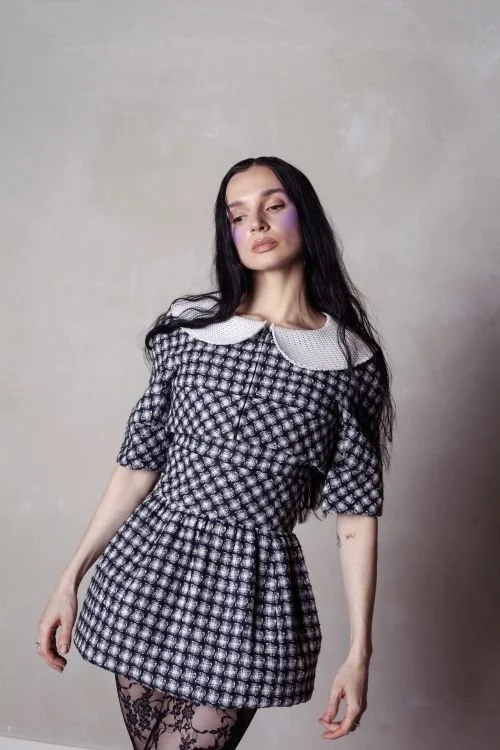
PHOTO CREDIT: Megan Winstone
Even when she applies a more melodic touch, her tone is at times more acerbic than she’s ever been. ‘You’re celibate but no-one wants to fuck,’ she sneers on the energetic blast of Eat The Hate, while on the eerily theatrical opener Public Domain, she slips into a mocking, robotic register to eviscerate materialistic people: ‘Can you bottle it? Will you sell it for food? Would you sleep with it? Tell me who’s using who.’ There’s nothing placid about the pastel blue on the cover – instead, it’s more like the colour of ice.
Poppy is visceral and cynical when it comes to the record’s primary theme of greed. “The sentiment of Empty Hands has a couple of layers to it, depending on how you take it in, or what it means to you,” she explains. “A few of them are obvious and a few of them are a little bit more coy. The message that is pertinent to me in relation to this is when there are a lot of people that are trying to grab and take, what is all of it for? Because when we leave, none of it is ours anyway – whether it’s money or recognition or anything superficial. Why are you being so greedy when it’s not coming with you into the afterlife?”
After all, when you remember greed is futile, the world becomes more absurd. The lust for power, status, achievements and material gains becomes unjustifiable, whether it’s a follower count ticking up or world leaders threatening wars over oil reserves. And, of course, social safety and agency can be bought – but not happiness.
“Everything means nothing and nothing means everything,” Poppy muses. “You can have everything in the world and still be unhappy, or you can have nothing and be the most fulfilled”.
Empty Hands is produced by Jordan Fish. A collaborator she is close with, you can feel that sense of trust throughout the album. Before getting to a positive review for Empty Hands, I want to bring in part of an interview from NME that was published this month. She discussed the analogue approach that helps navigate touring life, in addition to this restlessness. This sense of discontent that she has. One that “drives the exploration”. Again, this artist who is always searching and navigating new musical terrain. Trying to find that golden spot, perhaps:
“Habitually cryptic and often coy around her lyrics, it was not too long ago that Poppy used to conduct interviews in character. Over the course of today’s conversation, she becomes increasingly candid and descriptive, as we get closer to figuring out what makes the human behind the rockstar tick. We probe her on one particular line, “I am constantly nowhere / On the roam”, which creates an intriguing duality alongside Poppy’s apparent ethos of everything, everywhere, all at once.
“When my friends would call to check in on me on tour, they would say, ‘Where are you?’ – I’m nowhere today,” she begins. “With the way that the internet is, information is out there – it’s everywhere – but it’s also nowhere, and you can detach from it by closing the computer. I remember at one point, making videos, I would say, ‘If it’s on the internet, it’s real,’ and it was a bit of a joke, because the internet used to be fake, and then it became real. Being able to detach from it and exist in your own head is really important.”
Poppy finds the in-between aspects of non-stop touring life difficult, a challenge she insists has prevailed “since the beginning of performing arts”. “I have to be offline when I’m on tour,” she explains. “It’s helpful for me to read books, write in journals, make collages and find expressive avenues that way. It feels a little bit dysregulating to be far away and looking at things through a screen where there’s a lot of fear, uncertainty or aggression online. I can’t look at that stuff. I’m too sensitive for that, so I have to go a bit more analogue on tour.”
Back home, you’ll find Poppy hibernating indoors for weeks, making up for lost time with her cat, who will accompany her on the road when she next tours North America. But this pace, this purple patch, is entirely on her terms. “I always have something to say,” she grins. “I’m always working… and when I don’t enjoy it anymore, I stop.”
This year marks one decade of Poppy, the musician. Her latest headline shows have heavily leant on material from ‘Negative Spaces’, 2019’s industrial effort ‘I Disagree’ and recent collaborative singles – effectively abandoning her other four albums. “I don’t really see those albums as much more than soundtracks to what I was doing at that time, and they’re not inspiring enough to me to bring into my present-day live show,” she elaborates.
That sky-high threshold remains Poppy’s driving principle. Teasing other projects “that will require my attention” imminently, she continues to quench any boredom with creativity, maximising that feeling of excitement that she craves. A workaholic, but first and foremost, a roamer – in the literal sense of globetrotting and the figurative sense of her imagination.
“The discontent drives the exploration, and I feel like that’s all I have, to continue to pose the question and ask myself what I want to do next. It’s not an open narrative with the outside; it’s about what I want to see myself do. If that is something that inspires or excites other people, then that’s exciting to me, and it works in a circular way, but quieting the noise to ask yourself those questions is really important”.
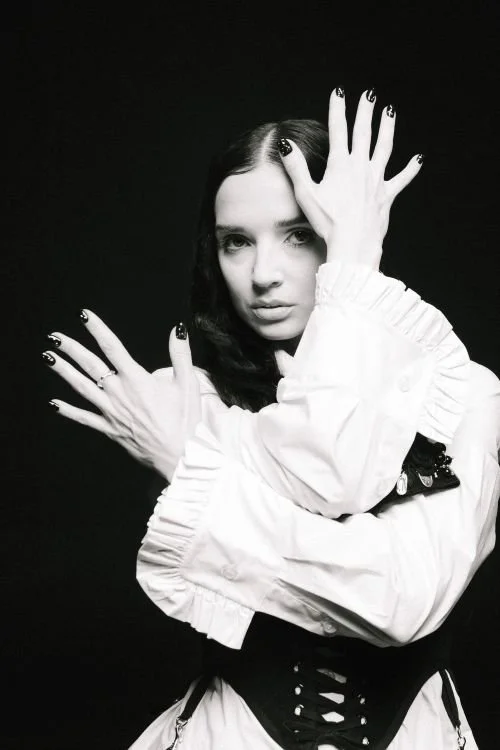
PHOTO CREDIT: Paris Mumpower
I will wrap up in a minute. However, I think I will sneak in another interview before a review. For Revolver, Poppy talked about her wildest album yet. An artist excited about what is to come for sure. She is proud of what she has created and produced in the past, yet the future is very much on her mind. If you have not heard Empty Hands then I would recommend that you do so:
“Was there a certain point where you actualized that power of saying no, or was it a more gradual shift?
I think it was gradual, and then all at once. There were a couple shifts that come to mind: One of them was around 2020, and then maybe another one was around 2022. Then I feel it again — being able to do this and release my seventh album. I think it’s my fourth or fifth record deal. I’m still excited about making music and doing this. Early on, I didn’t have a lot of tools to know how to trust certain people, how to not trust certain people. I was just thinking the best of everyone, then got served a reality that was pretty brutal, and then adjusted accordingly. I’m proud of what I’ve done in the past, but I’m excited about what’s happening now.
Were you afraid of not being liked?
I don’t think it was that, because I’ve always felt like I didn’t belong. I accepted that really early. I wanted to make friends. I had not very great friends for a while and not a very great team for a while. Most people have that because it’s part of growing up and learning about yourself.
Do you remember the first time some faceless commenter said something super toxic towards you online?
I don’t remember the first time. But I know there’s some pretty horrific things out there, and people have horrific things to say. But I’m smiling. I’m smiling big. I’m dancing hard. I’m playing loud music. So you can keep saying it.
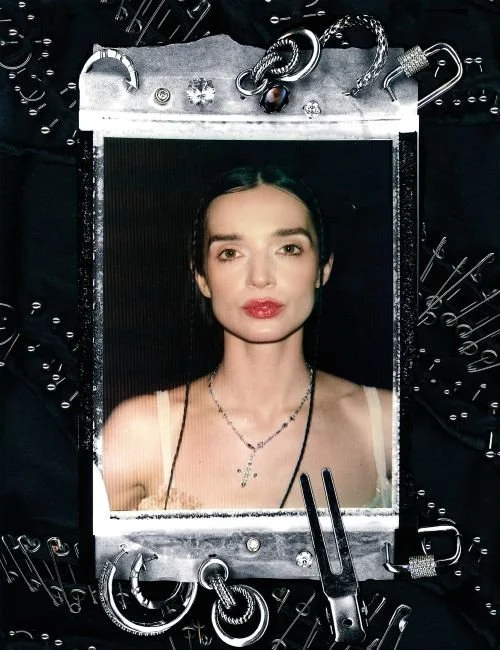
PHOTO CREDIT: Paris Mumpower
You came up in what i think was kind of the golden era of YouTube. What do you think of that world now
It’s not fun anymore. I thought YouTube at the time — before people knew how to use it — was so fun and uncharted. I feel very removed from the internet lately, actually. Every single time I go on tour, I try to not do the internet. I go analog and write and read books and draw… What I can hold. No screens — other than Animal Crossing. I will do that before bed. I will play Animal Crossing for at least an hour to get my Nook Miles up.
Back to the record — I like the way you say “Motherfucker” in “Dying to Forget.” You sound super pissed off but it’s also extremely over-the-top. Are those moments fun to do in the studio?
Absolutely. Yeah. Especially in the room. I think sometimes when Stevis [House of Protection singer-guitarist Stephen “Stevis” Harrison] and I are working on music together, I’ll read them something I wrote, and if I’m looking for the smile or the laugh, that makes me excited.
That one has the breakdown… Jordan bounced me the first demo, and it didn’t have the instrumental breakdown. I said, “Oh, we should just keep it vocal-only when I’m saying, ‘I want both eyes and your lying tongue.’” And he’s like, “No, we can’t do that.” I said, “It’s so hard, we should.” We went back and forth about it.
I don’t get the sense that you ever Googled how to scream properly. Your style always sounds really raw, emotional and real. And it always fits the song.
Yeah, I don’t watch YouTube tutorials for screams. I go based off emotion. I think it’s really corny when people have debates about technique. That’s the least hardcore-metal-punk-rock thing to do: worry about your technique. What happened to feeling anything and responding to it? I think it’s so corny. I hope you print this in bold letters: I think it’s so corny when people think about technique at the microphone, and they’re nerds.
“Ribs” feels particularly emotional. I’ve noticed that the way you write about feelings is often in relation to the body.
I’ve had this image in my mind for a while about keeping something protected, and what’s the closest place to do so, and where it would land. And then what it’s like when you’re parting with someone, or there’s the end or dissolve of something. You still hold onto the experience — or the faintness of the memory of the experience — emotionally.
Or maybe someday if the weather is the right way, and the sun is shining, and it catches you off guard, and it kind of throws you back, and there’s that moment of this melancholy feeling that you can’t entirely place, but it’s been so many years, and it’s just a fragment now. It’s still in you somewhere. So, I was thinking about that”.
There are not a great deal of reviews for Empty Hands. That is a shame, as it is one of the finest albums from a modern-day queen. Someone who should be talked about a lot more. Having interviewed Poppy for Kerrang!, Emma Wilkes provided her take on the brilliant Empty Hands. It is a phenomenal album that I can imagine will sound epic on the road. You can see Poppy’s tour dates here. Poppy is in the U.K. next week. As part of her Constantly Nowhere Tour, she will get a lot of love here:
“On her last album, 2024's Negative Spaces, Poppy set a new bar for herself, but she’s evidently undaunted by the thought of clearing it. Rarely concerned with numbers and milestones, she’s chasing what excites her, which right now is the raw, unfettered energy that she finds when she unleashes her emotions live. It certainly helps that she’s got a huge well of rage stored, specifically for those in life who take and hoard and pile their trophies up with little regard for its impact, or how long it might last.
Stylistically, Empty Hands isn’t wildly removed from Negative Spaces, especially as alternative mega-producer Jordan Fish is at the helm once again. It both builds on its strengths and irons out its weaknesses, particularly where Jordan’s production style is concerned. Instead of crowding out Poppy’s own style with his, their palettes coalesce better, such as on the volcanic yet melodic Bruised Sky and the skyscraping sweetness of Guardian.
It’s varied but cohesive, never sagging even with a 13-song tracklist, with glints of some of Poppy’s most exciting ideas yet. Chief among them is opener Public Domain, a juddering industrial number flowing from mocking, robotic vocals – ‘Fuck your ignorant opinions / Maybe you ain't got a reason to live,’ she sneers – into something almost theatrical, representing Poppy at her most individual.
Some of the most attention-grabbing moments here will inevitably be the heavier songs – and they are incandescent on a level you've not quite heard from Poppy before. Dying To Forget’s shrapnel-like riffs are as merciless as its lyrics – ‘I resent the fact you’re living / Now the hate will keep me warm’ – while the scathing title-track is a seething finale bristling with visceral hatred, as well as a brilliant climax offering some truly eye-watering screams. Elsewhere, she twists that hatred into some acerbic sass across Eat The Hate’s jiving rhythms – ‘Eat the hate ’cause I'm the judge / God will throw an uppercut / You're celibate ’cause no-one wants to fuck.’
This is what it sounds like when Poppy is properly in her element. When she’s got something that lights her on fire, she’s unstoppable, and this is how she’s been able to write possibly her best songs yet.
Verdict: 4/5”.
I am going to end here. A fabulous, raw and memorable album from Poppy, everyone needs to follow her. Always fascinating reading interviews with her. An artist that I would love to interview one day, I feel this year is going to be one of the biggest years for Poppy. When it comes to the Boston-born artist, she is truly…
A modern great.
_________
Follow Poppy