
FEATURE:
Damage, Inc.
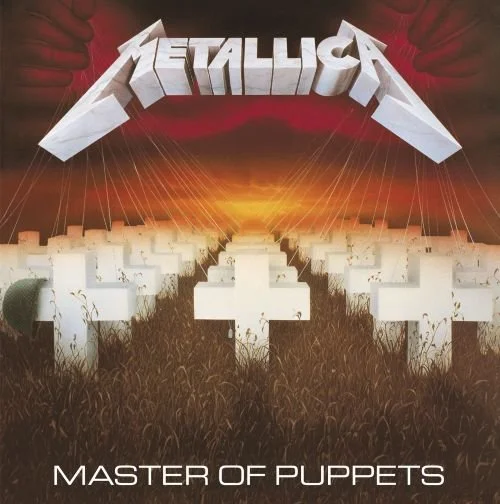
Metallica’s Master of Puppets at Forty
__________
THIS is not the only…

IN THIS PHOTO: Metallica at a hotel in Tokyo, Japan in November 1986/PHOTO CREDIT: Koh Hasebe/Shinko Music/Getty Images
album from Metallica that is celebrating a big anniversary this year. The band are celebrating forty-five years together. The original line-up got together in 1981, so I wonder if Metallica will mark that. Also, Metallica, a.k.a. The Black Album – which is their response to The Beatles’ eponymous album, a.k.a. The White Album -, turns thirty-five on 12th August. The third album from the Los Angeles band (in 1986, they were comprised of James Hetfield, Lars Ulrich, Kirk Hammett and Cliff Burton), Master of Puppets, turns forty on 3rd March. I am going to get to some features and a review of this monumental album. The final album to feature the late bassist Cliff Burton, many fans argue Master of Puppets is Metallica’s finest album. It is hard to disagree! This album helped bring Thrash Metal to the mainstream and challenge genres like Heavy Metal and Rock. A classic that is often included in the list of the best albums ever, I want to go deeper with Master of Puppets. In 2021, Beneath the Surface revisited Master of Puppets on its thirty-fifth anniversary. There are some sections of the feature that I want to bring in here:
“In the run-up to 1986, Metallica were already beginning to create waves across the metal scene for their help in forming the Thrash genre and solidifying American Metal music throughout the industry. Yet, following the release of their second album, Ride The Lightning, the band remained a pillar of the Underground music scene rather than the commercial success and household name to which they are now known.
That is why when it came to writing their next album, Metallica saw the opportunity to prove themselves more than ever before and created an album that established Thrash as a genre worthy of both commercial success and critical acclaim.
Aiming to provide a more refined and mature approach than in their previous releases, the writing for Master of Puppets also reinvented the structure of the band and juxtaposed the reputation they had already created for themselves.
Initially nicknamed ‘Alcoholica’ by fans and critics (due to their excessive drinking and rambunctious lifestyles), Metallica’s newfound desire to break out of the Underground scene saw the members sober up and incorporate more technical dexterity into their music than many thought they were capable of.
Almost entirely written by both Hetfield and Ulrich in mid-1985, the band, for the first time, chose to conduct the recording process outside of the US. This came as a result of their new, heightened standards and dissatisfaction towards the quality and capability of American studios.
Trying to capture an increasingly refined sound and a greater sense of detail, Metallica rethought their approach to their instruments and took numerous steps to make their playing abilities the highest possible. To achieve this, Ulrich underwent drum lessons, Kirk Hammett commissioned guitar-legend, Joe Satriani, as a mentor and Hetfield attempted to commission Rush’s Geddy Lee as the producer before the members flew to Denmark to record the album.
Now, paying more attention to their technical abilities and songwriting capability, the band set their eyes upon ambitious and politically-aware lyrics- aiming to capture critical reception and establish themselves as more than an amateur, underground band.
Using Hetfield’s new controlled and melodic vocals (as opposed to the harsh, uncontrolled shouts of the first two releases), Metallica strived to represent the alienation and powerlessness of the everyday man, victimised by those who wield power– raising some of the most important issues at the time into question.
Exploring themes including the exploitation of the common man, the abuse of power by authority figures and the subconscious manipulation of televangelism, the motifs behind Master of Puppets were intentionally crafted to generate controversy and place Metallica into discussion within mainstream society.
Tracks ‘Battery’, ‘Master of Puppets’, ‘Disposable Heroes’, ‘Leper Messiah’ and ‘Damage Inc.’ all followed this premise- shedding light on the lack of personal liberty the band saw across 1980s society.
Here, the band also saw their opportunity to highlight other taboo subjects that were restricted in mainstream media. Although predominantly about the vulnerability of mankind, the lyrics also tackled issues of drug addiction, the hypocrisy of religion and the trauma of PTSD faced by those sent to war.
A world away from the initial lacklustre meanings behind their earlier tracks such as ‘Whiplash’ and ‘Motorbreath’, when Master of Puppets made its debut, critics were caught off-guard by the newfound maturity and political commentary the four-piece had produced”.
Prior to getting to some reviews, Billboard spoke with some Metal musicians and asked them how Master of Puppets, this landmark release from 1986, influenced them. Published in 2017 to coincide with the reissue of the album, I have brought in observations and remarks from a couple of musicians. For those who do not know Master of Puppets, this is an album that you have to hear. Not only helping shape Metal music after 1986, it also impacted and shaped other genres:
“For Metallica, the album was their first major vault into the mainstream lexicon, seemingly almost purely by word of mouth and all those black “Metal Up Your Ass!” t-shirts peppering public school hallways. Puppets was more than a progression of the heavy sound that captured the metal community when Kill ‘Em All came out. It was a full-blown evolution in how they approached the speed/thrash formula, especially when you hear the Julian Bream-kissed flourishes of guitarist Kirk Hammett at the beginning of opening cut “Battery” as well as Burton’s subtle shout-out to Bach’s “Come, Sweet Death” at the top of “Damage, Inc.” No other metal band in the ’80s was truer to the roots of Deep Purple and Black Sabbath than Metallica, heard across the riffage of “The Thing That Should Not Be” and “Disposable Heroes,” while the complex progressions of the beloved title track hint at a love for groups like King Crimson and Rush.
As a lyricist, frontman James Hetfield made a giant leap toward his present status as one of the great American songwriters, especially when you take into consideration a song like “Welcome Home (Sanitarium),” where he channels Randle McMurphy in Ken Kesey’s One Flew Over the Cuckoo’s Nest to capture the emotions of a man psychiatrically held against his will. For the band, it was a bittersweet triumph punctuated by the tragic and unexpected death of their beloved friend and bandmate, bassist Cliff Burton, whose brilliance as a musician was cemented with Master’s instrumental crescendo “Orion.” It was eight minutes of infinite promise and a culmination of Burton’s roots in not only Lemmy Kilmister and Phil Lynott but Paul McCartney and Stanley Clarke as well, especially in his favoring of the high strings. No disrespect to Jason Newsted nor Robert Trujillo, but there was a certain harmony between Burton and drummer Lars Ulrich as a rhythm section, and on Puppets it hit its crescendo. One could only imagine what Metallica might’ve evolved into had Cliff lived to see his 56th birthday this coming Feb. 10.
The band recently revisited the album as part of its ongoing reissue series with the most generous entry yet, expanding Puppets exponentially with rare interviews, rough mixes and demos, including Lars’ and James’ riff tapes as well as Jason Newsted’s auditions, and a veritable metric ton of live audio and video. The live stuff is plentiful, and features recordings of shows from The Meadowlands and Hampton Coliseum as well as footage from concerts at the Joe Louis Arena, the Roskilde Festival and more. To experience the delight of what this super deluxe edition has to offer, check out the video of Hetfield unboxing it here. And don’t forget about the two never-before-released cover songs: Diamond Head’s “The Prince” (later re-recorded as the b-side to “One”) and the punk group Fang’s “The Money Will Roll Right In.” This 2017 remaster of Puppets is such a powerful restoration of the original Flemming Rasmussen production, you can’t help but play it loud. The crispness and clarity of this edition is arguably on par with the Giles Martin remaster of Sgt. Pepper’s Lonely Hearts Club Band, released earlier this year.
As for the proper LP, its influence remains as vital as ever in the metal community. To punctuate that sentiment, Billboard asked a wide swath of names in the field to speak to us about their personal histories surrounding Master of Puppets to commemorate having this heavy metal masterpiece thrust back into our lives in the best way possible.
“The first time I heard Metallica I was backstage at the historic Monsters of Rock Festival at the L.A. Coliseum back in July 1988, when they opened for Van Halen and all the fans stormed the stage. At that moment, I immediately knew they were going to be huge. The 20-disc box set of Master Of Puppets is an incredible snapshot of the band’s career during the mid-‘80s and is still one of the favorites in my collection.” – Stuart Smith, Heaven & Earth
“Master Of Puppets was a pivotal album for me in many ways. My first experience with Metallica had been with Ride The Lightning and what had started as a sort of musical oddity for me, developed into a massive appreciation for the band. For the first time I was able to see that the ‘heaviest music’ available to me at that time could still be a vehicle for legitimate musicality. When Master was released, it was a paradigm shift for me and the people around me as the stage had been set for them to really continue their momentum and they delivered in every way. Even the tonalities they chose, intentional or otherwise, were of such a foreign and antagonistic quality that it stood alone in a sea of fantasy inspired and image-centric heavy metal. I think for myself, as well as many others in my age group, Metallica was the single defining heavy band that not only went on to legitimize the genre as a sellable art form, but also that you could inject a musicality and intention into a heavy structure that carried a profound weight. Master Of Puppets is one of those rare, iconic albums that stands alone.” – Devin Townsend”.
I will end by taking from Pitchfork’s 2017 review of the album. They were writing about the reissue of Master of Puppets, complete with demos and live takes. Before that 10/10 review, another perfect score. This one is from Classic Rock around a 2022 vinyl overhaul and reissue:
“Thirty-one years later, it’s still hard to overestimate the impact Metallica’s Master Of Puppets had on the world. Their most profound and emphatic musical statement, it would come to define them, and with the death of bass player Cliff Burton on that album’s tour, it book-ended an era for the quartet when they went from being celebrated as the most important metal band on the planet to being another infamous rock act forever marred by a gruesome fatality. To their credit, as a unit they recovered, renewed and moved on, and in last year’s Hardwired… To Self Destruct showed that even three decades later, they’re still capable of fury and angst.
For those of us still marvelling at their unparalleled and sophisticated leap from the Kill ’Em All debut to their Ride The Lightning album, Master was a whole other level of erudition. Strange to think now that there was outrage in some quarters when they introduced acoustic guitars to the audience at Hammersmith Odeon (think Bob Dylan’s ‘Judas’ debacle when he went electric, but in reverse) on the Lightning tour. Though if their audience and critics were still clinging to the past, Metallica were marching purposefully forward to the beat of their own drum (toms and double bass drums, mostly), setting the spark to the flame of a genuine musical revolution.
All that history costs. If you want this Remastered Deluxe Boxset – that’s how they’re selling it – then be prepared to dig deep. That said, this collection brings new meaning to the term ‘exacting’.
Flemming Rasmussen’s strangely thin production has been boosted and remastered so the title track now sounds and feels like someone’s driven a dumpster truck through your French windows, but aural tweaking is only the beginning. So while you revel in the original album, you can unbox three vinyl records, 10 CDs, two DVDs, one cassette, a hardcover book (Metallica are master gurners, as these exclusive photos bear out), a folder of handwritten lyrics, six badges and a Damage, Inc. lithograph.
And as alluring as all the attendant bells and whistles are, it’s the attention to detail that will have you shouting, “Take my money!” at your computer screen.
There’s something quite heartening, if tempered with a sense of unease, at hearing Cliff Burton’s lazy stoner drawl again all these years later. He and the rest of the band (Kirk Hammett sounds about fifteen – you half expect his voice to start breaking) are captured here across two of the discs in interviews with radio stations and defunct magazines like Metal Forces and Sounds. Ulrich’s voice crackling down the line to London from his home in San Francisco, trying to indicate the magnitude of the album they’d just made, is a joy to behold. It’s a real artefact, a low-rent relic and just one of the many gems to be unearthed here”.
The final thoughts are from Pitchfork from 2017. The sheer influence and impact of this album forty years later. The melodic depth and complexities, fused with those incredible riffs, challenging, deep and important lyrics, and Metallica offering this incredible power, musicianship, storytelling and sophistication, I wonder how critics will reproach Master of Puppets closer to its anniversary on 3rd March:
“Puppets deals with the very nature of control, presenting the hangover of its allure. Metal is fight music for underdogs and while that is empowering and worthwhile, Puppets shows the consequences of control in the wrong hands. The title track was Hetfield warning himself about addiction, something he would become intimate with, and he wouldn’t listen until their 2004 tell-all documentary Some Kind of Monster made a tragic comedy out of Metallica’s near collapse while recording St. Anger. Through its raging rhythm and heart-wrenching valleys, where bassist Cliff Burton brought a distorted symphony of the mind, Hetfield’s pleas for sanity sure don’t sound like someone coming to grips with how fucked up he is.
This isn’t unusual for cautionary drug songs, yet “Puppets” doesn’t sound like a morality play—“Master! Master!” is servitude delivered as arena unity, where you grow stronger, not indentured, by yelling it louder and louder. “Disposable Heroes” and “Leper Messiah” explore the illusion of control through more conventional topics—“Heroes” takes on war and “Messiah” skewers televangelists as any decent ’80s metal band would—and still manage to be more powerful than most bands at their best. Metallica embraced more complex structures without diluting themselves, a rare instance where a band gets more accessible by getting more complicated.
Puppets’ fusion of beauty and savagery is best defined in its last two songs, “Orion,” an instrumental, and “Damage Inc.” Both tracks were co-written by Burton, effectively sealing his legacy that still looms over Metallica three decades later. His presence is strongest on “Orion,” making thrash move like ballet, a swelling motion that’s not just about crashing into things. The bridge takes the control motif and creates worlds with it, creating tenderness and majesty, showing what a man’s hand masquerading as divine can summon. “Orion” is celestial through meaning, not explicit text, Hawkwind’s high-mindedness combined with Lemmy’s more direct glance.
“Damage Inc.” closes how “Battery” opened the album: reckless carnage as a cleansing, necessary fire. While it’s more of a contrast than fusion, they still coexist with a purpose to elevate metal. It’s even more apocalyptic than “Fight Fire With Fire”—there’s no mention of nuclear war, just a focus on getting mowed down for someone else’s survival. “Fuck it all, fucking no regrets” proved to be such an impactful line, Hetfield reused it again in 2003, on St. Anger’s title track with a teenager’s enthusiastic clumsiness.
Nevertheless, Hetfield is, bar none, metal’s standout rhythm guitarist, handling blazing speed with a precision and heft. Metallica are so ubiquitous that this perhaps has gone under-recognized; hummable as his riffs are, and the legions of hummers massive, Hetfield’s role as frontman obscures his contributions as a guitarist. The rough mixes included in this deluxe reissue are mostly devoid of solos and vocals, and they become pantheons to Hetfield’s rhythm stature. It’s jarring to hear gaps where Hammett’s solos or Burton’s fills should be, and yet through him (and our collective memories) the songs still flow as they should. Hetfield-Hammett-Burton-Ulrich is one of the few metal lineups where every member was equally integral, where if you removed one, the band would be radically altered. Hetfield was the bond between everyone else, a ground to Burton’s ambitions and Hammett’s squalling lead work, a reason that Ulrich didn’t need to be flashy because he certainly couldn’t be.
Puppets brought Metallica to their artistic climax, but its touring cycle proved a severe challenge to such loftiness. The live recordings here are closer to the tapes that Metallica made their reputation off of than the polished productions on the 1993 box set Live Shit: Binge & Purge, the cash-out from touring all corners of the globe. As demanding of perfection they were making Puppets, live they were still more concerned with tearing through, out-of-place leads be damned. Except for a 1987 VHS Cliff ‘Em All!, there weren’t a lot of official live recordings from this era, odd given how Metallica made their name as a live band. The live tracks here are rough, unpolished, but you can basically smell the beer and sweat from the band and the crowd throughout”.
A truly stunning album that has lost none of its importance forty years later. Given the themes Master of Puppets tackles around the nature of control, corruption, warfare and senseless violence, it seems like it has a whole new influence today. In terms of learning from Metallica’s songs. How far has the world moved on since 1986? I think some critics will frame the album around modern politics and violence across the globe. In musical terms, Master of Puppets is complex and sophisticated yet it has this urgency and power. More storytelling than traditional Metal songs, you can see why it was influential and helped to change and reshape music. On 3rd March, we celebrate forty years of…
AN undeniable classic.