
FEATURE:
All You Need Is…
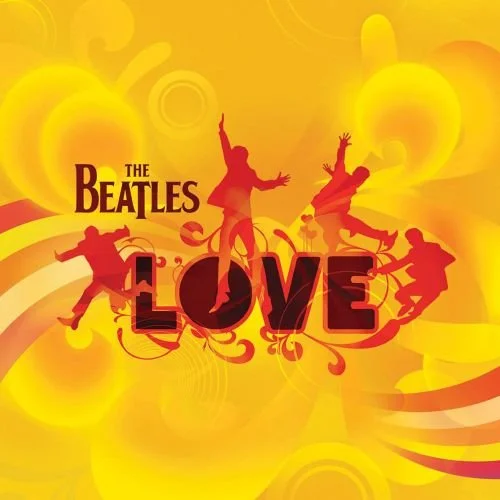
The Beatles' Love at Twenty
_________
I remember when this album came out…
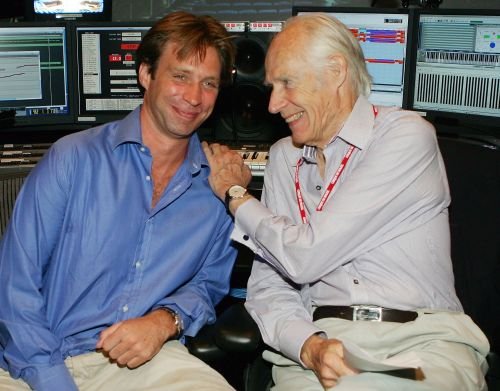
IN THIS PHOTO: Giles and George Martin in 2006/PHOTO CREDIT: Ethan Miller/Getty Images
and I was instantly curious. I was a Beatles fan way before 2006. My had albums by The Beatles in the house when I was growing up. So much of the music from the 1990s was inspired by The Beatles. I got given their 1 album as a Christmas present in 2000. Twenty years ago, there was Beatles retrospection, though I feel that has increased since then. There are four biopics planned for 2028. One for each member – Ringo Starr, Paul McCartney, John Lennon and George Harrison -, that is drawing some mixed reaction from fans. Seeing how it will turn out. Many of their studio albums have been reissued by Giles Martin. He is the son of the late Beatles produce, Sir George Martin. He died in 2016. George Martin produced The Beatles’ LOVE with his son. It was released on 20th November, 2006, so I wanted to mark twenty years. One reason it was so well received is that it was not just repacking their hits. This was songs placed together and almost made into something new. The concept of using The Beatles’ music in a Cirque du Soleil production had originally come from George Harrison, who died in November 2001. It was a commercial success and gained some very positive reviews. Before getting to them, this feature discusses the creation of the magical LOVE:
“After being asked by the remaining Beatles, Ringo and Paul, along with Yoko Ono Lennon and Olivia Harrison, to make experimental mixes from their master tapes for a collaboration with Cirque du Soleil, Sir George Martin, The Beatles legendary producer, and his son Giles Martin have been working with the entire archive of Beatles recordings to create LOVE. The result is an unprecedented approach to the music. Using the master tapes at Abbey Road Studios, Sir George and Giles have created a unique soundscape. The release of this album, which is also featured in the Cirque du Soleil/Beatles collaborative production of the same name at The Mirage in Las Vegas, has been much anticipated.
"This album puts the Beatles back together again, because suddenly there's John and George with me and Ringo," said Paul McCartney. "It's kind of magical."
"George and Giles did such a great job combining these tracks. It's really powerful for me and I even heard things I'd forgotten we'd recorded." commented Ringo Starr.
"The album has the feeling of love and that's why the title is Beatles LOVE," added Yoko Ono Lennon, "They have let everything that is beautiful and daring come out."
"The music is stunning. I think the most amazing thing about it is that you can pull it apart and all the elements carry with it the essence of the entire song," said Olivia Harrison.After being asked by the remaining Beatles, Ringo and Paul, along with Yoko Ono Lennon and Olivia Harrison, to make experimental mixes from their master tapes for a collaboration with Cirque du Soleil, Sir George Martin, The Beatles legendary producer, and his son Giles Martin have been working with the entire archive of Beatles recordings to create LOVE. The result is an unprecedented approach to the music. Using the master tapes at Abbey Road Studios, Sir George and Giles have created a unique soundscape. The release of this album, which is also featured in the Cirque du Soleil/Beatles collaborative production of the same name at The Mirage in Las Vegas, has been much anticipated.
"This album puts the Beatles back together again, because suddenly there's John and George with me and Ringo," said Paul McCartney. "It's kind of magical."
"George and Giles did such a great job combining these tracks. It's really powerful for me and I even heard things I'd forgotten we'd recorded." commented Ringo Starr.
"The album has the feeling of love and that's why the title is Beatles LOVE," added Yoko Ono Lennon, "They have let everything that is beautiful and daring come out”.
I will bring a couple in. I am not sure whether people will celebrate twenty years of Love, the same way they would a Beatles studio album. I do want to bring in part of this interview from Tape Op. They spoke with Giles Martin about his work in general, but there was a question about The Beatles’ LOVE. Announced in 2004, it was a GRAMMY-winning, multi-million-selling colossus. Critics would have sniffed at the idea and felt the concept of mixing a Las Vegas-style circus production and The Beatles’ music was doomed to fail. They were quickly and pleasingly silenced:
“Tell me a little bit about your background and how you ended up in your dad's profession.
I originally wanted to be a composer. That's what I was driven towards. I started writing music for commercials when I was in college, although I studied literature. When I was about 16 years old, my father started losing his hearing — he needed someone to be his ears, if you like. He didn't want me to go into the profession, in any shape or form. I was quite good academically at English. He wanted me to get a proper job, I suppose. He didn't want it to be exposed that he was losing his hearing, since he wanted to go on working, so I started working as an assistant, out of necessity on his part.
This was around the time of The Beatles' Anthology?
Yes, the Anthology era. [1995] I was hanging around in the studios with him during school time and he'd want me to come in and listen to things. At first it was sounds like cymbals, because that's where his hearing loss was. He'd have a quiet word with me and explain certain things. I remember he asked me who I thought should be engineering Anthology. I thought he should get Geoff Emerick [Tape Op #57] to do it, because it just made sense. Also, when Paul [McCartney] wrote asking for a producer [for what became Chaos and Creation in the Backyard], around 2005, my dad asked me [my opinion] and I suggested Nigel Godrich because I thought he'd be good. He's not as much a music producer as he is an engineering producer. That worked out well. Eventually I had some success writing and producing while working with different artists. I worked on Anthology 2 with my dad, because it came at a break between my studies. I was perfectly happy working away on my own thing; I had no aspirations to do Beatles work. When the Love project came up, I had a concept. My dad wasn't around because he wasn't well at the time, and Neil Aspinall [head of Apple Corps] asked me if I could experiment with something that hadn't worked in the past. I said that I reckoned I could create something by just chopping the tapes up. I'd heard the tapes, because I'd worked on Anthology, and tracks sounded live to me. Since it was live recordings, I figured we could create a live show out of the tapes. It became much more psychedelic as we got more into it, but that was the plan.
Was the Love project a mash-up idea from the beginning, or did you think of it in terms of complete songs at that point?
No, it was a mash-up from the beginning. I wanted to create a live feel. I know that's a ridiculous thing to say, a live feel by doing mash-ups, but I already knew that I could get the drum solo. I already had the concept of the show opening with the drum solo from "The End," which I knew I could combine with "Get Back." It sort of worked out from there. The piano chord from "A Day In The Life" going into it... it just worked backwards. I knew when I spoke to Neil that I could do it. I wasn't sure if other people would like it or not, but I knew that I could get it to work. I didn't really have much connection with The Beatles at all before that. It came from doing the Love show, which thankfully was critically acclaimed. Working with The Beatles continues to surprise me. I didn't really feel deserving of it. It's quite a big mantle to have. I remember after I did my demo of Love, with four or five tracks, everyone got enthusiastic. I remember saying to a friend of mine that I'd been asked to do this thing, but I wasn't sure if I should do it. I didn't know if it was because of my dad getting me the job, or because it was passed down. I'd avoided deliberately doing any kind of Beatles projects that felt passed down to me, probably to my detriment. I just didn't want to go down that route. This friend of mine, who's a producer and engineer, asked me if I had any idea how many people would love to be working on this. He said that if I turned it down I'd be completely crazy. I figured if I could put the teenage bitterness to one side and stop thinking about what other people would think, I could just enjoy myself and be honored that I had the chance to work in that situation. So that's what happened”.
There were so many glowing revies for LOVE when it was released in 2006. I will finish with a few of them. Starting out with Pitchfork and their opinions on an album that would have divided people ahead of its release. Some seeing LOVE as a risky concept or distilling The Beatles’ music. Tacky or a bit misguided. Giles and George Martin treated the music with great affection and created something extraordinary:
“Listening to Love I'm reminded first of a few artists that took from the Beatles without their permission, and how illicit beginnings gave their samples an extra hit of fun. There's the entire Danger Mouse/Jay-Z mashup The Grey Album, of course, but I'm thinking of smaller details. When Ringo Starr's solo from "The End" appears early here I go immediately to Jason Forrest's "Ten Amazing Years", not Abbey Road. The swirl of strings from "Good Night" stitched here to Ringo's "Octopus's Garden" brings to mind Ekkehard Ehlers' drawn-out loop of the same phrase that comprises the entirety of one side of "Ekkehard Ehlers Plays John Cassavetes". Having all the mixes band-sanctioned loses a little something. Paul McCartney is said to have heard Love and remarked that he wished it went a bit further out. And it's hard not to agree, especially for people used to hearing mash-ups and guerilla sonic deconstruction via laptop. How badly do you want Yamatsuka Eye to do a Rebore Vol. 0 on this material?
Really, the mashed-up bits here are just a seasoning, the occasional jarring effect to remind us that we're not just sitting around listening to Beatles records. Who knew that the backing track for "Drive My Car" fit perfectly over verses from "The Word" and "What You're Doing"? The a capella "Sun King" sounds great backward on "Gnik Nus" leading beautifully into "Something" and doesn't contain any hidden messages beyond the one conveyed by the opening "Because"-- that the Beatles were great singers. "Being for the Benefit of Mr. Kite" seems a natural soundtrack for tumbling acrobats, and the coda to "I Want You (She's So Heavy)" sounds like it was made for this project.
As the album wears on, the songs get "bigger" and are also made to stand on their own, without the mix trickery. But they also suffer from truncation. It's great to hear a round of the "Hey Jude"'s epic chorus with just voice and drums, but the song means so much less at four minutes than it does at seven, with a full verse cut and the final fade happening earlier. I will say that hearing it pulled apart finally confirms that Beta Band's "Dry the Rain" steals from it almost completely, one instrument after another.
It seems impossible to follow the final chord of "A Day in the Life", but the Martins are just closing the door on the darker, artier aspect of the Beatles, letting the uplifting pop band carry the day during the album's final section. The trimmed "Hey Jude", the reprise of "Sgt. Pepper's Lonely Hearts Club Band" (let's face it-- not great, but included because of all the showbiz connotations) and then closing with "All You Need Is Love".
What seems to consume people most about this record is the sound of the thing, just how beautifully the original material was recorded and how great it comes over on a purely sonic level. The art of recording a rock band, it seems, reached its zenith in the late 1960s. In terms of capturing guitar, bass, drums, and voice, nothing since-- no matter how many tracks-- sounds as pure and lovely as what the Beatles did at Abbey Road studios. Love is turning everyone into an audiophile, then, which means it's making younger people a little older. And it's also a mashup remix, which means it's making older people a little younger. They were just a pop band, yes, but if anyone can bring all these music fans together under one tent, it's the Beatles. Which is what Love is ultimately all about”.
There are a couple of five-star reviews I want to finish off with. The Guardian broke down the album and made me and so many others realise how much work went into it. In terms of the amount of songs George and Giles Martin worked with and how they produced this incredible sound collage. I think it drew a new audience to The Beatles’ work. Love is a masterpiece without a doubt:
“Of all the possible posthumous incarnations for the Beatles, here's one of the most unlikely - as soundtrack to a Las Vegas circus. It isn't any old circus, admittedly, but Canada's arty, super-acrobatic Cirque du Soleil, whose current Las Vegas show, Love, is modelled on the story of the Beatles and characters from their songs: Eleanor Rigby, Sergeant Pepper et al.
More importantly, Love the show - the result of George Harrison's friendship with Cirque founder Guy Laliberte - involved producer George Martin disinterring the group's master tapes from the Abbey Road vault for he and his son Giles to remix and remodel. The results blast Love audiences from a state-of-the-art surround-sound system that includes speakers in individual seats.
And the first thing Love the album does, at least in its DVD surround-sound format, is to blow you away with sheer sonic wizardry. Set to a noisy dawn chorus, complete with fluttering wings, the three-part vocal harmonies of 'Because' arrive with the clarity of an ice blue sky. The chugging introduction to 'Get Back' hurtles out of the mix like a train. The pumping fairground organs of 'Mr Kite' reek of steam and sawdust. Hearing many of the familiar tracks is like viewing an old masterpiece after cleaning: the light is brighter, the shadows deeper. Here, the trebles tingle while the bass end booms.
Some of this is painstaking technical restoration. After the Beatles swapped touring for the studio, they and Martin became experts at squeezing a quart of sound into a pint pot, extending the limits of four- and eight-track recordings by 'bouncing down' tracks. Today's technology has let the Martins reverse the process, giving instruments and voices more autonomy. Ever notice the pizzicato violins on the middle 8 of 'Something'? You will now.
The ambitions of Love go beyond renovation, however. Its 26 tracks are set in an ambient flow of sound collages distilled from hours of Beatles tapes and containing fragments and echoes of 130 songs in all. Frequently the effect is ghostly, as the stalking strings of 'Glass Onion' and a snatch of 'Nowhere Man' drift like ectoplasm down a corridor. 'I Want to Hold Your Hand' - one of the few numbers from the moptop days - surfaces from a scratchy haze of screaming.
The most ambitious songs emerge most improved. There is not, after all, much to be done with the rock'n'roll retro of 'Lady Madonna', whereas 'Strawberry Fields' and 'I am the Walrus' sound more than ever like avant-garde masterpieces. Harrison's 'While My Guitar Gently Weeps' (the slower version from Anthology 3) is given a sumptuous string setting by Sir George. Throughout, the McCartney/Starr rhythm section has never sounded so heavy, or the group's vocal harmonies so sharp and affecting.
Love vindicates the Beatles' status as master musicians and conceptualists. Not only for the spirit of optimism they embodied but artistically, they remain the act to beat. On this evidence, no one else comes close”.
I am going to finish with SLANT and their takeaways. How they note the sound quality is extraordinary. Fans had never heard these songs as crisp and polished. Rather than removing rawness and purity from the tracks, so many new aspects, layers and elements were uncovered. Twenty years later, we need to discuss LOVE more. I feel a lot of people have forgotten about it:
“The Beatles were primal, peerless artists, a group whose work has colored the ensuing decades’ culture and sound. As such, the Fab Four’s decade’s worth of records are often viewed as sacred texts that dare not be disturbed. However, it’s a foolish notion to think that anyone would hear the Beatles’s music and not feel moved to interpret it anew. From barbershop quartets to heavy metal headbangers, the Beatles have seen their timeless song craft bent to fit the feel of countless genres.
With Love, these Liverpool lads are, at last, quite literally being reinvented by one of their own. The idea of folding the Beatles’s catalog back upon itself is not new (DJ Danger Mouse’s Internet sensation The Grey Album got there first in 2004 and, perhaps inevitably, will be mentioned in nearly every review published about this disc), but Love, as much an experiment as it is a soundtrack to Cirque du Soleil’s Vegas extravaganza, detonates the Beatles catalog, conflating 10 years of iconic tunes into the space of 26 tracks. It’s a best-of compilation in the most palpable sense of that phrase.
Love doesn’t drastically reimagine the Beatles’s music, but rather pieces together fragments of songs that don’t seem an ideal match—“A Hard Day’s Night” and “Get Back,” for example—and topples the barriers of time, rendering the Beatles as a fluid musical entity, a group whose compositions float in and out of one another to often thrilling, phantasmagoric effect. The often dizzying swirl of sound—“Get Back” fairly bursts at the seams while “Eleanor Rigby” and “Julia” blend together in haunting fashion—will have dedicated Beatlemaniacs parsing each track, attempting to decipher what producers George and his son Giles Martin have meticulously assembled.
In addition to imploding the boundaries between albums and songs, the Martins have also polished these tracks for today’s ears; it’s a revelation to hear—particularly in the DVD-A version of the album being sold concurrently—the crispness of Paul McCartney’s vocals intertwined with John Lennon’s high, thin harmonies, and the bite of George Harrison’s guitar and the satisfying kick of Ringo Starr’s drums. It would’ve been easy for the Beatles’s records to be museum pieces, left alone to gather dust and appreciation; Love reaffirms these recordings’ enduring vitality and essential nature. By dusting them off and dismantling them, the Martins have fashioned a giddy mash-up that lays bare the very DNA of modern pop music. It’s a dazzling, expansive experience that ranks among the year’s best”.
I admit I had not listened to LOVE for a long while before writing this. Refreshing my memory and remembering just how brilliant it is! As it turns twenty on 20th November, I did want to spend some time with it. I hope some people share some words and it gets a little bit of new exposure and appreciation. It deserves it. LOVE was a massive commercial and critical success. In other people’s hands, LOVE could have been a disaster. Though this was George and Giles Martin, so they definitely knew what they were doing! Two decades on and LOVE remains this…
BEAUTIFUL thing.