
FEATURE:
My Artist of the Year 2026
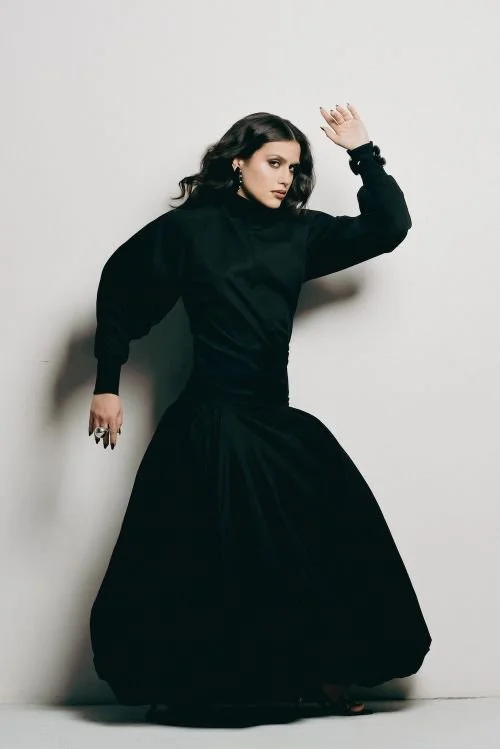
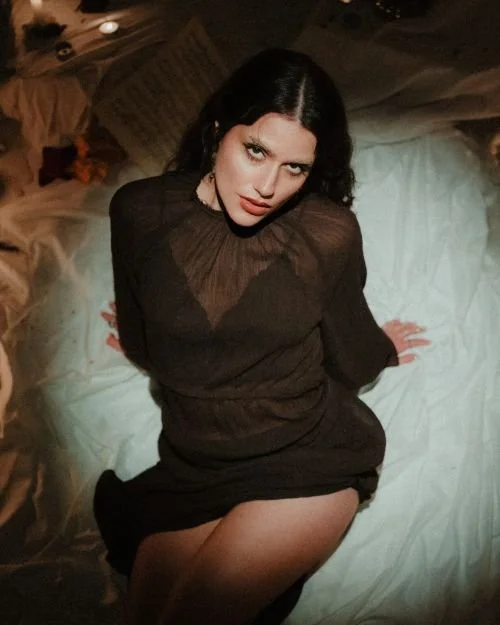
PHOTO CREDIT: Matt Bottomley
every artist featured on my blog this year. They are all tremendous. However, I was thinking of the one whose music, social media messaging and videos has impacted me hardest. It may be premature to declare a winner this far until the end of 2026, though I have been a big fan of Lana Lubany for a long time. The music she has put out this year has really got under my skin. Her videos and live performances. I did want to bring in some interviews from this year with her. She is a Palestine-born artist who resides in London. I have not interviewed her but, as we live in the same city, I will try and do it at some point. I spotlighted Lana Lubany in 2022 and revisited her work last year. Singles this year like BAD IDEA and CURRENCY are among her best work. I still need to see her perform live. Lots of people will hold their breath for an album from her soon. This is a very special artist indeed. I have been folioing her over four years, and she goes from strength to strength. In terms of her voice, style, her lyrics and everything, there is nobody like her. This year has been a massive one for her. I think how challenging it must be for a Palestinian artist and seeing the genocide in her country. I think what makes her important is that she mixes English with Arabic (specifically her native Palestinian dialect). On 3rd November, Lubany turns thirty, so this was a sort of early happy birthday too! I do want to bring in some interviews with her. Go and follow her on Instagram, and see everything that she is getting up to. Her shoot for Mille World earlier in the year must rank as a highlight. “We wanted to do something more playful,” Palestinian photographer Sama Haddad tells MILLE of her latest shoot with Palestinian stylist Yara Aboud featuring Lana Lubany. What they ended up creating instead was one of the most visually striking Arab editorials to emerge this year”.
This Palestinian-America modern-day icon is someone who I admire so much. I want to come to this interview from January. We get a look into the self-made universe of Lana Lubany. One of the most inspiring artists I have heard in years, I do feel like she is going to be a global sensation very soon. She is not far from that now:
“In this exclusive conversation, we discuss her latest single “BAD IDEA,” which has just been released online. We talk about her journey of self-discovery, something I found myself relating to deeply, along with her love for horror films, the challenges she faces with writing, and the long, often difficult process of finding the courage to fully embrace who she truly is.
In many ways, this doesn’t feel like a traditional interview. It feels more like a conversation—or perhaps even a kind of therapy session—for two people who proudly embrace being a little weird.
How has your journey of discovering your identity been so far?
There were not many Arab pop stars, and I’ve always wanted to do the singing thing, and I never had the representation. So, I thought I have to change myself in order to be who I thought I needed to be in order to do music for a living. And so, I was kind of lost for a long time, trying to find my sound, trying to find myself, trying to figure out what my story was, and I feel like I’ve reached a low point. I was living in London back then, and it was during Covid that I got to a really low point that one day I was like, just fuck it. I’m going to try and write a song with Arabic in it. Because my mom always said, Lana, you should write in Arabic. It makes you unique. It makes you who you are. And I always said, nah, Mom, you don’t understand. You don’t know. And then I did try, and I wrote a song before I wrote my breakout song, The Snake, and it felt cool. I was like, oh, this is something I’ve never heard before, and this is something that I feel like it’s cool and represents me.
And then I wrote The Snake, and that one, it wasn’t immediate, like I was not feeling great. And then I wrote it, then I knew there was something about it that was different and that felt good. And every time I showed it to people, my mom included, it felt like they reacted differently, and it felt more me and it felt scarier, which is how you know that, like this is hitting a point, like a sensitive point within me. So, I put out the song. I kind of got over my fears, and that song specifically helped me with my identity crisis, if you want to call it that, and it kind of made me understand that me being myself is the coolest shit ever, and I need to just be me and accept myself for who I am. And then I started working on a project called the Holy Land and released that. And that was the whole journey of me rediscovering myself by really being accepting of my identity. And to this day, I’m on a journey of self-discovery. I feel like that. It never stops.
Your single Bad Idea is about letting go. What is something Lana has let go of over the past year?
I think in life, you’re always forced to let go. I think bad idea specifically is kind of like letting go of your control and kind of being like, fuck it. I’m just going to do whatever feels good for me at the moment. I’ve let go of so many things. This past year, life has kind of come to me with a bunch of changes, and like, I’ve had to let go of bad habits like people pleasing and not standing up for myself, letting other people control me, some friendships that I’ve had to let go of. I think change is inevitable. There’s beauty in it. It’s really difficult. But I think when you kind of let go, life becomes a bit less anal, a little less kind of rigid. It starts working with you rather than against you. So, you just have to accept it and let go sometimes.
Have you ever considered acting?
I would love to act at some point, I think it would be really fun. Because. I love acting in my music videos, but it has to be the right role and the right type of movie. And I think horror would be really cool.
Has your music been a way for you to face your feelings, or a way to escape them?
Facing them for sure. Writing helps me make sense of my emotions, and it’s the way I process how I feel, and it helps me confront my feelings, especially when it’s uncomfortable. I think otherwise, if I didn’t do it through writing, I would be avoiding my emotions. But instead, I sit with my emotions, and I turn them into something tangible, and it makes them feel less overwhelming, and it just makes more sense. So, it’s not about escaping.
You have a song titled “I Wish I Was Normal.” Do you feel that you’re not “normal,” and what does that idea mean to you?
I wrote that song as a Palestinian who was living away from home in London, and at the time, I felt like the issues that I was dealing with and the things that I was worried about were not normal, were out of the ordinary, but I never felt ordinary. The thing is I never felt like I fully belonged anywhere, and I always felt like I was different from the environment I was around, always in between, and at the time, that was amplified because I was just worried about the politics and everything and people around me were normal. I don’t think I’m normal, and sometimes I wish I was, because it sounds like an easier life, but I think it’s, it’s more fun, kind of being all over the place, yeah?
Are there any emerging Palestinian actors or music artists that you think the world should keep an eye on?
Lina Mahul, I think is amazing. She’s an amazing artist. I love 47 Soul, a band who is also Palestinian. There’s so much like up-and-coming talent. I feel like, you know, if you come across someone, just keep an eye out, because I feel like we’re on the rise now. You know, it’s our time”.
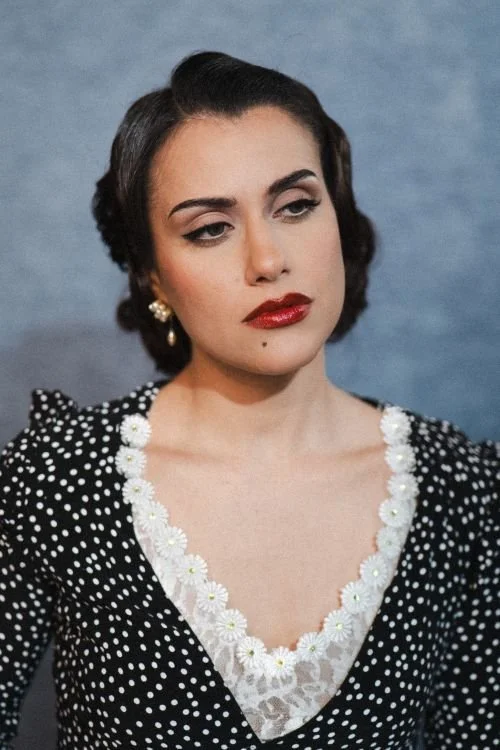
PHOTO CREDIT: Sama Haddad for Mille World
I do want to come to GQ Middle East, as there was a period when Lana Lubany was receiving backlash for not being as vocal as fellow Palestinian artists about genocide and what Israel are inflicting on Gaza. However, her advocacy has been proven. She is working on an album it seems. If she is not as vocal about the genocide as other artists, instead she shows her love for Palestine. Its people, history and culture:
“The artist still has family living in Palestine, which she says complicated her ability to use her platform to say or share anything publicly. It was an unprecedented moment for her and many Palestinian artists to navigate, putting musicians and creatives in an isolating position both personally and professionally. Due to this, Lubany was perceived to be quieter than other artists in her support for her homeland, Palestine.
It wasn’t until January 2024 that Lubany dropped her song “Make It Better” as her way of capturing all of the emotions pent up over the previous months.
But the song, she says, “flew under radar” and by the time she felt ready to step back into the public spotlight, some of her peers had already eclipsed her in terms of success in the movement she helped usher in.
“‘Make It Better’ was kind of my way of expressing my emotions without getting too much into it,” she says. “I was hoping that people would read between the lines, and most people didn't. I think people were looking for loud words, more obvious ones to validate what they were feeling. Which is fair, I completely understand. But I felt really trapped and like I had no freedom.”
What followed that year was a journey of renewed self-discovery for Lubany, forging ahead with experimentation in songs like the baddie anthem “Stanna” and the ode to her home “Nazareth”.
These singles culminated in her second EP “Yafa” later in 2024, which by her own admission came together very quickly.
Lubany speaks honestly about the process for creating and releasing “Yafa”, saying that she would “make different choices” if the EP were to come out now, like removing a couple of the songs.Yet what has stuck with her most from that release is the “external judgement” and feedback she received from fans and the Arab music industry writ large.
“I'm nostalgic for the “Snake” era because back then there was no judgment and it felt very positive online and people were lifting me up and telling me that I made them proud to be Arab."
“To me, songs like ‘Yafa’ or ‘Nazareth’ and so many of my other songs, they talk about my experience,” Lubany explains. “These songs are not as loud and obvious, but they show us as humans. They show more than just headlines. I think it's important to get different perspectives of a human, of a culture. I think there is definitely a certain perspective in the community that is shown, but there are so many more perspectives that should get a spotlight, in my opinion. So many things to get educated on as well. There's just so much good stuff in our culture that needs to be celebrated. So many stories that need to be told and preserved.”
Though the artist is now generally understanding and accepting of what happened, Lubany’s experience forced her to take a step back and reconnect with her identity and her humanity in a thoughtful way.
That introspection – and a change in management – seems to have paid dividends. With her two singles “Bad Idea” and “The Currency”” to start 2026, Lubany sounds more like herself, as though that weight of negativity has been completely lifted. She is quick to clarify, though, that she’s stepping back into this public spotlight with caution as she continues to heal from this traumatic experience.
Lubany holds no grudges, though, welcoming both new fans and the ones who might’ve doubted her. “It's good to have people listening to your art,” she says. “But I think now my mindset is very much that if I do the right thing, the right people will come.”
And if there are still any unfounded doubts about Lubany’s love and advocacy for Palestine, look no further than her participation in “Lullaby”, the ensemble charity single featuring other artists like Nai Barghouti, Bastille, and Mabel.
“It was so cathartic to be a part of that,” she shares. “It was a no-brainer when I got the email asking to participate. This was something I felt like my soul wanted to do and I felt like I needed. So many people came together in unity and it felt very hopeful for humanity in general. It felt like there was a light at the end of the tunnel.”
For now, Lubany continues to build herself back up. The artist remains busy in the studio, gearing up for her upcoming album. She’s prioritising her own world and creating on her own terms, including her love for Pilates.
“I feel like going to the gym is such an important thing for me to do. It's just good for you,’ she tells me. “Building these good, consistent habits help your bad days hit a little less hard and help you get out of slumps a little bit more easily. Now that I know how to take care of myself, I am stronger”.
I will end with the entirety of VIPER and their interview from July. As we look to the end of the year, these are exciting times for Lana Lubany. An album in the works. Plans for 2027. In the past couple of years, she has achieved so much. I think we will be talking about this incredible artists for many years more. I was blown away when I discovered her in 2022. Since then, she has evolved into one of the most important voices of her generation. No exaggeration:
“LANA LUBANY INTERVIEW: Breaking borders and bending genres, the London-based vanguard discusses bilingual flows, dark cinematic production, and the vital importance of creative autonomy.
The power of music lies in its ability to construct worlds where physical borders cease to exist. For Lana Lubany, this isn’t just an artistic philosophy—it is a lived reality. Since her breakthrough track ‘THE SNAKE’ seamlessly fused English and Arabic, the London-based artist has pioneered a haunting, avant-garde soundscape where ancient heritage and hyper-modern, bass-heavy production sit in perfect harmony.
Refusing to smooth out her edges for mainstream palatability, Lubany’s music serves as a sanctuary for the diaspora and a masterclass in world-building. Following a string of high-profile live dates—from Wembley Arena to touring with The Last Dinner Party—and a crucial partnership with AWAL, she is proving that absolute creative autonomy is the ultimate currency.
We spoke with the vocalist and songwriter to dissect bilingual rhythms, late-night intensity, and the necessity of protecting your true voice.
LANA LUBANY INTERVIEW: Your breakthrough track ‘THE SNAKE’ was a pivotal moment where you first merged English and Arabic (Arabizi). From a Rap and lyrical perspective, how did shifting into a bilingual delivery change the rhythm, flow, and cadence of your bars?
Adding another language to my writing unlocked a new perspective plus a new instrument. I feel like different parts of your personality come out in different languages. My Arabic wasn’t as strong as my English, so I couldn’t rely on a wide vocabulary or complicated descriptions. I had to keep things simple and find creative ways to connect ideas and build metaphors that communicated what I was trying to say.
Sometimes a phrase hits harder in Arabic because it carries an emotion or attitude that doesn’t really translate, and vice versa in English. They work so well symbiotically. Once I stopped treating language as a boundary and started treating it as part of the production itself, everything changed. It opened up new rhythms, new melodies, new flows and new ways of telling a story.
Your production heavily blends traditional sounds with avant-garde dark R&B, trap textures, and heavy bass. How do you approach the studio to ensure the ancient and the hyper-modern sit together without losing that raw, underground edge?
Everything starts with emotion. If the emotion is honest, the sounds can come from completely different worlds and still feel cohesive. I grew up between cultures, so hearing an Arabic melodic influence over dark bass-heavy production feels natural to me because that’s how my life feels. I think the underground edge comes from trusting my instincts rather than trying to make those influences more palatable or commercial. It all comes from my soul, from the elements that make me me.
Tracks like ‘THE CURRENCY’ and STANNA’ carry a very distinct, late-night intensity. What drew you toward these darker, more cinematic sonic landscapes for this era of your music?
I’ve always been drawn to turning wounds into something beautiful. A lot of that music came from a period of tension, both personally and in the world. The night became a sanctuary for me – it’s when the noise disappears and I can hear myself clearly. That’s where a lot of those songs were born. They feel cinematic because they came from those quiet hours where you’re forced to sit with your thoughts, your fears, your desires, and hopefully find some healing in them”.
Lana Lubany is my Artist of the Year. There are a lot of other artists who have had incredible years, but there is something about Lubany and where she is in her career. The music she has put out this year. Following her on Instagram and what she has been doing. The interviews. She is so compelling to read about. Next year could be even bigger than this one. I have so much love for…
EVERYTHING she does.