FEATURE:
Cosmia
Joanna Newsom’s Ys at Twenty
_________
THIS is an album…

that is often ranked alongside the very best of the 2000s. On 14th November, it will be twenty years since Joanna Newsom’s Ys was released. Some critics have labelled it a musical masterpiece and compared it to some of the most iconic and influential albums ever. I did want to end with a couple of reviews for Ys. Produced by Newsom and Dyke Van Parks, I do wonder if there will be any announcements or anything special to coincide with its twentieth anniversary. I want to start with an interview from Pitchfork, where Joanna Newsom discussed Ys:
“Newsom returned this year with Ys, an album that will do nothing to allay these criticisms. In an indie culture that rewards well-turned mediocrity and can be suspicious of ambition, the record's long compositions, ornate orchestral arrangements, and antique lyrics are guaranteed to be dismissed as pretentious by many. And they are-- symbolically dense and anachronistically stylized, Newsom's songs expect a lot from the listener. But whether or not the music is pretentious is beside the point. The debate between Newsom admirers and detractors seems to revolve around one question-- does she mean it, or is she selling us snake-oil? I don't claim to have gotten to the bottom of Joanna Newsom in a 45-minute conversation, but she left me with the impression of being an uncommonly graceful and articulate person, not a collection of tics and fancies; a person who, regardless of what she's doing, always means it.
Pitchfork: The Milk-Eyed Mender was a relatively small album, with its minimal arrangements and concise pop structures. Ys, by contrast, is huge. The songs are really long, and only "Cosmia" approaches pop phrasing. Can you talk about how Ys came to be conceptualized and what attracted you to this expanded format?
Joanna Newsom: It wasn't so much as conceptualized as fumbled toward instinctively. I don't really even consider it a concept album, even if it does have some unifying aesthetic choices that make it really different from the first record. It's the product of a series of very small decisions, as opposed to sitting down like, "I want to do this record with long songs and huge orchestral presences." Basically I wanted to undertake the task of writing songs about a particular year of my life. Not the task of telling that story in a linear way, or in any way that would make the story explicitly knowable to a listener, but rather, to tell the story to myself. I was starting to see a lot of connections, and I wanted to make them more substantial to myself, or at least explore them. Writing these songs was a way to organize my brain and organize these events and how they had affected me. There were four very big things that happened in my life in this particular year, and so four of the songs are about these things. The fifth song, "Only Skin", was an effort to talk about the connections between the events.
Pitchfork: Is it fair to say that the songs are longer because you needed a lot of space to examine these events?
JN: Absolutely. As soon as I knew that this is what I wanted to do, I recognized that it would be extremely awkward and vulgar to try and fit them into shorter forms. I'm not a huge proponent of the long song in general; I think they are often justified, but in general I believe economy is a tenet that's worth upholding in songwriting. It's important to say what you need to say as accurately and truly as possible, but with as few words as possible as well. In the case of this record, I did think I was doing that, but it didn't seem possible to tell the story in any fewer words than the amount I ended up with, or in any other form than the one I ended up with.
Pitchfork: And this was due to the magnitude of the events you were engaging with?
JN: I think so. And the magnitude of the individual events, and the larger structure ordered themselves for this record-- the particular form and the song lengths, and the presence of an orchestra. It hadn't really occurred to me until I was about halfway through writing these songs that it would be necessary for an orchestra to be involved. I'm not sure why I thought that; I have theories, but it was just an intuitive decision. It seemed necessary. Two of the songs, "Sawdust and Diamonds" and "Cosmia", were written before I had come to this realization, and the other songs had bits and pieces written but hadn't been completed yet. So "Monkey and Bear", "Only Skin", and "Emily" were all written with me keeping in mind there would be an orchestra involved at some point. In the case of "Sawdust and Diamonds", I wasn't ever able to make orchestral arrangements work. Van Dyke [Parks] came up with several drafts and lots of ideas, but it never worked gracefully, so I ended up deciding it was fine because it wasn't written with an orchestra in mind, unlike those other three I mentioned.
Pitchfork: You tread a pretty thin line between pop and classical composition. How do you personally reconcile them? Are they even that far apart?
JN: I guess I shouldn't say that I've struggled to reconcile them, because for years I didn't understand that what I was doing was slightly different than what I thought I was doing. Since I was about 13 or 14 years old, what I wanted more than anything was to be a composer, and I spent all my time playing harp and writing music. If you ask any of my friends who knew me back then, they remember coming over and finding me playing harp in the family room every spare minute, and writing music. I was really obsessed with that as my life's goal. But even though that was what I spent all my time doing, I didn't truly understand what it means to go to school, study composition, and be a composer. I hadn't really plotted out that life in my mind. All I knew is that the name for writing music is composition, and one who writes music is a composer, so I had to go to school to be a composer.
I ended up going to Mills College to study it, because a lot of composers I really liked had gone there or taught there or had some sort of affiliation with that school. The second I got there, I realized that what I was doing was completely separate from the dialogue taking place in that school at that time, and I think that is when I started struggling to reconcile where my music fit in. Not that it needs to fit in, but what should I even call it? Should I call them songs now, or can I still call them compositions? My music generally retains an interest in melody and harmony and some sort of meter-- it might be a polymeter, but some sort of meter that repeats for more than one bar. But a lot of these ideas that I was interested in seemed to be considered passé, like they were unworthy of discussion and unworthy of listening. I wouldn't necessarily say that would be true of the professors at that school, but the climate was dictated by what the students were interested in, and most of them were writing incredibly dissonant music on their laptop computers and didn't play instruments [or] know how to write notation. It was a whole different thing than what I thought it would be, and it might have been smarter to go to a less experimental composition school, where I would have gotten neo-classical training in composition.
After a few years I left the music program and went to study creative writing instead, which in a way I'm really grateful for, because I think that sense of alienation drove me to feel like I could go even further in the direction I'd been embarrassed of previously-- an obsession with melody rather than a rejection of it; an analysis of every interval that separates every note that follows in succession.
Pitchfork: How did Drag City react when you told them what you wanted to do with Ys?
JN: I think they felt pretty good. I didn't tell them much about it until it was time to actually start organizing the recording sessions. They're incredibly supportive of anything and everything. When I mentioned that I wanted to try and work with Van Dyke, [Drag City owner] Dan Koretzky said, "Well, I think that's going to be difficult, but we'll definitely talk to him." I think they understood to a greater extent than I did that it was a big deal to ask Van Dyke to do this. I didn't really know about most of the work he did; I was in love with his record Song Cycle and that's it. So I was intimidated because of the quality of his work and how much I respected him, but [not because] he was this hugely appreciated and obsessed-over person. He kindly chose to not unburden me of my ignorance of what a big deal it was to ask him, and agreed to meet with me in Los Angeles. I played my harp for him and his wife in a hotel room there-- the five songs that would end up being the songs off this record-- and he agreed that he would do it and make it financially possible to work with him.
I think under his normal fee it would have been impossible to make a record with him on Drag City. Of course, Drag City has a very accurate reputation for being economical, and not spending a lot of money on advertising or putting a big push behind their bands with marketing campaigns, but they'll spend money on things if they believe in it.
Pitchfork: Let's talk about Ys and its themes a bit more. There's an old Breton folktale where Ys is a sunken city very similar to Atlantis. The sea figures prominently on the album but there's nothing too overt about a sunken city. Did you draw the title from another source, or is it used more loosely, to allude to the mythological spaces the album inhabits?
JN: [The title] was the last thing that I chose, after all the songs and the cover art were finished. So none of the songs directly allude to that myth. But the main themes that emerge out of that myth are really close to the themes on the record-- mortality, decadence, an excess of water, isolation, rebirth. The myth is also significant to me because of the way that I encountered it, which relates to one of the huge events the record is about.
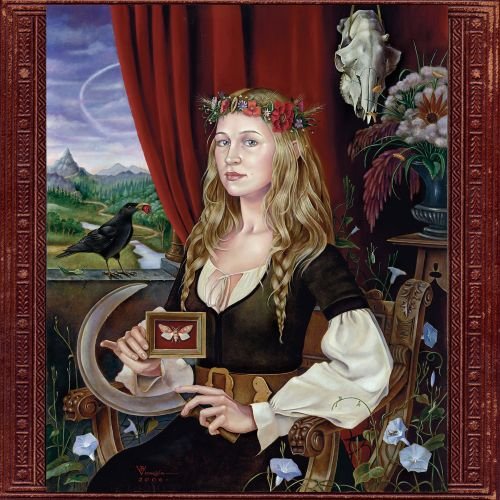
I also liked the power of the word itself. I liked how violent and cryptic it felt; it's such a daunting word to encounter. I like how it contrasted this finely rendered, carefully composed front cover-- the painting is information-dense, formal, and stylized; it looks the way something looks when a painter spends a year on it, which is what Benjamin [Vierling] did. So it has all this detail and carefulness to it, which was really important to me and relates very closely to the record. But I also felt like it needed some sort of ballast, or balance, next to it, to reflect the other elements of the record; its innate violence. I wanted a word that was like throwing a brick at the visual on the front cover; I liked that whenever someone looked at that cover they also had to encounter this short, weird word.
Pitchfork: The cover seems like a good symbolic digest of the album's themes. There's a moth, which can symbolize transformation; a sickle, which can stand for depletion and renewal; an open window standing for entrapment and release, framing a bird, which, according to folklore, symbolizes bad luck or death when it lands in a window. So the album seems very taken up with binary, metaphysical transformations. Can you talk about the literary or musical traditions from which you derived this very classical interpretation of art, which seems to privilege the beauty of natural cycles over man-made beauty, and which seeks to root human experience in these cycles?
JN: I don't necessarily see the elements that I invoke on the cover and in the songs as being in binary opposition. I know certain binary tensions emerge between these elements, but a lot of times they're more like archetypal elements; these free-standing, huge forces. Mortality, standing alone, as a thing; as opposed to, "Over here's life; over here's death. Here's bad luck, but here's blessing and redemption. Here's water; here's fire." Certainly those things come up again and again in the songs, but it's not intentional, and probably has more to do with the fact that those things emerge in real life, without any effort on our part whatsoever, than they are derived from any classical tradition. I think classicism in general might reflect more closely the natural order of human life, while postmodernism is somehow removed from the natural order, more cerebral and sterile, removed from real life on some level. So what seems like classicism in some of these songs might be just what I view as an accurate reflection of real life on this planet.
Pitchfork: You don't perceive postmodernism as mirroring the disruption wrought by technology on these natural cycles-- effectively, a reflection of modern life, however unnatural it may be?
JN: I wouldn't necessarily argue against that; of course I rely on a lot of postmodern forms myself within the narrative of these songs. I can't call them linear narratives, and I can't call them chronological in a traditional, classical sense; I'm sure there's plenty of stuff I borrow more from William Faulkner than William Shakespeare. I just find it funny that at this point, we see a collection of highly charged, highly potent symbols as referring back to a classical aesthetic, because to me they seem deeply connected to the pedestrian actuality of real life.
Pitchfork: The song "Emily" is very taken up with astronomy and astrology, both literally and figuratively-- a mud cloud is "mica-spangled"; a far butte lit by a flare and ship sailing toward the morning both invoke lodestars; Emily's a "beam of sun," and so on. It seems like Emily has a very scientific grasp of the cosmos-- "she taught me the names of the stars overhead"-- while the narrator has a more mythological sensibility: she knew "only the Pleiades." How important is this tension between science and magic to the album, and how does it relate to its cycles of escape and return?
JN: Like every other song on this record, "Emily" is deeply biographical. The Emily in the song is my sister, who's an astrophysicist; the narrator is myself, who is not an astrophysicist. Emily is the wanderer; she lives in Argentina and sometimes New Zealand. I'm not a wanderer, which is funny because I'm on tour half the time. I'm a home, hearth and family kind of person. It's difficult for me to make too many intelligent comments about what you brought up because the song really is a very personal reaction to real life”.
The first of two reviews I am interested in highlighted is from Drowned in Sound. Awarding it a perfect ten, I do think that everyone needs to hear Ys. It is an experience that you will never forget. Such a mesmerising and transformative album. I can not really do true justice to how good it is. As Joanna Newsom’s albums are not available on Spotify, I cannot include it here. However, I would urge people to buy a copy:
“It’s only very occasionally that I’ve come across an album that sounds so out of step with it's time that it's startling, even shocking, like a smouldering asteroid that crashes through the ceiling of your house.
Often it’s something so odd, so next level that it seems like it can only have come from the future. But _Ys_, the second full-length album by prodigious folk musician Joanna Newsom, sounds like it has come from some dimly remembered past. Like old wives’ tales, these autobiographical myths are built from grains of truth and wisdom, a vivid, living, textured account of a memory glimpsed or forgotten, like a dream upon waking or a fable from a faraway place written a long time ago.
Joanna’s voice itself is very different from her first EPs, and has notably changed since debut album The Milk Eyed Mender. It’s deeper, with more resonance; less grating and wild, and incredibly affecting. The bold intelligence of the album opener 'Emily' is dizzying. Adrenalizing. Powerful enough to set your nerves on fire and make you forget where you are, who you are, for a while. It’s almost scary how seductive and pungent this intriguing mythology is - from sitting skimming stones at the riverside, to the raging sea, or the vastness of a comet soaring through the heavens, this song is magnificent in its lyrical scope. For anyone who ever stared into a bruised evening sky and felt at once terrified, amazed, exhilarated, moved... just alive... Joanna Newsom with Ys has written the wonder of being into labyrinthine tangles of words and set it to music.
The stories continue throughout the five extended pieces that form Ys, weaving a gentle web around you, cocooning you in sweet chiming harp and wriggling flutes, groaning cello, layers of warmth and harmony, never settling but eddying and constantly evolving, deepening, unravelling around your ears. The string arrangements are sometimes genuinely surprising, even jaw-dropping. They swoop, stab and swoon around the harp and the wandering storytelling, guided, intelligent and precise; sometimes wistful, sometimes playful, lifting you vertically or falling away unexpectedly beneath your feet. The sensitivity of the composer with respect to how the strings fit around the music is apparent: a huge amount of care has been put into arrangement of the songs. Rather than being an embellishment thrown on to lend borrowed grandiosity to the proceedings, the instrumentation flits marvellously, clinging, hovering and breaking free from the thrust of the song, changing tack and tone as if blown by a sentient breeze.
_Ys_ is a truly special album that takes you gently by the hand and leads you through a distinctive magical landscape. Drift into it and you'll find your imagination dancing through wistful showers of falling leaves and kicking knee-deep through tangles of poppies, counting stars and wandering vast landscapes, lamenting a broken heart through abstract and taciturn poetry, or sinking back through the centuries to land gently back on your feet some time later.
It’s a vivid and beautiful painting that you can walk into; a magic window into another world that I'd be happy to get lost in, and never come back”.
I am going to finish with Slant and their five-star review of Ys. Twenty years after its release, I don’t think anything quite like it has been released. In terms of its legacy, it is seen as a landmark achievement in modern Indie Folk and Baroque Pop, permanently expanding the structural and narrative ambitions of the genre:
“Newsom recorded “base” vocal and harp tracks with Steve Albini, and then spent six months developing backing orchestral arrangements with Parks. The effect is outstanding and operatic and, thanks to the astute mixing work of Jim O’Rourke, the orchestral parts never feel tacked on or unnecessary. The dozens of strings and winds float in and out of the mix, truly accentuating Newsom’s compositions, without overwhelming her signature voice.
Of course, there’s not a symphony in the world that could overwhelm Newsom’s voice. Her vocals have been compared favorably and otherwise to Björk, Kate Bush, and Lisa Simpson, but these comparisons are inadequate, as is the rather blasé assessment that Newsom’s voice will “grow on you.” She’s the most innovative vocalist since Tom Waits, and like Waits she is capable of soothing dissonance.
Lyrically, Newsom’s talents are just as startling: She wraps her alto around tongue twisters like “Scrap of sassafras, eh Sisyphus?” and “The thought troubled the monkey, for he was afraid of spelunking down in those caves” with more grace than you could possibly expect. Newsom’s rhymes bear the wit and curiousness of her anachro-pop peers but with the profundity they lack. “Monkey And Bear” is a haunting fable as heartbreaking as it is magical. The epic “Only Skin” traces a love affair through a number of allusions and allegories before culminating in a duet with Smog’s Bill Calahan, where Newsom’s speaker pledges her body and soul to her beloved: “Take my bones, I don’t need none.”
Ys might seem like it will be a difficult, even unpleasant, listen: a mere five songs over the course of nearly an hour (“Only Skin” stretches to 17 minutes), an unconventional vocalist most would deem grating, lyrics with a demanding diction, and nary a chorus or verse to be found. But Ys is incredibly likeable, and more convivial than the twee Milk Eyed Mender. The album is a precious, in every sense of the word, masterpiece”.
Because the stunning Ys turns twenty on 14th November, I did want to spotlight it here. Bring in some reviews and an interview with Joanna Newsom. Without doubt one of the best albums of the 2000s, I do wonder how many people are discovering it new. Anyone who is unfamiliar with Ys needs to listen to it. An album that will stay in your head for weeks after. A true masterpiece from…
A musical goddess.