
FEATURE:
Breaking Glass
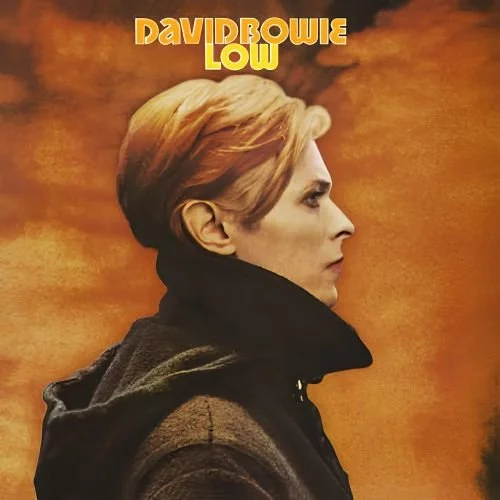
David Bowie’s Low at Fifty
_________
WHEN it comes to music…

IN THIS PHOTO: David Bowie in 1977/PHOTO CREDIT: Masayoshi Sukita
years that defined artists, maybe The Beatles’ 1967 is up there. They released Sgt. Pepper’s Lonely Hearts Club Band and Magical Mystery Tour. I feel David Bowie’s year was 1977. He released “Heroes” later in the year. Right at the start, on 14th January, he released Low. It is a fascinating Bowie album. I think one where he went a bit more experimental. You could see some of that on 1976’s Station to Station, but Low took that further. The second half of the album especially. Many will know the album for its standout single, Sound and Vision. Though I feel there are better songs on Low. Warszawa might be my favourite. The production influence of Brian Eno especially evident on Low. Ahead of its fiftieth anniversary, I want to bring together features and reviews. I will end with features where David Bowie’s albums are rankled. Seeing where Low comes in. January is a bittersweet month. We get to celebrate Low at fifty. However, it will also mark eleven years since Bowie died. 8th January is what would have been his eightieth birthday, so there is a lot to remember and commemorate. I want to keep it upbeat in celebrating one of his finest albums. I will come to some features that look at the making of Low. Some background. However, in November 1977, NME ran an interview. Interesting what David Bowie says about Low and his experiences making it:
“Low" had seemed to me an album and presenting in an attractive light-withdrawal from the world almost to the point of catatonic schizophrenia.
Bowie grimaces and clear his throat a trifle ostentatiously. There is more than an element of truth in whet you say. For me it was very... I wanted to do that, he interrupts defiantly.
What you have read from the experience of that album is absolutely accurate .I did achieve something, because there's very few albums that I haven't experienced at first hand. You can even tell what city I've been even by listening the albums.
I'm completely open. I'm so eclectic that complete vulnerability is involved. You've got no shields, then. I've never developed them, and I am not to sure that I want to anymore because I'm becoming far more satisfied with life... my private life. I'm becoming incredibly straight, level, assertive, moderate... very different from, say, two years ago.
Two years ago you were an uptight game player with a sore nose.
Out there on the wall! No, listen, I'd been exposed (he gives the last syllable of the word a savage, ironic twist) to a general LA-ism which, quite frankly, I can't cope with. It's the most vile piss-pot in the world.
LA, I say, is like being trapped in the set of a movie you didn't want to see in the first place.
Absolutely! It's worst than that. It transcends that. It's a movie that is so corrupt with a script that it is so devious and insidious. It's the scariest movie ever written. You feel a total victim there, and you know someone's got the strings on you.
So, why do people build themselves mansions out there? It must be like voluntary self-imprisonment.
Oh it is. It's like going to live in Switzerland to look after your tax money, which is the most incredible thing I ever did. I don't live there but I stayed there. I don't live anywhere. I have never got around to getting myself a piece of land, putting up a house on it and saying this is mine, this is home. If I did that, that would just about ruin everything. I don't think I'd ever write anything again. I must have complete freedom from bases. If I ever had anything that resembled a base-like a flat on a long lease or anything - I felt so incredibly trapped.
Even if I go away I know that it's waiting for me - more than that, it's like it has me on a string, and it's dragging me back. I don't foresee that I could live comfortably in any of the cities I go to. Unlike my managerial predecessor, I'm not investment minded. I still like the idea of making records of to the wall.
I think that is what one should do, in my case anyway.
Returning to the subject of the recent waxings, it seems that "Heroes" is an attempt to fight back against the state of mind that "Low" wallows in.
Do you know something? The hardest thing for me to do is to help you in solving those problems, because all I know is the input of the album. I have as much idea of the - Outback? he laughs, about what comes back off that album as what you do. Eno is the same. Neither of us understand on a linear level what the thing's about, but we get a damned good impression of information coming off those two albums that seems very strong, and that was not very intentional.
The intention was to go in and play around with method and process, but when we'd finished "Low" and "Heroes" that what we had in our hands was something that actually does give information.
If it seems to you, then you've described my state of mind at the time of making those two albums very accurately. That's exactly - on both albums - what I've gone trough. "Low" was a reaction to having gone through that peculiar... that dull greeny-grey limelight of America and roll and its repercussions; pulling myself out of it and getting to Europe and saying For God's sake re-evaluate why you wanted to get into this in the first place? Did you really do it just to clown around in LA? Retire. What you need is to look at yourself a bit more accurately. Find some people you don't understand and a place you don't want to be and just put yourself into it. Force yourself to buy your own groceries.
And that's exactly what I do. I have an apartment on top of an auto shop in an area of the town which is quite heavily populated by Turks, and I did that for a bit.
Two revelent quotes: the novelist Elizabeth Bowen once wrote: "Anywhere, at any time, with anyone, one may be seized by the suspicion of being alien - ease is therefore to be found in a place which nominally is foreign: this shifts the weight" which is as good a thumbnail sketch of the obsessive traveller as any I've encountered.
And the there's a character of Herbert Stencil in Thoms Pynchon's V: Herbert Stencil, like small children at a certain age and Henry Adams in the Education, as well as certain autocrats since time out of mind, always referred to himself in the third person.
This "Helped Stencil" appear as only a personality among a repertoire of identities. "Forcible disolvation of personality" was what he called the general technique? Which is not exactly the same as "seeing the other person's point of view"; for it involved, say, wearing clothes that Stencil wouldn't be caught dead in, eating foods that would have made Stencil gag, living in unfamiliar digs, frequenting bars or cafes of a non-Stencilian character; all this for weeks on end; and why? To keep Stencil in his place: that is, in the third person.
Ooh, aren't you well read! mocks Bowie, but his eyes show a flash of recognition. I understands that completely! I completely sympathise with the man! I know exactly why he did that, I think! So that initial period in Berlin produced "Low", which is isn't it great to be on your own, let's just pull down the blinds and fuck 'em all. The first side of "Low" was all about me: "Always Crashing In The Same Car" and all that self-pitying crap, but side two was more an observation in musical terms: my reaction to seeing the East bloc, how West Berlin survive in the midst of it, which was something I couldn't express in words. Rather it required textures, and of all the people that I've heard write textures, Brian (Eno)'s always appealed to me the most”.
I did want to highlight quite a lot of MOJO’s feature about the making of Low. Published earlier this year, there was a lot of chaos around the album. It was a difficult and low (no pun intended) period for David Bowie. You cannot really pick up on that listening to the album. It sounds inspired and Bowie entering this thrilling new phase. It is interesting learning about the story of Low:
“It started with two crises, and a work of charity. Throughout David Bowie’s time in Los Angeles in late 1975, as he descended into a cocaine-addled psychotic netherworld of alien visitations and Aryan mythology, he had also become obsessed with the abstract, electronic sound of Kraftwerk. But his first attempt at assimilating this new movement proved a disaster, when sessions with arranger Paul Buckmaster at Cherokee studios were abandoned, essentially unfinished. This was a rare setback, for even in the midst of crisis, David Bowie had proved remarkably adept, in control of the situation despite the psychoses that assailed him. After escaping from LA, via rehearsals in Jamaica and Vancouver for his imminent world tour, Bowie seemed to rebuild himself once again. Yet it turned out that the one event that truly made David Bowie pull out of his psychological tailspin was the act of rescuing the man who would be his companion throughout 1976, namely Iggy Pop.
The troubled ex-Stooge had been through a period of self-abuse and vilification that made Bowie’s LA meltdown look like a walk in the park. Iggy had stabbed himself on-stage, been confined to a mental institution, and by the winter of 1975 was reduced to sleeping on a stolen lounger mattress in a garage in West Hollywood. Finally, he’d been arrested for stealing vegetables and called an old friend, Freddie Sessler, for help. A concentration camp survivor and man of rugged humour, Sessler was also the supplier of the finest pharmaceutical cocaine on the West Coast. Unsurprisingly, Freddie knew David Bowie very well indeed; for it was the discovery of Merck cocaine – what Sigmund Freud termed “this magical substance” – that had brought David to his own psychological low. Now, by putting him in contact with Iggy, giving him a damaged soul to heal, Freddie lifted Bowie up again.
He needed lifting. Bowie’s first electronic music, an intended soundtrack for the movie The Man Who Fell To Earth, was a mess; without the core of regular musicians who gave his work shape, the results were aimless meanderings. Then there were disputes with his newly-acquired manager, Michael Lippman, as well as British Lion, the company who’d financed the movie. The soundtrack was abandoned, and the multi-track tapes left in LA. Yet in January 1976, when David hooked up with Iggy in San Diego, everything snapped into focus. Rather than talk in depth about personal problems, Bowie simply played him a song, Sister Midnight, inspired by a funky riff guitarist Carlos Alomar had crafted. Within days, Bowie proposed he and Iggy record an album – perhaps in Munich, at Conny Plank’s studio – partly inspired by the Kraftwerk albums Bowie would play in their long listening sessions in the car. With this project in mind, new songs seemed to flow out of Bowie, something that had not happened for years. And “There was a power to the music he was willing to provide for me,” Iggy told MOJO, “it was perfect – and I loved it.”
As Bowie returned to public view as The Thin White Duke in February 1976, for his first tour to take in both the US and Europe, there was plenty of megalomania on display – there was childish talk about Hitler, and his LA obsession with Aryan folklore still held a certain fascination, or at least helped generate press coverage. But behind the scenes, for arguably the first time in his life, he was relaxed, in control, enjoying conventional friendships. He and Iggy Pop – or, rather, Jimmy Osterberg, Iggy’s engaging, avuncular alter-ego – would sit down together in the morning, read the papers or sip espresso, chat… or simply not chat, as only old friends, confident in each others’ company, can do. There was something “marvellously instantaneous” about their relationship, Carlos Alomar observed.
The return to Europe – “the European canon” – had engaged Bowie’s thoughts for some time, and there was a delight in his explorations of the spring of 1976, particularly in his impromptu trip to Moscow that April. That March, he told interviewer Stuart Grundy he was planning a move to Berlin (an intention he didn’t confide to his wife Angie). Yet around May 18, his journey took an unexpected route. He, Coco Schwab, his assistant and companion, and Iggy were ensconced at the Hotel Plaza Athénée, in Paris, constantly mobbed by fans, when the enterprising new management of the Château D’Hérouville – the residential studio outside Paris where he’d recorded 1973’s Pin-Ups – reckoned he might need a break, and would, says commercial director Pierre Calamel, “appreciate some French cheese”. The trio turned up for a couple of nights’ break, bringing with them a huge trunk of LPs, which David played to engineer Laurent Thibault. Then Bowie told Laurent he had to take a trip to Switzerland, to look at a house Angie was buying, and would be back soon to record Iggy’s solo LP.
The album they recorded on their return, The Idiot, was a crucial turning point in Iggy’s career. It’s also worth emphasising that it was a major turning point in Bowie’s career too, and stands as a gateway to Bowie’s so-called “Berlin period”. Station To Station had taken an age to record, but for The Idiot, Bowie had a string of songs ready, many of which were unformed but brilliant. The studio, set in the rolling countryside of the Oise Valley, was isolated and nurturing; Bowie was relaxed, and looked healthy, like “un ange” – an angel – remembers Kuelan Nguyen, a beautiful Vietnamese woman who was staying at the studio, “ce qui’ n’était pas!” (“which he wasn’t”). Nguyen remembers Bowie as, “capricious, authoritarian, tormented, but also intelligent, alive, with a calm humour, discreet, totally English,” (he had also taken to smoking a pipe). Bowie saw that Iggy was infatuated with Kuelan and encouraged the couple. Their story became one of the pair’s finest songs, China Girl. Bowie played most of the instruments himself, calling in other musicians to augment The Idiot as necessary. Dark, jagged and deep, the recordings were unlike anything he’d attempted before; they also constituted the perfect prototype for his own next project. As David left the Château to make way for Bad Company, he booked the studio for a few weeks later, then left to check out apartments in Berlin.
As with many of Bowie’s key projects, the principal elements of Low – initial working title ‘New Music Night And Day’ – were laid out long before, while a huge amount was left to chance. Here, a main component was to be Brian Eno, whom Bowie knew from Ziggy days, and had met again that summer. The pair had long telephone conversations, and even before the sessions started the concept had arisen of making an album with one side of relatively conventional songs, and one of instrumentals.
Producer Tony Visconti, also part of those early discussions, remembers the thinking involved both what fans would appreciate, and what RCA would accept: “If the A side still had choruses and verses… [and the B-side was instrumental] we felt it was a perfect yin yang balance. Six or seven great songs with David Bowie singing is a good album.”
Complicating matters was the fact that Eno was working in Germany when the session was booked to start, on September 8. But all those details were simply left to chance.
The key contributors were gathered from random places, like one of those 1970s movies where a hit squad is assembled from grizzled veterans and sparkly eyed tyros, then sent off for a mission into the unknown. Carlos Alomar, drummer Dennis Davis and bassist George Murray were the old hands. Guitarist Ricky Gardiner probably counted as the novice recruit; he had no idea why he’d been called up, beyond the fact his friend Tony Visconti had recommended him. Pianist Roy Young was nearly as uninformed; David had called him to work on Station To Station, but Young couldn’t make the session. This time round the veteran British boogie woogie pianist – who’d played with The Beatles, Cliff Bennett And The Rebel Rousers, and many others – got called to the phone one night at the Speakeasy club, picked up the receiver to hear David ask if he’d get a plane over to Paris. David was persuasive, polite, but like Ricky, Roy had no idea what the project was.
In the popular conception, Low is often thought of as glacial and cold, inspired by a sense of withdrawal, a numbness, (or “autism”, as Hugo Wilcken posited in his work on the album) inspired by Bowie’s continuing cocaine intake. In fact, the album was inspired by a determined optimism, a reaching toward a new future. And although David had an occasional toot of cocaine, over this period he’d largely turned his back on the white powder. If he had a vice, it was alcohol, usually German beer, although early in recording the sessions hit a snag when he tried something stronger.
The unwitting villain of the piece was Roy Young. He’d been out on the studio floor with the rhythm section, Alomar and Gardiner as they worked on a song. They all revelled in working in a luxurious residential studio, with drink on tap. Young kept a large ice bucket, a bottle of gin, and a bottle of tonic by his piano, “So I could mix them the way I like them.” He heard a “rat a tat tat” on his headphones, “and there was David in the control room holding a glass up. So I sent him [a drink] in there. This happened a few times.”
Later the musicians convened in the control room to listen to the playback. David was sitting in his customary lotus position, legs folded under him on the studio chair next to Tony, his head resting on his hands. All those present waited expectantly for his verdict – until they realised he was fast asleep. Finally, says Young, someone shook him awake, “And I always remember, he scratched his head, like a scene from Laurel and Hardy, and then Tony said, ‘David, you’d better go for a lie-down.’” As David attempted to walk down the steep stairs out of the control room, there was a thud and a series of bumps. The next day at breakfast, David pulled up his shirt to show Young the bruises and weals from when he’d fallen down the stairs: “And that was when Tony warned me,” says Young, “‘If you ever give David another gin and tonic you’re going home.’”
Despite such bugs, the recording was focused. They moved on constantly from one idea to the next. Carlos Alomar remembers having real problems getting his head around one song, which from the beginning was named Always Crashing In The Same Car. The title had a black humour of its own, because David was attempting to sell his Mercedes at the time – the car was dented, and half the time wouldn’t start. The song, too, spluttered and lurched before it got going: “We didn’t understand what David wanted,” says Carlos, “and that was definitely the hardest one to get right. It had this kind of gloomy thing to it, so we kind of understood that. But it also had this chordal thing I was trying to get… the chorus is a bit different to the verse, and I felt it was a little disjointed.” In the end, says Carlos, it was Ricky who unlocked the song; “Not so much [with] a riff as a signature sound and a signature guitar - which gives an essence.”
Other songs did come together easily. Sound And Vision was a key breakthrough; the musicians thought it was an instrumental. “Carlos provided the riff,” says Gardiner, “and we put the music together around that.” One of Alomar’s key contributions to Bowie’s work was his funk-and soul-derived conviction that a song needed a key theme, right at the beginning, to differentiate it from whatever hot tune might pop up on the jukebox. Yet for Sound And Vision, his contribution was as much space as substance; a subtle, slight guitar lick that left huge gaps for the song to breathe, and let Murray and Davis’s effervescent rhythm carry the listener along. As the crew sculpted the song out of chaos, David sat in the control room listening. Then, says Gardiner, “He just went into the studio and sang it straight off, words and all. He listened to [the playback] once, adjusted something in his head and did it again. And that was that”.
I did want to also look at another making of feature about Low. Last year, the BBC - https://www.classical-music.com/features/works/david-bowie-low - took us inside the album. 1976 was a year when David Bowie was spiralling. When Low was delivered to the label, there was a sense of disappointment. Fifty years after its release, there has been this massive reappraisal. Some who were alienated or confused by Low not seeing it as a masterpiece. I will end with a couple of reviews:
“A futuristic, alien world
The sessions were painstaking: long days in the studio, repeated takes, and intense attention to sonic detail. Bowie’s withdrawal from drugs left him physically fragile but creatively alert, enabling him to embrace unconventional structures, sparse lyrics, and instrumental passages that conveyed emotion without words.
Low (originally titled New Music: Night and Day) emerged as a radical departure. Side one offered concise, haunting songs; side two unfolded as ambient, largely wordless soundscapes. Together, they created a futuristic, alien, yet deeply human world. What began as a personal and professional crisis became an unprecedented artistic breakthrough, with Bowie reinventing himself and redefining what a rock album could achieve.
Low: the backlash
When Low was completed in late 1976, RCA was unprepared for what Bowie had delivered. The label had anticipated another Station to Station, a record that would build on commercial success with accessible rock songs. Instead, they received an album that was fragmented, experimental, and, to some ears, impenetrable. Executives questioned its marketability, delayed its release until January 1977, and pressed Bowie to produce something “more conventional.”
Critics were equally divided. Some dismissed the album as cold, overly cerebral, or pretentious, struggling with its sparse lyrics and unconventional structures. Others immediately recognised its radical ambition: the marriage of ambient textures, dislocated vocals, and fractured pop songcraft created a sonic landscape unlike anything rock had Bowie at the Dorchester Hotel, London, 20 October 1977 - Mike Maloney/Mirrorpix/Getty Images
Yet what many saw as a breakdown was, in fact, a breakthrough. Bowie had transformed personal crisis and withdrawal into a new artistic language, fusing experimentation with emotional depth. Low influenced post-punk, ambient, electronic, and progressive rock, proving that albums could be immersive, atmospheric experiences rather than mere collections of songs. It remains a testament to Bowie’s resilience, vision, and willingness to reinvent both himself and the possibilities of modern music.
Low's legacy
Low did reach commercial success: in the UK it charted higher than Station to Station, singles like 'Sound and Vision' crept into the charts. But its deeper achievement was in altering expectations. Bowie had, in effect, reframed what it meant to make pop/rock art—to integrate ambient, abstract, and emotionally raw into the album form. What began as a dislocated mind, what many thought would be his collapse, became one of his most enduring, forward-looking works.
Low’s radical blend of ambient textures, fractured pop, and emotional starkness left a lasting imprint on generations of musicians. Trent Reznor cites its haunting minimalism as a template for Nine Inch Nails' The Downward Spiral, while Robert Smith acknowledges listening to a lot of Low while making The Cure's sparse, downtempo second album Seventeen Seconds. American classical composer Philip Glass produced a symphony inspired by Low, its three movements each referencing a track off the album”.
The first of two reviews I want to source is from The Quietus. Looking back on the album in 2017, forty years after its release, they provide some interesting observations and thoughts about this incredible album. If you are a David Bowie fan but have not heard Low for a while, I would urge you to listen to it. I had not heard it for a long time and played it back in preparation for this feature. It is a staggering thing:
“Perhaps there’s something in wanting to place yourself in the historic context of an album that makes you feel like you were there. No doubt the sessions for Low would have been interesting ones to be a fly on the wall for. But historic context is not the same as interpretation. If we take, for example, ‘Warszawa’, the anomalous centrepiece of Low, there’s somewhat of a conflict that exists in the account of its composition and the common interpretation of it as a piece.
‘Warszawa’ was almost entirely the work of Brian Eno who was working mostly alone towards the end of the sessions for Low, Bowie being away in Paris for a court case. Bowie returned and, impressed with Eno’s work, added the vocal of an invented language, apparently influenced by an LP of a Balkan boy’s choir he’d picked up, perhaps while on an extremely brief visit to Warsaw on a train from Zurich to Moscow via Poland in April of that year. But this brief visit coupled with the title of the track seems to invite many explanations for the source of the language or the reasons for doing so. We shovel unnecessary layers of explanation onto things to validify them. It’s hard to accept that Bowie quickly added this vaguely gibberish vocal line on top of Eno’s composition. It’s as if it needs to be defended rather than to be experienced. Chris O’Leary’s forensic ‘Bowiesongs’ blog on this, and every other song on Low, delves to these extreme depths. So, too, does Hugo Wilcken’s 33 ⅓ book on the album, Peter Doggett’s The Man Who Sold The World: David Bowie In The 1970s and Thomas Jerome Seabrook’s Bowie In Berlin: A New Career In A New Town, to name a few examples. All of these are fascinating and often well written historical accounts on the background of the recordings, but these details start to overshadow the experience of the works themselves.
Low is a brilliant album because, through its production alone, it can transport the listener to certain frontiers of place and thought in a very powerful way. The expert musicianship and the composition of its pieces allowed the players to circumvent their habits and thus form a new musical language, as was allegedly Bowie’s intention. To step out of the momentum of what they knew.
Low is also evocative of many things, but it isn’t definitive. Most tracks fade in and out of view with no real beginning or conclusion, they could be of any non-fixed duration beyond the timecode printed on the sleeve. Of what lyrics are there at all, they are rarely the central focus. The whole thing challenges a classical notion of a top-down creationist approach to making work – the idea of the heroic singular artist receiving divine inspiration – and instead establishes Bowie as a centre of gravity for many brilliant minds and influences to orbit around.
But the inability to separate the mythology with what is simply happening there before us traps us, the audience. This same obsessive interpretative appetite has, over time, created a landscape, at least in the wider spectrum of contemporary pop music, where most albums are now required to perform an act of conceptual importance – usually something that fits inside a topic of the zeitgeist – or to be of a searing confessional nature. We now expect our albums to come pre-loaded with context, vying for importance amid the competitive land grab for think pieces, and there’s a sort of latent expectation that our artists go on these personal journeys to legitimise the work they create and the experience that we might gain from it.
Conversely, what if we were to look at the general (and I do mean more in terms of its mainstream appeal) indifference to Brian Eno’s ambient projects? By contrast with Bowie’s mainstream success, although Eno’s position in the pantheon is well established, we’re perhaps only now starting to see an acceptance for the intentions of his ambient work, rather than a perplexity towards them. Audiences have long struggled with the more ‘functional’ aspect of Eno’s post-1975 work since it defies easy interpretation in many ways, not least because there are no words involved and that the details of Eno’s private life are fairly secret to us as an audience, nor are they important. It’s hard to accept work that is not narrative or autobiographical, as it’s these traits that make them apparently human. We have very little evidence with which to apply any meaning or give a sociological reading of Thursday Afternoon or LUX beyond the idea that they are beautiful as they are functional. We’re so obsessed with the personal narrative behind things that Roxy Music will scarcely not be mentioned next to Eno’s name even 45 years after he left the group that he only made two albums with.
This isn’t to say we shouldn’t think about what works mean in wider contexts. It’s important that we do. But there seems to be a lot of unattainable reaches for some absolute truths. I have only recently come to this realisation. Last year I wrote about the band of Montreal on this very site, and my obsession – as many other fans of the band will likely share – with the personal details and interweaving of confession and autobiography in Kevin Barnes’ work was one of my central attractions to them. Barnes has, unfortunately, set this precedent for himself though. When his work is merely allegorical or fictional now, you feel like you’re being short changed. By this logic, I want Kevin Barnes to suffer forever so that he may make brilliant work that ‘means something’. What a ridiculous standard to set for someone.
With Bowie’s final album, Blackstar, there was but a small window where the weight of interpretation didn’t burden the brilliant work that was already available to us without it. Upon the announcement of his death two days after its release, all the lyrical signs and hints on mortality within the songs quickly subsumed the focus of the work. It now feels impossible to discuss that album without the need to refer to the fact that it so heavily regarded the author’s demise. In the actual death of the author, the death of the author felt most prevalent”.
Prior to coming to David Bowie album ranking and where Low sits with critics, I do want to highlight some of what Steve Pafford observed in his review of Low. In 2022, he marked forty-five years of his favourite Bowie album. Even if Bowie’s personal life was a bit turbulent in 1977, it is arguably his finest year. One where he released two classic albums:
“Bowie’s flair for mechanised melodrama worked. That simple descending synthesizer line, a sudden sigh of delight. It’s three minutes of uplifting happy/sad hypno-disco wrapped in Krautrock and evocative electronic textures, Sound And Vision (the clue’s in the title) was used by the BBC in its continuity trailers at the time, providing incalculable exposure and giving the AWOL artist—holed up in Haupstrasse, West Berlin with Iggy Pop—a surprise hit single. The song was also a top ten hit in Germany, Austria and The Netherlands. However, it only managed a lowly 69 in the United States where it signalled a pause in his commercial success until 1983’s chart-slaying Let’s Dance.
If Low is the heart of the celebrated ‘Berlin’ trilogy then Sound And Vision is its soul.
The entire album still sounds hermetically sealed in a universe all its own. Low dives headlong into the avant-garde, not just breaking but shattering for good the glass ceiling of his previous songwriting. It also stands to reason that Bowie, with the help of Visconti, Eno and a huge element of risk, endeavoured to, in his words “develop a new musical language”, seeking out sonics and textures unlike any he’d produced before. And only Bowie can stand in an empty white room with a Fender and flip-flops and be completely captivating.
Low also left America behind, its sketchy synth washes, disinterested vocals and brittle funk owing little to rock and soul and a lot to the future. Right to the fore was Visconti’s new acquisition, the Eventide H910 Harmonizer pitch shifter, which the producer famously sold to Bowie and Eno with the phrase: “It fucks with the fabric of time.”
As a result, a new wave of artists such as Gary Numan, Ultravox and Orchestral Manoeuvres In The Dark were indebted to the terse, synth-based wall of sound BEV (Bowie, Eno and Visconti) had created.
Low changed everything for so many people, me included. Though I was familiar with the skewed rhythmic pop of side one for a number of years, it wasn’t until the latter half of my 20s when it changed from a strange, radically constructed concept to probably my favourite Bowie album of all time. Only then did I realise Low sounds the way it does for a reason.
Its looseness, structurally speaking, is what began to really draws me to it. Most of the tracks have a sense of intended incompleteness that feel more like a moment in time than compositions someone sat down and put together with intention. Rather than just a collection of songs with verses and choruses, intros and outros, they begin and then before you expect them to lead into a buildup or a middle of some sort, before you know it, they’ve ended.
Take the brilliantly brief Breaking Glass for instance, where the stark guitar twang is accentuated by thick ca-chunk-chunks of electro synth all tweaked and turned inside-out while Bowie’s hiccup-y delivery—“such-cha-won-Da-foe-perssunn-but-Cha-Gawt!!—seem to mimic a Hi-Hat before that three-tone keyboard riff takes over. And all this after the opening track, Speed Of Life, the best gateway drug rush this side of the Berlin Wall.
It’s incredibly fun, even though it sounds like having a conversation with someone who leaves the room half way through their sentence. Disconcerting to some, some of the quicker numbers leave you with an impression of an interlude, one that puzzles and intrigues, and which you can’t help but return to… for more of the same short shrift from an oddball who makes zero effort to be agreeable
By October 1976, work on Low had shifted from Paris to Berlin. That’s Hansa Studios engineer Eduard Meyer on the left
It took me a little longer to warm up to the moody ambient soundscapes of the mainly instrumental, impressionistic second side but on repeated listens you start to pick out how amorphous were the song structures, how rife was the experimentation but above it all, Bowie threw caution to the wind, putting everything he had in that material. He had what us Greeks call θάρρος, thárros, courage.
There seemed to be no rulebook and that is what makes Low such a daring, bold album. Duller critics sometimes call it soulless, or empty, as though not actually crying while singing makes music emotionless. Bowie himself said: “There’s oodles of pain in the Low album. That was my first attempt to kick cocaine, so that was an awful lot of pain”.
Going back to the BBC, they ranked Bowie’s albums back in January (to coinciding with the tenth anniversary of David Bowie’s death). They ranked Low in first place: “Producer Tony Visconti’s inventive techniques included the introduction of the extraordinary Eventide Harmonizer, which heightens the album’s otherworldly feel. Essentially a pitch-shifting and delay device, it allowed Visconti to detune, thicken, and manipulate drum and guitar sounds in ways previously unheard of. Most famously, it gives the drums that deep, 'splatting' quality – suddenly weighty, almost otherworldly, yet punchy. Bowie also experimented with cut-up lyrics and non-linear narrative, giving even his simplest lines weight and mystery. Low is more than a collection of songs; it’s a universe unto itself, a 40-minute immersion in mood, innovation, and daring. Few albums invite you in so completely, and few mark a reinvention so brilliantly”. In 2013, Rolling Stone ranked Low third: “Many Bowie fans didn't quite know what to make of Low when it first appeared in January of 1977. "Sound and Vision" and "Be My Wife" were the only songs that even sounded somewhat like pop music, and the second side was filled with instrumentals. Clearly, Bowie wasn't aiming for the pop charts with this one. Instead, he took the experiments from Station to Station to a new level. The disc was produced by Tony Visconti, but Brian Eno played a large role in shaping the unique sound of the disc. While many of his peers were totally ignoring new music, Bowie was immersing himself in Krautrock and discovering entirely new ways to express himself. Low was underappreciated at the time, but now it's widely seen as a masterpiece”. Whilst David Bowie’s eleventh studio album came at a time of personal struggle and hard times, the mighty Low is…
A creative high.