FEATURE:
For Those in the Back Rows
PHOTO CREDIT: Lisa Fotios/Pexels
Why 2027’s Festival Bills Are Still Depressingly Familiar and Sexist
__________
I do feel like…
the music industry has a long way to go in terms of progressiveness and equality. I am thinking about men in music who have been accused of sexual assault and rape and still have careers. Artists who are so disgraced and tarnished, and yet they can still sell out venues and are nominated for awards. Chris Brown, an abuser, a GRAMMY-nominated artist who is enjoying a thriving career. Dizzee Rascal, convicted of domestic abuse, plays more than one festival next year. Quite high up the bill of Kendal Calling. There is no world in which men in music can be cancelled. If they are convicted of crimes and accused of the most reprehensible things, it seems like the industry can overlook it. Or make exceptions. If a woman were to be in the same position, they were face so much vitriol and their careers would be hugely damaged. It makes me angry looking at festival bills and seeing men dominate. It is an industry still very much geared to them. Even though women have been dominating for years, that is not reflected in festival bills. There are few U.K. festivals where women take the majority of headline slots. Maybe this year, a few of the smaller festivals combated that and put women on top. Green Man was one of the more balanced when it comes to headliners. Though, when we look at the five or six biggest festivals in this country, the headline slots especially are given to men. I find it odd and unjust to say the best festival bills can do is fifty-fifty. Given the brilliance of women in music today, why are they not allowed to dominated? It seems like it is almost a sacrifice for women to be equal in that regard. I think one of the reasons Olivia Rodrigo established Daisy Chain Fields festival is that women could headline. A bill that actually truly represented and included women.
I know that a lot of festival bills for next year have been announced. There is excitement. There are festivals who always put men on top of the bill. Isle of Wight very much not going out of their way to headline women. Even though Glastonbury has announced a great raft of names for next year, they have booked two male headliners and one woman. Billie Eilish headlined Glastonbury in 2022. She is headlining again. She is magnificent and worthy of headlining, though I do feel that it marks a problem. The same with Coachella and them headlining SZA and Dua Lipa. Odd that they have essentially booked Glastonbury’s 2024 headliners. It is strange that they have paired those two artists. Both are deserving of headlining, though they had more momentum in 2024. Same with Billie Eilish in 2022. Cher plays Glastonbury’s legends slot, through that is not a headline slot. It is its own thing. Why not book Cher to headline? If you struggle to headline women and book an artist who has already headlined, it sort of suggests that there are few options. Same with Coachella and their lazy and odd Glastonbury pinch. There are so many female artists who could and should headline. Few major festivals headline women over the age of forty. They are often put lower on the bill or in a legends slot. Whereas men in their forties, fifties or even eighties can headline. It says that women over forty are not worthy or vital. Not seen as headline material. The conscious or unconscious sexism and ageism is already rearing its head when we look at the festivals who have announced their bills. I often wonder why Björk and Kylie Minogue have not been booked to headline festivals in the U.K. Female-fronted bands like Garbage would be epic headliners. Smaller festivals are a bit more progressive, though very few get it right. In terms of having an equal bill and ensuring that women headline. One of the most angering things about the continued sexism is that there is not a lot of media anger. Glastonbury have only ever booked more than one woman as headliners in the same year. Others, such as Reading & Leeds, have taken decades to affect some sort of gender equality when it comes to their headliners. When all the bills have been announced, the vast majority of the major festivals will be male-heavy in terms of headliners. Many of the smaller festivals will also be male-heavy. Parklife Festival last year. Four headliners. Three of them male. Zara Larsson the only woman. Why do major festivals in the U.K. struggle to book women as headliners when there really are no excuses?! Also, why is it seen as normal to book male artists over forty to headline and not women?!
All Points East came close to equality when it came to their 2026 headliners. Mighty Hoopla one of few festivals where there was that balance. Though very few had women as the majority headliners. Earlier this year, The Times looked at why festivals are in crisis. So many are folding. High ticket prices are an issue. Also, and what may explain Coachella copying Glastonbury’s 2024 headliners is systematic of a wider issue:
“Furthermore, five of those nine big festivals are sharing headliners, including Kasabian, Lewis Capaldi and Calvin Harris. The only time in festival history that line-ups have been more repetitive was in 2022, but at least they could blame an uncertain industry edging out of a pandemic. It is hard to stand out in a crowded market when every other festival has a set by Fatboy Slim, and it is also hard to persuade people to buy tickets when artists see festivals as just another tour stop rather than something special. At Glastonbury in 2023, Arctic Monkeys, Guns N’ Roses and Elton John headlined in the middle of vast tours that half the crowd had already been to. The reception for the former two was flat and John only got away with it because it was his final tour.
The type of music that’s popular has affected festivals too. “Suitable headliners have disappeared,” Goldsmith says. “Everything’s pop-orientated now and those artists are not really conducive to being in a field. So the traditional headliners disappeared, or are dying off, which means there’s too much competition for too few headliners, who are repeating themselves, and there’s no exclusivity to any of these events.”
The proof is in the Spotify listening stats, where artists such as Harry Styles, Dua Lipa, Ed Sheeran, Taylor Swift, Olivia Rodrigo, Sabrina Carpenter, Beyoncé, Lady Gaga, Chappell Roan and co dominate, and the newest bands who are considered big enough to headline a big festival — Arctic Monkeys, the 1975 — are at least 20 years old. This is not to say that pop acts cannot work in a field: Billie Eilish at Glastonbury in 2022 was superb. But by and large, big pop acts tend to host more extravagant stage set-ups that are better suited to the mechanics of a stadium or arena than a stage in a field.
Madonna, for instance, has never headlined a festival in the UK. She was tipped to bring her Celebration tour to Glastonbury in 2024, but talks were said to have collapsed because of the cost of her elaborate staging and backing dancers. Many headline talent acts increasingly want their own shows, which will give them more control and cash than a festival slot, says Luke Ralph, who founded Boundary festival in Brighton a decade ago and has just announced that it will not return.
Furthermore, guitar acts who felt like the Glastonbury stalwarts of yore now focus on stadiums because they can make far more money there. Across 36 tour dates last year, Oasis made roughly £8.4 million a night, with some fans paying up to £506. If you have blasted your budget on that, can you really afford to go to a festival?
“Stadium shows have gone berserk,” Goldsmith says. “Fans now want a bit of comfort. When they go to a stadium they’ve got much better facilities in terms of toilets, access to food and drink, and also cover if the weather’s bad. In a field you’re totally exposed. While people love going to rock and heavy metal shows in a field, they don’t really want to go to see a pop act like that. Festivals haven’t grasped that and they’re clutching at straws with headliners that just defy logic.”
These problems are a headache for bigger UK festivals, but they can be terminal for smaller, independent events; victims of competition for crowd-drawing acts and spiralling costs. In January Kevin Blackburne announced that the independent family festival he co-ran, Solfest in Cumbria, which has hosted acts including the Proclaimers and Basement Jaxx, was going out of business. After foot-and-mouth disease “decimated” the area 20 years ago, farmers banded together using money from the recovery fund to set up the non-profit festival — which closed its gates after last year”.
We can explain why there might be repetition with headliners. Though there is very little logic and reason why women are not booked as headliners. This 2024 article argued why it is important that women are visible headliners. Women coming into music need to see that they can achieve that. Looking around at the moment, the message is that women are very much not seen as headliners. Very few being booked. You can try and rationalise it, but there is no shortage of available acts. Women are not all saying ‘no’ when they are invited. Artists like Raye could and should headline our biggest festivals. Madonna would have been a great headliner. I know there are reasons why she is not headlining Coachella, though she really should be headliner. Women are not costing too much to book. I feel there is this bias that will always exist. Camila Cabello expressed her surprise in 2024 about the slow progress when it comes to female headliners. Dionne Bennett is chairwoman of Ladies of Rage, a Cardiff-based musicians' collective that champions under-represented women and non-binary artists. In 2024, she spoke with the BBC about the infuriating lack of female headliners:
"It’s disheartening to see how slow progress has been in mainstream spaces like festivals, but it also motivates us to keep pushing for change," she added.
"We are actively working to dismantle these barriers and to create more opportunities for women and marginalised communities to be seen, heard, and celebrated."
Fiona Stewart, the owner and managing director of Green Man, said: "The challenges faced in ensuring there is fair representation for all is a societal issue, and something we constantly try to address."
She said Green Man was the first UK festival to have 50-50 gender split, with more than 50% of last year's acts comprising of female and non-binary artists and 46% this year.
"Green Man is an event with inclusivity at its very core, and our work around this will always be a priority for us," she added”.
Women very much still seen as afterthoughts. The fact that Glastonbury was congratulated on booking two female headliners in 2024 is appallingly depressing. We should not be a position where booking two women to headline a festival is seen as applause-worthy and brave. It should be the norm. How many major U.K. festivals in history have booked women entirely as headliners? I don’t think our biggest festivals will be in that position for many years. There is no pipeline issue or a lack of availability now. From rising artists to legacy artists, I could rattle off dozens of women who could headline. If a dozen refuse, keep going. I don’t think gatekeepers and festival bosses consider how damaging it is when their headliners are male. There is one festival that shows how easy it is to book women to headline. Primavera Sound have an incredible headline look. Women who have been booked there that should have been booked here. Phoebe Bridgers and Doechii especially would have been amazing. Not all festivals in the U.K. have announced their bills, so there may be some surprises. However, I think 2027 will follow every other year. Women booked on the bill but very few of them as headliners. I think the fact Cher is in the legend slot and not Glastonbury headliner reflects Madonna not headlining Coachella. That was her choice. It is a deliberate call-back to her landmark 2006 performance in the festival's dance tent. However, with festivals very rarely booking women over forty as headliners, Madonna headlining Coachella would have been genuine progress. So many brilliant women who are constantly denied headline slots and booked lower down the bill. I do not hold much hope that things will reverse very quickly. Though, in years to come, festivals need to start normalising booking women as headliners. More than one too. If Primavera can do it then why can’t others?!
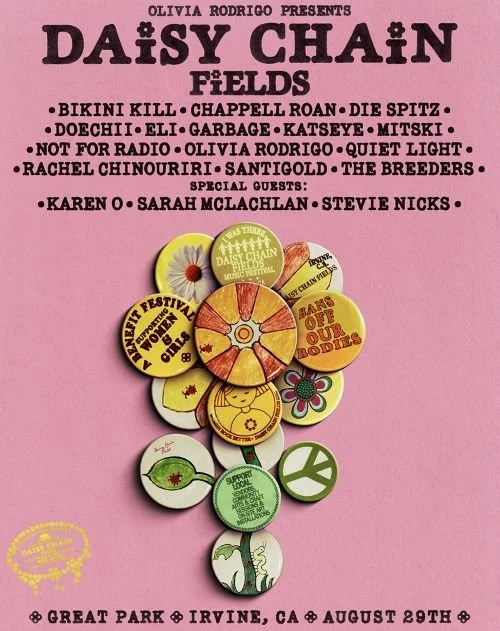
Given the sheer brilliance of women in music, the fact they are not being acknowledged with headline slots is a massive disrespect. Given how Olivia Rodrigo’s sold-out Daisy Chain Fields festival was such a hit and showed women can headline, how long before the industry at large wakes up?! Brandi Carlile established Girls Just Wanna Weekend. Those are great festivals and debunk the myth that women cannot headline. There is investment coming in. Though how long before their influence and leadership bleeds into other festivals? Earlier this year, Rolling Stone published a feature that everyone should read:
“A few years ago, Oliva Rodrigo invited Brandi Carlile out for coffee. They were in Los Angeles at the same time, and Rodrigo wanted to talk to Carlile, who has hosted her own all-woman festival Girls Just Wanna Weekend since 2019, about how she could impact gender equity on lineups and the road.
“It was like a blind date,” Carlile tells Rolling Stone, who was moved by Rodrigo’s commitment to debunk the pervasive industry myths that women don’t sell tickets as well as men, shouldn’t be booked back-to-back, and are unable to headline a festival — let alone populate an entire bill. Carlile had a feeling, she recalls, that Rodrigo was going to go far beyond just talk. “I remember clocking it and going, ‘Yep, she’s the one.’ I knew she wanted to do more with her rise and fame than just empower herself.”
Carlile was right: In June, Rodrigo announced her inaugural festival, Daisy Chain Fields, taking place Aug. 29 in Irvine, California. Inspired by Sarah McLachlan’s original all-female festival Lilith Fair and events like Carlile’s, its lineup comprises entirely women from across multiple generations: McLachlan herself, Chappell Roan, Bikini Kill, Stevie Nicks, Mitski, Doechii, and more. Just as remarkably, all profits will go to organizations “dedicated to advancing and advocating for women and girls.” The festival sold out instantly during a presale.
“I think there’s this rhetoric that girls are supposed to be competing against each other for the top spot, or that there’s only this many resources for everyone,” Rodrigo said during an interview with Good Morning America. “I think it’s an experience like Lilith Fair and hopefully Daisy Chain that will show us that we’re all way stronger when we come together and support one another.”
Compounded with a new report from Luminate that shows how Gen Z women are outpacing men when it comes to concert ticket sales, it raises the question: Is the concert industry finally willing to permanently invest in women-focused festivals and audiences? Festivals like Daisy Chain Fields, Girls Just Wanna Weekend, and other heavily female lineups this summer are proving they should.
“These all-female festivals like Daisy Chain Fields and Girls Just Wanna Weekend are delivering a clear, data-backed rebuttal to the outdated myth that women artists can’t reliably sell tickets or headline profitably,” says Leslie Fram of FEMco, a female-focused music consulting firm. “They demonstrate that all-women lineups aren’t just viable, but they can be highly successful when curated with care. The myth was always more inertia and bias than market reality. Events like these are accelerating its retirement.”
That myth — the adage that tours and festivals featuring all, or even primarily women, aren’t good business — has been around long before the days of Lilith Fair. It’s part of the premise that motivated McLachlan to launch her event in 1996, an endeavor recently recounted in the excellent documentary Lilith Fair: Building a Mystery – The Untold Story. McLachlan was sick of hearing how the idea of two women on a lineup was viewed as too financially risky, and founded Lilith to prove that women could headline festivals, sell concert tickets, and align with one another beyond competition — as well as make a profit. In the year it launched, Lilith ended up being the highest grossing tour of the season.
Old misogyny dies hard, however. Carlile remembers a time earlier in her career when she was bumped from a bill with another woman because “they wanted a male-fronted guitar band instead of me.” Girls Just Wanna Weekend, which runs as a multi-day destination festival each January in Mexico, was founded to prove that if women were willing to travel all the way to Mexico and spend several thousand dollars to see her event, wouldn’t they do the same for an all-female lineup in their hometown’s rock club or arena? Daisy Chain Fields, with its instant sell-out, has done the same”.
There is a small glimmer of hope. If we have all-female festivals, it sends a message to the industry that women should be booked as headliners. That they are worthy. It may take a while, but we may live to see a day when women are the sole headliners at major festivals worldwide – and not just the odd one here and there. Next year’s festivals will follow the trend when it comes to headliners, but it is absolutely clear that things needs to improve…
IN 2028.