
FEATURE:
Who’s That Girl?
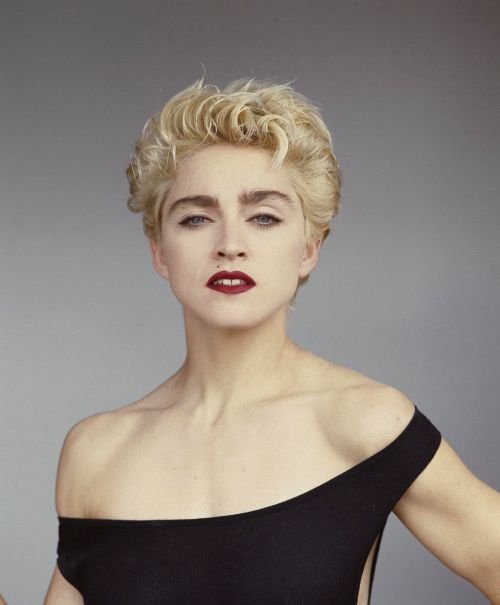
IN THIS PHOTO: Madonna in 1987/PHOTO CREDIT: Herb Ritts
Inside Madonna’s Busy and Eventful 1987
__________
I am curious…
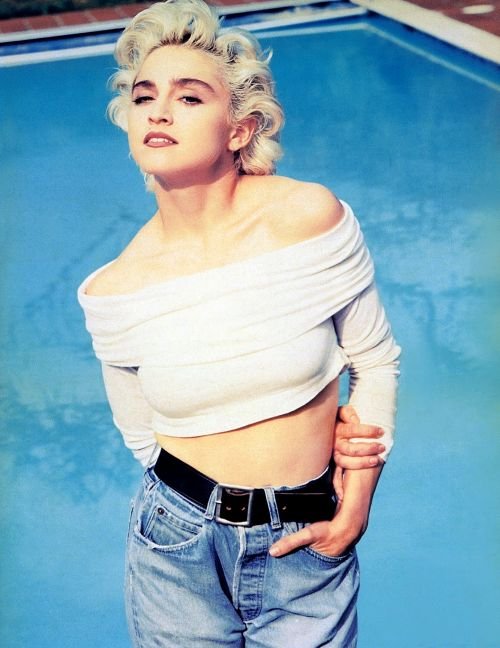
about Madonna’s 1987. It was a busy and eventful. Not in a bad way. This was a year after True Blue. In terms of her eras and looks, I think 1987 is one of her most interesting. In terms of how she shifted and evolved. I associate 1987 with Madonna having shorter hair. Almost white rather than blonde. She sported that in 1986 I think, but I think her hair was blonder. Look at the video for Papa Don’t Preach. It did get lighter/whiter for 1987. By 1989, Madonna’s hair was longer and darker. In terms of performance, it was her Who’s That Girl tour. Promoting True Blue and the Who’s That Girl soundtrack. In terms of the photography and promotional images from that year, you can see some of them here. I love what Madonna was up to in 1987. The photos from Australia’s TV Week shoot by Herb Ritts. They are some of the best of Madonna! I will get to features and reviews for Who’s That Girl. I wanted to highlight a few events from 1987. On 26th January, “Madonna won Favorite Female Pop/Rock Video for Papa Don’t Preach at the 14th annual American Music Awards at the Scottish Rite Auditorium, Los Angeles, CA”. On 25th February, “Madonna’s La Isla Bonita was released as the fifth and final single from the True Blue album”. On 9th July, “Madonna performed her Who’s That Girl World Tour to a sold out crowd of approximately 60,000 fans at the Sullivan Stadium in Foxborough, Massachusetts”. On 11th July, “Madonna’s Who’s That Girl made its U.S. chart debut at #43 on the Billboard Hot 100. The single entered the Hot 100 Airplay chart at #32 in the same issue”. On 12th September, “On September 12 1987, the Who’s That Girl: Original Motion Picture Soundtrack hit #7 on the Billboard Top 200 Albums Chart in the USA. Madonna had this to say about the music on the soundtrack: “I had some very specific ideas in mind, music that would stand on its own as well as support and enhance what was happening on screen and the only way to make that a reality was to have a hand in writing the tunes myself… The songs aren’t necessarily about Nikki or written to be sung by someone like her, but there’s a spirit to this music that captures both what the film and the characters are about, I think”.
That is just a snapshot of what was happening in 1987. In terms of the singles released in 1987, I think everyone thinks of Who’s That Girl. The title track from the soundtrack, that was released on 29th June. I think Causing a Commotion, released on 25th August, is the standout. It was a minor success, though I feel it is a Madonna song that deserves more credit. In terms of when Madonna was on top of the world or ascended to the level of global superstar, you could say that it happened before 1987. Perhaps as early as 1985. Some say later. I do think that 1987 was a year when she hit a new peak. Even though there was no studio album, her film work and touring confirmed her as this Queen of Pop. “On September 4 1987, Madonna performed Causing A Commotion live via satellite from the Stadio Communale in Turin, Italy, during the Who’s That Girl World Tour and won Best Female Video for Papa Don’t Preach at the 4th annual MTV Video Music Awards at the Universal Amphitheatre in Los Angeles, California”. Whilst Who’s That Girl is not Madonna’s defining film role (you could argue between 1996’s Evita, A League of Their Own (1992) and Desperately Seeking Susan (1985). I guess you could argue Madonna’s 1987 was not her most successful. Who’s That Girl was panned by critics and was negatively reviewed. The title track is not seen as one of her best. Though I think we should not overlook 1987. I think it was this year when she transformed from being a Pop artist on the verge of being a megastar and icon to her actually becoming one. I will finish off with some words on the Who’s That Girl tour. The soundtrack definitely deserves some plaudit. Albumism wrote about the soundtrack on its thirty-fifth anniversary in 2022:
“Desperately Seeking Susan remains her most popular movie—and the one that garners the most nostalgia—likely because it depicts ’80s hipster New York City in such loving detail, as well as Madonna at her enigmatic best. It was only director Susan Seidelman’s second film, although she had had lots of practice honing a seedy punk aesthetic while directing her first film Smithereens, a bleak 1982 cult classic about the end of the New York punk-rock scene. While making Susan, both Seidelman and Madonna were out to prove themselves. “They made me screen test her, and they kind of put us all through the ringer a little bit before they would hire her,” Seidelman recalls. “She was relatively unknown, and they wanted a kind of up-and-coming young movie star.”
By the time they were wrapping up their nine-week shoot, Madonna had become a star. “The first day we shot on St. Marks, and there were no crowds whatsoever,” Seidelman says. “We were just filming. By the end of nine weeks, her album had come out. It was the best of both worlds. I could film with her before she was famous and then her fame helped the release of the movie.” Of course, the major appeal of the film is not only New York, but Madonna—her Sphinx-like yet take-no-shit ways, evading everyone from her boyfriend Jim, who has to place ads in the personals just to see her, to Rosanna Arquette’s Roberta, who’s enthralled by the woman in the sparkly pyramid jacket who lives such a free and badass existence.
Though it was never billed as such, I like to think of Who’s That Girl as Susan’s sequel. Both films feature the same basic premise—a man Madonna was romantically involved with is murdered, she ends up in hot water, and hijinks ensue. While in Susan New York serves as a character in its own right, it’s more of a backdrop in Who’s That Girl, though the city does serve in both films to highlight and critique stark class divides—the upper-middle class Glasses of Fort Lee, NJ, versus Madonna and her impoverished downtown hipster friends in Susan; and the filthy-rich Upper West Side world of Loudon Trott (Griffin Dunne) and his soon-to-be in-laws the Worthingtons versus the very working-class Nikki Finn in Who’s That Girl.
Which leads us to the enduring—and mostly overlooked—appeal of Who’s That Girl. Whereas Madonna’s Susan is aloof and preternaturally cool, Madonna’s Nikki is brash and bombastic, with loud clothes, a thick East Coast working-class accent, and a laugh like machine-gun fire. The movie opens with a cartoon depiction of Nikki, and it’s apt—Nikki Finn is a colorful character. It’s the first and only time—in the history of all of Madonna—that we are allowed to see her let loose and be completely goofy.
In 1987, a goofy Madonna wasn’t a major selling point, but now that we’ve had several decades of Madonna as Susan (or, now, maybe a complete morphing into her wealthy movie counterparts), it’s worth another watch. The endearing qualities of Nikki Finn are only enhanced by her working-class signifiers, particularly in her refusal to entertain Loudon’s uptight fussiness and snobberies. Who’s That Girl also features a before-its-time parallel love story so that, while Nikki and Loudon are becoming a counterintuitive romantic pair, the two male undercover detectives trailing them also fall in love, ending the very mainstream movie with a passionate gay kiss.
In addition to the four Madonna songs on Who’s That Girl, the soundtrack is full of nods to New York’s diversity, and the sounds of Madonna’s early years. “24 Hours” by Duncan Faure is a synth-y New Wave club groove, while “Turn It Up” by Michael Davidson is a pounding, shimmery dance track. “Best Thing Ever” by Scritti Politti is, in a similar yet slightly more mellow vein, a celebration of easy, smooth-flowing love—“Baby, baby your love is just about the best thing ever”—and it’s pure ’80s feel-good movie soundtrack music.
“Step By Step” by Club Nouveau features a funky, meandering R&B groove, reflecting the rhythm of the city on any typical day. And “El Coco Loco (So So Bad)” is an island-y Latin jam by Puerto Rican-American musician Coati Mundi, who also starred as Raoul, Nikki’s nemesis, in the movie. “When you’re the baddest dude in the street / Sometimes you’ve got to kick some behind / And keep the homeboys in line,” Mundi sings cheekily.
As for the Madonna songs, “The Look Of Love” is a moody, rainy grey-day kind of ballad, and it plays in a montage when it appears that Nikki and Loudon’s budding romance might not make it—“Should have left you standing right where you stood / Should have let you go, should have had the sense to know.” In December 1987, Madonna would file for divorce for the first time from Sean Penn, with whom she had starred in another movie—another flop—called Shanghai Surprise. In 1989, she’d file again, and it would stick that time. It’s hard to listen to “The Look Of Love” and not think of that spiraling relationship and feel a pang of sadness. Later, in a particularly bare moment in the 1991 documentary Truth Or Dare, Madonna would admit that Penn was the love of her life.
Another Madonna track, “Can’t Stop” is a somewhat lackluster über-pop song with dance-y beats, a hooky chorus, and some very dorky robotic-voice elements about not being able to stop thinking about your crush. On the other hand, “Causing A Commotion” is a total banger, a track I come back to again and again even though it’s no longer considered a Madonna classic. “Causing A Commotion” is a fun, somewhat bubblegum ode to being sexy and sassy and feelin’ yourself, and having the confidence to go after whatever, or whomever, you want (“You met your match when you met me / I know that you will disagree it’s crazy / But opposites attract you’ll see / And I won’t let you get away so easy.”) It captures the character Nikki’s rough edges, rounding them out just a little, and the song eventually peaked at No. 2 on the Billboard Hot 100.
“Who’s That Girl,” the album’s title track, peaked at #1. Madonna and co-writer Patrick Leonard took the success of the ballad “La Isla Bonita” from 1986’s True Blue and turned it into a quicker-paced pop song with an earworm chorus that inquires in both English and Spanish “Quién es esa niña? / Who's that girl? / Señorita, más fina / Who's that girl?” However one might feel today about Madonna singing in Spanish—whether it was cultural appropriation, or a way to make a world that was much less worldly in 1987 more unified and connected—the song maintains a certain place in the Madonna canon, documenting a time when Madonna was on the cusp of transitioning from New York pop star to mega pop superstar.
Due to the song’s, and the soundtrack’s, success despite the movie’s flop status, Madonna would use Who’s That Girl as the moniker for her 1987 world tour, mostly because she liked the way it was a hat-tip to her dynamic nature. "I called my tour Who's That Girl because I play a lot of characters and every time I do a video or a song people go, 'Oh that's what she's like,’ Madonna said. “And I'm not like any of them. I'm all of them. I'm none of them”.
Actually, rather than look inside the Who’s That Girl Tour, I have found a 1987 interview that is worth bringing in. It was this whirlwind year. She was married to Sean Penn (they divorced in 1989), but her box office standing was not great. Shanghai Surprise came out in 1986 and was a bomb. Though I love Who’s That Girl and the soundtrack, even if not a lot of people love it. I do want to end with a Cosmopolitan interview published in July 1987. It is a fascinating read. I am not quoting the whole thing, but I did want to drop a chunk in, to give a sense of what her life was like that year. In terms of her rising fame and the press intrusion:
“Having been rendered somewhat cautious by Shanghai Surprise, Madonna didn’t leap to say yes when James Foley (who had directed Sean in At Close Range) brought her the script that subsequently became the movie Who’s That Girl—a romantic comedy in which she plays a character much like the one in Desperately Seeking Susan. “I said, ‘I like it, but it needs a lot of work.’ We went through several writers and several revisions of the script, until it was just the way we wanted.”
Director Foley is convinced Madonna was born to be a movie star. “The form is big enough, she was made for wide-screen Technicolor. And she is precociously talented. Every time I would say, ‘Action!’ what she would do made me giggle with excitement. She’s very instinctual, what comes out is unencumbered by analysis. Who’s That Girl was for me technically difficult, we shot a lot on the streets of New York and L.A., but she helped. Everyone on a crew observes the tone the star sets, and she emanated such a sense of ease and dignity it filtered clear down to the caterer. She’s curious as hell too—about lights, scripts, people’s names.”
Carol Lees, Madonna’s sidekick at Siren Films—Madonna has had her own production company since last June—says her boss works “forty hours a day. She’s got her hands in everything. She’ll screen a movie by a director she might want to hire, and if she likes it, we’ll have dinner with that director. She complains she has too much work, it’s interfering with her career. ‘I wish I could get my career going,’ she says.
“We have a bungalow—it’s all pink-and-purple leopard print—at Universal, where she has a development deal and we look for projects for her to act in and for us to produce together. She’s in a special position, she has a little bit of clout because of the success of her music.
“She has an incredibly strong persona, like an old-fashioned movie star, Bette Davis, Katharine Hepburn. I don’t think she’s going to be like Meryl Streep, German one week, Polish the next.”
But does Madonna look at Meryl Streep and say, “I could never do that,” or does she say, “I could do that better”?
“I look at Meryl Streep and I say she’s a fine actress,” Madonna says. “And I’m different. I think I’m a good actress, and I’m going to get better.”
As dopey as she finds the Meryl Streep question, the Marilyn Monroe question irritates her even more. Asked if she thinks of herself as another Marilyn, she bristles, “If I didn’t have blond hair, I don’t know what people would do for comparisons.”
But Madonna, dear, didn’t you imitate Marilyn in your “Material Girl” video?
“She’s been imitated by a lot of people,” Madonna says. “Marilyn Monroe was a victim, and I’m not. I know what I’m doing, and what I want. If I make mistakes, or fall into traps, they’re mine, not Marilyn Monroe’s.”
Guts, you think. She’s right when she says she’s nothing like Marilyn, who tried to please, to placate, to be loved and, therefore, saved through the grace of some man. Madonna saves herself. Coming to New York as a kid, living in the East Village, going to Paris with strangers, she had no fear.
Wrong, she says. “I had plenty of fear. Fear was my catalyst. It was the desire to get through all those things—I kept saying, Okay, this is hard, this is scary, but I’m going to make it—that kept me going.”
Is there anything she’s still scared of? “Oh, God, yeah, but it’s personal.” She’s quiet for a moment. Then: “The truth scares me,” she says. “Being alone scares me. Failure scares me. Dying scares me. I don’t think in that sense I’m different from anyone else.”
But her life is different from anyone else’s. Carol Lees recalls leaving a restaurant one night with Madonna and having a pack of photographers materialize out of the dark, and turn on their floods and flashes. “There was this white light on her platinum hair and her translucent face, and I have this image of this little vulnerable person, all white face and hair, waving good-bye. Sometimes you’d give your right arm to be Madonna, sometimes, you just want to take her in your arms and say, ‘Oh, you poor thing.’ At least I can get in my car and not have guys chasing me down the freeway.”
When guys start chasing Madonna down the freeway or anyplace else, her husband, as has been noted, is inclined to fight back. Just last February, he was fined and put on a year’s probation for knocking a songwriter off a chair in a nightclub. He thought the songwriter had been trying to kiss Madonna. In April, during a break in the filming of Colors, he punched an extra who had been taking pictures of him and Robert Duvall, which attack caused city prosecutors to issue a warning for Penn’s arrest, charging him with violating probation.
Is it fun to have your husband break cameras and whomp strangers while trying to protect you?
“No,” Madonna says, “It’s not fun. But I’ve been dealing with the media since the very beginning of my career, and Sean never really had to. I wanted it, and I was sort of ready to deal with it and he wasn’t. That’s all there is to it. I would rather see some sort of harmony taking place than all the violence—and when I say violence, I don’t mean necessarily hitting, but people screaming and tugging at you, I don’t like any of that”.
1987 was this year of transformation. Not only in terms of Madonna’s look and style. True Blue came out in 1986, but she was still promoting it. It kept on gaining success and plaudits. The Who’s That Girl film and soundtrack. Not a high cinematic moment, but one that definitely showed Madonna in a new light. An underappreciated gem. The soundtrack had its great moments. I think the reason I wanted to highlight 1987 is it arguably was the year when she became a global star. That 1987 was her first global tour. That demand increased. Five years or so since her debut single, this Pop innovator was now touring the world. She would grow bigger and more famous very quickly, but 1987 was this important year. Though she would divorce Sean Penn in 1989, she did seem largely settled and happy in 1987. I love the interviews from that year. Heading back forty years and going inside this incredible time. This amazing and innovative Pop artist became…
A global icon.