FEATURE:
Sweepin’ the Clouds Away
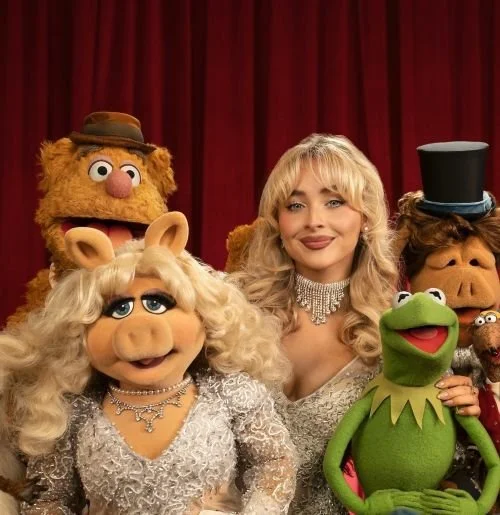
IN THIS PHOTO: Sabrina Carpenter is one of the most recent music guests who has visited Sesame Street/PHOTO CREDIT: Disney+
The Continuing Brilliance of Sesame Street and Its History of Music Guests
__________
ONE of the most joyous…
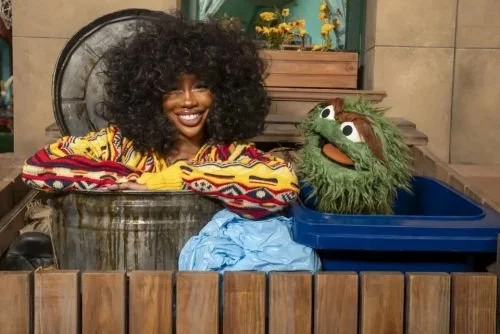
IN THIS PHOTO: SZA appeared on Sesame Street in 2025/PHOTO CREDIT: Sesame Workshop
and important T.V. series ever has new episodes out. Sesame Street first aired in 1969. It is amazing to think that it has been running that long (you can watch episodes here). Most of us know about it, though I feel like it is so relevant today. Whilst you may feel it is not cutting-edge or socially aware because of the premise and how it is aimed mostly at children, it is a show that has always been socially aware. Maybe it is more directed at adults than imagine. I think the fact that it does exclude or punch down in terms of how it addresses the audience. It is not infantilising or restricted to children, nor is it too inaccessible to children. Before getting to music and discussing why this is such a great series when it comes to showcasing artists in a different light, I want to come to this Forbes feature from 2021 regarding the 2021 documentary, Street Gang: How We Got to Sesame Street:
“Street Gang: How We Got to Sesame Street offers a nostalgic gaze into the minds of the visionaries who created the influential show, while also delving into never-before-seen archival footage and touching interviews with the cast, writers and crew. Directed by Marilyn Agrelo (Mad Hot Ballroom) and based on Michael Davis’ 2008 book, Street Gang: The Complete History of Sesame Street, the documentary includes a thorough look at the show’s goals: to educate children in underserved, lower-income communities with a diverse cast and to address real-life, contemporary problems, from the 1960s onward.
Joan Ganz Cooney, the first executive director of the Children’s Television Workshop, and Sesame Street co-founder Lloyd Morrisett, were deeply inspired by the civil rights movement. After Ganz Cooney noticed the educational gap in lower-income schools, she felt compelled to create a show that would speak to children everywhere. Another aim was to create educational programming in an experimental and creative format that didn’t seek to advertise to its young viewers. Federal funding made that possible, and Ganz Cooney’s vision drew in masterminds, including children’s television writer, director and producer Jon Stone and Muppets creator Jim Henson. The show consulted educators and psychologists on how to approach sensitive topics with children, without ever talking down to it’s young audience or underestimating their intelligence.
I spoke with Marilyn Agrelo about the film’s timeliness, how she because involved in the project and how quarantine has helped her to thrive in her creative work.
Risa Sarachan: How did you get involved with this project?
Marilyn Agrelo: I was lucky enough to be asked to direct a segment on Sesame Street about five years ago. It was a music video with Ernie and it was fantastic. At the end of the shoot, I posted a picture of Ernie and me on Facebook. Trevor Crafts, who had optioned the book and who I've known for twenty years, saw me on Facebook and he said, “Oh my God, Marilyn, I think she’d perfect to be the director of this documentary.” It was one of those crazy, amazing things. And so he called me, and we started talking, and that was the beginning of the partnership.
Sarachan: So many times I want to turn on social media, but then you hear stories like that, and you're like, okay, well, maybe it does bring some good into the world.
Agrelo: Trevor and I always joke that well, Facebook was at least good for one thing.
Sarachan: What did you want to make sure you kept from Michael Davis’ book while you were creating the film?
Agrelo: First of all, I was not aware of the political roots of Sesame Street and the fact that it really did come out of the civil rights movement. For me, that was the most amazing part of it.
I also love that Michael told the story from a very adult point of view, and I wanted to do that. I wanted to make a movie that was for adults, about adults, and capture the real struggle. They had all these ups and downs and setbacks in the beginning. What I do not want to do is make a love letter with a lot of clips of Sesame Street that you can get from YouTube. I wanted to go behind the curtain a little bit, and I think Michael's book introduced that idea to me.
Sarachan: That makes a lot of sense to me. The clips bring you to that nostalgic place, but I also had some revelations watching this. It explored ideas behind the show that I’d never thought about before.
Agrelo: That was really the hope. As in my first documentary, Mad Hot Ballroom, yes, it’s about kids in a dance competition, but it's really about all these other things, you know? And [with] this movie, yes, it's about Sesame Street, but it's really about this band of idealists and activists who wanted to make a difference in the world. Looking at it and telling the story from that lens, I think it tells a little bit of a different story than solely a story of Sesame Street.
The fact that they wrote it with such sophisticated humor and social commentary, they were writing for adults - which is just fantastic. The final thing about this film that I really wanted to bring out was the fact that Jon Stone is someone who nobody has heard of really. People will always assume - oh yes, Jim Henson started Sesame Street, and in fact, the genius of Jon Stone has been overlooked for 50 years. So, it was really important for me to, first of all, learn about him and then tell his story.
Sarachan: Yeah, it was really this whole team of people who were responsible for the show’s success. You can tell it wouldn't have been what it was without every single member of that team.
Agrelo: [That’s] exactly right. Joan Ganz Cooney, who, you know, there were no women executives in the television - there were no women put in a position to be in charge of such an experimental project. It was her vision of her leadership. Her ego didn't get in the way. She allowed people to express themselves and to be [their] crazy creative selves in a way that let everybody shine.
Sarachan: What do you think it is about Sesame Street that lingers with so many of us into adulthood?
Agrelo: I think it's this daring creativity. I think Sesame Street became, for all of us, a place where we wish we could be. I think all kids, even kids who had never seen a New York City stoop [and] didn't even know what that was, found this place where everyone was accepted, everyone was unified. Most kids, I'm guessing in the sixties, didn’t live in such an integrated neighborhood, and they saw that. No one talked about it, they just showed it. And I think it made everybody yearn for something. Then, of course, who doesn't want to live on a street where a giant bird is walking around? There's always that too. But I think it presented this ideal world in a way without being a fairy tale. It presented an ideal world but in a very real setting. It was so unique. I think it just gave kids a place to yearn to be.
Sarachan: What future programming do you think was influenced by the revolutionary work that Sesame Street created?
Agrelo: I think all of [the shows] since Sesame Street have taken notes. They've all tried to be like Sesame Street. They've all taken little bits of it and tried to incorporate it because there's no doubt that this was spectacularly successful. What Sesame Street did that no one else did and few people have done since is really bring in this level of educational expertise and really work with educators, psychologists, all kinds of people in our society who are advising.
I know that right now, they’re integrating stories of protests. They're integrating stories about homelessness. They're integrating stories about racial harmony. They’re mirroring the world and I think this is something that they were the first to do certainly and really raised the bar for everyone that has come since.
Sarachan: I haven’t watched Sesame Street in so many years. I’m happy to hear they are addressing the pandemic and the Black Lives Matter movement.
Agrelo: Exactly, because kids see all of this, and they have a lot of questions. It's the most serious time, I think, for kids to be exposed to the world. Much more so than when we were kids. So, I do think they have introduced something amazing into children's programming. The people at Sesame Street were frustrated because they could never really gauge their success. And the reason they couldn’t gauge it is that there was never a control group that they could compare with kids that were watching Sesame Street and kids that weren't. They could never find kids that weren't watching. They knew that they did raise the level of inner-city underprivileged children of color, but they also raised up the white children. It was quite amazing. I think it was far exceeded their expectation in every way.
Sarachan: I was reading about how many different countries play Sesame Street! It’s so impressive.
Agrelo: I know! It's in many different languages. Sesame Street also has programs in war zones. They are bringing muppets into Syrian refugee camps because they have found that this is very healing for little kids who are in crisis. So, they are doing so many things out there in the world that we're not even aware of.
Sarachan: How have you been able to access creativity during the pandemic?
Agrelo: I live in New York City. In New York, the impulse is always to go out: you go out to dinner, you meet friends for drinks, everything is out, and it has been very interesting to be so cut off. Luckily, in the course of making this film, we had shot everything before the pandemic hit, but it has very much forced me to observe. I've been watching a lot of stuff. It's fed my soul in a funny way because it's given me an excuse not to always be doing but to sit back and just watch. I think that is important for someone who is a storyteller or aspires to be an artist or to make things that people are going to see. You need to get back from the world a little bit. I think that's done a similar thing for many people that work in storytelling and filmmaking.
Sarachan: When you talk about sitting back and observing during this time - what has been feeding your soul creatively during this time? What books have you’ve been reading or films have you been watching?
Agrelo: I've been reading a lot, actually. They just finished a book called American Dirt, which is about this family coming across the border into this country. I really want to do a story in some way about the process of a child entering the United States. I'm an immigrant. I was born in Cuba. I've been watching everything that's happening this past year about acceptance. I'm very much thinking along those lines.
I feel almost like we're in the same moment that we were in 1969 when Sesame Street came on the air. You know, with the Black Lives Matter movement or with all of these things - everyone's consciousness being raised again. It seems a perfect moment really to bring this film out and to bring stories like this out into the world”.
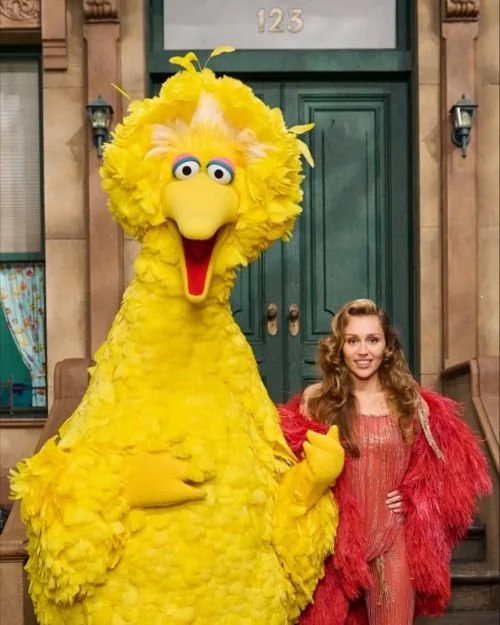
IN THIS PHOTO: Miley Cyrus appeared in Sesame Street’s fifty-fifth season in 2025/PHOTO CREDIT: Sesame Workshop
I wanted to highlight that interview, as we can feel the history and influence of Sesame Street. What I especially like about the series is that they bring in big names and interact with them. Through the years, everyone from R.E.M. to Paul Simon to Katy Perry have stepped into Sesame Street. I do think that we often see artists in a particular way, as the promotional circuit and social media casts them that way. I think a show like Sesame Street allows these well-known artists to cut loose and be off guard. They can inhabit this fast and different world and we see different sides to them. Sabrina Carpenter is one of the most recent musical guests. Before coming to more about music guests and Sesame Street today, The Guardian wrote about why 2026’s Sesame Street is must-watch T.V. Some huge names dropping by for a chat:
“That’s why we love them. Do we not, too, know ourselves to be odd, hapless psychological caricatures? Do our plans not also lead to flaming wreckage? Do we not long to put on a vaudeville-style variety show in a classic theatre?
Which brings us to the 2026 Muppet Show (Disney+, from Wednesday 4 February), with executive producer Seth Rogen on board. It’s a one-off, but could lead to a whole new series, the trailer reveals, “depending on how tonight goes”. Happily, it hasn’t been updated so Fozzie is doing bits on TikTok, or Rowlf protesting about streaming royalties. The guys are still trying to put on that variety show, and it’s still all going wrong.
Something I love about these geniuses made of rod and felt is their lack of false modesty. They know we love them. Every famous person in the world would kill to be on the Muppets (though what a horrific negotiation). They turn this popularity to farce: producer Kermit replies to every act who expresses interest in appearing, “That sounds like fun!” It’s a polite way of saying no, he confides to stage manager Scooter. “That’s very indirect,” responds Scooter, with misgivings.
Naturally, the overstuffed running order runs into crisis, with cuts needing to be made, a disaster for any fragile egos in the vicinity. At least guest star Sabrina Carpenter is unflappable. Like Rogen, the former Disney channel child is a perfect fit. She gets in a saucy joke with a straight face, doesn’t upstage the real stars and proves herself game. Or fowl, given her musical number backed up by a bunch of hens.
A highlight is when Carpenter meets Miss Piggy, gushing how she has always loved her, and even copied her look. “My attorneys have taken note,” Piggy replies primly. The porcine diva is energetic throughout, trotting backstage to announce to anyone present that she is “on vocal rest”. Protecting her place in the running order, she undertakes a water-based romantic rescue mission, which culminates in a bisexual rug-pull moment. She’s doing a lot.
Even the show within the show is good. Expect toe-tapping needle drops old and new. Skits include period-drama parody Pigs in Wigs, and a science segment about screen time, which ends with Beaker losing his eyes. Unlike Sesame Street, where the Muppets also appear, there is no educational agenda. The agenda is electric mayhem.
The Muppets have always been subversive. I thrill to the meta winks, comic timing, the sheer weirdness of this world. There’s a throwaway bit in which audience member Maya Rudolph dies and apparently goes to hell; it’s one of the sweetest things I’ve seen. Given that young people love choreographed K-pop and makeup tutorials, I wonder if nostalgic parents are now the primary audience. The kids may be just an alibi for them to watch.
The show’s resident theatre critics, Statler and Waldorf, remain unmoved by the Muppets. (The fact they live in a box, and have never missed a show, suggest a resentful dependence.) They are my spiritual teachers, yet here we must part company. This show isn’t half bad; it’s all great. In 30 minutes, I laughed more than I can count. In the end, it doesn’t matter why we love the Muppets. Joy needn’t be dissected, like a frog on the table. It’s meant to be felt”.
One of the greatest legacies Sesame Street has is its musical guests. There have been some classics through the years. Paul Simon is one of my favourite. Last year, they welcomed in great modern artists like Reneé Rapp. There must be this wish-list of artists who they’d like to book. I think that ROSALÍA and Chappell Roan would be especially great. Last year, ABC News explained why the long history of musical guests on Sesame Street continues:
“The music of Sesame Street lives rent free in many of our brains.
Songs like The People in Your Neighbourhood, Rubber Ducky, and C Is For Cookie introduced us to the soothing, educational and celebratory powers of music. They delivered little shots of pure joy into our lives. They helped raise us, and continue to comfort and delight the young people we cherish today.
These days, children around the world rinse all manner of kids songs of varying qualities ad nauseam, but there's a sophistication to the work from history's most famous kids show that has set it apart since it first aired in 1969.
"When you have a child who's singing one of your songs and doesn't even know that it's a learning thing at the same time, that is really the ultimate thing," says Bill Sherman, Sesame Street's long-time music director.
"It's not meant to be subliminal by any means, but in the same way we teach the ABCs in classrooms, a song is just another mnemonic way of learning something.
"The great songs on Sesame Street are the ones that do two things: they get stuck in your head because somebody wrote a great song, and whatever that thing is that's in your head is something you're learning.
"If you can do both of those things at the same time, that is a successful Sesame Street song. And a successful learning experience. I think that both are equally as important."
The famous people in your neighbourhood
Sesame Street has perhaps had the best musical guest list of any TV show in history. From Destiny's Child to Dave Grohl, Billy Joel to Diana Ross, Stevie Wonder to Carrie Underwood, Smoky Robinson to Katy Perry, most artists of note have figured out how to get to Sesame Street.
The latest season, which is screening now on ABC Kids, features influential R&B chart topper SZA, folk heart-throb Noah Kahan and the Zeitgeisty Reneé Rapp.
A particular highlight of this year's soundtrack comes from country star Chris Stapleton, whose song You Got A Friend In Music feels like a future Sesame Street classic.
It's a tribute to music's ability to heal, with Stapleton's soulful, gruff-yet-toasty vocal reminding kids (and the rest of us) that there's a song to match every mood.
"Chris Stapleton is one of those people that when he opens his voice, you can't imagine that he could do anything else," Sherman says. "He exudes music. Even when he talks it sounds melodic.
"Another guy who's like that is Ed Sheeran, who's just unbelievably musically oriented.
"It's really an honour to get to work with them, and to co-write a song is one of the great joys and achievements in life."
In his tenure at Sesame Street, Sherman has worked with many of modern music's biggest names, and says there's no one size fits all approach to a successful collaboration on the show.
"[Stapleton] was dead set on writing a song, so he wrote this song and sent it to us. Most of it is what you hear. We have our curriculum goals and our educational goals, and we've got to implement those back into the song.
"Sesame Street's been around for a very long time, and there's a very high level of musicianship and history. Getting songs together is sometimes a difficult task because the level is so high. But with a guy like Chris Stapleton, he comes in with so much that it's just sort of sculpting and moving parts around."
While Sherman is no slouch on the tools — his past credits as a producer, orchestrator and arranger include Broadway smashes like Hamilton, In The Heights and & Juliet — he reckons his key role is directing the creative traffic.
"I think my job in a lot of this is like setting the table, bringing everybody over to have dinner and then, whatever happens at dinner, just trying to guide it to be the best thing.
"It's just putting the right people in the room and making sure that everybody knows the end goal, and then figuring out the most graceful, efficient way to get there.
"And not being a jerk, just being a nice person helps."
It also helps to have an inherent understanding of the magic the artist you're working with possesses.
"I think the best compliment I can get is when we go to shoot it, and they're there and they go, 'Oh my God, this song sounds like it should be on my next record.' That's only happened like two or three times, but that to me is the ultimate compliment."
A song like The Power Of Yet, Sherman's 2014 collab with neo-soul shapeshifter Janelle Monáe, is a strong example of a song that fits with an artist's own creative approach.
"I had just seen her in concert and there was so much James Brown happening," he recalls. "There was so much gut funk, awesome horns and dancing and everything.
"I just wanted to make something where she could do all of that. She could really sing, and then she could really have a full dance break moment and all this stuff.
"She did the vocal and it was awesome, and she was just super into it. As I watched her move and dance, she became like her own Muppet, her own character of Janelle Monáe on Sesame Street. It was such a fun day, and such a great thing to watch and be a part of. She was super into it. She took some liberties on the melody and did all this stuff that really made it hers”.
The great Samara Joy, SZA and Sabrina Carpenter are just a few of the amazing music guests that Sesame Street has hosted the past year. Miley Cyrus also appeared. It is going to be amazing seeing which musicians appear next. I do feel there is this enduring message of hope and togetherness. Sesame Street not afraid to react to modern events and politics, though it also provides this escape too. Incredible music and a cast of beloved characters. Sesame Street is filmed in New York City, primarily at Kaufman Astoria Studios in Queens. You do get this feeling of being somewhere real, albeit with a slightly glossier edge. Rather than Sesame Street feeling like it is in a studio with an audience, instead, it is like being in a magical part of New York with this great community! Natural and real, maybe the opposite of the chat show studios. I am not a fan of chat shows, as it feels fake, forced and a bit sickly. Audiences that are a bit too over-excited. Sesame Street is infectious and not too cloying or happy. It is full of charm and there is no angle for artists to promote or do anything like that. They can relax into things and be playful. It is a remarkable show that I hope runs for decades more. That combination of major names coming by and the regular cast interacting. The real-world and make-believe together. Not a lot like that exists on T.V. Not in the same way. Sesame Street is this institution and icon of the screen. I do think that, especially in the U.S., Sesame Street is needed now more than ever. Providing that heart and kindness that is missing from the government. Maybe President Trump would see it as a propaganda channel or something anti-America. However, the fact that this series has been on the air for over fifty-five years and continues to captures the minds and imaginations of new generations is testament to its format, popularity and brilliance! No wonder so many giant artists are appearing on Sesame Street. It is an offer that is…
IMPOSSIBLE to refuse.