FEATURE:
Little Palaces
Elvis Costello's King of America at Forty
__________
A true classic…
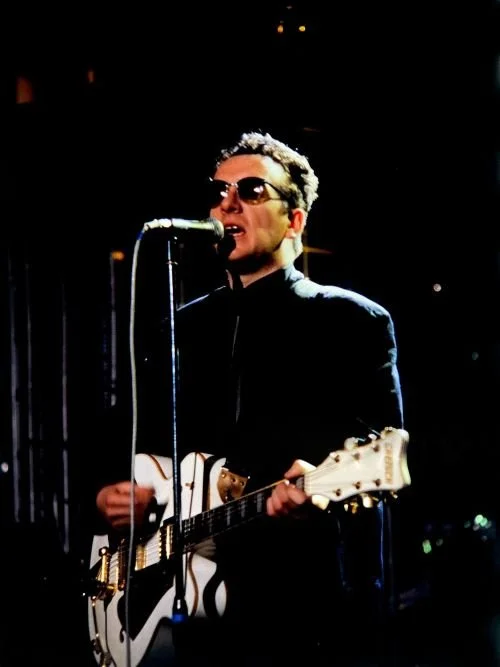
IN THIS PHOTO: Elvis Costello (Declan Patrick MacManus) in 1986/PHOTO CREDIT: BSR Agency/Gentle Look via Getty Images
turns forty very soon. Elvis Costello’s King of America was released on 21st February, 1986. His tenth studio album, it is also one of his most celebrated. Different to the scene around him, it was a key moment when Costello had this turnaround. Finding form critics felt he lost on albums previous, it was a big revelation that scored him a top twenty in the U.K. and top forty in the U.S. Ahead of its fortieth anniversary, I want to explore King of America. I will start off with an interview from the Los Angeles Herald Examiner from March 1986. Costello talking about an album that did seem like a new phase in his career:
“Perhaps the relaxed manner Costello displayed owes something to the fresh turns in his life. The most emblematic of these changes is his recent decision to change his name back to Declan Patrick MacManus, a decision that he says was tantamount to reasserting control over his life. (To appease Columbia Records, he will continue to be billed on records for a while as Elvis Costello.) In a similar back-to-simplicity vein, his new album, King of America, is his most straightforward-sounding record in many years, a record as genuinely fetching as it is guilelessly revealing.
"There's no question that this new album is me being as open as I'm capable of being at the moment," he said, leaning back in his chair. "Despite all the rumors that have circulated about me in England this last year — that I had writer's block, that I was alcoholic — and despite the fact that I'm now getting divorced from my wife, I'm far from being unhappy. As a result, I even took songs off the record that I thought were too negative."
Although King of America is hardly a blithe work, it does achieve a loose, rather offhand manner that is uncommon even in Costello's best early sessions. Co-produced by Costello and T-Bone Burnett (with whom Costello sometimes performs and records under the name the Coward Brothers), and supported by a remarkably diverse and capable batch of backing ensembles (Including Jazz musicians Ray Brown and Earl Palmer, and core members of one of Elvis Presley's greatest bands), the album is a spirited sampler of unadorned, fundamental folk, pop and rock styles. In fact, like much of the best post-punk music of our time, King of America seems to be a record bent on renewing some of the better folk-and-pop idioms of the past, and quickening them with the themes and temper of modern times.
"Obviously," said Costello, "this record owes less to current pop sounds than any other I've ever made. That's because most current pop music is really dreadful and soulless, and doesn't serve my purposes as a lyricist. Consequently, I'm relying on what are fairly timeless idioms, and though they're American in one respect, they're also, by this time, simply universal folk forms.
"But more important, this was the first time in quite a while that I didn't worry the material to death. If I began to lose my nerve about a song, began to think I should change it around or add some fancy chords to it, T-Bone would say, 'Remember why you wrote this song in the first place.' He kept dragging me back to what the feeling of the tune was about, rather than worrying whether I had a good hook or a proper sound on the bass drum. The song was the thing, and he never let me forget that. By approaching it that way, we let the arrangements grow from the material, so that everything would be in service of the song.
"If anything," said Costello, "I think the album offers a very oblique statement about America. In fact, while it isn't exactly intended as a love letter, it is an attempt to inject a little love into the situation.
"I think it's embodied mainly in two of the songs: 'Brilliant Mistake' and 'American Without Tears.' Somebody asked me what I thought of Los Angeles when I was there. I said I thought it was a brilliant mistake, and I came to recognize that as a fairly good description of America as a whole. It's a country with great intentions, founded on noble principles, and it very rarely lives up to it all. But having said that, I also recognize that there's a lot about the place that remains great, and there's a lot of ambitions and dreams that America is still made up of. There are people still coming here looking for a new world, hoping there's going to be something for them: a living, a fair hearing, a fair deal, maybe sanctuary. But they don't all arrive wise to how complex the place is, and that's what 'Brilliant Mistake' is all about.
"The other song that comments directly on the theme is 'American Without Tears.' It's something of a love song because it's about these two Englishwomen who had come over here a long time ago with complete trust, and were accepted by this country. This is the song where I tried to redress this awful, mindless racism that is going on in England at present toward America. Many people there have this attitude, 'Take your foreign policy and your president and go to hell,' and they just damn millions of people here, without really thinking about it.
"But the song is just a small observation, based on a certain private story. Really, there are no heavy or wild generalizations about America in this record, and there are no political statements intended. I wanted to avoid pompous generalizations and just describe my own personal journey over here. That's all I have the right to talk about."
I asked Costello whether, in this season of renewed social activism in pop, he had felt tempted to make music that was more politically overt. "No," he replied without hesitation. "Certainly, there are some noble causes that people are taking on at the moment, but I'm not sure there's really any good music that's come of it yet. Worse I'm not sure it truly changes anything in the long run, other than that a lot of pop stars get to wear political halos for a bit. I mean, isn't it just going to end up like in the late '60s and early '70s where everybody was singing 'We can change the world,' but all they really changed were their bloody bank accounts? What did a record like Volunteers do except make some more money for RCA and for the Jefferson Airplane?”.
Before wrapping up, there are reviews and features about King of America that I need to get to. Ultimate Classic Rock looked at the creation of a defining moment in Elvis Costello’s career. Still considered one of his best albums, I know there will be new reflection and inspection forty years later. This is what Ultimate Classic Rock wrote in their feature from 2021:
“By late 1985, as Costello pondered how to follow 1984’s Goodbye Cruel World (a flop in his and his fans’ minds), the big, highly produced sound of American rock began to show cracks. Bruce Springsteen dominated the charts like never before with Born in the U.S.A. and its six Top 10 singles, but he would turn away from that magnificent bombast and radio-oriented approach with 1987’s Tunnel of Love. With American Fool, John Mellencamp had matured toward becoming the John Steinbeck of Heartland rock, and he would champion the roots renaissance with The Lonesome Jubilee. Bon Jovi and Motley Crue were minting money, but acoustic guitars, vocal harmonies and subtly would rebound in a few months thanks to Tracy Chapman, Indigo Girls, R.E.M. and even Tesla. U2 were about to “discover” America; Talking Heads were about to discover Americana.
During this period, Costello got divorced, wrote most of King of America and embarked on a solo tour alongside singer-songwriter T Bone Burnett, the soon-to-be producer behind the Americana rebirth. (Not only did he co-produce this album, but he also helmed everything from the O Brother, Where Art Thou? soundtrack to Robert Plant and Alison Krauss' Raising Sand). The two plotted a break from Costello's old sound, old band and old image.
When King of America appeared, it was created to “The Costello Show featuring Elvis Costello” in North America and “The Costello Show featuring the Attractions and Confederates” in the U.K. and Europe. But the Attractions only team up on one track ("Suit of Lights”), and the "Elvis Costello" stage name he'd used for a decade gets pushed aside — he's credited as nickname "Little Hands of Concrete" for performance, with Declan Patrick Aloysius MacManus (his real name if you strike the "Aloysius") for songwriting.
Costello had previously dabbled in Americana. Of course, he also dabbled in so much else: punk, pub rock, New Wave, ska, country, soul. But album 10 was striking for its relentless push away from his past. His name and backing band and electric anger feel distant in this wash of mandolins, dobros, accordions and brushed drums — so many brushes that the stick hits come off as positively ferocious.
Critics and super fans, who went wild for the LP, often call it personal or self-reflective, but Costello never seemed to hold much back before this. Instead the music smacks of shocking earnestness. The writer who could lean on sardonic sneers, ironic detachment and whirling fury finished his long ebb from those voices. Left behind was sincerity dressed up just right in twang and pickin’ — Costello and Burnett replaced the Attractions with American session aces dubbed “the Confederates,” which included Elvis Presely alumni (members of the TBC Band, who backed the other King from ‘69 to ‘77).
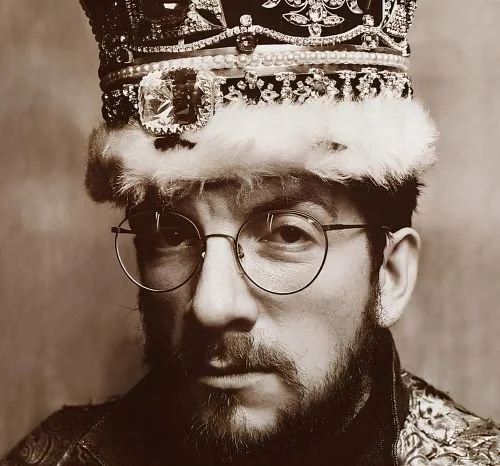
The LP opens with the woody thump of an upright bass, the lazy strumming of an acoustic guitar and Costello singing. “He thought he was the king of America / Where they pour Coca Cola just like vintage wine.” ("Brilliant Mistake" also features an insightful assessment of the country: “It was a fine idea at the time / Now it’s just a brilliant mistake.”) Definitively mid-tempo, it recalls something an Irish immigrant might croon on the docks in Boston, predicting the tone, speed and arrangement of Springsteen’s “Brilliant Disguise.” It defined the “new” Costello. The lyric that inspired the album title also influenced the LP cover photo, with the 31-year-old artist in a crown, looking like more introspective John Lennon than rave-up-ready Buddy Holly.
The set also includes doom-riddled folk rock (“Our Little Angel”) and blazing barnburners (“Glitter Gulch”). It finds the sonic overlap between Celtic and Appalachian traditions for a ballad about the battles of the working class (“Little Palaces”). It carves out space for a broken romance between Irish immigrants and G.I.s (“American Without Tears”). Costello covers old bluesmen, tries out lounge jazz, and closes the affair with a barbed, dense ballad about dignity, betrayal, estrangement and judgement: “Sleep of the Just” is the exact song the writer of “Allison” should have come up with a decade on.
His cult and the critics fell hard for the LP, but the record label and radio seemed befuddled and indifferent. In The Village Voice's annual Pazz & Jop critics poll, King of America finished at No. 2, but it peaked at No. 11 in the U.K. and only climbed to No. 39 in the States. In a bizarre, and perhaps ironic, twist, the label released his simmering, growling cover of Nina Simone's “Don't Let Me Be Misunderstood” as the first single, and it completely missed the Billboard Hot 100. The follow up, the rockabilly-meets-R&B jam “Lovable,” also failed to chart.
King of America is a dozen strange and wonderful things, none of them definitively. But it made one thing plain: Costello wasn’t the artist many thought he was. He would never again be the rock star that burst out of the ’70s British punk and pub rock scene. The album opened him up to everything”.
I will end things with this Pitchfork review that makes some interesting points about King of America. Many critics and fans were not expecting Elvis Costello to release an album like this in 1986. It did prove to be this turnaround. If you have never heard King of America, then make sure you do as soon as you can:
“Back in the midst of the Thatcher era, it must have been startling to see Elvis Costello staring back from the 12-inch-by-12-inch black-and-white LP cover of King of America, looking much older than the young rabble-rouser on the cover of 1983's Punch the Clock. Instead of the enormous Buddy Holly specs that had been his trademark for years, he continues to sport a pair of understated wire-rimmed spectacles that-- along with that facial hair-- lend his visage a grave, almost academic air. Bedecked with an ornate crown and an embroidered jacket, he hides his recognizable features behind a bushy beard, and his weary eyes manage a wary look.
More surprises awaited eager listeners: On the spine, the artist was listed not as Elvis Costello and the Attractions, but, more puzzlingly, as the Costello Show. Similarly, the songs were credited to Declan Patrick Aloysius MacManus, the acoustic guitar parts to The Little Hands of Concrete. In fact, the name Elvis Costello was barely mentioned in the packaging at all, as if MacManus needed a vacation from his alter ego.
These oddities heralded an even more dramatic change within the vinyl grooves. King of America was MacManus's first album without the Attractions since his debut (they appear on only one track, "Suit of Lights"). Instead, through co-producer T-Bone Burnett, he had corralled a strong roster of impressively pedigreed studio musicians (he calls them "my jazz and R&B; heroes" in the new liner notes) that includes Jim Keltner, Mitchell Froom, and Tom "T-Bone" Wolk, as well as Ron Tutt, Jerry Scheff, and James Burton from Elvis Presley's T.C.B. band. They lent the songs a professional albeit occasionally slick feel and helped MacManus realize his country and R&B; ambitions.
What wasn't different, however, was the barbed wit and acid humor that infuse songs like "Glitter Gulch", "Jack of All Parades", and "Brilliant Mistake". Costello's career to this date is often idealized as perfectly angry-- Costello the scourge-- but it contains a very human number of mistakes and miscalculations committed, on his own admission, by a very confident artist and a very confused man. The 31-year-old singer's anger and outrage had been diluted with disappointment and experience: the band was in turmoil and on the verge of breaking up (and would after one more album); MacManus's marriage had recently ended; he had been playing innumerable live shows to counter legal woes; his previous album, GoodBye Cruel World, had been a flop (he refers to it as his worst).
The result of all this angst is a complex and conflicted album that, despite all the spit and polish, sounds lively and raucous. Intense romantic embitterment informs the wordplay of "Lovable", the willful caution in "Poisoned Rose", and the extended metaphor of "Indoor Fireworks", which is all the more devastating for MacManus's straight-faced delivery. Likewise, the idea of America-- his adopted homeland, if only temporarily-- simultaneously repulses and attracts him. On the powerful "American Without Tears", he compares his own loneliness and alienation with that of two World War II G.I. brides, as Jo-El Sonnier's accordion plays over the chorus.
Not knowing exactly what to do with such a bristly, ruminative album, Columbia Records unenthusiastically released the cover of "Don't Let Me Be Misunderstood" as the first single, then promptly forgot about King of America, as did most listeners. A proper (and final) Elvis Costello and the Attractions album, Blood & Chocolate, was released before the year was out (on which Costello credited himself as Napoleon Dynamite). Rykodisc unearthed King of America almost a decade later, and Rhino is reviving it two decades later as the final installment in its ambitious and generous reissue project. While many of the 21 bonus tracks-- including the A- and B-sides of "The People's Limousine" / "They'll Never Take Her Love from Me" by the Coward Brothers, Costello's side project with T-Bone Burnett-- were included on the Rykodisc version, the real finds on this edition are the seven live tracks from one of MacManus's few shows with the King of America band. They fare respectably on the album track "The Big Light", but the band, especially guitarist Burton, blaze through covers by Waylon Jennings, Mose Allison, and Buddy Holly”.
In 2024, King of America and Other Realms was released. Anyone who is a big fan of Elvis Costello and King of America should consider investing. Arguably his very best album, I would urge anyone to check it out. It is a stunning album that I really love and am keen to see how others write about it on its fortieth anniversary. A commercial and critical success, it has gained even more retrospective acclaim. It is an…
UNDENIABLE masterpiece.