FEATURE:
Spotlight
of U.S dates for this month, though I do hope that Amie Blu comes and plays in her native London at some point. She would be lapped up, as I can imagine her stage performances are phenomenal! I guess that there will be a lot of U.K. performances later in the year. Her latest album, when all is said and done, was released last September. It won huge acclaimed and is up there with the best thing that she has ever done. I am starting out with a few interviews from last year before finishing with an impassioned and insightful reviews of when all is said and done. This is a hugely special artist that everyone needs to connect with. Let’s start with CLASH and their conversation with Amie Blu:
“Amie Blu grew up surrounded by music; it was woven into the fabric of her childhood home in Bromley, South East London. The living room doubled as a makeshift studio, as Amie and her brother moved between the drums, guitar and piano. “Piano practice was forced,” she recalls, laughing at the memory of inching the clock hands forward whenever her dad left the room. “But everything else; singing, writing… that’s always been natural.”
At six, Amie began experimenting with melodies, and by her teenage years she was developing her own songs in earnest. Her parents’ collection formed the earliest soundtracks; Biggie and Tupac, Eminem and Justin Timberlake, Alicia Keys pouring from her mother’s speakers. Everything shifted at 15, when a friend introduced her to FKJ’s ‘Vibin’ Out’. “That song completely changed my algorithm,” she remembers. “Suddenly I was getting COLORS shows, Daniel Caesar… it was like I’d finally found music that felt close to mine.”
Two EPs, ‘5 for U’ and ‘crumbs in my bed’, marked her as an artist unafraid of sincerity, but her debut album, ‘when all Is said and done’ moves with a different weight, carrying both the intimacy of her earlier work alongside the discipline of an artist finding her centre. Written in the South of France alongside longtime friends and collaborators, it transforms what she calls “one of the worst years of my life” into a tender exploration of sadness, endurance, and eventual hope. “Writing the album allowed me to process,” she explains. “Just having it in song form feels validating.”
Amie is meticulous about her delivery, often speaking with her singing teacher about how meaning shapes performance. “What am I trying to convey? What do I want people to feel? That was always in my head,” she says. The result is a voice unflinching in its documentation of grief yet never tipping into despair. Listeners have felt that honesty deeply: one fan has her lyrics tattooed, whilst others write to her about how her music connects with their own lives. “I write so specific to me and my life,” she reflects, “so it’s interesting seeing how people relate it back to themselves. Sometimes I’m like, are we living the same life?”
Her visual world, created with collaborator Alistair Mcveigh, extends her homespun tales into dreamlike textures. “Visual identity is so important,” she insists. “It’s what differentiates a singer and an artist.” That same sharpness carries into her navigation of the industry itself. Having worked in A&R and publishing, she explains, “It helped me learn how to read between the lines, speak on my own behalf, and stand on business”.
It is well worth people getting to know Amie Blu. That is what DIY did last year. There was a lot of fascination and love around her when she put out the album. It is a remarkable work and one from a singular talent. I am quite new to her music, but I can see why people are hailing her as a major talent. This is someone who will enjoy a long and successful career:
“You hail from South East London, which is a part of the city that’s known for having a really distinct cultural identity. For you, musically, what was it like growing up there?
To be honest, there wasn’t that much going on in my area… I think it’s probably like everywhere in London; if you’re passionate about something, you just need to find what you can and do whatever you can to make it work.
Lyrically, your work doesn’t shy away from exploring weighty topics, but the tracks themselves aren’t necessarily sombre - take ‘swimming in pity’, which is both a song about depression, and really quite anthemic. How do you walk this emotional tightrope?
Sometimes it’s a conscious decision; I love juxtaposition. But at other times, that’s just the direction we’ve gone in ‘cos it sounds lit. Also, most of my songs are sad so I’ve gotta switch it up somehow!
If you could be in a band/collab with an artist from the past two decades, who would you pick and why?
Ugh, my answer will always change depending on the day… right now, I’ll probably say Elliot Smith - but he’s the lead singer and guitarist, I just sing backing vocals (and my mic is muted).
Finally, DIY are coming round for dinner - what are you making?
Honestly, I rotate between the same two things… you can either have creamy salmon pasta or you can have chorizo pasta, I’ll let you guys decide. They’re both a 6.5 out of 10, but made with love”.
Prior to finishing with a fascinating review of when all is said and done, I want to bring in FADER and their interview with Amie Blu. Among the artists tipped for great things this year, I think that Blu is up there with the absolute best and brightest. After playing L.A. on 9th and New York on 19th March, she will be back home and I guess there will be plans for a summer of gigs. I am looking forward to catching her:
“The opening three song titles on Amie Blu's when all is said and done give a good impression of the album's downcast vibe: "swimming in pity," "worse," and "missing everything" make it clear the album is for grey days and depressive moments. The fourth song, titled simply "take me as I am," meanwhile, is the London-based songwriter reaching out a hand in the darkness. It could be adressed to a partner or the listener at home tuning in through their AirPods.
"Take me as I am," the 22-year-old pleads between carefully picked acoustic strings. "It's been so long since I felt whole." At a time when feelings of misery and hopelessness can often feel like they're being used a chic aesthetic, Blu's songwriting hits a cord with its blunt approach to documenting life's most uncomfortable feelings.
It's an approach that breeds connection and this year she opened for Faye Webster on tour while another when all is said and done song, "shadow," was co-signed by SZA online.
She is set to headline her first run of U.K. and European shows starting in October. Before that we asked him for some photos from behind-the-scenes of her recent shows, and got her opinions on Black Swan, London in a heat wave, seeing Justin Bieber live and other hot topics.
What’s the best advice you’ve ever received?
My nan is French and taught me how to make crepes. She ADVISED me to learn how to make crepes.
What’s your favorite song to play live right now and why?
Probably "falling to pieces" from my album. The song is from the perspective of my cat while he gets extremely ill and eventually passes away. Some people have been putting up pictures of their pets on their phones while I sing this song and it’s the sweetest thing ever. I could cry thinking about it.
What was the last creative idea you had that made you ask, ‘Can we do that’?
I had a listening party in London for my album where I invited fans to come hear me play a couple unreleased songs. It was originally meant to be in a live room but when I visited I fell in love with their kitchen and was like, 'Can we do it here instead pleaseeee?”.
I have one more interview to include before getting to a review. I was really captured by this Wonderland feature and what they asked Amie Blu. For anyone who has not heard her, I would say you definitely need to explore. Such a phenomenal artist that you know we will be listening to years from now:
“Following her debut album when all is said and done, made with her “talented friends”, a trio of rising producers, instrumentalists and songwriters Humble the Great, Will (Worm) and Will Hargreaves – Amie Blu is settling into her moment. Released this September, the reviews rolled in, and they were good. Co-signs from the likes of SZA (who liked an Instagram post of her stand-out track “shadow”), fellow Londoner Joy Crookes and a steadily growing audience of more than 260,000 monthly Spotify listeners only confirm what’s ahead: a quiet, steady ascension. Still, Amie stays grounded.
“I sound so cringe,” she laughs, “but I see music as this long marathon, and every message or co-sign or anything is like a high five. It means everything, it’s so validating, but it doesn’t change the distance. It just makes it easier though, for sure.”
After a long day on set for Wonderland, thick with outfit changes, lukewarm bath shots, TikToks to Yeat’s “COME N GO”, and the inevitable London downpour (pathetic fallacy, if you will), she finally melts into a chair at Cecconi’s downstairs, glowing in that post-shoot exhale. She orders decisively: “Spaghetti lobster with tomato and chilli, definitely.” A pause. “Actually, the crab ravioli please.” For the first time all day, she looks at ease.
The calm exterior, though, hides nerves. “I just always get a bit nervous with shoots because my least favourite part of being an artist is pictures,” she admits. “I don’t like pictures. I’m very insecure. I don’t like my face, I don’t like anything about myself.” Vulnerability sits in stark contrast to the “so beautiful” murmurs drifting from the crew all day, though contrast, in Amie’s world, is kind of the point. Take “missing everything”, an upbeat melody masking a quiet ache: ‘I can hardly believe / But lately I’m missing everything…’
“I find it easier to write with a pessimistic outlook,” she says simply. “To be honest, I just have that view on life in general.” Her then-favourite track from the album, “worse”, captures it in full: ‘Trying so hard not to break apart / You’re only gonna make it worse’. “It’s about friends being far away. I hadn’t seen mine in a while,” she says. “But the song is about my friends being there for me and me for them, and us just being there for each other. I’m so grateful for my friends.”
In moments like these, you can tell her heart is rooted in the human part of it all, not the attention that comes with it. Her album is an unfiltered catalogue of that. “Last year was one of the worst of my life. I was just like, if I continue, I am genuinely not going to be here anymore. I had no desire to be here,” she says, her head resting in her palm. And this heaviness, she doesn’t linger in it, but she doesn’t shy away from it either. Her song “if i leave” dives headfirst into that space. “It’s about not wanting to be here, but feeling like you’re forcing yourself through life for other people…and how I think that suicide can be really selfish,” she says, steady.
Weeks later, she follows up via email with something lighter: “We’ll probably hear all about it in a song one day lol. But now I’m feeling a lot better. I’m trying really hard every day to feel better, and I’m surrounded by people who genuinely love me and want the best for me. I have an amazing support system.”
From those teenage sessions to now, the growth feels both sudden and slow. “As an artist, I think I’m more confident,” she says. “I’m writing more clearly and have more of a vision, a sound.” As a person, the story’s rawer. “I’ve always felt sad…but I feel like…do I want to get better? And I think, this year, I genuinely do”.
This amazing review is what I shall end with. I am really keen to see where Amie Blu heads. The fact that she has U.S. dates and there is a fanbase there is already a big thing. After a busy and phenomenal year in 2025, this year is one where she will build even more fans and play some of her biggest shows. Her music has touched so many people already. It is incredible seeing this wonderful young artist get so much affection:
“At just 22, Amie Blu, the South East London singer-songwriter, had already carved a niche with her diary-like songwriting on the 2024 EP How We Lose, but this full-length project is a far more unfiltered portrait. Her music is confessional to its core, often evoking the feeling of reading someone’s private journal set to melody. That intimacy is immediate—Blu’s warm, unguarded vocals draw you in close, only to reveal heavy secrets just beneath the pretty surface. Her debut album, When All Is Said and Done, is a thoroughgoing introduction to a young artist unafraid to expose her bruises. The album doesn’t aim to be a polished escape. Instead, it’s drenched in messy, uncomfortable truths about love, loss, depression, and the tangled knots of human connection. In tone, it’s frank and unassuming yet assured in its vision, delivered with a candor that can stop you in your tracks as often as it comforts you.
From the outset, Blu establishes an emotionally open space where darkness and reluctant hope coexist. When detailing When All Is Said and Done, she outlined it as “such an honest depiction” of her lifelong feelings of sadness and struggle, and the candor is apparent in every lyric. The songs document depressive episodes, internal conflicts, and the faint glimmers of hope that sustain her. Writing these songs was clearly cathartic—after finishing the album, she realized, “It is so sad… lol,” a self-aware, gallows humor that actually helped her start feeling better in real life. That paradox of pouring out despair to make room for hope defines the record’s arc. Blu never sugarcoats her mental health battles—she often admits, “I struggle to find anything positive in my life… I want to get better… but despite all my efforts, I often still feel the same.” Yet by voicing these thoughts so openly, she transforms isolating pain into something communal. Her honesty turns vulnerability into connection, for herself and anyone listening. It’s as if sharing these diary pages creates a safe place for not only her survival but others’ too.
The album’s songwriting stays intensely personal and literal, which is both its main strength and a potential limitation. Blu writes in plain language that often reads like unfiltered journal entries—she even notes that she always writes for herself first, considering that others hear it as only a “privilege” afterward. This approach yields some beautifully earnest moments where her sincerity is heartbreaking, but it also means she can circle the same themes repeatedly. There’s a deliberate repetitiveness to some lines, a reflection of mental ruts and obsessive thoughts. If she occasionally sounds like a broken record about feeling broken (and she’s joked about this herself), it’s because these songs refuse to dilute the reality of depression. That directness can hit hard; lines like “what’s the point in having all that love just to keep it?” in the song “bite” land like a quiet gut-punch. Even so, the album strikes a balance between despair and subtle resilience. Blu’s voice, soft and smooth, has a way of making even the most wrenching confessions feel inviting—she lulls you in with a gentle melody, then crushes you with the truth. It’s a tricky tightrope of emotional songwriting that she walks with remarkable poise for a debut.
For an album rooted in one young woman’s internal battles, When All Is Said and Done is surprisingly dynamic and collaborative in its execution. Blu created these songs in close collaboration with her friends, embracing a DIY spirit, and that camaraderie is evident in the music. The production spans a wider range of styles than one might expect from the singular focus on depression. There are soul-soaked confessionals, gritty lo-fi textures, and even a hint of breezy soft-rock optimism peeking through in places. “Bite,” for instance, blends a loose live-band energy with touches of soul and country, bringing a warm, organic feel to her self-reflective musings.
By comparison, “Legs”—the centerpiece of the album—is stripped-back and raw. Blu first unveiled this song in a COLORS session, just her voice and the bare essentials, and in studio form, it remains the emotional crux where all the album’s themes coalesce. The song was born from a moment when she “felt like I no longer had the will to live,” and it confronts that breaking point directly. There’s a quiet intensity to it; rather than a polished pop song, “Legs” feels like eavesdropping on Blu’s most private plea to keep going. Fittingly, she positions it as the turning point where survival itself turns from a “whispered thought into song.” You get the sense of an artist mustering the strength to stand up (as the title implies) after being emotionally flattened. Throughout the record, the instrumentation and arrangements generally serve the songwriting well—organic guitars, piano, and subtle electronic flourishes are deployed to mirror the emotional beats.
If a song needs to brood in quiet despair, it does; if it needs to burst open in catharsis, it isn’t shy about it. At times, the lo-fi touches (a bit of fuzz on a guitar, or a room ambience in the recording) give the sense of Blu and her friends huddled in a small studio, capturing real feelings in real time. That intimacy is one of the album’s greatest strengths. On the flip side, a couple of tracks don’t stand out as much melodically and can blend on first listen—a possible side effect of sticking to mid-tempo, introspective territory. However, when given a fair shot, they reveal distinct shades of her melancholy: some songs are angry or frustrated, while others are resigned, and still others are cautiously hopeful. The cohesion of tone is actually purposeful, painting a comprehensive picture of depression without ever wallowing to the point of monotony.
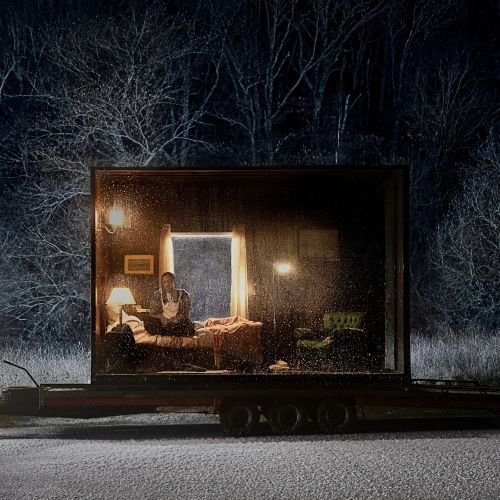
When All Is Said and Done’s visual presentation reinforces its honest portrait of survival in striking ways. The album’s surreal cover art (created in collaboration with Blu’s close friend and creative partner Alistair McVeigh) depicts a tiny, warmly lit room built on a flatbed trailer, parked in the middle of a bleak, wintry landscape. It’s an arresting image: a fragile sanctuary on wheels, literally a shelter from the storm of the outside world. This visual metaphor couldn’t be more apt—it’s as if Amie Blu built herself a safe space to contain all her vulnerabilities, and she’s towing it with her wherever she goes. The fact that the room is mobile hints at the transitory nature of healing and survival; you carry that cozy refuge with you, even through a desolate environment. Blu and McVeigh clearly put thoughtful intent into constructing a cohesive visual world around the album. Every shot, from press photos to the music videos, extends the album’s themes. There’s a sense of being exposed yet protected: Blu is often seen alone in empty or open spaces, bathed in gentle colors or soft light, visually emphasizing both her loneliness and her strength in that solitude.
At long last, When All Is Said and Done lands with a quiet sort of impact. It’s not the kind of debut that announces itself with bravado or flashy innovation, but it sneaks up on you, slowly enveloping you in its emotional atmosphere until you’re living in that little room with Blu, weathering the storm together. The album’s resonance comes from this unfiltered emotional truth. You feel you’ve read an entire chapter of someone’s life with a song pointedly titled “When There’s a Will There’s a Way,” an echo of hope if ever there was one (the ugly cries, dark jokes, desperate midnight thoughts, and all), and come out the other side with a surprising sense of comfort. The neutrality of the tone throughout—clear-eyed, unsentimental—keeps it from being a pity party. Blu is reporting from the trenches of depression with a wry smile and a tear in her eye, never asking for sympathy so much as understanding.
If there’s any gripe to offer, it’s perhaps that the album lives so intensely in its headspace of sadness that it rarely steps back to take a broader view; the catharsis is mainly in the act of expression itself rather than any grand revelation. But that in itself feels true to the subject matter. Depression often has no neat resolution, and When All Is Said and Done wisely doesn’t pretend to have one—it’s about finding a way to survive with honesty, not about being magically cured. In that regard, this record succeeds in expectations. It’s a richly human debut, one that confirms Amie Blu as a fearless new voice unafraid to document the hard stuff. Her candid songwriting and unguarded performances turn solitude into solace, inviting listeners to feel seen in their own struggles. When all is said and done, Amie Blu has delivered a debut album that finds strength in vulnerability—a shelter in the storm for anyone who needs it, built out of songs that are as comforting as they are cutting”.
I will leave things there. A wonderful live performer and one of the most memorable new artists I have heard in a long time, I do have the highest of hopes for the sensational Amie Blu. Following the release of when all is said and done, I wonder what music we will get this year. Take an opportunity follow Amie Blu on social media and give her some love. She is this incredible artist that everyone needs to know. If you are unaware of her brilliance then you need to…
CHANGE that now.
_________
Follow Amie Blu