
FEATURE:
Needle Drops and Scores to Settle
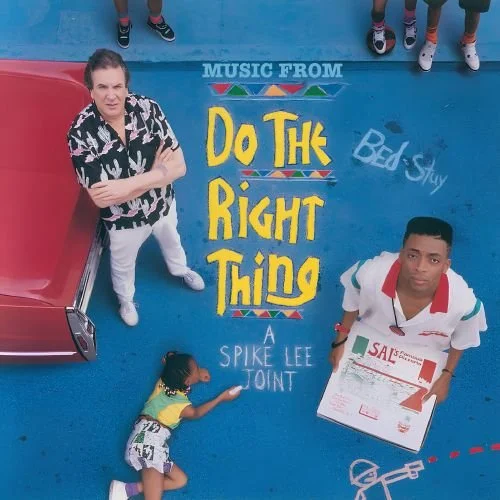
Seven Eight: Fight the Power: Do the Right Thing (1989)
__________
THERE are a couple of different…
versions here. There is the soundtrack of the film, Do the Right Thing, which features songs by Public Enemy, Steel Pulse, and E.U. There is also the incredible score from Bill Lee and The Natural Spiritual Orchestra. I am going to include both, though I will focus more on the soundtrack. Fight the Power by Public Enemy perhaps the most iconic and recognisable song from the album. Spike Lee’s masterpiece was released in 1989. Written by a cinematic genius, I do want to get to some features which look at the music from this landmark film. However, before getting there, Wikipedia give us some detail regarding the impact and legacy of the film: “Lee's direction combines heightened realism with theatrical and symbolic techniques to convey the psychological and emotional effects of heat, crowd dynamics and urban life. The film's ambiguous and controversial conclusion sparked widespread debate upon release regarding the nature of protest, responsibility and moral judgment. The film earned nominations for Best Original Screenplay and Best Supporting Actor (Aiello) at the 62nd Academy Awards. It has since been widely recognized as one of the most important American films of the late 20th century; in 1999, it was selected for preservation in the United States National Film Registry by the Library of Congress as being "culturally, historically or aesthetically significant". In 2022, the film was ranked the 24th greatest of all time in Sight and Sound magazine's decennial poll of international critics, programmers, curators, archivists and academics. It has been featured on many other lists of the greatest films of all time by numerous critics”. I do want to move to The Criterion Collection and their assessment of a hugely powerful and important film and its incredible score. If you separate the soundtrack and score or see them as one of the same, it is clear that the music in Do the Right Thing is integral and unforgettable. Almost as potent as any actor or scene:
“By the time Do the Right Thing was released—or maybe unleashed does its seismic and immediate impact more justice—Lee had already established himself as one of America’s foremost young filmmakers, following the success of She’s Gotta Have It (1986) and School Daze (1988). His eye for comedy was clear, as were his elegiac love for black people and his deep involvement in the politics of the moment. Now he found himself in the middle of one of New York City’s periodic inflammations of racial angst, sparked by state-sanctioned racist violence and intermittently settled in the streets. Lee dedicated his new film, an opus of racial proximity, to the families of Eleanor Bumpurs, Michael Griffith, Arthur Miller, Edmund Perry, Yvonne Smallwood, and Michael Stewart: each black, each killed by police or a white mob. All those names: songs cut short. (Incidentally, the crown Smiley draws over Dr. King’s head looks something like the crowns famously used by Jean-Michel Basquiat to honor bygone black heroes. Basquiat was so spooked by the killing of Stewart, a fellow graffiti artist, that he dedicated a painting, Defacement (The Death of Michael Stewart), to the incident.) Toward the end of Do the Right Thing, after Raheem’s asphyxiation by baton, the crowd starts to invoke the dead, first tentatively, then as a chant. The litany of names has become one of the signature rhetorical tropes of the twenty-teens; Lee’s crowd has memorized their list—on which Raheem is just the latest item—just as well and as thoroughly as contemporary viewers can tick through the likes of Trayvon Martin, Laquan McDonald, Sandra Bland, and Philando Castile.
Two years after Do the Right Thing, in 1991, a riot bloomed like a rash in Crown Heights, punctuating tensions between blacks and Jews that rhymed perfectly with the black-Italian (and, to a much lesser extent, black-Korean) strife that Lee sketches. Earlier that same year, on the other side of the continent, Rodney King had been pummeled by a gang of highway cops. Ten years after the film came out, in 1999, NYPD officers fired forty-one shots at Amadou Diallo, an innocent Guinean immigrant, killing him just after midnight, steps away from his own home. Fast-forward twenty-five years from Do the Right Thing, to 2014, and alight on Eric Garner, an eerie echo of Raheem: also big of body, also a fixture in his neighborhood, also choked to death on the sidewalk for no reason. Back in ’89, some viewers were worried that Lee might provoke black audiences to violence. What a strange and oblivious concern, what with reality’s steady supply of kindling for the fire. Lee’s crucial climactic passage—death, rage, riot—is easily the most blankly realistic in the film
Its notes of righteous anger notwithstanding, Do the Right Thing is an early articulation of the uneasy ambivalence that would become the signature black political attitude of the nineties. (It’s not too hyperbolic to say that this movie helped to call that decade, tonally and visually, into being; the fonts and angular graphics of its opening credits foreshadow those used in classic black sitcoms like Martin and Living Single, and its high-flying, supersavvy argot is echoed in John Leguizamo’s one-man shows and Wanda Sykes’s stand-up specials.) The civil-rights generation, with its totemic victories and liberal Protestant openness, was long gone, and its fierce successors, Black Arts and Black Power—those political-artistic twin nationalisms—were beginning to recede. Now Lee’s generation would start to sift through the work of their forebears and start to edge toward a tentative blend. The most chaotic moments of Do the Right Thing jibe naturally with lines like these, from Gwendolyn Brooks’s late-sixties poem “Riot”:
“Because the Poor were sweaty and unpretty
(not like Two Dainty Negroes in Winnetka)
and they were coming toward him in rough ranks.
In seas. In windsweep. They were black and loud.
And not detainable. And not discreet.”
But the movie also contains an earnest and quite unconcealed yearning for togetherness. Yes, one of the three outdoor choristers, ML (Paul Benjamin), is aggrieved by the economic foothold gained by the Koreans who own the grocery store that sits across Stuyvesant Avenue from Sal’s—but his buddies have fun reminding him that he, a West Indian, also stepped off “the boat” into New York. His pattern of absorption into the life of the city and the country is different from the grocers’—it’s unavoidably inflected by his color—but it is no less real, and no less comic in its quickness. ML has rushed into American covetousness just as abruptly as Sonny and Kim the grocers (Steve Park and Ginny Yang) have claimed their stake in American commerce”.
There are a couple of other features I want to pull in. Forbes looked at the Do the Right Thing soundtrack in 2019, thirty years after the film was released in cinemas. If you have not seen this Spike Lee work of brilliance, then I would advise people to do so. Even if the soundtrack I have embedded at the end of the feature does not include all of the songs, you can buy it on Apple Music here. That soundtrack came out in 2001. It is a case of a phenomenal director perfectly pairing music with images. One of the most acclaimed and highly regarded soundtracks ever, it has a legacy beyond the film it comes from:
”Perhaps the most memorable song from the soundtrack is "Fight the Power," a tape played often by Radio Raheem (Bill Nunn, pictured in the above photograph next to Lee) as he strolled the streets of Brooklyn in that film. Recorded by socially conscious rap group Public Enemy, the song reached #20 on Billboard's R&B/Hip hop singles chart. The movie opened with that song accompanied by Rosie Perez dancing solo. It subsequently played 14 more times before the credits rolled.
Another key song from the film, Teddy Riley and Guy's "My Fantasy," peaked later that fall at 62 on the Billboard hot 100 charts, but reached number one on the Hot Black Singles Chart that summer. The song is the mini-soundtrack to when Mookie (Spike Lee) and Buggin' Out (Giancarlo Esposito) discuss a potential boycott of the local pizza place. The soundtrack overall reached 11 on the Top R&B/Hip-Hop Albums chart, and peaked at 68 on the Billboard 200.
Lee curated a soundtrack that is just as memorable for its music as the movie is memorable for its ability to delve into tough racial topics. R&B group Guy was popular in the late 1980s, and the Teddy Riley-written "Fantasy" was a hit the entire summer. Riley's New Jack Swing brought a pivot to popular music, and it made sense to install a Riley cut on the film soundtrack. Bringing in gospel-pop stars Take 6 and rap stars Public Enemy also hit sweet spots with a variety of listener demographics. Ruben Blades joined with Take 6 for "Tu Y Yo (We love.)" And of course, "Party Hearty" kept EU and DC-area Go-Go music front and central”.
I will finish with Culture Sonar and their write-up about Do the Right Thing. Heralding this masterful soundtrack, there are few that have made the same impact. Even if you do not know Spike Lee’s work or know much about him, you will definitely be able to appreciate the soundtrack and score. I would suggest to people to seek out Do the Right Thing. A film that seems to be incredibly relevant to this day:
“There are few films that capture the simmering tension of an urban summer quite like Spike Lee’s 1989 film Do the Right Thing, where a New York City heatwave becomes the manifestation of American racial tensions. Although its action is more or less limited to a Bed-Stuy block in Brooklyn, the scope of this insightful film is certainly panoramic. Lee manages to bring the heightened reality of theater to his “Street Scene” film and uses the movie’s soundtrack as a powerful, natural extension to the furiously funny dialogue that so forcefully draws us into the action. The film’s score is a veritable window into the hip-hop and contemporary R&B scenes that were taking over in the late 1980s, and its enduring appeal is a testament to the strength of the era’s musical innovation. With its peppering of New Jack-era hits, summer party anthems, and slow jams Do the Right Thing’s music captures both the frivolity and the fury of 1980s America.
Public Enemy’s “Fight the Power”
Undoubtedly the song which has become most synonymous with Do the Right Thing, Public Enemy’s “Fight the Power” not only served as the film’s leitmotif, it also fully embodied the spirit and energy of the movie. The song accompanies the opening credits during which we see Rosie Perez’s character “Tina” dancing by herself against a backdrop of Brooklyn neighborhood images. Her dancing is fierce and pugilistic, and immediately communicates a tone of feverish intensity that will continue throughout the film. Spike Lee handpicked Public Enemy to create a theme song for his work, and Chuck D and the Bomb Squad did so with unapologetic mastery. “Fight the Power” is played fifteen times throughout the movie, and as its lead single, this singular track managed to both reflect the zeitgeist of the black community during that time, and become a lasting rallying cry for activists all over the world.
Guy’s “My Fantasy”
In 1989, the New Jack Swing movement was at its height. Spearheaded by Teddy Riley and Bernard Belle, this fusion of hip-hop, dance-pop, and R&B was taking over the black New York club scene. Riley was known for his inventive, funky beats, and before he created the group Blackstreet in 1991, his group Guy was commissioned to contribute a hot number for the Do the Right Thing soundtrack. “My Fantasy” was an instant hit, reaching the Number One spot on the Hot Black Singles Chart in 1989. The song also served as the backbeat to the film’s turning point, when Buggin’ Out (Giancarlo Esposito) tells Mookie (Spike Lee) about his plans to boycott Sal’s pizza place.
E.U.’s “Party Hearty”
While present-day Brooklyn may be best known for independent coffee shops and bearded hipsters, the outer-borough in the 1980s was a place for block parties and spontaneous gatherings over music. It’s only fitting then that Spike Lee called upon the legendary Go-Go band E.U. to deliver a track that had the party-hopping movers and shakers of that time in mind. Their song “Party Hearty” may be light on lyrics, but its funky rhythms and contagious instrumentation are hard to resist, making it an undeniable dance-party staple.
Steel Pulse’s “Can’t Stand It”
Although a lot has changed since 1989, one thing that hasn’t is the suffocating heat of a New York City summer. Perfectly capturing the sweltering temperatures the city endures is Steel Pulse’s feel-good, reggae tune “Can’t Stand It.” One of the things that makes Do the Right Thing such a lasting, relatable film is the way in which Spike Lee every so often pulls back from the film’s narrative in order to deliver montages that engross us fully in the time and place of the story. The scorching summer heat is thus palpably portrayed in the film through the juxtaposing images of sweating bodies and cooling water, scored by Steel Pulse’s appropriately named “Can’t Stand It.”
Take 6’s “Don’t Shoot Me”
Spike Lee gives a little corner of doo-wop with “Don’t Shoot Me,” sung by the a cappella gospel group Take 6. While the funky beat and soulfulness of the song conjure up images of stoop-singing groups of a bygone era, the lyrics of the song transport us directly into the narrative of Lee’s film and contextualize the feeling of neighborhood angst we see played out on screen. “Don’t shoot me, I didn’t mean to step on your sneaker” references the iconic moment in the movie when Buggin’ Out has a run in with a Brooklyn gentrifier, giving the song a singular blend of old-school musicality with the very real problems we see going on in the film”.
There are some great interviews such as this, where Spike Lee talks about making Do the Right Thing. I am going to end with Stereogum, and their interview from last year with Lee. Of course, Public Enemy’s Fight the Power is the standout track. The theme and biggest moment. One of the greatest Hip-Hop anthems ever, it works perfectly in Do the Right Thing:
“What was your relationship with Public Enemy before that song?
LEE: I knew them. I admired them. Chucky is a big sports fan, so we love the Knicks. And I knew with this film, I needed an anthem, and the rest is history. Herstory. But another thing, though, it's more than an anthem. It had to be a great song, because every time you see Radio Raheem with his boombox played by the great, great, great Bill Nunn, my Morehouse brother. Him and Sam Jackson were a couple years ahead of me at Morehouse College, Atlanta, Georgia. I don't know how many times you heard "Fight The Power" in that movie [laughs], but it had to be a great song! You hear it more than once, I think at least it was more than 10 times. And the way that song is weaved, it leads to him coming to Sal’s Famous Pizzeria with Smiley, played by Roger Smith, and Buggin Out, played by Giancarlo Esposito. Sal takes out his Mickey Mantle Louisville Slugger and stops that song. So it's interwoven. That stuff is interwoven, not a mistake. You had to hear it multiple times in the film to lead up to that point.
So was it as simple as you getting them the script or telling them what they're telling them the gist of the film, and then they made it after that?
LEE: No, no, no. They did some runs through the song even before they saw the film. And then we finally had a cut to show them, then they made changes”.
I do hope that there is a reissue of the soundtrack. Whilst it can be bought on Apple Music, it would be great if it were on vinyl and other formats. I think you can buy used copies or get the odd one here and there. However, given its impact and importance, it does deserve to be reissued. Many people will not know about the film and why its music is so key. I hope that what I have included here gives you a feel of why Spike Lee’s 1989 film and its music is so enduring. A timeless and classic soundtrack from one of the greatest writers and directors…
OF his generation.