FEATURE:
Big Time
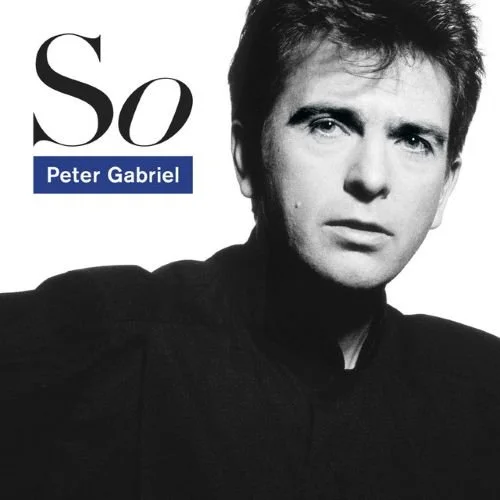
Peter Gabriel’s So at Forty
__________
ONE of the all-time…
greatest albums ever turns forty on 19th May. Peter Gabriel’s So is his fifth studio album. Many consider it to be his best. In terms of the quality of the songwriting throughout, it is undoubtably a masterpiece. Big Time, Sledgehammer, Red Rain, In Your Eyes and Don’t Give Up. The album reached the top of the charts in the U.K. and was a massive chart success all around the world. I do hope that there is a lot of celebration around the fortieth anniversary. If some critics felt Gabriel was too commercial and it was following what was popular during that time – rather than being distinct and original -, others noted how Gabriel transformed from being this cult to commercial artist without losing his brilliance and authenticity. After a run of albums more experimental, this was Gabriel making music that was perhaps more accessible but extraordinary. It happened with other artists during the 1980s who were releasing more experimental or less commercial albums then changed. Maybe because of the label, or the feeling that they needed to put something out that would sell more. Gabriel did not compromise or water his music down. The fusion of genres and the production is unlike anything else that was around in 1986 I feel. So still sounds fresh and relevant. Not dated at all. In 2012, Peter Gabriel spoke with Rolling Stone about So. That was a year when he played the album in full on stage:
“Why do you think So managed to reach a much broader audience than your previous albums?
There was less sort of esoteric songwriting. I think they were simpler songs in some ways, but I think we caught a wave. They were done with passion and we had a really good team working on them. Then, of course, we had things like the “Sledgehammer” video, which helped enormously. It got us a wider audience. Also, the one concession I agreed to was to place an actual photo of myself on the cover rather than the usual obscured stuff I had been doing.
You also gave this one an actual title.
It was named, yeah. That was a reluctant choice. In the old days I would go through my vinyl and identity each record by the picture, not by the title. I always liked that. In some ways, I’m just a visual person. It was the idea to just do away with titles. Give the pictures space to breathe and speak for themselves. But, of course, it caused confusion in the marketplace. The American record company, Geffen, got so fed up with me that they said they weren’t going to release my fourth record unless I gave it some title. So, it was called Security in America and it had no title everywhere else in the world.
When you made So, did you try and make it more accessible, or that was just sort of a natural development?
I think that was a bunch of songs that were there at the time. With “Sledgehammer,” everyone thinks, “Oh, he must have created that to get a hit.” And it wasn’t done that way. In fact, [bassist] Tony Levin reminded me that he was packing his bags to go home, and I called him back into the studio, saying “I’ve got this one idea that maybe we can fool around with for the next record – but I like the feel.” That was “Sledgehammer.” It was late in the day and we just fell into the groove, landed a beautiful drum track on it, a great bass line and it all came together.
I think the video really helped get it to a different audience. I’ve not had many intersections with mass culture, so that was one occasion where that happened.
Did you see “In Your Eyes” as a special song when you made it?
I knew it had some heart in it, and I loved the Youssou N’Dour bit at the end. We should have put out the longer version, but we had to cut it ’cause of time constraints. But it felt so heartfelt and, yeah, I I felt it was a special song, the like of which I hadn’t heard before in the way it integrated the different influences and tried putting together this love lyric, which was, in part, based on this African idea of having an ambiguous love song that can be human love, man to woman, or man to God.
You didn’t release a follow-up to So for six years. Do you think that was a mistake? You sort of lost some momentum there.
I’m sure commercially it wasn’t the smartest thing to do, but I’ve never really worried about that. And to be honest, I think one of the reasons I’m still lucky enough to put out records and have audiences come to shows is cause I haven’t played that game very well. I think that consumer culture tends to be very hungry. It can’t get enough of you for a very short time and then your taste gets boring and they spit you out and take the next new thrill. And so, while it was never a predetermined strategy, I would probably recommend it to artists now if they want a long career. If you got something worth saying, if you’ve got something to put out, don’t worry about what the record company tells you. Take your time”.
In May 2021, Albumism wrote about So on its thirty-fifth anniversary. Even if this album was less experimental than his previous work, there are still styles, sounds and genres mixed together that you were not getting on other albums at the time. Peter Gabriel able to perfectly balance something that can appeal to stations and T.V. and also speak to his existing fanbase:
“Gabriel began recording So with producer Daniel Lanois in 1985 at his home studio. Although the songs were less experimental, he fused African and Brazilian styles with the elements of his art rock past, and the end results were something magical. He managed to perform the difficult task of staying true to his style of music while making the album more listenable to a wider audience.
For better or worse, the popularity of So was buoyed by the release of the album’s first single “Sledgehammer.” It was accompanied by, at the time, a groundbreaking, multiple MTV Award winning music video. “Sledgehammer” was released a month before the album and ironically it was the last song recorded for the album. Gabriel refers to the song as an homage to the music that he grew up with and his all-time favorite singer, Otis Redding. To capture the feel of the late ‘60s Stax recordings, Gabriel used trumpeter Wayne Jackson, member of The Memphis Horns, who toured with Redding. Legend has it that Jackson recorded his trumpet solo in just one take.
Upon hearing “Sledgehammer” for the first time, I was curious about what the rest of the album would sound like. I thought most of the songs would be in a similar vein, but I was pleasantly surprised when I put the needle down on the record and I heard the opening cymbals (courtesy of Stewart Copeland) on “Red Rain.” Who knew that a song about torture, kidnapping, and parting red seas could sound so amazing. Gabriel has stated that the song is also the continuing story of Mozo, a character from his first two albums.
The third track, “Don't Give Up,” is a political statement decrying the rising unemployment that prevailed during Margaret Thatcher’s time as Prime Minister of England. It also has a very interesting story attached to it. When Gabriel wrote the song, his original intent was to have it be a duet with Dolly Parton. When Parton declined, Gabriel turned to his friend Kate Bush, who immediately agreed to sing the song. As much as I would have loved to hear Parton's vocal on the song, Bush's delicate reading creates a undeniable sense of beauty that makes the song work.
The running order for So has regrettably changed over the years. When it was first released, the opening track on side two (or track 5 for you CD owners) is the timeless “In Your Eyes.” The song is also famously featured in the 1989 movie Say Anything and features the iconic image of Lloyd Dobler (played by John Cusack) holding up a boombox while this song is emanating from it. Gabriel has said that he and Cusack "were sort of trapped together in a minuscule moment of contemporary culture." The song is also noteworthy for the powerful singing of Youssou N'Dour.
After 35 years, So has sustained the reputation of a great album that does not sound the least bit dated by 1980s production values. Rolling Stone placed it at #187 in its original list of the 500 greatest albums of all-time and at #14 in the 100 Best Albums of the ‘80s. It catapulted Gabriel into international superstardom. At one time, “Sledgehammer” was the most played music video in the history of MTV, but Gabriel's talent and influence is so much greater than just that video”.
In 2024, PROG told the story of So. Maybe Peter Gabriel felt that he was no longer able to remain where he was in terms of recognition and popularity. Having to make a break towards the mainstream. Rather than selling out, this was an album that he needed to make. One that is widely regarded as one of the best ever. So inventive and timeless. Such a broad range of songs:
“Don’t Give Up is arguably Gabriel’s most powerful statement. In 1981, Margaret Thatcher’s Employment Secretary Norman Tebbit infamously used an analogy about his father being out of work in the 30s, and instead of rioting, he got on his bike and looked for work. This became interpreted popularly as telling the unemployed to ‘get on their bike’ to find a job. Gabriel’s tale of a dispirited man at the end of his tether looking for work touched a raw nerve with millions of listeners in the UK and, latterly, the world. The song, with Gabriel’s despair in the verses and Bush’s words of hope in the chorus, has gone on to be arguably Gabriel’s most loved composition.
After such high drama, That Voice Again is a beautiful, Byrds-like pop song that often gets overlooked amid the album’s plentiful highlights. Originally entitled First Stone, it sounds almost as if Gabriel had taped one of the therapy sessions that he had been going through. Musically, it’s relatively simplistic, with Rhodes playing jangling Rickenbacker over the rhythm section of drummer Manu Katché and bassist Tony Levin.
Mercy Street was another standout. Gabriel had been reading the work of American poet Anne Sexton after having become interested in her work through the book To Bedlam And Part Way Back. Sexton had committed suicide at the age of 45 in 1974, leaving a slender yet highly confessional body of work, and the gentle, lilting rhythm of Gabriel’s song supports lyrics that allude to this. Percussion for the track was recorded by Gabriel in Rio de Janeiro by seasoned player Djalma Correa. With its deeply reflective tone and affecting vocal, Mercy Street became one of Gabriel’s most popular numbers and a staple of his live set.
Big Time was a sardonic reflection on the music business. It takes the opposite viewpoint of the Jacob character in I Know What I Like (In Your Wardrobe); it was time, after all, to try for that future in the fire-escape trade. Gabriel wrote the lyrics examining the dichotomy of his character, and perhaps realising it was fame he craved after all. The track was an obvious choice for a later single from the album in the UK, and the second single in the US, where it reached Number 8. Clean cut and funky, this was clearly how the States liked their Gabriel.
We Do What We’re Told (Milgram’s 37) had been around for a considerable period, originally recorded as far back as 1980’s Melt and seriously in the running for 1982’s Security. As it is, it sounds like the last link with that era. Strange, undercooked and difficult, it was about Professor Stanley Milgram’s social psychology experiment from 1961: volunteers assessing how far they would be prepared to follow an authority figure, even if it was in complete opposition to their conscience or their views. Gabriel explored how people are conditioned to believe in dictators and support war. With its patter of Jerry Marotta’s processed drums and L Shankar’s squalls of violin, and two overdubbed guitar tracks by Rhodes, it’s a disquieting interlude, proving to Gabriel’s new-found audience that it was still within his power to unsettle.
This Is The Picture (Excellent Birds) was adapted from the track Gabriel had written with Laurie Anderson for her Mister Heartbreak album. On it, he worked again with Nile Rodgers.
“I recorded my part in New York,” Rodgers recalled. “In those days I was gigging, and that was the height of my life. Sometimes it’s hard for me to remember what studio, what work, where I was. I loved that sound that Daniel got.”
What Gabriel wanted Rodgers to do was to add his remarkable, rhythmical guitar playing to another skeletal idea, and one that had been inspired by the Korean video artist Nam June Paik, who used to make TV shows. He had asked Laurie Anderson and Peter Gabriel if they would like to collaborate, and they worked quickly to produce this groove.
The album closed with another of Gabriel’s most loved songs, In Your Eyes, originally titled Sagrada Familia, inspired by the cathedral in Barcelona. Alluding to Antoni Gaudí and rifle heiress Sarah Winchester, the song was multi-layered and deeply affecting. The power of the track was made real by the stunning guest vocal performance from Youssou N’Dour, who sings in his native language, Ouoloff. In Your Eyes was featured dramatically in the Cameron Crowe film Say Anything in a sequence when protagonist Lloyd Dobler (John Cusack) plays it loudly from a ghetto blaster.
So was released on May 19, 1986. Sledgehammer was issued shortly before it and put Gabriel squarely into the charts and hearts of millions. With its Brothers Quay/Aardman Animation video, Gabriel showed that, after all, he was a song and dance man. Here was the flower-headed pipecleaner of Willow Farm, vamping it up for the MTV generation.
The video was a viral sensation long before such things existed. The single reached the top spot in the US. Gabriel was delighted. The most affectionate homage to the music that originated from deep within America, here was almost the ultimate tribute. An introverted white boy from a privileged British background convincingly interpreting the music of the impoverished, segregated south of America. And somehow, it not only worked, but absolutely nailed it.
So, just funky enough, just obscure enough, just nostalgic enough, fitted perfectly with the CD generation. Gabriel began to attract a breed of listener that welcomed him as a ‘new artist’. This was liberating but would ultimately prove constraining. Although a super-slick short single had always been part of Gabriel’s oeuvre, how willing would this new audience be when he was experimenting?”
I am going to finish with a review of So from AllMusic. There was quite a shift in mood from 1982’s Peter Gabriel (Peter Gabriel 4: Security). As it turns forty on 19th May, I know there will be some fresh features and reviews around So. You hear songs from So played widely to this day:
“Peter Gabriel introduced his fifth studio album, So, with "Sledgehammer," an Otis Redding-inspired soul-pop raver that was easily his catchiest, happiest single to date. Needless to say, it was also his most accessible, and, in that sense it was a good introduction to So, the catchiest, happiest record he ever cut. "Sledgehammer" propelled the record toward blockbuster status, and Gabriel had enough songs with single potential to keep it there. There was "Big Time," another colorful dance number; "Don't Give Up," a moving duet with Kate Bush; "Red Rain," a stately anthem popular on album rock radio; and "In Your Eyes," Gabriel's greatest love song, which achieved genuine classic status after being featured in Cameron Crowe's classic Say Anything. These all illustrated the strengths of the album: Gabriel's increased melodicism and ability to blend African music, jangly pop, and soul into his moody art rock. Apart from these singles, plus the urgent "That Voice Again," the rest of the record is as quiet as the album tracks of Security. The difference is, the singles on that record were part of the overall fabric; here, the singles are the fabric, which can make the album seem top-heavy (a fault of many blockbuster albums, particularly those of the mid-'80s). Even so, those songs are so strong, finding Gabriel in a newfound confidence and accessibility, that it's hard not to be won over by them, even if So doesn't develop the unity of its two predecessors”.
Such a phenomenal album that created this huge success for Peter Gabriel, he followed So with 1992’s As. Whilst not as acclaimed as So, it was another terrific album from Peter Gabriel. That gap of six year between albums. After the huge success of So, one might have thought he would follow it up more quickly. However, that does not take away from what he created with So. It has been great exploring…
A classic album.