
FEATURE:
Roll Up…
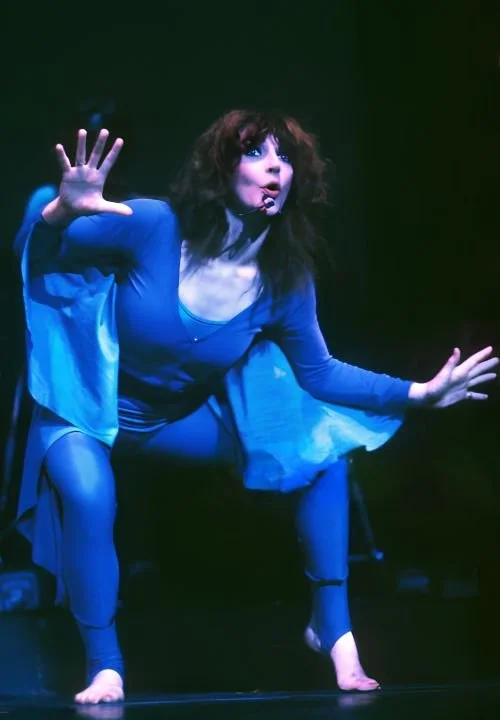
IN THIS PHOTO: Kate Bush performs on stage for The Tour of Life at Carre, Amsterdam, Netherlands on 29th April, 1979/PHOTO CREDIT: Rob Verhorst/Redferns
Kate Bush’s The Tour of Life at Forty-Seven
__________
IT was sort of like…
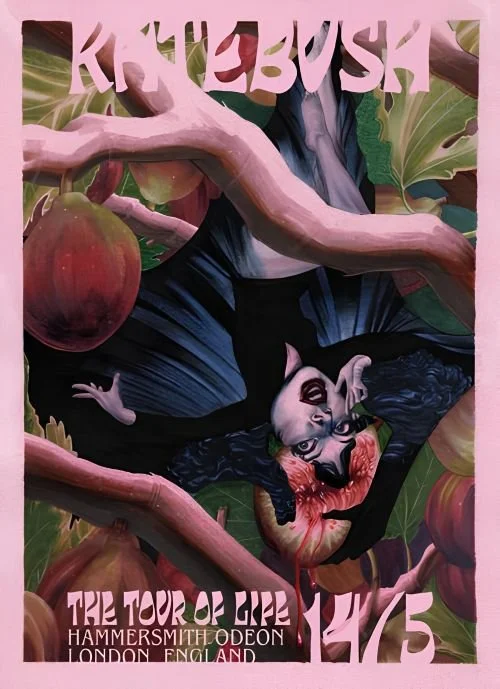
The Beatles’ Magical Mystery Tour. Kate Bush and her crew and players travelling across the U.K. and Europe for The Tour of Life in 1979. It was her one and only tour. Because the warm-up gig was on 2nd April, 1979, I want to mark forty-seven years of this spectacular. It is the build-up of the events leading to the first show that are of particular interest. I will draw in a feature I have included before. I am going to turn to Graeme Thomson’s Under the Ivy: The Life and Music of Kate Bush. There was a lot of preparation and build-up. To draw everything together, it was a huge process. However, given the rapturous reception from critics and the adoring crowds, it was a massive success. However, it did lose Kate Bush money, as she had to invest in it. EMI only put up a certain amount of money, but because the show was more ambitious and larger than the label could budget for, Bush had to put her own money in. I don’t think there had been any live tour like this like Kate Bush’s 1979 triumph. In terms of combining magic, mine, poetry and dance together with music, it was almost like a theatrical production rather than a traditional concert. Graeme Thomson suggests how there were elements of Guys and Dolls and Wacky Races. Seduction, cartoonish energy and trench-coated gangsters. Aspects of musicals and films. Thirteen people on stage and seventeen costume changes. A lot hinged on this tour. After two albums and all of this press attention and success, it could have failed. In terms of it being accessible and popular but also spectacular, the balance was just right. From the costumes and sets and lighting, through to the cuisine for the show, Bush was calling most of the shots. She was still only twenty!
It is amazing that she had the energy and maturity and focus to make sure that The Tour of Life was something truly different and representative of her. Although the first show was at the Liverpool Empire on 3rd April, 1979, there was a warm-up gig in Poole the night before. Maybe there was expectation that Bush would regularly tour and this was the first chapter. However, it was not until 2014 for Before the Dawn when she would embark on another large-scale live production. Perhaps there was something to prove after her second album, Lionheart, did not get great reviews. The Tour of Life was partly a sort of contractual obligation and what was expected. However, Bush wanted to make it both spectacular and exciting but also something she was in control of because she did not have too much say or production input into her first two albums. Hilary Walker, head of EMI’s international division, helped crack Bush’s music outside of the U.K. Bush asked Walker to leave EMI and work with her. Not strictly her manager, Walker handled a lot of the day-to-day stuff and was this tough and straight-talking person who was there to intercept any unwanted request and make decisions that were not important or essential, as Bush was busy preparing this important tour. Whilst Bush still had some promotion in 1979 and she performed Wow in Italy and Switzerland, she was clearing a path between Lionheart and The Tour of Life. Being this successful and public artist, Bush was offered opportunities and acting roles. Two roles in horror films (one as a vampire). The opportunity to sing the theme to the James Bond film, Moonraker (which went to Shirley Bassey) – which Bush did not feel she was right for -, she did briefly pop into the studio in February 1979 to record Magician for The Magician of Lublin, Menahem Golan’s interpretation of Isaac Bashevis Singer’s 1960 novel. Most of the focus, however, was on preparing for the tour.
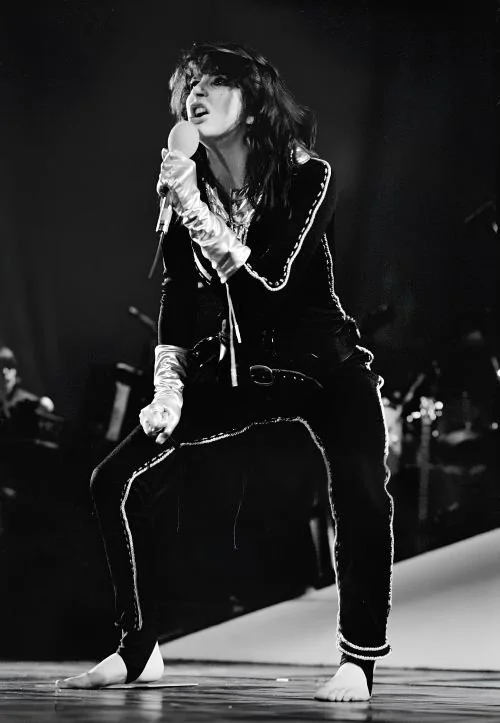
IN THIS PHOTO: Kate Bush performing at the Falkoner Centre (Falkoner Centret) in Copenhagen, Denmark on 26th April, 1979 during The Tour of Life/PHOTO CREDIT: Jorgen Angel/Redferns
Bush hated seeing gigs where bands would play the songs and just walk off. If most of her live performances to this point were quite limited in terms of what she could do on stage and how dynamic they would be, The Tour of Life afforded her the chance to be more ambitious and cinematic. 2014’s Before the Dawn was less alienated in terms of the experience of a live concert and what was around it. Other artists putting out these big and multi-faceted performances that mixed different visual elements, sets and costumes. In 1979, there was a lot of Punk and New Wave. The concerts were very basic and not concerned with stimulating the senses of being this multi-layered visual and audio experience. The tour was meant to start in March 1979, but it was pushed back as Bush needed more time for it to all come together to her satisfaction. Bush started preparation for The Tour of Life in Christmas 1978. Set designer David Jackson met Bush at EMI’s offices to discuss the tour and sets. She was surrounded by management types and, though he prepared this portfolio for her to look at, Bush very much took the lead. It was a bit looser than he imagined and a bit impromptu and freewheeling. Despite a slightly chaotic feel and a lack of solid direction, Jackson was won over. He met Bush at East Wickham Farm in early January to discuss the set and lighting. Even if Bush was not exactly clear with her vision and directions, she was full of ideas. Bursting with ideas and enthusiasm, it wads a case getting it all done and making it make sense! Working with wardrobe assistant Lisa Hayes for the costumes, there was also the issue of getting the musicians together. Brian Bath, Paddy Bush (her brother) and Del Palmer (her boyfriend) were in the fold, having not really been part of her first two albums – Paddy was on The Kick Inside, but Lionheart was the second where producer Andrew Powell used the musicians he wanted –, and they were core to the sound and feel of the show. The band grew larger, and it was amazing she managed to balance things and did not burn out. The band were drilled for three months so things came together. Bush worked through January and February with choreographer Anthony Van Laast on routines at The Place in Euston. This was the most collaborative aspect of the tour, as Bush was still learning dance and did need a lot of direction and input from Van Laast.
There was the matter of the set being built. I think that took about six weeks to all form. Graeme Thomson notes how, in March 1979, things moved to The Show’s sound stage at Shepperton Film Studios. “Huge mirrors were installed at the back of the room so everyone onstage could see what was going on and how they were projecting themselves”. The musicians could see the dance and dancers. The world of music and arts/theatre coming together. Its thirteen musicians, like Del Palmer, who wondered what was happening and what they had got themselves in for! I have skipped some details regarding the nuts and bolts. However, it is clear how involved Kate Bush was and what was at stake. She put so much of her time into The Tour of Life. It was the cost of the tour that is eye-watering. Up to £250,000 in 1979 (around 1.4-1.6 million in today’s money), EMI only put up “token support funds”. Having made the label so much money, it is shocking Bush basically had to fund everything. I am not sure what they had in mind for the tour with the meagre money they stumped up! Maybe they felt a four-piece shuttled in a van was going to be what we were dealing with. However, a whole cast and crew and all this set and lighting was more realistic. There were constant battles regarding negotiating a bigger budget. The cast and crew tired before things even started! However, things had been rehearsed and everything was set for 2nd April at Poole Art Centre in Dorset. Bush was not performing for the media and their approval; it was to prove to herself she could do this and realise her expectations. The first official night – 3rd April, 1979 in Liverpool – was one of the biggest and most important (and divisive) live events ever. On 3rd April, 1979 at the Liverpool Empire Theatre, the BBC’s Bernard Clark noted how there were conflicting emotions and this unsettling mood. Not knowing whether it would be a mad and unfocused mess or a funeral. Kate Bush herself was terribly nervous and Brian Southall, representing EMI, was flying the company flag and not sure what would lie in store.
Performing every song from The Kick Inside and Lionheart (both 1978) bar Oh to Be in Love, the reviews and audience reaction spoke for itself! The relief that this exceptional and unique live extravaganza had not only come together but seemed seamless and fully-formed from that first night. Kate Bush, with her team and crew, had pulled off something truly unheard of and seismic! I have not even mentioned how she managed to deliver this triumphant performance on 3rd April, 1979, considering how the night before, after the warm-up show in Poole, Bill Duffield was killed. He was the lighting director who tragically died after the show when he was racing around the venue to see if any clothes, bags and items had been left behind before everything was shut down. He fell through a gap in the flooring onto hard concrete. Someone had left a panel open. Faced with whether to cancel the tour or carry on, she had all that on her shoulders and in her heart and she had to go on and look unaffected and professional. Truly one of the most astonishing acts of resilience, professionalism and bravery in live music history! Forty-seven years later and you can feel and see the influence of The Tour of Life today. Major Pop artists and how they are combining multimedia aspects and multiple costume changed. Bush was not the first to do this, though she was one of the first female Pop artists to do so. Madonna definitely influenced by her. Taylor Swift and some of the biggest artists ever. The legacy Bush left, having invested huge amount of money and fought so hard to get her visions and concepts realised! I am ending with snippets of this feature from PROG that was published last year. The fact that it took five months to pull together and Bush could not write new material is perhaps a major reason it was her only tour – and it took thirty-five years before she was on the stage with Before the Dawn:
“I saw our show as not just people on stage playing the music, but as a complete experience,” she later explained. “A lot of people would say ‘Pooah!’ but for me that’s what it was. Like a play.”
Indeed it was – or perhaps several plays in one. On Egypt, she emerged dressed as a seductive Cleopatra. On Strange Phenomena, she was a magician in top hat and tails, dancing with a pair of spacemen. Former single Hammer Horror replicated the video, with a black-clad Bush dancing with a sinister, black-masked figure behind her, while Oh England My Lionheart cast her as a World War II pilot.
Like every actor, she was surrounded by a cast of strong supporting characters. As well as dancers Stewart Avon Arnold and Gary Hurst, several songs featured Drake, who performed his signature ‘floating cane’ trick during L’Amour Looks Something Like You. And then there was John Carder Bush reciting his poetry before The Kick Inside, Symphony In Blue (fused with elements of experimental composer Erik Satie’s Gymnopédie 1) and the inevitable encore, Wuthering Heights.
But at the heart of it all was Bush, whirling and waving, reaching for the sky one moment, swooping to the floor the next. Occasionally she looked like she was concentrating on what was coming next. More often, she looked lost in the moment.
“When I perform, that’s just something that happens in me,” she later said. “It just takes over, you know. It’s like suddenly feeling that you’ve leapt into another structure, almost like another person, and you just do it.”
Brian Southall was in the audience at the Liverpool Empire. Despite the fact he worked for EMI, he had no idea what to expect. “You just sat in the audience and went, ‘Wow’. It was extraordinary. Bands didn’t take a dancer onstage, they didn’t take a magician onstage, even Queen at their most lavish or Floyd at their most extravangant. They might have used tricks and props in videos, but not other people onstage.
“That was the most interesting thing about it – her handing it over to other people, who became the focus of attention. That’s something that never bothered Kate – that ‘I will be onstage all the time and you will only see me.’ It was like a concept album, except it was a concept show.”
Two and a quarter hours later, this ‘concept show’ was done and the real world intruded once again. If there was any sense of celebration afterwards, then the main attraction was keeping it to herself. “I remember sitting in the bar after the show at Liverpool and Kate wasn’t there. She was with Del,” says Southall. “She wasn’t an extrovert offstage. There were two people. There was that person you saw onstage, in that extraordinary performance, and then offstage there was this fairly shy, reserved person.”
Her reluctance to indulge in the usual rock’n’roll behaviour was both characteristic and understandable. It was a draining performance, night after night as the tour continued around Britain and then into Europe. It was hard work for everyone involved.
“We went out, but not exceptionally,” says Stewart Avon Arnold. “We weren’t out raving until seven o’clock in the morning on heroin. There’s no way we could have done the show the next day.”
They occasionally found time to let their hair down. The Sunday Mail reported that certain members of the touring party indulged in a water-and-pillow fight at a hotel in Glasgow, causing a reported £1,000 damage. EMI allegedly agreed to foot the bill, though they stressed that the singer wasn’t present during this PG-rated display of on-the-road carnage.
After 10 shows in mainland Europe, the tour returned to London for three climactic dates at the Hammersmith Odeon between May 12 and 14. The second of these shows was arranged as tribute to the late Bill Duffield. Bush and her band were joined onstage by Peter Gabriel and Steve Harley. The pair tackled various Bush songs (Them Heavy People, a renamed The Woman With the Child In Her Eyes) and played their own songs (Gabriel’s Here Comes The Flood and I Don’t Remember, Harley’s Best Years Of Our Lives and Come Up And See Me), before everyone came onstage for a cover of The Beatles’ Let It Be.
“Kate asked us all to come and sing with Peter and Steve,” says Avon Arnold. “We were onstage, singing chorus with these two icons. And I’m not a singer. It was an emotional night.”
48 hours later, the tour was over. And so was Kate Bush’s career as a live artist – at least for another 35 years”.
More than it being Kate Bush’s sole tour, The Tour of Life was a revelation and true first! As one of her dancers, Stewart Avon Arnold revealed for that 2025 feature: “She’s an innovator. She did things that had never been done before. She was the first one in this country to merge creative rock music with creative dance. She didn’t have a genre. She had a mentality”. Forty-seven after The Tour of Life started its run and wowed crowds, you can feel how it revolutionised live performance. Its mark being made on Pop tours to this very day. Something that is…
TRULY mind-blowing to behold.