FEATURE:
Smile Away
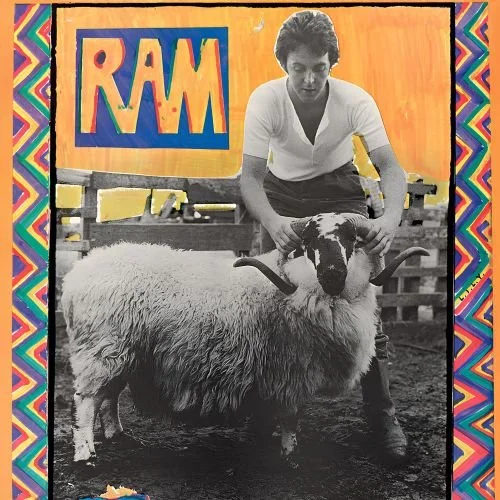
Paul and Linda McCartney's RAM at Fifty-Five
__________
THERE have been various…
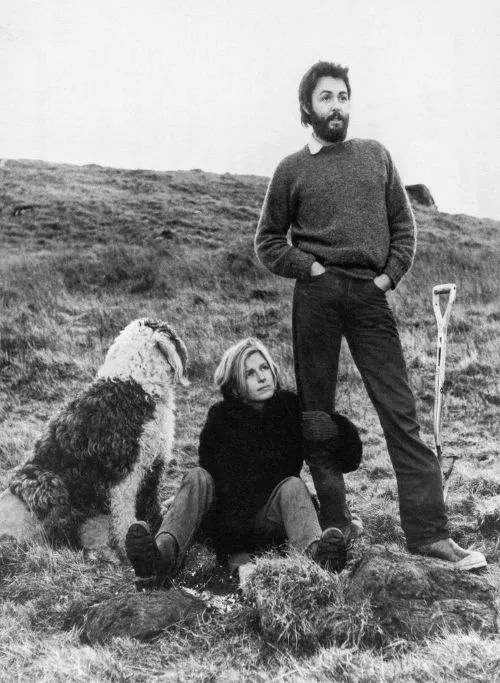
IN THIS PHOTO: Linda and McCartney in 1971/PHOTO CREDIT: Daily Record
incarnations of Paul McCartney’s career. As part of The Beatles, Wings and as a solo artist. However, the Paul McCartney and Linda McCartney partnership is perhaps the most unknown and best. RAM is the only album credited to each of them, in spite of the fact that Linda McCartney worked on several of her husband’s albums. It turns fifty-five on 17th May. Before getting to some features about this incredible album, here are some notes and a bit of background:
“The only album credited to both Paul and Linda McCartney, RAM reached Number 1 in the UK and stayed in the US Top 10 for five months. Recording after he’d left The Beatles and before the formation of Wings, Paul initially flew with Linda to New York to record the songs they'd written but arrived without a band. As Paul recalls, “We were thinking of forming a group at that time, Wings. We went to New York, found a really grotty little basement somewhere and auditioned a bunch of people. We got someone to throw a lot of drummers at us, out of which we picked Denny Seiwell who’s one of the best, and his personality fitted. Then we went in, worked with him, Hugh McCracken, Dave Spinozza, a couple of New York session men, and did RAM.” To avoid arousing too much interest, the auditions were held under the guise of a session for a commercial jingle. As well as Paul’s lead vocals there are harmonies from Linda. “I gave her a hard time, I must say, but we were pleased with the results. Elton John later said somewhere that he thought it was the best harmonies he’d heard in a long while. It was very much the two of us against the world at that point.” Despite an initially lukewarm Rolling Stone review, it was later hailed by them as one of his best solo albums. In 2012, RAM was reissued in remastered form with many extra elements, as part of the Paul McCartney Archive Collection.
Performed by Paul & Linda McCartney with Denny Seiwell, Dave Spinozza & Hugh McCracken
Tracks 1, 2, 3, 6, 11, 12 composed by Paul McCartney
Tracks 4, 5, 7, 8, 9, 10 composed by Paul & Linda McCartney
Produced by Paul and Linda McCartney
1993 reissue: Tracks 13 (‘Another Day’) & 14 (Oh Woman, Oh Why’) produced by Paul McCartney
Sound Engineers: Tim, Ted, Phil, Dixon, Armin & Jim
Mixing Engineer: Eirik the Norwegian”.
I am going to lead to a review from 2012. Pitchfork reviewed the reissue of RAM and provided some interesting insights. In 1971, there was still a lot of animosity around Paul McCartney. People blaming him for the break-up of The Beatles. His debut solo album, 1970’s McCartney, was hammered. Even though RAM is a masterpiece, there was this negativity because it was a Paul McCartney album:
“Sometimes an album gets a review so resoundingly negative that it lurks forever like a mournful spirit in its rear view mirror: Jon Landau, writing for Rolling Stone, claimed to hear in Ram "the nadir in the decomposition of Sixties rock thus far." Which is intense. But people wanted impossible things from Beatles solo albums-- closure, healing, apologies, explanations for what to do with their dashed expectations. John Lennon tried telling everyone outright "The dream is over" on Plastic Ono Band's "God", but that still wasn't a cold-water jet hard enough to prepare people, apparently, for the whimsical pastoral oddity that was Ram.
Landau was right, however, that it did spell the end of something, which might be a clue to the vitriol: If "60s rock" was defined, in large part, by the existence of the Beatles, then Ram made it clear in a new, and newly painful, way that there would be no Beatles ever again. To use a messy-divorce metaphor: When your parents are still screaming red-faced at each other, it's a nightmare, but you can still be assured they care. When one of them picks up and continues on living, it smarts in an entirely different way.
Ram, simply put, is the first Paul McCartney release completely devoid of John's musical influence. Of course, John wiggled his way into some of the album's lyrics-- in those fresh, post-breakup years, the two couldn't quite keep each other out of their music. But musically, Ram proposes an alternate universe where young Paul skipped church the morning of July 6, 1957, and the two never crossed paths. It's breezy, abstracted, completely hallucinogen-free, and utterly lacking grandiose ambitions. Its an album whistled to itself. It's purely Paul.
Or actually, "Paul and Linda." This was another one of Paul's chief Ram -related offenses: He not only invited his new photographer bride into the recording studio, he included her name on the record's spine. Ram is the only album in recorded history credited to the artist duo "Paul and Linda McCartney," and in the sense that Linda's enthusiastically warbling vocals appear on almost every song, it's entirely accurate. Some read Paul's decision as the ultimate insult to his former partner: I've got a new collaborator now! Her name is Linda, and she never makes me feel stupid. In the album's freewheeling spirit, however, the decision scans more like guilelessness and innocence. The songs don't feel collaborative so much as cooperative: little schoolhouse plays that required every hand on deck to get off the ground. Paul had the most talent, so naturally he was up front, but he wanted everyone behind him, banging pots, hollering, whistling-- whatever it is you did, make sure you're back there doing it with gusto.
It is exactly this homemade charm that has caught on with generations of listeners as the initial furor around the album subsided. What 2012's ears can find on Ram is a rock icon inventing an approach to pop music that would eventually become someone else's indie pop. It had no trendy name here; it was just a disappointing Beatles solo album. But when Ben Stiller's fussy, pedantic "Greenberg" character painstakingly assembles a mix for Greta Gerwig intended to display the breadth and depth of his pop-culture appreciation, he slides Ram 's "Uncle Albert/Admiral Halsey" on there. It's the song we see her singing along to enthusiastically in the following montage.
Critics hated "Uncle Albert". "A major annoyance," Christgau opined. Again, from the current moment we can only plead ignorance, assume that some serious shit had to be going down to clog everyone's ears. Because "Uncle Albert/Admiral Halsey" is not only Ram 's centerpiece, it is clearly one of McCartney five greatest solo songs. As the slash in the title hints, it's a multi-part song, starring two characters. To put its accomplishments in an egg-headed way: It fuses the conversational joy listeners associated with McCartney's melodic gift to the compositional ambition everyone assumed was Lennon's. To put it a simpler way: Every single second of this song is joyously, deliriously catchy, and no two seconds are the same. Do you think early Of Montreal, the White Stripes at their most vaudevillian, or the Fiery Furnaces took any lessons from this song?
What a lot of people thought they heard on "Uncle Albert/Admiral Halsey", and everywhere else on the album, is cloying cuteness. But it turns out you can say a lot of things-- things like "go fuck yourself" ("3 Legs"), "everything is fucked" ("Too Many People"), and even "let's go fuck, honey" ("Eat At Home)"-- with a big, dimpled grin on your face. "It's just the critics who say, 'Well, John was the biting tongue; Paul's the sentimental one,'" Linda observed shrewdly in a dual Playboy interview from 1984. "John was biting, but he was also sentimental. Paul was sentimental, but he could be very biting. They were more similar than they were different”.
This review from 2021 also highlights the vitriol aimed at RAM. Even Ringo Starr dismissed it. Saying there were no tunes on RAM, and feeling McCartney was getting weird. Fifty-five years after its release and the magic and sheer brilliance of RAM has not dimmed. A huge critical shift and retrospective positivity:
“Fifty years on from its release, the album is now being held aloft beneath the spotlight and readily proclaimed a classic. Still simple but now “relevant”, “revealing” and “austere”, an endearing snapshot of the time, and of a singer’s circumstance. It has taken time, Lord knows it has taken time, but this collection of songs is now seen and loudly credited for those very same joke-filled, shuffling and spontaneous lyrics to a loving young family that had rescued a tortured man from unrelentingly dark hours, and from the bottom of a bottle.
“The break-up had its effect on me,” Paul revealed later. “I took to the booze. I was trying to recover in whatever way I could.”
Remnants of those dark and unrelenting hours still managed to seep through somewhere though, as thinly-veiled barbs and none-too-subtle digs at his one-time friends and now former bandmates being torn apart by money-fuelled arguments and the endless rounds of high court meetings; four friends now angrily and hungrily picking very publicly over the bones of their joint creation and legacy. And, as a testament to all of this, RAM now stands alone, although suddenly proud. As the sole McCartney album credited equally to both Paul and Linda McCartney. As a family’s scrapbook of lyrical snapshots from a life together, far away from all the madness and recriminations, and of an artist waiting to be rediscovered within the sanctity of a sprawling farm hidden far away from prying eyes in remotest Scotland.
“If Linda hadn’t got on his case,” drummer Denny Seiwell told Tom Doyle for MOJO magazine, “RAM never would’ve been made.”
“She just eased me out of it,” MOJO reports McCartney as saying of that time, “and sort of said, ‘Hey, y’know, you don’t want to get too crazy.’ And made me feel a lot better. And then I moved again into music therapy, which was RAM…”
With each song, cathartically penned and reworked between the daily chores demanded by a working farm and a young growing family, and demoed at night, single-handedly, in a homemade studio that was little more than a simple “lean-to” propped up against an old out-house but containing a favourite four-track machine, McCartney began to rediscover his joy. He began to sober up, “to heal”. He began to emerge from the shadows of The Beatles, from the ties that bound him to John, George and Ringo and from the debris of all the legal wrangling that had threatened to bury him.
“I suppose I was just letting myself be free,” he would admit later to Tom Doyle.
In New York, fulfilling an ambition and finally managing to record in the U.S., something The Beatles had never done, and working with a new band comprising of David Spinozza, who had been recruited personally by Linda, Hugh McCracken and drummer Denny Seiwell, who would later join Wings, the recording sessions for RAM began on the 18th October 1970, and saw everyone enveloped within a family atmosphere, Paul and Linda’s daughter Mary content in a playpen installed in the control room of Columbia Record’s Studio B.
“Immediately what dawned on me was how good the songwriting was,” Spinozza tells MOJO.
“It was some of the best stuff that he did – definitely since leaving The Beatles,” Denny Seiwell revealed to Classic Rock.
The album opens with the track ‘Too Many People’, throughout which McCartney’s feelings begin to form and take shape, rising bitterly to the surface and aimed specifically towards his one time writing partner, John Lennon; the track famously beginning, apparently, with the words, “piss off”, sung in a whisper just above an otherwise slightly psychedelic intro, although now, Paul insists that he actually sings, “piece of cake”.
“And hey,” he tells Doyle, “come on, how mild is that?” And of the lines, “Too many people preaching practices…” and “you took your lucky break and broke it in two”?
“I felt that was true of what was going on. ‘Do this, do that.’” Now it seems as though Paul would not have cared so much if all the “preaching and the practices” he saw coming from those advising John, George and Ringo, namely Allen Klein, had been wise. But, according to The Beatles’ former business associate, Peter Brown, Lennon strongly believed that several songs, including ‘Too Many People’ and ‘Dear Boy’ had been aimed directly towards him and Yoko Ono, whilst both George and Ringo interpreted the song ‘3 Legs’ as attacks directed at them and John, especially the lines, “My dog he got three legs, But he can’t run”, and “I thought you was my friend, But you let me down”. The small image of two beetles, strategically placed on the back of an otherwise simple album cover, would only help to add to all these pent-up feelings of frustration, mistrust and recrimination, to what fans read and heard as barely hidden innuendoes.
One track that McCartney insists had nothing to do with Lennon though, is ‘Dear Boy’. Instead, he says, it was written to Linda’s first husband, who, as Paul sings, didn’t realise quite, “how much you missed”. But, the songs had been pored over endlessly by former bandmates, fans and critics alike, and the interpretations and lasting first impressions had been made, rightly or wrongly. And it was the songs ‘Too Many People’ and ‘Another Day’, the single released just before RAM, that Lennon would soon respond to directly, his track ‘How Do You Sleep’ famously including his own bitter observation that: “The only thing you done was yesterday, And since you’ve gone you’re just another day”. There would be no disguising who that was aimed at.
“Those freaks was right when they said you was dead, The one mistake you made was in your head.”
For Paul though, RAM was a way of making sense of all the conflicting emotions, and of working through them, finally ridding himself of all the confusion and frustrations. “Like I say,” he would explain to Tom Doyle, “that was my saviour.”
Ram is now seen as a more highly polished and professional offering than the album that had come before, McCartney, and with much less of the “homemade” or “rushed” feel about it, even including the New York Philharmonic who added full orchestrated flesh to the singles ‘Uncle Albert/Admiral Halsey’ and ‘The Back Seat of My Car’. Still minimalistic and simple, according to the various reviews that mark this anniversary, but now it is revered as tuneful and heartfelt, as a classic album from an artist cheerful and seemingly fulfilled, even in the midst of all the adversity.
“Looking back at it now, like a lot of things in retrospect,” Paul admits to Classic Rock, “it looks better than it looked to me then”.
I am going to end with an interview from 2021 from Paul McCartney. A RAM special, it is interesting hearing his recollections and insights into a time which was very strange and stressful. However, being in Scotland on a farm and away from the pressure and rush of the city must also have provided some space at least:
“Locutus on Twitter: In another interview you mentioned (when composing songs) "you know when it's a good one". When making RAM - a now highly acclaimed record - did you know it would be a good one?
Paul: I thought it was a good one, and enjoyed making it, and felt like I’d made a good album. What ruined it for me was that it was not well received critically, and that kinda put me off. Which is weird, it’s sort of weak of me to be put off by a review, but these things happen. The adverse reviews made me think ‘oh, maybe it wasn’t such a good album, I better try and make another one’.
But the saving grace in all of this is that years later people would tell me RAM was their favourite album, and that made me go back and listen to it and think again. The critics put me off it, and the fans put me on it! I remember my nephew Jay said to me ‘oh, my favourite album of yours is RAM’, and that was especially nice to hear because he grew up with it. Whenever I had a new album I’d want to play it for my family, so the kids got to hear it, which means he’s probably got nice memories of listening to it at home.
I actually did an interview the other day with a guy called Lou Simon from the Beatles channel on Sirius XM in America, and he said that it’s not only his favourite album of mine, it’s his favourite record of all time. Wow! Considering what great records there have been over the years, that was a pretty big compliment. But yeah, there are people who really like this. So, it’s really nice to rediscover something like that, particularly when you weren’t sure whether it was good or not.
PM.com: Does that change how you think of reviews now?
Paul: Yeah. Obviously, you’re always trying to make the best record so you only put records out that you think are good. The first person I need to please is me. You start there, and you think ‘if I like it, there’s a good chance that other people who are going to like it’. And then when you talk to the fans and they say they like it, or you see them writing in or tweeting in.
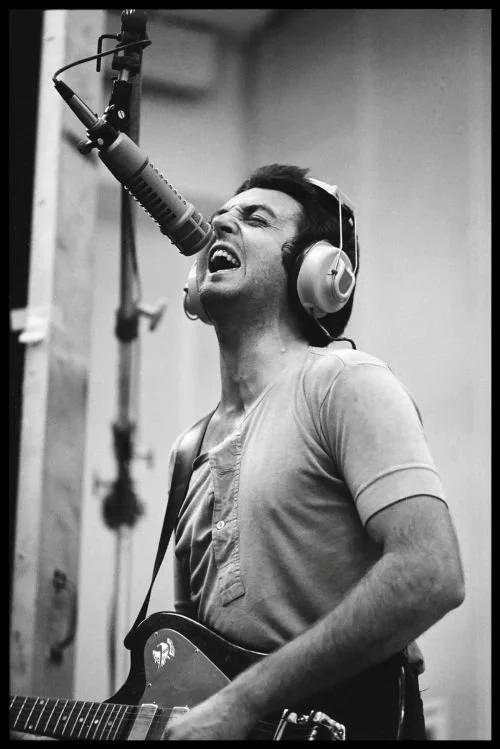
IN THIS PHOTO: Paul McCartney during the recording of RAM at Columbia Studios, New York in 1970/PHOTO CREDIT: Linda McCartney
Pintaadaptor on Instagram: How was writing on your farm in Scotland different from writing at studios such as Abbey Road etc?
Paul: Because of the lifestyle we were living, it was very free. The Beatles had been great, and I’d loved it, but I couldn’t say it was free, personally. I couldn’t exactly go to Scotland for a few months. If you were in The Beatles, you had to make records and work. But when we went to Scotland, we had a very free, sort of hippie lifestyle. It meant I could sit around in the kitchen in the little farmhouse we lived in, with the kids running around and me just with my guitar, making up anything I fancied. ‘Three Legs’ for instance was me jamming around with a blues idea, and then with no particular relevance I sang ‘my dog, he got three legs, but he can run’, meaning that everything doesn’t have to be perfect, it can still work. And then I added the lyric ‘a fly flies in’, and I’m sure that happened, with the window open in Scotland! I’m sure a fly actually flew in and I went ‘okay – you’re in the song! Fly flies in, fly flies out’. So yeah, it was a very free period and I think that found its way into the record.
I always think that the way we were living then was the way a lot of young people would like to live. We were escaping the constrictions of society. It’s why people move out to the country, or do a lot of gardening, all of those sort of things. It’s a great opportunity in your life to do something different.
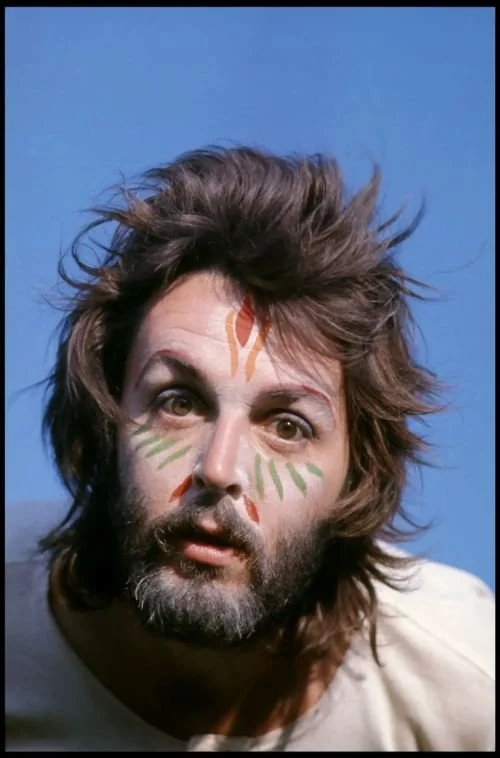
IN THIS PHOTO: Paul McCartney in Scotland in 1971/PHOTO CREDIT: Linda McCartney
Fleur on Facebook: How did the writing partnership with Linda work? Did you sit down formally together like you did with John?
Paul: No, it was much looser. I would be writing something mainly, because Linda didn’t really play a guitar and we didn’t have a piano knocking around, so it would be me messing around with a guitar and I might say to her ‘sing along!’ and then ‘ah that’s good, we’ll put it in’. She’d make suggestions as we went along, or sing a harmony or something, but it wasn’t a formal thing like John and I where you had two people sitting down with the intention of writing a song. With Linda I’d be sat in the kitchen making it up, and she’d throw a suggestion in and that made her a co-writer.
Brendan on Twitter: Linda’s harmonies on this album are exceptional. Did it take a long time to get right or was she naturally brilliant from the start?
Paul: Well, we worked at it. Because that’s what you do when you work on a record, you want it to sound right. Linda told me that she used to be a member of a glee club in America, when she was in college. Like the TV series ‘Glee’! I’d never heard of a glee club before, because in Britain we didn’t have that, and she explained that they would sing together and they used to go to a bell tower at the school because it had a good acoustics. She knew certain things about it, so when it came to writing and recording, she would naturally just sing a harmony or I would suggest one and we’d harmonise at home. Then when we would get into the studio, we’d work a little bit harder to try and get it right.
Looking back at the records we made together, I think our harmonies were a really individual sound, and a very special sound. Probably because she wasn’t a professional singer, that gave her an innocence to her tone that comes through on the records. I’d be singing ‘hands across the water’ and she’d echo ‘water, water’ and do this funny little American accent, and we’d put it in! We were having fun”.
On 17th May, RAM turns fifty-five. It is this exceptional album that I still don’t think gets enough credit. Paul McCartney recently announced a new album, The Boys of Dungeon Lane. That arrive on 29th May. This masterful genius still producing amazing music. I wonder whether he will say anything about RAM on its fifty-fifth anniversary. Despite how disheartening and damaging it would have been reading some of the reviews in 1971, Paul McCartney can be immensely proud of what he and Linda McCartney created. It is their album. Whilst we sadly lost Linda McCartney, Paul carries the legacy and can discuss the album. His memories of recording with his beloved wife. An album warmly received now, someone who went through such hell during the time and when it was released can now…
SMILE away.