FEATURE:
Spotlight

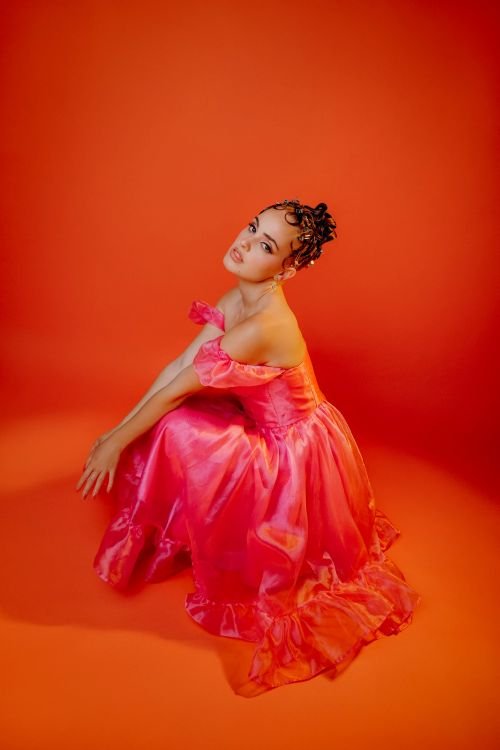
Avery Cochrane
__________
A lot of people are talking…

about Avery Cochrane as a star of the future. A terrific voice in music. It is hard to disagree. Listen to her extraordinary E.P., Male Validation and Other Drugs, and you can this is someone who is going to have an enormous career! The music has a familiarity to it, yet this is distinctly her voice. Music that you listen to and get caught up in, rather than being passive and it washing over you. I want to get to some interviews with Avery Cochrane, as she is someone you really need to know about. I want to go back to September and an interview from The Luna Collective. They spoke with Avery Cochrane around the release of her then-new single, Shapeshifting on a Saturday Night. A song that advocated for the introverts and overthinkers, as Luna write:
“LUNA: How did you get into music?
COCHRANE: I started singing in choir. In middle school and high school, I had a jazz choir. I think jazz specifically was such a great genre to start with, because so much of it depends on improvisation and making mistakes and coming up with things as you go. I've taken a lot of what I've learned in jazz choir into my songwriting today. Then I went to school, and I kind of put music on the back burner a little bit. But when COVID hit, which was my freshman year, I was kind of, like, forced to do something other than school or do something to fill the time of being locked away in quarantine at 18 years old. I rediscovered my love for music and singing, and I've always written songs, but I started writing them to be released and recorded during COVID. That’s when I started a little less than five years ago, and it's just been non-stop ever since. I've been trying to do as much as I can, as often as I can since I started releasing.
LUNA: Was there a specific event that inspired “Shapeshifting on a Saturday Night?”
COCHRANE: No specific event, just a combination of a lot of different events that I've experienced over the last 24 years. I think the concept of shapeshifting can can be done in any context, starting from an early age - you do it on the playground to fit in with other kids, whether that's like being a mean girl or something because you think you want to fit in that way, or wearing something that you don't really want to wear. I feel like shapeshifting begins at a very early age to adapt into what you think society or your surroundings want. I just chose the concept of a Saturday night because I personally don't like going to the club at all; I hate it. But when I was in the college setting, or frat parties or the club, or whatever your friends are doing, I would feel like, I don't want to do this at all, and everybody's having a great time, what's wrong with me for not having a great time or not wanting to do this? And I like the alliteration of Shapeshifting/Saturday Night.
LUNA: This release follows your single “Corporate Ladder,” which is also a very vulnerable track. Do you ever get worried about sharing these emotional songs with people?
COCHRANE: Honestly, not really. I think I used to, but the first song I ever released was a pretty vulnerable track, a pretty emotionally-charged track about somebody I literally met on Tinder. And, like, that's pretty embarrassing [laughs]. But it’s human and, I don't know. I just find comfort when people say, I relate to this so hard. And these lyrics are so relatable, it makes me feel better, because I know I'm not alone in feeling these things. I know I'm not the only one that's wanted to quit her day job and has been frustrated with corporate America, or has shifted on a Saturday night, or has crashed out about somebody they knew for three months. I know that these are common experiences, at least that's what I tell myself. So surprisingly, I don't get that worried about it, being vulnerable.
LUNA: Yeah, honestly, music connects people. So having songs like these is really special. It's reassuring to know that other people go through similar experiences to what we go through. I also want to talk a bit about your single “The Executioner.” I really like the line, “God, help me. I am female.” We all have our interpretation of being a woman, but what does it mean to you?
COCHRANE: It’s a beautiful question. That one is tricky, because I guess when I wrote it, it was one of those things where I felt it really strong, but I wasn't really thinking about what it could mean. And whenever I play it live, I encourage the audience to sing along at the end of the song, and some men will come up and be like, As a cis, straight guy,I felt a little weird singing along at the end. I understand that, but it's a song for everybody. I think everybody has a balance of masculine and feminine in them, and I do think the feminine are the traits of people that get exploited or taken advantage of the most. And that can be in a cis, straight man, it can be in a trans woman, it can be in a trans man, it can be in a cis woman, like it can be in literally anyone. Everybody has divine femininity, and I think that, like your kindness or your sensuality, for example, I feel like those are feminine traits, and I think those things get exploited the most. So I think that the softer, nurturing, emotional qualities of someone is, is the God, help me. I am these things, and I think these are beautiful things, but somebody's taking advantage of them.
LUNA: There's such a refreshing honesty in your lyricism. How do you achieve that? What is your writing process like?
COCHRANE: It honestly kind of feels like I take lines from my journal. I try to journal every day, because I read “The Artist’s Way” a couple times. It's by this woman named Julia Cameron. She wrote it in the ‘80s or ‘90s, I think, so it's pretty dated, but it's all lessons that you can apply 40 years later. And one of them is to write every day, and that's really hard to do with short attention spans and technology at our fingertips. Sometimes I'll do a voice memo journal or something, but I think it's just a matter of being in touch with what's going on, how you're feeling. Being emotionally self aware of how you're feeling, and then just not being afraid to turn those into lyrics”.
There is another interview around the single that you should check out. The Seattle-born artist among the best-kept secrets in music. Someone who can take anxieties and relatable stresses and turn them into anthems. No wonder that she resonates with a wider and adoring fanbase! I am going to mangle this interview from Teen Vogue slightly, but I would encourage you to read the entire thing. I wanted to select a few sections from it. So many fans of her music spending time with Avery Cochrane and going deep. It is fascinating learning about her background and path into music. It is clear that Cochrane is going to elevate to the same heights as the biggest modern Pop artists. This L.G.B.T.Q.I.A.+ icon and superstar-in-waiting released potentially the best E.P. of the year with Male Validation and Other Drugs:
“It feels like it’s building to something,” says 24-year-old singer-songwriter Avery Cochrane, sitting in the high-ceilinged studio at Artist House, a publishing and recording studio in New York City’s SoHo neighborhood. Producer Benzi Edelson (who has worked with Noah Kahan, John Legend, and more) is fiddling with a drum rack, twisting the nobs on his setup while the instrumental they scaffolded together on a Leslie baby-grand piano plays on a loop. Cochrane wants a “big pop cinema sound.”
Six months ago, Cochrane left the same golf course job where she’d been working since she was 14 and moved to Los Angeles on the back of the success of her biggest hit to date, the euphoric “Shapeshifting on a Saturday Night,” which has over 3.8 million plays on Spotify. The comments sections on her videos are filled with things like “here before it blows up,” and “the people aren’t here yet… but they will be,” and “this is my proof i was here before the stadium tours.” Her second EP, Male Validation and Other Drugs, dropped March 27, and in seven smartly written, well-crafted songs, it communicates something clear: This is an artist who can hold her own in an exciting class of pop upstarts who are on the rise after the Sabrina/Chappell breakout wave.
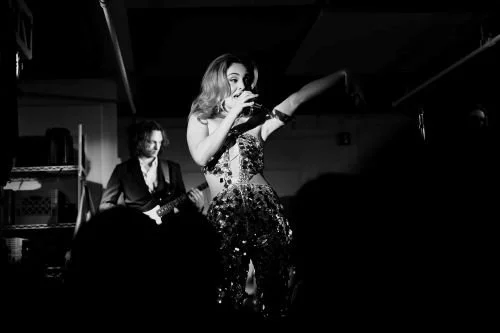
IN THIS PHOTO: Avery Cochrane on stage at Nightclub 101/PHOTO CREDIT: Charlie Bahama
Cochrane grew up as the baby of the family with an older brother. Her mom helps rich people organize their belongings before a move. (A plus: They often want to discard designer clothes, leaving Cochrane with a sizable collection.) Her dad works at a small health care publishing company in Seattle and is a baseball coach. They were not a musical family, but she stumbled into it anyway. She journaled obsessively and wrote songs in secret so as not to seem “weird” at the age when you just want to be cool. In high school, she played softball, sang in jazz choir, and dabbled in theater. She was Troy Bolton, she jokes, except she was just in the ensemble of Hairspray.
Cochrane left Seattle to study journalism at San Diego State University in 2019, then ditched the journalism major once the pandemic hit and moved back in with her parents, realizing she didn’t know what she wanted to do yet. During those 2020 months, she wrote songs and began recording them. She didn’t re-enroll at SDSU, and instead took some production and music-theory classes at a local community college, while working customer service jobs and writing more songs. But in spring 2022, she went back to SDSU; she finished her degree in 2024, this time in political science.
Cochrane is in a speed-dating era as she continues to develop her sound, which currently draws on a lot of ’70s and ’80s pop. (Her new EP has six lead producers across seven songs.) She does see the appeal of working with just one or two producers, a la Taylor Swift and Jack Antonoff, or Chappell Roan and Dan Nigro, especially when diving into really emotional, personal material.
The breakup, for example, is on her mind as she works on this next record. “Losing Streak” captures some of the falling apart between Cochrane and her ex-girlfriend, who she calls her "first serious queer relationship.” (Cochrane uses bisexual or pansexual for herself, but isn’t too pressed about labels.) That four-year relationship shaped many of the ideas on Male Validation and Other Drugs that she could see coming to some kind of resolution on the full-length album.
“I think after historically mostly being with men, there was a lot I had to learn and go through and unlearn,” Cochrane says. “That's why I was motivated to make my project about the male gaze, because that continued to seep into my actions and thoughts and behaviors, even in a sapphic relationship.”
As Cochrane figures out the sounds to go along with her lyrics, she’s developing her pop star aesthetic and performance style, which, she says, has felt overwhelming in the past. “I never really had an idea of what I wanted to be visually,” she shares. With a team behind her now, including a creative director for her music videos, it’s easier. She’s learning what she likes and doesn’t. “I want it to be campy. I want it to have queer themes, but not super overt,” she says. “I want it to be feminine, but I'm open to it changing and expanding. I want to look good.”
She already has a theatricality to her approach: At Nightclub 101, she wears a big black faux-fur coat and sunglasses as she wades through the crowd to get to the stage, phones flashing in her face, conjuring the image of a beleaguered celebrity as she begins singing “Griever.”
Cochrane drops the coat to reveal a shiny silver bodysuit, flips her hair, winks at the audience. Suddenly, she is not Avery, a regular 24-year-old in leggings and flats, hunched over a laptop. She is a Pop Star. She wins over the crowd, cracking jokes and introducing new fans to bits of lore, including a nonsense word—"intricities” instead of “intricacies”—she recorded for her song “Losing Streak.” Onstage, she has a fan flip a coin to decide which word she’ll sing live in the performance”.
I am going to end with a new interview from Atwood Magazine that was published earlier this week. They spent time with an artist who is not only making some of the best music out there, but she is also bringing so much strength and joy to so many people’s lives. Maybe she would not want to be seen as an idol, though it is clear that she is! The next few years will see her continue to grow and play some huge stages around the world. I would love to see her in London when she is next here:
“The exploration of stark contrasts and their inevitable chasms of turmoil are well shouldered on the EP, wherein the song “Loneliness in Numbers” is perhaps the best example of Cochrane’s satire skills.
A commentary on the vapidness of social media’s preoccupations amidst the darkness of current events, it’s the track I was most excited to be able to stream once the EP dropped. So I got pumped with the plastic front to back, cause I gotta look good for the nuclear blast, she sings facetiously in the lyrics. “You’re scrolling and you’re seeing all these beautiful, unobtainable women, and then you see like, you know, breaking news, drone strike here! And you’re like, oh my gosh, how am I being fed this much information about two completely unrelated things? Like, OK, product placement here, borderline pornography here, and political violence here,” explained Cochrane of what she unravelled in the lyrics.
The track reminds me in many ways of Lily Allen’s hit song, “The Fear,” released way back in 2008, as well as Marina’s lyrics on “Oh No!” from her 2010 breakout album, The Family Jewels, which have held onto a timelessness that I believe Cochrane’s work is also destined for.
In the weeks leading up to the EP release, Cochrane released one final single, “Losing Streak,” which immediately landed on 5 Spotify editorial playlists, including All New Pop, which used Cochrane’s photo as the playlist cover for the week. The track is centered on a growing divide between two lovers, and the release included a music video which opens with Cochrane arriving at a house with a boombox. Despite still being unreleased at the show where I interviewed Cochrane, the crowd knew the chorus well and sang along with fervor.

PHOTO CREDIT: Aaron Sinclair
“We left the session with just the chorus,” Cochrane explained of working on the track. “Then I posted it on TikTok and it did really well. So I was like, God, I need to go back and write these verses, but it was really hard to lock in and write these verses about this relationship that I was still in, that was kind of on the rocks. It was painful to write about, to be so honest about it in real time. I like to write a lot of my songs in hindsight, so this one is very fresh.”
Pushing herself in this regard has paid off – while Cochrane met fans at her merch table, I meandered down the line and spoke to those waiting, surveying them on which song they’re most looking forward to being able to stream once the EP is out. “Losing Streak,” said Bellise Sachetto, as she held onto Cochrane’s set list, standing in line with fellow concert goer, Grace Brummel. “Same,” said Brummel, nodding adamantly. “We’re in agreement,” they said in unison. The two of them drove 45 minutes from Orange County to come to the show; another fan flew into San Diego from Colorado. I asked Sachetto where she would put the set list once she got home. “With my Taylor Swift one, from the Eras tour,” she said immediately.
When I asked Cochrane what the “other drugs” are on the EP – aside from male validation – it seemed like every answer was both a description of a release and a trap, proving the precision of her writing to send listeners into frenetic loops of joy and deep thinking.
“Antidepressants, like sertraline. Sex, but that kinda falls into the male validation of it all,” she said as she counted on her fingers how many things she’d listed. “And then, approval, wanting approval, and shapeshifting – that feels like a drug to me, going out and partying and trying to fit in. Anything that’s trying to fill some void that you haven’t filled in yourself.”
As I wrapped up the interview with Cochrane, I asked her for thoughts during the final stretch of the EP release, and what she was most looking forward to. “I’m really excited to release the rest of the songs and give context to what these existential crises are,” she said, referring back to our discussion of her soft spot for tarnished narratives of the gilded age. “I’m excited to give context to the politics behind the music. Because I feel like my music isn’t overtly political,” she described. “I like to give subtle nods. I hope people can feel that and hear that in the music and the lyrics”.
I will leave things there. Having gifted us with the Male Validation and Other Drugs E.P. and some great new interviews out there, more and more people are discovering the music of Avery Cochrane. She is simply extraordinary, and we are going to be hearing about her for years (and perhaps decades) to come. You need to connect with this extraordinary artist, because it is very clear that she is…
GOING to be a Pop supernova before long.
___________
Follow Avery Cochrane