FEATURE:
You Always Taught My Right from Wrong
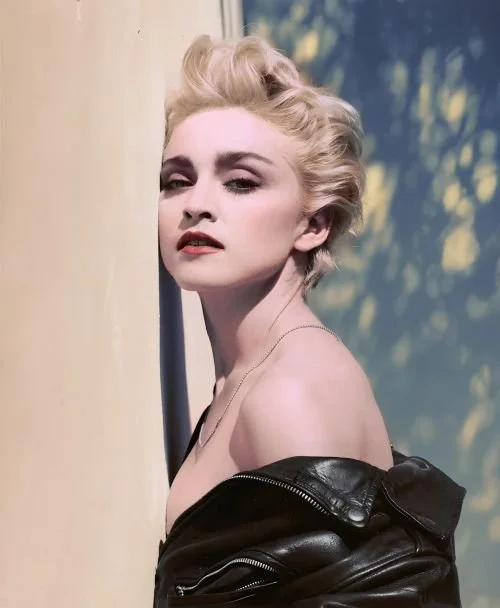
IN THIS PHOTO: Madonna in 1986/PHOTO CREDIT: Herb Ritts
Madonna's Papa Don't Preach at Forty
__________
ONE of the most…
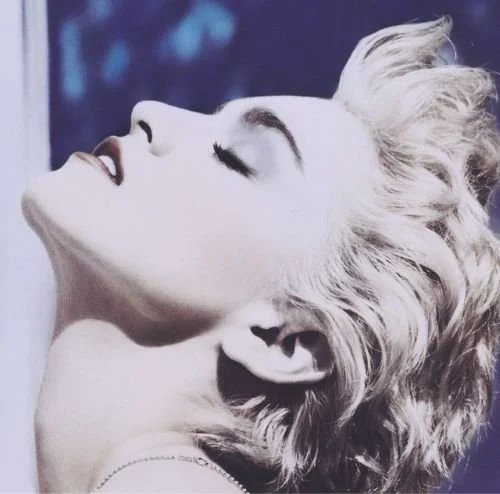
memorable Pop songs of the 1980s – or of all-time! – turns forty on 11th June. In terms of her fashion, look and songwriting, Papa Don’t Preach is peak Madonna! The second single from True Blue, we get to mark the album’s fortieth anniversary on 30th June. I am doing more anniversaries around that. Papa Don’t Preach was a real breakthrough for Madonna. With regards to the maturity of the lyrics. Co-writing the lyrics with composer Brian Elliot, Papa Don’t Preach tell the story of a teenage girl who becomes pregnant and chooses to keep her baby, despite her father's objection. A huge number one success around the world, it is arguable that Papa Don’t Preach truly cemented Madonna’s reputation as one of the most innovative and evolving artists of her generation. As a modern icon. Only a few years from her eponymous debut album, she had done so much. Her sound changed and her talent grew. Papa Don’t Preach is a masterpiece. There are some features that I want to get to. As we mark forty years of Papa Don’t Preach, it is worth remembering that Madonna has announced a new album, Confessions on a Dance Floor: Part 2. It comes out on 3rd July. She has barely slowed since she broke through. One of the hardest-working and consistently brilliant artists. Still very much the Queen of Pop! I want to first come to American Songwriter and their feature that tells the story behind the classic:
“Meaning Behind the Song
The song’s origins begin outside of Elliot’s recording studio where he allegedly overheard gossip on the street from girls at a nearby high school. Elliot would often see students standing outside the front window of his studio that they’d use as a mirror and hang-out spot, sharing gossip and stories from school. Elliot used this as inspiration for the song about a teenage girl who winds up pregnant, begging her father for compassion and assistance as opposed to judgment.
“I saw it as a sensitive plea for compassion and understanding about a young girl who found herself at a crossroads in life and didn’t know where to turn,” Elliot explained to the Los Angeles Times in 1986, describing “Papa” as “a love song, maybe framed a little bit differently.”
Elliot intended for the song to be recorded by another artist he was producing at the time, Cristina Dent. But when Michael Ostin, the A&R executive at Madonna’s label Warner Bros., heard the song, he asked to pitch it to Madonna instead. The superstar says that she was drawn to the confident nature of the song, as the young woman stands up to her father and friends, making it clear that the choice about what to do about the pregnancy is her own. Papa don’t preach I’m in trouble deep/Papa don’t preach, I’ve been losing sleep/But I made up my mind, I’m keeping my baby, she sings in the chorus.
The Message
”’Papa Don’t Preach’ is a message song that everyone is going to take the wrong way,” Madonna told Rolling Stone in 1986. ”Immediately they’re going to say I am advising every young girl to go out and get pregnant. When I first heard the song, I thought it was silly. But then I thought, wait a minute, this song is really about a girl who is making a decision in her life. She has a very close relationship with her father and wants to maintain that closeness. To me, it’s a celebration of life. It says, ‘I love you, father, and I love this man and this child that is growing inside me.’ Of course, who knows how it will end? But at least it starts off positive.”
The singer’s predictions were right. The song drew critical acclaim, while also having a polarizing impact at the time, as some critics felt like she was supporting teen pregnancy, while anti-abortion groups felt as though the song was in line with their views. “It just fit right in with my own personal Zeitgeist of standing up to male authorities, whether it’s the pope or the Catholic Church or my father and his conservative, patriarchal ways,” Madonna said to Rolling Stone in 2009 about why the song was a natural fit in her repertoire. “There have been so many fallouts, they all get confused. But for ‘Papa Don’t Preach,’ there were so many opinions, that’s why I thought it was so great. Is she for “schma-smortion,” as they say in Knocked Up? Is she against abortion?”
Regardless of the polarizing opinions, the song shot to the top of the charts around the world, including the Billboard Hot 100, and has solidified itself as one of Madonna’s career-defining hits”.
There are some features and interviews to get to. A couple of archives from New York Times. The first discusses how Papa Don’t Preach is a fantastic and memorable Pop song. Though, its messages and themes rankle and has caused division and controversy. Although Madonna liked to challenge and cause controversy, Papa Don’t Preach is the sound of this growing artist putting deeper themes into Pop music. Not just being flippant about pregnancy, it was a superstar redefining the genre and traditional narratives:
“Madonna's new song ''Papa Don't Preach'' hit the top of the pop charts a few weeks ago and all around the city her voice is heard, singing of adolescent pregnancy. It drifted through Kathie Peters's headphones on a recent afternoon as she made her way to a pizza parlor in Queens, and the 18-year-old broke into a sidewalk boogie:
''Papa don't preach, I'm in trouble deep Papa don't preach, I've been losing sleep But I made up my mind, I'm keeping my baby.. . .''
Later that day, she took part in a ''sexuality rap session'' at an adolescent services center in Manhattan, The Door, at 618 Avenue of the Americas at 18th Street. When a social worker leading the group mentioned ''Papa Don't Preach,'' Kathie Peters shook her head and said: ''Too many kids are getting pregnant. They don't know what they're getting into. I don't like the message.''
''But,'' she added with a sheepish smile, ''I do like the beat.''
Many young people like the beat. The song is the second single from Madonna's third album, ''True Blue,'' currently one of the best-selling records in the United States. In the popular video, the rock star portrays a pregnant teen-ager who begs her father to bless her decision to keep the baby. Song Gets Criticism and Support
As its popularity has increased, so has the criticism and support the song has received from groups concerned with pregnancy and abortion.
''The message,'' said the executive director of Planned Parenthood of New York City, Alfred Moran, ''is that getting pregnant is cool and having the baby is the right thing and a good thing and don't listen to your parents, the school, anybody who tells you otherwise -don't preach to me, Papa. The reality is that what Madonna is suggesting to teen-agers is a path to permanent poverty.''
However, groups opposed to abortion see ''Papa Don't Preach'' as a positive, ''pro-life'' song. ''Abortion is readily available on every street corner for young women,'' said the president of the California chapter of Feminists for Life in America, Susan Carpenter-McMillan. ''Now what Madonna is telling them is, hey, there's an alternative.'' Lace Gloves and Rosaries
Mr. Moran remembers how his agency's clinics were filled last year with girls wearing fingerless lace gloves and rosaries around their necks, in imitation of Madonna's fashion style.
''Everybody I've talked to believes she has more impact on young teen-agers than any other single entertainer since the Beatles,'' Mr. Moran said. ''That's what makes this particular song so destructive.''
Mr. Moran and others in the family planning field fear that the song will undermine their efforts to promote birth control among adolescents and that it will encourage teen-age pregnancy. More than a million American teen-agers become pregnant each year, according to the Alan Guttmacher Institute, a New York-based national research organization.
A campaign to discourage teen-age pregnancy began earlier this week, from the Mayor's Office of Adolescent Pregnancy and Parenting Services. Subway posters, television and radio spots will carry the slogan ''Be Smart About Sex,'' and L.L. Cool J., a rap artist, has recorded a ''Smart Sex Rap'' for radio.
''We're using the same medium to put across a very different message about being smart and avoiding teen-aged pregnancy,'' said Alice Radosh, the office's coordinator. ''The timing of the Madonna song concerns us.''
Mr. Moran said his Planned Parenthood chapter is sending a ''critical memo'' to radio and television stations in the metropolitan area urging them to ''think carefully about playing this song to young audiences.'' He added that his chapter is asking Warner Brothers Records, the parent company of Madonna's label, to donate at least 25 percent of earnings from the song to programs that promote responsible sexual behavior. Teen-Agers React Positively
Teen-agers do react positively to the song, said Ms. Carpenter-McMillan, who recently took a television crew to a Los Angeles maternity home where she played the music video for an audience of teen-agers. ''These were young girls, 14, 15, 16, living through tough times, going against parents and boyfriends,'' she said. ''Knowing someone like Madonna is in their corner, saying, 'All right! Go for it!' was so uplifting.''
For the most part, Madonna has avoided the debate. The singer will not comment on the song's use as an anti-abortion statement, according to a spokesman, Liz Rosenberg. ''She's singing a song, not taking a stand,'' Ms. Rosenberg said. ''Her philosophy is people can think what they want to think.''
Shortly before the record's release, however, in an interview with a New York Times music critic, Stephen Holden, Madonna described it as ''a message song that everyone is going to take the wrong way'' and predicted she would be accused of ''advising every young girl to go out and get pregnant.''
The song, written by Brian Elliot, with minor lyrical revisions by the singer, tells of ''a girl who is making a major decision in her life,'' Madonna said in the interview. ''To me, it's a celebration of life.''
In Washington, Tipper Gore, a founder of the Parents Music Resource Center - a group that a year ago spurred Congressional hearings on the issue of sex and violence in rock music lyrics and has criticized Madonna's songs in the past - has spoken out in favor of ''Papa Don't Preach.''
''To me,'' Mrs. Gore said, ''the song speaks to a serious subject with a sense of urgency and sensitivity in both the lyrics and Madonna's rendition. It also speaks to the fact that there's got to be more support and more communication in familiies about this problem, and anything that fosters that I applaud.'' Papa Don't Preach Papa I know you're going to be upset 'Cause I was always your little girl But you should know by now I'm not a baby You always taught me right from wrong I need your help, daddy please be strong I may be young at heart But I know what I'm saying The one you warned me all about The one you said I could do without We're in an awful mess And I don't mean maybe -- please Chorus: Papa don't preach, I'm in trouble deep Papa don't preach, I've been losing sleep But I made up my mind, I'm keeping my baby I'm gonna keep my baby, mmm... He says that he's going to marry me We can raise a little family Maybe we'll be all right It's a sacrifice But my friends keep telling me to give it up Saying I'm too young, I ought to live it up What I need right now is some good advice, please Chorus Daddy, daddy if you could only see Just how good he's been treating me You'd give us your blessing right now 'Cause we are in love We are in love, so please Chorus”.
This interview shows Madonna in relaxed mood. True Blue an album more varied and heartfelt than her previous work. Not only were the compositions different and more varied. I think there is this new maturity. Her lyrics also exploring subjects like teen pregnancy. I can understand why some parents in America might have felt like Madonna was glamorising it. However, it is this song of defiance and protest:
''I like challenge and controversy - I like to tick people off,'' Madonna boasted, tossing her head and flashing a mischievous half-smile. The 27-year-old pop star was sipping a diet cola in a conference room at the New York offices of Warner Bros. Records. She appeared almost demure in a pink-and-blue flowered dress and a very short haircut inspired by the late-50's gamine look of Jean Seberg, Audrey Hepburn and Leslie Caron. Gone along with most of her hair was the heavy makeup and jewelry that made last year's Madonna resemble a contemporary street version of Marilyn Monroe in ''Gentlemen Prefer Blondes.''
''After awhile I got sick of wearing tons of jewelry - I wanted to clean myself off,'' Madonna said flatly. ''I see my new look as very innocent and feminine and unadorned. It makes me feel good. Growing up, I admired the kind of beautiful glamorous woman - from Brigitte Bardot to Grace Kelly - who doesn't seem to be around much anymore. I think it's time for that kind of glamour to come back.''
If Madonna's new upscale look represents a dramatic swing away from the provocative sex symbol who wore lingerie as outerwear and crucifixes like diamonds, it does not signal an end to her courting of controversy. ''Papa Don't Preach,'' the second single from her third album, ''True Blue'' (Sire 25442; LP, cassette, compact disk), is bound to rile some parents of teen-age girls. The protagonist of the song, which was written by Brian Elliot, is a pregnant adolescent who begs her father to bless her decision to keep the baby and marry her boyfriend. Madonna sings it in a passionate, bratty sob that makes the plea immediate and believable.
The song has also been turned into a compelling slice-of-life music video. Filmed on location in a working-class neighborhood of Staten Island, with Danny Aiello playing the father, it features a virtuoso performance by a waifish, saucer-eyed Madonna, who looks all of 15 as she quivers anxiously, awaiting her father's response. Like Michael Jackson's ''Billie Jean,'' the song and its video have an iconographic resonance that could push Madonna's career to an even higher plateau than the household-word status she attained last year with her 6 1/2-million-selling second album, ''Like a Virgin.''
'' 'Papa Don't Preach' is a message song that everyone is going to take the wrong way,'' Madonna proudly predicted. ''Immediately they're going to say I am advising every young girl to go out and get pregnant. When I first heard the song, I thought it was silly. But then I thought, wait a minute, this song is really about a girl who is making a decision in her life. She has a very close relationship with her father and wants to maintain that closeness. To me it's a celebration of life. It says, 'I love you, father, and I love this man and this child that is growing inside me.' Of course, who knows how it will end? But at least it starts off positive.''
''Papa Don't Preach,'' for which Madonna contributed a couple of minor lyrical revisions, is the only song on the album that Madonna didn't have a strong hand in writing. The song was sent to her by Michael Ostin, the same Warner Bros. executive who discovered ''Like a Virgin.'' Most of the album's eight other songs Madonna co-wrote with Patrick Leonard, the musical director for her 1985 tour, or with her sometime songwriting partner, Stephen Bray. The three also co-produced the LP”.
I am going to end with Stereogum and their feature from 2020. The Number Ones celebrates chart-topping singles from throughout the years. Regardless of what you think of its messages and whether it is harmful or empowering, there is no doubting the credentials of Papa Don’t Preach. It is a masterfully written and produced gem. One that is the standout from True Blue:
“Those strings on the intro are an announcement, an almighty flex. Madonna's True Blue was her third album, but it was the first one she made when she was already a massive star, a foundational pop-music figure. Up until then, Madonna had been associated with a particular sound. Madonna made club music, post-disco dance-pop. Even her ballads nodded to that sound. So it must've been at least a little jarring for people to hear the fussy, rococo strings that open "Papa Don't Preach" -- or, for that matter, to hear those strings fade into a story-song about a pregnant teenager desperate for her father's approval. The strings nod to classical, to baroque, and to the Beatles-style psychedelia that had made a big deal about incorporating strings like those a couple of decades earlier. Madonna was doing what she felt like doing, and the things she felt like doing were working.
"Papa Don't Preach" wasn't the first single from True Blue; that was " Live To Tell," Madonna's previous chart-topper. But "Live To Tell" was a movie-soundtrack ballad, and it came out months before the album. Masterful as it is, "Live To Tell" didn't announce a great leap forward the way "Papa Don't Preach" did. "Papa Don't Preach" signaled that Madonna had enough juice to make a social-issue song that was also a stylistic left-turn. And for all its gutsiness, "Papa Don't Preach" still worked as post-disco dance-pop. Its strings faded into jittery, propulsive synth-bass and big, mechanized drums, and this story about a girl begging her father to accept her big life decision somehow became escapist club fare. That's a magic trick. That's cowboy shit.
"Papa Don't Preach" wasn't supposed to be a Madonna song. A decade earlier, the songwriter Brian Elliot had tried to become a pop star himself, but his self-titled Warner Bros. debut hadn't gone anywhere. By 1986, Elliot was producing demos for a singer named Christina Dent, who never really went anywhere either. Elliot had written "Papa Don't Preach" for Dent, and he'd played the song for the Warner A&R executive Michael Ostin. Ostin liked "Papa Don't Preach" enough to play it for Madonna, and she loved it. Ostin talked Elliot into giving "Papa Don't Preach" to Madonna, and she turned the song into a whole other thing.
Madonna is credited as the co-writer of "Papa Don't Preach," but her contribution is apparently limited to a few added-on lyrics. And yet "Papa Don't Preach" means more coming from Madonna than it would've meant from an artist who wasn't yet established. Part of it is the production. Madonna co-produced "Papa Don't Preach" with her old friend and collaborator Stephen Bray, who she'd known since before dropping out of college. (Around the same time as he was working on True Blue, Bray joined a reconstituted version of the Breakfast Club, the band that Madonna had been in before she got famous, and they peaked at #7 with 1987's " Right On Track." It's a 7.) But part of it is also the way "Papa Don't Preach" plays into the persona that Madonna had already established.
On Like A Virgin, Madonna had weaponized her own sexuality, finding a transgressive lane within mainstream pop stardom and becoming a target of parents' watchdog groups like the PMRC. But on "Papa Don't Preach," Madonna sang about a possible consequence of that sexuality. Her narrator is a teenager girl who is scared but determined. She's not thrilled about the fact that she's pregnant, but she's made up her mind. She's keeping her baby.
Naturally, "Papa Don't Preach" became a political football. Anti-abortion groups claimed "Papa Don't Preach" as an anti-abortion song. Tipper Gore, co-founder of the PMRC and pop-music boogeywoman, loved "Papa Don't Preach," calling it "an important song, and a good one, which discusses, with urgency, a real predicament which thousands of unwed teenagers face in our country." The feminist lawyer Gloria Allred, meanwhile, said that Madonna should "make a public statement noting that kids have other choices, including abortion."
Madonna never made that statement. At the time, she didn't say anything for or against abortion rights. The song never mentions the word "abortion." When Madonna's narrator sings that her friends are telling her to give the kid up, you don't know if they're talking about abortion or adoption. Maybe, for Allred, that was the problem. At the time, Allred said, "Pop songs have an enormous impact on kids today. They get their messages from music much more than from what they learn in school or in church. It becomes almost a religious message -- a code or part of their belief system." That's pretty much what Tipper Gore had been saying, too.
It gets weird when people talk about pop music as messaging rather than as pop music. I do that shit all the time. Everyone in my line of work does. Maybe, if I'd been a professional critic in 1986, I would've had some kind of take on whether "Papa Don't Preach" was an implied anti-abortion cop-out of a song. And maybe that's how Brian Elliot meant it. (At the time, he said, "If Madonna has influenced young girls to keep their babies, I don't think that's such a bad deal.") But "Papa Don't Preach" isn't a sweeping polemic about kids and sex. It's a pop song -- a great one.
For me, the strength of "Papa Don't Preach" is in how limited and specific its scope is. Madonna's narrator is one overwhelmed kid with a romantic idea in her head. It's hard to imagine things turning out well for her and her boyfriend. You can hear the doubt in her voice when she's imagining her own possible future: "He says that he's going to marry me/ We can raise a little family/ Maybe we'll be all right; it's a sacrifice." Her friends are telling her to go have a life instead, but she's not listening. That stubbornness almost feels admirable, even if it means she's going to have a hard future ahead of her.
I hear "Papa Don't Preach" as being in the tradition of the girl-group songs of the early '60s. (Elsewhere on True Blue, Madonna pays more direct tribute to that sound.) The best of those songs laid out storylines and situations. The point isn't the resolution, and it certainly isn't what that situation says about things happening in society. Instead, the point is the fear and love and anxiety and hurt that someone might feel in that moment. Madonna nails all of it.
"Papa Don't Preach" is one more example of how Madonna, a technically limited singer, could always capture the feeling of the song. On the first verse, when she's telling her father that she needs help, her voice is tremulous and hesitant. As the song goes on, her voice becomes stronger, but it keeps an anguish and a desperation. When she says that she and her boyfriend are in love, she sounds like she's melting. When she pleads for her father's blessing, she's in agony. It's a raw, messy conversation, and Madonna lets all those conflicting feelings bubble right up to the song's surface. Her voice says more than the words do.
For all the pathos of its story, though, "Papa Don't Preach" still works as pop music. The beat is steady, but all the song's flourishes -- the strings, the quasi-Spanish guitar solo, the coos of the backup singers -- float around that narrator, as if they're consoling or encouraging her. (One of the backup singers, Siedah Garrett, will appear as a featured guest in a future column.) "Papa Don't Preach" has hooks, too. It's dainty and insistent and urgent, and it glues itself right into your brain the first time you hear it. If "Papa Don't Preach" had been simply a message song, it would've aged like fine milk. But it's not a message song. "Don't Preach" is right there in the title. Instead, the song is a marvel of craft.
The video is pretty expertly crafted, too. Madonna made the "Papa Don't Preach" video with director James Foley, the filmmaker who'd just directed her then-husband Sean Penn in At Close Range. Foley had directed Madonna's "Live To Tell" video, but that one is really just Madonna close-ups and At Close Range clips. The "Papa Don't Preach" video, on the other hand, is a whole mini-movie. Madonna tries out a couple of different styles -- the hyper-styled dancer of the performance clips and the tough tomboy of the narrative scenes. But the video is way more of a showcase for Madonna's acting than for her ever-evolving persona.
The "Papa Don't Preach" video also probably did good things for Alex McArthur, the extremely handsome young man who played the one Aiello warned Madonna all about. A year later, McArthur played a serial killer in William Friedkin's Rampage. That was pretty much his entire run, though. Watching the "Papa Don't Preach" video today, it's weird to think that Danny Aiello became way more of a star than Alex McArthur. McArthur has the kind of face that seems to demand Tiger Beat covers. Aiello does not. But Aiello could act, and he had personality. Sometimes, those things matter.
The "Papa Don't Preach" video is made with style and grace, but it's the song that really does the heavy lifting. "Papa Don't Preach" rules, but it isn't one of my favorite Madonna songs. There's an intensity to her best tracks that I don't really hear in "Papa Don't Preach." Maybe there's just a bit of distance because I know she's singing in character, or maybe I just prefer my dance-pop catharsis raw and uncut. But "Papa Don't Preach" is still a masterful piece of pop craftsmanship -- one more great entry in an all-time run. We will see Madonna in this column again”.
The majestic and stunning Papa Don’t Preach turns forty on 11th June. It is one of Madonna’s most popular and celebrated tracks. I think this period of her career is the most fascinating and interesting. As I opened, Madonna’s looks, fashion, sound and her cultural impact was peak. She was this absolute superstar and great. Papa Don’t Preach proved – if that was ever needed in 1986! – that Madonna is…
A Pop genius.