
FEATURE:
Kate Bush: The Tour of Life
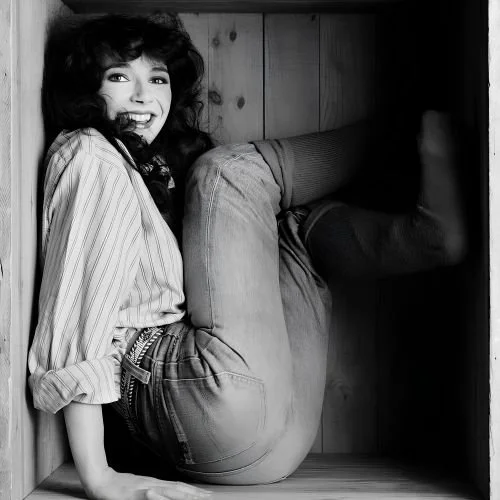
IN THIS PHOTO: Kate Bush in 1978/PHOTO CREDIT: Gered Mankowitz
The Pianistic Purity of Her First Three Albums
__________
SOMETHING that Stuart Maconie…

said on his BBC Radio 6 Music weekend show with Mark Radcliffe recently struck a chord with me. He said that he prefers Kate Bush’s first few albums because of their pianistic priority. That barer and perhaps more emotionally raw quality. There are a few distinct phases to Kate Bush’s career. 1978’s The Kick Inside, 1978’s Lionheart and 1980’s Never for Ever did see developments and evolution. Although piano is key and core to those albums, Bush did incorporate the Fairlight CMI on 1980’s Never for Ever. She was already friends with Peter Gabriel. He joined her on stage as part of her 1979 The Tour of Life for a benefit gig. That was to remember Bill Duffield, who was part of her team, and was killed after the warm-up gig in Poole. From then, Bush and Gabriel did work together. She appeared on his 1980 album, Melt, and Gabriel took part in Bush’s 1979 Christmas special, Kate. Peter Gabriel was already using the Fairlight CMI in his work, and he opened Kate Bush’s eyes to its possibilities. So progressive and advanced, it could produce so many different sounds and effects. However, I still associate Never for Ever with a certain delicate and romantic nature. Songs like Delius (Song of Summer), Blow Away (For Bill) and The Infant Kiss could have fitted on Bush’s first couple of albums. Whilst there are elements of Lionheart that are bolder and different from The Kick Inside, both are very piano-led. Never for Ever is a little more experimental in terms of the technology and electronic influence of the Fairlight CMI. The next phase was from 1982’s The Dreaming and 1985’s Hounds of Love. Both albums emboldened and heightened by the Fairlight CMI. Bush as solo producer, these are very different but ambitious. Extraordinary and layered. 1989’s The Sensual World and 1993’s The Red Shoes could be seen as the next phase, whilst her work from 2005’s Aerial onwards marks a new phase and chapter.
You can isolate The Kick Inside, Lionheart and Never for Ever. Bush going from being produced by Andrew Powell on her debut, assisting him on Lionheart, then working with Jon Kelly on Never for Ever. Each album a step on from the previous. The Kick Inside is my favourite album ever, and I think one reason is because of the piano. The beauty of Bush’s playing. Her phrasing, expressions and style. Critics were comparing her with Joni Micthell and Carole King in 1978. Bush respected those artists, though she was very separate from them. Less confessional. Her playing, I feel, broader and lighter. There is drama and sadness in some songs, though there is also delight, flights of fancy, joy, seduction, curiosity and wide-eyed wonder too. Such a broad palette. Kate Bush underrated as a pianist. I can see why Stuart Maconie loves the pianistic quality of those first three albums. Some see that purity as a negative. Hounds of Love and The Dreaming more respected and loved because they are fuller and more experimental. In the sense you get more genres and sounds blended. Bigger productions and perhaps more musical depth. The range of instruments gave Bush license to expand her horizons and what she was writing. Perhaps that natural nuance when you experience these layered and deep songs. That takes something away from the beauty of her playing. I have seen some who say the arrangements are basic or her playing developed and got better. I can appreciate that she is phenomenal on later albums like Aerial and 50 Words for Snow (2011). I feel the piano on her first three albums perfectly compliment her vocals. Think about all the characters Kate Bush inhabits and how she was so distinct from her contemporaries. The reason I come back to her first three albums, especially The Kick Inside, is the piano. Her favourite instrument and her passion, you can sense her heart and soul in every performance!
If you had to ask which Kate Bush ‘period’ or run of albums were their favourites, most would go from The Dreaming to The Sensual World inclusive. I have not really seen anyone else discussing this. The importance of her first three albums. Why the piano is so essential and effective. Kate Bush herself distanced herself a bit from those albums. She was not producing on her own, so she had limitations to what she could include and how much control she had. I do think that from The Dreaming on she was happier as an artist, as she was producing so got the final say. Bush was not having to compete or compromise. Perhaps she feels her songwriting was not its best. I would say The Dreaming and Hounds of Love are more masculine albums. Bolder and more percussive. Bush might have felt the first few albums were a little lacking in gravel and punch. That an effete or slightly unambitious or undercooked musical element was there. A single dimension when you focus on the piano. Elton John was and is an idol of Kate Bush’s. You feel like her love of the piano was because of him. When she became more experimental, artists like Peter Gabriel, Frank Zappa and David Bowie more in her consciousness. One cannot overstate the importance of her earliest songs and Kate Bush on the piano. How they captured the attention of her mentor, David Gilmour. Last year, Music Radar discussed The Man with the Child in His Eyes. Included on The Kick Inside, we learn about Kate Bush’s early life and how the piano spoke to her:
“Catherine’s work demonstrated a distinctive, albeit quirky, voice, yet there was something more broadly resonant about this early tranche of songs. Perhaps there was somebody out there who could market her music.
Using an Akai tape recorder, Catherine and her brothers taped over fifty of her original compositions. Next, Paddy and John hit-up an array of music industry-adjacent contacts, met via their own folk scene adventures, with the aim of eventually shopping Catherine’s demo to the big labels.
A few A&Rs did hear the demo, but some were daunted by either her youth, or the jarring oddness of Kate’s high-register vocal and distinctly intellectual musical universe. Sadly, everybody passed.
Catherine’s story might well have ended there, were it not for the interjection of John Bush’s good friend Ricky Hopper.
Hopper, a close Cambridge University chum of Pink Floyd’s David Gilmour, had been trying to help John get his sister’s music heard to no avail.
Upon hearing that Gilmour (then riding high after the release of Floyd’s 1972 opus The Dark Side of the Moon) was on the look-out for new artists to nurture, Hopper decided to pay Gilmour a personal visit.
“A friend of mine [Ricky], (that was) a friend of her brother arrived on my doorstep one day with rather squeaky demos of her,” Gilmour told the BBC’s Tracks of my Tears in 2006.
Enamoured by what he heard, and excited at the prospect of what she might be able to achieve with the right backing, Gilmour knew Kate was worth his time.
But David also knew that the business-minded execs would likely not share his enthusiasm for a teenager who clearly needed a fair amount of development work.
“The songs were too idiosyncratic,” David told The New Statesman in 2005. “It was just Kate Bush, this little schoolgirl who was maybe 15, singing away over a piano. You needed decent ears to hear the potential, and I didn’t think there were many people with those working in record companies. Yet I was convinced from the beginning that this girl had remarkable talent”.
I think about Kate Bush in the summer of 1976. PROG published a feature last year about The Kick Inside and the making of that. We learn how Bush got up early, practiced her scales, went off to dance class, and then played piano late into the night: “I’d get up in the morning, practise scales at my piano, go off dancing, and then in the evening I’d come back and play the piano all night,” she told VH1, recalling the remarkably hot summer of 1976. “I had all the windows open and I used to write until four in the morning. I got a letter of complaint from a neighbour who was basically saying, ‘Shut up!’ They got up at five to do shift work and my voice carried the length of the street”. Going back to where we started, and Stuart Maconie showing his love and appreciate of Kate Bush’s first few albums. I would agree with him in terms of their superiority and the purity of the piano. The pianistic beauty and enduring wonder of them. Like him, those albums are…
SO special to me.