
FEATURE:
Good Girl

IN THIS PHOTO: Paris Paloma recently appeared on Woman’s Hour and talked about creating feminist anthem, labour, her incredible new single, Good Girl, and how modern music (or Pop) is still very much expected to conform to the male gaze
The Discussion and Subject of Hypersexualisation and the Male Gaze in Pop Music
__________
MANY might say I am…
not qualified to discuss this subject. However, I think that this subject is worth discussing. I was listening to Paris Paloma on Woman’s Hour. She was telling Anita Rani how she was not seeking validation at all. That she didn’t care if people – the industry; men – found her attractive or not. Discussing her anthem, labour, and new single, Good Girl, she also touched embracing body positivity. You can listen here. I still feel there is so much emphasis on woman in music being seen as attractive and desirable. I will come to this, but is there this prerequisite that women are there for the male gaze. That they should show flesh and if they are not deemed attractive or sexy, then they are not worth anything. There was a period when body positivity was being discussed and celebrated. Perhaps less common now. Artists such as Lizzo very much at the forefront of that. Paris Paloma is an artist who, like so many of her female peers, has been valued and judged on how she looks. Rather than what is important: the music that she is making. It can be risky lashing back against that demand and desire. The fixation with women’s bodies. Not only stigmatising and misogynistic, there has always been this push from the industry. That woman’s bodies should be deemed ‘attractive or ‘sexy’. That is the way they get respect. Paloma said that women should be able to express themselves freely, but they should not have to flaunt their bodies to conform in order to be seen as attractive or valued. She lamented the loss of that body positivity movement and how now there is this Ozempic-fuelled reverse. That women are thinner or there is this pressure for women to be thinner, so that they are seen as attractive. This is something that is not discussed much in music.
Maybe, yes, men might not have the best perspective or sense of understanding, though I have seen few male journalists ever condemn this standard and sexism that has been rampant for decades. It ties into hypersexualsiation in music vs. body positivity. It is brilliant that women can feel confident and comfortable and there is this healthy image. That they do not have to slim and be a certain shape/size. That women can feel comfortable in their skin and talk about it. Paris Paloma does not care if people find her attractive. Someone who wants to feel safe and comfortable in her vessel. How it is so tragic that women still have to be moulded to fit the male gaze. Paris Paloma is not here to be a male fantasy or expose herself. How there is so much pressure on women to be slim. If they are not, then that criticism and attack against them. Paris Paloma saying that is not empowering for women to act, dress or look a certain way when that is pretty much what they are expected to do in order to conform to the male gaze. It was a powerful interview and statement that does raise that question. Will attitudes in music ever change?! I love the crop of modern female Pop artists. In terms of what they are producing. Artists like Sabrina Carpenter, I feel, are modern-day queens and incredible artists who will be remembered for decades to come. However, there is still this hypersexualisation. That question as to whether women are being free and expressive and it is positive writing sexualised songs and performing in a provocative and sexual way. That it is liberating and empowering other women. Or whether it is what the industry expects and what they have to do to be noticed. That it sets a bad example to young girls. Not something men are judged on. They are not sexualised and do not need to dress a certain way to sell records or get opportunities. I was reading a post on Instagram – I forgot to save the link so can’t remember who posted it -, but it asked whether there is needless hypersexualisation and whether women should be doing this. Using Ed Sheeran as an example of a male artist who is not expected to be sexual to sell music. Men not held to this standard or defined by their bodies.
This has been happening for decades. Think about a legendary icon like Madonna. Although she was very much someone who was comfortable in her body and used her sexuality to her advantage and was very open about sex and desire, you do wonder how much of that was expected. That she felt she needed to sell records. Madonna might argue that she was empowering herself and others. You can definitely argue this! Facing such abuse and misogyny during her career, songs like Human Nature struck back against critics who condemned Madonna for being evocative and talking about sex. Today, as she prepares to launch Confessions on a Dance Floor: Part II, you could say that she is still as bold and brilliant as ever. However, she still has to face misogyny and ageism. So many female Pop artists influenced by Madonna. There is this argument as to whether she and so many others are body positive and expressing their sexuality in a positive way or whether it is what women are expected to do. Tow this line. Last year, Belinda Carlile talked about hypersexualisation in Pop and cited Dua Lipa as an example of a hugely talented artist who was performing in this very sexual and charged way. How it was embarrassing and not empowering. One might say there is a distinction between hypersexualisation and conforming to the male gaze and sex-positivity. In general, there has been a reversal in terms of attitudes to sex. Perhaps there is more judgement when artists discuss sex. Decades ago, especially in the '00s, so much of modern music was about sex. Much more at the forefront. Sabrina Carpenter is a wonderful artist who very much should talk about her sex life and be sex-positive. However, like Madonna a few decades ago, she is judged and faces condemnation for being seen as risqué, as the BBC wrote last year:
“Carpenter's breakthrough came last year with the song of the summer, Espresso, and her Grammy-nominated album – amazingly, her sixth – Short n' Sweet. By then she'd long shed her Disney roots and embraced a coquettish, 50s bombshell look and overtly sexy persona. "I'm so [expletive] horny," she sang on Short n' Sweet's Juno. She made an eyebrow-raising play on the word "camaraderie" on Bed Chem. Things got even filthier when she toured the album, acting out sex positions and simulating sex with a male dancer. Outraged parents have decried her as a bad influence on their daughters.
A blonde bombshell pop star causing moral outrage with her overt sexuality? It all felt quite familiar. Carpenter certainly isn't shy about her love of Madonna, paying homage to the singer's Blonde Ambition era on a Vogue cover (shot by Steven Meisel, the same photographer behind Madonna's book) and wearing the star's 1991 Bob Mackie Oscars dress to last year's VMAs.
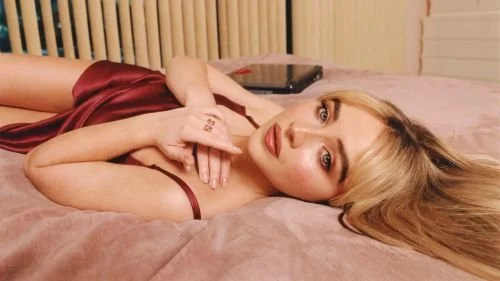
IN THIS PHOTO: Sabrina Carpenter/PHOTO CREDIT: Red Light Management
Whereas Madonna's overt sexuality felt radical, Carpenter's has a more tongue-in-cheek feel – to the point where some have questioned whether it's a marketing ploy. Criticism intensified in June when she unveiled the cover for Man's Best Friend, featuring the singer on her knees as a man grabs her hair. It drew ire from several quarters – some feminists, women's charities and fans thought it was degrading to women. Conservatives thought it was overtly sexual. Others defended the singer, calling the reaction puritanical and suggesting the image was satire. Carpenter later revealed an alternative "approved by God" cover – and this week said the original image was about deciding "when you want to be in control".
It all ramped up anticipation for the album's release, fuelling speculation on whether this might be Sabrina's Erotica, a daring and subversive, sex-positive album. In fact, the album has turned out to be, as one critic for The Times described, "surprisingly vanilla". Despite the provocation prompted by the cover – and nine out of the 12 tracks being labelled as explicit – there is nothing especially radical in either the music (perfectly pleasant, occasionally great '90s-and-Abba-inspired pop, with no hooks to quite rival Espresso) or the lyrics. Sure, there are plenty of lines that would make your grandmother blush, but Carpenter's album doesn't reveal anything that shocking – just a young woman exploring her sexuality and writing smart, funny and sometimes smutty lyrics about the realities of modern dating. So why all the fuss?”.
Not that sex is a controversial subject. Music cannot be too sanitised or purified. However, rather than this being a case of artists honestly talking about sex and doing so in a healthy way, there is still this feeling that so many women feel they can only get a toehold and be seen if they are hypersexual. That they are invisible. If they look a certain way and dress in a manner not seen as sexy and commercial, then they will be side-lined and buried. Whilst Sabrina Carpenter, Dua Lipa and so many of their peers are phenomenal artists who are inspiring so many girls and women, are they performing and writing in a way that fits into the male gaze? Do they feel they need to do that to stand out and get recognition?! They are hugely talented artists, and it may be them being very real and empowering. Being confident in their bodies. Though there is a connection between modern mainstream Pop artists getting buzz and attention and the nature of their music and performances. Not with every major female Pop artist. Though it applies to so many. Last year, Annie Lennox spoke with The Independent about her new memoir. Among other subjects, Lennox discussed how music is and always has been hypersexualised and misogynistic:
“Lennox, who went on to have an extremely successful solo career in the 1990s, has resisted reductive labels all her life. She has also always resisted the pop industry machine that tends to regard young female stars as bait. In 2013, she spoke out against the oversexualised state of the music business, condemning in particular “pornographic pop videos”. What does she think about the landscape now, which has arguably become even more sexualised thanks to the explicit provocations of artists such as Sabrina Carpenter and Charlie xcx? “I was originally objecting to the fact that [it was the] record companies [who] were promoting this hypersexualised look,” she says. “They were like, ‘Whoa, we’ve got soft porn with a musical background. That’ll make a ton of money.’ And it did.
“Now these artists, the ones you’ve referenced, they’ve found their niche, and I’m not saying it’s all soft porn. But hypersexualisation has become so normalised. I would say that if you want to do that, then you just have to live with whatever comes from it. That will be your life experience.”
Lennox and Dave Stewart met in a health food restaurant in Hampstead in 1975, where she was a waitress – and formed The Tourists and later the Eurythmics (Lewis Ziolek)
Lennox herself found the music industry in the late 1970s to be very “male-led”. “They certainly would have wanted to exploit my female side more,” she says. “And that was never said explicitly, but it was there. And so doing things in the way we did was always like a bit of a rebuff.” In 1986, she famously took off her top to expose a red bra while performing “Missionary Man” at a Eurythmics concert in Birmingham. “That had less to do with exploiting my sexuality than sticking a middle finger to the male gaze. I was saying, ‘I will do what I like on my terms”.
It is a complicated debate. If we tell modern Pop artists to be less sexualised and change things, that is telling them what to do with their bodies. Also, you can say it is expressive and empowering for women to discuss sex and have this confidence. Even so, there is a double standard in music and this idea still that women are not judged on talent and their words. More, they have to also be sexy and attractive to get ahead. Whereas men do not. This article from 2024 examined female sexuality in Pop and discussed the dangers of hypersexualisation and what that message says to young girls:
“Can you even imagine the uproar if a little boy were to be dressed in a nude coloured bodysuit, dancing with very adult-like moves to a song about one-night stands and alcoholism, or writhing around a cage with nearly nude adult? And yet Sia did this with two of her hit videos and very little was said about it. Because the child in question was a girl.
A Devastating Impact On Girls
Such explicit videos of female sexuality in pop are certainly exerting a negative influence on little girls. Even back in 2007 the American Psychological Society issued a report on the sexualisation of young women. They found “virtually every media form studied provided ample evidence of the sexualisation of women”. And since then, things have only gotten worse. One word, my friends: WAP.
In study after study, women – and increasingly, young girls – are portrayed in overtly sexualised ways. Vastly more than men. Unlike films, music videos are available for young children to watch without restriction. But some are getting so raunchy, there is a warning of ‘Adult Content’ before them. For example? Miley Cyrus’s MTV Music Awards performance where she ‘ejaculates’ smoke and glitter. Since the music video was originally created for youth culture, it’s a sad day when MTV has to carry warnings of ‘adult content’.
It’s About Safety, Too
The hypersexualisation of women in pop is more than a morality issue. It is one of women’s safety and equality. Studies show that girls who are exposed to sexualised content are more likely to endorse gender stereotypes and place attractiveness as central to a woman’s value. Boys who are exposed to this content are more likely to sexually harass females, and have inappropriate expectations of them. A shocking one in three girls in the UK say that they are ‘groped’ at school, or experience other unwanted sexual contact. Sexual harassment is practically routine at work, on public transport and other public spaces
Following a series of reviews, most recently the Bailey Review on the Commercialisation and Sexualisation of Childhood, the UK Government has decided to enact a series of measures to tackle sexualisation, including tighter guidelines on outdoor ads containing sexualised imagery, age-ratings on video games, restricting children’s access to online pornography.
A new project, Rewind and Reframe, has been set up by leading women’s groups in the UK. The End Violence Against Women Coalition, Imkaan and Object aim to provide a platform for young women to speak out about sexism and racism in music videos by blogging and sharing their experiences on a new website”.
It takes me back to Paris Paloma and what she was saying. How she does not care if people find her attractive. She is making music on her terms and wants to feel comfortable in her body without feeling the need to exploit herself or be exposing. It is sad how the male gaze still dictates how female Pop artists write and perform. Will that ever change? What can change that? Women in Pop are fully entitled to do what they want. Though one feels there is this pressure on them to be sexual. One could say most of their fans are women, so this sexualisation is empowering and not for men and their gaze. However, so many videos are directed by men and labels run by them. The industry still sexist and geared towards men. These Pop artists are so amazingly talented, you sort of feel that women run this risk of being forgotten or even dropped by a label if they act and say they are not going to do this. That they want to make music their way and it does not matter if they are seen as attractive and desirable. So many of the new weave of brilliant women in Pop are phenomenal songwriters. You read interviews and they are so compelling, compassionate and admirable. Incredible women who are so strong and empowering in what they say. But when you look at videos, listen to songs and see them live, there is that sexualisation/hypersexuality. Wil the industry ever truly respect women?! Can they make music and be popular without their bodies being on the line? People will point to artists who have succeeded and not do so whilst being very sexualised. However, those are perhaps rare cases. The male gaze still driving sales and demand. Body-positivity perhaps gone. Now, there is a standard that says women in Pop need to be super-thin and need to conform. I hope that anyone who reads this and is a woman in music forgives any missteps or ill-informed opinion. Though I am very much moved by what Paris Paloma said to Anita Rani recently on Woman’s Hour. How women’s bodies are commodities and they are judged on their looks and figures seemingly more than their brains, words and talent. Or that so many women have to be very sexualised to sell music. Nothing new (sadly) in the music industry you wonder if this is something…
THAT will ever change.