
FEATURE:
An Assassin’s Smile
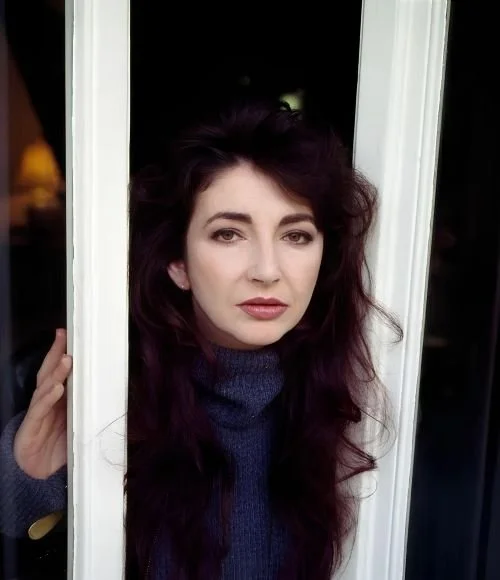
IN THIS PHOTO: Kate Bush in 1993/PHOTO CREDIT: John Stoddardt
Kate Bush and the Women Who Interview Her
__________
THIS is not a negative thing…

or any slight against Kate Bush. However, I wanted to look at how, through her career, Bush was mostly interviewed by men. I was re-reading Graeme Thomson’s Under the Ivy: The Life and Music of Kate Bush, and there is an interesting section on page 291 I wanted to expand on. Talking about Kate Bush in 1993 and what was happening then. This was a year when Bush was pretty much stepping away from music. The Red Shoes came out in November, and she also released the short film, The Line, the Cross and the Curve. Her mother died the year before and she had broken up with Del Palmer (who she was in a relationship with since the 1970s). She experienced personal loss and exhaustion through recording an album and shooting a short film. I am surprised that Bush had any energy left in the tank! In terms of promotion, it wouldn’t have been the most exciting or happy time. Bush had to speak about her work, though there was this challenge of having to be professional and provide some energy and engagement. However, as Graeme Thomson notes, there was this combative interview between Kate Bush and Chrissie Iley. Writing for the Sunday Times, this celebrity interview sat down with Kate Bush. Thinking that Bush had an “assassin’s smile”, there was this frustration with Bush, as she gave polite chat but there was an undercurrent of hostility. Even the simplest questions, like when she was asked what kind of doctor her father was, was met with refusal and this slight passive-aggressiveness. Maybe you can understand why Illey was annoyed. Thomson notes how an early interviewer likened Bush to Lady Macbeth. How men were too busy rhapsodising and getting distracted by her beauty, and they could not see something steelier and cold lurking beneath that exterior. I don’t think that it is fair on Kate Bush to call her cold towards women. However, maybe there was this dynamic shift. Bush maybe finding it easier to get along with men or it being unusual for her to be interviewed by women.
That has changed in more recent years, though Bush was mostly interviewed by men. After the interview with Chrissy Illey, Bush felt that something akin to a hatchet job had been perpetrated. This hatchet job occurred later. Articles that were about Bush’s son and lifestyle. Bush responded with a press statement, saying how she was very happy with her new son, Bertie, and gives him as normal and safe environment and life as possible. Maybe her not talking about her son and keeping quiet was to protect him. You can appreciate that. I don’t think it is the case that all Bush’s earlier interview encounters with women were frosty or awkward. I am going to highlight one with actor Laura Dern that is especially charming. Maybe that feeling that female journalists had an agenda or there would be this agenda. Bush did not work and collaborate with many women through her career. She may have felt like that would take away from her talent or like she was in competition. I am making it sound like she was unwelcoming to women. However, I feel like Bush bonded with men better, as she has two brothers and she grew up listening mostly to male artists. However, it was clear that there were select interviews with women that did not go well. This infamous Night Flight 1985 interview was a car crash from the start. The U.S. show was probably not used to artists like Kate Bush. In the case of Sue Simmons, she was probably given some brief notes and had never heard of Kate Bush. The Kate Bush Encyclopedia has more detail:
“In November 1985, Kate Bush was interviewed for the programme Night Flight during a promotional trip to the USA. While the segment in the actual broadcast has become hard to find, the uncut, unedited version of the interview has become a classic among Kate Bush fans for the inane questions by the uninformed interviewer. After the interview, Kate is further exploited by the studio crew, who pressure her into delivering a series of advertising ‘spots’ for a number of television programmes”.
One of the best moments is seeing the expression on Kate Bush’s face. Rather than an ‘assassin’s smile’, it was a cross between someone about to snap and this smirk! Not that this was gender specific: that U.S. trip in late-1985 where she was promoting Hounds of Love was quite ill-fated. More than one interview that went off the rails. Simmons’s questions were quite inane and she even labelled Bush’s 1982 album, The Dreaming, as ‘Dreaming’. I can understand why Bush might have felt a bit standoffish or reluctant to speak with female journalists and broadcasters if this was the sort of thing she had to endure!
However, it would be unfair to say that male journalists were too busy lost in their own minds and easier to control and women were seen as rivals or Bush needed to control them. That would paint her as someone who was professional at all, which couldn’t be further from the case. However, there are some wonderful examples of Bush bonding with female journalists and interviewers. In 1994, actor Laura Dern spoke with Kate Bush. I guess it did happen years ago where you got a celebrity outside of music chatting with an artist. It happens now, but on sites like Interview Magazine. It would be amazing to see YouTube shows where actors and people from other areas interviewed musicians. There is this respect and easy bond between Bush and Dern, as you can tell from the answers Bush provides:
“What do you say when someone has truly inspired you? How do you express to an artist how deeply their work has affected you? Well, for better or worse, I just had my opportunity.
I wanted to ask Kate Bush every obvious fan question in the book. I wanted to let her know how much her work means to me. I wanted to ask the right questions.
I have no conscious memory of our conversation, because I went into some altered state of panic. Luckily, I realized that my duty of being Lois Lane, reporter extraordinaire, would get in my way. So I just tried to chat with Kate.
With the release of her new album, The Red Shoes, Kate was in the U.S. for her first visit since 1989. She and I have both recently completed our directorial debuts on short films -- hers, a 50-minute feature, The Line, The Curve and The Cross, which links six of the new songs through a fairy tale.
How fantastic it was to speak with her! It was so unusual to hear that magical voice that I've heard singing into my inner ear (through headphones) since 1985. I remember first encountering Kate's music while filming Blue Velvet. I listened to Hounds of Love, and instantly felt I had found what I always longed for music to be: a discovery of self, a journey full of imagery and passion; and now this voice, this creator and I were having a conversation.
SPIN: Tell me about your new short film, The Line, The Curve and The Cross. I understand that Michael Powell, the director of the old classic movie The Red Shoes, is a hero of yours. Is your film adapted from his?
Kate Bush: It was something I thought of when we finished the album: to make a short film that would include some of the songs from the record but also tell a story. The only stuff I've worked on before has been short videos.
Spin: You've directed almost all of yours for years now.
KB: But I've never done anything like this before, and it was just such an education for me. I think the most demanding thing was being in it as well as directing, and I don't think I'd do that again. I found it very difficult --just having the sheer stamina. But what a wonderful experience, and it's so different from making an album because you've got this big group of people all working together on something that has to be done quickly and the albums are almost completely opposite to that.
Spin: I've read in interviews where you talk about how exciting it's been for you in the process of mixing, and I thought to myself, "Oh my God, as a director what an exciting new world that must be for you, with all that you can do with the visual side." Were you like a kid in a candy store?
KB: To a certain extent, but we were very restricted by having no money and so little time. But some of it was so new to me -- like working with dialogue, which I found fascinating. I really enjoyed it. The film is meant to be like a modern fairy tale. We worked on it so intensely and it's not been finished for very long, so it's really difficult for me to know what people will think of it and whether they'll get a sense of story from it.
Spin: The thing I remember when I was a teenager and saw The Red Shoes was the struggle of this woman's: having to choose between being a dancer and being with her man. That the passion for love and the passion for dance couldn't coexist really affected me. I don't know what you think about that. I hope to believe -- well, I hope to believe a lot of things -- but I hope to believe that we can be consummate artists as women or revolutionaries, or whatever women want to be, and also have love, not only for ourselves but from a partner.
KB: I have to believe that too. It's just not fair to think that it's not possible. But I suppose the consuming nature of being obsessed with one's work, or one's art, is obviously something that we probably all struggle with to try to find a balance.
Spin: In interviews, people always refer to you as this great perfectionist. Do you agree with that? Do you perceive yourself that way?
KB: Well, if perfectionist means taking a long time, then I would agree with it. But I really don't think that it's possible to make things perfect, really. In some ways, there's almost an attempt to try to achieve something that is quite imperfect. Do you know what I mean? And to be able to find a way of leaving it with certain raw edges, so that the heart doesn't go out of it. I don't think of myself as a perfectionist at all.
Spin: Critics, especially men, seem to describe women who are brilliant at what they do as perfectionists or loners or difficult to get at. I always find that so hilarious because I think someone who is connected to their work must be easier to reach than others.
KB: I think so too, it's just that maybe they're going to be a little more weary.
Spin: Do you struggle to balance your desire to keep a raw, spiritual edge to your music and a need to make the music accessible? Do you feel confident enough to just express what you believe and hope the audience catches up?
KB: There's kind of a driving force involved in the whole process of putting music together, to ultimately ending up with a finished album. I think there's a lot of stuff that I don't even question until other people come in and listen to the music, and it's almost like suddenly you're listening to things through other people's ears. I suppose that's when it gets a bit difficult. Sometimes I'm aware that things were actually a little more personal than I'd realized. But I suppose I feel if, when you are actually creating something, it feels kind of honest, it feels good, then that's the point where the intenion matters, and then from that point onwards it's just a matter of being brave enough to actually let it go.
Spin: That's why I've always loved film more than theater, and film may be more closely related to making a record because you have that ability to go in and do your work and have no judgment around it, and feel honest. Then, much later, it's presented to people. But in theater, people come backstage after a performance and you're about to do the same play again the next night, and people say, "Well, I didn't really believe that emotion" or whatever. It's really hard for me, I like to be closed up and just do the work.
KB: That's a very interesting observation, I'd not actually thought of it like that, but you're quite right. Films are kept very personal for quite a long time.
Spin: I've always been so curious to know if there are certain of your own songs or albums that you feel most proud of, or most connected to?
KB: I suppose, like most people, I tend to feel closest to the work I've most recently done. In a lot of ways, it's like extracts from a diary: If you look back at things in your past and consider events, it's like, "Oh God, no." You tend to feel differently about things as you move through two or three years. And I suppose also, hopefully, you like to think that you are getting better at what you do, more mature in your craft. Quite soon after that, there comes a point where you just want to do something completely different from the most recent piece of work in order to shake it off.
Spin: Have you ever gone back and either thought about songs you've written, or listened to your music from years before, and learned something you hadn't recognized, or understood something that at the time you didn't understand?
KB: I'm not sure I've ever reinterpreted something, but I have definitely been able to hear things in a different way from how I did at the time. I very rarely listen to any of my old music; it's the last thing I ever want to do. But occasionally I end up in a situation where I do, and if enough time has gone by, I can actually hear how I would do things differently.
Spin: But if art is a contribution, and I certainly know that your music has been, the one thing that I'm excited about as a listener is that you've been at different places in your life and have written pieces of music where you may now think, "if I had only done it that way," but somehow the place you were at allowed you to write it that way and it affected people who were in the same place.
KB: There was a reason for it happening then.
Spin: I've always wanted to ask you if you have interests in the shadow side, in understanding the repressed self -- things we are in denial about.
KB: Creative art is an awfully positive way of channeling the shadow side, and I think it's much more healthy to explore it and have fun with it within the boundaries of art. I'm not sure that it's something terribly good to go looking for. Do you know what I mean? I think it's actually something that ends up coming to you anyway”.
It is when someone asking the questions is a fan and you can tell they know about Bush’s music, that is when she is more relaxed. Is it a control thing? Maybe years ago, though you can tell Dern is a massive fan and this meant that you get these insights and interesting replies from Bush, rather than something that is tense and formulaic. Look at more recent years and how Bush has spoken with women more. Lauren Laverne (BBC Radio 6 Music, BBC Radio 4). Laverne interviewed Kate Bush for 50 Words for Snow in 2011, and it was a really great chat. Bush completely charming and loving speaking with Laverne! There is also the two very recent examples of Emma Barnett speaking with Bush. In 2022, when Running Up That Hill (A Deal with God) was used in Stranger Things and it was a chart success. That was for Woman’s Hour. I have dropped this interview in a lot in the past, though I feel it is necessary again, so that you can hear their rapport and that respect. Interesting Bush wanted to speak with Woman’s Hour at that time. Barnett interviewed Bush at the end of 2024, around the time Little Shrew (Snowflake) was released. That was a single aimed at raising funds for War Child. Bush directed the video and requested to speak with Emma Barnett. I hope the two chat again very soon. Going back to what Graeme Thomson noted in his book. That Chrissy Iley interview, where one can attribute blame to both sides. Maybe Bush was a little tense or reluctant that day and it came across as icy or calculating. Iley very much doing a hatchet job and sort of trying to settle a score or make Kate Bush look bad. It would be unfair to say that Kate Bush did not like being interviewed by women, though it is evident that it was unusual for that to happen to a point, and perhaps she preferred the dynamic of speaking with male journalists more. That did shift later in her career. If one would argue Kate Bush preferred speaking with male journalists more, or it was perhaps a different experience that meant that she could relax more, articles such as this argue how it is her female fans that understand her more – and male fans just don’t ‘get her’. Barbara Ellen, writing for The Guardian in 2024 – right after that interview with Emma Barnett for the Today programme -, caused backlash and criticism when she wrote this:
“What is it about Bush and her fans, and her female fans in particular? One radio interview and we’re transported into Kate-mode, which, for me, means going about my normal day (walking the dog; prodding at the supermarket self-checkout screen), booming her music on headphones, feeling thrilling, otherworldly, impetuous. Other female musicians can be exciting: Beyoncé dropping country music albums (yes!); Taylor Swift conquering the known pop universe (why not?). Bush, however, only has to murmur about “new ideas” and some of us feel all the molecules in our bodies rearranging themselves.
Do men understand the effect Bush has on so many women: how “other” she makes us feel? I’m sometimes surprised myself by my Kate-worship. It’s as if she’s snuck through the net as British pop culture’s only forgivable prog-hippy. And yet love her unreservedly I do. Obviously, it’s a lot to do with the music. Bush isn’t just another musician, she’s an entire genre. And, with perma-reclusive Bush truly the JD Salinger of music (just as the last album was in 2011, the most recent live shows were in 2014), everything she touches has rarity value.
But it’s also because she’s our Kate: the cultural trigger for the secret part of every outwardly sensible woman who wants to jack everything in (yes, all of it) and devote her life to floaty dancing in leotards and diaphanous skirts. Or fancies slipping into a hot Victorian nightie and running barefoot across a windswept moor towards a Heathcliff-esque lover, however brooding and dodgy he might be”.
There is perhaps more to be written, and I guess it might have been true of any major female artist of that time. What is being written about them and how they come across can affect their career and reputation. Words can be manipulated and, when two men or two women talk, it can be a different set of agendas or dynamics compared to those of the opposite sex in conversation. Bush’s male-heavy upbringing probably did affect the way she was with male interviewers. As a woman trying to make her own career and do it on her own terms, the experience of being faced with a female interviewer might have put the hackles up, or Bush felt like she had to compose herself in a different manner. That 1993 interview with Chrissy Iley seemed a trial. Also, in 1985, when speaking with Sue Simmons in the U.S., that was another blow. Though more recent examples sees Bush seek out women like Emma Barnett. So that idea that Bush was this assassin luring women in only to strike or not answer their questions seems unfair and not representative or who she is. As we all know, the great Kate Bush is…
ONE of the sweetest and nicest humans.