
FEATURE:
I See the People Working
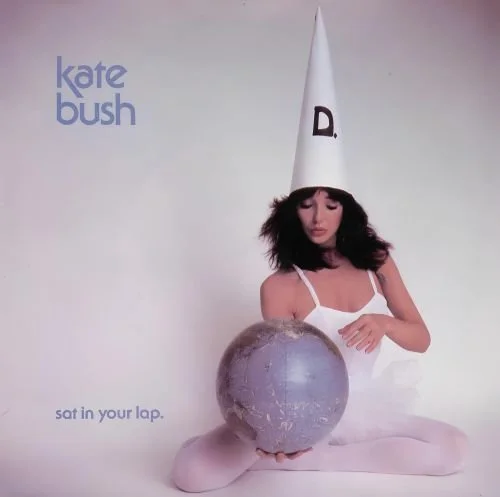
Kate Bush’s Sat in Your Lap at Forty-Five
__________
THERE is no denying that…

IN THIS PHOTO: Kate Bush in 1981/PHOTO CREDIT: Denis O’Regan
this single was a big turning point for Kate Bush. I have written another anniversary feature for this track. On 21st June, 1981, Sat in Your Lap was released. It was the first single from The Dreaming. This offering that arrived over a year before the album came out. It must have been strange for fans to get this single and then wait so long for an album. However, Sat in Your Lap definitely marked a real moment of growth and evolution. There is something I want to raise first. It is fascinating looking at all the different promotion Kate Bush did for her music. Today, there are a few T.V. shows, though most promotion is done online or radio. Back in 1981, when Kate Bush released Sat in Your Lap, T.V. was still a very powerful and important source of promotion. However, how do you market Kate Bush in terms of the shows she appears on? One of the great events around Sat in Your Lap is when Kate Bush appeared on Razzmatazz. This was a Pop show for children, and it was produced at Tyne Tees. This article recalls when Bush appeared on the shoe on 14th July, 1981. It was a brilliant and unusual experience:
“For the Sat In Your Lap promo spot, Kate was interviewed by Razzmatazz’s Lyn Spencer, and took questions from the young school age audience, even letting the miscreants try on props for the single’s video – and gave an early insight into her artistic prowess. Spencer recalls how “the male members of the crew were particularly excited at the prospect of Kate Bush appearing on the show – they had seen her racy stage costumes!”
“When I met Kate she was absolutely adorable, and quite shy. I decided to mic her up myself rather than have the sound department boys drooling over her, so I wasn’t Ms Popularity on that day as they were probably fighting for pole position. I remember the interview well, as we played in snippets of her very popular promotional videos, and she talked about the making of these, showed props from them and took questions from the young audience.”
“Smile, Kate, you’re on rancid camera.”
“It was such a great feature that the producers decided to extend the piece, which was originally scheduled to be edited to three minutes. The final piece ran for seven minutes, which is a large chunk of time for a show that fills a half-hour slot. However, Kate was very hot at the time and the feature was very well received. My lasting impression of her was that she was very sweet, charming, softly spoken, but obviously hugely talented as well as being a beautiful young lady.”
Kate told Razzmatazz: “The song really dictates what you have to do with it. Some songs are very simple and other songs become almost little epics where you have to section lots of little things together. It really is a lot of fun. For me it is like making a film. I think of it as something very special.” Bush then showed a storyboard for her Army Dreamers single from the previous year, and went on to say:
“That’s the wonderful thing about art, like music and dancing, everything you do can then become your work. If you’re cleaning up one night you might suddenly realise what a great routine it would make. It’s keeping your mind open to all these things. It’s really fun, life becomes work. Music and dance are meant to go together, they are very close arts. I went to see an incredible performance by someone called Lindsay Kemp, and I suddenly realised that this was what I was looking for, this movement combined with music”.
There is a great interview from 1981 that I want to come to. I wanted to lead with that article about Razzmatazz. The promotion around the single. It was quite an unusual one in terms of Pop music. Not necessarily that commercial or familiar to what children and teens were listening to in 1981. Quite a gamble going on this kid’s show and talking about a song that must have seemed quite complex and strange in terms of its inspirations. There were periods in Kate Bush’s career where she was burnt out and depressed. Working so hard on an album and then going into another one. That happened after Never for Ever came out. Whereas maybe piano was the inspiration and starting point for most of her songs before Sat in Your Lap, that then changed. This Dreams of Orgonon article that I soured for the other forty-fifth anniversary feature reveals why Sat in Your Lap was a turning point. Also, how Bush suffered this burn out and had this hard period after the 1980 album came out:
“The aftermath of Never for Ever was a period of burnout for Bush. Prone to depressive burnouts after the completion of projects, she found herself drifting into a nadir of fruitless ennui, which she deemed “the anti-climax after all the work.” Completing Never for Ever in May 1980, Bush, not for the last time, put significant space between herself and the public, taking a holiday after an exhausting several months of recording. By the time Never for Ever was released in September, Bush was only just recovering from her creative inertia. Her timing was auspicious, as Never for Ever not only became her first #1 LP in the UK but the country’s first ever #1 studio album by a female solo artist ever. Never for Ever’s success was accompanied by heaps of promotion by Bush, including the usual run of performing songs on talk shows as well as signing albums for hundreds of fans at a time. Now she had more creative agency than she had previously, touting Never for Ever as “the first [album] [she] could hand to people with a smile.” Kate Bush the prodigy who sang “Wuthering Heights” was already a distant memory, transforming into Kate Bush the great 1980s British songwriter.
Yet Bush’s listlessness and struggle to write songs persisted for some time. It’s not hard to see why — the stress of Never for Ever’s production and the attention of the British public would be enough to put a damper on anyone’s creative output. It took seeing other musicians at work to get her motivated again. In September, Bush and her boyfriend Del Palmer attended a Stevie Wonder concert at Wembley Arena. Wonder was in a period of creative renewal himself. Having recently turned out a rare Motown flop in the distinctively titled Journey Through “the Secret Life of Plants”, he’d rebuilt confidence with his delightful Hotter than July LP. The concert broke Bush out of her writer’s block — “inspired by the feeling of his music,” as she later wrote, Bush got back to work on her songs, and forged a path towards her next album.
Bush’s work to date was largely harmonic, built around what notes went together interestingly on the piano. Rhythm was secondary for her: it’s hard to think of a rhythmically powerful song on Bush’s first three albums. Her preparations for Kate Bush IV had thus far consisted of little bits of melody, but without a focal center. After the Wonder concert, she realized she needed to start her songwriting from the rhythm track upwards. At home, she programmed a rhythm into her Roland drum machine (according to my friend Marlo, the Roland on her demo from the period sounds like a CR-78, and woe to anyone who disagrees with Marlo on drum machines), and “worked in [a] piano riff to the hi-hat and snare.” A demo resulted: “Sat In Your Lap,” Kate Bush’s first solo production, was in its nascency.
“Sat In Your Lap” wasn’t always Bush’s first self-produced song. For a time, she entertained bringing in experienced producers, including long-standing David Bowie collaborator Tony Visconti, going so far as to spend a day in the studio with him. The collaboration went nowhere, and Visconti has grossly remarked “all I can remember is the Bush bum.” Perhaps unsurprisingly, Bush decided to take on the producer role herself, with the intensive collaboration of a series of engineers. The first set of sessions for the album that would be The Dreaming were staged at Townhouse Studios in May 1981. Her collaborating engineer was Hugh Padgham, a producer for Phil Collins and XTC known for the “gated drum” sound that would define 80s pop (compress the drums, use a recording console’s “gate” to remove their reverb, resulting in a kind of sound vacuum. See Phil Collins’ “In the Air Tonight”). Bush and Padgham’s time in Townhouse was productive yet short-lived. Padgham is rare among Bush collaborators in having negative feelings about working with her, grumbling about her tendency to overpack a mix and experiment rather than having a concrete, straightforward vision. After laying backing tracks for three songs, Padgham moved on, dissatisfied with his latest gig but having indelibly marked the sound of The Dreaming.
Bush’s ad-libs, piano riffs, and rhythm track came together quickly in the studio, quicker than any other song on The Dreaming. Having a drum-centric engineer like Padgham was incredibly useful for her, as the early recording of Bush’s rhythm track showed. “Sat In Your Lap” is heavily percussive, built around its drum sound and brass section (initially synthesized on a Yamaha CS-80). The partially syncopated drumbeat (“dum-DUM-dum-DUM”) is Preston Heyman’s most memorable to date, a fine translation of the demo. The frantic, almost pharyngeal rhythm track has a kick drum so guttural and suppressed (though not apparently gated) that it can easily be mistaken for one of Bush’s vocal onomatopoeias. The track’s sonic menagerie (Bush’s recurring motif of musical instruments as bodily extensions lives to a maniacal extent), a veritable ensemble of screams, tinny horns on the Fairlight CMI, swishing bamboo sticks (thanks to Paddy Bush and Preston Heyman) childlike whispers, “HO-HO-HO’s,” and bellows of “JUST when I think I’m king!”
What better to bring Bush out of a period of creative stagnation than a missive to psychological stagnation? Or even better, a tremendously loud, busy, and clamorous one. Amidst the song’s sheer volume is a narrative of inertia and stillness. Bush deploys a childlike whisper in the verses, a canny juxtaposition with the rhythm track’s masculine percussiveness, indicating juvenile trepidation as she watches adults go about their lives: “I see the people working/I see it working for them/and so I want to join them/but then I find it hurts me.” The verses are terse observations from an unmoving figure, grounded in a desire to catch up and have a powerful mind: “I see the people happy/so can it happen for me?,” “I want to be a lawyer/I want to be a scholar/but I really can’t be bothered,” “I want the answers quickly/but I don’t have no energy”.
I do want to finish with an interview from 1981. The point of this piece, not only is to mark forty-five year of one of Kate Bush’s best and most important singles. Looking at the promotion around the single and some background. How she went from Never for Ever and the period after that and into the first single from an album that would also cause burn out. It is hard to read that Bush took so much out of herself. That promotion did that too. Going from one album and needing to rest and feeling overwhelmed or worn out. Then this happening with her very next one. I do want to include again this interview from Record Mirror of September 1981. A few months after Sat in Your Lap was released, it is clear that Sat in Your Lap and 1981 was a change. In terms of her sound and maybe how the press perceived her: “No longer the little girl, wide-eyed, fey and whimsical, so beloved of award-show presenters with her squeaky string of "amazings" and "fantastic”:
“It's been two years now since what Kate calls her "Tour of Life", a massive circus of a tour that won't, repeat won't take place again until next year at the earliest. Again, it's been six months since the last single and Sat In Your Lap, as much as anything she's done, is the start of a new era, another "cosmic cycle" that will see the release of a new album later this year.
And now that all those ideas in the past--a theatrical tour that was a combination of the innovative and the unexpected, an album last year that surpassed all that went before it--have become reality, she's a powerful personality. SHe makes points where she used to make only comments, argues from experience now as much as from excitement, pushes herself as an artist ("one of us", she says, referring to the type) much more than a surprised, precocious talent.
Yet she's still infectious [huh?], vulnerable at times, as open to ideas as ever. Richness and fame don't embarass her; slowness in honing her creativity probably does, just a little.
Her favourite expression on this meeting wasn't one of wonderment, astonishment (ah, the cliche!); rather a dismissive pout of "Pah!" -- almost French, knowledgeable, and nearly coquettish.
"Pah! Let them think that! Pah! That's wrong!" she seems to imply, ready to underline her ideas. Call it a change, call it maturity, call it confidence in her art, for it almost certainly is. Take money:
"I've changed. I don't pretend it's not there any more, which I used to do," she says. "I'm not worried about being rich, I just didn't think of taking advantage of it. Now I buy things that I can use, things that will help me, like synthesisers and drum machines.
"My life has never been into money, more into emotional desires; like being an incredible singer or an incredible dancer; and if I can buy something that can help me, I will now. But I wouldn't buy something that I couldn't live with, like a country house which I don't need. [Actually, about two years after giving this interview, Kate bought--a country house.] I'd rather buy a huge synthesiser that I could live with all day."
She emphasises and explains, thinks out the question, returns to her theme. The easy answers have gone over the years. Take her career...
Kate maintains that there hasn't really been a gap, even though she admits that Sat In Your Lap only surfaced after her longest break to date.
"My slowness at doing things surprises me," she says, "but i have been doing things continuously. It's a battle to keep up with all the things I want to do, and obviously things like dancing are going to suffer. I couldn't spend twelve hours a day in a studio like I'm doing at the moment, and dance, as well."
Again the emphasis on her way of working--the only way. The ups and downs are of her own making, they don't follow rules. And Kate only bows to her own pressures.
"The last album was the first one that I would actually hand over to people with a smile," she says, almost seeming to imply that it was the first one she was actually pleased with, "and that was followed by a greater period of non-creativity, when I just couldn't write properly at all.
"It happened before, when the tour was over, and then I felt I'd just given so much out that I was like a drained battery, very physically and tired and also a bit depressed.
"This time it was worse; a sort of terrible introverted depression. The anti-climax after all the work really set in in a bad way, and that can be very damaging to an artist. I could sit down at the piano and want to write, and nothing would happen. It was like complete introspection time.
"I suppose I had about two months out earlier this year...and that was a break I really needed. It gave me time to see friends, do things I hadn't been able to do for three years.
"It wasn't really as if I was missing out on normality," she laughs. "I'd rather hang on to madness than normality anyway, so it was more like recharging."
But something more came out of it than just a rest?
"Oh yes!" The smile returns. "I felt as if my writing needed some kind of shock, and I think I've found one for myself. The single is the start, and I'm trying to be brave about the rest of it. It's almost as if I'm going for commercial-type "hits" for the whole album.
[I have always been struck by this statement. It seems to me to indicate that Kate really doesn't have a very sound notion of what is "commercial"--which is all to the good, of course. For if she felt that The Dreaming had a commercial sound, then some listeners's criticism that she seemed to have developed a calculatedly commercial sound for the next album, Hounds of Love, loses credence, since her mental image of "commercial" sound is so different from the sound of Hounds of Love.]
"I want it to be experimental and quite cinematic, if that doesn't sound too arrogant. Never For Ever was slightly cinematic, so I'll just have to go all the way."
The shock that Kate refers to, eyes almost ablaze as she uses the word, came months ago...after she started to work with a rhythm machine while she was writing.
"I'm sure lots of things that I'm trying to do won't work," she says, "but I found that the main problem was the rhythm section. The piano, which is what I was used to writing with, is so far removed from the drums. So I tried writing with the rhythm rather than the tune."
Sat In Your Lap, naturally, is the first fruit of the new approach--original (in that it could only be Kate Bush) marriage of pounding drum sounds and two layers of voice. There is a theme, but it's the rhythm that hits you first, blasting right through to the synthesised end--a step that she knows is likely to continue the critical division.
"I was really frightened about the single for a while," she admits. "I mixed the song and played it to people, and there was complete silence afterwards, or else people would say they liked it to me and perhaps go away and say what they really thought.
"Of course it's really worrying, because there's an assumption that if you're one of us, an artist, you don't need feedback at all, when in fact you need it as much as ever, if not more. I really appreciate feedback, and I'm lucky that the people closest to me, my friends and family, are used to me and realise that I've got my own 'bowl of feedback' to rely on."
And that's more important than the public reaction, or do you worry?
"There will always be some who are irritated by me. I seem to irritate a lot of people," she smiles, "and in a way that's quite a good thing."
Nor will the change stop there. Drums, Kate enthuses, are as wide a concept as music itself, and she's determined to go further than "a lazy acceptance of a drum kit." Add that to the news that she'll be working with other musicians on the new album--"the best around"--and it seems likely that "Kate Bush 4" will be one of the big surprises of the year.
As a preview she plays me one track that's currently being worked on: a wild soaring collusion with Irish group Planxty entitled Night of the Swallow, which also features one of the Chieftains. Again the sound is unmistakable, but this time it's Kate Bush married to the heartbeat of traditional Irish folk.
Discussing the project brings Kate Bush into larger-than-life focus once more. The burning enthusiasm returns, along with the string of "amazings", "incredibles" and "fantastics". She'd been up all night in the studio the previous night in Dublin, and her reactions are genuine, real and hard to resist.
"I'm still really up from the experience," she says. "In fact, I'm still reeling from it. I asked them if they'd be interested, and the whole thing was so relaxed, it was wonderful. I badly want to work with them again. I'm so excited about the fusion.
"And I think that there's so much of the Irish in my mother that it all suddenly came back to me--it was fate rearing its head at just the right time!"
So that's two surprises already, and although Kate has been making demo tracks since March, and Abbey Road is now her second home, the rest will have to wait until summer completion...if all goes according to plan.
What about the book you're planning to write, though? Again, she sighs (a marginal sigh) and repeats her line: "There's so many things I want to do, and it's so hard to fit them all in..."
But yes, a book is on the cards, hopefully before the end of the year, and she says: "I'd like to write it myself. Without saying anything about the other books, which I don't want to, I feel almost pressured to speak, otherwise there's this huge misrepresented area.
"In one way it's ridiculous--I feel it's much too early to write a book, I've hardly done anything yet. But I really want people to be aware of reality--subjective reality, obviously”.
That notion that an autobiography would be released by Kate Bush. To be called Leaving My Tracks. This is worth highlighting, as I feel one reason why she would have wanted to do this was put the record straight. So many misconceptions around her, his would have provided some truth and clarity from Kate Bush. However, as we read, the project was scrapped in 1983: “For some time in the first half of the Eighties, Kate Bush considered writing an autobiography. She was asked to write a book probably as early as 1980. At first Kate decided not to write an autobiography, but in the course of about a year the idea morphed into a book about her experiences and views, like an exploration of her work. There may even have been a proof text. Publishers Sidgwick & Jackson actually produced a dustjacket for the book, entitled Leaving My Tracks (pictured here). According to library data, the book was to run 144 pages plus 8 pages of photographs. The official fanclub even announced a release date somewhere in the autumn of 1981. In late 1983, the project was shelved indefinitely. No autobiography has ever been published. It isn’t even known if Kate ever wrote one or more chapters for the book”. On 21st June, we mark forty-five years of Kate Bush’s Sat in Your Lap. I hope this feature provided an idea of the background and lead-up to Sat in Your Lap. How it did cause a bit of a rumble, as this was like nothing we had heard from Kate Bush. It signalled a new direction. Also, “Two versions of Sat In Your Lap were released: the single version and the album version. Kate Bush stated in an early interview that the single version was remixed slightly for inclusion on The Dreaming. The vocals were raised higher and the backing track altered to fit in better with the overall feel of the album”. I was keen to include that to end up. Also, that the single reached number eleven in the U.K. It was the most successful single from The Dreaming. It is a shame that the song was not performed as part of a larger tour. It would have been amazing to see how it fitted in. However, there is no denying the fact Sat in Your Lap is a masterpiece. After suffering burn out and fatigue, there was this new spark and confidence. That struggle to write song and period of inactivity did probably affect the release date of The Dreaming. If people expected an album late in 1981, they had to wait until September 1982 until her fourth album came out. Forty-five years after its release and Sat in Your Lap remains…
THIS brilliant single.