FEATURE:
Spotlight
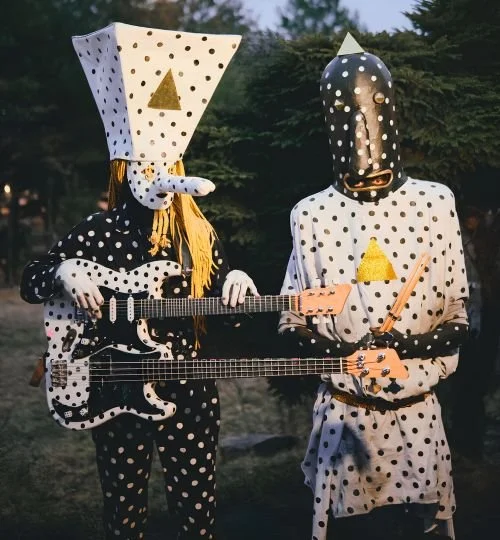
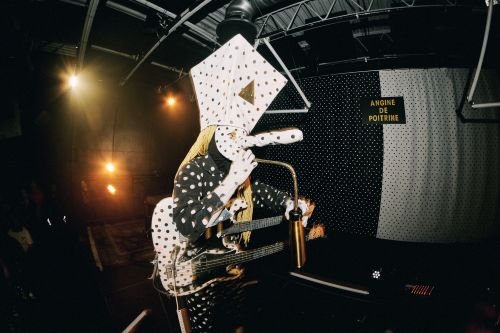
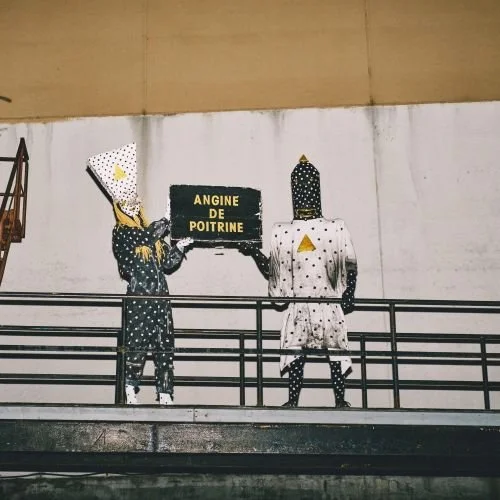
this duo before. However, for anyone unfamiliar, I am spotlighting Angine de Poitrine. They are composed of two anonymous musicians performing under pseudonyms as guitarist Khn de Poitrine and drummer Klek de Poitrine. Formed in Saguenay, Quebec, in 2019, they recently played dates in the U.K. They are back here later in the year. Though I am not a great fan of artists who remain anonymous or mysterious – SAULT did for a while, until they performed live and the cat was out of the bag! -, you cannot that the music of Angine de Poitrine is fantastic. I will end with a review of their new album, Vol.II. There are a couple of new interviews that I want to come to. CULT MTL interviewed Angine de Poitrine ahead of the release of their album. It must be quite a strange experience interviewing artists who keep their identities secret:
“Through a cloud of indoor cigarette smoke, I see something resembling a human being. This is Khn de Poitrine, the guitarist who wields his custom-made double-neck microtonal guitar and bass (polka-dotted, of course), and commands a legion of loop and effects pedals. Next, Klek, the in-the-pocket drummer, also decked out in polka dots on stage, appears only as an omniscient voice. And whatever god the Poitrine duo worship, they speak! French and English.
“This project is a culmination of a lot of years of inside jokes,” Khn says between cigarette drags. “The names were our alter egos in a 10-minute free jazz project, where I was just fooling around on saxophone and (Klek) was on drums.”
“Just to be clear, you won’t be showing or displaying our (human) names? We are Klek and Khn for life,” Klek laughs. As a music journalist, I oblige — partly out of respect for their art, partly out of some primal fear of what exposure might bring. I picture a Cronenbergian nightmare: Khn and Klek replacing my childhood sleep paralysis demons, haunting my dreams with infinite spirals of microtonal rock while they beam golden triangles into my skull. Why triangles?
“It’s the best shape,” Klek fires back, defending the polygon. During live shows, the duo throws up pyramid shapes to the crowd, and the crowd throws them back. “We just really fucking love triangles. They are beautiful, and the strongest shape,” Khn says, without an ounce of hyperbole.
Angine de Poitrine hails from the Saguenay–Lac-Saint-Jean region, and the duo has been playing music together since they were 14-years-old. That’s around 20 or so years, but again, they are intergalactic beings, so time is irrelevant. The costumes started as a prank. “At first, the idea for the costumes was to play more shows and play a bit of an Andy Kaufman-esque joke on the crowd and say, ‘Hey, can we start a band without anybody knowing who we are?’ And who is it behind the masks?” Klek says.
But the masks and personas of Khn and Klek have now become safety armour for both members. “There’s a comfort to feeling, ‘Oh, I’m this on stage,’ but after that, I’m a normal person,” Klek says. “We can avoid the, ‘Oh, this is the drummer’ talks, where everyone swarms you after a show when I just want to drink my water.”
Before releasing their first single, “Sherpa,” in 2024, the duo’s exploration of microtonal rock was born from musical curiosity. One day, Klek brought home a custom-made microtonal guitar for Khn to mess around with.
“I took two guitars, and I took the frets from one board, which was kind of rusty and fucked up anyway, and I put them on a second fret board,” Klek says. So what did this do? Standard Western music runs 12 tones in a chromatic scale. Add extra frets and you crack open a wider interval system — quarter tones, semitones — producing the fractal, frictional quality found in Japanese and Indian music. That friction became the foundation for Angine de Poitrine’s progressive rock-psych-freakish jazz wormhole.
In the beginning, Khn was playing with a microtonal guitar, looping it, and switching between guitar and bass while Klek laid down the beats. But they started toying with the idea of having a double-neck guitar made.
“We thought it would look fucking sick, and for 15 seconds, we were like, ‘Oh, that’s a funny joke.’ But it became clear that it was a good idea,” Klek says. After speaking to different luthiers, one who quoted Khn $12,000 per fret board (which they quickly declined), the guitar was made by a “professional friend” of Angine de Poitrine.
“The whole idea of the band was to assume a bit of a satirical approach to rock music in general,” Khn says. “We wanted an exaggeration, so the double-neck guitar was the perfect choice to kind of make fun of guitar heroes.”
As you can probably sum up, the twisting microtonal rock may seem like it comes from a super serious and pretentious place, but it’s actually quite the opposite. Both Khn and Klek are virtuosos of their craft, but much like their costumes and the excess of the double-neck guitar, parts of the music are a light, sardonic poke at rock music.
“We will have short musical statements in the songs that are actually just jokes, like, this is the boomer lick, and just shout (distortedly) ‘HAIL SANTANA!’ into the microphones,” Khn laughs. “Obviously, we love Santana. It’s a love statement, but also a caricature, because you’ve got to be able to laugh at yourself and say, ‘What we do is ridiculous”.
The second and final interview I want to highlight is from The Guardian. They have a growing fan base here in the U.K., and I can only imagine how exciting it was for fans here to see them on the stage. I don’t think that there is anyone quite like Angine de Poitrine at the moment. Even if they might not have the ear of all major radio stations here, I feel that those that get what they are releasing and truly appreciate their music makes up for that. The duo deserve as much attention as possible:
“In just a few months, Angine de Poitrine’s lore has entered the annals of rock iconography alongside the likes of Kiss, the Residents and Daft Punk. In February, US radio station KEXP published a video of the anonymous duo performing at a French festival: 27 minutes of ludicrously tight, swerving, looping grooves played by two figures who look like some ungodly union of Jar Jar Binks and Dada pioneer Hugo Ball. There was undoubtedly a novelty factor, but novelty alone can’t fuel you to 13.7m YouTube views. Those are pop-star numbers for genuinely freaky music, a prog-club sound that takes its wayward undertow from Khn’s microtonal musicianship – playing the notes between the notes, a mode historically found in eastern music – and Klek’s sewing-machine needle drumming.
But they’re nonplussed by the hype: even the luthier who made Khn’s microtonal double-necked guitar has become a figure of obsession; no wonder the creator of their new masks wants to remain unknown. “It’s only music. I’m not saving people’s lives,” Klek continues. “I’m just playing drums. One comment on KEXP said: ‘Now there’s a reason to live.’ I was like: calm down, man. Go kiss your mother or something – that’s a reason to live.”
Rabid fans have worked out who they are, but the fun of Angine is that they’re mysterious and inventive. The sleuthing, says Klek, makes him feel like when he asked for an Xbox for Christmas as a kid. “I really badly wanted to know if I had it, so I undo the tapes on my wrappings and take a look. It was like: oh yeah, I had it. Then I closed it back up and for a week I was like: why did I do that? Where’s the surprise now? There is a thing that is interesting in not knowing. And you find out who we are and you’re like … oh. We’re not Lady Gaga. We’re not Elton John. We’re two random dudes.”
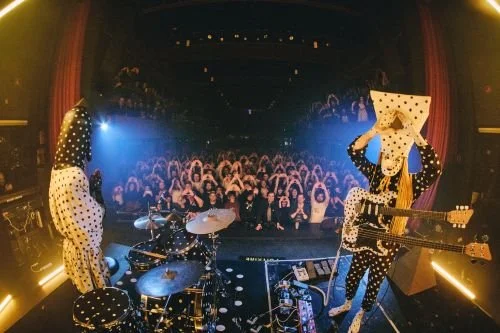
The incorporated Saguenay area had a great DIY arts scene. Khn was obsessed with a “mathy, rocky, bluesy, bit wonky rock’n’roll” band called Deux Pouilles en Cavale, whose drum kit was partially made of trash. They loved le parc, another hard-firing instrumental band. The region was surrounded by logging and aluminium factories: did those industrial pistons infiltrate the sound? “People in Saguenay are down for intense, loud music,” says Khn. “If you want to stand out, you have to blend all those influences together.” He cites prog metal band Voivod, until now the area’s biggest musical export. “They bring influences from punk rock, from prog, from a lot of different subgenres. Maybe people here don’t have those barriers.”
Klek and Khn kept playing together, alongside their mutual pal, but didn’t form a band until their early 20s. “For a while, we didn’t take it seriously,” says Klek. “It was just like playing with Legos.”
“Well,” says Khn, “maybe that’s true for you. I was 12 when I picked up a guitar and I instantly became very serious about it. I always had the intention to make a band.” He played with plenty of other serious musicians, but it never compared to noodling in the basement with Klek and their mate. Klek’s resistance drove Khn to distraction. “It was frustrating for me when the most interesting stuff I was doing was with two guys who had no ambition whatsoever.”
Klek couldn’t see himself as a musician. “I didn’t have idols or people to follow in their path,” he says. He was more into woodwork. In time, he realised what a vast part of his life music occupied. “I did a lot of jobs, but never did driving trucks or planting trees as much as playing music.”
Klek and Khn are lifelong jammers. Most Angine songs start that way. “We improvise and make a lot of crap, then you have a little spark,” says Khn. “A lot of the songs on the second album, I found one riff that’s got something to it, then you build from that.”
Building up these loops, says Klek, “there’s a feeling of anxiousness or something that comes with the repetitions, the frictions with the microtones. We’re always playing with that feeling, and tension and release.” Using a loop pedal live keeps them in line, says Khn. “If I start from this idea, I have to find a coherent way to move away from it.” Otherwise, he says, they have a “tendency to make songs that go from A to Z without coming back to A or B”.
Angine are open about being inspired by King Gizzard’s 2017 album Flying Microtonal Banana. Microtonal virtuosos have been going viral a lot recently: Maddie Ashman, Bryan Deister. The appeal, Klek thinks, is that “it sounds new for people”, though he finds it weird given that this musical system predates the 12-semitone western scale. He can’t say whether listeners are finding it a reassuring counter to AI-generated culture. “Since we are ‘popular’ in a certain way – it’s strange for me to say that – we don’t spend much time on the internet because we have a tight schedule. And sometimes people are … how can I say … angry about Angine. So we’re like: let’s not go on Facebook. People can say what they want.” Khn grins”.
I will finish with a review from Pitchfork. They wrote about Vol. II from a duo who “takes the throne as the world’s weirdest party band”. Where they come back to the U.K. and play dates here in October, they will be performing to packed-out venues:
“Their sudden, overwhelming success seems like something of a fluke since none of their obvious touchpoints are remotely fashionable. There’s definitely a little King Gizzard & the Lizard Wizard in their hypnotic churn and microtonal melodies, but beyond that, you’re swerving into serious dorkery: Think the ill-angled prog jabberwocky of ’70s French zeuhl bands like Magma or Art Zoyd; the demented herky-jerk of ’80s outsiders like Renaldo and the Loaf or Zoogz Rift; the heady grooves of Primus, Discipline-era King Crimson, or early Battles; the costumed performance noise of ’00s loft-punx like Forcefield, or the similarly two-toned Yip-Yip; maybe even the spate of Turkish psych-rock reissues that started emerging around 20 years ago. The band rides for Arto Lindsay and gamelan records but also Gentle Giant’s hyper-intricate prog, and John Scofield’s Bonnaroo-funk outing Überjam.
The first three tracks on Vol. II provide proper studio versions of their four-song KEXP set (the honking, space-choogle “Sherpa” opened Vol. I). All three are stellar examples of the band’s polyrhythm games. Angine is not Dillinger Escape Plan or Naked City leaping wildly between time signatures—a loop pedal serves as the third member of the band, so every song is generally locked into a pulse. Instead, Angine de Poitrine are more like Meshuggah or Dawn of Midi, establishing a meter and then creating rhythmic illusions using creative bursts of syncopation. Opener “Fabienk” is a simple 7/8. What makes Angine de Poitrine special is how they wiggle and writhe within that structure, filling the grid with weird rhythmic curlicues, ill-timed accents, and unlikely hooklets. Khn’s riffs span large gulfs of time so they lose their familiar shape, punctuating the air in strange polygons. “Sarniezz” is a basic 6/8, it only sounds weird because it takes Khn four bars until he repeats his Frith-ian melody and Klek alternates between swung time and traditional 4/4 caveman pound. When they lean back and sledgehammer that random second sixteenth note subdivision, it’s like synchronized swimming. The pair claim they have been playing together for 20 years, and their telekinetic bond is apparent in these twisted arrangements.
Surely, this type of granular analysis is thrilling to Zappa apologists and people who watch Drumeo videos, but ultimately Angine de Poitrine’s best balancing act is the ability to consistently dance this mess around. Vol. II is body music, dancefloor music, pogo music, moshpit music, noodle-dance music. It just happens to sound like Lightning Bolt trapped inside Pee-Wee’s Playhouse. All but one of the mesmerizing puzzles on Vol. II strut across the six-minute mark, and the songs never lose steam because they contain so many variations and plot twists. As avowed fans of house and acid techno, they not only understand hypnosis but also pacing: The climax is often Klek’s drums doing a frantic surge into straight meter, which is not just a balm for the brain-boggled but a fairly obvious cue to go apeshit. In “Yor Zarad” they cut the time in half, turning a nervy Wire spasm into the world’s happiest Helmet song.
Using a custom-made guitar to craft melodies from the notes in between the notes of the Western scale, Khn is an incredibly versatile musician. Even on the decidedly uncomplicated 4/4 bounce of “UTZP,” he still thrills because he morphs himself from Balkan brass rave-up to Snakefinger-style dizziness to multi-layered Glenn Branca guitar orchestra to total hair-metal shredding. Critic Craig Marks astutely brought up Dutch wacko-prog fluke “Hocus Pocus” by Focus, but I would point to Gary Hoey’s wheedle-metal cover that was a 1993 staple on Headbangers Ball. They’ve managed to take some of the unsexiest music in history and give it the type of groove that renders it undeniable.
Skeptics can paint Angine de Poitrine as gimmicky OK Go stunt rock, but there’s no denying the melodies and chops behind their dotted duds. At their best, they’re a beacon that North America is once again ready for art-fucky noise rock bands, a rising tide that will hopefully lift excellent, margin-dwelling weirdo-gnash outfits like Los Angeles’ Guck, Oakland’s Gumby's Junk, New York’s Chaser, Portland’s Rhododendron, and Las Vegas’ Spring Breeding. Angine de Poitrine have the muscle, the melody, and the magic to be the world’s weirdest party band; Vol. II is a powerful argument that we should all start seeing spots”.
Do make sure you experience the phenomenal music of Angine de Poitrine. Even though they have been playing and recording for a while, this year is one where they are gaining widespread acclaim and attention. I am relatively new to their music, so I wanted to collate some interviews and a reviews, so that you can get an idea of who they are – in a musical sense, rather than break that anonymity -, and why their music is so admired. They are so distinct and accomplished, but there is also this real sense of freedom and fun. If you buy that they are the world’s weirdest party band, then make sure that you do…
NOT miss the party.
___________
Follow Angine de Poitrine