
FEATURE:
Birth of the Cool: Miles Davis at One Hundred
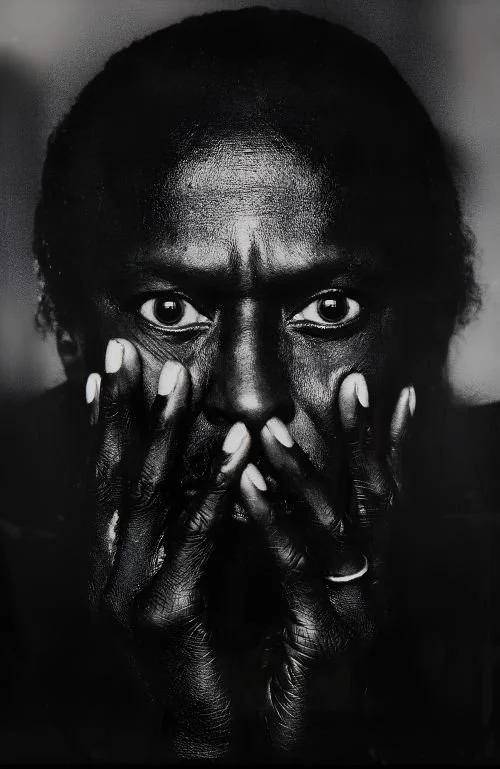
IN THIS PHOTO: Miles Davis, 1985/1989/PHOTO CREDIT: Anton Corbijn
The Legacy and Influence of a Jazz Giant
__________
BECAUSE the genius…
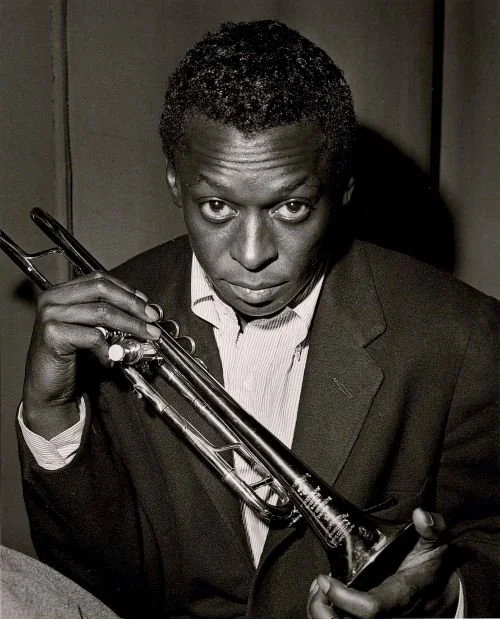
IN THIS PHOTO: Miles Davis in N.Y.C. in 1949/PHOTO CREDIT: Herman Leonard
and God-like Miles Davis would have turned a hundred on 26th May, I wanted to discuss his legacy and influence. In terms of the impact he had on music and wider culture. Perhaps he is still seen as niche or for Jazz lovers only. However, the variation of his music is incredible. One could not easily compare Birth of the Cool from 1957 to Bitches Brew from 1970. In 2022, Sounds of Life discussed the legacy of the Miles Davis. In terms of how he changed music, and the artists who followed who are clearly influenced by his music – Kendrick Lamar being among the most acclaimed:
“Miles Dewey Davis III was born in 1926 in Illinois. He started learning to play the trumpet at an early age, inspired by the creative atmosphere of St. Louis. In 1944, he entered New York’s Juilliard School of Music, where he started performing with some of the most well-known jazz musicians of the time.
From the end of the ‘40s to the end of the ‘50s, Davis recorded and played music extensively; he performed together with his legendary nonet, and in 1957 released Birth of the Cool under Capitol Records, his first major release and the one that led him to international recognition.
After recording and touring with his newly formed quintet, Davis released Kind of Blue in 1959, one of the most successful jazz albums in history. It was an instant success that skyrocketed Davis' career and made him a jazz icon.
Most musicians would consider this as the pinnacle of their career and start winding down thereafter, choosing not to explore new sounds but to stick with the ones that made them famous. However, that was never the case with Davis: the legendary trumpeter always tried to push the boundaries of his music. Throughout the ‘60s and ‘70s, he released almost 20 albums while constantly trying to blend and transcend musical genres.
Some of the albums Davis released at the time were not well received neither by critics nor by fans because they were considered too experimental and hard to follow. Looking back now, Davis was way ahead of his time, and it took us decades to fully understand the depth of his innovation and dedication to revolutionise contemporary music.
Miles Davis took a hiatus from recording and performing between 1975 and 1981. When he came back in the early ‘80s, he was a legend looking for new sources of inspiration, studying the latest technologies and sounds and implementing them in his songs. This final decade of his life proved to be another crucial chapter in Davis' career, defined by extensive experimentation, collaboration with artists across all genres, and relentless creativity.
The evolution of the Prince of Darkness
His ability to reinvent himself and draw inspiration from newer sounds to keep his style contemporary is nothing short of extraordinary. I can’t think of any other artist, in any discipline, who could be so inspired and inspiring for five decades.
If you skip through Davis’ discography on any music streaming service, you’ll hear influences from all possible music genres, from progressive rock to ambient to ethnic music. The variety and complexity of his output are mind-blowing and proof of Davis’ fundamental role in shaping modern music.
You can appreciate Davis’ chameleonic approach to composition since the early stages of his career – the period that led to the publication of Birth of The Cool. With his first commercially successful album, Miles Davis brought jazz closer to classical music with innovative and intricate arrangements that were unheard of at the time.
With his early works, Miles Davis elevated jazz music and upgraded the level of complexity this genre could achieve. Accompanied by an incredibly talented ensemble, Davis managed to be on top of the experimental scene while enjoying commercial success for many years.
In the ‘60s and ‘70s, Miles Davis evolved once again and added the influences of rock, electronic and funk to his music. The result was albums that were often misunderstood or altogether ignored at first, only to become seminal works for the following generations of musicians.
An example is the fantastic On the Corner, an experimental album published in 1972 and largely ignored by fans and critics alike when it came out. On the Corner features elements of rock and funk music blended with Indian and African instruments, mesmerising rhythms and moments of pure genius.
It took listeners decades to appreciate the experimentations included in this album, which jumps from one musical genre to another with such nonchalance that it still inspires artists today.
In the final part of Davis’ career, which began at the end of his hiatus in 1981, his usual experimental output is alternated with more accessible works. Two major albums that define this era of Davis’ career are the Grammy-award winning Tutu, and Aura, the last album that was published while the trumpeter was alive”.
His compositions never felt artificial and forcefully experimental. Since the beginning of his career in the 1940s, Miles Davis was always able to reinvent his style according to modern influences while staying fundamentally true to himself. He never tried to please his audience; instead, he chose to push the boundaries of his style until a bridge with a new audience was created.
To thoroughly examine the career of Miles Davis would probably require years of study. The way he pushed the boundaries of jazz, bridging the gap between seemingly unreconcilable musical genres, is something no other musician has been able to do since his death.
His legacy comprises artists who have an avant-gardist approach to music composition. American trumpeter Christian Scott is among those who have been able to reprise the work of Davis and push it forward.
American rapper and producer Kendrick Lamar stated Miles Davis was one of his primary sources of inspiration while recording his pivotal 2015 album To Pimp A Butterfly.
Ambient producer Brian Eno cited Get Up With It as the album that inspired him the most while recording On Land, released in 1982.
Every genre Miles Davis touched in his five-decade career brought to life a new generation of artists who understood the importance of contamination and artistic evolution. The Prince of Darkness paved the way that jazz musicians are still following today: the ultimate testament to the creative restlessness of one of the most incredible musicians ever to exist”.
Last year, IOL celebrated Mile Davis at ninety-nine. As they note, Davis was a “cultural icon, sonic philosopher, and the shapeshifter of the 20th century’s musical identity”. Someone whose genius and innovation is still shaping music. On what would have been his one-hundredth birthday, I know that others will be exploring his legacy and genius. I think there are people who still turn their noses up at Jazz and define it with one thing. Look at an artist like Miles Davis, and he took Jazz in new directions. In terms of his evolution and experimentation. There will be an album for everyone:
“The Reluctant Genius
Miles Davis was not a man to explain himself. He played, and we listened. His genius lay in his ability to intuit what the times required musically, and to deliver it before the rest of us even knew we needed it. From his early bebop collaborations with Charlie Parker, through Birth of the Cool, Kind of Blue, Sketches of Spain, Bitches Brew, and into his later funk and fusion experiments, Miles never repeated himself.
He led, often in silence, with sunglasses on, back turned to the crowd, allowing the music to be the only sermon preached.
He understood music as motion. “Don’t play what’s there, play what’s not there,” he said once. A mantra that could well be applied to social transformation and leadership. Miles believed in the becoming of things. That spirit of resistance to stasis is what makes him feel more alive today than most of the artists working now.
The revolutionary without a banner
Unlike some of his contemporaries, Miles Davis never positioned himself as a spokesman for Black America, yet his entire being was a refusal of subservience. He carried his dignity with an unyielding confidence, one that infuriated white America’s expectations of Black deference.
He dressed impeccably and challenged journalists, demanded equal pay, and lived large. He expected greatness and returned the favour by delivering it.
His presence in the civil rights era and later during the Black Power movement was more symbolic than vocal. Still, his art thundered louder than most speeches. Albums like On the Corner and Dark Magus were sonic revolts, full of dissonance, distortion, African polyrhythms, and urban edge. Prefiguring hip-hop, Afrobeat, and much of contemporary protest music.
In an era where artists are asked to use their platforms more responsibly, Miles Davis’s legacy urges them to understand that sometimes the most radical thing one can do is to refuse limitation, to make uncompromised art that challenges, confronts, and uplifts all at once.
The African connection
Although Miles Davis never physically set foot on the African continent, Africa pulsed through his work. From the modal compositions of Kind of Blue to the Afro-futuristic landscapes of Bitches Brew. His music mirrored the spirit of African improvisation: fluid, rooted in call and response, and resistant to strict Western forms.
In conversations with Bra Hugh, it became clear that Miles’s influence on African musicians was immense. Hugh often recalled how Miles encouraged him to find his sound, to stop trying to mimic the American jazz idiom and instead blend it with South African traditions.
That advice birthed masterpieces like Stimela and Grazing in the Grass. In this way, Miles did not merely influence Africa from afar, he catalysed a whole generation of African sonic self-determination.
Today, one hears echoes of Miles in the works of artists like Fela Kuti, Khaya Mahlangu, Manu Dibango, and even contemporary Afro-jazz and amapiano fusionists. His boundary-blurring sensibility fits perfectly with the spirit of Africa, where tradition and futurism walk hand in hand.
Lessons for the present
As we stare into the fog of modernity, with algorithms dictating taste, culture succumbing to trend cycles, and musicians often commodified before they are even seasoned, Miles offers crucial lessons:
Evolve or Perish: Miles was never afraid to shed his skin. Artists, thinkers, and leaders alike must resist the temptation of nostalgia and embrace growth, however uncomfortable.
Master Your Craft: He practised relentlessly. Miles reminds us that genius is not divine accident; it’s discipline, obsession, and listening deeply to the world.
Silence Is Power: His pauses were as profound as his notes. In a world of noise, his restraint teaches the value of considered expression.
Be Unapologetically You: Davis never pandered. He didn’t dilute his identity to please anyone. That kind of sovereignty, artistic and personal, is rare and urgently needed today.
Mentor the Next Wave: From John Coltrane to Herbie Hancock, Wayne Shorter to Marcus Miller, Miles surrounded himself with brilliance and helped others soar. He knew leadership meant creating room for others to lead.
There was a mysticism about Miles. He walked like he was from another realm. His raspy voice, his cryptic interviews, his love of painting, boxing, and silence, all made him something of a philosopher-artist.
He believed that music could heal, disturb, elevate, all in one phrase. His trumpet was an oracle. And for those of us who came to jazz through African ears, Miles was a griot of the future, reminding us that freedom isn’t a final destination but a constant state of improvisation”.
I want to finish off with Pollstar and their feature on Miles Davis at one-hundred. There is so much more I could have brought in when it comes to Miles Davis and his music. However, I wanted to combine some features that explore his legacy and how he changed the musical landscape. As he would have celebrated a century on 26th May, many are reflecting on his rare brilliance and incredible talent:
“The surfeit of iconic musicians Davis collaborated with is astonishing: The Birth of the Cool Nonet (1949–1950) with Gerry Mulligan, Lee Konitz, and Max Roach; First Great Quintet (1955–1958): John Coltrane (tenor sax), Red Garland (piano), Paul Chambers (bass), and Philly Joe Jones (drums). Later added Cannonball Adderley on sax. Kind of Blue Sextet (1959): John Coltrane, Cannonball Adderley, Bill Evans/Wynton Kelly (piano), Paul Chambers, and Jimmy Cobb (drums). Second Great Quintet (1964–1968): Wayne Shorter (tenor sax), Herbie Hancock (piano), Ron Carter (bass), and Tony Williams (drums). Known for post-bop and experimental, modal jazz. Fusion/Electric Period (Late 1960s–1970s): Included John McLaughlin (guitar), Chick Corea (keys), Joe Zawinul (keys), Dave Holland (bass), and Jack DeJohnette (drums), creating the groundbreaking Bitches Brew. 1980s Electric/Funk Group: Featuring Marcus Miller, Mike Stern, John Scofield, and Mino Cinelu, focusing on funk and pop-influenced rock.
Davis was musically omnivorous tastes and has cited influences from non-jazz artists like Jimi Hendrix, James Brown, and B.B. King. He played with a number of R&B/soul vocalists that included Chaka Kahn, Erykah Badu, Bilal and Leidisi as well as blues great John Lee Hooker and mega stars like Prince, Stevie Wonder and Sting. In April 1970, the Miles Davis Quintet famously opened for the Grateful Dead during a four-night run at the Fillmore West. His influence on contemporary is vast and includes a wide swath of hip-hop artists: The Notorious B.I.G., OutKast, J Dilla, Kendrick Lamar, Madlib and A Tribe Called Quest, who all sampled his work.
The various record labels that were stewards of Davis’ catalog are also part of the Centennial celebration. In January, Legacy Recordings, the catalog division of Sony Music Entertainment, released Miles Davis – The Complete Live at the Plugged Nickel 1965, returning the landmark recordings to vinyl and CD for the first time in three decades. In addition, Universal Music Group’s Blue Note Records, Warner Music Group’s Rhino, and Concord’s Craft Recordings will issue a number of releases throughout the year.
“There’s tons of music for people to explore,” says Davis. “And since Miles’ catalog is spread out over four or five labels it gives people a chance to hear from different eras.”
Just ahead of the Centennial last September, Reservoir acquired 90% of Davis’ publishing catalog and rights and royalties from his recoded music. While a figure was not released, the purchase was reportedly estimated at $40 million to $60 million. And a strategic purchase due to the sync/licensing potential for film, TV and luxury brands and the global attention around the Centennial.
“It was both an honor and a privilege for Reservoir to acquire the Miles Davis catalog at such a pivotal moment,” says Golnar Khosrowshahi, Founder and CEO of Reservoir. “Together with the Davis Estate, we approached the Centennial as a celebration of his extraordinary legacy and an opportunity to bring Miles into new musical and cultural spaces, ensuring he continues to influence artists and inspire audiences for the next 100 years.”
The caretaker and artistic hand behind the live part of the Davis legacy is his nephew Vince Wilburn, Jr., drummer, producer and founder/bandleader of M.E.B. (Miles Electric Band) and a Miles’ band member in the 1980s. Wilburn played on and co-produced legendary albums including the Grammy-winning AURA, Decoy and You’re Under Arrest. As a producer, he spearheaded the biopic “Miles Ahead” and the Emmy-winning documentary “Miles Davis: Birth of the Cool.
“It was exciting being on the road and playing with Uncle Miles,” offers Wilburn. “Friends that I grew up with were in the band – Darryl Jones, Robert Irving III. We had a band in Chicago and being on the road meant being out with my friends and an icon. And what was amazing was the effect that Uncle Miles would have on audiences all around the world – in countries where they didn’t speak the language, but the music was universal.”
Touring since his late teens, Wilburn recalls watching Davis from behind the drum kit.
“The audiences were hypnotized,” Wilburn says. “He had a wireless mic so he could go across the stage. And you could feel the energy and the eyes following him wherever he was on stage.”
Today, the stellar M.E.B. ensemble is focused on anchoring major U.S. jazz festivals and cultural events including tastemaker Big Ears Festival March 29 in Knoxville, Tennessee; Jazz St. Louis on April 8; Santa Monica International Jazz Festival May 9; and the Atlanta Jazz Festival kickoff on May 22 before international dates in Winnipeg, Canada, and Budapest, Hungary this summer.
On Feb. 25, the band headlined “Miles Davis Night” at the Miami Beach Bandshell during Montreux Jazz Festival Miami. Davis performed at the Montreux Jazz Festival in Switzerland 10 times between 1973 and 1991. His final appearance was captured in the landmark recording Miles & Quincy: Live at Montreux. Davis died three months after the festival on Sept. 28, 1991.
“Uncle Miles loved going to Montreux and he loved Claude Nobs, they were tight. And Quincy Jones was a close friend of ours,” says Wilburn. “Quincy and Uncle Miles did the recording in Montreux and that was one of his last performances in 1991, so when were asked to be part of this, we were very honored.”
With M.E.B. performing alongside the stellar Kind of Blue Acoustic Band, the Miami Montreux tribute featured an array of special guests including Jojo, Lalah Hathaway, Maurice “Mobetta” Brown, Gonzalo Rubalcaba, Ibrahim Maalouf and Sammy Figueroa who played with Davis and recorded on The Man with the Horn), backed by a breathtaking collection of Miles Davis alumni – Jones, Irving (aka Baabe), Munyungo Jackson and Jean-Paul Bourelly – with an array of jazz mavericks including Jason Kibler (aka DJ Logic), Greg Spero, Rasaki Aladokun, Antoine Roney and Keyon Harrold.
“We don’t want to be perceived as a tribute band,” says Wilburn. “We are just trying to have the audience experience our love for Uncle Miles and the musicians before us. This amazing music is our interpretation and we invite people to come with an open mind.”
Preserving the legacy while embracing the future is funneled through a single lens.
“We always say, ‘For the love of The Chief’ because that’s what we used to call Uncle Miles – affectionately The Chief,” confides Wilburn. “That’s in our heart, ‘For the love of The Chief.’” Through the efforts of M.E.B. and the Miles Davis Estate, an appreciation for The Chief is reaching new audiences and the next generation of trumpeters including Marquis Hill.
“When I reflect on the impact that Miles Davis has had on me, a wide range of thoughts and emotions surface,” says Hill. “But above all, one idea stands out – Miles embodies the archetype of pure originality. His originality wasn’t limited to sound – it extended to concept, composition, approach, bandleading and beyond. Through his work, Miles shows us that one of the most essential elements of this music is an unapologetic knowledge of self.”
Davis’ creative self-expression can be found throughout the Centennial, which runs through May 26, 2027. Managing the overall vision is The Miles Davis Estate, which is overseen by Davis’ daughter Cheryl Davis, her brother and Wilburn alongside General Manager Darryl Porter and Attorney Charles J. Biederman.
We Are (MIles’) Family: Erin Davis (Son of Miles Davis), Cheryl Davis (Daugher of Miles Davis) and Vince Wilburn Jr.(Nephew of Miles Davis) at the Miles Davis ‘The Art of Cool’ VIP Reception at the Napa Valley Museum on June 7, 2013 in Napa, California. (Photo by Earl Gibson III/WireImage)
The calendar is full of Estate-sanctioned events and various pop-up tributes honoring Davis as a cultural icon. This includes Laufey, the sublime Gen-Z Icelandic Chinese jazz vocalist whose helping revive jazz for a younger generation is giving her take on “Blue in Green” a seminal jazz ballad from the masterpiece Kind of Blue
Beyond music, Davis – who was ranked No. 1 on GQ’s list of Most Stylish Musicians of All Time – was the inspiration for Milan fashion label Off White’s March 5 fall show during Paris Fashion Week, titled “Mr. Davis.”
The estate is executive producing a feature film titled Miles & Juliette, starring Damson Idris (F1) as Miles Davis and Anamaria Vartolomei (Mickey 17) as Juliette Gréco. Directed and co-produced by Bill Pohlad, alongside producers Mick Jagger and Victoria Pearman, the film chronicles Davis’ first trip to Paris and his romance in the ‘40s and ‘50s with the city and the French singer/actress.
Perryscope, the Estate’s official global merchandising and brand licensing partner, has struck a deal with men’s premium retailer John Varvatos for Davis-themed apparel items.
Other partnerships include a recently released Lexus commercial featuring Davis’ Kind of Blue vinyl cover and a co-branded Miles Davis Centennial cigar lighting up later this year from premium cigar and accessories company Ferio Tego.
“We’ve always felt his music lines up so well with luxury items, the luxury lifestyle, the Miles lifestyle, if you will,” says Davis.
Simon & Schuster will publish a Centennial edition of Miles: The Autobiography. Originally published in 1989, the critically-acclaimed autobiography will be released with new cover and forwards to be revealed soon.
“Sometimes it’s a struggle to get it done,” says Davis of the effort behind curating the career-spanning Centennial. “But when it happens, it’s always beautiful.”
With his enduring impact on style and sound, it’s not surprising that a long list of cultural organizations, orchestras, jazz festivals and venues – from The Jazz Room in Charlotte, North Carolina, to Lincoln Center in New York – are planning tributes of their own including Carnegie Hall’s ongoing United in Sound: America at 250 series—to a Miles Davis-themed week of performances in San Francisco by SFJazz.
“Trumpeter Miles Davis was a pioneering and influential artist known for pushing the boundaries of jazz,” says Clive Gillinson, Executive and Artistic Director of Carnegie Hall. “He performed at Carnegie Hall eight times throughout his career, including his landmark 1961 concert with his close collaborator Gil Evans, which was recorded and released to wide acclaim as the live album Miles Davis at Carnegie Hall.”
Carnegie Hall will celebrate the Centennial May 8 with a United In Sound concert in Zankel Hall featuring Grammy-winning trumpeter and M.E.B. mainstay Keyon Harrold. Carnegie Hall and longstanding partner the iconic Apollo Theater will also present “Muted Genius: Celebrating Miles Davis at 100,” a weekend of film, music and conversation exploring Davis’ legacy in May.
“We’re delighted to feature these events as part of United in Sound – coming together to mark this important milestone and celebrate a quintessentially American artist,” adds Gillinson.
“We are very happy it’s being received so well,” Davis said of the way the greater industry is embracing the Centennial. “If they want us to be a part of it, we’ll try to be a part of it. If not, that’s ok, too. We’re just happy people are celebrating”.
Aside from articles being run, there is also radio coverage of his one-hundredth birthday. As Jazzwise write, there is going to be a week-long celebration of Miles Davis. I do think that anyone who has avoided his music or feel like they would not enjoy it needs to investigate it. Listen to a few of his albums:
“Highlights include Sound of Cinema (23 May, 4pm), focusing on Davis’s soundtrack for Louis Malle’s 1958 thriller Ascenseur pour L’Échafaud. On Sunday 24 May (4pm), Alyn Shipton presents Jazz Record Requests: Miles Davis at100, featuring newly remastered tracks from Ascenseur pour L’Échafaud and Birth of the Cool, plus interviews with former band members including bassist Dave Holland and guitarist George Benson. From Monday to Friday (4pm), Kate Molleson and US critic Nate Chinen explore Davis’s five-decade career in Composer of the Week, covering his early years, Kind of Blue, the Second Great Quintet (featuring Wayne Shorter, Herbie Hancock and Tony Williams), the electric fusion period, and his 1980s rebirth with bassist-producer Marcus Miller. Evenings bring The Essay: Miles Beyond (9.45pm) with writer Kevin Le Gendre examining Davis’s impact on politics, fashion and technology, plus ‘Round Midnight (11.30pm) hosted by Soweto Kinch featuring musicians Byron Wallen, Cassie Kinoshi, Marquis Hill and Emma Jean Thackray. Friday’s Late Junction (10pm) pairs trumpeter Laura Jurd with poet Anthony Joseph”.
You can feel and hear Miles Davis’s influence on modern music. Throughout so many different genres. Artists from Hip-Hop, Jazz and beyond who owe a debt to him. This incredible musician is one of the most influential…
WE have ever seen.