
FEATURE:
All the Clubs Have Been Closed Down
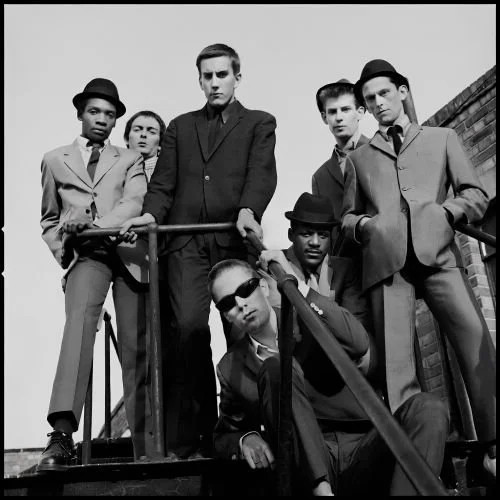
IN THIS PHOTO: The Specials (left-right: Lynval Golding, John Bradbury, Terry Hall, Jerry Dammers, Neville Staple, Roddy Radiation and Horace Panter) photographed on the roof of the Coventry Odeon, 1979/PHOTO CREDIT: Chalkie Davies/Getty Images
The Specials’ Ghost Town at Forty-Five
__________
THIS must rank…
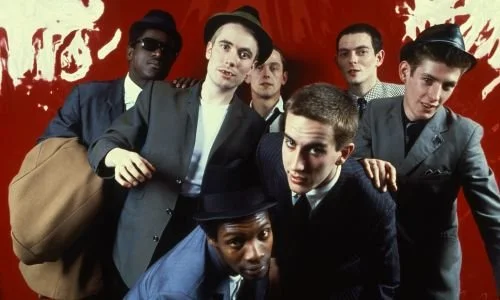
IN THIS PHOTO: The Specials in NYC circa 1980/PHOTO CREDIT: Allan Tannenbaum/IMAGES/Getty Images
alongside the most urgent and powerful singles ever released. On 6th June, 1981, The Specials released Ghost Town. It reflected unemployment and violence in inner cities. It was a chart success around the time where were riots happening in British cities. There were also tensions within the band, meaning it was the final that featured all original seven members. Even though The Specials were struggling and there were inter-band hostilities, the music press hailed and commended a vital piece of social commentary. A song that seemed to reflect this haunting and dark mood. One of the best songs of 1981, there is a modern-day relevance to Ghost Town. In the sense that there are protests and disruptions today. Far-right protestors and those who feel they are ‘patriots’. Pro-Palestine groups arrested and seen as the enemy. Clashes and groups of protestors pitted against one another. Violence and aggression in streets. Though not as extreme as was seen in 1981, there are aspects of what The Specials documented in Ghost Town and what we are seeing. Some would say the situations are different, as Ghost Town was released at a time of mass unemployment, urban decay and Black British youths clashing with police. Today, there is a different sort of threat. The youths were reacting to being victimised by police and a perceived racist agenda. Around the U.K., things were pretty bleak. In terms of The Specials, The band would travel around the country and see shops with the shutters down. Clubs closed down. It was despairing. The tour for The Specials’ More Specials album in late-1980 was a terrible breaking point. The band were exhausted from recording and touring. Members angry at bandleader Jerry Dammers, as he insisted on including ‘muzak’ keyboard sounds on the album. There were gigs that saw audience members attack one another. It was such a terrible time, I am surprised the band continued at all! 1984’s In the Studio was released under the name, Special AKA, but it would not be until 1996 when we got an album from The Specials. It was a cover that did not include all the original members.
We sadly lost Terry Hall in 2022. Even though Jerry Dammers wrote Ghost Town, Terry Hall provided the lead vocals. Full of weight and foreboding, he also made the song one that has endured to this day. Ghost Town went to number one in the U.K. upon its release. In 2020, The Guardian voted for the best U.K. number ones. Ghost Town came second. The dark power of the song and “its harrowing wail of a chorus, plunges you straight back into the anger, violence and despair of the early 80s”:
“In early 1981, the Specials were both at the top of their game and in their death throes. They had enjoyed a dizzying, agenda-setting rise to fame. Seven top 10 singles and two gold albums in two years; an entire youth subculture formed in their wake; a record label, 2 Tone, that seemed to guarantee success for anyone who signed to it: Madness, the Selecter, the Beat, the Bodysnatchers.
But the Specials were falling apart. They were overworked and riven with internal disagreements about the jazz and easy-listening-influenced direction leader Jerry Dammers was taking them in. They were a band born out of political and racial tension. They had changed their name from the Coventry Automatics and started playing a punky take on ska, with lyrics pleading for racial tolerance and unity, after a 1978 gig supporting the Clash was disrupted by the National Front. But now political and racial tension was threatening to engulf them. Guitarist Lynval Golding was seriously injured in a racist attack in south London. Gigs on their late 1980 tour were marred by audience violence: in Cambridge, Dammers and vocalist Terry Hall were arrested and charged with incitement to riot after trying to stop the fighting. The band announced they would quit touring.
Things came to a head in the studio while trying to record their next single, Ghost Town, a song Dammers had spent a year writing, horrified by what he had seen on the road: “In Liverpool, all the shops were shuttered up, everything was closing down. Margaret Thatcher had apparently gone mad, she was closing down all the industries, throwing millions of people on the dole. You could see that frustration and anger in the audience. It was clear that something was very, very wrong.”
Ghost Town was powered by despair and anger, both at the state of a country in which unemployment had risen by nearly a million in 12 months, and by 82% among ethnic minorities – “government leaving the youth on the shelf, no jobs to be found in this country” – and the state of the Specials (“Bands won’t play no more / too much fighting on the dancefloor”). It was all set to deeply unsettling, doom-laden music: a loping reggae beat topped with eerie, jazz chords, stabbing horns influenced by soundtrack composer John Barry and, instead of a chorus, a harrowing wail. The band fought so much during its recording that the studio engineer threatened to throw them out. Ghost Town was eventually completed and released in late June, around the same time the Specials played a benefit show in their home town of Coventry, inspired by the racist murder of a local teenager, Satnam Gill. The NF marched through the city on the same day; rumours they were also planning to attack the gig meant one of the biggest bands in the country found themselves playing to a half-empty venue.
The day before Ghost Town reached No 1, Britain erupted. There had been riots in Brixton the previous month, sparked by a new police stop-and-search policy named Operation Swamp 81 after Margaret Thatcher’s 1978 assertion that the UK “might be rather swamped by people of a different culture”: 943 people – the vast majority of them black – were stopped by plainclothes officers in six days.
On 10 July, a second wave of rioting spread across the country: Brixton, Southall, Battersea, Dalston, Streatham and Walthamstow in London, Handsworth in Birmingham, Chapeltown in Leeds, Highfields in Leicester, and many other cities including Edinburgh, Luton, Sheffield, Portsmouth, Preston, Newcastle, Derby, Southampton, Nottingham, Wolverhampton, Stockport and Cardiff all reported “riots” of varying degrees. In the past, No 1 singles had occasionally alluded to recent events or a prevalent mood – the blissed-out ambience and dippy logic of the Summer of Love was encapsulated by Procul Harum’s A Whiter Shade of Pale and the Beatles’ All You Need Is Love; a sense of trepidation around the moon landings found a voice in David Bowie’s Space Oddity and Zager and Evans’s In the Year 2525 – but nothing before had developed the terrible currency of Ghost Town, and nor has anything since.
Backstage at Top of the Pops for their No 1-crowning performance, Hall, Staples and Golding announced they were leaving the band: the Specials effectively broke up”.
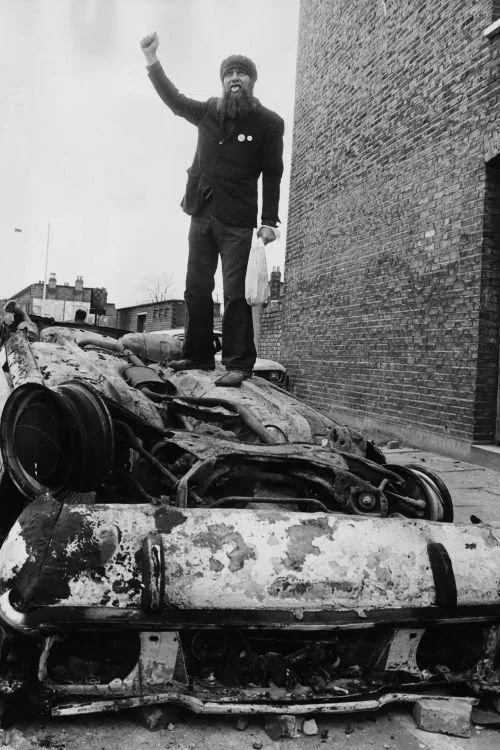
PHOTO CREDIT: Simon Dack
Originally published in 2007, UNCUT shared a piece earlier this year about Ghost Town. An extraordinary and incredible relevant track today, they got insight from “Terry Hall, Jerry Dammers and more on the final, epic single by the band’s original line-up: “It was about the state of the nation… and the state of The Specials”:
“JERRY DAMMERS (writer, organ): The song tried to link my personal feelings to the political situation. It was about the state of the nation, and the state of The Specials. And it was about being famous and going back to Coventry. That song was my sad farewell to Coventry, because becoming a pop star had made it unliveable in for me. I suppose I was depressed. It seemed like things that I’d dreamed of from the age of 10 were falling apart. I’d split up with my girlfriend of eight years. I think everyone in the band felt lost.
There was a feeling of dread. But “International Jet Set” had been about how weird it is to be in a pop group, and I’d realised the public don’t want to know. So I mixed it with the political. Because that feeling of dread was also in the country. The thing that stuck in my mind was before a Glasgow gig, which is where I got the original idea for “Ghost Town”. There were very old people out on the street, selling cups and saucers from their houses. I’d never ever seen that before, or since. And in Liverpool, all the shops had cast-iron shutters. I guess it’s commonplace now. But something had changed.
I’d been writing “Ghost Town” for nine months. It was a roots reggae song, and I’d heard “At The Club” [by Victor Romero Evans], produced by John Collins. It was really quirky, dub with a drum-machine. I brought John in because my control of the situation was evaporating. He did a fantastic job. He turned it into a pop song.
When we went into the studio, The Specials were in a worse state than even I knew. There was a rebellion against me directing the music. Roddy was… mad, basically, trying to kick holes in the control room. Neville turned on me. Also, we used a diminished chord, which is never used in reggae. In the Middle Ages, that was regarded as the devil’s chord [devil’s interval], and people were hung for playing it. So to Lynval particularly, it felt alien. He kept saying, “It sounds wrong! Why are you doing this?” There was a lot of ganja smoked, a lot of drink drunk, which added to the paranoia.
The riots happening as the record went to No 1 was uncanny. They were caused by Thatcher’s policies. The record probably fanned the flames. A lot of rock bands have sung about a revolution. We actually had one. When someone got killed in the riots, I felt terrible. There was that scary thing, the Jamaican thing about the killer tune – powerful part of reggae.
Terry Hall (vocals): I was leaving the band anyway. That was laid out, that the three of us were going. But we wanted to see “Ghost Town” through. From the initial meeting with Jerry, when he played me “At The Club”, I just thought this one idea was brilliant, and we’ve got to do it. But “Ghost Town” was the tip of a mountain of other stuff. It had to stop.
I don’t think we ever arrived at the studio as a seven-piece. We couldn’t be there at the same time without arguing. The others wanted input into what we did, but it wasn’t allowed. I was cool with that, because it was Jerry’s band. And what he needed was this beautiful mouthpiece. The music was great. My problems with Jerry were political. We had different roots, hearts in different places. If you’re middle class, admit that’s where you’re from.
“Ghost Town”’s lyrics were so simple. The middle-eight talked about the “boom town” when Coventry was factory heaven, until the early ’70s. Pretty much all my family worked in car factories. Then all of that stopped, and you watched people die off, one by one. You could name any city. But when I sang it, it was about Coventry.
For me The Specials was like a really brilliant film about a band, attempting to escape Coventry, and take on the world. And we failed miserably on the outskirts of Coventry. Because even in London, it wasn’t the same. “Ghost Town” took us back to Coventry. It was about the decline of the city, and The Specials.
“Ghost Town” getting to No 1 changed very little, if anything, socially. It didn’t change anything for the band. Doing it on Top Of The Pops, I had a walking stick, and I thought, ‘If one of ’em comes near, I’m gonna twat ’em!’ There were fist-fights in the dressing room. The three of us went in afterwards and told Jerry, “We’re out.” That was 1981, now it’s 2007. He still asks me why we left The Specials. Haven’t got a fucking clue, mate, do you know what I mean? I haven’t got a clue, mate, or do you really want to get into it?“.
There are a couple of other features I want to cover off. Steve Pafford marked forty years of Ghost Town in 2021. Whilst Britain was aflame and in the grip of violence and division in the summer of 1981, “Coventry ska miscreants The Specials captured the mood of the country with the ominous sound of one 45 which turned out to be their swan song. An ’80s summertime special and a half, this is Ghost Town”:
“No better band was positioned to epitomise these trying times in a single song. With a mix of black and white members, The Specials encapsulated Britain’s burgeoning multiculturalism. They were an integrated and socially-conscious group with deep respect and knowledge of ska, the music style that originated in 1950s Jamaica, a precursor to reggae. But ska alone was too tame a style for that moment in history.
The Specials blended in just the right ingredient with their nonchalant punk attitude, a style that came to be known as two-tone, which, as 2 Tone, just happened to be the name of the record label formed by band founder, keyboard player and main composer Jerry Dammers. 2 Tone skyrocketed between 1979 and 1981 with The Specials contributing more than their fair share of hits such as Gangsters, Too Much Too Young and A Message To You, Rudy.
Ghost Town is simultaneously The Specials’ creative peak and their last shining moment. During the recording the song the band was imploding. Problems started surfacing during atour of the US in 1980 supporting The Police. Money and the old cliché of sex and drugs and rock n’ roll had a corrupting effect on the lads who up to that point travelled up and down the UK in a beat-up van and were united by a single purpose of getting the music out there.
Matters hardly improved when it became clear during the work on the second album that Jerry Dammers wanted a change in direction while the rest of the band were happy to continue with the rough punk-ska style that they excelled at. Ghost Town is a result of the music experimentation that Dammers kept pushing the band towards. Alas, it would ultimately turn out to be the band’s swan song.
At first glance, the unusual, disjointed arrangement of Ghost Town makes it an unlikely chart topper. The extensive use of the diminished chord at the beginning of the song and before the line “Do you remember the good old days before the ghost town?” plus the foreboding sound of those woozy, lurching organ chords followed by haunted, spectral woodwind punctuated by blaring brass. It was not exactly the usual fare for your typical Radio 1 listener, put it that way.
Then again maybe that was exactly what was needed during that summer of ’81. Influenced by Joe Meek’s electronic experiments on The Tornados’ 1962 hit Telstar, producer John Collins made use of the windy sound effects that announce the track, played on Transcendent 2000 synthesizer beloved of Joy Division and Thomas Dolby.
It was all set to deeply unsettling, doom-laden music: a loping reggae beat topped with eerie, jazz chords, stabbing horns influenced by James Bond soundtrack composer John Barry.
Making Ghost Town even more unusual is the clarinet-like synth part played by Jerry Dammers on a Yamaha keyboard, a vaguely middle-eastern riff that at first seems incongruous yet somehow combined with the doom-laden bass and the portentous, nightmarish vocal chant makes the sum of its parts an irresistible combination. For aficionados the full length 12″ version includes a beautiful trombone solo by Rico Rodriguez and additional Hammond organ parts, both omitted from the single edit.
At this juncture it’s easy to take Ghost Town out of context and remember it as some sort of a semi-novelty hit, especially with that almost comical Tarzan-meets-pack-of-hyanas wailing in what passes for a chorus. But with the depressed social situation of 1981 as its backdrop the utter bleakness of the record is stark and startling.
And it follows that in Ghost Town’s promotional video — aired on the 18 June episode of Top Of The Pops as a new entry at No.21 — the Coventry crew cram into a 20-year old Vauxhall Cresta and cruise some of the three “Ds” of London: the derelict, the dilapidated and the deserted corners of the capital; once industrial now gentrified locales that are probably worth an absolute fortune now.
The band marked the song’s performance debut in the Top Of The Pops studio two weeks later, on 2 July. It was a suitably downbeat episode with only Bad Manners, the more lighthearted side of the ska revival coin, in camp carnival mode doing the Can Can in a dress to counteract the doom and gloom. Ghost Town had zipped up to No.2 and was on its way to the top, although “Smiling” Terry Hall’s decision to amble around the stage supported by a walking cane remains baffling. “The nation is sick”, perhaps? No doubt it was a statement of some kind he wasn’t spelling out. Either way, The Specials were in no mood to celebrate — the band was imploding, and matters would come to a head the following week”.
In 2021, as the U.K. was in lockdown during thew COVID-19 pandemic, the eeriness that Ghost Town talked about the and the streets being empty and things being shout, chimed at a time when people could not really go out. Dylan Jones wrote for GQ about his relationship with the song and why Ghost Town is meaningful and resonates today. One that I hope gets new inspection and praise ahead of its forty-fifth anniversary on 6th June:
“And breaking that silence wasn’t just the sound of petrol bombs and broken glass, it was the sound of “Ghost Town” by the architects of the recent two-tone revolution, The Specials. Not only was this one of the most important records of the early 1980s, it remains one of the most evocative, provocative singles of all time, a prime piece of agitprop that still has the power to shock. With its melancholic wailing, its hypnotic lope, its ominous organs and “The people getting angry” chant, there is no better mirror to the societal privations of 1981, a year that often felt on the brink of collapse. It’s one of the most baleful records to ever make No1. While punk was largely a cultural insurrection, repeatedly using thematic working-class imagery – the brutalist modern tower block being the most obvious manifestation of this, a symbol of post-war progress that very quickly became a totem of social deprivation – “Ghost Town” was a direct response to the urban distress that The Specials’ leader, Jerry Dammers, saw around him. The band had already had huge success as the standard-bearers of the multiracial 2 Tone organisation (which included the likes of Madness, The Selector and The Beat) and had had hits with “Gangsters”, “A Message To You Rudy” and “Rat Race”, among others. Inspired by punk, they had their own grudges to articulate and they were doing it through the medium of ska.
“Britain was falling apart,” said Dammers. “The car industry was closing down in Coventry. We were touring, so we saw a lot of it. Glasgow were particularly bad.” In Liverpool he saw shops closing down, more beggars on the streets, little old ladies selling their cups and saucers on tables outside their homes and he started to see the frustration and anger in the young faces of those who came out to see his band. He felt that there was something very, very wrong affecting the country. “The overall sense I wanted to convey was impending doom. There were weird, diminished chords: certain members of the band resented the song and wanted the simple chords they were used to playing on the first album, It’s hard to explain how powerful it sounded. We had almost been written off and then ‘Ghost Town’ came out of the blue.”
The Specials were advocates of late-1970s postmodern ska, the inventors of two-tone and – for the briefest of times – quite simply one of the coolest, most important British bands of the post-punk period. They were a gang – five white men, two black – who dressed well, spoke sharply and didn’t look like they wanted to be messed with. In the space of just two years, from 1979 to 1981, the original Specials managed to embody the new decade’s violent energies, morals and conflicts – though always with an ironic and often sardonic detachment that kept the band cool as the 1980s grew increasingly hot. Their records defined a slice of a generation who weren’t sure they wanted to be defined in the first place. They were slightly yobby – the NME called their debut album “a speed and beer-crazed ska loon” – but they had an underlying social conscience. They would turn out to be temporal, but they left their mark in the same way The Clash did, or The Undertones, by connecting. Sure, the band were earnest, but they were studiedly sarcastic, too, which endeared them to everyone from ageing punks to their younger siblings. Not only that, but they came from Coventry, Britain’s very own answer to Detroit, the epitome of the post-war urban wasteland, the quintessential concrete jungle, and felt they had a right to bleat about anything they wanted to, especially the determined onslaught of Thatcherism.
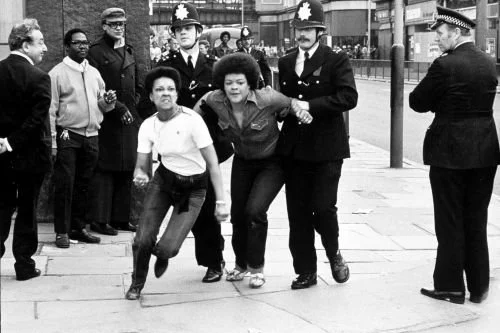
PHOTO CREDIT: Richard Young/Shutterstock
Nineteen-eighty-one was a desperate year in the UK. Youth unemployment was rife as the country felt the bite of Thatcher’s cuts and riots were erupting all over the country, riots that appeared, with eerie synchronicity, at the same time as “Ghost Town”. It even felt like a riot, or rather how a riot felt just before it kicked off, or maybe just after it, when all the dust had settled. Dammers’ record was an apocalyptic portrait of inner-city oppression set to a loping beat offset by an unsettling and vaguely Middle Eastern motif: “Government leaving the youth on the shelf… No job to be found in this country…” The single sounded like the fairground ride from hell, a snake charmer of a song, complete with strident brass, madhouse wailing and dub-style breaks. The video was just as bleak, featuring a road trip through some of the least salubrious streets of Central London. The week after the song was released – bingo! – there were riots and civil disobedience all over the country.
The 1980s riots were devoured so much by the international media that the burning oil drum became as much a part of modern British iconography as the white suits in the 1981 television adaptation of Evelyn Waugh’s Brideshead Revisited – and for a while seemed to appear in any film about the British underclass, surrounded by a gang of Rada-trained professional cockneys and a smattering of generic gangsters, drug dealers and punky fishnets molls. To the outside world it looked as though rioting was what any youth cult worth their salt did when they’d grown tired of posing for style magazines or making bad pop records.
Living in London you certainly got the feeling you were somehow living under siege. In South London, conflict gave an edge to every transaction in a corner shop, every late-night walk home from the Underground. Walk into a Brixton pub and you felt eyes upon you. Television coverage of the riots painted them clearly as battles between residents and the police force, although what they really did was create even more racial tension between blacks and whites on the street, between neighbours of different ethnic backgrounds, between people who knew each other and of course those who didn’t. I had a friend who was chased down Gresham Road near Brixton Police Station by some of his black neighbours just because he happened to be white at the wrong time of day. He sought refuge in a (black) neighbour’s house, who promptly called out to the gang chasing him, who ran in and kicked the living daylights out of him. Police aggression made everyone paranoid, and made people who had previously lived quite happily side by side turn against each other because it seemed like the safest thing to do”.
I have probably not done full justice to Specials’ Ghost Town and its brilliance. Why it was such an important song. There are articles like this and this that I have not been able to include, but you should check them out. Incredible how The Specials themselves trying to keep it together at a time when the country was divided and there was all this air of foreboding and doom. It is such a pity that the seven original members cannot get together for another performance of this song. However, the legacy of Ghost Town is huge. The despair and depression in the lyrics reflected a public mood. A protest song, a bitter commentary on Thatcher's England and a country on its knees, I feel we will be discussing Ghost Town for decades more. Forty-five years after its release, we get to discuss a song that…
DEFINED its era.