
FEATURE:
Kate Bush: Them Heavy People: The Extraordinary Characters in Her Songs
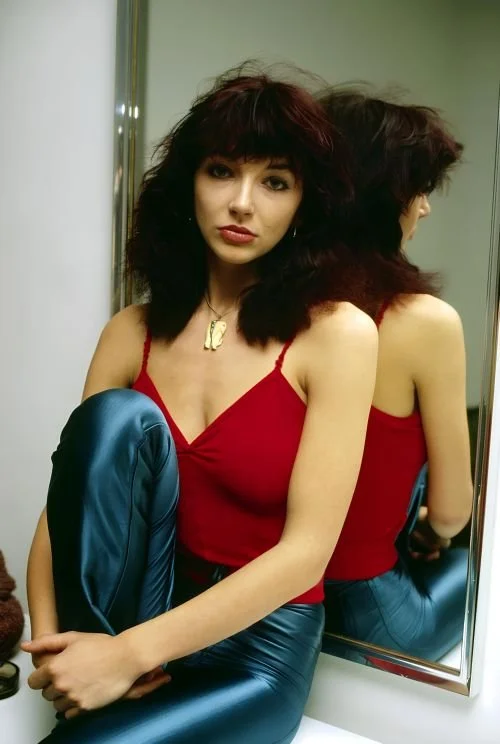
IN THIS PHOTO: Kate Bush circa 1980
My Pussy Queen (Egypt)/Sylvia (Come Closer to Me Babe)
__________
I am going to…
PHOTO CREDIT: John Carder Bush
dig into a very early Kate Bush song for the second side of this feature. I had forgotten the characters that appear in her earliest tracks. Those that are in demo form and not many fans are that familiar with. One of the tracks I want to investigate has a character called Sylvia that has drawn speculation. As to the identity of the Sylvia and what it means in the context of the song. However, I am starting out with a character that may well get me into some hot water. Recently, I featured Ran Tan Waltz and the fact it has some spicy lyrics. Kate Bush in quite bawdy and risqué mode. However, there is a brilliant lyric in Egypt that raises smiles and the eyebrows! I am going to bring in the lyrics. It relates to My Pussy Queen. I will look at Egypt and being an underrated song on Never for Ever. The way Kate Bush brought in different cultures and countries through her music. Also, how she evolved and was in a happier place for Never for Ever. There is a lot of fascinating things to discuss about Egypt. The song was performed during the Christmas Special in 1979. The way she depicted the song for that show. Ran Tan Waltz got its sole live outing there. It would have been hard to replicate Egypt or build pyramids for a stage version or anything in a T.V. studio. What she did come up with for the Christmas special is parody-worthy. Maybe there is this feeling that she did the best she could to depict an Egyptian flavour and flair. However, looking at the performance now, it does seem strange and perhaps a little outdated. I don’t think it was cultural appropriation. I shall mention this more in a bit. However, it is interesting learning the background to this underrated pearl of a song:
“‘Egypt’ is an attempted audial animation of the romantic and realistic visions of a country.
Kate Bush Club newsletter, September 1980
The song is very much about someone who has not gone there thinking about Egypt, going: “Oh, Egypt! It’s so romantic… the pyramids!” Then in the breaks, there’s meant to be the reality of Egypt, the conflict. It’s meant to be how blindly we see some things – “Oh, what a beautiful world”, you know, when there’s shit and sewers all around you.
Egypt was a song that was performed for The Tour of Life in 1979. Bush depicting herself as this seductive Cleopatra. In 1979, it might have been a bit strange for audiences in the U.K. and Europe hearing a song about Egypt. I do admire that Bush was looking to talk about a country in a realistic way. Many might have the cliché images of pyramids, pharaohs and this romantic element. However, even today, think about countries in Africa and the Middle East, and we have this rose-tinted vision. There are nations torn up by war and corruption. Whilst some could see Egypt as this slight song that had no real depth, it was Kate Bush being balanced in her view of a country that did get romanticised. I am not sure whether she ever visited the country. However, I do feel like many preferred the live versions of the song rather than what appears on Never for Ever. Some of the snap and momentum of the live version lost when brought into the studio. I am going to come to the brilliant Dreams of Orgonon and their interpretation of Egypt. This song, alongside Violin, is seen as the weakest on Never for Ever. It is a fantastic album where Kate Bush and Jon Kelly produced together. It went to number one, and confirmed Kate Bush was a genuinely great artist. There are some wonderful lines in Egypt. The opening lines are brilliantly evocative: “Follow the Nile/Deep to much deeper/The Pyramids sound lonely tonight”. The instrumentation gives the song this unique flavour and feel. Preston Heyman providing incredible percussion. Fender Rhodes and Minimoog by Max Middleton. Electric bass from Del Palmer. Paddy Bush playing Strumento de Porco. Mike Moran playing the spacey Prophet 5. I think one of the good or bad things about the song is the obliqueness of the lyrics. Or Kate Bush not being explicit. She is not talking about sewers and the violence in a country. Instead, she summons up all these classic images and familiar themes. However, there are lines like “She’s got me with that feline guise/Got me in those desert eyes” that suggests there is a dangerous seductiveness. That all of this grandeur and history suckered her in and, when going deeper into Egypt, the harsher realities present themselves.
Just before Kate Bush tells how she “drifts with dunes”, there is this immortal section: “My Pussy Queen/Knows all my secrets”. I am taking My Pussy Queen to be a literal character. However, you can interpret this in a number of ways. A feline goddess or something sexual. It does sound quite saucy when you read it! Though, when you hear it sung, there is not the sense Bush is winking at the listener. That said, Bush does offer up that line of “She’s got me with that feline guise”, which makes sense. Bush could have been referencing Bastet (or Bast). She was the primary ancient Egyptian goddess depicted as a cat, or a woman with the head of a cat. Originally a fierce lioness warrior, she evolved into a protector of households, women, children, and domestic cats, representing fertility and joy. She was widely worshipped in the city of Bubastis. This fascinating article discusses Bastet and a cult of feline deities:
“The fascinating and sometimes exotic character of ancient Egyptian religion finds its perfect symbolization in the feline goddess Bastet. In countless museums and exhibitions, we meet her depicted as a seated cat with varying divine iconography such as a scarab on her head. In a motionless, yet vigilant, pose easily seen on real cats, the beautiful, divine Bastet typifies an ancient world of mysterious beliefs.
Bastet, Lioness and Cat
Bastet’s main cult location is Bubastis, an important city in the southeastern Nile Delta. But the earliest attestations of Bastet come from the galleries under the famous step pyramid of Djoser at Saqqara near Memphis. Thousands of sherds of stone vessels from burials of the 2nd dynasty (around 2800 BCE) were discovered there. Some have short inscriptions mentioning deities, including a Bastet depicted as a female with the head of a lioness, plus priests and a possible cult place of Bastet in Memphis. It might be that Bastet was originally a deity of the royal residence and, judging from the etymology of her name, a derivation of the name of the ointment jar b#s.t. – perhaps a goddess connected to royal regalia. Merging the concept of a deity with a protective ointment, the protective and mighty nature of a divine lioness would have fit royal ideology. Temple of Bastet, Bubastis
The earliest attestation of Bastet at Bubastis dates to a later period, the reign of Pepi I of the 6th dynasty (around 2270 BC). This evidence comes from the decorated door lintel at the king’s Ka-temple showing Bastet and Hathor. Again, Bastet is depicted as an anthropomorphic female with the head of a lioness. Tomb stelas from the elite cemetery of Bubastis of the same period preserved the titles of Bastet temple administrators, so we can assume that a temple and cult of the goddess existed there by the end of the Old Kingdom.
It is unclear how the cult of Bastet found its way from the early dynastic residence at Memphis to Bubastis. One theory is that, in the early 3rd millennium, prides of lions lived in the Delta’s semi-desert fringes. With its seasonal lake at the center, the Wadi Tumilat offered an excellent sanctuary for these animals. At the time, the Delta supported large herds of cattle that were key to an emerging centralized state with royal agricultural domains but also an irresistible hunting ground for lions. Egyptians could easily observe attacks by lions and especially lionesses, which are known to be active hunters that use impressive teamwork. It is not far-fetched to deduce these observations would lead to the worship of those fearsome, fascinating animals”.
This is not the only case of Bush transporting herself beyond England. Inspiration for other songs have taken her to the U.S. and Ireland. She has also ‘travelled’ to Australia and beyond. The Dreaming’s title track was Bush trying to tackle the destruction of Aboriginal Australian homelands by white settlers, who were searching for weapons-grade uranium. The track tackles too themes of environmental ruin, colonial violence, and the loss of indigenous spiritual ‘Dreaming’ (or Dreamtime). Some criticised Bush for that song and felt it was cultural appropriation. Or this case of white privilege. Can you say the same about Egypt? Though Bush is not attacking a group of people or as political as she was in 1982, a couple of years prior on Never for Ever, there is this discussion of a side to a country not often discussed in music. Dreams of Orgonon wrote about some of the trickier themes and issues with the song:
“The perception of Egypt is occidental: Bush is captivated by the myth of Egypt, the country that’s found in history books rather than the one that actually exists on the Sinai Peninsula. She’s dealing with iconography more than actual lived history once again. Falling into the pervasive Western trope of depicting Eastern landscapes minus the people (The Lion King, anyone?), she sings about an unpopulated landscape, a playground for colonizers rather than a place where people live. In his classic text Orientalism, Edward Said describes the East as “a theatrical stage affixed to Europe,” where the interests of Western imperial powers are acted out. The ever-theatrical Kate Bush operates similarly.
To Bush’s credit, she attempts to grapple with this tension. An early part of the discordant lyric — consisting of a mere two verses and two choruses, which almost entirely fail to rhyme — makes mention of how “the sands run red/in the land of the Pharaohs.” Bush’s gaze shifts from the bloodshed: the chorus begins with “I cannot stop to comfort them/I’m busy chasing up my demons.” At the very least, she tries to deal with the solipsism of Western colonialism. Fetishization of Egyptian objects becomes a sickness that distracts from the exploitation and cruelty of material history.
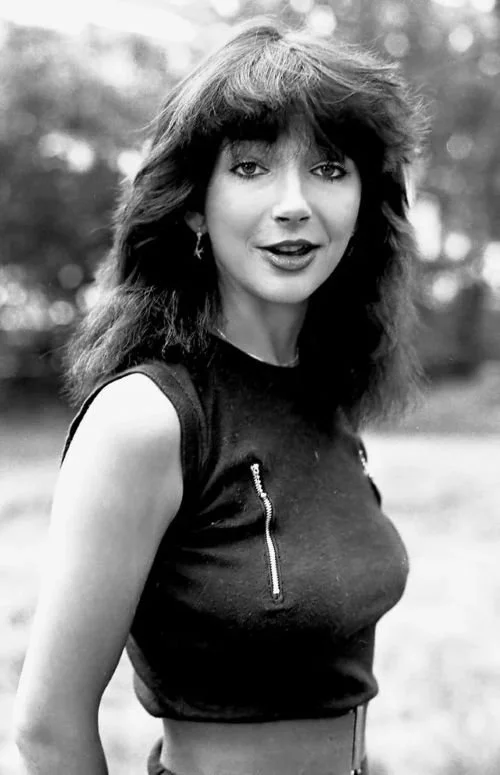
IN THIS PHOTO: Kate Bush in 1980/PHOTO CREDIT: Andy Phillips
The problem is that while Bush does take something of a critical hammer to colonialist attitudes, she engages in those very attitudes. Presenting Egypt as hypnotic is maybe not the critique Bush thinks it is. In fact it only buys into the Orientalist trope of the East as inherently mysterious and esoteric: just look at the first edition cover of Said’s Orientalism, with its snake-charming painting. And for all that I tipped my hat to Bush for her acknowledgement of Egypt’s violent conflict, it’s a very minimal part of the song. The unpopulated landscape is still almost the entirety of “Egypt”: there are no people in it. It’s not that I want Bush to write a song about the Suez Crisis or Yom Kippur. I shudder at the thought of such a song from nearly any white artist. But “Egypt” is such a minimalistic piece of songwriting it’s hard to derive anything conclusive from it.
This is no surprise given that “Egypt” was the first new song written for Never for Ever (“Violin” was recycled from the Phoenix years). It’s oddly shaped and difficult to parse — it sounds outright unfinished, with its sparse lyric and chorus. More than likely it was written in between Lionheart and the Tour of Life, as it made its first appearance on that tour, where it was introduced as visual spectacle instead of an album track. As a result the song is more something to be seen than heard, as it was originally written for the stage. In concert, Bush strove up to the audience draped in full Cleopatra-meets-Captain-Marvel, draped in the red, blue, and gold livery, heralded by pipes and Preston Heyman’s powerful drumming. The subsequent performance is tense and distant — its frantic arrangement keeps it from getting dull, and it’s more driving and catchy than its record counterpart. The tour’s punchy and often acoustic arrangements give “Egypt” more weight than it would later have, and the song would be worse off without it.
As the world rapidly organizes itself into new modes of capitalism and imperialist expansion, Bush is producing a soundtrack for its disasters. Her new music shows tradition crashing down on people who’ve followed them blindly, and sometimes she gets caught under the debris. Shortly we’re going to see how she deals with personal catastrophe as well. It forces her to look outward. Yet despite the abyss gazing also, she’s a bit too immersed in Western solipsism to see where it’s looking”.
I will come back to Dreams of Orgonon for the second song I am talking about. I do feel that Egypt is an underrated song. Sure, if you think about the lyrics and inspiration behind it, you can see some negatives or drawbacks. However, as a piece, it is a gem that is not often talked about. I can imagine it had more flair and power when seen on the stage. That said, you get this evocative and beautiful song on Never for Ever. Its placing too. It ends a run of slightly romantic of gentler songs. After the more intense and propulsive Babooshka, which opens the album, there is Delius (Song of Summer), Blow Away (For Bill) and All We Ever Look For. Egypt then follows, and the song that comes after that is The Wedding List. Going back into something more dramatic. Perhaps some parallels and comparisons between Babooshka and The Wedding List. Violin then follows, which is perhaps the most energetic and hard-driving song on Never for Ever. Perhaps there was a sense of sameness with that run of gentler songs. How Egypt required more bite and punch to elevate it and retain interest. Where else would you put Egypt? I think it could work as track eight, following Violin. The Infant Kiss is track eight. You can feel Kate Bush is in a happier place. She was happy enough recording The Kick Inside and Lionheart through 1977 and 1978. However, Andrew Powell was producing. These were Bush’s songs, though the final version was very much in someone else’s hands. I can imagine the joy and experimentation relating to Kate Bush as a producer. Songs like Egypt show new layers and this sense of a producer trying to take her music to new places. It is admirable that she documented something less conventional and discussed it in Egypt. If the lyrics do provoke some serious questions, the fantastical elements are wonderful! My Pussy Queen. Never truly revealed who that is, you can draw a line between that and feline deities. It is the playful and sexual wording that make it one of Kate Bush’s finest offerings!
PHOTO CREDIT: John Carder Bush
Let’s go back further in time. Quite a few of Kate Bush’s earlier songs got retitled. Berlin got renamed The Saxophone Song. Rinfy the Gypsy went through some changes, and it was part of this way she would change her mind with titles and there would be this evolution. A demo that was recorded in 1976, I did want to mark fifty years of these incredible recordings. Come Closer to Me Babe was called Goodnight Baby at one stage. The demo appears on the bootleg, Cathy Demos Volume Four. The name and character of Sylvia is referenced more than once. It is this verse that is especially intriguing: “What is it that you whisper/When you close your eyes?/Come closer to me, babe/Is it me it's all about?/And who is it that you're always/Calling in your sleep?/Who is Sylvia?”. Before coming to who Sylvia might be, it is worth noting how little is written about Kate Bush’s earliest demos. I am thinking back fifty years, when Bush was a teenager. She finalised her record deal with EMI in 1976, so this was a time when she was writing a lot and putting down demos. She had already recorded songs that would appear on The Kick Inside - her 1978 debut album. In terms of how much material was available for that album. So many songs never made it onto albums, so people do not really know much about them. It is weird that few dissect and spotlight these incredible tracks. The earliest signs of her genius. There are other elements I want to explore. In terms of these demos leading to The Kick Inside and Bush’s growing ambitions and confidence as a songwriter. I am going back to Dreams of Orgonon and some words about Come Close to Me Babe. It is a mysterious song, and we do not really know who Sylvia is: “Come Closer To Me Babe” is the reflection of a lullaby in a cracked mirror. The singer tries to sing their lover to sleep to get their guard down and reveal something. Who’s the Sylvia he calls out for in his sleep? Is he reading The Bell Jar too much? Or should Kate boot his ass out the door? As usual, Bush declines to condemn the man. Sylvia remains a mystery as the curtain closes—probably best for everyone”.
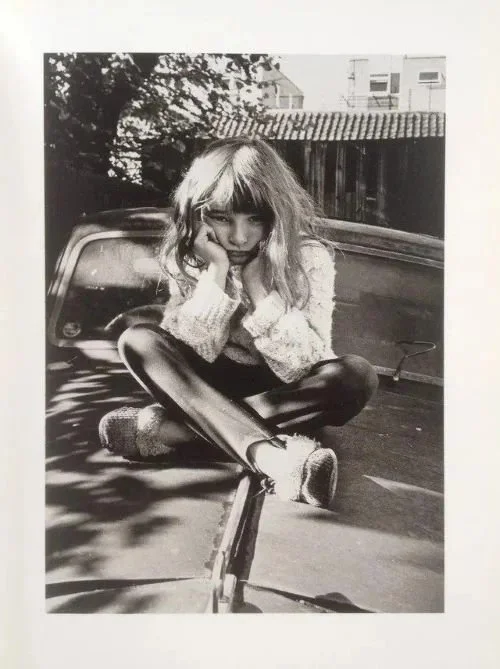
PHOTO CREDIT: John Carder Bush
I am dropping some photos from John Carder Bush of Kate Bush when she was a child, as there is not much audio I can include regarding this song. Even so, I do think of Kate Bush writing these songs that would only get as far as demos. What struck her to write them. Whether they started as poems and then she decided to work them into songs. At school, there would have been this unhappiness and sense it was not fulfilling. Even so, poetry was something she loved and she developed a fascination with words and literature. There are many examples of tracks that we can hear versions of, though very few people know about them. Snow Bowl, A Rose Growing Old, Something Like a Song, The Craft of Love, and Frightened Eyes. Something Like a Song probably dates back to 1973. One of Kate Bush’s earliest tracks. Cusi Cusi and Go Now While You Can are these remarkable tracks that have barely seen the light of day. People can say that many of these sound quite primitive and are similar. Bush was definitely developing as a songwriter. Many of the 1973 demos were her poems effectively set to piano. These demos were her and the piano, so you really only got this one-dimensional musical viewpoint. It was clear Bush was already a wonderful player that young. Remember, in 1973, she turned fifteen. Exceptionally young to write such quality songs! The Kick Inside was her further developing. In terms of the confidence as a player and the themes she was exploring. In the space of a few years, she had come on leaps as a writer. I do wonder how old many of those songs are. Like Oh to Be in Love and Kite. Bush might have written the earliest versions a few years before recording them. What I love about a song such as Come Closer to Me Babe is that it is almost fifty years to the day when Bush recorded it. There is not going to be this big anniversary. I feel it is quite important we shine a light on these songs. Bush now might not want people to hear them, and she may have vague memories of writing and recording them. However, it is a huge part of her life and the earliest recordings we have. The rest of the world would know her by 1978. However, a couple of years previous, Bush was taping these beautiful songs. Many started as poems. Others not. All quite different in terms of their themes and inspirations, I do not know many other people who explore these tracks.
Early Demos was an unofficial album released that featured many of her early demos. “The album The Early Years was prepared for release in early 1986 by a West German company. Someone, somehow has got hold of one of tapes, which appeared to have contained not only a number of Kate’s early (circa 1973) demos, but also embryonic versions of more well-known tracks”. An album that was planned but quickly got shut down was The Early Years, and you can appreciate why Bush might not have wanted this to come out. It was 1986 and the same year she released the greatest hits collection, The Whole Story: “A West German company appeared to believe that it had bought the ‘rights’ to this tape and was set to issue an album entitled: The Early Years. EMI-Electrola in Germany were aware of this. For some reason, they took no action in preventing the release. The album was in fact pressed and white labels send out in an attempt to secure overseas distribution deals. At this point Kate herself became aware of the proposed release, and feeling that her early mistakes are not fit for public consumption, took the appropriate legal action. The album was not released and the entire stock of the albums that were pressed was destroyed”. There is that discussion now and whether Kate Bush would ever let her demos be put onto an album. They are available on YouTube, and it is only right we get to hear them. A difference making them part of an official release. Aged sixty-seven, it seems a lifetime ago! I think it is important we mark fifty years of the demos that were recorded in 1976, though there are ethical debates as to whether we should upgrade or polish these demos and do something with them. That said, I feel more discussion needs to occur. These embryonic flashes of genius practically left to collect dust! There is something wrong about that.
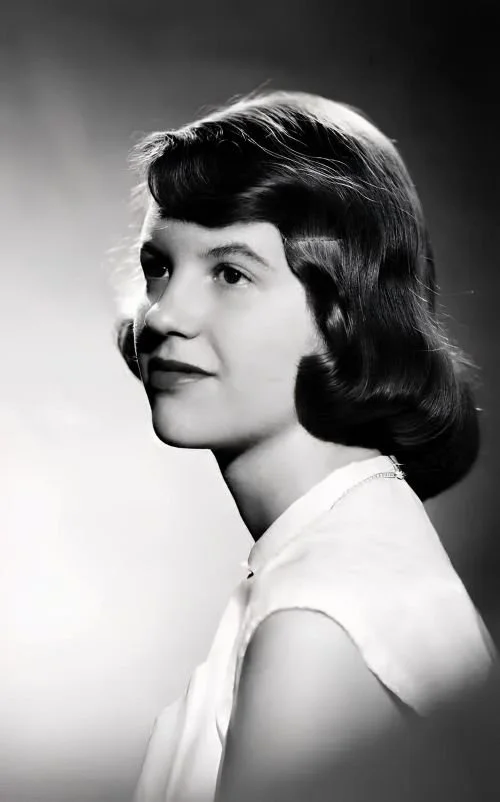
IN THIS PHOTO: Sylvia Plath
Let’s focus on Come Closer to Me Babe. That mention of a Sylvia. You could jump and say it is about the poet, Sylvia Plath. If you take this figure in the song to be about Plath, there is an interesting connection to the title of a Kate Bush album – though with a slightly different spelling. This information is especially fascinating: “In the final months of her life, beginning in October 1962, Plath experienced a great burst of creativity and composed most of the poems on which her reputation now rests, writing at least 26 of the poems of her second collection Ariel, which would be published posthumously (1965 in the UK, 1966 in the US)”. Kate Bush’s 2005 double album is called Aerial. At a time when Kate Bush herself was experiencing this burst of creativity, was she thinking about Sylvia Plath? Kate Bush’s brother, John Carder Bush, was a poet, and he introduced his sister to a lot of different works. Many of the poems Bush wrote at school were quite dark. She has said how they were quite morbid and about death. Considering how Sylvia Plath died by suicide in 1963 (the American poet died in London), was this Bush adding a darker and slightly deathly touch to a romantic song?! Also, why would a lover call out Sylvia Plath during their dreams?! Bush definitely writing about love and passion in very interesting ways when she was a teenager. The Man with the Child in His Eyes seems this fantasy man or someone that people say is “lost on some horizon”. A sea-farer or adventurer, almost like dipping into classic poetry. There are articles about The Cathy Demos. A lot of the songs were written in 1973 and re-recorded in 1976. The history of these demos really fascinates me. In terms of the story behind Come Close to Me Babe. It seems like the man has a secret or there is something he cannot share whilst they are awake. It is only when he is asleep that he calls Sylvia out and there is a mystery as to why he does this: “Come closer to me now/For I know there's something you must tell me/When slumber slips between your lips/Will the secrets ooze out easily?”. This woman that he is always calling in his sleep. These line warrant scurrility: “What is it that you whisper/When you close your eyes?/Come closer to me, babe/Is it me it's all about?”.
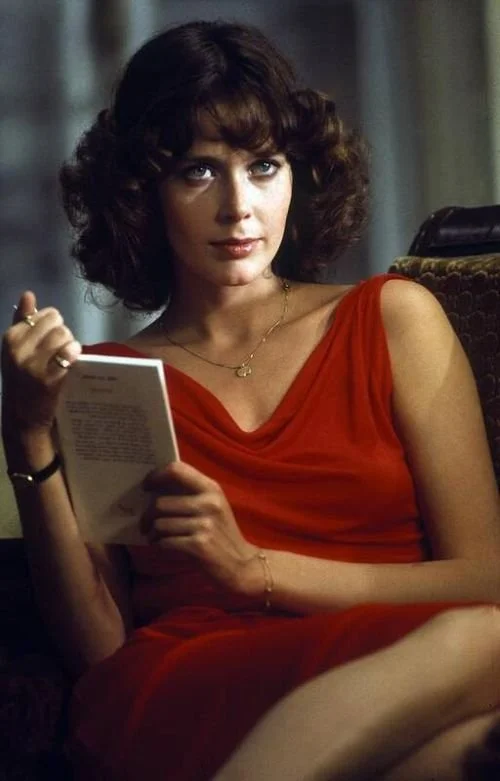
IN THIS PHOTO: Sylvia Kristel/PHOTO CREDIT: Getty Images
It would be hard to draw a line between a man lusting after someone else in the 1970s and a poet who died in 1963. Rather than this being an attraction to someone literal and alive, is there more of a psychological angle? The only notable Sylvia who was alive in the 1970s that could be whispered by a man seduced in his sleep is Sylvia Kristel. She was a Dutch actress and model who appeared in over fifty films. She was the eponymous character in five of the seven Emmanuelle films, including originating the role with Emmanuelle (1974). You can read more about her here. Another connection to a Kate Bush song (however loose) is that Kristel dated Ian McShane from 1977 to 1982. 1977 was the year when Kate Bush wrote Wuthering Heights. It was a 1967 BBC T.V. adaptation of the Emily Brontë novel that inspired her to write the song. Ian McShane played Heathcliff. Cathy was played by Angela Scoular. A phenomenal actress whose sadly premature death puts me in mind of Sylvia Plath. In terms of how much she struggled with mental health issues and they both lived with bipolar affective disorder (though Scoular did not die by suicide, she was in the grip of the illness and did cause her own death). Though, we will never know who the Sylvia in Come Closer to Me Babe is. I am not certain Kate Bush now would remember who she had in mind. Though it is that mystery that gives this track and so many of those demos such place and prominence now. Fifty years on, and we need to magnify them. Thinking about a young Kate Bush writing these songs and then sitting at her piano and capturing them. Even though they did not feature on albums, we can hear the recordings and wonder what might have been. Come Closer to Me Babe is a classic example of her genius coming through…
AT such a young age.