
FEATURE:
Can’t Make Up My Mind
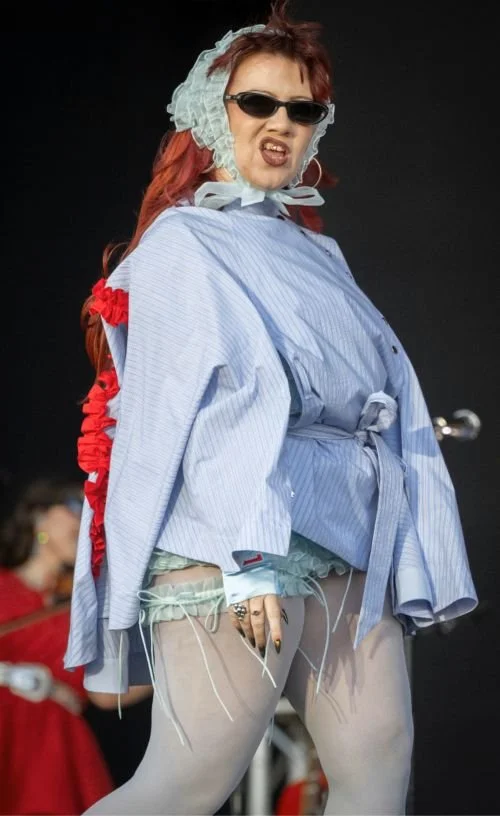
IN THIS PHOTO: CMAT performing at BBC Radio 1’s Big Weekend in May/PHOTO CREDIT: Getty Images
Why There Needs to Be Greater Industry Support, Outcry and Allyship Regarding the Backlash Women Face Concerning Their Appearance
__________
THERE seems to be…

IN THIS PHOTO: Olivia Rodrigo performs in Barcelona for Spotify’s Billions Club Live, on 8th May, 2026/PHOTO CREDIT: Xavi Torrent/Getty Images for Spotify
no winning when it comes to women in music. Always seemingly there to satisfy the male gaze, no matter how they dress themselves and what they look like, there will be criticism and attack. Body-shaming, sadly, is nothing new in music. Artists like Lizzo and Jorja Smith have experienced it in recent years. Women who are independent and confident subjected to abuse and seen as terrible role models. Those who are distinctly there to go against the male gaze seen as unattractive and also abused. A recent example of two incredible women in music both being put under the lens for different reason, it makes me wonder why there is relative silence from the industry and men. CMAT is a brilliant Irish artist who released her latest album, EURO-COUNTRY, last August. It was an award-nominated and critically-acclaimed work from one of our greatest living songwriters. A woman who is so funny, honest and open. An idol and inspiration for so many women and girls, she has been subjected to recent body-shaming. I shall come to Olivia Rodrigo. Her album, you seem pretty sad for a girl so in love, is released on 12th June. Both modern-day queens and geniuses. They should be afforded nothing but respect and enormous opportunities. In terms of criticism and the public, there is a lot of love and respect. Though one cannot ignore the toxic and damaging dialogue around how they dress. It affects so many women in music. Spectrum-opposite in terms of the nature of backlash and how each dress; CMAT being body-shamed and criticised because she is seemingly an affront to the male gaze. Olivia Rodrigo more indulging it. Each under the microscope recent. It seems women are constantly being shrunk and limited in terms of how they dress. Though that may be the point. How women have always and, tragically, currently are there to be controlled and diminished. Control taken from them.
How are women supposed to dress? This is the question Laura Snapes asked in her fascinating and illuminating article for The Guardian. I shall come to that. This article includes reaction from CMAT. This ideal body size and look seems to remain. If women do not conform, they have to face vile abuse and misogyny:
“The Irish singer-songwriter says her rise has been increasingly ‘tarnished by the fact that I would be allowed to enjoy it so much more if I was thin’
The Irish singer-songwriter CMAT has responded to ongoing abuse she has received about her body and her weight following an appearance last week at BBC’s Radio 1 Big Weekend.
The musician, whose real name is Ciara Mary-Alice Thompson, wrote on Instagram on Thursday that she had felt “compelled to wade in and speak for myself” after learning of the abuse being directed at photos taken of her on stage at the Sunderland festival on 24 May.
“It is literally so boring for me, a gorgeous genius, to keep having to yap on about how horribly I am treated because of my body,” she wrote. “I would love to stop but I cannot because it keeps happening, at an accelerating and worsening pace as I become more famous.”
CMAT shared screengrabs of a Substack essay by a music fan going by Front Row Feels, which “summed up a lot of what is causing my deep sadness,” she wrote.
The essay compared the treatment of CMAT with fellow Big Weekend acts Zara Larsson and Olivia Dean, who didn’t appear to be subjected to the same level of abuse online.
“What struck me most while scrolling through those toxic comment sections was the glaring disparity in how different women on that same lineup were treated,” Front Row Feels wrote, adding that Larsson and Dean “were granted a level of grace and basic humanity that was completely denied to CMAT”.
CMAT pointed out to “well-meaning” commenters that her body size was not a choice: “I am not being defiant. I am not choosing to look like this or weigh this much as some kind of punk rock act of liberty. I simply have a body, one that I would of course like to change in order to fit in and avoid all of this abuse, but I have had extreme difficulty in doing so. I don’t get a say in whether or not I want to be brave, I simply have to sit here and take it.”
She said that though she was grateful for her success, it is “increasingly becoming tarnished by the fact that I would be allowed to enjoy it so much more if I was thin”.
“There is no relief from this – nobody can protect me or save me from this, and all that is demanded of me is more and more work as every environment I am placed in becomes more hostile,” she wrote.
Last year the singer-songwriter released Take a Sexy Picture of Me, which criticised the scrutiny women face on their bodies and appearance”.
I want to highlight sections of that Laura Snapes article. It is an article that raises a lot of questions and makes me wonder why there is not backlash and condemnation from more in the industry. Especially men. That sense of pacifism or ignorance is troubling. How “backlash over their appearances that came from the scummy bottom of the internet” is rampant. The scuzzy and scummy bottom of the barrel of the Internet:
“Even subverting the male gaze won’t stop you from being accused of pandering to it. In the styling for Rodrigo’s new album, You Seem Pretty Sad for a Girl So in Love, the 23-year-old pop star is wearing babydoll dresses in tribute to the 90s female punks – Kathleen Hanna, Courtney Love, Kat Bjelland – who revamped the cropped nightgowns into the “kinderwhore” look, shredding and smearing them with makeup to confront men with the discomfort of their unwanted objectification. A concert in Barcelona during which Rodrigo wore a puffy floral number prompted mass online commentary calling her “pedo bait” and “Lolita”. “That’s been making me so upset,” Rodrigo told the New York Times’ Popcast, published yesterday. She pointed out how illogical these comments were: in the past, she has performed in a bra and shorts, to no outcry, “but me fully covered up in a dress that people deem to be childlike was inappropriate”.
Rodrigo continued: “I think it shows how we really normalise paedophilia in our culture. And also it’s just this rhetoric that we’re fed as girls since we’re so little, which is like, ‘Don’t wear that because then a man is going to sexualise your body and it’s your fault.’”
If CMAT is supposedly an affront to the male gaze, but Rodrigo is indulging it, what sliver of ground is left? Even the inverse empowerment narrative is a trap. As CMAT pointed out, many “well-meaning” people have tried to claim her as a figurehead of the body positivity movement, but, she wrote, “I am not choosing to look like this or weigh this much as some kind of punk-rock act of liberty. I simply have a body, one that I would of course like to change in order to fit in and avoid all of this abuse, but I have had extreme difficulty in doing so. I don’t get a say in whether or not I want to be brave, I simply have to sit here and take it.” Every possibility for how a woman in the public eye might look has been co-opted by an agenda that would rather tell her who she is rather than listen to who she is saying she is.
We are in the midst of a massive conservative retrenchment around femininity that is also being manipulated by bad actors. To me, the groundswell of comments such as these towards CMAT and Rodrigo comes with a distinct tang of bot farming, a coordinated attack boosted by figures or movements with a vested interest in shrinking the ways that women can exist in public. It’s misogyny’s latest pathetic costume: a bunch of losers stacked up in a grubby trenchcoat, fooling everyone”.
Whereas a lot of this backlash and misogyny is from bots and a select group of desperately pathetic people, it is still hugely damaging and systematic of a growing and poisonous masculinity. Women almost forced to be someone else to avoid being attacked or face abuse. That not only affects them. It affects and resonates with all women across the industry. What does seem galling is how there is very little in the way of condemnation from the industry and particular men. Allyship, when we do hear about it, quite selective. Male artists maybe supporting women and talking of their brilliance. Booking them as support acts on tours, or hyping queens coming through. When it comes to issues around gender discrimination, divides, misogyny and abuse right across the industry, why is there a near unanimous silence? It is not a controversial subject facing up to those who attack and marginalise women. There does need to be more activation and words from men in the industry. Whilst it does not fix the problem and stem the relentless sewage of the Internet, it does seem more and more than women are alone in trying to tackle and speak out against the male gaze and misogyny. I think back to Sophie Gilbert’s Girl on Girl: How Pop Culture Turned a Generation of Women Against Themselves “Cosmetic surgeries are at an all-time high, Ozempic is bringing back 'heroin chic' and the manosphere on the rise - after four waves of feminism, what went wrong? Despite decades of progress, modern womanhood feels more challenging than ever. Atlantic critic and Pulitzer Prize finalist Sophie Gilbert reveals how today's misogyny emerged from another turbulent era: the late 90s and early 2000s. Spanning the past thirty years of pop culture - from Madonna to Taylor Swift, #GirlBoss to OnlyFans, Real Housewives to trad-wives - Girl on Girl shows how every form of media, heavily influenced by the rise of porn, has warped women's relationships with themselves and others”. It is so horrifying and disheartening having to read of constant misogyny and objectification. How body-positivity is such a risky thing. If you do not fit into the male gaze then you are condemned and abused. Artists like Olivia Rodrigo accused of sexualising child-like imagery when her babydoll dress look is a statement of power and defiance. Inspired by icons like Courtney Love and Kathleen Hana. This misogyny. If women are confident and show their body and are sexy then they are seen as bad role models and inappropriate. If they cover up and comfortable and themselves, then they are also exposed to weird, disturbing and misogynistic comments. Where is the outrage from the industry?! Where are the male voices speaking out?! They do not have to go through the same thing to emphasise and call out the misogyny. I feel that the silence is deafening. Body-shaming, misogyny and this impossible dilemma for women regarding how they should dress. There seems to be no end in sight for the sludge and slurry of misogyny. Having to have these same conversations…
TIME and time again.