
FEATURE:
New Dawn Fades
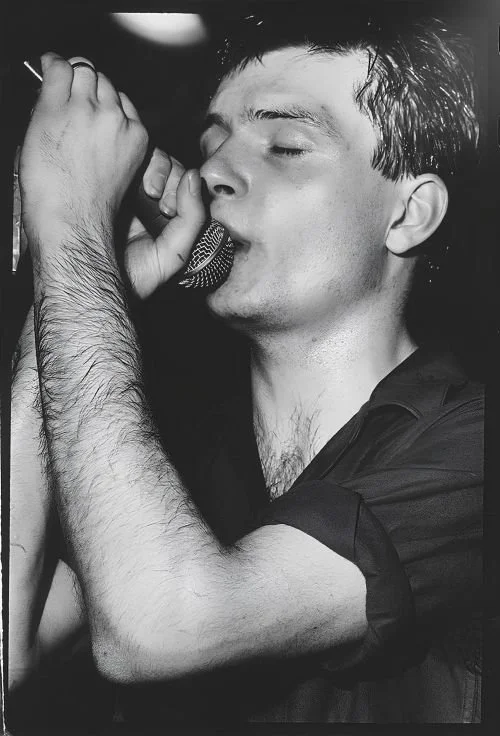
IN THIS PHOTO: Ian Curtis at the Moonlight Club, London in 1980/PHOTO CREDIT: Peter Anderson
Remembering Ian Curtis at Seventy
__________
ONE of the most heartbreaking…
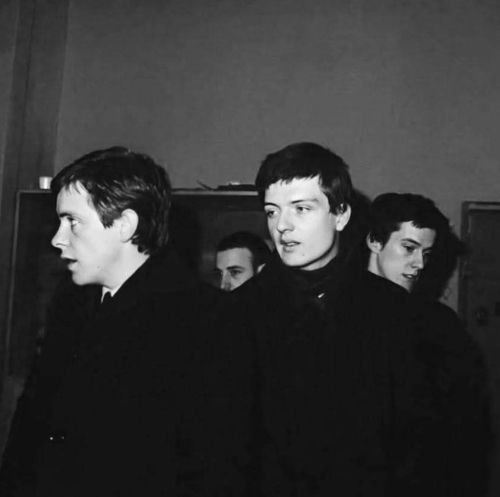
IN THIS PHOTO: Joy Division in 1980
losses in music history was when Ian Curtis died in 1980. He was only twenty-three. The incredible lead of Joy Division, he was one of the most distinctive voices and mesmeric leads ever. An accomplished songwriter and someone who seemed to inhabit the songs and felt every word, he was this rare talent that faced so many struggles and barriers. He died by suicide after struggling with severe epilepsy and depression. It must have been such a curse and burden for someone so blessed. Wanting to perform and write music but having to live with these debilitating illnesses, I did want to remember him as his seventieth birthday is on 15th July. He should be remembered as someone who led a group who have influenced artists like U2, Bloc Party and The Cure. This year, Ian Curtis was posthumously inducted into the Rock and Roll Hall of Fame as a member of Joy Division after two previous nominations. It is a fitting acknowledgment of his legacy and importance. I want to explore that more. However, this interesting blog piece about this great has a lot of personal meaning and depth. Those who were fans of Joy Division loved Ian Curtis. He had such a devoted following. Left shattered when he died in 1980:
“I did not discover the music of Joy Division until a few years after the death of their lead singer, Ian Curtis, but it was love at first sight. Songs of doomed romance like ‘Love will tear us apart’ expressed what most troubled teenagers were feeling. Never was the gloom and despair and solipsism of youth better conveyed. The poster for the album Unknown Pleasures decorated the door into the bedroom of my first girlfriend, and when we split up after a year and a day, I turned to Joy Division for consolation.
Ian Curtis grew up in Macclesfield, Cheshire, where he distinguished himself at school by his poems, if not by his hard work. He won a scholarship to secondary school but left at age of 16 and did a series of administrative jobs. These included working as an Assistance Disablement Resettlement Officer, where he was responsible for trying to help disabled people find work, in an era which was even less open to disability employment than today.
Ian Curtis married at age 19 and became a father at age 22. By then, he had already met Bernard Sumner and Peter Hook at a Sex Pistols gig. The resulting band was first known as Warsaw, then as Joy Division (after a novel which described the women whom Nazis forced to prostitute themselves at the concentration camps). The band played their first gig as Joy Division in January 1978, and were soon signed to Tony Wilson’s Factory Records. With their spare, brooding sound, their black clothes, and Curtis’ frenzied dancing, they became a post-punk sensation, and were to inspire most of the alternative pop music which came after them. Curtis was both singer and lyricist, his dark songs drawing on his love of writers and musicians including William Burroughs, JG Ballard and David Bowie.
The manic dancing owed something to Curtis’ experience of epilepsy. He was diagnosed in January 1979, and his symptoms were never successfully controlled by medication. As his disease worsened, he would sometimes have siezures on stage, possibly triggered by the strobe lighting. In his recent memoir, Joy Division bass player Peter Hook remembers “looking at Ian wondering if, or when, it was going to happen”. He records that Curtis’ onstage siezures left “some of the audience laughing, some scared, some cheering”.
Curtis’ song, “She’s lost control”, describes the experience of a seizure:
Confusion in her eyes that says it all
She’s lost control
And she’s clinging to the nearest passer by
She’s lost control
And she gave away the secrets of her past
And said I’ve lost control again
And of a voice that told her when and where to act
She said I’ve lost control again
And she turned around and took me by the hand and said
I’ve lost control again
And how I’ll never know just why or understand
She said I’ve lost control again
And she screamed out kicking on her side and said
I’ve lost control again
And seized up on the floor, I thought she’d died
She said I’ve lost control again, she’s lost control
Well I had to ‘phone her friend to state my case
And say she’s lost control again
And she showed up all the errors and mistakes
And said I’ve lost control again
And she expressed herself in many different ways
Until she lost control again
And walked upon the edge of no escape
And laughed I’ve lost control again
She’s lost control again, she’s lost control
Ian Curtis’ home life was increasingly difficult, particularly after he began an affair with a Belgian journalist, Annik Honoré, and left his wife and child. His siezures were getting worse. The band were under great pressure after the success of their first album, Unknown Pleasures. Joy Division were due to tour America later in the year. All of them still had “day jobs”, but were writing, recording and performing on evenings and weekends. During an intense period of work, they recorded their second album, Closer, in April 1980.
The following month, Curtis tried to kill himself with a kitchen knife. Neither his fellow bandmates nor his record label were seemingly able to give him the support or understanding he needed, even after a second suicide attempt by overdose. But equally, Curtis was an introspective and secretive person who did not share his feelings easily or ask for help. Tony Wilson said later “I think all of us made the mistake of not thinking his suicide was going to happen… We all completely underestimated the danger. We didn’t take it seriously. That’s how stupid we were.” Another band member said “this sounds awful but it was only after Ian died that we sat down and listened to the lyrics.”
In the end, depressed, exhausted and under great personal strain because of the break-up of his marriage, Ian Curtis hung himself using a washing line in the kitchen of the house he had shared with his wife, on May 18, 1980. His death helped propel him into legendary status, just as with the suicide of Kurt Cobain, or the tragedies of Jim Morrison, Marc Bolan or Jimi Hendrix. Perhaps the Romantic poets Keats and Shelley would be other apt comparisons for this tormented, disabled poet whose lyrics captured the ennui and angst not just of his generation, but of many since”.
In 2014, to mark Ian Curtis’s fifty-eighth birthday, Post-Punk.com transcribed a “BBC Blackburn interview, which is one of the few recordings of Ian being interviewed. To the surprise of many, when Ian discusses shopping for records, one band that comes to mind for him happens to be Bauhaus, which he seemingly thought were from London”:
“WHAT SORT OF RELATIONSHIP DO YOU HAVE WITH OTHER MANCHESTER BANDS?
We tend to be pretty isolated now really…apart from the Factory groups. We have a lot to do with the other groups on Factory. We tend to play a lot of gigs with them and … there’s other things like erm the Durutti Column LP – the sandpaper sleeve – we stuck that on. So everyone there, with each other, and groups they got booked with, groups like the Buzzcocks, that we knew when we started really. You know when we sort of see them, we talk to them, but it’s not very often. We’d like to, you know, see a lot more of other Manchester groups. Any other groups in general.
WHAT DO YOU THINK OF THE STATE OF NEW WAVE?
Don’t know. I think it’s, a lot of it tends to have lost its edge really. There’s quite a few new groups that I’ve heard.. odd records. Record or have seen maybe such as, eh, I like, I think it’s mostly old Factory groups really, I like the groups on Factory; A Certain Ratio and Section 25. I tend not to listen, when I’m listening to records, I don’t listen to much new wave stuff, i tend to listen to the stuff I used to listen to a few years back but sort of odd singles. I know someobody who works in a record shop where I live and I’ll go in there and he’ll play me “have you heard this single?” singles by er the group called The Tights, so an obscure thing … and a group called, I think, er Bauhaus, a london group, that’s one single. There’s no one I completely like that I can say “well I’ve got all this person’s records. i think he’s great” or “this group’s records” it’s just, again, odd things
WHAT IS YOUR SORT OF RELATIONSHIP WITH FACTORY RECORDS
It’s very good sort of friends everyone knows each other it’s all 50:50. Everything’s split.
DOESN’T IT IT SEEM A BIT INSULAR SORT OF BEING IN THE FACTORY SORT OF SET UP?
Don’t know. I suppose to somebody looking at it from the outside i suppose it is really
I mean you’re not pressurised into having to sign … like you know get a normal record company – they’re always looking for the next group for the next big thing … you know … to bring the record sales in and for them to promote and everything…but Factory just sign who they want to, put records by who they want to out, package it how they want to, you know, how they like doing it. It’s just run like that. You might get sort of a spurt of 3 singles out – you might not see anything for the next 6 months. You know. I like the relationship.
YOU HAVE A COUPLE OF TRACKS ON THE THIRD FAST EARCOM, WAS IT? OR IS IT THE SECOND FAST EARCOM?
Yeah. It’s the second one, yeah.
HOW DID YOU GET INVOLVED WITH FAST? AN EDINBURGH COMPANY?
Yeah, it was when we started playing; we played a few dates with The Rezillos. Bob Last was their manager at the time and he talked then about setting up a record label. And he wanted us to do a single for them. But due to Factory coming along and other things – he did things with Gang of 4 and The Human League first and got tied in in a sort of management way with The Human League – I think he manages another one – it never came about. When we were doing the album we had quite a few tracks left over; we recorded 16 in all and just cut 10 and our manager, Rob Gretton, had talked to him about certain things and we’d always sort of kept in touch. He mentioned his idea for Earcom and we just offered him the 2 tracks to put out on that. Cos we like to get everything we record out one way or another, like we’ve done the Earcom, we’re doing the Sordide Sentimental thing, which are a French limited edition magazine-cum-record thing. There are two tracks on that that will be coming out that won’t be on an album or a single. It’s just that we like getting, you know, as much stuff out as we can, really. In some form or another. You know, it’s often hard with Factory because obviously they’re limited financially. I mean you can’t just put out a record, you know, when you’ve got other things planned. So with no room on the LP, we tend to look for other outlets for them, really. See what we can do.
WHERE DO YOU SEE OR WHERE DO YOU FEEL YOU WANT JOY DIVISION TO END OR GO TO?
I just want to carry on the way we are, I think. Basically we want to play and enjoy what we like playing. I think when we stop doing that I think, well, that will be the time to pack it in. That’ll be the end”.
What is the legacy of Ian Curtis? In May, MOJO ran a feature on the anniversary of Ian Curtis’s death. Although his final months were tragic and marred by increased illness and torment, we cannot associate this incredible artist with darkness and tragedy. MOJO spoke with “bandmates, friends and family help to unravel the story of an artist torn apart by love, epilepsy and duty”:
“Ian just seemed like one of us,” recalls Hook. “He had an Army & Navy flak jacket with ‘Hate’ written on the back. That was quite good. He was quiet and polite. Dead nice, really. He had a mate at college who painted doors on the floorboards. That’s Macclesfield for you! Then Steve joined. Did coming from Macclesfield make them outsiders? In a way. It was green hills and open spaces. They were both fuckin’ mad.”
Joy Division’s unusual sound developed during 1977 and 1978 at T.J. Davidson’s, a drab, ugly textile warehouse converted to a rehearsal space. Now demolished, it was situated on Little Peter Street, behind Deansgate Station on the fringes of Manchester city centre. In winter, it was so cold the group used to start fires with scavenged wood to keep themselves warm. The group – initially called Warsaw – practised for three hours every Saturday afternoon. All of them had day jobs.
Their originality stemmed from a punk naïveté. “None of us could play a note,” explains Bernard Sumner. “So instead we decided to use our brains and intelligence to do something original. We learned to play within our limits. What we did was simple and powerful.”
“There was none of this ‘four bars of that’ malarkey,” grins Morris. “It was like, ‘Play that riff twice and then do another riff.’ We had no musical language at all. None of us knew what a bar was. We used to argue about it, ‘Hang on, that’s your idea of a bar, not mine.’”
Tony Wilson describes Warsaw, who regularly played Manchester’s punk venues – Electric Circus, Rafters – as a “fucking cacophony with a great singer”. Famously, Hook played melodic riffs high up on the neck of his bass because his equipment was so poor it was the only way he could hear himself. Their music was edgy and intense. In From Joy Division To New Order, Mick Middles posits the theory that the group may have unwittingly been funnelling the vibrations of T.J. Davidson’s grim, industrial past.
Sumner and Hook take the psycho-architectural link even further.
“My background was working class,” says Bernard. “I lived in Alfred Road with my mother and my grandparents. It was a Coronation Street-style house. My niece and aunties lived in the same road. There was a chemical factory at the end of the street, which backed onto the River Irwell. It stank. When I was 11 we were moved into a tower block. We thought it was great. It had a bathroom and an airing cupboard. But it was also the breaking up of that community. I thought everyone in the street would move into the same tower block, but they didn’t.”
Hook: “Where Bernard and I lived it was dark, it was the ’50s and ’60s, there was still smog, rows and rows of terraced houses. It was black and claustrophobic.”
“There was something subconscious in my mind,” adds Bernard. “The displacement and sense of loss I had… Then my stepfather died. I was quite angry. Up until I was moved to a tower block, everything was really good. Afterwards it wasn’t. I think that may have affected the music in some way.”
“Joy Division were from the north side of Manchester,” the group’s producer, Martin Hannett, explained to Martin Aston in an unpublished interview from 1989. “It’s a science fiction city. Not like the south side at all. It’s all industrial archaeology, chemical plants, warehouses, canals, railways, roads that don’t take any notice of the areas they traverse. The incidence of serious diseases in north Manchester is 50 per cent higher than anywhere else in the country. Grim, eh?”
Ian was a working class bloke who had to go out and make a living. He had responsibilities and struggled hard to feed his family. I think that makes him more rock’n’roll.
Peter Hook
In April 1978, Ian Curtis handed Tony Wilson a note at a local battle-of-the-bands contest, the itinerant Stiff/Chiswick Challenge, informing him he was a “fucking cunt” for not booking the band on his Granada TV show, So It Goes. Within a year the group had recorded an album, Unknown Pleasures, for Wilson’s new independent label, Factory Records (no advances, no contracts). It was only when Martin Hannett – who based its sound on The Doors’ Strange Days – played them a test pressing that they properly heard what Curtis was singing about.
The lyrical content was blacker even than their music: death, religion, love, war. There were references to “the blood of Christ”, a girl’s uncontrollable seizures, childhood rooms filled with “bloodsport and pain”. His poetry was chilling, polished and original. Just as the group never analysed their music, no one ever asked Curtis to explain the words he sang in his rich, powerful tenor. It wasn’t as if Joy Division were consciously trying to preserve their own mystery. “Ian’s words sounded great,” says Hook. “That’s all that was important at the time.”
It’s a wet, drizzly night in December and Macclesfield isn’t in the mood to give up its secrets. MOJO is trying to find the “monstrous” grey council block behind the town station where Ian Curtis lived as a teenager. After 40 minutes trudging around the perimeter of Victoria Park, I give up. It later transpires that Park View flats were demolished 18 months ago.
Deborah, Ian’s widow – who now uses her maiden name Woodruff – has fond memories of them. “I remember Ian standing on the balcony, wearing his sister’s pink fluffy jacket and eyeliner,” she smiles. “He was tall and imposing, over six foot, a little bit frightening. This was 1973. Did he ever attract trouble? No. He could give people the stare.”
We are sitting in a pub, the Station Hotel, opposite the railway station, looking out on Macclesfield’s old industrial centre, warehouses and textile factories now converted to posh flats and heritage museums. When it was first published 10 years ago, Deborah’s memoir, Touching From A Distance, gave the first intimate and detailed picture of the singer’s life. It was an intensely moving book (and soon to be turned into the film Control).
Ian Curtis was 16 when Deborah first met him. A bright grammar school boy who’d passed seven O-Levels, he was also a pharmaceutical adventurer (solvents, Valium, barbiturates) and music nut (Lou Reed, Bowie, MC5, Iggy). His interest in drugs got him expelled from school – where Steve Morris was in the year below. Ian’s father worked as a detective in the Transport Police: it’s from him that Ian apparently inherited his love for literature and “silent moods”. Though living at 11 Park View when they began courting, Curtis had spent his early life in Hurdsfield, on the outskirts of Macclesfield.
“From what I can tell it was a fairly idyllic childhood,” says Deborah. “Wandering around fields, building dams in brooks, chasing pigs. It always puzzled me why he was so obsessed with writing about cityscapes. Maybe he felt guilty that he wasn’t trapped in one. Ian was angry,” adds Deborah. “But I was never sure why.”
Deborah found Ian charismatic and attractive. He was highly creative and original, and kept box files full of poems, lyrics and stories. He often stayed up late writing. He was desperate to make it as a rock star. Deborah recalls that he was smitten with tragic figures like James Dean and Jim Morrison; he also, she says, entertained romantic fantasies of his own early death.
He read Hesse, Sartre, Ballard, Dostoevsky, sought out cult films by Herzog and Fassbinder and, like most youths of his generation, was fascinated with Nazi Germany and military history. (Hence ‘Joy Division’, the corps of Jewish women forced to pleasure SS officers in the concentration camps.) Later, when Joy Division was taking off, Ian privately corresponded with Genesis P Orridge from Throbbing Gristle, punk’s foremost avant-garde thinker and outré performer.
“He was really clever,” she explains. “He could have done something very cerebral. He was a fantastic writer and had plans for various works. It’s a loss in that way. His lyrics are fantastic – imagine if he wrote a novel…”
Intelligent though he undoubtedly was, the man Deborah describes in her book isn’t always likeable; nor is he standard-issue rock’n’roll material. His politics were to the right. In 1975, he voted Conservative and insisted Deborah did the same. Though caring and tender, he could also be insecure, possessive and controlling. According to Deborah, she agreed to their marriage in 1975 under duress: Curtis made vague threats that he might do something to himself if she turned him down.
At their engagement party Ian violently threw his Bloody Mary over his fiancée, believing she was flirting with an uncle. Later that evening, she saw Curtis dance for the first time – the awkward, weaving shimmy the world now knows so well. She didn’t think it unusual at the time.
Once married, Deborah often found it hard to talk to her husband about his poetry and deeper thoughts. “He didn’t communicate very well,” she sighs. “You never knew what his agenda was.”
He got a job in a Manchester record store and was an early convert to punk. When he met Sumner and Hook he had the means to channel his literary ambitions and rock star dreams into something real.
Throughout 1978 and ’79, when the group was taking off, he worked hard to keep his domestic and band life together. He took his new job, at the Manpower Services Commission, seriously. He and Deborah were so strapped for cash he even cleaned the group’s rehearsal room for a few extra quid. When Tony Wilson co-opted Joy Division to glue together the sandpaper sleeves for Durutti Column’s Return Of The… LP, the rest of the group paid Ian to do theirs for them. Meanwhile, they sat and watched a porn film.
In social situations Ian was witty and good company. He was also capable of being provocative, especially after a few drinks. In her book, Deborah mentions being upset when she heard that Ian had entertained the band with an offensive story about a Pakistani family defecating into sheets of newspaper and hurling the parcels into a neighbour’s garden.
There was, it seemed, a disturbing and unfathomable side to Curtis. It was only seen occasionally, but it was, says Morris, like “someone had flicked a switch”. His first encounter with “alter-Ian” came not long after he joined the group, and they all went to see The Stranglers at the Electric Circus. “We couldn’t get in, so we went to the pub,” Morris explains. “The Stranglers’ drummer, Jet Black, was in there smoking a pipe. So Ian said, ‘Look, I’ll go over and sort us out.’ He was drunk [and] the next thing was like, Where’s Ian gone? Then I saw him necking with some bird I’d never seen before in me life! It was like, What?! I said, Do you know her? He said, ‘No.’ So Ian is wearing a black star on his lapel and goes up to [journalist] Paul Morley, who says, ‘That’s a fascist symbol’, and Ian says, ‘No, it’s not, Paul, it’s anarchy, FUCKING ANARCHY!’ Then Ian said, ‘Shall we go into the ladies bogs?’ And I was like, Ladies’ bogs? Erm, why would we want to? It was frightening. He did like to carry on with the ladies.”
“Ian did have a bit of Jekyll and Hyde thing,” agrees Sumner. “I remember he tried kicking in the door of the dressing room at [the Stiff/Chiswick Challenge] gig, when Paul Morley and Kevin Cummins were taking ages to come on-stage. He [once] got so wound up arguing with Rob Gretton he ran around shouting with a bucket on his head. I thought it funny more than anything else.”
Outside the group, Ian and Deborah enjoyed a fairly ordinary domestic life. At weekends, they would take country walks with their dog. In April 1979, the Curtises became a trio when a daughter, Natalie, was born. His existence was, in many respects, the paradigm of normality. I put it to Hooky that Curtis – and Joy Division – weren’t very rock’n’roll in comparison with The Clash and Sex Pistols, who lived in squats, stole their food from street markets, and led a bohemian, art school life. He bristles. “Ian was a working-class bloke who had to go out and earn a living,” he says. “We all were. All those other bands you mention were middle-class and had money. We had nothing, it was totally derelict where we came from in Manchester. Ian had responsibilities, he struggled hard to feed his family, even though he’d rather have played music all day.
“I think that makes him more rock’n’roll. Don’t you?”
In October 1979, with a new single, Transmission, out, the group set out on tour with the Buzzcocks. By now, Unknown Pleasures, was a permanent fixture on the indie album chart. In Sounds, Jon Savage proclaimed it to be “one of the best, white, English debut LPs of the year”.
The Buzzcocks’ Steve Diggle remembers the group as “very reserved. I don’t know if we frightened them off because we were pissed-up and full of drugs. We had a different verve and spark. It was rock’n’roll. They seemed reticent and timid.” Many claim that Joy Division’s deeply emotional, sheet-metal roar blew the ’Cocks off the stage. (Diggle, not surprisingly, dismisses such talk: “Another Factory myth. Most of the audience were still in the bar when they played. We were louder, heavier… No, quite impossible.”)
On October 16 the group journeyed on their own to Brussels Raffinerie du Plan K, an old sugar refinery converted into an arts centre. The evening culminated in a reading by beat legends Williams Burroughs and Brion Gysin from their collaboration The Third Mind. “To be honest, we all liked that kind of stuff, but we didn’t go on about it,” says Morris. “We didn’t go around in black or wearing sunglasses inside. But occasionally Ian would reveal that part of himself. I remember he went smooching over to Burroughs. We were like, ‘Great, we’ve got a crate of double-dead-strong beer, can we get another?’ He was off getting his book signed.”
Later, a drunken Ian reverted to type and pissed into the aforementioned metal ashtray. When a member of staff remonstrated with him, he sarcastically addressed her in slow, loud English, casting her in the role of stu-pid for-eign-er.
The constant touring and exhilaration of being the music press’s bright new promise was beginning to adversely affect Ian’s health. At the end of the previous year, in December 1978, he had suffered his first epileptic seizure, following Joy Division’s first ever London gig, at the Hope & Anchor in Islington. He had been prescribed medication, but the attacks were becoming ever more frequent, more violent. On a couple of occasions, Diggle recalls that the Buzzcocks were asked to extend their set, so fans wouldn’t interfere with ambulance crews trying to reach Ian backstage. The seizures usually occurred either on-stage or directly after performances.
Soon, however, there would be another stress that would send Ian’s epilepsy spiralling out of control. The last night of the tour, at the Rainbow Theatre in Finsbury Park, Steve Diggle was chatting at the bar when Ian approached him. “We were talking generally about it being a good tour, how everything had gone really well, etc,” he recalls. “Then Curtis said, ‘I’ve got this problem. I met this girl in Europe and I’m married with a kid.’ He said it in a very sensitive and troubled way. That sort of thing was happening to a lot of people around us at that time. The temptations of the road. I just said, Don’t worry, mate. You’ll get over it! Other blokes would have laughed about it, but Curtis didn’t. It seemed to be a real problem. I didn’t realise how much of a problem.”
When Joy Division sped off down Ian’s street to start their European tour on January 10, 1980, Curtis looked directly ahead and didn’t wave goodbye to Deborah. Annik Honoré, the girl he’d met at Plan K in Brussels, would be secretly accompanying him throughout the tour. None of the other band members had a wife or girlfriend in tow. Annik worked at the Belgian Embassy in London. She was, by all accounts, “glamorous and exotic”.
On the road, the usual pranks and japes prevailed. “In Cologne, I did the stupidest thing that I’ve ever done,” says Morris. “We quite liked speed at the time. We sent someone to get some, and he came back and said, ‘I’ve got you this.’ It was like this red star.”
“It was called a Belgrade Star,” clarifies Peter Hook. “Steve swallowed it. This guy was like, ‘On no! Dat is five hits of acid!’ He took the lot in one go. Steve was out of his mind for two days. We were staying in a loft space, 12 feet up. Twinny, our roadie, thought it would be amusing to take the ladder away for the night.”
Morris: “I spent the rest of the tour tripping. I kept shouting, I’m going to chop off your head with an axe!”
Having Ian’s mistress travelling with them inevitably caused tensions. “I liked her,” says Hook. “But she was very bossy and domineering. The funny one was staying in a brothel. I can’t remember where. Speakers under the bed. You hired it by the half hour. After the gig we were in the van outside, waiting to go in. Annik said, ‘Hang on, ziz is a knock-ink shop!’ Yeah, so what? She said, ‘I am not staying in an ’ouse of ill-repute.’ So we said, Look, you’re shagging a married bloke, so what the fuck are you talking about, you silly cow!”
Outwardly, Curtis didn’t seem fazed by what was clearly an awkward situation. However, once the tour had finished and he was back home with a suspicious Deborah in Macclesfield, there was a sign that he was deeply troubled. One night, he drunkenly sought out a Bible. Having studied religion at school, he knew just where to look. He gouged out chapter two of The Revelation Of St John The Divine. It concerned the wanton Jezebel: “Behold, I will cast… them that commit adultery with her into great tribulation.”
Later, it transpired that same night he’d cut himself up, too. Unbeknown to anyone, Ian’s life was entering its final phase”.
On 15th July, it will be Ian Curtis’s seventieth birthday. Rather than it being about his short life and how turbulent his life got towards the end, I wanted to use the opportunity to put in music and interviews. So many artists who have followed looked up to Ian Curtis. One of the all-tiume great songwriters. Even though Joy Dicivison released two studio albums – 1979’s Unknown Pleasures and 1980’s Closer -, they are perfect and incredible influential. Ian Curtis’s voice and songwriting talent front and centre. I do wonder whether Joy Division would still be playing if Curtis had lived. You do wonder just what he could have achieved in life. It is sad he was only twenty-three when he died, but he achieved so much and left his permanent mark on music history. We should remember fondly…
THIS much-missed great.