
FEATURE:
There’s Light in Love You See
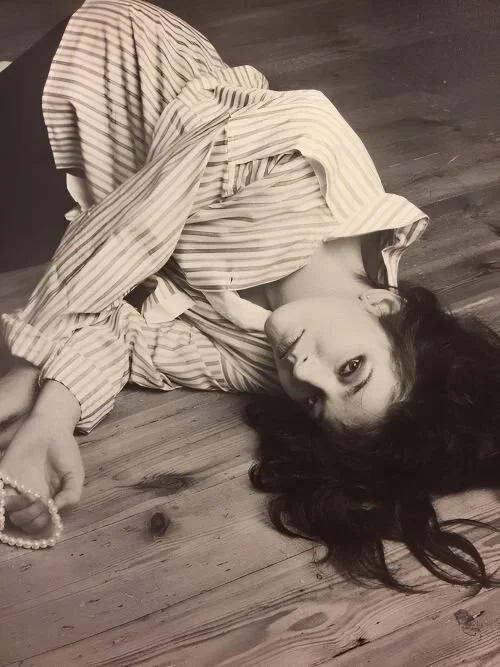
IN THIS PHOTO: Kate Bush in 1985/PHOTO CREDIT: John Carder Bush
Kate Bush and Her Impact on the L.G.B.T.Q.I.A.+ Community
__________
AS it is Pride Month…
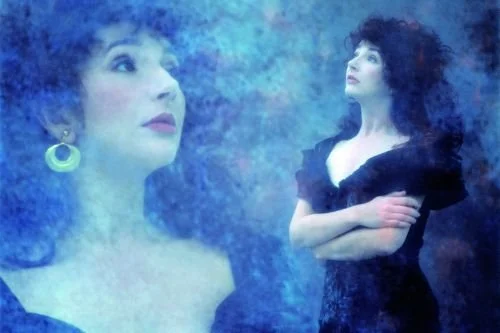
IN THIS PHOTO: Kate Bush in 1989/PHOTO CREDIT: Guido Harari
I wanted to revisit a subject I have covered before. In terms of Kate Bush and her L.G.B.T.Q.I.A.+ fanbase. When we think of major artists who have this enormous following within the community, our minds go to someone like Madonna. Maybe Kate Bush is not as vocal when it comes to backing and shouting out her L.G.B.T.Q.I.A.+ fanbase. However, as an artist, her songs did not strictly stick to the heteronormative ideal. I think it was hard for artists to bring queerness into their music. Seen as controversial or inappropriate, thankfully things have progressed since then. Even today, there are artists who are perhaps hesitant about expressing their sexuality, in case it splits their fans or creates any sort of backlash. Things are easier today for L.G.B.T.Q.I.A.+ artists today - and yet things are not perfect. Think about Kate Bush and her music. I do love how she was not restricted or felt the need to be rigid regarding sexuality and what she discussed through her music. I am going to come to articles I have sourced before. Even some of her earliest demos featured queer/L.G.B.T.Q.I.A.+ characters. The Gay Farewell is an example. Kashka from Baghdad. That song appeared on her second studio album, Lionheart (1978). Wow is also on that album and there is reference to homosexuality. The line “He’s too busy hitting the Vaseline”, where Kate Bush pats her bottom in the video, is pretty unequivocal! That is a song about showbusiness. It is a song that partly addresses the music industry, but its lyrics concern actors and luvvies. Last Pride Month, I ran a feature saluting Kate Bush as this ally. Someone who has always been very open regarding sexuality. A fluidity through her work, at times in music where many artists who were queer could not talk about it. Even though she is someone who very much speaks to the L.G.B.T.Q.I.A.+ community, there has been critique of her work. Whether, when writing about homosexuality, Bush checks her privilege and it is written about as a positive thing, and not a spectre.
I am saying that because Dreams of Orgonon spotlighted Kashka from Baghdad and wrote this: “This makes her treatment of Kashka’s gay life as a matter of secrecy distressing. The polite heterosexual audience needs its eyes shielded from the gay sex it’s teased with. Yes, remaining in the closet is a safety measure for many if not most gay people. But it takes a severe toll on one’s mental health. In “Kashka” the closet is a place where great, magical events happen (“at night they’re seen laughing”). The difficulties of closeted life don’t enter the equation. Bush reduces Kashka and his partner to an instrument of pleasure and titillation”. As I recently wrote about The Gay Farewell (also know as Queen Eddie), even Bush’s earliest songs had empathy and understanding. Where she was very open to bring in queerness. Coming to another Dreams of Orgonon article. It concerns the beautiful Queen Eddie (or The Gay Farewell as it is also know). When Bush wrote this song (around 1973), gay rights in the U.K. were being challenged. Even though it never made it to an album, a song like The Gay Farewell was very brave and bold for someone who was barely a teenager: “Bush’s music often displays a strong interest in the feminine side of men, and this is the earliest musical manifestation of her concern. Eddie is someone with no time for masculinity. Everything from the effeminate adjective of “pretty” to the fact he’s saying goodbye to “his boy” points to that (who’s his boy? Is he breaking up with a boyfriend, or is he transitioning?) Even the song’s varying titles, in all probability not penned by Bush, point to a queer reading of the song (“The Gay Farewell” is a pretty wretched pun even by my standards). There’s an element of fetishization here — Eddie is denied an identity outside of his gender and sexuality in a way that’s genuinely harmful. For all that the empathy on display is genuine, so is the singer’s privilege. Yet for this song’s flaws, it feels like something that needed to be written in 1973, even if it wasn’t heard outside 11 East Wickham. An LGBT rights movement was booming in the UK at the time — The Gay Liberation Front was new and alive, and the First British Gay Pride Rally had been held in London, not too far from the Bushes, a year previously. But these movements were responded to by things like the Nationwide Festival of Light, a puritanical attempt by notorious professional bigot Mary Whitehouse and others to suppress the existence of gay people, as well as any expression of sexuality that didn’t pertain entirely to procreation. The LGBT community needed some allies, and Kate was willing to step into the ring early on. Kate’s complex championing of the queer community has begun. Thus we get “Queen Eddie,” her first camp song”.
There is quite a lot to unpack and examine. Although her allyship and empathy is perhaps not completely without fault or some naivety, this was an artist writing these songs very young. In a British society where gay rights were often attacked, ignored and stigmatised. Although she had some L.G.B.T.Q.I.A.+ artists that she looked up to, such as Elton John, there was not a music scene promoting and spotlighting them in a way that is more familiar today. I guess David Bowie had this fluidity and androgyny that was also appealing to her. But think of music in the 1970s and how often queer love was being written about. Not as much as you’d like. That sense of stigma for artists did not end for decades. Some would say it is still a barrier. So we cannot mark Kate Bush down. I am going to end with a recent article in The Guardian, where a writer reveals how Kate Bush’s music was so powerful and resonant when it came to coming out as a trans woman. The trans community among the most pilloried and abused today. They are often vilified and marginalised, and yet it was music written many years ago by this incredible artist that broke through. I do want to get to writings where Bush is spoken about as an ally and idol. Kate Bush’s music has always been very open and free. In the way she talks about desire and sex. Which must have been liberating and inspiring for many who lived on the fringes. In 2018, forty years after her debut single, Wuthering Heights was released, Attitude wrote how “the queen of quirk left a lasting impact on the gay community“:
“Queer people identified with Kate Bush because of that otherness, because of her bravery and defiance, her fearless examination of previously ‘taboo’ themes, and her often high-camp performance style. As Rufus Wainwright told The Guardian in 2006: “She is the older sister that every gay man wants. She connects so well with a gay audience because she is so removed from the real world. She is one of the only artists who makes it appear better to be on the outside than on the inside.”
The magnificent, lushly exotic ‘Kashka from Baghdad’ from 1978’s Lionheart, is one of the prime examples of Kate’s celebration of the joy of the outsider status. “Kashka from Baghdad,” she sings over sensual piano chords, “lives in sin, they say, with another man – but no one knows who.”
Kate fixes her gaze firmly on an outcast couple, the music alternately romantic, enigmatic, and menacing, as male backing vocals chant aggressively behind her as she shrieks “at night / they’re seen / laughing / loving” but, by the time the narrator observes that “they know the way to be happy,” the aggression has subsided into regal elegance.
It’s a powerful statement of approval, and Kate herself put it simply when she told Interview Magazine in 2011: “I just liked the idea of this couple. Nobody really knew much about them—and they’re obviously having a great time.”
Observational songs like ‘Kashka’ highlight Kate’s keen eye for detail and empathetic lyrical style; her warm, graceful acceptance – and endorsement – of homosexual desire marked her out as an LGBT advocate from the outset.
Her frank openness and recognition of a gamut of gender norms and of the reality of sexual fluidity became a recurrent theme in her work; ‘Wow’, a biting satire of the theatrical business, finds Kate singing “He’ll never make the scene / he’ll never make the Sweeney / be that movie queen / he’s too busy hitting the Vaseline.” If we were in any doubt as to her underlying meaning, her performance in the video removes all doubt as she taps her buttock on the payoff line.
Kate’s deep and thoughtful understanding of men in her songs is an underrated value in her arsenal; there are the men sent to war in ‘Army Dreamers’, or the kindly but increasingly distant father figure in ‘The Fog’, the misunderstood mathematician in “Pi,” and, most of all, the exquisite ‘This Woman’s Work’, where she sings about parenthood and birth from the male perspective. And no one could inhabit Peter Gabriel’s lyric as the voice of reason and comfort in ‘Don’t Give Up’ better than Kate Bush.
Perhaps most poignant of all, the father-son narrative of ‘Cloudbusting’ climaxes with the Shakespearean pun “your son’s coming out.” The rush of hearing Bush equate positivity, happiness, open-mindedness, and the promise of good things with the emergence – sexually or otherwise – into the world at large remains a profound thrill.
“Kate Bush is an LGBT icon for several reasons, not least because she built a successful career, without compromise, on her own terms, with thorough originality, ingenuity, and, crucially, trueness to herself. She did, and continues to do, things her own way, and is undaunted in her distinctiveness and navigation of the peculiarities of life.
Who else could make a song about intercourse with a snowman (‘Misty’) seem plausible? Who else would find both eroticism and melancholy in the humdrum as Kate does in ‘Mrs. Bartolozzi’?
Anohni Hegarty told The Guardian in 2005 that her first glimpse of Kate, singing ‘Wuthering Heights’ now forty years ago, was a seminal experience.
“She was so magical: the world she inhabited was, especially poetically, a sort of fairyland. It was very sensuous and very pagan, and she sang so high – it was madcap,” she said.
And it is that sensuality, magic, and poeticism, that otherness and courageousness, that has carried Kate Bush, for forty years, through the choppy, murky waters of pop music and carved a firm place in our hearts.
She is, and always has been, herself, with no apologies. And for that, we salute you Kate Bush”.
At its roots and at heart, it is Kate Bush’s empathy, and approach to gender expression that means she is this icon. There was never a hesitation around avoiding queer relationships through fear of attack. Even though she is heterosexual, here is a writer who observes all humans and wants to include them. Always writing positively and with great investment and interest, that was instilled into her from a young age. You feel like, as a child, she would have been fascinated by people as a whole, regardless of sexuality and gender. More orthodox or mainstream artists are either hesitant about discussing queer love or, if they are queer themselves, feeling like they had to keep that hidden. I guess there is privilege and a lack of pressure from Kate Bush, but there is also that bravery and boldness. Something that continued. Even a song like Running Up That Hill (A Deal with God) has been adopted by the L.G.B.T.Q.I.A.+ community. A song about understanding and swapping places to better relate to someone else. Its use in Stranger Things so powerful for a number of reasons. DIVA used this as a starting point for their 2022 love letter to an eternal queer icon:
“Teenagers across the world are now discovering her magic for the first time, with the track experiencing a rapid increase in Spotify streams since it featured in cult Netflix series Stranger Things. With Season 4 premiering in May 2022, this season’s storyline features a much-darker hook as teenagers across Hawkins perish in eerily similar circumstances. The gang quickly decipher this as the work of demon of the upside-down, Vecna, finding that the only way for an infected victim to fight off this fate is to play their favourite song. This is where Kate Bush comes in.
After eternally beloved Max Mayfield finds that she has been cursed by Vecna, experiencing headaches, jarring nightmares and haunting visions, she dazes into a trance and rises six feet into the air one afternoon. Recognising this as Vecna’s murder method, the gang scramble for her Walkman. “What’s her favourite song?” they scream at Lucas, Max’s ex-boyfriend. With his hand landing upon the bluish hue of the Hounds of Love cassette, Running Up That Hill quickly comes blaring through Max’s ears. Caught in an eerily realistic, trance-like dream, Max escapes Vecna’s chokehold and sprints through the upside-down, dodging falling boulders and debris alike, moving towards the white, cloud-esque image of real like. Seeing herself floating above her best friends, she flashes back on all the happy memories she’s enjoyed with her friends and family alike. Tumbling through the vision back into real life, Kate Bush quite literally saved Max’s life. What a beautiful metaphor that is.
Kate Bush is the ultimate queer icon. Her music has always been a home for misfits, though Running Up That Hill is arguably her most mainstream, tame track. Wearing an armour-like costume for the Babooshka music video and red dress for Wuthering Heights, she has relied on costume and dance alike to express herself. With a multi-dimensional approach to creativity, her music isn’t just a collection of notes: it’s an experience. Drawing heavily on techniques employed by visionary mime artist Lindsay Kemp – who personally taught her – Kate Bush has always used her body and her dance routines to express emotion, and to tell a story. The video for Running Up That Hill is deeply symbolic of that fact, pairing with dancer Michael Hervieu to create an intricate, storyboard-like performance that was vastly aheadof its time, playing on Bush’s background in ballet.
Creative aesthetic aside, Kate Bush famously sang about anal sex in 1979 track Wow, which featured on her second album Lionheart. Singing about an actor who will never be a “movie queen” because he’s “too busy hitting the Vaseline”, in the video, she winked and patted her bum to ensure that her message of allyship was truly disseminated. What an icon. And, of course, the music video was censored by the BBC, which is always a good sign of a forward-thinking bit of art. Think Frankie Goes To Hollywood.
All in all, Kate Bush’s music has been a critical source of comfort and, by extension, an expression of identity for LGBTQI people for decades now. Ginny Lemon lovingly referenced her by dragging up as the Wuthering Heights-esque young Kate on Drag Race UK for the gay icon category. And that very sentiment is true: Kate Bush is the ultimate queer icon, and forever will we applaud her for her deeply unique, kooky ways of being. Music wouldn’t be the same without her”.
I am surprised there have not been newer articles written about her music and how it connects to L.G.B.T.Q.I.A.+ people. Last October, Alexandra Diamond-Rivlin wrote a very personal and moving article for The Guardian, where she talked about Kate Bush’s music, and how it helped her come out as a trans woman. I want to include the whole thing, as I feel it would be a disserve to cut bits out, lest the impact and full picture by distorted, dampened or diminished. Before getting there, I would urge people to support and check out the Trans Journalists Association, and support L.G.B.T.Q.I.A.+ charities and organisations like the LGBT Foundation. Mind Out. Stonewall is another incredible resource. Mermaids supports trans, non-binary and gender-diverse children, young people and their families. You can find more here:
“It wasn’t safe for me to discover The Sensual World, the eponymous track on what Kate Bush described as her “most female album”. The song was intended to be a rejection of the masculine influence that had unwittingly shaped the artist’s previous work, and an ode to something taboo within the female experience. Based on Molly Bloom’s soliloquy in James Joyce’s Ulysses – a stream of consciousness in which the character reflects on her experiences of nature, sex and love – Bush wanted to celebrate the experience of life inside a woman’s body, and the ways it gives her spiritual and sexual pleasure. I knew that, for someone like me, who was already being bullied, to openly love a song like this could make me an even more obvious target to those who saw femininity as a sign of weakness. More daunting than that, it might force me to confront my own repressed desires.
By the time I was around 17, I had already spent most of my teenage years in a constant state of survival. I wasn’t yet out as a transgender woman; this was a part of me I could keep secret, unlike my effeminacy. I had a naturally high voice, which I tried and failed to deepen. “You sound like a girl,” was one of the daily taunts aimed at me by pupils at my school, even as I strained my vocal cords. My camp mannerisms and the way I walked were other noticeable crimes to the boys around me, who enjoyed mocking my “sassy” stride. Growing up in an environment such as this meant I never saw my femininity as something to embrace. That I was soft and girlish was a sign of a defective self. Still, it felt safer to be a feminine boy than a boy who wanted to become a woman.
Her ode to womanhood invoked all the things I knew I could be: euphoric, audacious and free.
The school I attended in Plymouth was single sex, but high-achieving girls were allowed to enter its gates at sixth form, something I was grateful for. Some of the new students lived near me, by the forests surrounding the city. One morning, while we ambled along the grassland, one of the girls shared her headphones with me and played her favourite music. That’s when the discovery was made.
For the rest of the day, I couldn’t stop thinking about Bush’s ethereal voice. On my solitary walk home, I listened to her song again under the shelter of leaves and the furry limbs of trees. I listened carefully, but most of her words appeared formless – lines sung breathlessly behind an orchestra of uilleann pipes and other traditional Irish instruments I remembered learning about in class. In certain moments, her words’ sharpness broke in again like splices of light along my trail: “to where the water and the earth caress … now I’ve powers of a woman’s body.” Moments such as these were laced throughout, often referencing nature, and culminating in postcoital bliss: “Mmh yes.” I pictured Bush dancing among trees in a state of synaesthetic ecstasy, her body lit by a neon green glow. My body swayed instinctively to the rhythm. It didn’t bother me that I must have looked like a girl doing it. I followed the flickers of emerald to the forest’s end.
Something shifted in me that day. Bush’s ode to womanhood felt like an invocation of all the things I knew I could be: euphoric, audacious and free. I started to view my femininity not as a flaw, but as an affirmation of life; a way of indulging in the intense pleasure of the world, nature and my body.
It still wasn’t safe to be my natural self in my final year of school. My transition came a couple of years later, when I moved away for university. But, from this point onwards, I knew there was a place in my mind to escape to whenever I wanted – the lush, fevered universe Bush had created – where I danced in recognition of my own sacred womanhood. And waiting patiently for that reverie to become my everyday reality, I was able to refuse the voices that told me it never would”.
From gay clubs and spaces playing the music of Kate Bush and providing this safe and loving space, through to major artists discussing Kate Bush, to those who have been given this new life and strength thanks to Kate Bush. I have probably not done full justice to her music and how she has affected, infused and enriched conversation around L.G.B.T.Q.I.A.+ people! Though I felt compelled to write about Kate Bush…
THIS Pride month.