
FEATURE:
Kate Bush: Them Heavy People: The Extraordinary Characters in Her Songs

IN THIS PHOTO: Kate Bush in 1978/PHOTO CREDIT: Gered Mankowitz
Dennis (In Search of Peter Pan)/Daddy (Cloudbusting)
__________
THERE are three more parts…
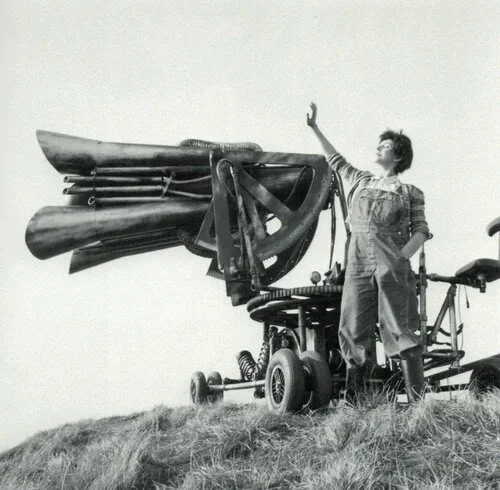
IN THIS PHOTO: Kate Bush on the set of Cloudbusting/PHOTO CREDIT: John Carder Bush
of this series that I have left. The antepenultimate one pairs characters from 1978’s Lionheart and 1985’s Hounds of Love. I shall come to a character in Kate Bush’s Cloudbusting. A song inspired by a book, there are real-life people who were very much at the centre. I wanted to start out with a song from Lionheart. Kate Bush’s second studio album, it came in November 1978. Rather than talk about Peter Pan, there is a character called Dennis that is mentioned in the lyrics. “Dennis loves to look/In the mirror/He tells me that he is beautiful/So I look too, and what do I see?/My eyes are full/But my face is empty”. It does make me wonder who that person is and what could have inspired those lines. Rather than speculate whether he could have been named after a famous person, I have been considering the sense of fantasy and escape in Kate Bush’s music. Bush did discuss what the song is about:
“There’s a song on [Lionheart] called ‘In Search Of Peter Pan’ and it’s sorta about childhood. And the book itself is an absolutely amazing observation on paternal attitudes and the relationships between the parents – how it’s reflected on the children. And I think it’s a really heavy subject, you know, how a young innocence mind can be just controlled, manipulated, and they don’t necessarily want it to happen that way. And it’s really just a song about that.
Lionheart promo cassette, EMI Canada, 1978”.
That is really fascinating. The second song in this feature is another that is influenced by a book. It is work considering the text. The Peter Pan story first came to life on 27th December, 1904. It debuted as a stage play in the heart of the West End at the Duke of York's Theatre in London. Author J. M. Barrie later turned the play into a classic novel in 1911. Despite the fact that it is seen as whimsical and fantastical, it is actually quite a sinister text. Something that could well have intrigued Kate Bush. A song written before 1978, In Search of Peter Pan was dusted off for Lionheart. In 2011, The Guardian explored the darker elements of Peer Pan:
“That we now know so much about the story behind Peter Pan is mostly down to one writer. It can be hard to forgo any myth of departed splendour, and for me, watching Andrew Birkin's The Lost Boys (1978) itself fostered nostalgia for the hallowed decades of British television drama. The programme's brilliance arises both from Birkin's commitment to accuracy and from the knowledge that truth must be something concealed from us, somewhere playing hide and seek among the manuscripts and letters. The acting is note-perfect too, especially Ian Holm's performance as Barrie. The attentiveness and patience of the piece, its combining the richness of a novel and the virtues of theatre with the resources of television (the voice-over, the use of landscape) are qualities that it would be hard to find now on British TV.
Holm has played both Barrie and Lewis Carroll; more recently, and more implausibly, Johnny Depp has nearly followed in his footsteps by acting both The Mad Hatter and, in Marc Foster's Finding Neverland (2004), the author of Peter Pan. Finding Neverland tenders the same story as The Lost Boys, but this time as a sweet romantic fable. Everything odd and intriguing about the real story is smoothed away – no inconvenient Arthur Llewelyn Davies, no thought of blaming Barrie for the failure of his marriage, no marked interest in the boys as boys, no insight into Barrie's glum and fantastical complexities. Instead there's just a summer-soaked hymn to the imagination and a subdued, unspoken love affair, Brief Encounter with Billy Liar dream-escapades thrown in. There is plenty of boyish romping, but no scene that lingers long enough to give room to complexity. And so all the power of Barrie's strangeness slips away, leaving only an immense pity for a young mother dying and leaving her sons.
Just as we return over to Barrie's personal life, versions of the Peter Pan story itself proliferate (we hurry past Steven Spielberg's Hook (1991), averting our eyes in silence); the play still on occasion holds the stage. But these multiple reimaginings only perpetuate a process that Barrie himself began. The first problem faced by Maria Tatar, the editor of The Annotated Peter Pan, is what version of the story one would choose to annotate. There are least six possible contenders: The Boy Castaways of Black Lake Island, purportedly by Peter Llewelyn Davies, a photo book of the Llewelyn Davies boys playing out the adventures of shipwrecked sailors, of which two copies were made in 1901; The Little White Bird (1902), a novel for adults with some chapters devoted to Peter Pan; the original stage play (1904); the Peter Pan chapters from The Little White Bird reissued, with Arthur Rackham's wonderful illustrations, as Peter Pan in Kensington Gardens (1906); Peter and Wendy (1911), "the book of the play", and the closest thing to a standard children's book; and finally the printed, much revised play text of Peter Pan published in 1928. It's a bibliographer's dream, and an editor's nightmare. Understandably Tatar plumped for Peter and Wendy, though in my view, the play is the thing, the finest and most interesting expression of Barrie's personal myth.
Nonetheless, Tatar makes up for her choice with four separate introductions, plus Barrie's introduction to the play, FD Bedford's original illustrations to the children's novel, Rackham's illustrations, an essay on Rackham, a facsimile printing of The Boy Castaways, Barrie's scenario for a proposed silent movie version of Peter Pan, an essay on adaptations, prequels, sequels and spinoffs, and a collection of quotes and responses by people as diverse as George Bernard Shaw, George Orwell and Patti Smith. As will be obvious, it's a sumptuous and copiously illustrated book that anyone who loves Peter Pan would love.
Barrie is the most ironical of children's writers. He stands always at a winking distance from words, making faces behind the phrases. This is why the play remains the classic version. For here Barrie bases his story of a child given over to perpetual playing in the fact that theatre anyway consists of adults seriously playing the childhood game of "let's pretend". Here there are only pretend mothers and fathers, pretend food, pretend deaths. The play's stage directions call for an infected realism, precise and literal, and yet utterly fantastic. The play's preposterous demands, with its flying children, swimming mermaids, pirate ship and hungry crocodile, dance around the limits of theatrical illusion. And then the horrible appeal to the audience comes, that they should play "let's pretend" too and assert their belief in fairies, to clap their hands and save Tinkerbell's life. They must pretend really to believe in the pretence, and act as though they are more childlike than they are. No wonder that when he saw the play as a child, Graham Greene sat on his hands.
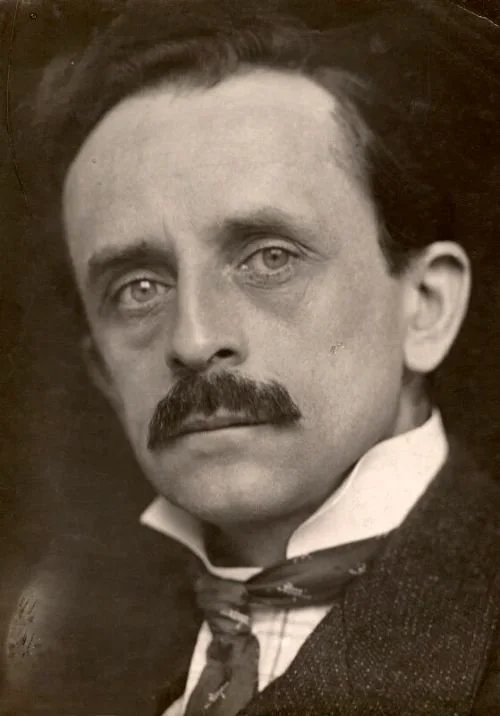
IN THIS PHOTO: J.M. Barrie in 1902/PHOTO CREDIT: George Charles Beresford
Peter Pan in Kensington Gardens dishes up a potent local myth, one that even now endows that park with magic. To have permanently altered the way we imagine a part of London is a grand achievement. The later reworking of the plot, with Tinkerbell, pirates, Indians and the Darlings lost this specifically local beauty, but gained a great deal. Above all, it discovered Neverland, that map of Barrie's imagination. Other than its central myth of eternal youth, the life of Peter Pan itself now resides mostly in Captain Hook – a man hungry for admiration, flamboyant, maimed, vindictive, a passionate hater of the child and yet condemned to play for ever in a world of children. He's the bad parent waiting to be slain. In the story, fathers come in for a hard time, conceited and insubstantial Mr Darling being consigned to the kennel; mothers on the other hand have it even worse. Barrie contemplated naming the story "The Boy Who Hated Mothers", and tried to have the actress playing Mrs Darling double with Captain Hook (Barrie himself remarked, "There is the touch of the feminine in Hook, as in all the greatest pirates). In a remarkable moment in Peter and Wendy, the narrator declares that he despises Mrs Darling; a little later, he says that he likes her best of all. Out of such idiosyncratic, rapid switches of feeling, this classic draws its life.
Pan kills Hook; it's only "pretend", only a play, of course, but also an intimation of a darker world. It reminds us that RM Ballantyne's The Coral Island inspired both Barrie and William Golding's The Lord of the Flies. Peter is both the hero of the play and its true villain; there is something of the Hook in him too. The fact that children are learning to become moral agents and accept a place in the world failed to touch Barrie. Imaginatively he loved children's amorality, and wished that they could stay outside the world, before it or beyond it, inside the fenced-in territory of Kensington Gardens or marooned on a faraway island. He himself freely mixes sentimentality with heartlessness. The joke was to present emotional situations and then to refuse emotion for them, not to play "the crying game". Perhaps for Barrie feigning heartlessness rescued him from the pain of loving, whether an unwinnable mother or the lost boys themselves.
But what's oddest of all is that the public shared Barrie's private fantasy. In literature, success means finding a market for monomania. In order to resurrect Tinkerbell, adults as well as children applauded. They too, it seems, were attuned to Barrie's desire to remain a child. For us that desire has gone. Who now would really want to be a child and never grow up? Of course, in our wish to escape from work, responsibility, or money worries, I am sure that many on occasion would like to be a kid again. But a hankering for childhood – that now seems entirely lost. Very likely the long, protected "childhood" was anyway a myth, a middle-class prerogative, but then Peter Pan is a very middle-class tale. Still it is hard to imagine anyone now suggesting that childhood is holy, or that it represents the peak of life, with everything that comes after being merely a long descent. We are more likely to call someone a Dorian Gray than a Peter Pan.
These days it seems that the twilight zone of adolescence is the preferred place to be shipwrecked. "Youth" has advanced on two fronts, seizing the ground of "childhood" while occupying the place of maturity. As on that beach in Brighton, many look to loiter for ever in a state once considered ephemeral and transitional. In The Disappearance of Childhood (1982), Neil Postman persuasively argued that with childhood's disappearance, adulthood vanishes too. All that is left is one marketed expanse, where the consumers cling to the illusion of youth, a Botoxed utopia”.
I will come to Kate Bush quoting from Pinocchio for the final section of In Search of Peter Pan. I do like the study of adolescence and how she approaches it for this song. Wondering if Dennis is a childhood friend or someone she used to know, he sits in this fascinating song. I am interested in what Dreams of Orgonon say about In Search of Peter Pan:
“Peter Pan is effectively popular culture’s favorite anthropomorphization of adolescence. As he will never grow up, he embodies childhood as an endless state which actively revolts against growing up. Given that Bush had been writing fairly adolescent songs not too far back, it’s clear to see why she’d use Pan as a touchstone. Yet her path differs from Pan’s: in the chorus, she declares her desire to grow up and “find Peter Pan” (perhaps as some kind of star sailor) and escape from the trap of adult life. The departure from Peter Pan is that Bush states that she will become an adult instead of just flying to Neverland. Part of being an adult to Bush is being able to enjoy childlike things. More pertinently, as a child you believe you will hold onto childish things forever, and as an adult she holds onto this belief. The culture of children is an important part of Bush’s ethos — it presents an alternative to the tedium of adulthood. She’s never let go of childhood as an ideal, letting it play a role in her work as late as Aerial.
Bush’s quotation of Disney in the outro is an extension of this. The quote she knabs is the most famous part of Pinocchio: “when you wish upon a star/makes no difference who you are/when you wish upon a star/your dreams come true.” This is the Disney theme song, the saccharine aphorism on which their brand is constructed. Bush is quoting the most fantastical idea of childhood possible. Yet she takes this overused quote and turns it into the song’s most interesting musical moment. She sings the quote in a minor key, slowly descending as she does it. It’s not a straight quote; Bush outright warps the song. As Bush won’t pretend childhood is without pain, depictions of it must reflect some kind of wrongness and pain.
“In Search of Peter Pan” has no shortage of adolescent agony. At the start of the song, Bush has given up and declared that she “no longer see[s]” a future. Throughout the song she sings about a child whose life has been derailed by adult interference, taking the game right out of it. Modes of escape are flights of fancy, whether it be the singer’s friend Dennis who fancies himself beautiful (a queer part of the song) or flying away to be Peter Pan. Fantasy is a refuge for Bush: when in doubt, remember your inner fantasist”.
I don’t think that her words for In Search of Peter Pan reflect any struggles for Kate Bush. In terms of her own childhood. She had a stable upbringing with her parents and two older brothers, John and Paddy. Though I can see why she wrote this song. Something about Peter Pan and its darker side. There is this unsettling aspect to J.M. Barrie’s work. This article talks about the legacy and modern relevance of Peter Pan:
“More than a century later, Peter continues to fly through our cultural imagination. But why?
1. The fear of adulthood is timeless
In an age of delayed adulthood, “kidult” culture, and economic precarity, Peter’s refusal to grow up speaks louder than ever.
2. Nostalgia sells
From Disney remakes to fashion lines, Peter is a global brand. But behind the sparkle is something more melancholy: a longing for a past that never was.
3. The orphaned hero trope persists
Peter, like Harry Potter or Luke Skywalker, is a child without parents, thrust into leadership, adventure, and emotional solitude. It’s a potent narrative formula.
4. We recognise the cost of freedom
Peter is free - but he’s also alone. He forgets the people he loves. He doesn't change. In many ways, he’s a ghost. That ambivalence keeps the story alive for modern readers.
A Legacy That Lasts Forever
The story of Peter Pan has been retold in countless adaptations, from stage plays and films to spin-off novels and reinterpretations. Its universal themes of adventure, freedom, loss, and the magic of childhood ensures that it remains relevant to every new generation. Barrie’s brilliant blend of humour, fantasy, and emotional depth makes Peter Pan a book that truly stands the test of time”.
Before moving on to one of Kate Bush’s most famous and popular songs, it is worth talking about the words from Pinocchio that are used. “When you wish upon a star/Makes no difference who you are/When you wish upon a star/Your dreams come true". Pinocchio has been referenced a few times in Kate Bush’s work. I have said before how she is almost unique among established artists in that she has written her own material. You have songwriters like Joni Mitchell who have written their own stuff, though there are so many established and long-running artists who have co-writers. What we get from Kate Bush is a discography of here own words. In Search of Peter Pan does contain some words from elsewhere. There are the odd bits here and there where Bush has referenced other sources, though her studio albums were written by her. I think that this individualism and assurance makes her songs so enduring. This is an artist who did not want to collaborate or include cover versions. I think that it is impressive that Bush wrote her songs. Even today, many major artists have others adding to their work. From the very start, Kate Bush wanted only her voice in the songs. A track like In Search of Peter Pan could not have been written by anyone else. On the promotional cassette for Lionheart, Bush was interviewed and asked whether any classic English themes would be explored. If that is something that was going to be big. Although In Search of Peter Pan sources from a Scottish author, I guess there was an element of a classic British setting. Oh England My Lionheart is another. Though I don’t think Bush was trying to write English or British songs. She was fascinated by different themes and threads. I do wonder about Dennis and what his role is. Someone who Bush names in the song, I think he might have been a family friend or someone that she knew at school.
Let’s move to Cloudbusting and Daddy. Of course, this song is about Peter and Wilhelm Reich. The Cloudbuster is a controversial, pseudo-scientific weather modification device invented in the 1950s by Austrian psychoanalyst Wilhelm Reich. Designed to manipulate "orgone energy" (a universal life force Reich believed existed in the atmosphere), it supposedly could cause rain or clear clouds by drawing this energy into a grounded water source. In the Cloudbusting video, Bush plays Peter Reich. The son. Looking up to Daddy, played by the late Donald Sutherland. Prior to getting to Kate Bush and why she wrote Cloudbusting, this article examines this strange and wonderful machine that was designed to make it rain:
“Wilhelm Reich invented what he called a “cloudbuster” after observing the behavior of water in a bucket when a pipe was held above its surface. He was even hired by blueberry farmers in Maine to end a deadly drought that threatened their harvest and livelihoods. As reported in the Bangor Daily News on 24 July 1953:
“Dr. Reich and three assistants set up their ‘rain-making’ device off the shores of Grand Lake, near Bangor hydro-electric dam, at 10:30 on Monday morning 6 July. The device, a set of hollow tubes, suspended over a small cylinder, connected by a cable, conducted a ‘drawing’ operation for about an hour and ten minutes….
“According to a reliable source in Ellsworth the following climactic changes took place in that city on the night of 6 July and the early morning of 7 July: ‘Rain began to fall shortly after ten o’clock Monday evening, first as a drizzle and then by midnight as a gentle, steady rain. Rain continued throughout the night, and a rainfall of 0.24 inches was recorded in Ellsworth following morning.
“A puzzled witness to the ‘rain-making’ process said: ‘The queerest looking clouds you ever saw began to form soon after they got the thing rolling.’ And later the same witness and the scientists were able to change the course of the wind by manipulation of the device”.
Like In Search of Peter Pan, I think childhood links it to Cloudbusting. There is this dynamic between father and son. This almost mad inventor trying to make it rain. His young son in attendance. Discovery and chance are to key to some of Kate Bush’s best songs. Seeing the last fifteen/twenty minutes of a 1967 BBC adaptation of Wuthering Heights and then writing her debut single. For Cloudbusting, rather than it being a T.V. show, a book caught her attention, as we discover here:
“This was inspired by a book that I first found on a shelf nearly nine years ago. It was just calling me from the shelf, and when I read it I was very moved by the magic of it. It’s about a special relationship between a young son and his father. The book was written from a child’s point of view. His father is everything to him; he is the magic in his life, and he teaches him everything, teaching him to be open-minded and not to build up barriers. His father has built a machine that can make it rain, a ‘cloudbuster’; and the son and his father go out together cloudbusting. They point big pipes up into the sky, and they make it rain. The song is very much taking a comparison with a yo-yo that glowed in the dark and which was given to the boy by a best friend. It was really special to him; he loved it. But his father believed in things having positive and negative energy, and that fluorescent light was a very negative energy – as was the material they used to make glow-in-the-dark toys then – and his father told him he had to get rid of it, he wasn’t allowed to keep it. But the boy, rather than throwing it away, buried it in the garden, so that he would placate his father but could also go and dig it up occasionally and play with it. It’s a parallel in some ways between how much he loved the yo-yo – how special it was – and yet how dangerous it was considered to be. He loved his father (who was perhaps considered dangerous by some people); and he loved how he could bury his yo-yo and retrieve it whenever he wanted to play with it. But there’s nothing he can do about his father being taken away, he is completely helpless. But it’s very much more to do with how the son does begin to cope with the whole loneliness and pain of being without his father. It is the magic moments of a relationship through a child’s eyes, but told by a sad adult.
Kate Bush Club newsletter, 1985
‘Cloudbusting’ is a track that was very much inspired by a book calledA Book Of Dreams. This book is written through a child’s eyes, looking at his father and how much his father means to him in his world – he’s everything. his father has a machine that can make it rain, amongst many other things, and there’s a wonderful sense of magic as he and his father make it rain together on this machine. The book is full of imagery of an innocent child and yet it’s being written by a sad adult, which gives it a strange kind of personal intimacy and magic that is quite extraordinary. The song is really about how much that father meant to the son and how much he misses him now he’s gone.
Can wee see Cloudbusting as a summer anthem? We have just endured a torturous and hot summer and am relieved that it is almost autumn. Though there is so much atmosphere and weather on Cloudbusting. I will end by looking at its video and how Donald Sutherland became involved. Though this feature argues how Cloudbusting could be the sound and song of every summer:
“Bush was inspired to write “Cloudbusting” after reading about the relationship between the psychologist Wilhelm Reich and his son Peter. The track concerns their practice of trying to make rain using a machine Reich built, called a cloudbuster. A singular song with very few points of comparison within the pop music canon, “Cloudbusting” is a piece of work on which it feels easy to project your own feelings, because it is neither happy nor melancholy. Instead, the song is on the cusp of something, and it’s expansive, the way languid summer days are, vessels ready to fill with what you make of them. The quickly recognisable cello part ebbs and flows like water lapping your feet, rising like a tide at the song’s crescendo, allowing you to ride whatever emotion you like on its wave. “Cloudbusting” has bookended my summers: it has been there during a glorious 5AM sunrise, as pink light melted through my window, and for total stillness at the height of a sweaty, sleepless night. On both occasions, and in all of the moments when I’ve heard it in between, the song’s largesse allowed me to simply be enveloped by it, as my heart swelled up with whatever it wanted, the strings stretching like muscles.
In that way, there’s a sensuality about “Cloudbusting” that makes it feel like it belongs firmly within summer, the most tactile season. Bush’s voice, which tangibly sighs and pleads across the track, feels like it’s trying to grab onto something, like fingers in sand, or feet climbing a hill under beating sun. Her lyrics are largely centred on the Reichs (singing from Peter’s point of view, Bush is concerned with Wilhelm Reich’s arrest in 1941: “I can’t hide you from the government / Oh, God, Daddy, I won’t forget”), and yet the hope at its core, paired with the rousing, lilting musicianship that could mean anything at all, allows the song to maintain a universality that is bigger than their story. In fact, “Cloudbusting” is just one of many examples of Bush’s gift for taking a narrative (think, even, of her most famous song “Wuthering Heights”) and reinventing it for her own purposes, to make more all-encompassing points.
That broadness can be observed at all levels of the song, and I think I like best about “Cloudbusting”. It’s rare that you hear pop music that feels so simply big. It is an island of a song, existing in and of itself, and it lies outside of trends, expressing itself entirely without need for them. It is not the Song of the Summer, but the Song of Every Summer, because it can mean something different every time. It tells a story that is small – the tale of a son and his father – but inside that specificity there are pockets of enormity: there’s a whole sky just in its soaring chorus.
It’s here, in the chorus, where the summer in “Cloudbusting” seeps out. Bush’s voice, pretty but somehow beseeching, conjures sun after rain, light after dark, summer after a long, punishing winter. It’s a perfect image of possibility, made more powerful by the surge of the cello. And then there are the words themselves, like an incantation opening up the sweeping vistas of life that summer promises in a way that other times of year just cannot: I just know that something good is going to happen. And I don’t know when. But just saying it could even make it happen.
I am quite sure that there are no words that feel truer on a summer evening, which is as close as nature gets to real magic – the cloudless heavens turning purple, your body warm and light like the air – than those words of Kate Bush’s from “Cloudbusting”’s chorus. Close your eyes and say them for yourself. I just know that something good is going to happen. And I don’t know when. But just saying it could even make it happen. Perhaps it really could”.
Kate Bush did perform Cloudbusting as part of her 2014 residency, Before the Dawn. This idea of Donald Sutherland playing Wilhelm Reich. That bond between him and Kate Bush playing father and son. It does bring to life the power of the book and the story about Wilhelm and Peter Reich. The tale of how Donald Sutherland came to be in the video for Cloudbusting is interesting. Bush would have been moved by countryside and trees and wind when sitting to write the lyrics. That idyllic setting around her. I do love how Kate Bush turned up at his hotel and pitched the video, as this 2025 article explores:
“One afternoon in 1985, Donald Sutherland was enjoying the rarefied tranquility of Suite 312 at London’s Savoy Hotel, when there was an unexpected knock at the door.
With its panoramic view over the River Thames, Suite 312 was the Canadian actor’s favourite place to stay when in London, due to its position and the way it made him feel, in his words, “so cosseted, so private”.
The knock at the door was a rare event. The Savoy’s floor butler was usually the only one who ever knocked.
When Sutherland opened the door, standing in front of him was Kate Bush.
“She wanted to explain what her video was about,” said Sutherland in a 2015 interview with Dazed magazine. “I let her in.”
Weeks earlier, Bush had approached a mutual contact to ask Sutherland if he would appear in the video for her forthcoming single Cloudbusting. Sutherland promptly declined the offer, so Bush decided to pay him a visit to try and change his mind.
Bush explained the song to Sutherland and her idea for the short film – directed by Julian Doyle and conceived by Bush and Terry Gilliam – in which she would play Peter Reich and Sutherland would play his visionary father.
“She sat down, said some stuff,” continued Sutherland. “All I heard was ‘Wilhelm Reich’. I’d taken an underground copy of his The Mass Psychology Of Fascism with me when I went to film [Bernardo] Bertolucci’s Novecento in Parma… Everything about Reich echoed through me.
“He was there then — and now he was here, sitting across from me in the person of the very eloquent Kate Bush. Synchronicity. Perfect.
“She talked some more. I said okay and we made Cloudbusting. She’s wonderful, Kate Bush. Wonderful. I love that I did it.”
Cloudbusting is a magnificent song, one that hones in on the touching relationship between father and son as seen through the boy’s eyes.
The resulting short film that Donald Sutherland co-starred in was a breathtaking visualisation of Bush’s retelling of Peter Reich’s story. 40 years on from its release, Cloudbusting has lost none of its emotive power and it stands as one of Kate Bush’s finest, most enduring works”.
The two had a clear affection. That comes through in the video. Donald Sutherland died in 2024. However, he had a brilliant experience working on a music video. CLASH provided some of the great memories. Hoe Sutherland almost was like a father figure to Kate Bush on the set:
“She’s wonderful, Kate Bush. Wonderful. I love that I did it,” Sutherland continued. “I remember being in the car and the hill and them taking me, taking Reich, away and looking back through the back window of the car and seeing her, seeing Reich’s son Peter, standing there. And I remember the first morning on set seeing her coming out of her trailer smoking a joint and I cautioned her, saying she shouldn’t smoke that, it’d affect her work, and she looked at me for a second and said she hadn’t been straight for nine years and I loved her.”
For her part Kate Bush told MTV: “Whenever we were acting, he was my father. I just had to react to him like a child. He made it very easy”.
I have two more features to go in this run. I am going to end with songs from The Dreaming and The Kick Inside for the final piece. The next feature will unite The Red Shoes and The Kick Inside. It will be sad bringing this all to a close, as the characters in Kate Bush’s songs are tremendous and so interesting. From Dennis in In Search of Peter Pan to Daddy in Cloudbusting, we get angles to explore. Bringing out new layers…
IN Kate Bush’s songs.