FEATURE:
Spotlight
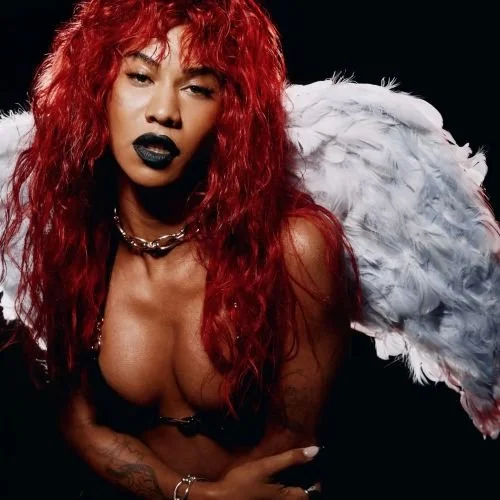
Slim Soledad
__________
I am excited to…
introduce Slim Soledad. This artist is someone I am new to but want everyone else to find and cherish. I did want to start out with DJ Mag and their interview from November 2024. This was a crucial point in Slim Soledad’s career. Perhaps still coming through, you could feel this breakthrough happening. They write how “Brazilian DJ Slim Soledad has become an unstoppable force over the last five years. Her latest EP, ‘Space Manual for Those Who Cannot Swim’, is a testament to how far her sound has come, merging deep beats with futuristic sounds and her “travesti means resistance” narrative”:
“The full potential of Slim’s sound had not been achieved yet. Two things were crucial to its development: the first was creating her own party and collective, and the second was moving to Berlin in 2019. The collective in question is Chernobyl, which came to life when Slim and Brazilian producer and DJ, XD Eric, united two parties — Mil Grau and Baile em Chernoby — into one based on their shared goal of creating a safe space for LGBTQAI+ people in São Paulo. “We wanted a space where queer bodies would be seen,” says Slim, herself a trans woman.
“For me, travesti means resistance. I wear it to remind me of the strength I have, of where I came from. I have been very blessed by all the travestis that have been a part of my life.”
At the time, the baile funk party scene in São Paulo was somewhat coming down from a high. After blowing up at the start of the ’10s, with many events happening for free in the streets, they were getting swept off by city hall-directed gentrification. But the need for them was still there. “I had many friends who worked on the streets. We also had this [Chernobyl] so the girls could have some fun too,” she says. When the party became established as one of the staples of underground electronic music in São Paulo, Slim started to get opportunities elsewhere. In 2019, she was performing as a dancer for Linn da Quebrada at Berlin’s CTM Festival, followed by a small tour with Chernobyl as a DJ.
She says that she returned to Brazil only to say goodbye to her parents and friends. “I fell in love with the city. I just knew there was something for me to do there, even if I had not had any previous ideas of living in Europe,” says Slim. “It all happened organically, and it was all by chance.”
It was in Berlin that Slim Soledad really came into her own as a DJ. The accelerated BPM of the German capital left her dizzy and craving more for her sets. “I used to play everything at 130 BPM. Today, I go for 150 or more — I really think it’s become part of my language, of how I demonstrate what I want to convey to whoever’s on the dancefloor.”
And what is it she wants to convey? “I want you to have the urge to run away, screaming,” she laughs. “That’s my narrative, that’s the sensation I want people to have when they’re listening.” The change of BPM allows the baile funk and techno in her sets to blend in a contrasting way, matching each other’s intensity while going through the full spectrum of smooth and sharp sounds. Slim plays the kinds of sets that are impossible to pull yourself away from — they make you deeply involved. They’re the furthest possible thing from easy listening, but worth every minute.
After the pandemic, the desire to register this profusion of sound in a studio format came about. Since she was a kid, Slim dreamed about going to space — “I feel like it’s going to be possible in a few years” — and also had a strong fear of swimming. Exploring the sounds of the Roland TR-8, she built a narrative that displays all of her desires and fears, starting with these two symbols of the deep, the dark, the unknown: space and the sea.
The result is five hard techno tracks that showcase the depth and intensity of Slim’s sound, not losing one ounce of the edge she acquired between her many experiences and relocations (she’s now based in Paris) . The last track of ‘Space Manual for Those Who Cannot Swim’ is ‘T.E.T.A Intergalactica’, which features Venezuelan visual artist and writer Iki Yos. At the start of the song, you can hear Iki and Slim using the word “travesti”, a once-pejorative word that was reappropriated by Latin American trans women to define their identity. During our interview, Slim is wearing a shirt that has the term emblazoned across it. “For me, travesti means resistance,” she says. “I wear it to remind me of the strength I have, of where I came from. I have been very blessed by all the travestis that have been a part of my life.”
With her debut album planned for release in 2025, we can’t wait to see how Slim Soledad's deeply personal and boundary-pushing sound will evolve next”.
Let’s move to Metal Magazine and their interview from this year. Soleadad talks about her D.J. work and path into music in addition to the dangers of being a queer Black artist. Every interview with her is amazing, and this chat is no exception:
“Berlin-based DJ and producer Slim Soledad, has lived many lives. Scrolling through her Instagram, you can find her in Switzerland, France, Spain, and more. Beyond DJing, she sings and mixes and also has an extensive background in contemporary dance. When she’s not wowing audiences with her energised beats like she did at Primavera Sound’s Boiler Room, she can be found modelling for brands like Burberry or facilitating safe spaces for queer folk across Brazil and Europe.
For those who are not familiar with you or your work, could you tell me a little about yourself?
My name is Slina, aka Slim Soledad, I am an artist working as a DJ, music producer, and performer. I started DJing about 6 years ago when I was still living in São Paulo. Before that, I already was in contact with music because I had studied contemporary dance and, in a certain way, there is a big influence coming from my parents since I was a little girl. I believe I have been diving into the world of music for a long time, and also experienced it in several layers – like producing, mixing, performing, singing – and I want to be able to continue working as an artist, but trusting without the fear of making mistakes and embracing chaos.
You seem to travel a lot for work – in the last few months you've been to Germany, France, Switzerland and Spain, for example. Do your travels influence your sound? What keeps you grounded?
Yes, it does. I've been to many countries (laughs), but my travels influence the sound I create a lot. Every trip I feel like I get some kind of boost and inspiration to keep doing what I'm doing. I think what keeps me grounded is to rest well, eat well, understand the things in my surroundings that make me feel good and discard the things that make me sick and keep doing it because I'm passionate about it.
You are the co-founder of Chernobyl, a collective that creates safe spaces for queer people in Brazil. Since you have been in Berlin, how have you continued this work? Have you found opportunities to create safe spaces for queer folk in the city?
We've been doing parties and events in Brazil, but we slowed down because of some turbulence that one of our members went through, but now we are with the founder of the collective here in Europe. Unfortunately, we only did one edition of an event that was very special in 2020 in Berlin, but we have the idea of planning something out in Paris in the future.
Can you tell us about any future projects of yours? What are you currently working on?
I've been working on a few projects at the moment, both related to dance and music, but other than that, I've been putting energy into some songs that I intend to release early next year. In the meantime, I'll release some surprises that I've been working on over the last few months, which consist of finding more power and noise from the voice to build beats. I'm looking forward to it and I've been doing it with a lot of love and making sure I enjoy every moment and part of the process”.
I do want to end with Mixmag and their chat with Slim Soledad from March. She was preparing to release her debut album, Noches Calientes De La Soledad, a surprise drop that came out on Headroom Records. Speaking in London at an event to mark a decade of the Herrensauna label, we do get this sense of excitement for someone who is embarking on this new chapter:
“Can you tell us about the music scene in São Paulo when you were growing up? What were your formative experiences with dance music in the city?
When I was in my teenage years in São Paulo, I started to have this desire for music and dance. My first parties in Brazil were these big streetside reggae parties, and after my first experience where I danced all night long with my friends, I started discovering more about the nightlife in Brazil. I really had this love for dance – I started to get into the nightlife scene when I was 17 or 18, and I’d go to more in the centre of São Paulo and discover all these underground parties.
What kind of music styles were popular at the time?
There were so many parties on the street, we don’t have those as much anymore except on certain holidays, but there would be all kinds of techno or reggaeton events, because that was really trendy in São Paulo at the time. But it was very mixed, you would even see people from the punk movement come and join those parties.
You mix a lot of Latin American styles like Brazilian funk and bass in your music – since moving to Europe, have you noticed an increased appetite for those styles on this side of the world? How does it differ from back home?
I think so. Everyone's really into Latin sounds now, but there are so many different styles. The stuff that comes here is the more mainstream stuff which is cool as well, but if you go to baile funks in the neighbourhoods of Brazil, you're gonna see that the music is so much more raw, unpolished in production, and so loud. That’s the real beauty of it. There are cars with speakers and DJs playing loads of unreleased music that you’ll probably never hear again. It’s a very unique experience.
You often use your own vocals on your tracks, does it feel liberating to be able to work on music entirely yourself without relying too heavily on samples and other vocalists?
It feels so liberating because I was really shy before and I didn't like to hear my own voice. It takes a little time when you're producing to get used to your own vocals, and I think the lyrics that I wrote I was ashamed to share with other people – I thought the music wasn’t good enough. I decided that I just have to be a little bit more gentle with myself, and if I don't do this for me right now, when am I going to do it? That's why it feels so liberating, because it feels like a page being turned – I'm being much more gentle with myself.
Your debut album ‘Noches Calientes De La Soledad’ is landing in a few days. How are you feeling about it?
I'm so excited. This is actually a gift that I'm giving to my teenage self, especially because of the pressure I was putting on myself about using my own vocals and thinking so much about how people would see me. I'm so proud of myself. I was thinking that it would take so many years to do something like this, you know? So, yeah, I’m super happy.
Can you talk me through some of the themes and ideas on this record? What were you expressing lyrically?
The theme of my new album is ‘hot nights’. All the music is very related to how I have experienced the night, and how a lot of us have the same kind of experiences like coming back from the club alone or being super drunk and not knowing who you're gonna meet. But so much of it is about shame, too – about relationships with other people or talking about drugs openly. I thought that if I said this out loud, people would judge me so bad, and maybe I’m trying to project someone that I really am. I really wanted to show to people this true picture of myself rather than just hiding it, so I think this music is a really good way to communicate what I'm feeling.
You’ve helped to create safe spaces for queer people both back home in Brazil and in Europe with your events while championing LGTBQ+ artists from your home. What inspired you to make this move and forge a community in nightlife?
I always want to have a space where I feel comfortable and where there is no judgment, no sexism, and you can have a relationship with the people around you. Sometimes you just want to hug someone or give a little kiss on the cheek, and feel that everything is alright. Me and my friends wanted to have a space to exercise freedom. I know that we are not free when there are other people in chains, but we can at least try. Just for a few hours, we can feel free and that everything is okay”.
Go and follow the incredible Slim Soledad. I am dropping in some music and D.J. sets to show just what she is about, though I wonder if that can do full justice to her talents. I wonder what the rest of the year holds in store for Soledad. A talent that everyone should know, this internationally acclaimed D.J. and artist is…
A true powerhouse.
__________
Follow Slim Soledad