FEATURE:
Kate Bush: Them Heavy People: The Extraordinary Characters in Her Songs
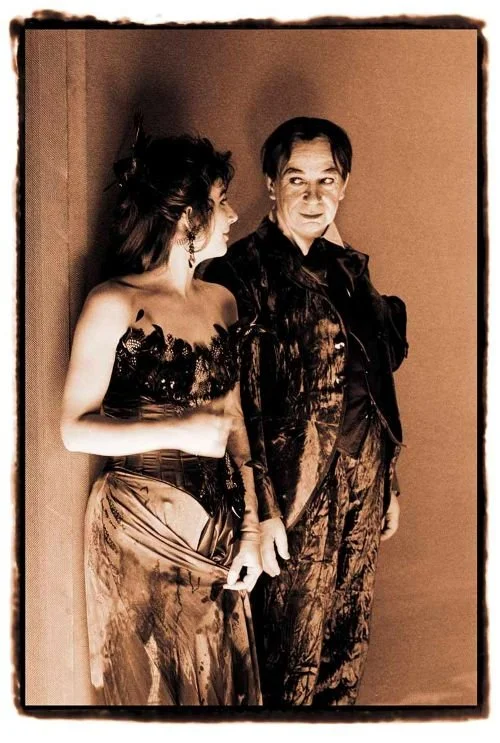
IN THIS PHOTO: Kate Bush and Lindsay Kemp on the set of her 1993 short film, The Line, the Cross and the Curve (which was loosely inspired by the 1948 film, The Red Shoes, which share the title of Bush’s 1993 album)/PHOTO CREDIT: Guido Harari
The Diva (The Red Shoes)/Cathy/Heathcliff (Wuthering Heights)
__________
THIS is the penultimate…
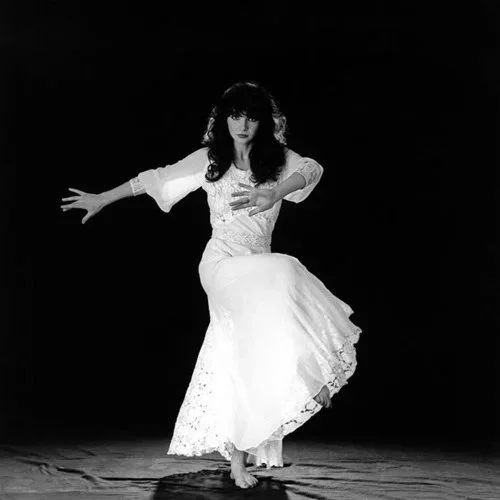
IN THIS PHOTO: Kate Bush in 1978/PHOTO CREDIT: Gered Mankowitz
edition of a series that looks at the amazing characters in Kate Bush’s song. I am featuring one track from The Kick Inside for this edition and another in the final one. This inclusion is the most famous and popular song from her debut album. It is Wuthering Heights and Cathy and Heathcliff. These doomed lovers. The ghost of Cathy at Wuthering Heights, trying to grab Heathcliff’s soul (which is a scene not in the book but a T.V. adaptation she saw), it is one of Kate Bush’s most extraordinary songs. A lot to talk about around this track. I am starting out with The Diva from The Red Shoes’ title track. These are the opening lines from The Red Shoes: “Oh she move like the Diva do/I said “I’d love to dance like you.”/She said “just take off my red shoes/Put them on and your dream’ll come true”. In terms of who this character is, The Diva in the 1948 classic film The Red Shoes is the aspiring ballerina Victoria ‘Vicky’ Page. She was played by the late great Moira Shearer, a renowned Scottish ballet dancer and actress. I will come to a 1993 interview with Kate Bush. I do want to start out with a look at the 1948 film that influenced Kate Bush. It is not unusual for artists to write songs or albums based around a film. Many people will not know about The Red Shoes and its origins. The BFI published an article in 2023 around their exhibition, The Red Shoes: Behind the Mirror. Among the artefacts included are the ballet shoes worn by Moira Shearer:
“Alexander Korda’s original vision for The Red Shoes
Our story starts in 1937. Leading producer Alexander Korda is searching for his next box office success. It will star his future wife, Merle Oberon. Industry rumours start to swirl of a film “derived from an old legend of a girl who wore red shoes which made her dance unceasingly”.
Korda recruits a series of writers to bring his vision to life. Unhappy with each new version of the script, Korda finally abandons the project in 1939, and in the mid-1940s he sells the concept to Powell and Pressburger. They transform the story. Travelling to Andersen’s home in Odense, the writer-directors imagine a film much closer to the passion and violence of its Danish source.
London-based artist Michelle Williams Gamaker has created a new piece for the exhibition, exploring this early genesis of The Red Shoes story. Oberon (2023) responds to a photographic series in the BFI’s collection, taken at around the time that Korda was developing the script for The Red Shoes.
Oberon had a complex relationship with her visual identity in these years. Make-up and lighting were used to mask the physical trauma of a car accident in 1937. These techniques also lightened her skin on camera. Williams Gamaker interprets the script as a love letter from Korda to Oberon, with Korda speaking the lines of Konstantin – an early version of ballet impresario Boris Lermontov – during a fictional make-up test. The artist reflects on the spaces of casting and screen testing beyond the archival photographs, and the relationships that extend behind the camera to the individuals (mostly men) who held Oberon’s career and her image in their power.
A life-changing role for Moira Shearer
Moira Shearer in costume for the 1942 Sadler’s Wells production of The QuestPhotographed by Anthony. Moira Shearer’s ArchiveMoira Shearer’s pink pointe shoes, and note cards from her time at Sadler’s WellsMoira Shearer’s Archive. Photo: Tim Whitby
By 1946, Powell and Pressburger had a clear vision of the story that they wanted to tell, and were ready to start planning The Red Shoes in detail. It would centre on the story of a young woman, Victoria Page, falling in love: with her art form and with a fellow artist. Powell and Pressburger were aware that its success would depend on the creativity of an established performer to occupy this central role.
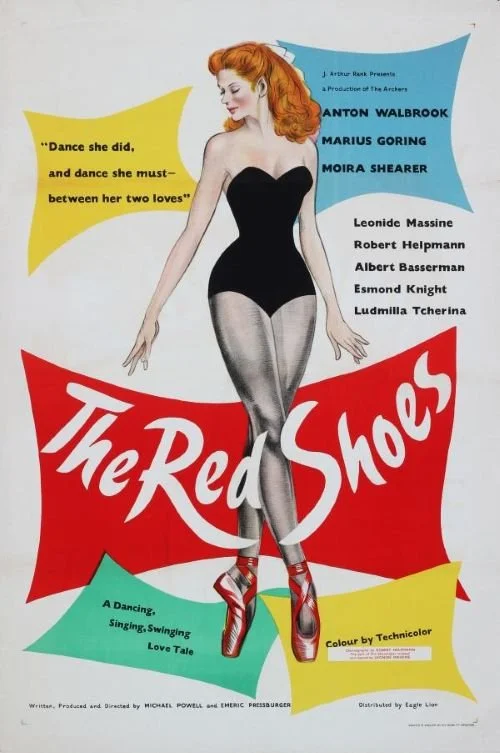
In Powell’s eyes, Scottish-born dancer Moira Shearer was the very embodiment of Page. On the brink of international success as a dancer, she was initially hesitant to step into the world of film and declined the offer a number of times. Powell was insistent – the role belonged to Shearer. It took nearly a year, but the announcement of her acceptance came in 1947.
The role would be both career and life changing for Shearer. She was catapulted almost overnight to global stardom, with a tour of the USA following the film’s box office success. Shearer’s image was used to represent the film internationally, and her burnished auburn hair was associated with the unfettered creativity of the scarlet slippers.
The Red Shoes explores the world of a fictional ballet company – the Ballet Lermontov. During a residency in Monte Carlo, the company’s defining production is ‘The Ballet of the Red Shoes’: a reworking of the Andersen fairytale. Cast in the lead role of ‘The Girl’, Vicky Page finds that art mirrors real life. Her desire for artistic fulfilment is challenged when she finds herself falling in love with composer Julian Craster (Marius Goring) and is asked to make a choice between the part she plays and the life she loves.
The Ballet of the Red Shoes
Within the exhibition we invite you to step over the threshold between a real and imagined world, and into the shoes of Vicky Page. Music, art, light and dance magically combine to transport us, in Powell’s words, “inside the heads of two people who were falling in love”.
The famous ‘Ballet of the Red Shoes’ is presented as a series of ‘scenes’, drawing on the work of designer Hein Heckroth and sketch artist Ivor Beddoes, who, with the help of art director Arthur Lawson, helped to bring Powell and Pressburger’s vision to life. Just as the film is shot out of sequence, carefully pieced together in the editing suite, so too this room of the exhibition is structured thematically, allowing you to fully immerse yourself in the filmmaking process.
The legacy of The Red Shoes
Powell and Pressburger’s totemic red slippers, imbued with a magic that inhabits their wearer, never truly stopped dancing. In interview, Shearer was honest about the mental and physical toll that the production took on her. But just as Vicky returned in the final scenes of The Red Shoes to perform for her company director, so too Shearer seemed unable to resist the possibility of another performance with Powell and Pressburger. She returned in both The Tales of Hoffmann (1951) and in Powell’s Peeping Tom (1960). In Shearer, not only the red shoes, but the Girl, danced on.
When Shearer finally hung up her pointes, the magic of The Red Shoes went on to inspire generations of creative practitioners. In 1993, musician Kate Bush created her studio album The Red Shoes, followed by an extended music video, The Line, the Cross and the Curve. More recently, Matthew Bourne’s production of The Red Shoes (2016) brought together Powell and Pressburger’s story with the music of Bernard Herrmann. Victoria Page was danced by Ashley Shaw. With the support of Bourne’s choreography and Lez Brotherston’s designs, Shaw took on the demanding role to bring the blood-red pointes to life for new audiences”.
The Red Shoes was released as a single and reached twenty-one in the U.K. It is the lead track of the short film, The Line, the Cross and the Curve. Although it premiered at the London Film Festival in November 1993 (around the time of the release of The Red Shoes), it got a wider cinematic release in May 1994. I have said before how The Line, the Cross and the Curve is arguably the first visual album by a female artist. Bush inspired by this classic 1948 film and producing her own version. Bush re-recorded The Red Shoes for 2011’s Director’s Cut. I think I prefer the 1993 original, as there is more energy to it. Beautiful instrumentation. Gaumont d’Oliveira, Paddy Bush and Justin Vali among the musicians who bring alive this fantastic track. Thinking of The Red Shoes, I don’t think that many people know about the 1948 film. Kate Bush was a fan of it and Michael Powell. The two were going to work together on a project shortly before his death (in 1990). He is immortalised in Moments of Pleasure from The Red Shoes. Thinking of The Diva and that mention in The Red Shoes’ title track, I did want to look at the Powell- Pressburger film and its legacy. Another article from the BFI, it is clear that The Red Shoes has a big modern legacy:
“It’s a spectacular rejection of realism
The Red Shoes (1948) followed a tremendous run of films by Michael Powell and Emeric Pressburger. Between 1943 and 1947, they made The Life and Death of Colonel Blimp, A Canterbury Tale, “I Know Where I’m Going!”, A Matter of Life and Death and Black Narcissus. For their next trick, they took a decisive step away from the tendency towards realism in postwar cinema, pushing the emotional expressiveness of Technicolor photography yet further, in collaboration with genius cinematographer Jack Cardiff.
Pressburger had originally worked on the idea for the film before the war. Producer Alexander Korda had hired him to write a script that combined the story of the dancer Nijinsky, and his time at Sergei Diaghilev’s Ballet Russes, with the Hans Christian Anderson fairytale about enchanted shoes that force the wearer to dance on and on until death. He’d also instructed Pressburger to write a role for Merle Oberon, but as that passion cooled, so did the producer’s interest in the film.
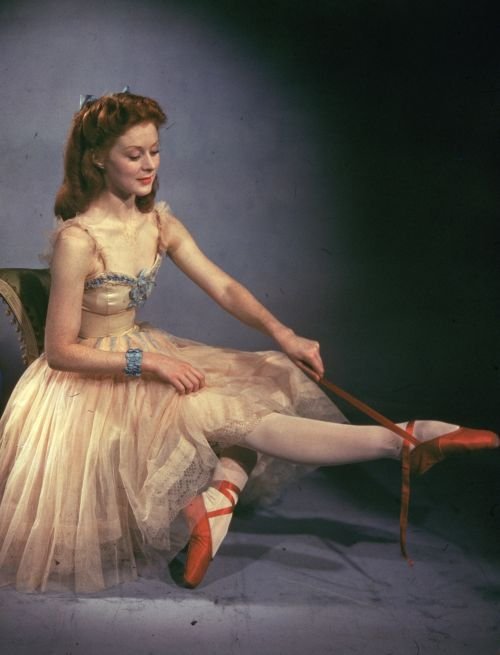
IN THIS PHOTO: Moira Stewart (who played Victoria Page) in The Red Shoes/PHOTO CREDIT: Hulton Deutsch
It’s about the agony of artistic expression
Lermontov chides Vicky: “Don’t forget, a great impression of simplicity can only be achieved by great agony of body and spirit.” Few films reveal, either as cruelly or as eloquently as this one, the sacrifices that artists make. We see more bruising rehearsals than standing ovations, and yet, the Ballet Lermontov dances on.
Page’s final, anguished choice between love and art only makes tangible the decision that Lermontov clearly made long ago. Walbrook, who plays him so brilliantly, was gay, as was Diaghilev. Lermontov knows nothing of Page’s “charms” and cares less, he says; his “family” is his company, and he asserts that: “The dancer who relies on the comforts of human love will never be a great dancer. Never!”
As certain critics have noted, there is a striking gay subtext to The Red Shoes, but it is a tragic one – Lermontov is a lonely figure whose obsessive nature demonstrates the danger of living for art rather than love.
From Scorsese to La La Land, its influence lives on
The Red Shoes is one of the most widely influential movies of all time. Regularly hailed as a favourite in critics’ polls and by directors including Martin Scorsese (“It’s one of the true miracles of film history”), Francis Ford Coppola, Steven Spielberg and Brian De Palma, it has also been reworked by artists outside the cinema. Kate Bush’s 1993 album The Red Shoes was inspired by the film, for example. Coming full circle, Matthew Bourne choreographed the film as a ballet at Sadler’s Wells in 2017.
The film also has an afterlife in the classic Hollywood musical. Gene Kelly screened the film multiple times for the producers of An American in Paris (1951), as he persuaded them to let him include a ballet sequence in the film. He did, and in the following year’s Singin’ in the Rain too. The popularity of the ballet sequence as a genre trope was underlined when Damien Chazelle included one in his pastiche La La Land (2016).
There are several, pointed, references to the film in a very different musical, the 1985 Broadway adaptation A Chorus Line. That’s not a direct cinematic influence but rather a testament to the film’s impact on generations of girls. The book for that musical was based on interviews with New York dancers, several of whom confided that The Red Shoes inspired their choice of career.
In a 1970 interview with the New York Times, Shearer expressed a little self-deprecating regret on this score: “I’m a bit embarrassed whenever I hear how many girls were influenced by it. The dancing in it wasn’t terribly good”.
Prior to moving to the second part of this feature, I do want to source a 1993 interview with Kate Bush. The Red Shoes arrived at a difficult time. When there was this balancing of personal loss and change. Her mother died in 1992. Her long-term relationship with Del Palmer ended, and she faced her first real creative and commercial slump. The Red Shoes’ production quite plasticky and compacted. Bush wanted to reapproach some of the songs from the 1993 album in 2011. Give the songs more space. 1993 was a pivotal year. She id pack quite a lot in, though her next album would not arrive until 2005. That is when Aerial was released. Nick Coleman interviewed Kate Bush for Time Out in November 1993. I did want to highlight the section where we get mention of The Red Shoes film:
“She pours tea and places herself on the edge of her chair. She is small, not minute, and erect. One booted leg crosses the other and bumps gently up and down. She cocks her head and waits. She is courteous, cool and suspicious.
My friend Catherine has never opened any post addressed to Kate Bush. There was, however, a letter that came addressed merely to 'Catherine '. So Catherine opened it. Inside was a lot of stream-of-consciousness stuff about dreams, and about how the writer was watching Catherine. So Catherine snorted, noted the postmark and forgot about it. Then another letter arrived, identically addressed, from the same postal region; then another, and another, each of them increasingly weird and disturbing. Sometimes three would arrive in a day. And it so happened that on the day that Catherine decided to go to the police, a letter arrived that included a reference to Catherine's poetry and music, neither of which are big with Catherine. Also, the letter included the appellation Kate.'
'It's so nice to talk about my work for once,' she says. By this she means she's glad we've started by talking about the great film director Michael Powell and his influence on her, which is signally manifest in the title track of her new album 'The Red Shoes'.
'The Red Shoes' is a ballet film made by Powell and Emeric Pressburger in 1948, telling the story of a dancer who is torn between the demands of a great impresario, who can help her to become an artist of destiny, and those of her composer/husband, who can bring her happiness. The story elides an old fairy tale and a take on the power struggle that raged between the dancer Nijinsky and Diaghilev, first director of the Ballet Russe. Bush says the song evolved out of a feeling she had one day at the piano of music running away with itself. The image in her mind 'was like horses galloping and running away, with the horses turned into running feet, and then shoes galloping away with themselves'. Which corresponded, conveniently enough, with the key fairy-tale element in the Powell film: the red pumps worn by the tragic ballerina, which are imbued with a magic that carries their wearer off in a terrible outpouring of expressiveness.
Bush contacted Powell shortly before he died, 'to see whether he'd be interested in working with me. He was the most charming man, so charming. He wanted to hear my music, so I sent him some cassettes and we exchanged letters occasionally, and I got a chance to meet him not so long before he died. He left a really strong impression on me, as much as a person as for his work. He was just one of those very special spirits, almost magical in a way. Left me with a big influence.'
Which makes some kind of sense. Powell's super-rich three-strip Technicolor, his English-ness, his 'expressiveness', his interest in the shadows cast by daylight; even, you could argue, his thematic preoccupation with islands, solitary souls and the unconfined spirit; these are some of Bush's favourite things.
'His work is just so... so beautiful,' says Kate, in her tiniest voice.
Meaning what, exactly?
'Well, there's such heart in his films. The way he portrayed women... that was particularly good and very interesting. His women are strong and they're treated as people...'
That's one kind of beauty.
'The heart, I think, is the main beauty. This human quality he has. Although there's clever shots in his films, they're not really used for effect, to be clever. They're used for an emotional effect. I'd call that a human quality. Like vulnerability. Also, I like the emotional qualities of the characters. I suppose in one way they're very English ...'
To combine her interest in Powell with her lust for new directions, and perhaps to solve one or two promotional problems, Bush has directed a 40-minute film interpreting six songs from the excellent 'Red Shoes' album. It will be premiered at the London Film Festival.
'I'll be very interested to see what people make of it. To see whether they regard it as a long promo video or as a short film,' she says.
Where do your stories come from?
'Oh, all kinds of sources but generally they come down to people. People's ideas or works. Films, books, they all lead back to someone else's ideas, which in turn lead back to someone's else's ideas...'
I've always assumed you must be a bit of an Angela Carter fan.
'Um, no. I don't think I know her stuff.'
She wrote 'Company Of Wolves' and was big, I believe, on pomegranates, the predatory nature of nature, the heat of female sexuality; that sort of thing.
'Oh, yes.' Bush smiles, and her dimple disappears.
Other post addressed to Kate Bush arrived which went unopened. Then one day a letter came for the attention of Catherine Earnshaw. This being ambiguous, Catherine opened it just to make sure. Inside was a note from a Harley Street doctor indicating that Catherine was fit as a fiddle. This was good news. Unfortunately, Catherine had not been to see a Harley Street doctor. She hastily sent the letter on to Bush's record company, blushing at her daftness in not remembering immediately that Catherine Earnshaw is the name of the storm-tossed tragic heroine of 'Wuthering Heights '.
You're 35 and you've been doing this since you were a teenager. How have you changed?
'I think I've changed quite a lot. Essentially I'm still the same person but I suppose I've grown up a lot, and learned a lot.'
What's made you grow up the most?
'You get lots of disappointments. I'm not sure that they make you grow up but they make you question intentions.' She pauses. 'But life is what makes you grow up’”.
From a song on an album influenced by a 1948 film, we now move to a stunning single influenced by a 1847 novel. This is another case of Kate Bush being inspired by the screen. I feel her love of The Red Shoes was centred around the 1948 film. Bush did reads Emily Brontë’s only novel. There is quite a bit to unpack when it comes to this song. There has been a lot of recent interest around Wuthering Heights as Emerald Fennell’s film, “Wuthering Heights”, was released earlier in the year. Starring Margot Robbie as Catherine Earnshaw and Jacob Elordi as Heathcliff, it did divide critics. It is not exactly true to the novel in terms of its casting and feel. It is a retelling or reimagining. In the same way Bush was inspired by the last few minutes of a 1967 BBC adaptation of the novel when it came to writing the song, I have reengaged myself with Emily Brontë’s novel because of the 2026 film. One of the most pleasing aspects of the film is how there has been interest in Kate Bush’s number one single. I did want to start out with an article from The New Yorker. They write about the “timeless provocation” of this incredible text. Although there has been some controversy around Emerald Fennell’s film, “Emily Brontë’s ruthless text will always have the last word”:
“If Victorian fiction ordinarily treats the orphan as an engine of social mobility, whose path involves finding his place in the world, “Wuthering Heights” asserts that any such progress is temporary. At the end, Heathcliff stands alone and “unredeemed,” as Charlotte Brontë wrote of him in 1850. He destroys all his relationships, such that he can’t think of how to write his will and bequeath all the property he’s spent his life vengefully acquiring. Emily Brontë, instead, writes him out of it altogether. He has nothing to show for all of his actions. His sole biological heir predeceases him, and, once he has gone, the two homes in question, Wuthering Heights and Thrushcross Grange, will pass to Hareton and young Catherine, who continue the Earnshaw family lineage. By the standards of the Victorian novel, Heathcliff, who leaves neither descendants nor legacy behind him, is a dead end.
In this way, Brontë demonstrates that not all trauma has a resolution, that belonging is a gift that not even the most powerful of novelists can readily bestow. She does not tame, contain, or tidy Heathcliff’s wild energy. It shapes his outlook even in death. When Nelly, the Earnshaw family’s longtime servant, finds his body, his eyes are wide open, with a stare both “keen and fierce.” She says, “I tried to close his eyes: to extinguish, if possible, that frightful, life-like gaze of exultation, before any one else beheld it. They would not shut.” His tombstone reminds us one last time of how little we know him. “As he had no surname, and we could not tell his age,” Nelly says, “we were obliged to content ourselves with the single word, ‘Heathcliff.’ ”
Whenever a fuss arises over the adaptation of a literary text to screen, I think of what James M. Cain told an interviewer for The Paris Review who asked him what he thought of the film that Billy Wilder and Raymond Chandler made of his novel “ Double Indemnity.” Their version made significant changes to the plot. Cain replied that he didn’t like movies. “I don’t go,” he said. “People tell me, don’t you care what they’ve done to your book? I tell them, they haven’t done anything to my book. It’s right there on the shelf.”
“Double Indemnity” ’s plot was reworked, in part, to sanitize the story for screen audiences. The Hays Code, a precursor to the motion-picture rating system that gave Fennell’s “Wuthering Heights” an R for its depictions of violence, sex, and death, required that Hollywood movies eschew profanity, obscenity, and other indicators of low morals, and also stipulated that “the sympathy of the audience shall never be thrown to the side of crime, wrongdoing, evil, or sin.” Among other potential issues, in Cain’s ending, the lovers who commit the insurance fraud at the center of the story escape the country, with plans for a double suicide. The film closes, instead, with a confession scene.
It’s hard these days to imagine a situation in which, through a self-imposed agreement among all the major studios, movies and television series would need to be tamer than their source material specifically so as not to corrupt the audience. If anything, in our visual culture, we tend to expect—indeed, anticipate—the opposite. But the impulse behind the Hays Code aligns with a truism of nineteenth-century fiction that its successful writers well knew: that characters who transgress within the pages of a novel could not be allowed to prosper without punishment. It doesn’t take a literary scholar to notice, for example, that adulterous women in nineteenth-century novels—English, French, Russian—meet tragic ends, no matter how sympathetically or charismatically their creators portray them. Even the men must square their accounts. In “Jane Eyre,” Mr. Rochester, Jane’s employer at Thornfield Hall, where she goes to work as a governess, fails in his initial attempt to marry her when the existence of his first wife, Bertha, locked up in the attic, is revealed. He gets Jane in the end, but only after being maimed and partially blinded in a fire set by Bertha, in which she perishes. It’s not exactly an eye for an eye, but it reflects the belief that actions have moral consequences.
“Wuthering Heights” abides by that convention. Heathcliff and Cathy both must suffer and die, lest readers make the mistake of believing it’s acceptable to profess undying love for your childhood companion while you’re seven months pregnant and married to another man (as Cathy does) or to try to kill your wife’s dog (as Heathcliff does), to name but two of their many offenses. The placid romance of Hareton and young Catherine leaves us, superficially, in a peaceful, even hopeful place.
But it is Heathcliff’s passionate declarations and shocking acts that stay in the mind and color our lasting impression of “Wuthering Heights” as strange and uncontainable. They will outlive the blood-red, entertaining raunch of Fennell’s movie, too, in spite of the recency bias that kicks in when we’re confronted with contemporary interpretations of classics. It’s humbling to admit that an isolated nineteenth-century Yorkshirewoman, of whom her sister wrote that “she had scarcely more practical knowledge of the peasantry amongst whom she lived, than a nun has of the country people who sometimes pass her convent gates,” could possibly harbor thoughts as wild or knowing or kinky as we do now. But Brontë’s novel easily checks the first and third of those R-rated boxes. (As for the second, we can make our own assumptions.)”.
I do love how Margot Robbie recreated the dance of Wuthering Heights when she was on the set of the film. This song has enjoyed an interesting life. Noel Fielding performed a version of the song for Let's Dance for Comic Relief in 2009. Prior to ending with a BBC feature about Kate Bush’s Wuthering Heights, I did want to come to the Kate Bush Encyclopedia and their information about Wuthering Heights. We also get some interview archive where Bush discussed writing this timeless debut single:
“The release date for the single was initially scheduled to be 4 November 1977. However, Bush was unhappy with the picture being used for the single’s cover and insisted it be replaced. Some copies of the single had already been sent out to radio stations, but EMI relented and put back the single’s launch until the New Year. Ultimately, this proved to be a wise choice, as the earlier release would have had to compete with Wings’ latest release, ‘Mull of Kintyre’, which became the biggest-selling single in UK history up to this point in December 1977.
‘Wuthering Heights’ was finally released on 20 January 1978, was immediately playlisted by Capital Radio and entered their chart at no. 39 on 27 January. It crept into the national Top 50 in week ending 11 February at No.42. The following week it rose to No.27 and Bush made her first appearance on Top of the Pops (“It was like watching myself die”, recalls Bush), The song was finally added to Radio One’s playlist the following week and became one of the most played records on radio. When the song reached number 1, it was the first UK number 1 written and performed by a female artist
“I wrote in my flat, sitting at the upright piano one night in March at about midnight. There was a full moon and the curtains were open, and every time I looked up for ideas, I looked at the moon. Actually, it came quite easily. I couldn’t seem to get out of the chorus – it had a really circular feel to it, which is why it repeats. I had originally written something more complicated, but I couldn’t link it up, so I kept the first bit and repeated it. I was really pleased, because it was the first song I had written for a while, as I’d been busy rehearsing with the KT Band.
I felt a particular want to write it, and had wanted to write it for quite a while. I remember my brother John talking about the story, but I couldn’t relate to it enough. So I borrowed the book and read a few pages, picking out a few lines. So I actually wrote the song before I had read the book right through. The name Cathy helped, and made it easier to project my own feelings of want for someone so much that you hate them. I could understand how Cathy felt.
It’s funny, but I heard a radio programme about a woman who was writing a book in Old English, and she found she was using words she didn’t know, but when she looked them up she found they were correct. A similar thing happened with ‘Wuthering Heights’: I put lines in the song that I found in the book when I read it later.
I’ve never been to Wuthering Heights, the place, though I would like to, and someone sent me a photo of where it’s supposed to be.
One thing that really pleases me is the amount of positive feedback I’ve had from the song, though I’ve heard that the Bronte Society think it’s a disgrace. A lot of people have read the book because of the song and liked it, which I think is the best thing about it for me. I didn’t know the book would be on the GCE syllabus in the year I had the hit, but lots of people have written to say how the song helped them. I’m really happy about that.
There are a couple of synchronicities involved with the song. When Emily Bronte wrote the book she was in the terminal stages of consumption, and I had a bad cold when I wrote the song. Also, when I was in Canada I found out that Lindsay Kemp, my dance teacher, was in town, only ten minutes away by car, so I went to see him. When I came back I had this urge to switch on the TV – it was about one in the morning – because I knew the film of Wuthering Heights would be on. I tuned in to a thirties gangster film, then flicked through the channels, playing channel roulette, until I found it. I came in at the moment Cathy was dying, so that’s all I saw of the film. It was an amazing coincidence.
Kate Bush Club Newsletter, January 1979”.
Kate Bush did say in another 1978 interview how “This young girl in an era when the female role was so inferior and she was coming out with this passionate, heavy stuff. Great subject matter for a song”. I do think that there is a lot more to be said about Wuthering Heights (the novel) and its legacy in the present day. Following a new adaptation of the novel and Kate Bush’s 1978 single, I do think that more should be written. I am ending with the BBC and their article from last year. They tell the story behind this extraordinary and powerful debut single from Kate Bush:
“Well, I hadn't read the book, that wasn't what inspired it. It was a television series they had years ago," she told Michael Aspel in a BBC interview in 1978. As a teenager she had come across the end of an episode of a 1967 BBC adaptation of Brontë's tale of doomed love. Its startling imagery had captivated her. "I just managed to catch the very last few minutes where there was a hand coming through the window and blood everywhere and glass. And I just didn't know what was going on and someone explained the story."
Bush was just 19 years old when the single was released. Although she may have seemed precocious to the public, she had been writing songs for years. Born in July 1958, the youngest of three children, she grew up in an artistic household in Kent, England. Her father, a doctor, and her mother, a nurse, surrounded their children with music, and encouraged them to learn instruments from an early age. Both of her older brothers were heavily involved in music and poetry, and she would join them performing Irish and English folk songs at home. "My brothers are very musical, yes. They were really responsible for turning me onto it in the first place. They were always playing music when I was a kid," she told Aspel.
Bush began to compose her own songs in her early teens, recording them on homemade demo tapes. One of these tapes found its way via a family friend into the hands of Pink Floyd guitarist David Gilmour, who recognised the promise in her songwriting and was particularly taken with the otherworldly quality of her voice. "I was intrigued by this strange voice," he told BBC podcast Profile in 2022. "I went to her house, met her parents down in Kent, and she played me, God, it must have been 40 or 50 songs."
Gilmour re-recorded three of Bush's songs with her in his studio for a new demo, and then encouraged Pink Floyd's record label, EMI, to sign her at the age of 16. As Bush was still at school, she spent the first two years of her contract continuing with her studies, while using the record company's advance to enrol in interpretive dance classes with mime artist and choreographer Lindsay Kemp, who had previously taught a young David Bowie.
In History
"I've definitely been influenced by Lindsay Kemp because he's one of my heroes and he was my teacher for a while," she told Aspel. "Marcel Marceau, I admire his stuff, but it is a little too staid for me. It's the art of illusion. It's not really the actual showing of emotion, which is what Lindsay teaches, and for me that's perfect because that's what music in any form of art is about. It's emotion, it's from inside."
At the same time, she was also honing her musical craft. She formed a group called the KT Bush Band and began playing in London pubs while working on songs for her debut album, The Kick Inside. The singer told the BBC that she tended to compose these songs late in the evening. "It seems to be the time of day that things gather, you know. I wake up about 11pm, I'm sort of sleepy all day, then at 11pm I really wake up." One night when she was 18, she sat down at the piano to write a song from the perspective of Brontë's passionate, conflicted heroine, Catherine Earnshaw, who haunts her lover Heathcliff, both during her life and after she dies. The imagery from the Wuthering Heights TV adaptation "was just hanging around for years", she said, "so I read the book in order to get the research right".
New influences and new technologies
The song's lyrics evoke Catherine's obsessive longing for Heathcliff, her mercurial nature, and the couple's charged, destructive relationship. Bush also wanted to convey Catherine's ghostly presence, so she adopted high-pitched, keening vocals to give the song an eerie, haunting air. "It was really specifically for that song, it was that high because of the subject matter," she said. "I'm playing Cathy and she was a spirit, and it needed some kind of ethereal effect, and it seemed to be the best way to do it, to get a high register."
Wuthering Heights, with its lush, sweeping orchestration, its literary sensibilities, and Bush's soaring theatrical delivery, did not strike her record company as an obvious radio hit. EMI instead wanted the rockier sounding James and the Cold Gun, a favourite from her KT Bush Band's pub set, to be the first single from the album. But Bush was adamant that Wuthering Heights should be her debut – and EMI eventually relented.
To accompany its release, two music videos were filmed. One was studio-based and the other was shot outside, with Salisbury Plain in Wiltshire, England, standing in for the novel's windswept Yorkshire moors. For the shoots, Bush used the interpretive dance instruction she had received to mesmerising effect. Both videos feature her gazing intensely at the camera, clad in floaty dresses while performing dramatic and emotive dance movements to express the spectral essence of Cathy. Her dance routine was so distinctive that it became something of a cultural touchstone, inspiring both comedic homages and an annual event called The Most Wuthering Heights Day Ever, at which Bush devotees recreate her performance from the videos.
The single would prove to be her breakthrough. Within three weeks of being released, it had reached number one, getting a boost from Bush's arresting mime-style performance on the BBC's music chart show, Top of the Pops. It knocked Abba's Take a Chance on Me off the UK singles chart's top spot, and stayed there for a month. It also topped the charts in Ireland, Italy, New Zealand and Australia. Her album, The Kick Inside, when it was released the following month, sold more than one million copies. She would go on to collect an Ivor Novello award in 1979 for The Man with The Child in His Eyes, released as her second single from the album.
Wuthering Heights marked the start of Bush's innovative, critically acclaimed and shape-shifting musical career. She has now released a total of 10 studio albums, melding diverse influences, complex musical storytelling and new technologies, such as sampling, to spawn hit singles like Hounds of Love and Babooshka. She has also collaborated with artists including Prince and Elton John. Her duet with Peter Gabriel, Don't Give Up, would pick up another Ivor Novello award in 1987”.
In 2028, we mark fifty years of Wuthering Heights. Still perhaps the most singular and extraordinary debut single ever. There are songs where Bush brought in literary characters. I think Wuthering Heights is one of her most powerful examples. How it was an adaptation of the novel that led her to write this song. How she would then read the text after writing the track. Bush had to perform the song multiple times. On Top of the Pops several times. Around Europe. During The Tour of Life. It must have been quite exhausting, though there was such a demand for this song. Testament to the good sense of the record buying public in 1978 that they sent it to number one. I think the song resonates because of how Bush represents Cathy. Casting her as this possessed and somewhat horrible spirit. The two videos that were shot for the single. I will always favour the white dress version. In the final part of this series, I am going to unique The Dreaming’s Houdini and The Kick Inside’s Them Heavy People. From The Diva who we can draw to the 1948 film, The Red Shoes, which influenced Kate Bush’s seventh studio album of the same name, she then created a version of that film for her own short film. We then move to a 1967 adaption of an 1847 novel that influenced a 1978 song. So many different years and time periods that connect together. How Kate Bush was drawing guidance from films and T.V. Fascinating and fantastic characters to investigate for this part. I am sort of sad to be ending this run very soon. However, it has been great looking inside Kate Bush’s songs and the vast array of characters. It goes to show what an imaginative writer she is. No doubt that Kate Bush is…
A songwriting genius.