
FEATURE:
Kate Bush: Them Heavy People: The Extraordinary Characters in Her Songs

IN THIS PHOTO: Kate Bush photographed in Advision Studio, London in April 1982, where she recorded and produced some of The Dreaming/PHOTO CREDIT: George Bodnar Archive/IconicPix
Houdini/Rosabelle (Houdini)/Gurdjieff/Jesu (Them Heavy People)
__________
I am quite sad…
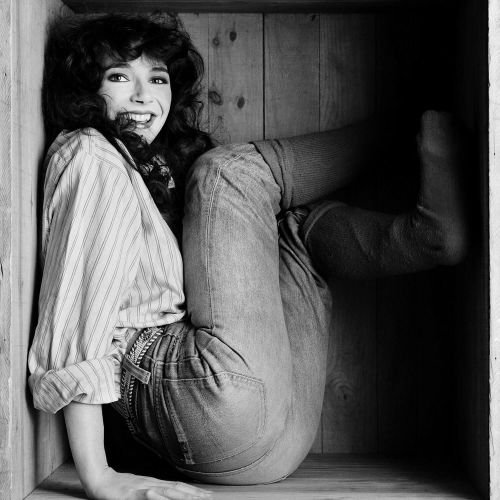
IN THIS PHOTO: Kate Bush in 1978/PHOTO CREDIT: Gered Mankowitz
that this is the final edition of this feature. I feel I have exhausted all characters in Kate Bush songs. Though I am finishing strong! I am ending with the song that inspired the title of this series. Them Heavy People is from Kate Bush’s debut album, The Kick Inside (1978). In it, she mentions teachers and philosophers who opened her mind. Those who were rolling the ball to her. I will write more succinctly and fully about this track soon. Before that, I am featuring characters from my favourite Kate Bush song. Houdini is the penultimate track from 1982’s The Dreaming. In terms of its concept and inspiration, I do feel that Houdini and Rosabelle represent sides of Kate Bush. In terms of an escape. Her casting herself perhaps as someone trapped or locked in who was taking risks and was trying to pull off this spectacle. Maybe that is me overreaching, though the final song on The Dreaming, Get Out of My House, seems autobiographical. Even though it was influenced by Stephen King’s The Shining, that idea of Bush wailing and screaming out. What you hear on the song. The paranoia and anger. I do look at Houidini and feel it is a personal revelation. Though this is a track influenced by real people. There is a bit of a cheat, as the unnamed character in the song is Houdini’s wife, Bess. Rosabelle was not a person; it was the name of a popular 1800s song and the secret code-word used by the famous escape artist Harry Houdini and his wife, Bess Houdini. Rosabelle, Sweet Rosabelle was a romantic ballad Bess used to sing in her vaudeville act when the couple first fell in love at Coney Island in the late-1890s. However, I am going to mention Bess when writing about this track. I will discuss Kate Bush and how she transformed and prepared for this track.
In reading the inspiration behind it, it brings to mind subjects that I want to explore first of all. The Kate Bush Encycloppedia provide us with interview archive. I wanted to drop in these words from Kate Bush, as it is very eye-opening and interesting what she says. Why she chose to write Houdini:
“The side most people know of Houdini is that of the escapologist, but he spent many years of his life exposing mediums and seances as frauds. His mother had died, and in trying to make contact through such spiritual people, he realized how much pain was being inflicted on people already in sorrow, people who would part with money just for the chance of a few words from a past loved one. I feel he must have believed in the possibility of contact after death, and perhaps in his own way, by weeding out the frauds, he hoped to find just one that could not be proven to be a fake. He and his wife made a decision that if one of them should die and try to make contact, the other would know it was truly them through a code that only the two of them knew.
His wife would often help him with his escapes. Before he was bound up and sealed away inside a tank or some dark box, she would give him a parting kiss, and as their lips met, she would pass him the key which he would later use to unlock the padlocks that chained him. After he died, Mrs. Houdini did visit many mediums, and tried to make contact for years, with no luck – until one day a medium called Mr. Ford informed her that Houdini had come through. She visited him and he told her that he had a message for her from Houdini, and he spoke the only words that meant for her the proof of her husband’s presence. She was so convinced that she released an official statement to the fact that he had made contact with her through the medium, Ford.
It is such a beautiful and strange story that I thought I had very little to do, other than tell it like it was. But in fact it proved to be the most difficult lyric of all the songs and the most emotionally demanding. I was so aware of trying to do justice to the beauty of the subject, and trying to understand what it must have been like to have been in love with such an extraordinary man, and to have been loved by him. I worked for two or three nights just to find one line that was right. There were so many alternatives, but only a few were right for the song. Gradually it grew and began to piece together, and I found myself wrapped up in the feelings of the song – almost pining for Houdini. Singing the lead vocal was a matter of conjuring up that feeling again and as the clock whirrs and the song flashes back in time to when she watched him through the glass, he’s on the other side under water, and she hangs on to his every breath. We both wait.
It goes to show that Kate Bush thinks like no other songwriter, and yet she has inspired so many. I think about a song like Houdini and I also can see the impact today. I have compared Charli xcx to Kate Bush. I know that she is a big fan of Kate Bush. Songs like Houdini seem like something Charli xcx would have written if she were alive in 1982. You can hear some of her more modern stuff and trace it to tracks like this. Kate Bush is someone who has a very open mind. She has said before how she believes in ghosts, and I feel like she is open to the idea of reincarnation and Heaven. Not devout, she has said how her going into music was a mission from God. She believes in unknown creatures or figures like a Yeti. You feel she puts some faith and trust in astrology. Though I cannot share many of those beliefs – especially astrology -, I do like how this open-mindedness works creatively. It opens her palette and makes her sphere much wider. Going beyond the normal and human. Discussing a medium or person who was a fraudster. I don’t think it is controversial to say mediums are fraudsters. They have not and cannot communicate with the dead. They pick up cues and make vague guesses and assumptions. Though people believe them and there is this belief from some. I do wonder how Bush feels about mediums and those who feel they can communicate with spirits. The idea of seances and mediums. Being twisted and adapted and going into this song. We cannot forget Bess. Though I have not mentioned her by name, she is really the one Kate Bush is casting herself as. Passing Houdini a key with a kiss. Houdini, I imagine, played by the late Del Palmer. They were dating at the time, and he is on the cover of The Dreaming. The idea of Bush passing Palmer a key with a kiss. In the song, Del Palmer can be heard saying “Rosabelle, believe”. Bess or Beatrice to give her her full name, is a fascinating human. This article gives us more information:
“Beatrice or Bess Houdini was born Wilhelmina Beatrice Rahner on January 23, 1876, in Brooklyn, New York. Like her famous husband, Bess came from a large German speaking immigrant family and was bitten by the showbiz bug in her teens.
Bess was working at Coney Island in a song and dance act called The Floral Sisters when she was first courted by Houdini's younger brother, Dash (aka Theo Hardeen). But it was the older Houdini brother, Harry, that she fell in love with and married on June 22, 1894.
Bess and Harry worked as The Houdinis for several years before Houdini hit it big as The Handcuff King. But he and Bess continued to occasionally perform the Metamorphosis. Bess also looked after their menagerie of pets, collected dolls, and made the costumes for Houdini's full evening show. She also said it was her duty to make sure her absent-minded husband was dressed well and had clean ears.
By all accounts, Bessie was strong-willed and very spirited. While her husband was a teetotaler, Bess enjoyed drinking and she also smoked. Following Houdini's death in 1926, Bess struggled with money, alcohol, and was the target of unethical spiritualists and journalists out to exploit her. She twice attempted suicide.
In 1930 Bess met Edward Saint who became her companion and manager (and some say secret husband). Together they moved to Hollywood where they held a Final Houdini Seance atop the roof of the Hollywood Knickerbocker Hotel. Bess also helped form the MagiGals, a group of female magicians and enthusiasts which included Gerri Larsen, the mother of Magic Castle co-founders Bill and Milt Larsen. In 1938 she appeared as herself in the film Religious Racketeers .
Bess remained a much loved and respected fixture at magic conventions until her death on February 11, 1943 aboard a train in Needles, California. She is buried in Gate of Heaven Cemetery in Hawthorne, NY”.
I lead on to discussing Harry Houdini. Why he is someone who would have resonated with Kate Bush. Again, I see him in her. Bush feeling she needed to escape or was almost in a position where she was trying to fool the public. Though we have to talk about Bush preparing for this track and the sonic leaps from Never for Ever (1980). The final two songs on The Dreaming are the biggest examples of an artist evolving and changing. Again, I come back to someone like Charli xcx. Listen to songs on Never for Ever and Bush’s vocals. Breathing is indication of a rawness she would display on The Dreaming, though I feel The Dreaming is a more masculine and raw album. Get Out of My House is Bush at her most primal to that point. Though you can hear something almost demonic in her voice on Houdini! Going from soft and sweet to this guttural growl, she achieved this by drinking milk and eating chocolate. That gives the song this mucus. It is not wise for singer to do this! However, as a sole producer on The Dreaming, Bush was not having to listen to others. She could take her music and voice deeper. No boundaries or barriers. Less commercial than anything she has ever recorded, Houdini is truer to her vision of her being an artist rather than a Pop singer. I do feel Houdini is among her best songs. It is my favourite because of the subject matter and how phenomenal Bush sounds. Those beautiful strings written and arranged by Dave Lawson and Andrew Powell (who produced The Kick Inside and Lionheart). By the end of The Dreaming, it was clear this artist was vastly different to the one who debuted in 1978! Hounds of Love would arrive three years after The Dreaming. Though not as dark and heavy as The Dreaming, Bush’s voice and composition had this more masculine or deep quality. That would shift again for 1989’s The Sensual World. However, Houdini is this staggering example of Bush writing about something other artists would not even consider. Also, her performance on the song is among the most spectacular in music history. I read some of the lyrics as this being about Kate Bush and EMI. That relationship at the time: “He’s using code that only you and I know/This is no trick of his/This is your magic”, about the unusualness of her music and this idea of ‘fitting in’. “I’d catch the cues/Watching you/Hoping you’d do something wrong” perhaps about this idea people wanted her to fail, or she was trying to perform this trick for the public. “Everybody thinks you’ll never make it/But every time/You escape: ‘Rosabel believe/Not even eternity/Can hold Houdini!’. I do sort of read between lines!
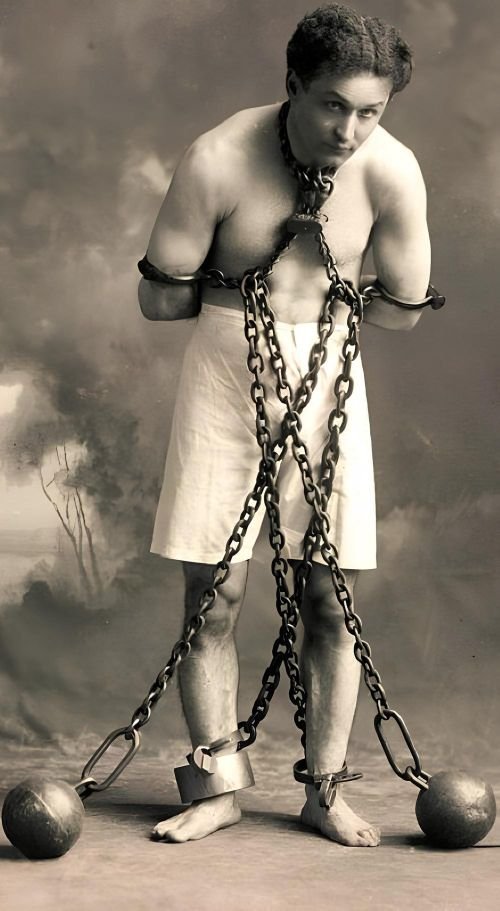
IN THIS PHOTO: Harry Houdini in chains, circa 1900/PHOTO CREDIT: Look and Learn/Bridgeman Images
Let’s end with the man in question. Harry Houdini was born Erik Weisz in Budapest, Hungary. When he was four years old, his family emigrated to the United States and settled in Appleton, Wisconsin. Learning about his extraordinary life and mysterious death makes him this perfect Kate Bush character. National Geographic looked at Harry Houdini’s wild life and his mysterious death in a compelling feature:
“Houdini’s talent for escape was matched only by his knack for self-promotion. The era loved a daredevil, and Houdini was the ultimate American success story. He was an early adopter of corporate sponsorships—for example, inviting beer companies to manufacture the barrels he’d escape from for cross-promotional opportunities—and used the press to plant stories, good and bad, about his act. Often, Houdini’s performances drew public derision from those who wanted to challenge him, although today it’s thought that he himself planted many of those challengers to drum up attention.
As Houdini’s fame grew, so did his bold public stunts. In 1908, he offered a $1,000 reward to anyone who could build a device that could successfully restrain him. (It appears no one ever claimed the prize.) A decade later, Houdini made an elephant disappear as he slowly turned the massive cabinet it stood in onstage at New York’s Hippodrome Theater. With the dawn of cinema, Houdini also dabbled in movies, appearing in several stunt-filled films. But he never became a screen star.
Houdini’s fame amplified his crusade against the spiritualist mediums popular in the late 19th and early 20th centuries. His efforts would inspire generations of magicians to speak out against frauds and con artists, including religious figures claiming to channel spirits or possess mind-reading powers.
His stunts were not without real risk, and Houdini was often injured during his routines, once even rupturing his kidney when a longshoreman tied him up too tightly. But seemingly nothing could pierce his image of impermeability. Though Houdini was never considered as masterful in the art of technical magic as some of his contemporaries, his commitment to bold, daring stunts makes many remember him as the world’s greatest magician.
Houdini’s death on Halloween of 1926 was just as mysterious as his lifetime of tricks. His death is attributed to complications from appendicitis, which likely traced to a lecture at McGill University weeks earlier, where a student had challenged Houdini’s claim that he could withstand punches and hit him forcibly in the stomach. But no autopsy was performed, and rumors of his cause of death have continued to swirl. Some even speculate that enemies in the Spiritualism movement planned his assassination.
Although he never believed the spiritualists’ claims, Houdini did promise his wife, Bess, that he’d communicate a secret code to her from the beyond if he could. For a decade, Bess attended séances hoping for a signal from him, but his voice had been silenced by the grave”.
Let’s end this series by going back to the start of Kate Bush’s career. Them Heavy People is the song that influenced this series and its title. Bush mentions Gurdjieff (who you can read about here) and Jesu. I will come to words from Kate Bush about the song but, in writing about Them Heavy People, it takes me to her brief time in Japan. I also want to look back to 1978 and how unique she was. How the press perceived her. Also, why we should listen more to Bush’s earlier albums. Let’s start out with some background and explanation from Bush about this track. That takes me again to the Kate Bush Encyclopedia:
“The idea for ‘Heavy People’ came when I was just sitting one day in my parents’ house. I heard the phrase “Rolling the ball” in my head, and I thought that it would be a good way to start a song, so I ran in to the piano and played it and got the chords down. I then worked on it from there. It has lots of different people and ideas and things like that in it, and they came to me amazingly easily – it was a bit like ‘Oh England’, because in a way so much of it was what was happening at home at the time. My brother and my father were very much involved in talking about Gurdjieff and whirling Dervishes, and I was really getting into it, too. It was just like plucking out a bit of that and putting it into something that rhymed. And it happened so easily – in a way, too easily. I say that because normally it’s difficult to get it all to happen at once, but sometimes it does, and that can seem sort of wrong. Usually you have to work hard for things to happen, but it seems that the better you get at them the more likely you are to do something that is good without any effort. And because of that it’s always a surprise when something comes easily. I thought it was important not to be narrow-minded just because we talked about Gurdjieff. I knew that I didn’t mean his system was the only way, and that was why it was important to include whirling Dervishes and Jesus, because they are strong, too. Anyway, in the long run, although somebody might be into all of them, it’s really you that does it – they’re just the vehicle to get you there.
I always felt that ‘Heavy People’ should be a single, but I just had a feeling that it shouldn’t be a second single, although a lot of people wanted that. Maybe that’s why I had the feeling – because it was to happen a little later, and in fact I never really liked the album version much because it should be quite loose, you know: it’s a very human song. And I think, in fact, every time I do it, it gets even looser. I’ve danced and sung that song so many times now, but it’s still like a hymn to me when I sing it. I do sometimes get bored with the actual words I’m singing, but the meaning I put into them is still a comfort. It’s like a prayer, and it reminds me of direction. And it can’t help but help me when I’m singing those words. Subconsciously they must go in.
It is a shame that Kate Bush did not like the studio version. I love it! Though the live performances during The Tour of Life – her one and only tour, it took place in 1979 and saw her perform in the U.K. and Europe – brings new life and layers out. A looser and perhaps livelier and interesting version. Songs like this were parodied. People think Kate Bush was this airy-headed singer waffling on about philosophy and niche things. Being arty and weird for the sake of it. Though this bravery to be true and uninhibited can be heard through her career. The Kick Inside was recorded and released when she was so young (Bush was nineteen when it came out on 17th February, 1978). Rather than write about love in a very commercial and ordinary way, this was an artist writing about so many interesting things. I do love Them Heavy People. Her fascination with Gurdjieff, Jesu and other teachers. Her brother John was a reader and poet, and no doubt would have exposed his sister to these people. The end of this feature looks to Kate Bush now and me writing why we need to value more her earliest work. Even if Kate Bush herself perhaps feels it is not her best. I do want to include the invaluable Dreams of Orgonon – who have been so useful and present in these features and I offer huge thanks! -, and what they say about Them Heavy People:
“There is a cosmic law which says that every satisfaction must be paid for with a dissatisfaction.”
— G. I. Gurdjieff.
The philosopher-mystic G. I. Gurdjieff’s spiritual path The Fourth Way presents a response to three ways of enlightenment: disciplining the body, emotions, or mind (these are the paths of the fakir, the monk, and yogi, but this isn’t a theology blog). Rather than focusing on becoming one’s true self through just one of these channels, Gurdjieff taught a Fourth Way which prioritized all of them at once. This was a way for people to learn their true selves by engaging with this path in daily working life without undertaking John the Baptistian asceticism. Gurdjieff’s doctrine caught on with such figures as P. L. Travers, Robert Anton Wilson, Peter Brook, and became influential in its disparate, scattered way.
The reference to Gurdjieff in “Them Heavy People” is notable for how it tips an already offbeat song into esoterica. Like much of The Kick Inside, the song is Bush paying her debts to influences and teachers. A number of musicians of the time had spiritual gurus: Pete Townshend never stopped writing songs about Meher Baba, Dave Davies followed yoga teachings, and the Beatles famously lavished Maharishi Mahesh Yogi with attention for a period. Bush touches on this fad not by leaning exclusively on Gurdjieff but by discussing the wonders of influence and being taught.
Bush begins the song with a single phrase, “rolling the ball,” which she calls back and forth across the song’s intro like (fittingly) a ball. She proceeds to speak of having existed in a state of social and mental inertia (“I was hiding in a room in my mind,” “I’d shut the people out of my life”) until some instructive magi hoisted her out of her ennui. Bush is vague on the extent of her isolation, focusing more on how cool it is to be influenced by wise people (the “heavy people” of her title), “wonderful teachers ready to teach me.” The people helping her bring her out of her plight matter more than the spot she found herself in.
So what exactly did the heavy people do to Bush? Their treatments range from the scriptural (“they read me Gurdjieff and Jesu”) to the ascetic (“they build up my body/break me emotionally/it’s nearly killing me/but what a lovely feeling”) to ritual (“I love the whirling of the dervishes”). Bush conjures up a series of esoteric images, ideas keeping her alive mentally and physically as well as spiritually. She’s stepping forward from where she began the song, her eyes tracking a pendulum-like ball, or perhaps getting something started. Gurdjieff’s teachings are compatible with Bush’s aesthetic here: they unify the body with the mind, keeping both alive and in a constant dialogue with each other”.
Them Heavy People was released as a single in Japan and retitled Roiling the Ball. It was featured in a Seiko watch advert Bush appeared in. Dreams of Orgonon have also written about that trip of June 1978. It was a weird thing. Rolling the Ball peaked at number three on the Japanese Oricon Singles Chart. She was successful there for a brief period, though it was not a long-term relationship. Something about her music that resonated with people there. A philosophical or spiritual quality that connected with a more peaceful and curious nation compared to, say, America. Bush seen as too odd or uncommercial in the U.S. Even in this country, she was subjected to misogyny and ridicule. People feeling a track like Them Heavy People was ridiculous. The song expresses an insistent desire to learn as much as possible, while she is still young. That is a plaudit-worthy thing! Though, in 1978, New Wave and Punk were more popular, and artists were writing about politics and an anger and unrest. Pop artist discussing love and traditional subjects. Kate Bush offering something deeper and more interesting. When artists do this, they are open to scrutiny and criticism. Though I feel Kate Bush’s intelligence and bravery should be rewarded. What could have been a one-dimensional song about curiosity and discovering the teachings of people like Gurdjieff and Jesu, has this depth and nuance. Again, people are connecting with Bush’s earlier work. So much attention given to Hounds of Love (1985) and that period. Though listen to songs like Them Heavy People. Pop artists of today I feel are taking elements, if not of that song directly, then The Kick Inside as a whole. Kate Bush was not keen on her first few albums. Maybe writing them off at a point and feeling they were not her vision. And instead something she was part of but not in control of. I reckon that we need to reappraise. In terms of their power and influence. It is unfair to call them ’good’ or ‘promising’, but not as worthy as later albums. Songs like Them Heavy People are as important and potent as anything she has released!
I want to end with an interview that highlights a few things. First, that she was subjected to creepy journalists who were more invested in her beauty than anything. Also, just how compelling and charming Bush is. The below interview was published in February 1978, the month The Kick Inside was released. Even though you hear about her sexiness and beauty – the lure and sleaze of male journalists started very early! -, Bush’s answers and sheer joy is a reason why we need to spend more time with her early work. Dig out these interviews and learn more about this teenage artist who soon would conquer the world. I will wrap up with Kate Bush now. Though, this Evening News interview ("Sexy Kate Sings Like An Angel") is illuminating:
“Kate Bush was a wistful, wide-eyed 14 year-old schoolgirl when she first realised she was destined to become a star.
By the time she was 16, EMI Records had released it too and they advanced her L3,000 to live on while she developed her prodigious song-writing and singing talents.
Now, at 19, her first record - a plaintive, tormented song, "Wuthering Heights" - has just been released.
The record has jumped into the top twenty and I'll be astonished if it doesn't make No. 1 by the middle of next month.
Yet the song is merely the tip of a whole iceberg of talent.
And, having listened to Kate's album, The Kick Inside, and been charmed by her company I'm convinced she is the most important girl singer to have emerged in Britain for at least ten years.
SEXUAL
She's beautiful too and very sexy - al huge brown eyes and long, tangled auburn hair.
"But I'm not going to fall into the trap of doing the whole female thing, being a sex object," she says.
"I think a lot of woman are conditioned to want to look like that when they are young.
"But it's so dangerous to come on all sexual because straightaway you are label as a woman instead of an artist."
"I'm very interested, though, in people's emotions and their relationships. I'm intrigued by the way women use their power over men.
"They can use their bodies and they can use the obviously sexual way to get through but I just think that's wrong.
"That's relying on something that is fading and something that is purely material anyway - it's not really anything."
Kate's fascination with relationships prompted her to write "Wuthering Heights".
It is a strange, almost mystical song which is based around the part of the novel by Emily Bronte where Cathy wants to take Heathcliffe's soul so they can be together in the spiritual world.
"I developed a kind of fascination with Cathy after I saw the last 10 minutes of the television series where she was at the window and cutting herself with the glass. It always stuck in my brain.
"It was probably a lot to do with the fact that her name was Cathy - and I was always called that as a child.
"My feeling about it was so strong that it kept coming back to me again and again.
"Then I read the book and discovered that Emily Bronte had her birthday on the same day as me, July 30, and I really, really wanted to write a song about it all."
She is the daughter of a general practitioner and was brought up in a middle-class home at Plumbstead, in Kent.
"I have two older brothers and they were both very keen on musical instruments so I just grew up with music all around me," she says.
"When I was about 11 I just started poking around at the piano and started making up little songs.
"It was just an easy way to release all the energy I felt inside me. I never played Beatle songs or anything like. I was always just exploring the instrument.

IN THIS PHOTO: Kate Bush in 1978/PHOTO CREDIT: Gered Mankowitz
"Then, when I was 14, I started taking it seriously and i began to treat the words to the songs as poetry. I'd always been keen on poetry at school and it was lovely to put the poems together with the music."
Her brothers were astute enough to realise that here's was a quite exceptional talent - but no record companies were interested when they were offered tapes of little Kate singing and playing the piano.
Eventually, via a friend of a friend, Dave Gilmour, Pink Floyd's millionaire guitarist, came to hear about this strange little girl who sang like an angel.
"I was really nervous about meeting Dave but he was so nice and kind," she says.
"He told me to go into a studio to make a finished demo tape and then to select the three best songs and to offer them to a record company.
"Dave took me into AIR London studios and put up the money for everything. It must have cost a fortune but he didn't want to get anything out of it.
"He's done the same sort of things with a couple of bands. He just discovers them and tries to help them. Since then he's always kept in touch and made sure everything is going OK."
EMI jumped at the chance of signing Kate up when they heard the tape.
"But," she says, "I was only just 16 and then and - though everyone had been telling me for a couple of years I was going to be a star I wasn't really capable of handling it. I needed time."
GIGGLES
So, spared from the drudgery of having to work by EMI's generous advance, Kate first studied mime under Lindsay Kemp - David Bowie's old tutor, then moved on to work at the Dance Centre, in Covent Garden.
"I couldn't believe how hopeless I was," she giggles.
"I went on thinking: 'Oh well I'll have this off in a week.' But after a year I realised that I didn't know anything - ten years and I might just be starting to get good. It really is so very difficult."
During this period she moved from her parents' home to a flat in a house owned by her father in Lewisham.
"It was good for me to be independent," she says.
"I didn't leave home because we were having home troubles. I did it because I wanted to maybe grow up a bit, to find out about the world - to be myself and not have the influence of my parents all the time.
"In fact my father owning the flat is a great situation because both my brothers have flats below me and they are always there when I need them."
She composes now on a honky-tonk piano she bought from a second-hand show in Woolwich.
"I feel as though I've built up a real relationship with the piano," she says. "It's almost like a person. Like, it's really comforting just to sit down and play it.
"And the piano almost dictates what my songs will be about.
"If I haven't got a particular idea I just sit down and play chords and then the chords almost dictate what the song should be about because they have their own moods”.
I am finishing off here, as I feel I have said everything I need to. I wonder what Kate Bush thinks of her earliest work and songs like Them Heavy People. I feel they are being discovered by a new generation. I have heard artists like Billie Eilish herald her earlier, ‘weirder’ music. It is as powerful and important now more than ever. I feel her songwriting is a big reason why. The characters she puts in her music was a reason I started this series. Ending with “them heavy people” who hit her “in the soft spot”. This incredible young artist exploring beyond the ordinary and personal. Songs like Them Heavy People show she was a genius from the start! Why this work needs more exposure and discussion. Even though she has millions of fans today, and so many artists cite her as an influence, it is clear that there is...
NOBODY quite like her.