FEATURE:
Of Wolf and Man
Metallica at Thirty-Five
__________
THIS is one of…
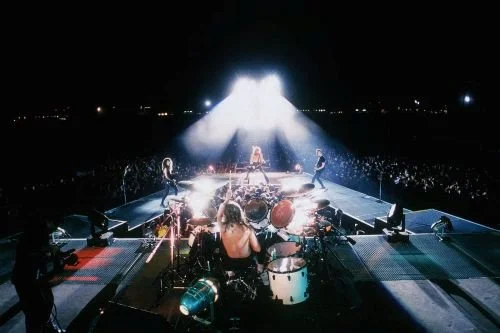
IN THIS PHOTO: Metallica (L-R) Kirk Hammett, Lars Ulrich (back to camera) James Hetfield and Jason Newsted on the Nowhere Else to Roam tour in 1993/PHOTO CREDIT: Ross Halfin
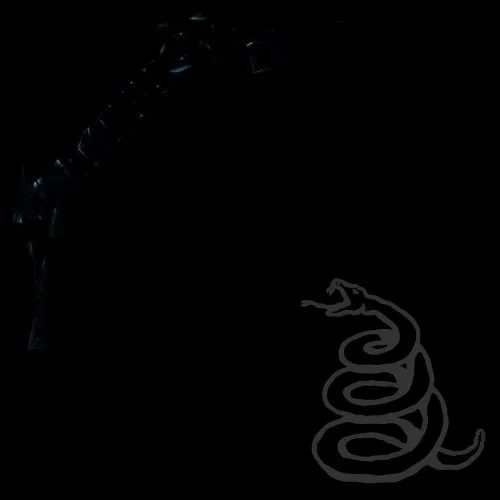
the most-streamed albums of the 1990s. Metallica is the incredible eponymous album from the American band (James Hetfield – guitars, vocals; Lars Ulrich – drums, percussion on The God That Failed and My Friend of Misery; Kirk Hammett – lead guitar; Jason Newsted – bass). Also known as The Black Album, it was released on 12th August, 1991. I want to mark thirty-five years of a Metal classic. Reaching number one in the U.S. (and other nations), Metallica was a change in the band's style. From the Thrash Metal sound of their previous four albums to a slower, heavier, and more refined feel. Three years after ...And Justice for All, they provided something that was a bit of a change for fans. However, the popularity of this monster album meant that it was accepted and embraced. I do want to start out with Billboard and their feature from 2016. Marking twenty-five years of Metallica, it is an album that transformed Metal and brought it to the masses. In the process, it “cemented Metallica as one of the biggest and most-legendary bands in history”:
“Metallica changed the face of heavy metal when they released their self-titled fifth album, also known as The Black Album, on Aug. 12, 1991. The monumental effort saw the band step in a more melodic direction than their previous thrash metal sound and helped garner a mainstream following. It is by far their biggest album, shifting over 16 million copies in the U.S., making it the best-selling album of the Nielsen SoundScan era (1991 to present).
It spawned the singles “Enter Sandman,” “The Unforgiven,” “Wherever I May Roam” and the first Metalliballad, “Nothing Else Matters.” It also features some incredible deep cuts like “The God That Failed” and “My Friend of Misery.” The album won the Grammy for Best Metal Performance in 1992, beating the likes of Anthrax, Megadeth, Motorhead and Soundgarden.
In the documentary A Year and a Half in the Life of Metallica, Bassist Jason Newsted explained, “On this album we really went after a rhythm section, an actual rhythm section like it’s supposed to be… like everyone else has known about for a long time and we are just now realizing it or something.”
Bob Rock, who was in high demand after helming Motley Crue’s chart topping Dr. Feelgood, produced the album and gave Metallica a slick, polished rock sound. Rock focused heavily on James Hetfield’s vocals and wanted to capture a true rhythm section, which was notably absent on Metallica’s previous album 1988’s …And Justice For All. Many of the songs were based on vocal lines, a first for the band. Hetfield explained, “We wanted to concentrate more on the vocals. We never really took the time to do that with any of the vocal stuff.” He added, “The vocals really had to take over in a lot of songs.”
The Black Album is a landmark effort that brought heavy metal to the masses and cemented Metallica as one of the biggest and most-legendary bands in history. In 1991 the group went from a cult band to global superstars. While some of their hardcore and longtime fans believe the band “sold out” on the effort, drummer Lars Ulrich brashly refuted the claim saying, “Yeah, we sold out arenas.”
In the end, Rock pushed the band out of their comfort zone and helped create the historic and inspired performances captured on the album.
“Enter Sandman”: The album kicks off with what turned out to be its huge crossover hit. The video was played frequently on MTV and the song received a ton of radio airplay — a big moment for a band that rarely, if ever, hit the airwaves. The platinum-selling single brought an entirely new mainstream audience and suddenly wearing Metallica gear didn’t come with a negative stereotype. The track introduced fans to the band’s new sound spotlighted the rhythm section featuring Ulrich’s famous backbeat drums, Newsted’s distinctly audible bass frequencies, Hetfield’s improved and powerful vocals, as well as Kirk Hammett’s notable wah-infused guitar solo.
“The Unforgiven”: The album’s second single reversed the tide of such previous spotlight songs such as “Fade to Black” and “Welcome Home (Sanitarium)” by swapping the distorted verse with a clean and melodic sound, while interchanging the heavy chorus for a bright and dulcet one. Hammett struggled in the studio to lay down the guitar solo on the song, but in the end laid down powerful and memorable work. He later said, “It’s pretty much the type of guitar solo I’ve been trying to do for the past five or six years. I’m really proud of that.”
“Nothing Else Matters”: The first true Metalliballad shows off Hetfield’s songwriting and improved vocals. Rock brought in a keyboardist and a string section to layer textures onto the track. The music video features the band recording in the studio and is highlighted by Hetfield’s melodic guitar solo, which surprised many fans who were more accustomed to Hammett always taking the lead”.
In 2015, Ultimate Classic Rock wrote how Metallica turned them into superstars. They call it The Black Album but, like The Beatles/The White Album, the eponymous is correct, so I am going to refer to it as such. Metallica still sounds phenomenal thirty-five years later:
“We wanted to create a different record and offer something new to our audience. I hate it when bands stop taking chances," added Hammett. "A lot of bands put out the same record three or four times, and we didn't want to fall into that rut."
"They had broken through to one level, but they still weren’t on mainstream radio," Rock told Music Radar. "When they came to me, they were ready to make that leap to the big, big leagues. A lot of people think that I changed the band. I didn’t. In their heads, they were already changed when I met them."
Those changes caught up with fans on Aug. 12, 1991, when the new self-titled effort — informally referred to as the Black Album due to its nearly featureless black cover — arrived in stores. Even though the lead-off single, "Enter Sandman," proved Metallica had lost none of their trademark snarling swagger, the band's sound had definitely changed in some very noticeable ways. There was no arguing with the muscle and polished heft Rock brought to the group's historically rather muddy sonics, and the songs boasted plenty of the live feel that he and the band members had painstakingly assembled over a grueling period of months. But they were also shorter, leaner and more varied — and not everyone appreciated the evolution.
"I've run into fans who think the album's crap," grumbled Hammett in a 1991 interview with Rolling Stone. "Friends of mine who are really hardcore fans have said, 'Well, the album's not as heavy. You guys aren't as heavy as you used to be.' I go, 'Man, you're trying to tell me 'Sad But True' isn't heavy? 'Holier Than Thou' isn't heavy? How do you define heavy?'"
"Kids come up and say, 'How come you don't do Kill 'Em All again?'" added Hetfield. "And I go, 'Yeah, I like that album too. But there's more to our music than that.' We can still do it live, and when we play it, we mean it, man. But we have those songs in the set already. And they'll be there for the life of the band. But sitting there and worrying about whether people are going to like the album, therefore we have to write a certain kind of song – you just end up writing for someone else. Everyone's different. If everyone was the same, it would be boring as shit."
If the new songs didn't thrash as hard as their predecessors, the new album was heavier in at least one respect: Rock's production took a much more dynamic approach to the music, allowing the instruments more room to breathe — particularly Jason Newsted's bass, which had been all but squeezed out of the mix during their previous effort, 1988's ...And Justice for All.
The fatter bottom end fans heard on the Black Album was coupled with a change in the way drummer Lars Ulrich approached his own contributions to the tracks.
"I noticed that Lars played to James’s guitar, much like the way that Keith Moon played to Pete Townshend. That’s fine for some bands, but not every one," Rock explained. "Lars wanted Metallica to groove more. AC/DC’s Back in Black was a big reference point as a rock record that grooved. I told him that in order to get that feel, he had to be the focal point musically. So on certain songs, the band played to Lars. They followed him. It made a real difference."
Newsted's bass wasn't the only new sound that filtered into the mix — Rock also encouraged the group to add an assortment of other sonic touches, including sitar and cello, and allowed them free rein to experiment with more melodic material like the eventual hit "Nothing Else Matters," which found Hetfield tapping into a whole new side of his singing skills.
"It's absolutely crazy, that was the song that I thought was least Metallica, least likely to ever played by us, the last song anyone would really want to hear. It was a song for myself in my room on tour when I was bumming out about being away from home," Hetfield later told the Village Voice. "I'm grateful that the guys forced me to take it out of my tape player and make it Metallica”.
Prior to getting to a review of Metallica, The Independent marked thirty years of a classic. This titanic eponymous album turned “Metallica from niche concern to mainstream titans in the early Nineties”. I still think that it is inspiring artists to this day. One of the greatest albums ever released:
“Metallica punctured the charts because they also understood song construction. “They are great songwriters, the songs have great melodies and progressions,” agrees Luciano. “When you take those kinds of good bones and add a different mood to it, you still can’t escape the best part – the songwriting.”
The other reason The Black Album went interstellar was because Metallica’s record label, knowing they had a hit on their hands, put all their resources behind it.
“They were marketed extremely well,” says Stenning. “The promotion for the album – free, large-scale listening sessions, for instance – was unprecedented. And then their tour with Guns N’ Roses [across the US in summer 1992] really took them to a new audience and made it apparent that the two worlds – hard rock and metal – were now somehow acceptable to be merged together, whereas before that had never happened and was totally unacceptable… They became the ‘universal’ metal band.”
There was something ironic about Guns ’N Roses and Metallica touring together. While Nirvana’s Nevermind, released on 24 September 1991, is credited with killing off the Eighties “hair-metal” scene that spawned Axl Rose and Slash’s LA rockers, the truth is Metallica had just as big a hand in bringing about its extinction. They may even have helped clear the path for grunge.
“The music journalist narrative has long been that Nirvana finished off hair metal,” says Albert Mudrian, editor of American hard rock magazine Decibel. “And while they may have fired the kill shot, it was Metallica’s Black Album that had already mortally wounded that genre dinosaur. The truth is The Black Album had sold a couple million copies before Nevermind really took off, so an entire generation had a mainstream blueprint for heavier songs with pop sensibilities.
If catchier and better marketed than its predecessors, The Black Album also saw Metallica lower their guards emotionally. This was a first for a group that had traditionally concealed their vulnerable side within squalls of braggadocio.
A case in point is that blistering elegy and central megahit, “Nothing Else Matters”. Written by Hetfield in the middle of a long tour, when he was missing home, it’s raw, earnest and packs a softer punch. Metallica had always hidden behind a theatrical bombast. Now Hetfield was baring his soul on lyrics such as “Never opened myself this way/Life is ours, we live it our way”. He was addressing then-girlfriend, Kristen Martinez, from whom he would separate in 1992.
“‘Nothing Else Matters’ … was a huge turning point,” Hetfield told Playboy. “It was sensitive.”
“James always wants to be perceived as this guy who is very confident and strong,” Hammett had added. “And for him to write lyrics like that – showing a sensitive side – took a lot of balls.”
“Nothing Else Matters” has weathered the years because it comes from a place of simplicity and humility, Dermot Kennedy believes. “[It has] lyrics and chord progressions that can be completely stripped back and still resonate with people, no matter how heavy it is. A song starts with just a single idea, whether that’s musical or lyrical. The fact that it was so easy to strip this song back is testament to the strength of Metallica’s lyrics and musical foundations.”
Metallica’s story didn’t end with The Black Album. Through subsequent years there would be highs and lows – to say nothing of the unintentional comedy of their 2004 rockumentary Some Kind Of Monster, a behind-the-scenes fever dream which challenged This Is Spinal Tap for absurdity. And yet the 1991 LP was their commercial peak – the project that changed everything for them.
The fact that 30 years later artists such as Dermot Kennedy and Miley Cyrus (who inevitably covers “Nothing Else Matters”) are lining up to pay homage speaks to its enduring power and to the fact this was a headbanger opus that smashed through the “metal ceiling” and carried the group shoulder high to the heart of the pop charts. With a rumble and a roar, The Black Album ushered Metallica into the technicolour world of mainstream fame. As Gessle says simply: “It sounds great – and the timing was perfect”.
I am finishing off with a review from Pitchfork. Metallica changed the band’s course and raised them to new heights. In their 2017 review, Pitchfork highlight how (the album’s) “muscular sound would permanently alter the course of heavy music”:
“Metallica’s twelve tracks may be sorted into three categories: angsty arena anthems, furrowed-brow ballads, and tamer, hybridized takes on Metallica’s famous pit-starters. Aside from “Holier Than Thou” and “Through the Never,” which offer red meat for the black-leathered fans of old, the album skews simplistic, melodically and lyrically. Whereas Ride the Lightning and ...And Justice for All prioritized instrumental stunts over melody, Metallica bets it all on Hetfield, a paradigm shift made all the more noticeable by his bandmates’ restraint. Instead of firing off fills, Ulrich keeps it simple, locked in 4/4 throughout (“It’s a little bit like building a house,” he crows in A Year and a Half in the Life of Metallica, chest puffed, shit-eating grin on his face, “If you have a good foundation, then…”) Newsted mostly swears by the root notes, but gives millions of would-be bassists their first homework assignment with “My Friend of Misery”’s percolating refrain. While he’s given plenty of room to show off his solos (”Don’t Tread on Me” and “Of Wolf and Man” are particularly fiendish), Hammett’s riffs skew tamer, more deliberate, and subservient to the Hetfield’s pained yowls.
Hetfield pivots between devastating croons and razor-throated yells like a seasoned “American Idol” contestant. “I’m your dream/I’m your eyes/I’m your pain” he sneers on “Sad But True,” a song Rock labelled the heavy metal “Kashmir.” This technique inevitably draws the listener’s focus to Hetfield’s lyrics, which, while perfectly suited for stadium sing-a-longs, aren’t exactly Pulitzer material. You can see the low-hanging rhymes coming from a mile away—“real” and “feel,” “be” and “see,” “you” and “do.” More damningly, it saps his revealing personal narratives of their latent emotional heft.
“The God That Failed” is a bittersweet ode to Hetfield’s mother, a Christian Scientist who succumbed to cancer because she refused to treat it through any means other than faith. And yet, for every devastating couplet (”The healing hand held back the deepened nail/Follow the God that failed”), there’s two chunks of clunky poetry not far behind (”Find your peace/Find your say/Find the smooth road on your way”; “Pride you took/Pride you feel/Pride that you felt when you’d kneel.”)
The simplicity proves far more successful on “Nothing Else Matters,” an acoustic ballad which, however ham-fisted, stands as one of the album’s most revolutionary moments. Here, smack dab in the center of metal’s hyper-masculine universe, we have one of the genre’s most fearsome luminaries singing the praises not of Satan, sex, or the good sweet leaf, but rather a woman. Given the overarching cultural context, Hetfield’s insistence that he’s “Never cared for what they say/Never cared for games they play/Never cared for what they do/Never cared for what they know” scans as a middle finger to all the meatheads who think intimacy and metal are mutually exclusive. His solo acts as the band’s closing argument, undeniable proof that vulnerability could both rock and sell.
August 12, 1991: At midnight, the coup officially begins. The metalheads don their old concert tees and rush, rapt and stoned, to their nearest record store, where they await Metallica’s fifth album coming in droves. The makers of A Year and a Half in the Life of Metallica are on hand to chronicle one such release party, and ask the faithful for their thoughts on this monumental album, and what they think it all means. “Reality, man…some shit you just can’t change.” responds one particularly impassioned mullet-man, shouting over his equally-stoked friend. “Listening to the words, it talks about people who, I don’t know, either can’t forgive, or the people that die unforgiven by others,” a soft-spoken young woman posits, reverent, as if contemplating a Rothko.
Just like Metallica’s lyrics, the band’s fans’ insights scan as invariably vague, slightly naive, and unflinchingly, impossibly earnest. It’s only appropriate that these remarks comprise A Year and a Half in the Life of Metallica’s opening scene: They’re candids of the Black Album’s power as a tabula rasa for a young, embittered generation, saddled with their parents’ wars and religious scorn. When the hesher in the “Metal Up Your Ass” t-shirt proclaims, “My parents don’t think anything about Metallica, they just ignore it,” he’s really gesturing to a generational victory: Mom and Dad with their heads in the sand, while the kids raise hell and make history.
Heavy metal had officially set up shop on the main stage. As if to prove their point, they hit the road in 1992 with Guns N’ Roses (the only band who rivaled their power at the time; their contemporaneously released albums Use Your Illusion I and II moved 14 million units altogether) for a massive, effects-heavy arena outing. During the band’s run-through of “Fade to Black” at the August 8 stop in Montreal, Hetfield lost track of the band’s complicated pyrotechnics setup and found himself standing atop an erupting grate, leaving the frontman with second- and third-degree burns and forcing his band to the sidelines for several days.
The real burn, though, was still five years off. In May 1996, MTV screened Samuel Bayer’s surreal, melodramatic visual for “Until It Sleeps”—the moody, ur-Godsmack lead single from the Black Album’s successor Load, which removed thrash from the musical equation even further. Five seconds in, we spot Ulrich, dressed like one of the cock-rockers he loved to loathe: thick black eyeliner, shorn head, silver earrings. He drags his hands down his face, his lips curling in a cartoonish gesture of exasperation as if struggling to understand how he ended up in the get-up to begin with. Elsewhere on Load, Hetfield sings in a voice that would usher in the sound of post-grunge and butt rock for the next decade: “Careful what you wish you may regret it/Careful what you wish you just might get it.”
The words drip with meaning now, knowing Metallica’s long road through the turn of the 21st century would be filled with charges of “hair cuts!” and “sell outs!” as well as their own much-derided suit against Napster. There was Newsted’s famous quip from their episode of VH1’s “Behind The Music:” “Yes, we sell out: every seat in the house, every time we play, anywhere we play,” spoken just a few years before he departed the band in early 2001; his acknowledgements of Metallica’s rise in the public sphere and identity crises embedded therein, however lighthearted, nonetheless presaged the physical and existential temper tantrums captured on 2004’s tell-all documentary Some Kind of Monster. Metallica, however, remains the final bastion of focus: a hubristic request for grace masquerading as a show of force, the prophetic turning point for the world’s biggest ever metal band”.
Turning thirty-five on 12th August, I did want to spend some time with the phenomenal Metallica. Whether you see it as The Black Album instead, nobody can deny its importance and legacy. There are other features like this that are interesting to read. In terms of its accolades, Wikipedia detail its success: “In 2000, it was voted number 88 in Colin Larkin's All Time Top 1000 Albums. In 2012, Rolling Stone ranked Metallica number 255 on "The 500 Greatest Albums of All Time", and then number 235 in a 2020 revised edition of the list. It was also ranked 25th on the magazine's "100 Greatest Metal Albums of All Time" (2017). Spin ranked it number 52 on the "90 Greatest Albums of the '90s" (1999), with its entry reading: "this record's diamond-tipped tuneage stripped the band's melancholy guitar excess down to melodic, radio-ready bullets and ballads”. On 12th August, we salute and celebrate…
A Metal classic.